Feeds:
Posts
Comments

The third episode of Upstairs Downstairs will be shown this Sunday. Will you tune in?  (Watch all three episodes from April 25 through May 24 at this link.) Better yet, the BBC will make the DVD available for sale Tuesday, April 26th.

BBC’s Upstairs Downstairs DVD is available for purchase!

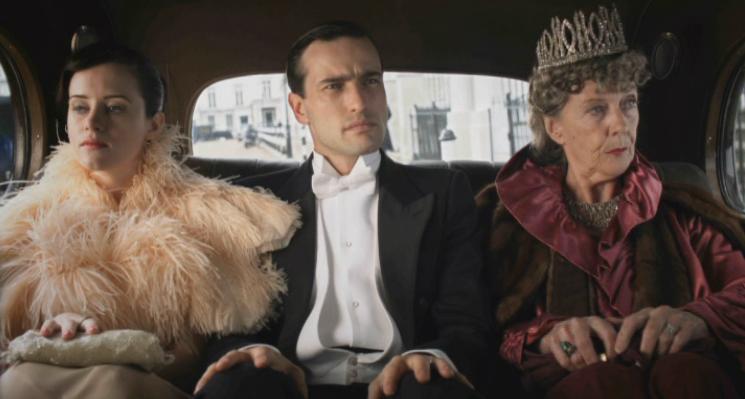
Upstairs Downstairs has been brought back with a fresh new cast. It is 1936 and six years since parlormaid Rose (Jean Marsh) left 165 Eaton Place. Fate brings her back to the house and its new owners, Sir Hallam Holland (Ed Stoppard), his wife Lady Agnes (Keeley Hawes), and his mother, Lady Maud Holland (Eileen Atkins). Rose recruits a new “downstairs” family to help run the elegance and finery of the “upstairs” world. Set against the historical backdrop of a pre-World War II Britain with a new King on the throne, with Fascism on the rise on the continent, and with sexual, social and political tensions at 165 Eaton Place, this new series provides an evocative take on the master-servant relationship.

In honor of the U.S Premiere on PBS’s Masterpiece Classic, the BBC is giving away a free DVD just two days following the conclusion of the third episode. This DVD includes the making-of featurette Upstairs Downstairs – Behind Closed Doors. (SRP: $34.98 ($43.98 in Canada)

CONTEST is CLOSED. The winner is Felicia!!: For an opportunity to win the DVD, all you need to do is leave a comment stating what you liked best about this 2010 series! The drawing (by random number) will be held on Tuesday, April 26th at 11:59 PM, EST.

Read this blog’s reviews of UpDown in these posts:

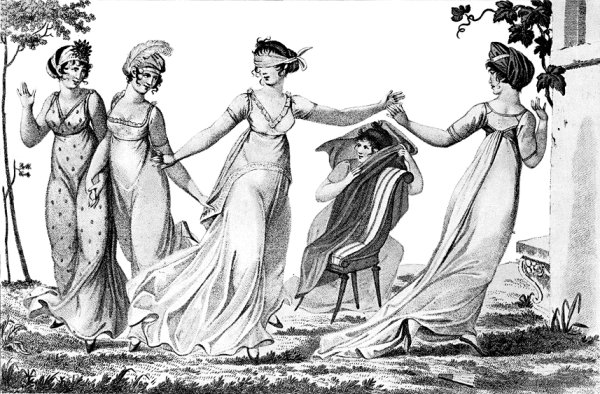
Gentle readers, I will be on semi-hiatus for the next few weeks, as my personal and work schedules do not permit me to concentrate as much on my blogs as I would like. For the time being I will feature past posts or link to others. When I looked at these images, I was reminded of the old-fashioned games of my childhood. Do children, I wonder, still play blind man’s bluff? Curious minds want to know.

Blind Man's Bluff

The above plate came from Healthful Sports for Young Ladies by Mlle St. Sernin, a French governess, and delightfully illustrated by Jean Demosthene Dugourc (1749-1825). In blind man’s bluff, the blindfolded person must first find someone and then guess her identity. Here is a charming description from Mlle St. Sernin:

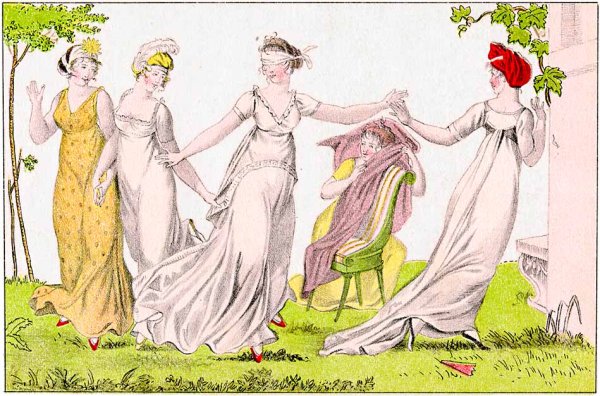
Le Bon Genre documented the social trends and leisure activities of Parisians. Below are two images from that magazine.

Black and white plate of Blind Mans Bluff, Le Bon Genre, 1803

Magazines with color plates cost more. Blind Mans Bluff, Le Bon Genre, 1803

Oh, my, Upstairs Downstairs turned down a darker road in the second episode, which can be seen online this week until May 24th.

The arrival of parlor maid, Rachel Perlmutter, changes the mood of the show from light-hearted to somber. She is a Jewish refugee from Germany who is forced to work as a maid, a career that is dangerous to her asthmatic condition.

Rachel (Helen Bradbury) suffers from asthma, which strikes her at the most unexpected moments.

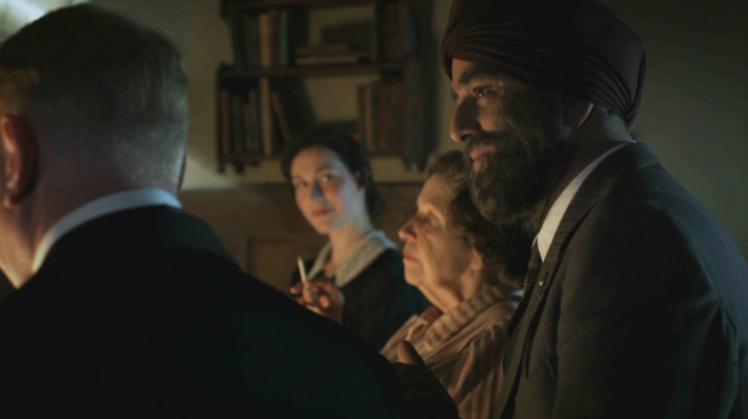
Race and prejudice are the very obvious subtexts of this episode, in which Mr. Amanjit, who at first lived apart from the staff, is slowly accepted downstairs.

This scene, in which Mr. Amanjit was invited to listen to music on the radio, was most gratifying

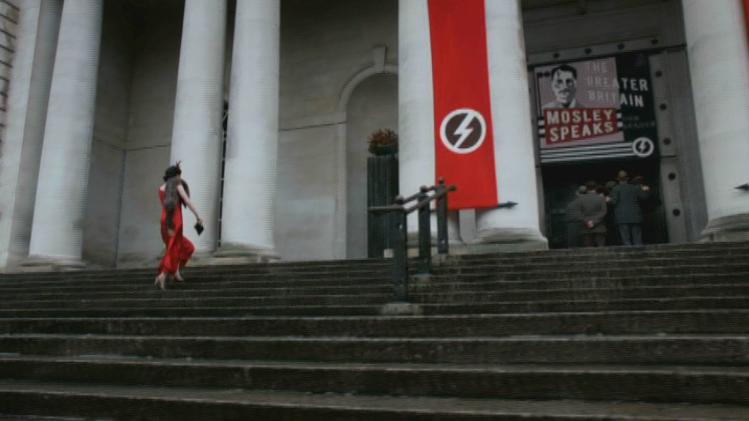
Harry Spargo, the chauffeur, has developed a political interest that is typical of many people in the 1930’s, but his leanings are towards the far right and with the black shirts of Oswald Mosley’s fascist party.

Harrys social politics will place him at odds with the family and lead to tragedy belowstairs

A bored Ladie Percie flirts with danger as she pursues the chauffeur and his interests.

Bored and rebellious are not a good combination in the mind of a none too bright woman. Lady Percie races up the stairs to join an unsuspecting Harry at a far right rally.

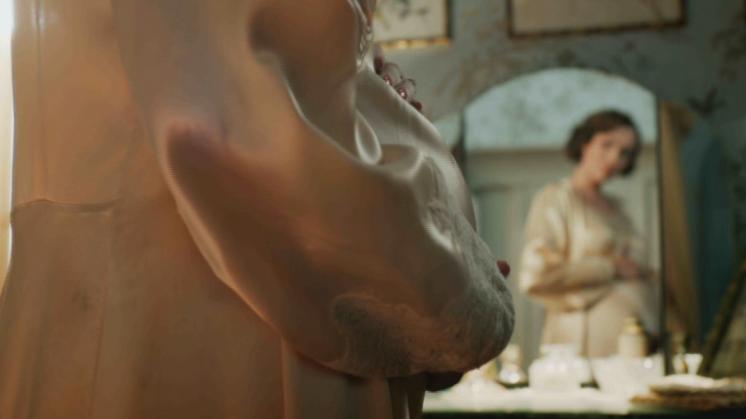
And Agnes, the mistress, is pregnant.

A montage shows the stages of Agness pregnancy in swift succession

While I liked that Upstairs Downstairs embraced the many social upheavals of pre-war Britain, the one hour format is too rushed for these complex plot developments. I know the original series was based on one-hour shows, but back then each episode centered on one plot line that was often developed over several episodes. There were too many holes in the various plots that have been introduced and this series seems rushed, giving almost no time to character development. I hope that the pace slows down in Season 2 next year. Meanwhile, I can’t wait to see what develops in Episode 3, for at this point the twists and turns have intrigued me.

I must admit to being disappointed with the costumes, which did not appeal to me at all.

Other Upstairs Downstairs posts on this blog:

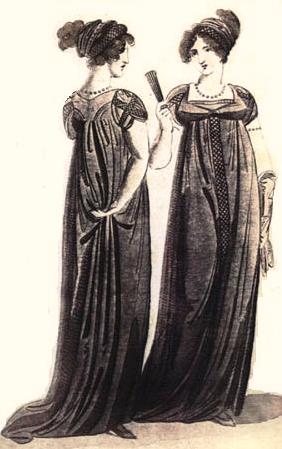
Fashionable mourning dresses, Ladies Museum, 1805

According to Jane Austen chronicler and scholar, David Nokes, when Martha Lloyd’s mother died on April 16, 1805, Jane Austen showed few signs of grief or emotion over that woman’s earthly departure. Instead, Jane wrote a jaunty verse to an uncivil (and imaginary) dressmaker. I surmise that these verses were meant more to cheer Martha up than to bring Martha’s mood down by reminding her of her loss. Mrs Austen, who was known for her droll verses, wrote a mythical reply by the dressmaker. At this time the Austen women were still reeling from Rev. Austen’s death in January and their own change in financial circumstances, having moved to more modest lodgings and becoming accustomed to a drastically reduced style of life. They would soon invite Martha to live with them in Bath. (Martha would remain with the Austen women through their move to Southampton in 1809.) After Jane’s death in 1817, Martha joined Cassandra in Chawton to help look after Mrs. Austen.

The poem that Jane wrote gives us a glimpse into how mourning clothes were made to order quickly. In this for-instance, the dressmaker, Miss Green, was slow to respond.

Lines sent to an uncivil Dress maker

Miss Lloyd has now sent to Miss Green,
As, on opening the box, may be seen,
Some yards of a Black Ploughman’s Gauze,
To be made up directly, because
Miss Lloyd must in mourning appear –
For the death of a Relative dear –
Miss Lloyd must expect to receive
This license to mourn & to grieve,
Complete, er’e the end of the week –
It is better to write than to speak – Jane Austen

Mrs. Austen’s reply as Miss Green

I’ve often made clothes
For those who write prose,
But ’tis the first time
I’ve had orders in rhyme – .
Depend on’t, fair Maid,
You shall be obeyed;
Your garment of black
Shall sit close to your back,
And in every part
I’ll exert all my art;
It shall be the neatest,
And eke the completest
That ever was seen –
Or my name is not Green! – Mrs. Cassandra Austen

Gentle Readers, Laurel Anne from Austenprose and I were chatting the other day about this, that, and the other, for we are both a bit Jane Austen nutty (if you haven’t noticed.) As you continue reading, you will need to know only one thing:  we are just a wee bit longer in the tooth than Jane’s young heroines:

LA: Vic and I were chatting on the phone today. Over the course of our three plus year Austen-inspired friendship we have mostly emailed, so this was a treat. She has the most infectious laugh which made me laugh too. Of course we were talking about our favorite author and she remarked that Austen excelled at humor and the amazing secondary characters she developed. Somehow it just popped out and I boldly asked her what Jane Austen character she most identified with. Without hesitation she replied, Lady Russell from Persuasion. “Lady Russell?” I replied in surprise! “Well, yes.”
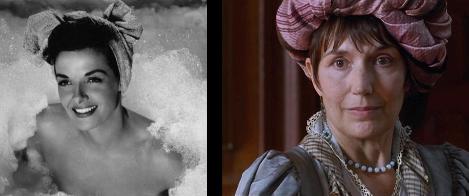
Jane Rus.., er, Mrs. Russell

She then revealed that she is often wrong about the advice she gives people. At work she gathers the young-uns around her and freely offers opinions, whether they are solicited or not. When she gives wrong counsel – which she admits is more often than not – she torpedos herself in a most spectacular fashion. “The error of my ways does not go unnoticed by this unforgiving crowd. Unlike Lady Russell, I will own up to a misteak, er, mistake or two, and apologize for having interfered, but I hold the line at groveling.”

Another reason why she identifies with this character is her independence. Lady Russell is a widow with a healthy income and she has no intention of remarrying and being subjugated by a man. “I am a divorced woman who has discovered the joys of living singly on my own terms and by my own schedule. Ah, what total, selfish bliss!”

Vic further admitted that at a party, or when she lets her hair loose, she starts to resemble Mrs. Jennings. You know the type: a bit vulgar, out for a good time, giggling at precisely the wrong moments, and making those with a more composed nature feel uncomfortable with crass jokes and loud language. “Like Mrs. Jennings, I have a good heart. But I can be out there and in your face too. I might seem unseemly to a quieter person like Elinor, and be totally disliked by the likes of a Marianne, but my friends and family get me, and that’s what counts.”

Oh Vic! You are such a card. Lady Russell and Mrs. Jennings? She then turned the tables on me. “Now, who do you identify with in Jane’s novels? Are you like me, a bossy and interfering carouser? Or are your a bit more sedate and ladylike?”

Harriet Smith (Tony Collette) patiently poses for Emma

Vic: “Sedate. A total Harriet Smith,” LA replied. Many years ago a dear Janeite friend tagged her as a Harriet to her Emma. “It seemed appropriate since I was often asking for advice and was very mailable to change.” In her view, Harriet was a bit of a ditz and gullible which she has been accused of too. The thing she liked about being a Harriet is that Austen gave her such a great ending. She is resilient, and after being tossed about in love no less than three times in a year, Harriet gets the man she wanted in the first place and proves Emma, with her self-important airs, was totally clueless about the human heart. “I like having the last laugh, and being right.” ;-)
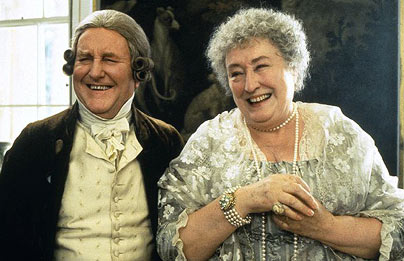
Sir John Middleton (Robert Hardy) and Mrs. Jennings (Elizabeth Spriggs)

Lately LA thinks she has evolved into Sir John Middleton from Sense and Sensibility. He was the Dashwood’s cousin and landlord of Barton Cottage. He is very gracious and likes to pop in and make sure his tenants are comfortable and entertained. He is a bit of a bore and talks too much about things that are not of interest to his young companions, but he likes dogs, has a good heart and loves to laugh. “As an enthusiastic bookseller, I like to inform customers of their choices and make suggestions. I am also a bit of an organizer and enjoy planning events on my blog, and orchestrating the 23 authors in my anthology. It is like herding cats, but I like being the boss of my own world!”

One man’s ways may be as good as another’s, but we all like our own best. Persuasion, Ch 13

Now our question. Which Jane Austen character do you, estimable viewer, most identify with, or which character are you afraid of becoming? Feel free to leave your comments!