Feeds:
Posts
Comments

by Brenda S. Cox

“Madam” Anne Lefroy

Anne Lefroy, a dear friend of young Jane Austen, lived about two and a half miles north of Steventon, in the village of Ashe. Wealthy Benjamin Langlois was patron of the parish church, and he gave the living of Ashe to his nephew, Reverend Isaac Peter George Lefroy (called George) in 1783, when Jane was eight years old. At that time the church was called St. Andrew’s, and Ashe was spelled Ash.

Church of the Holy Trinity and St. Andrew at Ashe. While there has been a church on this site since Norman times, major rebuilding was done in 1878-9 by the Victorian church architect, George Gilbert Scott. So this is not the same building Jane Austen knew. The belfry houses one bell and occasional bats.

Rev. Lefroy’s wife was Anne Lefroy, cultured, educated, and hospitable. She wrote poetry, and had two witty poems published before her marriage. Because of her sophistication and hospitality, in the neighbourhood she was “known affectionately and respectfully” as Madam Lefroy. Mrs. Lefroy was 25 years older than Jane. So how did they become friends?  According to information sheets at the church,

“Anne Lefroy and Jane Austen, despite their age difference, formed a close friendship that started when the Lefroys invited the 11-year-old Jane to play with their 7-year-old daughter. Due to a mutual love of literature, Anne and Jane are believed to have had long literary discussions. Jane was allowed access to the extensive library of the Ashe rectory. Jane may also have shared her writing with Anne who, some have suggested, acted as a surrogate parent. This must have acted as an important source of support for Jane in her early years of writing.”

This is speculative. But Mrs. Lefroy is often mentioned in Jane Austen’s letters. Jane frequently visited the Lefroys’ parsonage and attended dances and parties there and at the local squire’s house, Ashe Park.
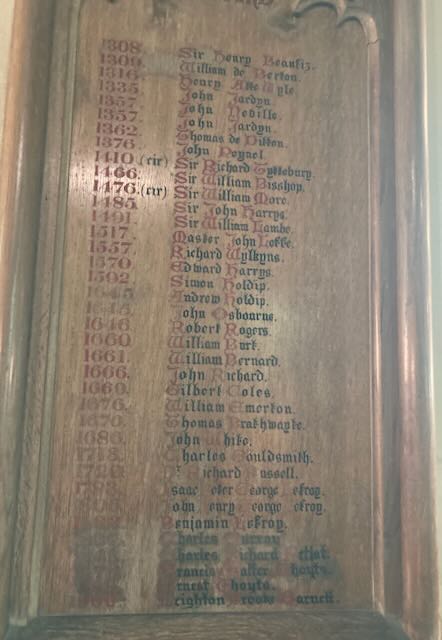
Rectors of Holy Trinity, Ashe. Rev. George Lefroy, wife of Jane’s friend Anne Lefroy, was rector from 1783 to 1806. His son John Henry followed him as rector, then another son, Benjamin, who married Jane Austen’s niece Anna Austen.

Tom Lefroy

Famously, Jane danced and flirted with George Lefroy’s nephew from Ireland, Tom Lefroy, when he came for a visit in 1796. She wrote to Cassandra, “Imagine to yourself everything most profligate and shocking in the way of dancing and sitting down together” (Jan. 9, 1796). A week later, on January 15, she wrote, “At length the Day is come on which I am to flirt my last with Tom Lefroy. . . . My tears flow as I write, at the melancholy idea.” She immediately starts another topic and we don’t know if she was joking or serious. She may have hoped to marry Tom, but a proposal never came.

It’s been speculated that Rev. and Mrs. Lefroy sent him away, since he needed to marry someone with more money than the Austens had. Or Tom himself may have decided to leave, and the Lefroys were disappointed in him for flirting and not following through. Jane said Tom was “laughed at” at Ashe because of her, so it might have all been teasing, not serious. In any case, Jane does not seem to have held the outcome against Tom or against Mrs. Lefroy. After all, as she wrote in Pride and Prejudice, “Handsome young men must have something to live on as well as the plain.”

(Tom Lefroy, by the way, pursued a legal career and became a chief justice of Ireland. His son Jeffrey became a churchman, dean of Dromore Cathedral in Ireland, and Tom’s grandson George Alfred Lefroy became an Anglican clergyman and a missionary to India, then Bishop of Lahore and Calcutta. He is remembered for opposing western racism toward Indians.)

Mrs. Lefroy apparently tried to set Jane up later with another friend, the Reverend Samual Blackall, who Jane later called “a piece of . . . noisy perfection . . . which I always recollect with regard.” But nothing came of that, either.

This information sheet at Holy Trinity, Ashe, shows the former rectory, home of Mrs. Anne Lefroy, as it is today, inside and out. Double doors between the drawing room and dining room could be thrown open for parties and dances, including those Jane Austen attended. The brick façade was built by Rev. George Lefroy, who “mortgaged the living,” presumably taking out a loan on the basis of his church income, to pay for improvements to the rectory.
Pews in the Ashe church, and a churchwarden’s stave, which was used to bar the way of congregants who misbehaved.

Jane Austen’s Poem

The strongest testimony of Jane’s attachment to Mrs. Lefroy is a poem Jane wrote to her in 1808. Four years earlier, Mrs. Lefroy had been thrown from her horse and died on Jane’s birthday, December 16.

In the poem, Jane calls Mrs. Lefroy “beloved friend,” and says the reminder of her death is a “bitter pang of torturing Memory.” She describes her:

Angelic Woman! past my power to praise
In Language meet, thy Talents, Temper, Mind.
Thy solid Worth, thy captivating Grace! –
Thou friend and ornament of Humankind! –

She says Mrs. Lefroy was unequalled, angelic, “with all her smiles benign, Her looks of eager Love, her accents sweet.” She spoke with “sense, . . . Genius, Taste, & Tenderness of soul.”

Jane also praises Mrs. Lefroy’s religious principles:

“She speaks; ’tis Eloquence–that grace of Tongue
So rare, so lovely! – Never misapplied
By her to palliate Vice, or deck a Wrong,
She speaks and reasons but on Virtue’s side.

Hers is the Energy of Soul sincere.
Her Christian Spirit, ignorant to feign,
Seeks but to comfort, heal, enlighten, chear,
Confer a pleasure, or prevent a pain. –

Can ought enhance such Goodness? – Yes, to me,
Her partial favour from my earliest years
Consummates all. – Ah! Give me yet to see
Her smile of Love. – the Vision disappears.

And Jane says she hopes to meet her again in heaven.

Mrs. Lefroy as a Clergyman’s Wife

Interestingly, Jane’s tribute is similar to Mrs. Lefroy’s obituary. One section says:

“Her religion predominated over all her excellencies, and influenced and exalted every expression and action of her life. How amiable and angelic she was in the domestic duties of daughter, wife, mother, and sister, . . . She has left a chasm in society. . . . Above all, the poor will receive this afflicting dispensation of Providence with the keenest sorrow and lamentation: she fed, she cloathed, she instructed them, with daily and never-ceasing attention; in grief she soothed them by her conversation and her kind looks; and in sickness, she comforted them by medicines and advice. . . .”

Mrs. Lefroy was very attached to her children, as we see in her letters to her son Christopher Edward. They have been published by the Jane Austen Society. Mrs. Lefroy ran a school from her home. She said teaching other children helped her to not miss her own children so much when they were away at school. She taught poor children to read and write and gave them practical skills to help them support themselves.

Like most clergy wives, she was also involved in medicating her parish as needed, but she took that a huge step further. Smallpox was a great killer in those days. When Mrs. Lefroy learned about the brand-new system of vaccination, she investigated and determined it was beneficial. Then she learned to do it herself, and vaccinated her own family and over 800 poor people, giving them protection from smallpox. The obituary concludes, “Thus she seemed like a ministering Angel, going about to dispense unmingled good in the world.”
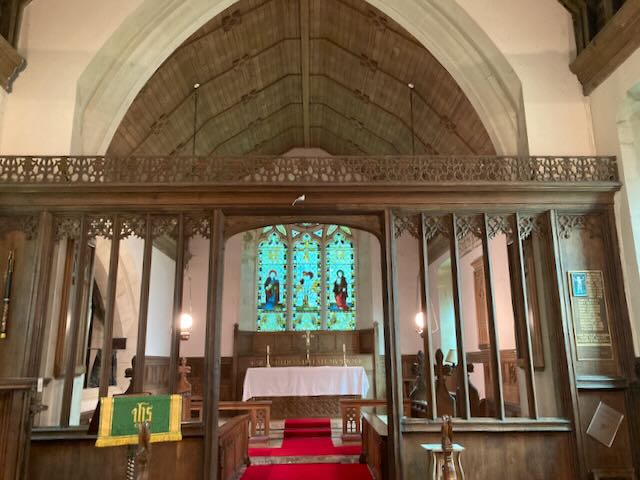
A rood screen separates the nave, where the congregation worships, from the chancel, where the altar is located. It was designed to look like the same screen that Austen would have seen in the eighteenth century church at Ashe.

Ashe Church Memorials to the Lefroy Family

While most of the Ashe church is Victorian, a number of memorials remain from Austen’s time. Her Lefroy friends are all buried there.
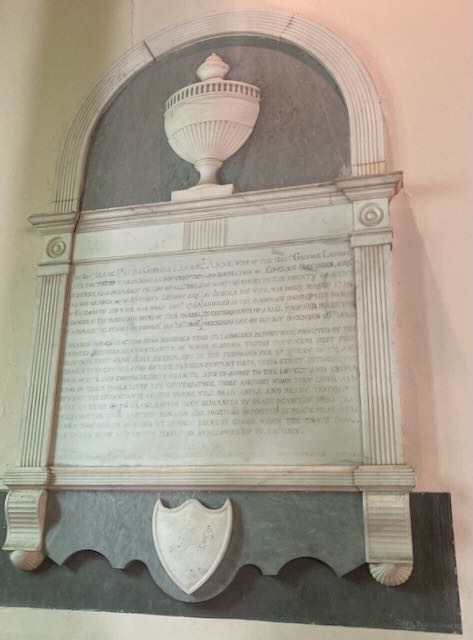
Memorial to Rev. Isaac Peter George Lefroy, “late Rector of this Parish and of Compton in Surry and formerly Fellow of All Souls College Oxford,” born Nov., 1745, died at the parsonage of a paralytic stroke Jan. 13, 1806; and Anne Lefroy, born March, 1749, and “died at the Parsonage House of this Parish in consequence of a fall from her horse the preceding day on Sunday December 16th 1804.”

The memorial to George and Anne Lefroy is very hard to read now, but a page in the church gives the text. The facts of their deaths are followed by:

“Reader: The characters here recorded need no laboured panegyric; prompted by the elevate dictates of Christianity, of whose glorious truths they are most firm believers, they were alike exemplary in the performance of every duty, and amicable in every relationship of life; to their fervent piety their strict integrity, their active and comprehensive charity, and in short to the lovely and useful tenor of their whole lives and conversations those amongst us who they lived, and especially the inhabitants of this parish, will bear ample and ready testimony, after a union of 26 years, having been separated by death scarcely more than 12 months, their earthy remains are together deposited in peace near this marble. Together be raised. We humbly trust in glory when the grave shall give up her dead, and death itself be swallowed up in Victory 

Rev. 14 v. 13

Blessed are the dead, which die in the Lord, even so saith the spirit for they rest from their labours.”
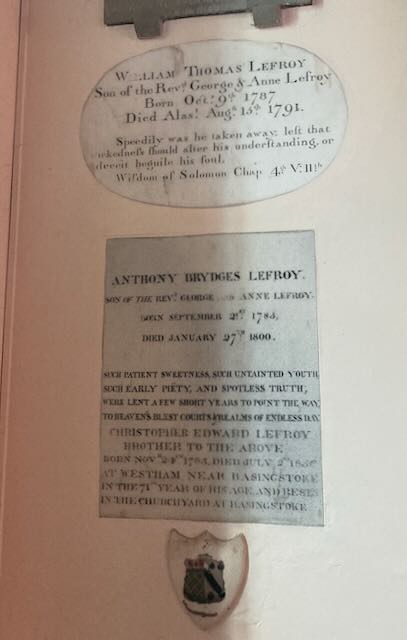
Many children died young. Memorials in the Ashe church commemorate two of the Lefroys’ children who died young, leaving their parents broken-hearted.

William Thomas Lefroy was only three years old when he “Died Alas!” as the plaque says. His brother Anthony Brydges Lefroy was fifteen when he died of an enlarged heart; they speculated it was the result of him falling from a horse two years earlier and not being bled by the doctor. Anne may have written the poem commemorating her son: “Such patient sweetness, such untainted youth, such early piety, and spotless truth; were lent a few short years to point the way; to heaven’s blessed courts, realms of endless day.” The plaque also commemorates their brother Christopher Edward, recipient of Anne’s letters, who lived to the ripe age of 71.

 Memorial in Ashe church to Rev. John Henry George Lefroy, born in 1782, who succeeded his father as rector of Ashe from 1806 until his death in 1823. (He became rector at age 24, the earliest legal age to take a living.)

The memorial to their son John Henry, the next rector of Ashe, focuses a great deal on his parents, George and Anne, who apparently taught him well: [brackets added]

“Heir to the same glorious hopes, he pursued with undeviating fidelity the example of his parents, whose characters are recorded on the adjacent marble. Distrustful alike of clamourous profession [religious ‘enthusiasm’] and philosophical liberality [Deism], he daily sought, with anxious singleness of eye [focus], amidst the tumult of religious opinions, the narrow practical way of Christianity. Imbued from his infancy with the deepest reverence for the benignant [kind, good] character and divine authority of Christ, the spirit of Christianity pervaded his whole walk and conversation; in all the relations of son, brother, husband, father, as a minister, a magistrate, a man, his constant affection, his earnest benevolence, his scrupulous integrity were equally conspicuous; utterly rejecting at the same time, all presumptuous dependence on his own merits, his humble and only confidence in death, as through life, was in the one full perfect, and sufficient sacrifice of his saviour upon the cross, for the sins of the whole world. Having, thus, maintained through life, his parents character, and died in his parents faith, here, at the early age of forty one, he reposes in his parents grave, having left a widow and eleven children to cultivate the memory of his excellence, exert themselves to follow his footsteps, and deplore their irreparable loss.”

Wow! I don’t know who wrote that, but this was an impressive family.
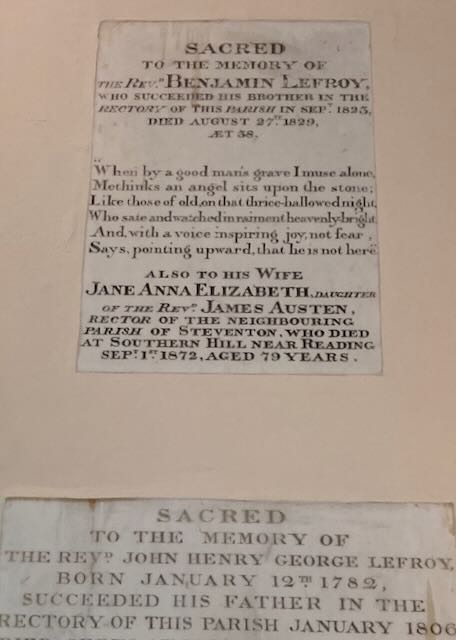
Memorial in Ashe Church to Benjamin Lefroy, the next rector, who married Jane Austen’s niece Anna Austen, also memorialized here.

John Henry’s brother Benjamin Lefroy married Jane’s beloved niece Anna Austen (daughter of Jane’s clergyman brother James). Benjamin followed John Henry as the next rector, for only four more years until he died in 1829, age 38. A poem recalling Christ’s resurrection commemorates Ben Lefroy’s life, and the life of his wife Anna, who died near Reading in 1872, age 79.

“When by a good man’s grave I muse alone,

Methinks an angel sits upon the stone; 

Like those of old on that thrice-hallowed night.

Who sate and watched in raiment heavenly bright,

And, with a voice inspiring joy, not fear,

Says, pointing upward, that he is not here.”

Holy Trinity and St. Andrew’s Church, Ashe, Today

There has been a church in Ashe since Norman times. In 1851, during the only Religious Census taken in England, the church had a seating capacity of 140. Their attendance at the morning service that Sunday was 98, and at the afternoon service, 120. 

However, like many English rural parishes today, the area is now mostly farmland with only about 100 residents in the parish. About 10-15 people attend the church’s Sunday services twice a month. Of course they can attend other churches nearby on the alternate Sundays. Ashe is in a combined benefice with Steventon, Deane, and North Waltham, and they sometimes combine events with the adjoining benefice of Overton. Special services bring in more people; Ashe may fill the church with 140 worshipers at Christmas. They occasionally host weddings; special services, including one for blessing pets; and other events.

The Robin at the Ashe church. When the church was being rebuilt in the nineteenth century, a robin would come in and eat out of the workmen’s hands. It even built a nest in one of the windows. In honor of that robin, one of the carpenters carved this wooden robin, kept in a little closed vault in one wall of the church.
The church sometimes enjoys organ music from this instrument at Ashe church, which I was told is about 150 years old.
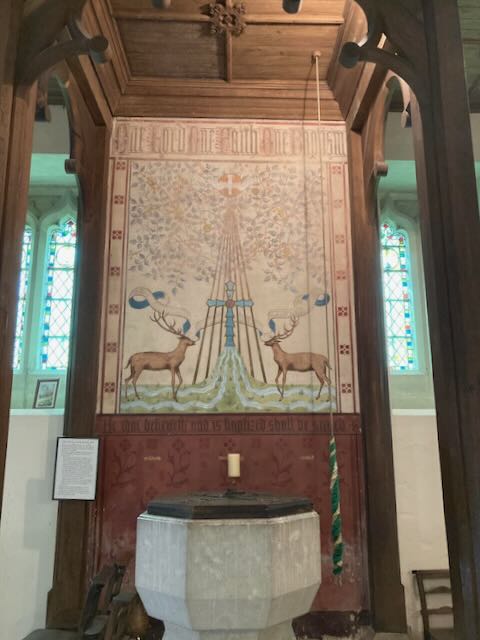
At Ashe church, Victorian stained glass windows and this 1887 painting representing baptism and the Tree of Life, add lovely touches to the walls.

Fiona Price, our guide to the church, said she and her young grandson love the peace and tranquility of the place. Holy Trinity and St. Andrew’s Church at Ashe is an interesting church to visit, near Steventon. It would have been about an hour’s walk away for Jane Austen.

All images in this post ©Brenda S. Cox, 2024.

Brenda S. Cox is the author of Fashionable Goodness: Christianity in Jane Austen’s England. She also blogs at Faith, Science, Joy, and Jane Austen.

The obituary is quoted from a “Provincial Newspaper” in a footnote to S.E. Bridges, “Lines to the Memory of Mrs. Lefroy,” in The Poetical Register, 1805 (London: Rivington, 1807): 67–68. 

Further Resources

The Letters of Mrs. Lefroy, edited by Helen Lefroy and Gavin Turner, published by the Jane Austen Society (U.K.) This is hard to get hold of in the US, though I found it through Inter-Library Loan. I thought it gave the best insights into Mrs. Lefroy, her character, thoughts, and life. 

Jane Austen’s Inspiration: Beloved Friend Anne Lefroy, by Judith Stove, explores Anne Lefroy’s life, writings, and family connections. 

Posts on Other Austen Family Churches

Steventon

Chawton

Hamstall Ridware

Adlestrop and the Leigh Family
Stoneleigh Abbey Chapel

Great Bookham and Austen’s godfather, Rev. Samuel Cooke

Deane

Note: Inquiring readers, due to a busy schedule, I have updated this blog post from 2012 that discussed carpet cleaning. During this time of year, fresh air enters my open windows, while my furniture, windows, and carpets receive a thorough cleaning until everything looks and smells fresh. I’ve made a few changes to the original post by switching a link to a history of carpet cleaning to a safer site, as well as making minor edits.

This historical tidbit comes from a page designed by Knight and Doyle about the history of carpet cleaning. Some of the methods described were downright poisonous, such as using chloroform!

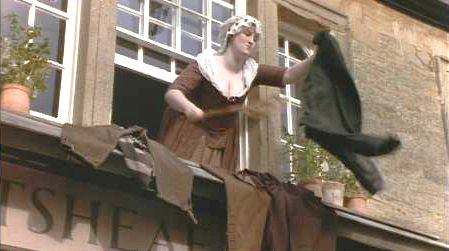
The screen capture below depicts a scene in Sense and Sensibility in which Elinor Dashwood, using a carpet beater made of cane, beats a carpet hung outside.

Sense and Sensibility 2008

Some carpets were fitted and hard to remove. In such instances, druggets, or hard-wearing canvas cloths, came to the rescue.

The Young Trio, by E.V. Rippingille, 1829. Image @Bristol City Museum & Art Gallery.

One of the most common strategies of keeping carpets clean in the early nineteenth century was to use druggets, heavy woolen goods spread under tables to protect carpet from spills. They are sometimes called crumb cloths. In addition to dining rooms they were used in other areas of heavy wear. E.V. Rippingille painted The Young Trio in 1829 showing a drugget protecting carpet in a parlor where children are at play. – Historic Carpet Cleaning Methods in the Nineteenth and Twentieth Century, Edited by John Burrows, J.R. Burrows and Company (this link is not an https.)

You can clearly see the drugget underneath the table in this classic print.

The Dinner-Locust; or Advantages of a Keen Scent’, Charles Hunt after E. F. Lambert, c.1823; hand coloured etching and aquatint. Image @The Geffrye Museum of the Home

Read more at these links:

A maid shakes a small carpet or a drugget from a second story window, as well as some trousers. If I recall, one of the actors walked through the door below her as she shook the cloth. Such scenes must have been common in Austen’s day. Sense and Sensibility, 1996.

Share this post with others!

Screen Shot 2024-04-15 at 1.38.15 PM

As we continue our month-by-month journey through Jane Austen’s novels, letters, and lifetime, we find ourselves in the lovely month of April! If you’re just jumping on the bus, you can find previous articles in my “A Year in Jane Austen’s World” series here: JanuaryFebruary, and March.

Let’s see what we find as we explore April in Jane Austen’s World! First up, our monthly view of Chawton House and Gardens, where the tulips are beginning to bloom!

Chawton House in April, Photo: @ChawtonHouse.

April in Hampshire

April is when everything starts to come back to life and bloom in Hampshire. The trees boast new leaves, the roads and lanes are lined with green, and flowers and trees are in blossom. The weather ranges from cloudy to partly cloudy to partly sunny to rainy.

Why talk about the flowers and the weather? Because it’s fun to picture some of the details about Hampshire that Austen loved and that we can still enjoy today!

The badness of the weather disconcerted an excellent plan of mine,—that of calling on Miss Beckford again; but from the middle of the day it rained incessantly.

Letter to Cassandra, Sloane St., Thursday (April 18, 1811)

Your lilacs are in leaf, ours are in bloom. The horse-chestnuts are quite out, and the elms almost. I had a pleasant walk in Kensington Gardens on Sunday with Henry, Mr. Smith, and Mr. Tilson; everything was fresh and beautiful.

Letter to Cassandra, Sloane St., Thursday (April 25, 1811)

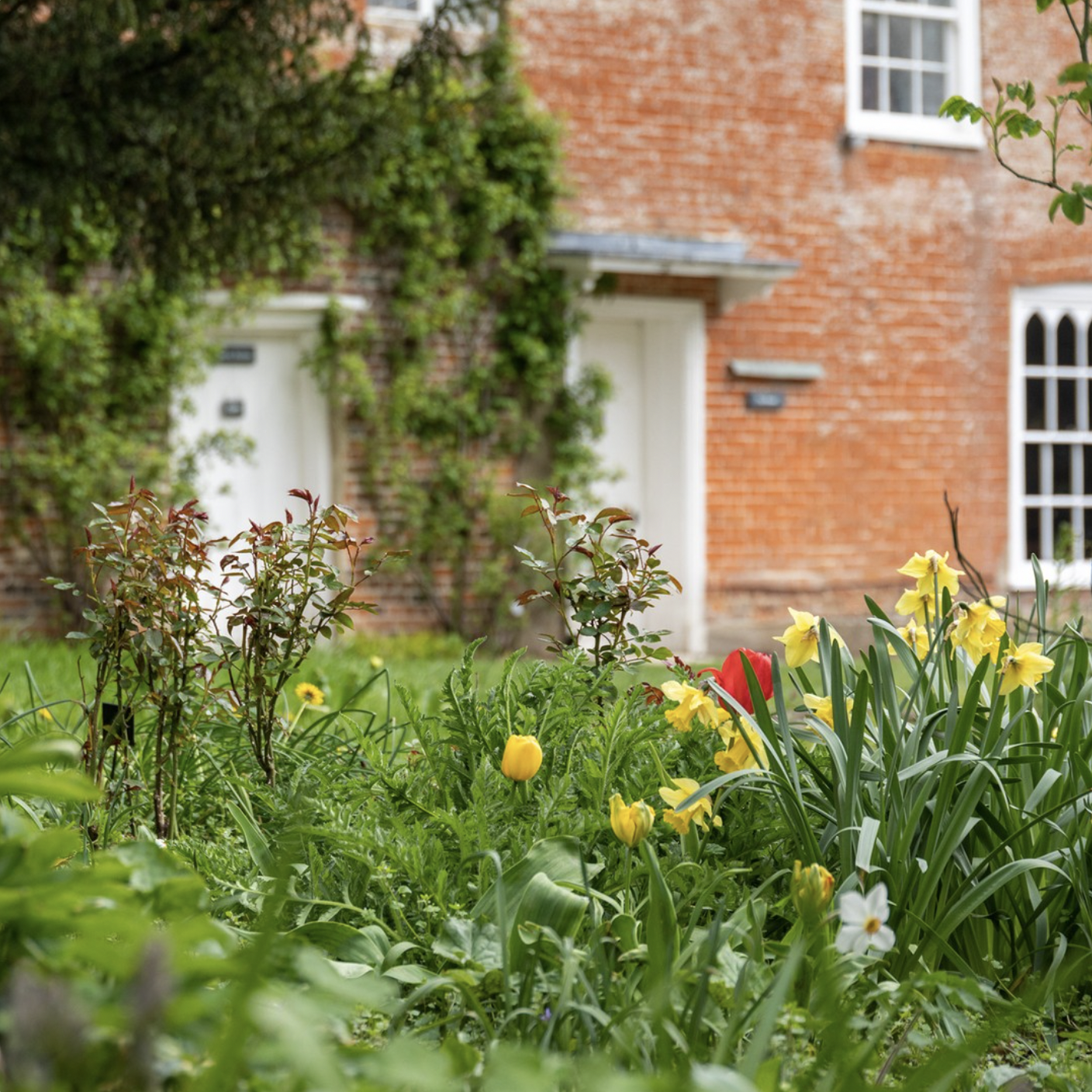
Here is a glimpse of Jane Austen’s House Museum this month. The garden is looking absolutely lovely already!

Jane Austen’s House in April, Photo: @JaneAustensHouse.

April in Jane Austen’s Letters

We have two letters from April 1811 when Jane was staying with her brother in Sloane Street in London. The following are a few excerpts of special interest:

April 18, 1811 Letter: Sloane Street

  • Her spring shopping purchases: “I am sorry to tell you that I am getting very extravagant, and spending all my money, and, what is worse for you, I have been spending yours too; for in a linendraper’s shop to which I went for checked muslin, and for which I was obliged to give seven shillings a yard, I was tempted by a pretty-coloured muslin, and bought ten yards of it on the chance of your liking it; but, at the same time, if it should not suit you, you must not think yourself at all obliged to take it; it is only 3s. 6d. per yard, and I should not in the least mind keeping the whole. In texture it is just what we prefer, but its resemblance to green crewels, I must own, is not great, for the pattern is a small red spot. And now I believe I have done all my commissions except Wedgwood.”
  • More walking and shopping: “I liked my walk very much; it was shorter than I had expected, and the weather was delightful. We set off immediately after breakfast, and must have reached Grafton House by half-past 11; but when we entered the shop the whole counter was thronged, and we waited full half an hour before we could be attended to. When we were served, however, I was very well satisfied with my purchases — my bugle trimming at 2s. 4d. and three pair silk stockings for a little less than 12s. a pair.”
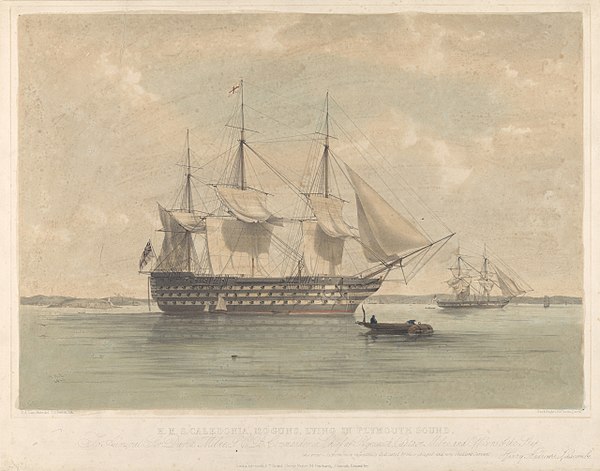
  • News about their brothers and their careers in the Navy: “Frank is superseded in the ‘Caledonia.’ Henry brought us this news yesterday from Mr. Daysh, and he heard at the same time that Charles may be in England in the course of a month. Sir Edward Pollen succeeds Lord Gambier in his command, and some captain of his succeeds Frank; and I believe the order is already gone out. Henry means to inquire farther to-day. He wrote to Mary on the occasion. This is something to think of. Henry is convinced that he will have the offer of something else, but does not think it will be at all incumbent on him to accept it; and then follows, what will he do? and where will he live?”
The HMS Caledonia was a 120-gun first-rate ship of the line of the Royal Navy, launched on 25 June 1808 at Plymouth. Wikipedia.

April 25, 1811 Letter: Sloane Street

  • Austen’s progress with and thoughts about Sense and Sensibility: “No, indeed, I am never too busy to think of S. and S. I can no more forget it than a mother can forget her sucking child; and I am much obliged to you for your inquiries. I have had two sheets to correct, but the last only brings us to Willoughby’s first appearance. Mrs. K. regrets in the most flattering manner that she must wait till May, but I have scarcely a hope of its being out in June. Henry does not neglect it; he has hurried the printer, and says he will see him again to-day. It will not stand still during his absence, it will be sent to Eliza.”
  • Plenty of wonderful details about a party hosted by Henry and Eliza: “Including everybody we were sixty-six — which was considerably more than Eliza had expected, and quite enough to fill the back drawing-room and leave a few to be scattered about in the other and in the passage.”
  • “The music was extremely good. It opened (tell Fanny) with ‘Poike de Parp pirs praise pof Prapela’; and of the other glees I remember, ‘In peace love tunes,’ ‘Rosabelle,’ ‘The Red Cross Knight,’ and ‘Poor Insect.’ Between the songs were lessons on the harp, or harp and pianoforte together; and the harp-player was Wiepart, whose name seems famous, though new to me. There was one female singer, a short Miss Davis, all in blue, bringing up for the public line, whose voice was said to be very fine indeed; and all the performers gave great satisfaction by doing what they were paid for, and giving themselves no airs. No amateur could be persuaded to do anything.”
  • “The house was not clear till after twelve. If you wish to hear more of it, you must put your questions, but I seem rather to have exhausted than spared the subject.”
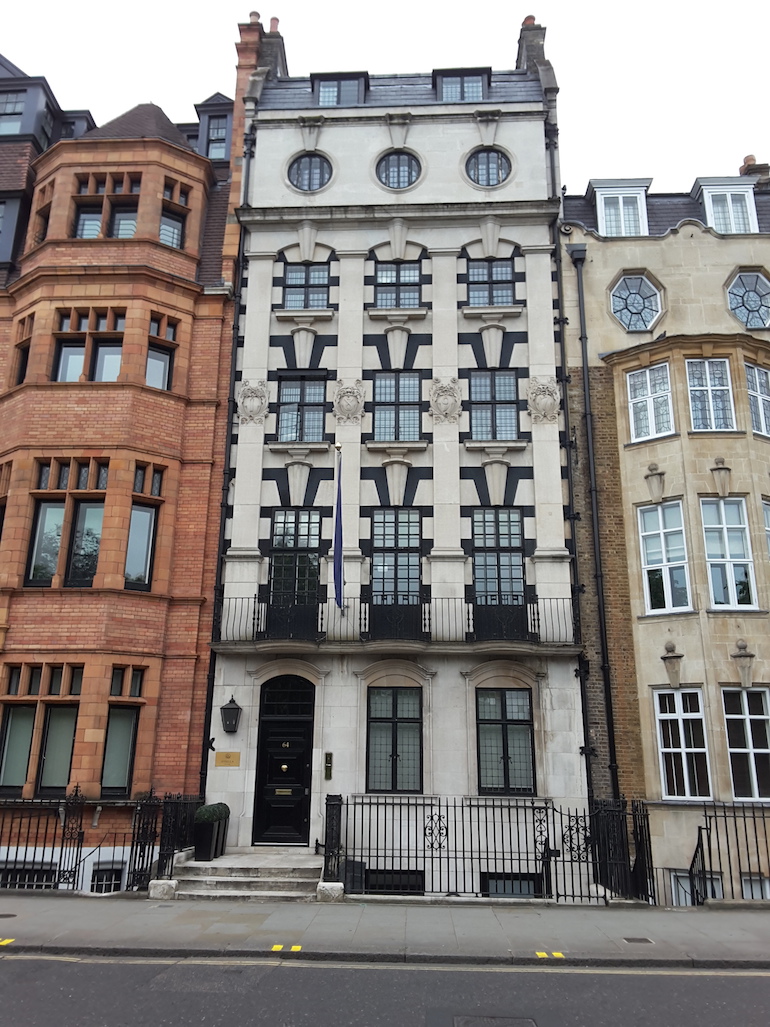
64 Sloane Street in London. Photo Credit: © Ingrid M Wallenborg, GuideLondon.org.

April in Jane Austen’s Novels

The following are a collection of interesting details and scenes that occur in (or refer to) the month of April in Austen’s novels. Springtime appears to be a good time for travel, walking, and riding as the weather slowly improves:

Sense and Sensibility

  • The Palmers, Mrs. Jennings, and the Dashwood sisters leave London for Cleveland in April (for the Easter holidays): “Very early in April, and tolerably early in the day, the two parties from Hanover Square and Berkeley Street set out from their respective homes, to meet, by appointment, on the road. For the convenience of Charlotte and her child, they were to be more than two days on their journey, and Mr. Palmer, travelling more expeditiously with Colonel Brandon, was to join them at Cleveland soon after their arrival.”

Pride and Prejudice

  • Darcy proposes again and refers to his first April proposal to Elizabeth Bennet (he surely remembers that date VERY well): “You are too generous to trifle with me. If your feelings are still what they were last April, tell me so at once. My affections and wishes are unchanged; but one word from you will silence me on this subject for ever.”

Mansfield Park

  • Fanny is left without fitting exercise: “[The Miss Bertrams] took their cheerful rides in the fine mornings of April and May; and Fanny either sat at home the whole day with one aunt, or walked beyond her strength at the instigation of the other: Lady Bertram holding exercise to be as unnecessary for everybody as it was unpleasant to herself; and Mrs. Norris, who was walking all day, thinking everybody ought to walk as much.”
  • Sir Thomas’s letter home: “[Sir Thomas] wrote in April, and had strong hopes of settling everything to his entire satisfaction, and leaving Antigua before the end of the summer.”
  • Fanny Price in Portsmouth: “The end of April was coming on; it would soon be almost three months, instead of two, that she had been absent from them all, and that her days had been passing in a state of penance, which she loved them too well to hope they would thoroughly understand; and who could yet say when there might be leisure to think of or fetch her?”
  • Fanny’s thoughts on springtime in the countryside versus the congested town: “It was sad to Fanny to lose all the pleasures of spring. She had not known before what pleasures she had to lose in passing March and April in a town. She had not known before how much the beginnings and progress of vegetation had delighted her. What animation, both of body and mind, she had derived from watching the advance of that season which cannot, in spite of its capriciousness, be unlovely, and seeing its increasing beauties from the earliest flowers in the warmest divisions of her aunt’s garden, to the opening of leaves of her uncle’s plantations, and the glory of his woods. To be losing such pleasures was no trifle; to be losing them, because she was in the midst of closeness and noise, to have confinement, bad air, bad smells, substituted for liberty, freshness, fragrance, and verdure, was infinitely worse: but even these incitements to regret were feeble, compared with what arose from the conviction of being missed by her best friends, and the longing to be useful to those who were wanting her!

Northanger Abbey

  • Isabella writes a “very unexpected letter” to Catherine.

Emma

  • Mrs. Elton pressures Jane to find a position as a governess very soon so that she doesn’t miss her chance: “But, my dear child, the time is drawing near; here is April, and June, or say even July, is very near, with such business to accomplish before us. Your inexperience really amuses me! A situation such as you deserve, and your friends would require for you, is no everyday occurrence, is not obtained at a moment’s notice; indeed, indeed, we must begin inquiring directly.”
  • For the introverts among us: “John Knightley only was in mute astonishment.—That a man (Mr. Weston) who might have spent his evening quietly at home after a day of business in London, should set off again, and walk half a mile to another man’s house, for the sake of being in mixed company till bed-time, of finishing his day in the efforts of civility and the noise of numbers, was a circumstance to strike him deeply. A man who had been in motion since eight o’clock in the morning, and might now have been still, who had been long talking, and might have been silent, who had been in more than one crowd, and might have been alone!—Such a man, to quit the tranquillity and independence of his own fireside, and on the evening of a cold sleety April day rush out again into the world!
Mrs. Elton and Jane Fairfax in Emma (1996).

April Dates of Importance

This brings us now to several dates that would have been important to Austen personally and to the Austen family as a whole:

Family News:

26 April 1764: Rev. George Austen marries Cassandra Leigh.

23 April 1774: Francis (Frank) Austen (Jane’s brother) born at Steventon.

April 1786: Francis Austen enters the Royal Naval Academy at Portsmouth

15 April 1793: James Austen’s first child, Anna, is born.

Historic Dates:

19 April 1775: The Battle of Lexington marks the start of America’s Revolutionary War.

Writing:

April 1811: Austen continues to correct proofs of Sense and Sensibility. She anticipates its publication date.

Sorrows:

22 April 1813: Eliza de Feuillide (Austen’s cousin and, later, sister-in-law) ill. Jane Austen goes to her bedside in London to help attend to her.

25 April 1813: Eliza de Feuillide dies.

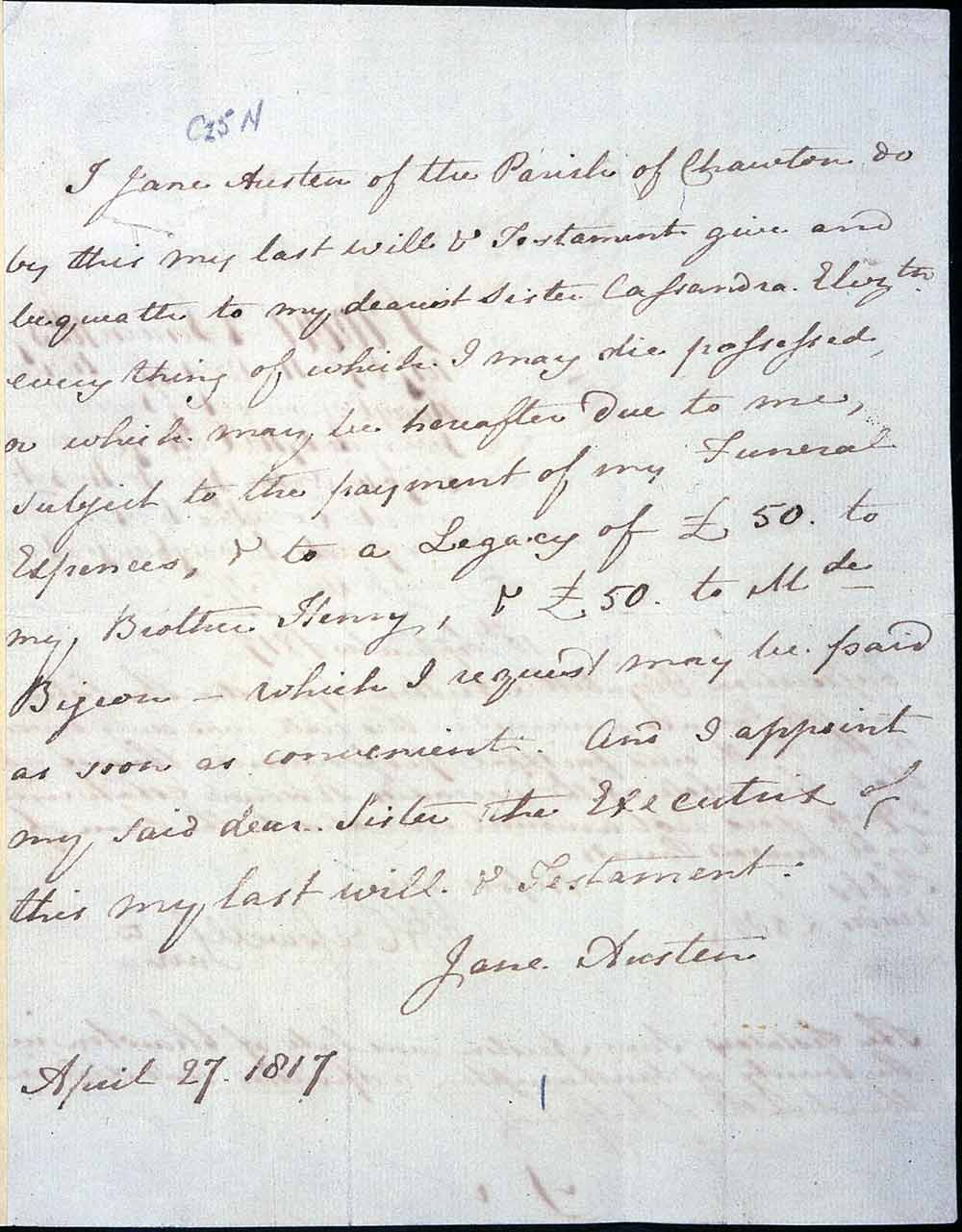
27 April 1817: Austen drafts her will:

“I Jane Austen of the Parish of Chawton do by this my last Will & Testament give and bequeath to my dearest Sister Cassandra Elizth everything of which I may die possessed, or which may be hereafter due to me, subject to the payment of my Funeral Expences, & to a Legacy of £50. to my Brother Henry, & £50. to Mde Bigeon–which I request may be paid as soon as convenient. And I appoint my said dear Sister the Executrix of this my last Will & Testament.”

April Showers

As we continue through the year, one of the highlights for me has been surveying the photos of the gardens at Chawton House and Jane Austen’s House each month and seeing the changes therein. I hope these April showers will bring many beautiful May flowers next month as we continue our tour of Hampshire in the spring with May in Jane Austen’s World!


RACHEL DODGE teaches college English classes, gives talks at libraries, teas, and book clubs, and writes for Jane Austen’s World blog. She is the bestselling author of The Little Women DevotionalThe Anne of Green Gables Devotional and Praying with Jane: 31 Days Through the Prayers of Jane Austen. Now Available: The Secret Garden Devotional! You can visit Rachel online at www.RachelDodge.com.

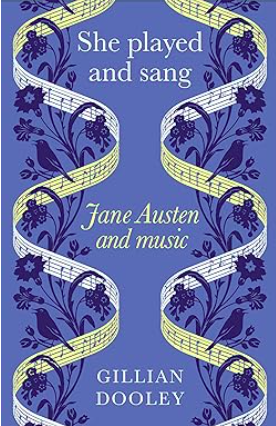
Inquiring Readers, In early March, I reviewed Gillian Dooley’s book, She played and sang: Jane Austen and music, published by Manchester University Press. While I knew some information about the Austen family’s collection of music books from the Internet Archive and several JASNA articles, none were as comprehensive as Dr. Dooley’s book. Her book now sits proudly on my library shelves in the Jane Austen section, where It will be used often as reference material. I still had a few questions, which Dr. Dooley was kind enough to answer.

Q & A With Dr Gillian Dooley:

Question #1: 

First, I want to thank you for writing this highly informative book. Almost all of the information contained in it is new to me. It’s obvious in Austen’s letters and novels that she loved music. I’m not a musician and sing off key, but I do love listening to classical music, especially from the late 18th and early 19th centuries– Haydn, Bach, Mozart, and Beethoven– and attending music concerts. I’ve read that the Austen family, like so many of their peers, read books out loud to each other when families gathered in the evening. They also played music and sang at home, with Austen playing the piano for her younger nieces and nephews as they danced. In her day, what were the connections, if any, between the music Austen collected and the stories in her novels? 

Dooley: 

Thanks for your interest in my book! I do discuss some possible links between her music collection and her writings, specifically in the juvenilia – where she often parodies the sentimental love songs of the time – and in Sense and Sensibility, where the plot has some structural similarities with a ballad named ‘Colin and Lucy’, of which she owned a copy. I don’t think that there are many direct or obvious connections, though. She rarely refers to an identifiable piece of music – ‘Robin Adair’ in Emma is the only explicit allusion and there are interesting emblematic resonances between that song and the plot. There are some other allusions to song texts in the novels that her contemporary readers might have noticed, but most of those songs are not in her music collection. I think they would have been common knowledge at the time, but we don’t necessarily recognize them now.

On the other hand, it would be possible to take almost any love song and find parallels in her novels, mainly because the narrative of most love stories includes roughly the same series of events: a meeting, getting acquainted, facing difficulties, and finally the happy ending. I guess what I’m saying is that what’s enduring and engaging about Austen’s novels is not their plots, but her use of language, her narrative voice, and her depiction of character. And I do think these aspects might be influenced by the fact that she was a musician. The rhythm of her language can be very musical, and in the songs she sang she would often have been acting the part of a character, or, in a way, embodying a character who might be quite different to herself.

Question #2:  

Can you describe some of the pieces she copied that were her favorites? I’m struck at how few of the composers in Appendix 2 are familiar to me. 

Dooley: 

Appendix 2 of my book lists the pieces of music that Austen copied herself by hand. She also owned some printed scores that she might have bought or been given. Her music collection includes both piano music and songs. I spend some time in my book surveying the handwritten pieces because it seems to make sense that, having invested the time in making copies, they might the ones she liked most. But that’s only a guess and isn’t supported by her niece Caroline’s memories of hearing her sing in her last years ‘when she had nearly left off singing’: only one of the four songs she mentions is among the manuscripts. 

These four songs are all in their way love songs. Two are Scottish songs, ‘Their Groves of Sweet Myrtle’ – which has words by Robert Burns – and ‘The Yellow-Haired Laddie’. Another song, in French, tells a sad story about swallows being separated and dying of love. And the fourth is from the English theatre – quite a sardonic song in its way, about a wife whose husband is leaving her. So though they share a sense of drama, they are all different in mood and character, and the singer has to interpret the songs through the character. 

And as you say, not many of the composers are well known today. I have discovered several new favourite composers in the course of my research, including Stephen Storace, Giovanni Paisiello, François Devienne, and James Hook.

Question #3  

I attend performances monthly given by our local chamber orchestra. The next performance will include Mozart’s Violin Concerto No 1 in B-Flat Major K. 207 (1773), written before Austen’s birth. It is divided into three movements– Allegro moderato, Adagio, and Presto. I understand that these three tempos indicate mood and expression. I’m struck that Austen’s novels are written in three parts. How do the divisions in music tempo relate to the pacing of her stories, or am I off base? 

Dooley: 

That’s an interesting thought! Form is important in any work of art, and especially in that era, most artists worked within various standard forms. For example, in music there is the da capo aria, and sonata form (made up of exposition – development – recapitulation), or theme and variations, or rondo – and, as you say, on a more macro level the 3-movement concerto or sonata. In poetry there were various standard metres and verse forms, e.g. the sonnet. Novels were usually in three volumes.

The Romantic movement pushed against some of these forms but they were remarkably persistent for a long time. Mozart and Haydn wrote amazing and idiosyncratic music, but it stayed mostly within these constraints. And Austen worked mainly within the form of the comic novel. There’s a very interesting book by Robert K. Wallace, Jane Austen and Mozart: Classical Equilibrium in Fiction and Music (Georgia UP, 1983), that compares Austen’s novels and Mozart’s concertos in detail.

I think there is an enduring rhetorical significance in the number three. And if you think of the way a novel like Pride and Prejudice divides into three parts, an argument could probably be made that the moods and tempi of the classical musical forms map approximately onto the structure of the novel. But only approximately.

Thank you so much for this informative discussion! Please feel free to add any information you’d like our readers to know. 

Dooley: 

Book CoverMy book is based on the Austen Family Music Books, which is a collection of about 20 albums of music, printed and manuscript, that belonged to various members of the Austen family circle – all female – around the time of Jane Austen’s life, from her teacher, Ann Cawley, to some of her nieces. I concentrated mainly on the books that belonged to her, especially the ones in her own handwriting, but I also look at her relationships with the owners of the other books. They contain a variety of music, both instrumental and vocal, and give an interesting snapshot of the music that was popular at the time for playing at home. There’s more information, including links to collection online, plus some scores I have transcribed and some live recordings I’ve done over the years, at my Jane Austen’s Music website .

Additional information:

Flinders University: Find Dr Dooley’s university profile on this page.

The University of Edinburgh –

  •  Jane Austen and Scottish Music – “Jane Austen’s surviving music collection includes many songs that are either genuinely Scottish or reflect the fashion for Scottish music in England in her time. In this program a selection of these melodies is presented, either as songs or piano variations, and some links with her novels are suggested.” (Note: Tickets are on sale for a July 22 concert. Gillian Dooley (soprano) and Judith Gore (piano) present ‘Scotch’ and ‘Irish’ Airs from Jane Austen’s collection.) 

Synopsis of project proposal:

In my forthcoming book “She Played and Sang: Jane Austen and Music” (Manchester University Press), I include a survey of British song in Austen’s surviving music collection, digitized by Southampton University Library, and in her fiction. So-called ‘Scotch airs’ were enormously popular during Austen’s lifetime. Given Austen’s well-known Jacobite sympathies, it is not surprising that she felt no impulse to resist this musical tide from the north. Her music collection shows that she was drawn to Scottish music, and two of the four songs her young relatives remember her singing in her later years were Scottish: ‘Their groves of sweet myrtle’ and ‘The yellow-haired laddie’ – the other two being respectively French, and English (by an Irish composer). Roger Fiske proposes that one of the reasons for the popularity of Scottish songs was ‘the piquancy of their Scots characteristics’. Other political or ideological reasons might be adduced, but these characteristics do set them apart from the common run of pastoral love songs and help to explain their attraction for Austen. – Enter the site to read the rest of the project description

Listen to/See the Music:

SOUNDCLOUD 

Gillian Dooley: 75 tracks, that include:

Angels ever bright and fair – Handel

If grief has any power to kill – Henry Purcell

Colin and Lucy – Tommaso Giordani

Jane Austen – The French Connection

And more!

Gillian Dooley’s YouTube Channel

Their Groves of Sweet Myrtle

The Yellow Haired Laddie, instrumental

Words to the song

Book Reviews and the author’s published articles

Reviews of She Played and Sang

In  Addition:

Austen Chat, from the Jane Austen Society of North America, brings you entertaining and informative discussions on Jane Austen each month.

A Review by Brenda S. Cox

The idea suddenly came to Mrs. Breckyn Wood that JASNA needed a podcast. Breckyn says,

“My main goal is to attract a whole new generation of JASNA members–younger Jane Austen fans who maybe have read a book or two or seen one of the adaptations, but who didn’t know there was a whole organization dedicated to Austen. I had already been to a few meetings of my local Georgia Region and was blown away by the talent and intelligence of its members, so I knew JASNA would have a huge pool of potential podcast guests from which to draw.”

Being a young lady of ingenuity and determination, she came up with a plan and presented it to the leaders of JASNA, who gave their complete support for Austen Chat. This delightful podcast began in July, 2023, with new episodes released on the first Thursday of each month. As the Austen Chat website says:

“JASNA’s mission is at the heart of Austen Chat—to further the study, appreciation, and understanding of Jane Austen’s works, life, and genius. There is always more to learn and enjoy about Jane, and we invite you to join us for the ride! Each month we talk with scholars, authors, and subject experts on a wide variety of Austen-related topics. We think you’ll have fun and learn something new from every episode—whether you are a lifelong reader, an Austen newbie, a seasoned Austen scholar, or somewhere in between. Tune in each month to enjoy the company of clever, well-informed guests, who have a great deal of conversation!”

I have listened to the first nine episodes (through March 7, 2024) and loved them all. I learned new things from each expert, despite my years of studying Austen.

In each instalment, Breckyn interviews someone in the Austen world about their specialty. Then we have news for the JASNA community about upcoming events and resources. Finally, a Janeite shares one of his or her favorite quotes from Austen, and tells why they love it. So be sure to listen all the way to the end!

Here’s what we’ve gotten to enjoy so far:

Episode 1, Jane Austen & Her House: A Visit with Lizzie Dunford, brings us right to the Jane Austen House in Chawton. We learn about its background, the changes that have been going on, and the treasures on display in this Mecca for Janeites. 

Episode 2, Jane Austen & Goodness: A Visit with Brenda Cox, is my own discussion with Breckyn about how Austen’s faith and the Church of England are reflected in Austen’s novels, including some hidden “faith words” used with religious meanings, women church leaders of Austen’s time, and the differences between rectors, vicars, and curates. 

Episode 3, Jane Austen & Her Wardrobe: A Visit with Hilary Davidson, is a fun discussion of the clothes Jane Austen is known to have worn. I learned that Austen kept up with the latest fashions. Davidson tells us that in general it was easy to find relevant pictures of the types of clothing Austen mentioned in her letters, since they were what was popularly worn in those years. 

Episode 4, Jane Austen & Her Endings: A Visit with Inger Brodey, gives some surprising insights into the endings of Austen’s books. She talks about whether the novels end happily or not, the different kinds of happiness, and how Austen’s endings were unusual for her time. 

Episode 5, Jane Austen & Divorce: A Visit with James Nagle, tells us some suprising facts about ways people got divorced or separated in Austen’s time, including the practice of selling wives, which he says was often to the wife’s lover. 

Episode 6, Jane Austen & Mr. Wickham, A Visit with Adrian Lukis, explores Lukis’s experiences in portraying Wickham in the 1995 Pride and Prejudice movie, then what led him to write his current hit, Being Mr. Wickham, and his thoughts on Lydia and Wickham’s later lives. 

Episode 7, Jane Austen & Dido Belle, A Visit with Renata Dennis, gives us some insights from the head of JASNA’s Diversity Committee about mixed-race Dido Belle, her life, family, and connections with Jane Austen and Sanditon

Episode 8, Jane Austen & Food: A Visit with Julienne Gehrer, discusses Martha Lloyd, the friend who lived with Jane, Cassandra, and Mrs. Austen, and her Commonplace Book and recipes. 

Episode 9, Jane Austen & Her Genius: A Visit with Juliet McMaster, explores some facets of Austen’s brilliance in each of the novels and the Juvenilia. For example, McMaster compares Henry Tilney to Henry Higgins; both taught the heroine a new “language.” And she considers which heroes learned from the heroines, as well as which heroine learned from the hero. Juliet McMaster, a founding member of JASNA and “grande dame of Austen scholarship,” also talks about the early days of JASNA.

This is a great array of topics, all of which I enjoyed. I don’t know what’s coming next, but I’m sure it will be fun!

Episodes begin with a “desert island” question for the interviewee. Either:

If you were stranded on a desert island and could only have one Austen book, which one would it be?   Or,

If you were stranded on a desert island and could have one penpal from among Austen’s characters, who would it be?

Gentle reader, what is your answer?  And if you want to add your favorite Austen quote, please do!


Brenda S. Cox is the author of Fashionable Goodness: Christianity in Jane Austen’s England. She also blogs at Faith, Science, Joy, and Jane Austen.