Feeds:
Posts
Comments


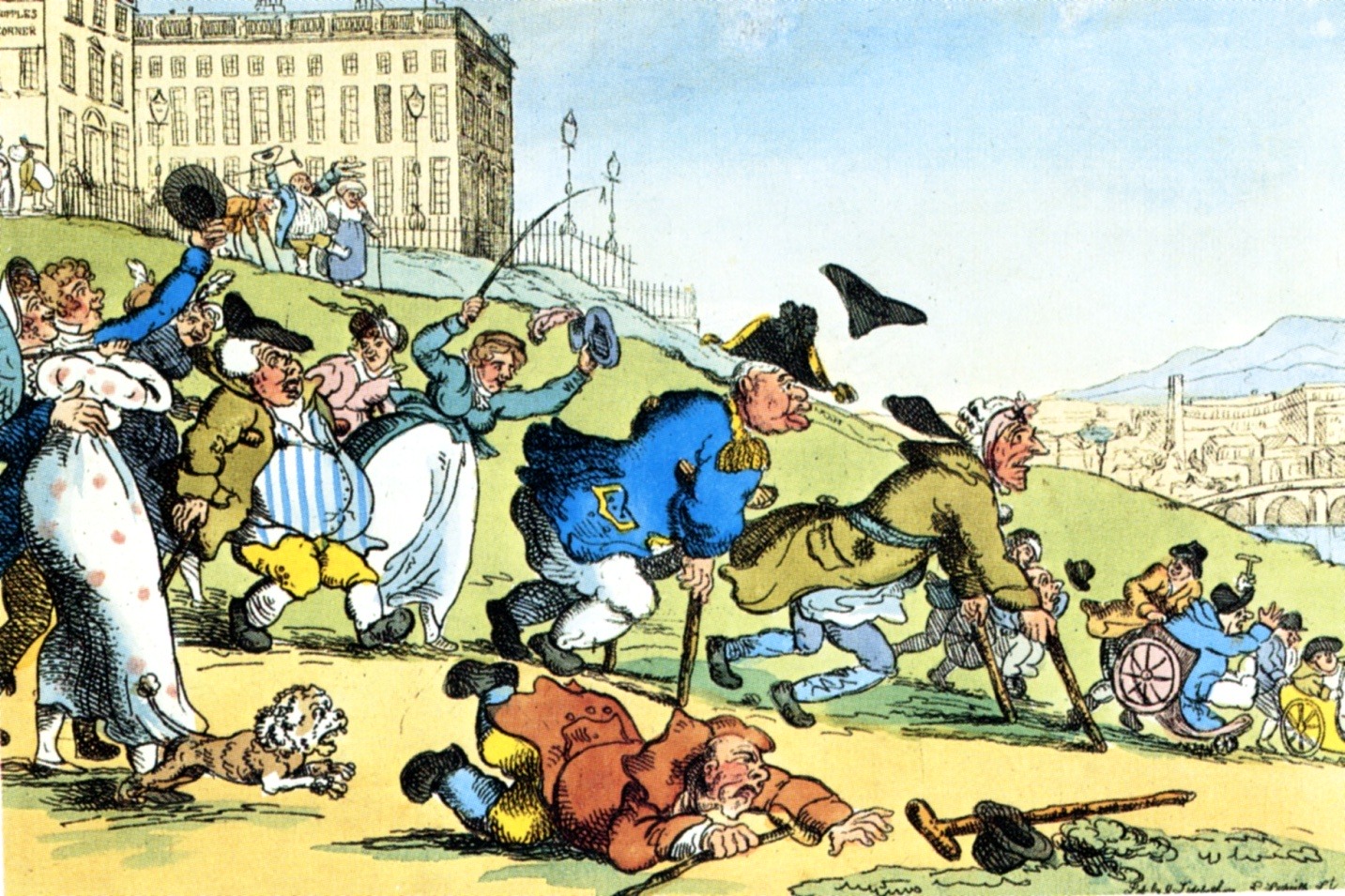
The Comforts of Bath, Rowlandson


Had Margaret Dashwood fallen from a tree and broken her forearm, Mrs. Dashwood would have sent for the surgeon to set it. A broken bone presented a painful procedure in a time before anesthesia, but simple fractures of the arm were relatively easy to fix, even in the late 18th and early 19th centuries. In reaction to the injury, muscles contract and are stretched before the bone is set. Arm muscles do not offer undue resistance. Thus the bone of a forearm can be set without too much exertion on the part of the surgeon or bone setter. Once set and placed in a sling, the arm bone required time and rest for healing.
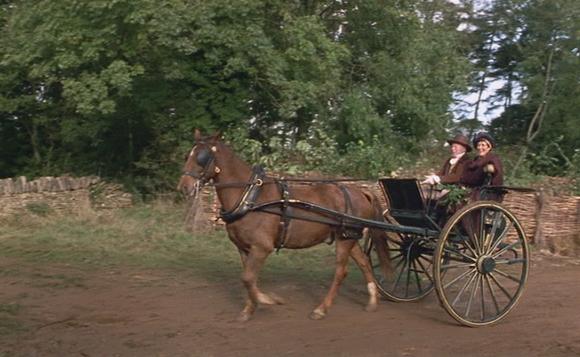
 

The Crofts in their gig, 1995 Persuasion


If Admiral Croft, a notoriously bad driver, had overset his vehicle and tossed poor Mrs. Croft to the ground, breaking her leg in two places, the situation would have been different. The size and strength of her leg muscles would have been so much stronger than Margaret’s arm muscles, and the exertion to set Mrs. Croft’s bone in place would have required more effort and required the work of at least two persons.

A fracture in Mrs. Croft’s lower leg would have been easier to remedy than a fracture of the thigh, in which large and strong muscles would experience a great degree of contraction and shortening. Considerable manipulation would have been required by several assistants to overcome strong thigh muscles and stretch them in order to place the bones in their natural position.

The simple position of the injured member sometimes suffices to overcome the contraction of the muscles and to restore the broken bone to something like its natural position. Yet, in most cases, it becomes necessary to employ additional means to accomplish this object by pulling the lower fragment away from the upper. This must be done with care and yet with considerable force.”- Home Medical Treatments

If, after the pulling and resetting, both limbs were the same length again, then the procedure was succesful, but this was not always the case. Soldiers on the battlefield whose bones shattered from canon and gun fire risked getting an infection. In such instances, surgeons often chose to amputate before the tissue became necrotic.

Bone Setters

As early as the 16th century, apprentice barber-surgeons were impressed in the army to treat soldiers, where they learned their trade by neccesity Generally, surgeons and bone setters learned how to set various kinds of fractures through apprenticeship.

“Bone setters included surgeons and barbers. the practice of bonesetting by both qualified and unqualified practitioners. (In using the term “unqualified,” we refer to those who take up the practice of healing without having had any formal training in the accepted medical procedures of the day.) –  Bonesetting, Chiropractic, and Cultism Chapter 1: The Origin and Course of Bonesetting ©1963, Samuel Homola, D.C.”

Not all bone setters were apprenticed to a medical person. If no surgeon or physician lived within the vicinity, the local blacksmith would set bones in humans and animals, for a fee, of course.
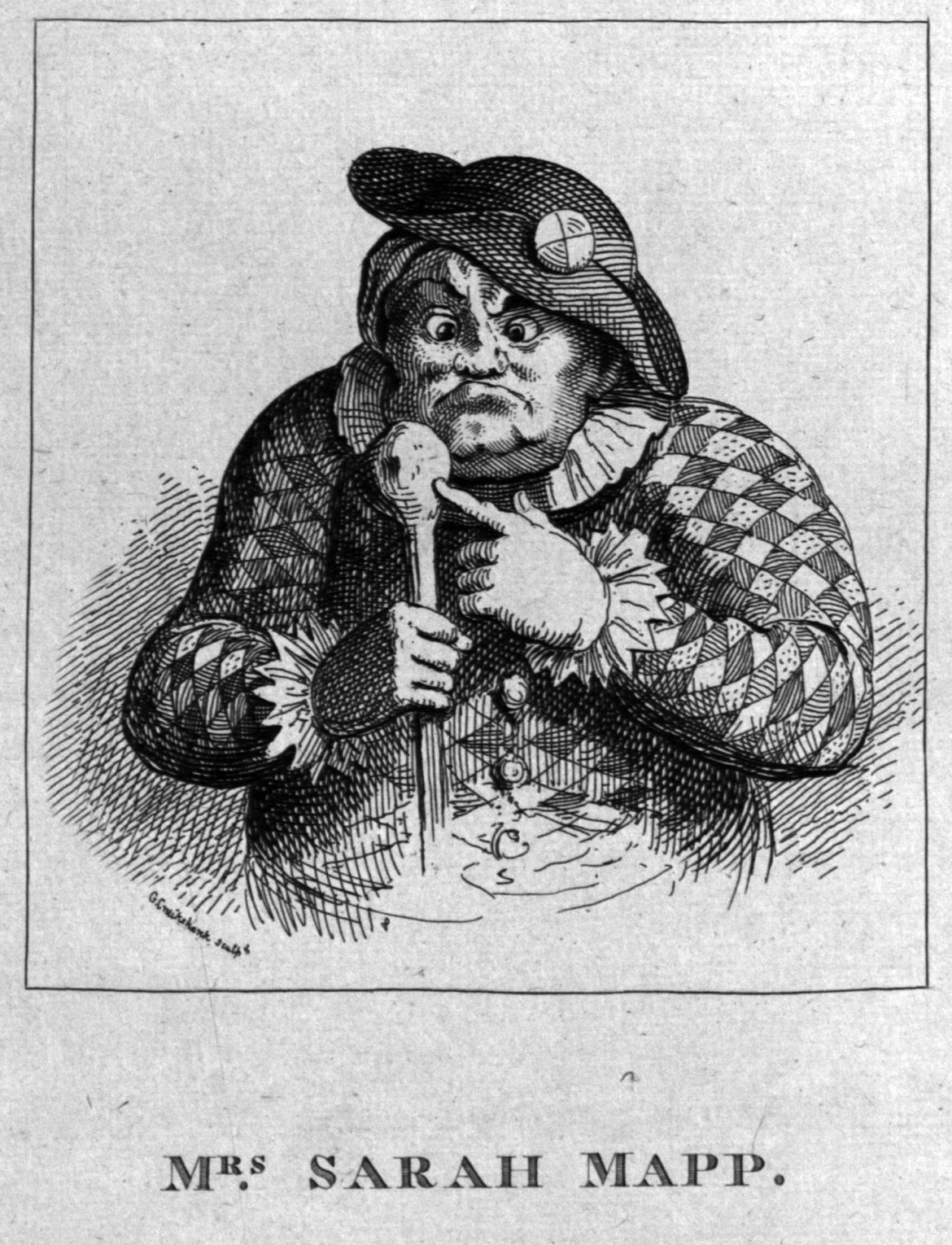
 

Sarah Mapp, 18th Century Bone Setter


Some bonesetters became celebrated for their dexterity. One such person in the early 18th century was Mrs Mapp, whose skill was legendary. A daughter of another famous bone setter, Polly Peachum (who married the Duke of Bolton), she was known as crazy Sally. Nevertheless, her “cures earned her upward of 100 guineas per year. Sally Mapp’s marriage was not as successful as her skills with bones. Her husband thrashed her several times before absconding with a majority of her earnings.

“Her bandages were neat, and her skill in reducing dislocations and in setting fractures was said to be wonderful. If it was known that she was going to the theatre, that was sufficient to fill the house. Her own estimate of herself is shown by an interesting incident. When passing through Kent street, she was taken for one of the King’s German mistresses, who was unpopular. A mob gathered and used threatening languages. Mrs Mapp thereupon put her head out of the window and cried, “Damn your bloods, don t you know me! I am Mrs Mapp, the bone setter,”and drove away amid the applause of the multitude.” – Boston Medical and Surgeon Journal

Not everyone was a fan. “Mr Percival Pott, the celebrated surgeon, who was her contemporary, spoke of her claims as the most extravagant assertions of an ignorant illiberal drunken female savage.”  – Boston Medical and Surgeon Journal

As the medical professions evolved, barber-surgeons, midwives, and professional bone setters like Mrs. Mapp, began to be replaced by trained male physicians and surgeons. During the 19th century, colorful characters like Mrs. Mapp, and midwives, who had widely practiced across all spectrum of classes, labored primarily for the poor and could barely scrape a decent living.

By the 1860’s, British physicians and surgeons were largely registered. A case against a Mr. A.E. Shakesby, bonesetter and osteopath was dismissed, for “osteopathy was not regulated, supervised, or recognized by any statute.” Mr. Shakesby had committed the cardinal sin of elevating his stature as bonesetter and describing himself as an osteopathic physician and surgeon. While his self-description amplified his profession of bonesetter, the grander sounding title did not go against the Medical Act of 1858, which required doctors to be registered in recognized fields. – Medico-Legal, 1932

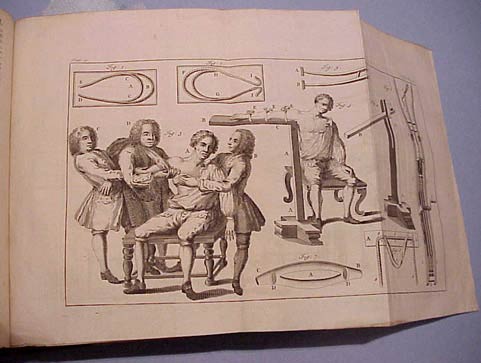
Over the centuries, scientific inventions sped up a surgeon’s or bonesetter’s ability to help patients. As early as the 15th century, the printing press churned out medical manuals, in which medical procedures were standardized and disseminated over the world. In the late 17th century, traction was used to repair a broken bone, and in 1718, French surgeon, Jean Louis Petit, invented the tourniquet to control bleeding, a medical technique that was especially helpful during amputations.
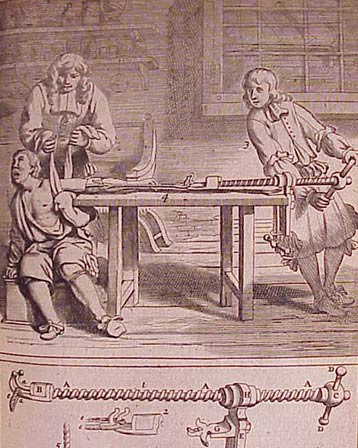
Traction to repair a broken bone is seen here in “Armamentarium Chirurgiae”, by Ioannis Sculteti (1693), and the final illustration is by Laurence Heister in “A General System of Surgery” (1743). Note the numerous assistants required to restrain the patient in this pre-anesthetic era. – Collect Medical Antiques
Pain Control

Bone setting could be extremely painful, and pain was excrutiating during amputations. Before 1853, only a few substances were available to dull pain, but these efforts were generally unsuccessful and many surgeons relied on their patients to faint from pain as a method of relief. A person in shock would feel less pain and bleed less, for their lower blood pressure would reduce the flow of blood, in the case of a jagged bone.

Methods of pain control included: icing the limb, prescribing laudanum, drinking alcohol, and providing nerve compression or hypnosis. Icing the limb was problematic in that carting ice was a hugely expensive and laborious procedure, and storage through the warms months required ice houses and was available to only a few. (Storing Ice and Making Ice cream in Georgian England)

During the latter half of the 18th century and early 19th century, there were several missed opportunities for finding an effective anesthetic. In 1773, Joseph Priestley used nitrous oxide, a gas that was difficult to synthesize and store. Humphry Davy commented in 1800 that nitroous oxide transiently “relieved a severe headache, obliterated a minor headache, and briefly quenched an aggravating toothache.” No one seems to have taken that observation further. Humprhy Davy also realized that inhaling ether relieved pain, but remarkably, ether was considered a recreational drug during this period. In Britain and Ireland, when gin was taxed to the point where the poor found the cost prohibitive, they began to drink and ounce or two of ether instead. In America, students would hold nocturnal “ether frolics” by holding ethe-soaked towels to their faces.

By 1846, the situation had changed. Ether had made its appearance as a pain reliever, and chloroform was introduced for operations a year later. In 1853, Queen Victoira requested chloroform when giving birth to her eight child, and from then on it was accepted practice to offer pain relief to women in labor.

Sources
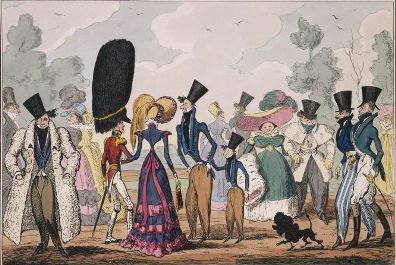
The Parks of London by Mary Elizabeth Brandon, 1868, on Dandyism.net discusses the dandies parading up and down London’s fashionable parks. After visiting that site, return to read some of my older posts about Hyde Park and the pleasure gardens.

More on the Topic:

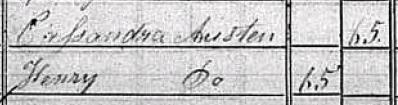
Inquiring Reader, This post is the second part of solving the mystery of Cassandra Austen’s age in the 1841 census, which reader Craig Piercey brought to my attention. A number of people became involved in the mystery of Cassandra’s age, which was 68 at the time the census was taken, but was listed as 65. To review the situation, click on this link and read the emails sent to explain the anomaly.

The first letter came from Laurel Ann of Austenprose, who had left a comment on the first post.

Vic,  I have come across many discrepancies on census enumerations. The process is part of the problem. Families were asked to fill out their own sheets and then they gave them to the enumerator who transcribed them onto the sheets of record. The original family sheets do not survive. There is always the possibility of illegible handwriting, transcription error, the family did not understand the directions or people lied about their age! It is not considered a primary source document by the government or family historians. Cassandra’s christening record would serve as a legal record of her birth. Since her father filled this out, we can be pretty certain that it is correct. It is also confirmed in family letters. By her death in 1845 it was required to report deaths to the new Registrar and would have included a doctor’s verification. That is the best explanation I can offer. The government was primarily interested in  numbers. They used the data for general ranges like the number of children under 10 or men of military age etc. The fact that exact ages are listed from 1851 onward is a bonus to family historians now, but not so much for the government then. Census records are not an exact science. I am glad you had so much interest in this puzzle. The discrepancy does appear odd to one who has not done family research.  I hope this is helpful. LA

St. Nicholas Church at Chawton, taken by @sneakymagpie

Laurel Ann was not the first person to point out that the Census taker would use a general number that could be divided by five. Before I received her answer, I had written to Ray Moseley, Fundraising Administrator of Chawton House. He replied promptly:

Dear Vic,

Sarah Parry our education officer at Chawton House has replied as below. I do hope that this helps. If we can of any further help please don’t hesitate to contact me.

Ray

Cassandra and Cassandra Austen grave

Hi Ray

I think that the following might be an explanation.

This is the web page for the 1841 census on the National Archive website: http://search.ancestry.co.uk/iexec/Default.aspx?htx=List&dbid=8978&ti=5538&r=5538&o_xid=24149&o_lid=24149&offerid=0%3a21318%3a0 It makes the point about how ages were recorded on this census and notes if over 15, the ages “were usually rounded down to the nearest 5 years”.

I also had a look at Deirdre le Faye’s A Chronology of Jane Austen and her Family (Cambridge University Press 2006). The entry referring to the 1841 census reads:

“June 6, Sunday
National census this year shows CEA [Cassandra Elizabeth Austen] living at Chawton Cottage, with three maids – Mary Butter, Emily Kemp, Jane Tidman – and one manservant, William Sharp. HTA [Henry Thomas Austen] and Eleanor Jackson are also there on census night.”

Cassandra was born on 9 January 1773 and would have been 68 on the night of the census so it would have been correct, by the format of the 1841 census, to show her age as 65.

Henry would have celebrated his 70th birthday in 1841. He was born on 8 June 1771. The 1841 census was taken on 6 June – just two days before his 70th birthday. So the figures are correct as Henry would have been 69 on the night of the census so again, by the format of how to record ages in the 1841, census it would therefore have been quite correct to show his age as 65. Henry’s surname isn’t shown on the census because the mark below the “Austen” of Cassandra’s name and alongside Henry’s Christian name is the equivalent of ditto marks.

Hope this helps.

Best
Sarah

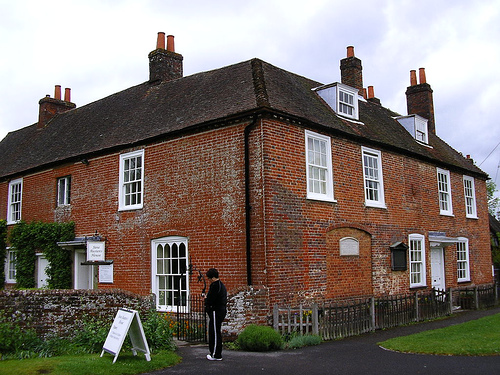
Chawton Cottage

Sarah’s explanation dovetails in with other speculations, but because she works for Chawton House as an education officer, I will take hers as the last word on the subject.

Tony Grant, London Calling, wrote Louise West at the Jane Austen’s House Museum in Chawton about the same time that I wrote Chawton House, and her reply, while supportive, did not include additional information.

Hi Vic,
I just received this today from Louise West at Chawton Cottage. Remember our exciting foray into working out Cassandra’s age? … Here you are. – Tony

Dear Tony

Many thanks for sharing with me this interesting correspondence.  I really admire all the effort that has gone into trying to solve the mystery and wish I could offer anything more illuminating but I’m afraid I’m as much in the dark as you are.  If you uncover anything definite I would be very interested to hear.

Best wishes

Louise West
Collections and Education Manager
Jane Austen’s House Museum
Chawton
Alton

So, gentle reader. This is the end of our research into this topic. I hope others have found this journey into uncovering a mystery as interesting as I have. Thank you for stopping by, and thanks to all who have answered our emails and helped, especially Laurel Ann, whose initial comments and follow-up email unlocked the mystery first.

PBS Masterpiece Mystery! is featuring Faceless Killers, the first episode of Wallander, Season 2 online. Click here to see the video until November 2, 2010. Click here to read my review for the season.

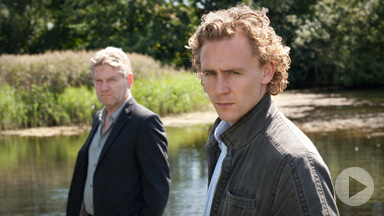
Kenneth Branagh is Wallander

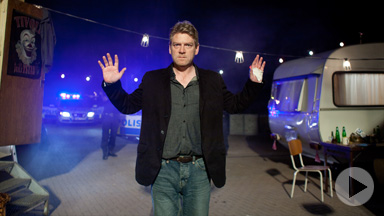
Kenneth Branagh in Faceless Killers

Kurt Wallander’s life is all about work and it is killing him. Kenneth Branagh is perfect as  the world weary Swedish cop who cares about his cases at the expense of his family and physical and emotional health. The actor is fearless in depicting a tired, overweight and unkempt man who drinks too much, sleeps too little, and suffers from diabetes and depression. Wallander’s wife has left him, his relationships with his daughter and father stink, and he has no friends to speak of.

The first three episodes of Wallander (Series One) were a revelation. Series Two is as good if not better. The series is filmed in the bleak landscape of southern Sweden and in the small port city of Ystad. Initially, there was thought of producing a feature film, but Branagh voted against it, saying.

I thought it might be tough in the current climate to produce a film with somebody like me in it and expect it would last much longer than an opening weekend. Just because our business is incredibly brutal.” – Kenneth Branagh

Wallander is the brain child of Henning Mankell, a successful Swedish author who created the character in reaction to the anti-immigration sentiment expressed in his country.

I had no idea this would be the start of a long journey,” Mankell says. “I was writing the first novel out of anger at what was happening in Sweden. And, since xenophobia is a crime, I needed a police officer. So the story came first, then the character. Then I realised I was creating a tool that could be used to tell stories about the situation in Sweden — and Europe — in the 1990s. The best use of that tool was to say ‘What story shall I tell?’, then put him in it.” – Times Online

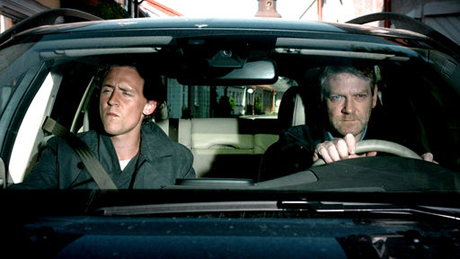
Tom Hiddleston and Kenneth Branagh in Wallander

Wallander’s single-minded doggedness in solving his investigations leaves him with little room in life for anything else. The solitary detective is miserable but unable to do anything to change his life, as Kenneth Branagh explained in a recent interview:

So there is little room in his mind for small talk, superficiality. He’s not much interested in sport. He doesn’t have hobbies. He doesn’t have extra room or space for what might be therapeutic reflection. It’s almost always about why people commit acts of violence. And complicated analysis and consideration of what drove him or her to it. Or why the person he has interviewed responded in the way they did. And sometimes in his own life why he is unable to say to his own daughter, “I love you”, or return her call.

‘So all of that physically just makes you feel heavier. I remember reading the script for the first of these new ones – I’d not been near it for a year – and by the end of it I was hunched and bent over. And I felt as though my skin was sagging. I felt as though the gravitational weight of Wallander was starting to have an impact.’  – Telegraph Co.UK

Jeannie Spark as Linda Wallander and Arsher Ali as Jamal, the young doctor she is seeing

The first series, produced by Yellow Bird, Mankell’s film production company, in partnership with Left Bank Pictures, ran on PBS in 2009. Wallander garnered Branagh a Golden Globe nomination and a BAFTA for Best Drama Series for the first season.

PBS will offer the following episodes in Series 2:

Faceless Killers, October 3


An elderly couple is brutally assaulted in their rural farmhouse. The press takes hold of the foreigner angle, inciting swift and deadly retribution against local migrant workers. But there is more to the case — a potential mistress, a lost son and a large sum of money. Wallander’s inquiry takes him deep into his own damaged psyche, forcing him to examine and question his own motives before he can even begin to understand those of a killer.

The Man Who Smiled, October 10,

Gustaf Torstensson quietly chants “Mea culpa, mea culpa,” as he drives to his death. His son Sten Torstensson, a friend of Inspector Kurt Wallander, begs the detective to investigate the suspicious case — Wallander is his last hope. But hope has all but drained from Wallander’s life, as he’s now on indefinite leave from his work and has been all but forgotten after enduring an on-the-job trauma.

The Fifth Woman, October 17

Inspector Kurt Wallander is torn between two disparate cases while dealing with one harsh and heartbreaking reality — the demise of his father. When another victim is found, it is clear that a serial killer is at work in Ystad.

Other features:

As usual, PBS Masterpiece Mystery provides special features that add dimension to the series.

Other posts