This Jane Austen blog brings Jane Austen, her novels, and the Regency Period alive through food, dress, social customs, and other 19th C. historical details related to this topic.
After much celebration, Christmas and New Year’s festivities are over. I dare not weigh myself until I’ve dieted for a week. Wine and spirits are banned for the time being. Decorations will eventually be stashed away as life slowly returns to normal.
We still celebrate these holidays in similar ways to those held in the past. Lesley-Anne McCleod wrote about the similarity of Christmas and New Year’s celebrations in a 2016 post entitled A Regency New Year–“Begin as you mean to go on:
“New Year’s Eve and New Year’s Day in the Regency era in England was celebrated, it seems, very much like Christmas with: Parties and celebrations … particularly among the Royals … gifts … and acts of charity…”
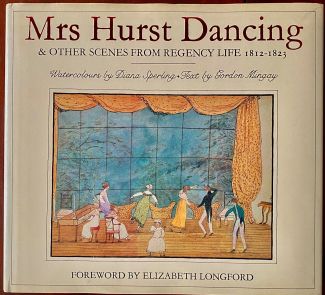
Book Cover of Mrs Hurst Dancing
Dancing:
Today as in Austen’s time we still party and dance the night away. In the book cover image above, Diana Sperling painted a private dance party at home, with the rug rolled up and the furniture pulled aside. One of the ladies plays the pianoforte for the dancers. Some – an older woman/chaperone (?), a young girl wearing a cap, and a young woman without a cap – sit on the sidelines.
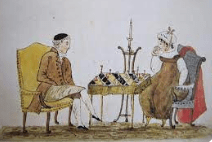
Pappy and Mum play chess
While the younger crowd danced exuberantly, one imagines that their elders enjoyed a quieter way to spend the time – near a fire, perhaps, while playing a game, much like Mr Woodhouse and Emma or Mr Knightley might have done.
Dining and Feasting:
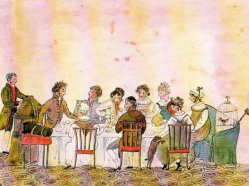
Dynes Hall, Family at Dinner
Dinners with guests and family would be intimate, as in this image (see the bird cage at right?), or enormous, as with the Royals and the very wealthy, like Mr Bingley and Mr Darcy.
Please Note: images might be copyrighted. If enlarged, these will lose clarity.
Transportation:
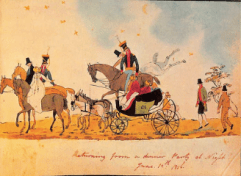
Returning from a dinner party at night, 1816
Visiting neighbors or friends in nearby villages at night presented logistics. Roads were unlit and often deeply rutted and muddy after heavy rains or melting snow. The preferred days for traveling coincided with the full moon, which at times was obscured by clouds. Lanterns helped to pave the way, yet the going was still rough, as this Sperling image shows.
The threat of snow was enough to put a spoke in plans. In Austen’s Emma, Mr Woodhouse, having been enticed from his cozy chair in front of his fire to attend the Westons’ dinner, hastened before food service hardly began to hie it back home before the snow accumulated.
Charity:
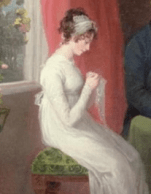
Detail, Group portrait at a drawing room table, Maria Spilsbury
Charity played an important part in Regency England. Ladies from the middle classes and upward gave out baskets containing contents distributed to the poor – including knitted and sewn items, and food. When Mrs Austen, Jane’s mother, received visitors in the small parlor in Steventon Rectory, she would work on her latest project.
A contemporary news item mention the following:
“Tuesday being New Year’s Day, eight girls, who are clothed and put to school by Lady Mill, dined at Mattisfont-house, the seat of Sir Charles Mill, agreeable to the usual custom. – Hampshire Chronicle, Monday 7, January 1805,” McLeod, A Regency New Year
Austen frequently mentioned charitable work in her novels and letters. She was:
“… concerned with the practical needs of her neighbours: ‘Dame Tilbury’s daughter has lain-in – Shall I give her any of your Baby Cloathes?’ she asks Cassandra, October 1798.”
and
On Christmas Day she wrote: “Of my charities to the poor since I came home you shall have a faithful account. – I have given a p.r of Worsted Stockgs to Mary Hutchins, Dame Kew, Mary Steevens, & Dame Staples; a shift to Hannah Staples, & a shawl to Betty Dawkins; amounting in all to about half a guinea. – Jane Austen’s Microcosm
Twelfth Night on January 5th marks the end of the Christian holiday season. This and many other Western holiday traditions, many harking back to the 5th century, have stood the test of time. Each generation and country have placed their own mark on how these customs are celebrated.
“I had expected to find everything about the place very fine and all that, but I had no idea of its being so beautiful.” –Mrs. Cassandra Leigh Austen, Aug. 13, 1806, on a visit to Stoneleigh Abbey with her daughters Jane and Cassandra
Merry Christmas and Happy Holidays! As my gift to you, let’s take a trip to Stoneleigh Abbey together.
Jane Austen visited Stoneleigh Abbey in 1806. She and her mother and sister were visiting their cousin, Rev. Thomas Leigh, in Adlestrop when his distant cousin, the Honorable Mary Leigh, died. Rev. Thomas inherited the wealthy estate. He took his poorer relations, the Austens, with him to take possession, as a treat for them. They enjoyed it very much, as Mrs. Austen wrote in a letter. She said the house was so large that they needed signposts to find their way, and that it was not only very “fine,” but more beautiful than she had imagined. Catherine Morland, similarly, when she saw Northanger Abbey, “was struck . . . beyond her expectation, by the grandeur of the abbey.”
Based on income, Stoneleigh Abbey was an even grander place than Pemberley or Sotherton (the Rushworth estate in Mansfield Park) would have been. Austen tells us that Darcy’s income was £10,000 a year and Mr. Rushworth’s was £12,000 a year. But the income of the Leighs of Stoneleigh Abbey, in Jane Austen’s time, was even higher, at £17,000 a year, which Victoria Huxley says was “perhaps the annual equivalent of a million pounds in today’s values” (p. 9). (We were told when touring Chatsworth that the income there in Austen’s time was about £30,000, three times Darcy’s income; I haven’t found confirmation of that number anywhere, though.)
Today, ideally you need a car or a tour bus to get you to Stoneleigh Abbey. It is about an hour’s drive north of Oxford or about 40 minutes southeast from Birmingham. If you want to take public transport, it looks like you’ll have a half-hour’s walk at the end of your journey.
I went with the JASNA Summer Tour. We saw the Adlestrop church the same day; it’s only about an hour’s drive away.
Stoneleigh Abbey, like Austen’s fictional Northanger Abbey, is a mix of older monastic buildings and newer buildings. (Newer in Austen’s time, at least.) Let’s take a trip through it, with some quotes from Austen’s novels.
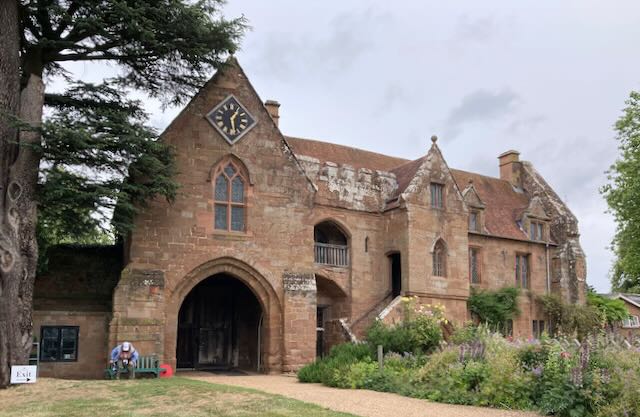
The red sandstone gatehouse, where you buy entry tickets, is from the 14th century, a remnant of the original Cistercian monastery. At this gatehouse, built in 1346 by Abbot Robert de Hoeckle, the poor received alms and travelers found hospitality.
So low did the building stand, that she found herself passing through the great gates of the lodge into the very grounds of Northanger, without having discerned even an antique chimney. . . . To pass between lodges of a modern appearance, to find herself with such ease in the very precincts of the abbey, and driven so rapidly along a smooth, level road of fine gravel, without obstacle, alarm, or solemnity of any kind, struck her as odd and inconsistent.–Catherine Morland, Northanger Abbey
Now we are coming to the lodge-gates; but we have nearly a mile through the park still.–Maria Bertram, Mansfield Park
The tour did not take us into this north wing. But you can still see arches on the walls, from the original monastery church. They are now bricked over. A cloister and medieval stained glass windows remain in the older buildings.
Another building from the old monastery. Stoneleigh Abbey was a small Cistercian monastery from 1155 until Henry VIII dissolved the monasteries in 1536. The Leigh family bought it in 1561. Catherine Morland was disappointed not to stay in such a building at Northanger Abbey.
[Catherine] was hardly more assured than before, of Northanger Abbey having been a richly endowed convent at the time of the Reformation, of its having fallen into the hands of an ancestor of the Tilneys on its dissolution–Northanger Abbey
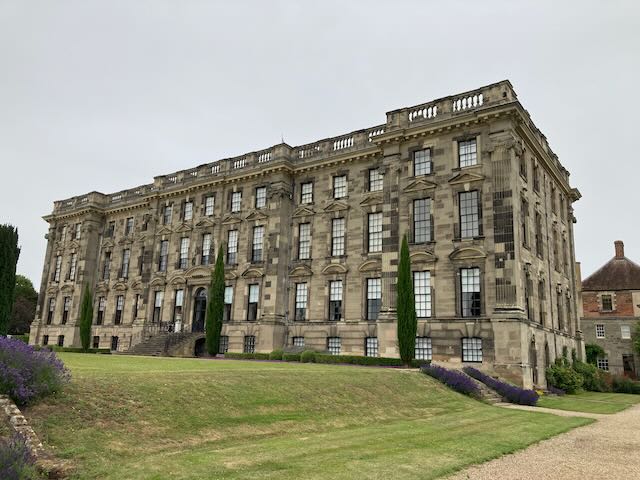
The baroque West Wing is the most impressive building, built in the 1720s by Edward, the third baron Leigh. He married a rich heiress. After his Grand Tour on the continent, he was inspired to create his own Italian-style palace. Mrs. Austen wrote that there are 45 windows in the front.
She was struck, however, beyond her expectation, by the grandeur of the abbey, as she saw it for the first time from the lawn.–Catherine Morland, Northanger Abbey
Even Fanny had something to say in admiration. . . . Her eye was eagerly taking in everything within her reach; . . . being at some pains to get a view of the house, and observing that “it was a sort of building which she could not look at but with respect”–Mansfield Park
Architect Francis Smith designed the Stoneleigh Abbey West Wing, which cost £3,300. The older abbey buildings became servants’ quarters.
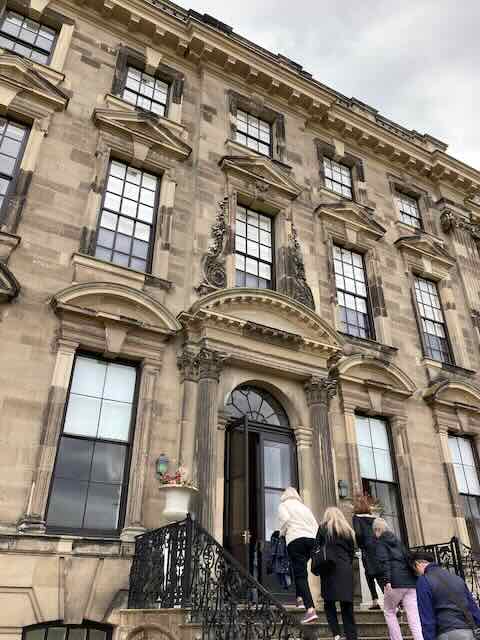
A flight of stairs leads up to the main entry to Stoneleigh Abbey, West wing
Miss Bertram could now speak with decided information of what she had known nothing about when Mr. Rushworth had asked her opinion; and her spirits were in as happy a flutter as vanity and pride could furnish, when they drove up to the spacious stone steps before the principal entrance.–Mansfield Park
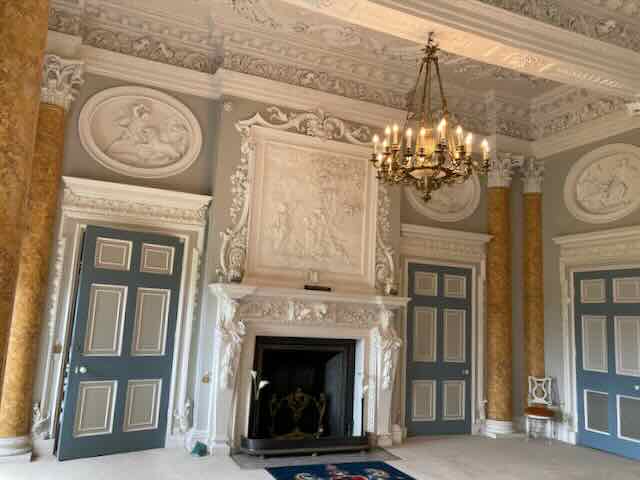
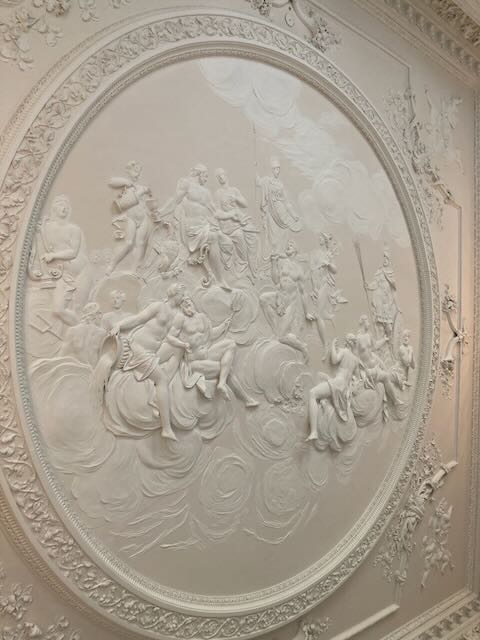
One end of the impressive “saloon” (salon, entry room) of Stoneleigh Abbey. Plaster decorations show myths of the Greek hero Hercules. Edward, the fifth Lord Leigh, decorated this room in the 1760s while doing vast “improvements” to his manor.
Ceiling plasterwork in the Stoneleigh Abbey saloon showing Hercules joining the gods. Ironically, Hercules suffered from bouts of madness, as did Edward Leigh himself.
An abbey! Yes, it was delightful to be really in an abbey! But she doubted, as she looked round the room, whether anything within her observation would have given her the consciousness. The furniture was in all the profusion and elegance of modern taste.–Catherine Morland, Northanger Abbey
The whole party rose accordingly, and under Mrs. Rushworth’s guidance were shewn through a number of rooms, all lofty, and many large, and amply furnished in the taste of fifty years back, with shining floors, solid mahogany, rich damask, marble, gilding, and carving, each handsome in its way.–Mansfield Park
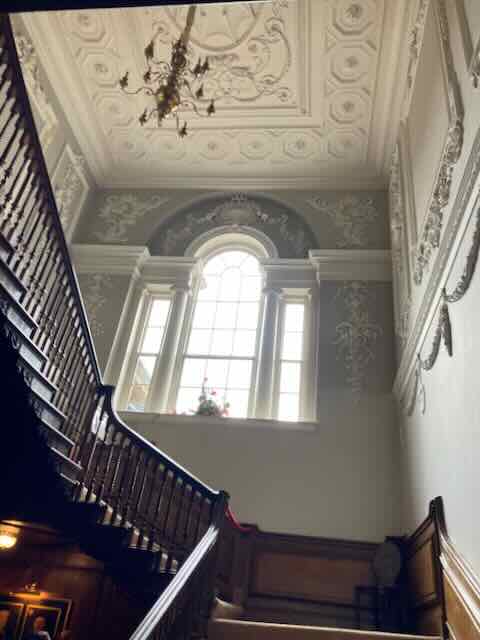
The main staircase of Stoneleigh Abbey, one of three staircases Jane Austen’s mother mentions.
They returned to the hall, that the chief staircase might be ascended, and the beauty of its wood, and ornaments of rich carving might be pointed out.–Northanger Abbey
The lower part of the house had been now entirely shewn, and Mrs. Rushworth, never weary in the cause, would have proceeded towards the principal staircase, and taken them through all the rooms above, if her son had not interposed with a doubt of there being time enough.–Mansfield Park
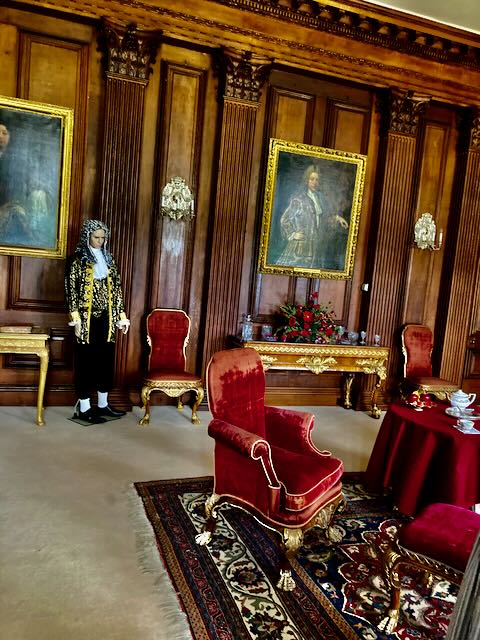
The drawing room of Stoneleigh Abbey. After dinner, the ladies would “withdraw” to the “withdrawing room,” later called the drawing room. The gentlemen would join them after a time.
The general leads Catherine “into a room magnificent both in size and furniture—the real drawing-room, used only with company of consequence. It was very noble—very grand—very charming!—was all that Catherine had to say, for her indiscriminating eye scarcely discerned the colour of the satin; and all minuteness of praise, all praise that had much meaning, was supplied by the general: the costliness or elegance of any room’s fitting-up could be nothing to her; she cared for no furniture of a more modern date than the fifteenth century.”–Northanger Abbey
The drawing room clock, from 1786, plays carillon music on the hour. Stoneleigh Abbey
“Till midnight, she supposed it would be in vain to watch; but then, when the clock had struck twelve, and all was quiet, she would, if not quite appalled by darkness, steal out and look once more. The clock struck twelve—and Catherine had been half an hour asleep.”–Northanger Abbey
Stoneleigh Abbey card room fireplace, with plates of “the prettiest English china,” hand painted by ladies of the family.
The fireplace, where she had expected the ample width and ponderous carving of former times, was contracted to a Rumford, with slabs of plain though handsome marble, and ornaments over it of the prettiest English china.–Northanger Abbey
A Rumford was an invention that made fireplaces more efficient. They are still used today.
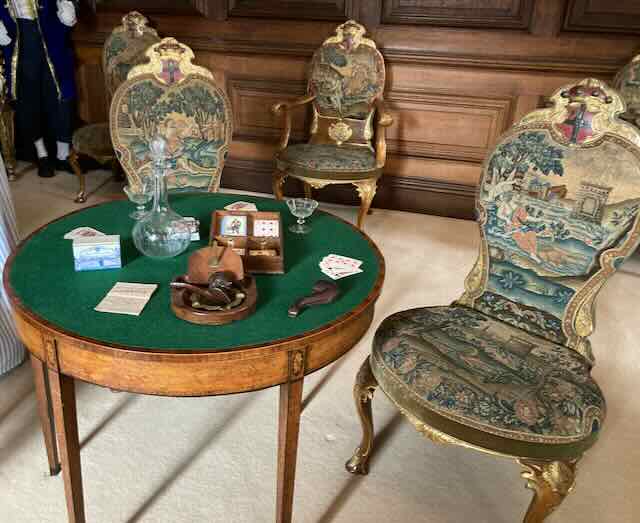
Stoneleigh Abbey card room, set up for a game of cards.
Mr. Elton had retreated into the card-room, looking (Emma trusted) very foolish.–Emma
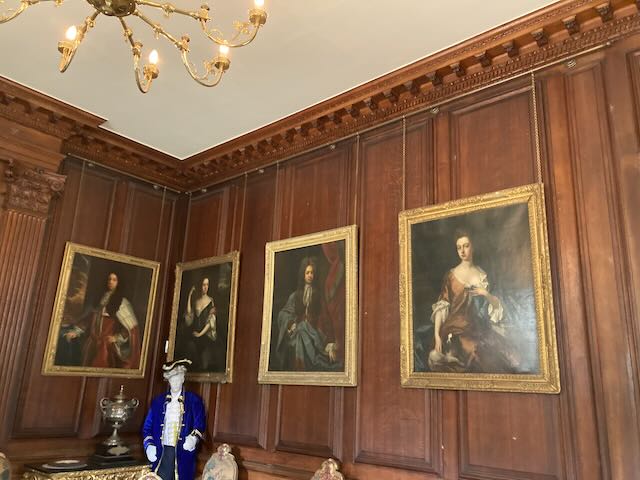
Portraits in the Card Room. All the rooms we saw were lined with family portraits.
Of pictures there were abundance, and some few good, but the larger part were family portraits, no longer anything to anybody but Mrs. Rushworth–Mansfield Park
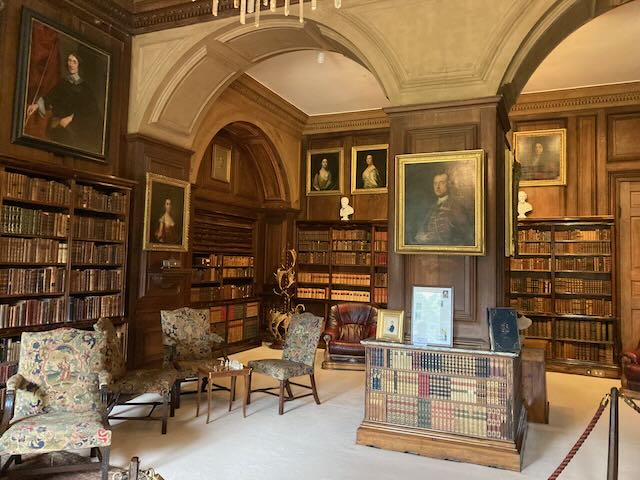
Edward, fifth Lord Leigh, bequeathed most of his extensive library to his alma mater, Oriel College at Oxford. These included “outstanding works on architecture and music, his scientific instruments, maps and prints.” (Jane Austen & Adlestrop, 22).
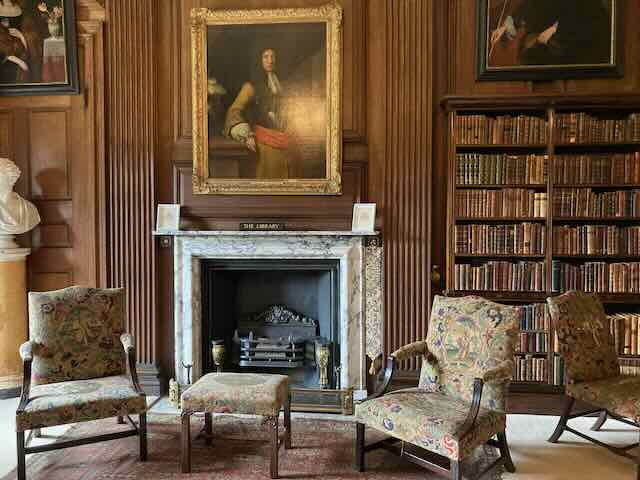
The library of Stoneleigh Abbey was replenished by later heirs.
Marianne, who had the knack of finding her way in every house to the library, however it might be avoided by the family in general, soon procured herself a book.–Sense and Sensibility
Ready to play chess in the library, Stoneleigh Abbey
“What a delightful library you have at Pemberley, Mr. Darcy!”
“It ought to be good,” he replied, “it has been the work of many generations.”
“And then you have added so much to it yourself, you are always buying books.”
“I cannot comprehend the neglect of a family library in such days as these.”–Miss Bingley and Mr. Darcy, Pride and Prejudice
Stoneleigh Abbey library
After tea, Mr. Bennet retired to the library, as was his custom–Pride and Prejudice
Ladies’ dressing table, Stoneleigh Abbey
“My mother is tolerably well, I trust; though her spirits are greatly shaken. She is up stairs and will have great satisfaction in seeing you all. She does not yet leave her dressing-room.”–Jane Bennet, Pride and Prejudice
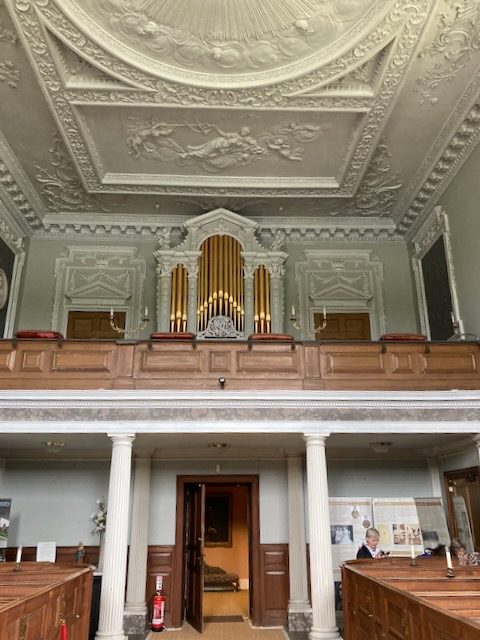
The chapel at Stoneleigh Abbey is considered to be the model for the chapel at Sotherton in MansfieldPark. Crimson cushions appear over the balcony ledge, as in Mansfield Park. Rev. Thomas Leigh read prayers (led a worship service) in the chapel twice a day, with morning prayers at 9 A.M.
Fanny’s imagination had prepared her for something grander than a mere spacious, oblong room, fitted up for the purpose of devotion: with nothing more striking or more solemn than the profusion of mahogany, and the crimson velvet cushions appearing over the ledge of the family gallery above. “I am disappointed,” said she, in a low voice, to Edmund. “This is not my idea of a chapel. There is nothing awful here, nothing melancholy, nothing grand.” . . .
Mrs. Rushworth began her relation. “This chapel was fitted up as you see it, in James the Second’s time. Before that period, as I understand, the pews were only wainscot; and there is some reason to think that the linings and cushions of the pulpit and family seat were only purple cloth; but this is not quite certain. It is a handsome chapel, and was formerly in constant use both morning and evening. Prayers were always read in it by the domestic chaplain, within the memory of many; but the late Mr. Rushworth left it off.” . . .
“It is a pity,” cried Fanny, “that the custom should have been discontinued. It was a valuable part of former times. There is something in a chapel and chaplain so much in character with a great house, with one’s ideas of what such a household should be! A whole family assembling regularly for the purpose of prayer is fine!”–Mansfield Park
Queen Victoria’s bedroom at Stoneleigh Abbey. In 1858, Queen Victoria stayed for two nights at the Abbey, in a suite of five rooms. The furniture was painted white and gold, according to the Queen’s preference.
In a house so furnished, and so guarded, she could have nothing to explore or to suffer, and might go to her bedroom as securely as if it had been her own chamber at Fullerton.–Catherine Morland, Northanger Abbey
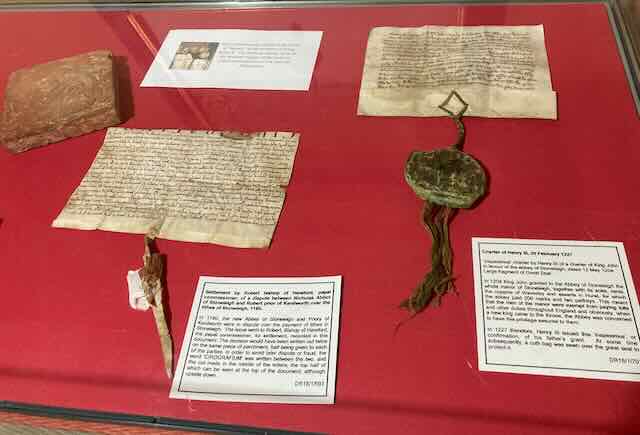
Further rooms at Stoneleigh Abbey display historical relics, such as the monks’ charters and seals.
Northanger turned up an abbey, and she was to be its inhabitant. Its long, damp passages, its narrow cells and ruined chapel, were to be within her daily reach, and she could not entirely subdue the hope of some traditional legends, some awful memorials of an injured and ill-fated nun.–Catherine Morland, Northanger Abbey
Humphry Repton was hired to improve Stoneleigh Abbey and its surroundings. His Red Book, showing before and after pictures, still exists.
Repton moved the river toward Stoneleigh Abbey so you could see the house reflected in the water.
“Smith’s place is the admiration of all the country; and it was a mere nothing before Repton took it in hand. I think I shall have Repton.”–Mr. Rushworth, Mansfield Park
A ha-ha (see below) at Stoneleigh Abbey gives an uninterrupted view across the fields.
From the other side of Stoneleigh Abbey’s hedge of lavender shown above, you can see the wall that kept animals from trespassing to the area around the house. A ha-ha is a walled ditch dug to act as a fence without disrupting the view.
A few steps farther brought them out at the bottom of the very walk they had been talking of; and standing back, well shaded and sheltered, and looking over a ha-ha into the park, was a comfortable-sized bench, on which they all sat down. . . .
“You will hurt yourself, Miss Bertram,” [Fanny Price] cried; “you will certainly hurt yourself against those spikes; you will tear your gown; you will be in danger of slipping into the ha-ha.”–Mansfield Park
In 1946, Stoneleigh Abbey became “one of the first stately homes to open its doors to the public” (Stoneleigh Abbey, 18). A fire destroyed much of it in 1960, though most of the furniture and paintings were rescued. In 1996, a trust was set up to restore it, at a cost of £12 million. They did an amazing job. Restoration was also done on the grounds and the lake. The restoration work sought to improve the habitats of bats, otters, kingfishers, and other species
Restorers also worked on conserving water management structures such as these locks.
We exit back through the Stoneleigh Abbey gatehouse, having enjoyed a beautiful day.
I hope you have enjoyed our visit to Stoneleigh Abbey with Jane Austen’s characters, and that you can see it in person some day! This year, the Abbey celebrated Christmas with a Christmas fair and a series of concerts, including carols in the chapel. If you have been to Stoneleigh Abbey, please tell us about your impressions!
Ah, holiday gatherings! December is an historic month to celebrate good cheer and good will towards family, friends, and neighbors – this means inviting guests for food, drink, music, games, and entertainments. During Austen’s time, the hosts at houses or assemblies traditionally provided refreshments for their guests. Centuries later we still follow these wonderful customs. This post concentrates on popular drinks prepared for the ladies in the Regency era.
“Cordials were popular for social occasions—ratafia, orgeat, negus, and punch among others. Ratafia used a base of distilled spirits into which aromatics were infused, often almonds or fruit pits, and the brew was then sweetened. Orgeat was a syrup made with sugar, orange flower water, and almond that was added to distilled spirits. Negus used a base of sherry or port, to which were added hot water, sugar, nutmeg, and lemon; it was considered an appropriate drink for men or women.“
Regency Drinks
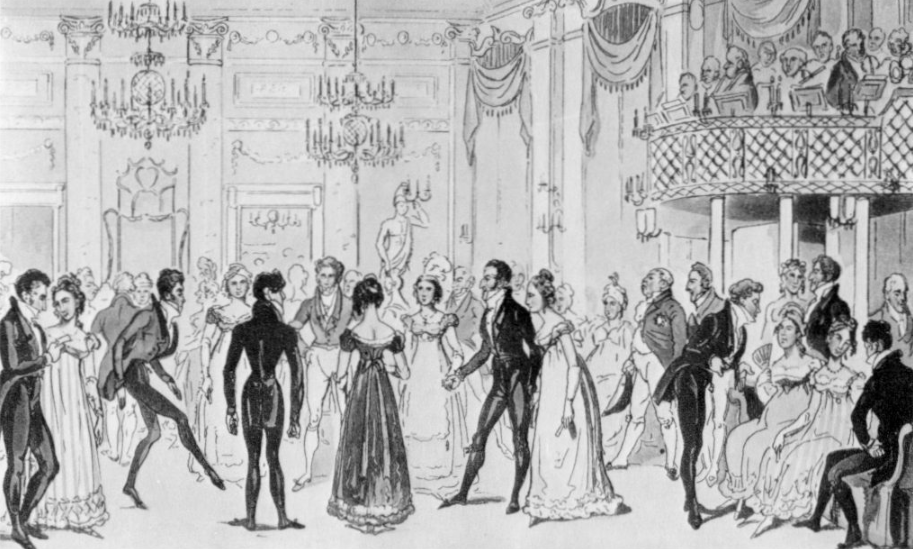
According to history, the patronesses of Almack’s served watered down drinks of orgeat and ratafia, since both of these refreshments were deemed acceptable for ladies. The drinks remained syrupy sweet. Men in general arrived at this strictly exclusive event already soused from having drunk hard liquor at their clubs or at home. Syrupy sweet, watered down drinks would not have tempted them.
A Ball at Almack’s Assembly Rooms in London, 1821, Version of illustration from the “Tom and Jerry” book (1821) by George CruikshankWikipedia
“There was a balcony at one end where the small orchestra were seated. Refreshments (such as they were) were deliberately (revoltingly) mediocre: weak lemonade or orgeat or ratafia, dry biscuits and day-old brown bread and butter. – Almack’s – it’s not quite what you think…
In no particular order, the drinks served in public assemblies and at festive gatherings were:
Orgeat
This light, sweet drink was considered appropriate for debutantes. While orgeat was not mentioned by Jane Austen, it was popular in her time. Pronounced or-zat, readers of Georgette Heyer novels can easily associate this drink with the watered down refreshments described at Almack’s that were considered too syrupy for male tastes.
Author Sharon Lathan provides a fascinating insight into the history of orgeat, which was once made with barley. The syrup can be purchased today to satisfy a variety of tastes.
“Orgeat syrup, made with almond extract, sugar, and orange flower water, was (and still is) added as a flavoring to punch, coffee, or cocktails. I wouldn’t want to drink this milky liquid by itself, and a little bit goes a long way (we usually only use 1/4 ounce per cocktail). Some drinks were made like orgeat lemonade. Orgeat lemonade would have been orgeat syrup, lemonade and soda water, and might well have been the sort of drink served at Almack’s. and orgeat (distilled from barley or almonds with orange flower water, considered to be a light refreshing drink), Almack’s Assembly Halls – LLWiki
Orgeat was once made with bitter almonds, which in large quantities contained cyanide. The drink could be lethal. Today’s recipes are made with sweet almonds, which reduce the levels of hydrocyanic acid, and are considered safe, except for individuals with allergies. Wikipedia
The Spruce Eats offers a modern orgeat recipe. Here’s the link: Orgeat Syrup Recipe
Negus
Negus was an English drink popular in the 18th and 19th centuries. It was an “extremely popular party drink throughout Georgian and early Victorian times.” — The Jane Austen Cookbook, Maggie Black & Deirdre Le Faye)” Click on this link.
Austen mentioned negus in The Watsons:
“As Tom Musgrave was seen no more, we may suppose his plan to have succeeded, and imagine him mortifying with his barrel of oysters in dreary solitude, or gladly assisting the landlady in her bar to make fresh negus for the happy dancers above.” – The Watsons
Interestingly, during the early Regency era negus and white soup were expected to be served near midnight at balls, such as the one at Netherfield Park. Here’s Martha Lloyd’s recipe for the soup.
One can imagine the aftermath of the dinner in Emma, when the guests, because of Mr Woodhouse’s panic, quickly departed from the Weston’s party due to a smidgen of fallen snow. Did anyone receive a comforting drink of negus before they hastened into their carriages, I wonder? Mr Elton perhaps?
Negus still figured prominently in Victorian times. Charles Dickens in “A Christmas Carol” mentioned old Mr Fezziwig:
“There were more dances, and there were forfeits, and more dances, and there was cake, and there was negus, and there was a great piece of cold roast, and there was a great piece of cold boiled, and there were mince pies and plenty of beer.” – Negus – vintage cookbook shelf
Over time, negus morphed into a children’s drink . Yet it still contained alcohol!!. No longer fashionable, the beverage had become similar to mulled wine, as this recipe in Mrs Beeton’s Book of Household Management attests, and it was made with a variety of ingredients.
“Negus does have striking similarities to mulled wine — with interchangeable main ingredients of red wine/port, nutmeg, sugar, and citrus like lemon juice or orange zest. So, it seems, the most striking and significant difference between the two popular warm sips is the addition of hot water to the negus recipe – A Short History of Negus, the Mulled Wine Beverage of Yesteryear | VinePair
Ratafia
Ratafia was another beverage deemed suitable for ladies. Its preparation began in December, with the concoction ready to drink in mid-February. Abigail Reynolds writes:
“…along with lemonade, orgeat, and punch, so I assumed it was similarly low in alcoholic content. Silly me! It’s a liqueur made of brandy with fruit, spices, and crushed fruit pits steeped in it for 1-2 months, then filtered and sweetened with large amounts of sugar. The sweetness and fruitiness meant that men didn’t touch the stuff, but if you think about that recipe for a minute, you’ll realize it’s nothing more than slightly diluted flavored brandy. – Austen Variation, Abigail Reynolds, – Ratafia is Not for Sissies
In her excellent blog, Lesley-Anne McLeod wrote:
“The Professed Cook” has a section titled Des Ratafiats or Of sweet Drams or Cordials. It includes some ten recipes for different versions of ratafia. They all begin with brandy and they all take thirty to forty days to prepare and infuse. The adventurous cook, it seems, can add almost anything to the brandy. Some of the ingredients listed in “The Professed Cook” include walnuts, quinces, orange-flowers, juniper-berries, lemon-peel, anise seeds and apricots. Plenty of sugar is included and three spices in these receipts in particular–coriander, cinnamon and cloves.” – Lesley-Anne McLeod, Ratafia, The Lady’s Choice
Ratafia, was either distilled or with an infusion of fruits and spices. The drink had an alcoholic base of Marc brandy and grape juice. A liqueur routinely made in December, could be ready to serve two months later on Valentine’s Day. A recipe for dark brown ratafia suggested that it be stored in an oak barrel for at least two years. — Gin Affair Champagne Punch – Bridgerton Cocktail
At the end of an evening:
In Austen’s day, often after a local assembly ball, a neighbor’s party, or a return from the opera or theatre in town, supper was served quite late. People would gather to eat or drink before returning home in the wee hours of the morning. White soup was served, as well as negus, which was prepared a half hour before guests left for home.
This Saturday, December 16th, we wish Jane Austen a very happy birthday! Austen fans and groups around the globe will unite this weekend to celebrate our favorite author, her incredible life, and the novels she wrote.
Here are a few ways you can join in the fun!
Design: Rachel Dodge; Image: James Edward Austen-Leigh, Memoir of Jane Austen, London 1870, Wikimedia Commons.
Schedule a Jane-a-Thon
When is the last time you took a full day off to read Jane Austen’s beloved novels? I can’t imagine a better way to honor her life and celebrate her birthday!
My daughter schedules 24-hour read-alongs with her best friend whenever she has a break from school. I could never handle 24 hours of reading without falling asleep (ah, to be young!), but when I watch them gather their snacks, make their reading schedule, and read around the clock together for a full 24 hours, I always find it inspiring. Don’t you?
Schedules permitting, perhaps you might block off a day or half a day and devote yourself to a Jane-a-thon! Can you imagine spending the whole day with your nose in a Jane Austen novel (or two)?
You might also take a tour of her novels: You could read your favorite portions of each novel, read all the opening chapters and compare Austen’s style in each, or read all of the final chapters and see which one is most satisfying.
Photo: Rachel Dodge
Watch the Films
Another favorite way to celebrate Austen is to have a movie marathon. You can do this alone or with a friend (or a group of friends)! If you want to do a true marathon, you can try to cover all six novels in a day or pick one novel and watch several versions to compare them.
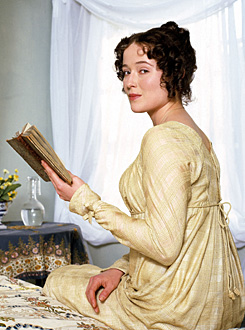
I personally love to turn on the 6-hour, BBC version of Pride and Prejudice (1995) and get some of my Christmas projects done! It’s the prefect movie to watch while you wrap gifts, stuff Christmas cards, bake cookies, or work on other projects.
Jennifer Ehle as Elizabeth Bennet, Pride and Prejudice (1995).
Eat Good Food!
Whether you’re reading Austen’s novels, watching the movie adaptations, or honoring Jane in other creative ways, you must buy or make a few treats to eat in honor of Jane. A traditional English tea can be prepared with homemade or store bought cakes, scones, sandwiches, or other tasty treats.
Truly adventurous bakers might try their hand at traditional Regency baked goods. There are many recipes online, in the many Jane Austen cookbooks that have been published over the years, and in several tea time books devoted to Jane Austen. Here is one of my favorites!
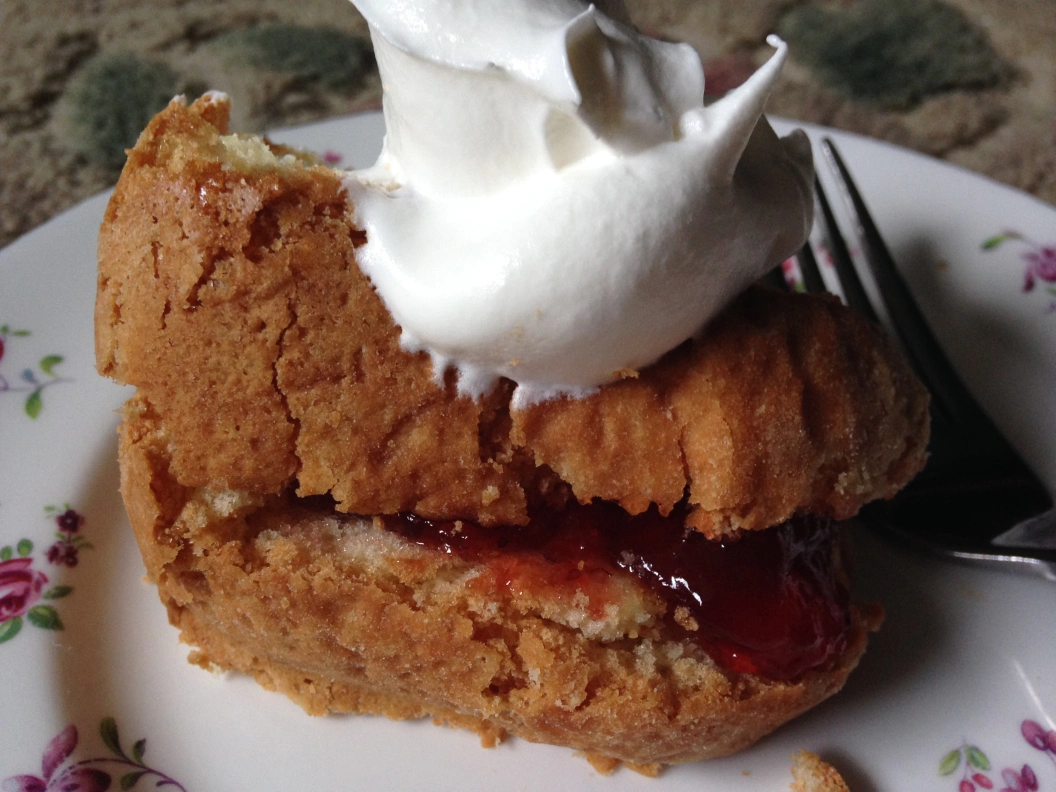
This recipe from Bite From the Past looks lovely. Angela Hursh provides helpful step-by-step instructions for making the recipe for Jane Austen’s Sponge Cake from Cooking with Jane Austen and Friends by Laura Boyle (now out of print).
Join the Party!
If you really want to go all-out, Jane Austen’s Virtual Birthday Party, hosted by Jane Austen’s House Museum, is a much-loved annual tradition. If you’ve never joined the party online, there is room for everyone! Jane’s birthday falls on Saturday this year, so reserve your spot and set your alarm (depending on your time zone).
Party guests will enjoy fabulous music, fascinating talks, beautiful readings, and all sorts of fun and games in the spirit of Jane Austen and her family.
Description from JAHM: “We’ll be joined by some very special guests! Enjoy a mini keynote by fabulous historian and broadcaster Lucinda Hawksley, a quick dive into Georgian prints by historian Alice Loxton, a dramatic reading by actor Rebecca Tanwen, a sneak peak into the making of the Jane Austen collection at Moorcroft Pottery, a reading by Jessica Bull from her debut novel Miss Austen Investigates, and beautiful music by pianist Laura Klein!”
Regency attire strongly encouraged!
Party Details:
Date: Saturday 16 December Time: 8pm – 9pm (GMT) Location: This event takes place online. Join in from the comfort of your own home! Tickets: £10
Note: This event will be recorded so ticket holders can enjoy it at a later date if needed!
Finally, one tangible way to celebrate Jane Austen’s birthday is to consider giving a gift in her honor to Jane Austen’s House Museum. Chawton Cottage is lovely, secluded, and historic. I’ve visited the house several times, and it is an absolute treasure for Jane Austen fans. This is one simple way we can all play a part in preserving Jane Austen’s legacy both now and in the future.
The House Museum’s current Courtyard Restoration Appeal is designed to help raise funds toward repairing and restoring the roofs of the courtyard buildings, including the Bakehouse, cellars, offices, store rooms, and privy! You can find out more here.
Wherever your plans take you this weekend, I hope you’ll join me and everyone here at Jane Austen’s World in honoring and celebrating our Jane on her birthday. She has given us so much, and we all love her tremendously.
This post features the recollections about a severely cold winter in 1794/95 by three Englishmen: Rutland squire, Thomas Barker, the Rev James Woodforde, a country parson whose diary (1759-1802) provides valuable first hand insights, and an event described by Matthew Flinders, listed in the Lincolnshire Archives. Interestingly, their observations, which read like today’s text messages, will intrigue the modern reader.
The weather in central England during the fall of 1794 started out warmly. Barker recorded:
“The autumn though wet was mild; swallows and martins did not go away till about October 18; the autumnal flowers continued till December, anemones were then in flower; winter and spring flowers were forward, and the leaves of the spring crocus appeared.”
Reverend James Woodforde came to Weston Longville, a small village north of Norwich, in 1775 and remained as rector until his death in 1803. During this time he kept a diary of his life as a country parson. While he mostly focused on parish visits, food, and the people and villages in his surroundings, he concentrated many of his observations on the weather from October to March 1794/95. His descriptions dovetailed nicely with Barker’s notes. In the next two passages Woodforde also mentioned the rains in October and flowers in November:
“The Rain that Fell yesterday [October 6] rose the Water at Foxford & East Mills quite high, Nancy very much alarmed and frightened therewith as it came almost into our little Cart.”
and
“Nov. 30, Sunday …. Mem. a Primrose in my Garden in full bloom, seen by myself and my Niece.”
Thomas Barker then referred to the sudden change in the balmy weather:
“But in the latter half of December the scene altered, and the frost began; it was a mixture of severe and moderate frost, falling and melting snows, and floods, with hard frost and breaks; the beginning of a very severe winter … for a quarter of a year, yet now without a thawing day or two now and then in January…”
Pastor Woodforde wrote a sequence of descriptions on weather events and how they impacted his life. One gains a visceral sense of how the intense and unrelenting cold invaded houses and affected the inhabitants down to their bones.
Dec 25, Thursday, X-mas day….It was very cold indeed this Morning, and the Snow in many Places quite deep, with an E. Wind. About 11. this Morning I walked to Church and read Prayers & administered the Holy Sacrament. Had but few Communicants the Weather was so bad….The Weather being so severely cold, which I could never escape from feeling its effects at all times, affected me so much this Morning, that made me faint away…..Mr Howlett after Service, very kindly offered to drive me home in his Cart, but as I was better I declined it, however hope that I shall not forget his civility….
and
Jan. 15, Thursday….Got up this morning very bad indeed in the Gout in my right foot….The Weather Most piercing, severe frost, with Wind & some Snow, the Wind from the East and very rough…I had my bed warmed to night & a fire in my bed-Room….Obliged to put on my great Shoe, lined with flannel. The Weather very much against me besides.
and
Jan. 21, Wednesday….The last Night, the most severest yet, extreme cold. So cold that the Poultry kept in the Cart-Shed and obliged to be driven out to be fed….
Image of George Morland, 1763-1804, British Winter Landscape with Figures, ca. 1785 Yale Center for British Art, Public Domain
Jan. 23, Friday….The Weather more severe than ever, it froze apples within doors, tho’ covered with a thick carpet. The cold to day was the severest I ever felt. The Thermometer in my Study, with a fire, down to No. 46….
and
Jan. 25, Sunday….The Ice in the Pond in the Yard which is broke every Morning for the Horses, froze two Inches in thickness last Night, when broke this morning.
The pastor also wrote that a terrible storm took the thatch off the barn and stripped the tiles from his roof. On the 28th he described a “very severe frost indeed. It freezes sharply within doors,” and he related the sad news of two women who “froze to death Saturday last going home from Norwich market to their home.”
Early February provided a smidgen of hope:
Feb. 8, Sunday…..Weather much altered, very foggy and a cold Thawe, with very small Rain, all the whole day. I hope to God that now We shall no more have any severe Frosts this Year…
Woodforde’s hopes were premature, however. Thomas Barker observed that a thaw for four or five days from February 8 to 12:
“…took away a great part of the snow, and made a greater flood than any remembered, which did more damage to the bridges all over the kingdom than was ever known yet without taking away all the ice and snow; the frost returned again as hard as before, and with a less break near the end of February …”
The Lincolnshire Archives provides a description from Matthew Flinders, who wrote about the abnormal winter and great flooding as the snow melted. His observations add dimension to Barker’s and Woodforde’s writings, for he referred to the misery that farmers and peasants must have felt. He also mentioned the war raging in the background, which affected all Englishmen during this period.:
“…This has been the severest winter in these climates known in living memory… the snow began at Xmas Eve – and continued with intervals most of the time. I think I may say more has fallen than in the last 7 years together and several times more on the ground, than has been since the great snow in 1767 when it was a yard deep on the level… very great damage has been done on the breaking up of the frost by the floods – numbers of bridges being broke down, and large tracts of land overflowed – no such flooded known since the memorable year 1764. Great injury done to the farmers – much sowed wheat destroyed & the poor much distressed – tho’ there were very liberal subscriptions in many towns. This added to the distress occasioned by the War – has given the times an alarming aspect w’ch I hope God in his good time will remove.” [Lincolnshire Archives] – Extreme weather events in focus: White Christmases
The flooding was ruinous to the winter crops. Pastor Woodforde also worried that the poor people would suffer from the effects.
More recently, John Kington from the University of East Anglia states that the cold in January 1795:
…was exceptionally severe, it was not until Christmas Eve 1794 [as previously related] that the very cold conditions set in The frost then lasted, but without breaks, until late March. The cold was most intense in January, which resulted in the coldest January (-3.1°C) in the Central England Temperatures series (Manley 1974). – The Severe winter of 1794/95 in England, Climatic Research Unit, University of East Anglia, Norwich
An article in The Guardian dated Jan 01, 2022 provides the following information about the cold’s impact on people:
The coldest January since 1659, when records began in England, was in 1795 when rivers including the Thames and Severn froze over. The temperature barely rose above freezing all month.
and
Country parsons, who fed poor people at Christmas, gave them a shilling each to buy food for January. Grain was in already in short supply because of a dry summer and hunger became so widespread that the following spring there were bread riots. (Read more on this topic later in this post.)
The thaw previously mentioned on February 8 by Parson Woodforde and Thomas Barker resulted in floods that devastated lands in Norwich, near the Pastor’s parish, but also farther west in Shrewsbury. Shrophsire Star.com features a facsimile of the news published on February 13, 1795. The following information are excerpts from that facsimile, which you can read in full at this link to the article.
In consequence of the sudden thaw after so long a frost, the Severn has overflowed its banks to a higher degree than ever was known in the memory of man. This town is, therefore now nearly an island; neither the Mail-Coach or any other carriages could get out of town on Wednesday morning, the water being so deep at both the bridges….
and
…Great quantities of timber have been carried away by the violence of the flood; several houses are fell in, and the furniture entirely swept off;…the inhabitants….cannot leave their habitations but by boats; a number of horses, cattle and pigs have been drowned…
and
Great praise is due to several humane Gentleman, who were active in assisting the poor people whose dwellings were inundated. Several boats loaded with fresh meat, bread and cheese, etc. were sent for the relief of such poor persons who could not leave their habitations, and which was given to them thro’ their chamber windows.
The flooding did not reflect the full extent of the damage from the east of central England to the west, for the “thaw” did not last. A cold spell ten days later froze the Severn to such an extent that John Kington wrote:
On the 23rd [of January], the Severn [river] was frozen and a printing press, after the fashion set on the Thames, was set up on the ice.
The River Severn, which is the longest river in England, experienced thick frosts during the “mini” ice age of the 16th, 17th, and 18th centuries. By 1795 at least ten frost fairs were held on the Thames River. Communities along the Seven, while not as organized as those along the Thames, held frost fairs in 1620, 1622, 1795, and lastly in 1855. – Wyre Forest Net
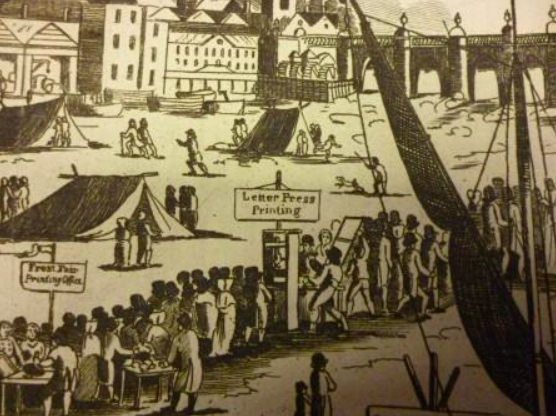
Despite the hardships from the hard freezes, these “frost fairs” provided winter entertainments in the form of food tents, sports, and games. Paper souvenirs were printed on the ice. They all but shouted for posterity — “I was at the Frost Fair at the Severn in 1795!” These mementos could be simple or more elaborate, depending on the amount of money the fair goer could afford to spend. The image below of a Frost Fair on the Thames River shows a long line of revelers waiting at the printing press for their choices. Other images in the links provided below depict simple or more elaborate souvenirs saved by fair goers.
Close up of a printing press set up on ice on the Thames River.The British Library, Printing on Ice
This link leads to four affordable paper souvenirs printed on a sheet. Click to view. This elaborate Frost Fair souvenir was printed in 1740. Click here.
In his Memoir of that winter, Pastor Woodforde did not mention a Frost Fair, but he continued to observe the weather in his diary. On Feb. 18 he wrote:
Wednesday….Very hard Frost, with strong Easterly Winds, a black Frost*. Every Vegetable seems affected by it. A cold this day almost, as any this Winter. I felt it before I got up this Morning, pain within me. It froze very sharp within doors all the day long. Dinner to day odds and ends, but very good. Had a fire again in My bedchamber to night, tho’ I had left if off some time, bitter cold to night.
*a dry, non visible killing frost that turns vegetation black (Oxford Languages)
Feb. 20, Friday….This Day is said to be this most cutting this Winter. It snowed the whole Day, but small & very drifting. The cold this day affected us this day so much that it gave us pains all over us, within & without and were even cold tho’ sitting by a good fire….
and
Feb. 22, Sunday….Severe, cold Weather still continues, froze again within doors. In the Afternoon some Snow. I am afraid now that we shall have more of it–The New Moon being now three Days old, and no appearance of a change.
The weather was unrelenting. Pastor Woodforde went on to say that although he meant to make an appearance at church, the weather continued on so severely and with so much snow on the ground that he “sent word to my Parishioners that there would be no service.”
His journal mentioned only one final entry in my edition of his memoirs regarding these severe winter events:
March 13, Friday….Ground covered with Snow this Morning, having a great deal of Snow in the Night. The Morning was fair but Air very cold. A 4th Winter….
A fourth winter indeed. Thomas Barker picked up the narrative:
… it continued into March. It was in general a calm frost, with vast quantities of snow coming and going, so that though it was pretty thick at times, it never lay so deep as it sometimes does. But perhaps some of the deep pits of snow and beds of ice were not entirely gone at the end of March.”
The effects of this cold weather on the populace did not end with a warming spring.
“Grain was already scarce thanks to a hot and dry summer in 1794, but Britain was at war with revolutionary France, too, which disrupted imports and raised food prices even higher. The Gentlemen’s Magazine, a popular periodical from the time, warned of “unprecedented inclemency” – How British people weathered exceptionally cold winters, University of Liverpool Research News, 04 January 2021
Some rich landowners feared an uprising due to the scarcity of food, bread, and fuel.
Land agent William Gould’s diary entry for January 21 1795 notes that he was instructed to give money, coal, beef and bread to the hungry around the Duke of Portland’s Welbeck estate in Nottinghamshire. Elsewhere in the county, Reverend Samuel Hopkinson bought peat turf (a kind of fuel) to distribute to the poor on behalf of Earl Fitzwilliam. – University of Liverpool Research News, 2021
Even with this ‘minimal’ support, the general populace suffered and bread riots ensued the following spring.
Fashionable Goodness: Christianity in Jane Austen's England is now available! By JAW contributor Brenda S. Cox. See Review. Available from Amazon and Jane Austen Books.
Available through December 31st, 2025. Click on image for details, and share this poster with other teachers and students!
The Obituary of Charlotte Collins by Andrew Capes
Click on image to read the story.
Comments
“My idea of good company…is the company of clever, well-informed people, who have a great deal of conversation.” – Jane Austen, Persuasion
Gentle readers: Please feel free to post your comments and continue the conversation! Due to SPAM, we will no longer accept comments on posts after 30 days of publication. In some instances, links will be removed from comments as well.
Administrators and Contributors
Vic Sanborn, founder of this blog, is supported by a team of talented and knowledgeable writers about Jane Austen and the Regency era. They are:
Tony Grant, who now contributes his photos from London and England
Click on their names to enter their own blogs.
In addition, we thank the many experts and authors who frequently contribute their posts and opinions, and who continue to do so freely or at our request.
Click here to enter the page. Topics include Regency fashion, historic foods, Jane Austen societies, British sites, related topics. Click on image.
May we suggest?
Hello, my name is Vic and I live in Maryland, USA. I have adored Jane Austen almost all of my life. I am a proud lifetime member of the Jane Austen Society of North America. This blog is a personal blog written and edited by me and my team. We do not accept any form of cash advertising, sponsorship, or paid topic insertions. However, we do accept and keep books and CDs to review.
If you would like to share a new site, or point out an error, please email us. (Yes, we are fallible. We'll own up to our mistakes and will make the corrections with a polite smile on our faces.) Write us at
Thank you for visiting this blog. Your comments and suggestions are most welcome.
Project Gutenberg: eBook of Stage-coach and Mail in Days of Yore, Volume 2 (of 2), by Charles G. Harper
STAGE-COACH AND MAIL IN DAYS OF YORE: A PICTURESQUE HISTORY
OF THE COACHING AGE, VOL. II, By CHARLES G. HARPER. 1903. Click on this link.























 Jane Austen's World