Feeds:
Posts
Comments

Dear readers, This is the latest article from frequent contributor, Patty Saffran, the Contributing Editor for Horse Directory Magazine, about the last surviving harness racing track on LI. One aspect is about the English Thoroughbred stallion Messenger, bred by Richard Grosvenor, First Earl of Grosvenor in the 18th C. The magnificent horse came to the US in 1788 and was the foundation stud of just about every important US Thoroughbred and Standardbred you’ve ever heard of including Seabiscuit, Man o’ War, Secretariat, Seattle Slew, etc. Messenger is buried on LI with a memorial plaque.
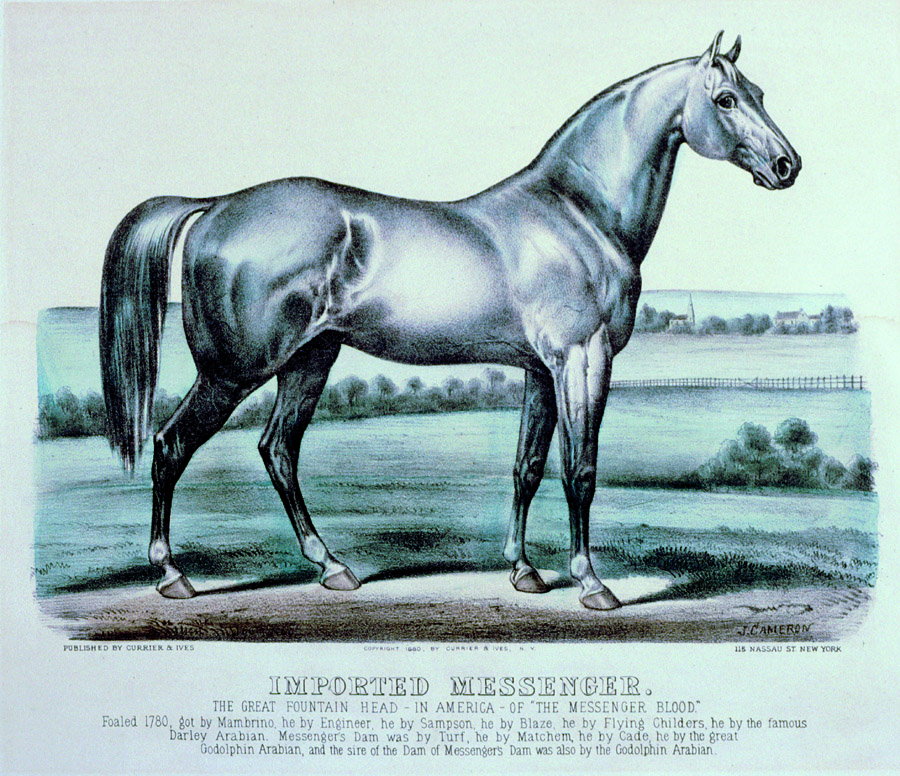
messenger-by-currier-and-ives-courtesy-of-the-harness-racing-museum-and-hall-of-fame-goshen-ny-public-domain.jpg

Messenger by Currier and Ives, courtesy of the Harness Racing Museum and Hall of Fame, Goshen, NY,-public domain image.

Port Jefferson Station, LI residents were once so wild about harness racing that they originally named their village Echo after their local hero, the famous bay gelding harness horse named Echo. Echo won many races at nearby harness tracks located in villages like Setauket, Huntington, and Smithtown and on his local track, the Gentlemen’s Driving Park, which was founded around 1880. There were twenty five harness tracks on LI in the 1880’s. While Echo and his contemporary harness horses may have been pushed aside for the auto and cement roads, the track where he raced, the Gentlemen’s Driving Park has miraculously survived. The Park is the only harness racing track left on Long Island and Jack Smith, President of the Cumsewogue Historical Society of Port Jefferson Station, and many other civic- minded residents are determined to preserve it.

harpers-weekly-trot-1881-wood-engraving-public-domain.jpg

Harpers Weekly trot, 1881, wood engraving, public-domain image.

Mr. Smith recently gave us a tour of the race track, now in a wooded area and hidden from the main road. While the half mile oval is overgrown in the center and on the perimeter, the track is still visible. As we walked around the track, he explained, “The Driving Park was once part of the Grand Circuit of Harness Racing Tracks of the North East and a member of the National Trotting Association. It was the site of many exciting races in its day. Adjacent to the track was the site of legendary owner and trainer Robert L. Davis’s Cumsewogue Training Stables – he also oversaw the race track. Today that land is occupied by the Davis Professional Park. The track itself is located in the woods east of Morgan Avenue and northeast of Canal Road. The oval track is clearly evident in aerial photos of the area.”

53_currier__ives_a_race_from_the_word_go_b.jpg

Currier and Ives, A race from the word go

Mr. Smith continued, “The Driving Park was in use for harness racing until about 1946, but most of the racing was up until about the time of WWI. The reason this track has survived is that until the mid 1950’s teenagers used to race jalopies there. Now, our township is in the process of acquiring the property and, to date, has purchased about half of the acreage. Our Councilman, Steve Fiore-Rosenfeld, has been very diligent in pursuing the acquisition of this historic property. It is being preserved and the land purchased through open space funding.”

On our tour, Mr. Smith said that he has found an actual ticket stub from a race day from July 4, 1892. Also, while looking for horseshoes with a metal detector, he found a pair of period field glasses. These and other items about the Gentlemen’s Driving Park were on recently on display during October-November 2012 at the town library.
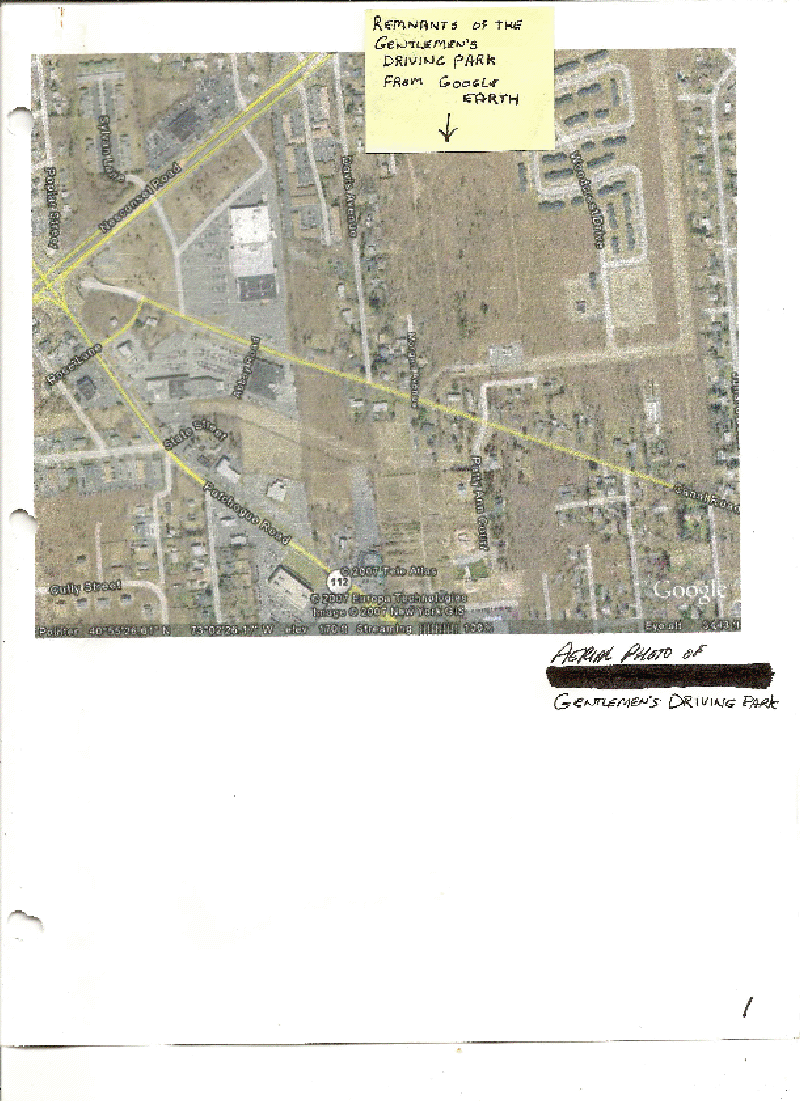
viewer

In 1892,The Port Jefferson Echo (named after the town hero, Echo) reported: “The trotting and running events on the Gentlemen’s Driving Park [later called the Herman Floyd Race Track] on Thursday afternoon, attracted a large attendance, and the number no doubt would have been greatly augmented had the condition of weather been more favorable. Many ladies were present. The fact that no liquor is sold at the park and the absence of its attendant demoralizing scenes have made it possible for ladies to enjoy the races quite as well as their husbands or sweethearts”. Further back, it was reported that Decoration Day, now called Memorial Day, were special race days at the Park in the late 1880’s with ladies admitted free.

The revered local trotter, Echo, a bay gelding was originally bred and owned by Captain Nathaniel Dickerson. Dickerson’s breeding book has yet to be discovered but from the number of races Echo won and the price that Dickerson sold him to D.B. Goff for in 1881, $1,500. (over $34,000. today), he was considered a quality horse. At some point, Echo was sold to Frank Edsall of New York City, a known owner of harness horses who was such a racing devotee that when he died in 1898, he was buried in the famous harness racing town of Goshen, NY. Edsall owned Echo when he was finally defeated on August 9, 1884 in Smithtown by his arch rival Fredonia Boy owned by Colonel Beecher and George Ticehurst of Smithtown.
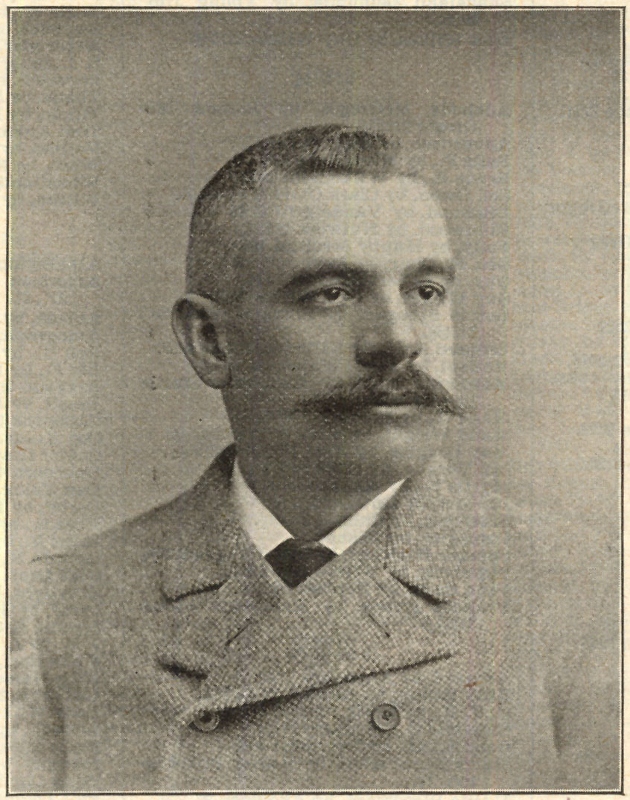
robert_l-_davis_robert-l-davis-owner-of-cumsewogue-training-stables-who-also-oversaw-the-adjacent-gentlemens-driving-park.jpg

Robert L. Davis, owner of Cumsewogue training stables, who also oversaw the adjacent gentlemens driving park

The Port Jefferson Times from August 2, 1884, describes Echo, with affection, something that is rarely seen anymore with reporting on horse racing, “Echo is the pet of the local turf, and the pride of Capt. Dickerson’s heart. A horse that defeats him, will be a good’un. It is doubtful that Solon can do it – ’tis possible that Fredonia Boy may.” The actual race on August 9, 1884 had the crowd in a stir, with lots of money bet on Echo. It was run at the distance of a mile in five heats. There was a judge’s dispute concerning two of the heats, resulting in one judge so disgusted he left the stand and had to be replaced. When it was all over, Fredonia Boy edged out his rival Echo in three out of five heats with Solon third. The analysis was, “The pride of Capt. Dickinson’s heart was broken” and the loss was pinned to Echo being “out of form”, and Fredonia Boy’s driver, Ticehust, being “the best in the county”. Times were between 2:40 and 2:33, with slower high wheelers. (After 1900, many races were run in faster smaller sulkies with tires and more aerodynamic lower driver positions, and the times started dropping.)

Edsall later entered Echo in another race he did not win at Narraganset in September 1884. A few months later, Edsall sold Echo. In The American Gentlemen’s Newspaper, NYC in November 1884, “By Frank Edsall of this city, has sold, through D. B. Goff. [Echo’s previous owner] to Mr. Wm. C. France, the bay gelding Echo, 2:28)4, by Regulus. He was bred by Captain Dickerson, of Port Jefferson. L. Echo was tried to the pole with F. D., 2244, last Saturday, and they speeded a quarter in 31 seconds.” This period sale notice is actually an exciting find today because it mentions Echo’s sire – Regulus. While the records seem to have been lost for Echo, Regulus has turned up in a stud book, Wallace’s American Trotting Register, Vol. 4. It turns out that Captain Dickerson bred possibly his unnamed mare to “Regulus (Suffolk Chief) foaled in 1864, got by Hambletonian 10, dam by American Star, bred by George Lorillard, N. Y. and owned by Joseph Rowland of Miller’s Place, LI [right next to Port Jefferson Station]”. With Echo’s pedigree going back to Hambletonian10, his sire, Abdullah, and thus also to Messenger, Echo is officially descended from the famous foundation sires of the Standardbred, horse royalty. The get from these sires had a natural ability to trot and pace fast. Even the sire of Messinger, Mambrino in England, was noted as preferring to trot around the pasture. Researchers today have discovered that a horse’s ability to trot or pace and to maintain that gait is genetically determined.

william-c-france-in-the-december-25-1894-edition-of-american-horse-breeder-magazine-public-domain.jpg

William C. France in the December 25 1894 edition of American Horse Breeder Magazine, public domain image

It turns out that Long Island turns is rich in horse history and figures in the saga of Messenger. The great Messenger was brought over from England by Irish sportsman Thomas Benger to stand at stud in Philadelphia in 1788 for $15. (Top Thoroughbred stud fees today are from $10,000. to over $100,000.) The gray Messenger was in demand as a sire for pacers, trotters and Thoroughbreds. Messenger was sold, resold and eventually retired to the Townsend Cock farm, Locust Valley, LI after a life at stud in nearby states and locally at the Philip Platt farm in Flushing LI. Messenger colicked and died at the Cock farm in 1808. At what is now called Messenger Hill Farm, a beautiful memorial bronze plaque to this stallion may be found sitting on a large rock along Duck Pond Road, just east of the Piping Rock Road intersection, opposite the Friends Meeting House. The text says:

“Approximately twenty paces to the south of this spot lies MESSENGER, Foaled in England in 1780, brought to America in 1788, Buried with military honors on January 28, 1808, Descended from England’s greatest Thoroughbreds, Son of Mambrino and of a daughter of turf, Bred by the First Earl of Grosvenor, No stallion ever imported into this country, Did more to improve our horse stock, None enriched more the stock of the whole world, Today his blood is carried by most American Thoroughbreds, As the great founder, Of the breed of Standard Bred light harness horses, His blood is now dominant, In America throughout Europe and in Australia, Among his direct descendants is every two minute trotter, ‘None but himself can be his parallel’, [Homer describing Hercules] In tribute to, His enduring greatness, This memorial has been erected by American horse lovers. A.D. 1935”.
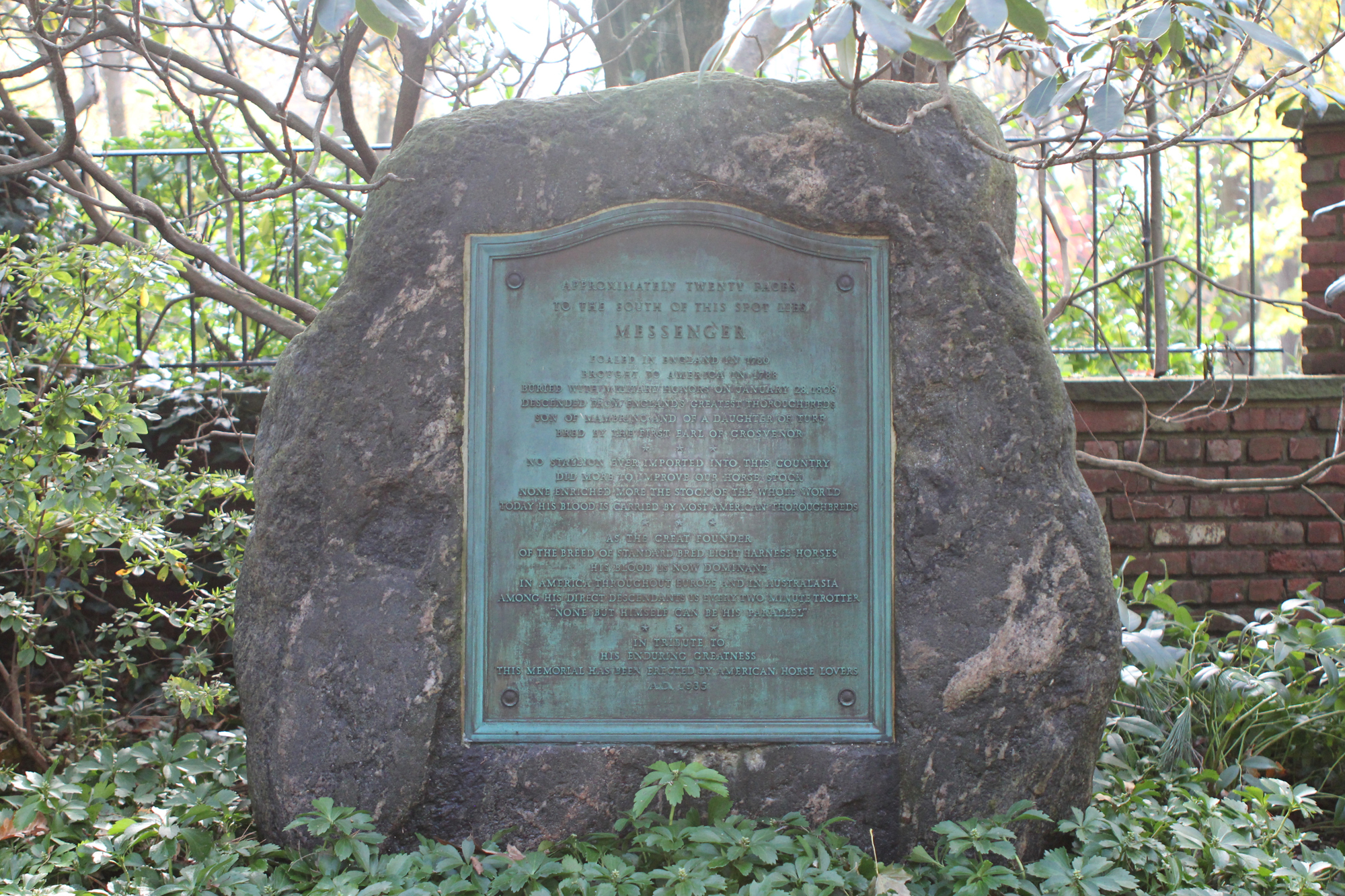
messenger-rock-photos-by-amanda-fisk-courtesy-of-friends-academy-locust-valley-li.jpg

Messenger rock photos by Amanda Fisk, courtesy of Friends Academy, Locust Valley

Messenger’s line is through two of the Thoroughbred foundation sires on both sides (the Darley Arabian on the sire line and the Godolphin Arabian on the dam line). There is a bit of confusion concerning Messenger because Messinger’s sire is Mambrino and one son is also Mambrino. The son was bred in the US to Amazonia, possibly a daughter of a Messenger son, Saratoga. The mare was not beautiful but she was a speedy natural trotter. Amazonia contributed much to the eventual Standardbred’s impulse to trot or pace. Amazonia and Mambrino (US) produced Abdullah, also a homely horse but an incredibly fast trotter. The sires’ line of descent is as follows: Mambrino b. England 1768 – Messenger b. England 1780 – Mambrino b. US 1807 – Abdullah b. US 1823 – Hambletonian 10 b. US 1849, the most important North American sire of harness horses who was born in Orange Country, NY and sired 1,335 offspring for a stud fee of approximately $500. (Top Standardbred stud fees today are around $15,000.) Messenger’s descendants include the Thoroughbreds American Eclipse, Man o’ War, Kelso, Seattle Slew and Secretariat and the Standardbreds Niatross, Dan Patch, Greyhound and Bret Hanover.

Brookhaven

Messenger’s grandson Abdullah (sire of Hambletonian 10) was foaled in 1823 at the Tredwell farm, Salisbury Place, LI. Later in November 1854, Abdullah died later on LI of a not so fortunate fate. The horse’s brilliance and strength in a way condemned him. S.W. Parlin writes in The American Trotter 1905, “The man who took care of him [Abdullah] at one time stated to the writer that the cause of his lack of patronage late in life was the fact that many of his get, though good-gaited trotters, were inclined to pull too strongly on the bit when speeding on the road for the comfort of their drivers. [This made him a fantastic sire for racing harness horses.] It is said that the owner of Abdallah finally gave the horse to a farmer on Long Island, with the understanding that the farmer should care for the horse properly as long as the animal lived. The farmer became tired of his bargain, so the story goes, and sold the old horse to a fish peddler for thirty-five dollars. The fish broker hitched Abdallah to his cart, but the horse did not take kindly to that occupation and kicked himself free. The peddler then turned Abdallah loose, and he finally died on Long Island from neglect and starvation”.
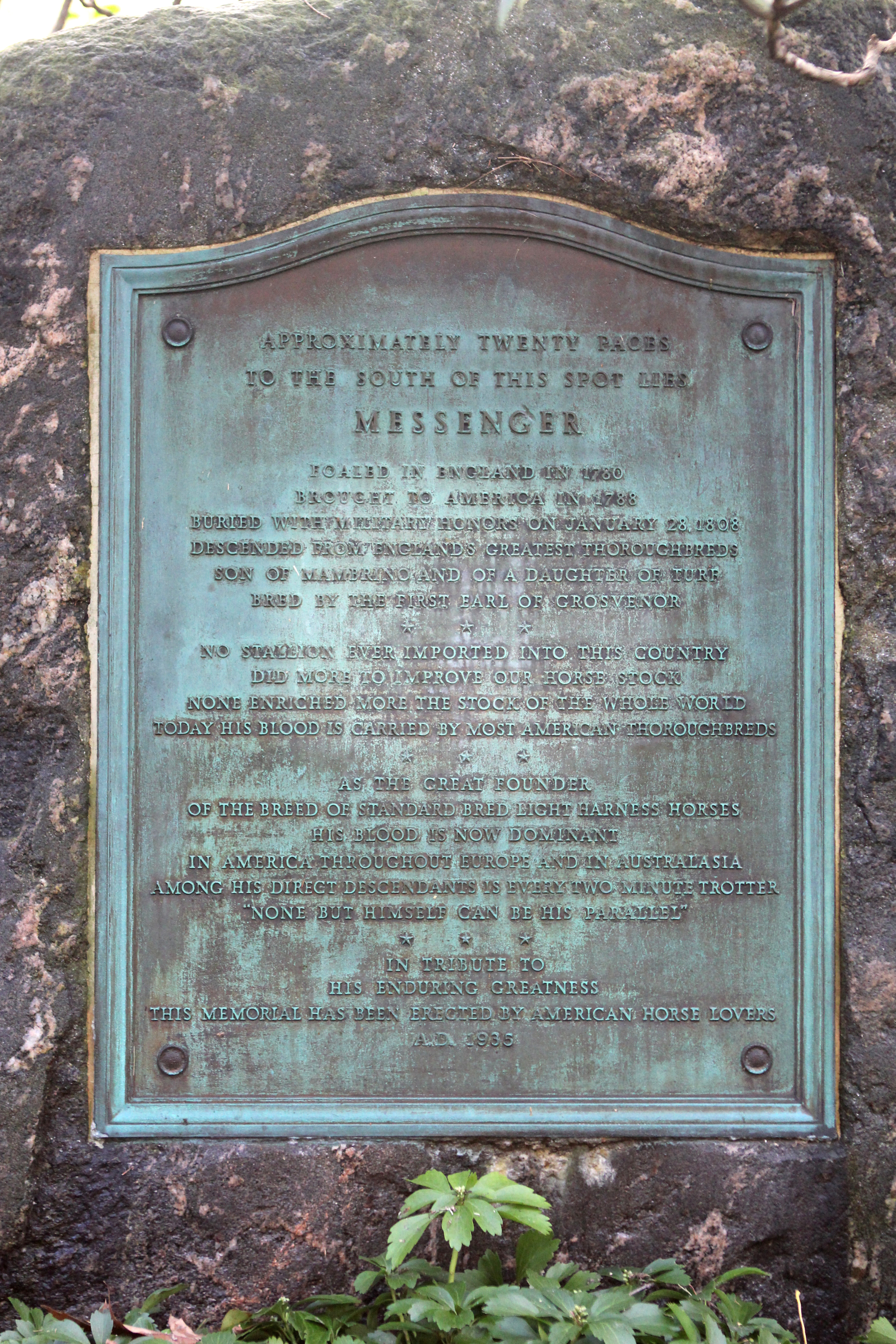
Messenger Rock, photos by Amanda Fisk, courtesy of Friends Academy, Locust Valley, LI  2

Echo, the hero of Port Jefferson Station, who through Regulus was descended from the illustrious Messenger, Abdullah and Hambletonian 10, won races at the Gentleman’s Driving Park and on many other race tracks. As mentioned in the sale notice of 1884, Echo was sold by to William C. France. France at the time was a well known breeder of Standardbreds and Thoroughbreds. A few years before he died in New Rochelle in 1901 at his son’s home, France had financial difficulties. It was reported in his NY Times Obituary that he had been forced to sell his 387 Thoroughbreds [!] from his Highland Stock Farm in KY. France was known for having bred the famous trotters Fred Wilkes and Allie Wilkes at this same farm. After the sale notice for Echo, the trail runs cold for now as to where William C. France ran or retired Echo. Hopefully, more articles will turn up on Echo as well as period photographs of him and the Gentlemen’s Driving Park. Port Jefferson Station should be proud of its efforts to save this historic harness racing track from intrusive development.

Fabulous Dr. Lucy Worsley discusses the Regency Era in these videos. Wonderful.

drush76's avatarThe Rush Journals

Below are links to a BBC documentary called “ELEGANCE AND DECADENCE – The Age of the Regency”. The documentary is hosted by historian Dr. Lucy Worsley, author of the 2011 book, “If Walls Could Talk, An Intimate History of the Home”.

“ELEGANCE AND DECADENCE – The Age of the Regency”

Here are the links to the documentary hosted by Dr. Worsley:

Part 1 – “Warts and All – Portrait of a Prince”

Part 2 – “Developing the Regency Brand”

Part 3 – “The Many and the Few – A Divided Decade”

View original post

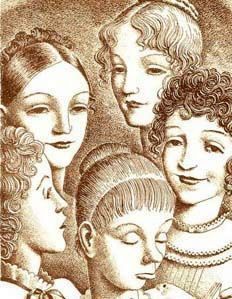
Sewell, The Bennet sisters

Sewell, The Bennet sisters. The photos do not capture the detail of each image.

This year we celebrate all things Pride and Prejudice in honor of the novel’s 200 year anniversary. Just recently, Ruby Lane sold a rare, out of print, limited 1940 edition of Pride and Prejudice, illustrated by Helen Sewell, an illustrator of mainly children’s books. People today still recognize the original drawings she created for the Laura Ingalls Wilder Little House books.

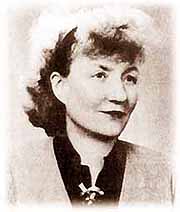
Helen Sewell

Helen Sewell

About Helen Sewell

Sewell was born June 27, 1896 at Mare Island Navy Yard, California. Her family moved to Guam shortly afterward, where her father, William Elbridge Sewell, served as Governor.

Education

Sewell wanted to be an artist since the age of eight. At 12 years old, she began attending Pratt Institute’s Saturday classes and by 16 years of age was enrolled there full time. This was in place of completing high school. At Pratt, she studied classes with Alexander Archipenko, who was the underlying influence for her broken-cylinder figures.

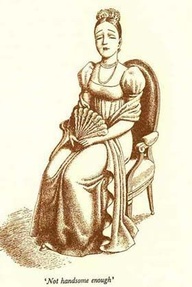
"Not handsome enough"

“Not handsome enough”

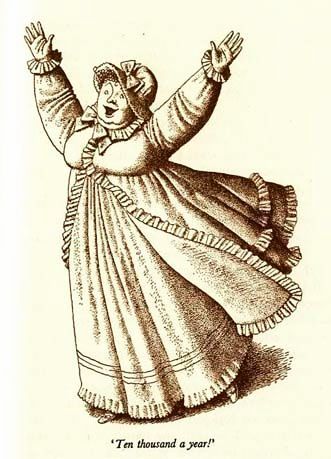
mrs bennet

Mrs. Bennet

Sewell began her long career working on Christmas and greeting cards; her first illustrated publication was in 1923. She primarily illustrated children’s books by Laura Ingalls Wilder, Elizabeth Coatsworth, Eleanor Farjeon, and Frances Clarke Sayer. As with Pride and Prejudice and a 1957 edition of Sense and Sensibility, Sewell also created drawings for a small number of adult publications

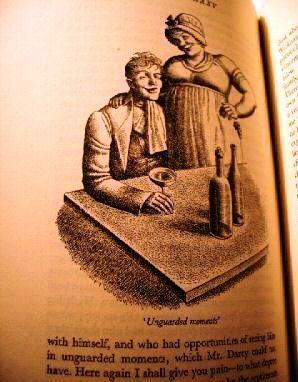
Unguarded moments shows the full page illustration

Unguarded moments shows the full page illustration

Sewell’s style included a simple use of color, which at times eliminated black all together, and her use of the white paper.  Her line drawings were in imitation of 19th century steel engravings. She died in 1957 at the age of 61.

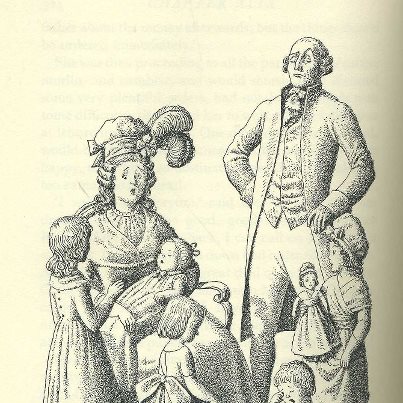
Illustration of the Gardiners on page 324

Illustration of the Gardiners on page 324

About the Limited 1940 edition of Pride and Prejudice

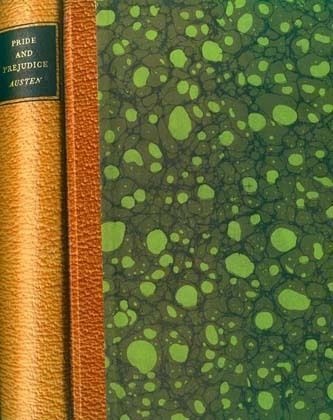
coverThe image at right is of a hardcover, green marbled slipcase. Quarter binding, green marbled board cover, with  brown faux leather spine. Heritage edition illustrations are signed by the illustrator. (The commercial issue would have fewer illustrations for the ordinary book buyer.) It is said that photographic images do the drawings no justice, for they are quite detailed when seen in person.


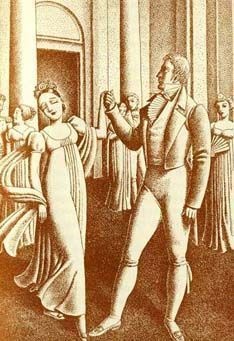
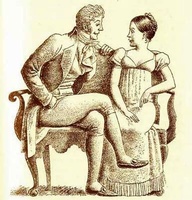
darcy and elizabeth

Darcy and Elizabeth dancing

sewell illustration

This limited edition book sold for $74 at Ruby Lane. I would gladly have paid more. Other limited edition books are selling for as much as $900 per copy. (Click on images for a larger view.)

WARNING! SPOILER ALERT in the body of this review and comments of the Downton Abbey Finale of Season Three. If you have not seen the last installment, please view the 7th episode online at this link. I deliberately kept the incriminating images at the back of this post. Readers who comment can leave their honest assessments, for the 4th season will not be aired in the U.K. until next fall.

Tug of War. Credit: Courtesy of © Nick Wall/Carnival Film & Television Limited 2012 for MASTERPIECE

Tug of War. Credit: Courtesy of © Nick Wall/Carnival Film & Television Limited 2012 for MASTERPIECE

What did you think? Did Julian Fellowes leave us with a cliffhanger or a major downer? How will this latest catastrophic development change Season 4 and the actions of major characters? I must admit to some RELIEF that the 3rd season of Downton Abbey has finally ended. I’ve not been on such a roller coaster ride since I last visited our local amusement park, one minute loving the story lines and the next minute loathing certain plot developments. One thing is for certain, the popularity of DA is here to stay as long as Julian Fellowes continues to provide us with such lively and unpredictable entertainment. And, now, my rather cryptic thoughts on Downton Abbey Season Three, Episode Seven:

Off to Duneagle in Scotland. redit: Courtesy of © Nick Wall/Carnival Film & Television Limited 2012 for MASTERPIECE

Off to Duneagle in Scotland. redit: Courtesy of © Nick Wall/Carnival Film & Television Limited 2012 for MASTERPIECE

An interlude in Scotland

An excuse for a change of scenery means a road trip to Scotland. This episode was divided between  Downton Abbey with the servants and Duneagle Castle in Scotland with the Crawley family. Lord Grantham described the annual visit to the Highlands as the highlight of his year.  (The war and Sybil’s death had prevented the Crawleys from visiting in previous seasons.) Viewers now understand why Lady Rose made her appearance in the last episode, for her family are close to the Crawleys. This segueway to the Highlands is a means to get Rose to Downton Abbey – as a replacement for Sybil? One shudders.

Mrs. Patmore’s pasties entice a Lothario

No sooner had Mr. Tufton the new shopkeeper, smelled the enticing aroma of Mrs. Patmore’s cooking and sampled a few of her dishes than his mind was made up – he would woo her until she was installed as his wife/personal cook in his kitchen.

Mrs. Patmore , flattered by his not so subtle attentions, simpers like a 16-year-old girl at all the testosterone aimed her way. She purchases a pretty new blouse for her date with the first man to pay court to her in decades and cheers him on in the rope pulling contest (which the men of Downton win.)

Upon seeing Mrs. Patmore all gussied up for the day, Mr. Tufton comes on as strong as a jack hammer: “I hope you don’t mind if I say so Mrs Patmore, but in that blouse you look like you stepped off the pages of Vogue”. This doesn’t fool Mrs. Hughes one bit. “You are free with your compliments,” she observes. And he replies tellingly: “I love to be in love Mrs Hughes. I’ll not deny it. Any time, any place, I love to be in love!”

But Mrs. Hughes wasn’t born yesterday. Tufton’s not so subtle moves on other women at the fair doesn’t escape her knowing gaze.

Like a true friend Mrs Hughes summons the cook to her quarters and reveals the unpleasant truth. Instead of stomping out of the housekeeper’s quarters, Mrs. Patmore giggles, saying: “It was the cookin’ he was after and not me. I never felt such relief in my life. The more he said about how he liked his beef roasted, his eggs fried, and his pancakes flipped, then the more I wanted out and get away.”

It is side stories like this one, filled with colorful characters, comedy, and a glimpse of the life of ordinary mortals, that elevate Downton Abbey from the mundane to the fabulous.

Love is All Around You

Romance is in the air for a number of Downton’s inhabitants. Bates and his Anna kiss by a babbling brook and she learns the reel for him.

Dr. Clarkson reaches the inevitable conclusion – that Isobel Crawley would make a perfect wife. Isobel likes their platonic friendship and discourages the doc from declaring himself. But after this episode’s awful ending, one can conclude that Isobel will need the doctor’s substantial shoulders and his considerable support to get over Matthew’s sudden demise.

Thomas sacrifices his pretty face to save Jimmy’s after the Downton men win a tug of war. If that isn’t love, what is?

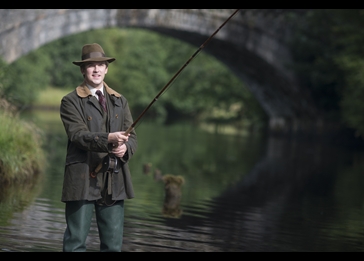
Michael Gregson and Edith: “He’s brought his pencils and his rods what’s wrong with that?

This is the most improbable subplot in the season finale. Michael Gregson, fishing rod in hand, rushes to Scotland and finagles an invitation to Duneagle. His motive? To convince the Crawleys that he’s a decent chap despite his batty wife in the belfry.

It’s a good thing that Edie has low self-esteem or else she would have been spooked off him from the beginning. The family is not very receptive. Michael wants them to get to know him – the real him – so that the Crawleys can see that he’s the perfect man for Edie, with just one teensy little flaw.

This subplot had more in common with One Life to Live than Downton Abbey. Our Edie deserves better.

Michael: I thought if they knew me, if they came to like me, they might find it easier to be on my side. My basic fact is that I am in love with you. Really and truly. Cross my heart and hope to die.

Edith: And I want to be in yours. But this visit of yours is so creepy,  I can’t see a happy ending.

Nothing stops  Michael. Having made a tepid impression on Robert and Mary, who refuses to open her eyes, he makes a move on Matthew.

redit: Courtesy of © Nick Wall/Carnival Film & Television Limited 2012 for MASTERPIECE

Credit: Courtesy of © Nick Wall/Carnival Film & Television Limited 2012 for MASTERPIECE

But his appeal to Matthew’s sense of romance doesn’t get very far (the dialogue is priceless; how can one make fun of it?):

Michael: Does the law expect me to have no life at all until I die? Would Lord Grantham?

Matthew: You can’t expect that he would want you to involve his own daughter, what when all you have to offer her is a job as your own mistress.

Michael: No, I love her.  I’m offering my love.

Matthew: You’ve been misled by our surroundings. We’re not in a novel by Walter Scott.

Edith will not be put off when Michael tries to say his goodbyes, saying, “It’s odd. If you’d asked me before tonight how I felt about you I’m not sure what I would have answered, but now I’m absolutely sure, and this is NOT our last evening.” Ah, our rebellious Edith. Will she live in sin with this man? Set fire to the asylum in which his wife is housed? Carry on as usual and be dangled on a string for life? This improbable plot twist is not what we had hoped for Edith. These scenes seemed so contrived.  I do hope that Julian Fellowes gets this relationship back on track in Season 4, for it had such an interesting start.

Edna and Tom

The title should actually read “A Brazen Maid Sets Her Sights on Tom.”

Tom, the new estate manager, lives in limbo. His position is much like that of a governess – he belongs nowhere, not with the servants and not with the family. Case in point, when the Crawleys dash off to Scotland, Tom remains behind, eating alone and thinking of his dead wife, Sybil, who is missed by one and all. Leaving Tom alone to supervise the estate worries Violet:

Violet: Do you think it is wise to leave him here unsupervised?

Cora: What do you mean?

Violet: Well I know he’s housebroken, more or less, but I don’t want freedom to go to his head.

Isobel: I’ll keep an eye on him.

But the one keeping her eye on him is Edna, the new maid.

After the Crawleys leave for Scotland, Branson is seen walking, eating, and sleeping alone in the house in scenes reminiscent of Jack Nicholson several months into winter in The Shining. Edna pops up wherever he goes – at the pub, in a room, in the hallway – smart, fresh, and pretty. Each time she hones in on Branson like a heat-seeking missile.

For a supervised maid, Edna seems to have a lot of free time to stalk Branson without a reprimand. While Branson’s intrigued, he is a male after all, Edna cannot make him forget his misery over Sybil’s death. When Mrs Hughes cautions him about getting involved with the help, he blurts out his misery.

Like a mother hen, Mrs. Hughes, who gets better with each season, comforts Branson and fires Edna, who is obviously not cut out of maid-of-all work cloth.

DA3_7_3

Credit: Courtesy of © Nick Wall/Carnival Film & Television Limited 2012 for MASTERPIECE

A Tale of Two Marriages: Shrimpie and Susan vs Robert and Cora

We don’t really care about Shrimpie and Susan, the Marquess and Marchioness of Flintshire, who have an awful marriage, but we do care about Cora and Robert. If the earl and his countess needed proof that their marriage was on solid footing, then Shrimpie and Susan, who have tired of each other over the years, provide it.

The marquess and his marchioness are stuck with each other, despite the absence of passion and lack of mutual respect. Worse, Shrimpie has squandered his inheritance by following the traditional route of estate management, which bankrupted him. He praises Robert for his modern thinking and for making smart choices. Robert is more grateful than ever for Matthew’s good sense.

Shrimpie’s solution out of his financial predicament is to take a post in Bombay, where he and Susan will live in couples hell, and leave Rose with the Crawleys for her coming out.

The contrast between the two aristocratic couples couldn’t be greater. While Susan and her husband quarrel over every minor detail, the earl begins to appreciate what he has. He gives his Cora a passionate kiss and recognizes Matthew’s part in his success. “Downton will survive because of Matthew’s vision and now I give thanks for him.”  Even if many of us didn’t know ahead of time that Matthew was about to meet his Maker, these sentences act like sign posts: Matthew’s gonna die. Matthew’s gonna die.

Matthew and Mary

The dialogue between Mary and Matthew hinted of a less than happy ending because they have never been so happy before. She’s soft and amorous. He simply can’t resist patting her on her bump and giving her compliments left and right. They coo and ooh and ah all over each other…

… so that their love talk is beyond sugary.  Mary to Matthew: “You think me nice, but nobody else does. What makes you sure I am? Matthew: “Because I’ve seen you naked.” The dialogue makes even the most clueless viewer wonder – What’s going on? Why the chemistry all of a sudden?

At eight months pregnant, Mary feels safe traveling to Scotland, but makes a mistake in joining the picnic. “I was stupid to go”, she says later, “we were shaken about like dice in a cup.” Which, as everyone knows, is code for early labor.

After Mary’s twinges start, she rushes back to Yorkshire to have her baby, telling Matthew he can join her later with the rest of the Crawley gang.

Alone and about to give birth prematurely, Mary confesses: “I feel I’m only half myself without him.”

The doomsday clock is ticking more loudly.

Matthew arrives to view his son and heir. “My darling, how are you really?” he asks. “Tired and pretty relieved. Just think, we’ve done our duty. Downton is safe. We have an heir, and as soon as I get out of bed we can work on the spare.”

Tick tock tick tock.

Matthew is giddy with delight holding his little chap and waxing eloquently about teaching his son cricket and estate maintenance.

And now we hear the dialogue that seals the doom deal:

Mary: “I hope I’m allowed to be your Mary Crawley for all eternity.

Matthew: “You’ll be my Mary always because mine is the true Mary.

Mary: “Ever wonder how happy you have made me?”

Matthew: “Right now I want to tell you that I fall more in love with you every day that passes.”

It’s a wonder that lightning doesn’t come out of the blue and strike him then and there.

Mary asks for a decent kiss before sending her beloved away to collect her family. Life couldn’t be more perfect for our happy couple. But this is Downton Abbey and no one is allowed to remain blissfully happy for long.

Matthew’s Death

Sybil’s death scene lasted 10-15 minutes, giving viewers time to prepare for her unhappy end. But with Matthew’s the viewers were robbed.

Matthew's last moments. Credit: Courtesy of © Carnival Film & Television Limited 2012 for MASTERPIECE

Matthew’s last moments. Credit: Courtesy of © Carnival Film & Television Limited 2012 for MASTERPIECE

One moment he is rejoicing in the birth of his heir, the next moment he is dead in some roadside ditch. End of episode. End of the season. PBS immediately switches to a fund appeal to capitalize on their stupified viewers. I felt cheated.

The camera lingers on the shocking scene for a few micro seconds before cutting to the Crawley’s drawing-room, where the family placidly awaits Matthew’s arrival.

DA3_7_2

Credit: Courtesy of © Nick Wall/Carnival Film & Television Limited 2012 for MASTERPIECE

As he lies dying in the road, Violet says appropriately: “We don’t always get our just desserts.” Which is exactly how the viewers are starting to feel.

Mary, who is happily expecting the arrival of  her family, says of her husband: “Tell Mr Matthew he must wait his turn, he’s seen the baby and they haven’t.”

I wonder if that statement will come back to haunt her! Two major characters killed off this season. Life in Downton Abbey land is unfair!

Please vote in the poll or leave your considered thoughts about this episode and the third season. Will you return to view Season 4?

All images via PBS Pressroom.

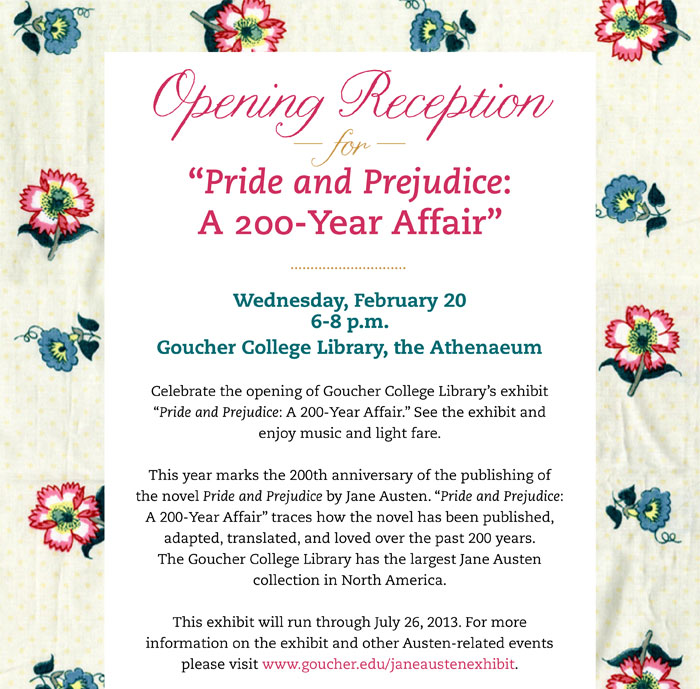
Gentle readers, If you live near the Baltimore area, this exhibit might interest you.

Pride and Prejudice Goucher

Since it was first published in 1813, Pride and Prejudice by Jane Austen has charmed generation after generation. The exhibition Pride and Prejudice: a 200 Year Affair celebrates one of the most popular and beloved novels of our time. A colorful visual history reflects how Pride and Prejudice has been published, adapted, translated, and loved over the last 200 years. It features the first edition published on January 28, 1813 as well as, rare and illustrated editions, and collectibles. Goucher College has the largest collection on Jane Austen and her times in North America.

The Goucher College Special Collections and Archives is home to our Jane Austen collection, but also collections spanning the early printing age to the Modern era. Our closed stacks house rows of first edition books, rare publications, and historical ephemera. We are open to the public Monday-Friday from 10 a.m. to 4 p.m. While we generally accommodate the needs of our student body and faculty in their research, we also have visitors from around the world for academic research as well as recreational visits.

For more interesting information about the exhibit, click on this Goucher College link: http://gouchercollegejaneausten.wordpress.com/