Feeds:
Posts
Comments

Posts Tagged ‘PBS Masterpiece Classic’

Jane is NOT amused

These past two weeks I have been anticipating Downton Abbey daily, getting ready for PBS’s presentation of the series, researching historical tidbits that will add to the reader’s enjoyment, and eagerly anticipating the U.S. audience’s reaction.

Then The Daily Mail (or The Daily Fail, as an astute reader called the tabloid) published an article, Downton Downsized, accusing PBS of cutting 2 hours from the original 8 hour U.K. presentation. Writer Chris Hastings not only pointed to the edits with glee, but accused PBS of dumbing down the series for American audiences. Hastings quoted PBS Executive Producer Rebecca Eaton as admitting “that American audiences demand a ‘different speed’ to their shows.”

The article was an insult to the American viewing audience, and PBS for that matter. It did not take into account that PBS shows no commercials (as ITV does), which means that the U.S. And U.K. Versions of Downton Abbey are practically the same length, even with minor editing. Neither did it acknowledge that PBS viewing audiences are sophisticated, patient, well-read, and well-traveled, as well as knowledgable about history and social customs in the U.K.

I watched the first two ITV episodes of Downton Abbey, to compare them to the so called edited PBS version. I saw so little difference, even with the discussion about inheritances and the British entail, that I wondered what this across-the-pond kerfuffle was all about.

When Sarah Crompton from The Telegraph, wrote her opinion about The Daily Fail’s article, she gave me hope that relations between U.S. and U.K. viewing audiences are still friendly and filled with mutual respect. Crompton wrote:

“Anyone who has read any of the novels of Edith Wharton will know that the statement from PBS executive producer Rebecca Eaton that “we thought there might be too many references to the entail… It is not a concept people in the US are very familiar with” is simply untrue. The difficulties of fortune and inheritance power whole tracts of American 19th-century fiction.”

Crompton goes on to say with confidence that educated American audience would have no trouble following Downton Abbey’s plot. She also found Eton’s statement extraordinary, mentioning The Wire and The Larry Sanders Show as two examples of intelligent, complex and creative television shows that originated in the U.S. and that our audiences have supported.

“This is, after all, the country that gave us The Wire, possibly the most complex series of plotlines ever devised. Are we really to think that US audiences understand drug-dealing in Baltimore any better than they grasp 19th-century legal shenanigans? Of course not. PBS is just being silly.

It is, ironically, the sophistication of the best of American television that I most admire.” – Sarah Crompton, The Telegraph, Americans Understand the Wire, So Why Simplify Downton Abbey for Them?

Insulted by The Daily Mail’s stance, I placed a poll about the edits on my regular Sunday Throwdown feature on Jane Austen Today, asking readers what they thought. The results of that poll demonstrate that PBS viewers do not want to watch a changed version of this British show or any British show for that matter. We feel confident that we can take the slow-pokey, esoteric passages as well as any Brit and not yawn half-way through or lose our way because we don’t understand British social customs or legalities.

The comments left by those who voted in the poll show that the PBS brass might be overreacting to our willingness to sit through exposition. I suspect that in talking about needing a faster-paced plot, Ms. Eaton was discussing the new viewers PBS is courting, but this is only a guess. Be that as it may, in their comments the poll voters expressed mostly their hurt from The Daily Mail’s view about American audiences and the nasty tone of the article. Here is a sampling:

If we Americans can watch 8 hours of Bleak House and Little Dorrit and love it, then we should be able to handle [Downton Abbey]. As for the plot being complicated, Americans flocked to “Inception” and loved it. No way “Downton Abbey” can be more complicated than that.

Rebecca Eaton should know that the attention span problem she refers to does not apply to “her” audience!

I’m very disappointed. Below the Daily Mail article sits a parody for American viewers to help us “understand” the series.

“…although it seems the beautifully nuanced portrait of pre-First World War upper-class life could prove just a little too complex for the trans­atlantic audience.” How insulting!

I am offended by anyone who would feel the American audience can’t support good drama.

I was weaned on Masterpiece Theatre and PBS and this pains me to see this reaction by Eaton. I have seen the UK version. It is not that complicated.

I am really hurt by this attitude! England means the world to me. How can they say Americans need these shows dumbed down?

This is typical ignorance on the part of the Brits. I say that as an American of much experience and relatives in UK. Annoyed as hell.

Don’t underestimate the size of the American audience who are longing for something other than arid, mindless TV fair geared to a 10 year old audience!!!

I think The Daily Mail article brought up two issues that raised hackles and confused readers, who assumed that PBS shared Chris Hastings’ disdain for the American viewing audience and that we require dumbed down versions of British T.V. shows in order to understand them. Since this mentality was shared by Joe Wright, who directed Pride and Prejudice 2005 and who offered an insulting “American” ending for U.S. audiences, no wonder we are baffled.

The second issue is one that many of us who adore PBS imports from Britain have noticed all too often recently. When purchasing the BBC (or ITV) and PBS versions of the same movies, PBS films are routinely shorter, with scenes that have been cut out. Why? These edited versions (sometimes only one or two scenes are missing) lend credence to Rebecca Eaton’s assessment that U.S. audiences demand a different pace. I would love for this PBS executive to explain her statement more fully, for I must admit that the differences between the first two episodes of ITV’s version of Downton Abbey and PBS’s first 100 minutes are so minor as to be barely noticeable. If this is the case, and if the change in pace is barely perceptible, and if Matthew Crawley still shows up in the first 90 minutes, why make the changes at all?

Other bloggers who have written about this controversy:

Read Full Post »

Downton Abbey, a PBS Masterpiece Classic mini-series, is as much a tale about the servants below stairs as about the noble Earl of Grantham and his family who employed them. With the recent airing of the updated version of Upstairs Downstairs in Great Britain, I am sure a debate will long rage about which series portrayed their eras and class differences better. In both cases, the viewer is the winner.

Downton Abbey. Credit: Courtesy of © Carnival Film & Television Limited for MASTERPIECE

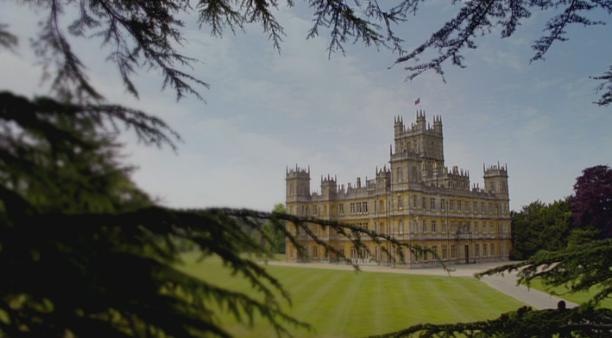
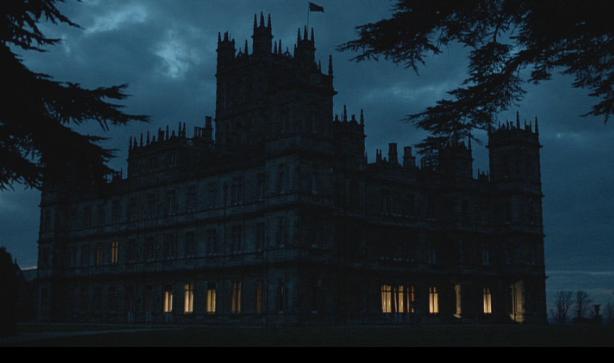
Downton Abbey (Highclere Castle, an “Elizabethan Pile”) Credit: Courtesy of © Carnival Film & Television Limited for MASTERPIECE

Images Credit: Courtesy of © Carnival Film & Television Limited for MASTERPIECE

No matter how expertly this mini-series of Downton Abbey tries to portray this bygone era, it is nearly impossible to capure life in an Edwardian country house exactly as it once was. The viewer should be aware that we can glimpse only a faint, musty, museum shadow of the complex and thriving community that a great English estate once supported.

Downton Abbey. Jane Austen's World. Credit: Courtesy of © Carnival Film & Television Limited for MASTERPIECE

The Crawleys and the servants of Downton Abbey. Credit: Courtesy of © Carnival Film & Television Limited for MASTERPIECE

Images Credit: Courtesy of © Carnival Film & Television Limited for MASTERPIECE

It is a well-known fact that grand country houses could only be run with a great deal of help. As early as the 18th century, Patrick Colquhoun estimated that there were around 910,000 domestic servants (in a population of 9 million). By 1911, the number of domestic servants had risen to 1.3 million. Eighty percent of the land during the Edwardian era was owned by only 3% of the population, yet these vast estates were considered major employers.

Downton Abbey. Credit: Courtesy of © Carnival Film & Television Limited for MASTERPIECE

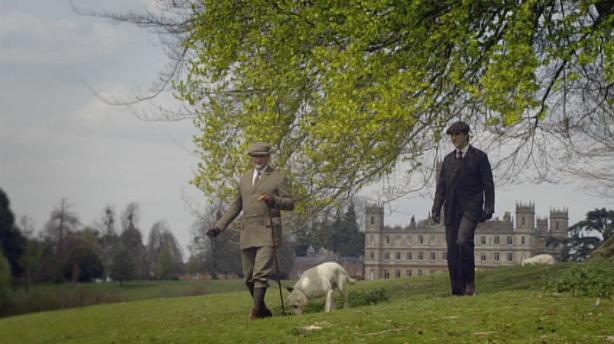
The earl (Hugh Bonneville) and his heir, Matthew Crawley (Dan Stevens), survey his vast estate. Credit: Courtesy of © Carnival Film & Television Limited for MASTERPIECE

In the grander and larger houses, the ratio of servants (both indoor and outdoor) to the family could approach 1:7 or 1:10, but as the industrial revolution introduced improvements in laundering, lawn maintenance, and cooking, the number of servants required to run a great estate was greatly reduced.
Credit: Courtesy of © Carnival Film & Television Limited for MASTERPIECE

The earl and his heir, Matthew Crawley, survey the cottages and outer buildings on his estate. Credit: Courtesy of © Carnival Film & Television Limited for MASTERPIECE

After World War One and the rise in taxes for each servant employed, many great families no longer kept two sets of house staff. They began to bring servants from their country house to their house in Town, leaving only a skeleton crew behind to maintain the family seat in their absence.
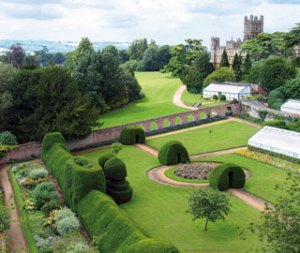
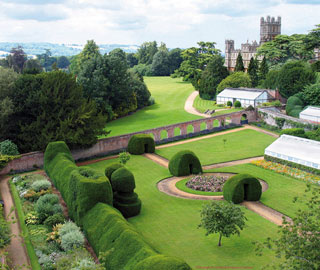
Grounds of Downton Abbey (Highclere Castle)

Country estates were designed to showcase the owner’s wealth via collections of art, furniture and other luxurious possessions, such as carriages, lawn tennis courts, and the like. The main house sat at the end of a long and winding drive through acres of beautifully landscaped park lands.

Downton Abbey.

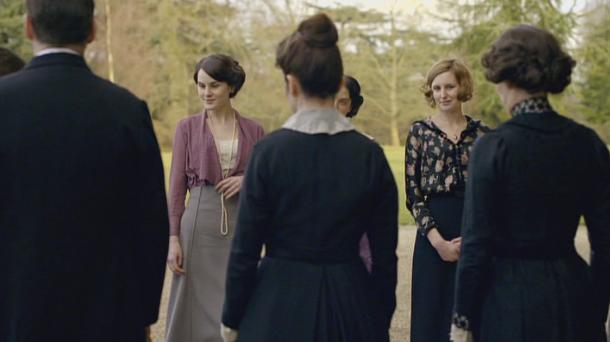
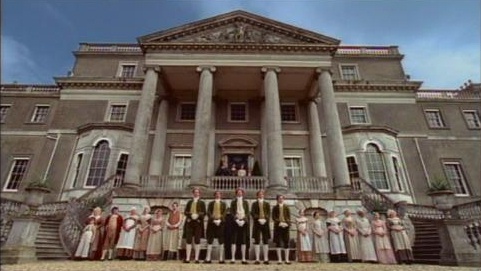
The Duke is greeted by both the family and the servants. Credit: Courtesy of © Carnival Film & Television Limited for MASTERPIECE

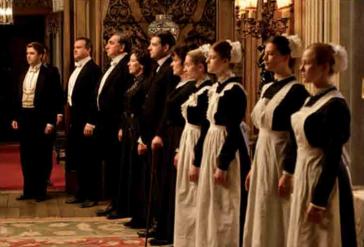
The spectacle did not end there, for approaching the house, guests would see a grand facade or an equally imposing flight of stairs that led to the first floor (or both). In Downtown Abbey, the family awaited the arrival of the Duke of Crowborough (Charlie Cox) along with their servants, who were arrayed in line according to their station.
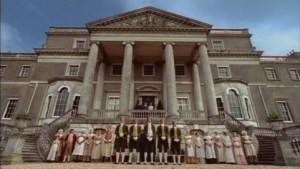
Downton Abbey. Jane Austen's World

The servants await their new masters at Norland. Sense and Sensibility, 2008.

Such a display of staff was also evident in the 2008 adaptation of Sense and Sensibility, when Fanny and Robert Dashwood arrived to claim Norland Park.

Downton Abbey. Credit: Courtesy of © Carnival Film & Television Limited for MASTERPIECE

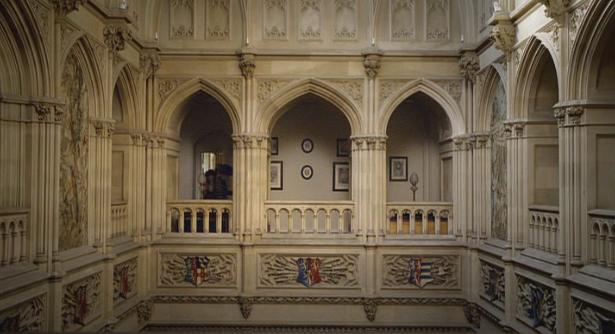
Grand interior hall of Downton Abbey, floor leading to the private rooms. Credit: Courtesy of © Carnival Film & Television Limited for MASTERPIECE

Once introductions had been made, the guests would ascend the imposing stairway and enter an equally impressive high-ceilinged hall that contained yet another grand staircase, which led to the private rooms upstairs. The ladies customarily brought their own maids, who would also require lodging. (In Gosford Park, a poor female relation had to make do with one of the hostesses’ house maids to help her with her dress and hair.)
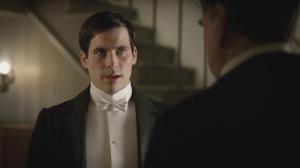
Downton Abbey. Credit: Courtesy of © Carnival Film & Television Limited for MASTERPIECE

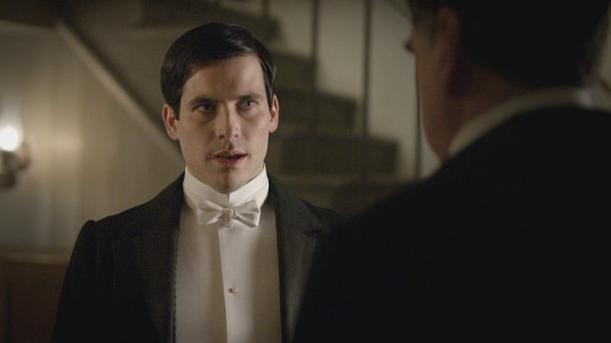
Thomas (Rob James-Collier), the first footman, is chosen to act as valet to the duke. Credit: Courtesy of © Carnival Film & Television Limited for MASTERPIECE

The guests’ servants were expected to enter the house through a separate, back servant’s entrance, and shared quarters with the regular staff. The host supplied his own butler or footmen to help serve as valet to his male guests.
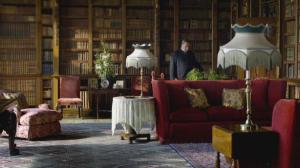
Downton Abbey. Credit: Courtesy of © Carnival Film & Television Limited for MASTERPIECE

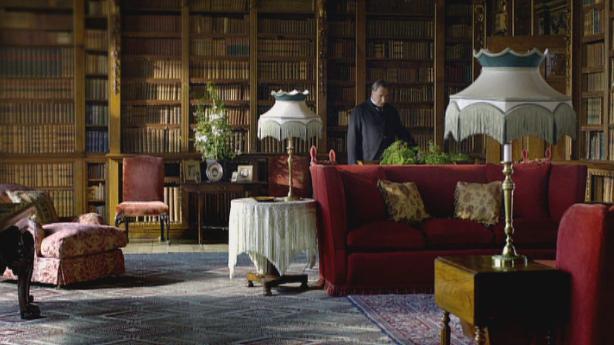
The Earl of Grantham’s impressive library/study. Credit: Courtesy of © Carnival Film & Television Limited for MASTERPIECE

A host’s willingness to lavishly entertain his guests did not necessarily reflect the family’s daily schedule:

In 1826 a German visitor to England remarked that: it requires a considerable fortune here to keep up a country house; for custom demands… a handsomely fitted-up house with elegant furniture, plate, servants in new and handsome liveries, a profusion of dishes and foreign wines, rare and expensive desserts… As long as there are visitors in the house, this way of life goes on; but many a family atones for it by meagre fare when alone; for which reasons, nobody here ventures to pay a visit in the country without being invited, and these invitations usually fix the day and hour… True hospitality this can hardly be called; it is rather the display of one’s own possessions, for the purpose of dazzling as many as possible.(3)” – The Country House: JASA

Downton Abbey. Jane Austen's World

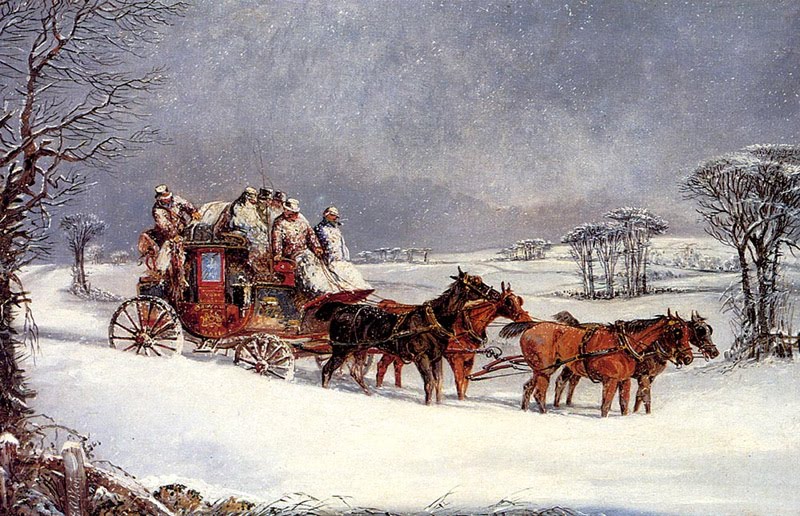
Travel in winter, Henry Alken, 1785

Guests stayed for a long time for a variety of reasons. In the 17th and 18th centuries, travel over a long distance was laboriously slow and difficult, for roads were notoriously poor and dangerous. Long visits, such as Cassandra Austen’s visits to her brother Edward in Godmersham Park, became a custom. Even during the Edwardian age, when travel was much improved, guests tended to stay for the weekend (Saturday through Monday). In Downton Abbey, the Duke of Crowborough arrived amidst much hope and anticipation, until he discovered that the estate had been entailed to a third cousin not the earl’s daughter, whom he had come to woo, and he cut his visit to one short day and evening, making an excuse that did not hold water.
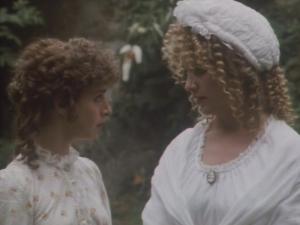
Downton Abbey. Jane Austen's World

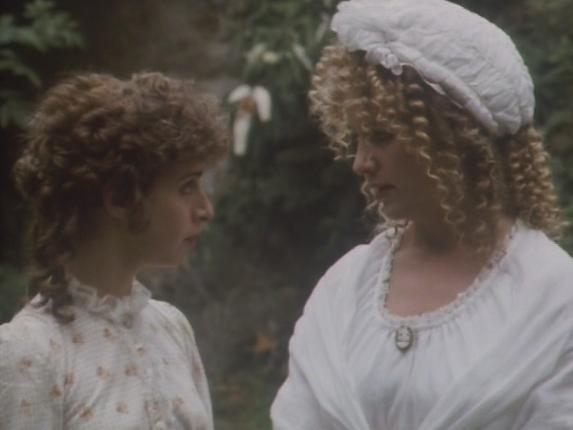
Catherine Morland (Katherine Schlessinger) and Eleanor Tilney (Ingrid Lacey), Northanger Abbey 1986

Even during the 18th century, when long-term guests were expected, some overstayed their welcome, like Jane Austen’s anti-heroine, Lady Susan Vernon, whose hostess (sister-in-law) despised her but was forced to tolerate her because she was ‘family.’ Desirable guests, like Catherine Morland of Northanger Abbey, were invited to extend their visit. In Catherine’s instance, Eleanor Tilney, a motherless young lady who lived without a female companion, found the young girl’s company delightful. By the time General Tilney discovered that Catherine was no heiress, she had been with the Allens in Bath and the Tilneys in Northanger Abbey for a total of 11 weeks. As previously noted, Edwardian hosts, while generous, expected house guest to stay for only three days. During this time every luxury was lavished upon them, but it was considered bad form if they stayed longer than arranged or without invitation.

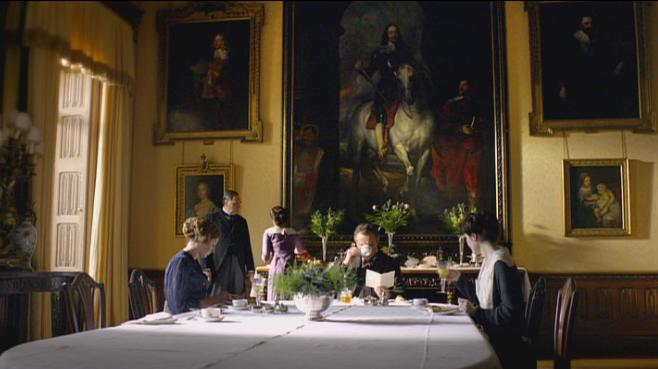
Downton Abbey. Credit: Courtesy of © Carnival Film & Television Limited for MASTERPIECE

Breakfast was a substantial meal served at 9:30 a.m. Credit: Courtesy of © Carnival Film & Television Limited for MASTERPIECE

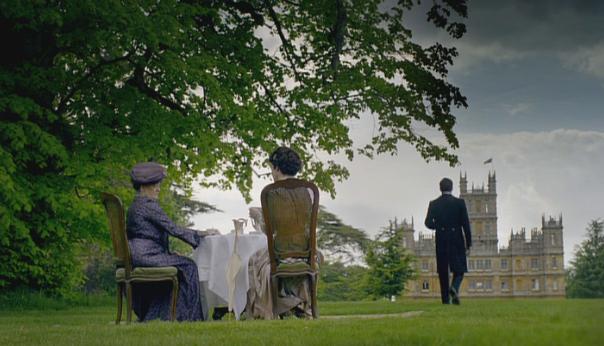
At set times, Edwardian guests would congregate in the common rooms, which included the drawing room, music room, dining room and breakfast room, the library or study, the gallery (where ancient family portraits were hung), the billiard room, and the conservatory. Vast lawns and gardens were laid out for promenading; guests could ride or walk through the parklands to view picturesque follys or dine alfresco (outdoors), take tea under an awning, or paint a vista or two.

Downton Abbey. Credit: Courtesy of © Carnival Film & Television Limited for MASTERPIECE

Taking tea alfresco. Credit: Courtesy of © Carnival Film & Television Limited for MASTERPIECE

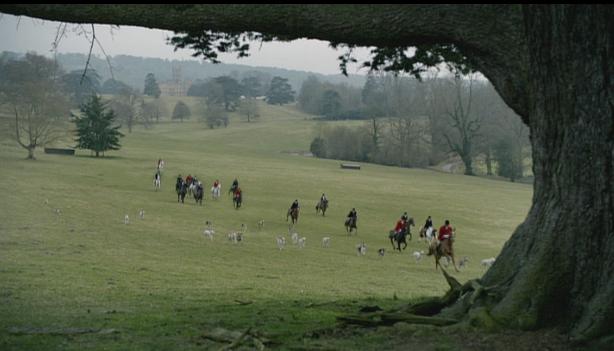
The reputation of a host rested on the entertainments, which helped to pass the time – walking, riding, shooting (in winter), and hunting (in fall) for outdoor activities; and card parties, musicales, and dances for indoor festivities. A fox hunt, such as the one depicted in Downton Abbey, required riding skill and stamina, for the chase would take riders over hills and dales, and hedges, and over long distances for much of the day.

Downton Abbey. Credit: Courtesy of © Carnival Film & Television Limited for MASTERPIECE

The hunt required riding skills and stamina.Credit: Courtesy of © Carnival Film & Television Limited for MASTERPIECE

Billiards made an appearance during the 17th century, and by the 19th century billiard rooms had become a staple. Private libraries offered a variety of books and periodicals. In the summer, Edwardians enjoyed lawn tennis, croquet, cricket, and golf (by the men).

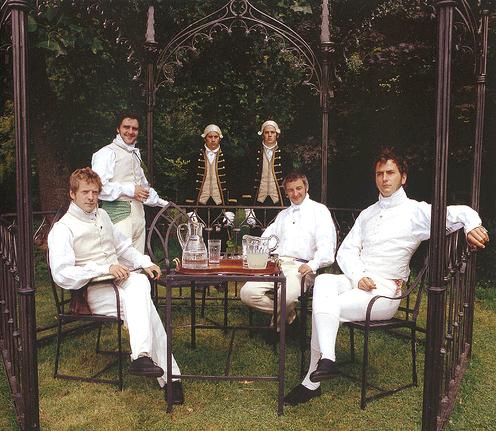
The male guests in Regency House Party (2004) could pretty well behave and move around as they pleased.

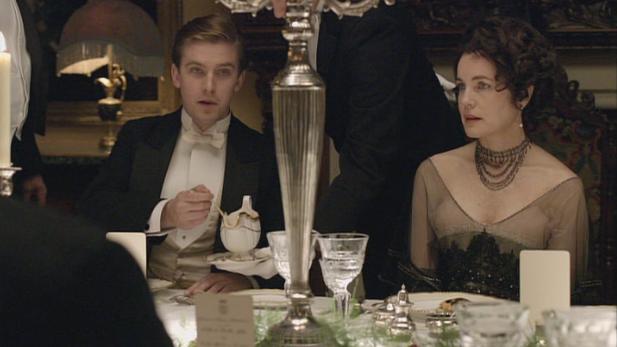
Ladies and gentlemen tended to spend the day apart. Male guests were more active and could engage in almost any activity during the day, except at the time reserved for dinner, when they were expected to show up. In an Edwardian house, men did not escort their female dining partners into the dining room. Rather, after the host served cocktails in the drawing room a half hour before the meal, the group moved to the dining room where they were seated according to a set pattern, with guests sitting between members of the family and their neighbors.
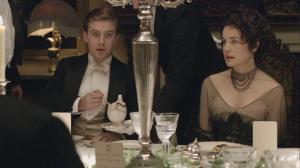
Downton Abbey. Credit: Courtesy of © Carnival Film & Television Limited for MASTERPIECE

The new heir of Downton Abbey (Dan Stevens) sits next to his hostess, the Countess of Grantham (Elizabeth McGovern). Credit: Courtesy of © Carnival Film & Television Limited for MASTERPIECE

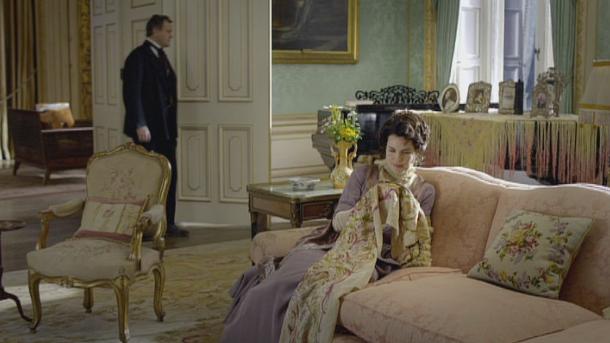
After dinner, the ladies would remove to the drawing room, which became increasingly larger and more feminine over time, while the gentleman relaxed at the dining room table, drinking port, smoking their cheroots, and discussing manly topics.

Downton Abbey. Credit: Courtesy of © Carnival Film & Television Limited for MASTERPIECE

The drawing room at Downton Abbey was large and feminine. Credit: Courtesy of © Carnival Film & Television Limited for MASTERPIECE

While an 18th century gentlemen would have talked about horse flesh and carriages, Edwardian guests would have included automobiles and their rapidly changing technology, road improvements, and the availability of petrol as well.

Downton Abbey. Credit: Courtesy of © Carnival Film & Television Limited for MASTERPIECE

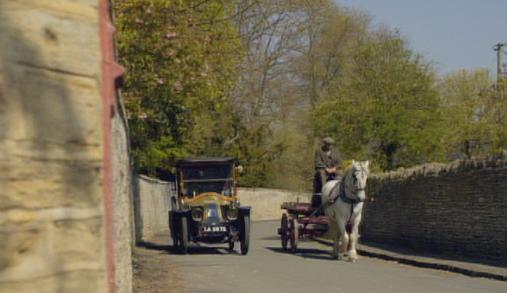
Transportation was changing rapidly at the turn of the 20th century. Credit: Courtesy of © Carnival Film & Television Limited for MASTERPIECE

Unlike the gentlemen, a lady’s day was more restricted and confined. She spent her day following a set routine, starting with breakfast, and wearing appropriate outfits and getting into them and out of them. Mothers spent some time overseeing the nannies and the care of their children (if they were brought along). Ladies, married or not, would also receive visitors, sew, gossip, read, walk, participate in charity work, observe the men at sport (if invited) or take a ride in the carriage. They did join in on more active, outdoor games at set times during the appropriate season, such as cricket, croquet, lawn tennis, lawn bowling, and the like, but they would have been properly dressed for the occasion.

Downton Abbey. Credit: Courtesy of © Carnival Film & Television Limited for MASTERPIECE

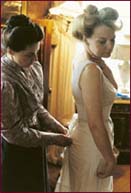
The head maid (Joanne Froggatt) dresses Lady Mary’s (Michelle Dockery) hair for dinner. Credit: Courtesy of © Carnival Film & Television Limited for MASTERPIECE

Imagine poor Eleanor Tilney in the late 18th century, alone in a grand house without female companionship, having no-one to talk to and forced to live a constricted life. No amount of walking, charity work, practicing the piano, or overseeing the household would have made up for her boredom, and thus Catherine Morland’s companionship was so welcome.

Manor House (2002), dressing Lady Olliff-Cooper. Image @PBS

In Regency House Party (the 2004 mini-series), the modern women who portrayed Regency ladies chafed under the strict rules of protocol, forced chaperonage, and daily tedium. A lady’s routine did not much improve during the Edwardian era, although towards the end of this period changing one’s gown for afternoon tea became obsolete.
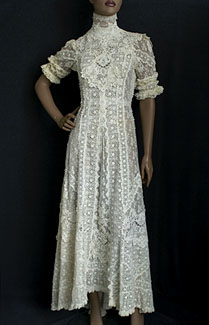
Tea gown, circa 1908. Image @Vintage Textiles

In Manor House, the 2002 mini-series set in the Edwardian era, Lady Olliff-Cooper’s spinster sister, the lowest-ranking member of the family, had so little to do and so little say in how she could spend her time, that Avril Anson (who in real life is a professor) left the series for a few episodes to maintain her sanity.

Downton Abbey. Credit: Courtesy of © Carnival Film & Television Limited for MASTERPIECE

Evelyn Napier (Brendan Patricks) and Matthew Crawley (Dan Stevens) eye their rival before dinner. Credit: Courtesy of © Carnival Film & Television Limited for MASTERPIECE

Lady Olliff-Cooper … [needed] to change her clothes five or six times a day. And very few of these dresses would be what today we’d call practical. Not only did each meal carry its own dress code, but if she needed to receive a visitor, pay a call or go riding, she’d have to change both her clothes and often her hairstyle as well.” Manor House, clothes

Anna Olliff-Cooper, who portrayed the lady of the house in Manor House, spent an enormous amount of her day changing into new gowns and having her hair dressed. She would stand passively as her maid did all the work. Anna noted how constricting the dresses were, and cried as she described how the tight sleeves of her gowns prevented her from raising her arms above her shoulders or from closely hugging her eleven-year old son. Even the fashions conspired to keep a women passive!

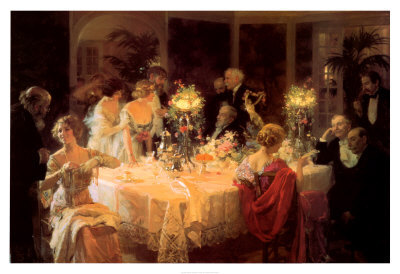
The Dinner Party, 1911, Jules Alexandre Grun

After they had finished their cigars and port, the gentlemen were obligated to rejoin the ladies for cards or music, or both, to while away the evening. The Duke’s behavior in Downton Abbey was egregious, for instead of joining the group for the rest of the evening, he went to bed early. The house party would stay up until 10:30 or so (unless a grand ball had been arranged, and then the guests would stay up until the wee hours of the morning).
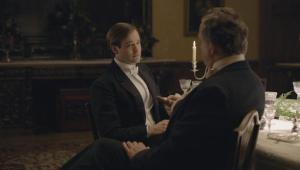
Downton Abbey. Credit: Courtesy of © Carnival Film & Television Limited for MASTERPIECE

Male conversation after dinner over port and cigars. The duke and earl have a frank conversation. Credit: Courtesy of © Carnival Film & Television Limited for MASTERPIECE

In either case, the last people in the house to retire for the night would be the servants, but their lives and schedule will be described in another post.

Look for Downton Abbey, Part One to air on PBS Masterpiece Classic on Sunday, January 9th! Once again PBS will host a twitter party! Stay tuned for details.

Downton Abbey. Credit: Courtesy of © Carnival Film & Television Limited for MASTERPIECE

End of the day at Downton Abbey. Credit: Courtesy of © Carnival Film & Television Limited for MASTERPIECE

More on the topic:

Images of Downton Abbey Season 1: Credit Courtesy of © Carnival Film & Television Limited for MASTERPIECE

Read Full Post »
Created by Oscar-winning writer Julian Fellowes (Gosford Park), “Downton Abbey” depicts the lives of the noble Crawley family and the staff who serve them at their Edwardian country house. It is April and the Titanic has just sunk.The world will never be the same for the Crawleys, for both the heirs to Downton Abbey went down with the ship.

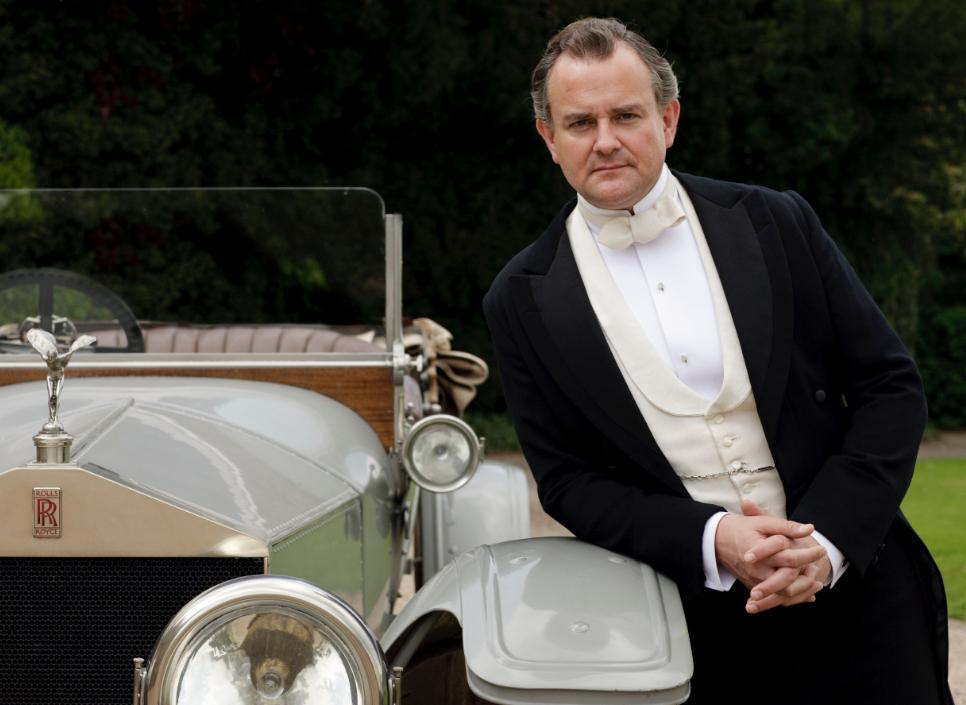
Hugh Bonneville as the Earl of Grantham. This image speaks of power and privilege.

The earl and countess of Grantham’s three daughters cannot inherit the estate, which is entailed to the male next in succession. He is Matthew Crawley, a third cousin, son of a doctor and a nurse, and a lawyer by trade. Matthew knows nothing about running such a vast estate, and cares little about the niceties of protocol.

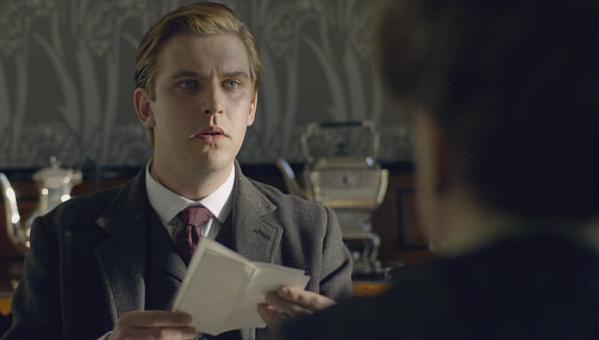
Dan Stevens plays Matthew Crawley. He also played Edward Ferrars in Sense and Sensibility.

The answer to the earl’s predicament is simple really – Lady Mary, his eldest daughter, should marry Matthew. But nothing is simple in Downton Abbey, for Lady Mary is stubborn and has a mind of her own.

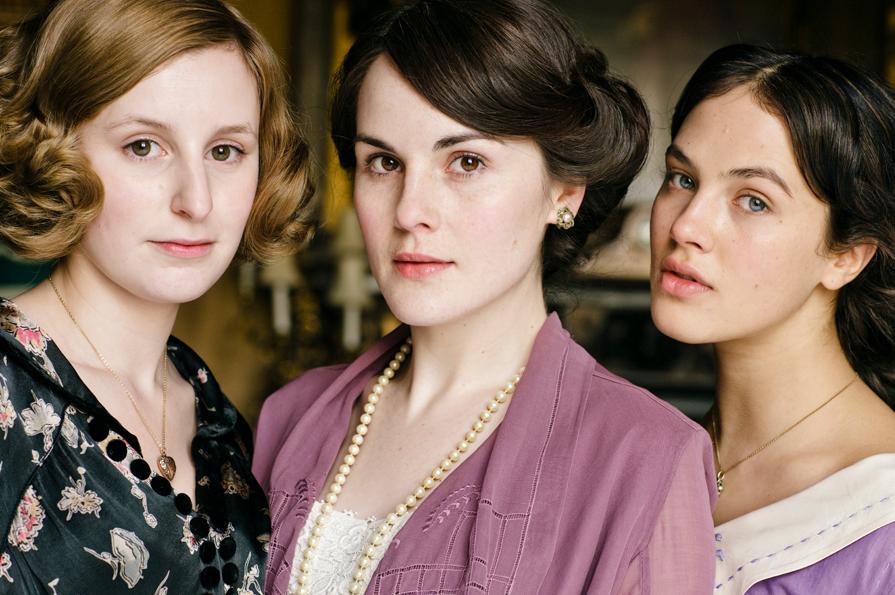
The Crawley sisters: Lady Edith, Lady Mary, and Lady Sybil

The series is lushly produced and the story lines are riveting. In its depiction of the intertwined lives of servants and aristocrats, Downton Abbey recalls one of television’s most beloved programs, Upstairs Downstairs, which aired on MASTERPIECE (then MASTERPIECE THEATRE ) in the 1970s. One of the thrills of MASTER PIECE’s 40th season is a new three-part Upstairs Downstairs with a new cast of characters set in the same house at 165 Eaton Place, taking the story from 1936 to the outbreak of World War II .

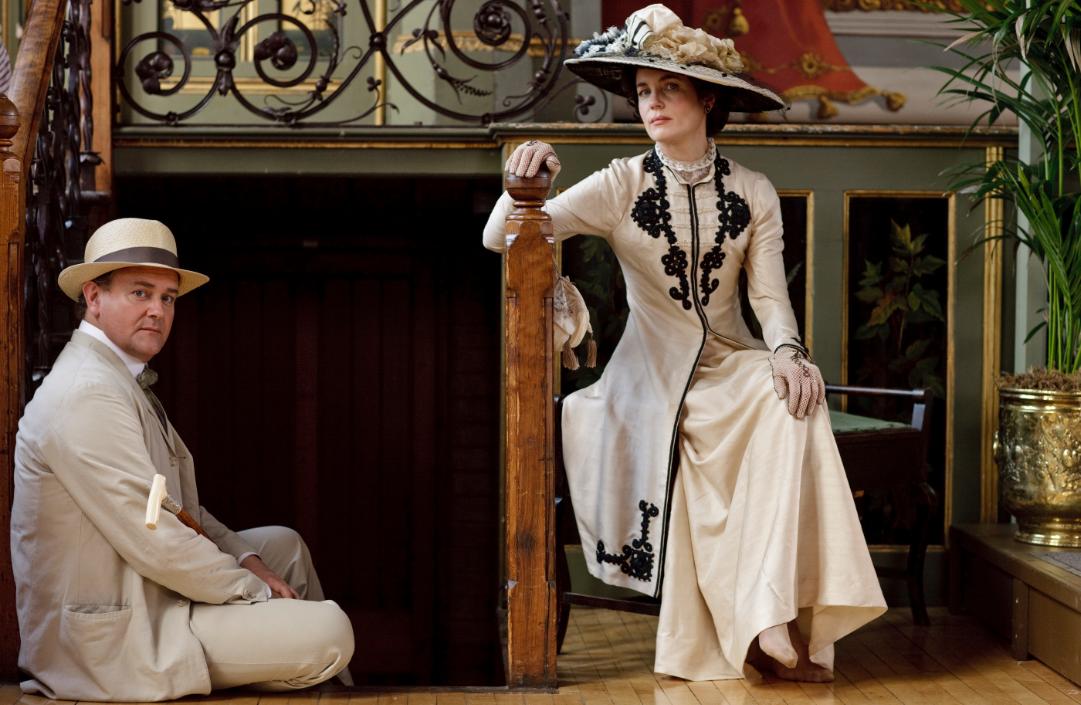
The Earl and Countess of Grantham (Hugh Bonneville and Elizabeth McGovern)

Episode 1
Sunday, January 9, 2011, 9 to 10:30pm
When the Titanic goes down, Lord Grantham loses his immediate heirs, and his daughter Mary loses her fiancé, throwing Downton Abbey and its servants into turmoil. The new heir turns out to be Matthew, a handsome lawyer with novel ideas about country life.

Matthew and his mother are formally received by the servants and family during their first visit to the Abbey

Episode 2
Sunday, January 16, 2011, 9 to 10:30pm
Mary entertains three suitors, including a Turkish diplomat whose boldness leads to a surprising event. Downstairs, the shocking former life of Carson, the butler, is unmasked, and Bates risks his health to remain valet.

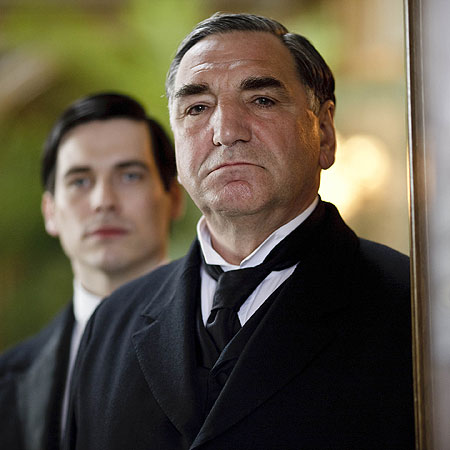
Jim Carter (Cranford) as Mr. Carson, the butler

Episode 3
Sunday, January 23, 2011, 9 to 10:30pm
Growing into his role as heir, Matthew brings out the bitter rivalry between sisters Mary and Edith. Servants Thomas and O’Brien scheme against Bates, while head housemaid Anna is increasingly attracted to him. Lady Violet’s winning streak in the flower show is threatened.

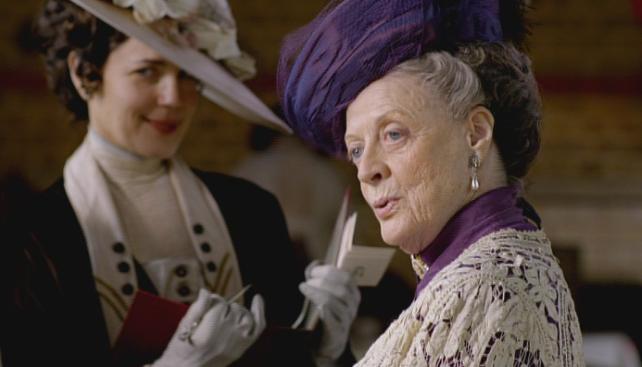
The Countess (Elzabeth McGovern) and the Dowager Countess (Maggie Smith) at the flower show.

Episode 4
Sunday, January 30, 2011, 9 to 10:30pm
The heir crisis at Downton Abbey takes an unexpected turn. Meanwhile, rumors fly about Mary’s virtue. Her sister Sybil takes a risk in her secret political life. Anna unearths Bates’ mysterious past. And O’Brien and Thomas plot their exit strategy.

The Countess of Grantham with her daughter Lady Edith

My posts about Downton Abbey

Cast

Hugh Bonneville (Daniel Deronda, Filth)…Robert, Earl of Grantham
Jessica Brown-Findlay…Lady Sybil Crawley
Laura Carmichael…Lady Edith Crawley
Jim Carter (Cranford)…Mr. Carson
Brendan Coyle (Prime Suspect 7: The Final Act)…John Bates
Michelle Dockery (Return to Cranford)…Lady Mary Crawley
Siobhan Finneran (The Amazing Mrs. Pritchard)… O’Brien
Joanne Froggatt (Robin Hood)…Anna
Thomas Howes…William
Rob James-Collier…Thomas
Rose Leslie…Gwen
Phyllis Logan (Wallander)…Mrs. Hughes
Elizabeth McGovern (A Room with a View)…Cora, Countess of Grantham
Sophie McShera…Daisy
Lesley Nicol (Miss Marple)…Mrs. Patmore
Maggie Smith (Harry Potter)…Violet, Dowager Countess of Grantham
Dan Stevens (Sense & Sensibility)…Matthew Crawley
Penelope Wilton (Wives and Daughters)…Isobel Crawley
Charlie Cox (Stardust)…Duke of Crowborough
Kevin Doyle (The Tudors)…Molesley
Robert Bathurst (Emma)…Sir Anthony Strallan
Bernard Gallagher…Bill Molesley
Samantha Bond (Miss Marple)…Lady Rosamund Painswick
Allen Leech (The Tudors)…Tom Branson
Brendan Patrick…Evelyn Napier
David Robb…Dr. Clarkson
Helen Sheals…Postmaster’s Wife

More on the Topic

Read Full Post »
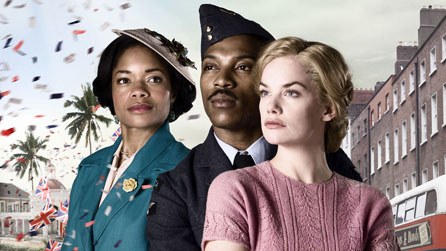
I had never heard of the book Small Island or author Andrea Levy until PBS scheduled the film as the last presentation for Masterpiece Classic this season. The story follows two couples, one from London, England and the other from Jamaica, whose lives intersect at crucial moments. Against the backdrop of World War II and post war England, we learn about the dreams and ambitions of Queenie, Bernard, Hortense, and Gilbert.

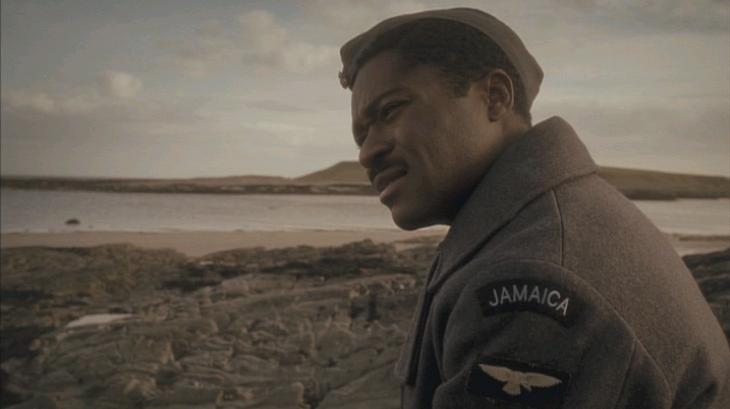
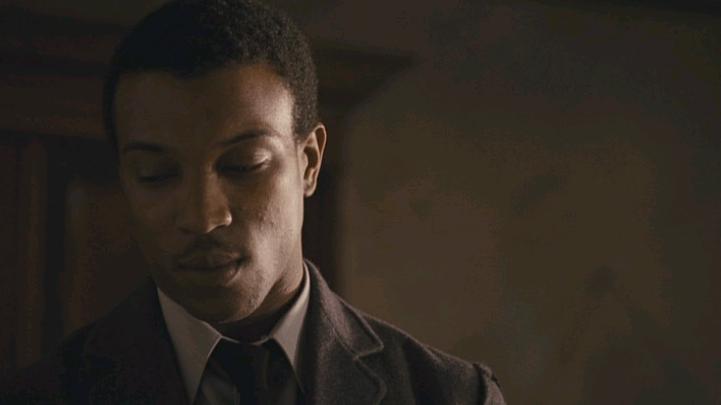
David Oyelowo as Gilbert Joseph

The story is about the reaction of the British to the 492 men from the British Colonies who bought passage on the Empire Windrush in 1948 and emigrated to England. Prior to that event, 6,000 West Indian men had volunteered for the RAF during World War II. After the war, they wanted a better life and sought it in the motherland.

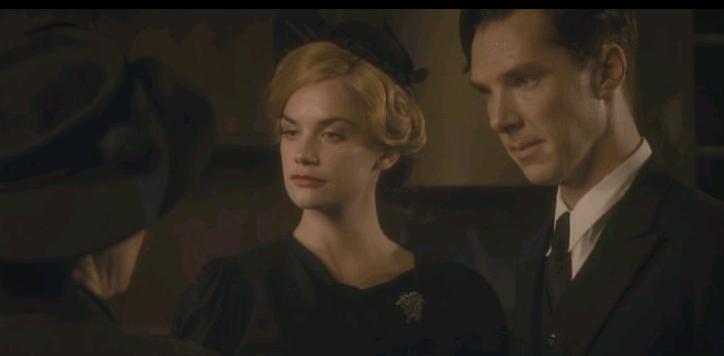
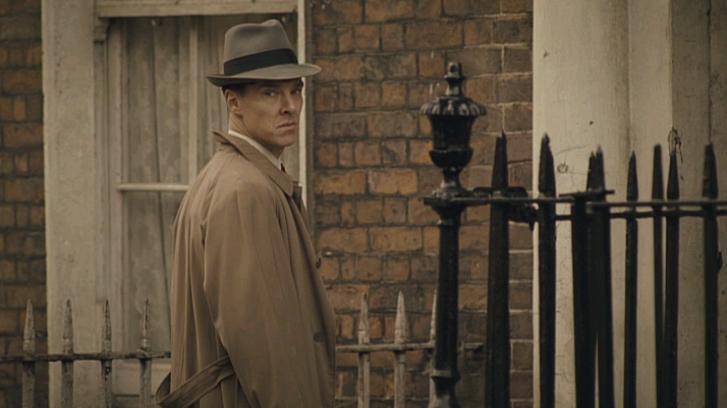
Queenie (Ruth Wilson) and Bernard (Benedict Cumberbatch)

As the story unfolded I was struck by the Jamaican islander’s view of their mother country. Their attitude towards England was  loving, deferential, and loyal. While the Jamaicans learned everything they could about English customs and history, the British knew or cared very little about the people they had exploited. Reality sunk in for the young Jamaican men who had signed up to fight alongside the British in WWII. They dreamed of fighting as pilots, but were assigned menial jobs, some not even at the front. Worse, they encountered racism designed to squash their pride and put them in their place.

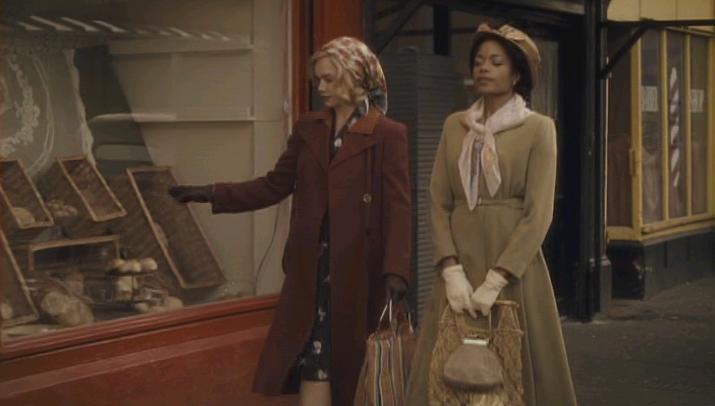
Hortense (Naomi Harris) goes out shopping properly dressed

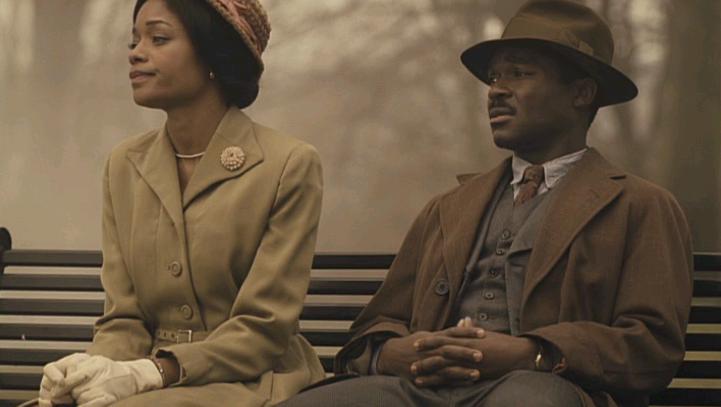
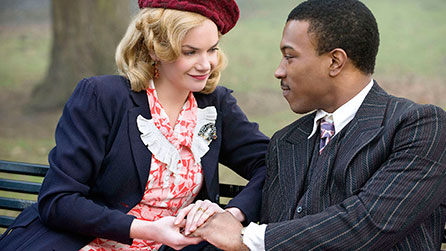
David Oyelowo plays Gilbert Joseph, a wonderfully optimistic and cheerful man, who aims to find a better life in the motherland. His dream was to become a lawyer, but in reality he became a postman for the Royal Mail. His scene on the park bench after being humiliated by other postal workers broke my heart. I think I fell a little in love with Mr. Oyelowo then.

Hortense and Gilbert

Hortense (Naomi Harris) dreams of becoming a school teacher in London. An orphan, she pursues her teaching degree in a Jamaican school and learns how to conduct herself properly. Her ambition prompts her to betray a friend and finagle her way into a marriage of convenience with Gilbert, whose passage on the Empire Windrush she finances. Their deal is that he will send for her as soon as he finds a nice place for them to live in London.

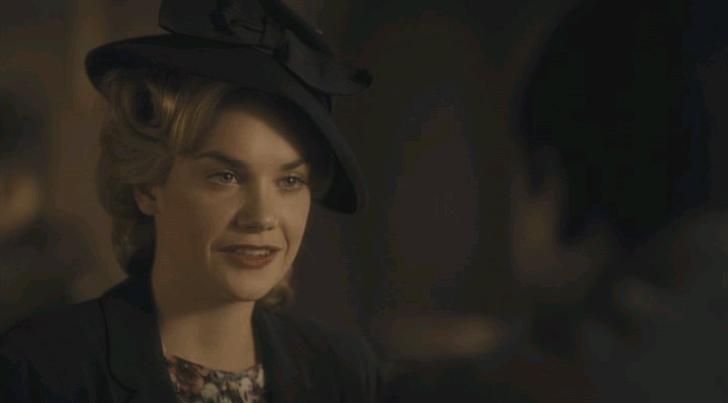
Ruth Wilson as Queenie

Queenie (Ruth Wilson)dreams of a more exciting life than on the pig farm that her parents own. We first meet her with her aunt in London, practicing elocution lessons – “the rain in Spain stays mainly in the plain”. Queenie’s dreams are squashed when she makes a compromise after her aunt’s death and marries the dull colorless young man who has fallen in love with her. Her existence becomes lackluster and uneventful, and she chafes under her boring routine. Benedict Cumberbatch plays Bernard in the unsympathetic part of Queenie’s husband. Sadly, Bernard has already realized his dream, which was to marry Queenie, who does not love him. He must confront his disillusionment and resistance to change if he is to hold on to his marriage to Queenie.

Bernard (Benedict Cumberbatch)

Then the war begins and suddenly life changes for Queenie, whose path crosses with Gilbert and Hortense, and a mysterious man named Michael, who (coincidentally) Hortense has loved all her life. Rather than spoil the plot, I encourage you to read a lovely synopsis at this PBS link along with an interview with the author, which I recommend highly.

Ashley Walters as Michael

These days we do not often encounter black ladies of the old school. Do you remember them? Their postures were ramrod straight. Their neat clothes did not allow for a single crease. Their hats were proper and decorous, and their purses were held just so in their gloved hands. Their language was grammatically correct, old-fashioned and Victorian, as if they had been taught from a 19th-century grammar book. I volunteered with such a lady, Miss Edna, who had been a school teacher since the 1930’s and who volunteered as a tutor well into her 90’s. Hortense reminded me of Miss Edna. I thought that Naomi Harris captured every aspect of Miss Edna, including her unassailable dignity.

Queenie and Michael

To my mind, Queenie, is the tragic character of this tale. As Andrea Levy said “She is a warmhearted person, a kind person, an open person.” Yet she is not perfect. None of the characters are. The author explains, “With all my characters, I never want them to be perfect, they have faults, just like us all.” Despite her imperfections, Queenie is the heroine who, when faced with a King Solomon decision, does not flinch from choosing the right course.

The acting is superb. There were scenes that caused me to hold my breath, they were that good, and there were times when I literally ached for the characters. When I cried, it was from sympathy, not from a contrived plot. Like real life, this drama is sprinkled with humor, which cuts the tension. At the end of the film, I wanted to see more. Rarely does this happen. PBS will air the first part of Small Island tonight, April 18th at 9 p.m., and the second part on April 25th. I highly recommend that you see it.

Hortense, Michael, and Queenie

If you have missed the first part, you can watch it online at this link starting April 19th through the 25th.

Read Full Post »

Ellie Kendrick as Anne Frank

PBS’s new adaptation of The Diary of Anne Frank is a must-see for everyone this Sunday night on PBS Masterpiece Classic at 9 PM local time. The film is powerful, how could it not be? Ellie Kendrick, the actress who portrays Anne, is perfect for the part. She is not beautiful like young model Millie Perkins, the 1959 Anne (and hand-picked by Otto Frank, Anne’s father), or 16-year-old Natalie Portman, another beautiful young actress.

Anne Frank learns she is going into hiding

Ellie is more realistic, like the actual Anne – dark-haired, good looking, a little awkward, and on the cusp of womanhood.

Watching the film, I could not help but compare Anne Frank to a young and precocious 15-year old Jane Austen, who in her teens wrote the delightful but irreverent The History of England. Both Jane and Anne changed the world of literature with their writing. Both died too soon, Anne tragically of typhoid fever in Bergen-Belsen. The family had been in hiding for two years and one month before they were betrayed by a Dutch informant.  My heart always aches when I think of how close Anne  came to making it in that notorious concentration camp, for she and her sister died just months shy of liberation.

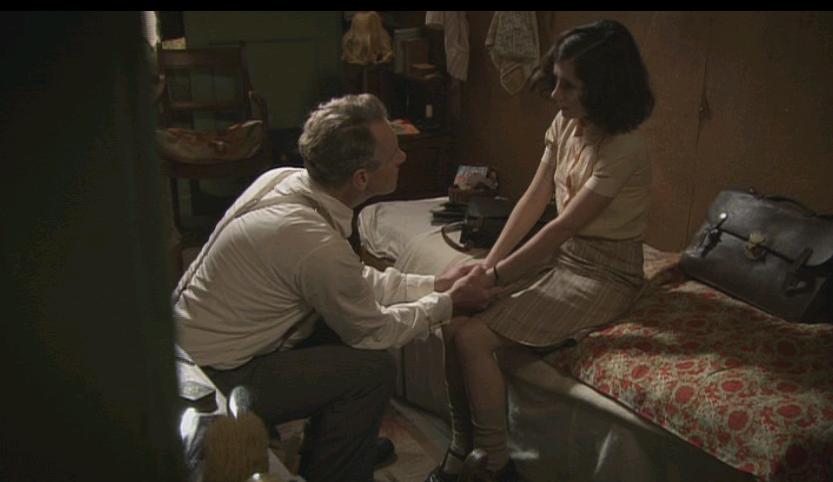
Albert Dussel joins the Franks and Van Daans. L to R: Tamsin Greig as Mrs. Frank, Iain Glen as Otto, Felicity Jones as Margot, and Ellie Kendrick as Anne

Anne Frank’s story has always loomed large in my life. I spent my childhood years in Holland, as did Anne. My Oma in Utrecht lived near an apartment complex that was similar to Anne’s in this short video. I recall playing with my brother in streets that uncannily resembled the one shot in the film.

Anne and Peter, young love

While Anne and her family, and the Van Daans and Albert Dussel hid in the attic, my 15-year-old step-father hid as a young girl on a Dutch farm in the southernmost tip of The Netherlands. The Franks were able to hide with the help of brave Dutch citizens, as my step-father did. The Franks followed the allied invasion of Normandy and the armies’ progress through Europe, just like my step-father, who pinned their every movement on a map (as in the film).

Keeping tabs on the Allieds' progress

I grew up listening to World War II lore and watching the movies. I grew up wishing with every fiber of my being that the Franks were liberated as both my stepfather and father had been.

Mr. Dussel helps Anne after the attic hideaway has been discovered

But that was not to be. One year before the war’s end, the Franks, Van Daans, and Albert Dussel were betrayed. All died except for Otto Frank. It is a testament to Anne’s humanity that, despite having to hide during the most formative of her young teen-aged years, she was able to write these beautiful words:

Anne Frank writes in her diary

“It’s really a wonder that I haven’t dropped all my ideals, because they seem so absurd and impossible to carry out. Yet people are really good at heart. I simply can’t build up my hopes on a foundation consisting of confusion, misery, and death. I see the world gradually being turned into a wilderness, I hear the ever approaching thunder, which will destroy us too, I can feel the sufferings of millions and yet, if I look up into the heavens, I think that it will all come right, that this cruelty too will end, and that peace and tranquility will return again”

My heart aches when I think of the loss of those millions of innocent lives in that senseless, hateful war (any war, for that matter).  As I think about Anne and the life she was never able to live out, I am saddened by the fact that 65 years after her death so many of young people have never heard of her, or could care less about World War II. Even my nieces and nephew, whose great grandfather and great uncles died in a Japanese concentration camp, rarely give a thought to their sacrifices. Anne died in Bergen-Belsen Concentration Camp of typhoid fever in March 1945. The war ended in Europe in May.

View from the attic, the Kerk

It is my hope is that every family will sit down on Sunday night to watch this film together … The final scenes in which the Frank family and Van Daam family are found and taken from their hiding place are heart-rending. April 11 is Holocaust Remembrance Day.

Cast:

Miep Gies, Kate Ashfield (helped to hide the Franks)

Miep Gies finds the diaries

Peter van Daan, Geoff Breton (the young man Anne liked)

Peter Van Daan dies of exhaustion 3 days before his camp was liberated.

Hermann van Daan, Ron Cook (Peter’s father)

Hermann Van Daan

Victor Kugler, Tim Dantay (helped to hide the Franks)

Albert Dussel, Nicholas Farrell (Dentist, shared a room with Anne)

Albert Dussel

Johannes Kleiman, Roger Frost (helped to hide the Franks)

Bep Voskuijl, Mariah Gale (helped to hide the Franks)

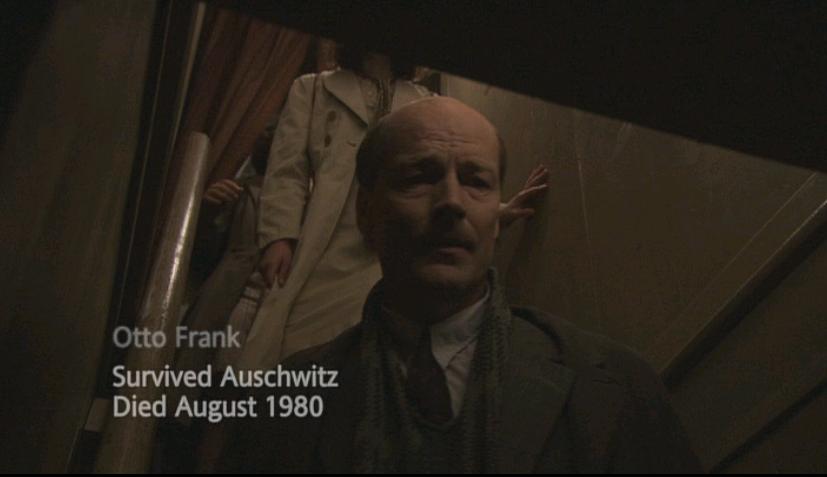
Otto Frank, Iain Glen (father)

Otto Frank, only survivor

Edith Frank, Tamsin Greig (mother)

Edith Frank

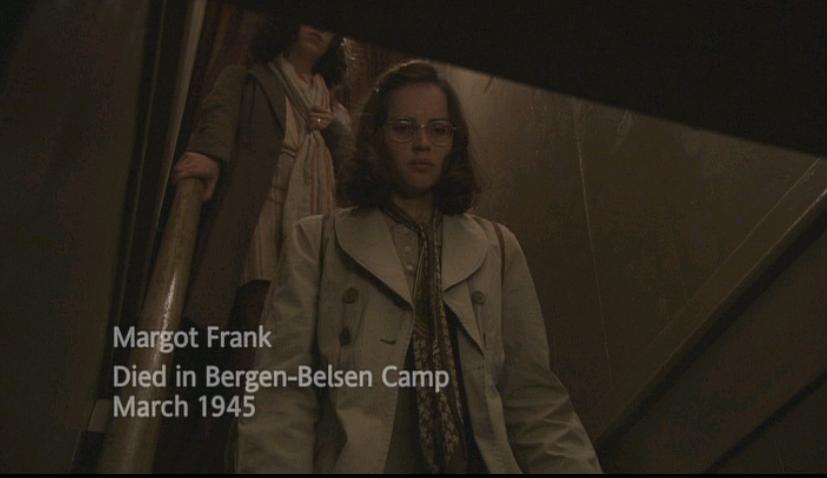
Margot Frank, Felicity Jones (sister)

Margot Frank

Anne Frank, Ellie Kendrick

Anne Frank

SS Silberbauer, Robert Morgan (Nazi officer who captured the Franks)

Petronella van Daan, Lesley Sharp (Peter’s mother)

Petronella Van Daan

Director  Jon Jones

Adapted by  Deborah Moggach

The Diary of Anne Frank Airs: Sunday, April 11, 2010, PBS Masterpiece Classic, 9 PM local time.

The film will be available for online viewing April 12 – May 11, 2010

More on the topic:

Actor Connection to Jane Austen Film Adaptations:

  • Nicholas Farrell played Edmund Bertram in Mansfield Park, 1981, and Mr. Musgrove in Persuasion, 2007
  • Felicity Jones played Catherine Morland in Northanger Abbey, 2007
  • Tamsin Greig played Miss Bates in Emma, 2009

Read Full Post »
« Newer Posts - Older Posts »