Feeds:
Posts
Comments

Archive for the ‘19th Century England’ Category

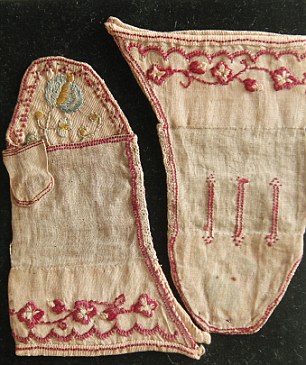
Princess Charlotte's embroidered linen mittens

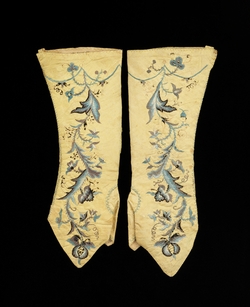
Among the fashion items in Kensington Palace are a pair of hand-embroidered mittens owned by Princess Charlotte, daughter of George 1V and Caroline of Brunswick  (the Princess Diana of her day) who died tragically young in 1817 while in childbirth. Read more: Mail Online

Silk 18th C. mittens. Image @Metropolitan Museum

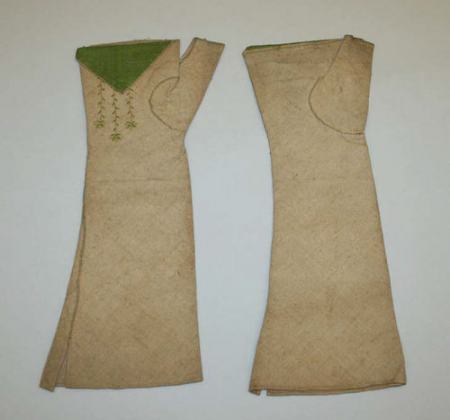
Your average 18th century mitt would have a thumb (or rather half a thumb), but not have any other fingers. It would sometimes extend not just over the hand but over part of the fingers as well. This meant that it would keep you warm (or protected from the sun in the summer) but not hinder your movements at all. You could do things like write, draw or do needlework with mitts on. And combined with a muff, they were quite enough even for venturing outside in the winter.” – Mitts & Fingerless Gloves

18th century mittens. Image @Metropolitan Museum of Art

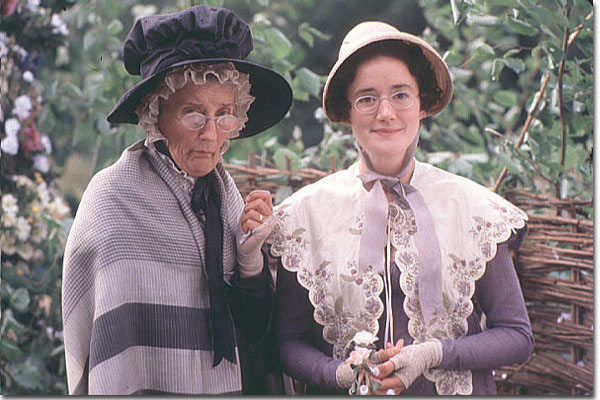
Mrs. Bates and Miss Bates wearing lacy mitt gloves

Read Full Post »

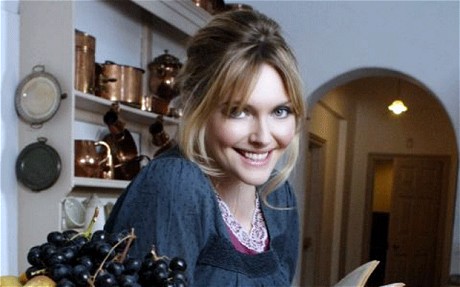
Four YouTube videos feature the recipes of Mrs. Beeton and her story in a BBC2 show, The Marvellous Mrs. Beeton, hosted by Sophie Dahl. Check the first of four videos here, then find the other videos in YouTube’s sidebar.

Edwardian Promenade lists these videos in its YouTube account. (A visit to the site is well worth your time.) Thank you, Karen Reedy-Wilcox, for pointing out these videos.

Sophie Dahl, hostess and narrator of this show.

Read Full Post »

Gentle readers: Today I present to you this chapter about The Dress Maker in its entirety from a book in the public domain, Book of English Trades, and library of the useful arts, published in 1818.

THE LADIES’ DRESS-MAKER.
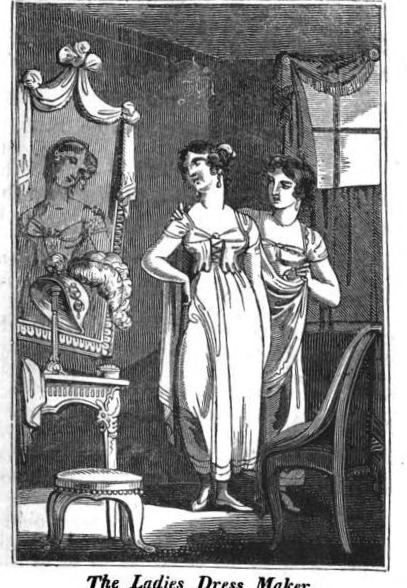
Image from the book: "The plate represents the Dress-Maker taking the pattern off from* a lady, by means of a piece of paper or cloth: the pattern, if taken in cloth, becomes afterwards the lining of the dress."

Under this head we shall include not only the business of a Mantua Maker, but also of a Milliner: for, although in London these two parts of in fact the same trade, are frequently separate, they are not always so, and in the country they are very commonly united.

The history of dress would be as voluminous as the history of mankind: dress is a thing subject to almost daily fluctuation, so that a history of the ladies’ dresses in England, for merely half a dozen years, would furnish matter for a bulky volume; we shall therefore not attempt it, but merely observe that the best, and, perhaps, the only excuse for such continual change in the empire of dress, is the opportunity which that change offers of employment to those persons who would otherwise have no immediate claim upon the rich and opulent; and thus, what would be retained in their coffers, is now scattered in a variety of ways amongst the community in the purchase of luxurious dress, and in the alterations which fashion is continually introducing.

In the Milliner, taste and fancy are required; with a quickness in discerning, imitating, and improving upon various fashions,which are perpetually changing among the higher circles.

  • Silks and Satins, of various sorts, are much used in this business; which were formerly imported into this country, but now are manufactured ia great perfection in Spitalfields and its neighbourhood.
  • Gauze is a very thin, slight, transparent kind of stuff, woven sometimes of silk, and sometimes only of thread.
  • Crape is a very light, transparent stuff; in some respects like gauze: but it is made of raw silk, gummed and twisted on the mill, and woven without crossing. It is used for mourning, and is now a very fashionable article in court-dresses.
  • Spangles are small, thin, round leaves of metal, pierced in the middle, which are sewed on as ornaments to dress.
  • Artificial Flowers are made, sometimes, of very fine coloured paper, sometimes of the inside linings upon which the silk worm spins its silk, but principally of cambric, which is a kind of linen made of flax, and was first manufactured at Cambray in France, whence its name.
  • Ribbands used by the Milliners are woven: of these there are different sorts, distinguished by different names; as, the China, the sarcenet, and the satin.
  • Muffs and fur tippets are sold by the Milliner; but the manufacture of them from the skin, is a distinct business.
  • Velvet is also used by Milliners, and is now much in fashion: it is a sort of stuff, or silk; the nap of which is formed of part of the threads of the warp, which the workman puts on a channeled ruler, and then cuts, by drawing a sharp steel tool along the channel of the ruler, to the end of the warp.
  • Muslin is a fine sort of cloth, wholly made of cotton, so named from the circumstance of having a downy nap on its surface, resembling moss, which in French is called mousse.
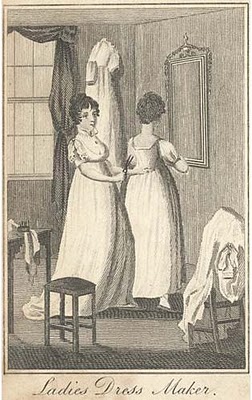
Dress Maker

The Ladies’ Dress-Maker’s customers are not always easily pleased; they frequently expect more from their dress than it is capable of giving. “Dress,” says Mr. Addison, ” is grown of universal use in the conduct of life. Civilities and respect are only paid to appearance. It is a varnish that gives a lustre to every action, that introduces us into all polite assemblies, and the only certain method of making most of the youth of our nation conspicuous: hence, Milton asserts of the fair sex,

-Of outward form
Elaborate, of in ward, less exact.’

“A lady of genius will give a genteel air to her whole dress, by a well fancied suit of knots, as a judicious writer gives a spirit to a whole sentence, by a single expression.”

The Dress-Maker must be an expert anatomist; and must, if judiciously chosen, have a name of French termination; she must know how to hide all defects in the proportions of the body, and must be able to mould the shape by the stays, that, while she corrects the body, she may not interfere with the pleasures of the palate.

The business of a Ladies’ Dress-Maker and Milliner, when conducted upon a large scale and in a fashionable situation, is very profitable ; but the mere work-women do not get any thing at all adequate to their labour. They are frequently obliged to sit up very late, and the recompense for extra work is, in general, a poor remuneration for the time spent.

More on the topic on this blog:

Read Full Post »
Poor Miss Manners is always having to explains why Americans hold forks in their right hands as opposed to Europeans, who use their left hand to spear their food. Have American table manners deteriorated? Or are we following an historic tradition?

Image @Silver Collect Blog*

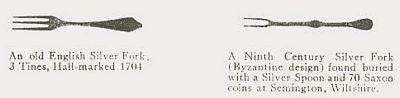
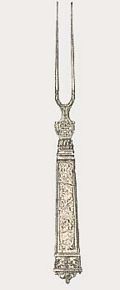
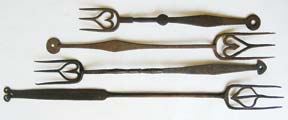
To answer that question we need to go back to ancient times when two-tined kitchen forks were used to help carve and serve meat. (We still require the assistance of large two-tined forks when barbecuing foods on a gas or coal grill.) In the 7th century the people in the Middle East began to use forks when dining, and by the 10th through the 11th centuries such usage had become quite common. The Italians were introduced to the fork in the 11th century.

One tale of the introduction of the fork to Western Europe credits Maria Argyropoulina, the Greek niece of Byzantine Emperor Basil II, who brought a case of golden forks to Venice in 1004, when she was to be married to the son of the Doge. She shocked guests at the wedding feast by using a fork, leading one priest to comment, “God in his wisdom has provided man with natural forks — his fingers. Therefore it is an insult to Him to substitute artificial metal forks for them when eating.” Italian clerics viewed it as God’s vengeance when Argyropoulina died of the plague two years later. – Early British Table Silver: A Short History

Image @Silver Collect Blog

It took 500 years for the implement to be used widely in that land. The French had their first look at the fork in 1533 when Catherine de Medici brought them from Italy upon the occasion of her marriage. The fork was at first thought to be an affectation, thus its adoption was slow, as it was in England after Thomas Coryate brought the implement back in 1608 from one of his travels to Italy. He observed that at their meals Italians  “use a little forks when they cut the meats.” Early table forks were small and two-pronged, but the sharp straight tines were unable to hold much food, inspiring mockery.  “Why should a person need a fork when God had given him hands?” one Englishman asked. (History of the Fork).  Ben Johnson satirized the fork in 1616 in The Devil is an Ass for “the sparing of napkins.”

One wonders how the Europeans ate their food without a fork. If you’ve ever attended a reproduction of a medieval banquet you have an idea. People used knives to spear food, spoons to scoop up, and fingers to grab. Only one implement was used at a time, and it was held in the right hand.

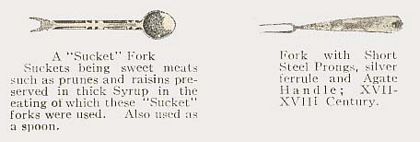
Slowly but surely the fork began to make inroads upon the dining table. As is the usual case, the wealthy began to adopt the new implement first. The upper crust began to impress their guests with forks made of expensive materials. Called suckett forks, they were used to protect the hands from sticky and messy foods or foods that stained the hands, like mulberries. By the mid 1600s, forks had become luxury items and were considered to be marks of fashion.   At the end of the 17th century and beginning of the 18th century the three-tined fork was introduced. The “sherbet course”, introduced in the early 1700’s, was created to wash the single fork for the next course.” (The History of the Fork)

Image @Silver Collect Blog*

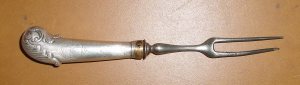
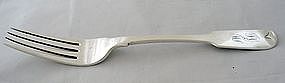
Four-tined prongs became popular in the 1750s.  These tines were curved and served as a scoop, reducing the need for the spoon. By the time Jane Austen and her family had moved from Steventon to Bath, the four-tined fork was also being made in Germany and England and had traveled to the Americas. In the mid 19th century specialized forks were produced for every kind of food, including cakes and fish.

Table fork, 1771

This short history still does not explain why Americans and Europeans hold their forks in different hands. History Matters: Cutlery provides an insight:

Cardinal Richelieu of France supposedly was so disgusted by a frequent dinner guest’s habit of picking his teeth with his knife that he had the tips of the man’s knives ground down. The fashion-conscious French court picked up on this style and followed suit. In 1699, to reduce the risk of dinnertime knife fights, French King Louis XIV banned pointed knives outright. Since blunted knives were useless for spearing food in the old two-knife dining style, forks replaced the knife held in the left hand.

The newfangled blunt knives reached the American colonies in the early 1700s, where few forks were available. Americans were forced to use upside-down spoons to steady food for cutting. They would then switch the spoon to the right hand, flipping it to use as a scoop. Even after forks became everyday utensils, this “zigzag” style (as Emily Post called it in the 1920s) continues to divide American eaters’ customs from the Continental style of dining. (Shifting the fork to the right hand after cutting is considered uncouth by Europeans.) – (This passage seems to have used The Uncommon Origins of the Common Fork as its source.)

18th C. flesh forks for broiling meat

In a recent Washington Post advice column, Miss Manners contends that Americans follow the correct European way of eating centuries ago and that it was the Europeans who sped things up by keeping the fork in the left hand as they cut their food with the right hand. She concludes her advice with this thought:

Those who point out that the European manner is more efficient are right. Those who claim it is older or more sophisticated — etiquette has never considered getting food into the mouth faster a mark of refinement — are wrong. – Miss Manners: Fork’s History is not a big Mystery

Silver serving fork, 1825

Read Full Post »

Gentle readers: I am on vacation at the shore. The hot weather has cooled and the crowded beaches are empty, except for a few bathers and the shore birds. Yet, somehow my Internet connection is spotty and my ability to add images is nil. So, here is a link to an article I wrote for Suite 101 over a year ago about Martha Gunn and John Smoaker Miles, famous sea dippers who helped men and women into the sea waters at Brighton.

Martha Gunn, dipper

Martha Gunn, dipper

In 1750, Dr Richard Russell wrote a dissertation advising his patients with glandular conditions to swim in the ocean and drink the iodine-rich sea water. The Prince of Wales, who first visited Brighton in 1783, began taking the sea cure for his swollen glands on his second and third visits. Brighton was a mere 6 hours by stagecoach from London, and where the prince went, the fashionable crowd followed. The town quickly became the seaside resort of choice for people seeking a pleasant diversion, or a cure for gout and other illnesses caused by rich food and lack of exercise, and a thriving industry devoted to bathing soon developed.

Bathers were drawn into the ocean inside bathing machines constructed of wood. Men and women were required to enter the water at specified times in different sections of the beach. The women used the beaches on the east side of town near the Brighton aquarium, while the men were diverted to the west end beaches. This custom ensured that the sexes could not view each other in revealing bathing costumes, or while swimming in the nude, a practice that the men followed often and the women more infrequently

Read more at: Sea Bathing in Georgian Brighton: Martha Gunn and John ‘Smoaker’ Miles

Other posts on this topic:
Martha Gunn, Brighton’s Queen of the Dippers|

Read Full Post »

« Newer Posts - Older Posts »