Feeds:
Posts
Comments

Archive for the ‘Edwardian Life’ Category

This Sunday, PBS will air on most stations an hour presentation of  Secrets of the Manor House, a documentary narrated by Samuel West, that explains how society was transformed in the years leading up to World War One. Expert historians, such as Lawrence James and Dr. Elisabeth Kehoe, discuss what life was like in these houses, explain the hierarchy of the British establishment, and provide historical and social context for viewers. For American viewers of Downton Abbey, this special couldn’t have come at a better time.
The British manor house represented a world of privilege, grace, dignity and power.

For their services for the King in war, soldiers were awarded lands and titles. The aristocracy rose from a warrior class.

This world was inhabited by an elite class of people who were descended from a line of professional fighting men, whose titles and land were bestowed on them by a grateful king.
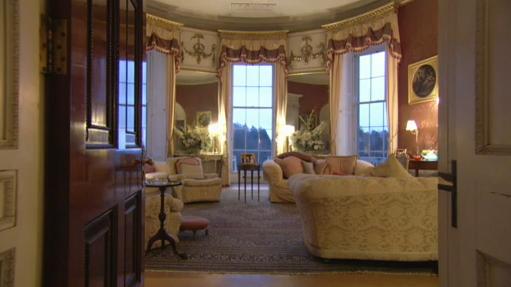
Manderston House, Berwickshire.

For over a thousand years, aristocrats viewed themselves as a race apart, their power and wealth predicated on titles, landed wealth, and political standing.

Huge tracts of lands with fields, villages, laborers' cottages, and forests surrounded country estates.

Vast landed estates were their domain, where a strict hierarchy of class was followed above stairs as well as below it. In 1912, 1 ½ million servants tended to the needs of their masters. As many as 100 would be employed as butler, housekeeper, house maids, kitchen maids, footmen, valets, cooks, grooms, chauffeurs, forestry men, and agricultural workers. Tradition kept everyone in line, and deference and obedience to your betters were expected (and given).
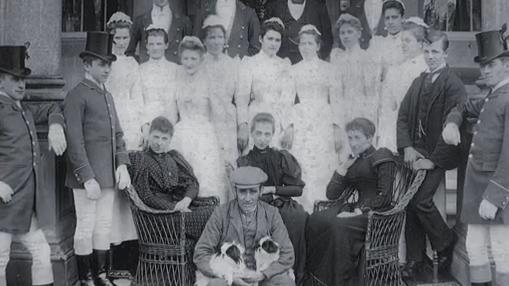
22 staff were required to run Manderston House, which employed 100 servants, many of whom worked in the gardens, fields, and forests.

As a new century began, the divide between rich and poor was tremendous. While the rich threw more extravagant parties and lived lavish lives, the poor were doomed to live lives of servitude and hard work.
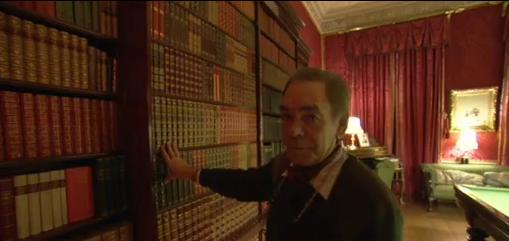
Lord Palmer pulls on a false bookcase to open a passage to the next room.

Manderston House in Berwickshire represents the excesses of its time. The great house consists of 109 rooms, and employed 98 servants just before the outbreak of World War One. Twenty two servants worked inside the house to tend to Lord Palmer and his family. Every room inside the house interconnected.
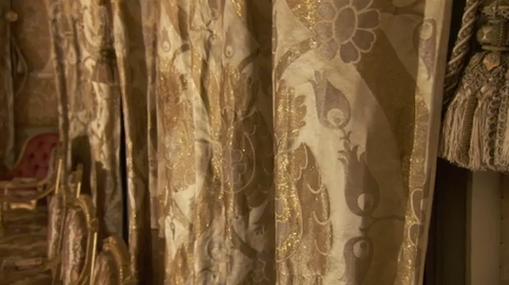
The curtains in the ballroom of Manderston House look as fresh as the year they were made in 1904.

The curtains and drapes, woven with gold and silver thread, were made in Paris in 1904 and cost the equivalent of 1.5 million dollars. Manderston House itself was renovated at the turn of the century for 20 million dollars in today’s money. This was during an era when scullery maids earned the equivalent of $50 per year.
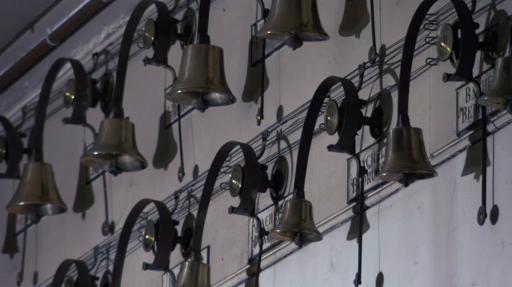
Once can clearly see the differences in bell sizes in this photo.

The servant hall boasted 56 bells, each of a different size that produced a unique ring tone. Servants were expected to memorize the sound for the areas that were under their responsibility.
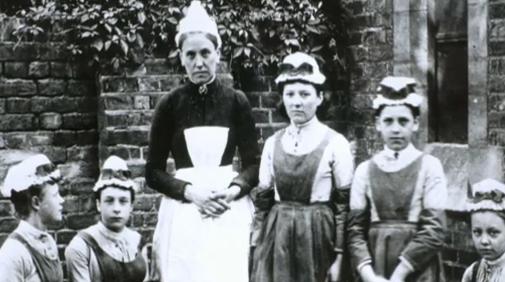
Scullery maids were placed at the bottom of the servant hierarchy. They rose before dawn to start the kitchen fires and put water on to boil. Their job was to scrub the pots, pans and dishes, and floors, and even wait on other servants.

Life was not a bed of roses for the working class and the gulf between the rich and poor could not have been wider than during the turn of the 21st century.
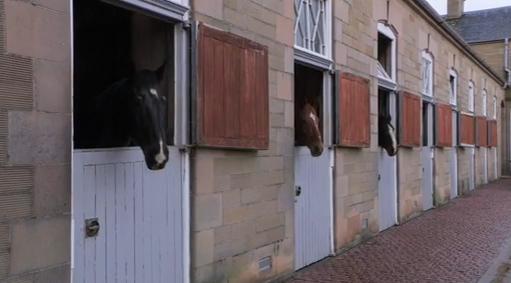
Thoroughbred horses lived better than the working classes.

While the servants slept in the attic or basement, thoroughbred horses were housed in expensively designed stable blocks. As many as 16 grooms worked in the stables, for no expense was spared in tending to their needs.
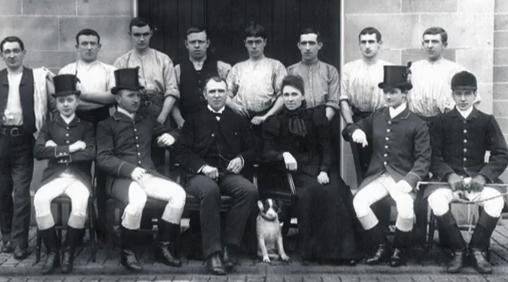
The stables at Manderston House required 16 grooms to feed, care for, and exercise the horses.

As men and women worked long hours, as much as 17-18 hours per day, the rich during the Edwardian era lived extravagant, indulgent lives of relaxation and pleasure, attending endless rounds of balls, shooting parties, race meetings, and dinner parties.
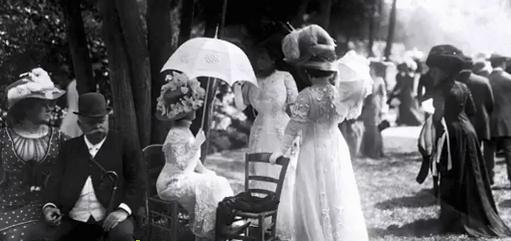
Up to the moment that war was declared, the upper classes lived as if their privileged lives would never change.

The Edwardian era marked the last great gasp of manor house living with its opportunities of providing endless pleasure. For the working class and poor, the inequities within the system became more and more apparent. The landed rich possessed over one half of the land. Their power was rooted in owning land, for people who lived on the land paid rent. The landed gentry also received income from investments,  rich mineral deposits on their land, timber, vegetables grown in their fields, and animals shipped to market.
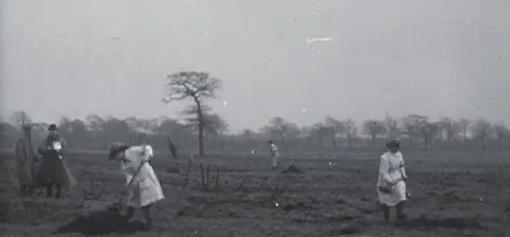
The lord of the manor and his steward can be seen walking among the farm laborers, many of whom were women.

The need to keep country estates intact and perpetuate a family’s power was so important that the eldest son inherited everything – the estate, title, all the houses, jewels, furnishings, and art. The laws of primogeniture ensured that country estates would not be whittled away over succeeding generations. In order to consolidate power, everything (or as much as possible) was preserved. Entailment, a law that went back to the 13th century, ensured that portions of an estate could not be sold off.
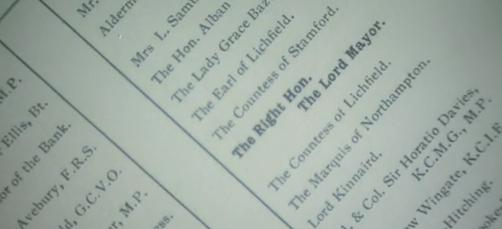
The Lord Mayor of London was seated at the center of the table next to the Countesses of Stamford and Lichfield.

The system was rigged to favor the rich. Only men who owned land could vote, and hereditary peers were automatically given a seat in the House of Lords. By inviting powerful guests to their country estates, they could lobby for their special interests across a dinner table, at a shoot, or at a men’s club.
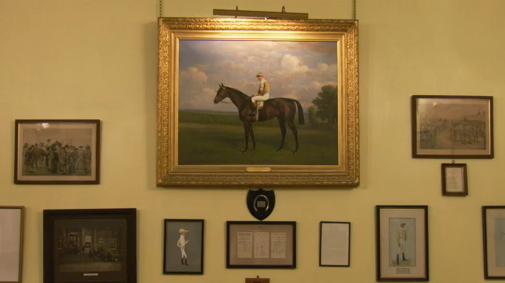
Thoroughbred horses were valued for their breeding and valor, traits that aristocrats identified with.

The Industrial Revolution brought about changes in agricultural practices and inventions that presaged the decline of aristocratic wealth. Agricultural revenues, the basis on which landed wealth in the UK was founded, were in decline. Due to better transportation and refrigeration, grain transported from Australia and the U.S. became cheaper to purchase. Individuals were able to build wealth in other ways – as bankers and financiers. While the landed gentry could still tap resources from their lands and expand into the colonies, the empire too began to crumble with the rise of nationalism and nation states.
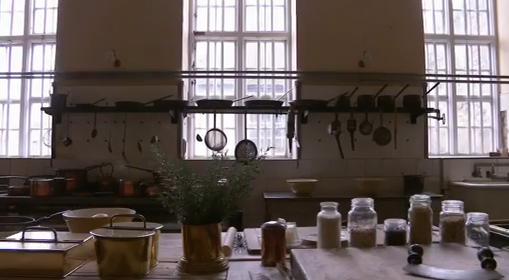
The servant hierarchy echoed the distinctions of class upstairs. The chef worked at the end of the table on the left, while the lowest ranking kitchen maids chopped vegetables at the far right. The kitchen staff worked 17 hours a day and rarely left the kitchen.

Contrasted with the opulent life above stairs was an endless life of drudgery below stairs. On a large estate that entertained visitors, over 100 meals were prepared daily. Servants rose at dawn and had to stay up until the last guest went to bed. Kitchen maids, who made the equivalent of 28 dollars per year, rarely strayed outside the kitchen.
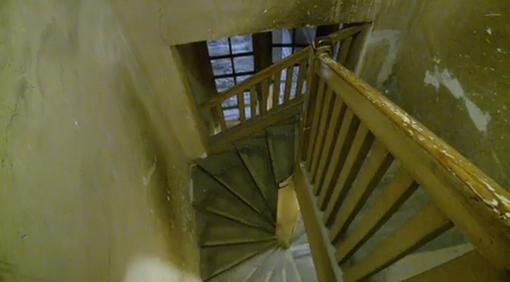
Steep back stairs that servants used. Out of sight/out of mind.

One bath required 45 gallons of water, which had to be hauled by hand up steep, narrow stairs. At times, a dozen guests might take baths on the same day. House maids worked quietly and unseen all over the manor house. The were expected to move from room to room using their own staircases and corridors. Underground tunnels allowed servants to move unseen crossing courtyards.
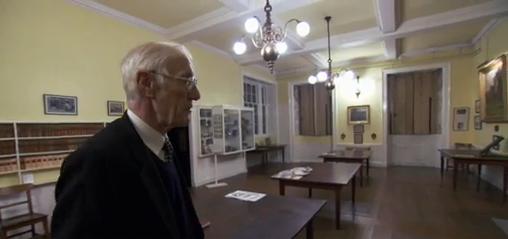
Manderston House's current butler shows the servant's hall

Maids and footmen lived in their own quarters in the attic or basement. Men were separated from the women and were expected to use different stairs. Discipline was strict. Servants could be dismissed without notice for the most minor infraction.

Footmen tended to be young, tall, and good looking.

Footmen, whose livery cost more than their yearly salary, were status symbols. Chosen for their height and looks, they were the only servants allowed to assist the butler at dinner table. These men were the only servants allowed upstairs.
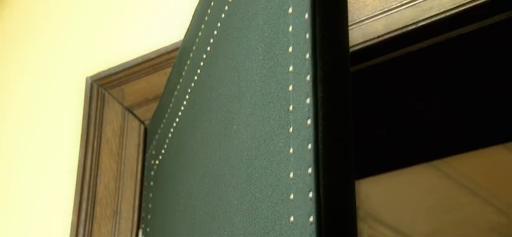
Green baize doors separated the servants quarters from the master's domain.

Green baize doors were special doors that marked the end of the servants quarters and hid the smells of cooking and noises of the servants from the family.
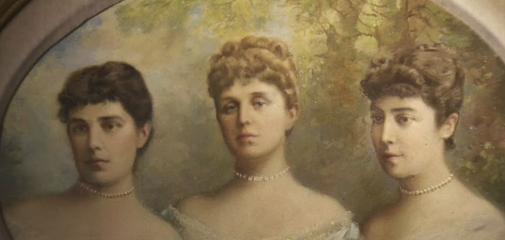
The Jerome sisters were (l to r) Jennie, Clara, and Leonie.

As revenues from agriculture dwindled, the upper classes searched for a new infusion of capital.This they found in the American heiress, whose fathers had built up their wealth from trade and transportation. Free from the laws of primogeniture, these wealthy capitalists distributed their wealth among their children, sharing it equally among sons and daughters. The ‘Buccaneers,’ as early American heiresses were called, infused the British estates with wealth. ‘Cash for titles’ brought 60 million dollars into the British upper class system via 100 transatlantic marriages.
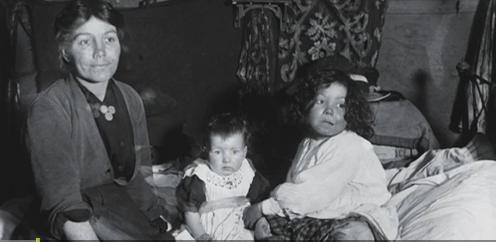
Working class family

Transatlantic passages worked both ways, even as American heiresses crossed over to the U.K.,  millions of British workers emigrated to America looking for a better life. The sinking of the Titanic, just two years before the outbreak of World War One, underscored the pervasive issue of class.
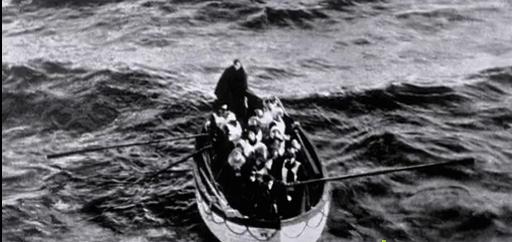
Most likely this lifeboat from the Titanic was filled with upper class women and children. Only 1 in 3 people survived.

The different social strata were housed according to rank, and it was hard to ignore that a large percentage of first class women and children survived, while the majority of third and second class passengers died.
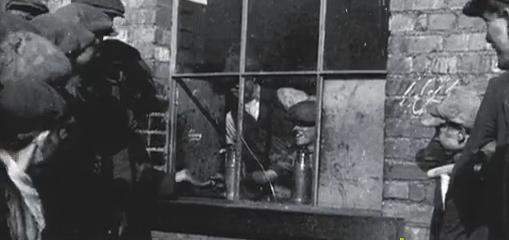
Labor strikes became common all over the world, including the U.K.

Society changed as the working class became more assertive and went on strikes. The Suffragette movement gained momentum. Prime Minister David Lloyd George was a proponent of reform, even as the aristocracy tried to carry on as before.
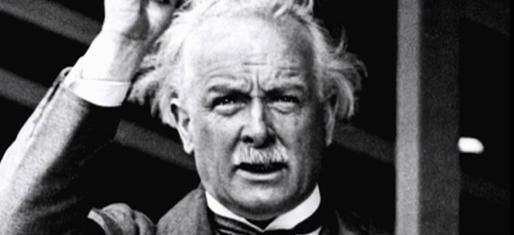
Lloyd George campaigned for progressive causes.

Inventions revolutionized the work place. Electricity, telephones, the type writer, and other labor-saving devices threatened jobs in service. A big house could be run with fewer staff, and by the 1920s a manor house that required 100 servants needed only 30-40.
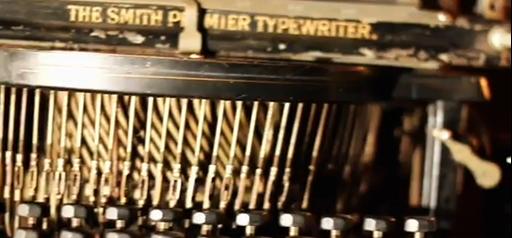
Change is ever present. The last typewriter factory shut its doors in April, 2011.

Women who would otherwise have gone into service were lured into secretarial jobs, which had been revolutionized by the telephone and typewriter.
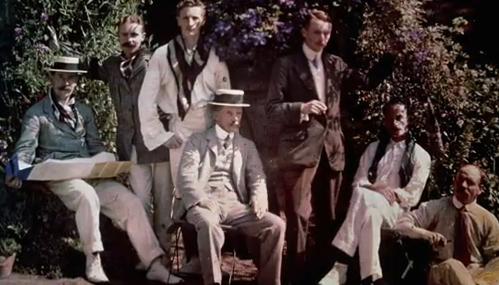
Many of the aristocratic young men in this photo would not return from war.

The manor house set enjoyed one last season in the summer of 1914, just before war began. Many of the young men who attended those parties would not return from France. Few expected that this war would last for six months, much less four years. Officers lost their lives by a greater percentage than ordinary soldiers, and the casualty lists were filled with the names of aristocratic men and the upper class.
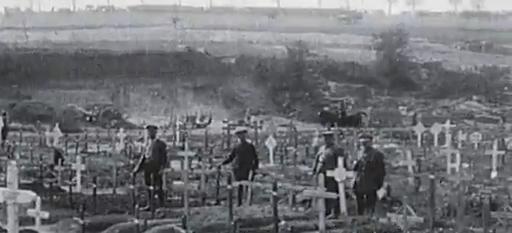
Over 35 million soldiers and civilians died in World War 1

Common soldiers who had died by the millions had been unable to vote. Such inequities did not go unnoticed. Social discontent, noticeable before the war, resulted in reform – the many changes ushered in modern Britain.
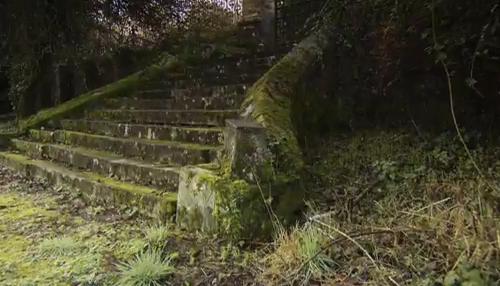
As the 20th century progressed, owners found it increasingly hard to maintain their manor houses. According to Lost Heritage, over 1,800 have been lost.

Watch Secrets of the Manor HouseJanuary 22 on PBS. All images from Secrets of the Manor House.

Please note: All advertisements on this blog are placed here by wordpress. I earn no income from my blog.

Read Full Post »

Highclere Castle as Downton Abbey was a beautiful setting

Now that the last episode of Downton Abbey has aired, I can reflect back on the series and revisit some of the most surprising scenes. Indeed, the unexpected plot developments, which kept the viewers on their toes,  helped to make this series so unforgettable. Throw luscious costumes into the mix, stunning locations, a wealth of detail about Edwardian life, and great acting and you get one of the best costume dramas in recent years. Oh, the series had its faults with one or two too many stereotypical characters, but overall I give it a grade of A.

Reader alert: Spoilers!!

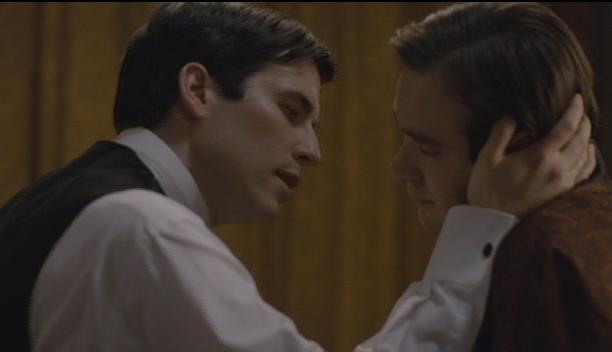
Surprise #1: Thomas kisses the Duke

Thomas (Rob James-Colier) and the Duke of Crowborough (Charley Cox)

This scene, which upset parents watching with their children, helped to seal the character of Thomas, the first footman, and clued the viewer into the the Duke’s motives for hightailing it to Downton Abbey when he thinks Mary will come into a boatload of money.

The duke learns the true situation of Lady Mary's finances from Lord Grantham.

The Duke finds and burns Thomas’s letters, which were the footman’s only means of blackmailing him, and then he scurries away the moment he discovers that Lord Grantham’s estate is entailed to the closest male heir, making his chance to marry into the Grantham fortune less than zero. Thomas goes on to demonstrate his sleazy character in many more ways, but his move on the Duke packed a real punch.

Surprise #2: Lady Mary is not just another cookie cutter heroine

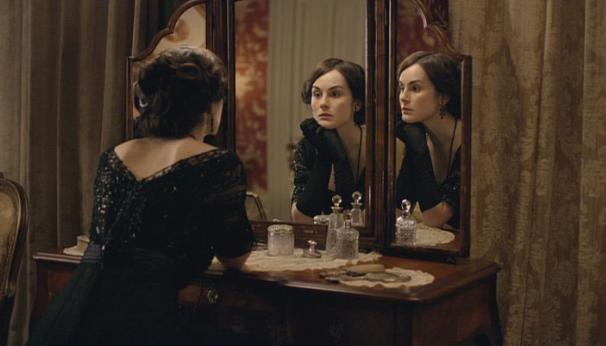
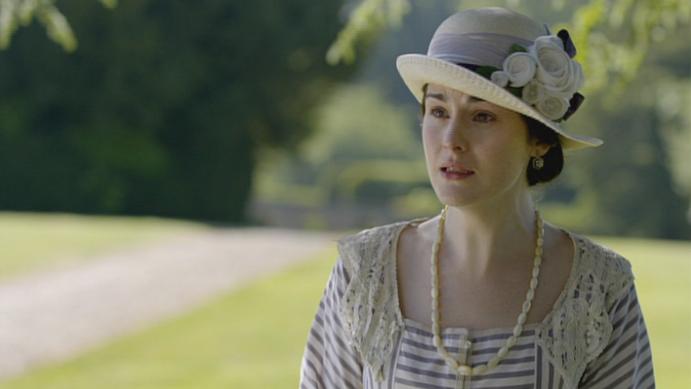
Michelle Dockery as Lady Mary Crawley

From the moment we meet her, Lady Mary comes off as a cold, calculating, and complex woman, whose vulnerability does not come into full view until the third episode. When the viewer meets her, she worries about having to wear black after the death of her fiance on the Titanic and only mourns the fact that she cannot mourn him. Haughty and immodestly aware of her attraction to men, her pursuit of a wealthy and titled husband begins to take on a hint of desperation, which is why her fall from grace with Evelyn Napier’s attractive Turkish friend, Kemal Pamuk (Theo James), is even more shocking.

Surprise #3: Lady Mary, Lady Cora, and Anna share a terrible secret that cannot be contained

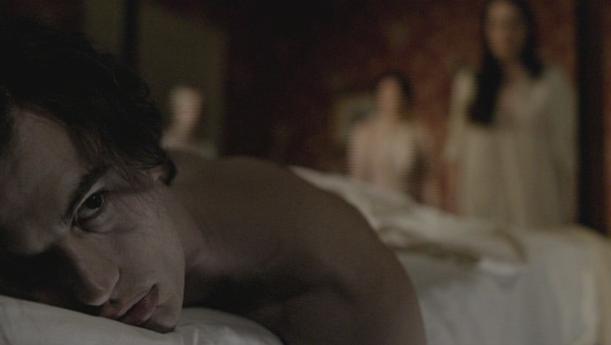
Lady Mary is in deep trouble after Pamuk dies in her bed.

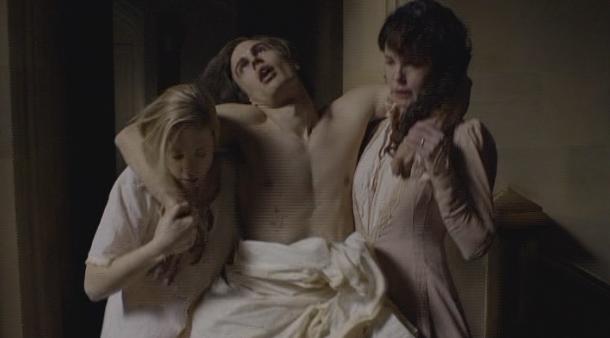
The scene in which Pamuk dies in Lady Mary’s bed and the women secretly carry him back to his bedroom could have descended into slapstick comedy, but it did not due to great directing and acting. As I watched, I didn’t know whether to laugh, cry, or whoop it up. All I knew was that in no way did I anticipate this plot development, which would affect Mary’s story arc and uneasy relationship with her mother for the rest of the mini-series.

Consequences of Lady Mary's fall from grace. Anna and Cora carry Pamuk back to the bedroom.

Handsome Pamuk is reduced to a limp corpse. And Mary? What on earth was she thinking? When Matthew finally proposes, Cora reveals to Violet that Mary wants to confess about the circumstances of Pamuk’s death, prompting the dowager to exclaim:  “She reads too many novels. One way or the other, everyone goes down the aisle with half the story hidden!”

Surprise #4: The Enjoyable Saga of One Upmanship Between Two Well-Matched Battle Axes

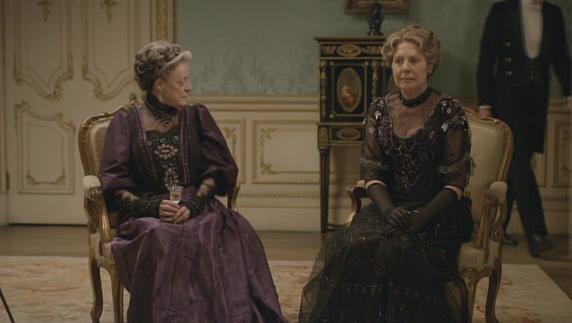
Violet, the dowager countess (Maggie Smith) and Isobel Crawley (Penelope Wilton), Matthew's mama

Violet and Isobel: Two strong-willed women, both firm in their belief that they are right, one with modern notions, the other clinging to old-fashioned ways, provide a colorful but minor story line. Isobel Crawley, despite her comparative lack of social status (when matched against the Dowager Countess), manages to make her will known and felt. Violet can only sputter and rage at Isobel’s interference, and she finds scant satisfaction in proving Isobel’s diagnosis and treatment of Molesley’s skin condition wrong. But Isobel was not born yesterday, and at the Flowershow Death Match she shames Violet into giving the trophy for best roses to Molesley’s papa, instead of appropriating it as her own for the umpteenth time.

Violet graciously gives this year's prize to old Mr. Molesley.

In their scenes together,  Penelope Wilton  gave the incomparable Maggie Smith a run for her money. The enjoyable interplay between these two marvelous actresses was as surprising as it was worth watching.

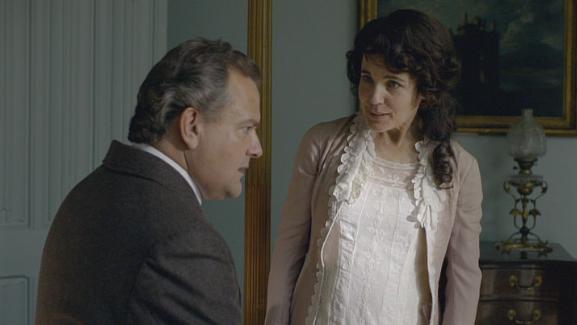
Surprise #5: Cora’s Pregnancy

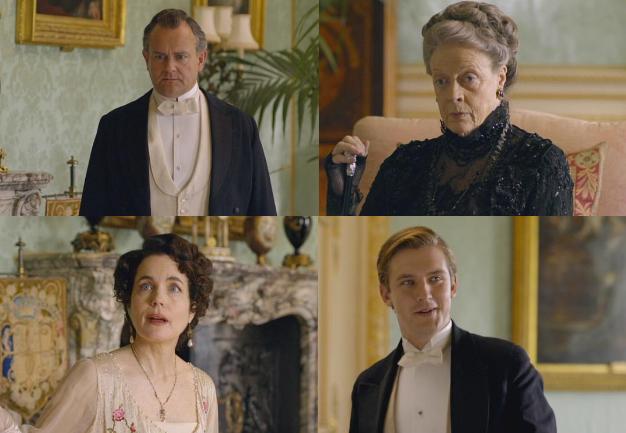
Lord Grantham's surprise at learning of Cora's pregnancy. (Hugh Bonneville and Elizabeth McGovern)

Did you see this scene coming? I did not, although it made sense, for this unexpected pregnancy explains much about the entail and why Matthew Crawley was only the presumptive heir and therefore essentially helpless in changing his situation. As long as the earl could possibly sire a son, Matthew’s claim to the inheritance would remain tenuous. The entail could not be broken for the Grantham was still  a healthy and virile man, as this scene shows. The pregnancy led us to discover…

Surprise #6:  O’Brien’s True Malevolent Impulses

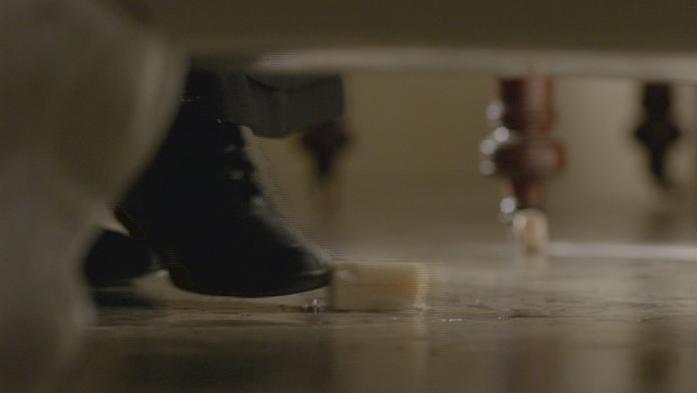
Cora (Elizabeth McGovern) holds the fatal bar of soap

O'Brien shoves the bar of soap in harm's way.

Cora’s fatal flaw was in thinking that she and O’Brien had developed a mutual friendship and trust. While Cora receives glimpses of O’Brien’s true character, she never fully understood the anger and insecurity that her ladies maid harbored. O’Brien’s pang of conscience about shoving the broken half of the bar of soap from under the bath tub came too late, and Cora slipped and fell, losing the male heir that she and Lord Grantham so desperately wanted.  O’Brien’s dark impulse was for naught. Cora wasn’t actively looking to replace her, but only helping her mother-in-law in hiring a new ladies maid. This surprising news hit the viewer at the same time as it did O’Brien.

O’Brien’s momentary second thought comes too late. (Siobhan Finneran)

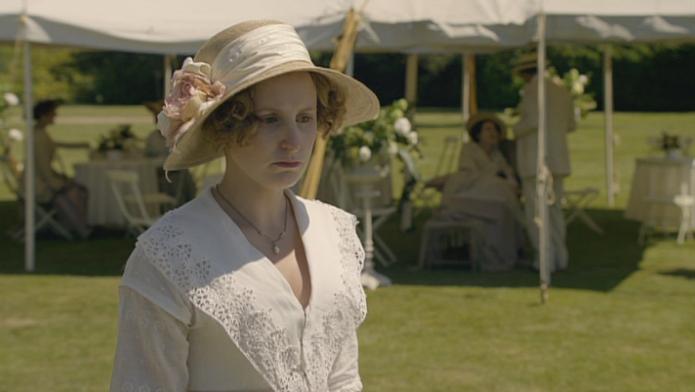
Surprise #8: The Spiteful Tug of War Between Two Sisters

Lady Edith (Laura Carmichael) realizes that her sister Mary was behind Lord Strallan's cool departure.

At first the viewer felt a great deal of sympathy towards plain Lady Edith, who was only to happy to go after Lady Mary’s leavings. But as the mini-series progressed, the viewer came to understand just how much animosity the two women felt towards one another and how far they would go to extract their revenge, Lady Edith writing the Turkish embassy about Mary’s part in Pamuk’s death, and Lady Mary sabotaging Lady Edith’s happiness with Sir Anthony Strallan, who was about to propose.

Lady Mary salutes her triumph over Lady Edith.

In the end, neither sister came up smelling like a rose. The surprise was that their story line was written so well that many viewers came away feeling sympathy towards both women.

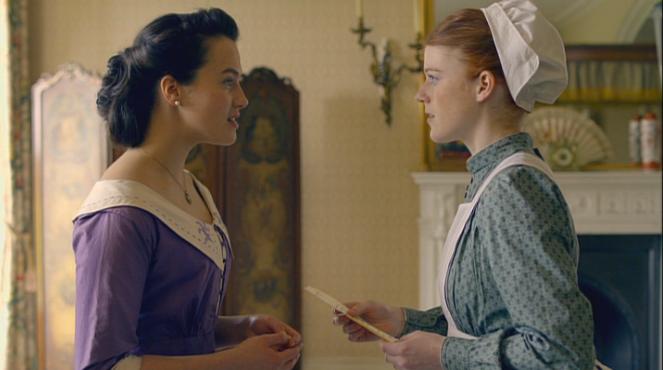
Surprise #9: Lady Sybil’s Firm Stance Behind Women’s Rights

Lady Sybil (Jessica Brown-Findlay) urges Gwen (Rose Leslie) to keep trying to find a job as a secretary

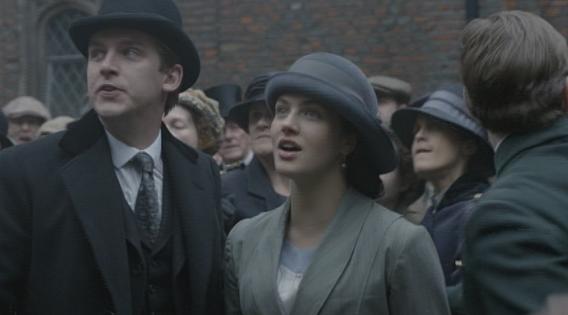
Lady Sybil’s story arc did not truly begin until the second episode and reached its full glory in episode four, when she is struck during an election rally and is carried from the scene bleeding.

Matthew Crawley and Lady Sybil at the election rally

A smart, independent, and kind woman, one can only hope that Lady Sybil’s character gains traction in the second series that is currently being filmed. The surprise here is that quiet, sweet Lady Sybil is truly the most daring and courageous of the three sisters. Jessica Brown-Findlay has true star status, and any time she came on the small screen, she lit it up.

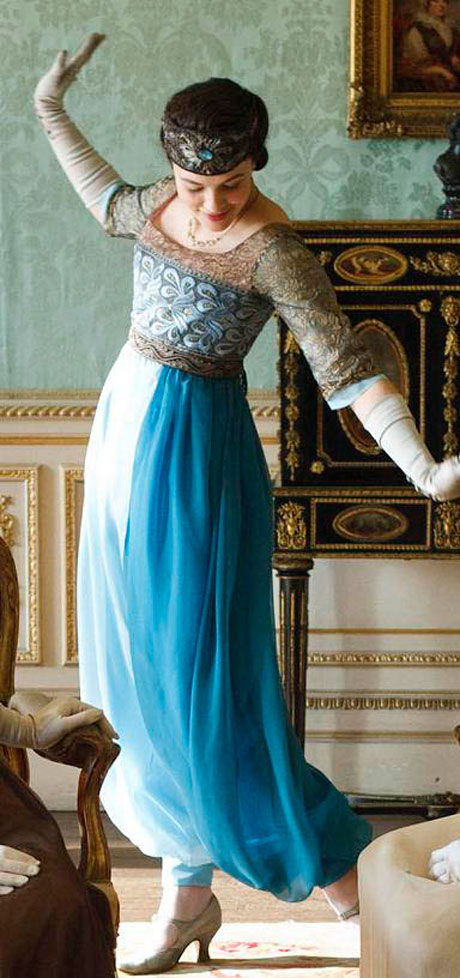
Lady Sybil's daring new harem pants.


The family reacts to Lady Sybil's harem pants. Priceless.

Surprise #10: The ending


Lord Grantham, "I regret to announce we are at war with Germany."

Obviously a second series is in the works, for the story line is left hanging. World War I has broken out, causing consternation among the group.

Matthew refuses Lady Mary's acceptance of his proposal after her baby brother's death, and vows to leave Downton Abbey to make his own way.

Lady Mary accepts Matthew’s proposal, but he refuses her, unsure of whether the baby’s death had anything to do with her acceptance, and he declares his intention to leave Downton Abbey and make his own way in the world. Lady Mary, in a Scarlet O’Hara moment, realizes too late that she waited too long to accept Matthew.

Lady Mary understands she has made a mistake in waiting so long to accept Matthew's proposal.

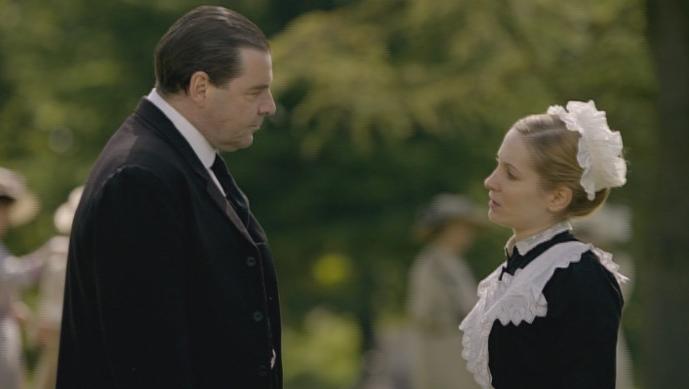
Bates,  who cares for Anna as much as she cares for him, refuses to discuss his wife’s whereabouts with her.

Bates (Brendan Coyle) and Anna (Joanne Froggat) find themselves in the throes of bittersweet love.

And so, the viewer must wait an entire year to see what will happen to the characters in Downton Abbey, testing our patience sorely.

None too soon, Thomas announces his resignation to Mr. Carson and Mrs. Hughes

In addition to my ten choices, there were other surprises and great story arcs in Downton Abbey: Cook’s failing eyesight and the operation that saved it, Daisy’s blindness towards Thomas’s true character, which leads her to lie,

Daisy is haunted by what she saw in the corridor and her lies about Bates.

Mrs. Hughes’s longing for her own family, which made her momentarily receptive to an old flame’s advances, and Mr. Carson’s past as a performer, of which he is ashamed.

Mrs. Hughes says no to Joe, an old flame (Bill Fellows).

For those of you who missed certain episodes or who would like to watch the series again, PBS has made it available for online viewing until February 22. DVD’s are also available for sale.

My question to you is this: Of all the characters and story lines, which was your favorite? Please feel free to leave a comment.

Read Full Post »

The servants in Downton Abbey. Image courtesy @ITV and PBS Masterpiece.

Downton Abbey. Gosford Hall.  Manor House. Regency House. Each film follows the servants and takes the viewer up and down back stairways, into kitchens and butler’s pantries, and stables and courtyards. But how were the servants’ quarters laid out, and where were they placed in relation to the public and private rooms that the family used? Each house had a different arrangement, to be sure, but patterns did exist.

A narrow corridor leads from the kitchen. Image courtesy @PBS Masterpiece.

The interior and exterior shots of Downton Abbey were filmed in Highclere Castle,but because the servant kitchens and bedrooms below-stairs no longer existed as they once were, the servant quarters for the mini-series were reconstructed in Ealing Studios in London. The cost of reconstructing these “plain” rooms was relatively affordable. Imagine if one of the elaborate public rooms had to be reconstructed. As script writer Julian Fellowes observed: “The thing about filming in these great houses is that if you were to start from scratch, you simply couldn’t build this and if you did you would have used up all your budget in one room.”

Servant stairs in Downton Abbey. Image courtesy @PBS Masterpiece

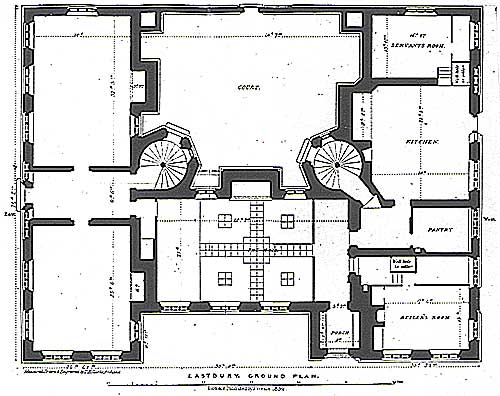
The ground plan from Eastbury Manor House is representative of a great house. It shows the servant quarters at the right near tight round servant stairs, or back stairs, that the servants used instead of the grand staircase reserved for the family and their guests. Maids were expected to work invisibly and sweep and dust when the family was asleep, or work in a room when the family was not scheduled to use it. In fact, many of the lower servants never encountered the family during their years of service.

Unless they were polishing or cleaning the grand staircase, the servants would use the backstairs for all other occasions. A small housemaid’s closet would be located near the back stair on the bedroom floor to accommodate brushes, dusters, pails, and cans. In “modern” Victorian and Edwardian houses, such a closet might  contain a sink that provided water for mopping.  Some great houses boasted a linen-room on the bedroom floor, where clean bed linen and table linen were stored. In this instance, a dry environment was essential.

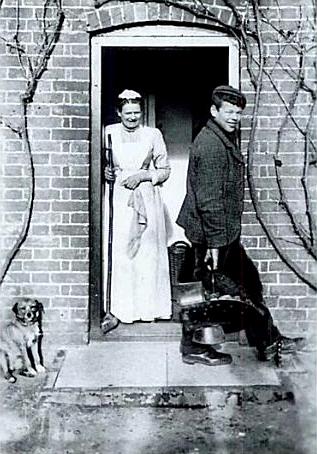
Late 19th c. maid and lad at the back entrance

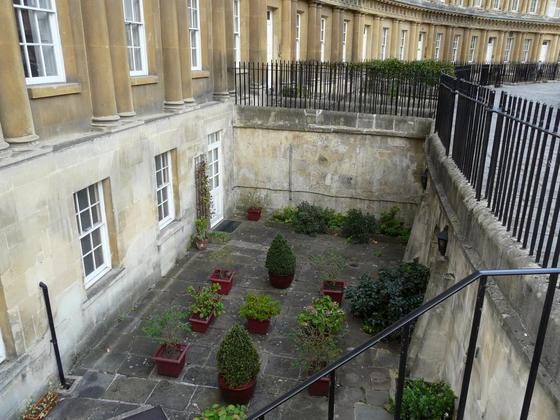
Servants were expected to enter the house in their own entrance, even in smaller houses, such as townhouses.  The Regency Townhouse Annex shows a typical entrance below street level. If you click on the links on the various rooms, you can see the other servant areas in this site.

Stairs to servant’s entrance. Bath. Image @Tony Grant

In a country house, the entrance would be in the back of the building or from a courtyard, where supplies could be delivered. The philosophy of a smooth running household was that servants were out of sight and out of mind.

Belowstairs entrance, Bath. Image @Tony Grant

Upon entering, servants would walk along a long hallway to reach the servants’ rooms and other work areas such as the kitchen, scullery, servant’s hall, housekeeper’s room, butler’s room, storage room, etc.  Country were at least two or three stories tall. Servants climbed the stairs and came down them again all day long, cleaning, hauling water, carrying meals or coal for fires, and a myriad other duties. They rose before the family, often from top floor garrets with small windows, and worked long after their employers had gone to bed.

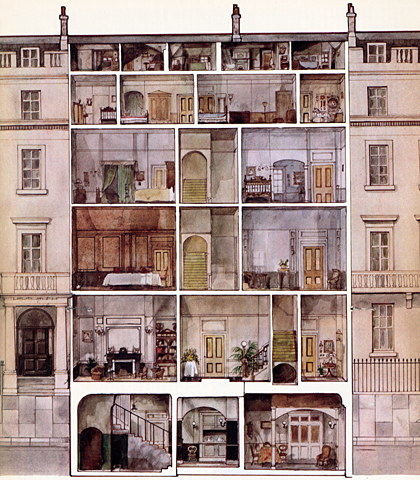
Interior, Upstairs Downstairs web page. Notice the tiny garret bedrooms.

In this image, you can see the small garret rooms reserved for servants in the attic of a townhouse. Men’s and women’s quarters were separated, as in Downton Abbey, with the women’s quarters called the virgin’s wing. The most common servant quarters are described below.

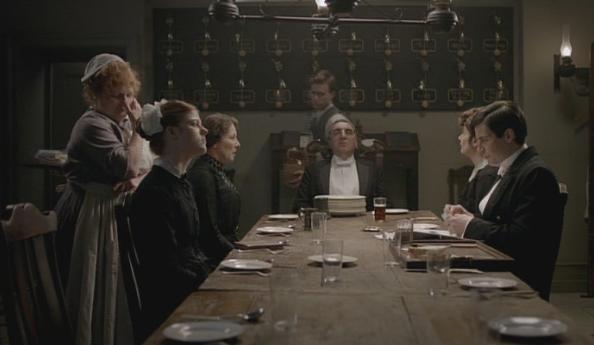
A meal belowstairs. Downton Abbey. Notice the servant bells on the back wall. Image courtesy @PBS Masterpiece

Servant’s Hall:

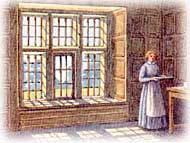
The servant’s hall was a common room where the work staff congregated, ate their meals, performed small but essential tasks, like mending, darning, polishing, ect. A long table was its main feature, as well as a window that would let in enough light for the tasks that needed to be accomplished. This window is a feature in images of several servants halls, which makes me think it was essential, for many of their tasks (darning, polishing shoes, ironing, and the like) required good light.

1907 Watercolor of the windows in a servant’s hall

The servants would regard the hall as their living room, for they ate their meals there and congregated in the hall for the evening. Often the cook did not regard making the servants’ meals as part of her duty, and this task would be left to the kitchen maids. Servants would also receive the visitors’ servants here (as in Gosford Park), persons of similar rank, or their own visitors on a very rare occasion.

Image of Victorian servants eating dinner in the servants hall.

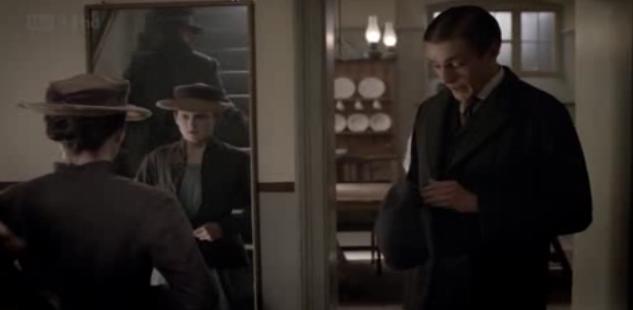
The servant bells were located in this area, as well as hooks for coats and uniforms.

Daisy puts on her coat as William speaks to her just outside the servants hall. Downton Abbey. Image courtesy @PBS masterpiece

The servants followed a hierarchy downstairs as strict as upstairs, and the upper servants, the butler, housekeeper, cook, valet and ladies maid would be served meals and tea by the lower servants.  The highest ranking servant was the stewart, then came the butler and housekeeper.

Anna completes a task in the servants hall. Downton Abbey. Image courtesy @PBS Masterpiece

The ladies maid would defer to the housekeeper and the valet to the butler. Standing low down was the scullery maid or tweeny, who often was just a young girl of twelve or thirteen. Her hours were the longest, for she would make sure that the water was boiling for the cook before she began her day.

Kitchen:

The long work table is the focal point of the kitchen. Downton Abbey. Image courtesy @PBS Masterpiece

The kitchen even in great houses were utilitarian, and positioned away from the family quarters to keep cooking smells away yet near enough for the delivery of food. Kitchens were also located near an entrance were supplies could be delivered, and near the kitchen gardens (but not always. See below.)

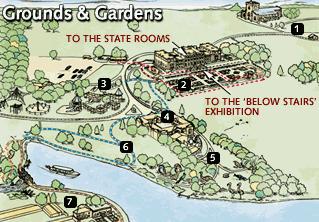
Harewood house and grounds. The kitchen was a 20-minute walk to the walled garden.

Kitchens tended to be oblong and dominated by a large kitchen table, where the majority of food preparation was done. The window would be ideally positioned to the left side of the range, and the kitchen dresser, where essential equipment was held, would stand close to the work table.

Kitchen suite, 1900 house.

The cook worked under the housekeeper, but the kitchen was her domain. She saw to its cleanliness and neatness, and made sure the larders were well-stocked. Not only were the floors, shelves, and work spaces scrubbed, but they had to be thoroughly dried to prevent mold and mildew from contaminating food stuffs and work tops. The arrangement of the scullery and kitchen was convenient, so that one did not need to cross the kitchen to reach the scullery. Natural light in both rooms needed to be ample. 

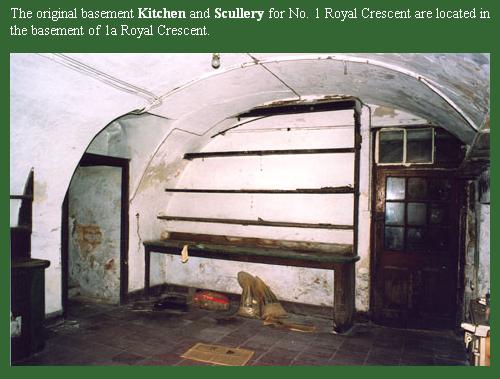
This kitchen in the Royal Crescent in Bath needs renovation and preservation.

She (for by the end of the 19th century, most of the cooks in British households were female) oversaw the meals and kitchen staff, consisting of kitchen maids and the scullery maid.

Scullery and kitchen in the Fota House, Ireland

Scullery:

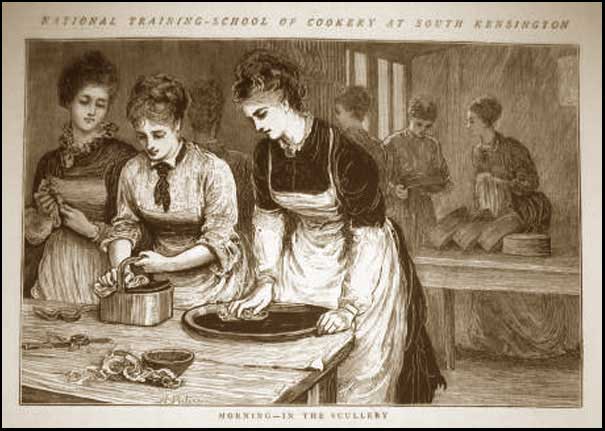
Cleaning in the scullery

The scullery was always located in a separate room from the kitchen so that food would not be contaminated by soiled water. Double stone sinks were the main feature of this room, where pots and pans and the servants’ crockery were rinsed and cleaned. The family’s fine china would be washed in a copper sink, whose softer surface prevented chipping. A cistern above the sinks was used to flush the drains, which led out of house. This was one reason that sculleries were located next to the outer walls and nearest the courtyards or an outer garden. Often, the scullery had no door into the kitchen (only a pass through), and one could enter the room only from the outside. An outside door in the scullery was also known as the “tradesmen’s entrance”.

Scullery, Image @Harewood House.

Food preparation also occurred in this area, such as chopping vegetables. Hygiene was essential in order not to contaminate existing food supplies, or the people within the house with soiled cutlery or water. This meant constant hauling of fresh water, scrubbing, washing, and cleaning. The scullery floor, made of stone, was lower than the kitchen’s, which prevented water from flowing into the cooking areas. Dry goods were stashed well away from the scullery, which also had to be kept dry in order to prevent mold. To prevent standing in water all day long, raised latticed wood mats were placed by the sink for the scullery maid to stand upon.

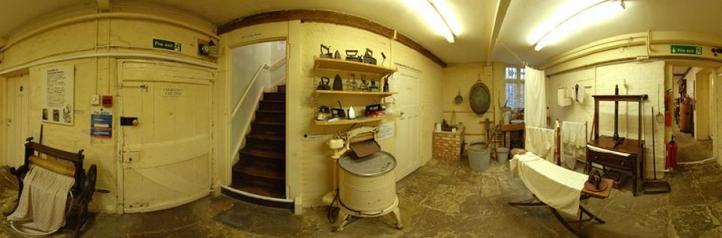
Panorama of a Victorian scullery with boiler and laundry features

Sculleries also contained a copper for boiling clothes on laundry day, washtubs, washboards, irons, and cabinets for cleaning supplies. In 1908, an eight-room house required 27 hours per week of labor, which did not include laundering clothes. One can only imagine how long a house the size of Downton Abbey took to manage.

Scullery sinks, Chawton

She stood at a sink behind a wooden dresser backed with choppers and stained with blood and grease, upon which were piles of coppers and saucepans that she had to scour, piles of dirty dishes she had to wash. Her frock, her cap, her face and arms were more or less wet, soiled, perspiring and her apron was a filthy piece of sacking, wet and tied round her with a cord. The den where she wrought was low, damp, ill-smelling, windowless, lighted by a flaring gas-jet……with many ugly dirty implements around her. – The History of Country House Staff

In this 17th c. image, the scullery maid stands upon a platform to keep her feet dry.

In Downton Abbey, the scullery maid is nowhere to be seen. (Daisy is the kitchen maid,  with vastly different duties.) Two modern women who played the scullery maid in Manor House quit the series, unable to pursue that role for the duration of the series. Only the third person, Ellen Beard, who had a better understanding of the scullery maid’s duties of endless washing, managed to remain at her station until the very end. Click on this link to hear a short podcast of a Scottish scullery maid, who described her job as slave labor.

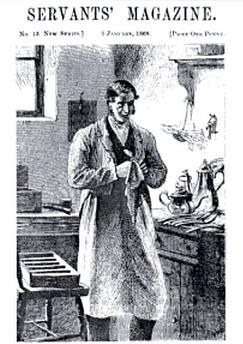
The butler polishes the silver, 1868.

Butler’s room and Butler’s Pantry

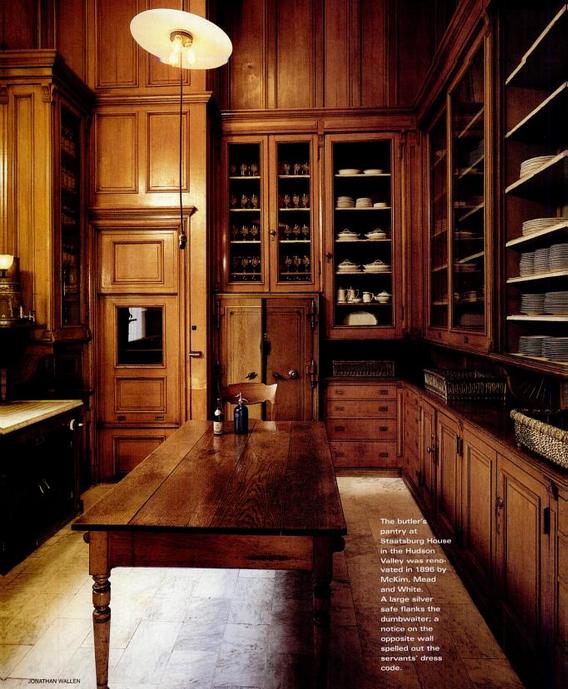
The duties of the butler confine him to the drawing-room and dining-room. The dining-room, however, is his particular domain; he sees that everything is in order, that the table is laid correctly, the lighting effect satisfactory, the flowers arranged, and in short that the room and appointments are in perfect readiness for a punctual meal. In this work a parlor maid assists him by sweeping and dusting, and a pantry-maid helps him by keeping everything immaculate and in readiness in the pantry. The butler serves at breakfast, luncheon and dinner.” – Vintage Maids and Butlers

Butlert’s pantry, 1896. Staatsburg House, McKim, Mead, & White

The butler’s rooms, which included the Butler’s Pantry, were located in the basement nearest the dining room upstairs and back entry, and had no connection with the kitchen, except for service. When he was summoned, even in his rooms, the butler could appear quickly. In smaller establishments, such as Matthew Crawley’s house, the butler also acted as valet. In all instances, except for the steward, he was the highest-ranking servant, answering directly to the master.

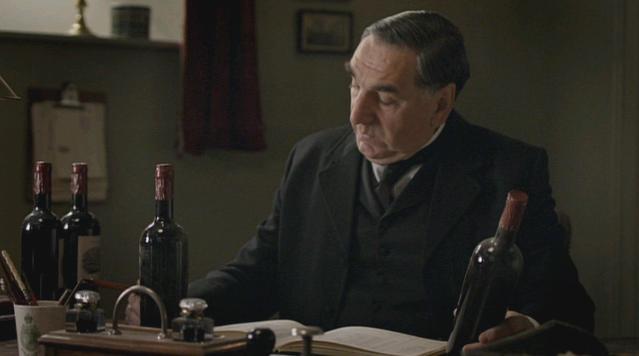
One of the duties of the butler (Mr. Carson in Downton Abbey) is to account for the wine. In this instance, he notices a discrepancy in the tally and the books. Image courtesy @PBS Masterpiece

The butler’s pantry was kept under lock and key, so that thievery was impossible at best, and at the very least deterred. A plate-closet or safe were placed there, as well as a private scullery for cleaning. The butler’s bedroom was a necessary (and lockable) adjunct in large houses for the protection of the plate.

Mrs. Hughes and Mr. Carson chat in her sitting room. Downton Abbey. Image courtesy @PBS Masterpiece

The Housekeeper’s Room

The housekeepers room in large establishments served as both a sitting- and business-room where she would take the directions of the day from the lady of the house. She would also entertain visitors of similar rank in her quarters. The housekeeper oversaw the female servants, and when she walked, a thick assortment of keys, symbols of her status and which dangled from her waist, would jiggle and certainly make a sound.

The housekeeper’s room in Uppark. At times the upper servants would congregate there for tea, and in some houses, for dinner.

Before dinner in the servants hall, the upper servants would assemble in the housekeeper’s room, also known as the Pug’s Parlour, and walk in for dinner, with the butler leading the way. This was known as the Pug’s Parade. After dinner, the upper servants would withdraw to the housekeeper’s parlor again for conversation.

Servant Bedrooms

Anna and Gwen confronted by O’Brien in their unlocked room. Downton Abbey. Image courtesy @PBS Masterpiece

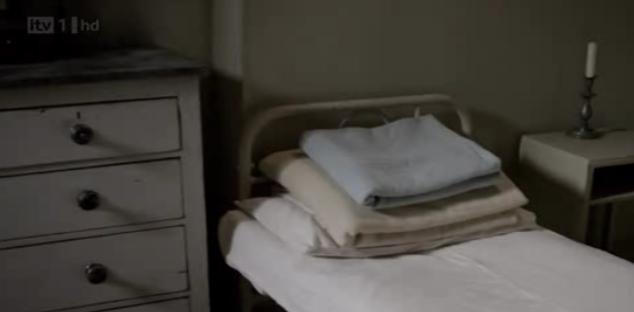
In the latter half of the 19th century, servants slept in attic bedrooms. These were often cold and damp in the winter and hot in the summer, with little light coming in from small windows. Some male servants slept downstairs to guard the family silver. The furnishings in servant quarters were basic and essential. A servant might have a locked box in which personal materials were kept, but the rooms were open and subject to inspection by their employers.

The valet’s simple bedroom. Downton Abbey. Image courtesy @PBS Masterpiece

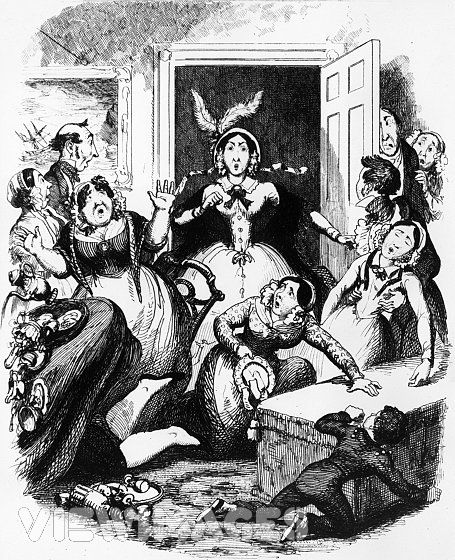
One source for servant quarters and duties of the servants cautioned that books about servant etiquette discussed ideal behavior. In reality, servant turnover was high, theft did occur, and servants did not always know their place. In this humorous Punch cartoon, the mistress arrived home unexpectedly, catching the servants eating upstairs and generally misbehaving. The truth, I suspect, is somewhere in between.

“Oh, hey, the missus! Servants eating a meal upstairs.” Cruikshank. Punch

Sources: (A long list that fleshes out the topic.)

Read Full Post »

The valet (rhymes with pallet) is a personal manservant who tends to his master’s every need, from a clean room to seeing to his clothes to making sure that his entire day goes smoothly from the moment he rises to the time he goes to bed. Also known as a gentleman’s gentleman, the valet is the closest male equivalent to a lady’s maid.

Mr. Darcy (Colin Firth) dresses with the help of his valet, who stands ready to put on his coat. In this scene, Mr. Darcy changes his mind and chooses another coat before visiting Elizabeth at the inn. Image @Pride and Prejudice, 1995

Mrs. Beeton describes a valet’s duties in her excellent 1861 book on household management:

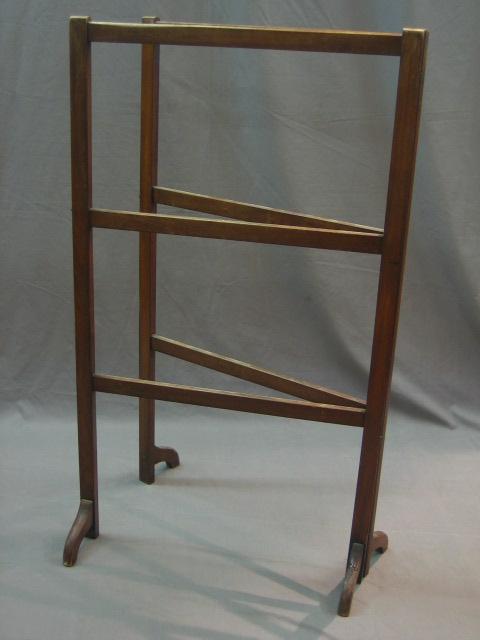
His day commences by seeing that his master’s dressing-room is in order; that the housemaid has swept and dusted it properly; that the fire is lighted and burns cheerfully; and some time before his master is expected, he will do well to throw up the sash [open the window] to admit fresh air, closing it, however, in time to recover the temperature which he knows hismaster prefers. It is now his duty to place the body-linen on the horse before the fire, to be aired properly;

Edwardian clothes horse. Image @Denhams.com

to lay the trousers intended to be worn, carefully brushed and cleaned, on the back of his master’s chair; while the coat and waistcoat, carefully brushed and folded, and the collar cleaned, are laid in their place ready to be put on when required. All the articles of the toilet should be in their places, the razors properly set and stropped, and hot water ready for use.

Barry Lyndon (Ryan O’Neal). While the master shaves, his footmen assist him, making sure his implements are at hand. His valet would have overseen the arrangements and will sharpen the razor and clean the shaving brush after Barry has finished shaving. Image @Barry Lyndon

Gentlemen generally prefer performing the operation of shaving themselves, but a valet should be prepared to do it if required; and he should be a good hairdresser. Shaving over, he has to brush the hair, beard and moustache, where that appendage is encouraged, arranging the whole simply and gracefully, according to the age and style of the countenance. Every fortnight, or three weeks at the utmost, the hair should be cut, and the points of the whiskers trimmed as often as required. A good valet will now present the various articles of the toilet as they are wanted; afterwards, the body-linen. Neck-tie, which he will put on, if required, and, afterwards, waist-coat, coat, and boots, in suitable order, and carefully brushed and polished.”

Other valet duties:

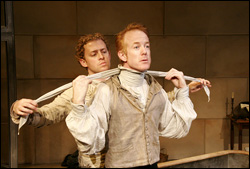
Ian Kelly (Brummel) and Ryan Early in Beau Brummel (2006 play)

  • As his master goes out, the valet hands him his gloves and hat, opens the door for him, and receives his orders for the rest of the day.
  • He puts his master’s dressing-room in order, cleaning combs and brushes, folding clothes and putting them in drawers.
  • If his master has no clothes sense, the valet will select suitable clothes, making sure they are clean, particularly the collars, and maintained in good repair.
  • He consults with the tailor, perfumer, and linen-draper.
  • He awaits his master’s return, making sure that his drawing room is picked up by the maids, and dusted and swept by them, and that the room is made ready with a lit fire and candles.
Credit: Courtesy of © Carnival Film & Television Limited 2012 for MASTERPIECE

Bates (Brendan Coyle) assists Lord Grantham (Hugh Bonneville) in Downton Abbey. A valet and his master become close over the years. Image @Downton Chaser

  • The valet stands ready to help his master dress for dinner or any other occasion.
  • He makes sure that the washing table is ready, filling the ewer and carafe with fresh water, and placing the basin towels, brushes, hot water, and shaving apparatus near at hand.
  • In case of wet weather, when his master has returned from riding, the valet lays out a change of dry linen and clothing, and is ready to assist his master out of the damp clothing.
  • He helps his master prepare for journeys, packing enough linen and other clothing for the trip. At the Inns, he takes charge of his master’s comfort as he would at home, and has everything ready to assist his master in dressing and undressing.
  • If no footmen is available during the journey, the valet will also see to these services, even at table.
Bates at the moment he is informed that he must leave Lord Grantham's service. Despite their long association, it was imperative that a valet was physically capable of performing all his duties, including standing in as footman when the occasion required. Bates' reliance on a cane prevented him from carrying a tray. (We all have learned that Lord Grantham is a softie and kept Bates on.) Credit: Courtesy of © Carnival Film & Television Limited 2012 for MASTERPIECE

Bates at the moment he is informed that he must leave Lord Grantham’s service. Despite their long association, it was imperative that a valet was physically capable of performing all his duties, including standing in as footman when the occasion required. Bates’ reliance on a cane prevented him from carrying a tray. (We all have learned that Lord Grantham is a softie and kept Bates on.) Credit: Courtesy of © Carnival Film & Television Limited 2012 for MASTERPIECE

The valet keeps his master’s clothes in good repair:

  • Hats are kept well brushed on the outside with a soft brush, and wiped inside with a clean handerchief.
  • Clothes placed in a wardrobe are covered with brown holland or linen wrappers to secure them from dust.
  • He places boots and shoes cleaned by the under footman in the dressing room.
  • Slippers are aired by the fire.
  • As soon as his master finishes shaving, the valet will clean the razor and brushes.
  • Before he hangs damp clothing by the fire, he rubs the cloth with a sponge until the smoothness of the nap is restored. If the clothes are allowed to dry before brushing, then later brushing might not remove the roughness.
Credit: Courtesy of © Carnival Film & Television Limited 2012 for MASTERPIECE

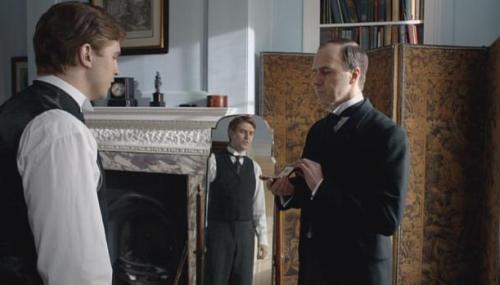
In Downton Abbey, Matthew resists Molesley’s services, causing an undue amount of stress to the butler, who also acts as his valet. Credit: Courtesy of © Nick Wall/Carnival Film & Television Limited 2012 for MASTERPIECE

Valets in humbler households:

The butler in a second or third rate establishment takes on the duties of the house steward, valet, and footman as well. He is likely to pay market bills, assist his master in dressing, serve at table and oversee the wine and silver, and superintend other male servants.

Sources:

Read Full Post »

Tea is always served by the host/hostess or a friend, never by servants. Tea is never poured out, then passed several cups at a time, the way coffee may be, because it cools very quickly. Instead, it is always taken by the guest directly from the hands of the pourer.” – Etiquette Scholar

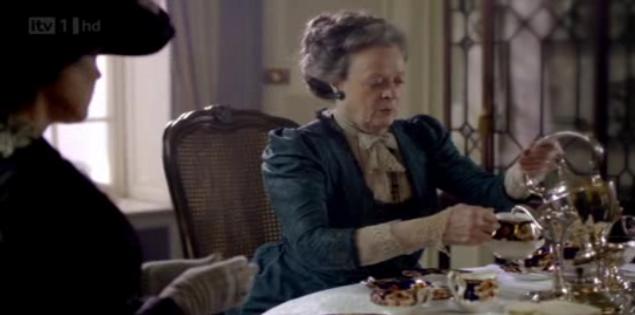
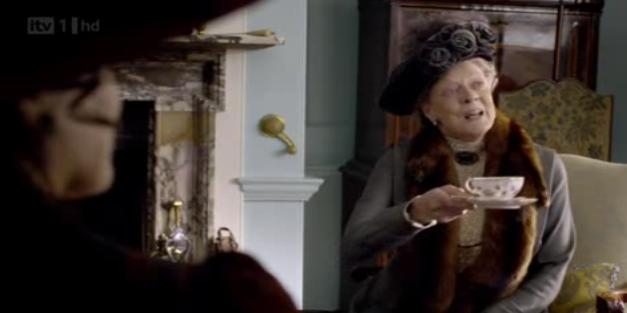
The ceremony of making tea is almost always included in costume dramas like Downton Abbey or a Jane Austen film, such as Emma. When Maggie Smith as the Dowager Countess of Grantham invited her daughter-in-law, Cora (Elizabeth McGovern), to the Dower House for tea in Downton Abbey, the arranged time was most likely at four o’clock in the afternoon.


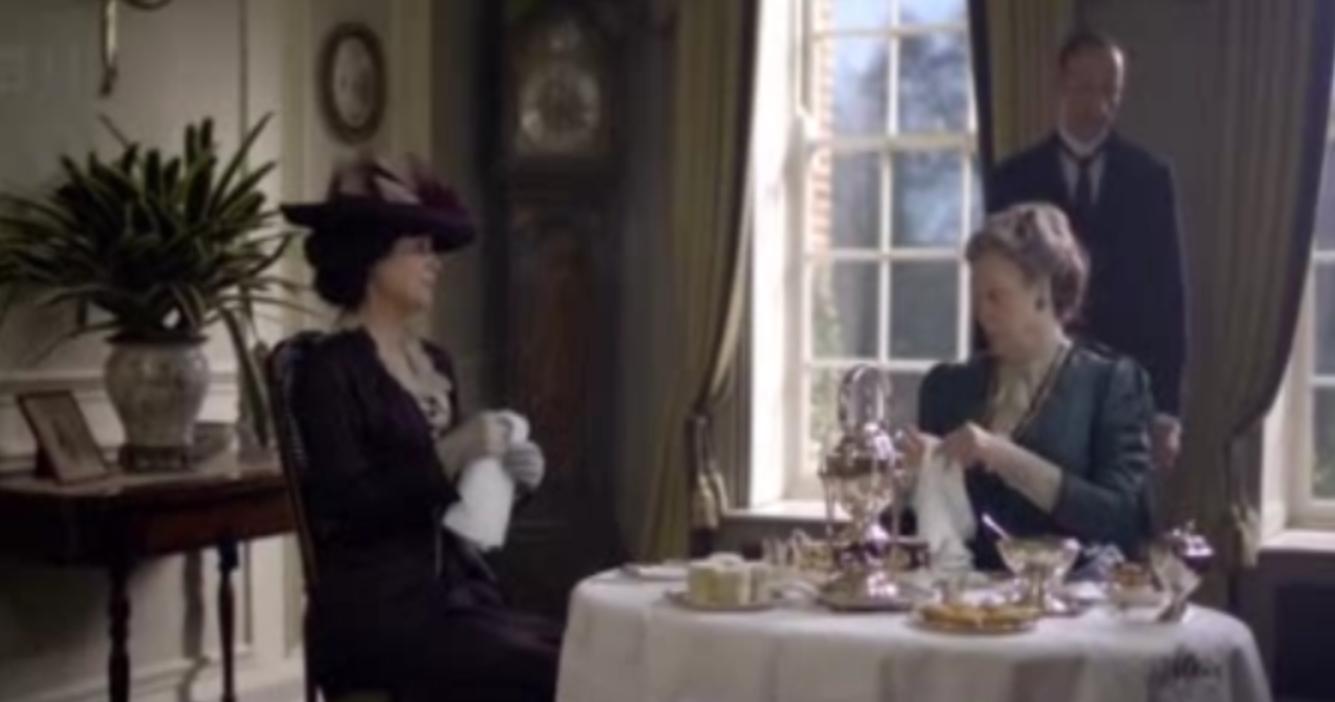
Cora and the Dowager Countess sit down to tea

In one particular scene, the two women entered the drawing room in which a small table had been laid out with an elaborate tea set, fine china, and silver spoons. An assortment of tiny sandwiches, cookies, and scones were arranged upon a beautiful batttenburg lace tablecloth that covered the table. Low tea (an Edwardian dowager would never have said high tea) was meant to blunt the appetite before dinner.

The duchess pours boiling water over the tea leaves in the tea pot

A tea ceremony provided an intimate setting between the hostess and her guests, for it was the hostess who prepared and served the tea, catering to each guest and handing them their custom-prepared tea one cup at a time. In this time honored ritual, one of the most important questions the dowager would ask was: “Would you care for weak tea or strong tea?” Cora’s preference would guide the Countess in the next stage of tea preparation, for if she said “strong tea,” then the Dowager would pour the tea as she had prepared it into Cora’s cup. Had Cora said “weak tea”, the Countess would pour a smaller quantitiy of the brew into the china cup, then top it off with hot water.

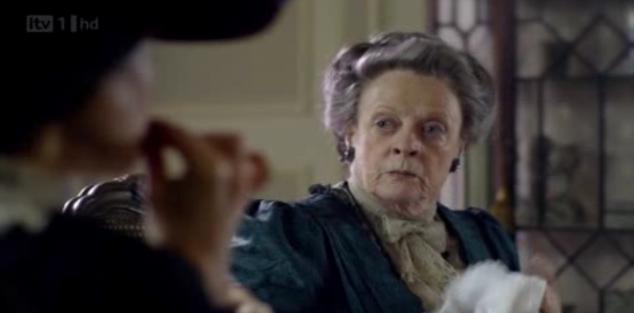
Cora eats a crustless sandwich as her mother-in-law prepares the tea

The Dowager would then ask her guest how much milk and sugar to add. She would have poured boiling water over the tea leaves in a tea pot, and steeped the leaves for three minutes, all the while conversing with her guests. At this point the water was no longer boiling. Then the Countess would pour in the milk. (If she poured it in first, she would have found it difficult to judge the strength of the tea by its color.) Hudson, the butler in Upstairs, Downstairs, said about pouring milk into tea: “Those of us downstairs put the milk in first, while those upstairs put the milk in last.”

In this instance, the Dowager leaves her guest in the middle of serving tea, a faux pas

History of Low Tea

On September 25, 1660, Samuel Pepys recorded: “did send for a cupp of tee (a China drink) of which I had never drank before.” By June 1667, tea was considered to be a healthy drink. One day Pepys arrived home to find his wife making tea, which his apothecary had found good for her cold.

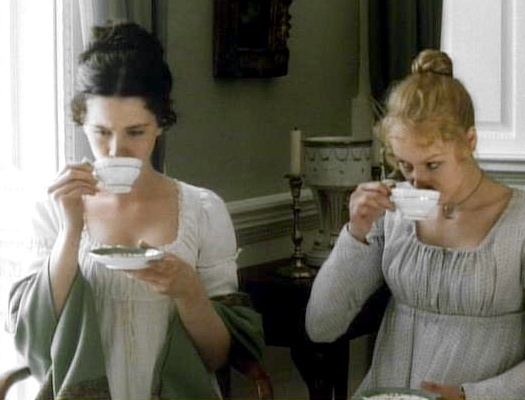
Emma, 1996 (with Kate Beckinsale). Emma and Harriet drink tea during Mrs. Elton's first visit

Samuel Johnson was a self-described “hardened and shameless tea drinker, who has, for twenty years diluted his meals with only the infusion of this fascinating plant; whose kettle has scarcely time to cool; who with tea muses the evening, with tea solaces the midnight, and with tea welcomes the morning.” His chronicler James Boswell observed that “It was perfectly normal for him to drink sixteen cups in very quick succession, and I suppose no person ever enjoyed with more relisht the infusion of that fragrant leaf than did Johnson.”

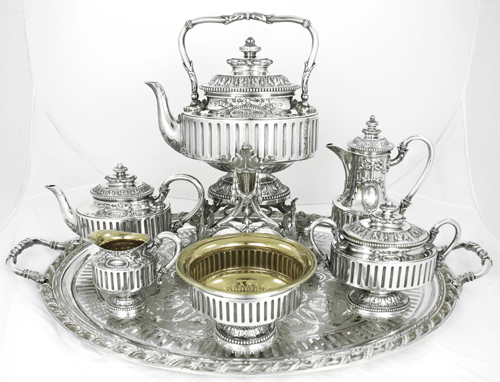
Silver tea set by Odiot, Paris, circa 1880. Image @A.Pash and Sons, Mayfair

Until the 1760’s, only the rich could afford teapots, which were made of silver. Then in 1765 Queen Charlotte commissioned Josiah Wedgwood to create a tea service made from his quality cream colored earthenware, which he named Queen’s Ware (with the Queen’s permission, of course) and gave to her as a gift. From that moment on he was the Queen’s potter. Wedgwood’s creamware was thin, attractive and durable. After receiving the Queen’s patronage, his firm became quite famous. The attractive new tableware quickly became popular, and by 1775 other manufacturers, including those on the Continent, had widely copied Wedgwood, imitating Queensware and creating increasingly fanciful teapots. It is said that this tableware was instrumental in spreading the popularity of tea.

Wedgwood Queensware, c. 1790. Image @Christies

In 1840, the Duchess of Bedford began serving tea with refreshments in the afternoon to appease her appetite before dinner, and the custom of afternoon tea, or low tea, took off. To read more about drinking tea between the 18th and mid-19th centuries, read my post about Tea in the Regency Era.

Some interesting facts about tea:

  • Notice, this is a change: The difference between high tea and low tea: Low, or afternoon, tea is served at four o’clock with light snacks, such as sandwiches, cookies, and scones. High tea is a full meal served with tea, including meat, bread, side dishes and dessert on a table of regular height. Hence high tea.

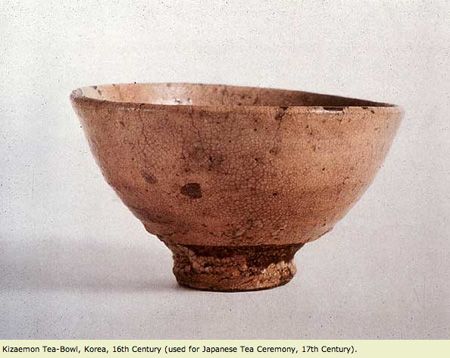
16th century tea bowl, Korea

  • Tea cups at first were fashioned after Chinese bowls without handles or saucers. In the mid 1750-s, a handle was added to prevent ladies from burning their fingers.
  • A saucer was once a small dish for sauce. During the Dowager Countess’s day, it was acceptable to pour tea into a cup’s saucer to cool the beverage before drinking it.
  • In the late 17th century, a lady would lay her spoon across the top of her cup to signal that she was through drinking. Other signals included turning the cup upside down, or tapping the spoon against the side of the cup.
  • Filling the cup with tea almost to the rim is considered a faux pas.

"Might I give you this cup?" The Dowager hands her tea to Moseley while visiting Matthew Crawley.

Sources:

Read Full Post »

« Newer Posts - Older Posts »