Feeds:
Posts
Comments

Archive for the ‘Jane Austen Novels’ Category

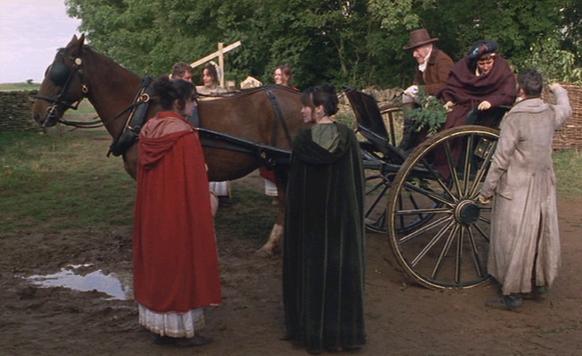
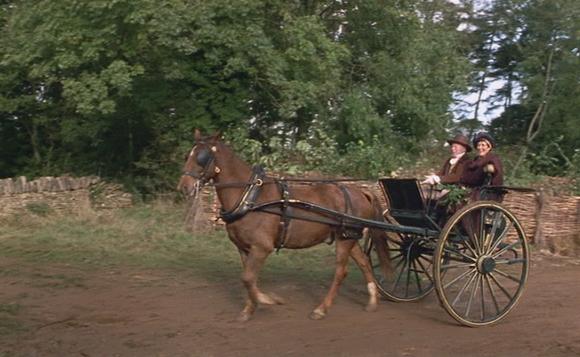
Crofts arrive in the gig, Persuasion 1995

In Persuasion, Jane Austen depicts the Crofts as the happiest couple imaginable. Sophy, who is also Captain Wentworth’s sister, follows her Admiral across the seas, sacrificing her looks in the process. She is only 38 years old, but her complexion is ruddy and has obviously been affected by the sun. Jane Austen writes about the couple in a realistic way, and like all happily married folks, these two exhibit their own idiosyncracies. Admiral Croft, it turns out, is a bad driver. Captain Wentworth says about his brother-in-law to Louisa:

“What glorious weather for the Admiral and my sister! They meant to take a long drive this morning; perhaps we may hail them from some of these hills. They talked of coming into this side of the country. I wonder whereabouts they will upset to-day. Oh! it does happen very often, I assure you–but my sister makes nothing of it–she would as lieve be tossed out as not.”

“Ah! You make the most of it, I know,” cried Louisa, “but if it were really so, I should do just the same in her place. If I loved a man, as she loves the Admiral, I would always be with him, nothing should ever separate us, and I would rather be overturned by him, than driven safely by anybody else.”

The party stops to talk to the Crofts

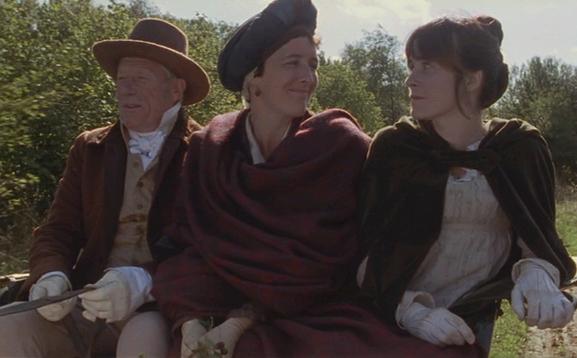
During their return walk from Winthrop, the party from Uppercross, which includes Anne Elliot and Captain Wentworth and a number of the Musgroves, encounter Admiral and Mrs. Croft in a gig. They offer a seat to one of the party. Everyone declines, except for Captain Wentworth, who has noticed Anne’s fatigue. He whispers something to his sister, then encourages Anne to join the Crofts in their two-seater for the rest of the way back to Uppercross (about one mile.) Anne is grateful for his thoughtfulness. But as she rides in the carriage, she hears Mrs. Croft warn her husband:

The Crofts and Anne Elliot crowded in a 2-man gig

My dear admiral, that post!–we shall certainly take that post.”

Jane Austen goes on to write:

But by coolly giving the reins a better direction herself, they happily passed the danger; and by once afterwards judiciously putting out her hand, they neither fell into a rut, nor ran foul of a dung-cart; and Anne, with some amusement at their style of driving, which she imagined no bad representation of the general guidance of their affairs, found herself safely deposited by them at the cottage.

The happy admiral is more than willing to allow his wife to steer the carriage alongside him, which many of us who have driven with “back-seat driving” spouses know is a rare attitude indeed!

In this famous scene by Jane Austen, the Crofts moved over to make room for Anne. Mary Musgrove would rather die from fatigue than be seen crowded in a humble gig, but Anne could only feel gratitude. She is beginning to understand that while Captain Wentworth is unable to forgive her for rejecting him, he is still a kind and decent man. He knows her well enough to see that she was tired and made arrangements for her. In these small observable progressions (as with taking the child Walter from her without comment), we see the Captain’s love for Anne come to the surface. It will take a little longer for his anger at her rejection to recede. See also Shopping and Milsom Street, Bath

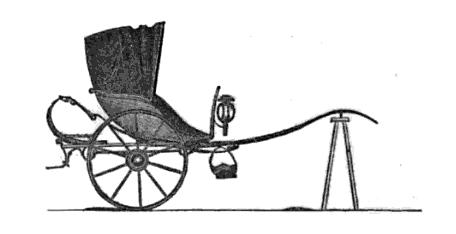
Light weight gig

About Gigs: Gigs were two-wheeled carriages equipped for one horse only. They were designed for two people, one of whom was the driver, and were considered carriages for the middle class, or for the “poorer” classes, who paid less duty on them. Because these carriages were light in weight and springy, they could be easily turned over, especially by a poor driver like Mr. Croft. Gigs were used by doctors, travelers, and people who made short journeys that would not fatigue the horse. Gigs evolved into cabriolets (early versions of cabs) Dennet, Stanhope, and Tilbury. The Stanhope was designed by Fitzroy Stanhope, the second son to the Third Earl Stanhope. This carriage became popular towards the mid-19th century for short trips between Town and the suburbs.

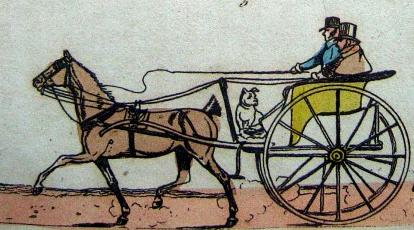
Road to a fight, detail by Henry Alken, 1821

The two men in this high perch phaeton show how precarious a light two-wheeled vehicle can be. One can see the difference between this “sporty” more expensive vehicle and the humble gig (above).

Read Full Post »

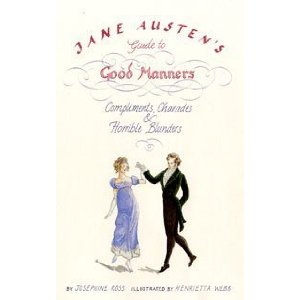
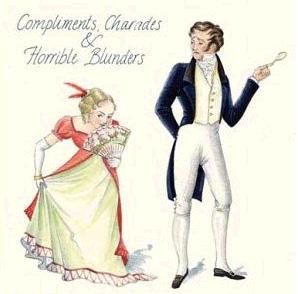
I’ve owned Jane Austen’s Guide to Good Manners: Compliments, Charades and Horrible Blunders by Josephine Ross for a number of years. It is a small book (133 pages), very pretty, and filled with charming illustrations like the one below painted by Henrietta Webb. The language is slightly old-fashioned, as if the book was written in the 19th century. The rules of etiquette and manners are lifted from Jane Austen’s novels, and thus we know they are authentic. The eight chapters are divided logically: Manners; Forms of Introduction; Calling and Conversation; Dancing and Dining; Dress and Taste; Matrimony; Family; and Servants.

Each chapter is divided into “rules”, which serve as guides to the rule of etiquette that will be discussed. For example, Rule 1. Do not be presumptuous in offering introduction. The example comes from the scene in Pride and Prejudice in which Lady Catherine de Bourgh charges angrily into the Bennet home and does not ask for an introduction to Mrs. Bennet, who, awkwardly, has not been granted permission to speak to that grand lady in her own house. Lady Catherine’s rudeness towards Elizabeth and her mother is exacerbated by her pointed cut and lack of manners!


The book would make a wonderful gift for a Jane Austen fan who would like more background into the Regency era. Someone like me, who owns several books of etiquette of the period, would find the lack of index irritating. It is hard to find the precise rules of etiquette quickly. If I must hunt and peck, I infinitely prefer consulting original sources: The Mirror of Graces (1811) by A Lady of Distinction and Lord Chesterfield’s letters to his son, for instance.

But for clarifying exactly what Jane intended in terms of behavior, this book is a tiny gem. Josephine Ross, the author of Jane Austen: A Companion, knows whereof she speaks.  I give Jane Austen Guide to Good Manners four correct rules out of five.

Read Full Post »

Inquiring Readers: This is the third of four posts in honor for Pride and Prejudice Without Zombies, Austenprose’s in-depth reading of Pride and Prejudice. My first post discussed Dressing for the Netherfield Ball and my second post talked about the dances. This post discusses the suppers served during Jane Austen’s era, and concentrates on what kinds of food and drink might have been served at the Netherfield Ball.

“As for the ball, it is quite a settled thing; and as soon as Nicholls has made white soup enough I shall send round my cards.” – Charles Bingley, Pride and Prejudice

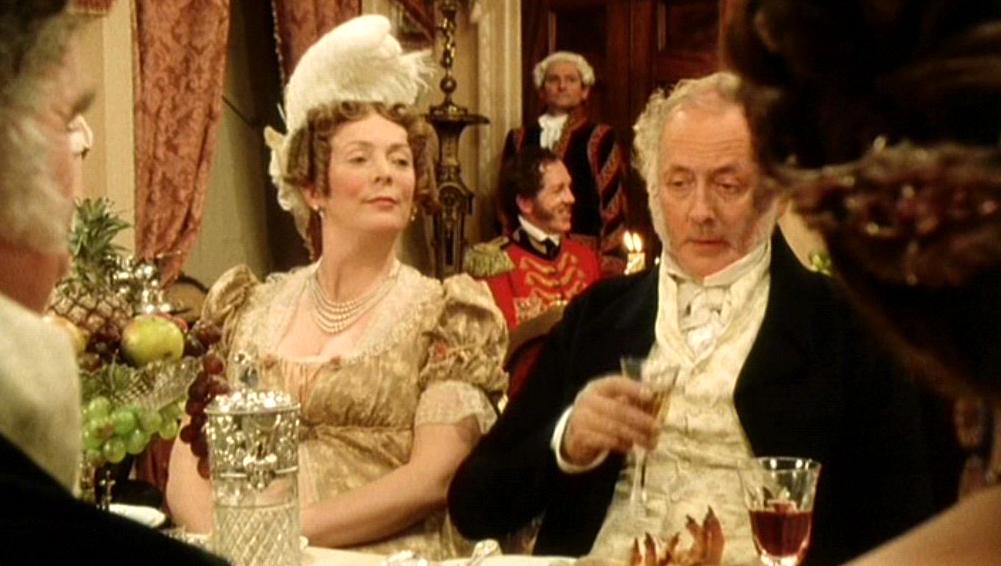
Mr & Mrs Bennet sit down to supper. Notice the lavish bowl of fruit.

The sit-down supper served at the Netherfield Ball in Pride and Prejudice probably occurred around midnight. By that time, people would be famished after their physical exertions or from playing cards nonstop in the card room. They had most likely eaten their dinner between 3-5 p.m. (earlier in the country, and later in Town). Dinners consisted of between 5-16 dishes and could last several hours. The best families would serve up two courses, for a meal’s lavishness depended on the number of courses and dishes that were served. Dishes representing a range of foods, from soups to vegetables and meats, would be spread over the table in a pleasing arrangement and would be set down at the beginning of the meal.

Large Derby porcelain supper dish from Ruby Lane

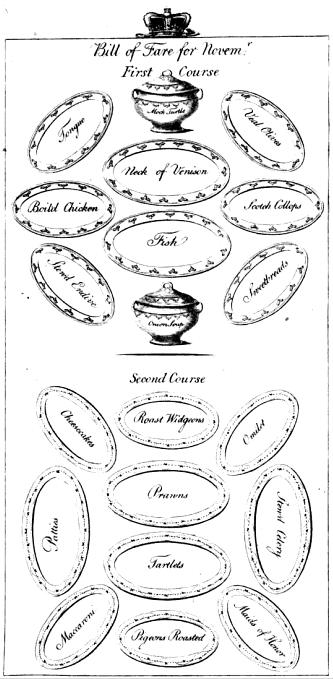
It is conjectured that by the time the covered dishes arrived from the kitchen and the family and guests were seated, the food had turned cold. Diners would be confined to eating from the dishes placed closest to them. In the Bill of Fare from the Universal Cook, 1792 (Francis Collingwood and John Woollams) one can see the foods that were available in November.

Bill of Fare, November 1792

The evening meal, which also included a dessert course, lasted as long as two hours, leaving the diners sated. Suppers were therefore served quite late and were simple and small in comparison. Often called a “tea board”, this small repast was frequently served on a tray between 10-11 p.m. If more than one person was hungry, a cloth would be laid on a small table, not the dining table, and a limited assortment of cakes, tarts, biscuits, pastries, jellies, cheeses, cold meats, sandwiches, savories, salad, dessert, or local fruits – whatever was at hand – would be made available. (One can imagine how tired the servants must have been, rising early as they did.)

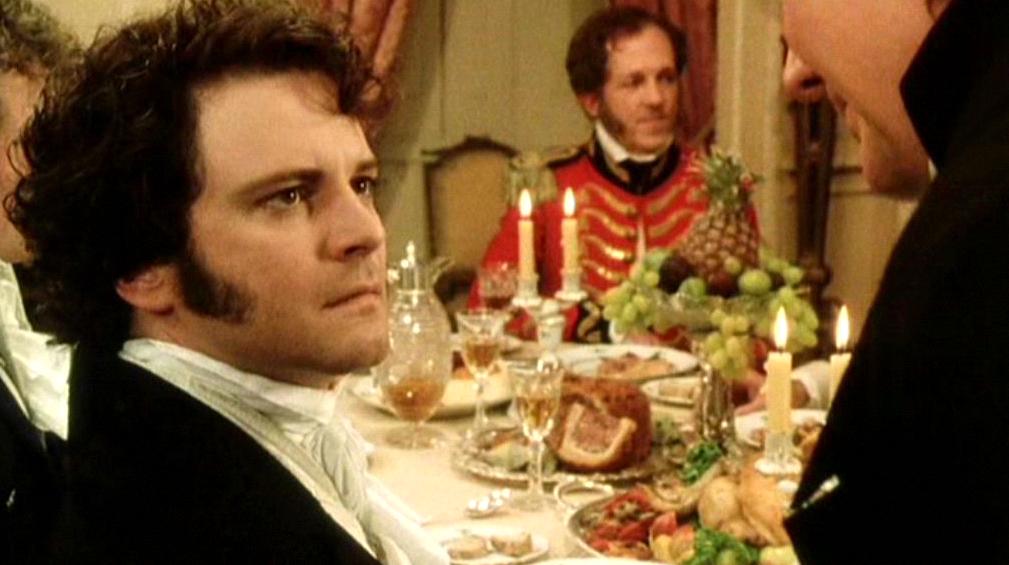
Mr. Darcy observes the Bennet family during supper and is accosted by Mr. Collins

Suppers served at private balls were an entirely different matter for they reflected on the splendor of the event. Balls generally began at 8-9 p.m. and the dancers sat down to a lavish spread at 11 p.m. or midnight. A gentleman accompanied his dance partner into the supper room, which makes one think that it would have been wise for a suitor who wished to further his acquaintance with a young lady to reserve a dance just before the meal.

Jane and Elizabeth at supper

Mr. Bingley most likely served a sumptuous supper on a magnificent table set with his finest china and silver. The food would consist of white soup, which during this time was made with veal stock, cream, and almonds; cold meats, such as chicken or sliced ham; poached salmon; glazed carrots and other seasonal vegetables; salads; fresh fruits;biscuits;dry cake (which meant unfrosted cake, like the pound cake recipe from the Delightful Repast at the bottom of this post); cheeses; short-bread cookies; pies; ice-cream; and trifles. One must not forget that during this period cockscombs and testicles were considered delicacies, and that bone marrow was routinely added to pies for richness. (Fancy Tripe or Trotters for Supper?)

Kitty and Lydia tippling, Netherfield Ball, P&P 2005

Drinks of tea, coffee, lemonade, white wine claret, and red wine (sweet madeira wine was especially popular) were served. Regency cups were filled with punch, negus (wine mixed with hot water, lemon and nougat); orgeat (made with a sweet syrup of orange and almonds); or ratafia (a sweet cordial flavored with fruit or almonds). Port was reserved for gentlemen, though I am not sure that they were allowed to imbibe this liquor in front of the ladies.

A footman holds a tray of drinks, Netherfield Ball, P&P 2005

A private midnight supper at Netherfield was a more splendid affair than the suppers served up at the weekly Wednesday night balls at Almack’s. These subcription dances coincided with the three months of the London social season. Alcohol was not served to discourage drunkenness among gentlemen, who were known to imbibe several bottles of wine per day, and only an assortment of thinly sliced stale bread (which was a day old), dry cakes, lemonade and tea were provided. Simpler balls given by hosts who were not as rich as Mr. Bingley  might offer a little bit of hot supper consisting of six dishes, including salad, dessert, and fruit, and coffee, tea, lemonade and wine.

Trifle, The Delightful Repast

The links to the two recipes in this post were created expressly for us by Jean at The Delightful Repast. The pound cake (dry cake) recipe is one that even I am able to attempt with some success, and Jean’s solution of serving trifle in individual dessert dishes is sheer genius.

The last to leave the Netherfield Ball. Kitty and Lydia sleeping off their drinking. P&P 2005

The Food Timeline shows when meals were served during the Georgian and Regency periods, and how the hours changed.

  • 1780: Breakfast 10AM; Dinner 3-5PM, Tea 7PM, Supper 10-11PM
  • 1815: Breakfast 10AM (leisurely), 9AM (less leisurely), 8AM (working people); Luncheon Midday; Dinner 3-5PM; Supper 10-11PM
  • 1835: Breakfast, before 9AM; Luncheon (ladies only) Midday; Dinner 6-8PM; Supper depending upon the timing and substantiality of dinner

Read Full Post »

Gentle Reader, next week Austenprose will begin a Pride and Prejudice extravaganza entitled, Pride and Prejudice Without Zombies. The group will be reading Jane Austen’s own words. Not some mash up. Not a sequel. And, as far as I am concerned, my favorite book of all time. When Laurel Ann asked me to contribute my thoughts during the event, I was already researching information about Mr. Jones, the apothecary who treated Jane Bennet. So, as a pre-announcement, I am publishing this post. Do obtain a copy of Pride and Prejudice and join Laurel Ann and her readers as she begins her in-depth analysis of the book on Tuesday, June 16th.

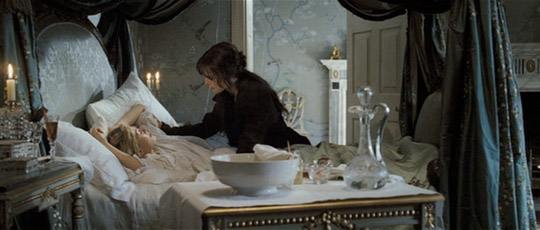
Jane is sick, Netherfield Hall, Pride and Prejudice 2005

In 1813, the year that Pride and Prejudice was finally published, apothecaries filled an important role in rural areas where physicians were scarce. When Jane Bennet fell ill at Netherfield Park, Mr. Jones, the apothecary was sent for:

Breakfast was scarcely over when a servant from Netherfield brought the following note for Elizabeth:

“My dearest Lizzy,

I find myself very unwell this morning, which, I suppose, is to be imputed to my getting wet through yesterday. My kind friends will not hear of my returning home till I am better. They insist also on my seeing Mr. Jones therefore do not be alarmed if you should hear of his having been to me and excepting a sore throat and head-ache, there is not much the matter with me.

Yours, &c.”

Unlike a physician, whose social standing ranked high, apothecaries were considered one step up from a tradesmen, and several rungs below the physician/doctor.
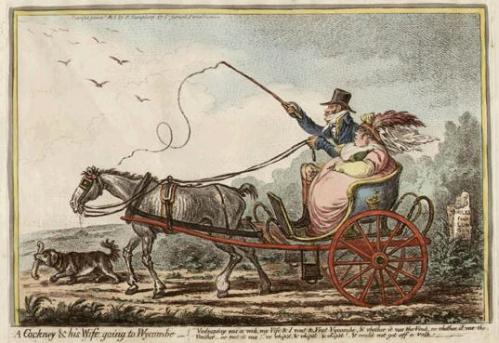

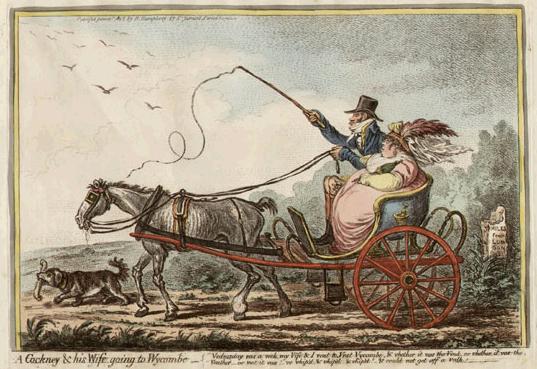
This cartoon by James Gillray suggests that the Cockney in question is an apothecary. Note the mortar and pestle symbol on the side of the carriage.

Apothecaries learned how to make drugs and poultices during their tenure as apprentices. They used their hands and labored in shops, and were often the only alternative for people who sought medical care and who could not afford a doctor’s fees. Interestingly, apothecaries were not paid for giving advice or providing medical treatment. They were paid only for the drugs they sold.
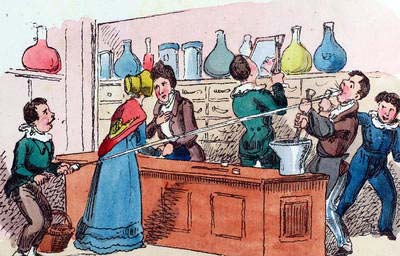
Apothecary Shop, Glasgow Looking Glass

Mr. Jones, would have traveled to Netherfield Hall and dispensed his advice without recompense. But he recommended his draughts, which enabled him to earn some money, and instructed Elizabeth on how to use them:

The apothecary came and having examined his patient said as might be supposed that she had caught a violent cold and that they must endeavor to get the better of it advised her to return to bed and promised her some draughts. The advice was followed readily for the feverish symptoms increased and her head ached acutely.

Visiting an ill Jane at Netherfield, Pride and Prejudice 2005

Mrs. Bennet’s ploy to keep Jane at Netherfield, using Mr. Jones as an excuse when Mr. Bingley inquires about Jane’s condition, worked:

“Indeed I have, Sir,” was her answer. “She is a great deal too ill to be moved. Mr. Jones says we must not think of moving her. We must trespass a little longer on your kindness.”

Mr. Bennet used Mrs. Bennet’s machinations to his advantage, demonstrating his wit even as he admonished his wife for placing Jane in danger:

“Well, my dear,” said Mr. Bennet, when Elizabeth had read the note aloud, “if your daughter should have a dangerous fit of illness, if she should die, it would be a comfort to know that it was all in pursuit of Mr. Bingley, and under your orders.”

“Oh! I am not at all afraid of her dying. People do not die of little trifling colds. She will be taken good care of. As long is she stays there, it is all very well. I would go and see her, if I could have the carriage.”

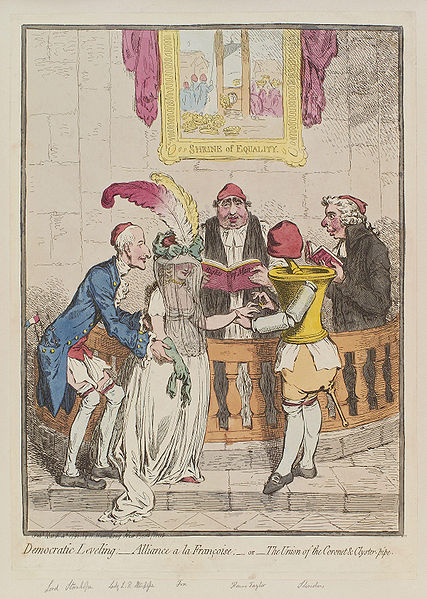
As an interesting aside, one of the 3rd Earl of Stanhope’s third daughter’s eloped with the family apothecary, prompting James Gillray to draw the cartoon, Democratic Levelling: Alliance a la Francaise, The Union of the Coronet and Clyster Pipe. (A coronet is a small crown symbolizing a peer’s status and a clyster pipe was a tube used for injections). The earl was a great proponent of liberty and revolution, but this marriage sorely tested his tolerance for equality! One wonders what Mr. Bennet might have said had Jane or Lizzie run off with Mr. Jones!
At the turn of the 19th century, the practice of medicine would benefit from rapid scientific advances brought about by methodical and well-reasoned experimentation and observations. But at the height of Thomas Rowland’s and James Gillray’s satiric powers, doctors, surgeons, and apothecaries were still targets of fun. The medical field also did not fare well with popular opinion.
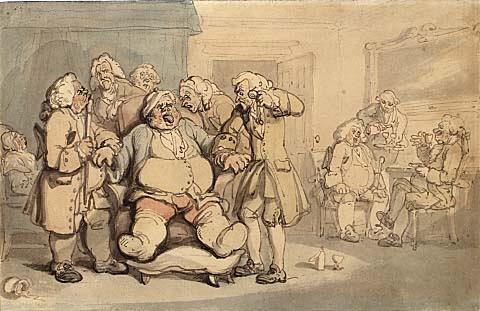
The Comforts of Bath, Rowlandson. At the end of the 18th Century, Bath had more doctors and apothecaries per number of citizens than any city in England.

The following humorous scene between a doctor and an author sums up the popular perception of a doctor’s swelled head. His miniscule knowledge about medicine does not detract from his exalted opinion of his social standing in relation to an apothecary’s. This passage emphasizes the point that the medical field took a back seat to poetry and criticism:

Doctor: I suppose, Sir, you are his apothecary.

Gent: Sir, I am his friend.

Doctor: I doubt it not. What regimen have you observed since he has been under your care? You remember, I suppose, the passage in Celsus, which says, “if the patient on the third day have an interval, suspend the medicaments at night. Let fumigations be used to corroborate the brain.” I hope you have upon no account promoted slernutation by hellebore.

Gent:  Sir, you mistake the matter quite.

Doctor: What! an apothecary tell a physician he mistakes! You pretend to dispute my prescription! Pharmacopola componant. Medicus folus prefabricat. Fumigate him, I say, this very evening, while he is relieved by an interval’

Dennis: Death, Sir, do you take my friend for an apothecary! A man of genius and learning for an apothecary! Know, Sir, that this gentleman professes, like myself, the two noblest sciences in the universe, criticism and poetry. By the immortals, he himself is author of three whole paragraphs in my Remarks, had a hand in my Public Spirit, and assisted me in my description of the furies and infernal regions in my Appius.

(The discussion continues.) Then the doctor says:

Doctor: He must use the cold bath, and be cupped on the head. The symptoms seem desperate. Avicen says: “If learning be mixed with a brain that is not of a contexture fit to receive it, the brain ferments till it be totally exhausted. We must endeavour to eradicate these indigested ideas out of the perieranium, and to restore the patient to a competent knowledge of himself. – Elegant Extracts, or Useful Entertaining Passages
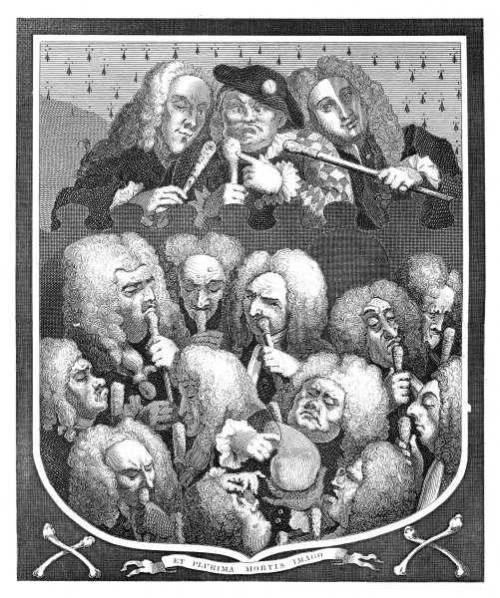
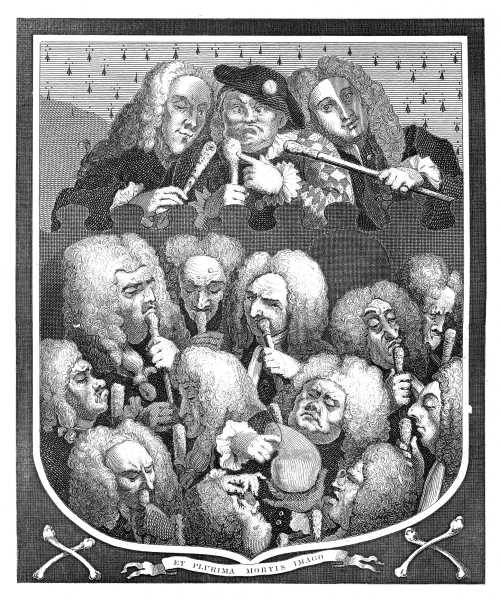
Consultation of Physicians, Hogarth

Physicians occupied the top rung of the medical social ladder because they did not “soil” their hands by treating the patient directly, as a surgeon would. They did not accept money in public (the payment would have been made discreetly). These “learned” men attended university but did not perform autopsies or dissect cadavres. Men of breeding, they merely sat back and watched the procedure from afar.
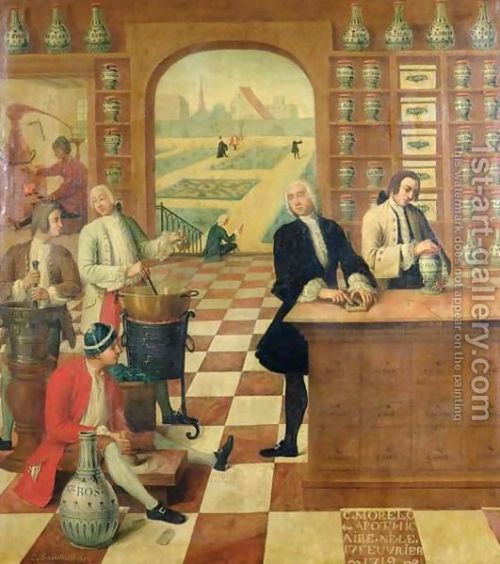
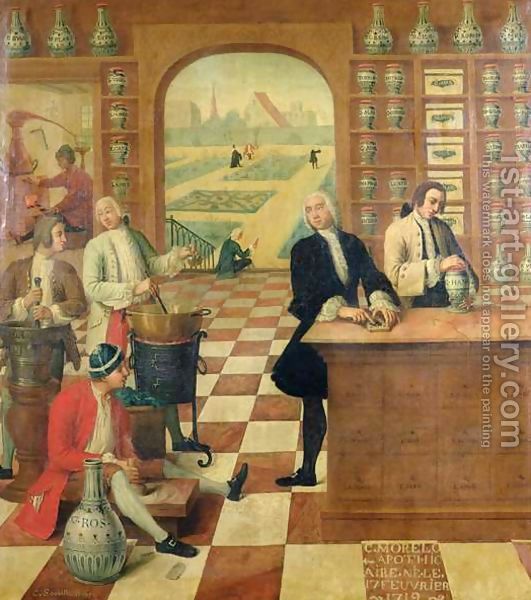
Apothecary shop, 1719

An apothecary shop during Jane Austen’s day was much like today’s drug store, where a customer could purchase drugs, herbs, poultices, panaceas, and other medicinals. In the image from 1st Art Gallery, one can see the preparations and infusions being made in an 18th century apothecary shop. Herbs grew in an adjacent garden and substances were stored in apothecary jars and drawers. Such shops also sold surgical equipment. In this link one can view an apothecary shop in Colonial Williamsburg, much as a similar shop might have looked in Meryton.
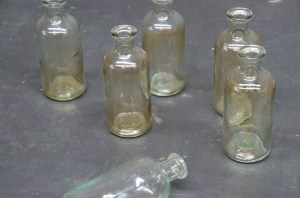
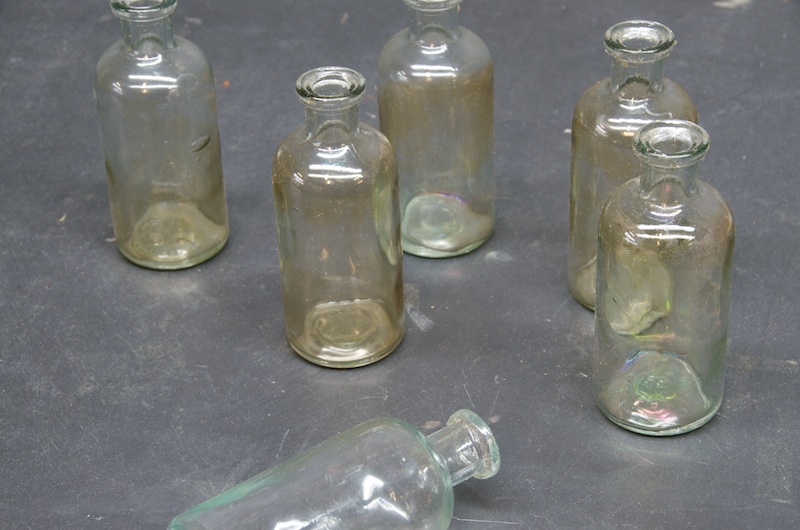
18th century apothecary bottles made with mercury glass

Apothecaries were often the only doctors available in a rural community, and they would take their supplies with them in portable apothecary box. Mr. Jones, Jane Bennet’s apothecary, must have dispensed his solutions from a similar box.
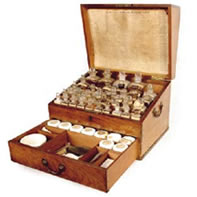
Apothecary box

By the mid-19th century, the medical field changed drastically, including the pharmaceutical field, and medications and medical practices  began to actually heal patients with predictable success. In 1895, the Pharmaceutical Journal wrote what might well be an eulogy for apothecaries:

You are all familiar in one way or another with the apothecary of the last century. A gloomy little man in a gloomy little shop with a gloomy little helper. What mystery there was surrounding every step!  His weird work with flame and flask mortar pestle and still! … These were pioneers in our profession and all honour is due them.

My further discussions about medicine in the 19th century can be found in three posts I have written on the topic:

More on the topic of medicine in Jane Austen’s day in these links:

Read Full Post »
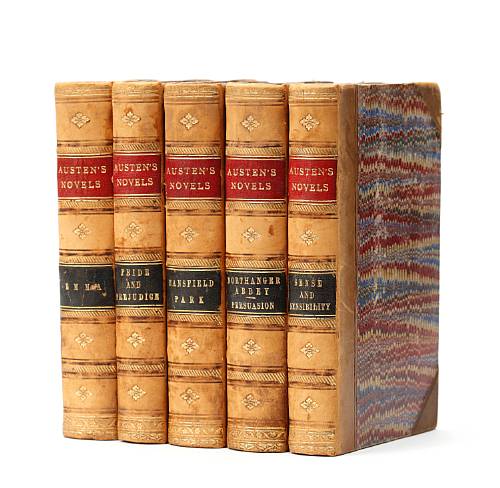
1833 Bentley edition of Jane Austen's novels

If you are thinking about getting out of the stock market and placing your money on a sure thing, consider bidding for this edition of six Jane Austen novels in 5 volumes at Bonhams. Set to be sold on June 8, with an estimate of £2,000 – 3,000, the value of this rare set is sure to  go up during the auction and for many years thereafter. The description of the Standard Novels on Bonhams’ web site states:

[Works, Bentley’s Standard Novel edition], 6 vol. in 5, 5 engraved frontispieces and additional titles, some light spotting to first and final few leaves, small corner tear to printed title “Pride and Prejudice”, without half-titles, ownership inscription of Eularia E. Burnaby (1856) on printed titles, bookplate of Henry Vincent, bookseller’s label of H.M. Gilbert, Southampton, uniform contemporary half calf, red and dark green morocco labels, extremities lightly rubbed [Gilson D1-D5], 8vo, R. Bentley, 1833 – Bonhams Website

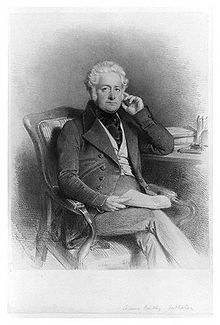
Richard Bentley (Wikimedia Commons)

The Bentley editions are notable in that no English reissue of JA’s novels is known after 1818. In 1832, Richard Bentley, publisher, purchased the remaining copyrights to Jane’s novels. (An excellent description of how Henry and Cassandra Austen sold the copyright to Richard Bentley and how little money they received for relinquishing their rights to their sister’s novels can be found in Claire Harman’s Jane’s Fame.) Bentley published all of Austen’s completed novels in 1833 in five volume sets known as the Standard Novels.  They came with illustrations that were significant for depicting scenes in early Victorian settings, not Regency settings. (One wonders how much the costume designers of the 1940 Pride and Prejudice film adaptations were influenced by these illustrations.) Bentley’s purchase marked a milestone, for from this time forward Jane Austen’s novels would always remain in print.

Illustration, Pride and Prejudice, Bentley edition (Image: Wikimedia Commons)

At the time of the Bentley reissues, Jane Austen was still regarded as a niche writer. Only a few hundred copies of her books were published and reprinted over the years. When Bentley’s copyrights expired, other printers began to publish her works, but book sales remained modest. Then came 1870. The publication of A Memoir of Jane Austen by J.E. Austen-Leigh, Jane’s nephew, sparked renewed interest in her novels. Bentley reprinted the novels as 21-5 in his Favorite Novels series (Sutherland, page 3),keeping Jane’s name in front of the public. Public demand for Jane’s novels continued to rise with the arrival of Bentley’s deluxe Steventon edition in six volumes in 1882. In 1884, Jane’s great nephew Lord Brabourne published the 2-volume set of Letters of Jane Austen. Combined with the previous publications and a largely favorable assessment of scholars and critics, Jane’s star was born.  A second wave of popularity, whose crest we are still riding, surged after the Jane Austen film adaptations of the 1990’s. It is conjectured that interest in her novels, adaptations, and sequels has peaked, but the number of readers that continue to visit this blog (and other Jane Austen blogs) and to clamor for films based on her life and novels belie that belief .

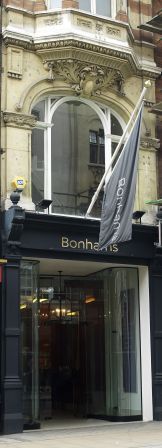
Bonhams, New Bond Street

About Bonhams LTD:

Bonhams is the world’s oldest and largest auction house still in British ownership. Thomas Dodd, an antique print dealer, and Walter Bonham, a book specialist, founded Bonhams in London in 1793.  When the auction house was launched, it was one of several similar concerns in Georgian London. The firm handled antique objects as well as fine wines. Today Bonhams is considered on of the four major auction houses in England, along with Christie’s, Sotheby’s, and Phillips, and sales take place almost daily at the firm’s New Bond Street location in Mayfair, London. (Image at right: University of Notthingham.)

For a more detailed description of Eularia E. Burnaby, whose name is inscribed inside the printed titles of this Standard Novel Edition, read Laurel Ann’s post entitled, Hey Bonhams! That Bentley Edition of Jane Austen Novels is Worth More Than You Thought!

Read Full Post »
« Newer Posts - Older Posts »