Feeds:
Posts
Comments

Archive for the ‘Jane Austen Novels’ Category

The JASNA AGM recently closed its workshops to online viewing. It was held virtually in early October. One workshop that resonated with me was Professor Theresa Kenney’s discussion of Reginald De Courcy as the hero in Lady Susan, an epistolary novel written by Jane Austen in 1794-95, when she was 19 to 20 years of age. I had the pleasure of viewing some pages of the manuscript during the exhibit about Jane Austen’s Life and Legacy in 2009 at The Morgan Library in New York. It was the first time that I saw Jane’s handwriting on a page close up and I felt as thrilled as a teenage groupie seeing her heart throb idol in person. As soon as I returned home I read the novel.

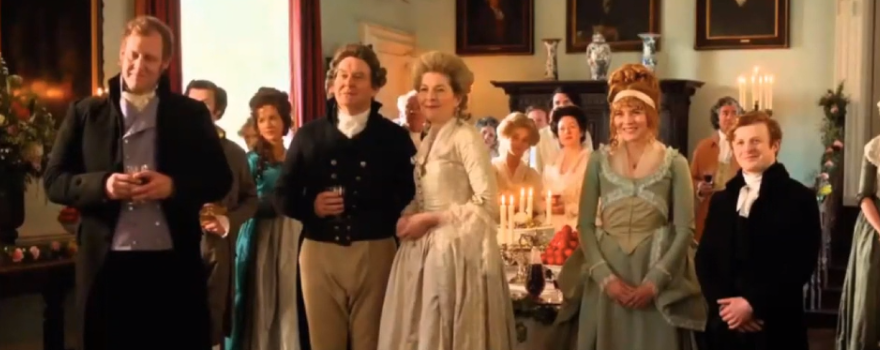
Seven years later, two friends and I saw “Love and Friendship,” in which Kate Beckinsale played the conniving Lady Susan Vernon. Needless to say, after viewing Professor Kenney’s AGM presentation, I rewatched the film and was struck by its faithfulness to Austen’s novella. It helped that the script took advantage of entire swaths of Austen’s dialogue in letters written by the main characters.

Introduction:

Professor Kenney in a talk entitled “Abjuring All Future Attachments: Concluding Lady Susan” spoke about the youthful Austen’s experimentation with Reginald as the hero. His status is not at first obvious. We know about him largely through the strong women swirling around his life and who write about him: his sister, Catherine Vernon; his mother, Lady De Courcy; Catherine’s widowed sister-in-law, Lady Susan Vernon; and Lady S’s confidant, Mrs. Alicia Johnson. These main characters reveal much about themselves as they write their true opinions of others behind their backs against the polite, entirely false conversation they engage in when speaking in person.

Deceptions and manipulations abound:

The central character is beautiful, mature Lady Susan, the daughter of a peer, widow of Vernon (no first name), who must find refuge after her dalliance with the very much married Mr. Mainwaring, in whose house she was a guest. And so Lady S appeals to the only available persons left to her, the reluctant Catherine Vernon, whose marriage she attempted to block to her brother-in-law, Charles Vernon. Catherine is no fool and has taken Lady S’s measure:

…if I had not known how much she has always disliked me for marrying Mr. Vernon, and that we had never met before, I should have imagined her an attached friend…She is clever and agreeable, has all that knowledge of the world which makes conversation easy, and talks very well, with a happy command of language, which is too often used, I believe, to make black appear white.- Catherine Vernon to Reginald De Courcy. Letter, VI

Reginald De Courcy, Catherine’s brother, having heard no good news about the beautiful widow, and influenced by his sister and mother, is disposed to dislike her, that is until he meets her and she wraps him around her little finger.

And so the fun begins, Austen style:

According to Prof. Kenney, Reginald’s character is more akin to Marianne Dashwood, Edmund Bertram, Harriet Smith, and Edward Ferrars, who fall violently in love with the wrong person and then miraculously recover a short time later to find a love worthy of them. Kenney termed this phenomenon “shifting affections.” Young Reginald is easily influenced in falling in love with the wrong person. At twenty-three he is quite young and still malleable, a fact not lost on the opportunistic Lady Susan or on his mother and sister, who are alarmed. Catherine writes to her mother, Lady De Courcy:

My dear Mother,—You must not expect Reginald back again for some time. He desires me to tell you that the present open weather induces him to accept Mr. Vernon’s invitation to prolong his stay in Sussex, that they may have some hunting together. He means to send for his horses immediately, and it is impossible to say when you may see him in Kent. I will not disguise my sentiments on this change from you, my dear mother, though I think you had better not communicate them to my father, whose excessive anxiety about Reginald would subject him to an alarm which might seriously affect his health and spirits. Lady Susan has certainly contrived, in the space of a fortnight, to make my brother like her. … I am, indeed, provoked at the artifice of this unprincipled woman; what stronger proof of her dangerous abilities can be given than this perversion of Reginald’s judgment, which when he entered the house was so decidedly against her! – Letter VIII

In the next letter, we gain a good sense of Alicia Johnson, Lady Susan’s confidant and partner in the devious plans intended to ensnare her unsuspecting victim.

My dearest Friend,—I congratulate you on Mr. De Courcy’s arrival, and I advise you by all means to marry him; his father’s estate is, we know, considerable, and I believe certainly entailed. Sir Reginald is very infirm, and not likely to stand in your way long. I hear the young man well spoken of; and though no one can really deserve you, my dearest Susan, Mr. De Courcy may be worth having.Mrs. Johnson to Lady S, Letter IX

This novella is filled with strong women. Two who will move heaven and earth to protect brother and son, and two who behave like a pair of rats intent on devouring the last piece of cheese in an alley. Interestingly, we only hear directly from Reginald in three letters. For much of the novel we see him only through the words and opinions of others, but some of those words are revealing. When his father sends him a letter of alarm due to Lady S’s increasing influence over him, Reginald tries to soothe him.

The father emplores him in Letter XII:

I hope, my dear Reginald, that you will be superior to such as allow nothing for a father’s anxiety, and think themselves privileged to refuse him their confidence and slight his advice. You must be sensible that as an only son, and the representative of an ancient family, your conduct in life is most interesting to your connections; and in the very important concern of marriage especially, there is everything at stake—your own happiness, that of your parents, and the credit of your name.”

To which Reginald answers:

My dear Sir,—I have this moment received your letter, which has given me more astonishment than I ever felt before. I am to thank my sister, I suppose, for having represented me in such a light as to injure me in your opinion, and give you all this alarm…I entreat you, my dear father, to quiet your mind, and no longer harbour a suspicion which cannot be more injurious to your own peace than to our understandings. I can have no other view in remaining with Lady Susan, than to enjoy for a short time (as you have yourself expressed it) the conversation of a woman of high intellectual powers.”

He goes on in a quite lengthy letter to blame his sister’s prejudice for not forgiving Lady S in opposing her marriage to Charles, and is convinced that the world has injured the Lady by questioning her motives, etc. etc. Yet Austen gives this hero short shrift in the narrative. We know very little about his thoughts and reasons for his actions, including being manipulated by Lady S. into feeling bitter towards Frederica, her young daughter, and thinking the girl worthless, even when it becomes clear that she “brightens” in Reginald’s presence.

In other words, Lady S has completely ensnared her sincere young man. He is as gullible with Lady S as Harriet Smith is with Emma, and just as changeable. This shifting of affection and lack of self-knowledge, as Prof. Kenney terms it, defines these characters, who are vastly different from Elizabeth Bennet and Mr. Darcy or Anne Elliot and her Captain Wentworth.

To be fair, Lady S does see some of Reginald’s good qualities (besides his inheritance). She writes to Alicia Johnson:

Reginald is never easy unless we are by ourselves, and when the weather is tolerable, we pace the shrubbery for hours together. I like him on the whole very well; he is clever and has a good deal to say, but he is sometimes impertinent and troublesome.”

She also understands her sister-in-law, Catherine, very well: “[Frederica] is in high favour with her aunt altogether, because she is so little like myself, of course.”

The Spell:

The letters ping pong back and forth, with Lady S only baring her true motives to her like-minded friend, Alicia. Mrs. Johnson’s husband, Mr. Johnson, has forbidden her to consort with Lady S, whom he has banned from his house, but Lady S still has Reginald, who is now set on marrying her.

Interestingly, Reginald is the hero in this tale, a weak one to be sure. His main redeeming quality is that when he learns of Lady S’s dalliance with Mr. Mainwaring his blinders fall off. We hear from him twice more and can feel his wrath in two scathing, but youthfully passionate letters:

…I write only to bid you farewell, the spell is removed; I see you as you are. Since we parted yesterday, I have received from indisputable authority such a history of you as must bring the most mortifying conviction of the imposition I have been under, and the absolute necessity of an immediate and eternal separation from you…”

and later:

Why would you write to me? Why do you require particulars? But, since it must be so, I am obliged to declare that all the accounts of your misconduct during the life, and since the death of Mr. Vernon, which had reached me, in common with the world in general, and gained my entire belief before I saw you, but which you, by the exertion of your perverted abilities, had made me resolved to disallow, have been unanswerably proved to me; nay more, I am assured that a connection, of which I had never before entertained a thought, has for some time existed, and still continues to exist, between you and the man whose family you robbed of its peace…”

screenshot of film-manipulated

Screen shot of Love and Friendship, with all females delighted at the results of Reginald’s and Frederica’s marriage.

The Spell is Removed: Young Reggie grows up!

A few more plot strings remain to be tied. Lady S is an execrable mother. She bullies Frederica and presses her to marry Sir Charles Martin, a dimwit, albeit a rich one. Frederica resists, raising her mother’s ire. Catherine, who loves the girl and pities her situation, takes her in. Lady S, it is obvious, loves no one but herself. She has, in the words of Prof. Kenney, “no time for romantic nonsense.” Her motherly instincts are for show only, and after a few months of separation her letters and attentions to her daughter peter out.

Reginald leaves to lick his wounds, but his mother and sister are always looking out for him, as well as Frederica. The author writes in her conclusion, “Frederica was therefore fixed in the family of her uncle and aunt till such time as Reginald De Courcy could be talked, flattered, and finessed into an affection for her.” And, so, Austen demonstrates that Reginald, a hero with the same weak qualities as a Mr. Bingley or Edward Ferrars, is managed by the real power in the family – the women, although, he has in his favor the quality of realizing his deficiencies and, more importantly, he has a heart.

De Courcy and Frederica marry. And so I ask you fair reader: Who had the happier union? Reginald or Lady S?

Conclusion

Inquiring reader, I hope I have persuaded you to read or reread Lady Susan, a novella that surprised me on the first and second reading. I didn’t think that I would like reading a book that consisted of letters, but was so enthralled with the story that I read it in one sitting.

Just think. Jane Austen wrote this novella during a creative spurt in her early life. In 1794-95, she wrote Lady Susan and in 1795 she wrote Elinor and Marianne, the epistolary version of Sense and Sensibility. In 1796, she began writing First Impressions, the precursor to Pride and Prejudice. What a fertile period for a budding author! And what creativity! At 19, 20, and 21 years of age she laid the groundwork for two great novels and one experimental foray into the many complexities of what makes a hero. While, like Mr. Darcy, Reginald has great wealth, which, according to Prof. Kenney gives him alpha status, he is a bit of a wuss, masterfully controlled like a puppet by female relatives. In the end, Lady S is hoist by her own manipulative petard. She has no recourse but to marry Sir Charles Martin to maintain face and a fortune. Uggh. What a fitting ending.

Austen’s three novels, written in such a short time, laid much of the foundation for her greatness. She would rework them over the years, with only one, Lady Susan, published posthumously. After a lifetime of reading her works, including her Juvenilia, I remain in awe of her immense talent.

Resources:

Lady Susan, Jane Austen, Project Gutenberg Online Book

https://www.gutenberg.org/files/946/946-h/946-h.htm

Lady Susan, Jane Austen, Librivox Audio

https://archive.org/details/lady_susan_0811_librivox

“Love and Friendship,” Amazon Prime movie

Lady Susan: List of Characters: Austenprose

Read Full Post »

Inquiring Readers, I discovered that Susanna Fullerton, President of the Jane Austen Society of Australia and Austen author, is as much of a fan of Georgette Heyer as I am, perhaps more. This delightful article compares and contrasts the writings of Jane Austen and Georgette Heyer. Susannah also offers a giveaway at the end of her article. Enjoy!

In Georgette Heyer’s novel Regency Buck there’s a delightful scene that takes place in Hookham’s Library in London’s Bond Street. The heroine, Judith Taverner, picks up a novel called Sense and Sensibility, one of the “new publications on offer” and written “By a Lady”. She proceeds to read aloud to her cousin Bernard from the scene when mercenary John Dashwood congratulates his sister Elinor on capturing the romantic interest of Colonel Brandon. John Dashwood is of course mistaken – it is Marianne that interests the Colonel – and it’s a lovely comic moment of misunderstanding. Judith closes the book and says to her cousin, “Surely the writer of that must possess a most lively mind?” This is one of the tributes that Heyer pays to Jane Austen, in her fiction. She knew only too well how very lively was the mind of her favourite novelist.

She’d have loved to have learned more about Jane Austen, but Heyer did not have the wealth of material available to today’s reader. James Edward Austen-Leigh’sMemoir had been published, and she could also turn to Constance Hill’s Jane Austen: Her Homes and Her Friends, but otherwise she had to pretty much rely on the novels to gain details she could use in her own fiction. There was no superbly researched edition of the letters by Deirdre le Faye, no Tomalin biography, no John Mullan analysis, for Heyer to turn to. But she made the most of what she had and reread the novels frequently. One reviewer of Friday’s Child picked up on this, noting with approval, “The author has read Jane Austen to advantage”.

I think Heyer must have felt, even with the limited biographical material available to her, that she had much in common with Jane Austen. Both women lost adored fathers and had rather troubled relationships with their mothers, both cherished their privacy, both were meticulous when it came to accuracy, and neither suffered fools easily. Both novelists “dearly loved to laugh” and their humour shines through in their fiction.

Sense and Sensibility is a novel about sisters and one can see the influence of this in Heyer’s oeuvre. Frederica is the sensible sister in the novel of that name, while Charis is the emotional and romantic equivalent of Marianne Dashwood. Mary and Sophia Challoner of Devil’s Cub, Horatia and Elizabeth Winwood of The Convenient Marriage are more examples of Austen-influenced sister-pairings, and Heyer shows, just as Austen did in Sense and Sensibility, that second attachments can succeed and that sometimes handsome young men turn out to be rotters.

Heyer learned from Northanger Abbey too, playing with Gothic conventions such as abductions, strange and overbearing ‘villains’, dark and stormy nights, and people being locked in cellars – but, like Austen, she mines Gothic tropes for humour, not for scariness. We find Gothic devices being mocked in The Reluctant Widow, Devil’s Cub, Friday’s Child, Cousin Kate and Faro’s Daughter.

Image of the cover of 24 novels of Georgette Heyer published by Sourcebooks Cassablancain 2008
Image of the cover of 24 novels of Georgette Heyer published by Sourcebooks Cassablanca in 2008

Novelist PD James once described Pride and Prejudice as “Mills & Boon, written by a genius”. Certainly, Austen’s novels give us the standard romance plot of ‘boy meets girl – consequent misunderstanding – romantic happiness’. Of course, Austen adds to this standard plot her own unique depth, psychological acuteness, and complexity of character which lifts her books into the realm of genius. Heyer uses this standard plot too – just as Elizabeth Bennet has to listen to Darcy’s “not handsome enough to tempt me”, so does Arabella have to listen to slighting comments from Mr Beaumaris. Like Austen, Heyer shows her couples learning about themselves and their world, often through making mistakes or initial prejudice. Sylvester, like Darcy, will learn to be “properly humbled” by the woman he comes to love, Sherry has to learn from Hero to think of others and not just himself, Freddy Standen in Cotillion must discover that love comes into one’s life in unexpected ways. Heyer shows couples sparring with each other in seeming dislike, just as Elizabeth and Darcy bandy words in the ball room. In Bath Tangle, Lady of Quality, Black Sheep and The Grand Sophy we see young men and women falling in love as they argue, and so often their language has echoes of the language used by Austen’s characters.

Eyes are said to be the windows of the soul, and eyes that speak to each other are important in Jane Austen’s books. Darcy finds himself admiring Elizabeth’s very fine eyes and when Emma’s eyes “invited him irresistibly to come to her”, Mr Knightley doesn’t even try to resist. The eyes of Heyer’s heroines (usually cool grey ones) are often mentioned and are a great part of their attraction to their lovers. Eyes in her novels also sparkle with laughter, for Heyer’s heroines all love to laugh, as do Austen’s (even Fanny Price laughs – once!). Gurgles of laughter, lips twitching in smiles, and sudden bursts of laughter, all remind one of Elizabeth Bennet’s laughter, or of Emma’s smiles.

Stack of the annotated editions of Jane Austen's six novels: Northanger Abbey, Pride and Prejudice, Sense and sensibility, Emma, Mansfield Park, and Persuasion.
Stack of the annotated editions of Jane Austen’s six novels: Northanger Abbey, Pride and Prejudice, Sense and sensibility, Emma, Mansfield Park, and Persuasion.

“There are just so many similarities in language, character and plot, as one sees again and again how Heyer pays tribute to Jane Austen. To many modern readers, the idea of cousins marrying each other is not appealing (we know of the possible genetic consequences for their children), but we find cousin marriages, which must have been common in the Regency, happening in Mansfield Park and in The Grand Sophy. That Heyer novel has a rather sleepy Spanish woman, a Marquesa, who is surely a Lady Bertram copy-cat, Dr Grant’s obsession with food and wine is mirrored in the wonderfully named Sir Bonamy Ripple of False Colours, and sudden illness, elopements to Scotland, and marital unhappiness (all to be found in Mansfield Park) are found frequently in Heyer. Sir Thomas Bertram and Miles Calverleigh have money from Indian plantations, Tom Bertram and Horatia Winwood are addicted to gaming, Fanny Price and Kitty Charing are taken in by relatives when young, and even Lady Bertram’s lazy pug is comically reincarnated in Friday’s Child. Emma is a rather managing young lady – so is Sophy Stanton-Lacy of The Grand Sophy though Emma has more to learn than Sophy; Miss Bates rarely stops talking long enough to draw breath and we gain such a vivid sense of how exhausting it must be for poor Jane Fairfax to live with her – Maria Farlow in Lady of Quality also has an inexhaustible flow of “nothing-sayings” which exhausts Annis; and Mr Woodhouse’s hypochondria has influenced the vapourish and imagined illness of many Heyer characters. Mrs Elton’s social climbing teaches Mrs Challoner a thing or two, dim-witted Harriet Smith and Belinda of The Foundling have much in common, while Bath Tangle concerns itself with lost love and second chances, just as does Persuasion.

Both Jane Austen and Georgette Heyer wrote about young women who enter the marriage market, and their novels are centred on romantic relationships. However, both novelists then proceed to de-centre this romance by using comedy, irony and by showing us the realities of marriage. Sometimes love or lust are just not enough, as is obvious from the Bennet marriage. Both writers investigate what W.H. Auden called “the amorous effects of brass” and show how money influences and distorts. And both show us the instability and social concerns of the Regency era (urban poverty, enclosure of land, women lacking dowries, a growing middle class, and soldiers with not enough to do). They give us heroines who must learn to cope on their own while losing homes, income, family and love, both show an unerring sense of place, and they give us so much to laugh over.

I love both of these authors, sometimes for the same reasons and sometimes for very different reasons. Jane Austen was writing contemporary novels, Heyer historical ones, so she spends more time explaining social detail than does Austen. I love Heyer’s sense of fun and relax into her fiction without feeling challenged or disturbed (which in these Covid times is exactly what I need). But Heyer never provides the acute psychological brilliance that we find in Austen, or the sheer innovation, or the depth of characterisation, or the knowledge that every single time we go back to her books we will learn something new about ourselves or other people. Austen challenges our intellects and makes us think; Heyer soothes and restores. Georgette Heyer would have been the first to admit that her own talents were far inferior to those of her literary mentor – she knew her novels were not in the same class. And yet her novels have huge charm and I am happy to keep going back to them, always with delight. I think that as readers we can rejoice in the differences and enjoy both writers in different ways, and have the fun of finding the echoes of Austen in the pages of Heyer.

Jennie Chawleigh of A Civil Contract reads Mansfield Park after her marriage to Adam. She is consoled by reading in its pages that a man can form a deep and lasting second attachment, and seeing Edmund Bertram begin to forget Mary and think about Fanny brings her comfort. I love such references made by one of my favourite novelists to the writer whose books I adore more than any other. In my view, one can find that both writers are, in the words of Heyer, “complete to a shade”, each in their own inimitable way.

About Susannah Fullerton:

Susannah Fullerton, OAM, FRSN, has been President of the Jane Austen Society of Australia for the past 25 years. She is the author of several books about Jane Austen – Jane Austen and Crime, A Dance with Jane Austen, Happily Ever After: Celebrating Jane Austen’s Pride and Prejudice and Jane & I: A Tale of Austen Addiction. She has also organised 3 Georgette Heyer conferences in Sydney and edited Georgette Heyer: Complete to a Shade. Please visit her website at https://susannahfullerton.com.au/ She is a ‘Lady Patroness’ of the newly formed International Heyer Society, which publishes a newsletter ‘Nonpareil’ and sends out fascinating posts about all things Heyer. For further information, see https://heyersociety.com/

Bibliography:

A fuller version of this article can be found in Heyer Society: Essays on the Literary Genius of Georgette Heyer, Edited by Rachel Hyland, Overlord Publishing, 2018

Georgette Heyer: Biography of a Bestseller, Jennifer Kloester, ,Penguin, 2011

SPECIAL OFFER!:

Susannah writes a very popular blog, ‘Notes from a Book Addict’, which comes out for free on the first day of each month. This blog provides reading recommendations, keeps you up-to-date concerning film versions of classic novels, discusses a fabulous poem each month, and much more.

If you subscribe to this blog before 31 September, your name will be entered into a draw to win one of these prizes:

  • A signed copy of Georgette Heyer: Complete to a Shade 
Image of the cover of Georgette Heyer: Complete to a Shade
Cover of Georgette Heyer: Complete to a Shade
  • A signed copy of Jane Austen and Crime

  • A 25-page Reader’s Guide to Jane Austen’s Emma

  • Complimentary membership for the rest of 2019 and all of 2020 of the International Heyer Society

  • Two of Susannah’s fabulously illustrated video talks: ‘Jane Austen: Her Life and Works’ and ‘The Inimitable Georgette Heyer’ (each talk is about 60 mins)

To enter the draw, simply email Susannah on susannah@susannahfullerton.com.au, reference HEYER, and she will subscribe you to the blog and enter your name in the draw. Winners will be announced at the end of September.

Georgette Heyer links on this blog:

How I Fell In Love With Georgette Heyer, Vic Sanborn, August 7, 2012

Georgette Heyer Posts on Jane Austen’s World

Read Full Post »

“‘a mob of three thousand men assembling in St. George’s Fields, the Bank attacked, the Tower threatened, the streets of London flowing with blood . . .'” —Northanger Abbey

The only riot in Jane Austen’s novels takes place in Eleanor Tilney’s mind, her brother says. But is it only in her mind?

In Northanger Abbey, Catherine Morland is walking with Henry and Eleanor Tilney  on Beechen Cliff, which overlooks Bath. They admire the scenery, then the conversation moves to government and politics;

“from politics, it was an easy step to silence. The general pause which succeeded [Henry’s] short disquisition on the state of the nation was put an end to by Catherine, who, in rather a solemn tone of voice, uttered these words, “I have heard that something very shocking indeed will soon come out in London.”

Not surprisingly, since they had just been talking about government and politics, Eleanor thinks that Catherine has heard rumors of something terrible about to happen in London.

“Miss Tilney, to whom this was chiefly addressed, was startled, and hastily replied, ‘Indeed! And of what nature?’”

[Catherine responds,] “’That I do not know, nor who is the author. I have only heard that it is to be more horrible than anything we have met with yet.’”

“’Good heaven! Where could you hear of such a thing?’”

“’A particular friend of mine had an account of it in a letter from London yesterday. It is to be uncommonly dreadful. I shall expect murder and everything of the kind.’”

“’You speak with astonishing composure! But I hope your friend’s accounts have been exaggerated; and if such a design is known beforehand, proper measures will undoubtedly be taken by government to prevent its coming to effect.’”

“’Government,’ said Henry, endeavouring not to smile, ‘neither desires nor dares to interfere in such matters. There must be murder; and government cares not how much.’”

[Eleanor responds,] “’Miss Morland, do not mind what he says; but have the goodness to satisfy me as to this dreadful riot.’”

“”Riot! What riot?’”

[Henry explains,] “’My dear Eleanor, the riot is only in your own brain. The confusion there is scandalous. Miss Morland has been talking of nothing more dreadful than a new publication which is shortly to come out . . .’”.

Catherine is talking about a new Gothic novel!

Henry explains that Eleanor, though,

“’immediately pictured to herself a mob of three thousand men assembling in St. George’s Fields, the Bank attacked, the Tower threatened, the streets of London flowing with blood, a detachment of the Twelfth Light Dragoons (the hopes of the nation) called up from Northampton to quell the insurgents, and the gallant Captain Frederick Tilney, in the moment of charging at the head of his troop, knocked off his horse by a brickbat from an upper window.’”

Henry think Eleanor is foolish to imagine such a thing, but was she? Was Jane Austen perhaps describing a real riot?

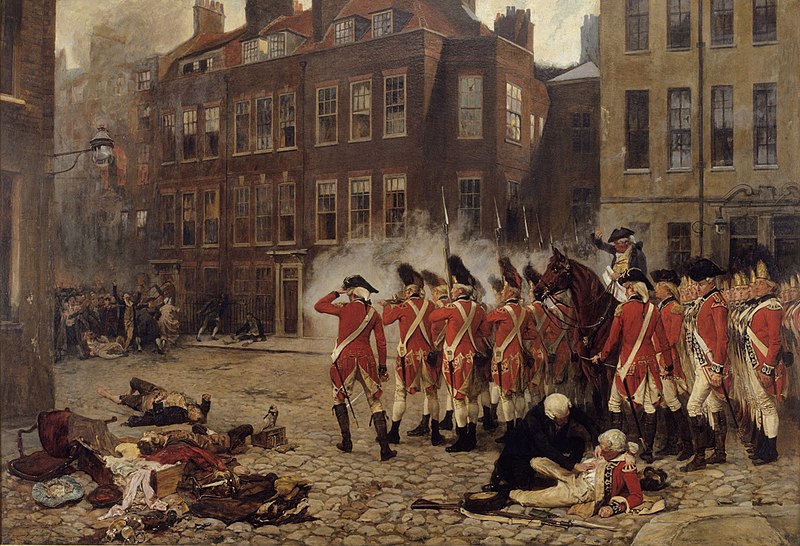
800px-The_Gordon_Riots_by_John_Seymour_Lucas

Captain Frederick Tilney, knocked off his horse? “Gordon Riots,” Project Gutenberg eText 19609, by John Seymour Lucas, 1879. Public domain.

The Gordon Riots

Such riots had happened before. Henry might have been talking about the Gordon Riots of 1780.* These are considered the most destructive and violent riots in English history. Lord George Gordon initiated these anti-Catholic riots, though he intended only a peaceful demonstration. At that time, Catholics in England had very limited rights. An Act of Parliament, passed in 1778, gave Catholics a few rights, including the rights to buy and inherit property, and to join the military, if they took an oath of allegiance to the Crown.

On June 2, 1780, Gordon gathered a crowd of around sixty thousand people at St. George’s Fields, London. They marched to Parliament to present a petition. Parliament did not choose to overturn the law.

256px-Charles_Green13

Thousands gathered in St. George’s Fields. “The Gordon Riots,” Charles Green (1840-1898) / Public domain

Riots ensued, with people shouting “No popery!” and burning down Catholic chapels, priests’ houses, Catholic homes, shops, and schools, and a distillery owned by a Catholic. Lord Chief Justice Mansfield had supported the Catholic Relief Act (he later supported rights for black people in England as well); his house was looted. (Yes, Mansfield Park may have been named after this Lord Mansfield.) The homes of other politicians who supported the Act were also attacked. Lord Gordon tried to calm the situation; he took no responsibility for the riots.

Mobs, already angry about poverty and injustice, attacked the Bank of England on June 7. They burned prisons and prisoners went free. The rioting lasted for about a week. Over ten thousand soldiers were brought in to quell the riots. More than three hundred rioters were killed during the riots or executed afterwards. (By the way, at least two black men, included in the picture below, were involved in the rioting, and black writer Ignatius Sancho witnessed it and wrote about it. The story is told at Black Presence.) George Gordon was imprisoned in the Tower of London but was eventually acquitted of treason.

800px-An_exact_representation_of_the_Burning,_Plundering_and_Destruction_of_Newgate_by_the_rioters,_on_the_memorable_7th_of_June_1780_(BM_Z,1.4)

Newgate Prison was burned during the Gordon Riots. “An exact representation of the Burning, Plundering and Destruction of Newgate by the rioters, on the memorable 7th of June 1780,” by Henry Roberts, 1781. © The Trustees of the British Museum, released as CC BY-NC-SA 4.0

The Gordon Riots seem an appropriate possibility for Henry’s description: thousands gathering in St. George’s Fields (though many more than what he described), the bank attacked, the army called in, many people killed. I haven’t found references to the Tower of London being threatened, however.

These riots also relate to Bath, where Henry and the ladies were having their conversation. During the Gordon riots, anti-Catholic rioting also broke out in Bath. Rioters burned down the Catholic chapel, the bishop’s house and the priest’s house. The city of Bath responded strongly, hanging the ringleader and taxing the whole city to pay for the building of a new Catholic chapel.

Other Riots

However, the Gordon Riots took place when Jane Austen was only four years old; long before she wrote Northanger Abbey. Could she have been referring to more recent riots? Collins Hemingway, in an article in Jane Austen’s Regency World (July/Aug 2018), suggests that it is more likely that Austen was describing one of the many riots going on in England closer to the time when Northanger Abbey was written or revised. (The novel was apparently written between 1797 and 1803, and revised somewhat in 1816-17.)

Some examples of riots closer to the writing of Northanger Abbey:

  • The Priestley Riots in Birmingham in 1791: Rioters attacked Dissenters (non-Anglicans) who were supporting the French Revolution, including Joseph Priestley. Priestley was a Unitarian minister as well as the chemist who discovered oxygen. Houses, chapels, and businesses were burned.
  • The Bristol Bridge Riot in 1793 in Bristol was a protest against taxes and tolls. Soldiers were called in and 11 people were killed and 45 injured. This was the second most violent riot in England in the eighteenth century.
  • A series of riots in 1795, in various towns in England, has been called “the Revolt of the Housewives.” Led mostly by women, these were protests against high food prices. Women would seize the goods of a merchant who they thought was overcharging customers. The women sold the goods at what they considered a fair price, and gave the money to the merchant.
  • A London riot in 1809, the Old Price Riot, protested price increases at the newly-rebuilt Covent Garden Theatre. The management eventually gave in. They restored earlier prices so the theatre would be accessible to everyone, rich and poor.
  • In late 1816, as Austen may have been revising Northanger Abbey, a mob of about 10,000 people in Spa Fields, London demanded election reforms and relief for the poor. The first meeting was peaceful, but the second meeting, of about 20,000 people, turned violent. They attempted to attack the Tower of London. However, troops quickly put down the riots. Perhaps this riot inspired Austen to mention “the tower threatened.”

Hemingway suggests that the most likely riot to have inspired Austen was a riot in Manchester in 1808. Six thousand weavers gathered in St. George’s Field, Manchester (rather than St. George’s Field, London) to demand a minimum wage. Dragoons were sent to restore order. According to Hemingway, when Henry Tilney says the dragoons were called “up from Northampton,” it may mean they were called up to the north, to Manchester. One man was killed, and others were injured. The rioting spread to neighboring towns. Weavers did receive a small pay increase in the end. Surprisingly, the dragoons later apologized to the weavers for their actions, and took up a collection for the family of the man who was killed.

760px-Barnaby_Rudge_-_P207c

Illustration from Charles Dickens’ historical novel about the Gordon Riots, Barnaby Rudge, “Barnaby at the Gordon Riots,” 1871, public domain.

However, London is mentioned several times in the Northanger Abbey passage. It’s possible that Austen was taking details of other recent riots and transplanting them to London, for the story. To me, however, the Gordon Riots seem to most closely fit the details given. While there was not a time when the streets of London were literally “flowing with blood,” those were the riots in which the most people were killed.

Although Henry says Catherine’s “words could relate only to a circulating library,” riots similar to what he described had happened in recent history. Of course he also criticizes her vivid imagination when she thinks his father has committed a terrible crime. It turns out that his father is not a murderer, but does treat Catherine cruelly. Henry’s words are often ironic.

What do you think? Was Austen referring to a real riot (or several riots) here, or was the riot only in Eleanor’s mind?


*R. W. Chapman (1923 edition of Northanger Abbey), Roger E. Moore (Jane Austen and the Reformation, 105), and others consider this riot to refer to the Gordon Riots.

Brenda S. Cox blogs about Faith, Science, Joy, and Jane Austen, and is currently working on a book entitled Fashionable Goodness: Christianity in Jane Austen’s England. You can also find her on Facebook.

Read Full Post »

Inquiring readers, This fascinating post written by author Clyve Rose explains to film viewers who have not read Emma the short, confusing scene shown in Autumn de Wilde’s 2020 film adaptation of Austen’s novel. Ms. Rose reviews the history of Gipsies or Gypsies in Regency England and Europe in general, and provides insights into why this nomadic group was shunned and feared.

Painting of a young gypsy woman by Karlis Teodors Huns, 1870.

Public domain image of a young Gypsy woman with a tambourine, painted by Kārlis Teodors Hūns, 1870. Wikimedia Commons.

In Chapter 39 of Austen’s Emma, we come upon a curious incident. Miss Harriet Smith (the pretty and ‘natural daughter’ of no-one-yet-knows), out walking with a companion, is accosted by a ‘group of gypsies’. This incident is curious for many readers, and for many reasons.

For modern readers who may not understand the fear and attendant danger of such an episode, it is worth remembering that merely associating with “such a set of people” was judged to be a crime in Regency England. From the 1500s onwards the Crown made several attempts to rid their green and pleasant land of these ‘other’ residents, including deporting them to the colonies and attempting to legislate them out of all existence. By Austen’s time, any conversation or ‘consorting’ with ‘gypsies’ was considered a criminal act for which one could be incarcerated — or worse. A case in 1782 saw a fourteen year old girl hanged for such acquaintance, on the orders of the local magistrate.

That Harriet Smith speaks to the ‘gypsies’, offers them money, and then pleads with them would have been enough to see her in trouble with the law. While the local Highbury magistrate (our hero, Mr Knightley) would be unlikely to order Harriet hanged (I doubt even Austen could redeem a hero who sentences his heroine’s ‘particular friend’ to the gallows), Miss Smith still, technically, commits a crime in this scene. Leaving aside the impact this moment has on the romantic machinations of Emma and her friends, it affords us a rare glimpse into a Regency England that is not often represented in contemporary works.

Austen’s England is a very specific place. A place inhabited only by the English themselves. It is very interesting that one of the few glimpses her readers ever receive of the scaffolding behind this construct, is in the novel where her heroine is labelled by the author herself as ‘an imaginist’ – because, of course, the ideal of a homogenous England is pure imagination: Especially as the empire was at its height at the time, both from a cultural and a mercantile perspective.

There are hints of a similar façade – and Austen’s awareness that this is a façade – in Mansfield Park as well. Sir Thomas Bertram’s references to the slave trade in Jamaica, and its importance as the mainstay of his wealth, is touched upon. He even suggests introducing some of his ‘stock’ at Mansfield Park, but this is not taken seriously. What happens in Jamaica must stay in Jamaica. England is only for the English, Sir Thomas!

The British Empire once spanned a quarter of the known world, but at no point were the native-born residents of these colonies truly deemed to be ‘English’. These antipodeans were not, after all, actually resident in England itself. At least, not most of them. What if the ‘non-English’ people were not ‘out there’ in the colonies? What if they did, in fact, live in England right alongside the Bertrams, the Woodhouses, the Knightleys – and even the Bennets?

Which brings me to the Romany of England: Their position in these narratives is unique; almost as unusual as their place in Regency England – because of course they had one. They lived, loved, and mattered in the same geographic spaces as Emma Woodhouse and Harriet Smith.

The fact is, this ‘England-only-for-the-English’ was peopled by another culture entirely. England was, and is, a shared land. Two cultures, so vastly different in so many ways, coexisted for centuries, and rarely peacefully. The English Romany were as present and alive and wonderfully romantic as the Regency English. Coming from a mostly oral tradition, Romany stories from that time are rarely found in print but that they were there, and experienced this period, and undoubtedly have stories to tell about it – is visible even in the work of authors determined to showcase only their ‘own England’ to their ‘own’ readers.

Austen’s England has the backing of every powerful institution of her day. In terms of crafting the dominant narrative, the English are able to draw on the Crown, the Military, the Law, and of course the Church, which played such a vital part in the lives and lovers of Regency England. Even Heaven sides with the English in Austen’s world view. Her father, let’s not forget, was a clergyman. In the incident ascribed above, Austen does not specifically accuse the ‘gypsies’ of being heathens, but they are clearly depicted as ‘other’; outside the town limits of Highbury itself and dark, terrifying, criminal, and dangerous. They certainly do not ‘fit’ in Austen’s England, and are quite unsatisfyingly removed from Emma’s tale as soon as they have served their rather meagre narrative purpose: “The Gypsies did not wait for the operations of justice: they took themselves off in a hurry.”

Or rather, the author moved them quickly off her bleached white pages and out of ‘her’ England – despite the truth that there were non-English people present in Austen’s England; other voices with their own perspectives and their own stories worth telling, and worth writing. Contemporary Regency writers can not erase these different voices from their tales, because these real people existed all around them, finding their way into these ‘English-only’ narratives with the same kind of side-eye once given to the Irishman and the Scot. The cultural difference between these latter still-European folk and the Romany is, however, far greater – which may account for the fact that their treatment at the hands of English Regency writers seems to have been far worse.

It is difficult to be born into a place that never allows you to become a part of it without a fight, a plea, an effort to assimilate and cut away the parts of you that discomfit the powerful dominant culture all around you. It is more than difficult; it is painful and damaging. The very term ‘marginalisation’ is an admission of the lack of narrative ‘space’ allotted to the voices fiction has chosen to leave unloved, and unnoticed.

The term ‘marginal’ itself bothers me. It is almost (but not quite) a pejorative, which is why I place it in single quotes. I have here done the same with the term ‘gypsy’. I am aware that neither term is universally regarded as harmful. Debates rage all over this, on may fronts. I am only one writer; one voice among many and I have no answers. That there is ongoing debate however, is encouraging.

For myself, born into a marginalised culture with a mostly oral tradition, the ‘minor’ incident in Emma stands out. After all, my own tribe has quite a bit in common with the Romany. There was once a link made between the Romany of Europe and the Lost Tribes of Israel. It turned out to be incorrect, but the placement of ‘other’ in an otherwise ‘native’ land is a context embedded into my lived experience every day – and that’s quite apart from the grim reality shared in the concentration camps of Europe during World War II; a shared history I am sure not even an imaginist like Austen – or Emma – could envisage. Its very surreality is what allows deniability to play so plausibly in the minds of those focused on the façade, rather than any kind of ‘real’ history.

Real history is profoundly unromantic – and yet, somehow, we still try. There is beauty in stories, in narratives of the tales about long-ago lovers and their imagined worlds. There is much solace to be found in story – I love re-reading Austen (although Emma is not my favourite of her works), but in between the wonder of her words, I find myself reading for traces. Traces of others who were there – and whose stories deserve to be told.

Image of Clyve Rose. Permission of her publicist Andrea Kiliany Thatcher, taken by photographer Kira, www.artphotobykira.com.au

Image of Clyve Rose. Permission of her publicist Andrea Kiliany Thatcher, taken by photographer Kira, http://www.artphotobykira.com.au

About Clyve Rose:

Clyve Rose has been writing historical romance fiction for the best part of two decades. Her newest work, Always a Princess, published by Boroughs Publishing Group, debuts this September. She works in the historical romance, fantasy, and speculative fiction genres. She also creates literary novels under an alternative pen name. In between her devotion to fiction writing, Clyve researches various mythologies and historical periods, often basing her characters on actual historical personalities.​

One of her novels was longlisted for a Hachette Development Award for Fiction while her paranormal short story, The One Below, won the Passionate Ink (RWA) award for best Speculative Fiction Short.

​Visit her online at:

Connect with Clyve Rose at ClyveRose.com and Instagram.com/ClyveRose, in which she writes “Clyve Rose is an award-winning Regency Romance author. New Regency release out on 8 Sept. 2020.”

Read Full Post »

Inquiring Readers:

Chris Brindle, who lives in Colchester, England, is a prolific writer of music and books, and also a producer. Chris has written the following post (a compilation of information on his website and from the emails & materials he sent me.) He postulates that as Austen was dying in 1817, she deliberately wrote ‘Sanditon’ as a challenge and inspiration for other people in her family to finish, particularly her niece Anna (Lefroy) and nephew James-Edward (Austen-Leigh). Here, then, is Chris’s article.

Steventon Rectory. Image Wikimedia Commons

Steventon Rectory. Image Wikimedia Commons

Sanditon was Jane Austen’s last, partially completed, novel of around 24,000 words, written in 1817 between January 27th and March 18th. Jane’s niece Anna, the daughter of Jane’s eldest brother James, had been brought up in her youngest years at Steventon where her aunt, who was 18 years older, also lived. Anna remained at Steventon with her father until she married Ben Lefroy at 21. After a brief interlude, Anna moved back to Hampshire to live two miles away from Jane, then living at Chawton.

Jane Lefroy's biography pages by Chris Brindle in his book Hampshire, Vol 2, pp. 72-73. Image courtesy of Chris Brindle. His book is available via Amazon.

Jane Lefroy’s biography pages by Chris Brindle in his book Hampshire, Vol 2, pp. 72-73. Image courtesy of Chris Brindle. His book is available via Amazon.

Anna was surely the first ‘Janeite’ and harboured a life-long ambition to emulate and honour her aunt. In March 1845 she inherited Jane’s manuscript in the will of Jane’s sister Cassandra, and set about writing her continuation [of the unfinished novel], which is of similar length and is similarly unfinished.

By the time Austen put down her pen and finally her pencil, she had introduced all the characters that the story needed—apart maybe for a good villain, as Lefroy realised in her continuation, when she invented Mr Tracy as one of Sidney Parker’s friends (friends Austen told us would join Sidney at the Hotel). I don’t believe Austen intended Sir Edward Denham to be a villain, rather just a sexually frustrated character answering to Lady Denham’s will, who, as dowager, controlled Sir Edward’s estate.

When Austen realised she was dying, I believe she worked out a way in which her books and letters would not die with her, but would live on as the next generation took up the baton as her literary heirs. Her book and letters were her children and she wanted them to live forever.

This is the lyric in my ‘Song For Jane Austen’–YouTube link

When did you realise that your life would soon come to its end ?

Did you always know your life would be so short ?

What is a life, what is it worth ?

Is it what you leave behind you at the end ?

Your books and letters were your children

Left to others to inspire, and maybe carry on your work

Do you die if a little bit of you will live in others ?

Or memories of you will still remain ?

How do you spend your last few moments on this earth

When your journey has to come to its end

One last display of brilliance in three tiny booklets

Your sketches on a canvas for others to fill in

Your gift to God and to the world

And those you leave behind you at the end

In your pain you left us biting satire

A town built on sand in need of hope

But you left us characters who could save it

If in our imagination we could see how they would cope

May the Lord look on you with grace and favour

For this was the world you created

Reaching out for your future

A century or more away

When your pain was most intense

And your time was running out”

Anna Lefroy, whose mother died when she was two, was largely brought up with Jane at Steventon in her early years.  Thus she most probably earns the right to be known as Austen’s first fan. Anna’s life was devoted to an effort to emulate her aunt. We know most about Jane’s approach to writing from the exchange of letters between her and Anna, as Anna sent the latest piece of dialogue to Jane for her comments.  From the letters it was clear that Anna had no idea how to plot a novel, or to start with a strong enough idea to drive an interesting story, so Sanditon was most probably written as a starting place for Anna to complete the novel.

In 1817 Anna was starting a family and had no time to write. In any case, Anna would need to earn the right to be Austen’s literary heir by being a published author. Thus, after Jane’s death in 1817, all the letters and manuscripts went to her sister Cassandra. To keep Austen’s memory alive, it would be for Cassandra to decide who should get what. Anna Lefroy inherited the unfinished manuscript of Sanditon on Cassandra’s death in 1845.

I tell this story in my Documentary (YouTube link)  and how, although Anna failed to complete Sanditon (Click here to read her unfinished text), her half brother James Edward Austen-Leigh went one better and wrote the first biography of Austen. A Memoir of Jane Austen put the life of Austen together with her fiction and made her a mega-star. It was the competition that Austen created between her nieces and nephews that made the Memoir happen. (Click here to read the Memoir.)

I came to realise what Sanditon actually was when writing the illustrated story of the life of my great great great grandfather R.H.C. Ubsdell (1812-1887), the Portsmouth miniaturist, portrait painter and early photographer. Ubsdell had a studio and art gallery in Old Portsmouth opposite the theatre. He painted portraits of Jane Austen’s sailor brothers Charles and Francis (Frank) and the miniature of Anna Lefroy, delivered to her in the Autumn of 1845. He probably also drew the disputed portrait in graphite on vellum of Austen (the property of Paula Byrne) as an ‘identikit reconstruction’ for Anna Lefroy circa 1845 (probably to serve as a frontispiece for her intended completion of Sanditon together with her own portrait.)

'Unseen' Portrait of Jane Austen (Paula Byrne), Miniature of Charles Austen, and miniature of Anna Lefroy. Images courtesy of Chris Brinkle.

‘Unseen’ Portrait of Jane Austen (Paula Byrne), Miniature of Charles Austen, and miniature of Anna Lefroy. Images courtesy of Chris Brinkle.

These illustrated books, entitled Hampshire, are available on Amazon. Click on this link to view the books.

History of the Church and Rectory at Ashe

A page in Hampshire, a book by Chris Brindle. This one discusses the history of the church and Rectory at Ashe, a village close to Steventon. Image courtesy of Chris Brindle.

I think it is only when one puts the Lefroy continuation together with the Austen original that one truly understands why Austen wrote Sanditon. My conclusion comes from studying the life stories of Austen and Anna Lefroy, and Anna’s diary and life story that her daughters copied out. (One copy was kindly lent to me by descendant Helen Lefroy).  So perhaps one cannot complain if ITV chooses Andrew Davies to write a very modern ‘Love Island’ ‘take’ on the book.  Having invested our time in a couple of episodes, most people will probably want to know how it ends.

Sanditon, the ITV/PBS Masterpiece television mini-series

Davies does little more than take the names of some of the characters, however, whilst ignoring most of the content of Austen’s original fragment, niece Anna Lefroy’s continuation, and the financial relationships between the characters that Austen very clearly outlines, and which Lefroy clearly understood. Austen’s story should be about property speculation and money, inspired by her time in London with brother Henry, when the bank of which he was a partner, Austen, Maude & Tilson was collapsing because of their ill-considering loans.

Davies and the production studio also fail to present the main character properly–a South Coast English seaside resort in its earliest stages of speculative development. Trafalgar House (Tom and Mary Parker’s house) is not part of ‘New Sanditon’, a bold new development on the cliff, instead in the TV show it is stuck down in a very squalid looking village.

The other thing that is unsatisfactory about the ITV/PBS Masterpiece production is that it ignores the actual history and real-life detail of the development of the English seaside resorts such as Brighton, Worthing and Southsea. It wasn’t an accident that Austen chose the setting of an English Seaside Resort, because she saw that this was a character in its own right. From its infancy, Sanditon would grow up over time. Therefore, for any future ‘completer’ there would be so much actual historical detail of the financial machinations to draw upon.

Chris Brindle’s works and productions

I am very gratified that people looking for something more authentic have been viewing on YouTube my original solution to the completion clues that Austen and Lefroy left, my 2014 Play:

and my Documentary filmed in Hampshire in the same year that tells ‘The Story Behind Sanditon‘:

Austen left us so little of Sanditon that I think rather than rushing ahead and inventing new story lines I thought it might be better to look at Austen’s characters in more detail, using as many of her actual words as possible, and thus my idea for a musical was born. This built on the duet ‘Blue Briny Sea’ that I had written for the original stage show  (filmed at Chawton Great House) https://youtu.be/2gmrFrEdMBg

and  ‘Song For Jane Austen’ (filmed in Bath) that I had written for the 200th Anniversary of Jane’s death:

My first script for the musical was a grand stage musical with a cast of 19, which I then reduced to an actor musician musical performed by 11 players that I produced and filmed at ‘The Other Palace’ Theatre in London in July last year:-

In this musical the songwriter for a modern 21st Century Pop Band persuades the members of her band to take on Austen’s words, the characters in Austen’s novel, tell the story behind the novel, and reflect on what the novel means to them ‘200 Years Later’.  The carriage ride from Willingden to Sanditon then becomes this song as Tom & Mary Parker and Charlotte Heywood give their respective views on the resort:

Whilst an Austen story with modern popular music might seem a strange mix, another example of a musical doing very well on tour in the UK at the moment is “Pride & Prejudice” (Sort Of ), which features the Pride & Prejudice story told by the Bennet’s servants, but in broad Glaswegian with added karaoke songs!

Everything I’ve done has been on a tiny budget driven by my fascination for the subject matter.  I’m currently working on plans to develop the big stage production in the amateur sector.  More details can be found on my website www.Sanditon.info, which I’ve updated.

On my website you will find the links to

  • The texts of both the Austen and Lefroy fragments of ‘Sanditon’ (An entirely different perspective opens up if one asks oneself line-by-line, why did the author include ‘that bit’?  (If you read the Austen fragment in this way, Austen clearly leaves so many plot openers and clues in her work for future ‘completers’ to solve.  This is probably what is most unsatisfactory about the Andrew Davies / ITV dramatisation in that Davies chooses not to solve any of Austen’s clues and just ‘does his own thing’.)
  • My 2014 Film of The Play of Jane Austen’s and Anna Lefroy’s Sanditon.
  • My 2014 Documentary filmed in Hampshire & Berkshire with piano music by American Composer and JASNA delegate Amanda Jacobs
  • My 2019 Musical  “200 Years Later”  Jane Austen’s ‘Sanditon’ The Pop/Rock Musical as premiered at ‘The Other Palace’, Victoria London on 26th July 2019

Additional information from other sources

Photo of Chris Brindle

Chris Brindle 

Chris is a writer (see www.Ubsdell.com) and in 2014 produced a play, short film and documentary that completed and told the story of Jane Austen’s last unfinished novel Sanditon. Read more of his biography at this link.

Read Full Post »

« Newer Posts - Older Posts »