Feeds:
Posts
Comments

Archive for the ‘jane austen’ Category

Gentle Readers, Tony Grant’s latest contribution to this blog centers around Jane Austen’s two sailor brothers. What a delightful read just before the Holidays. His blog, London Calling, is worth visiting.
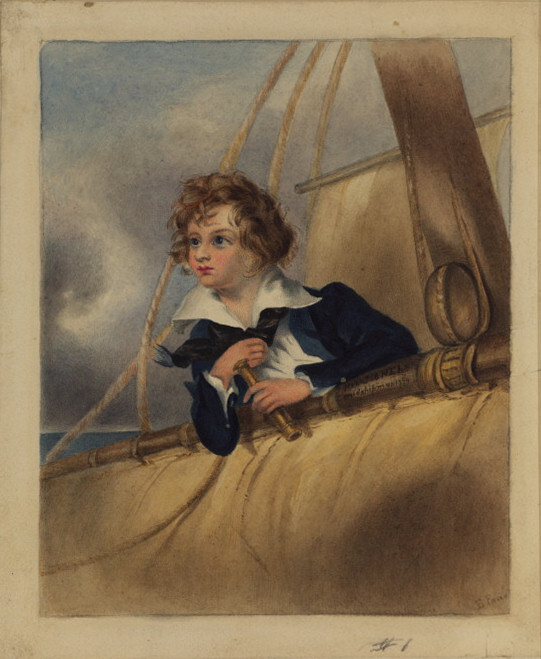
Horatio Nelson as a midshipman (middie) in the year Jane Austen was born, 1775

Francis was the older of Jane’s two brothers who joined The Royal Navy. He was twelve years old in 1786 when he travelled to Portsmouth from Steventon, a mere twenty miles away, to be enrolled at The Royal Naval Academy.
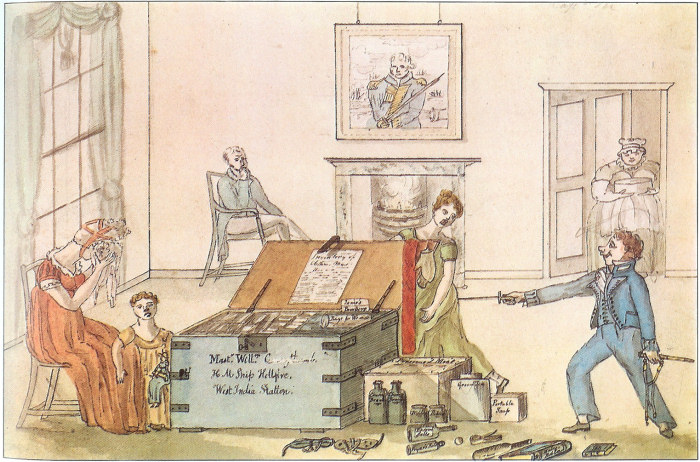
Young midshipman going off to sea. Would such a scene have been reenacted in the Austen household? Image @The Joyful Molly

His father thought it would provide a good education for Francis. The Royal Naval Academy provided a very formal education. He was taught, navigation, mapping, how to use and handle sails, the construction and architecture of ships and gunnery, ropework, communications, maritime law, weather, meteorology and watch standing. He needed a thorough knowledge of mathematics to be able to be proficient at all these skills. The mathematics he had to learn and become adept at included pure mathematics, stations, elongations of an inferior planet, reflection at plane surfaces and reflection at two plane surfaces, Euclid, algebra and trigonometry. Future officers were also taught politics and diplomacy alongside fencing, French and dancing. It was thought that these skills were needed in diplomacy and often officers of ships, arriving at far-flung parts of the world, were required to act as diplomats for Britain.
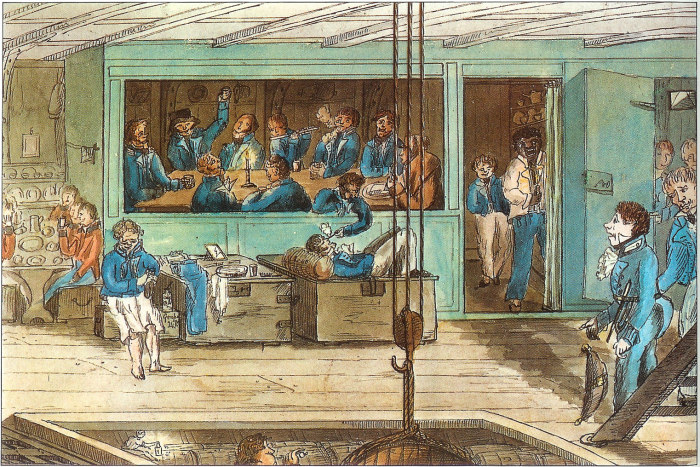
Life for middies on board ship. Image @The Joyful Molly

Jane’s brother Charles joined The Royal Navy five years after Francis and followed a similar course of education.

Life at the Royal Naval College in Portsmouth was tough. We might say more than tough, in these enlightened times. Claire Tomlin, in her biography , Jane Austen A Life, writes,

“…and Francis was at the naval school in Portsmouth. The regime there was tough, not to say brutal; discipline was maintained with a horsewhip, and there were complaints about bullying, idleness and debauchery.”

From our point of view, in the Britain of the 21st century, horse whipping and a very rigid regime of rules and punishments might be termed as abuse and a criminal offence, damaging individuals for life. I don’t think it was seen like that in the 18th century.It is difficult for us to get into the minds of people in the 18th century but the Christian religion in the form of the Anglican church as part of the state, primarily possessed the minds, hearts and actions of people in very authoritarian and draconian ways. What was written in the Bible was law. Man’s baser instincts and proclivity for the seven deadly sins of wrath, greed, sloth, pride, lust, envy, and gluttony could be legitimately beaten out of them through pain and fear. Hence the horsewhipping. This obviously created the opposite scenario too. The secret lives of people in the 18th century, particularly those who could afford it, created a world of brothels and the prostitutes of Covent Garden and the affairs and licentious living that took place in a city like Bath. It just shows that fear and pain do not create the noble perfect man, they create somebody with two diverse sides to their personality . But of course in the 18th century psychiatrists and behaviourists had not been invented . A hundred years later,the story of Jekyl and Hyde was trying to grapple with this more overtly, and Darwin was beginning to challenge the viewpoint of religious status quo through science. With the fear of wrongdoing and the prospect of going to hell, at the back of peoples minds it took strong intelligent characters to question and be creative in their views about life and living.

Claire Tomlin goes on to explain that Jane’s two brothers did not appear to mind this strict regime of corporal punishment. They were both bright and intelligent and so succeeded. They probably avoided being punished because of their abilities and being successful and probably also, as we say, by“keeping their heads down.”
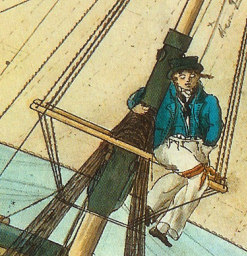
Middie sleeping on duty. Image @The Joyful Molly

The two brothers, during their careers saw action and provided a diplomatic service in many places across the globe including, the Mediterranean, the Adriatic, the Indian Ocean, the North and South Atlantic, the China Seas, the Caribbean and in South American waters.
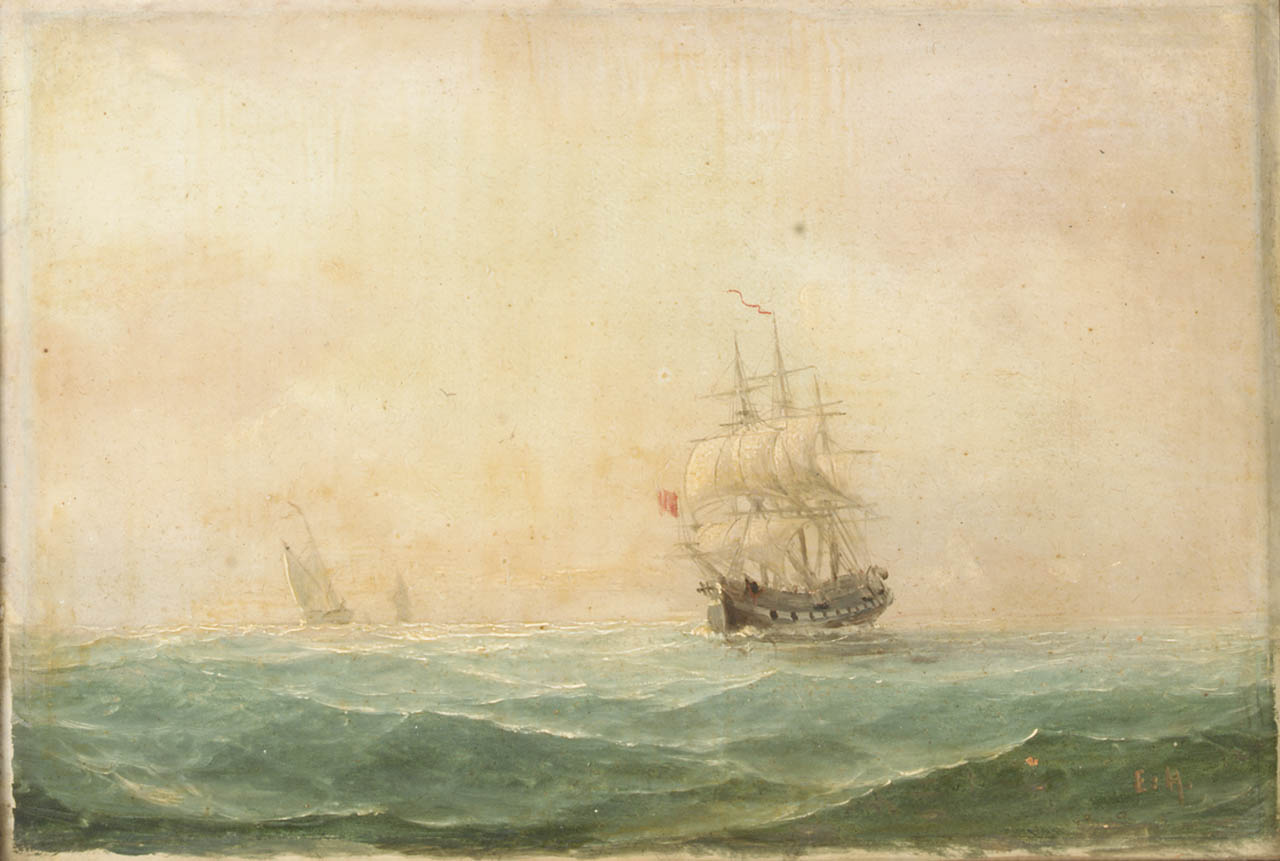
Frigate before the wind

The Royal Navy provided a very rigid hierarchical career structure. Once an officer had progressed past midshipman to Lieutenant, their career was often guaranteed. They progressed because of age and endurance. As people above them advanced, they moved in to fill their positions. Nowadays the Royal Navy and every professional and modern navy promotes their officers depending on their abilities. In the 18th century ability was not taken into account. Skilled people like Admiral Nelson or Jane’s two brothers rose through the hierarchy, but not because they were necessarily deemed as more able than others. Officers were in the navy virtually until they died, and as long as they stayed alive they progressed up the career ladder.
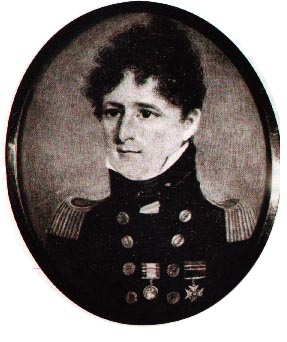
Francis Austen

Francis and Charles both rose through the ranks. Francis eventually became a full admiral and was the Commander in Chief of The North American and West Indian fleet. He became the Senior Admiral of the Fleet in 1868 when he was 89 years old. That seems ridiculous to us now. Unfortunately, Francis, did not have a very good opinion of Americans. He disapproved of the men spitting and didn’t like the flippant attitude of the women. The American women were not as cultured and sedate as his dear sister, Jane.
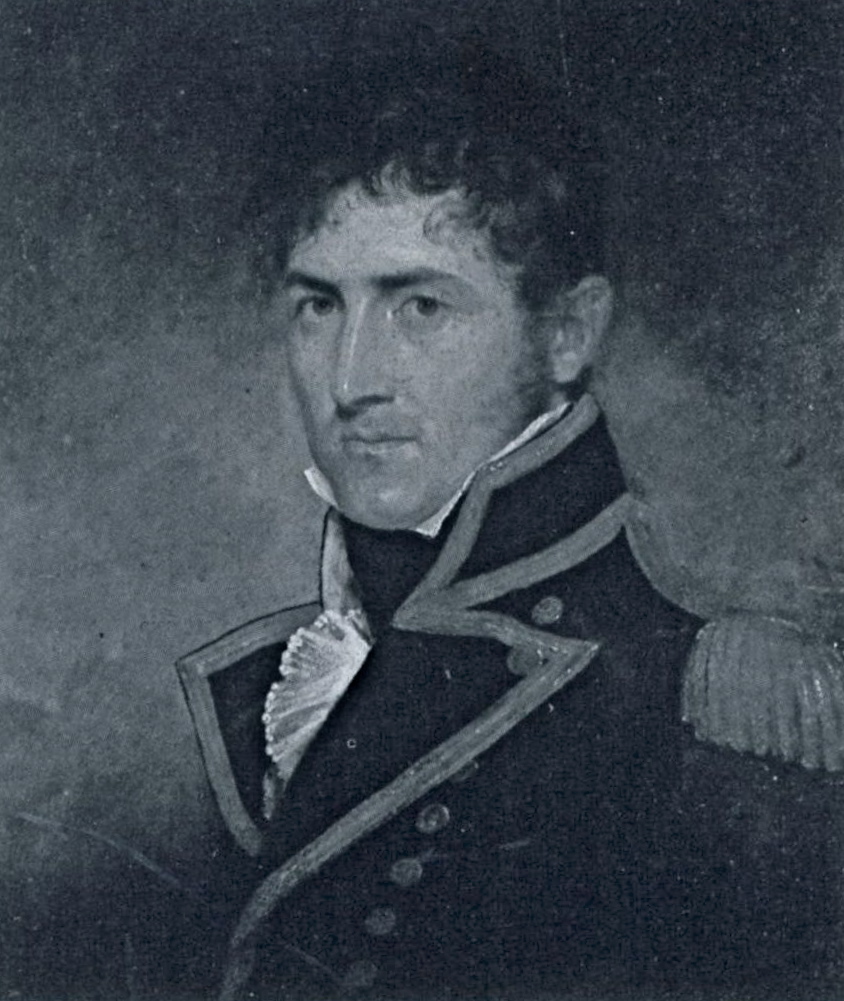
Charles Austen

Francis was unhappy about his career. Many things passed him by or were too slow in coming,  such as the position of Senior Admiral of the Fleet. His deepest regret was that he missed being at The Battle of Trafalgar with Nelson. His ship was there, but at the time he was ordered to perform another duty ashore.
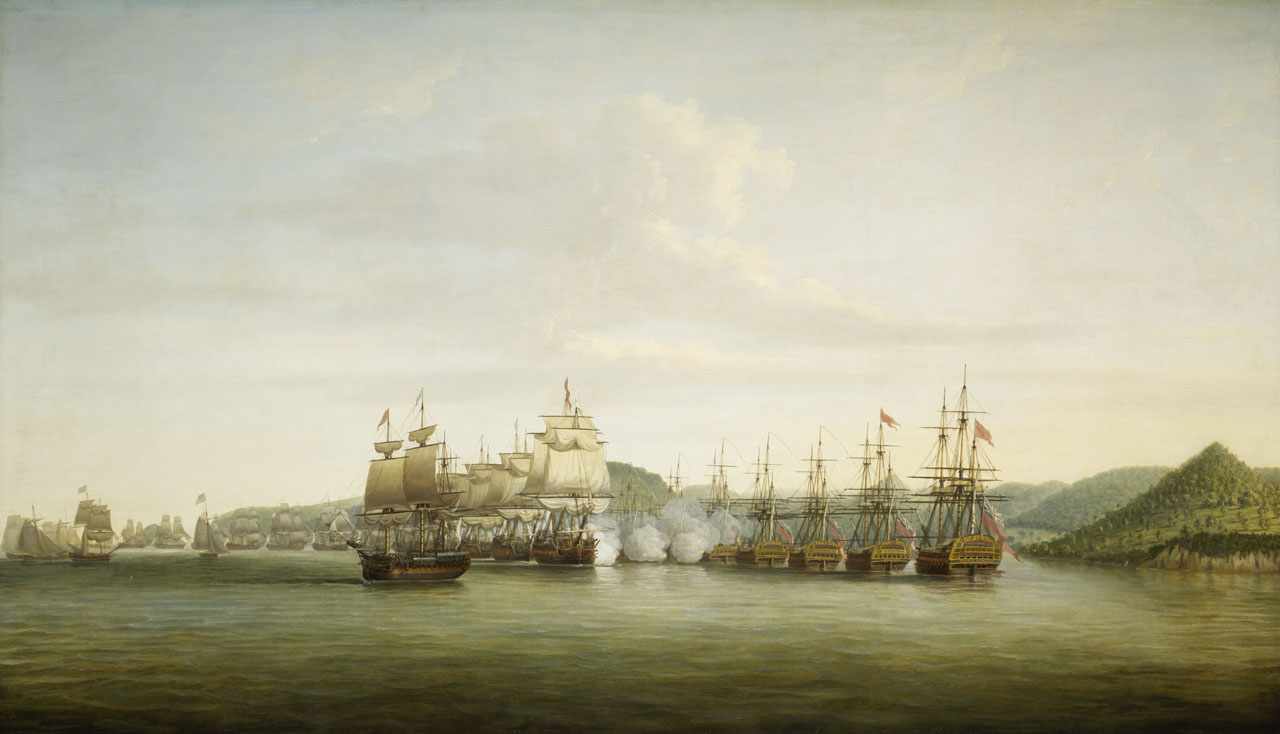
Barringtons action at St. Lucia 1778

Jane Austen includes Royal Naval characters in her novels, Persuasion and Mansfield Park. She had a great deal of affection for her brothers and knew a lot about the navy through them. Like her brothers, her naval characters were honest and chivalrous.

More on the topic
Read Full Post »

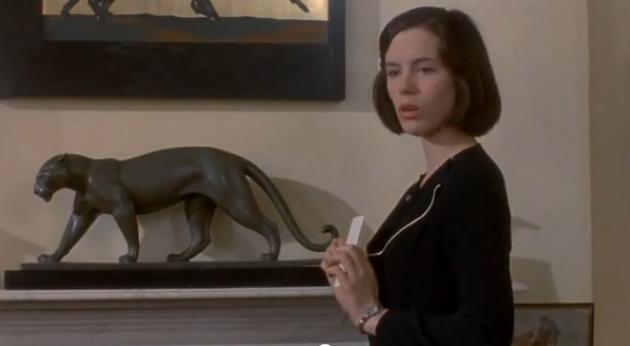
Gentle readers, Recently I had the pleasure of watching Cold Comfort Farm, a film adaptation of the comic 1932 novel by Stella Gibbons.  In 1995, Kate Beckinsale played the delightful Flora Poste, the girl who likes to organize things and tidy up. Kate also portrayed Emma Woodhouse at this time, before she turned Hollywood glam and began to play a vampire.

"I want to be a writer. I've so much in common with Jane Austen."

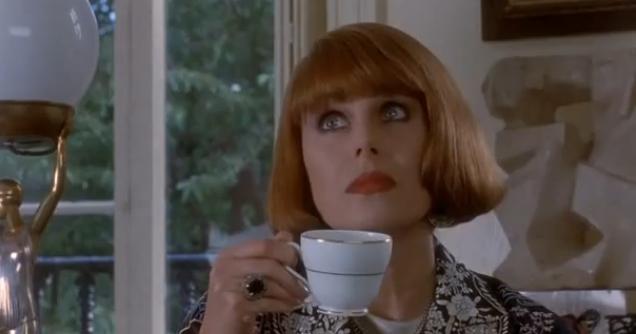
I find all of Cold Comfort Farm enchanting, but as a Jane Austen fan I naturally gravitated towards the conversation between Flora and her friend Mary Smiling (played by Joanna Lumley), who tells her young, recently orphaned friend that with an income of only 100 pounds per year she must find employment.

Mary Smiling's reaction to Flora's announcement is priceless.

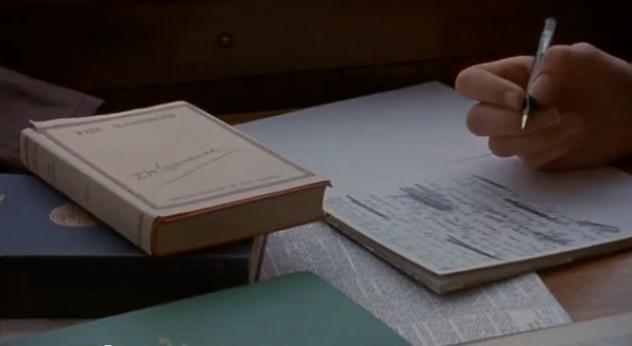
Flora, who lived a life of luxury and was gently bred, counters with the thought that she would like to become a novelist much in the mold of Jane Austen. All she really needs is a few more years of observing life and she could write a novel as good as Persuasion.  After accepting the invitation to live with distant relatives – the Starkadders who have always lived at Cold Comfort Farm – Flora begins to write her novel on the train.

"It was winter ...."

With ‘gems’  like these, do you think she will ever realize her dream of becoming the 20th century answer to Jane Austen?

“It was winter, the grimmest day of the darkest hour of the year…”

“The golden orb had almost disappeared behind the interlacing fingers of the hawthorne…”

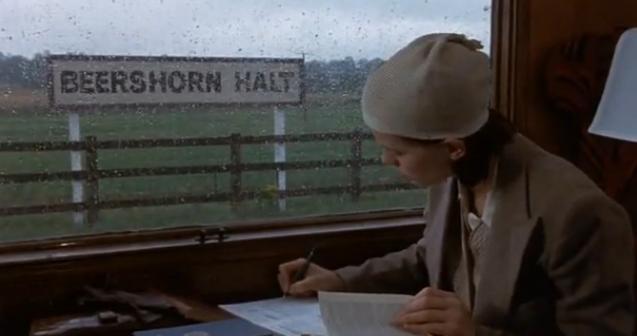
Flora arrives at her destination immersed in her writing.

“The man’s huge body, rude as a wind-tortured thorn, was printed dark against the flame of sand that..that throbbed..that throbbed on the tip of …”

One of my favorite quotes from the film is by Ada Doom (Sheila Burrell), who’s often repeated phrase – “I saw something nasty in the woodshed” – casts a pall over the entire Starkadder clan and is the theme of the movie. Can you remember other pearls of wisdom from this fine film/novel?

Read Full Post »

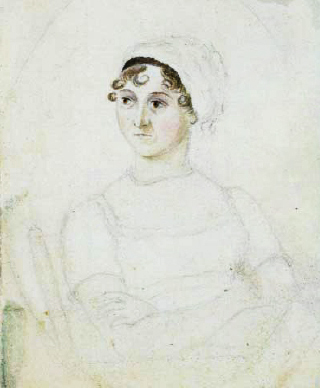
Let’s face it. Cassandra Austen’s tiny watercolour of her famous sister simply does not satisfy viewers. Jane Austen’s fans have been dying to find another authentic portrait of their favorite author. Has Dr. Paula Byrne accomplished this task? The Guardian.UK features an article with an imaginary portrait that Dr. Byrne believes was drawn from life.

Jane Austen portrait drawing, in graphite on vellum

The portrait drawing, in graphite on vellum, had been in a private collection for years, and was being auctioned as an “imaginary portrait” of Austen, with “Miss Jane Austin” written on the back. “When my husband bought it he thought it was a reasonable portrait of a nice lady writer, but I instantly had a visceral reaction to it. I thought it looks like her family. I recognised the Austen nose, to be honest, I thought it was so striking, so familiar,” Byrne told the Guardian.

Compare this portrait with images of Jane’s family and of Jane herself.

Cassandra's watercolour of Jane

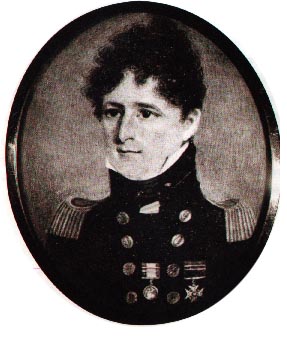
Captain Charles Austen, Jane's brother

Francis Austen, Jane's brother

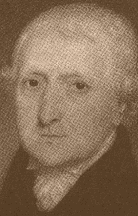
George Austen, Jane's father

James Austen, Jane's eldest brother

Read Full Post »

I was at the private view of the “Diorama”; it is in part a transparency; the spectator is in a dark chamber, and it is very pleasing, and has great illusion. It is without the pale of art, because its object is deception. The art pleases by reminding, not deceiving. The place was filled with foreigners, and I seemed to be in a cage of magpies. – John Constable.

Ruins of Hollyrood Chapel, one of Daguerre's paintings for an 1824 Paris diorama

Imagine a world without films or television, computers or cell phones. Where transportation was slow and costly, and only the rich could afford to travel out of the country. Then imagine a new cutting edge technology in which lifesized illusions of ancient or distant lands were recreated on large transluscent screens and scenes of beauty or disaster were enhanced with lights that simulated scenes containing fire, the changing seasons, and sunrises and sunsets. Dioramas were a 19th century version of virtual reality – spectacles that both entertained and filled the viewer with wonder. Illusionary, seemingly 3D, and augmented by concealed lights in back of the stage, these entertainments were shown in buildings designed to display them.

Photo shows people watching Daguerre's diorama. Undated illustration. Image by © Bettmann/CORBIS

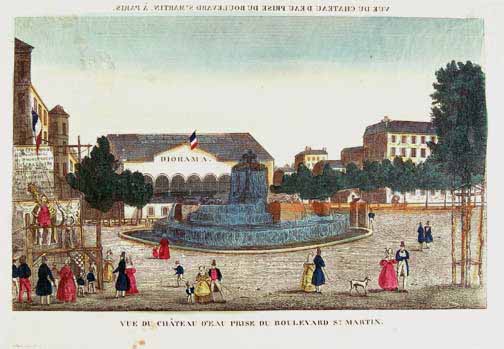
In 1822, a mere 5 years after Jane Austen’s death, Louis Jacques Mandé Daguerre, introduced the first Diorama theater in Paris.

Diorama in Paris. Image @Jack and Beverley's Optical Toys

“Daguerre made large paintings of scenes and displayed they in elaborate layered stage settings along with real objects. The theater was equipped with windows and louvers that could be opened and closed to front light and back light the images. This caused transparent areas of the scene to change and new images to appear. Most often these were day to night transformations.” – Jack and Beverley’s Optical Toys

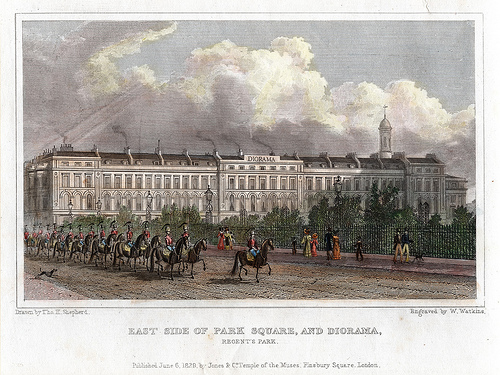
Diorama, Regent's Park

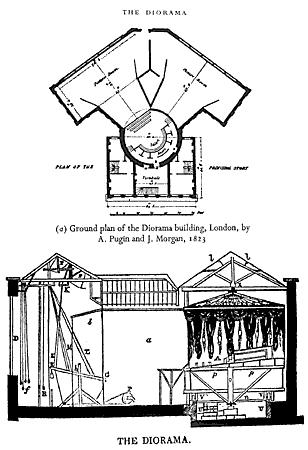
One year after Daguerre’s introduction of this wondrous new entertainment, the first diorama opened up in London in Regent’s Park. (The building still stands, but the interior has been vastly transformed.) The subject matter included landscape scenes of the grand tour, religious stories, recreations of paintings and grand architecture, and historical themes well-known to the public. The images could be made more or less bright according to the mood or atmosphere required by the theme. Props were also added for realism:

Diorama theatre

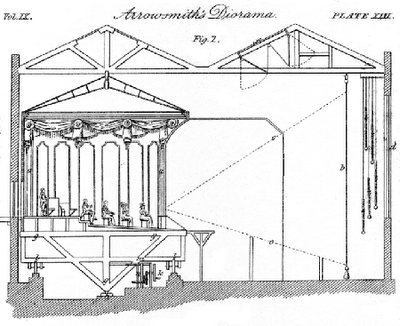
The visitors, after passing through a gloomy anteroom, were ushered into a circular chamber, apparently quite dark. One or two small shrouded lamps placed on the floor served dimly to light the way to a few descending steps and the voice of an invisible guide gave directions to walk forward. The eye soon became sufficiently accustomed to the darkness to distinguish the objects around and to perceive that there were several persons seated on benches opposite an open space resembling a large window. Through the window was seen the interior of Canterbury Cathedral undergoing partial repair with the figures of two or three workmen resting from their labours. The pillars, the arches, the stone floor and steps, stained with damp, and the planks of wood strewn on the ground, all seemed to stand out in bold relief, so solidly as not to admit a doubt of their substantiality, whilst the floor extended to the distant pillars, temptingly inviting the tread of exploring footsteps. Few could be persuaded that what they saw was a mere painting on a flat surface. The impression was strengthened by perceiving the light and shadows change, as if clouds were passing over the sun, the rays of which occasionally shone through the painted windows, casting coloured shadows on the floor. Then shortly the lightness would disappear and the former gloom again obscure the objects that had been momentarily illumined. The illusion was rendered more perfect by the sensitive condition of the eye in the darkness of the surrounding chamber.” “- The History of the Discovery of Cinematography http://www.precinemahistory.net/1800.htm

Diorama

Dioramas were created for spectacle and entertainment, and one can readily imagine Georgette Heyer’s characters attending these events during the London Season.

The popularity of the dioramas generated a debate over whether their pictures were art. The press discussed them as ‘exhibitions of art.’ But if the dioramas were art, it was a mundane art, and it rarely elevated the viewer’s taste. Indeed, if contemporary reactions are to be believed, the highest artistic achievement the diorama could attain was providing an entertaining substitute for reality. These pleasant but uncomplicated images required little or no preparation for serious thought… – Robert W. Brown.

Diorama diagram. Image @Wikipedia

This first-hand account gives the modern reader a sense of how these 30 – 50 minute light shows seemed to the viewer:

Woodcut of a diorama, day and night scenes.

A bell now rings, we find ourselves in motion; the whole theatre in which we sit, moves round till its wall closes the aperture or stage, and we are in perfect darkness; the bell rings again, a curtain rises, and we are looking on the time-worn towers, transepts, and buttresses of Notre Dame, its rose window on the left, and the water around its base reflecting back the last beams of the setting sun. Gradually these reflections disappear, the warm tints fade from the sky, and arc succeeded by the cool grey hue of twilight, and that again by night—deepening by insensible m degrees till the quay and the surrounding buildings and the water are no longer distinguishable, and Notre Dame itself scarcely reveals to us its outlines against the sky. Before we have long gazed on this scene the moon brgins to emerge slowly—very slowly, from the opposite quarter of the heavens, its first faint rays tempering apparently rather than dispersing the gloom; presently a slight radiance touches the top of one of the pinnacles of the cathedral—and glances as it were athwart the dark breast of the stream; now growing more powerful, the projections of Notre Dame throw their light and fantastic shadows over the left side of the building, until at last, bursting forth in serene unclouded majesty, the whole scene is lit up, except where the vast Cathedral interrupts its beams, on the quay here to the left, and where through the darkness the lamps are now seen, each illumining its allotted space.” – London Volumes 5-6, Edited by Charles Knight, 1843, pp. 284 – 288

Diorama, Edinburgh

By the early half of the 19th century there were five diaromas open in London. They were also popular in other British cities, as well as Breslau, Berlin, Cologne, Stockholm, and the United states. It is interesting to note that the end of the diorama’s popularity coincided with the rise of photography.

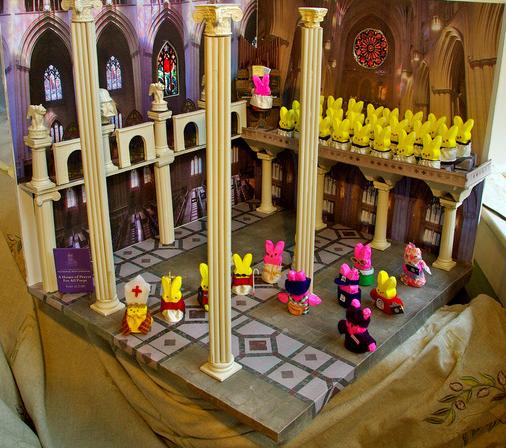
The Annual Peeps Diorama competition grows bigger every year: Easter at the National Peeps-thedral

Dioramas have shrunk in size, and today’s viewers know them only as scenes in boxes or bottles, as museum displays, or for competitions, such as the science fair or annual peeps contest.

Read Full Post »

Gentle Readers, This month I have joined the Sense and Sensibility Bicentenary Celebration on Maria Grazia’s My Jane Austen Book Club blog. Click on the banner on the sidebar to read the other articles posted each month in celebration of Jane Austen’s first published book. The first half of my post about Mr. Palmer’s observations of his fellow minor characters in the book sits here. The rest of the article sits on My Jane Austen Book Club.

I, Thomas Palmer, Esq., have been charged to analyze and discuss the traits of my fellow minor characters in Sense and Sensibility, the first of six novels by Jane Austen. I shall endeavor to do JUSTICE to that estimable author’s first published effort, which made its way to the public some 200 years ago and has never failed to be in print since.

I must first cast my thoughts upon Fanny and John Dashwood, whose miserliness oblidged the Dashwood women to leave their comfortable home at Norland to establish themselves in Barton Cottage and live a FRUGAL life in Devonshire amongst strangers. Miss Austen was a mere 20 years of age when she first conceived of this novel in epistolary form, first naming it Elinor and Marianne. That such a young author, whose knowledge of the world was CONFINED largely to books and the experiences of others, could create two such memorable characters as Fanny and John Dashwood portended her genius.

Fanny in particular is a character like no other in literature. Her manipulation of her weak husband in persuading him to abandon his PLEDGE to his father on that man’s deathbed is breathtaking in its audacity and avarice. The sequence of her skewed logic and her husband’s reaction to her CONTRIVANCE to preserve every pence of her darling son’s inheritance is matchless. Even I could not have conceived of a more cynical, darkly humorous dialog than young Miss Austen presented through these two minor characters, thereby setting the novel’s direction and tone. “People always live for ever when there is an annuity to be paid them.” One simply cannot add or take away a word to improve this utterance by Mrs. Dashwood.

The John Dashwoods represent, like so many minor characters, a FOIL – brilliantly conceived foils, to be sure – that are meant to contrast with other characters. Take my rather vulgar brother-in-law, Sir John Middleton, who is renowned for his generous impulses. Whilst the Dashwood ladies were figuratively shoved out of Norland by the John Dashwoods, Sir John, a distant relation, emerges from nowhere to offer them a hearth and home. The CONTRAST twixt the two Johns – one so weak and tight-fisted that he willing to break his vow to his dying father, the other so generous that he is forever inviting the entire neighborhood to sample the contents of his larder – cannot be ignored.

I next turn my gaze upon the Steele sisters, Lucy and Anne. Anne is a flat minor character who is doomed to learn nothing from life’s experiences, but who interjects a running COMIC gag over her obsession with Dr. Davies (he will never offer his hand in marriage). Her main purpose in the novel is to REVEAL the engagement of Lucy to Edward at a most awkward moment.

Her sister Lucy, a smarter, prettier version of Anne, is as mean, cunning and scheming a creature as I have ever come across. I had her measure from the start, I assure you. Lucy’s sole ambition is to ingratiate herself with her betters in order to take her place in SOCIETY. Knowing of Edward Ferrars’ attraction to Miss Dashwood, she makes a preemptive strike by CONFIDING her secrets to Elinor, forcing our hapless heroine to LISTEN to matters that, while they pain her deeply, she must keep to herself. Many minor characters play the role of confidante to a novel’s protagonist, but Lucy Steele turned the table on Elinor, forcing her to listen to matters that were most distasteful and hurtful. Our scheming Lucy more than turned the table on Edward, eloping with his younger brother Robert when it becomes apparent that the latter will INHERIT the Ferrars fortune of £1,000 per year. One can only cheer knowing that this feckless couple will always be dissatisfied with each other, always wanting more possessions.

To read the rest of the article, click here to enter My Jane Austen Book Club

Click here to read the other articles in this year long series:

1. January          Jennifer Becton    

Men, Marriage and Money in Sense and Sensibility

2. February      Alexa Adams         

Sense and Sensibility on Film

3. March            C. Allyn Pierson

Property and Inheritance Law in S &S 

4. April               Beth Pattillo

Lost in Sense and Sensibility

5. May                Jane Odiwe

Willoughby: a rogue on trial

6. June               Deb @JASNA Vermont

Secrets in Sense and Sensibility

7. July                Laurie Viera Rigler

Interview with Lucy Steele

8. August           Regina Jeffers       

Settling for the Compromise Marriage

9. September    Lynn Shepherd

The origins of S&S: Richardson, Jane Austen, Elinore & Marianne                                        

10. October       Meredith @Austenesque Reviews

Sense and Sensibility Fan Fiction

11. November   Vic @Jane Austen’s World  

Mr. Palmer Discusses His Fellow Minor characters in Sense and Sensibility

12. December    Laurel Ann @Austenprose

Marianne Dashwood: A passion for dead Leaves and other Sensibilities                 

Read Full Post »

« Newer Posts - Older Posts »