Feeds:
Posts
Comments

Archive for the ‘jane austen’ Category

Feather by feather the goose can be plucked.
– French Proverb

My mental image of Jane Austen at her writing desk at Chawton Cottage is of a cozy room, a small octagonal table, and a lady holding a goose quill pen, staring out of a window in rapt concentration or scribbling furiously on sheafs of hot press paper.

Goose feathers were the most popular natural material for making quill pens. Raven or crow feathers were chosen for very fine work that required tiny writing, but the most reliable feathers for quill pens came from geese, turkeys and swans.

The feathers used to make pens are the stiff-spined flight feathers on the leading edge of the bird’s wing. Pens for right-handed writers come from the left wing, and pens for left-handers, from the right! Each bird supplies just 10-12 good quills, and sometimes only 2 or 3 – so small a yield that the geese reared in England could not furnish nearly enough for local demand, and quills were imported from the Continent in large quantities. At one point St Petersburg in Russia was sending 27 million quills a year to the UK. It is said that geese were specially bred by US President Thomas Jefferson (1743-1826) to supply his own vast need for quills – in his lifetime he wrote almost 20,000 letters. – The Writing Implement, JASA
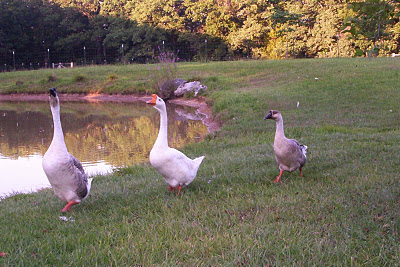
Noisy guardian geese. Image @Alpaca Love

These intelligent birds are aggressive and responsive in nature and have served as guards and early warning systems for centuries.

As sentinels and guards, geese have legendary qualities. It is the same territorial behaviour (mostly threat rather than fight), plus a tendency to call and alarm the mate and the rest of the flock of danger, that is invoked. Their eyesight is acute and their awareness of sounds at night has been especially praised. F.O. Morris in 1897 pointed out that ‘you may drive over a cat, dog, hen, pig, or even pigeon, but few, in any, can record an instance of driving over a tame goose.’ “- Man and Wild Fowl, Janet Kear
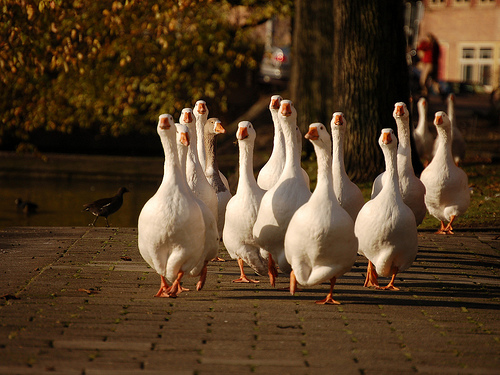
A gaggle of unsuspecting geese

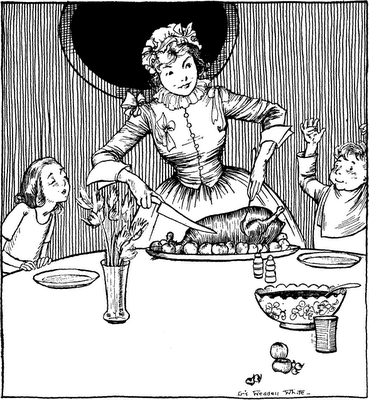
Geese have also provided mankind with sustenance in the form of eggs and their own meat. While wild geese have little body fat compared to their tame brethren, if the meat is slow-cooked (roasted, grilled, braised, broiled, or rotated on a rotisserie) and served with rich cream sauces and gravies, then such dishes are considered more than fit for the holiday table.
It is in the goose’s nature to flock, making domestication of this intelligent, rather biddable creature easy. Grimm’s fairy tale includes a story of a princess turned into a goose girl, and sentimental 19th century paintings exist of young girls looking over their flock of geese or caring for them.
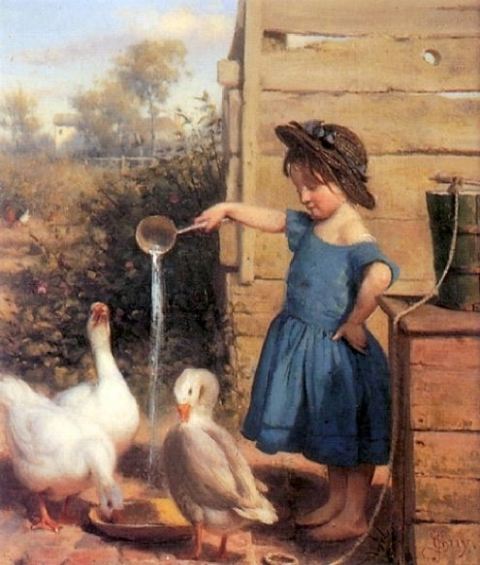
The Goose Girl, Joseph Seymour, late 19th c.
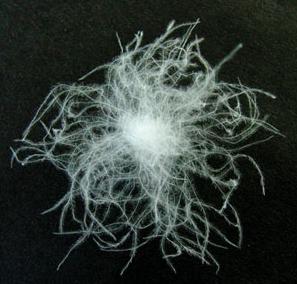
Soft goose down feather

How would mankind have survived without the versatile goose? Less comfortably, one would suppose, for early on man discovered that down feathers provided excellent thermal insulation. Down feathers lack barbicels, allowing the barbules to float free and trap air. As water birds,  geese required insulation from the cold while swimming and down feathers provided the warmth without bogging the goose down with weight. The goose knows of the down feather’s excellent insulating qualities, for it plucks down from its breast to line the nest and keep the eggs and its young warm.

Swansdown provided soft, insulating trim to women’s clothes and the material for powder puffs. Once made from the skins of wild Trumpeter swans, which were brought to near extinction in the early 20th century due to the popularity of its feathers, ‘swansdown’ is now made in the Poitiers region of France from white goose skins that are cured with the soft down still attached.
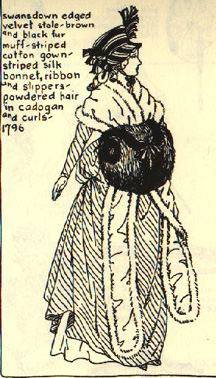
Velvet stole edged with swansdown, which today is made from the white goose.

I now turn to the euphemistic phrase: “supplying of feathers”.  (Caution, the rest of the article is not for the faint of heart.) After Elizabethan times, down feathers began to increasingly replace straw and wool as stuffing for mattresses, bolsters, and pillows. Birds were traditionally killed for food at Michaelmas, but even so the number of holiday geese killed were not sufficient to supply enough down feathers for bedding.
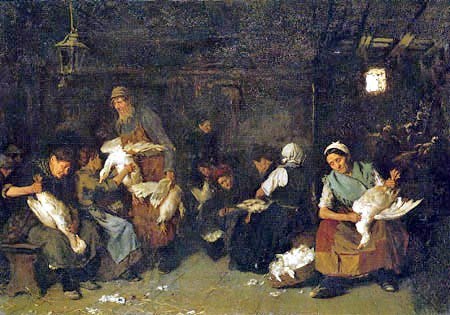
Women Plucking Geese, Max Liebermann (Do not assume these geese are dead.)

The cruel practice of plucking live geese occurred as early as Roman times, but the torture of live birds increased as the demand for down comforters, pillows, and bedding escalated. It was discovered that:

Geese could be plucked 3 times per year: The reproductive power of the feather follicle appears to be almost inexhaustible, since it is not diminished appreciably by age, nor restricted to definite moulting periods, as is shown by the cruel and now obsolete custom of plucking geese alive, no less than three times annually, for the sake of their feathers . The growth of the feathers is, however, certainly affected by the generalhealth of the bird, mal-nutrition causing the appearance of peculiar transverse V-shaped grooves, at more or less regular intervals, along the whole length of the feather . These are known as ” hunger-marks,” a name given by falconers, to whom this defect was well known . It would seem that while the feather germ may be artificially stimulated to produce three successive generations of feathers within a year, it may, on the other hand, be induced artificially to maintain a continuous activity extending over long periods. – Read more: Online Information article about Feather, Online Encyclopedia 

The plucking of geese provided a good livelihood before the Enclosure Act was actively enforced:

There were important feather industries in Lincolnshire and Somerset during the 18th Century. Large flocks of up to 900 birds grazed the commons and produced, for every four birds, 1 lb (450 g) of feathers a year; the barbarous business of live-plucking only stopped in England when enclosures limited access to free grazing. Horsehair, much of it imported from South America, thereafter became the usual filling for mattresses, and in 1797 goose-owners on the Somerset levels burnt an effigy of a drainage agent whose activities preceded their loss of commoner’s rights. – Man and Wild Fowl, Janet Kear

The Regency Redingote writes about Lady Day and the practice of live plucking geese, a torturously painful procedure, which is where I first read about this practice:

Lady Day (March 25) was also a very important day in the life of any goose farmer in England. For it was on that day that the farmer would commence the plucking schedule of his birds. Quills for pens were harvested from geese only once a year, right after Lady Day, since the day itself was still a holiday. Down was plucked four or five times a year, beginning right after Lady Day, as by then it was warm enough the geese would not suffer unduly without their down. The geese would be plucked again periodically through the summer, the last plucking taking place close to Michaelmas. The geese would not be plucked in the winter, as they would need their down during those months as protection against the cold. – Regency Redingote 
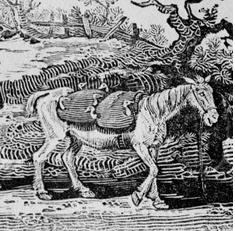
Geese carried to market, detail of an illustration by Thomas Bewick

As a side bar, live-plucking induces geese to eat more to maintain body heat. Therefore, they wound up weighing a great deal more before they were killed for slaughter.In Britain today the feathers of slaughtered geese are used, but in many countries down feathers are still imported from Russia, Hungary, Poland,  China and other countries where humane laws are not enforced.

One of the biggest understatements one can use to describe this continuous multi-year torture of a helpless animal is to call it an “unpleasant procedure”. Sadly, live plucking of a particular goose could continue for years. At the end they were not even given the dignity of a contented life in retirement:

According to Francis Grose’s Dictionary of the Vulgar Tongue published in 1811, ‘cagg maggs’ were old Lincolnshire geese, which, having been plucked for ten or twelve years, were ‘sent up to London to feast the cockneys’. – Man and Wild Fowl, Janet Gear
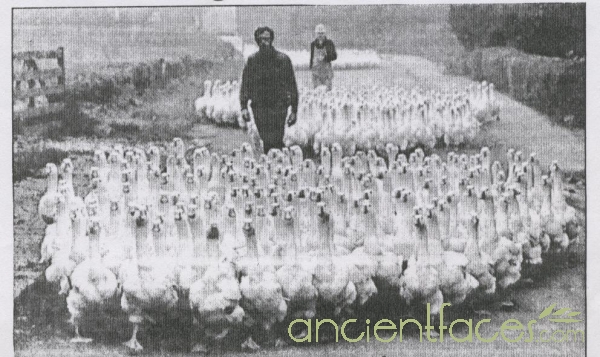
Thomas and Sarah Bruff taking geese to market, late 19th/early 20th c., Tennessee

While live plucking is no longer practiced in England,

Beauty Without Cruelty charity reports (summer 1992) that in Hungary, France, Israel and China, live geese have their feathers ripped off, a process that may be repeated every 8 weeks for about 3 sessions until the bird is killed for food or force fed to make pate de foie gras.” – Vegetarian Society 

Let me conclude this heart-wrenching post by saying that while I intend to honor the geese that died to produce the contents of my down comforter, pillows, and jacket by using these products until they are no longer serviceable, I will no longer support the barbarous practice of live plucking by purchasing anything in the future that is stuffed with goose down.
Read Full Post »

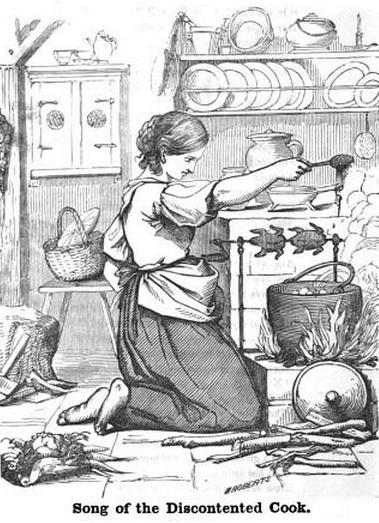
Gentle readers, this poem in a mid-19th century children’s family circle book perfectly describes the long and arduous day of an ordinary family cook.

The Discontented Cook. Image @Forrester's pictorial miscellany for the family circle edited by Mark Forrester, 1855

Oh, who would wish to be a cook,
To live in such a broil!

With all one’s pains, to cook one’s brains,
And lead a Life of toil?

“Tis, Stir the pudding, Peggy,
And give those ducks a turn;

Be quick, be quick, you lazy jade!
Else one or both will burn.

An hour before the rising sun
I’m forced to leave my bed,

To make the fires, and fry the cakes,

And get the table spread.
‘Tis, Stir the pudding, Peggy,

And give those ducks a turn;
Be quick, be quick, you lazy jade!

Else one or both will burn.

The breakfast’s scarely over,

And all things set to rights,
Before the savory haunch, or fowl,

My skill and care invites.
‘T is, Stir the pudding, Peggy,

And give those ducks a turn;
Be quick, be quick, you lazy jade!

Else one or both will burn.

And here I stand before the fire,

And turn them round and round;
And keep the kettle boiling —

I hate their very sound!
‘T is, Stir the pudding, Peggy,

And give those ducks a turn;
Be quick, be quick, you lazy jade!

Else one or both will burn.

And long before the day is spent,

I ‘m all in such a toast,
You scarce could tell which’s done the most

Myself, or what I roast!
‘Tis, Stir the pudding, Peggy,

And give those ducks a turn;
Be quick, be quick, you lazy jade’.

Else one or both will burn.

From Forrester’s Pictorial Miscellany for the Family Circle, 1855

Read Full Post »

Gentle Readers, Patty of Brandy Parfums frequently contributes articles of interest to this blog. Her latest post is about Anonymous, the film about the authorship of Shakespeare’s plays, which recently opened in theatres.

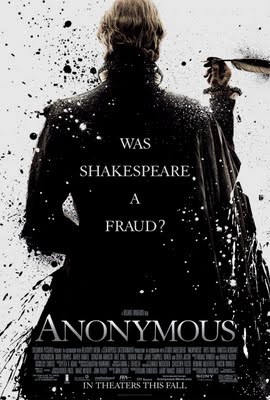
Film Poster

Introduction  – Instead of writing a traditional plot-spoiler review of Anonymous, which can be found in many newspapers and magazines, I’ve written what I think will be more useful – a short guide to Shakespeare authorship. Enjoy! – Patricia Saffran

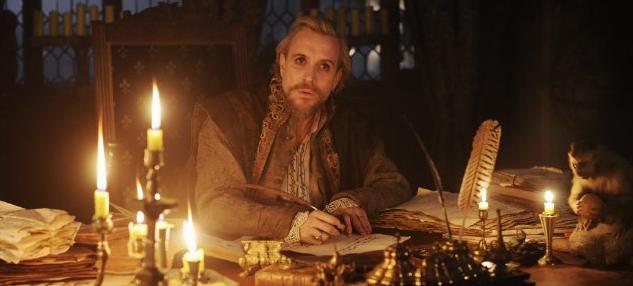
Jamie Campbell Bower as the young earl of Oxford

A Guide to Shakespeare Authorship

Jane Austen knew Shakespeare’s plays well and based a number of her novels on Shakespeare’s characters and plot devices. Stephen Derry writes about these many references in his paper for the Jane Austen Society of North America, ‘Jane Austen’s Use of Measure for Measure in Sense and Sensibility.’ Derry begins his paper by saying -In Mansfield Park, Edmund Bertram declares that one is familiar with Shakespeare in a degree from one’s earliest years. His celebrated passages are quoted by everybody we all talk Shakespeare, use his similes, and describe with his descriptions.

Tudor England

Knowing of Jane Austen’s profound knowledge of Shakespeare should give those who love her works a keen interest in all things Shakespeare – and in this new movie, which brings the Elizabethan period to life. This is the first time a major movie studio has taken a leap, with an elaborate period production, costumes, and star-studded cast, to delve into the question plaguing scholars for centuries, as to who the author of  Shakespeare’s plays really was.

Joely Richardson as a young Elizabeth I and Jamie Campbell Bower as a young Earl of Oxford

The gamble has payed off, as this is a truly sensational
movie. It takes place during the succession of Queen Elizabeth I, and the Essex Rebellion against her – a period of turmoil and political instability. During this period, being the author of a play with politically loaded or satirical material was dangerous. Some authors chose anonymity………

Shakespeare authorship as an area of inquiry is not new. While making a list of the greatest Elizabethan poets, Henry Peacham in The Compleat Gentleman published in 1622, when the First Folio was being created, lists Edward de Vere, the Earl of Oxford, first on his list and does not include Shakespeare at all. Many believe that this was Peacham’s way of hinting that Edward de Vere, not William Shakespeare, wrote the plays and poetry.

Rafe Spall as William Shakespeare

More recently, in the past 150 years, there have been many notable actors, writers, and Supreme Court judges who have questioned William Shakespeare as the author of the plays. Among them are Mark Twain, Leslie Howard, Charlie Chaplin, Orson Welles, Sigmund Freud, Charles Dickens, Walt Whitman, Henry James, J. Thomas Looney, Michael York, Sandra Day O’Connor, Harry A. Blackmun, and John Paul Stevens. Besides de Vere and William Shakespeare, the other main candidates to have written the plays are Bacon, Marlowe, and Neville.

Rhys Ifans as the mature Earl of Oxford

A fantastic short video by the director of Anonymous, Roland Emmerich, summarizes ten reasons why it is implausible that the Stratford William Shakespeare wrote the plays. For some, the main reason is that unlike all other great authors of the period, no letters exist either to or from Shakespeare.

Preview: Was Shakespeare a Fraud?

A new book coming out November 8th continues to examine the question of Shakespeare authorship – The Shakespeare Guide to Italy by Richard Paul Roe, paints the Stratford man who never left England as an improbable author of the many distinctively Italian plays.

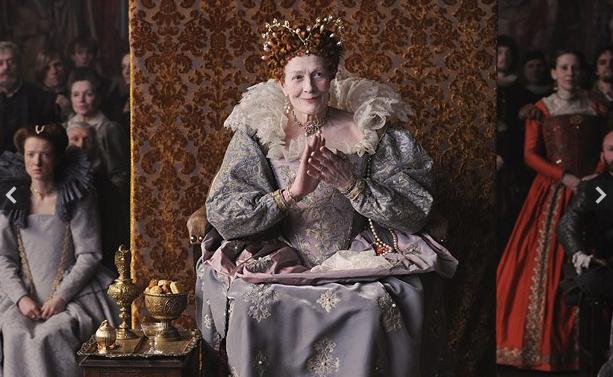
Vanessa Redgrave as the mature Elizabeth I

Current scholars, and by extension many of their now journalist proteges, who defend William Shakespeare as the author of the plays, are extremely defensive and say there is no room for doubt. Time will likely make the world more receptive to exploring Shakespeare authorship, but for now Anonymous will inspire interest in this fascinating field. I highly recommend this film.

For more on Shakespeare and Shakespeare Authorship:

About the film:

Anonymous, the new movie about Edward de Vere, the Earl of Oxford, as the true author of Shakespeare’s plays. With Rhys Ifans, Vanessa Redgrave, David Thewlis, and along with those who actively support authorship studies, Derek Jacobi and Mark Rylance. Directed and produced by Roland Emmerich, released by Columbia.

Read Full Post »

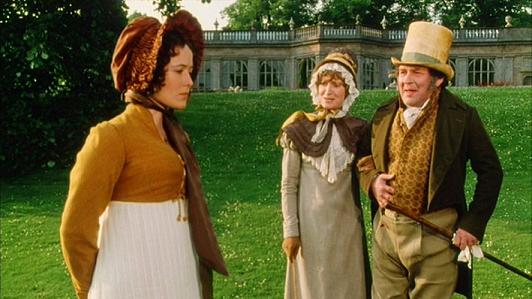
One of the most pivotal decisions in Pride and Prejudice was when Elizabeth Bennet agreed to visit Pemberley’s gardens and grounds with the Gardiners, only to suddenly encounter Mr. Darcy, who was not slated to return until the next day.

Such a visit to grand estates by the well-heeled and more common folk like Elizabeth and her aunt and uncle were quite common in the 18th century. They would have purchased an inexpensive guide book at a local inn or town, and read information about the paintings and objects inside the great houses, and a description of the gardens and their rustic buildings and ornaments.

Prospect of Stowe House by Benton Seeley

Stowe in particular was a destination point for visitors. Its magnificent gardens and grounds were a model and inspiration for other gardens of the Romantic era, which echoed the movement’s reverence for nature and aesthetic ideals. The blog of the current Duke of Buckingham and Chandos contains this passage:

“The house and gardens at Stowe, my family seat, were tourist attractions from around 1724, when my ancestor Lord Cobham set out the gardens. People came to visit the gardens and house, sometimes invited, often not. Topographical notes and poems were written. And in 1744 the first full guidebook to the house and grounds was published by Benton Seeley, a writing master in Buckingham. The guidebooks continued for a further 70 years and Seeley went on to become a printer and publisher, founding a business that wound up only in 1978.” – Duke of Buckingham and Chandos 

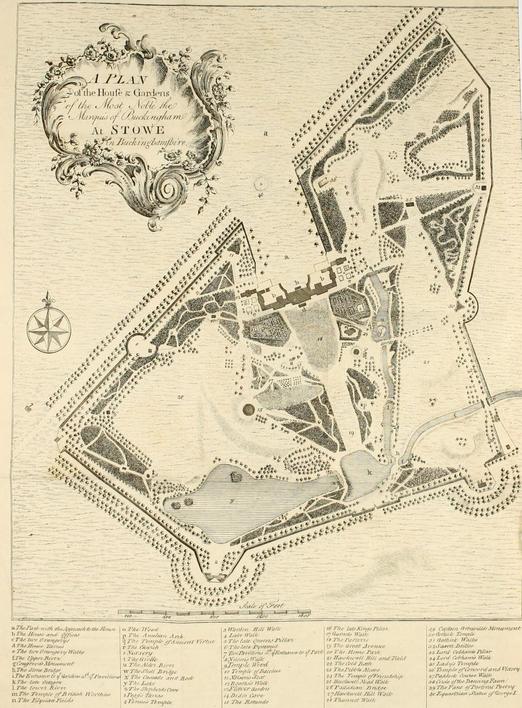
Seeley's plan of the house and gardens at Stowe.

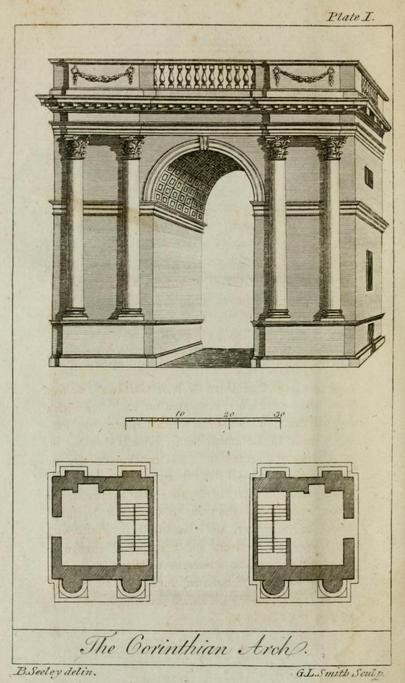
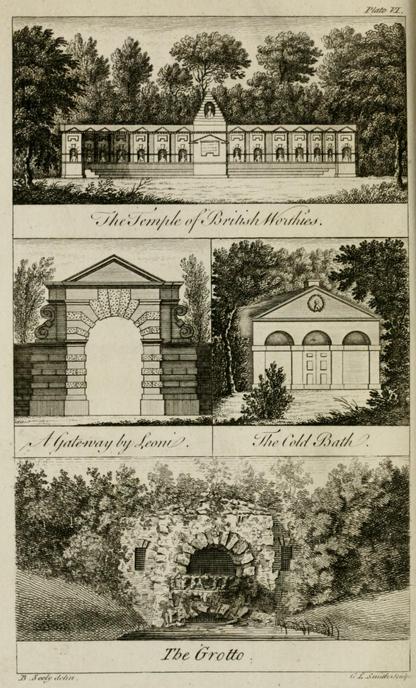
Benton Seeley’s guidebook, Stowe: A Description of the Magnificent House and Gardens of The Right Honourable Richard Grenville Temple, Earl Temple… Embellished with a General Plan of the Gardens, and also a separate Plan of each Building, with Perspective Views of the same, was published in the same year that Elizabeth Montague described Stowe’s gardens as “beyond description, it gives the best idea of Paradise that can be.” Visitors came away from viewing Stowe’s natural gardens inspired to implement changes to their own grounds. Seeley’s guidebook helped to spread Stowe’s influence throughout the 18th century as the model for the ideal English garden. (Today the original guidebook sells for close to $2,000.)

Thomas Jefferson owned at least two of Seeley’s guidebooks. In fact, Stowe’s reputation as a gardening attraction had spread beyond the British Isles:

“When well-heeled Americans traveled to England in the late eighteenth century, they often sought out famous gardens to inspire their own designs at home. As Benton Seeley’s Stowe: A Description of the Magnificent House and Gardens shows, the gardens at Stowe were particularly large and ornate, featuring temples, pavilions, and statues strewn about the grounds. Thomas Jefferson and John Adams visited Stowe together in 1786 in what Abigail Adams called their “journey into the country.”- Better Homes and Gardens, Stanford University

Corinthian Arch

Seeley’s Guide Book became historically significant. It went through seventeen editions between 1744 and 1797, continually undergoing improvements and revisions. The book’s influence was such that it helped to make the Stowe gardens among the most publicized and copied of the English landscape model. However, Seeley’s was not the only guidebook written for the famed Stowe gardens. In 1732 Lord Cobham’s nephew Gilbert West wrote a lengthy poem The Gardens of the Right Honourable Richard Viscount Cobham that is actually a guide to the gardens in verse form. Charles Bridgeman commissioned 15 engravings of the gardens from Jacques Rigaud, and these were published in 1739 (Wikipedia), five years before Seeley’s guide.

The Stowe gardens and grounds were extensive, offering planned vistas along a winding path, parterres, canals, large swaths of meadows, places for isolation and retreat, rustic buildings, and an emphasis on natural grandeur over formal symmetry. The 4th Baronet, Viscount Cobham, who married a rich brewery heiress, implemented the garden changes at Stowe in 1711. By 1724, the gardens rested on 24 acres and required the labor of 30 men. Garden maintenance cost the family 827 pounds in 1749-1750. Multiply that amount by 50, and you gain a quick idea of the cost in today’s terms. This sum represented almost all the spare money Lord Cobham could afford on the house and grounds.

The grotto was originally designed by William Kent in the late 1730s as a symmetrical, freestanding structure decorated with flints, colored glass, and shells. Soon covered over with earth, it was then described as a “romantic retirement.” By the 1780s, it was more deeply buried, resurfaced with tufa, and planted with vines and conifers for a cavernous effect.- Romantic Gardens: Nature, Art, and Landscape Design, 2010, The Morgan Library Museum

In “A fine house richly furnished: pemberley and the visiting of country houses,” Stephen Clarke, a London lawyer and architectural historian discusses the kind of information a guidebook owner could expect. A New Description of Blenheim by Mayor, 1811, offered the following General Information in its preface:

“BLENHEIM may be seen every afternoon, from three till five o’Clock, except on Sundays and public Days. On Fair days at Woodstock, likewise, it can be seen only by particular permission.

COMPANY who arrive in the morning may take the ride of the Park, or the walk of the Gardens, before dinner, and after that visit the Palace.

The CHINA GALLERY, PARK, and GARDENS, will, on proper application, be shewn at any hour of the day, except during the time of Divine Service on Sundays.”

In 1776, the Wilton visitors book showed 2, 324 visitors in the last year.

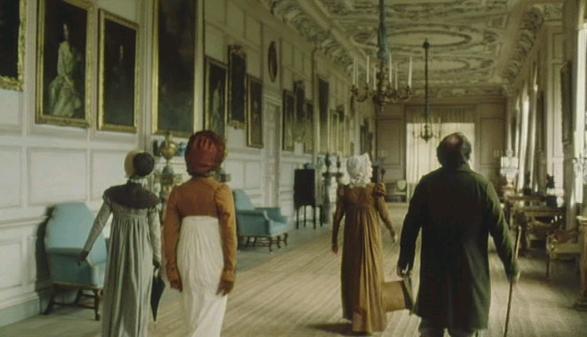
The housekeeper guides Elizabeth and the Gardiners through Pemberley's interior

As discussed on this blog in another post, The Housekeeper as a Guide to a Great Country Estate, housekeepers and other servants stood to make a great deal of extra money from tourists.

“The rapacity of housekeepers-and, in the larger houses, of the other staff–was a common complaint. At Blenheim during his tour of 1810-1811, Louis Simond was required to pay the porter at the gate, the woman showing the china collection, the woman showing the theatre, the woman showing the pleasure grounds, the gardener showing the park, and the upper servant showing the house–at a total cost of 19s. (qtd. in Ousby 81). There are similar complaints of Woburn, Chatsworth, and other great houses. Horace Walpole wryly remarked that he should have married his own housekeeper, who had grown rich on showing Strawberry Hill, as the only way of recouping some of his expense on the house (Walpole Correspondence 33, 411) –

At most houses, the traveller would send in his name to the porter or housekeeper to request access–at Hagley in 1800 Mrs. Lybbe Powys, (5) a perceptive visitor of country houses, noted that “we sent in our names for leave to walk round Lord Curzon’s [actually Lord Lyttelton’s] grounds, and he desired we would go into any part of it we chose, without being attended by his gardener” (Lybbe Powys 339). Elizabeth and the Gardiners were of course accompanied by the gardener in the park at Pemberley, as was normal. – A fine house richly furnished: pemberley and the visiting of country houses, Stephen Clarke

In the YouTube video below, one can get a sense of Stowe’s grounds and gardens in the first 3 ½ minutes. Enjoy the tour!

More on the topic:

Read Full Post »

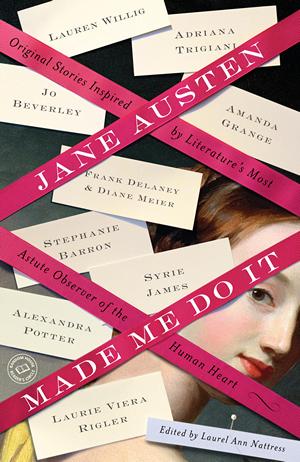
One regret I have in my busy life is the lack of leisure time I have for reading. Right now there are four stacks of books on the floor of my office, all waiting to be read. So many books! So little time. Given my schedule, I am glad I set aside the required hours to read Jane Austen Made Me Do It, an anthology of Jane Austen-inspired stories by published Jane Austen sequel authors and edited by Laurel Ann Nattress.

I rarely read anthologies front to back, but flit here and there, landing instead on a story with an intriguing title or by a favorite author. In this instance I began with Stephanie Barron’s tale of Jane And the Gentleman Rogue: Being a fragment of a Jane Austen mystery. I am so glad I did, for it prompted me to linger longer over dinner and read another short story. Beth Pattillo’s  When Only a Darcy Will Do was a delight, as was Margaret C. Sullivan’s Heard of You, which I read just before going to bed. The list of authors in this anthology is impressive: Pamela Aidan • Elizabeth Aston • Brenna Aubrey • Stephanie Barron • Carrie Bebris • Jo Beverley • Diana Birchall • Frank Delaney & Diane Meier • Monica Fairview • Amanda Grange • Syrie James • Janet Mullany • Jane Odiwe • Beth Pattillo • Alexandra Potter • Myretta Robens • Jane Rubino & Caitlen Rubino Bradway • Maya Slater • Margaret Sullivan • Adriana Trigiani • Laurie Viera Rigler • Lauren Willig.

I’ve always enjoyed reading anthologies. They allow one to pick and choose on a whim, and finish a story in a short space of time. Anthology stories serve as literary versions of amuse bouches, those tasty bites served at the start of dinner. Even the most the discerning reader is bound to find selections and authors they will love. (Or discover a new author!) Click here to read a short synopsis of each story.

I favored some stories over others, but won’t share them with you for the simple reason that some of the stories I disliked received rave reviews on other blogs. Anthologies appeal to a variety of tastes, and I found it remarkable how many in Jane Austen Made Me Do It captivated me.  If you decide to purchase this book, I can guarantee that you will discover new authors and stories that you will want to reread.

This is due, no doubt, to the hard work that editor Laurel Ann Nattress put into the project. As a blogger, I can’t imagine how much of her time was spent in contacting the authors and working with them, overseeing a contest for an  unpublished author (the honor went to Brenna Aubrey), working with her publishing house in editing the stories, and now publicizing the book. I tip my hat to Laurel Ann for overseeing this ambitious and very worthwhile project, for this is her first book.  I give Jane Austen Made Me Do It  five out of five Regency tea cups!

Ballantine Books
Trade paperback (464) pages
ISBN: 978-0345524966

Order the Book

• Barnes & Noble
• Amazon
• IndieBound
• Book Depository
• Random House

Read Full Post »

« Newer Posts - Older Posts »