Feeds:
Posts
Comments

Archive for the ‘jane austen’ Category

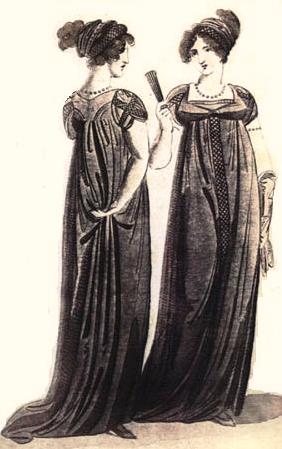
Fashionable mourning dresses, Ladies Museum, 1805

According to Jane Austen chronicler and scholar, David Nokes, when Martha Lloyd’s mother died on April 16, 1805, Jane Austen showed few signs of grief or emotion over that woman’s earthly departure. Instead, Jane wrote a jaunty verse to an uncivil (and imaginary) dressmaker. I surmise that these verses were meant more to cheer Martha up than to bring Martha’s mood down by reminding her of her loss. Mrs Austen, who was known for her droll verses, wrote a mythical reply by the dressmaker. At this time the Austen women were still reeling from Rev. Austen’s death in January and their own change in financial circumstances, having moved to more modest lodgings and becoming accustomed to a drastically reduced style of life. They would soon invite Martha to live with them in Bath. (Martha would remain with the Austen women through their move to Southampton in 1809.) After Jane’s death in 1817, Martha joined Cassandra in Chawton to help look after Mrs. Austen.

The poem that Jane wrote gives us a glimpse into how mourning clothes were made to order quickly. In this for-instance, the dressmaker, Miss Green, was slow to respond.

Lines sent to an uncivil Dress maker

Miss Lloyd has now sent to Miss Green,
As, on opening the box, may be seen,
Some yards of a Black Ploughman’s Gauze,
To be made up directly, because
Miss Lloyd must in mourning appear –
For the death of a Relative dear –
Miss Lloyd must expect to receive
This license to mourn & to grieve,
Complete, er’e the end of the week –
It is better to write than to speak – Jane Austen

Mrs. Austen’s reply as Miss Green

I’ve often made clothes
For those who write prose,
But ’tis the first time
I’ve had orders in rhyme – .
Depend on’t, fair Maid,
You shall be obeyed;
Your garment of black
Shall sit close to your back,
And in every part
I’ll exert all my art;
It shall be the neatest,
And eke the completest
That ever was seen –
Or my name is not Green! – Mrs. Cassandra Austen

Read Full Post »

Gentle Readers, Laurel Anne from Austenprose and I were chatting the other day about this, that, and the other, for we are both a bit Jane Austen nutty (if you haven’t noticed.) As you continue reading, you will need to know only one thing:  we are just a wee bit longer in the tooth than Jane’s young heroines:

LA: Vic and I were chatting on the phone today. Over the course of our three plus year Austen-inspired friendship we have mostly emailed, so this was a treat. She has the most infectious laugh which made me laugh too. Of course we were talking about our favorite author and she remarked that Austen excelled at humor and the amazing secondary characters she developed. Somehow it just popped out and I boldly asked her what Jane Austen character she most identified with. Without hesitation she replied, Lady Russell from Persuasion. “Lady Russell?” I replied in surprise! “Well, yes.”

Jane Rus.., er, Mrs. Russell

She then revealed that she is often wrong about the advice she gives people. At work she gathers the young-uns around her and freely offers opinions, whether they are solicited or not. When she gives wrong counsel – which she admits is more often than not – she torpedos herself in a most spectacular fashion. “The error of my ways does not go unnoticed by this unforgiving crowd. Unlike Lady Russell, I will own up to a misteak, er, mistake or two, and apologize for having interfered, but I hold the line at groveling.”

Another reason why she identifies with this character is her independence. Lady Russell is a widow with a healthy income and she has no intention of remarrying and being subjugated by a man. “I am a divorced woman who has discovered the joys of living singly on my own terms and by my own schedule. Ah, what total, selfish bliss!”

Vic further admitted that at a party, or when she lets her hair loose, she starts to resemble Mrs. Jennings. You know the type: a bit vulgar, out for a good time, giggling at precisely the wrong moments, and making those with a more composed nature feel uncomfortable with crass jokes and loud language. “Like Mrs. Jennings, I have a good heart. But I can be out there and in your face too. I might seem unseemly to a quieter person like Elinor, and be totally disliked by the likes of a Marianne, but my friends and family get me, and that’s what counts.”

Oh Vic! You are such a card. Lady Russell and Mrs. Jennings? She then turned the tables on me. “Now, who do you identify with in Jane’s novels? Are you like me, a bossy and interfering carouser? Or are your a bit more sedate and ladylike?”

Harriet Smith (Tony Collette) patiently poses for Emma

Vic: “Sedate. A total Harriet Smith,” LA replied. Many years ago a dear Janeite friend tagged her as a Harriet to her Emma. “It seemed appropriate since I was often asking for advice and was very mailable to change.” In her view, Harriet was a bit of a ditz and gullible which she has been accused of too. The thing she liked about being a Harriet is that Austen gave her such a great ending. She is resilient, and after being tossed about in love no less than three times in a year, Harriet gets the man she wanted in the first place and proves Emma, with her self-important airs, was totally clueless about the human heart. “I like having the last laugh, and being right.” ;-)

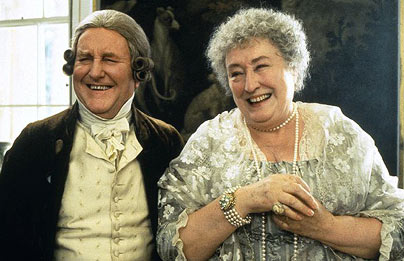
Sir John Middleton (Robert Hardy) and Mrs. Jennings (Elizabeth Spriggs)

Lately LA thinks she has evolved into Sir John Middleton from Sense and Sensibility. He was the Dashwood’s cousin and landlord of Barton Cottage. He is very gracious and likes to pop in and make sure his tenants are comfortable and entertained. He is a bit of a bore and talks too much about things that are not of interest to his young companions, but he likes dogs, has a good heart and loves to laugh. “As an enthusiastic bookseller, I like to inform customers of their choices and make suggestions. I am also a bit of an organizer and enjoy planning events on my blog, and orchestrating the 23 authors in my anthology. It is like herding cats, but I like being the boss of my own world!”

One man’s ways may be as good as another’s, but we all like our own best. Persuasion, Ch 13

Now our question. Which Jane Austen character do you, estimable viewer, most identify with, or which character are you afraid of becoming? Feel free to leave your comments!

Read Full Post »

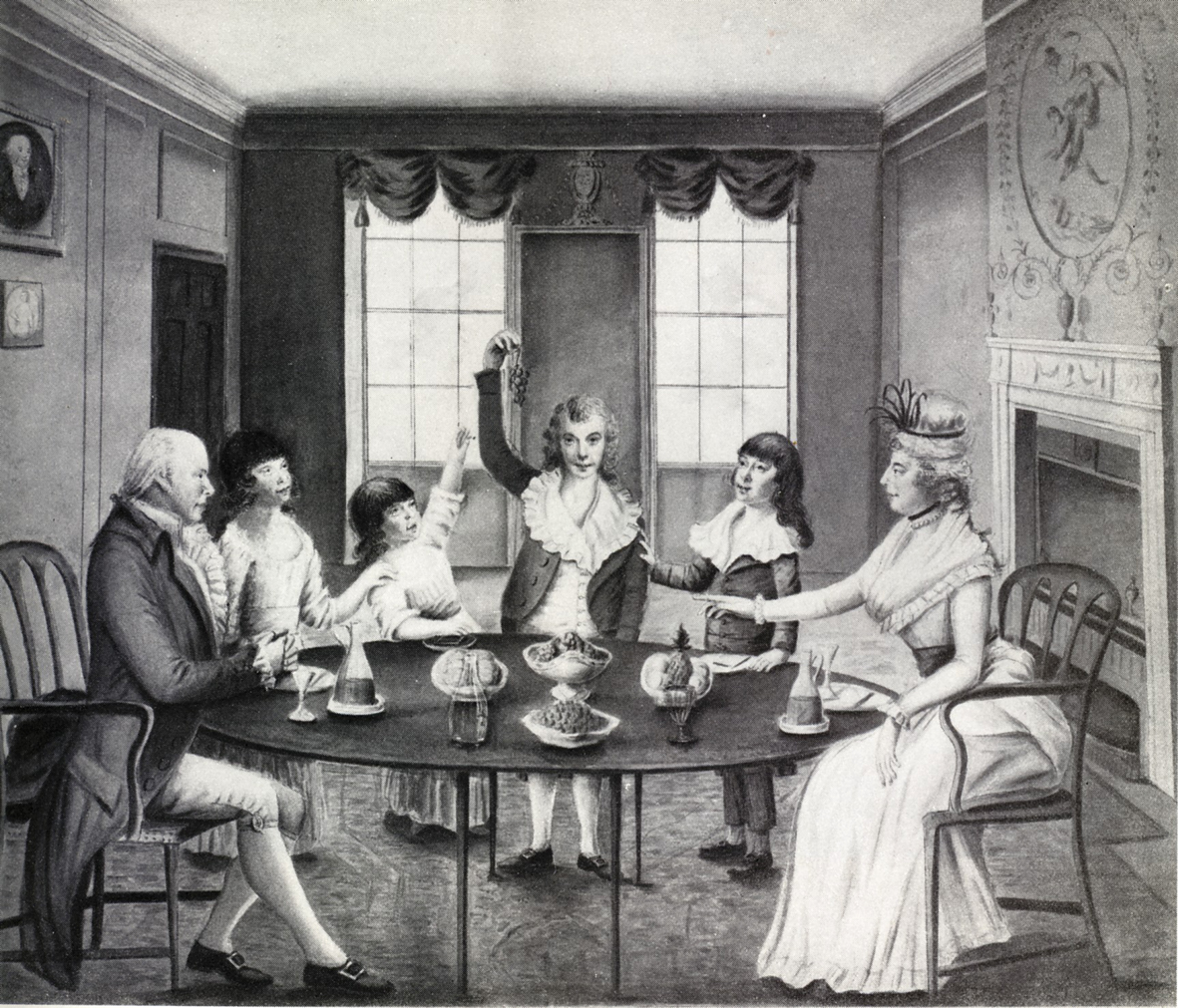
Inquiring readers: Jane Odiwe’s blog features a portrait of a Regency family that had sold in 1983. She wrote to several bloggers recently: “I’m writing to you on Mrs. Henry Rice’s behalf to ask if you would be interested in showing the painting with the information I’ve learned about on your blogs. The family would really like some help in publicising the picture, and wish to make an appeal to see if we can find its whereabouts, as Christie’s do not seem to have any record. They are hoping the painting is by Ozias Humphry, which will help to strengthen his association as a painter of the Austen family.”

Jane Austen's family?

Is this a portrait of Jane Austen’s family that has gone unnoticed until now?  The image was made in 1781, when young Jane would have been six years old. What say you?

To learn more about this art work and possible image of the Austen family, click on this link to Jane’s blog. Thank you for joining in!!

Read Full Post »

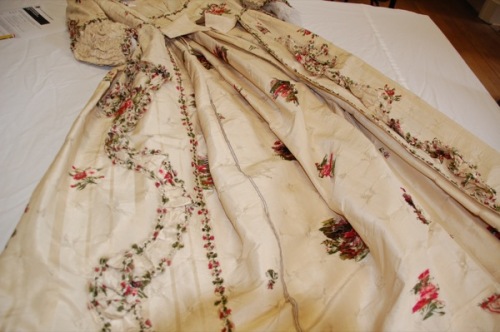
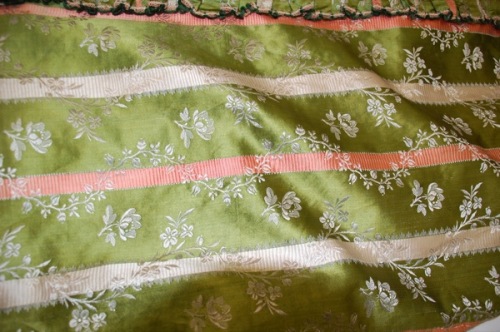
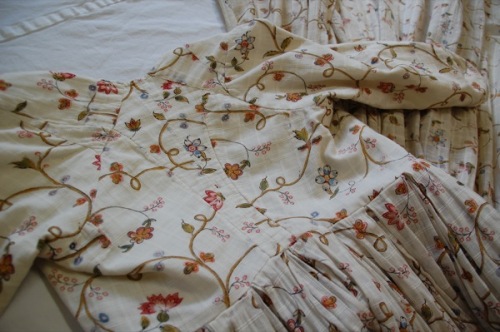
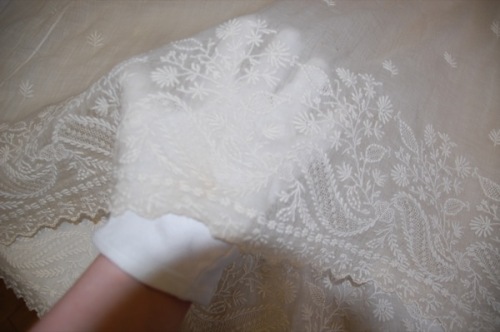
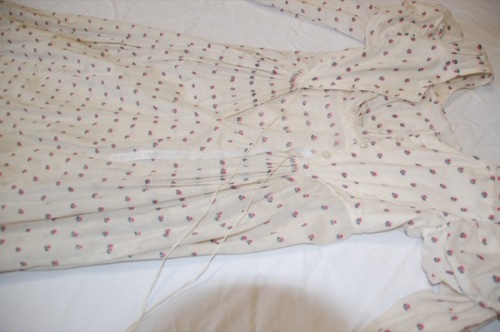
I spent a lazy Sunday catching up on the many posts I am unable to read during the week. Imagine my delight when I landed on Madame Guillotine’s blog and read her impressions about her visit to the Fashion Museum in Bath.  With increasing excitement, I viewed her close up images of several of the most beautiful 18th and early 19th century gowns imaginable. Melanie graciously allowed me to showcase her posts. (I concentrated on the early 19th century examples.) Do rush over and view all her photos. They are simply amazing.

I have just got home after an amazing couple of hours spent studying some of the eighteenth century dresses in the vast collections (I think they said they have 80,000 pieces in their archives) of the Fashion Museum in Bath.

English, silk, 1770-73.

It was amazing seeing the hook and eye arrangements that they used to do up the bodices, the neat seam work and even the staining beneath the armpits which serves as a reminder that these are the real deal and not just mere costumes!

French, sacque gown, 1760-63. Image @Madame Guillotine

They were really keen on combinations of pink and green during the eighteenth century – a colour combination that seems to have vanished from fashion, alas.

A floral printed muslin from 1793-97. Image @Madame Guillotine

[This dress] is really is lovely – very floaty and romantic with a pretty floral print. You can really imagine Marianne Dashwood in this one!

Muslin dress, 1813-20. Image @Madame Guillotine

This dress was so beautiful but really worryingly see through! You forget this about muslin when you see them in period dramas…

Patterned muslin dress, 1815-20. Image @Madame Guillotine

This is the sort of thing that a Heyer heroine would have worn.

These images are just a foretaste of the many photos that Melanie took at the Fashion Museum. To read both her posts, click on the two links below:

Read Full Post »

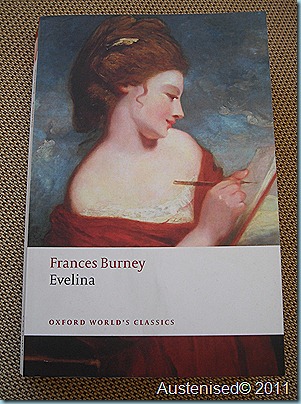
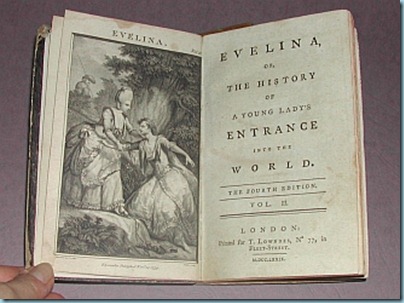
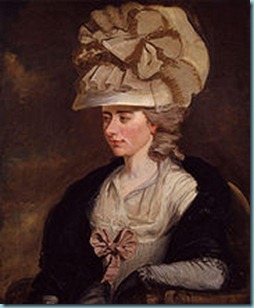
It is interesting to know that the 18th Century author, Fanny Burney, introduced several new words into the English language through the literary form. Through Evelina, she is the first known person to use words which are still so commonplace now, such as a-shopping, seeing sights, break down and grumpy.


Have you ever wondered what inspired Jane Austen to use dialogue as a clever way to personify her characters? Was the romantic charlatan, Mr Willoughby, a product of Jane’s imagination or an imprint of her early reading? Read on!

In her novels and letters, Jane Austen made several references to her favourite authors, and amongst her favourites were always Frances (Fanny) Burney and Maria Edgeworth. Fanny Burney wrote Evelina in the 1770’s, when Jane Austen was still an infant, and Cecilia soon after, and Jane grew up reading these stories. As you read through her novels, it becomes evident that Jane Austen drew inspiration from them.

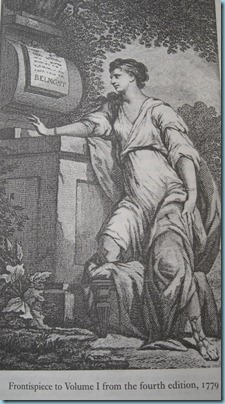
Evelina is a lengthy novel, which was originally written in 3 volumes, according to the custom of the time. Like Northanger Abbey, Evelina is a coming-of-age novel, with the apt subtitle “The History of the Young Lady’s Entrance Into the World”. The heroine is a girl of obscure birth who has been raised by her loving foster father, Mr Villars, in a comfortable home. Like Catherine, Evelina is set to ‘come out’ and enter the society to lure the attentions of eligible young men.

Evelina is chaperoned to London, where she visits the numerous theatres, operas and pleasure gardens frequented by fashionable society. As Evelina enters into society, she comes across one odious character after another and must defend her virtue against characters of low morals. Not unlike Catherine, Evelina is all innocence and youthfulness and is shocked to experience the realities of London society. She is repulsed by the lewd behaviour of men that she meets and soon wishes that she had never left Berry Hill, her home. In short, her trips are a journey from innocence to experience (to quote Blake).

Evelina is a satire of fashionable life. Like Jane Austen, Frances Burney is an excellent satirist and parodies characters through her excellent mimicry. It is in the dialogue that she really shows her ingenuity. In the preface of Evelina, Burney describes her style as follows:

To draw characters from nature, though not from life, and to mark the manners of the times, is the attempted plan…”

As a key component of her style, Burney reveals personality through her use of language. Her highest-ranking characters (e.g. Lord Orville, Lady Louisa) use extremely formal register, as opposed to the lower-ranking, more vulgar characters (e.g. Captain Mirvan, Madame Duval), who Burney mimics endlessly.

The grotesque Captain Mirvan who enjoys abusing the would-be French woman, Madame Duval, uses crass language with plenty of nautical references.

The old buck is safe – but we must sheer off directly, or we shall be all aground.”

On the other hand, Madame Duval’s bad grammar reveals her lack of breed and education.

This is prettier than all the rest! I declare, in all my travels, I never see nothing eleganter.”

As Evelina meets her ‘vulgar’ cousins in London, the scene reminds me of Mansfield Park where Fanny meets her real family in Portsmouth after several years and feels out of place, having got used to the genteel, polished manners of a country house (Burney uses the word “low-bred” to describe Evelina’s relatives).

Like Austen’s novels, Evelina too is written in somewhat archaic 18th Century language with a preference for long, complex sentences – a style that Jane Austen certainly assumed. Thankfully, this Oxford edition has been carefully edited by Edward Bloom, with detailed notes on 18th Century vocabulary and manners… to read the rest of the post, click here to enter Austenised by Anna.

Thank you, Anna, for giving me permission to link to your post!

Read Full Post »

« Newer Posts - Older Posts »