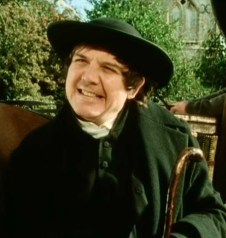
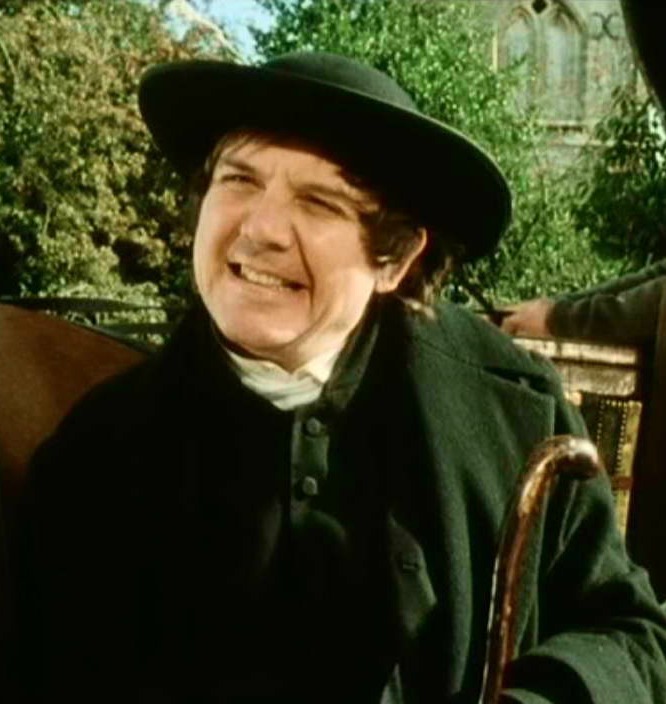
David Bamber is Mr Collins, Pride and Prejudice 1995
This year marks the 200th anniversary of the publication of Pride and Prejudice. When I was fourteen I read the novel in one sitting, choosing the book one summer in a quest to finish a list of classics. Like so many girls, I identified with Lizzy and wished that some modern Mr. Darcy would find my eyes strikingly beautiful. While P&P’s protagonists attracted me at first, it is the secondary, more imperfect characters who continue to fascinate me: Mrs. Bennet, Mr. Collins, Caroline Bingley, Mr. Bennet, Lydia, and Mr. Wickham, as well as those who played minor but crucial roles – Mary Bennet, Sir William Lucas, and Mr. Hurst. All are archetypes of people we have known in one way or another.
I have not forgotten Lady Catherine de Bourgh, or Lady CdeB, as she will be known henceforth in this narrative. In my opinion, Lady CdeB is in a class by herself and rises above the other sterling cast (although Mr. Collins is tough competition.) She’s a giant in the annals of literary supporting characters. My older self is astonished that a 19 year-old slip of a girl living in a quiet backwater village could have come up with such a magnificent creation. It boggles the mind.
It is quite telling that we are first introduced to Lady CdeB through Mr. Collins. That Jane Austen chose to announce the appearance of this proud, arrogant aristocrat through a fawning and obsequious bootlicker is genius, for we swiftly come to the conclusion that she is either as foolish as her empty-headed flatterer or is using him for some purpose. To the delight of Mr. Bennet, who has been bored out of his gourd since saying “I do” at the altar, Mr. Collins preens and swaggers at the very mention of his patron.
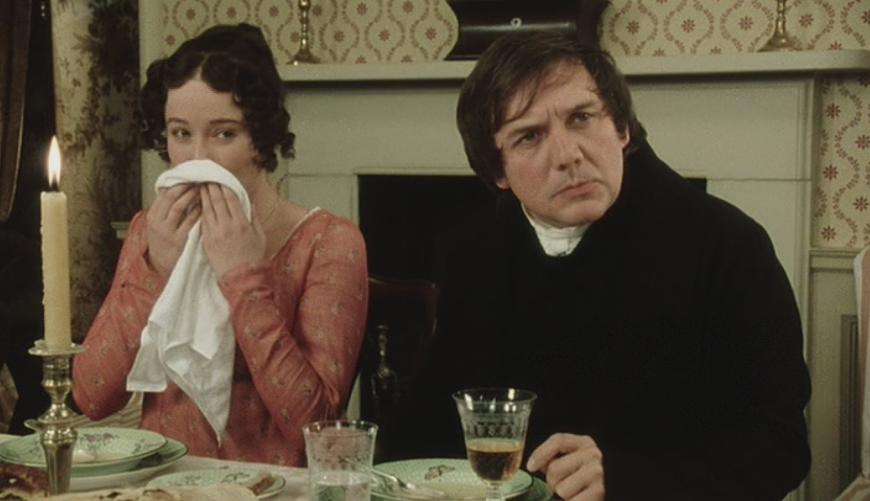
During dinner, Mr. Bennet scarcely spoke at all; but when the servants were withdrawn, he thought it time to have some conversation with his guest, and therefore started a subject in which he expected him to shine, by observing that he seemed very fortunate in his patroness.”
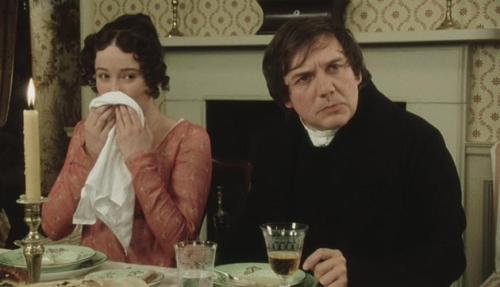
Mr Collins responds to Mr. Bennet’s question. Pride and Prejudice 1995
Like a marionette tugged on a string, Mr. Collins jumps at this prompt, much to Mr. Bennet’s delight. After years of suffering through banal dinner conversations with Mrs. Bennet and three of his five daughters, he now actively seeks relief from his ennui and his guest does not disappoint. The vicar boasts that:
he had never in his life witnessed such behaviour in a person of rank — such affability and condescension, as he had himself experienced from Lady Catherine. She had been graciously pleased to approve of both the discourses which he had already had the honour of preaching before her. She had also asked him twice to dine at Rosings, and had sent for him only the Saturday before, to make up her pool of quadrille in the evening. Lady Catherine was reckoned proud by many people he knew, but he had never seen any thing but affability in her.”
This effusive praise begs the question: if Lady CdeB had a lick of sense, why would she waste her precious time with this clown? Austen continues to dangle interesting glimpses of her in front of us, using Mr. Collins as her mouthpiece and building up our expectations of this nonpareil. During the most brilliantly ridiculous proposal written in English literature, Austen arranges to have Lady CdeB speak directly to us for the first time:
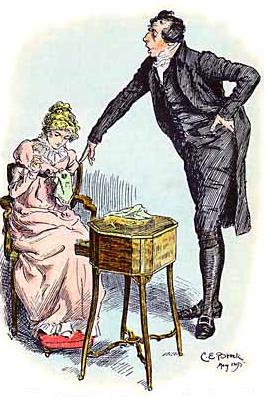
Mr Collins and Lizzy, by Brock. Image @Mollands
My reasons for marrying are, first, that I think it a right thing for every clergyman in easy circumstances (like myself) to set the example of matrimony in his parish. Secondly, that I am convinced it will add very greatly to my happiness; and thirdly — which perhaps I ought to have mentioned earlier, that it is the particular advice and recommendation of the very noble lady whom I have the honour of calling patroness. Twice has she condescended to give me her opinion (unasked too!) on this subject; and it was but the very Saturday night before I left Hunsford — between our pools at quadrille, while Mrs. Jenkinson was arranging Miss de Bourgh’s foot-stool, that she said, “Mr. Collins, you must marry. A clergyman like you must marry. — Chuse properly, chuse a gentlewoman for my sake; and for your own, let her be an active, useful sort of person, not brought up high, but able to make a small income go a good way. This is my advice. Find such a woman as soon as you can, bring her to Hunsford, and I will visit her.”
Such delicious dialogue! Lady CdeB has no higher hope for Mr. Collins’ happiness other than a wife who is active (can work her butt off) and can make a small income go a good way (is thrifty). The future Mrs. Collins must not be too high in the instep, but not so low of class that it would be impossible for Lady CdeB to be seen with her. In other words, Lady CdeB must be assured that those with whom she socializes are worthy of her attentions. (The more worthy, the better, for subjugating a strong person would give her a headier sense of power than lording it over a weakling.)
In rural Regency England, a grande dame’s social circle was restricted to the slim pickings in her community. Despite a lack of choice, there were standards to be maintained and Mr. Collins is as low down the status totem pole as Lady CdeB can go. Emma Woodhouse experiences a similar dearth of social connections in Highbury. Before easy travel became possible, one simply had to make do.
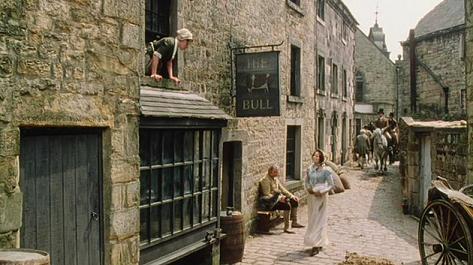
Social circles are small in a rural village. Pride and Prejudice 1995
In these early scenes with Mr. Collins, Austen builds up our expectations. Knowing what priceless enjoyment is in store for us, she makes us wait for a few more chapters before Lady CdeB’s grand entrance, and so, during Lizzy’s visit to Hunsford, she continues to pique our curiosity.
Yes, Miss Elizabeth, you will have the honour of seeing Lady Catherine de Bourgh on the ensuing Sunday at church, and I need not say you will be delighted with her. She is all affability and condescension, and I doubt not but you will be honoured with some portion of her notice when service is over. I have scarcely any hesitation in saying that she will include you and my sister Maria in every invitation with which she honours us during your stay here. Her behaviour to my dear Charlotte is charming. We dine at Rosings twice every week, and are never allowed to walk home. Her ladyship’s carriage is regularly ordered for us. I should say, one of her ladyship’s carriages, for she has several.”
We are so entranced with Mr. Collins’s banal utterances that we nearly miss Charlotte’s quiet opinion of the patroness. Until she married Mr. Collins, Charlotte seemed a sensible sort, but now we are coming to understand why Lizzy’s respect for her old friend has cooled so dramatically. Aside from willingly marrying a buffoon, it turns out that Charlotte has inherited some of her father’s capacity for groveling.
Lady Catherine is a very respectable, sensible woman indeed,” added Charlotte, “and a most attentive neighbour.”
What? Where’s the irony in that statement? When Mr. Collins answers,”Very true, my dear, that is exactly what I say. She is the sort of woman whom one cannot regard with too much deference,” Charlotte remains silent. Her lack of rejoinder is damning – to us and surely to Lizzy – for she is becoming a toady.
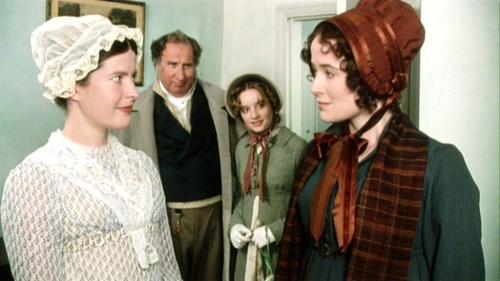
Charlotte, Lizzy, Maria Lucas, and Sir William Lucas. Pride and Prejudice 1995
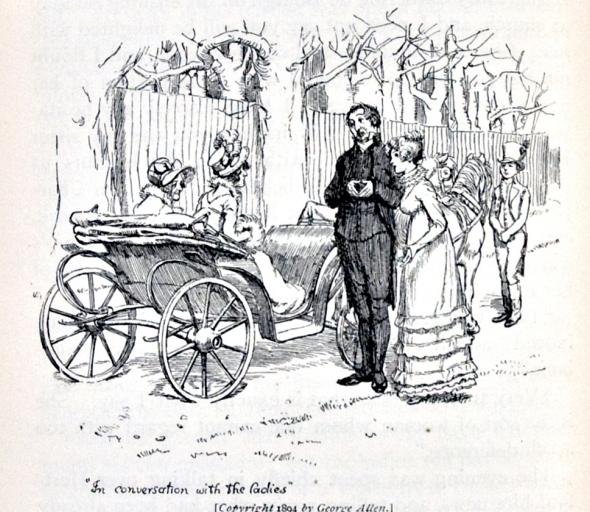
Observe Charlotte’s behavior somewhat later when Anne deB, Lady CdeB’s daughter, commands her driver to halt her phaeton at the parsonage’s garden gate. This non-event starts a rube goldberg chain of events in which Mr. Collins stops dead in his tracks to go rushing to the gate, Charlotte tosses aside her women’s work to chase after him and stand by his side, Sir William Lucas parks his carcass in the doorway to bask in all that reflected greatness, and Maria Lucas clomps noisily up the stairs to broadcast the GRAND EVENT and drag Lizzy to the window to SEE for herself!
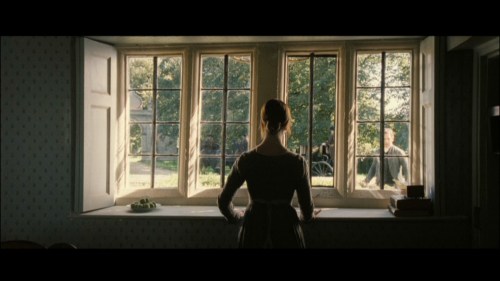
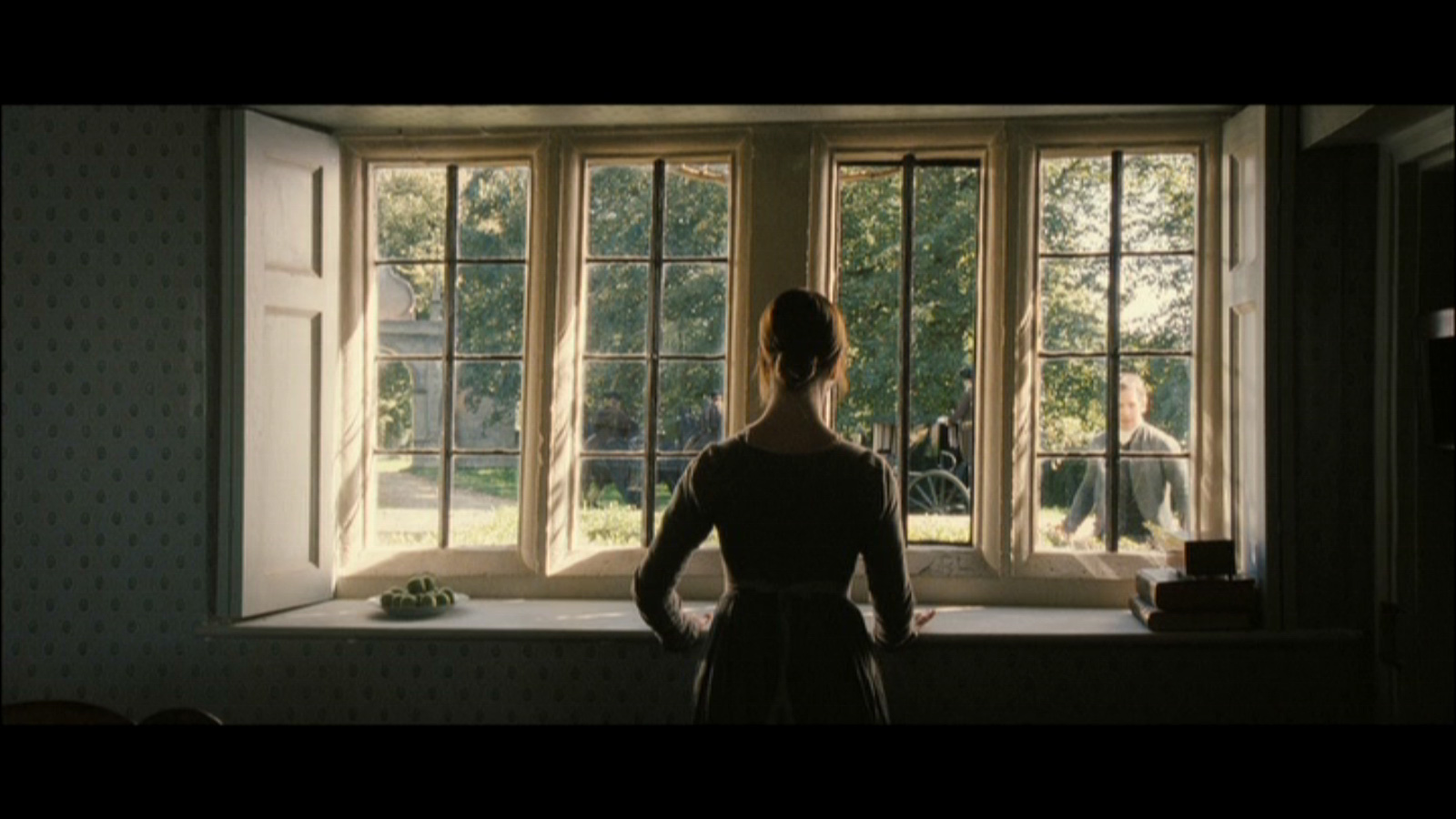
Charlotte at the window. Pride and Prejudice 2005
Lizzy, who had been busy searching for an instrument with which to catch pigs, thinking that only a herd of swine on the loose could cause such a commotion, looks in astonishment at an anemic woman with a scowling face and her companion. Suddenly it dawns on her that THIS is the cousin intended for Mr. Darcy! And here is when we discover that Miss Elizabeth has the makings of a mean girl, for she is pleased as punch to know that this sallow creature is destined to be Mr. Darcy’s bride.
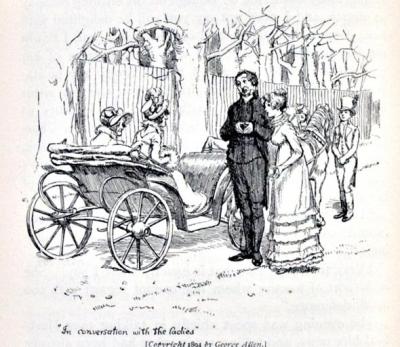
At the parsonage gate with Lady Anne her companion and the Collinses.
In this farcical scene Austen has provides us with foreshadowing of how things will be at Rosings and how these characters will conduct themselves in the presence of Lady CdeB. Their reaction to her daughter, a nonentity, is extraordinary, with the Collinses bobbing like two plastic dunking birds and the star-struck Lucases re-enacting the Regency version of a Kim Kardashian fan club.
Next: Lady CdeB
Only Lizzy remains untouched, for she’s not easily awed by the trappings of title and position. Anne’s visit had a real purpose it seems, for Charlotte informs them that they are invited to dine at Rosings the next day. As Mr. Collins whirlygigs himself into a tizzy, Miss Elizabeth Bennet of Longbourn House, and the daughter of a gentleman, girds her loins in anticipation of meeting the dragon lady. Jane Austen, meanwhile, has us readers chomping at the bit.
Next: Lady Catherine de Bourgh in all her glory.
More posts on this blog regarding Pride and Prejudice 200 year anniversary.
Read Full Post »

 Fried and Prejudice
















 Jane Austen's World