Feeds:
Posts
Comments

Archive for the ‘Jane Austen’s World’ Category

Review and Discussion by Brenda S. Cox

“Had Elizabeth’s opinion been all drawn from her own family, she could not have formed a very pleasing opinion of conjugal felicity or domestic comfort. Her father, captivated by youth and beauty, and that appearance of good humour which youth and beauty generally give, had married a woman whose weak understanding and illiberal mind had very early in their marriage put an end to all real affection for her. Respect, esteem, and confidence had vanished for ever; and all his views of domestic happiness were overthrown.”—Pride and Prejudice, chapter 42

Mr. and Mrs. Bennet’s Courtship

Have you ever wondered how on earth intelligent Mr. Bennet came to marry a woman of “weak understanding” and an “illiberal” [uncultured, unrefined] mind? Jane Austen gives us a brief explanation above: he was “captivated by youth and beauty” and an “appearance of good humour.” But what was their courtship like? Emma Wood has imagined that in the play Mr. Bennet’s Bride. First, let’s think a little more about what Austen tells us. 

Mr. and Mrs. Bennet, an ill-assorted pair.
Hugh Thomson, 1894, public domain.

It’s often been pointed out that Mrs. Bennet, silly as she seems, has some worldly wisdom. She has legitimate concerns about providing for herself and her children after Mr. Bennet’s death. It seems that Mr. Bennet had earlier considered this, but now has more or less given up. In chapter 50, when Lydia is to marry Wickham, we read:

“Mr. Bennet had very often wished before this period of his life that, instead of spending his whole income, he had laid by an annual sum for the better provision of his children, and of his wife, if she survived him. He now wished it more than ever. . . .

“When first Mr. Bennet had married, economy was held to be perfectly useless, for, of course, they were to have a son. The son was to join in cutting off the entail, as soon as he should be of age, and the widow and younger children would by that means be provided for. Five daughters successively entered the world, but yet the son was to come; and Mrs. Bennet, for many years after Lydia’s birth, had been certain that he would. This event had at last been despaired of, but it was then too late to be saving. Mrs. Bennet had no turn for economy, and her husband’s love of independence had alone prevented their exceeding their income.

“Five thousand pounds was settled by marriage articles on Mrs. Bennet and the children. But in what proportions it should be divided amongst the latter depended on the will of the parents.”

So Mrs. Bennet did have some fortune, enough to give her about £250 a year (5% of £5,000). Not enough for a gentry family to live on, but not poverty, either. However, divided between five daughters, once their father died and his estate went to Mr. Collins, it was insignificant.
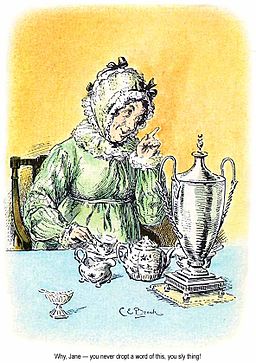
Mrs. Bennet has some valid concerns mixed with her foolishness.
C.E. Brock, 1895, public domain

While her family’s future is uncertain, Mrs. Bennet does not recognize, as her husband does, that saving money would be a help. Her extravagant plans for Lydia’s wedding clothes, and for Lydia and Wickham’s future house, servants, and carriages, show that she has no conception of limiting expenditures according to income. It is her husband whose “love of independence” (desire to avoid debt) has kept their family solvent. Mr. Bennet was at least better than that “foolish, spendthrift baronet,” Sir Walter Elliot of Persuasion, “who had not had principle or sense enough to maintain himself in the situation in which Providence had placed him.”
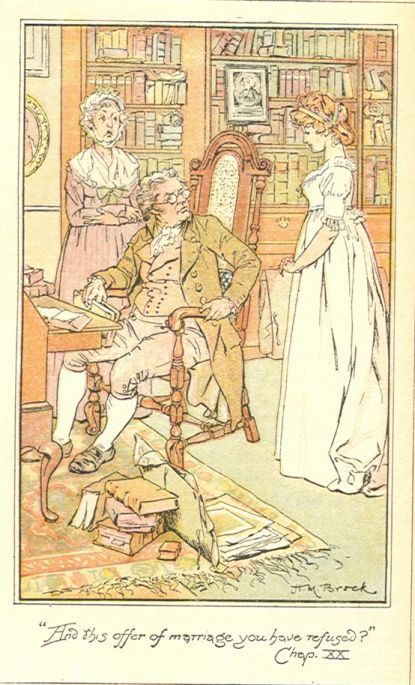
Mr. Bennet wishes he had saved money to provide for his daughters, but he has not.
H. M. Brock, public domain

Mrs. Bennet, when she was lovely young Miss Gardiner, had enough sense to get the attention of young Mr. Bennet, heir to Longbourn estate, and wheedle him into marrying her.

And that’s where the imagination of Emma Wood, an Australian playwright, took off.

The Play, Mr. Bennet’s Bride

Wood says,

“I began to imagine the details of their courtship. I knew the end, but how did the story begin? The characters flew onto the page. It was such a joy to write. Imagining the earlier lives of the ill-suited couple and peopling the stage with other characters in the previous generation to the novel was an adventure. . . . I felt a deep sense of obligation to honour the characters and style of the novel as I wrote, aware that audiences would expect to see people and situations they recognized in a loving tribute to the novel.”

Mr. Bennet’s Bride is a fun play by Australian playwright Emma Wood. Its US premiere was this month in Cartersville, GA. Photo by Brenda S. Cox

Wood’s play, Mr. Bennet’s Bride, has been delighting audiences in Australia and the U.K. since 2014. This February it premiered in the United States, in the small town of Cartersville on the outskirts of Atlanta, Georgia. I was privileged to attend a performance with a group of JASNA friends. We all loved it. The characters were engaging and fun, and the dialogue sparkled. A few little “Easter eggs” were thrown in, Austen quotes that fit well. One started with “It is a truth universally acknowledged . . .”; I won’t give away the others.

The Plot (Includes spoilers)

Here’s how Ms. Wood imagines the story:

We have James Bennet, age 29. His mother died giving birth to him, and his father has been distant all his life. His father’s sister, Aunt Mary, has raised James. His father is pressuring him to marry and produce an heir for Longbourn. His father’s cousin, Benedict Collins, has just produced his own heir, William Collins, and looks on Longbourn as William’s future inheritance.

First we see James hiding behind a sofa, reading a book. When he is discovered, he is forced to make small talk with one of the appropriate young ladies his father has been trying to set him up with. She is no more interested than he is.

Afterwards, his father lays down an ultimatum: Get married within six months, or you’ll be kicked out and have to make your own way in the world. To get James to take him seriously, he puts it into a contract, involving his lawyer (solicitor), Mr. Gardiner.

Jolly Mr. Gardiner and his wife—an earlier incarnation of Mrs. Bennet—take advantage of the situation. In a hilarious scene, Mr. Gardiner manages to introduce James to their beautiful but air-headed daughter Emily. She is in love with an officer but is savvy enough to quickly replace him in her affections with the heir to Longbourn. The story continues with much laughter.

In a serious scene, the elder Mr. Bennet has a touching reconciliation with his son, then allows him to choose his own bride. He chooses Emily. Only at the end does James get an inkling of what he’s gotten himself into.

Some flashed scenes show the new Bennet couple’s future.
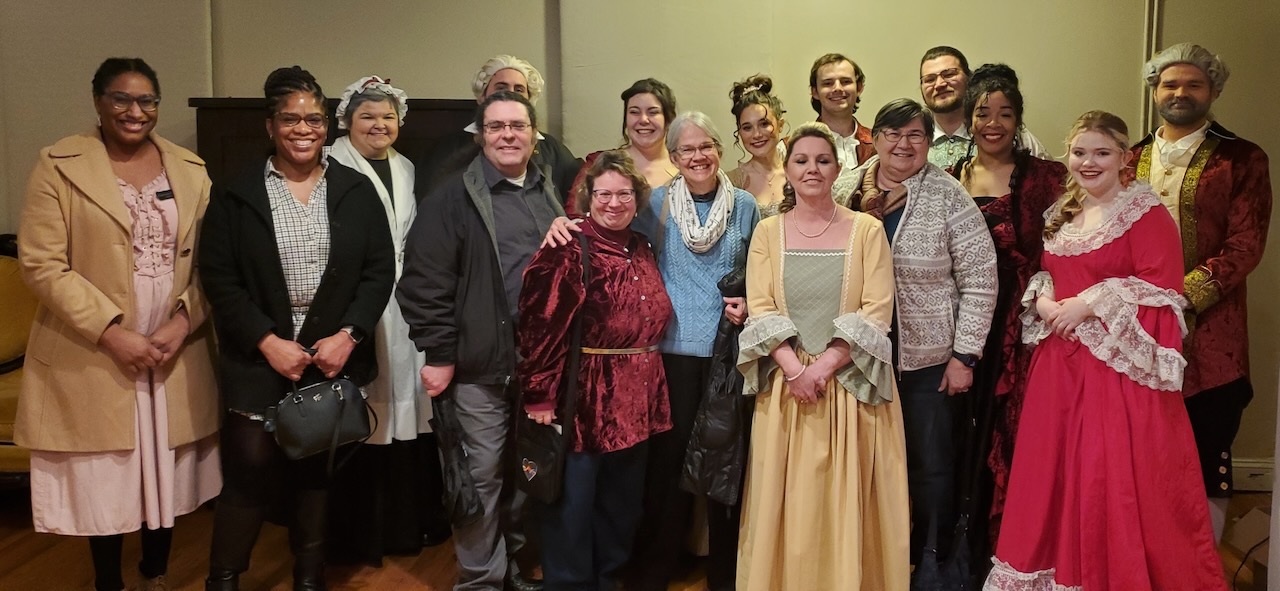
The cast and director of Mr. Bennet’s Bride with some visiting Janeites, Feb., 2024. Photo by Brenda S. Cox

Gaining Depth and Understanding

Imani Anderson did a beautiful job of directing Mr. Bennet’s Bride for the Pumphouse Players in Cartersville, Georgia. She says,

“One of the reasons why I have fallen in love with Mr. Bennet’s Bride is how James (our Mr. Bennet), Emily (Mrs. Bennet), and their families are written. They bring another level of depth and understanding for the matriarch and patriarch we’ve come to know in the classic tale. It’s clear both families want the best for their children and I think it’s so important that they admit their faults too when need be. . . . I hope that our production . . .  makes you get those warm fuzzy feelings of love and laughter during this Valentine’s season.”
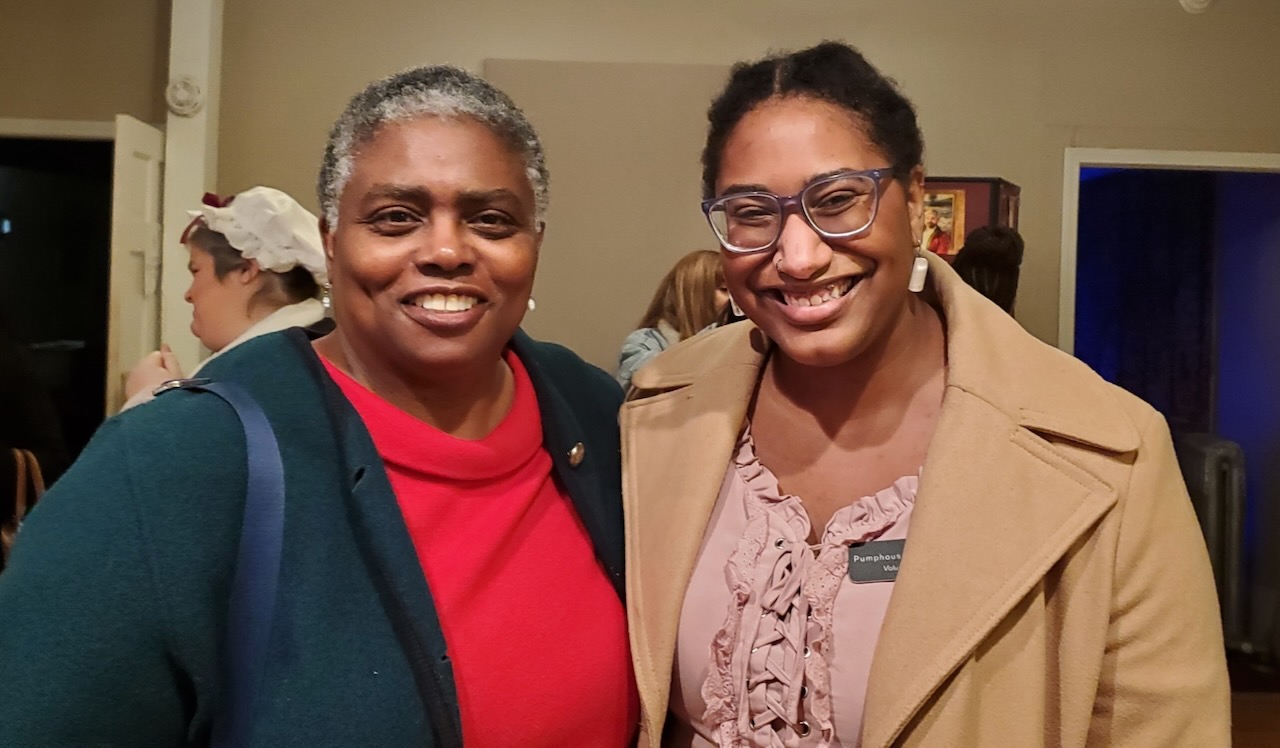
Renata Dennis, Regional Coordinator of JASNA Georgia, and Imani Anderson, director of Mr. Bennet’s Bride. Photo by Brenda S. Cox

The play did indeed give a deeper understanding of Mr. and Mrs. Bennet and how their family came to be what it was.

Gentle readers, how do you imagine Mr. and Mrs. Bennet’s courtship?

Brenda S. Cox is the author of Fashionable Goodness: Christianity in Jane Austen’s England. She also blogs at Faith, Science, Joy, and Jane Austen.

Her posts on Jane Austen’s Family Churches will resume in April.
Read Full Post »

Inquiring readers,

Since 2007, this blog has published a number of posts regarding Steventon, the village where Jane Austen and her parents and siblings lived until the parents and sisters moved to Bath in 1801. Austen was 26 years old. It is said that upon hearing of her parents’ plans to leave Steventon, she fainted. 

Well, girls, it is all settled. We have decided to leave Steventon and to go to Bath.’ To Jane, who had been from home and who had not heard much before about the matter, it was such a shock that she fainted away . . . . Constance Hill, Chapter IX, Leaving Steventon

The probable truth was that she was deeply unhappy to move from a community and friends and family she knew so well, and where her writing skills had flourished. Her creativity blossomed in Steventon, while her life in Bath resulted in a writing desert, where her projects were not completed – until she moved in 1809 to Chawton Cottage

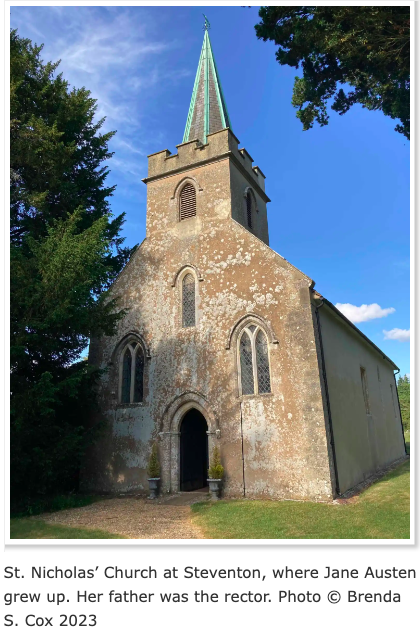
Regardless of her difficulties in Bath, this post is about her life in Steventon, where Austen grew up. Contributors Brenda Cox, Rachel Dodge, and Tony Grant published their outstanding (copyrighted) images in these posts!

Steventon Village

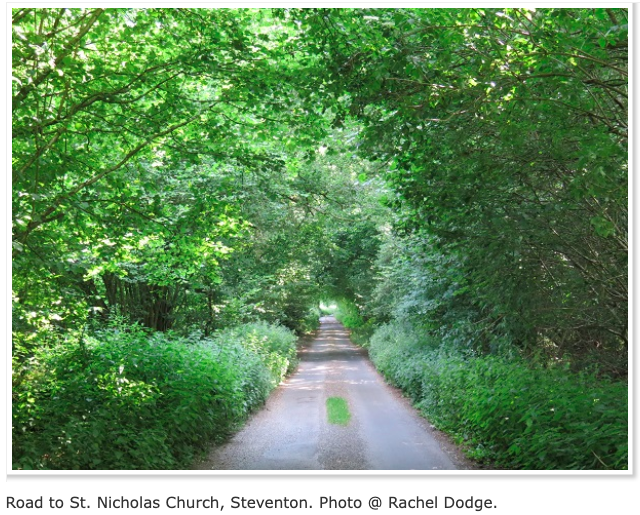
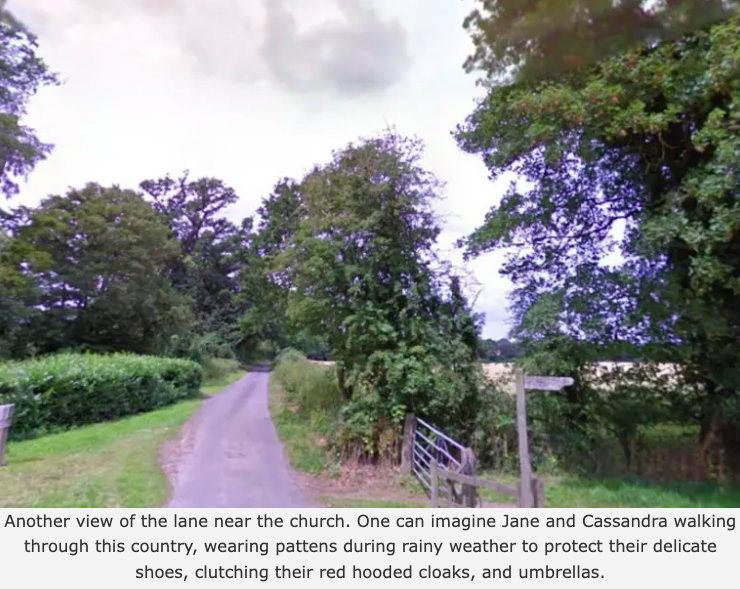
A Drive Through Steventon to St. Nicholas Church

Sadly, my five visits to England focused on London, Bath, Salisbury Cathedral, Stonehenge, Brighton and the South Downs, Warwickshire, Eton, Oxford, Windsor, etc. I missed Austen’s villages of Steventon and Chawton by a smidge. Thank goodness that I could take the road to St. Nicholas Church via Google street view.

Screen Shot 2024-02-24 at 11.41.21 AM

St. Nicholas, Steventon

Jane Austen’s Family Churches: St. Nicholas’, Steventon

This past summer, Brenda Cox, after an extensive trip to England, wrote a series of posts regarding the churches in Austen’s world. Cox’s original photos and historical information are unique to this blog and provide us with a fabulous way to view these beautiful buildings and their history.

Screen Shot 2024-02-24 at 11.44.35 AM

Steventon Rectory:

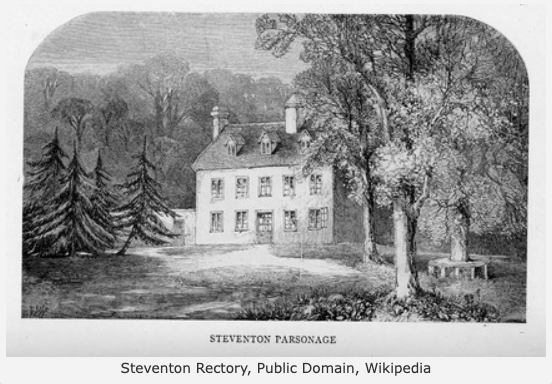
Steventon Rectory: Jane Austen’s Childhood Home

This was the first post I published in 2007 regarding Steventon Rectory. During that time I was a Jane Austen groupie and knew very little about her life. In the article, I focused on pattens, shoes with which I was not familiar. Good news: After all these years in this old post, the links still work! Looking back, the one negative comment still gives me the shivers, for I had no idea at that time  how to title a post! The reader came looking for substance and got clattering pattens instead!

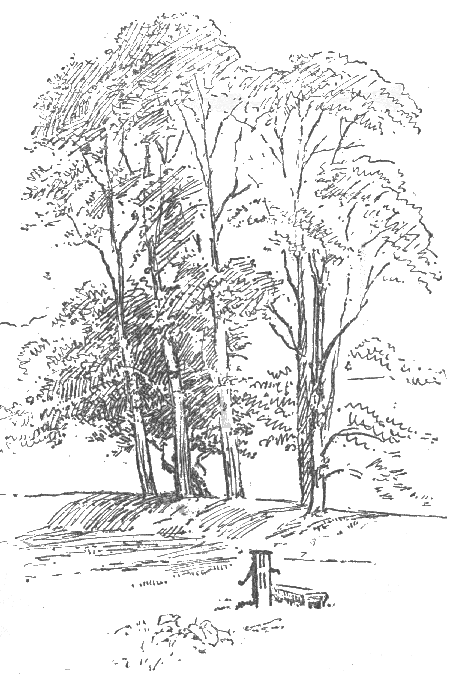
The image below of the remaining remnant of the Steventon Rectory (a pump) was drawn by Ellen G. Hill, whose sister, Constance wrote a book now in the public domain: Jane Austen: Her Homes and Her Friends by Constance Hill, 1901. See the link at the bottom of this post. Like me in 2007, Ellen and Constance were Austen fans. They visited the sites three quarters of a century after Austen died. In a some instances, they talked to a few aging villagers who recalled those who knew Cassandra Austen in her old age (dod 1845) and related some first-hand minutiae about her.

Screen Shot 2024-02-24 at 12.23.47 PM

Ellen Hill’s sketch of the pump on the site where the rectory stood.

The Garden:

Steventon Rectory Garden: Imagining the Landscape of Jane Austen’s Youth

Rachel Dodge, another outstanding writer for this blog, wrote a post about her visit to Steventon, Chawton, and the Austens’ self-sufficient gardens. Her photographs, as Brenda’s and Tony’s, are outstanding. This blog is blessed to have these contributors!

Screen Shot 2024-02-24 at 1.47.42 PM

The Rectory:

Servants in Jane Austen’s Houses

This post leads to an article that details the life of the Austen family in Steventon Rectory. It refers to Linda Robinson Walker’s 2005 Persuasions-Online article entitled Why Was Jane Austen Sent away to School at Seven: An Empirical Look at a Vexing Question. Ms Walker describes the Austen parents’ incentive to provide sufficiently for themselves and six children, which was not enough on Rev Austen’s two livings. The parents’ hard work to oversee a boy’s boarding school allowed the family to live a life of some comfort. Walker’s information regarding their daily lives and the costs for maintaining the boarding school and hire the servants is quite insightful.

Screen Shot 2024-02-24 at 1.16.24 PM

Last but not least: 

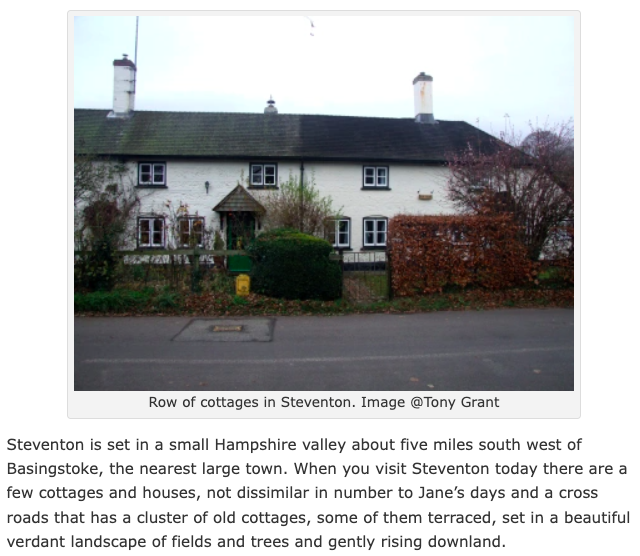
Steventon and Barton Cottage by Tony Grant

Tony Grant, a contributor to this blog since 2010, wrote this post and supplied his photographs to demonstrate the relationship between cottages in Steventon and Barton Cottage in Sense and Sensibility. His articles are always intriguing and informative, for he acted as a guide in Jane Austen tours in his native England for many years.

Screen Shot 2024-02-24 at 2.17.13 PM

More on the topic:

This online, public domain book, published in 1901 and referenced in this blog post, was my initial introduction to a first-hand Jane Austen fan account of her life. Enjoy the read! Jane Austen: Her Homes and Her Friends By Constance Hill

Read Full Post »

Last month I started a new month-by-month series titled “A Year in Jane Austen’s World,” wherein I began exploring important events and details that happened in Jane Austen’s novels, letters, and lifetime during each month of the year. Starting with January in Jane Austen’s World, my aim is to share my monthly finds every month this year, through December. My goal is simple: Glean as much as I can from Austen’s life, letters, and novels about what life was like for Jane Austen during her time and era.

We now turn our attention to February in Jane Austen’s novels. As I examined passages in her novels and letters that mention February, some of the information I found was an extension of what we learned last month: Mainly, that most of the British aristocracy went to the London (and some to Bath) during the winter months for “the season.” They enjoyed balls, parties, and other social gatherings in the bigger cities during the colder months and then moved back to their country homes by summer when the heat and stench of the cities became unendurable. You can read about it here.

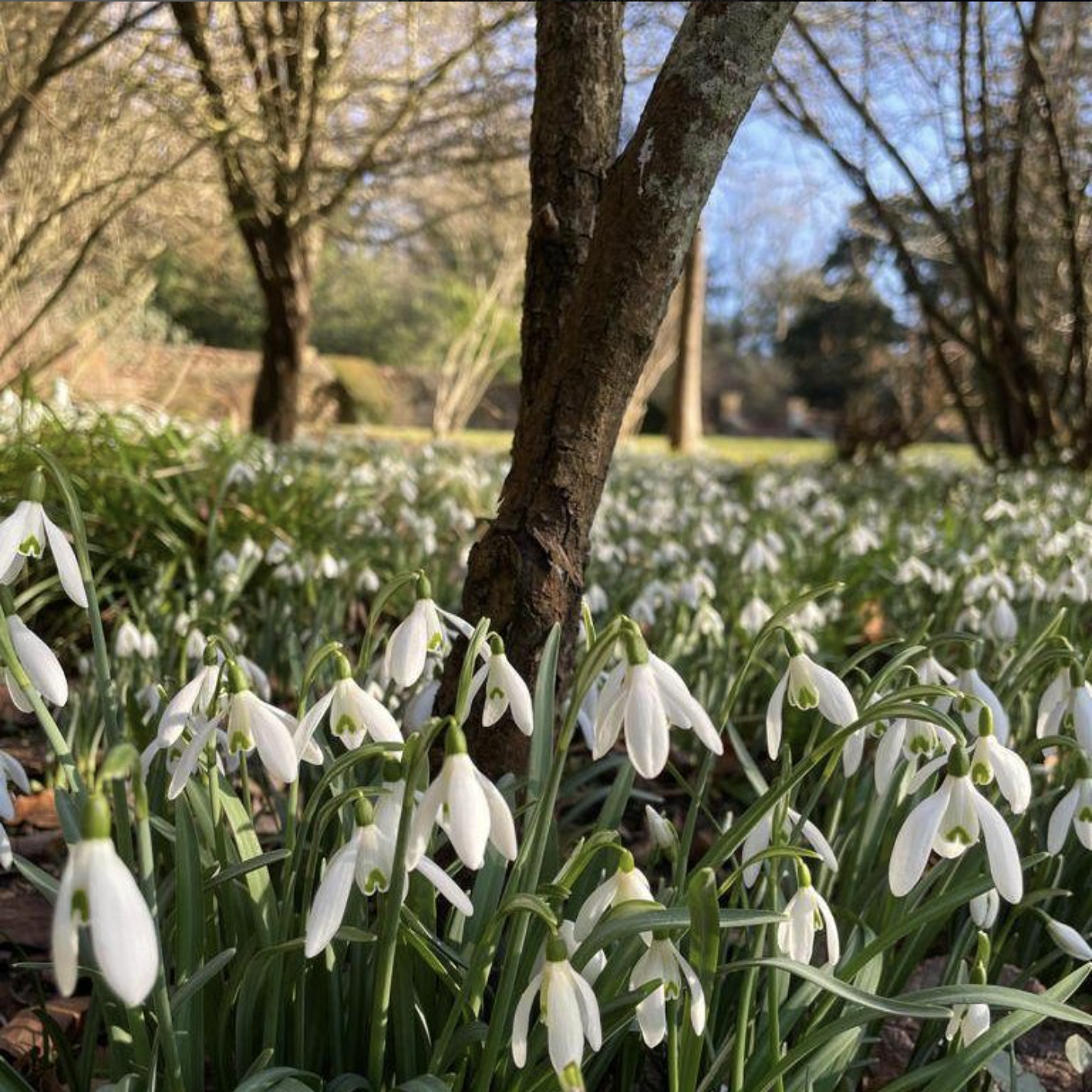
Snowdrops at Chawton House in February, Photo: @ChawtonHouse.

February in Hampshire

The snowdrops are in full bloom at Jane Austen’s House Museum and Chawton House this time of year. Chawton House even hosts “Snowdrop Sunday” tours, when guests can come visit the grounds and enjoy the stunning display of snowdrops and other bulbs that are starting to pop out.

I mention the snowdrops because they are everywhere on the grounds of Chawton House in the winter time, and it’s lovely to think that perhaps Jane Austen saw them for herself. These type of bulbs can spread and spread for years.

Chawton House in February, Photo: @ChawtonHouse.

February in Jane Austen’s Letters

Several of Austen’s surviving letters were written in February. In them, she covers many topics, but the excerpts belows are especially intriguing.

8 February 1807 (Castle Square, Southampton):

These snippets are from Austen’s letters when the Austen women lived in Castle Square, Southampton. This first letter mentions the improvements they were making:

  • Garden: “Our garden is putting in order by a man who bears a remarkably good character, has a very fine complexion, and asks something less than the first. The shrubs which border the gravel walk, he says, are only sweetbriar and roses, and the latter of an indifferent sort; we mean to get a few of a better kind, therefore, and at my own particular desire he procures us some syringas. I could not do without a syringa, for the sake of Cowper’s line. We talk also of a laburnum. The border under the terrace wall is clearing away to receive currants and gooseberry bushes, and a spot is found very proper for raspberries.”
  • Interior: “The alterations and improvements within doors, too, advance very properly, and the offices will be made very convenient indeed. Our dressing table is constructing on the spot, out of a large kitchen table belonging to the house, for doing which we have the permission of Mr. Husket, Lord Lansdown’s painter — domestic painter, I should call him, for he lives in the castle. Domestic chaplains have given way to this more necessary office, and I suppose whenever the walls want no touching up he is employed about my lady’s face.”
  • Beds: “The garret beds are made, and ours will be finished to-day. I had hoped it would be finished on Saturday, but neither Mrs. Hall nor Jenny was able to give help enough for that, and I have as yet done very little, and Mary nothing at all. This week we shall do more, and I should like to have all the five beds completed by the end of it. There will then be the window curtains, sofa-cover, and a carpet to be altered.”
  • You must be very cold to-day at Godmersham. We are cold here. I expect a severe March, a wet April, and a sharp May. And with this prophecy I must conclude.

20 February 1807 (Castle Square):

In this letter, we hear a bit more about the weather there in Southampton and at Godmersham, where Cassandra was staying:

  • “We could not pay our visit on Monday; the weather altered just too soon, and we have since had a touch of almost everything in the weather way; two of the severest frosts since the winter began, preceded by rain, hail, and snow. Now we are smiling again.”
  • “You must have had more snow at Godmersham than we had here; on Wednesday morning there was a thin covering of it over the fields and roofs of the houses, but I do not think there was any left the next day. Everybody used to Southampton says that snow never lies more than twenty-four hours near it, and, from what we have observed ourselves, it is very true.”
  • And one of Austen’s hilarious one-liners:”A widower with three children has no right to look higher than his daughter’s governess.”
Southampton High Street, 18th C.

4 February 1813 (Chawton, regarding PP):

In the following letters, we read a bit about Austen’s first beta readers for Pride and Prejudice and her reactions to their commentary:

  • “My dear Cassandra,—Your letter was truly welcome, and I am much obliged to you for all your praise; it came at a right time, for I had had some fits of disgust. Our second evening’s reading to Miss B. had not pleased me so well, but I believe something must be attributed to my mother’s too rapid way of getting on: though she perfectly understands the characters herself, she cannot speak as they ought. Upon the whole, however, I am quite vain enough and well satisfied enough. The work is rather too light and bright and sparkling: it wants shade; it wants to be stretched out here and there with a long chapter of sense, if it could be had; if not, of solemn specious nonsense, about something unconnected with the story,—an essay on writing, a critique on Walter Scott, or the history of Buonaparte, or something that would form a contrast, and bring the reader with increased delight to the playfulness and epigrammatism of the general style…. The greatest blunder in the printing that I have met with is in page 220, v. 3, where two speeches are made into one. There might as well be no suppers at Longbourn; but I suppose it was the remains of Mrs. Bennet’s old Meryton habits.”

Dated soon after:

  • “I am exceedingly pleased that you can say what you do, after having gone through the whole work, and Fanny’s praise is very gratifying. My hopes were tolerably strong of her, but nothing like a certainty. Her liking Darcy and Elizabeth is enough. She might hate all the others, if she would. I have her opinion under her own hand this morning, but your transcript of it, which I read first, was not, and is not, the less acceptable. To me it is of course all praise, but the more exact truth which she sends you is good enough.”

Garden Plans at Castle Square

As most gardeners (myself included) can attest, planning one’s spring garden is a happy prospect in the middle of February. Jane Austen was no different! With that in mind, let’s take a closer look at her descriptions of the plans for their garden from her 8 February 1807 letter to Cassandra:

Our garden is putting in order by a man who bears a remarkably good character, has a very fine complexion, and asks something less than the first. The shrubs which border the gravel walk, he says, are only sweetbriar and roses, and the latter of an indifferent sort; we mean to get a few of a better kind, therefore, and at my own particular desire he procures us some syringas. I could not do without a syringa, for the sake of Cowper’s line. We talk also of a laburnum. The border under the terrace wall is clearing away to receive currants and gooseberry bushes, and a spot is found very proper for raspberries.

Letter to Cassandra, 8 February 1807.

Austen’s Southampton Garden

With these lovely descriptions, we can paint a picture in our minds of what Austen was imagining as she planned the garden:

Sweet Briar

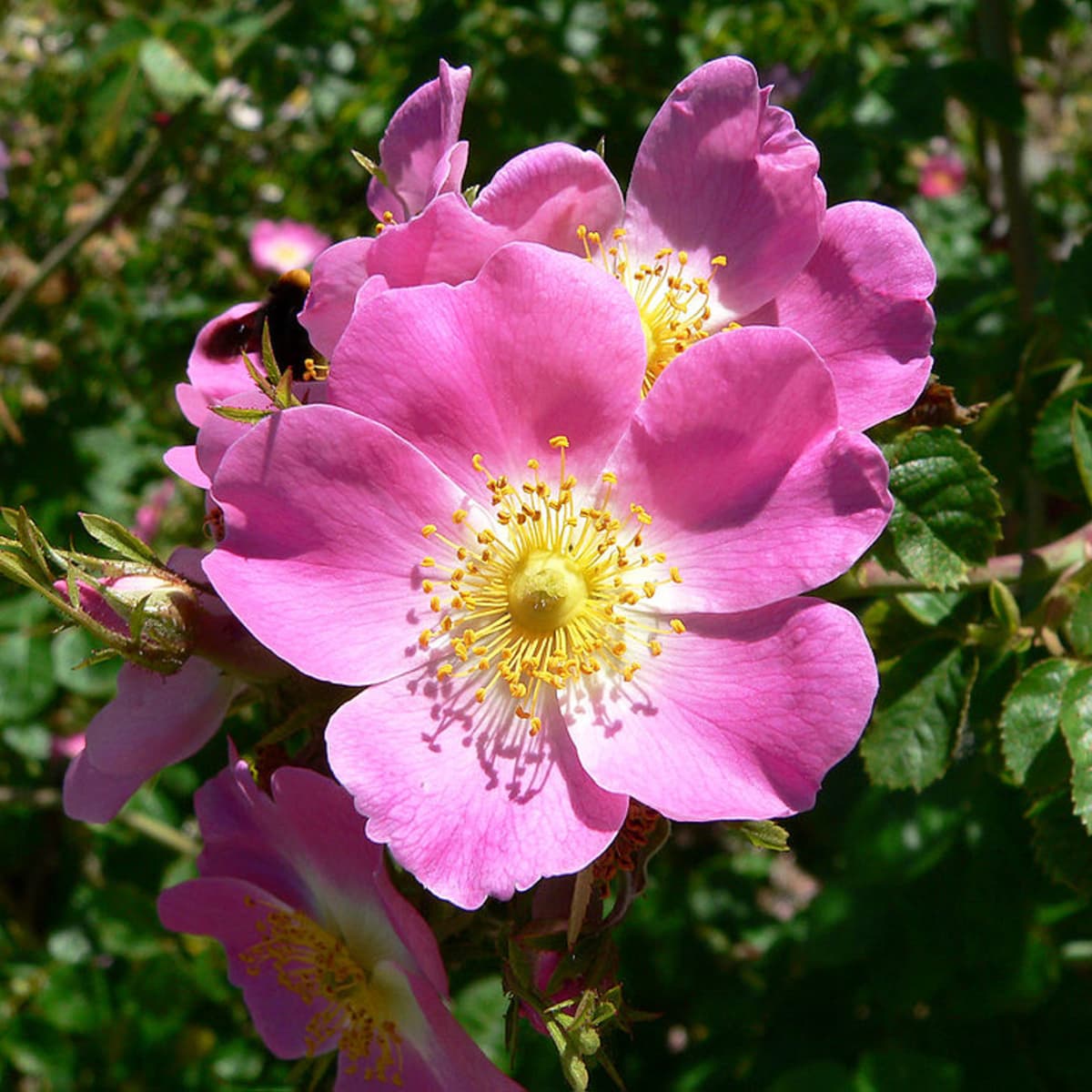
Austen wrote: “The shrubs which border the gravel walk, he says, are only sweetbriar and roses, and the latter of an indifferent sort; we mean to get a few of a better…”

On the blog From the Notebook of a Rosarian, you can read all about Sweet-Briar (or Eglantine Rose). I imagine Austen would have looked forward to seeing these blooms very much! Here is an example:

Regency Roses

Austen wrote: “roses . . . of an indifferent sort; we mean to get a few of a better…”

Perhaps the existing roses either weren’t uniform or weren’t as pretty as the Austen women wanted. Thus, they planned to add a few of “a better” sort. One can imagine a line of beautiful roses along their walkway come summer.

You can read a wonderful article about Regency Roses from Leeds University Library here: Regency Roses. Here is an example:

Pierre-Joseph Redouté, ‘Les Roses’, 1817-1824. Image credit: Leeds University Library.

Syringa (Lilac)

Austen wrote: “I could not do without a syringa, for the sake of Cowper’s line. We talk also of a laburnum.” This is in reference to a line in William Cowper’s poem, “The Winter Walk at Noon” (Book VI, The Task, 1899).

In her article “‘With what intense desire she wants her home’: Cowper’s Influence on Jane Austen,” Jane Darcy provides the following commentary:

The house in Castle Square in Southampton feels more like a home [for Austen]; there is a garden which she energetically starts to plan. She insists on lilacs: ‘I could not do without a Syringa, for the sake of Cowper’s Line’, adding ‘We talk also of a Laburnum’, referring to the lines in ‘The Winter Walk at Noon’,
Book VI of The Task:
… Laburnum rich
In streaming gold; syringa iv’ry pure (149-150)

Jane Darcy, CowperandNewtonMuseum.org
Edward Phillis, “A Georgian Springtime” (Strictly Jane Austen).

Laburnum

Austen wrote: “We talk also of a laburnum.”

Laburnum, a flowering tree, also called golden chain or golden rain, is pictured below. One can imagine how lovely it would look in Austen’s garden in spring.

Laburnum, flowering tree. Wikimedia.

Austen wrote: “The border under the terrace wall is clearing away to receive currants and gooseberry bushes, and a spot is found very proper for raspberries.”

Here, we find an example of something pretty and edible for the garden come summer. Currants, gooseberries, and raspberries were all useful in a variety recipes. You can read more about the history of British food and Gooseberries here.

Gooseberries, Britishfoodhistory.com.

To read more about the trees and shrubs Austen would have recognized, the JASNA Eastern Washington/Northern Idado region provides this fascinating information regarding the “Trees and Shrubs Mentioned in Jane Austen’s Novels, Letters, and Minor Works with Historical Background: “Austen’s Trees and Shrubs A-K” and “Austen’s Trees and Shrubs L-Z.”

February in Jane Austen’s Novels

The following are a collection of interesting little tidbits and important moments from Austen’s novels:

Sense and Sensibility

  • “[Mrs. Palmer] expects to be confined in February,” continued Mrs. Jennings.
  • “[Edward] will be there in February, otherwise London would have no charms for me; I have not spirits for it.” (Lucy Steele)
  • Colonel Brandon: “But last February, almost a twelvemonth back, [my little Eliza] suddenly disappeared.” […] “Good heavens!” cried Elinor, “could it be—could Willoughby!”—
  • “[Mrs. Dashwood] had yet another reason for wishing her children to remain [in London]; a letter from her son-in-law had told her that he and his wife were to be in town before the middle of February, and she judged it right that they should sometimes see their brother.”
  • “Early in February, within a fortnight from the receipt of Willoughby’s letter, Elinor had the painful office of informing her sister that he was married.”

Pride and Prejudice

  • “With no greater events than these in the Longbourn family, and otherwise diversified by little beyond the walks to Meryton, sometimes dirty and sometimes cold, did January and February pass away.”

Mansfield Park

  • “With such thoughts as these, among ten hundred others, Fanny proceeded in her journey safely and cheerfully, and as expeditiously as could rationally be hoped in the dirty month of February. They entered Oxford, but she could take only a hasty glimpse of Edmund’s college as they passed along, and made no stop anywhere till they reached Newbury, where a comfortable meal, uniting dinner and supper, wound up the enjoyments and fatigues of the day.”
“Entrance to Oxford from the London Road.” Ackermann’s Oxford University. Engraved by Frederick Christian Lewis after Frederick Nash (1814).

Emma

  • “In the summer it might have passed; but what can any body’s native air do for them in the months of January, February, and March? Good fires and carriages would be much more to the purpose in most cases of delicate health, and I dare say in her’s. I do not require you to adopt all my suspicions, though you make so noble a profession of doing it, but I honestly tell you what they are.”
  • “Frank was here in February for a fortnight.”
  • “When [Frank] was here before, we made the best of it; but there was a good deal of wet, damp, cheerless weather; there always is in February, you know, and we could not do half that we intended. Now will be the time.
  • “Mr. Woodhouse was resigned. The time of year lightened the evil to him. May was better for every thing than February.”

Persuasion

  • “It was the beginning of February; and Anne, having been a month in Bath, was growing very eager for news from Uppercross and Lyme.”
  • Mary Musgrove sends a long, newsy letter to Anne from Uppercross.

Northanger Abbey

  • “Catherine . . . gave herself up to all the enjoyment of air and exercise of the most invigorating kind, in a fine mild day of February, with the consciousness of safety.”
Bath, England, Regency Era.

February Dates of Importance

This brings us now to several dates that would have been quite important to Austen personally:

Celebrations/Birthdays:

13 February 1765: James Austen (Jane’s brother) born at Deane.

Historic Dates:

1 February 1793: France declares war on England.

4 February 1794: France abolishes slavery in French colonies.

February 1811: George, Prince of Wales, becomes the prince regent of England.

Sorrows:

22 February 1794: Eliza de Feuillide’s husband is executed by guillotine in Paris.

February 1797: Tom Fowle (Cassandra’s fiancé), who was serving as a chaplain, dies in San Domingo of yellow fever.

Writing:

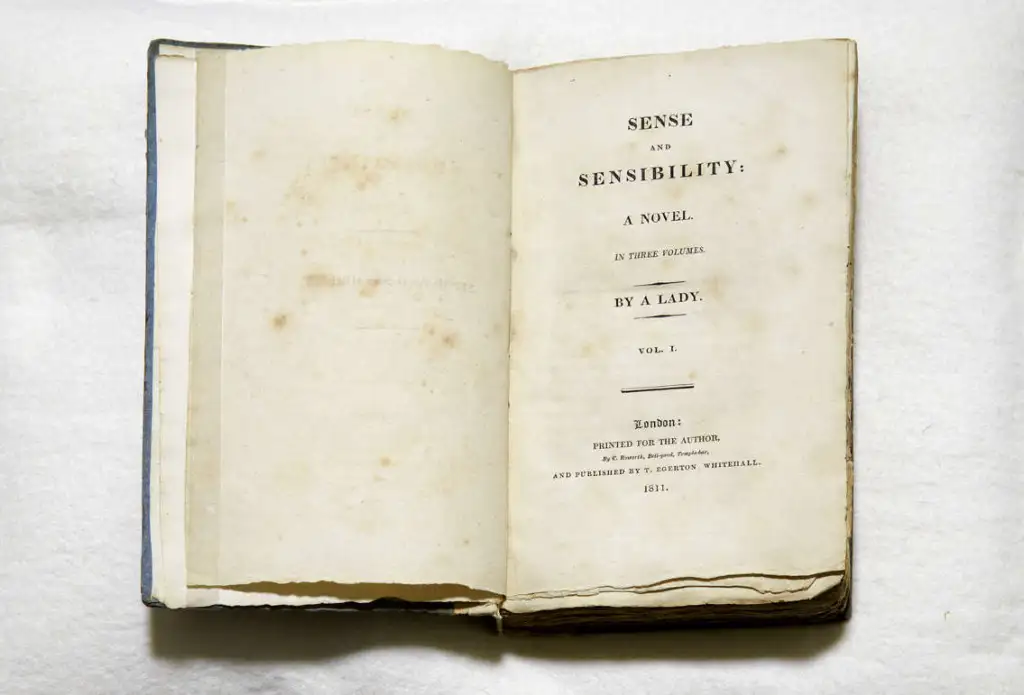
Winter 1810: Sense and Sensibility accepted for publication (Thomas Egerton).

February 1811: Jane Austen starts work on Mansfield Park.

Sense and Sensibility, 1st edition, JaneAusten’s.House.

February in the Life of Austen

I hope you enjoyed this tour of February in Jane Austen’s World as much as I enjoyed researching it and writing it. There is so much more to explore! I followed several intriguing trails and threads in this article, but I’m sure one might find many other avenues to research. Austen’s letters alone are a fount of information and charm. Here’s to what we’ll find in March in Jane Austen’s World next month!


RACHEL DODGE teaches college English classes, gives talks at libraries, teas, and book clubs, and writes for Jane Austen’s World blog. She is the bestselling author of The Little Women DevotionalThe Anne of Green Gables Devotional and Praying with Jane: 31 Days Through the Prayers of Jane Austen. Now Available: The Secret Garden Devotional! You can visit Rachel online at www.RachelDodge.com.

Read Full Post »

Austen Chat Podcast

Austen Chat Podcast
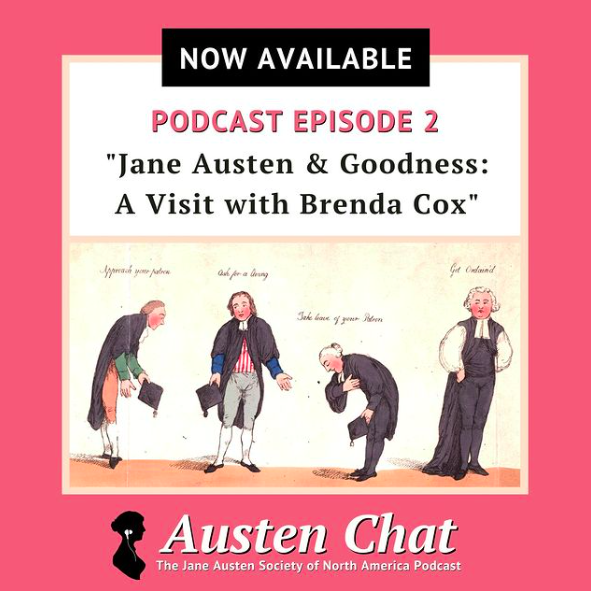
Brenda Cox, a writer for this blog, steered me to these wonderful podcasts offered by JASNA (Jane Austen Society of North America). Brenda’s discussion is featured in the second podcast on August 2023 entitled Jane Austen & Goodness: A Visit with Brenda Cox. 

On JASNA’s instagram’s site: 

Screen Shot 2024-02-04 at 6.48.15 PM

“This month we visit with the author of “Fashionable Goodness: Christianity in Jane Austen’s England” to discuss clergymen in Austen’s novels, her use of certain words that hold deeper religious meaning than you might think, women who were influential in the church, and the role churches played in the many social reforms of her time.”

A new podcast is featured every first Thursday of each month. This means a new one will appear in early March! Each is approximately 30 to 40 minutes long. They also come with a full transcript for a quick reference later, or for leisurely reading.

The Podcast host is Breckyn Wood, a member JASNA’s Georgia Region and an independent Jane Austen scholar. She is a freelance writer, editor, and children’s book author.

In addition to Brenda’s wonderful talk, previous podcasts include:

2023

July 6: Jane Austen & Her House: A Visit with Lizzie Dunford

Sep 7: Jane Austen & Her Wardrobe: A Visit with Hilary Davidson

Oct 5:  Jane Austen & Her Endings: A Visit with Inger Brodey

Nov 10: Jane Austen & Divorce: A Visit with James Nagle

Dec 7: Jane Austen & Mr. Wickham: A Visit with Adrian Lukis

2024

Jan 4: Jane Austen & Dido Belle: A Visit with Renata Dennis

Feb 1: Jane Austen & Food: A Visit with Julienne Gehrer

I can’t wait to listen to them all!

Tony Grant:  Review of Northanger Abbey, a play by Zoe Cooper

On the 26th January Tony Grant and his wife saw “Northanger Abbey” at The Orange Tree Theatre, Richmond upon Thames. The play, written by Zoe Cooper, was ”inspired” by Jane Austen’s novel. Only three actors enacted all the roles as written by Ms Cooper. 

I’ve seen plays in experimental theaters where actors played several roles after hastily making costume changes. This method of acting leaves me in awe in how the actors inhabit the different characters fully and with perfect recall of their varying dialogues.

Zoe Cooper's Northanger Abbey

The link below leads to the review on his blog of Cooper’s adaptation of Northanger Abbey. In preparation for the performance, Tony read Northanger Abbey again, which gave him fresh insights.

zoe cooper playwright

Playwright Zoe Cooper

Click on this link to enter Tony’s blog to read the review and information about Zoe Cooper.

Hallmark’s Loveuary Experience in February 2024

presents four original movies inspired by the novels of Jane Austen… with a Hallmark twist. 

The first movie aired on February 3rd, but never fear, it will be streamed on Peacock on demand.

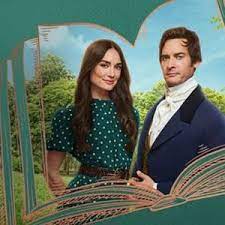
Paging Mr Darcy:  

paging mr Darcy

When an overly serious scholar attends an annual Jane Austen conference, she has a sudden change of heart when she strikes a deals with the man who’s playing Mr Darcy. 1 hr 24 m, 2024

Future February Airings on the Hallmark Channel

Love & Jane, Premieres Sat Feb 10 8/7c

An American in Austen, Premieres Sat Feb 17 8/7c

Sense and Sensibility, Premieres Sat Feb 24 8/7c

These movies will also stream on demand on the Peacock App.

A short review of ‘Paging Mr Darcy’

I just viewed “Paging Mr Darcy.” I give it 2½ out of 5 stars, having spent much of my time keeping half an ear and eye on the film while looking up information for my sick dog. The story was pleasant, but would have been better had the script reflected the energy, fun, and seriousness of an actual Austen conference, like the yearly JASNA AGM. The script was not robust enough for my tastes, but then again, there’s a reason why Hallmark movies with their happy endings are popular with a large number of viewers, and why so many of these romance movies are generated each year.

Read Full Post »

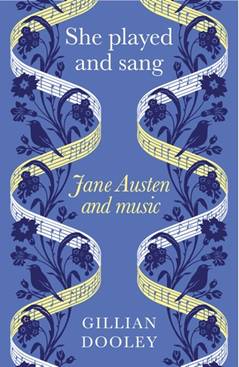
She Played and Sang: Jane Austen and musicThis is the time when new books are published ahead of the spring and summer seasons. One offering from Manchester University Press particularly intrigued me. I also included in this post  my responses to two books I recently purchased in preparation for a post about the Grand Tour.

She Played and Sang: Jane Austen and Music by Gillian Dooley

In March, Manchester University Press will offer a book that features an in depth look at Jane Austen’s lifelong connection to music. I have the honor of reading an advance proof and will review the book this March. The press sheet states:

“Until recently, our knowledge of Austen’s musical inclinations was  limited to the recollections of relatives who were still in their youth when she passed away. But with the digitisation of music books from her immediate family circle, a treasure trove of evidence has  emerged. Delving into these books, alongside letters and other  familial records, She played and sang unveils a previously unknown facet of Austen’s world. 

[Dooley] not only uncovers the music closely associated with Austen, but also unravels  her musical connections with family and friends, revealing the intricate ties between her fiction and  the melodies she performed. With these revelations, Austen’s musical legacy comes to life, granting  us a deeper understanding of her artistic prowess and the influences that shaped her literary  masterpieces.

Screen Shot 2024-01-28 at 9.52.53 AMThe Grand Tour of Europe

I recently purchased this lavish book, The Grand Tour of Europe, which sits prominently on my coffee table. 

“The Grand Tour, a journey through Europe aimed at culture and leisure, was a common practice between the 17th century and the first quarter of the 19th century. This book revisits the stages in an itinerary that left profound traces in European culture.”

Published by Van Cleef & Arpels and edited by Franco Maria Ricci, the information is divided into the following lushly illustrated sections:

Chapter I: Three essays 

Fops on Holiday, Nicholas Foulkes

Theatres of Antiquity: Art and Artists During the Grand Tour, Fernando Mazzocca

The Grand Tour of Europe, Attilio Brilli

Chapter II: Myths and Views of Italy

Chapter III: Imagination and the Grand Tour – Sculpture

Chapter IV: Imagination and the Grand Tour – Painting

Chapter V: Travellers and Artists

Note: Chapters II – V include anthologies with reactions from 17th – 19th C. travellers to their experiences. 

For a peek inside the book, click on this link: https://www.francomariaricci.com/en/books/grandtour Publisher ‏ : ‎ Franco Maria Ricci Editore (October 29, 2023), 168 pages, ISBN-13 ‏ : ‎ 979-1280294180

I wanted to connect this beautiful book to Jane Austen’s life, and found the bridge in the following reproduction of Edward Austen Knight’s memories of his own Grand Tour.

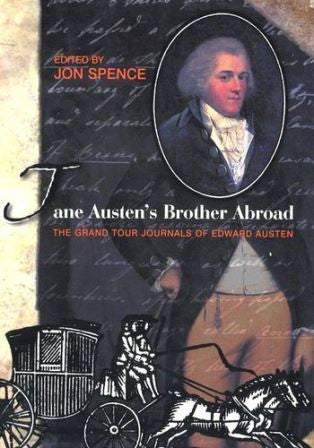
Edward Grand TourJane Austen’s Brother Abroad: The Grand Tour Journals of Edward Austen 

I ordered this book, edited by Jon Spence and first published in 2005, from Jane Austen’s Books. Austen herself, while she mentioned Edward Austen Knight in her surviving letters, provided few personal details about this brother and none about his Grand Tour. Before this book’s publication, we knew very little about his personality or his likes and dislikes, except for a letter from his mother, who compared and contrasted his talents with those of his brother James:

“[He] has a most active mind, a clear head, and a sound judgement, he is quite a man of business. That my dear James was not – Classical Knowledge, Literary Taste and the Power of Elegant Composition possessed in the highest degree; to these Mr Knight makes no pretensions. Both equally good, amiable and sweet-tempered.” – From an introduction in the book by Jon Spence.

In his foreword, Richard Knight, a descendant of Edward Austen Knight and a trustee today of the Chawton House Library writes:

“The publication of Edward’s Grand Tour journals provides another, more personal and intimate memorial to Edward himself. In the journals he speaks to us as he was as a young man: wry, amusing, playful, eager, and interested.”

The latter two books help Austen aficionados understand the scope of these “rites of passage” and educational journeys for the males* of the upper classes and those of the bourgeoisie who had the time and means to leave their home countries for lengthy periods, in some instances for years. Edward’s journal was written from the notes he kept during his travels and the result was meant to be read out loud to his family. 

*Females also embarked on Grand Tours, but not near the numbers of their male counterparts.

Read Full Post »

« Newer Posts - Older Posts »