Feeds:
Posts
Comments

Archive for the ‘Jane Austen’s World’ Category

by Brenda S. Cox

“I dread the idea of going to Bookham as much as you can do”—Jan. 9, 1799

“My scheme is to take Bookham in my way home for a few days . . . I have a most kind repetition of Mrs. Cooke’s two or three dozen invitations, with the offer of meeting me anywhere” –Nov. 3, 1813

We’ve been looking at some of Jane’s mother’s Leigh family. The Austens also corresponded regularly with the Cooke family in Great Bookham, who are often mentioned in Jane’s letters. Mrs. Cooke was Jane’s mother’s cousin. Her name was the same as Jane’s mother’s: Cassandra Leigh. She was the daughter of Jane’s uncle Theophilus Leigh, master of Balliol College at Oxford.

This cousin’s husband, Rev. Samuel Cooke, was Jane’s godfather. He was the vicar of St. Nicolas’, Great Bookham. He was also rector of Cottisford, Oxon, about 80 miles away, but he and his family lived in Great Bookham.

Godparents play an important role in Anglican families.They promise to pray for the child’s salvation, faith, and obedience, and, at the child’s baptism, they renounce the devil on the child’s behalf. A girl has one godfather and two godmothers.

Memorial plaque in St. Nicolas’ Church, Great Bookham, to Jane Austen’s godfather, Rev. Samuel Cooke, “formerly fellow of Baliol College Oxford, and for fifty-two years the resident and respected vicar of this parish. He died March 29th, 1820, in the eightieth year of his age. Guided by a spirit of piety and benevolence and by an inflexible sense of duty, which sought not the honour that cometh of man, he ran his long course in peace and content; and closed it in an humble trust on that blessed hope, ‘Enter thou into the joy of thy Lord.'”
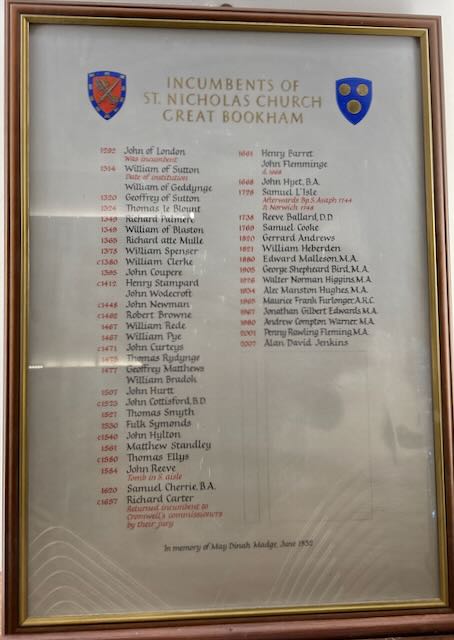
The Incumbents (vicars, then rectors) of the Great Bookham church lists Samuel Cooke from 1769 to 1820.

Jane Austen visited the Cookes in Great Bookham, which is between Chawton and London, a number of times. We don’t know why she did not want to go there in 1799, but she visited from May 14 to June 2.
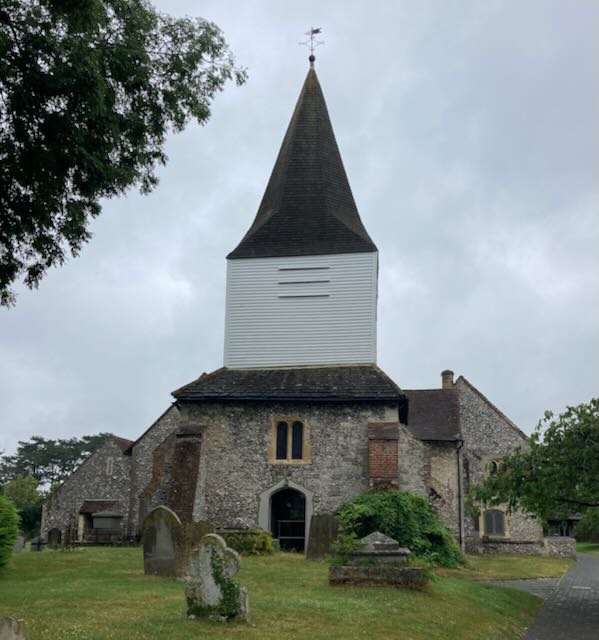
St. Nicolas’ Church, Great Bookham, externally still much as it was when Jane Austen visited there. See this image by JMW Turner.

Great Bookham in Austen’s Novels

Jane made good use of her visit. In 1801, she started writing The Watsons. Its setting in “Stanton” was apparently based on West Humble (now Westhumble), a town near Great Bookham. It is three miles from Dorking, which Austen calls “the town of D. in Surrey.” Betchworth Castle is nearby, so it may be the basis for Osborne Castle in the novel.

After probably visiting several more times, in the summer of 1814, Austen decided to visit the Cookes again. On June 14, she wrote,

“The only Letter to day is from Mrs. Cooke to me. They . . . want me to come to them according to my promise.—And after considering everything, I have resolved on going. . . . In addition to their standing claims on me, they admire Mansfield Park exceedingly. Mr. Cooke says ‘it is the most sensible Novel he ever read’—and the manner in which I treat the Clergy, delights them very much.—Altogether I must go–& I want you [Cassandra] to join me there . . .”

One commentator (Chapman) says the Cookes may have had Evangelical leanings and appreciated Mansfield Park’s protest against lax views of the duties of the clergy. Evangelical or not, Edmund Bertram of Mansfield Park does present a very high view of the clergy. He says, for example:

“I cannot call that situation [of clergyman] nothing which has the charge of all that is of the first importance to mankind, individually or collectively considered, temporally and eternally, which has the guardianship of religion and morals, and consequently of the manners which result from their influence. No one here can call the office nothing. . . . it will, I believe, be everywhere found, that as the clergy are, or are not what they ought to be, so are the rest of the nation.”

Jane Austen apparently based Highbury in Emma on Great Bookham or the adjacent town of Leatherhead.

When Jane Austen visited in 1814, she was in the midst of writing Emma. She later told her nephew that Leatherhead, next to Great Bookham, was the model for Highbury. Box Hill, where Emma and her friends picnic, is nearby, and Great Bookham had an Old Crown Inn similar to the one in Highbury. (It was, however, demolished in 1930). There was also a Randalls Park, and other features similar to Highbury.
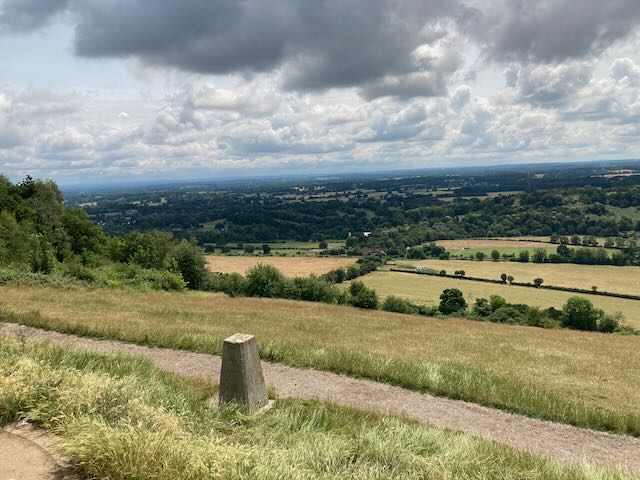
View from Box Hill, where Emma and her friends picnic in Emma. (Tony Grant points out that this wonderful view is not from the exact spot where they held their picnic. “Frank Churchill, when he gets up to to proclaim to the world, says that Dorking is to his left and Mickleham to his right. That can only mean the picnic took place on the Burford Spur of Box Hill.” You can find photos of other views in his posts linked below.)

Box Hill

Box Hill is still a beautiful spot for picnics, hiking, walking, and cycling. The current rector of Great Bookham, Alan Jenkins, kindly took us to visit there. It includes a cycling trail. In the 2012 Olympics, cyclists made nine laps on this trail as part of their route.

The Vicarage

The Cookes’ parsonage, where Jane Austen stayed, was a large one. (A maid working there was named Elizabeth Bennet, by the way.) They had at least six children, but only three survived to adulthood. Their daughter Mary, who apparently did not marry, was a good friend of Jane’s, mentioned in her letters. Their son Theophilus Leigh Cooke (1778-1846) became a clergyman, a fellow of Magdalen College at Oxford, and holder of three church livings. His brother George Leigh Cooke (1779-1853) combined religion and science. He was a fellow of Corpus Christi College and earned a bachelor of divinity (a graduate degree). He also became a professor of Natural Philosophy (science) at Oxford, a keeper of the archives, and published an edition of Newton’s Principia Mathematica. Austen’s nephew, James-Edward Austen-Leigh wrote in his Memoir that George was “an impressive preacher of earnest and awakening sermons,” which, in the jargon of the time, implies that he was an Evangelical. Jane mentions in one of her letters that George “was very kind & talked sense to me every now & then” (Apr. 21, 1805).

Until 1869, Great Bookham had vicars, not rectors, so the parsonage was called a vicarage. The patron of the parish (a person who changed over the years), took part of the tithes and the rest went to the vicar, along with income from the glebe farmland belonging to the living. It is speculated that some of the excommunications in the Vestry Books were for non-payment of tithes (from 1800: Great Bookham at the Time of Jane Austen).

The parsonage was removed in 1961. For early pictures, see here. The parish now has a rector; the term no longer refers to tithes. His rectory is a modern building.

St. Nicolas’ Church, Great Bookham, History

Jane Austen must have worshiped in this church, where her godfather was the vicar, a number of times on her visits to Great Bookham.

When Austen visited, the church was full of box pews with walls around them. Some were three feet high, some were four feet high. The box pews were replaced by regular pews in 1885.

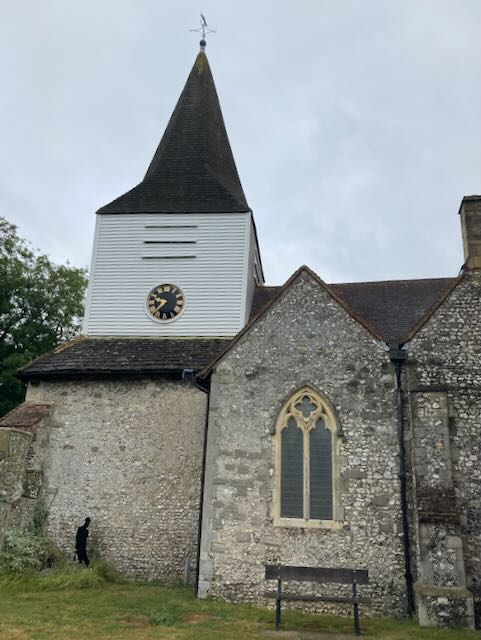
This wooden gate was added to side of the Great Bookham church in 1914. In Austen’s time, there was an external staircase here to an upper room, where Sunday school was held. Sunday schools, run by Christians of all denominations across England, educated the poor and enabled them to build better lives.
The church tower of St. Nicolas’ Great Bookham dates back to the 1100s. The clock in it was not there when Austen visited. Some years ago, the tower was in danger of falling down. The whole village got behind the project of fixing it, and raised even more than the large sum necessary to save the tower.
The chancel of the Great Bookham church was built in the 1300s, though when Jane Austen saw it, it did not have stained glass.

Other Literary Connections at Great Bookham

Great Bookham has a number of literary connections, some of which Jane Austen would have known about.
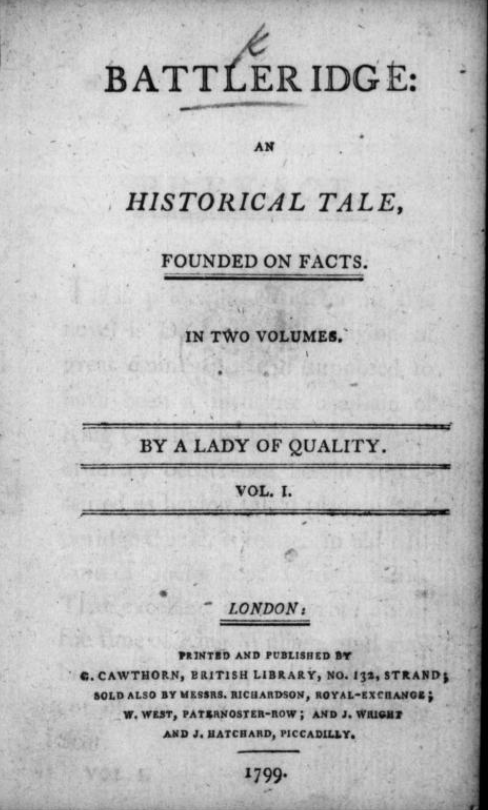
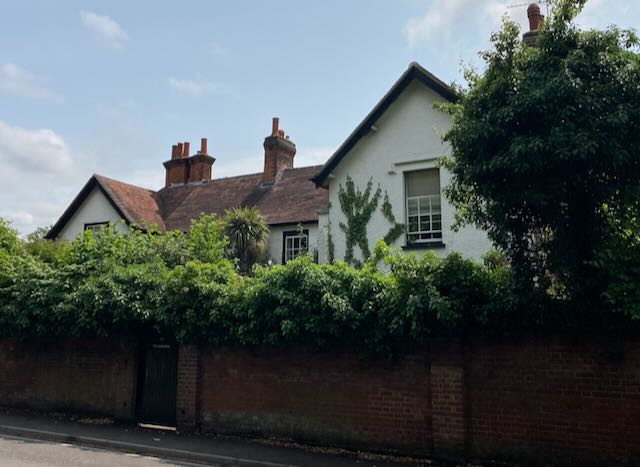
Cassandra Cooke, Jane Austen’s mother’s cousin, published her novel, Battleridge: An Historical Tale founded on facts, in 1799, by “a lady of quality.” Austen mentions it in her letters. Available on archive.org in two volumes.
Fanny Burney, one of Jane Austen’s favorite authors, lived here at the Hermitage with her husband, General Alexandre D’Arblay. Their son was baptized in the nearby Great Bookham church in 1795.

Fanny Burney wrote of the Cookes, “the father is worthy, the mother is good, so deserving, so liberal and so infinitely kind, that the world certainly does not abound with people to compare them with. The eldest son is a remarkably pleasing young man. The young seems sulky, as the sister is haughty.” She also wrote of Rev. Cooke, “Our vicar is a very worthy man and goodish—though by no means a marvellously rapid preacher.”

She also wrote to her father, Dr. Burney, “Mr. Cooke tells me he longs for nothing so much as a conversation with you on the subject of Parish Psalm singing—he complains that the Methodists run away with the regular congregation from their superiority in vocal devotion.” The Methodists, led by John and Charles Wesley, had been leading a revival in the church. They attracted people with lively hymns. Country churches were mostly singing psalms, often quite poorly, at this time, though hymns were beginning to be introduced into some churches.
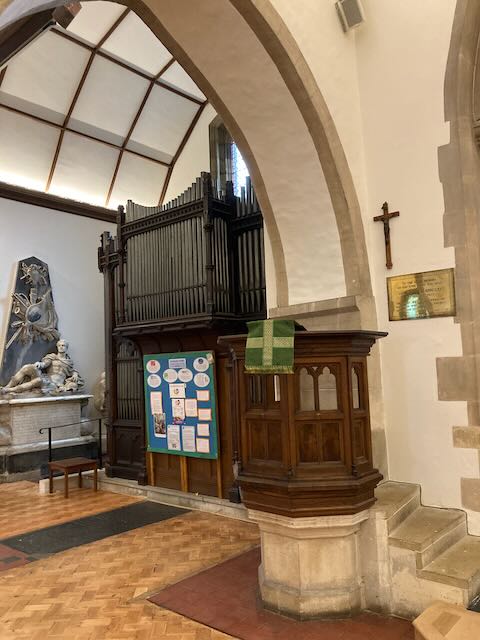
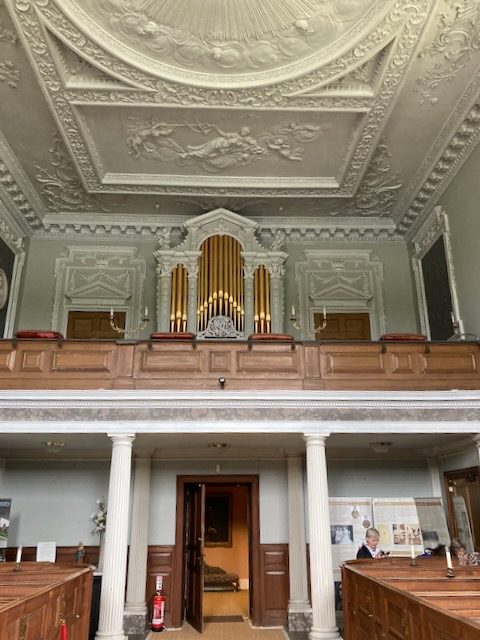
Old and new: St. Nicolas’ pipe organ today. In 1800, the Great Bookham church only had a barrel organ that could play ten tunes. It accompanied their choir of Singers who sang from the West Gallery (balcony) of the church. So their music was probably better than that of many country churches at the time, which often had no musical instruments. This photo shows a memorial tomb/statue that Austen would have seen. The pulpit would have been higher, however, to be seen over the box pews. The blue bulletin board is modern, showing charities the church supports.

Playwright and politician Richard Sheridan (1751-1816), who wrote The Rivals and School for Scandal, owned several manors in the area around Great Bookham.

Later, teenaged C. S. Lewis lived in Great Bookham from 1914-1917, being educated by a private tutor, William T. Kirkpatrick.

St. Nicolas’ Church, Great Bookham, Today

St. Nicolas’ is a very active church, larger than the others we have “visited” so far. I was told the parish includes eleven to twelve thousand people. The electoral role of St. Nicolas’ lists about 250 members, and around 140 attend on Sundays. Three other ministers and five staff members assist the rector in serving the church. The church holds services every Sunday, Communion on Thursdays and Sundays, and several weekly prayer meetings. Members also meet in housegroups.

This board welcomes people to St. Nicolas’, Great Bookham, and advertises concerts and other community events held at the church.

The area also includes Baptist, Catholic, and United Reformed churches, and St. Nicolas’ cooperates with them on projects like Alpha Courses, designed to address people’s questions about Christian faith.

A few years ago, the church removed the Victorian pews and substituted chairs. This gives them the flexibility to hold various kinds of services and to host community events.

Religious education and daily worship are required to be offered in British government schools (student participation is optional). The rector, Alan Jenkins, provides some of this in local schools, briefly sharing a Bible story, prayer, and sometimes a song. School groups also come into the church for harvest or Easter services, with programs organized by the teachers.
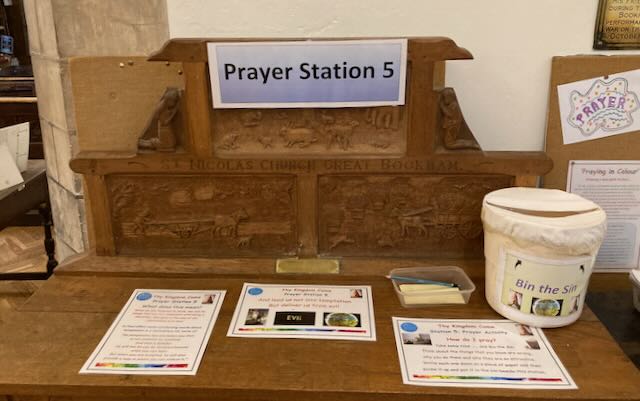
Prayer stations around the church offer ideas for personal prayer.
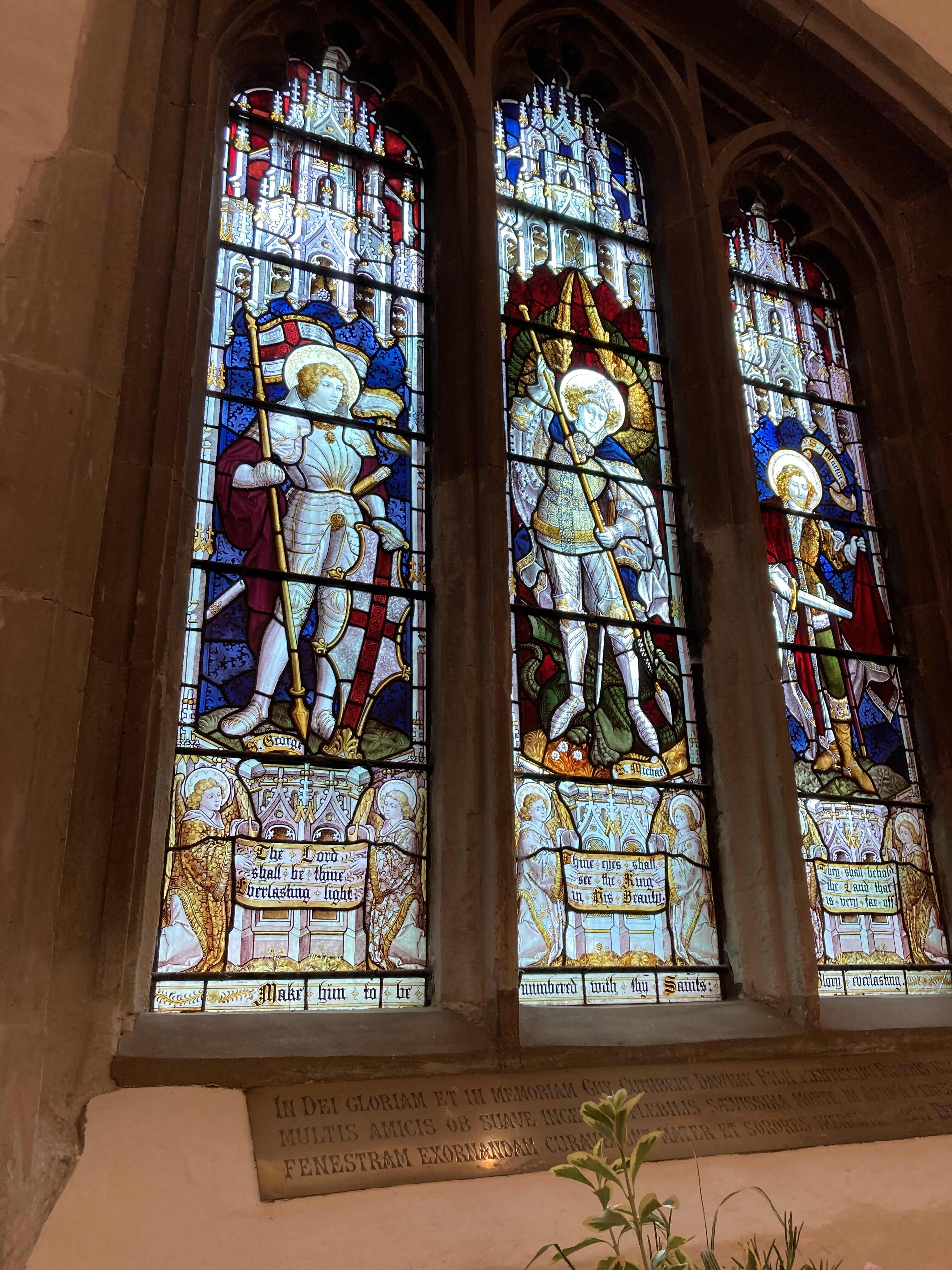
An interesting aside for you: St. Nicolas’ Great Bookham has many lovely stained glass windows today, though there were none when Jane Austen visited. This one honors St. George, patron saint of England; St. Michael, who in the Bible defeats the great dragon, the devil; and St. Martin using his sword to cut his cloak in half in order to give half to a beggar in winter. These windows, with military images, are dedicated to Guy Cuthbert Dawnay, a soldier and Conservative politician. A large cross dedicated to Dawnay in the churchyard says he “was killed by a buffalo while on a hunting expedition in Masailand, E. Africa,” Feb. 28, 1889. Both have verses from Isaiah 60:19-20 about the Lord being his everlasting light.
On the day we visited the Great Bookham church, the central kneeling cushion at the altar commemorated Jane Austen’s connection with the church.

I hope you are enjoying learning about Jane Austen’s churches along with me. There is so much history at these old churches, as well as continuing community life and worship today.

All photos copyright Brenda S. Cox, 2024.

Brenda S. Cox is the author of Fashionable Goodness: Christianity in Jane Austen’s England. She also blogs at Faith, Science, Joy, and Jane Austen.

Sources

1800: Great Bookham at the Time of Jane Austen, Fanny Burney, and R. B. Sheridan, published by the Parochial Council of St. Nicolas Great Bookham (booklet available at the church, funded by JASNA)

The Original of Highbury,” Jane Austen Society Collected Reports II:60,

Church of St. Nicolas, official list entry

St. Nicolas, Great Bookham website and The History of the Building

Special thanks to Tony Grant for telling me that Box Hill was near Great Bookham, and to Rev. Alan Jenkins for taking us up to Box Hill!

Further Exploration

Jane Austen and Great Bookham, by Tony Grant

Box Hill in Jane Austen’s Emma, by Tony Grant (includes the geology, history, and literary connections of Box Hill)

Jane Austen’s Surrey, by Tony Grant (includes views Emma might have seen on her picnic)

Emma Woodhouse’s Surrey, by Tony Grant (includes views Emma might have seen on her picnic)

Other Churches Connected to Jane Austen

Steventon

Chawton

Hamstall Ridware and Austen’s cousin Edward Cooper

Adlestrop Church and the Leigh Family

Stoneleigh Abbey Chapel

Read Full Post »

Today marks the start of a new month-by-month series, “A Year in Jane Austen’s World,” in which I highlight several important events and details that happened in Jane Austen’s novels, letters, and lifetime during each month of the year.

We’ll kick off Jane Austen January (aka “Jane-uary”) by examining passages and situations in each of her novels that occur in January. While some of the novels have no mention of January, others do—with interesting results! Next, we’ll note where Austen was and what she was doing in January by checking her letters for January dates and details. Finally, we’ll highlight events and anniversaries that occurred in January that directed affected Jane Austen or her family.

All of this can help us better understand Austen’s life and times as we look at specific dates, events, and details in the context of months and seasons.

Snowdrops at Chawton House in January, courtesy of Chawton House.

January in Regency Times

One of the highlights of January for Jane Austen’s family was surely Twelfth Night (also known as Epiphany), which falls on January 5th.

Maria Grace, in her article “Celebrating Twelfth Night–Jane in January and You,” explains its religious importance: “Epiphany or Twelfth Night … was the exciting climax of the Christmastide season… It was a feast day to mark the coming of the Magi bearing gifts to the Christ child, and as such was the traditional day to exchange gifts.”

She also explains the social side of Twelfth Night: “In Jane Austen’s day, the party of the year would generally be held on Twelfth Night.” (Austen Variations)

During the Regency Era, people hosted parties and balls to celebrate Christmas and especially the last day of the Christmas season. The entertainment often involved guests playing assigned parts for the evening, dressing up in costumes, eating “Twelfth Cake,” and eating and drinking.

Rowlandson, “Twelfth Night Characters,” Creative Commons, 1811.

In a letter to Cassandra on December 27, 1808, Austen writes about an upcoming ball between Christmas and “Twelfth-day” at Manydown:

I was happy to hear, chiefly for Anna’s sake, that a ball at Manydown was once more in agitation; it is called a child’s ball, and given by Mrs. Heathcote to Wm. Such was its beginning at least, but it will probably swell into something more. Edward was invited during his stay at Manydown, and it is to take place between this and Twelfth-day. Mrs. Hulbert has taken Anna a pair of white shoes on the occasion.

Austen’s Letters (December 27, 1808)

Later, on January 10, 1809, she writes, “The Manydown ball was a smaller thing than I expected, but it seems to have made Anna very happy. At her age it would not have done for me.”

Manydown Great House, Wikipedia Commons, 1833.

January Travel in Jane Austen’s Novels

In Austen’s novels, January is primarily mentioned in the context of parties and travel. Anne Elliot goes to Bath for January and February, Miss Crawford is invited for “a long visit” to see her friend in London in January, Mrs. Jennings goes to her own house in London in January, and Mr. Bingley, Mr. Darcy, and Bingley’s sisters all go to London (when Bingley leaves Netherfield) and stay for the winter.

In Sense and Sensibility, Lucy Steele and her sister, Anne, go to “town” (London) in January to stay with relatives (and subsequently move from house to house throughout the season as socially advantageous opportunities become available):

I had quite depended upon meeting you there. Anne and me are to go the latter end of January to some relations who have been wanting us to visit them these several years! But I only go for the sake of seeing Edward. He will be there in February, otherwise London would have no charms for me; I have not spirits for it.

Sense and Sensibility

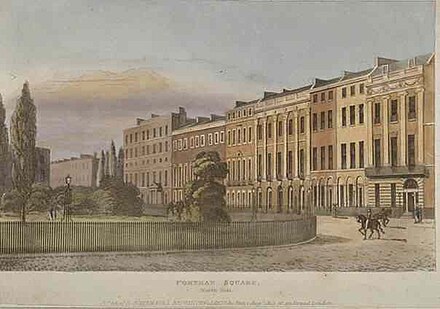
Mrs. Jennings, who “resided every winter in a house in one of the streets near Portman Square,” invites Elinor and Marianne to come with her to London in January when her thoughts begin to turn toward home after Christmas.

Portman Square, London, Wikipedia Commons, 1813.

The London Season

So why do so many of Austen’s characters travel to London in January? Wouldn’t the weather make travel difficult? Wouldn’t they prefer to stay home (and inside) where it’s cozy?

These are fair questions, but after Christmas, a large portion of the genteel class moved “to town” during the winter months for the London Season, which coincided with England’s political schedule, for entertainment and socializing. The Season had previously started in the fall, meaning most people went to London before the bad weather set in, but with the improvement of roads and travel during Austen’s day, the season slowly shifted later.

Here’s an explanation of the London Season from Jane Austen’s House Museum:

The London season coincided with the sitting of Parliament, beginning at some point after Christmas when fashionable families would move into their London houses. The men would attend Parliament, whilst the women shopped, visited, and found husbands for themselves or their daughters. It lasted until early summer, when the ‘beau monde’ would return to their country estates, escaping the city’s stifling heat and pungent smells.

The season was a whirlwind of court balls and concerts, private balls and dances, parties and sporting events. On a typical day, ladies would rise early to go riding in Hyde Park, before returning home to breakfast and spending the day shopping, dealing with correspondence and paying calls.

The Season, Jane Austen’s House Museum

Most villages had assemblies and balls during the winter, but all of the most important social occasions happened “in town.” In Pride and Prejudice, we’re told that the Bennet sisters have little to do “beyond the walks to Meryton” in January and February, when conditions are “sometimes dirty and sometimes cold” (Ch. 27). It makes sense that many young women longed to go to town in the winter, at the height of the London Season and “marriage market,” when the majority of the parties, balls, and social events were held.

Rowlandson, Drawing Room at St. James’s Palace in London, Wikimedia Commons, 1810.

January in Jane Austen’s Letters

January often brings rain, cold weather, and even snow to the various locations where Austen lived and traveled. Austen kept her spirits up, but January in England, especially in homes without central heating or today’s insulation, could not have been entirely comfortable. Balls and assemblies, visits and travel, kept Austen busy and content during the winter months.

Austen’s entries follow below and give us a glimpse into the miserable weather conditions during one particularly snowy and wet January:

17 January 1809 (Castle Square):
“Yes, we have got another fall of snow, and are very dreadful; everything seems to turn to snow this winter.”

24 January 1809 (Castle Square):
“This day three weeks you are to be in London, and I wish you better weather; not but that you may have worse, for we have now nothing but ceaseless snow or rain and insufferable dirt to complain of; no tempestuous winds nor severity of cold. Since I wrote last we have had something of each, but it is not genteel to rip up old grievances.”

In the same letter, Austen describes her writing:
“I am gratified by her having pleasure in what I write, but I wish the knowledge of my being exposed to her discerning criticism may not hurt my style, by inducing too great a solicitude. I begin already to weigh my words and sentences more than I did, and am looking about for a sentiment, an illustration, or a metaphor in every corner of the room. Could my ideas flow as fast as the rain in the store-closet, it would be charming.”

On the topic of the store-closet, she writes this:
“We have been in two or three dreadful states within the last week, from the melting of the snow, etc., and the contest between us and the closet has now ended in our defeat. I have been obliged to move almost everything out of it, and leave it to splash itself as it likes.”

30 January 1809 (Castle Square):
“Here is such a wet day as never was seen. I wish the poor little girls had better weather for their journey; they must amuse themselves with watching the raindrops down the windows. Sackree, I suppose, feels quite broken-hearted. I cannot have done with the weather without observing how delightfully mild it is; I am sure Fanny must enjoy it with us. Yesterday was a very blowing day; we got to church, however, which we had not been able to do for two Sundays before.”

And a final update on the flooded closet:
“The store-closet, I hope, will never do so again, for much of the evil is proved to have proceeded from the gutter being choked up, and we have had it cleared. We had reason to rejoice in the child’s absence at the time of the thaw, for the nursery was not habitable. We hear of similar disasters from almost everybody.”

If you’ve ever dealt with water damage or burst pipes due to cold weather, you know how awful and destructive it can be. Austen makes light, but one can imagine it caused quite a bit of damage.

Snow at Jane Austen’s House Museum, January 2021.

January in Jane Austen’s Lifetime

And finally, let us turn our attention to some of the most important dates and events that happened (or were celebrated) during the first month of the year in Jane Austen’s lifetime. In December 1800, Reverend Austen decided to retire and remove his family to Bath. Austen’s letters in January 1801 prove an interesting read as she and the Austen family prepare to move later in the year:

3 January 1801 (Steventon):
Austen writes that her mother wants to keep two maids and quips about their plans to have “a steady cook and a young giddy housemaid, with a sedate, middle-aged man, who is to undertake the double office of husband to the former and sweetheart to the latter.”

Austen discusses three parts of Bath where they might live:
“Westgate Buildings, Charles Street, and some of the short streets leading from Laura Place or Pulteney Street.” She writes extensively about each neighborhood and several others, giving her opinion and hopes about each. She details which pictures, furniture, and beds they are choosing to keep or leave behind and asks Cassandra’s advice. And she shares plans for the family to travel to Bath a few weeks from then.

Austen shares own thoughts on their move to Bath:
“I get more and more reconciled to the idea of our removal. We have lived long enough in this neighborhood: the Basingstoke balls are certainly on the decline, there is something interesting in the bustle of going away, and the prospect of spending future summers by the sea or in Wales is very delightful. For a time we shall now possess many of the advantages which I have often thought of with envy in the wives of sailors or soldiers. It must not be generally known, however, that I am not sacrificing a great deal in quitting the country, or I can expect to inspire no tenderness, no interest, in those we leave behind…”

The letter is full of useful information and well-worth a read. You can access it HERE.

14 January 1801 (Steventon):
Austen speaks of the many visitors they’ve received in response to the news that Rev. Austen is retiring and the family is moving to Bath. She says, “Hardly a day passes in which we do not have some visitor or other: yesterday came Mrs. Bramstone, who is very sorry that she is to lose us, and afterwards Mr. Holder, who was shut up for an hour with my father and James in a most awful manner.”

4 Sydney Place, Bath.
Plaque outside 4 Sydney Place, Bath.

January Dates of Importance

This brings us now to several dates that would have been quite important to Austen personally:

Celebrations/Birthdays:

9 January 1773: Jane Austen’s sister, Cassandra Elizabeth Austen, born.

23 January 1793: Edward Austen’s first child, Fanny, born.

Goodbyes/Sorrows:

January 1796: Tom Lefroy leaves Ashe for London (and never returns) and Tom Fowle (Cassandra’s fiancé) sets sail for the Indies, where he later dies.

21 January 1805: Rev. George Austen (Jane’s father) dies suddenly in Bath.

Writing:

28 January 1813: Pride and Prejudice was published, by Thomas Egerton (Whitehall, London).

21 January 1814: Austen begins writing Emma.

The Joys of Sleuthing

I hope you’ve enjoyed this first installment of our month-by-month exploration of Jane Austen’s world. I was pleasantly surprised to find that there was so much more to research and explore about the month of January than I anticipated. I enjoyed sleuthing around, following my nose, and discovering what I could uncover–just with the word “January.” If you have ideas about what I might pursue for February in Jane Austen’s World, please share your ideas in the comments.


RACHEL DODGE teaches college English classes, gives talks at libraries, teas, and book clubs, and writes for Jane Austen’s World blog. She is the bestselling author of The Little Women DevotionalThe Anne of Green Gables Devotional and Praying with Jane: 31 Days Through the Prayers of Jane Austen. Now Available: The Secret Garden Devotional! You can visit Rachel online at www.RachelDodge.com.

Read Full Post »

After much celebration, Christmas and New Year’s festivities are over. I dare not weigh myself until I’ve dieted for a week. Wine and spirits are banned for the time being. Decorations will eventually be stashed away as life slowly returns to normal. 

We still celebrate these holidays in similar ways to those held in the past. Lesley-Anne McCleod wrote about the similarity of Christmas and New Year’s celebrations in a 2016 post entitled A Regency New Year–“Begin as you mean to go on:

“New Year’s Eve and New Year’s Day in the Regency era in England was celebrated, it seems, very much like Christmas with: Parties and celebrations … particularly among the Royals … gifts … and acts of charity…”

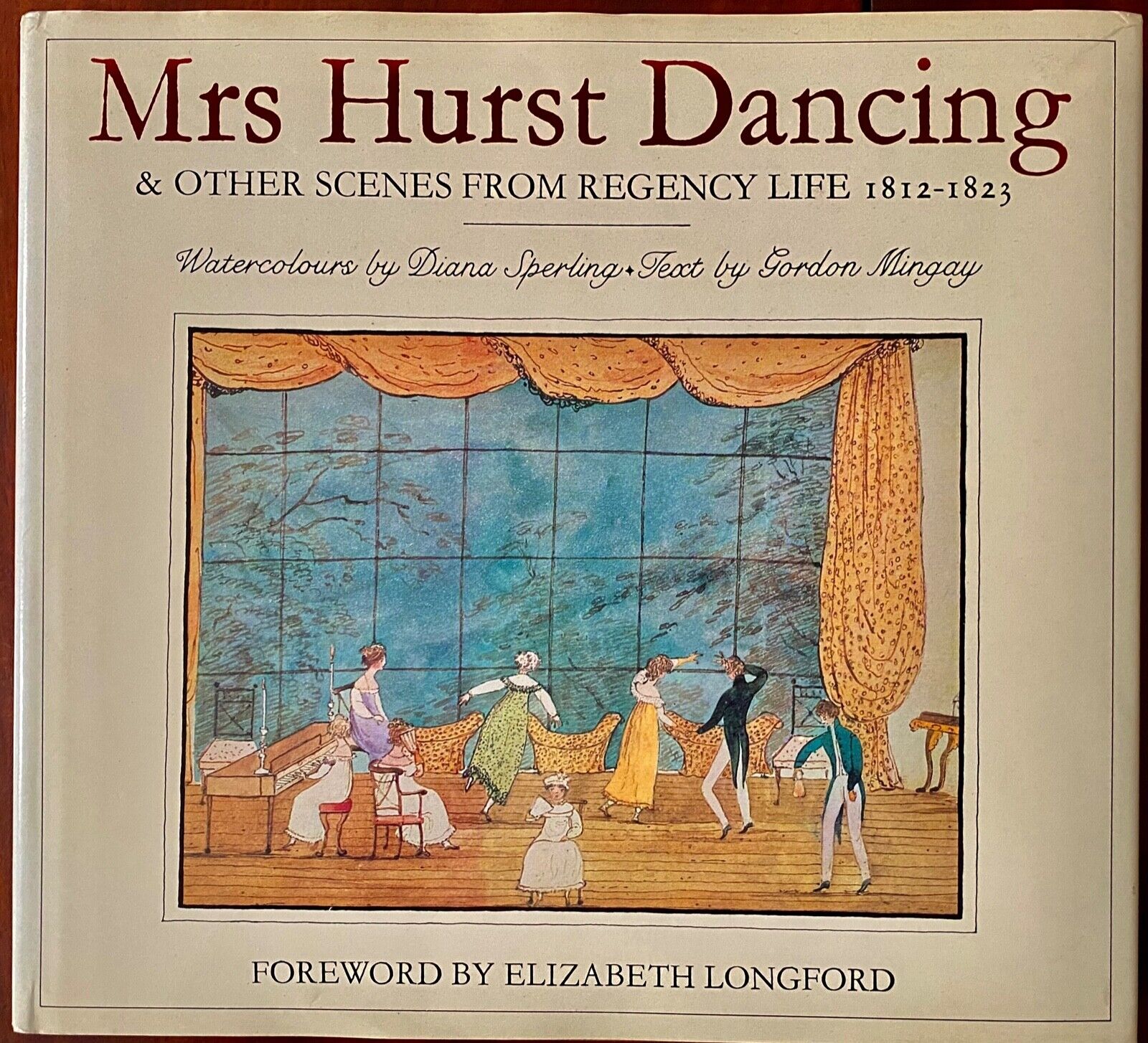
hurst dancing book cover ebay

Book Cover of Mrs Hurst Dancing

Dancing:

Today as in Austen’s time we still party and dance the night away. In the book cover image above, Diana Sperling painted a private dance party at home, with the rug rolled up and the furniture pulled aside. One of the ladies plays the pianoforte for the dancers. Some – an older woman/chaperone (?), a young girl wearing a cap, and a young woman without a cap – sit on the sidelines.

Screen Shot 2024-01-02 at 8.22.13 AM

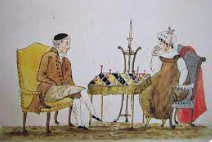
Pappy and Mum play chess

While the younger crowd danced exuberantly, one imagines that their elders enjoyed a quieter way to spend the time – near a fire, perhaps, while playing a game, much like Mr Woodhouse and Emma or Mr Knightley might have done.

Dining and Feasting:

Screen Shot 2024-01-02 at 8.21.35 AM

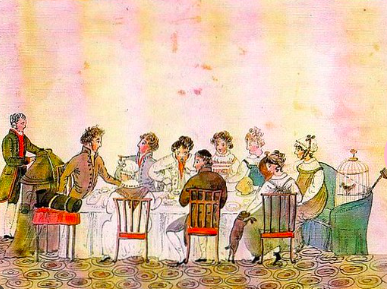
Dynes Hall, Family at Dinner

Dinners with  guests and family would be intimate, as in this image (see the bird cage at right?), or enormous, as with the Royals and the very wealthy, like Mr Bingley and Mr Darcy. 

Please Note: images might be copyrighted. If enlarged, these will lose clarity.

Transportation:

Screen Shot 2024-01-02 at 8.35.52 PM

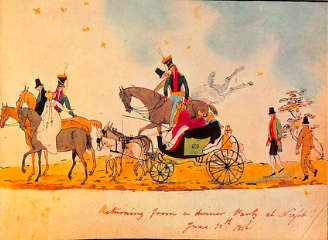
Returning from a dinner party at night, 1816

Visiting neighbors or friends in nearby villages at night presented logistics. Roads were unlit and often deeply rutted and muddy after heavy rains or melting snow. The preferred days for traveling coincided with the full moon, which at times was obscured by clouds. Lanterns helped to pave the way, yet the going was still rough, as this Sperling image shows.

The threat of snow was enough to put a spoke in plans. In Austen’s Emma, Mr Woodhouse, having been enticed from his cozy chair in front of his fire to attend the Westons’ dinner, hastened before food service hardly began to hie it back home before the snow accumulated. 

Charity: 

Screen Shot 2024-01-02 at 8.18.11 PM

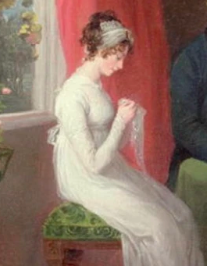
Detail, Group portrait at a drawing room table, Maria Spilsbury

Charity played an important part in Regency England. Ladies from the middle classes and upward gave out baskets containing contents distributed to the poor – including knitted and sewn items, and food. When Mrs Austen, Jane’s mother, received visitors in the small parlor in Steventon Rectory, she would work on her latest project. 

A contemporary news item mention the following:

“Tuesday being New Year’s Day, eight girls, who are clothed and put to school by Lady Mill, dined at Mattisfont-house, the seat of Sir Charles Mill, agreeable to the usual custom. – Hampshire Chronicle, Monday 7, January 1805,” McLeod, A Regency New Year

Austen frequently mentioned charitable work in her novels and letters. She was:

… concerned with the practical needs of her neighbours: ‘Dame Tilbury’s daughter has lain-in – Shall I give her any of your Baby Cloathes?’ she asks Cassandra, October 1798.” 

and

On Christmas Day she wrote: “Of my charities to the poor since I came home you shall have a faithful account. – I have given a p.r of Worsted Stockgs to Mary Hutchins, Dame Kew, Mary Steevens, & Dame Staples; a shift to Hannah Staples, & a shawl to Betty Dawkins; amounting in all to about half a guinea. – Jane Austen’s Microcosm

Twelfth Night on January 5th marks the end of the Christian holiday season. This and many other Western holiday traditions, many harking back to the 5th century, have stood the test of time. Each generation and country have placed their own mark on how these customs are celebrated.

More on the topic:

Read Full Post »

“I had expected to find everything about the place very fine and all that, but I had no idea of its being so beautiful.” –Mrs. Cassandra Leigh Austen, Aug. 13, 1806, on a visit to Stoneleigh Abbey with her daughters Jane and Cassandra

Merry Christmas and Happy Holidays! As my gift to you, let’s take a trip to Stoneleigh Abbey together.

Jane Austen visited Stoneleigh Abbey in 1806. She and her mother and sister were visiting their cousin, Rev. Thomas Leigh, in Adlestrop when his distant cousin, the Honorable Mary Leigh, died. Rev. Thomas inherited the wealthy estate. He took his poorer relations, the Austens, with him to take possession, as a treat for them. They enjoyed it very much, as Mrs. Austen wrote in a letter.  She said the house was so large that they needed signposts to find their way, and that it was not only very “fine,” but more beautiful than she had imagined. Catherine Morland, similarly, when she saw Northanger Abbey, “was struck . . . beyond her expectation, by the grandeur of the abbey.”

Based on income, Stoneleigh Abbey was an even grander place than Pemberley or Sotherton (the Rushworth estate in Mansfield Park) would have been. Austen tells us that Darcy’s income was £10,000 a year and Mr. Rushworth’s was £12,000 a year. But the income of the Leighs of Stoneleigh Abbey, in Jane Austen’s time, was even higher, at £17,000 a year, which Victoria Huxley says was “perhaps the annual equivalent of a million pounds in today’s values” (p. 9). (We were told when touring Chatsworth that the income there in Austen’s time was about £30,000, three times Darcy’s income; I haven’t found confirmation of that number anywhere, though.)

Today, ideally you need a car or a tour bus to get you to Stoneleigh Abbey. It is about an hour’s drive north of Oxford or about 40 minutes southeast from Birmingham. If you want to take public transport, it looks like you’ll have a half-hour’s walk at the end of your journey.

I went with the JASNA Summer Tour. We saw the Adlestrop church the same day; it’s only about an hour’s drive away.

Stoneleigh Abbey, like Austen’s fictional Northanger Abbey, is a mix of older monastic buildings and newer buildings. (Newer in Austen’s time, at least.) Let’s take a trip through it, with some quotes from Austen’s novels.

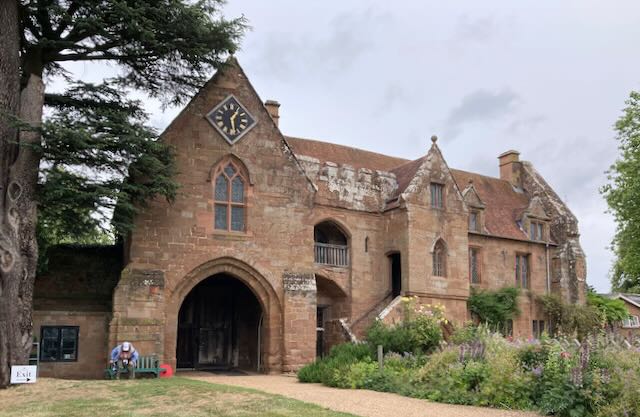
The red sandstone gatehouse, where you buy entry tickets, is from the 14th century, a remnant of the original Cistercian monastery. At this gatehouse, built in 1346 by Abbot Robert de Hoeckle, the poor received alms and travelers found hospitality.

So low did the building stand, that she found herself passing through the great gates of the lodge into the very grounds of Northanger, without having discerned even an antique chimney. . . . To pass between lodges of a modern appearance, to find herself with such ease in the very precincts of the abbey, and driven so rapidly along a smooth, level road of fine gravel, without obstacle, alarm, or solemnity of any kind, struck her as odd and inconsistent.–Catherine Morland, Northanger Abbey

Now we are coming to the lodge-gates; but we have nearly a mile through the park still.–Maria Bertram, Mansfield Park

The tour did not take us into this north wing. But you can still see arches on the walls, from the original monastery church. They are now bricked over. A cloister and medieval stained glass windows remain in the older buildings.
Another building from the old monastery. Stoneleigh Abbey was a small Cistercian monastery from 1155 until Henry VIII dissolved the monasteries in 1536. The Leigh family bought it in 1561. Catherine Morland was disappointed not to stay in such a building at Northanger Abbey.

[Catherine] was hardly more assured than before, of Northanger Abbey having been a richly endowed convent at the time of the Reformation, of its having fallen into the hands of an ancestor of the Tilneys on its dissolution–Northanger Abbey

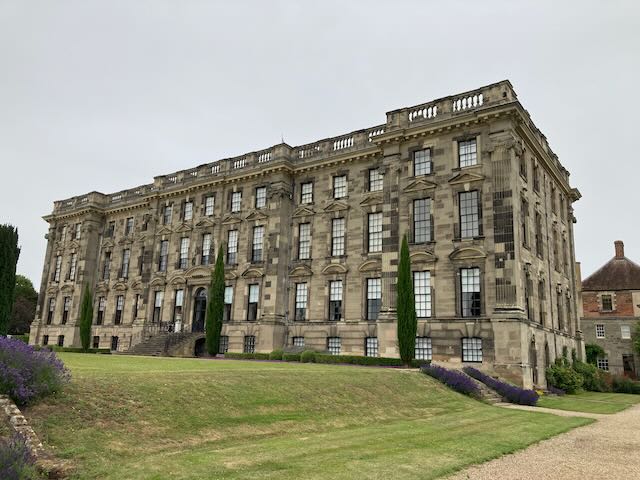
The baroque West Wing is the most impressive building, built in the 1720s by Edward, the third baron Leigh. He married a rich heiress. After his Grand Tour on the continent, he was inspired to create his own Italian-style palace. Mrs. Austen wrote that there are 45 windows in the front.

She was struck, however, beyond her expectation, by the grandeur of the abbey, as she saw it for the first time from the lawn.–Catherine Morland, Northanger Abbey

Even Fanny had something to say in admiration. . . . Her eye was eagerly taking in everything within her reach; . . . being at some pains to get a view of the house, and observing that “it was a sort of building which she could not look at but with respect”–Mansfield Park

Architect Francis Smith designed the Stoneleigh Abbey West Wing, which cost £3,300. The older abbey buildings became servants’ quarters.
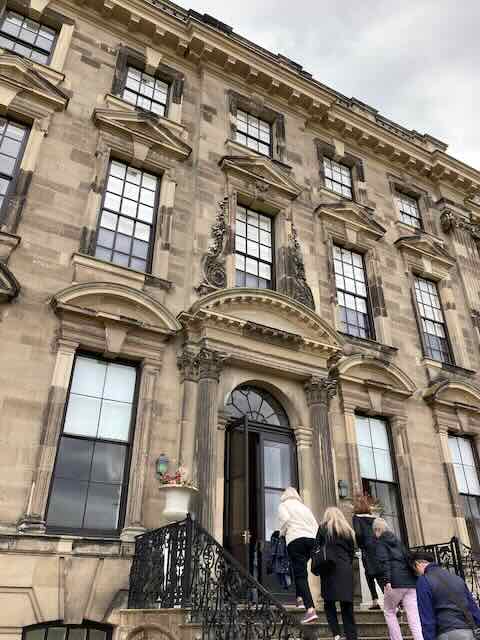
A flight of stairs leads up to the main entry to Stoneleigh Abbey, West wing

Miss Bertram could now speak with decided information of what she had known nothing about when Mr. Rushworth had asked her opinion; and her spirits were in as happy a flutter as vanity and pride could furnish, when they drove up to the spacious stone steps before the principal entrance.–Mansfield Park

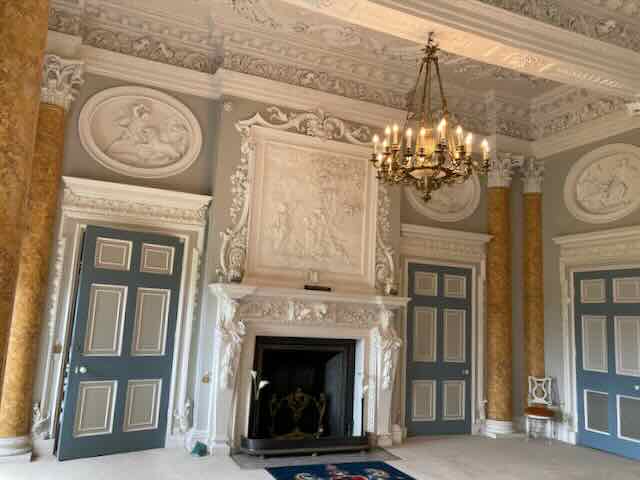
One end of the impressive “saloon” (salon, entry room) of Stoneleigh Abbey. Plaster decorations show myths of the Greek hero Hercules. Edward, the fifth Lord Leigh, decorated this room in the 1760s while doing vast “improvements” to his manor.
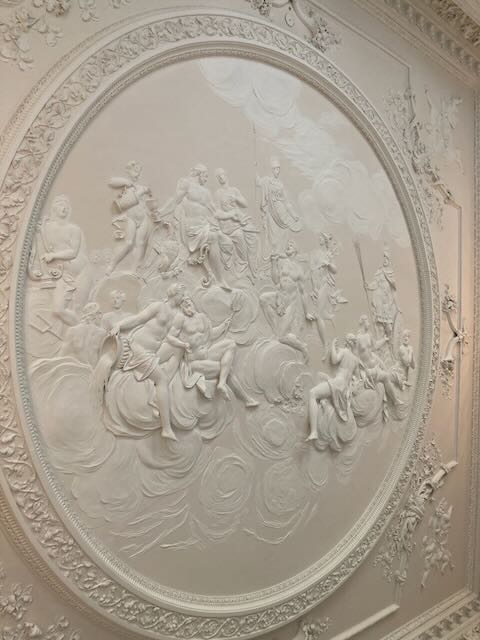
Ceiling plasterwork in the Stoneleigh Abbey saloon showing Hercules joining the gods. Ironically, Hercules suffered from bouts of madness, as did Edward Leigh himself.

An abbey! Yes, it was delightful to be really in an abbey! But she doubted, as she looked round the room, whether anything within her observation would have given her the consciousness. The furniture was in all the profusion and elegance of modern taste.–Catherine Morland, Northanger Abbey

The whole party rose accordingly, and under Mrs. Rushworth’s guidance were shewn through a number of rooms, all lofty, and many large, and amply furnished in the taste of fifty years back, with shining floors, solid mahogany, rich damask, marble, gilding, and carving, each handsome in its way.–Mansfield Park

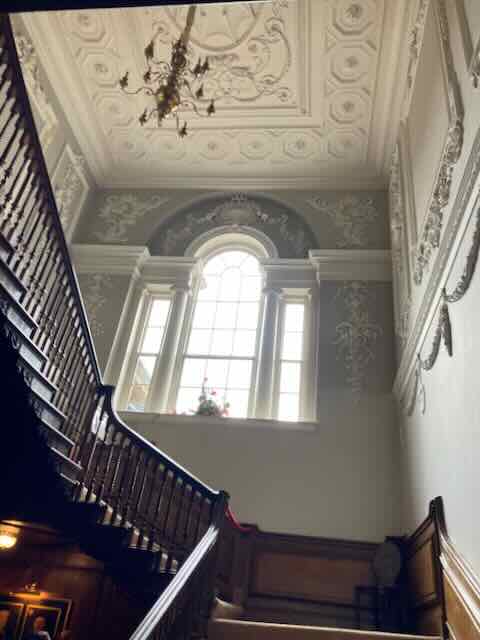
The main staircase of Stoneleigh Abbey, one of three staircases Jane Austen’s mother mentions.

They returned to the hall, that the chief staircase might be ascended, and the beauty of its wood, and ornaments of rich carving might be pointed out.–Northanger Abbey

The lower part of the house had been now entirely shewn, and Mrs. Rushworth, never weary in the cause, would have proceeded towards the principal staircase, and taken them through all the rooms above, if her son had not interposed with a doubt of there being time enough.–Mansfield Park

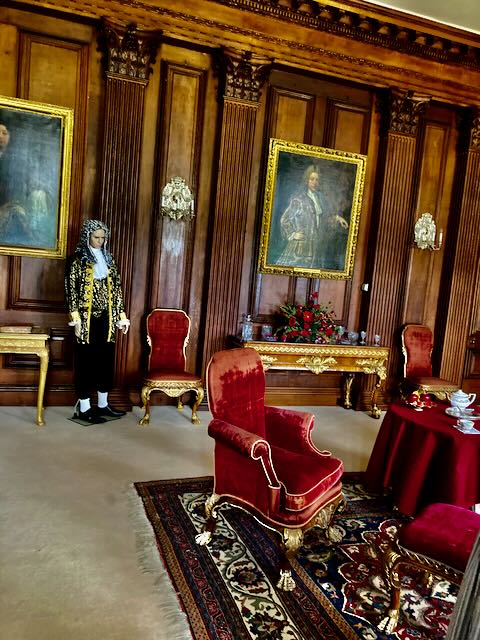
The drawing room of Stoneleigh Abbey. After dinner, the ladies would “withdraw” to the “withdrawing room,” later called the drawing room. The gentlemen would join them after a time.

The general leads Catherine “into a room magnificent both in size and furniture—the real drawing-room, used only with company of consequence. It was very noble—very grand—very charming!—was all that Catherine had to say, for her indiscriminating eye scarcely discerned the colour of the satin; and all minuteness of praise, all praise that had much meaning, was supplied by the general: the costliness or elegance of any room’s fitting-up could be nothing to her; she cared for no furniture of a more modern date than the fifteenth century.”–Northanger Abbey

The drawing room clock, from 1786, plays carillon music on the hour. Stoneleigh Abbey

“Till midnight, she supposed it would be in vain to watch; but then, when the clock had struck twelve, and all was quiet, she would, if not quite appalled by darkness, steal out and look once more. The clock struck twelve—and Catherine had been half an hour asleep.”–Northanger Abbey

Stoneleigh Abbey card room fireplace, with plates of “the prettiest English china,” hand painted by ladies of the family.

The fireplace, where she had expected the ample width and ponderous carving of former times, was contracted to a Rumford, with slabs of plain though handsome marble, and ornaments over it of the prettiest English china.–Northanger Abbey

A Rumford was an invention that made fireplaces more efficient. They are still used today.

Stoneleigh Abbey card room, set up for a game of cards.

Mr. Elton had retreated into the card-room, looking (Emma trusted) very foolish.–Emma

Portraits in the Card Room. All the rooms we saw were lined with family portraits.

Of pictures there were abundance, and some few good, but the larger part were family portraits, no longer anything to anybody but Mrs. Rushworth–Mansfield Park

Edward, fifth Lord Leigh, bequeathed most of his extensive library to his alma mater, Oriel College at Oxford. These included “outstanding works on architecture and music, his scientific instruments, maps and prints.” (Jane Austen & Adlestrop, 22).
The library of Stoneleigh Abbey was replenished by later heirs.

Marianne, who had the knack of finding her way in every house to the library, however it might be avoided by the family in general, soon procured herself a book.–Sense and Sensibility

Ready to play chess in the library, Stoneleigh Abbey

“What a delightful library you have at Pemberley, Mr. Darcy!”

“It ought to be good,” he replied, “it has been the work of many generations.”

“And then you have added so much to it yourself, you are always buying books.”

“I cannot comprehend the neglect of a family library in such days as these.”–Miss Bingley and Mr. Darcy, Pride and Prejudice

Stoneleigh Abbey library

After tea, Mr. Bennet retired to the library, as was his custom–Pride and Prejudice

Ladies’ dressing table, Stoneleigh Abbey

“My mother is tolerably well, I trust; though her spirits are greatly shaken. She is up stairs and will have great satisfaction in seeing you all. She does not yet leave her dressing-room.”–Jane Bennet, Pride and Prejudice

The chapel at Stoneleigh Abbey is considered to be the model for the chapel at Sotherton in Mansfield Park. Crimson cushions appear over the balcony ledge, as in Mansfield Park. Rev. Thomas Leigh read prayers (led a worship service) in the chapel twice a day, with morning prayers at 9 A.M.

Fanny’s imagination had prepared her for something grander than a mere spacious, oblong room, fitted up for the purpose of devotion: with nothing more striking or more solemn than the profusion of mahogany, and the crimson velvet cushions appearing over the ledge of the family gallery above. “I am disappointed,” said she, in a low voice, to Edmund. “This is not my idea of a chapel. There is nothing awful here, nothing melancholy, nothing grand.” . . .

Mrs. Rushworth began her relation. “This chapel was fitted up as you see it, in James the Second’s time. Before that period, as I understand, the pews were only wainscot; and there is some reason to think that the linings and cushions of the pulpit and family seat were only purple cloth; but this is not quite certain. It is a handsome chapel, and was formerly in constant use both morning and evening. Prayers were always read in it by the domestic chaplain, within the memory of many; but the late Mr. Rushworth left it off.” . . .

“It is a pity,” cried Fanny, “that the custom should have been discontinued. It was a valuable part of former times. There is something in a chapel and chaplain so much in character with a great house, with one’s ideas of what such a household should be! A whole family assembling regularly for the purpose of prayer is fine!”–Mansfield Park

See my post on The Stoneleigh Abbey Chapel and Mansfield Park for a visit to the chapel with further quotes from Mansfield Park.

Queen Victoria’s bedroom at Stoneleigh Abbey. In 1858, Queen Victoria stayed for two nights at the Abbey, in a suite of five rooms. The furniture was painted white and gold, according to the Queen’s preference.

In a house so furnished, and so guarded, she could have nothing to explore or to suffer, and might go to her bedroom as securely as if it had been her own chamber at Fullerton.–Catherine Morland, Northanger Abbey

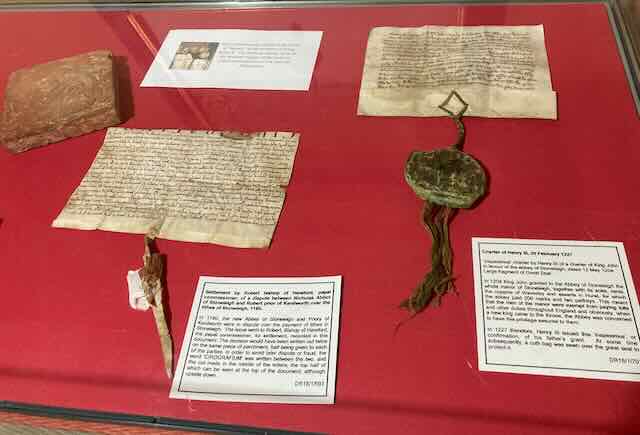
Further rooms at Stoneleigh Abbey display historical relics, such as the monks’ charters and seals.

Northanger turned up an abbey, and she was to be its inhabitant. Its long, damp passages, its narrow cells and ruined chapel, were to be within her daily reach, and she could not entirely subdue the hope of some traditional legends, some awful memorials of an injured and ill-fated nun.–Catherine Morland, Northanger Abbey

Humphry Repton was hired to improve Stoneleigh Abbey and its surroundings. His Red Book, showing before and after pictures, still exists.
Repton moved the river toward Stoneleigh Abbey so you could see the house reflected in the water.

“Smith’s place is the admiration of all the country; and it was a mere nothing before Repton took it in hand. I think I shall have Repton.”–Mr. Rushworth, Mansfield Park

A ha-ha (see below) at Stoneleigh Abbey gives an uninterrupted view across the fields.
From the other side of Stoneleigh Abbey’s hedge of lavender shown above, you can see the wall that kept animals from trespassing to the area around the house. A ha-ha is a walled ditch dug to act as a fence without disrupting the view.

A few steps farther brought them out at the bottom of the very walk they had been talking of; and standing back, well shaded and sheltered, and looking over a ha-ha into the park, was a comfortable-sized bench, on which they all sat down. . . .

“You will hurt yourself, Miss Bertram,” [Fanny Price] cried; “you will certainly hurt yourself against those spikes; you will tear your gown; you will be in danger of slipping into the ha-ha.”–Mansfield Park

In 1946, Stoneleigh Abbey became “one of the first stately homes to open its doors to the public” (Stoneleigh Abbey, 18). A fire destroyed much of it in 1960, though most of the furniture and paintings were rescued. In 1996, a trust was set up to restore it, at a cost of £12 million. They did an amazing job. Restoration was also done on the grounds and the lake. The restoration work sought to improve the habitats of bats, otters, kingfishers, and other species

Restorers also worked on conserving water management structures such as these locks.
We exit back through the Stoneleigh Abbey gatehouse, having enjoyed a beautiful day.

During their visit, the Austens enjoyed extensive walks through the grounds. Rachel Dodge has posted some of those lovely views. The Austens must have also attended the Stoneleigh Church, St. Mary the Virgin, though we didn’t get to visit it this trip. 

I hope you have enjoyed our visit to Stoneleigh Abbey with Jane Austen’s characters, and that you can see it in person some day! This year, the Abbey celebrated Christmas with a Christmas fair and a series of concerts, including carols in the chapel. If you have been to Stoneleigh Abbey, please tell us about your impressions!

Brenda S. Cox is the author of Fashionable Goodness: Christianity in Jane Austen’s England. She also blogs at Faith, Science, Joy, and Jane Austen.

All photos in this post, © Brenda S. Cox, 2023.

Sources and Further Reading

Jane Austen & Adlestrop: Her Other Family, by Victoria Huxley. US Amazon link

Stoneleigh Abbey by Paula Cornwell (obtained from Stoneleigh Abbey)

Jane Austen: A Family Record, 2nd ed., by Deirdre Le Faye

The Stoneleigh Abbey Chapel and Mansfield Park

Jane Austen’s Rich(er) Leigh Family Connections at Adlestrop and Stoneleigh Abbey 

Visiting Stoneleigh Abbey

Cassandra Leigh Austen’s Stay at Stoneleigh Abbey (letter)

Jane Austen’s Leigh Family: Stories Behind the Stories

Jane Austen’s Clergymen and Her Leigh Family

Jane Austen’s Mansfield Park and Stoneleigh Abbey

More pictures of Stoneleigh village, church, and abbey 

Stoneleigh Abbey website

Read Full Post »

Ah, holiday gatherings! December is an historic month to celebrate good cheer and good will towards family, friends, and neighbors – this means inviting guests for food, drink, music, games, and entertainments. During Austen’s time, the hosts at houses or assemblies traditionally provided refreshments for their guests. Centuries later we still follow these wonderful customs. This post concentrates on popular drinks prepared for the ladies in the Regency era.

The Darking Hundred describes the drinks most popular during this time – Food, Part the Third: What People Drank, Darking Hundred

“Cordials were popular for social occasions—ratafia, orgeat, negus, and punch among others. Ratafia used a base of distilled spirits into which aromatics were infused, often almonds or fruit pits, and the brew was then sweetened. Orgeat was a syrup made with sugar, orange flower water, and almond that was added to distilled spirits. Negus used a base of sherry or port, to which were added hot water, sugar, nutmeg, and lemon; it was considered an appropriate drink for men or women.“

Regency Drinks

According to history, the patronesses of Almack’s served watered down drinks of orgeat and ratafia, since both of these refreshments were deemed acceptable for ladies. The drinks remained syrupy sweet. Men in general arrived at this strictly exclusive event already soused from having drunk hard liquor at their clubs or at home. Syrupy sweet, watered down drinks would not have tempted them.

Screen Shot 2023-12-20 at 11.32.27 PM

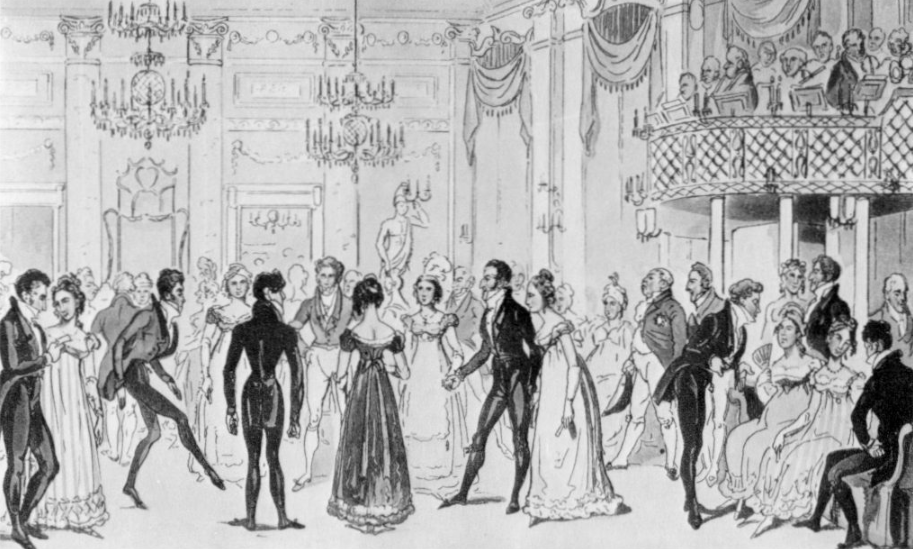
A Ball at Almack’s Assembly Rooms in London, 1821, Version of illustration from the “Tom and Jerry” book (1821) by George CruikshankWikipedia

“There was a balcony at one end where the small orchestra were seated. Refreshments (such as they were) were deliberately (revoltingly) mediocre: weak lemonade or orgeat or ratafia, dry biscuits and day-old brown bread and butter. – Almack’s – it’s not quite what you think…

In no particular order, the drinks served in public assemblies and at festive gatherings were:

Orgeat

This  light, sweet drink was considered appropriate for debutantes. While orgeat was not mentioned by Jane Austen, it was popular in her time.  Pronounced or-zat, readers of Georgette Heyer novels can easily associate this drink with the watered down refreshments described at Almack’s that were considered too syrupy for male tastes. 

Author Sharon Lathan provides a fascinating insight into the history of orgeat, which was once made with barley. The syrup can be purchased today to satisfy a variety of tastes.

“Orgeat syrup, made with almond extract, sugar, and orange flower water, was (and still is) added as a flavoring to punch, coffee, or cocktails. I wouldn’t want to drink this milky liquid by itself, and a little bit goes a long way (we usually only use 1/4 ounce per cocktail). Some drinks were made like orgeat lemonade. Orgeat lemonade would have been orgeat syrup, lemonade and soda water, and might well have been the sort of drink served at Almack’s. and orgeat (distilled from barley or almonds with orange flower water, considered to be a light refreshing drink), Almack’s Assembly Halls – LLWiki

Orgeat was once made with bitter almonds, which in large quantities contained cyanide. The drink could be lethal. Today’s recipes are made with sweet almonds, which reduce the levels of hydrocyanic acid, and are considered safe, except for individuals with allergies. Wikipedia

The Spruce Eats  offers a modern orgeat recipe. Here’s the link: Orgeat Syrup Recipe

Negus

Negus was an English drink popular in the 18th and 19th centuries. It was an “extremely popular party drink throughout Georgian and early Victorian times.” — The Jane Austen Cookbook, Maggie Black & Deirdre Le Faye)” Click on this link. 

Austen mentioned negus in The Watsons:

“As Tom Musgrave was seen no more, we may suppose his plan to have succeeded, and imagine him mortifying with his barrel of oysters in dreary solitude, or gladly assisting the landlady in her bar to make fresh negus for the happy dancers above.” – The Watsons

Interestingly, during the early Regency era negus and white soup were expected to be served near midnight at balls, such as the one at Netherfield Park. Here’s Martha Lloyd’s recipe for the soup. 

One can imagine the aftermath of the dinner in Emma, when the guests, because of Mr Woodhouse’s panic, quickly departed from the Weston’s party due to a smidgen of fallen snow. Did anyone receive a comforting drink of negus before they hastened into their carriages, I wonder?  Mr Elton perhaps?

Negus still figured prominently in Victorian times. Charles Dickens in  “A Christmas Carol” mentioned old Mr Fezziwig:

“There were more dances, and there were forfeits, and more dances, and there was cake, and there was negus, and there was a great piece of cold roast, and there was a great piece of cold boiled, and there were mince pies and plenty of beer.” –  Negus – vintage cookbook shelf

Over time, negus morphed into a children’s drink . Yet it still contained alcohol!!. No longer fashionable, the beverage had become similar to mulled wine, as this recipe in Mrs Beeton’s Book of Household Management attests, and it was made with a variety of ingredients. 

“Negus does have striking similarities to mulled wine — with interchangeable main ingredients of red wine/port, nutmeg, sugar, and citrus like lemon juice or orange zest. So, it seems, the most striking and significant difference between the two popular warm sips is the addition of hot water to the negus recipe A Short History of Negus, the Mulled Wine Beverage of Yesteryear | VinePair

Ratafia

Ratafia was another beverage deemed suitable for ladies.  Its preparation began in December, with the concoction ready to drink in mid-February. Abigail Reynolds writes:

“…along with lemonade, orgeat, and punch, so I assumed it was similarly low in alcoholic content. Silly me! It’s a liqueur made of brandy with fruit, spices, and crushed fruit pits steeped in it for 1-2 months, then filtered and sweetened with large amounts of sugar. The sweetness and fruitiness meant that men didn’t touch the stuff, but if you think about that recipe for a minute, you’ll realize it’s nothing more than slightly diluted flavored brandy. – Austen Variation, Abigail Reynolds, – Ratafia is Not for Sissies  

In her excellent blog, Lesley-Anne McLeod wrote: 

“The Professed Cook” has a section titled Des Ratafiats or Of sweet Drams or Cordials. It includes some ten recipes for different versions of ratafia. They all begin with brandy and they all take thirty to forty days to prepare and infuse. The adventurous cook, it seems, can add almost anything to the brandy. Some of the ingredients listed in “The Professed Cook” include walnuts, quinces, orange-flowers, juniper-berries, lemon-peel, anise seeds and apricots. Plenty of sugar is included and three spices in these receipts in particular–coriander, cinnamon and cloves.” – Lesley-Anne McLeod, Ratafia, The Lady’s Choice 

Ratafia, was either distilled or with an infusion of fruits and spices. The drink had an alcoholic base of Marc brandy and grape juice. A liqueur routinely made in December, could be ready to serve two months later on Valentine’s Day. A recipe for dark brown ratafia suggested that it be stored in an oak barrel for at least two years. — Gin Affair Champagne Punch – Bridgerton Cocktail

At the end of an evening:

In Austen’s day, often after a local assembly ball, a neighbor’s party, or a return from the opera or theatre in town, supper was served quite late. People would gather to eat or drink before returning home in the wee hours of the morning. White soup was served, as well as negus, which was prepared a half hour before guests left for home. 

More on the topic:

Read Full Post »

« Newer Posts - Older Posts »