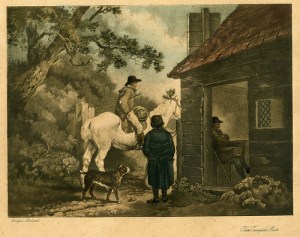
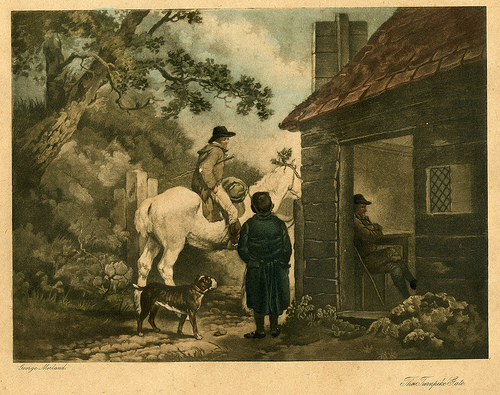
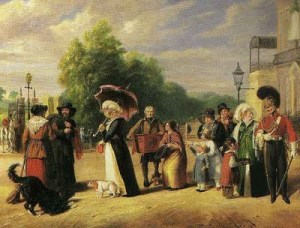
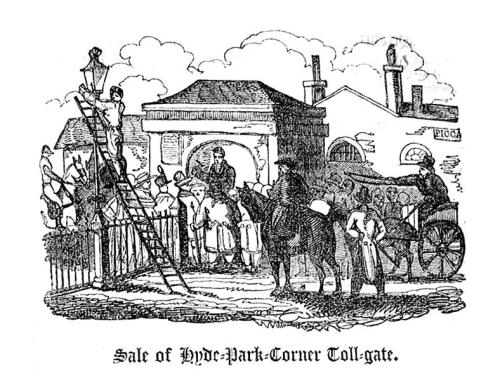
Turnpike Gate, George Morland
Historical romances abound with tales of aristocrats falling in love with beautiful women outside of their own class and marrying them. Several years ago in The Dairy Maid and the Master of Uppark, I wrote about Sir Harry Fetherstonhaugh, who married his milkmaid. These exceptions prove the rule, for Society frowned severely upon those who married downward. Thomas Thynne, 5th Viscount Weymouth, who made the mistake of falling in love with the tollgate keeper’s daughter, was never to become the 3rd Marquess of Bath. He first eloped to Paris with his pretty bride, then lived in Italy, where he waited to claim his inheritance. No matter how hard his father (the 2nd Marquess) tried, he could not get around the legalities of the entail and disinherit his son. So the Marquess dug in his heels, willing himself to live longer than the Viscount …
The first Marquess of Bath was said to have been a great womanizer, gambler, and dissipator. His biggest contribution to posterity was in hiring Capability Brown to landscape his estate at Longleat, a former priory, changing the gardens from formal parterres to a more natural design. After his death in 1792, his son, Thomas Thynne, the second Marquess of Bath, rebuilt the outdated portions of the old priory. By 1815, he had spent over£100,000 on improvements. In 1820, the second Marquess opened the grounds to the public once a week and free of charge, encouraging picknics and similar leisurely pursuits. One would think that by setting such a sober example, his children would live equally responsible lives, but this was not to be the case for all.
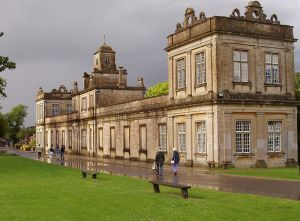
The 2nd Marquess and his plumb intellectual wife, Isabella, had eleven children. Two daughers married well, but three of his sons caused them no end of trouble. Without consulting his parents, Thomas, the 24-year-old heir, eloped with beautiful, raven-haired Harriet Robbins, the daughter of a humble local toll-keeper named Thomas Robbins. Up to that point, the young Viscount had not led an exemplary life and had a reputation for drinking and gambling. The Marquess was furious with his son’s marriage. He must have made his extreme displeasure known, for after two months of silence young Thomas replied in a letter from Italy:
You know the remorse I feel for having given so many miseries to so good a father … a sort of fate hurried us on … I saw myself surrounded by misfortunes which I find at last were of my own making … My mind was in a state of confusion and despair, and I am ashamed to say I tried to attach the blame on you. I did not dare open the last letter from you for a long time, but when I did, I flew to anything to drive away reflection…
The young Viscount was smitten by “the artful charms of a country girl, then hurled [his] fortune to the wind in hasty flight“. The letter did not assuage the Marquess, who set about to disinherit his heir. He attempted to “bribe” Thomas by offering money in exchange for his inheritance, but the Viscount rejected the offer, opting to live in Italy while literally waiting for his father to die.
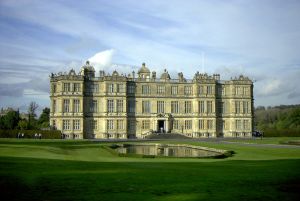
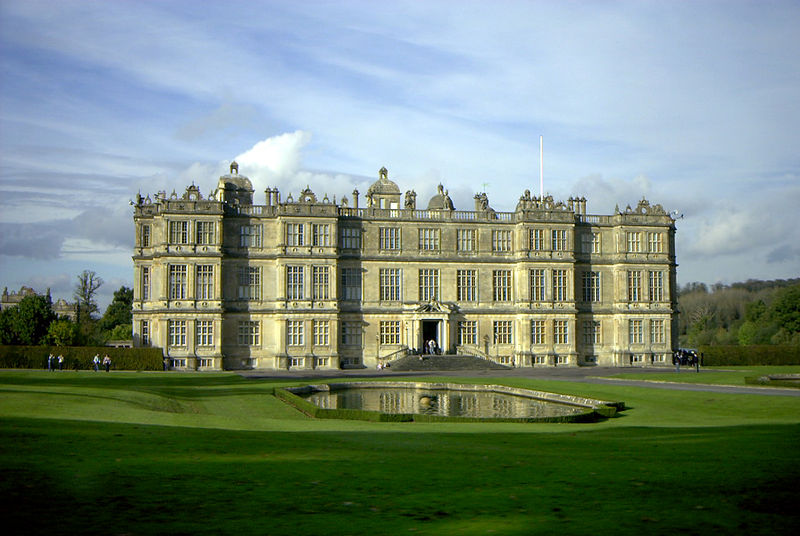
Longleat House. Image @Wikimedia Commons
Weymouth was not the only child to disappoint the Marquess, for two of his other three sons, Charles and Edward, lived lives of such extravagance and mounted such enormous debts, that the Marquess fired off a letter to The Times “disclaiming all responsibility for their behaviour” and any liability for their debts. Charles and Edward had expected their father to bail them out. When this did not occur, they moved from England. It is thought that Charles ended up in Canada and Edward in Australia, but the records are not clear on this topic. Thomas’s mother, Isabella, was the only member of the family to travel to Paris to visit the Viscount and his wife. Seeing that they were reasonably happy, she forgave them for their unkindness and misconduct, but she was never able to arbitrate a truce between her husband and son. Before her death in 1830, she wrote in a letter to her husband:
Accept my grateful thanks for all the kindness and happiness you have bestowed on me for so many years, which has been returned by the warmest affection that one mortal is capable of for another…Talk to our children of your interests, of your affairs, and try to get reacquainted with theirs. Be their friend, as well as their respected father …
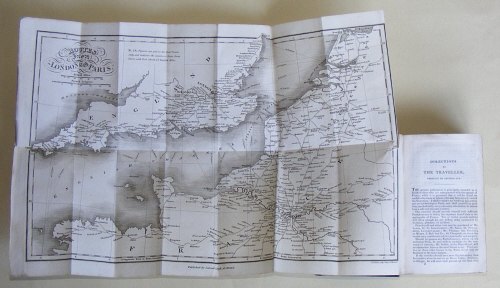
London to Paris routes
Despite his wife’s wishes, the Marquess remained obdurate. After Isabella’s death, any hope of reconciliation vanished, and both he and his son were determined to outlive the other. In January of 1837, the Viscount died at the age of 41 without an heir. He shrugged off his mortal coil a scant five weeks before his father, who died at the age of 74. Harriet, only a few years younger than her husband, was now a widow.
“So the family now awaited with bated breath to hear if she were pregnant. Insensitive suggestions were made about getting her to submit to an official examination so as to preclude the possibility of her turning up at Longleat in years to come, having acquired a son of approximately the right age, to claim the inheritance retrospectively.
Yet such cynicism proved unwarranted. Harriet went on to marry an Italian nobleman and never did have any children. But in any case, she did not attempt, nor wish, to give any further trouble to the Thynne family. – Strictly Private
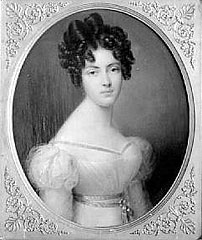
Harriet, Marchioness of Bath and Henry Thynne's wife. Image @Turtle Bunbury
As for the title and the inheritance, they passed to Henry Thynne, a captain in the Royal Navy, who died soon afterwards. A Pyrrhic victory, indeed.
Facts about Harriet Matilda Robbins – Born:18 Nov 1800. Died: 18 June 1873. Daughter of Thomas Robbins. She married, Thomas Thynne, Viscount Weymouth, son of Sir Thomas Thynne, 2nd Marquess of Bath and Hon. Isabella Elizabeth Byng, on 11 May 1820. Her married name became Thynne. She married, secondly, Count unknown Inghirami after 1837, and died on 18 June 1873 at Florence, Italy. From 1837 on her married name became Inghirami.
More on this topic:
Read Full Post »

 Inquiring readers,








 Jane Austen's World