Feeds:
Posts
Comments

Archive for the ‘Jane Austen’s World’ Category

Inquiring readers: Paul Emanuelli, author of Avon Street, has contributed posts for this blog before about the City of Bath as a Character and Law & Order and Jane Austen’s Aunt. He has graciously sent in an article about food preparation in the 18th and 19th centuries. The content will astonish you. Paul writes about Bath in his own blog, unpublishedwriterblog. It is well worth a visit.

Miss Bates, let Emma help you to a little bit of tart–a very little bit. Ours are all apple-tarts. You need not be afraid of unwholesome preserves here. I do not advise the custard.”

Michael Gambon as Mr. Woodhouse, Emma, 2009

So says the ever-cautious, Mr Woodhouse, in Jane Austen’s Emma as he entertains his guests at supper. Yet Mr Woodhouse’s fears were not entirely in his imagination. At the time it was relatively common for commercially bought pickles and preserves to contain poisonous sulphate of copper to improve their eye-appeal. And even when prepared at home, the copper pans in which they were cooked, unless properly looked after, could also poison the ingredients.

Churning butter

Yet for most people who lived in the country, as Jane Austen did for much of her life, food-safety was not a major concern. Food was prepared and preserved either by the family themselves or by their domestic staff, and cooking and baking was done at home.

Food preparation in the kitchen.

The ingredients were for the most part grown and bought locally, and word travels quickly in small communities. Meat came from local farms or estates, and farmers and landowners had reputations to maintain, as did the local mill for flour, and the local shopkeepers for all that they sold.

Costermonger from Henry Mayhew’s London Labour and the London Poor, 1840s.

The situation though, was very different in towns and cities. Here it was the shopkeepers and “costermongers” who sourced, stored, prepared and supplied the produce. And with a wider market at their disposal these tradesmen were often less concerned with quality, as they were with cost. The worst affected were the poor. For the most part they lived from hand-to-mouth and bought food in “pennyworths” or even “half-pennyworths.” Buying in these smaller quantities (enough for the day) meant goods often cost four or five times more than they would have cost had they been bought in regular quantities.

Bread Seller, William Henry Pyne, ca. 1805

Bread itself could be bought as quarter or half loaves and the poor subsisted largely on bread. But even then, bakers used chalk to make the bread whiter, and alum to enable the use of inferior flour, and while alum was not poisonous it inhibited the digestion and decreased the nutritional value of anything else their customers ate.

Rabbit seller, William Henry Pyne, 1805

The wealthier residents in towns and cities could afford a “better” diet, yet this too carried its own dangers. There was of course no refrigeration at the time and little concept of hygiene. In towns and cities most meat was killed locally, but then it had to be stored, sold and transported to the home. As late as 1862 the government estimated that one-fifth of butcher’s meat in England and Wales came from animals which had died of disease or were carrying considerably disease. And at the start of the nineteenth century butcher’s boys would deliver meat to the wealthier homes, carried on their heads, in baskets or trays, open to the heat and dirt of the day.

A butcher’s shop, by James Pollard

As the Industrial Revolution took hold, the British population grew, and so did the towns and cities. The nation became more dependent on imported and processed foods. The growing “middle classes” were acquiring a growing taste for tea, coffee, sugar, cocoa, and sauces and spices from around the world. The problem that the fictional Mr Woodhouse had been concerned about a few years earlier rapidly became a fact of life as the century progressed.

Coachman, seated, holding a tankard. Mezzotint by Ryley, printed in colours for John Bowles in London Feb. 1st, 1768

The “adulteration” of food and drink became increasingly commonplace. Producers, importers, merchants and sellers were all adding ingredients to increase bulk or “improve” appearance. The making of beer had more to do with chemistry than the brewing process. As Dr Richard Wetherby says, in my novel, Avon Street,

Have you any idea of how they adulterate the beer in the ale houses around Avon Street? It is full of foxglove, henbane, opium and God knows what other concoctions. They use chemicals so that they can water down the beer, keep its taste and appearance, but make it stronger, and still sell it cheaply.”

Cow Keeper’s Shop in London, 1825, George Scharf

Milk too, was often watered down, sometimes by as much as 50%. So common did the adulteration of food become that books on housekeeping routinely carried warnings and tests for detecting added chemicals like plaster of Paris. Mrs Beeton in prefacing a recipe for a popular anchovy paste warned against shop-bought pastes,

In six cases out of ten, the only portion of those preserved delicacies, that contains anything indicative of anchovies, is the paper label pasted on the bottle or pot, on which the word itself is printed.”

Typical coffee house, late 18th century

In 1851 The Lancet, medical journal, commissioned a doctor from the London Royal Free Hospital to examine the adulteration of thirty common foods. The study revealed that China tea contained 45% sand and dirt together with traces of sulphate of iron; lard contained carbonate of soda and caustic lime; coffee included chicory, mangel wurzel (root vegetable) sawdust, and acorns; cocoa and chocolate were coloured with earth and included arrowroot and Venetian lead; sweets (candy) were found to contain chromate of lead, sulphate of mercury and various other noxious flavourings and colourings. Red lead and other chemical colourings were found to be routinely used in foodstuffs such as “Red Leicester Cheese.”

Six pence a pound, fair cherryes

Even after the study was published the merchants, tradespeople and government were slow to respond. It was not until 1860 that the Adulteration Act was passed. Thankfully, technology and innovation helped in the interim. In 1857 a process for the mass production of ice was patented allowing foods to be better preserved and transported. The availability of canned goods also increased. The army had been supplied with canned foods since 1820, but the cans had to be opened with a chisel or a bayonet, until the can-opener was invented in 1858. As technology improved, mass-produced processed foods like soups, sauces, biscuits, chocolate, pickles and egg-powder became more popular and were prepared to more rigorous standards. And though the Adulteration Act was still largely resisted, in 1872 official inspectors were created with the power to test food and impose substantial fines. Quality and safety of food gradually improved, which I am sure would have pleased the fictional Mr Woodhouse.

Old Covent Garden market, 1825, Scharf

More on the topic:

Refrigerated milk cart, 19th c. This design, from the USA, used ice to keep the air temperature cool for the transport of milk. Holes in the compartments allowed air to circulate from where the ice compartments to the milk compartments.

This slideshow requires JavaScript.

Read Full Post »

Gentle readers, frequent contributor Tony Grant has recently returned from visiting the Lake Country with his friend, Clive. (Visit his blog, London Calling, where he shares his experiences and wonderful images.) While there he was reminded of Wordsworth’s poem about Tintern Abbey and sent in his thoughts. Thank you, Tony, for making poetry come alive!

“Lines composed a few miles above Tintern Abbey, on Revisiting the Banks of the Wye during a Tour, July 13, : 1798”

Wye Valley

This rather ungainly title is the precursor to a poem by William Wordsworth written in 1798, as the title shows, which lays out his philosophy about his understanding of the world and the effect it has on him.

First of all the title tells us about a revisiting of the Wye Valley. Wordsworth may well have been using the guide book written by William Gilpin about the Wye and Tintern Abbey. Gilpin was a fellow lover of nature, who was also born in Cumberland and The Lakes. In this poem Wordsworth is revisiting, recalling, adjusting his memory of a place and adding to the strength of its power over him.

Once again

Do I behold these steep and lofty cliffs,

That on a wild secluded scene impress

Thoughts of more deep seclusion; and connect

The landscape with the quiet of the sky.”

The Lakes. Image @Tony Grant

Wordsworth emphasises seclusion such as a hermit might experience.. This aloneness is an important aspect of this poem. When we meditate we find a secluded tranquil spot to be alone in.

The use of his senses is paramount to this process.

again I hear

These waters, rolling from their mountain-springs

With a soft inland murmur.”

And also,

Once again I see

These hedgerows, hardly hedgerows, little lines

Of sportive wood run wild; these pastoral farms,

Green to the very door; and wreaths of smoke

Sent up,”

Foxgloves and dry stone wall. Image @Tony Grant.

Sound and sight come together to make an impression on his mind and feelings. But these are not short lived impressions. They have a deep and profound effect.

“oft, in lonely rooms, and ‘mid the din

Of towns and cities, I have owed to them,

In hours of weariness, sensations sweet,

Felt in the blood, and felt along the heart;

And passing even into my purer mind,

With tranquil restoration: -feelings too

Of unremembered pleasure; such, perhaps,

As have no slight or trivial influence.”

Rocky outcrop, image @Tony Grant

Wordsworth is saying that remembering the sensations that nature has had on him can be recalled, relived at other times and in other places and help him overcome things such as weariness and other detrimental sensations.

how oft –

In darkness and amid the many shapes

Of joyless daylight; when the fretful stir

Unprofitable, and the fever of the world,

Have hung upon the beatings of my heart –

How oft, in spirit, have I turned to thee,

Tintern Abbey

Memory, imagination, recalling good sensations, becomes a sort of force that Wordsworth can use. He describes it as being “felt in the blood” and “along the heart. “ These sound strange phrases to us. We might describe these experiences as affecting us deeply or having a psychological influence or even providing a spiritual experience.

Methods of meditation use memory and imagination in this way. Athletes and sportspeople use this method too. We are experiencing the Olympics at this moment. Athletes have described how they use imagination to help them perform to the best of their ability. A white water canoeist was interviewed yesterday morning and asked how she prepares for such a hazardous descent and how is she able to get the timing of her turns just right. She answered that she imagines the descent through the rough and tumbling waters again and again, living in her imagination every move, paddle stroke and turn she is going to make.

Wordsworth gives even more importance to the powers of nature when he says these experiences have an effect ,

On the best portion of a good man’s life,

His little, nameless, unremembered, acts

Of kindness and of love.”

He is saying our experience of nature has an actual effect on the way behave.

The chancel crossingot Tintern Abbey looking towards the east window, JWM Turner, 17942

Wordsworth takes his ideas to an even higher almost mystical religious level when he says,

that blessed mood,

In which the burthen of the mystery,

In which the heavy and the weary weight

Of all this unintelligible world,

Is lightened: -that serene and blessed mood,

In which the affections gently lead us on –

Until, the breath of this corporeal frame

And even the motion of our human blood

Almost suspended, we are laid asleep

In body, and become a living soul;”

The effects last into the afterlife and affect our experience of heaven. This is serious stuff. Wordsworth is completely taken with this concept.

Banks of the Wye

Towards the end of the poem it becomes a letter, almost a love letter, to his sister Dorothy, who he sees as his soul mate. He includes her in his understanding of what he experiences,

all which we behold

Is full of blessings.”

What is interesting to consider is that in this poem Wordsworth describes how he uses his experience of nature through his senses to lighten and bring joy and spiritual pleasure to himself at other times. This revisit to the Wye Valley five years after his first visit appears to be an attempt to strengthen his experiences of nature and to replenish and strengthen his memories so he can use a stronger dose, so to speak, of his experiences in future. This begs the question , does Wordsworths poem, help the reader of the poem along this path of spiritual experience in anyway or is he just telling the reader, you must go and experience nature yourself to gain these effects?

Edward Dayes, Tintern Abbey from across the Wye 1795.

What the poem does for me is help me recall my own experiences of places that gave me pleasurable experiences through my senses. Wordsworth in his poem is triggering our memory of good things too. He suggests we find a secluded place ourselves, remember, imagine and discover our own benefits. Nature can provide a healing process,

when thy mind

Shall be a mansion for all lovely forms,

Thy memory be as a dwelling place

For all sweet sounds and harmonies; oh! then,

If solitude, or fear, or pain, or grief,

Should be thy portion, with what healing thoughts

Of tender joy wilt thou remember me,”

There is something ageless in Wordsworth’s theory which is the theory of Romanticism. It makes me think of Karma and the Buddhist approach to meditation.

Tintern Abbey. Postcard photo courtesy of Paradoxplace.com.

As an addenda to the William Gilpin (1724-1804) reference above: Wordsworth may have used Gilpin’s guide book in the Wye Valley. Gilpin also was an advocate of experiencing nature and drawing benefits from it , it’s hues and colours and it’s natural arrangement He wasn’t averse, however, to making suggestions about its arrangement. He might suggest in his writing the removal or addition of a tree or even the roughing up and creation of a more crumbling effect of Tintern Abbey to create a better aesthetic affect. It is suggested that Jane Austen made fun of this in Northanger Abbey.

More on the topic:

Read Full Post »

Reverend George Austen

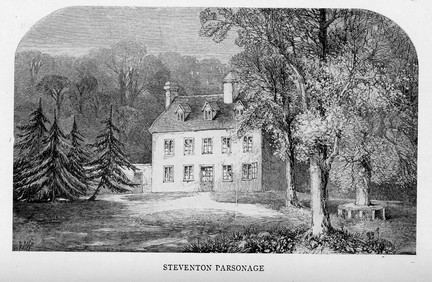
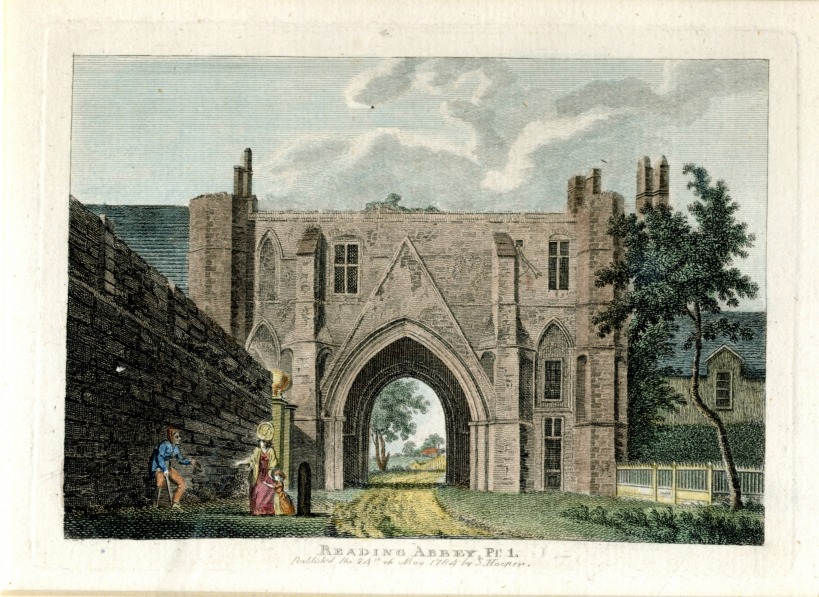
As many Jane Austen fans know, Rev. George Austen ran a boarding school out of his parsonage house in Steventon to augment his £230 pr year income. In1793 he began to teach the sons of local gentlemen in his home to prepare them for university. His library was extensive for a man of modest means, from 300- 500 volumes, depending on the source, an amazing collection, for books were frightfully expensive. Rev. Austen encouraged Cassandra and Jane to read from his library and supported budding author Jane in her writing. At some point, the Austens sent the girls to boarding school in Reading, for which he paid £35 per term, per girl, a not inconsiderable sum. He received around the same amount of money per boarder, and it is conjectured that the Austens hoped to replace their two daughters with many more pupils, which made economic sense. (See Linda Robinson Walker’s link below.) Mrs. Austen was not an indifferent bystander. She cooked, cleaned, sewed, and clucked over the boys like a mother hen, and was involved in their maintenance in a hands-on and caring way, acting as a surrogate mother.

In his Travels Through England in 1782, German traveler Karl Phillip Moritz describes learning academies, head masters, and boarding schools. From his observations, one gains a sense of what life must have been like for the Austens and their pupils:

A few words more respecting pedantry.  I have seen the regulation of one seminary of learning, here called an academy.  Of these places of education, there is a prodigious number in London, though, notwithstanding their pompous names, they are in reality nothing more than small schools set up by private persons, for children and young people.

One of the Englishmen who were my travelling companions, made me acquainted with a Dr. G– who lives near P–, and keeps an academy for the education of twelve young people, which number is here, as well as at our Mr. Kumpe’s, never exceeded, and the same plan has been adopted and followed by many others, both here and elsewhere.

18th Century school room. One imagines a less formal setting for Rev. Austen’s school.

At the entrance I perceived over the door of the house a large board, and written on it, Dr. G–’s Academy.  Dr. G– received me with great courtesy as a foreigner, and shewed me his school-room, which was furnished just in the same manner as the classes in our public schools are, with benches and a professor’s chair or pulpit.

The usher at Dr. G–’s is a young clergyman, who, seated also in a chair or desk, instructs the boys in the Greek and Latin grammars.

Such an under-teacher is called an usher, and by what I can learn, is commonly a tormented being, exactly answering the exquisite description given of him in the “Vicar of Wakefield.”  We went in during the hours of attendance, and he was just hearing the boys decline their Latin, which he did in the old jog-trot way; and I own it had an odd sound to my ears, when instead of pronouncing, for example viri veeree I heard them say viri, of the man,exactly according to the English pronunciation, and viro, to the man.  The case was just the same afterwards with the Greek.

Mr. G– invited us to dinner, when I became acquainted with his wife, a very genteel young woman, whose behaviour to the children was such that she might be said to contribute more to their education than any one else.  The children drank nothing but water.  For every boarder Dr. G– receives yearly no more than thirty pounds sterling, which however, he complained of as being too little.  From forty to fifty pounds is the most that is generally paid in these academies.

I told him of our improvements in the manner of education, and also spoke to him of the apparent great worth of character of his usher.  He listened very attentively, but seemed to have thought little himself on this subject.  Before and after dinner the Lord’s Prayer was repeated in French, which is done in several places, as if they were eager not to waste without some improvement, even this opportunity also, to practise the French, and thus at once accomplish two points.  I afterwards told him my opinion of this species of prayer, which however, he did not take amiss.

After dinner the boys had leave to play in a very small yard, which in most schools or academies, in the city of London, is the ne plus ultra of their playground in their hours of recreation.  But Mr. G– has another garden at the end of the town, where he sometimes takes them to walk.

After dinner Mr. G– himself instructed the children in writing, arithmetic, and French, all which seemed to be well taught here, especially writing, in which the young people in England far surpass, I believe, all others.  This may perhaps be owing to their having occasion to learn only one sort of letters.  As the midsummer holidays were now approaching (at which time the children in all the academies go home for four weeks), everyone was obliged with the utmost care to copy a written model, in order to show it to their parents, because this article is most particularly examined, as everybody can tell what is or is not good writing.  The boys knew all the rules of syntax by heart.

Reading Abbey, where Jane and Cassandra Austen were sent to boarding school

All these academies are in general called boarding-schools.  Some few retain the old name of schools only, though it is possible that in real merit they may excel the so much-boasted of academies.

It is in general the clergy, who have small incomes, who set up these schools both in town and country, and grown up people who are foreigners, are also admitted here to learn the English language.  Mr. G– charged for board, lodging, and instruction in the English, two guineas a-week.  He however, who is desirous of perfecting himself in the English, will do better to go some distance into the country, and board himself with any clergyman who takes scholars, where he will hear nothing but English spoken, and may at every opportunity be taught both by young and old.

Source: Moritz, Karl Philipp, 1757-1793. Travels in England in 1782 by Karl Philipp Moritz (Kindle Locations 645-656). Mobipocket (an Amazon.com company).

Read Full Post »

Inquiring readers, One of the benefits of overseeing a long-lasting blog is the number of Jane Austen aficionados one meets via email and online. Ronald Dunning, a descendant of Jane Austen’s brother, Francis, recently emailed me to discuss his new genealogy site and Jane Austen family website. After I visited the sites and read Deb Barnum’s excellent post on the topic at Jane Austen in Vermont, I invited Mr. Dunning to explain how he managed to fill in so many members on his family tree. When all was said and done, what excited me most was when I saw the resemblance between Mr. Dunning and his illustrious ancestor. The Austens do indeed live on. Enjoy!

Sir Francis William Austen, Admiral of the Fleet, and descendant Ronald Dunning

Hi Vic! I’m a 4th-great-grandson of Frank Austen, and a committed genealogist. I’ve been working for quite a few years on an extended and inclusive genealogy of the Austen family, which can be seen at RootsWeb: http://wc.rootsweb.ancestry.com/~janeausten. It’s an ongoing project, subject to addition and revision, but has reached an advanced state of maturity. Various writers on the Austen family in England and the US have used it, and I’ve even found it cited as a reference source for biographies at Wikipedia.

Joan Corder

I’ve just posted a new website dedicated to Jane Austen’s Family, which was announced to the public at last week’s JAS AGM. The address is www.janeaustensfamily.co.uk. The first content is Joan Corder’s “Akin to Jane” – a 1953 manuscript listing as many descendants of George and Cassandra Austen as the author could find. Joan recorded something like 320 descendants of George and Cassandra Austen, which is very good going for 1953. The biographical detail in the manuscript makes it invaluable. She could never find a publisher and the book exists only in a couple of manuscript copies, one of which is at the Jane Austen’s House Museum at Chawton. When I first began working on the site, I wasn’t sure whether it would interest anyone – I was simply driven on by my obsession with family history – but it’s been well received, to my delight. The Museum is pleased that they can now retire Joan Corder’s fragile original.

Joan’s page on Jane Austen in Akin to Jane Austen. The fragile original has been replaced with interactive online pages.

With the benefit of modern genealogical facilities, I’ve increased the tally from 320 to over 1200 – all of whom are to be found on my RootsWeb site. I have to admit that I have included very little anecdotal information, it is mainly genealogy; and all details except the surname are withheld for anyone born after 1915, though I have them on my computer database.

Austen (l) and Austen-Leigh (r) family coat of arms.

You asked for an anecdotal example for Jane Austen’s World readers that would flesh out the details of my research. I immediately thought of James Brydges, 8th Baron Chandos of Sudeley and Elizabeth Barnard – Cassandra Leigh’s great-grandparents. Cassandra was of course Jane Austen’s mother.

Hearing Miss Barnard was engaged to a party with a fashionable conjuror, who showed the ladies their future husbands in a glass, he by a proper application to the cunning man beforehand, and by a proper position at the time, was exhibited in the glass to Miss Barnard: clapping her hands she cried, ‘Then Mr. Bridges is my destination, and such he shall be.’”

This lovely anecdote was recorded in a footnote, in The Complete Peerage,under the entry for James Brydges, the 8th Lord Chandos of Sudeley. The lady in question, Elizabeth Barnard, did become his wife. Elizabeth’s father Sir Henry Barnard was a “Turkey merchant,” a trader whose business interest was in importing from Constantinople. Her husband James Brydges was himself the Ambassador of the “Turkey Company” (properly the Levant Company) in Constantinople from 1680 to 1686.

Sir James Brydges (1642–1714), 8th Baron Chandos, Turkey Company Ambassador to Constantinople

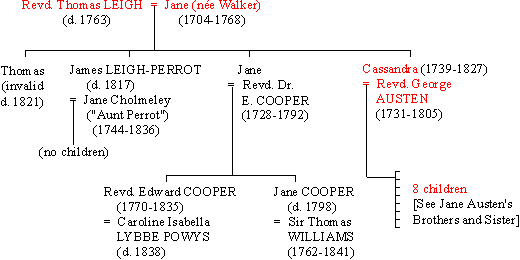
Elizabeth gave birth to twenty-two children. We are familiar with the mortal threat to women’s lives from childrearing – three of Jane Austens’ sisters-in-law suffered that fate. Elizabeth survived her twenty-two deliveries and lived to the age of 77. Not all of her children fared so well – only fifteen were baptized, and of those, three sons and five daughters survived infancy. This was far from unusual – Antonia Fraser, in her study of 17th-century woman, The Weaker Sex, stated that it was normal for only a third of children born to a large family to survive. Their eldest child, Mary Bridges, was one of the survivors. The link to Jane Austen can now be traced within a few generations. Mary married Theophilus Leigh; they were Cassandra Leigh’s paternal grandparents and the parents of Theophilus Leigh, who served as Master of Balliol College in Oxford from 1726 until his death in 1785. Theophilus Jr.’s brother Thomas Leigh married Jane Walker, and they were Cassandra Leigh’s parents. Cassandra, who married George Austen, gave birth to eight children, including Jane Austen in 1775. (And she too survived to a ripe old age, outliving her daughter Jane by 10 years.)

Click on image for details. Image @A Reading Affair

I hope you enjoyed this small sampling of the information that my sites offer about Jane Austen’s family. Deb Barnum from Jane Austen in Vermont has interviewed me, and written a very thorough review and detailed explanation of how to find information on the sites.

More on the topic:

Read Full Post »

Gentle Readers, author Colette Saucier has written a description of her journey on writing Pulse and Prejudice, a vampire adaptation of Pride and Prejudice. Those of us who are fascinated with the vampire myth can relate to her journey! You can find more information about Colette and her book on Colette Saucier.com

This is a story of Mr. Darcy, Lord Byron, and vampires.

I love Pride and Prejudice. I have read it so many times, I cannot even remember a time before it was not part of my consciousness. Of course, I like all of Jane Austen’s novels, but the story of Mr. Darcy and Elizabeth speaks to me in a way the others do not. I do not believe I am alone in this, as it set the standard for every romance novel and romantic comedy since its publication 200 years ago: boy meets girl, boy likes girl, girl hates boy, girl and boy like each other, misunderstanding/outside forces tear them apart, reunion, reconciliation, happily ever after.

Quite a number of years ago, I had the misfortune of seeing what I refer to as the Pride and Prejudice mutilation, the 1940 film starring Laurence Olivier and Greer Garson. Not only did they dress all of the Bennet girls as Southern Belles, Greer Garson was thirty-six. THIRTY-SIX! Three years older than Olivier. I won’t even go into the plot except to say they had no right to call it Pride and Prejudice. After that, I decided never again would I subject myself to any adaptation of my beloved Austen. I did not even see the BBC miniseries with Colin Firth when it premiered.

So what changed? First, I saw the movie Clueless. I enjoyed every moment of it, all the while thinking to myself, “This is Emma!” Sure enough, Amy Heckerling had updated my second favorite Jane Austen novel. Then, without knowing Helen Fielding had written it as a modern variation on Pride and Prejudice, I read Bridget Jones’s Diary. Well, after that, I had to see Colin Firth’s Pride and Prejudice, and now I had a face to go with my Mr. Darcy. Thus ended my boycott of all things not-quite-Austen.

All of this, of course, occurred some fifteen years ago. Although my mind had been opened to the possibilities, I had no intention of writing any Austen adaptations myself. Then a little book called Pride and Prejudice and Zombies took off like wildfire and landed near the top of the New York Times bestseller list. I have never been a zombie fan myself, but I did love the film Shaun of the Dead. When I stumbled upon the zombie book in my daughter’s bedroom, I knew it was a parody, and I had hoped its approach would be similar to that film. I had never heard of a “mash-up” before, but now I know I do not like them. The (co)author had taken the complete text of Pride and Prejudice and just stuck zombies and ninjas between the paragraphs. Not impressed. The zombie book did, however, introduce me to the genre of Austen adaptations and variations, and an addiction was born. I ate them up like potato chips. Some were good, some were horrid, but many I found completely delightful. All of them allowed me to continue my literary love affair with Mr. Darcy.

Now to back up a bit, somewhere in the middle of my multiple readings of Pride and Prejudice (actual Austen, not adaptations), I learned about Lord George Gordon Byron. I had read some of his poems over the years, but after seeing the film Gothic, I became more interested in the man behind the words. That he was portrayed by a young Gabriel Byrne didn’t hurt! This film depicts the summer night when Byron and his pal Percy Shelley gathered with friends in Switzerland and told each other ghost stories, one of which became Mary Shelley’s Frankenstein.

That evening also inspired John Polidori to write The Vampyre – the original gentleman vampire. Although I never cared for zombies or werewolves or other monsters, I have always been a vampire fan. (To all of those publishers who rejected my manuscript because they believed the “vampire trend is over,” allow me to say, vampires will never of out of style. They’re immortal, after all!) I refer to the sensual, suave, and seductive variety of vampire, or the tortured souls such as Gary Oldman’s depiction in Bram Stoker’s Dracula. That image of the mysterious and charismatic vampire originated that night in 1816 with Polidori and Lord Byron.

Austen’s Mr. Darcy struck me as a Byronic figure – intelligent but arrogant, sophisticated and cynical, introspective and conflicted. “That man of loneliness and mystery, Scarce seen to smile, and seldom heard to sigh.” (The Corsair, I, VIII) Knowing that Polidori had based his Vampyre on Byron cultivated in my mind the idea that Darcy as a character – as well as Pride and Prejudice as a whole – lent itself well to a vampire adaptation; however, when I looked, I could not find the adaptation I envisioned. Yes, someone had published a vampire “mash-up,” but I have already expressed my opinion on those. I also found a vampire sequel told in gothic style. Regina Jeffers had written a fascinating novel inspired by Pride and Prejudice with Mr. Darcy as dhampir, battling against vampires while resisting the urge to become one himself.

I needed something more. I wanted Mr. Darcy to be an honest-to-goodness neck-biting, blood-drinking, night-walking vampire who could be healed in the moonlight as in the Polidori story. I felt the story must be told from Mr. Darcy’s point of view to explore that Byronic Hero aspect of his nature, which we only glimpse in Austen’s narrative, and allow the curse of vampirism to reveal further depths of character – an outcast, suffering, jaded . Because this adaptation of Pride and Prejudice did not exist, I had no choice but to write it myself.

I threw myself full-force into researching Regency England, vampire folklore, and Pride and Prejudice itself. This paranormal adaptation had to remain faithful to Austen in style, plot, and characters. How would Austen’s Elizabeth Bennet react to vampires? That itself required a thorough analysis of Elizabeth to ensure in this adaptation she remained true to the original character under remarkable circumstances. The novel had to be historically accurate and free of any anachronisms. I wanted it to be as if Jane Austen herself had written the story of Mr. Darcy as vampire, and I think I have succeeded. Well, except I did add another section – Beyond Pride and Prejudice – to peek into the passion, lust, and desire between Elizabeth and Mr. Darcy that simmers just under the surface in the original. Jane Austen teases us with hints of Darcy’s attraction to Elizabeth, and I could not leave that territory uncharted.

Thus, after fifteen years gestation, Pulse and Prejudice was born – an authentic vampire variation of the beloved classic. I hope I have written the paranormal adaptation others want to read as well.

Read Full Post »

« Newer Posts - Older Posts »