Feeds:
Posts
Comments

Archive for the ‘Regency Customs’ Category

Copyright @Jane Austen’s World. Gentle readers, as you know, the northeast has been socked in by snow, ice, gale winds, and bitterly cold temperatures today.

George Scharf, Sketches of People in Snow. Some scenes of winter have never changed.

This is a perfect time for hunkering inside and drinking hot chocolate. Or is it?
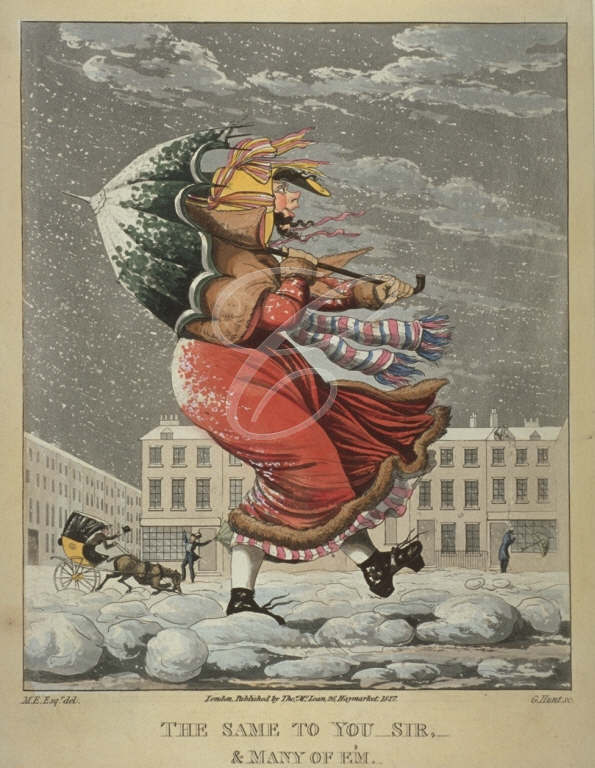
Image @City of London. This young lady is wearing pattens to protect her shoes.

My nephew’s children will go sledding, others will go ice skating, and my dog will bound through the snow drifts with undisguised glee, as people have done for ages.

Winter Amusement, Hyde Park, after Ibbetson, 1789. Note the bare feet on the young child in rags. (Foreground)

As early as the 17th century, the noted diarist John Evelyn noted: ” Having seen the strange and wonderful dexterity of the sliders on the new canal in St James’s Park, performed before their Ma[ties] by divers gentlemen, and others with Scheetes, after the manner of the Hollander,s with what swiftnesse they passe, how suddainely they stop in full carriere upon the ice, I went home by water, but not without exceeding difficultie,s the Thames being frozen, greate flakes of ice incompassing our boate. Pepys entry is as follows: St James’s Park Dec 1 1662. “Over the Park where I first in my life it being a great frost did see people sliding with their skeates, which is a very pretty art.”


Dutch steamers on the frozen Zuyder Zee. The leather straps are quite visible on these skates.

Skating has been around since 3,000 BC or thereabouts and stone age skates have been uncovered in bogs. But it was the lowlanders who took to the sport with glee, using wooden platform skates with iron runners as early as the 14th century. At first, skaters strapped their skates around their shoes with leather straps and propelled themselves forward with wooden poles.
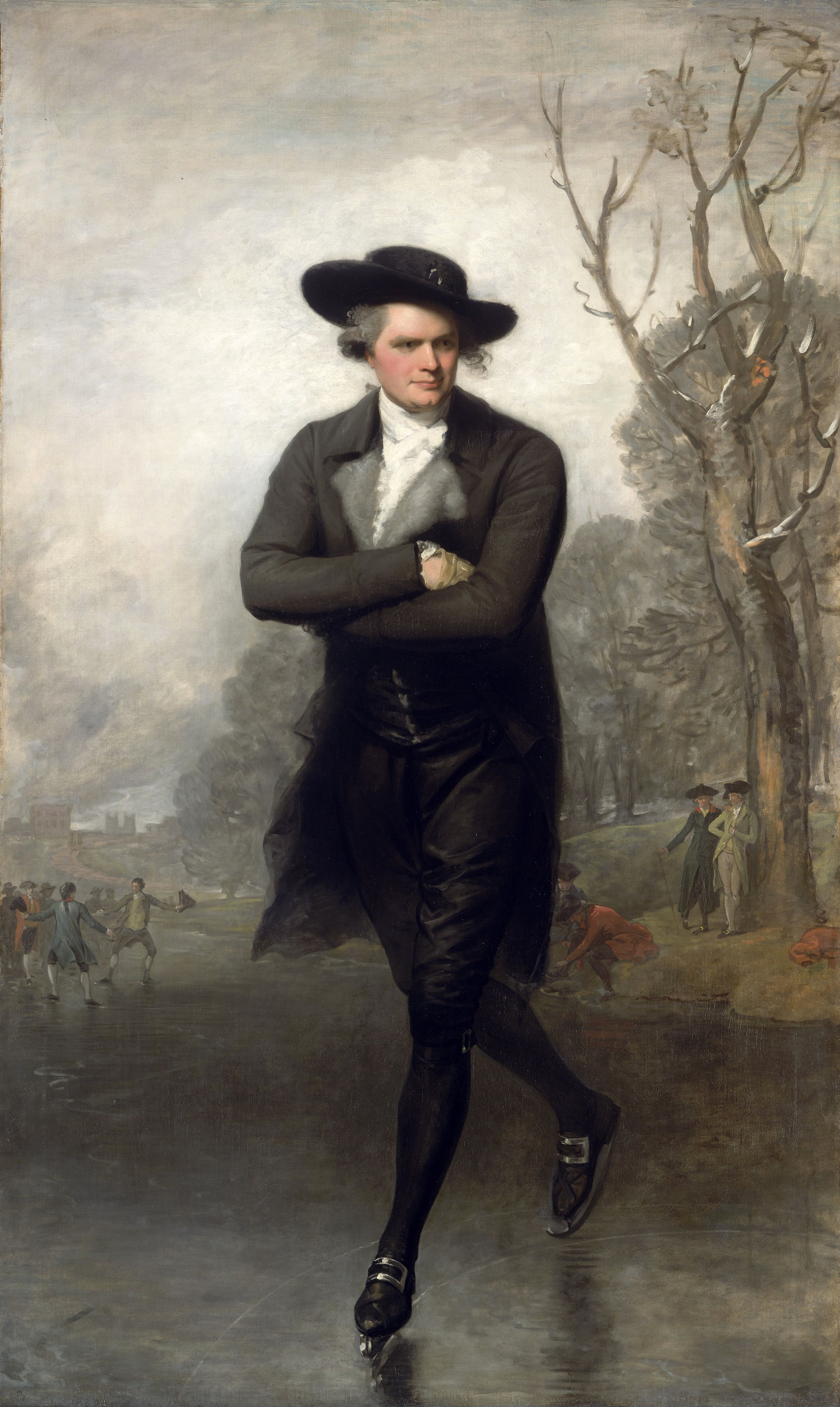
 

William Grant, The Skater, 1782

Then, the Dutch invented a narrower double-edged metal blade that allowed them to glide with their feet, and the poles became obsolete.
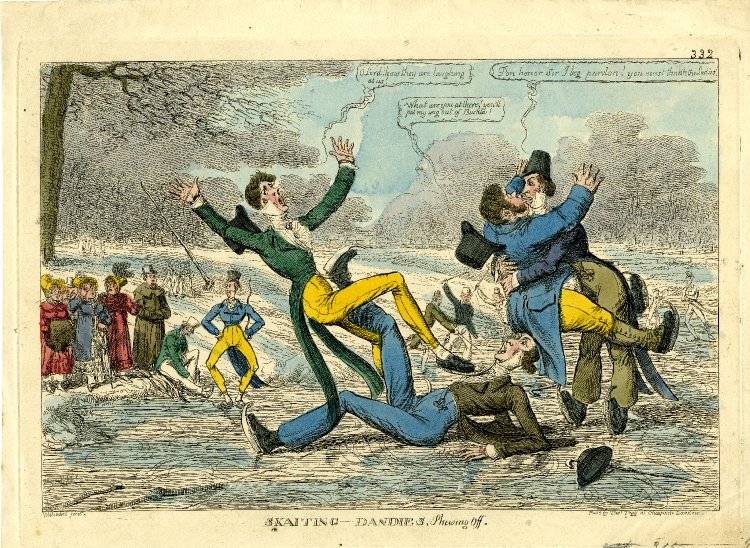
1824 Skating Dandies Showing Off

Many 19th century images exist of people skating on frozen streams and ponds, and sledding or sleighing.
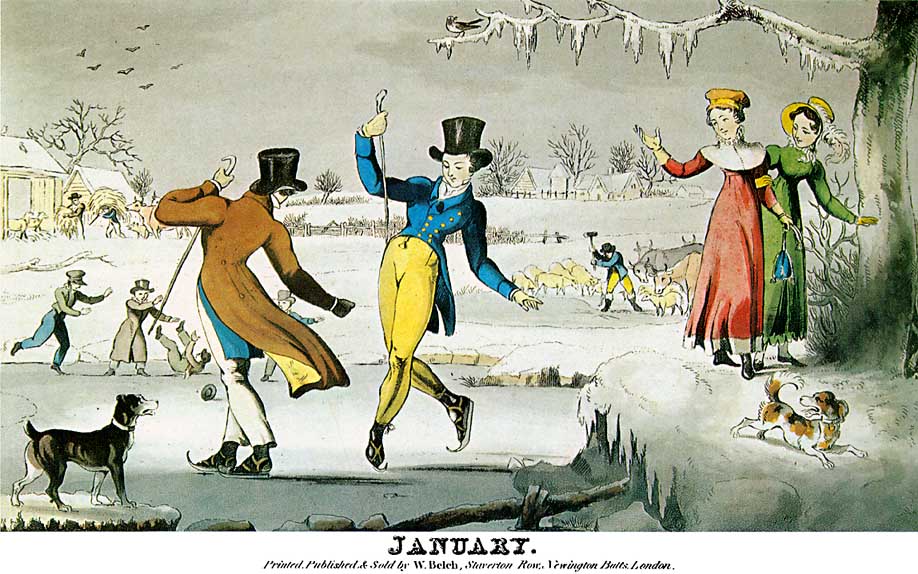
 

1820. In the distance on the right, one can see a man chopping through the ice to allow his cattle to drink water. On the left, another man is spreading grain to feed his animals.

“..moderns sledges are used, which being extended from a centre by the means of a strong rope, those who are seated in them are moved round with great velocity, and form an extensive circle. Sledges of this kind were set upon the Thames during the hard frost in the year 1716 as the following couplet in a song written upon that occasion 1plainly proves:

“While the rabble in sledges run giddily round
And nought but a circle of folly is found” – The sports and pasttimes of the people of England

By the mid 18th century, Robert Jones described paired ice skating, or figure skating in A Treatise on Skating (1772).
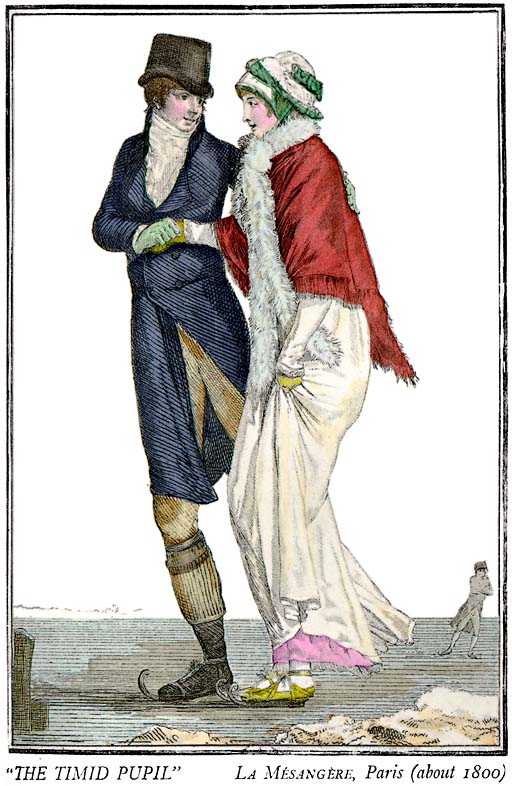
 

The Timid Pupil, 1800. Both this ladies feet are placed together, as her escort gently leads her over the ice.

Sleds and sleighs have been used for centuries to transports logs, people, and good over frozen waters all over northern Europe for centuries.
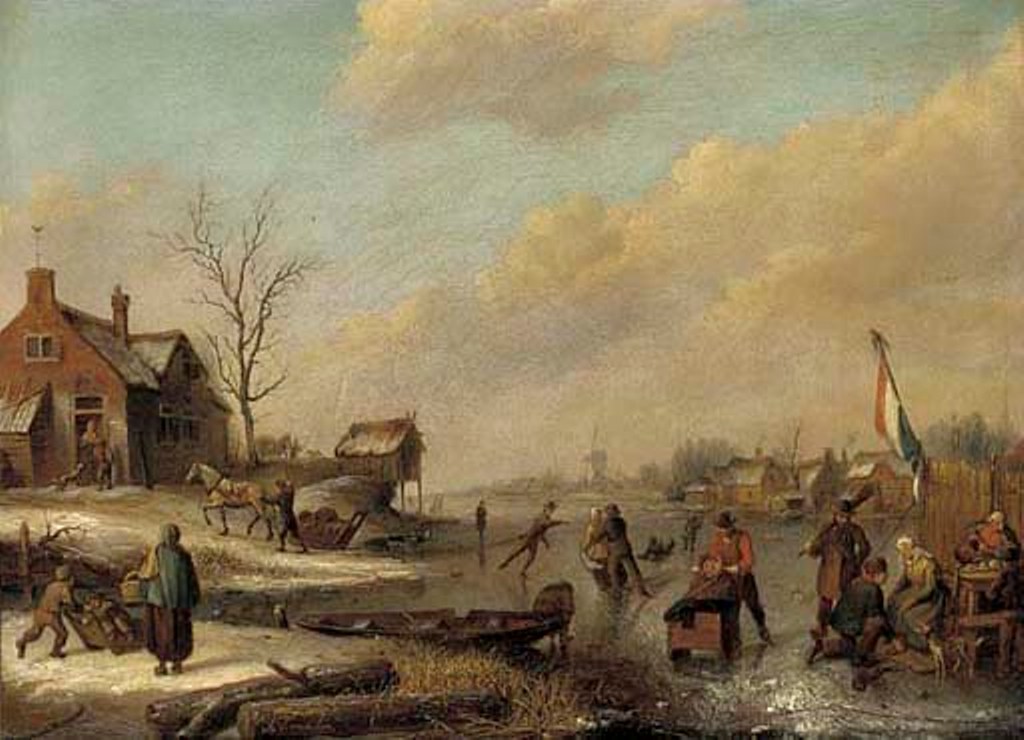
 

Frozen river in The Netherlands with townsfolk skating and sledging using various forms of sleds pushed by people, and one pulled by a horse. By Vermeulen

Called coasting, sliding down hills and inclines on hand sleds or sledges provided hours of pleasure, as well as a practical way to get around over frozen landscapes and water. Wooden sleds pulled by a rope are still a familiar sight today.

19th century porcelain (figures in 18th century dress): man pushing woman on a sleigh

Fancy sleighs pulled by horses (or reindeer in the frozen north) transported groups of people, often in comfort, for their feet were placed upon footwarmers that were heated with hot coals, and their bodies were covered by thick furs or blankets.
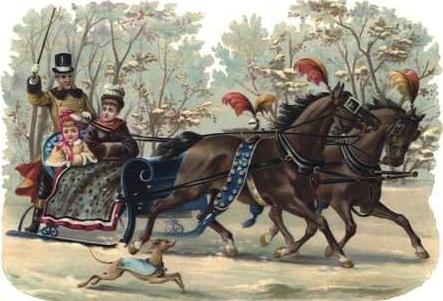
 

Victorian sleigh. The travelers are protected from the cold by muffs and a thick blanket. Even the dog wears a coat. Note the bells on the horses.

More on the topic:

Read Full Post »

“Heigh ho! sing heigh ho! unto the green holly:
Most friendship is feigning, most loving mere folly:
Then, heigh ho, the holly!
This life is most jolly.”
– William Shakespeare, As You Like It

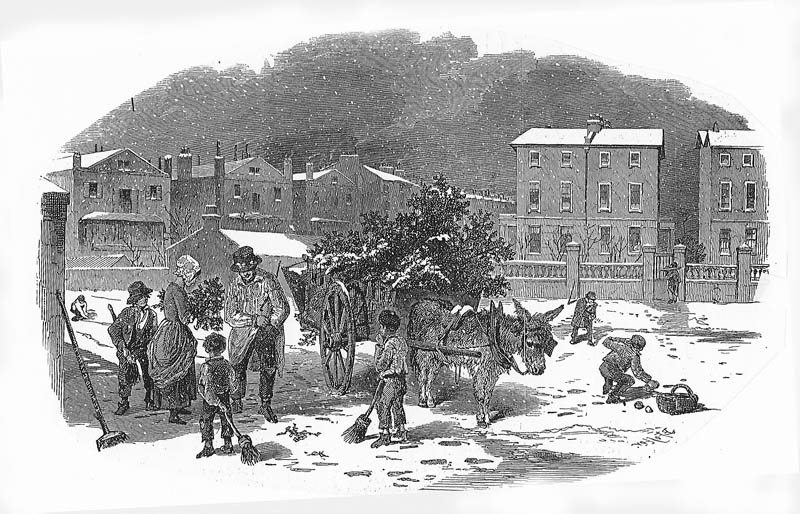
Decorating one’s house with natural boughs has been a Christmas tradition since Celtic times. Boughs of holly with their bright red berries were especially coveted. (Read Mythology and the Folklore of Holly.) One understands how easily people in rural areas could obtain these bright green leaves, but what about those who lived in London? This image of a holly cart pulled by a donkey provides a solution.

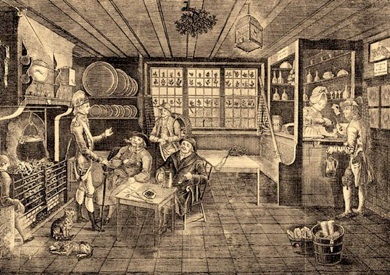
Note that the customer purchases a small amount of boughs. Christmas decorations in the 19th century were modest to none compared to ours. In this 18th-century print of a coffee house or chocolate shop, one can see small leaves of holly placed in each window pane and a bough hanging from the center of the ceiling. (One cannot imagine that mistletoe would  be hung in a public setting.)

Bowles and Carver print, London. Circa 1775

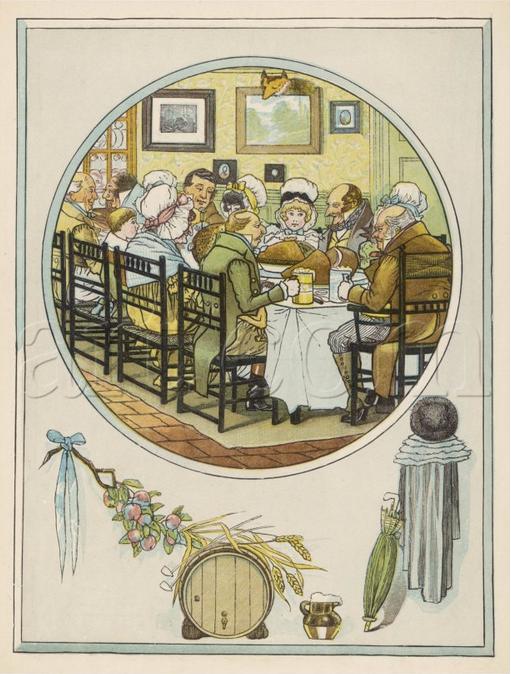
In this image of a lavish family dinner by Cruikshank, not a single bough of holly decorates the room. Most likely a wreath had been hung on the front door or some boughs had been hung from the ceiling. With holly hard to obtain in metropolitan areas, one imagines that the spare use of decorations was as much from necessity as from tradition.

Image: Art.com

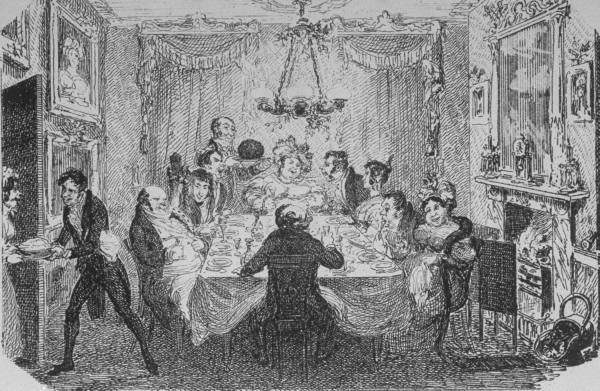
This image by Cruikshank of a family celebrating Christmas during early Victorian times  shows a few boughs inserted into the chandelier, a roaring fire, and the Christmas pudding about to be served to the hostess. This year, I have taken the Regency approach to decorating my house, emphasizing the season with just a few well placed decorations. And I love it.

Other Christmas Posts on this blog:

Read Full Post »

Copyright @Jane Austen’s World

Looking at the images in this post, one can only imagine how difficult it was for a woman in full evening dress (or court dress) to move around. Between taking care of her shawl, reticule, dance card, and fan, she had to walk upright and sedately so that her head feathers did not topple over after an abrupt movement or caught fire under chandeliers ablaze with candles.

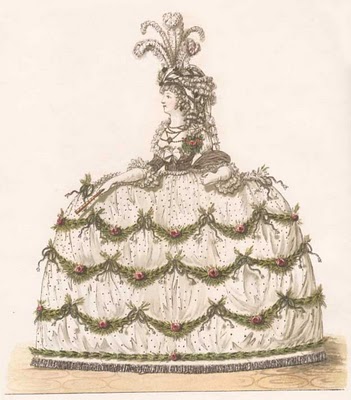
1794-95 Court Dress

Examining the above image, one can readily see that these costumes were designed for high-ceilinged rooms that were opened by high double doors.

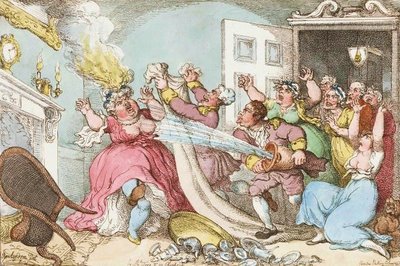
A lady's wig catches fire. Thomas Rowlandson. Image @Yale University

In this dramatic image, Thomas Rowlandson catches a moment of real danger both for the lady whose wig (and feathers) caught fire, and for the guests, who might have been trapped in a house fire, for water to put out flames was not easily obtained.  In the late 18th century The London Times reported on several more incidents in which ladies found ways to accommodate their head feathers, or in which the feathers (and mother nature) got the best of them.

Lady Godina's Rout

At all elegant Assemblies there is a room set apart for the lady visitants to put their feathers on, as it is impossible to wear them in any carriage with a top to it. The lustres are also removed upon this account, and the doors are carried up to the height of the ceiling. A well-dressed Lady who nods with dexterity can give a friend a little tap upon the shoulder across the room without incommoding the dancers. The Ladies feathers are now generally carried in the sword case at the back of the carriage.  – Times,  Dec 29, 1795.

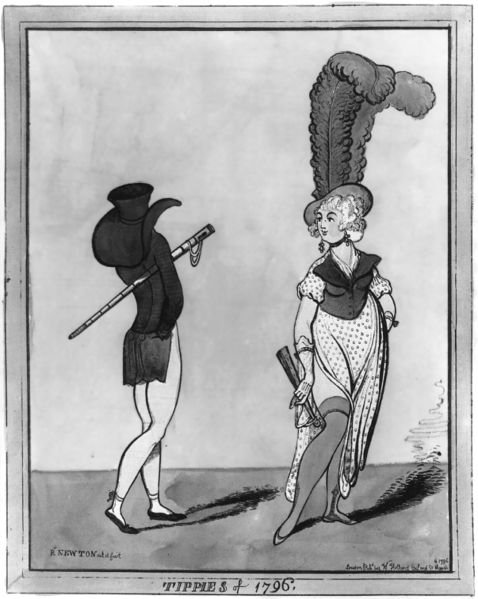
Tippies of Newton, 1796 caricature by Richard Newton. Image @Wikimedia Commons

A young lady only ten feet high was overset in one of the late gales of wind in Portland Place, and the upper mast of her feather blown upon Hampstead Hill.  “The maroon fever has been succeeded by a very odd kind of light-headedness, which the physicians call ptereo mania, or feather folly.” The Ladies now wear feathers exactly of their own length, so that a woman of fashion is twice as long upon her feet as in her bed. –  Times, Dec 30, 1795.

1796, High Change in Bond Street, Gillray

We saw a feather in Drury Lane Theatre yesterday evening that cost ten guinea. We should have thought the whole goose not worth the money.  – Times, Jan 6, 1796.

A Modern Belle Going to the Rooms at Bath, James Gillray, 1796. Image @Wikimedia Commons

Here is a contrivance by which A Modern Belle going to the Rooms or Balls can go fully dressed with her feathers fixed. There is to be seen in Gt Queen Street a Coach upon a new construction. The Ladies set in this well and see between the spokes of the wheels. With this contrivance the fair proprietor is able to go quite dressed to her visits, her feathers being only a yard and a half high. –  Times, Jan 22, 1796.

Vis a vis Ladies Coop, 1776

The Times described predicaments regarding head feathers that were not new. Note how twenty years before, both high wigs AND feathers were accommodated. And, indeed, feathers, whether made from ostrich, emu, goose, or peacock, remained popular as a head dress for years to come.

The headdress, while always including a veil, also required feathers as part of it, although, the number and size of the feathers varied with the Monarchy. At the time of Queen Charlotte, young ladies wore one single towering ostrich feather, but through the years, the number of feathers required increased. By the Edwardian Era, the widespread use of feathers to decorate hats and bonnets began the passage of laws that restricted using certain types of bird’s feathers.*

Queen Victoria hated small feathers, so orders were issued that Her Majesty wanted to see the feathers as the young lady approached. Later in Queen Victoria’s reign, as well as in the court of Edward VII, the mandated headdress was three feathers arranged in a Prince of Wales plume–that is, the center feather was higher than the two on each side of it–and it was worn slightly on the left side of the head. Tiaras were worn by married women, and it was extremely difficult to keep the feathers in place, especially during the curtsy.

More on the topic:

Read Full Post »

Copyright (c) Jane Austen’s World. In A Triple Tragedy: How Princess Charlotte’s Death in 1817 Changed Obstetrics, I discussed the two approaches to obstetrics in the early 19th century – the conservative approach, which meant no intervention, and the more radical intervention approach. I included no image of a physician examining a woman.

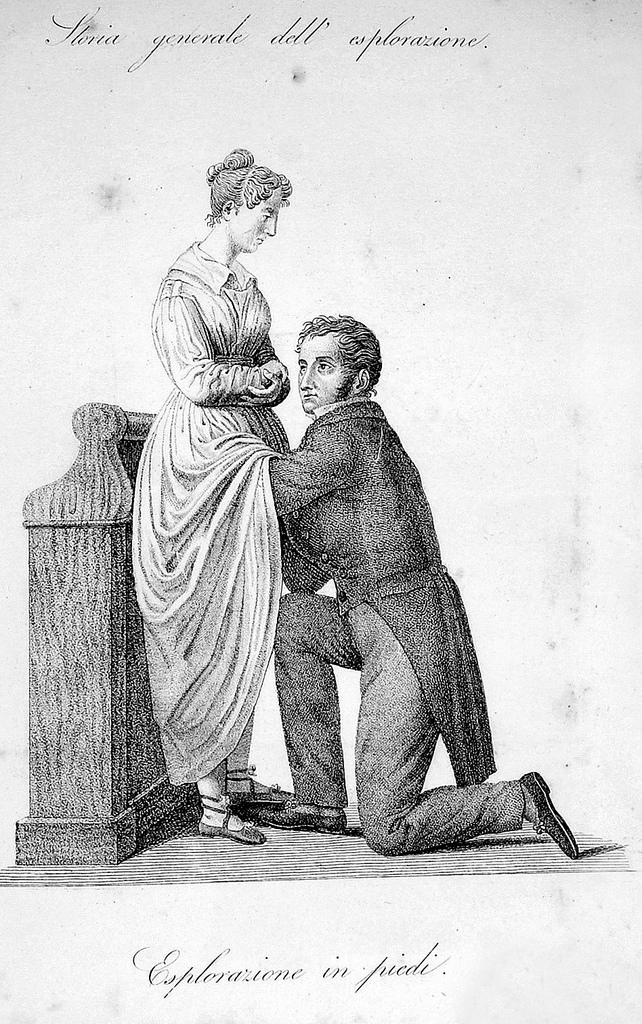
Morbid Anatomy, one of my new favorite sites, features three images of a physician examining a woman (circa 1800). These images came without attribution, but are interesting nevertheless. Click here to see them all.

Internal examination of a woman, circa 1800

In the early 1800’s there was also a growing number of formally trained doctors who took great pains to distinguish themselves from the host of lay practitioners. The most important real distinction was that the formally trained, or “regular” doctors as they called themselves, were male, usually middle class, and almost always more expensive than the lay competition. The “regulars'” practices were largely confined to middle and upper class people who could afford the prestige of being treated by a “gentleman” of their own class. By 1800, fashion even dictated that upper and middle class women employ male “regular” doctors for obstetrical care—a custom which plainer people regarded as grossly indecent.” – Witches, Midwives, and Nurses A History of Women Healers by Barbara Ehrenreich and Deirdre English

More on the topic:

Read Full Post »

Copryright (c) Jane Austen’s World. This post is in honor of Thanksgiving and all the cooks, feminine or masculine, who toil hard in the kitchen to feed their families on this special holiday.

I am sure that the ladies there had nothing to do with the mysteries of the stew-pot or the preserving-pan” – James Edward Austen-Leigh, writing about his aunts, Jane and Cassandra Austen, and grandmother, Mrs Austen, when they lived at Steventon Rectory.

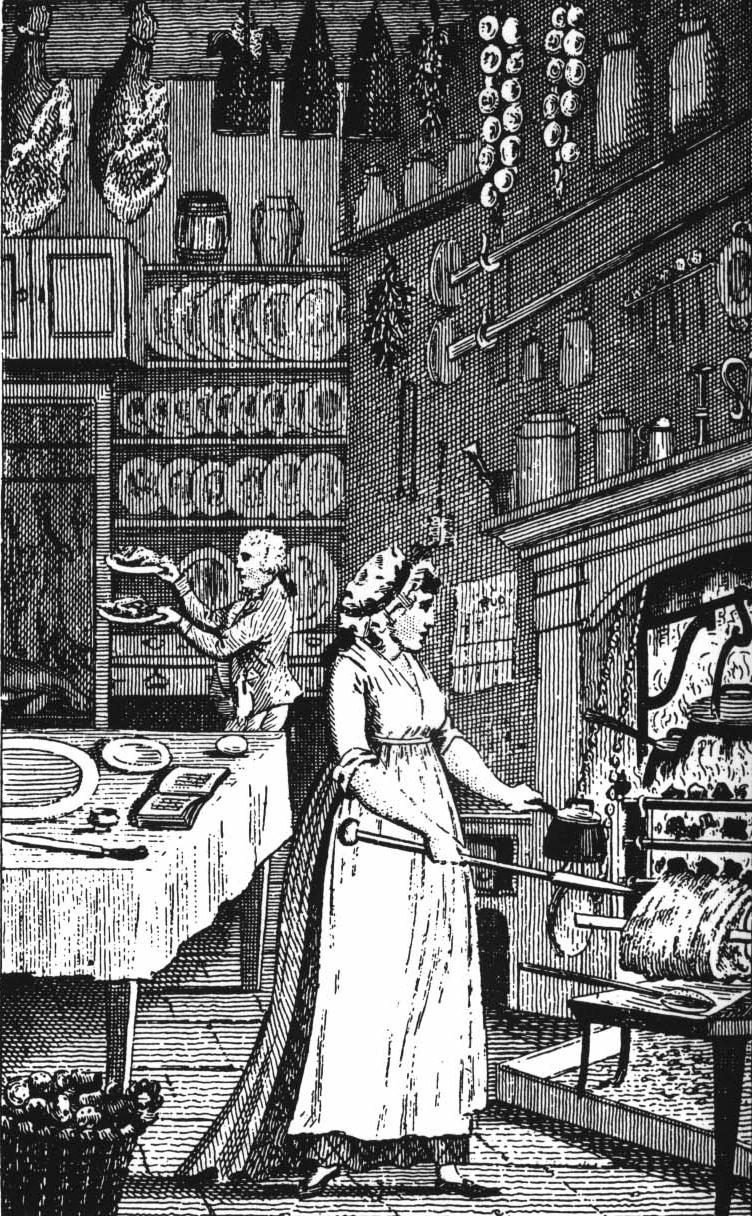
18th century kitchen servants prepare a meal. Image @Jane Austen Cookbook

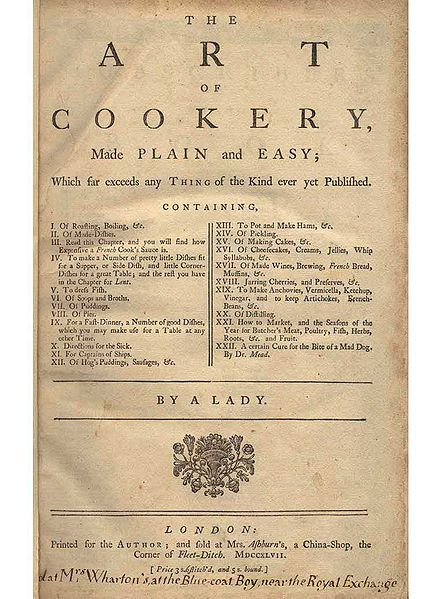
In 1747, Mrs.Hannah Glasse wrote her historic The Art of Cookery Made Plain and Easy, an easy-to-understand cookbook for the lower class chefs who cooked for the rich. Her recipes were simple and came with detailed instructions, a revolutionary thought at the time.

The Art of Cookery’s first distinction was simplicity – simple instructions, accessible ingredients, an accent on thrift, easy recipes and practical help with weights and timing. Out went the bewildering text of former cookery books (“pass it off brown” became “fry it brown in some good butter”; “draw him with parsley” became “throw some parsley over him”). Out went French nonsense: no complicated patisserie that an ordinary cook could not hope to cook successfully. Glasse took into account the limitations of the average middle-class kitchen: the small number of staff, the basic cooking equipment, limited funds. – Hannah Glasse, The Original Domestic Goddess forum

Hannah Glasse's The Art of Cookery Made Plain and Easy

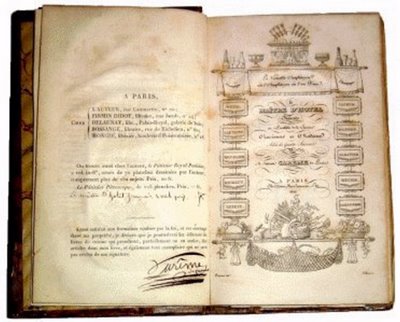
Until Mrs. Glasse wrote her popular cookery book (17 editions appeared in the 18th century), these instructional books had been largely written by male chefs who offered complicated French recipes without detailed or practical directions. (To see what I mean, check Antonin Careme’s recipe for Les Petits Vol-Au-Vents a la Nesle at this link.) Like Jane Austen, Hannah signed her books “By a Lady”.

Antonin Careme's cookbook

Mrs. Glasse had always intended to sell her cookery book to mistresses of gentry families or the rising middle class, who would then instruct their cooks to prepare foods from her simplified recipes, which she collected. “My Intention is to instruct the lower Sort [so that] every servant who can read will be capable of making a tolerable good Cook,” she wrote in her preface.

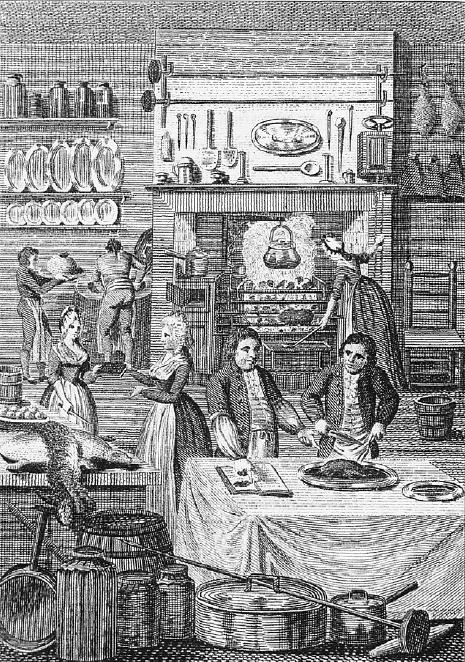
Frontispiece from William Augustus Henderson, The Housekeeper’s Instructor, 6th edition, c.1800. This same picture appeared in the very first edition of c.1791and it shows the mistress presenting the cookery book to her servant, while a young man is instructed in the art of carving with the aid of another book.*

Hanna’s revolutionary approach, which included the first known printed recipe for curry and instructions for making a hamburger, made sense. In the morning, it was the custom of the mistress of the household to speak to the cook or housekeeper about the day’s meals and give directions for the day. The servants in turn would interpret her instructions. (Often their mistress had to read the recipes to them, for many lower class people still could not read.)

In theory, the recipes from Hannah’s cookbook would help the lady of the house stay out of the kitchen and enjoy a few moments of free time. But the servant turnover rate was high and often the mistress had to roll up her sleeves and actively participate in the kitchen. Many households with just two or three servants could not afford a mistress of leisure, and they, like Mrs. Austen in the kitchens of Steventon Rectory and Chawton Cottage, would toil alongside their cook staff.

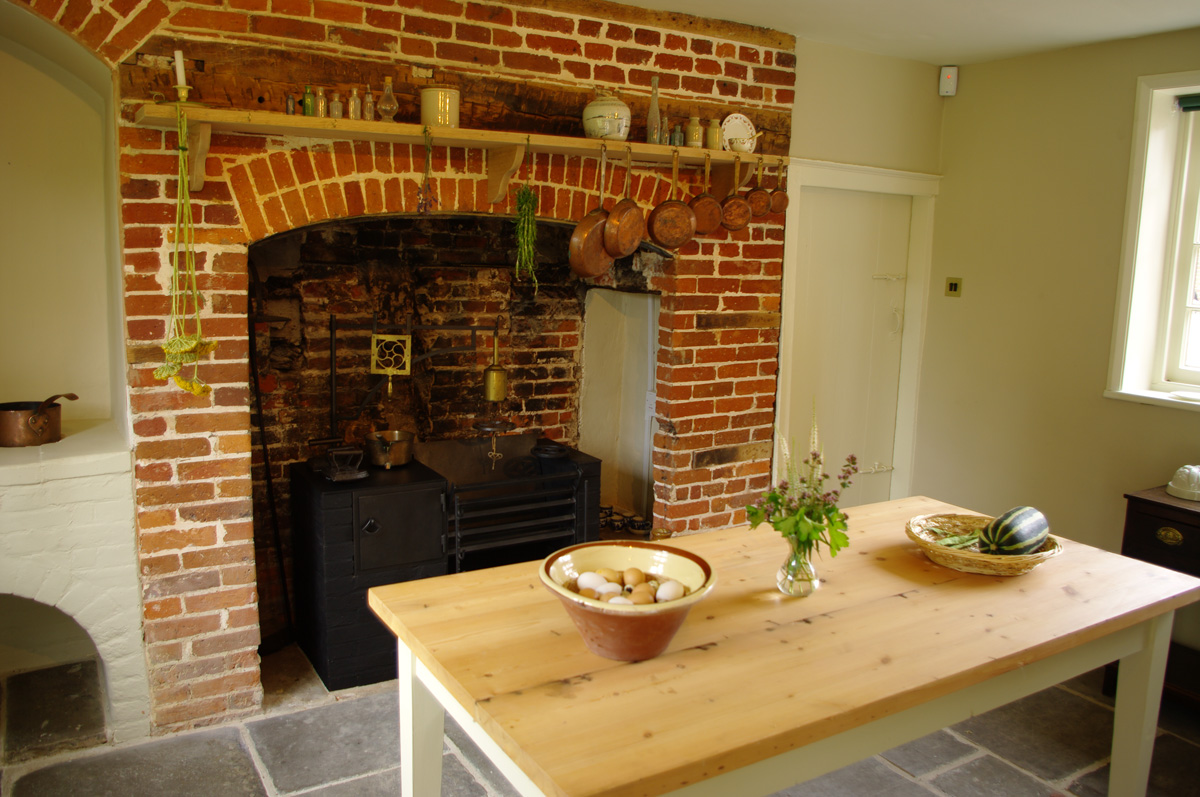
The simple kitchen at Chawton cottage. Image @Tony Grant

At the start of the 18th century the French courtly way of cooking still prevailed in genteel households. As the century progressed, more and more women like Hannah Glasse began to write cookery books that offered not only simpler versions of French recipes, but instructions for making traditional English pies, tarts, and cakes as well. Compared to the expensive cookbooks written by male chefs, cookery books written by women were quite affordable, for they were priced between 2 s. and 6 d.

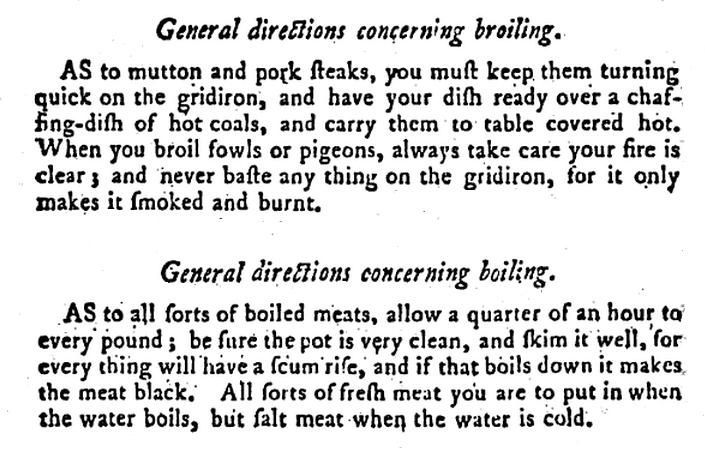
Hannah Glasse's practical directions for boiling and broiling

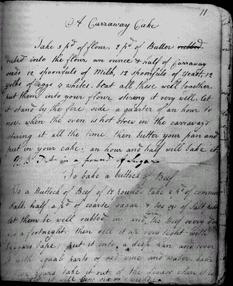
Publishers took advantage of the brisk trade, for with the changes in agricultural practices,  food was becoming more abundant for the rising middle classes. Large editions of cheap English cookery books by a variety of female cooks were distributed to a wide new audience of less wealthy and largely female readers who had money to spend on food. Before Hannah Glasse and her cohort, cooks and housewives  had been accustomed to sharing recipes in private journals (such as Marthat Lloyd’s) or handing them down by word-of-mouth.

Martha Lloyd's recipe for caraway cake written in her journal.

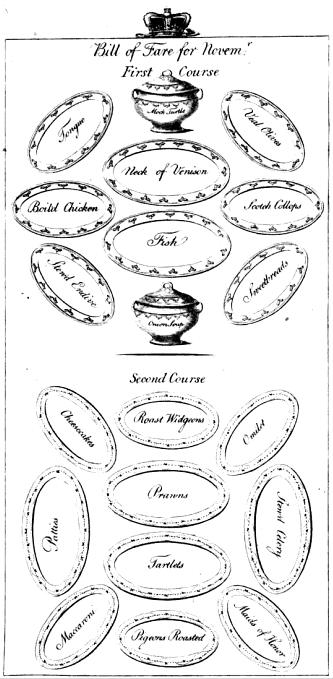
Female authors tended to share their native English recipes in their cookery books. As the century progressed, the content of these cookery books began to change. Aside from printing recipes, these books began to include medical instructions for poultices and the like; bills of fare for certain seasons or special gatherings; household and marketing tips; etc.

Bill of fare for November, The Universal Cook, 1792

By the end of the 18th century, cookery books also included heavy doses of servant etiquette and moral advice. At this time plain English fare had replaced French cuisine, although wealthy households continued to employ French chefs as expensive status symbols.  In the mid-19th century cookery books that targeted the working classes, such as Mrs. Beeton’s famous book on Household Management, began to be serialized in magazines, as well as published in book form.

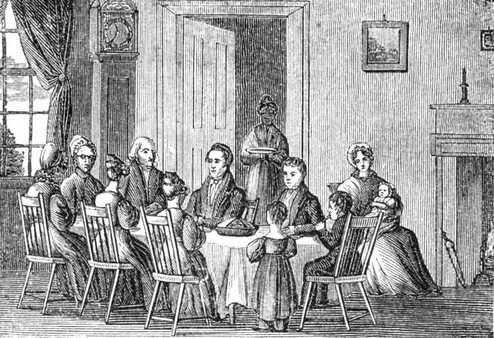
Family at meal time

Before ending this post, I would like to refer you back to James Edward Austen-Leigh’s quote at top. In contrast to what he wrote (for he did not know his aunts or grandmother well), Jane Austen scholar Maggie Lane reminds us that housewives who consulted with their cook and housekeeper  about the day’s meals still felt comfortable working in the kitchen. She writes in Jane Austen and Food:

“though they may not have stirred the pot or the pan themselves, Mrs. Austen and her daughters perfectly understood what was going on within them…The fact that their friend and one-time house-mate Martha Lloyd made a collection of recipes to which Mrs. Austen contributed is proof that the processes of cookery were understood by women of their class.”

More on the topic:

Read Full Post »

« Newer Posts - Older Posts »