Feeds:
Posts
Comments

Archive for the ‘Regency Customs’ Category

Gentle readers, I am taking a short hiatus from this blog for Thanksgiving week. Meanwhile, enjoy these images of people dining in days of yore…

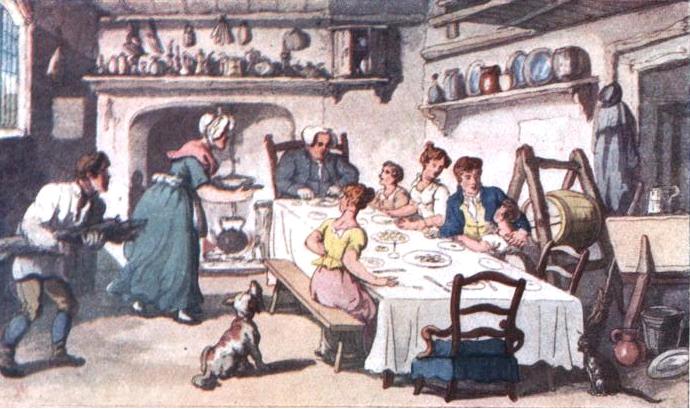
Dining for most people was a simple affair and food was taken from the land. Many families, unless their house was large enough to accommodate a dining room, ate in the kitchen.

Notice in this image of a family sharing a meal by Thomas Rowlandson (from The Vicar of Wakefield by Oliver Goldsmith), that the meal is eaten during the day and near the fire.

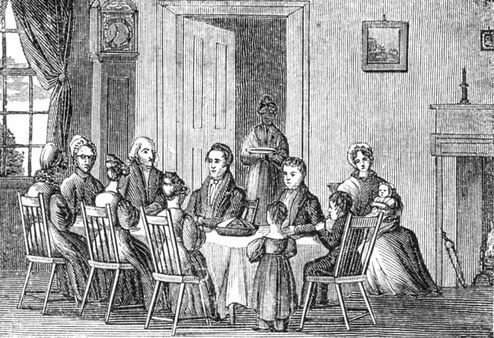
The rich could afford to eat by candlelight, as in this early 20th C. image of a Georgian dinner scene.

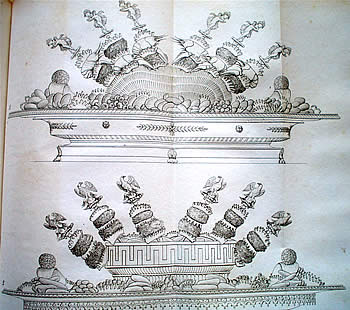
For some, like the Prince Regent, dinners were elaborate affairs.

For other families the meal was more basic and simple.

Family Meal

The hours in which people ate meals were changing:

In the beginning of the sixteenth century in England, dinner, the main meal of the day, used to begin at 11:00AM. Meals tended over time to be eaten later and later in the day: by the eighteenth century, dinner was eaten at about 3:00PM…By the early nineteenth century, lunch, what Palmer in Moveable Feasts calls “the furtive snack,” had become a sit-down meal at the dning table in the middle of the day. Upper-class people were eating breakfast earlier, and dinner later, than they had formerly done…in 1808…dinner was now a late meal and supper a snack taken at the very end of the day before people retired to bed. For a long time luncheon was a very upper-class habit; ordinarily working people dined in the early evening, and contented themselves as they had done for centuries with a mid-day snack…Supper now means a light evening meal that replaces dinner; such a meal is especially popular if people have eaten a heavy lunch – The Rituals of Dinner, Margaret Visser [Penguid:New York] 1991 (p. 159-160) – Food Timeline

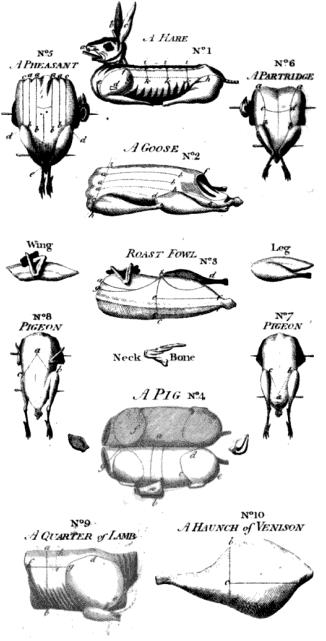
Image source: The Universal Cook: And City and Country Housekeeper, John Francis Collingwood and John Woollams, Principal Cooks at The Crown and Anchor Tavern in the Strand, 1792

Meat made up a large part of the Regency diet, even for the middle class. For most people living in London, the animals had to be brought a long way to market. Due to the length of the journey, the quality of meat was often poor. In contrast, venison and game procured from country estates and served fresh was often considered prize meat.

The Breedwell Family, Thomas Rowlandson

Families tended to be large and extended. In this boisterous family scene by Rowlandson, the Breedwells obviously bred beyond “the heir and the spare.”

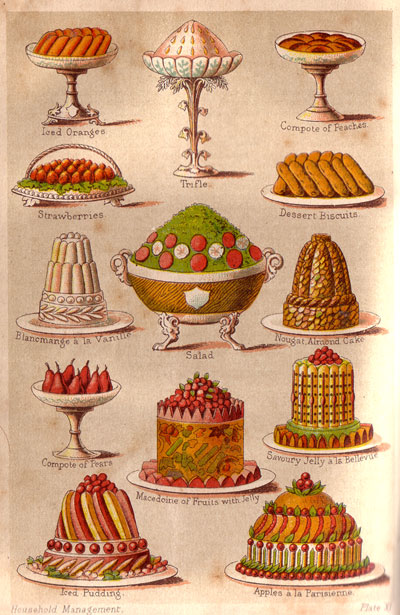
Desserts, Isabella Beaton

Desserts made up the last course of the meal. Even for the middle class this course was elaborate and plentiful, but for the rich it was spectacular.

Walled kitchen garden

Kitchen gardens provided fresh produce during the growing season. The very rich grew fruits and vegetables in hot houses, but most people ate meat, soups, or bread throughout the year. Fruit and vegetables were preserved, or, as in the case of apples and root vegetables, stored through the winter.

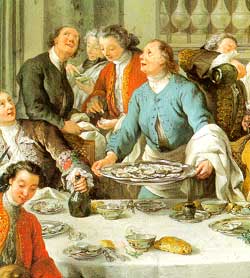
Seafood had to be served fresh and within hours of its harvest. Chances were that this tavern, where oysters were served on a platter, sits in a geographic area by the sea.

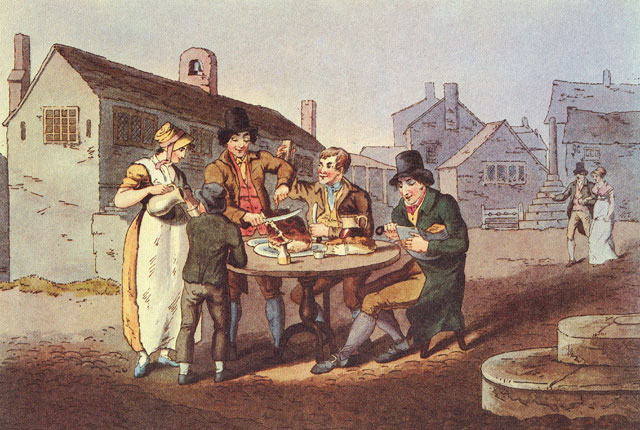
Life in Yorkshire

Elegant, or simple, the family meal meant togetherness.

Happy Thanksgiving everyone

More on the topic:

Read Full Post »

Another book review so soon on this blog? Well, yes. This book from Shire Publications, Victorian and Edwardian Horse Cabs by Trevor May, is short, just 32 pages long, but it  is filled with many facts and rare images of interest to lovers of history. In Jane Austen’s day most people walked to work, town, church, and market square, or to their neighbors. Six miles was not considered an undue distance to travel by foot one way. The gentry were another breed. They either owned their own carriages or hired a public horse cab. These equipages were available as early as the 1620’s.

Hackneys, or public carriages for hire made their first significant appearance in the early 17th century. By 1694, these vehicles had increased to such a number that a body of Hackney Coach Commissioners was established in London. The commissioners dealt out licences, which was a bit of a joke, for a mere four inspectors were responsible for over 1,000 vehicles.

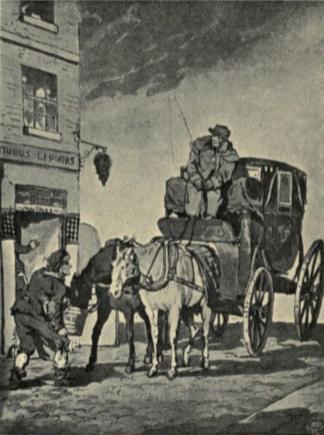
Hackney Coach 1680

Most of these licensed hackney coaches were purchased second hand. All that an enterprising person needed to establish his own hackney coach business was enough money for a used carriage and three horses, two that worked in rotation, and one that could be used as a replacement in case of injury or illness. The death of a horse could lead to a cab owner’s financial ruin. Another important ingredient was housing for the horses.

Hackney Coach 1800. Image @Wikimedia Commons

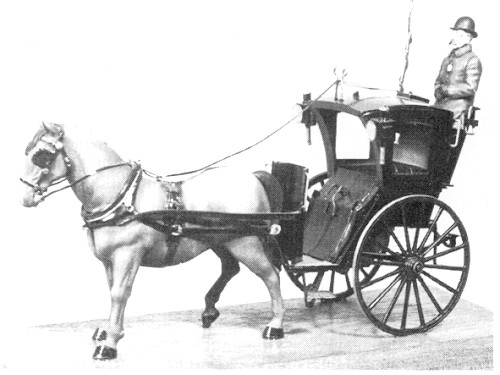
By, 1823, the lighter horse cabs began to replace cumbersome hackney coaches in great quantity, and by the mid 1830’s, the hansom cab set the new standard for modern horse cabs. Aloysius Hansom, an architect, designed the first carriage. When Hansom went bankrupt through poor investments, John Chapman took over, designing an even lighter, more efficient cab, one whose framework did not strike the horses on their backs or sides whenever a carriage ran over an obstacle in the road.

Hansom Cab

Commercial cab firms tended to be small, even as late as 1892. Only one or two proprietors provided a large number or variety of equipages, like Alfred Pargetter, whose concern advertised removal carriages, cabs, and funeral coaches for hire. While cabs were licensed, their drivers were not and the road could present a dangerous obstacle course. The video clip below shows how adroitly horses and carriages managed to avoid each other with seemingly few rules (mostly towards the end of the clip). Notice how some lucky individual horses pulled relatively light loads compared to other horses forced to pull heavy carts.

These two video clips, one from 1903 and the other from 1896 (unbelievable!) show the end of an era, for by 1914, motorized vehicles were rapidly replacing the horse-drawn cart.

I recommend this book to anyone with an insatiable appetite for a pictorial history on a particular topic. Trevor May is an expert on the Victorian era, and he has managed to squeeze more information about horse-drawn cabs in this short book (more a thick pamphlet) than I have read before. The images are simply splendid.

Read Full Post »

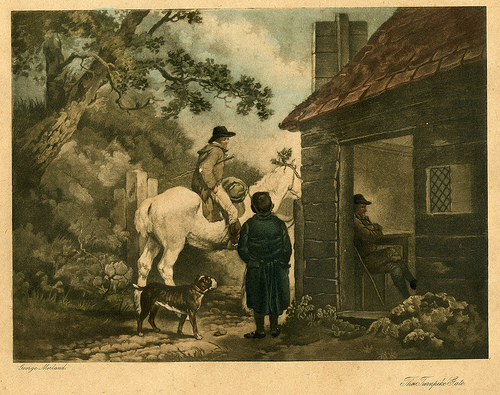
Turnpike Gate, George Morland

Turnpike Gate, George Morland

Historical romances abound with tales of aristocrats falling in love with beautiful women outside of their own class and marrying them. Several years ago in The Dairy Maid and the Master of Uppark, I wrote about Sir Harry Fetherstonhaugh, who married his milkmaid.  These exceptions prove the rule, for  Society frowned severely upon those who married downward. Thomas Thynne, 5th Viscount Weymouth, who made the mistake of falling in love with the tollgate keeper’s daughter, was never to become the 3rd Marquess of Bath.  He first eloped to Paris with his pretty bride, then lived in Italy, where he waited to claim his inheritance. No matter how hard his father (the 2nd Marquess) tried, he could not get around the legalities of the entail and disinherit his son. So the Marquess dug in his heels, willing himself to live longer than the Viscount …

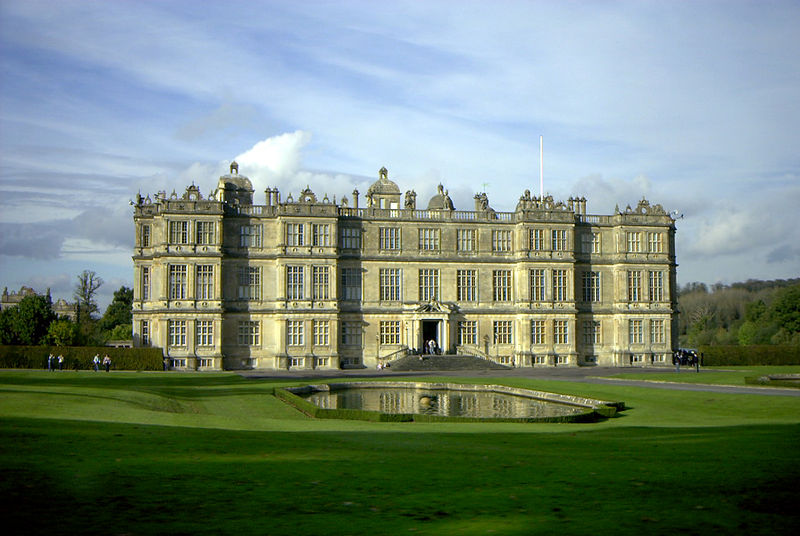
The first Marquess of Bath was said to have been a great womanizer, gambler, and dissipator. His biggest contribution to posterity was in hiring Capability Brown to landscape his estate at Longleat, a former priory, changing the gardens from formal parterres to a more natural design.  After his death in 1792, his son, Thomas Thynne, the second Marquess of Bath, rebuilt the outdated portions of the old priory. By 1815, he had spent over£100,000 on improvements. In 1820, the second Marquess opened the grounds to the public once a week and free of charge, encouraging picknics and similar leisurely pursuits. One would think that by setting such a sober example, his children would live equally responsible lives, but this was not to be the case for all.

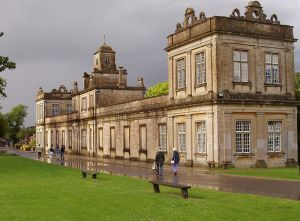
Longleat Outbuilding

The 2nd Marquess and his plumb intellectual wife, Isabella, had eleven children. Two daughers married well, but three of his sons caused them no end of trouble. Without consulting his parents, Thomas, the 24-year-old heir, eloped with beautiful, raven-haired Harriet Robbins, the daughter of a humble local toll-keeper named Thomas Robbins. Up to that point, the young Viscount had not led an exemplary life and had a reputation for drinking and gambling. The Marquess was furious with his son’s marriage.  He must have made his extreme displeasure known, for after two months of silence young Thomas replied in a letter from Italy:

You know the remorse I feel for having given so many miseries to so good a father … a sort of fate hurried us on … I saw myself surrounded by misfortunes which I find at last were of my own making … My mind was in a state of confusion and despair, and I am ashamed to say I tried to attach the blame on you. I did not dare open the last letter from you for a long time, but when I did, I flew to anything to drive away reflection…

The young Viscount was smitten by “the artful charms of a country girl, then hurled [his] fortune to the wind in hasty flight“.  The letter did not assuage the Marquess, who set about to disinherit his heir. He attempted to “bribe” Thomas by offering money in exchange for his inheritance, but the Viscount rejected the offer, opting to live in Italy while literally waiting for his father to die.


Longleat House. Image @Wikimedia Commons

Weymouth was not the only child to disappoint the Marquess, for two of his other three sons, Charles and Edward, lived lives of such extravagance and mounted such enormous debts, that the Marquess fired off a letter to The Times “disclaiming all responsibility for their behaviour” and any liability for their debts. Charles and Edward had expected their father to bail them out. When this did not occur, they moved from England. It is thought that Charles ended up in Canada and Edward in Australia, but the records are not clear on this topic.   Thomas’s mother, Isabella, was the only member of the family to travel to Paris to visit the Viscount and his wife. Seeing that they were reasonably happy, she forgave them for their unkindness and misconduct, but she was never able to arbitrate a truce between her husband and son. Before her death in 1830, she wrote in a letter to her husband:

Accept my grateful thanks for all the kindness and happiness you have bestowed on me for so many years, which has been returned by the warmest affection that one mortal is capable of for another…Talk to our children of your interests, of your affairs, and try to get reacquainted with theirs. Be their friend, as well as their respected father …

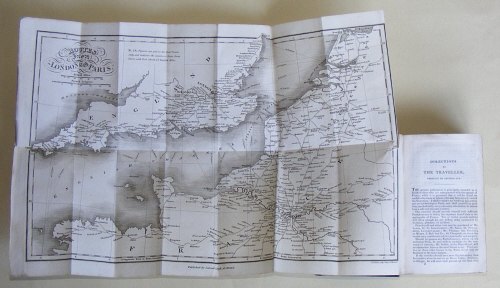
London to Paris Routes, Planta's Paris, 1825

London to Paris routes

Despite his wife’s wishes, the Marquess remained obdurate. After Isabella’s death, any hope of reconciliation vanished, and both he and his son were determined to outlive the other. In January of 1837, the Viscount died at the age of 41 without an heir. He shrugged off his mortal coil a scant five weeks before his father, who died at the age of 74.  Harriet, only a few years younger than her husband, was now a widow.

“So the family now awaited with bated breath to hear if she were pregnant. Insensitive suggestions were made about getting her to submit to an official examination so as to preclude the possibility of her turning up at Longleat in years to come, having acquired a son of approximately the right age, to claim the inheritance retrospectively.

Yet such cynicism proved unwarranted. Harriet went on to marry an Italian nobleman and never did have any children. But in any case, she did not attempt, nor wish, to give any further trouble to the Thynne family. –  Strictly Private

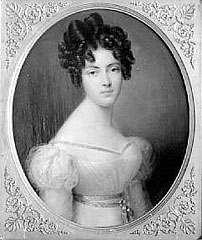
Harriet, Marchioness of Bath

Harriet, Marchioness of Bath and Henry Thynne's wife. Image @Turtle Bunbury

As for the title and the inheritance, they passed to Henry Thynne, a captain in the Royal Navy, who died soon afterwards. A Pyrrhic victory, indeed.

Facts about Harriet Matilda Robbins – Born:18 Nov 1800. Died: 18 June 1873. Daughter of Thomas Robbins. She married, Thomas Thynne, Viscount Weymouth, son of Sir Thomas Thynne, 2nd Marquess of Bath and Hon. Isabella Elizabeth Byng, on 11 May 1820. Her married name became Thynne. She married, secondly, Count unknown Inghirami after 1837, and died on 18 June 1873 at Florence, Italy. From 1837 on her married name became Inghirami.

More on this topic:

Read Full Post »

“We have this comfort, he cannot be a bad or a wicked child,” George Austen writing about his second son, George

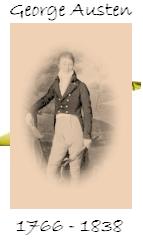
George Austen 2George Austen, Jane’s second oldest brother is an enigma, rarely glimpsed and hardly known to the world. No image exists of him, which is why the image I used for this post has no face to speak of. George Austen was thought to be mentally or physically impaired, or suffering from an infirmity. Nearly ten years older than Jane, Claire Tomalin wrote that he still lived in Steventon village in 1776 (See Boris’s comment in the comment section) and that the very young Jane knew him.

“He could walk, and he was not a Down’s Syndrome child, or he would not have lived so long, lacking modern medication. Because Jane knew deaf and dumb sign language as an adult— she mentioned talking “with my fingers” in a letter of 1808— it is thought he may have lacked language; it would not have stopped him joining in the village children’s games.” – Claire Tomalin, Jane Austen, A Biography

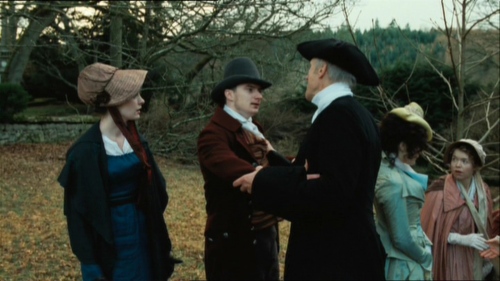
The Austens produced remarkably hardy children, for all survived their childhood. At forty-one, Jane was the youngest to die. George, who survived to a ripe old age, was cared for along with his Uncle Thomas (a mentally defective person), by Francis Cullum, who lived in Monk Sherborne, a nearby Hampshire village. Although George was not mentioned in Austen family letters, he was not totally forgotten, for the family contributed to his upkeep. The wildly sentimental film, Becoming Jane, shows George as an active member of the family, walking with Jane in the woods and attending church with them, but an article in JASNA rightly states, “It is not likely that he attended church with the Austens, as depicted in the movie.”

Jane, George, Rev. Austen, Eliza de Feuillide and Cassandra after church service in Becoming Jane.

Jane, George, Rev. Austen, Eliza de Feuillide and Cassandra after church service in Becoming Jane.

After Jane’s death, mention of George disappeared from several family sources. John and Edith Hubback in Jane Austen’s Sailor Brothers wrote: “In a family of seven all turned out well, two rose to the top of their profession, and one was—Jane Austen.”  Their math is obviously wrong. In the Memoir of Jane Austen, her nephew James Edward Austen-Leigh mentions that James was the first brother and Edward the second. This historical oversight has outraged some authors, David Nokes in particular, whose reaction is described in a Washington Post review of his book, Jane Austen: A Life:

A second “family secret” hitherto little mentioned is the existence of Jane Austen’s brother George, 10 years older than Jane, who “never learned to speak” and was boarded out for the rest of his life in another Hampshire village along with Thomas Leigh, Mrs. Austen’s mentally defective brother. This George Austen (perhaps the origin of “poor Richard” Musgrave in Persuasion) long survived his sister Jane and lived on into his seventies. David Nokes devotes an indignant last chapter to “poor George” and contrasts the Austen family’s ruthless jettisoning of him — apart from payment of a small, regular fee for his upkeep — with their family’s rather sickening adulation, after Jane’s death, of their “dear angel” Aunt Jane — whose propensity for satire and malice was almost entirely played down, while her simple religious beliefs were elevated into near-canonization.

The Loiterer cautions us about first-hand accounts, saying they can be wildly inaccurate:

“There were eight children in the family and the second brother was George and not Edward who, in fact, was the third brother. George, apparently, was epileptic and may have been deaf and dumb as well. He simply was not allowed to join the family in their home. None of Jane’s existing letters mentions him—not one single time. (In spite of his infirmities, he outlived Jane by at least ten years!) Now, there is something to give one perspective on “first-hand accounts”. – The Loiterer

Another source of outrage for David Nokes was Mrs. Austen, who died in 1823. In her will she had divided the money from her South Sea Annuities equally among the surviving Austen children, with the exception of  George.

“He, as usual, was excluded and forgotten. It was Edward Knight who, as an act of kindness, made over his share of the money ‘for the use of my brother George, being his full share of the £3,350 old South Sea Annuities. – David Nokes, p. 525

Francis Cullum, George caretaker, died in the spring of 1834. After his death, his son George took over the responsibilities of caring for George Austen, who died of dropsy in 1838. Once again, David Nokes writes with melodramatic flourish about the loving way in which Jane’s memory was perpetuated by her family, even as they neglected poor George:

“Less than twenty miles away [from Jane’s grave], Jane’s brother George was laid to rest in an unnamed grave in the churchyard of All Saints church, Monk Sherborne. In death, as in life, he was to be forgotten, his remains unmarked by any stone. Only George Cullum was in attendance at George Austen’s death. It was he who noted for the death certificate that George Austen was ‘a gentleman’. – Nokes, p. 526

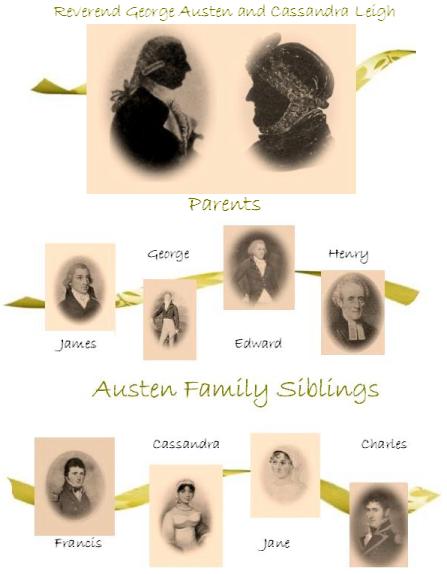
I cannot express how much I disagree with David Nokes in this instance. The Austens arranged to have George and Cassandra’s brother, Thomas Leigh, looked after by a caring family, and supported these two family members financially. One imagines that with eight children, a boarding school, a small plot of land to tend to with chickens and a cow, and two livings as a clergyman, that the two elder Austens had their hands full overseeing their burgeoning household. The addition of a special needs child who required constant care would have added a great strain to their living situation.

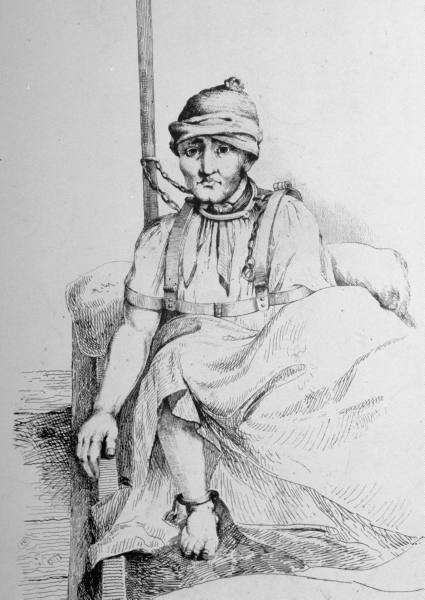
Bedlam inmate shackled in irons, Bethelehem Royal Hospital, London

Bedlam inmate shackled in irons, Bethelehem Royal Hospital, London

This was an age where few asylums for the mentally disabled or the physically disabled existed. People with infirmities were looked upon as defectives and many became sideshows at fairs or carnivals, or as beggars on the streets. It was a custom at this time to visit Bedlam and stare at the people in the lunatic asylum. In fact, there were very few institutions available during this era for people of special needs and very few places that could take them in. Bedlam was the only hospital of its kind in London during Jane’s lifetime. Workhouses and almshouses were the only other places where the physically and mentally handicapped could be deposited, and these were places that people strove to avoid at all cost. In addition, there has been a history since the beginning of time in almost all cultures that looked the other way when parents left their defective babies in the wild to die. (This situation still exists today.) Unlike David Nokes, my conclusion is that, given the era the Austens lived in, the family behaved in a remarkably responsible manner towards George, who lived a quiet life of peace and relative comfort for 72 long years. As for the inaccuracies in later biographies written by Austen family members, one wonders how effectively George had been hidden from view. Out of sight is out of mind, and these mistakes of omittance may well have been the natural result of – as David Nokes accused the Austens of doing – the extended family forgetting that George had ever existed.
Austen family

Gentle reader: In honor of JASNA’s annual meeting in Philadelphia this week, this blog, Austenprose, and Jane Austen Today have devoted posts to Jane Austen and her siblings. This is the last of seven articles devoted to her brothers and sisters. Tomorrow, Laurel Ann and I will recommend several biographies on Jane Austen.

Read Full Post »

write letter byron 2003Gentle readers,

The Lady Susan Soiree is going full tilt at Austenprose, where Laurel Ann and her band of readers are finishing up Jane Austen’s last published novel. Lady Susan is an epistolary novel, or one that is written in letter format. Last week I wrote a post about Upper Seymour Street, one of the prominent addresses in the novel, this week I will be writing about the postal service during the Georgian era. Not only did Jane Austen write a novel in letter format, she was a great letter writer herself. Sending a letter over two hundred years ago was much like sending an email today: the service was expensive and it depended upon the smooth running of a money making operation. But in London the service was different, for the Penny-Post had been introduced. This form of sending letters was both easy, affordable and practical, and explains how a lady with straitened finances like Lady Susan Vernon could afford to write so many letters in such a short space of time.

During the eighteenth century a letter from London to Bath could take three days to arrive, but by the 1820s, mail was delivered the morning after posting in towns more than 120 miles apart. In central London the postal service was so efficient, and there were such frequent deliveries, than an invitation issued in the morning could be acknowledged the same afternoon. – High Society, Venetia Murray, ISBN: 0670857580, p. 2.

Venetia Murray’s entry about the postal service was short and to the point, but it does not come close to telling the entire story. Because I uncovered so much information, I am dividing this post into three parts: 1) Letters and the Penny-Post, 2) Post Roads and Post Boys, and 3) John Palmer and the Royal Mail Coach.

Part One: Letters and the Penny-Post

In 1635 Charles I opened up his ‘royal mail’ for use by the public. Oliver Cromwell established the General Post Office in 1657 and after the Restoration, Charles II authorized the General Post Office to operate the ‘royal mail’, with the revenue from the postal service going to the Government.
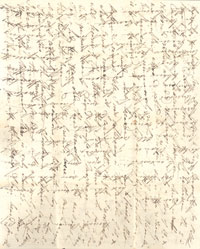
Small cross written letter

Small cross written letter

In those early days, postal rates were calculated according to the distances traveled and the number of sheets that comprised a letter. Because of their cost, only businesses and the wealthy could afford to send letters. Others simply had to entrust their missives to friends and family members, or ask people traveling to another town to serve as a messenger. Even the wealthy kept their sheets of paper small and wrote in a cross writing style to conserve space. (See the  image at right and click here to read my post on Letter Writing in Jane Austen’s Time.) Envelopes would have been considered an additional sheet, so these very early letters did not include them.  A letter was simply folded over and sealed with wax that was stamped by a signet ring or a seal.  Recipients, not the sender, had to pay for the cost of a letter. This system caused hardship in cases where the recipient did not have the money, and as a result many letters languished on a post office shelf or were thrown away. Knowing these facts about the postal system of the period helps the reader to understand the following passage from Mansfield Park. Even though this scene occured in the early 19th century, the costs associated with sending letters from one city to another had not changed in over 100 years, for the postal system would not significantly improve until 1837, when Rowland Hill set out to reform it.

    “But William will write to you, I dare say.” “Yes, he had promised he would, but he had told her to write first.” “And when shall you do it?” She hung her head and answered hesitatingly, “she did not know; she had not any paper.”

    “If that be all your difficulty, I will furnish you with paper and every other material, and you may write your letter whenever you choose. Would it make you happy to write to William?”

    “Yes, very.”

    “Then let it be done now. Come with me into the breakfast room, we shall find every thing there, and be sure of having the room to ourselves.”

    “But, cousin—will it go to the post?”

    “Yes, depend upon me it shall; it shall go with the other letters; and, as your uncle will frank it, it will cost William nothing.”

    “My uncle!” repeated Fanny, with a frightened look.

    “Yes, when you have written the letter, I will take it to my father to frank.”

    Fanny thought it a bold measure, but offered no farther resistance

Edmund also sits down to write “with his own hand his love to his cousin William, and sent him half a guinea under the seal.” This was a remarkable sum of money for the day, and demonstratedEdmund’s character like no words could. From this point on, William would have enough money to pay for Fanny’s letters as they came.
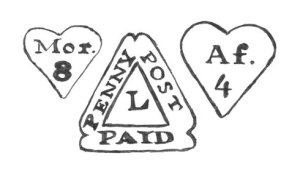
William Dockwra's postal markings

William Dockwra's postal markings

Interestingly, the Post Office did not handle letters sent from one London address to another. The city was a thriving metropolis and trading center, yet merchants had to employ private messengers to carry letters and packages across town, much like the poor in other parts of the country. In 1680, an enterprising merchant named William Dockwra introduced a local Penny-Post in London, which carried letters within a ten mile radius. His service also introduced the pre-payment of letters, a revolutionary idea. William’s advertisement in the Mercurius Civicus read:

“The Undertakers for the Incomparable and Advantageous Design for the Speedy and safe Conveyance of Letters and packquets under a pound weight, to all parts of the Cities of London and Westminster, and the suburbs thereof … [have] ordered their Messengers to call for all Letters at all Coffee-Houses in the High Roads and Streets following . . . And all persons, who leave their Letters at any of the places aforesaid, may be sure to have them speedily dispatched for ONE PENY”.

William’s method of operation was immediately successful, “particularly as letters left at any Penny-Post House were sent out “successively every hour of the Day, till Eight of the Clock at Night”. Furthermore, to ensure that correspondence was delivered as soon as possible, each letter was stamped with the hour of the day on which it was sent out. This way, people could work out whether the “delays that may happen be really in the Office, or their own Servants (or other) with whom their Letters were left in due time”. “– Potted History by Ben Locker

Dockwra used two main postmarks for each letter. One was a triangular stamp with “Penny-Post Paid” on the three sides and the initials of the sorting office in the centre. This indicated that the rate had been paid and there was no further charges necessary on receipt. The second postmark was a heart shaped stamp indicating the date and time of dispatch.

There was a great deal of opposition to Dockwra’s post from porters and messengers whose livelihood was affected by the service. The church, a powerful force at the time, also had strong opposition!

The most serious opposition to Dockwra’s system came from the General Post Office, which heavily resented the competition. As such, in 1682 legal action was taken against William Dockwra in the name of the Duke Of York (Later King James II.) who was responsible for overseeing the Post Office at the time. – William Dockwra

Unfortunately, the Duke of York  held the monopoly on collecting revenue from the mail. He prosecuted Dockwra for £100 (Wikipedia says it was £2,000)  in damages and forced the merchant to relinquish control of his enterprise. Four days after the judgement, the London Gazette announced that the Penny-Post would shortly be reopened as part of the General Post Office.  For nine years Dockwra petitioned the Duke to save him and his “family of 9 children from Ruine.” Eventually in 1689, after James II’s death, Dockwra received a “seven-year pension of £500 “in consideration of his good service in inventing and setting up the business of the Penny-Post.” (Potted History by Ben Locker)

General Post Office in Lombard Street, London

General Post Office in Lombard Street, London

“The Penny-Post was quickly adopted in other cities and towns, like Dublin, Edinburgh and Manchester. Revenues steadily increased, and by 1727 the London District Post was so well regarded that ‘Daniel Defoe praised it for not charging for “a single Piece of Paper, as in the General Post-Office, but [sending] any Packet under a Pound weight . . . at the same price.'” The employment of extra letter carriers increased the number of deliveries, so that the system became even more efficient. From the 1770s the numbering of houses began, and by 1805 this system became mandatory in London Streets, making it even easier for letter carriers to deliver mail (Potted History by Ben Locker).  In contrast to the Penny-Post, letters that went out via the General Post Office still charged recipients for distance traveled and the number of sheets used, so that a letter sent from Steventon Rectory to Chawton would be quite expensive as compared to a letter sent from one London address to another, or one Manchester address to another.
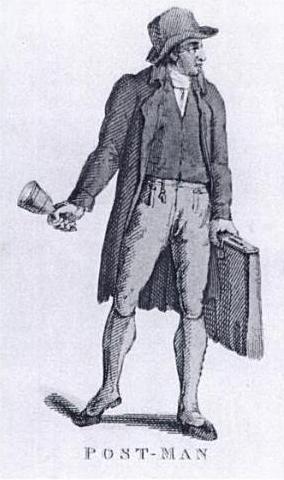
Letter carrier, 1800, with bell and satchel

Letter carrier, 1800, with bell and satchel

For ordinary people the cost of receiving a letter was a significant part of the weekly wage. If you lived in London and your relatives had written to you from Edinburgh you would have to pay one shilling and one pence per page – more than the average worker earned in a day. Many letters were never delivered because their recipients could not afford them, losing the Post Office a great deal of money.” – Rowland Hill’s Postal Reforms

To help finance the war against Napoleon, the London Penny-Post was increased to tuppence in 1801; in 1805 the amount was raised to three pence. The beginning of uniform penny postage in 1840 made sending mail affordable to all for the first time. In 1837, English schoolmaster, Rowland Hill, wrote a pamphlet, Post Office Reform: its Importance and Practicability, which was privately circulated. In that year, he also invented the postage stamp, which necessitated the use of an envelope. “The Penny-Post system that began in 1840 used a lozenge-shaped sheet more akin to today’s aerogrammes, though in the same year George Wilson patented a system for printing several envelopes from one large sheet of paper, and in 1845 a steam-driven cutting and folding machine was invented.”  History of the Humble Envelope

Hill’s famous pamphlet, Post Office Reform, was privately circulated in 1837. The report called for “low and uniform rates” according to weight, rather than distance. Hill’s study showed that most of the costs in the postal system were not for transport, but rather for laborious handling procedures at the origins and the destinations.

Costs could be reduced dramatically if postage were prepaid by the sender, the prepayment to be proven by the use of prepaid letter sheets or adhesive stamps (adhesive stamps had long been used to show payment of taxes – for example, on documents).

Letter sheets were to be used because envelopes were not yet common – they were not yet mass produced, and in an era when postage was calculated partly on the basis of the number of sheets of paper used, the same sheet of paper would be folded and serve for both the message and the address. In addition, Hill proposed to lower the postage rate to a penny per half ounce, without regard to distance. He presented his proposal to the Government in 1838.

Postal service rates were lowered almost immediately, to fourpence from the 5 December 1839, then to the penny rate on the 10 January 1840, even before stamps or letter sheets could be printed. The volume of paid internal correspondence increased dramatically, by 120%, between November, 1839 and February, 1840. – Rowland Hill

More on this topic:

Read Full Post »

« Newer Posts - Older Posts »