Feeds:
Posts
Comments

Archive for the ‘Regency Life’ Category

Downton Abbey, a PBS Masterpiece Classic mini-series, is as much a tale about the servants below stairs as about the noble Earl of Grantham and his family who employed them. With the recent airing of the updated version of Upstairs Downstairs in Great Britain, I am sure a debate will long rage about which series portrayed their eras and class differences better. In both cases, the viewer is the winner.
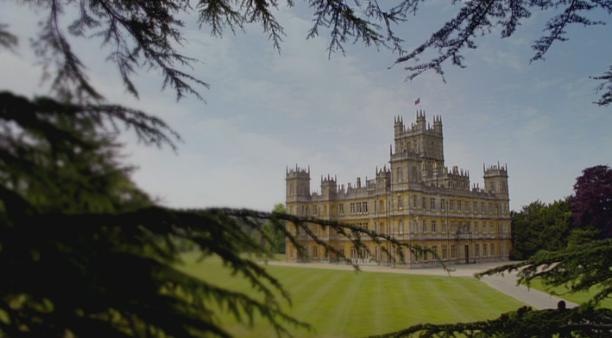
Downton Abbey. Credit: Courtesy of © Carnival Film & Television Limited for MASTERPIECE

Downton Abbey (Highclere Castle, an “Elizabethan Pile”) Credit: Courtesy of © Carnival Film & Television Limited for MASTERPIECE

Images Credit: Courtesy of © Carnival Film & Television Limited for MASTERPIECE

No matter how expertly this mini-series of Downton Abbey tries to portray this bygone era, it is nearly impossible to capure life in an Edwardian country house exactly as it once was. The viewer should be aware that we can glimpse only a faint, musty, museum shadow of the complex and thriving community that a great English estate once supported.

Downton Abbey. Jane Austen's World. Credit: Courtesy of © Carnival Film & Television Limited for MASTERPIECE

The Crawleys and the servants of Downton Abbey. Credit: Courtesy of © Carnival Film & Television Limited for MASTERPIECE

Images Credit: Courtesy of © Carnival Film & Television Limited for MASTERPIECE

It is a well-known fact that grand country houses could only be run with a great deal of help. As early as the 18th century, Patrick Colquhoun estimated that there were around 910,000 domestic servants (in a population of 9 million). By 1911, the number of domestic servants had risen to 1.3 million. Eighty percent of the land during the Edwardian era was owned by only 3% of the population, yet these vast estates were considered major employers.
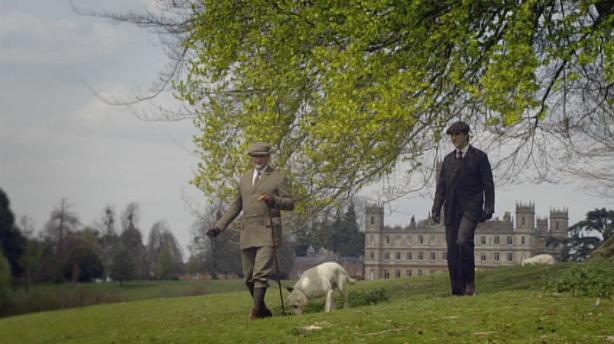
Downton Abbey. Credit: Courtesy of © Carnival Film & Television Limited for MASTERPIECE

The earl (Hugh Bonneville) and his heir, Matthew Crawley (Dan Stevens), survey his vast estate. Credit: Courtesy of © Carnival Film & Television Limited for MASTERPIECE

In the grander and larger houses, the ratio of servants (both indoor and outdoor) to the family could approach 1:7 or 1:10, but as the industrial revolution introduced improvements in laundering, lawn maintenance, and cooking, the number of servants required to run a great estate was greatly reduced.

Credit: Courtesy of © Carnival Film & Television Limited for MASTERPIECE

The earl and his heir, Matthew Crawley, survey the cottages and outer buildings on his estate. Credit: Courtesy of © Carnival Film & Television Limited for MASTERPIECE

After World War One and the rise in taxes for each servant employed, many great families no longer kept two sets of house staff. They began to bring servants from their country house to their house in Town, leaving only a skeleton crew behind to maintain the family seat in their absence.
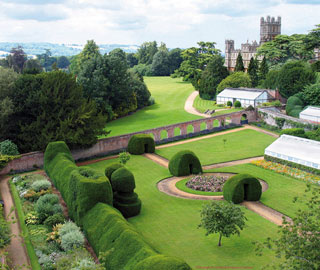
Grounds of Downton Abbey (Highclere Castle)

Country estates were designed to showcase the owner’s wealth via collections of art, furniture and other luxurious possessions, such as carriages, lawn tennis courts, and the like. The main house sat at the end of a long and winding drive through acres of beautifully landscaped park lands.
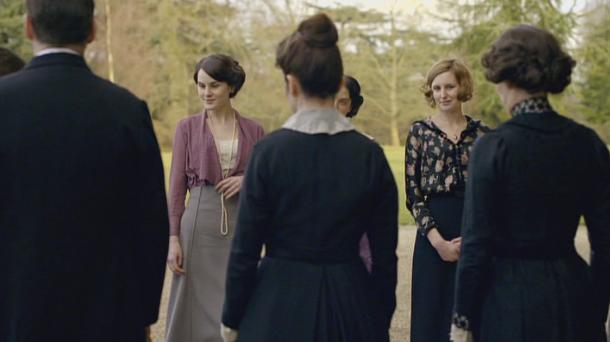
Downton Abbey.

The Duke is greeted by both the family and the servants. Credit: Courtesy of © Carnival Film & Television Limited for MASTERPIECE

The spectacle did not end there, for approaching the house, guests would see a grand facade or an equally imposing flight of stairs that led to the first floor (or both). In Downtown Abbey, the family awaited the arrival of the Duke of Crowborough (Charlie Cox) along with their servants, who were arrayed in line according to their station.
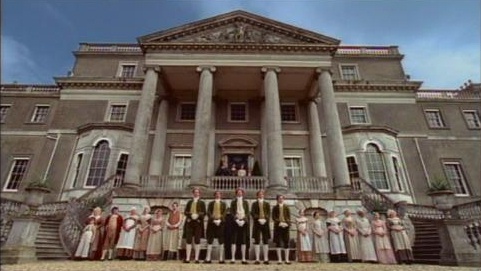
Downton Abbey. Jane Austen's World

The servants await their new masters at Norland. Sense and Sensibility, 2008.

Such a display of staff was also evident in the 2008 adaptation of Sense and Sensibility, when Fanny and Robert Dashwood arrived to claim Norland Park.
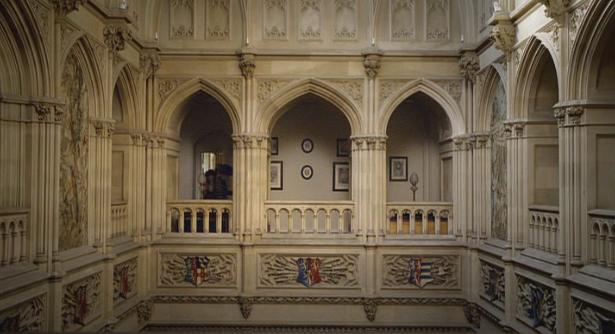
Downton Abbey. Credit: Courtesy of © Carnival Film & Television Limited for MASTERPIECE

Grand interior hall of Downton Abbey, floor leading to the private rooms. Credit: Courtesy of © Carnival Film & Television Limited for MASTERPIECE

Once introductions had been made, the guests would ascend the imposing stairway and enter an equally impressive high-ceilinged hall that contained yet another grand staircase, which led to the private rooms upstairs. The ladies customarily brought their own maids, who would also require lodging. (In Gosford Park, a poor female relation had to make do with one of the hostesses’ house maids to help her with her dress and hair.)
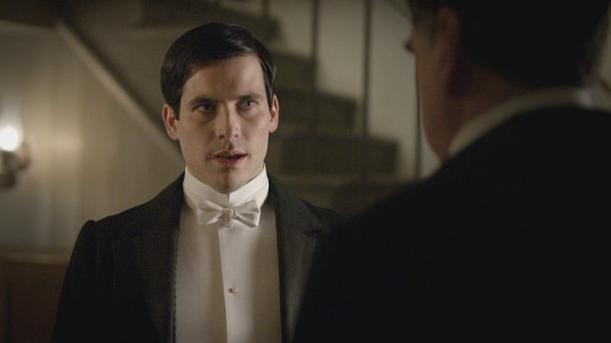
Downton Abbey. Credit: Courtesy of © Carnival Film & Television Limited for MASTERPIECE

Thomas (Rob James-Collier), the first footman, is chosen to act as valet to the duke. Credit: Courtesy of © Carnival Film & Television Limited for MASTERPIECE

The guests’ servants were expected to enter the house through a separate, back servant’s entrance, and shared quarters with the regular staff. The host supplied his own butler or footmen to help serve as valet to his male guests.
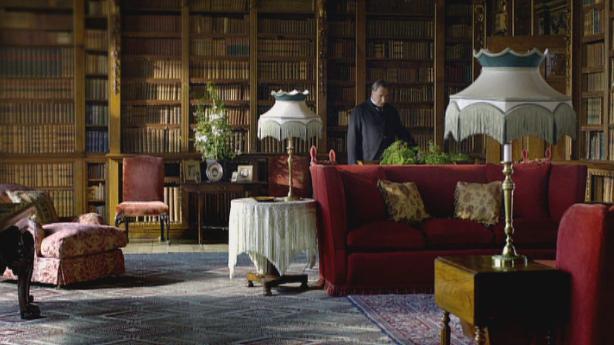
Downton Abbey. Credit: Courtesy of © Carnival Film & Television Limited for MASTERPIECE

The Earl of Grantham’s impressive library/study. Credit: Courtesy of © Carnival Film & Television Limited for MASTERPIECE

A host’s willingness to lavishly entertain his guests did not necessarily reflect the family’s daily schedule:

In 1826 a German visitor to England remarked that: it requires a considerable fortune here to keep up a country house; for custom demands… a handsomely fitted-up house with elegant furniture, plate, servants in new and handsome liveries, a profusion of dishes and foreign wines, rare and expensive desserts… As long as there are visitors in the house, this way of life goes on; but many a family atones for it by meagre fare when alone; for which reasons, nobody here ventures to pay a visit in the country without being invited, and these invitations usually fix the day and hour… True hospitality this can hardly be called; it is rather the display of one’s own possessions, for the purpose of dazzling as many as possible.(3)” – The Country House: JASA
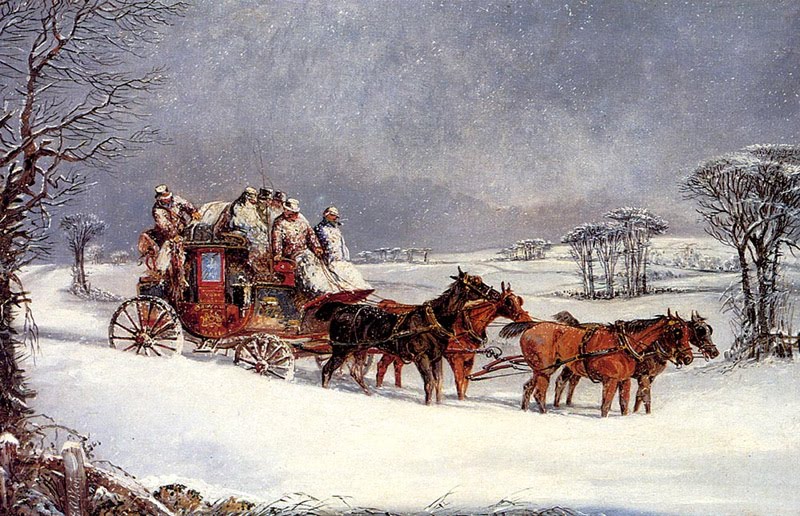
Downton Abbey. Jane Austen's World

Travel in winter, Henry Alken, 1785

Guests stayed for a long time for a variety of reasons. In the 17th and 18th centuries, travel over a long distance was laboriously slow and difficult, for roads were notoriously poor and dangerous. Long visits, such as Cassandra Austen’s visits to her brother Edward in Godmersham Park, became a custom. Even during the Edwardian age, when travel was much improved, guests tended to stay for the weekend (Saturday through Monday). In Downton Abbey, the Duke of Crowborough arrived amidst much hope and anticipation, until he discovered that the estate had been entailed to a third cousin not the earl’s daughter, whom he had come to woo, and he cut his visit to one short day and evening, making an excuse that did not hold water.
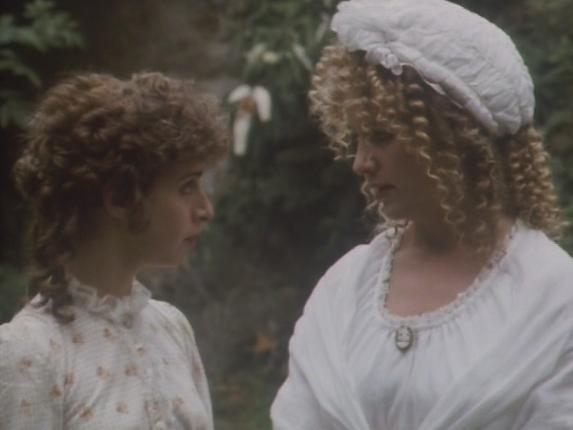
Downton Abbey. Jane Austen's World

Catherine Morland (Katherine Schlessinger) and Eleanor Tilney (Ingrid Lacey), Northanger Abbey 1986

Even during the 18th century, when long-term guests were expected, some overstayed their welcome, like Jane Austen’s anti-heroine, Lady Susan Vernon, whose hostess (sister-in-law) despised her but was forced to tolerate her because she was ‘family.’ Desirable guests, like Catherine Morland of Northanger Abbey, were invited to extend their visit. In Catherine’s instance, Eleanor Tilney, a motherless young lady who lived without a female companion, found the young girl’s company delightful. By the time General Tilney discovered that Catherine was no heiress, she had been with the Allens in Bath and the Tilneys in Northanger Abbey for a total of 11 weeks. As previously noted, Edwardian hosts, while generous, expected house guest to stay for only three days. During this time every luxury was lavished upon them, but it was considered bad form if they stayed longer than arranged or without invitation.
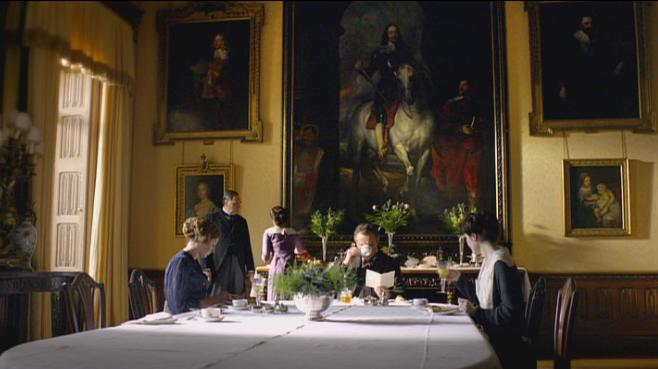
Downton Abbey. Credit: Courtesy of © Carnival Film & Television Limited for MASTERPIECE

Breakfast was a substantial meal served at 9:30 a.m. Credit: Courtesy of © Carnival Film & Television Limited for MASTERPIECE

At set times, Edwardian guests would congregate in the common rooms, which included the drawing room, music room, dining room and breakfast room, the library or study, the gallery (where ancient family portraits were hung), the billiard room, and the conservatory. Vast lawns and gardens were laid out for promenading; guests could ride or walk through the parklands to view picturesque follys or dine alfresco (outdoors), take tea under an awning, or paint a vista or two.
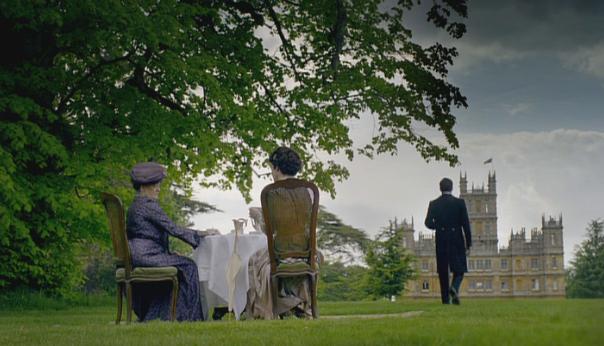
Downton Abbey. Credit: Courtesy of © Carnival Film & Television Limited for MASTERPIECE

Taking tea alfresco. Credit: Courtesy of © Carnival Film & Television Limited for MASTERPIECE

The reputation of a host rested on the entertainments, which helped to pass the time – walking, riding, shooting (in winter), and hunting (in fall) for outdoor activities; and card parties, musicales, and dances for indoor festivities. A fox hunt, such as the one depicted in Downton Abbey, required riding skill and stamina, for the chase would take riders over hills and dales, and hedges, and over long distances for much of the day.
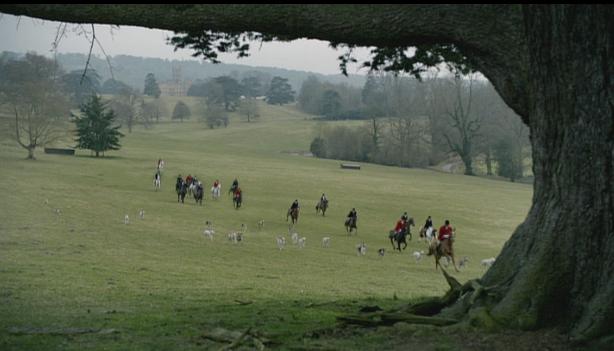
Downton Abbey. Credit: Courtesy of © Carnival Film & Television Limited for MASTERPIECE

The hunt required riding skills and stamina.Credit: Courtesy of © Carnival Film & Television Limited for MASTERPIECE

Billiards made an appearance during the 17th century, and by the 19th century billiard rooms had become a staple. Private libraries offered a variety of books and periodicals. In the summer, Edwardians enjoyed lawn tennis, croquet, cricket, and golf (by the men).
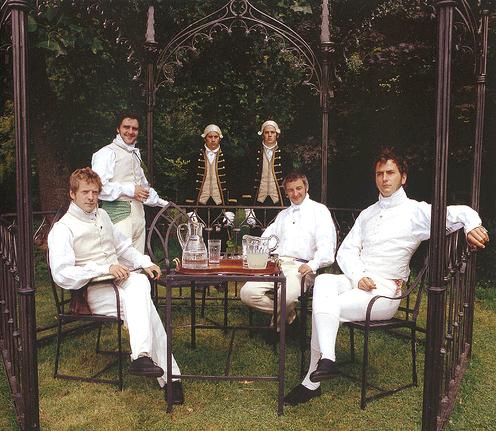
The male guests in Regency House Party (2004) could pretty well behave and move around as they pleased.

Ladies and gentlemen tended to spend the day apart. Male guests were more active and could engage in almost any activity during the day, except at the time reserved for dinner, when they were expected to show up. In an Edwardian house, men did not escort their female dining partners into the dining room. Rather, after the host served cocktails in the drawing room a half hour before the meal, the group moved to the dining room where they were seated according to a set pattern, with guests sitting between members of the family and their neighbors.
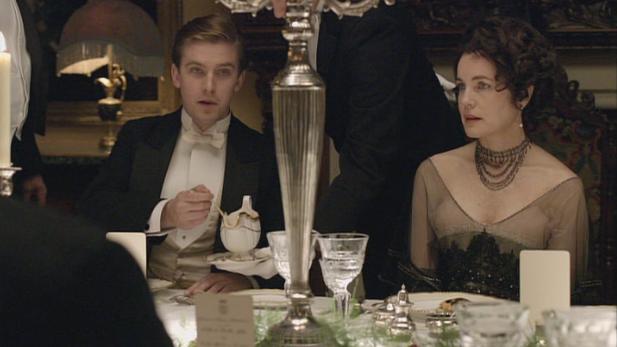
Downton Abbey. Credit: Courtesy of © Carnival Film & Television Limited for MASTERPIECE

The new heir of Downton Abbey (Dan Stevens) sits next to his hostess, the Countess of Grantham (Elizabeth McGovern). Credit: Courtesy of © Carnival Film & Television Limited for MASTERPIECE

After dinner, the ladies would remove to the drawing room, which became increasingly larger and more feminine over time, while the gentleman relaxed at the dining room table, drinking port, smoking their cheroots, and discussing manly topics.
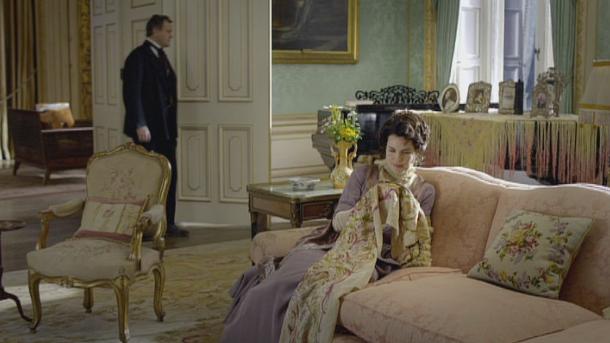
Downton Abbey. Credit: Courtesy of © Carnival Film & Television Limited for MASTERPIECE

The drawing room at Downton Abbey was large and feminine. Credit: Courtesy of © Carnival Film & Television Limited for MASTERPIECE

While an 18th century gentlemen would have talked about horse flesh and carriages, Edwardian guests would have included automobiles and their rapidly changing technology, road improvements, and the availability of petrol as well.
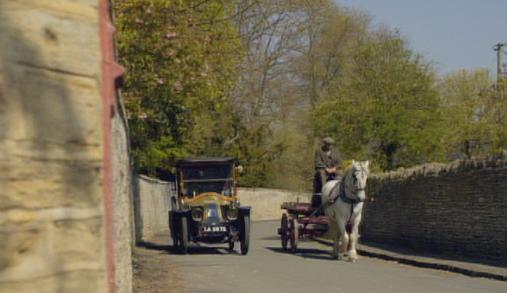
Downton Abbey. Credit: Courtesy of © Carnival Film & Television Limited for MASTERPIECE

Transportation was changing rapidly at the turn of the 20th century. Credit: Courtesy of © Carnival Film & Television Limited for MASTERPIECE

Unlike the gentlemen, a lady’s day was more restricted and confined. She spent her day following a set routine, starting with breakfast, and wearing appropriate outfits and getting into them and out of them. Mothers spent some time overseeing the nannies and the care of their children (if they were brought along). Ladies, married or not, would also receive visitors, sew, gossip, read, walk, participate in charity work, observe the men at sport (if invited) or take a ride in the carriage. They did join in on more active, outdoor games at set times during the appropriate season, such as cricket, croquet, lawn tennis, lawn bowling, and the like, but they would have been properly dressed for the occasion.

Downton Abbey. Credit: Courtesy of © Carnival Film & Television Limited for MASTERPIECE

The head maid (Joanne Froggatt) dresses Lady Mary’s (Michelle Dockery) hair for dinner. Credit: Courtesy of © Carnival Film & Television Limited for MASTERPIECE

Imagine poor Eleanor Tilney in the late 18th century, alone in a grand house without female companionship, having no-one to talk to and forced to live a constricted life. No amount of walking, charity work, practicing the piano, or overseeing the household would have made up for her boredom, and thus Catherine Morland’s companionship was so welcome.
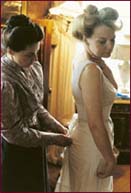
Manor House (2002), dressing Lady Olliff-Cooper. Image @PBS

In Regency House Party (the 2004 mini-series), the modern women who portrayed Regency ladies chafed under the strict rules of protocol, forced chaperonage, and daily tedium. A lady’s routine did not much improve during the Edwardian era, although towards the end of this period changing one’s gown for afternoon tea became obsolete.
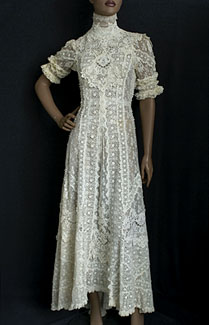
Tea gown, circa 1908. Image @Vintage Textiles

In Manor House, the 2002 mini-series set in the Edwardian era, Lady Olliff-Cooper’s spinster sister, the lowest-ranking member of the family, had so little to do and so little say in how she could spend her time, that Avril Anson (who in real life is a professor) left the series for a few episodes to maintain her sanity.

Downton Abbey. Credit: Courtesy of © Carnival Film & Television Limited for MASTERPIECE

Evelyn Napier (Brendan Patricks) and Matthew Crawley (Dan Stevens) eye their rival before dinner. Credit: Courtesy of © Carnival Film & Television Limited for MASTERPIECE

Lady Olliff-Cooper … [needed] to change her clothes five or six times a day. And very few of these dresses would be what today we’d call practical. Not only did each meal carry its own dress code, but if she needed to receive a visitor, pay a call or go riding, she’d have to change both her clothes and often her hairstyle as well.” Manor House, clothes

Anna Olliff-Cooper, who portrayed the lady of the house in Manor House, spent an enormous amount of her day changing into new gowns and having her hair dressed. She would stand passively as her maid did all the work. Anna noted how constricting the dresses were, and cried as she described how the tight sleeves of her gowns prevented her from raising her arms above her shoulders or from closely hugging her eleven-year old son. Even the fashions conspired to keep a women passive!
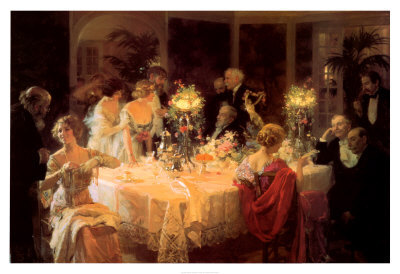
The Dinner Party, 1911, Jules Alexandre Grun

After they had finished their cigars and port, the gentlemen were obligated to rejoin the ladies for cards or music, or both, to while away the evening. The Duke’s behavior in Downton Abbey was egregious, for instead of joining the group for the rest of the evening, he went to bed early. The house party would stay up until 10:30 or so (unless a grand ball had been arranged, and then the guests would stay up until the wee hours of the morning).

Downton Abbey. Credit: Courtesy of © Carnival Film & Television Limited for MASTERPIECE

Male conversation after dinner over port and cigars. The duke and earl have a frank conversation. Credit: Courtesy of © Carnival Film & Television Limited for MASTERPIECE

In either case, the last people in the house to retire for the night would be the servants, but their lives and schedule will be described in another post.

Look for Downton Abbey, Part One to air on PBS Masterpiece Classic on Sunday, January 9th! Once again PBS will host a twitter party! Stay tuned for details.
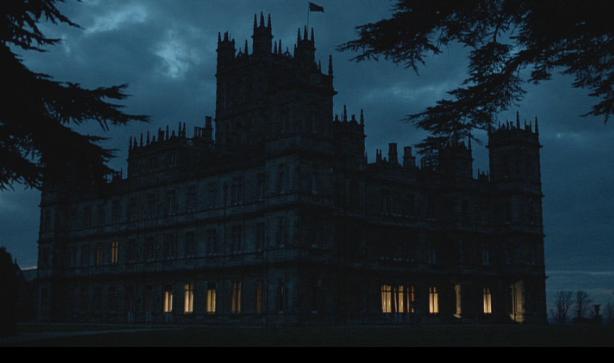
Downton Abbey. Credit: Courtesy of © Carnival Film & Television Limited for MASTERPIECE

End of the day at Downton Abbey. Credit: Courtesy of © Carnival Film & Television Limited for MASTERPIECE

More on the topic:

Images of Downton Abbey Season 1: Credit Courtesy of © Carnival Film & Television Limited for MASTERPIECE

Read Full Post »

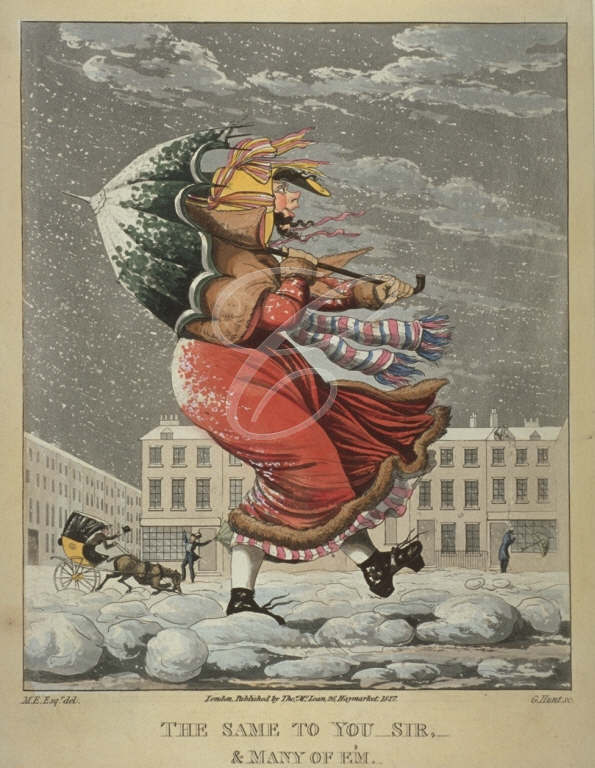
Copyright @Jane Austen’s World. Gentle readers, as you know, the northeast has been socked in by snow, ice, gale winds, and bitterly cold temperatures today.

George Scharf, Sketches of People in Snow. Some scenes of winter have never changed.

This is a perfect time for hunkering inside and drinking hot chocolate. Or is it?

Image @City of London. This young lady is wearing pattens to protect her shoes.

My nephew’s children will go sledding, others will go ice skating, and my dog will bound through the snow drifts with undisguised glee, as people have done for ages.

Winter Amusement, Hyde Park, after Ibbetson, 1789. Note the bare feet on the young child in rags. (Foreground)

As early as the 17th century, the noted diarist John Evelyn noted: ” Having seen the strange and wonderful dexterity of the sliders on the new canal in St James’s Park, performed before their Ma[ties] by divers gentlemen, and others with Scheetes, after the manner of the Hollander,s with what swiftnesse they passe, how suddainely they stop in full carriere upon the ice, I went home by water, but not without exceeding difficultie,s the Thames being frozen, greate flakes of ice incompassing our boate. Pepys entry is as follows: St James’s Park Dec 1 1662. “Over the Park where I first in my life it being a great frost did see people sliding with their skeates, which is a very pretty art.”


Dutch steamers on the frozen Zuyder Zee. The leather straps are quite visible on these skates.

Skating has been around since 3,000 BC or thereabouts and stone age skates have been uncovered in bogs. But it was the lowlanders who took to the sport with glee, using wooden platform skates with iron runners as early as the 14th century. At first, skaters strapped their skates around their shoes with leather straps and propelled themselves forward with wooden poles.


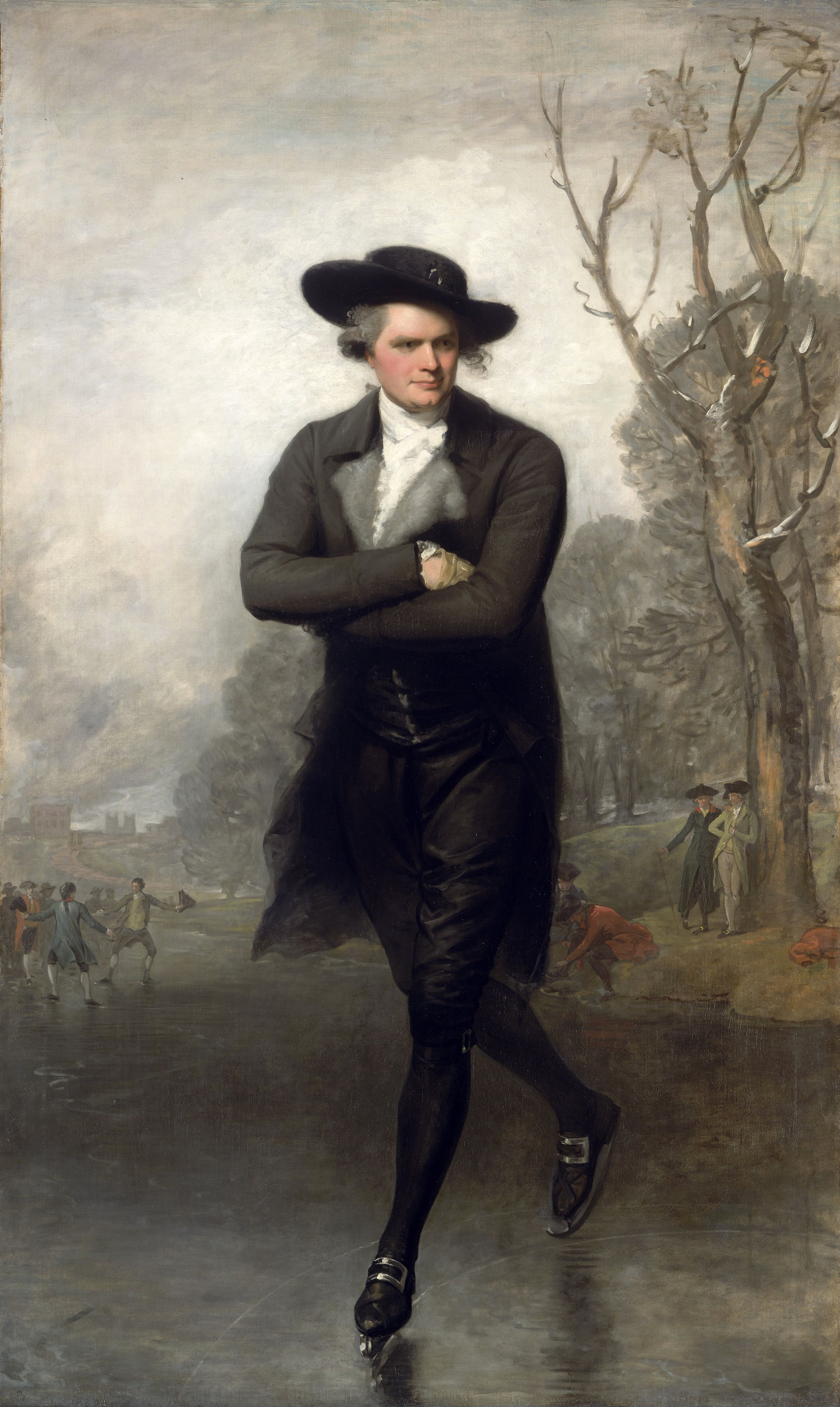
William Grant, The Skater, 1782

Then, the Dutch invented a narrower double-edged metal blade that allowed them to glide with their feet, and the poles became obsolete.

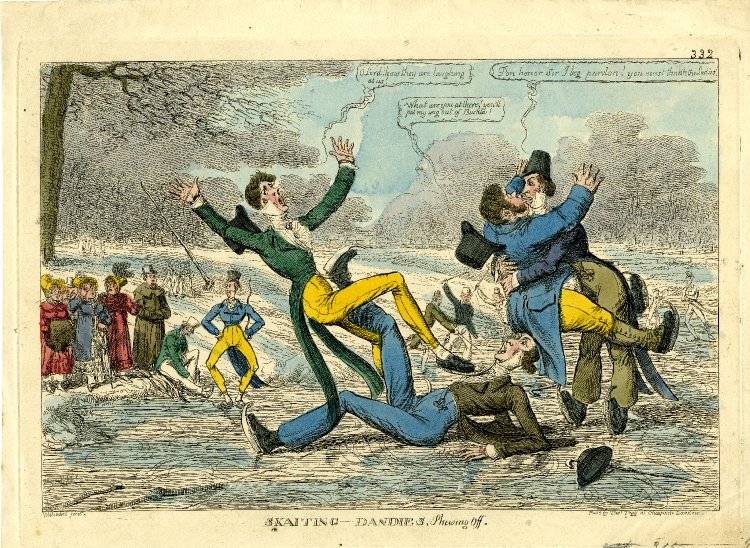
1824 Skating Dandies Showing Off

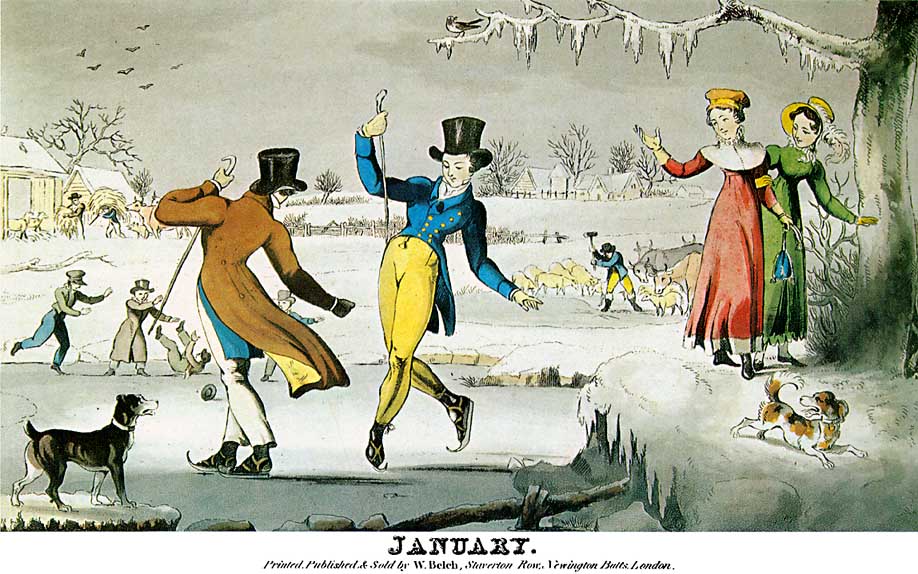
Many 19th century images exist of people skating on frozen streams and ponds, and sledding or sleighing.


1820. In the distance on the right, one can see a man chopping through the ice to allow his cattle to drink water. On the left, another man is spreading grain to feed his animals.

“..moderns sledges are used, which being extended from a centre by the means of a strong rope, those who are seated in them are moved round with great velocity, and form an extensive circle. Sledges of this kind were set upon the Thames during the hard frost in the year 1716 as the following couplet in a song written upon that occasion 1plainly proves:

“While the rabble in sledges run giddily round
And nought but a circle of folly is found” – The sports and pasttimes of the people of England

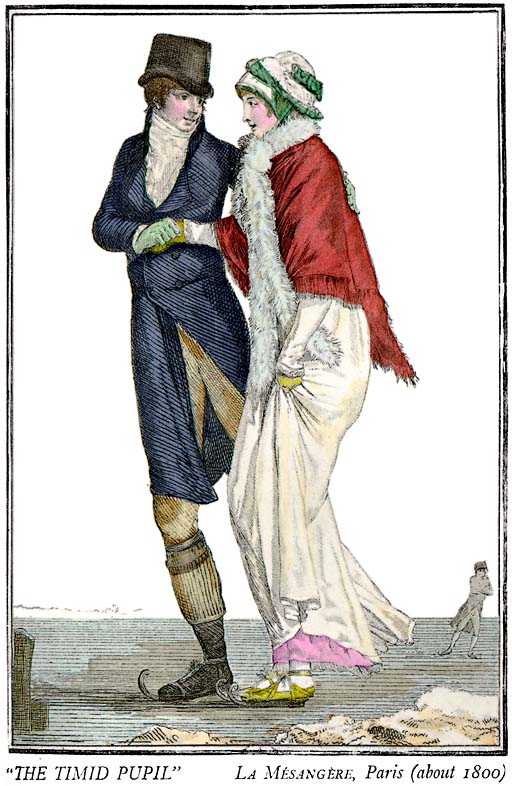
By the mid 18th century, Robert Jones described paired ice skating, or figure skating in A Treatise on Skating (1772).


The Timid Pupil, 1800. Both this ladies feet are placed together, as her escort gently leads her over the ice.

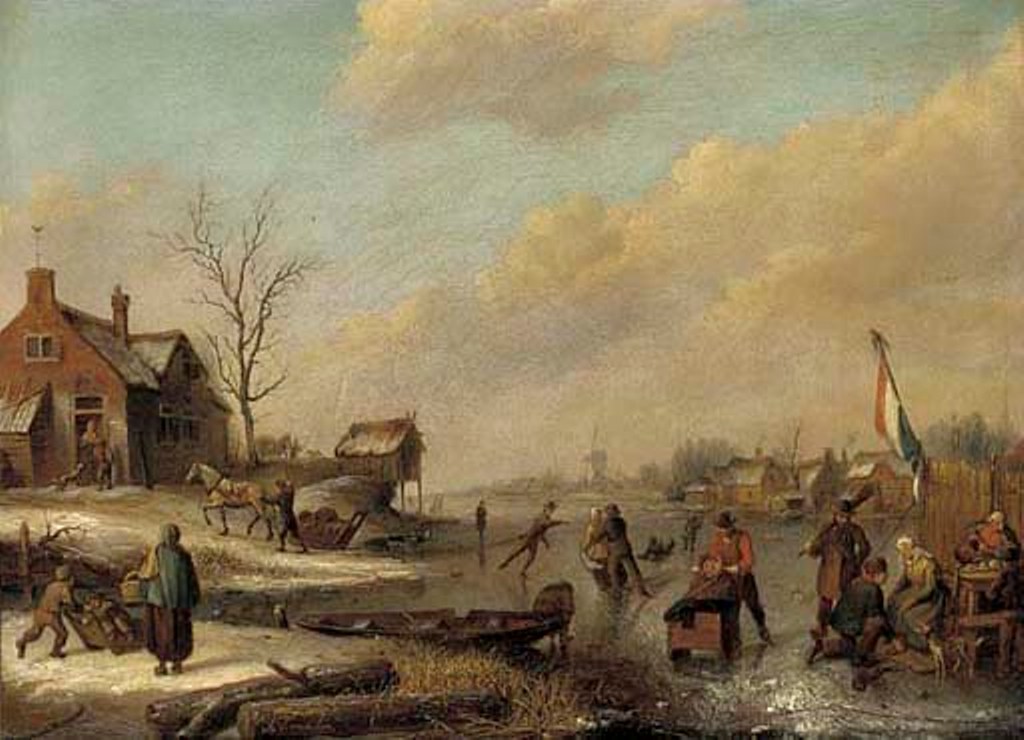
Sleds and sleighs have been used for centuries to transports logs, people, and good over frozen waters all over northern Europe for centuries.


Frozen river in The Netherlands with townsfolk skating and sledging using various forms of sleds pushed by people, and one pulled by a horse. By Vermeulen

Called coasting, sliding down hills and inclines on hand sleds or sledges provided hours of pleasure, as well as a practical way to get around over frozen landscapes and water. Wooden sleds pulled by a rope are still a familiar sight today.

19th century porcelain (figures in 18th century dress): man pushing woman on a sleigh

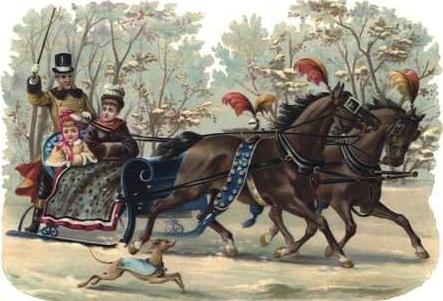
Fancy sleighs pulled by horses (or reindeer in the frozen north) transported groups of people, often in comfort, for their feet were placed upon footwarmers that were heated with hot coals, and their bodies were covered by thick furs or blankets.


Victorian sleigh. The travelers are protected from the cold by muffs and a thick blanket. Even the dog wears a coat. Note the bells on the horses.

More on the topic:

Read Full Post »

Happy Christmas Eve and Merry Christmas, everyone! I leave you with this post about Plum Pudding as I celebrate the occasion with my favorite people in all the world – my family. May this season be a truly special one for you. And thank you for visiting Jane Austen’s World.

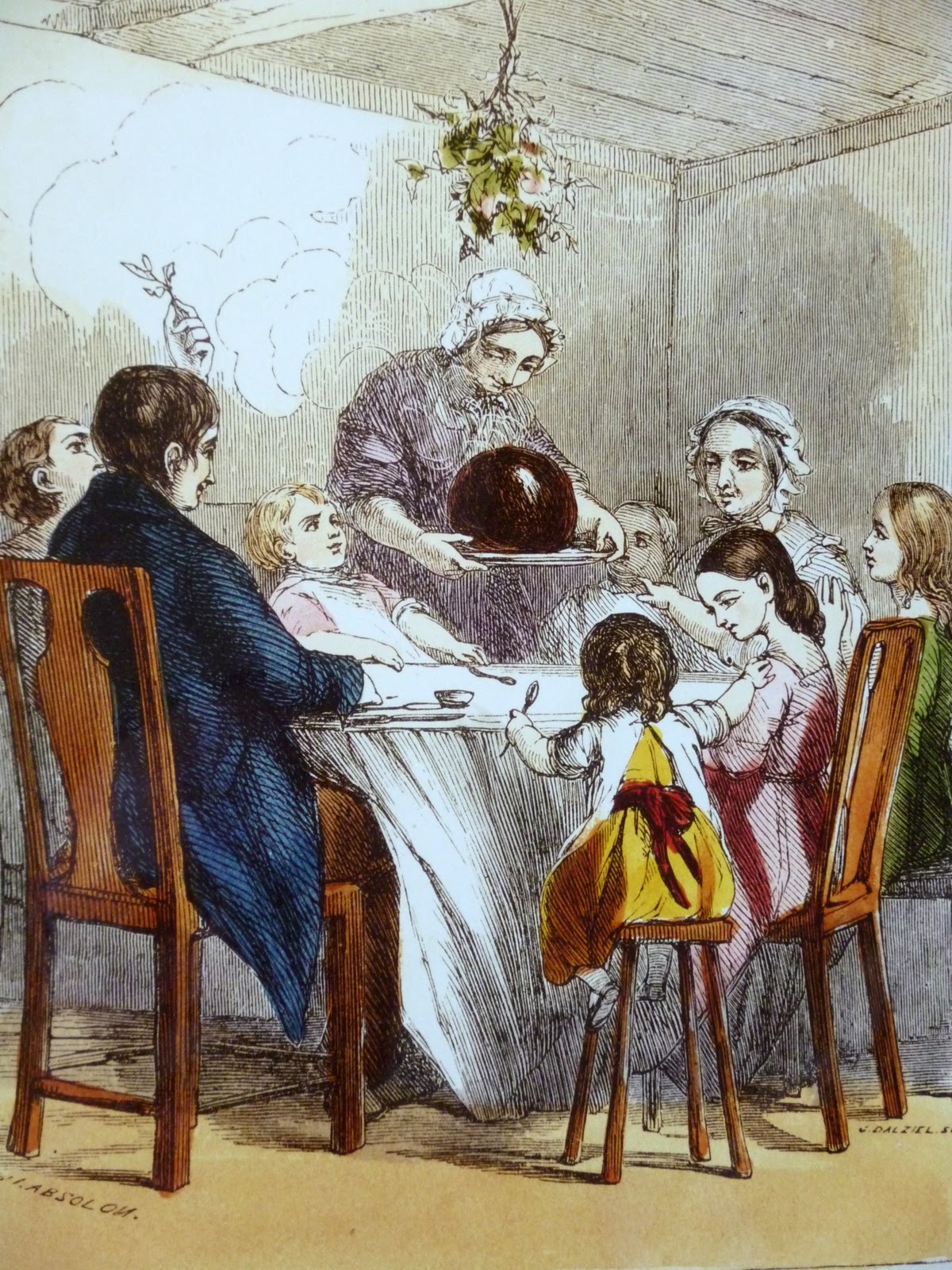
In half a minute Mrs. Cratchit entered — flushed, but smiling proudly — with the pudding, like a speckled cannon-ball, so hard and firm, blazing in half of half-a-quartern of ignited brandy, and bedight with Christmas holly stuck into the top. – Charles Dickens, A Christmas Carol

Stir-Up Day is the name traditionally given to the day on which Christmas puddings are made in England.

Banned by the Puritans in the 1660s for its rich ingredients, the [plum] pudding and its customs came back into popularity during the reign of George I. Known sometimes as the Pudding King, George I requested that plum pudding be served as part of his royal feast when he celebrated his first Christmas in England after arriving from Hanover to take the throne in 1714. By 1740, a recipe for ‘plum porridge’ appeared in Christmas Entertainments. In the Victorian era, Christmas annuals, magazines, and cookbooks celebrated the sanctity of family as much as the sanctity of Jesus’ birth, and the tradition of all family members stirring the pudding was often referenced…Poorer families made the riches version of plum pudding that they could afford…Even workhouse inmates anticipated a plum pudding on Christmas Day.” – Food and Cooking in Victorian England: A History, Andrea Broomfield [Praeger:Westport CT] 2007 (p. 150-151)

Stir-Up Sunday, the last Sunday before Advent, is considered the final day on which one can make the Christmas fruit cakes and puddings that require time to be aged before being served.

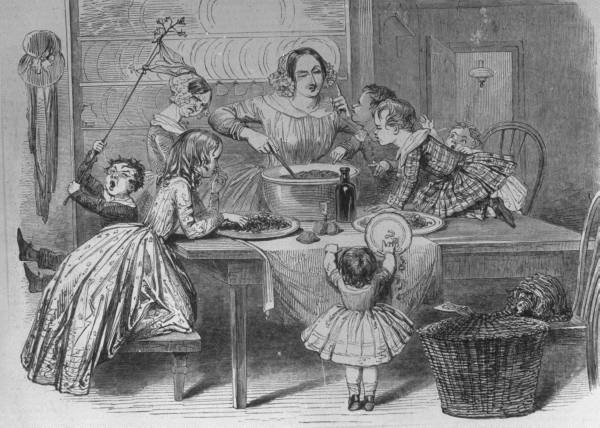
The Christmas pudding is traditionally “stirred up” on Stir-Up day day. All family members must take a hand in the stirring, and a special wooden spoon (in honor of Christ’s crib) is used. The stirring must be in a clockwise direction, with eyes shut, while making a secret wish. Source: The Customs and Ceremonies of Britain by Charles Knightly. London:Thames and Hudson, 1986, p. 211.”
The Folklore of World Holidays, Robert H. Griffen and Ann H. Shurgin editors, Second Edition [Gale:Detroit] 1998 (p. 679)

Stirring the Christmas pudding. Image@LIFE magazine

In past times the words “stir up”…reminded people to begin preparing their Christmas puddings…Children chanted a rhymed verse on that day that mixed the words of the collect with requests for special Christmas fare…Thus, the preparation of the Christmas pudding eventually became associated with this day. Folk beliefs advised each member to take a turn stirring the pudding, and ace that was believed to confer good luck. Another custom encouraged stirrers to move the spoon in clockwise motion, close their eyes, and make a wish.” – Encyclopedia of Christmas and New Year’s Celebrations, Tanya Gulevich, 2nd edition [Omnigraphics:Detroit] 2003 (p. 741)

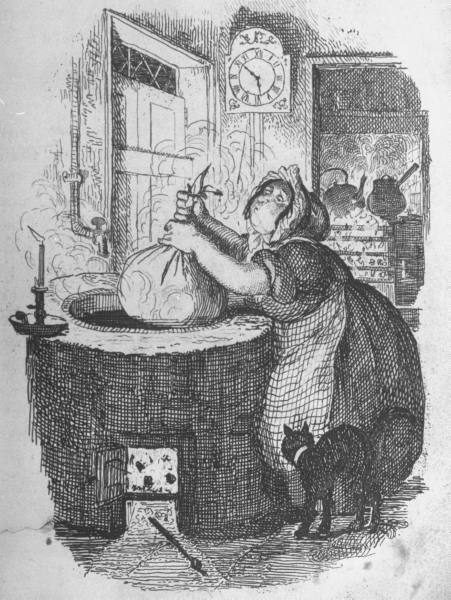
Cook making Christmas pudding, Cruikshank

Hallo! A great deal of steam! The pudding was out of the copper. A smell like a washing-day! That was the cloth. A smell like an eating-house and a pastrycook’s next door to each other, with a laundress’s next door to that! That was the pudding!- Charles Dickens, A Christmas Carol

A boiled Plum Pudding – Hannah Glasse (18th century recipe)

TAKE a pound of suet cut in little pieces not too fine a pound of currants and a pound of raifins storied eight eggs half the whites half a nutmeg grated and a tea spoonful of beaten ginger a pound of flour a pint of milk beat the eggs first then half the milk beat them together and by degrees stir in the flour then the suet spice and fruit and as much milk as will mix it well together very thick Boil it five hours – Hannah Glasse, The Art of Cookery made plain and easy, p. 137

Rich Plum Pudding Recipe, Lady Godey’s Book, December 1860

Stone carefully one pound of the best raisins, wash and pick one pound of currants, chop very small one pound of fresh beef suet, blanch and chop small or pound two ounces of sweet almonds and one ounce of bitter ones; mix the whole well together, with one pound of sifted flour, and the same weight of crumb of bread soaked in milk, then squeezed dry and stirred with a spoon until reduced to a mash, before it is mixed with the flour.

Cut in small pieces two ounces each of preserved citron, orange, and lemon-peel, and add a quarter of an ounce of mixed spice; quarter of a pound of moist sugar should be put into a basin, with eight eggs, and well beaten together with a three-pronged fork; stir this with the pudding, and make it of a proper consistence with milk. Remember that it must not be made too thin, or the fruit will sink to the bottom, but be made to the consistence of good thick batter.

Taking up the Christmas pudding

Two wineglassfuls of brandy should be poured over the fruit and spice, mixed together in a basin, and allowed to stand three or four hours before the pudding is made, stirring them occasionally. It must be tied in a cloth, and will take five hours of constant boiling.

Carrying the plum pudding

When done, turn it out on a dish, sift loaf-sugar over the top, and serve it with wine-sauce in a boat, and some poured round the pudding. The pudding will be of considerable size, but half the quantity of materials, used in the same proportion, will be equally good.

Presenting the plum pudding

The following articles about plum pudding were published in 19th century periodicals and in a more recent blog:

Colonel Hazard’s Plum Pudding (In which the Colonel proves that plum pudding has impressive staying power.)

Colonel Rowland R. Hazard of electric railroad fame tells a story which gives the plum pudding a new dignity. Several years ago, the colonel suddenly decided to run over to England to make a holiday call on relatives there. It was a few days before Christmas, and just as the colonel was starting for the steamer, a Christmas package arrived for him. He had no time to examine it then, and left orders to have it kept for him. He did not return to New York for two year.s When he did get back, the package was brought down from the garret. It proved to contain a plum pudding that his English friends had sent him. It was as hard as a rock, but Colonel Hazard ordered it to be cooked, and he declares he never tasted a more perfect plum pudding in his life. He is inclined to think that good plum pudding, like the wheat found in the old Egyptian mummy cases, would keep all right for a thousand years. –  New York Commercial Advertiser – Good Housekeeping, Vol 5, Hearst Corp, 1887

Plum Pudding

The secret of making plum pudding light and digestible lies in properly preparing the suet, mincing the currants, and boiling a sufficient time. Puddings made with breadcrumbs are lighter than those made wholly of flour; and a mixture of the two makes the best pudding. Plum puddings may be made some time before Christmas, and, having been boiled, the cloth must be opened out, but not taken off the pudding, and dried. Wrapped in paper, and stored in a dry place, puddings will keep good for several months, and only require to be boiled for an hour at the time of serving.  – Household Words, A weekly journal, vol 2, 1882. Charles Dickens

Christmas pudding on a hook. Image @eons

This pictorial article in eons explains the various steps in making a Christmas pudding.

Surprises Inside Plum Pudding

Plum pudding is well known for the silver coins and small objects hidden within the pudding to be found by the eater. Common objects were the silver coin for wealth, a tiny wishbone for good luck, a silver thimble for thrift, a ring for marriage or an anchor for safe harbor. These items have migrated from plum pudding to bridal shower cakes, oddly enough…- Gram’s Recipe Box, Plum Pudding

Sources for this post:

Read Full Post »

In the second episode of At Home With the Georgians: A Woman’s Touch, Amanda Vickery mentioned metamorphic furniture and (remarkably) turned a desk into a bed. A visitor to Tony Grant’s excellent post left this question: What is metamorphic furniture?

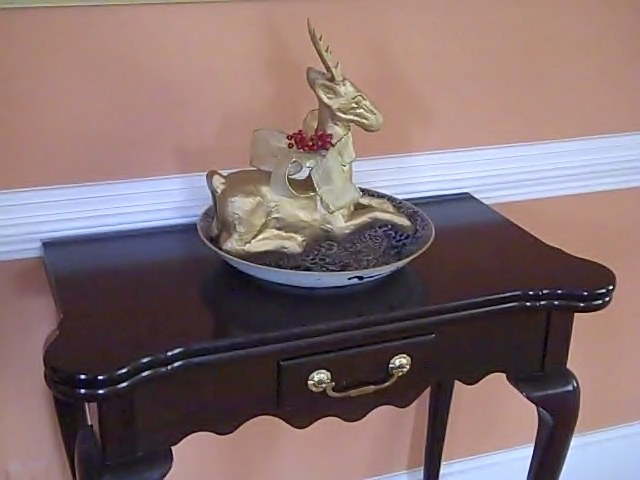
Modern example of metamorphic furniture: hall table/card table

Tony answered the question admirably. This mechanical furniture, wide-spread in Georgian times, had a dual use. A small folding staircase could be transformed into chair or desk, such as a writing table, library table, or card table. These pieces of furniture were great space savers, as I can attest. Only last week I transformed my faux-Georgian hall table into a card table for my guests. I never guessed until Tony’s post that I owned an example of mechanical furniture. Sweet!

The only change I would make in the video (besides the annoying lilt in my voice) is to make sure that the next time I film an example of my furniture, it is thoroughly dusted and cleaned! Extra points if you can spot my pooch in one of the scenes. His hang dog expression tells me that he was out of sorts, having been told to stay put.

This Victorian piano at the Brooklyn Museum pulls out into a bed. Fascinating. The video is available to view until March 2011.

READ MORE: If your interest in the topic is piqued, Clive Taylor (who also left a comment on the previous post) has written a dissertation on the topic (click here to read The Regency Period Metamorphic Chair) and sells metamorphic library chairs/stairs in his shop, Parbold Antiques.

Read Full Post »

“Heigh ho! sing heigh ho! unto the green holly:
Most friendship is feigning, most loving mere folly:
Then, heigh ho, the holly!
This life is most jolly.”
– William Shakespeare, As You Like It

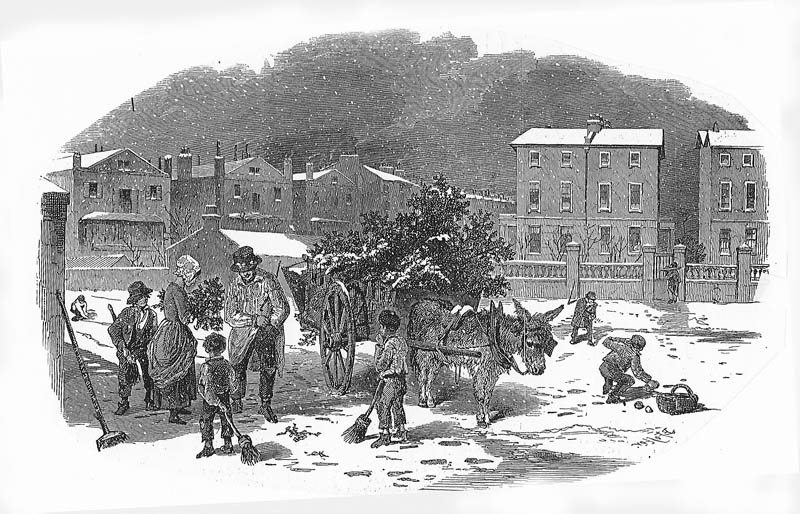
Decorating one’s house with natural boughs has been a Christmas tradition since Celtic times. Boughs of holly with their bright red berries were especially coveted. (Read Mythology and the Folklore of Holly.) One understands how easily people in rural areas could obtain these bright green leaves, but what about those who lived in London? This image of a holly cart pulled by a donkey provides a solution.

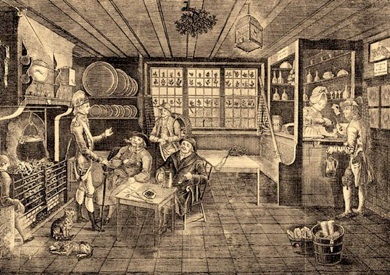
Note that the customer purchases a small amount of boughs. Christmas decorations in the 19th century were modest to none compared to ours. In this 18th-century print of a coffee house or chocolate shop, one can see small leaves of holly placed in each window pane and a bough hanging from the center of the ceiling. (One cannot imagine that mistletoe would  be hung in a public setting.)

Bowles and Carver print, London. Circa 1775

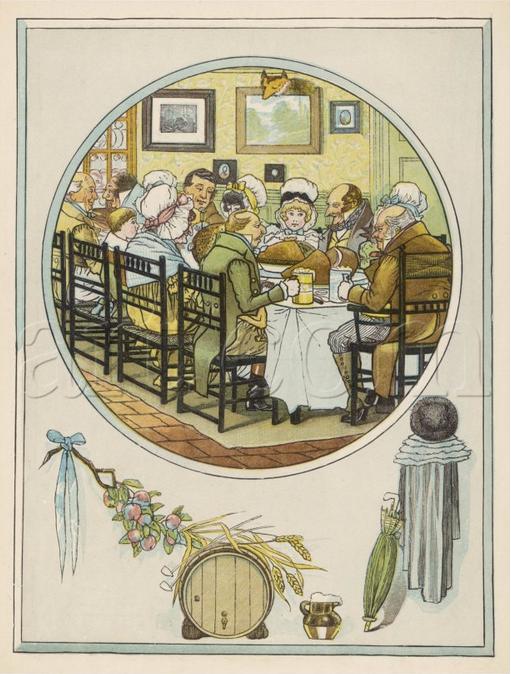
In this image of a lavish family dinner by Cruikshank, not a single bough of holly decorates the room. Most likely a wreath had been hung on the front door or some boughs had been hung from the ceiling. With holly hard to obtain in metropolitan areas, one imagines that the spare use of decorations was as much from necessity as from tradition.

Image: Art.com

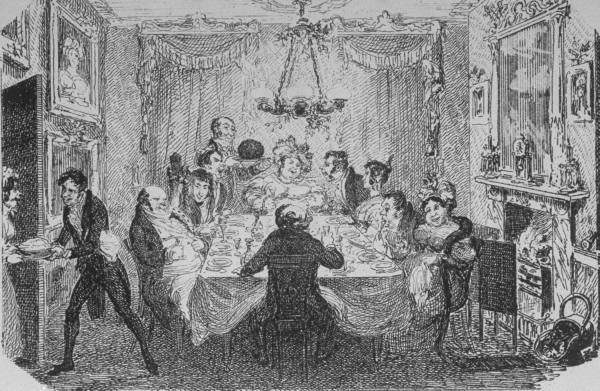
This image by Cruikshank of a family celebrating Christmas during early Victorian times  shows a few boughs inserted into the chandelier, a roaring fire, and the Christmas pudding about to be served to the hostess. This year, I have taken the Regency approach to decorating my house, emphasizing the season with just a few well placed decorations. And I love it.

Other Christmas Posts on this blog:

Read Full Post »

« Newer Posts - Older Posts »