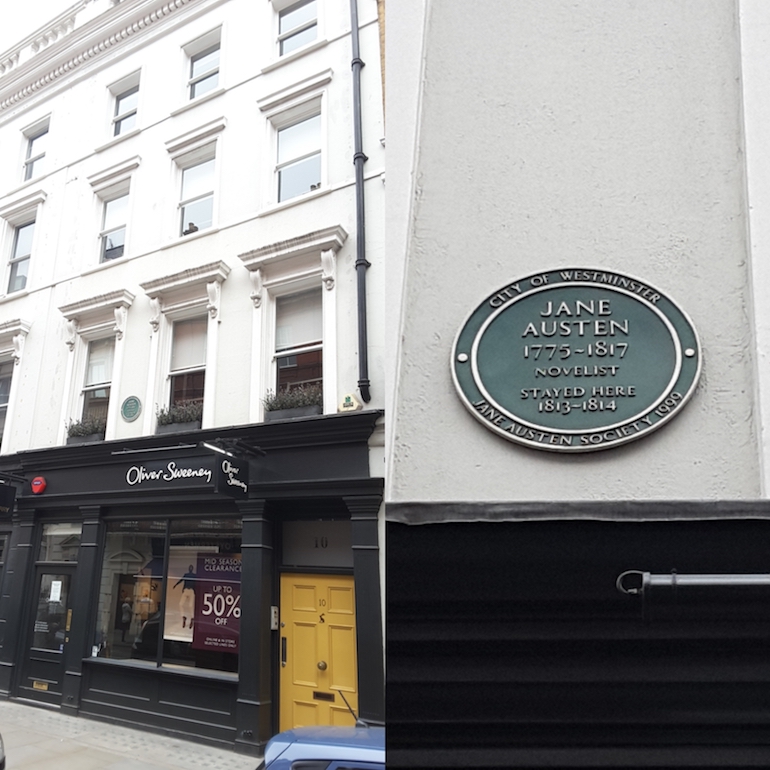
This Jane Austen blog brings Jane Austen, her novels, and the Regency Period alive through food, dress, social customs, and other 19th C. historical details related to this topic.
“My dear child, commend Dr. Grant to the deanery of Westminster or St. Paul’s, and I should be as glad of your nurseryman and poulterer as you could be.”—Mrs. Grant to Mary Crawford, Mansfield Park, chapter 22
Churches Mentioned in Mansfield Park
Four real churches are mentioned in Mansfield Park, which talks extensively about the church and clergy. I’ve written about the Garrison Chapel, where the Prices and Henry Crawford went to church. A few days ago, I posted about a church in London, St. George’s, Hanover Square, the wedding venue that Mary Crawford wants to show Fanny.
Two more real London churches are mentioned in Mansfield Park. Mrs. Grant speaks of the two most well-known churches in England, Westminster Abbey and St. Paul’s Cathedral. Mary Crawford tells her sister to greet the nurseryman (who took care of plants) and the poulterer (who provided poultry), but her sister tells her there are no such people in Mansfield. The Grants will need to move to the big city to get such help. She hopes that someone will “commend Dr. Grant to the deanery of Westminster or St. Paul’s,” so they can move to London.
The “deanery” is the office of the dean, the head clergyman of a major church.
Mrs. Grant finally gets that opportunity:
“Dr. Grant, through an interest on which he had almost ceased to form hopes, succeeded to a stall in Westminster, which, as affording an occasion for leaving Mansfield, an excuse for residence in London, and an increase of income to answer the expenses of the change, was highly acceptable to those who went and those who staid.”— Mansfield Park, chapter 48
Dr. Grant, as he had hoped, moves up in the church hierarchy to a prestigious church. He’s been the rector of a small country church at Mansfield Park. He will still receive the tithe income from that church until he dies, when Edmund will become rector. But Dr. Grant has connections to people with influence who can get him a higher church position. The church worked much like the Navy, where Henry Crawford’s uncle, the Admiral, gets William Price a promotion.
Westminster Abbey
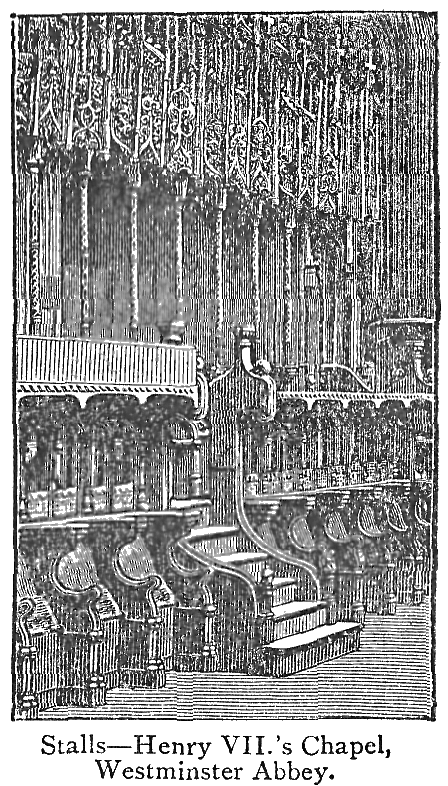
One of Dr. Grant’s friends, or more likely a friend of a friend, gets him a “stall in Westminster,” meaning a position as a prebendary. A prebendary was a church official who sat in a prebendal stall, a seat of honor in the church. The position came with income from a “prebend,” specific church possessions.
Stalls in Westminster Abbey, 1908. Image Credit: Rev. Thomas Davidson 1856-1923 (ed.), Public domain, via Wikimedia Commons
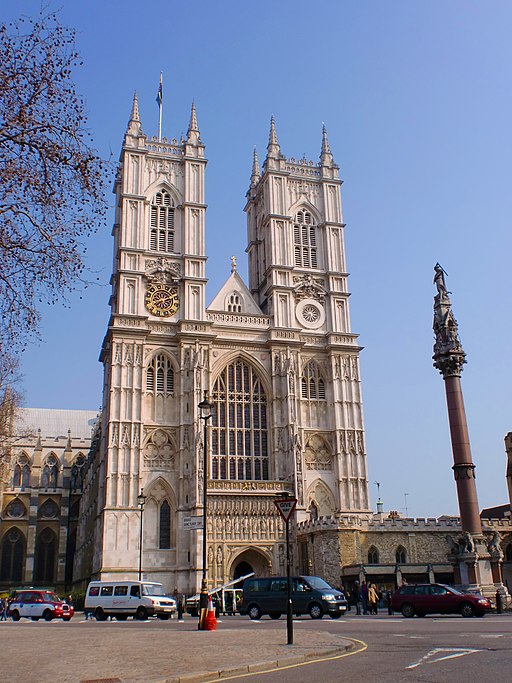
Westminster Abbey is, of course, the church in London where monarchs are crowned, as King Charles III was not long ago. All English coronations have taken place there since 1066. It is not a cathedral or a parish church. Instead it is a “Royal Peculiar,” with a dean like other large churches, but under the direct supervision of the monarch rather than a bishop or archbishop.
Westminster Abbey in London, a “Royal Peculiar” directly under the Crown. Credit: Σπάρτακος, CC BY-SA 3.0, via Wikimedia Commons
Westminster Abbey is also, of course, a place where many famous people are buried and memorialized. While Jane Austen is buried in Winchester Cathedral, there is a small plaque commemorating her in Poet’s Corner in Westminster Abbey, adjacent to Shakespeare’s memorial.
St. Paul’s Cathedral
St. Paul’s Cathedral, the other place where Dr. Grant hoped to get a position, is the cathedral of the diocese of London. (A diocese is a geographical group of parishes, led by a bishop, whose “seat” is at the cathedral for the diocese.) The history of the church reflects the history of London.
One interesting fact: women were first ordained as priests in the Church of England in 1994, and St. Paul’s first clergywoman was appointed in 1997. Now the Lord Bishop of London is a woman, installed in 2018, with her seat, of course, at St. Paul’s. She is called the Right Reverend and Right Honorable Dame Sarah Mullally, and she is a member of the House of Lords. No doubt Jane Austen would be amazed.
One more London church is mentioned in Jane Austen’s novels. In Pride and Prejudice, Lydia tells her sisters,
“We were married you know, at St. Clement’s, because Wickham’s lodgings were in that parish. And it was settled that we should all be there by eleven o’clock.”
We don’t know for sure which St. Clement’s in London Austen has in mind. An old nursery rhyme goes, “Oranges and lemons, say the bells of St. Clement’s,” and two churches claim to be the St. Clement’s in the rhyme.
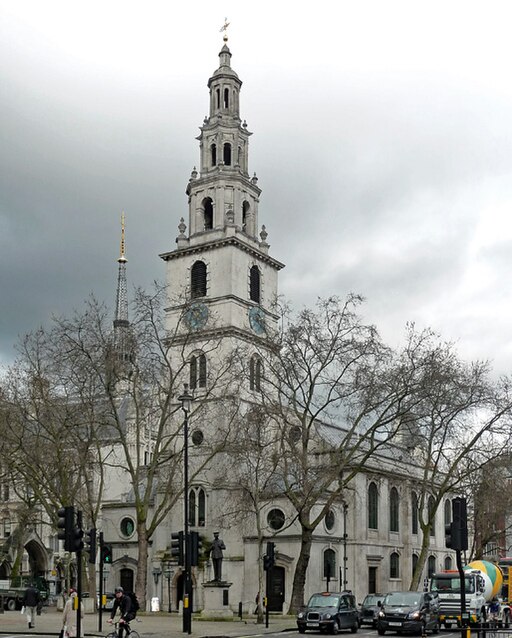
It seems most likely that Austen was referring to St. Clement Danes in the Strand, which served a large parish. The parish included areas of cheap lodgings and less savory areas, where Wickham could have afforded lodgings. It was also some distance from Gracechurch Street where the Gardiners lived, better concealing Wickham and Lydia from her family. (Source: Pat Rogers, editor of the Cambridge Pride and Prejudice.)
Another option, according to Rogers, is St. Clement’s Eastcheap on the east side of Clement’s Lane. However, this was a tiny parish only a block from Gracechurch Street, so was less likely to be the parish Wickham chose to lodge in.
The rhyme goes on to talk about not being able to pay a debt until one gets rich, at some unknown future time. Quite appropriate for Wickham, who was deep in debt but always hoping to get rich.
St. Clement Danes in the Strand, possible location for Lydia and Wickham’s wedding. Image credit: Stephen Richards / St Clement Danes, Strand / CC BY-SA 2.0
Faith in London Today
Another surprise for Jane Austen: In Mansfield Park, Edmund Bertram states, “We do not look in great cities for our best morality.” He implies that there was more virtue in the countryside and more vice in London. That was probably true in Austen’s time, according to all I have read.
However, a survey a few years ago indicated that the opposite is now true: “London is now more religious and socially conservative than the rest of Britain.” According to that survey, Londoners pray more, attend religious services more, and are more conservative on moral questions than those outside London. Also, Christian Londoners help their neighbours and give to charity more than non-religious Londoners. Of course, London is also a diverse religious environment, with people practicing various religious faiths, which are less common outside of the capital.
The London churches Austen mentions in Mansfield Park are still thriving.
Other churches mentioned by name in Jane Austen’s novels and letters
“. . . perhaps you would not mind passing through London, and seeing the inside of St. George’s, Hanover Square. Only keep your cousin Edmund from me at such a time: I should not like to be tempted.”—Mary Crawford, Mansfield Park, chapter 43
Mansfield Park includes much more discussion of the church than any other Austen novel. Not surprisingly, it also names more real churches than the other novels do.
In an earlier post we explored the Garrison Chapel, where Fanny Price and her family worship in Portsmouth. Henry Crawford attends with them on his visit. Perhaps this symbolizes his attempts to reform himself and become worthy of Fanny; attempts that ultimately fail.
Remains of the Garrison Chapel in Portsmouth where the Prices and Henry Crawford worshiped.
Henry’s sister Mary names another real church in a letter to Fanny. She wants Fanny to let her and Henry take Fanny back to Mansfield from Portsmouth, where Fanny has been staying with her family. Fanny is unhappy and unhealthy, but will not commit the impropriety of going back to Mansfield Park before her uncle sends for her. Mary wants to take Fanny to see Henry’s estate and then pass through London on the way to Mansfield.
She suggests visiting St. George’s, Hanover Square. This was a popular church for weddings among the upper classes of London. Mary hopes Fanny will marry Henry there. At the same time, Mary says it might tempt her to marry Edmund. She doesn’t want to marry a clergyman, or a second son who will not inherit an estate, but she is attracted to Edmund.
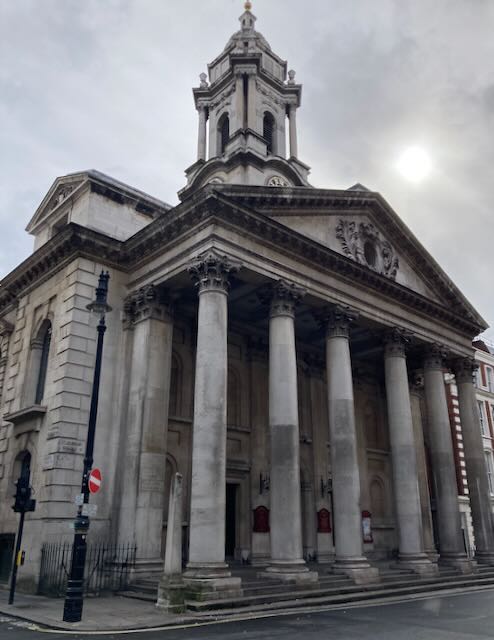
St. George’s Hanover Square exterior. According to the church website, “The classical front with six great Corinthian columns supporting a pediment represented a new trend in English Church design.”
St. George’s, Hanover Square Today
During a recent visit to London, I had the privilege of worshiping at St. George’s, Hanover Square on a Sunday morning. The service was a Sung Eucharist, a Communion service in traditional language, with beautiful singing from the choir and impressive organ music. During the service, the congregation renewed their baptismal vows.
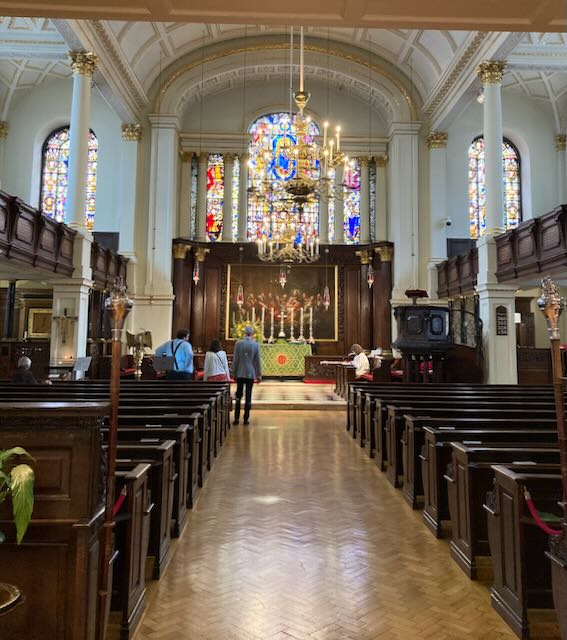
St. George’s Hanover Square interior. The painting of the Last Supper over the altar, and the surrounding carvings, were installed in 1724. The seven silver hanging lights in the church represent the seven lamps of fire burning before God’s throne, according to the book of Revelation in the Bible.
The church also offers brief midday services from the Book of Common Prayer on weekdays and several other Communion services during the week. Weekday “Morning Calm” services are held during termtime, as “a short period of reflection, contemplation, and relaxation before the challenges of the day begin.”
Nowadays the area around Hanover Square is mostly offices and businesses. I was told that most people in the current congregation live farther away, since few people live close to the church now.
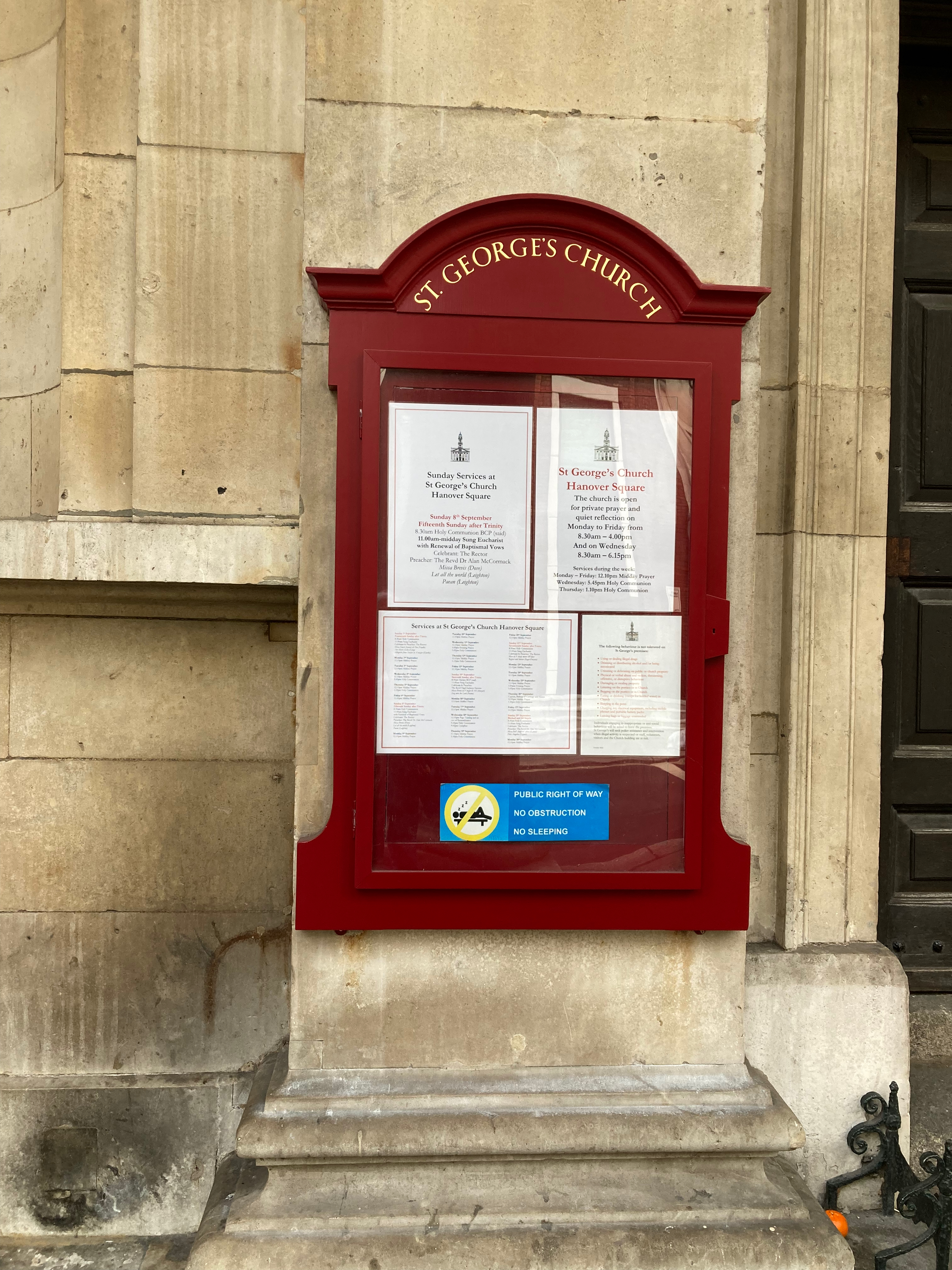
The signboard for St. George’s Hanover Square lists services, extensive opening hours, and rules such as no drugs in the church and no sleeping on pews.
Wealthy Mayfair
Hanover Square is in Mayfair. In Austen’s England, many wealthy people had large houses in Mayfair or surrounding areas. In Sense and Sensibility, the Palmers live in Hanover Square, while the Middletons, Mrs. Ferrars, and Willoughby live nearby in Mayfair. Mrs. Jennings and John and Fanny Dashwood live in Marylebone, an area just north of Mayfair. It developed when Mayfair could no longer accommodate all those who wanted fashionable, elegant housing. (Source: The Annotated Sense and Sensibility, David Shapard.)
St. George’s is the parish church of Mayfair, where the wealthy worshiped. In 1711, Parliament had passed an Act for the building of fifty new churches in and around London. The wealthy of Mayfair petitioned for a church, which was completed in 1725. The patron saint of the church is St. George, a Christian martyr of the third century who is also the patron saint of England.
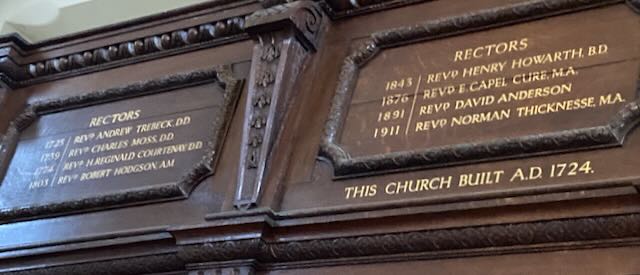
Rectors of St. George’s Hanover Square during Austen’s time and thereafter. Some held other influential church positions as well.
The parish was large, with a vestry of 101 vestrymen. These included 7 dukes, 14 earls, 7 barons, and 26 other titled people. A vestry, led by the church’s rector and churchwardens, decides matters relating to the church and the secular parish. (Mr. Knightley, Mr. Weston, Mr. Cole, and Mr. Cox are apparently on the vestry for their parish, as they are “busy over parish business” in Emma.) The St. George’s, Hanover Square vestry dealt with local issues including street lighting, refuse disposal, nightwatchmen, and a workhouse for the poor.
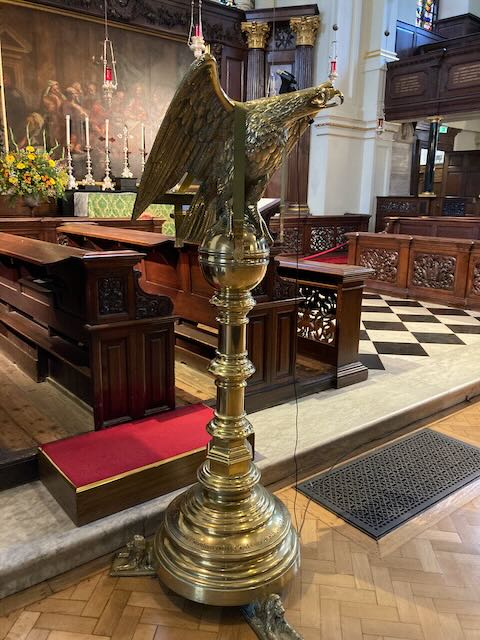
St. George’s Hanover Square eagle lectern. Many churches of Austen’s time had lecterns similar to this, where the Bible was read to the congregation. (The eagle symbolized the Word of God because supposedly it could fly directly into the sun without closing its eyes, so it was like the Bible, leading people to God with eyes open. Eagles’ wings also symbolized carrying the gospel to the ends of the earth.)
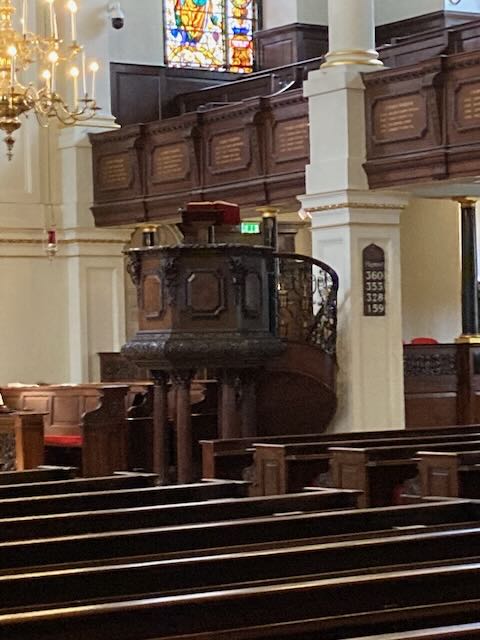
Pulpit of St. George’s, Hanover Square
Rich and Poor
While the wealthy owned mansions in the area, most spent only the winter in London, passing the rest of the year on their country estates. The back alleys behind the mansions teemed with poverty and misery year-round. In the early 1800s, the Evangelical movement began to awaken the church to the needs of the poor. St. George’s established a parish school for poor children in 1804, supported by public subscriptions. Later in the century, the church initiated and supported extensive projects to help the working classes of the area.
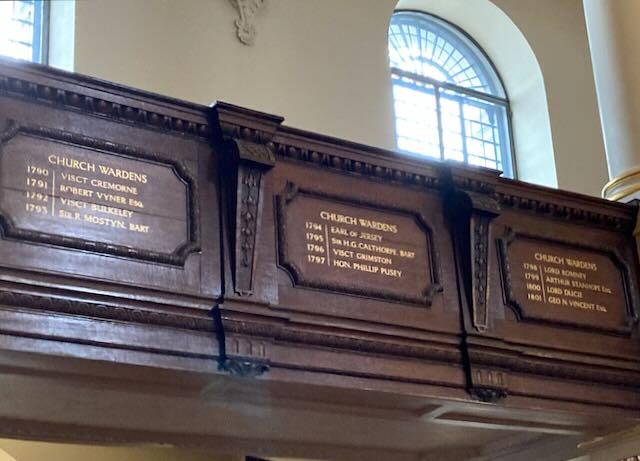
But the wealthy ran the church in Austen’s time. Around the gallery (balcony) are listed the churchwardens, year by year. Anglican churches generally have two elected churchwardens, responsible for financial accounts, movable property of the church, keeping order, and other administrative responsibilities. The churchwardens listed on St. George’s galleries for the 1700s and early 1800s sound impressive: Viscounts, Earls, Lords, Sirs, Honorables, and Esquires.
St. George’s Hanover Square balcony listing early churchwardens. Many were titled men.
Music
The composer George Friderick Handel lived about a four minute walk from the church. He helped choose the organ and organist for the new church. He had a pew there and worshiped at St. George’s until he died. He wrote the Messiah in his house nearby on Brook Street, which is now a museum.
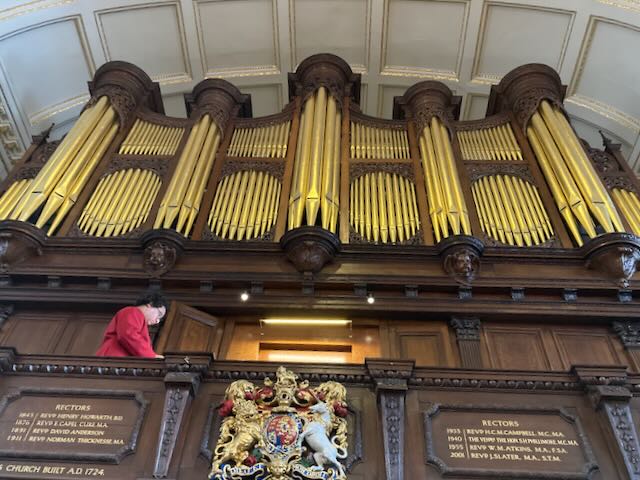
St. George’s Hanover Square organ pipes; a new organ was installed in 1972. The original organ had 1514 pipes and three manuals (keyboards for the hands). It cost £500 in 1725.
Weddings
Since it was at the heart of the wealthy district, St. George’s, Hanover Square was the popular place for weddings of the wealthy and influential. In 1816, the church hosted 1,063 weddings! Famous people including Percy Bysshe Shelley, Benjamin Disraeli, George Eliot (Mary Lewes), and Theodore Roosevelt were married at St. George’s. Mary Crawford was likely staying near there with her wealthy London friends, and she may have attended church there. So it was the first place she thought of for her own and her brother’s weddings. It is still a popular venue for weddings, though not as much so as in Austen’s time.
On Thursday, we’ll look at the other two real churches mentioned in Mansfield Park, the two most famous churches in England. Do you know which ones they are? We’ll also consider which London church Lydia and Wickham married in!
This year I’ve embarked on a new series, “A Year in Jane Austen’s World,” that focuses on important details that happened in Jane Austen’s novels, letters, and lifetime during each month of the year. Each month, I share with you my findings as I scour her letters, novels, and personal and family history.
Thus far, we’ve covered January and February and learned a lot about the “Season” in London and Bath during the winter months during the Regency Era, as well as the garden the Austen women planned for their Southampton home during their first winter there.
Next, we turn to March in Austen’s novels. While January and February were still quite wintry, March in the south of England is a mix of weather and season. As always happens, this type of research is a “follow your nose”-type study – let’s see where March will take us!
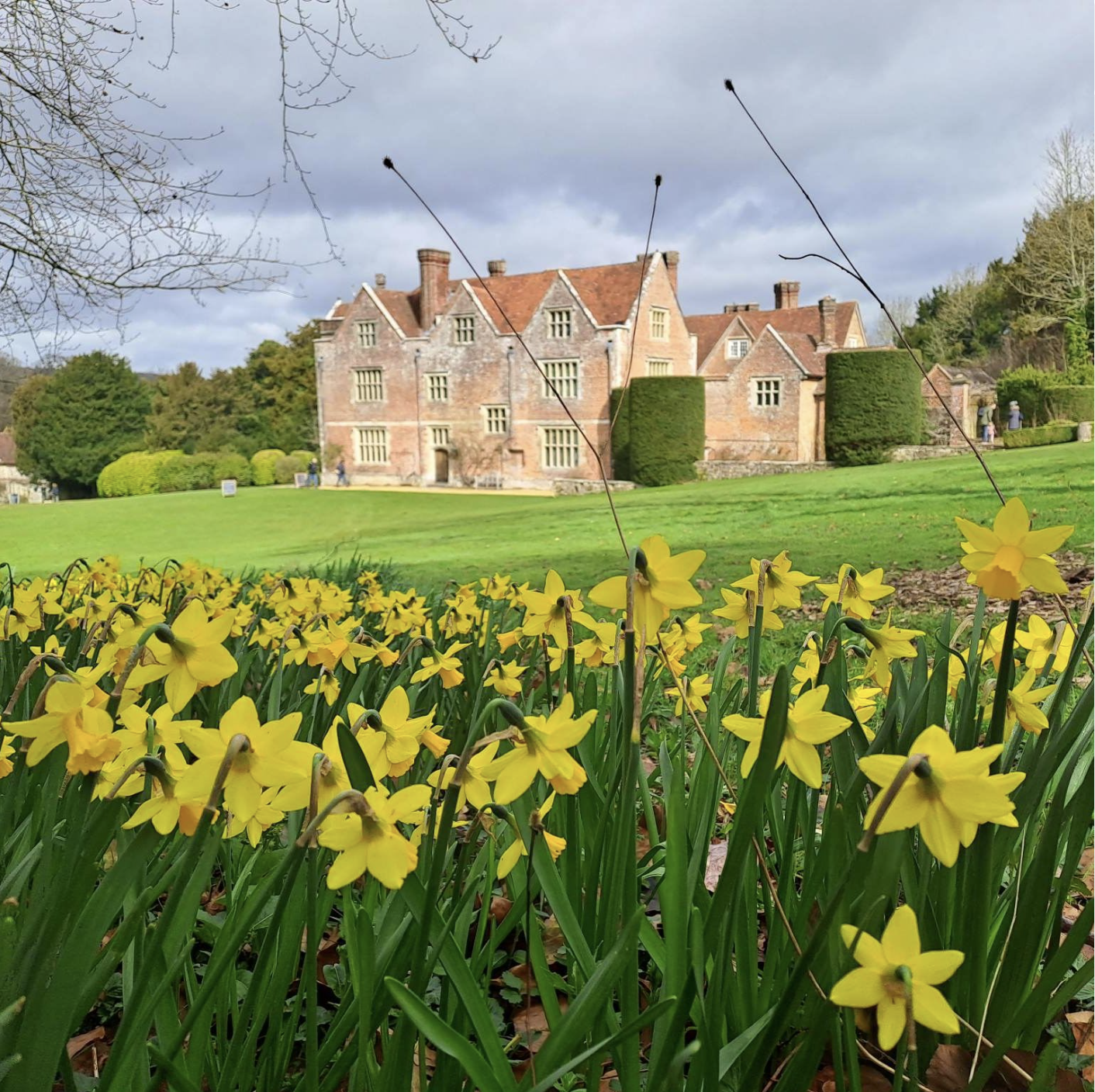
The daffodils like to put on a good show at Jane Austen’s House Museum and Chawton House this time of year. The yellow pops of color are good for the soul and prove to be a hopeful sign that spring is on its way, to those who visit the grounds this time of year.
The daffodils in my yard are glorious right now and it makes my heart happy. I planted 250 bulbs last fall, which meant a lot of work … without anything to show for it at the time. But now that it’s spring, I’m seeing the fruit of my labors!
Daffodils and the like are a wonderful reminder that many worthwhile projects and tasks take work and time before we see fruit. In Austen’s life, before she was published, only her family and close friends enjoyed her work. But later, there was an abundance of fruit from her labors–and it continues to this day!
Several of Austen’s surviving letters were written in March or about March. Here are some interesting highlights:
1814: We have several letters from Jane to Cassandra from March 1814, when Austen visited her brother Henry at his house in Henrietta Street in Covent Garden (you can read more here).
These letters give us a glimpse into Jane’s mind about London, the weather that winter, shopping for herself and the other women in her family, her brother Henry’s thoughts on Mansfield Park, and the plays they attended (several that she liked and others she did not).
Henry’s thoughts on MP: “We did not begin reading till Bentley Green. Henry’s approbation is hitherto even equal to my wishes. He says it is different from the other two, but does not appear to think it at all inferior. He has only married Mrs. R. (Rushworth). I am afraid he has gone through the most entertaining part. He took to Lady B. (Bertram) and Mrs. N. (Norris) most kindly, and gives great praise to the drawing of the characters. He understands them all, likes Fanny, and, I think, foresees how it will all be.”
More on that topic: “Henry is going on with ‘Mansfield Park.’ He admires H. Crawford: I mean properly, as a clever, pleasant man.”
Austen’s thoughts on reading The Heroine: “We have drank tea, and I have torn through the third vol. of the ‘Heroine.’ I do not think it falls off. It is a delightful burlesque, particularly on the Radcliffe style.” (The Heroine; Or Adventures of Cherubinais a novel by Eaton Stannard Barrett, 1813).
In this letter, Austen provides short accounts from several different days in one week. She provides news each day for Saturday, Sunday, Monday, and Tuesday:
The weather seems quite uncomfortable: “Do not be angry with me for beginning another letter to you. I have read the ‘Corsair’ (Byron), mended my petticoat, and have nothing else to do. Getting out is impossible. It is a nasty day for everybody. Edward’s spirits will be wanting sunshine, and here is nothing but thickness and sleet; and though these two rooms are delightfully warm, I fancy it is very cold abroad.”
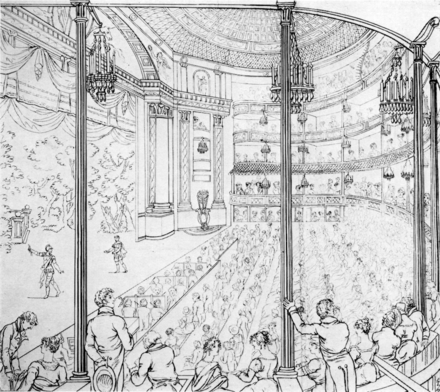
She attends several plays at the Theatre Royal in Drury Lane, London. On Saturday, March 5, 1814, she sees Edmund Kean as Shylock in William Shakespeare’s The Merchant of Venice and provides her thoughts: “We were quite satisfied with Kean. I cannot imagine better acting, but the part was too short; and, excepting him and Miss Smith, and she did not quite answer my expectation, the parts were ill filled and the play heavy. We were too much tired to stay for the whole of “Illusion” (“Nour-jahad”), which has three acts; there is a great deal of finery and dancing in it, but I think little merit. Elliston was “Nour-jahad,” but it is a solemn sort of part, not at all calculated for his powers. There was nothing of the best Elliston about him. I might not have known him but for his voice.”
Later, she continues with this: “I shall like to see Kean again excessively, and to see him with you too. It appeared to me as if there were no fault in him anywhere; and in his scene with “Tubal” there was exquisite acting.”
She writes more about Henry’s assessment of Mansfield Park: “Henry has this moment said that he likes my M. P. better and better; he is in the third volume. I believe now he has changed his mind as to foreseeing the end; he said yesterday, at least, that he defied anybody to say whether H. C. [Henry Crawford] would be reformed, or would forget Fanny in a fortnight.”
Her thoughts on the increase in the price of tea: “A cold day, but bright and clear. I am afraid your planting can hardly have begun. I am sorry to hear that there has been a rise in tea. I do not mean to pay Twining till later in the day, when we may order a fresh supply.”
Jane Austen and her mother and Martha Lloyd all have winter colds: “I have a cold, too, as well as my mother and Martha. Let it be a generous emulation between us which can get rid of it first.” And later: “We are home in such good time that I can finish my letter to-night, which will be better than getting up to do it to-morrow, especially as, on account of my cold, which has been very heavy in my head this evening, I rather think of lying in bed later than usual. I would not but be well enough to go to Hertford St. on any account.”
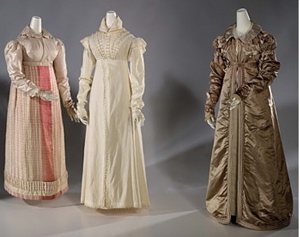
Austen’s dress: “I wear my gauze gown to-day, long sleeves and all. I shall see how they succeed, but as yet I have no reason to suppose long sleeves are allowable. I have lowered the bosom, especially at the corners, and plaited black satin ribbon round the top. Such will be my costume of vine-leaves and paste.” And later: “Mrs. Tilson had long sleeves, too, and she assured me that they are worn in the evening by many. I was glad to hear this.”
And Henry’s final thoughts on Mansfield Park: “Henry has finished ‘Mansfield Park,’ and his approbation has not lessened. He found the last half of the last volume extremely interesting.”
Austen’s romantic advice: “To you I shall say, as I have often said before, Do not be in a hurry, the right man will come at last; you will in the course of the next two or three years meet with somebody more generally unexceptionable than anyone you have yet known, who will love you as warmly as possible, and who will so completely attach you that you will feel you never really loved before.”
Notes on writing: “I will answer your kind questions more than you expect. “Miss Catherine” (Northanger Abbey) is put upon the shelf for the present, and I do not know that she will ever come out; but I have a something ready for publication (Persuasion), which may, perhaps, appear about a twelvemonth hence. It is short — about the length of ‘Catherine.’ This is for yourself alone. Neither Mr. Salusbury nor Mr. Wildman is to know of it.”
Illness: “I am got tolerably well again, quite equal to walking about and enjoying the air, and by sitting down and resting a good while between my walks, I get exercise enough. I have a scheme, however, for accomplishing more, as the weather grows spring-like. I mean to take to riding the donkey; it will be more independent and less troublesome than the use of the carriage, and I shall be able to go about with Aunt Cassandra in her walks to Alton and Wyards.”
In this letter, Austen speaks of many other topics, but the state of her health seems to be the most important topic in this letter:
“Many thanks for your kind care for my health; I certainly have not been well for many weeks, and about a week ago I was very poorly. I have had a good deal of fever at times, and indifferent nights; but I am considerably better now and am recovering my looks a little, which have been bad enough — black and white, and every wrong colour. I must not depend upon being ever very blooming again. Sickness is a dangerous indulgence at my time of life. Thank you for everything you tell me. I do not feel worthy of it by anything that I can say in return, but I assure you my pleasure in your letters is quite as great as ever, and I am interested and amused just as you could wish me.”
Evening: “I was languid and dull and very bad company when I wrote the above; I am better now, to my own feelings at least, and wish I may be more agreeable. We are going to have rain, and after that very pleasant genial weather, which will exactly do for me, as my saddle will then be completed, and air and exercise is what I want. Indeed, I shall be very glad when the event at Scarlets is over, the expectation of it keeps us in a worry, your grandmamma especially; she sits brooding over evils which cannot be remedied, and conduct impossible to be understood.”
“I took my first ride yesterday, and liked it very much. I went up Mounter’s Lane and round by where the new cottages are to be, and found the exercise and everything very pleasant; and I had the advantage of agreeable companions, as At. Cass. and Edward walked by my side. At. Cass. is such an excellent nurse, so assiduous and unwearied! But you know all that already.”
March in Jane Austen’s Novels
The following are a collection of interesting little tidbits and important moments from Austen’s novels:
Sense and Sensibility
“The third day … was so fine, so beautiful a Sunday as to draw many to Kensington Gardens, though it was only the second week in March. Mrs. Jennings and Elinor were of the number; but Marianne, who knew that the Willoughbys were again in town, and had a constant dread of meeting them, chose rather to stay at home, than venture into so public a place.” While walking, Elinor meets Miss Steele (Anne) who says Edward tried to persuade Lucy to give up their engagement, but that Lucy has said she never will.
In that same chapter, a letter arrives: “The next morning brought Elinor a letter by the two-penny post from Lucy herself” (from Bartlett’s Building). In this letter, Lucy claims that she tried to persuade Edward to give her up, but “he would not hear of [their] parting.”
In the next chapter, we read this: “The Palmers were to remove to Cleveland about the end of March, for the Easter holidays; and Mrs. Jennings, with both her friends, received a very warm invitation from Charlotte to go with them.” Elinor and Marianne, both for different reasons, don’t want to go, but they are persuaded to go because going to Cleveland will mean they are only “a long day’s journey” from Barton and can soon go home.
Promenade in Kensington Gardens, 1804.
Pride and Prejudice
“March was to take Elizabeth to Hunsford. She had not at first thought very seriously of going thither; but Charlotte, she soon found, was depending on the plan,{190} and she gradually learned to consider it herself with greater pleasure as well as greater certainty. Absence had increased her desire of seeing Charlotte again, and weakened her disgust of Mr. Collins. There was novelty in the scheme; and as, with such a mother and such uncompanionable sisters, home could not be faultless, a little change was not unwelcome for its own sake. The journey would, moreover, give her a peep at Jane; and, in short, as the time drew near, she would have been very sorry for any delay. Everything, however, went on smoothly, and was finally settled according to Charlotte’s first sketch. She was to accompany Sir William and his second daughter. The improvement of spending a night in London was added in time, and the plan became as perfect as plan could be.”
Mansfield Park
It’s in March that Mr. Crawford visits Fanny in Portsmouth. First, they go to church: “The Prices were just setting off for church the next day when Mr. Crawford appeared again. He came, not to stop, but to join them; he was asked to go with them to the Garrison chapel, which was exactly what he had intended, and they all walked thither together.”
Then, on a walk: “The day was uncommonly lovely. It was really March; but it was April in its mild air, brisk soft wind, and bright sun, occasionally clouded for a minute; and everything looked so beautiful under the influence of such a sky, the effects of the shadows pursuing each other on the ships at Spithead and the island beyond, with the ever-varying hues of the sea, now at high water, dancing in its glee and dashing against the ramparts with so fine a sound, produced altogether such a combination of charms for Fanny, as made her gradually almost careless of the circumstances under which she felt them.”
Later, we read these poignant thoughts from Anne on missing spring in the countryside: “It was sad to Fanny to lose all the pleasures of spring. She had not known before what pleasures she had to lose in passing March and April in a town. She had not known before how much the beginnings and progress of vegetation had delighted her. What animation, both of body and mind, she had derived from watching the advance of that season which cannot, in spite of its capriciousness, be unlovely, and seeing its increasing beauties from the earliest flowers in the warmest divisions of her aunt’s garden, to the opening of leaves of her uncle’s plantations, and the glory of his woods. To be losing such pleasures was no trifle; to be losing them, because she was in the midst of closeness and noise, to have confinement, bad air, bad smells, substituted for liberty, freshness, fragrance, and verdure, was infinitely worse: but even these incitements to regret were feeble, compared with what arose from the conviction of being missed by her best friends, and the longing to be useful to those who were wanting her!”
Fanny Price in Portsmouth, Mansfield Park, Folio Society, illustrated by Joan Hassall.
Persuasion
According to the Baronetage in Persuasion, a very important man (in his own estimation) was born in March: “ELLIOT OF KELLYNCH HALL: Walter Elliot, born March 1, 1760…”
Northanger Abbey
“[Catherine] was struck, however, beyond her expectation, by the grandeur of the abbey, as she saw it for the first time from the lawn. The whole building enclosed a large court; and two sides of the quadrangle, rich in Gothic ornaments, stood forward for admiration. The remainder was shut off by knolls of old trees, or luxuriant plantations, and the steep woody hills rising behind, to give it shelter, were beautiful even in the leafless month of March. Catherine had seen nothing to compare with it; and her feelings of delight were so strong, that without waiting for any better authority, she boldly burst forth in wonder and praise. The general listened with assenting gratitude; and it seemed as if his own estimation of Northanger had waited unfixed till that hour.”
Lismore Castle was used for the 2007 Northanger Abbey film adaptation.
March Dates of Importance
This brings us now to several dates that would have been important to Austen personally and to the Austen family as a whole:
Family News:
23 March 1773: Rev. Austen becomes rector of Deane parish (in addition to Steventon).
27 March 1792: James Austen marries Anne Mathew (they move into the parsonage in Deane).
25 March 1805: Mrs. Austen and her daughters move to 25 Gay Street, Bath.
Historic Dates:
11 March 1793: Civil war erupts in France.
Writing:
March 1811: Austen corrects proofs of Sense and Sensibility.
29 March 1815: Emma finished.
Sorrows:
January-March 1816: Austen begins work on Sanditon.
I hope you enjoyed this month’s overview of March in Jane Austen’s World. As always, there is so much more to explore! These are merely highlights and snippets. In some instances, the information I found was a tad contradictory, so I did my best to find the most accurate research available. If you have more information on any topic, feel free to share in the comments. Next up: April in Jane Austen’s World!
Today marks the start of a new month-by-month series, “A Year in Jane Austen’s World,” in which I highlight several important events and details that happened in Jane Austen’s novels, letters, and lifetime during each month of the year.
We’ll kick off Jane Austen January (aka “Jane-uary”) by examining passages and situations in each of her novels that occur in January. While some of the novels have no mention of January, others do—with interesting results! Next, we’ll note where Austen was and what she was doing in January by checking her letters for January dates and details. Finally, we’ll highlight events and anniversaries that occurred in January that directed affected Jane Austen or her family.
All of this can help us better understand Austen’s life and times as we look at specific dates, events, and details in the context of months and seasons.
Snowdrops at Chawton House in January, courtesy of Chawton House.
January in Regency Times
One of the highlights of January for Jane Austen’s family was surely Twelfth Night (also known as Epiphany), which falls on January 5th.
Maria Grace, in her article “Celebrating Twelfth Night–Jane in January and You,” explains its religious importance: “Epiphany or Twelfth Night … was the exciting climax of the Christmastide season… It was a feast day to mark the coming of the Magi bearing gifts to the Christ child, and as such was the traditional day to exchange gifts.”
She also explains the social side of Twelfth Night: “In Jane Austen’s day, the party of the year would generally be held on Twelfth Night.” (Austen Variations)
During the Regency Era, people hosted parties and balls to celebrate Christmas and especially the last day of the Christmas season. The entertainment often involved guests playing assigned parts for the evening, dressing up in costumes, eating “Twelfth Cake,” and eating and drinking.
Rowlandson, “Twelfth Night Characters,” Creative Commons, 1811.
In a letter to Cassandra on December 27, 1808, Austen writes about an upcoming ball between Christmas and “Twelfth-day” at Manydown:
I was happy to hear, chiefly for Anna’s sake, that a ball at Manydown was once more in agitation; it is called a child’s ball, and given by Mrs. Heathcote to Wm. Such was its beginning at least, but it will probably swell into something more. Edward was invited during his stay at Manydown, and it is to take place between this and Twelfth-day. Mrs. Hulbert has taken Anna a pair of white shoes on the occasion.
Austen’s Letters (December 27, 1808)
Later, on January 10, 1809, she writes, “The Manydown ball was a smaller thing than I expected, but it seems to have made Anna very happy. At her age it would not have done for me.”
Manydown Great House, Wikipedia Commons, 1833.
January Travel in Jane Austen’s Novels
In Austen’s novels, January is primarily mentioned in the context of parties and travel. Anne Elliot goes to Bath for January and February, Miss Crawford is invited for “a long visit” to see her friend in London in January, Mrs. Jennings goes to her own house in London in January, and Mr. Bingley, Mr. Darcy, and Bingley’s sisters all go to London (when Bingley leaves Netherfield) and stay for the winter.
In Sense and Sensibility, Lucy Steele and her sister, Anne, go to “town” (London) in January to stay with relatives (and subsequently move from house to house throughout the season as socially advantageous opportunities become available):
I had quite depended upon meeting you there. Anne and me are to go the latter end of January to some relations who have been wanting us to visit them these several years! But I only go for the sake of seeing Edward. He will be there in February, otherwise London would have no charms for me; I have not spirits for it.
Sense and Sensibility
Mrs. Jennings, who “resided every winter in a house in one of the streets near Portman Square,” invites Elinor and Marianne to come with her to London in January when her thoughts begin to turn toward home after Christmas.
Portman Square, London, Wikipedia Commons, 1813.
The London Season
So why do so many of Austen’s characters travel to London in January? Wouldn’t the weather make travel difficult? Wouldn’t they prefer to stay home (and inside) where it’s cozy?
These are fair questions, but after Christmas, a large portion of the genteel class moved “to town” during the winter months for the London Season, which coincided with England’s political schedule, for entertainment and socializing. The Season had previously started in the fall, meaning most people went to London before the bad weather set in, but with the improvement of roads and travel during Austen’s day, the season slowly shifted later.
Here’s an explanation of the London Season from Jane Austen’s House Museum:
The London season coincided with the sitting of Parliament, beginning at some point after Christmas when fashionable families would move into their London houses. The men would attend Parliament, whilst the women shopped, visited, and found husbands for themselves or their daughters. It lasted until early summer, when the ‘beau monde’ would return to their country estates, escaping the city’s stifling heat and pungent smells.
The season was a whirlwind of court balls and concerts, private balls and dances, parties and sporting events. On a typical day, ladies would rise early to go riding in Hyde Park, before returning home to breakfast and spending the day shopping, dealing with correspondence and paying calls.
Most villages had assemblies and balls during the winter, but all of the most important social occasions happened “in town.” In Pride and Prejudice, we’re told that the Bennet sisters have little to do “beyond the walks to Meryton” in January and February, when conditions are “sometimes dirty and sometimes cold” (Ch. 27). It makes sense that many young women longed to go to town in the winter, at the height of the London Season and “marriage market,” when the majority of the parties, balls, and social events were held.
Rowlandson, Drawing Room at St. James’s Palace in London, Wikimedia Commons, 1810.
January in Jane Austen’s Letters
January often brings rain, cold weather, and even snow to the various locations where Austen lived and traveled. Austen kept her spirits up, but January in England, especially in homes without central heating or today’s insulation, could not have been entirely comfortable. Balls and assemblies, visits and travel, kept Austen busy and content during the winter months.
Austen’s entries follow below and give us a glimpse into the miserable weather conditions during one particularly snowy and wet January:
17 January 1809 (Castle Square): “Yes, we have got another fall of snow, and are very dreadful; everything seems to turn to snow this winter.”
24 January 1809 (Castle Square): “This day three weeks you are to be in London, and I wish you better weather; not but that you may have worse, for we have now nothing but ceaseless snow or rain and insufferable dirt to complain of; no tempestuous winds nor severity of cold. Since I wrote last we have had something of each, but it is not genteel to rip up old grievances.”
In the same letter, Austen describes her writing: “I am gratified by her having pleasure in what I write, but I wish the knowledge of my being exposed to her discerning criticism may not hurt my style, by inducing too great a solicitude. I begin already to weigh my words and sentences more than I did, and am looking about for a sentiment, an illustration, or a metaphor in every corner of the room. Could my ideas flow as fast as the rain in the store-closet, it would be charming.”
On the topic of the store-closet, she writes this: “We have been in two or three dreadful states within the last week, from the melting of the snow, etc., and the contest between us and the closet has now ended in our defeat. I have been obliged to move almost everything out of it, and leave it to splash itself as it likes.”
30 January 1809 (Castle Square): “Here is such a wet day as never was seen. I wish the poor little girls had better weather for their journey; they must amuse themselves with watching the raindrops down the windows. Sackree, I suppose, feels quite broken-hearted. I cannot have done with the weather without observing how delightfully mild it is; I am sure Fanny must enjoy it with us. Yesterday was a very blowing day; we got to church, however, which we had not been able to do for two Sundays before.”
And a final update on the flooded closet: “The store-closet, I hope, will never do so again, for much of the evil is proved to have proceeded from the gutter being choked up, and we have had it cleared. We had reason to rejoice in the child’s absence at the time of the thaw, for the nursery was not habitable. We hear of similar disasters from almost everybody.”
If you’ve ever dealt with water damage or burst pipes due to cold weather, you know how awful and destructive it can be. Austen makes light, but one can imagine it caused quite a bit of damage.
Snow at Jane Austen’s House Museum, January 2021.
January in Jane Austen’s Lifetime
And finally, let us turn our attention to some of the most important dates and events that happened (or were celebrated) during the first month of the year in Jane Austen’s lifetime. In December 1800, Reverend Austen decided to retire and remove his family to Bath. Austen’s letters in January 1801 prove an interesting read as she and the Austen family prepare to move later in the year:
3 January 1801 (Steventon): Austen writes that her mother wants to keep two maids and quips about their plans to have “a steady cook and a young giddy housemaid, with a sedate, middle-aged man, who is to undertake the double office of husband to the former and sweetheart to the latter.”
Austen discusses three parts of Bath where they might live: “Westgate Buildings, Charles Street, and some of the short streets leading from Laura Place or Pulteney Street.” She writes extensively about each neighborhood and several others, giving her opinion and hopes about each. She details which pictures, furniture, and beds they are choosing to keep or leave behind and asks Cassandra’s advice. And she shares plans for the family to travel to Bath a few weeks from then.
Austen shares own thoughts on their move to Bath: “I get more and more reconciled to the idea of our removal. We have lived long enough in this neighborhood: the Basingstoke balls are certainly on the decline, there is something interesting in the bustle of going away, and the prospect of spending future summers by the sea or in Wales is very delightful. For a time we shall now possess many of the advantages which I have often thought of with envy in the wives of sailors or soldiers. It must not be generally known, however, that I am not sacrificing a great deal in quitting the country, or I can expect to inspire no tenderness, no interest, in those we leave behind…”
The letter is full of useful information and well-worth a read. You can access it HERE.
14 January 1801 (Steventon): Austen speaks of the many visitors they’ve received in response to the news that Rev. Austen is retiring and the family is moving to Bath. She says, “Hardly a day passes in which we do not have some visitor or other: yesterday came Mrs. Bramstone, who is very sorry that she is to lose us, and afterwards Mr. Holder, who was shut up for an hour with my father and James in a most awful manner.”
4 Sydney Place, Bath.Plaque outside 4 Sydney Place, Bath.
January Dates of Importance
This brings us now to several dates that would have been quite important to Austen personally:
Celebrations/Birthdays:
9 January 1773: Jane Austen’s sister, Cassandra Elizabeth Austen, born.
23 January 1793: Edward Austen’s first child, Fanny, born.
Goodbyes/Sorrows:
January 1796: Tom Lefroy leaves Ashe for London (and never returns) and Tom Fowle (Cassandra’s fiancé) sets sail for the Indies, where he later dies.
21 January 1805: Rev. George Austen (Jane’s father) dies suddenly in Bath.
Writing:
28 January 1813: Pride and Prejudice was published, by Thomas Egerton (Whitehall, London).
21 January 1814: Austen begins writing Emma.
The Joys of Sleuthing
I hope you’ve enjoyed this first installment of our month-by-month exploration of Jane Austen’s world. I was pleasantly surprised to find that there was so much more to research and explore about the month of January than I anticipated. I enjoyed sleuthing around, following my nose, and discovering what I could uncover–just with the word “January.” If you have ideas about what I might pursue for February in Jane Austen’s World, please share your ideas in the comments.
During Jane Austen’s lifetime, conduct literature that advocated ideal conduct and character for young women was common. In the form of letters, pamphlets, and full-length novels, conduct literature covered an array of topics meant to instruct and inform.
Conduct manuals played a large part in forming Austen’s culture and the world of her novels. To better understand her world and her characters, let’s take a closer look at the world of conduct literature for young ladies.
Conduct Books
Whereas etiquette books of the last century, such as Emily Post’s Etiquette, stressed good manners and how to behave in specific social situations, the conduct manuals and letters written for young ladies in Jane Austen’s time focused mainly on propriety. The central purpose was to mold the character of a young woman and teach her how to think, act, and speak in a way that was both morally and socially proper.
Conduct manuals discussed a wide range of subjects, including household chores, religion, and what to look for in a husband. However, the underlying concern evident in most of the conduct pamphlets being written at this time was the cultivation of “virtue” in the female sex. As Mary Wollstonecraft Godwin states in Thoughts on the Education of Daughters (1787), “the main business of our lives is to learn to be virtuous.” And according to many eighteenth-century conduct books, a woman’s virtue was expressed in her attitudes, her carriage, her accomplishments, and her actions and speech.
But what did these books, letters, and pamphlets actually say? Let’s take a closer look at three examples from the late 1700s to see what young ladies were taught during Austen’s youth and adolescence:
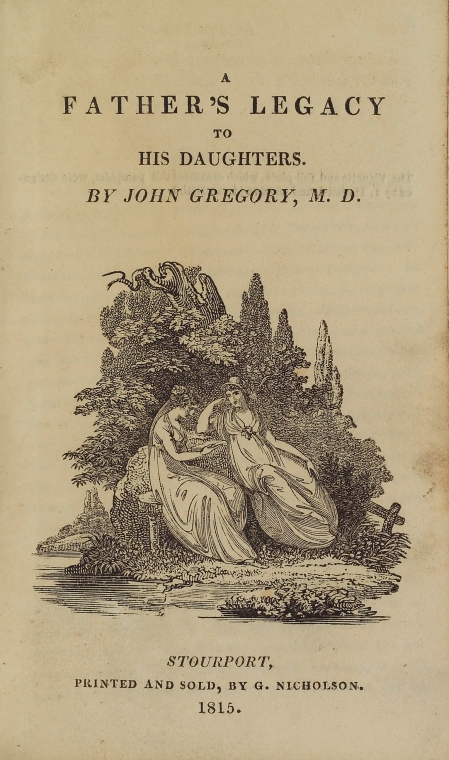
“A Father’s Legacy to His Daughters”
In John Gregory’s popular conduct book, A Father’s Legacy to his Daughters(first published in 1774), Gregory told his daughters that they should aspire to the kind of “virtue” their deceased mother possessed and put on “a certain gentleness of spirit and manners extremely engaging in [women].”
Carl H. Pforzheimer Collection of Shelley and His Circle, The New York Public Library. “A father’s legacy to his daughters.” The New York Public Library Digital Collections.
The topics for this particular conduct book are as follows:
Religion
Conduct and Behaviour
Amusements
Friendship, Love, Marriage
On the topic of Amusements, Gregory has this to say:
Some amusements are conducive to health, as various kinds of exercise: some are connected with qualities really useful, as different kinds of women’s work, and all the domestic concerns of a family: some are elegant accomplishments, as dress, dancing, music, and drawing. Such books as improve your understandings, enlarge your knowledge, and cultivate your taste, may be considered in a higher point of view than mere amusements. There are a variety of others, which are neither useful nor ornamental, such as play of different kinds.
On the topic of Friendship, Gregory makes these comments:
A happy choice of friends will be of the utmost consequence to you, as they may assist you by their advice and good offices. But the immediate gratification which friendship affords to a warm, open, and ingenuous heart, is of itself sufficient motive to court it. In the choice of your friends, have your principal regard to goodness of heart and fidelity. If they also possess taste and genius, that will still make them more agreeable and useful companions.
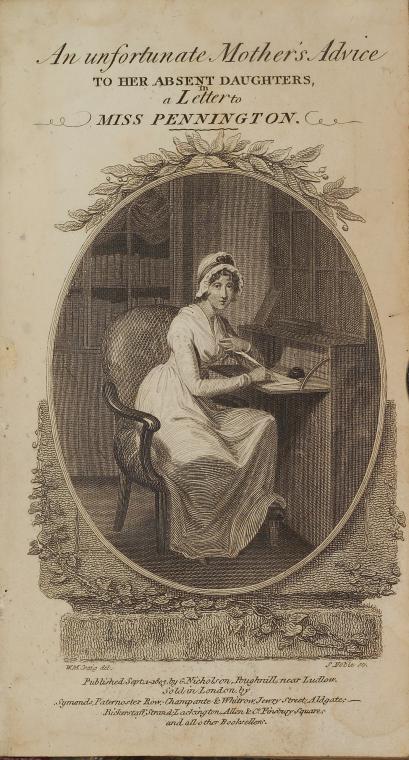
“An Unfortunate Mother’s Advice to Her Absent Daughters”
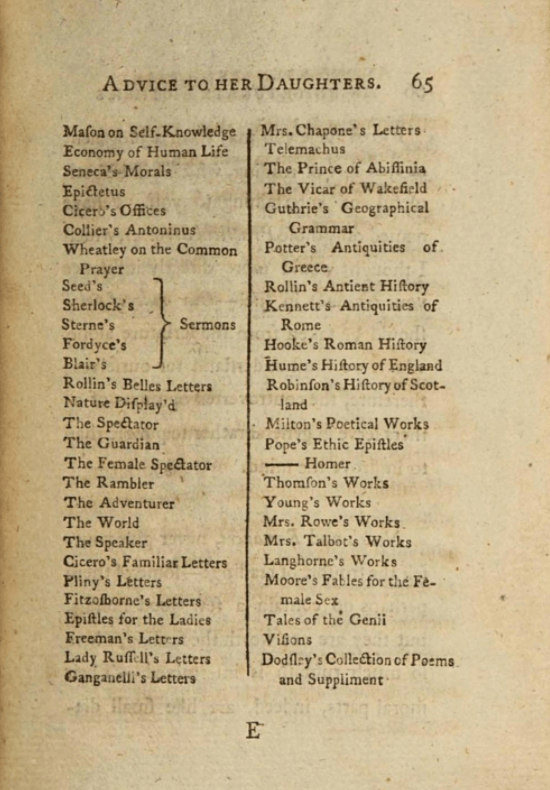
In Lady Pennington’s An Unfortunate Mother’s Advice to Her Absent Daughters(1761), she covers many topics for young ladies, complete with an index of books her daughters should read as part of her discussion on how her daughters should make “mental improvements” through reading, which gives us insight into other literature of the time period that was considered edifying for young ladies:
Along with Gregory, Pennington suggests that virtue should be a person’s highest goal: “Aim at perfection, or you will never reach to an attainable height of virtue.”
She goes into great detail on an expansive number of subjects, but one interesting highlight that seems to have been common for Jane Austen herself and for her leading ladies is in regard to one’s daily schedule. She explains that mornings should be spent in domestic duties and “improvement.” Afternoons “may then be allowed to diversions” (which includes “company, books of the amusing kind, and entertaining productions of the needle, as well as plays, balls”).
But, she says, the former part of the day should be “devoted to more useful employments”:
One half hour, or more, either before or immediately after breakfast, I would have you constantly give to the attentive perusal of some rationally pious author, or to some part of the New Testament, with which, and indeed with the whole Scripture, you ought to make yourself perfectly acquainted, as the basis on which your religion is founded. From this practice you will reap more real benefit than can be supposed by those who have never made the experiment.”
Carl H. Pforzheimer Collection of Shelley and His Circle, The New York Public Library. “An Unfortunate Mother’s Advice to Her Absent Daughters, in a letter to Miss Pennington,” The New York Public Library Digital Collections.
Further advice includes studying “your own language thoroughly, that you may speak correctly, and write grammatically.” She suggests being “well acquainted” with French and, if possible, Italian; the history of England other European nations; Geography, as this will “make history more entertaining to you;” Philosophy; and the “first four rules of Arithmetic.” Music and Drawing are humorously described as “accomplishments well worth the trouble of attaining, if your inclination and genius lead to either: if not, do not attempt them; for it will be only much time and labour unprofitably thrown away.”
Finally, a quote I found personally inspiring which I can imagine Austen might have agreed with:
Expect not many friends, but think yourself happy, if, through life, you meet with one or two who deserve that name, and have all the requisites for the valuable relation.
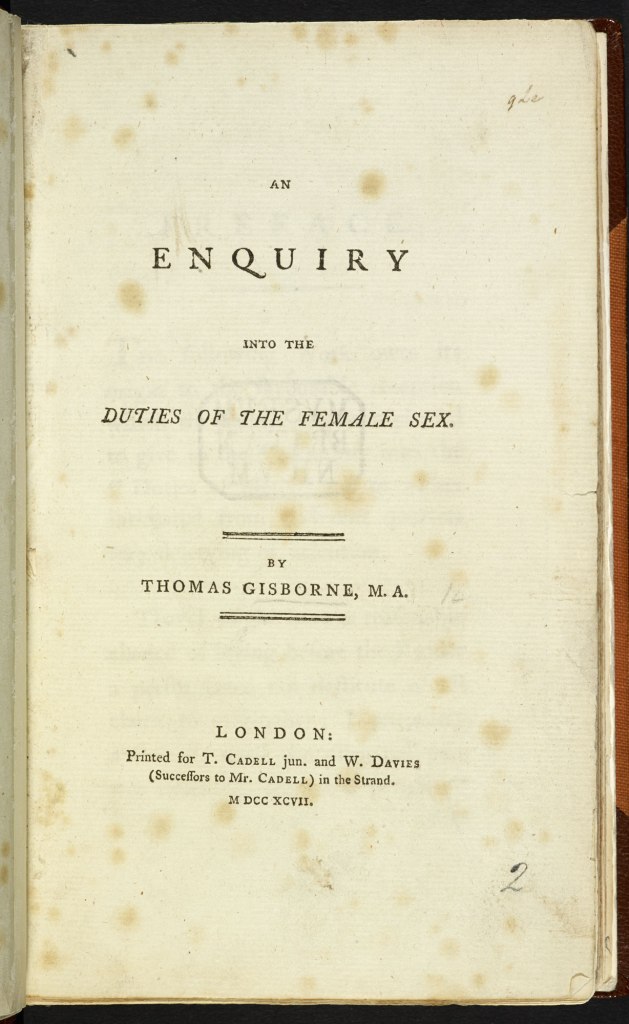
Austen herself read a conduct manual titled An Enquiry into the Duties of the Female Sex, written by Thomas Gisborne (1797), which followed his popular “Enquiries into the Duties of Men.” It covers topics such as the differences between men and women, female education, introducing young women into society, conversation and letter writing, dress, entertainment, the employment of time, choosing a husband, the duties of parents, and so forth.
I am glad you recommended “Gisborne”, for having begun, I am pleased with it, and I had quite determined not to read it.
Letter from Jane to Cassandra, 30 August 1805
To explain Austen’s possible reason for this common, the British Library has this to say:
“We don’t know why Austen had ‘determined not to read’ An Enquiry. Perhaps she expected it to be similar to the Mr Collins-endorsed Sermons to Young Women, referred to in Pride and Prejudice, which stresses the need for women to be submissive and modest. In fact, Gisborne praises woman’s capacity for ‘sprightliness and vivacity’, ‘quickness of perception’ and ‘fertility of invention’ – as well as the more traditional female virtues of offering comfort and cheer to those around them.
“Though Gisborne’s views seem conservative to modern readers, many of them are similar to those that Austen expresses in her novels. He urges women to spend time each day reading improving books, mentioning as particularly suitable the works of William Cowper, one of Austen’s favourite poets (p. 219). He warns against the ‘absurd and mischievous’ belief that a woman can reform a cruel and immoral man after marrying him (p. 238), and criticises mothers who prioritise wealth over happiness in choosing husbands for their daughters.” (British Library, Conduct Book for Women)
Forms of Conduct Literature
There were countless other conduct books, letters, and pamphlets written during Austen’s lifetime. These, along with sermons and religious writings, were the only kind of reading material that was thought proper for young ladies. Later, didactic novels that taught a moral lesson in story form, became more popular. Still within the genre of conduct literature, didactic novels were written to entertain and instruct. Stay tuned for more on that topic next month.
I encourage you to follow the links above and read some of these books for yourself. It’s quite interesting to find out what exactly young women were taught during Jane Austen’s time. And it’s easy to see where Austen may have found instruction, inspiration, and even, at times, amusement within their pages.
Fashionable Goodness: Christianity in Jane Austen's England is now available! By JAW contributor Brenda S. Cox. See Review. Available from Amazon and Jane Austen Books.
Available through December 31st, 2025. Click on image for details, and share this poster with other teachers and students!
The Obituary of Charlotte Collins by Andrew Capes
Click on image to read the story.
Comments
“My idea of good company…is the company of clever, well-informed people, who have a great deal of conversation.” – Jane Austen, Persuasion
Gentle readers: Please feel free to post your comments and continue the conversation! Due to SPAM, we will no longer accept comments on posts after 30 days of publication. In some instances, links will be removed from comments as well.
Administrators and Contributors
Vic Sanborn, founder of this blog, is supported by a team of talented and knowledgeable writers about Jane Austen and the Regency era. They are:
Tony Grant, who now contributes his photos from London and England
Click on their names to enter their own blogs.
In addition, we thank the many experts and authors who frequently contribute their posts and opinions, and who continue to do so freely or at our request.
Click here to enter the page. Topics include Regency fashion, historic foods, Jane Austen societies, British sites, related topics. Click on image.
May we suggest?
Hello, my name is Vic and I live in Maryland, USA. I have adored Jane Austen almost all of my life. I am a proud lifetime member of the Jane Austen Society of North America. This blog is a personal blog written and edited by me and my team. We do not accept any form of cash advertising, sponsorship, or paid topic insertions. However, we do accept and keep books and CDs to review.
If you would like to share a new site, or point out an error, please email us. (Yes, we are fallible. We'll own up to our mistakes and will make the corrections with a polite smile on our faces.) Write us at
Thank you for visiting this blog. Your comments and suggestions are most welcome.
Project Gutenberg: eBook of Stage-coach and Mail in Days of Yore, Volume 2 (of 2), by Charles G. Harper
STAGE-COACH AND MAIL IN DAYS OF YORE: A PICTURESQUE HISTORY
OF THE COACHING AGE, VOL. II, By CHARLES G. HARPER. 1903. Click on this link.
















 Jane Austen's World