Feeds:
Posts
Comments

Archive for the ‘Regency society’ Category

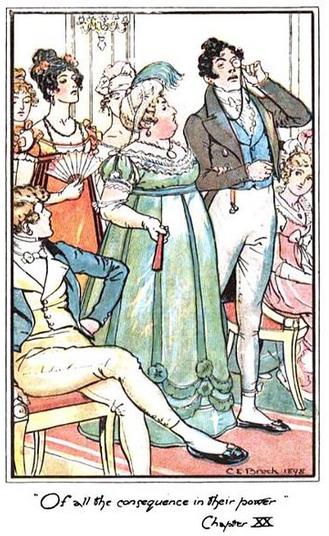
Dowager Viscountess Dalrymple makes an appearance with Sir Walter Elliot. Brock illustration.

“The Bath paper one morning announced the arrival of the Dowager Viscountess Dalrymple, and her daughter, the Honourable Miss Carteret. . . ” – Jane Austen, Persuasion

I have often wondered about dowagers and their status in Regency society in relation to widows. When did a widow become a dowager? Did all 19th century widows acquire the title? Why or why not?

Mirriam Webster Dictionary provides an answer : “Dowager – The widow of a peer, eg the Dowager Countess of Somewhere. The term was not added to a woman’s title unless and until the new holder of the title married.” The definition contains the clue. Until the new heir married, an aristocratic widow retained the title she acquired on the day of her own wedding.

Widows were legally entitled to a dower share or a third of the value of her husband’s estate after his death, for under the law of primogeniture he was the only real property owner. Dower rights meant that she would benefit for the rest of her life from a third of the income produced by a farm or from rental property on his estate:

“Under English common law and in colonial America, dower was the share of a deceased husband’s real estate to which his widow was entitled after his death. After the widow’s death, the real estate was then inherited as designated in her deceased husband’s will; she had no rights to sell or bequeath the property independently. She did have rights to income from the dower during her lifetime, including rents and including income from crops grown on the land.

One-third was the share of her late husband’s real property to which dower rights entitled her; the husband could increase the share beyond one-third in his will.

Where a mortgage or other debts offset the value of real estate and other property at the husband’s death, dower rights meant that the estate could not be settled and the property could not be sold until the widow’s death.” Women’s History 
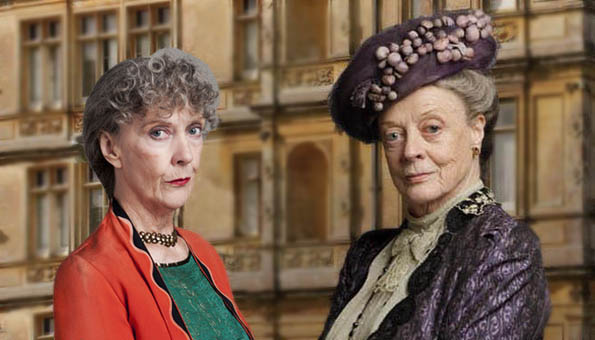
Dowager Maud, Lady Holland (Dame Eileen Atkins) and Violet, Dowager Countess of Grantham (Dame Maggie Smith) were able to live comfortably on 1/3 of the income of their husbands' estates.

Violet, the Dowager Countess of Grantham in Downton Abbey, would actively assume the title of dowager upon her son’s marriage so that there would be no confusion of having two Countesses of Grantham in the same room. But she did not always go by that title. Generally speaking the dowager would be known by the simplest title when encountered alone. Therefore, Violet would be referred to as the Countess of Grantham unless she attended the same event as her daughter -in-law. In that case, she would be referred to as the dowager countess.

Cora, Countess of Grantham

Upon the heir’s marriage, it was expected that the dowager would move from the estate into a house of her own to guarantee a smooth transition of power. This was not always the case. As Amanda Vickery made clear in her fascinating book, Behind Closed Doors: At Home in Georgian England, some brides needed to summon a great deal of patience and cunning when their mamas-in-law dragged their heels in moving to the dower house. In real life, the Dowager Duchess of Leinster chose to live at Number 14 Harley Street in London. She would leave town occasionally to stay in her cottage in Wimbledon. Eleanor Percy, the Dowager Duchess of Northumberland, was the childless widow of the 4th Duke. The dowager moved into Stanwick Park following her husband’s death in 1865, and after the 5th Duke had moved into Alnwick Castle, the ducal estate. Eleanor lived a productive life at Stanwick Park, creating elaborate gardens and cultivating fruits and flowers. Sadly, Stanwick Hall no longer stands today due to lack of fortune. – Stanwick Hall: England’s Lost Country Houses
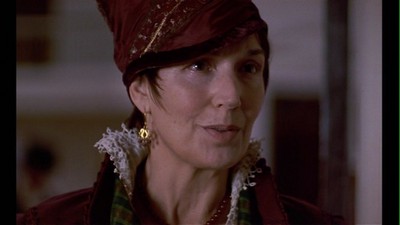
Susan Fleetwood as Lady Russell in Persuasion

Widowhood could emancipate a woman or lead her to poverty, depending on the income she derived from her dower rights and her dowry, which was the money and goods that a bride’s father had negotiated for her upon her marriage. Take Lady Russell from Persuasion. She did not remarry again from choice. Her independent life, free from money worries, was so improved without the presence of a husband who could dictate her every move and who would have control over her possessions that she would be a fool to remarry unless she fell head over heels in love. In that event she would lose her first husband’s income as stipulated by dower rights, although she would retain her dowry and any property she received through her mother.

Mrs. Dashwood and her daughters await the arrival of her replacement as mistress of Norland.

In contrast to Lady Russell’s situation, Mrs. Dashwood’s circumstances in Sense and Sensibility were instantly reduced due to the stipulations of the estate her husband was overseeing, which decreed the inheritance would go directly to the son, regardless of how much Mr. Dashwood desired to make provisions for his second wife and daughters. This is why on his deathbed he tried to extract a promise from John Dashwood, for Mr. Dashwood had not lived long enough to save money from the income of the estate for his second family. Due to Fanny’s stinginess, Mrs. Dashwood and her daughters are left to live on the modest income from her dowry (which was barely enough to keep them comfortable) and the beautiful items that she had brought into her marriage (which she retained as her own, much to Fanny Dashwood’s chagrin).
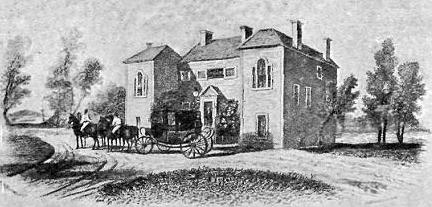
An elopement to Gretna Green was a most foolhardy and risky step for a young heiress

The dowry was one of the reasons that it was more than foolhardy for a young woman of fortune to elope to Gretna Green. Upon marriage all her worldly goods were legally handed over to her husband. An unscrupulous man could spend every single one of her pennies – except the amount that her father had settled upon her. A young woman who eloped had no such protection, for her family, caught unawares, would not have had the time to provide for her personal welfare. Her husband could go through her fortune (and his) with impunity, leaving her penniless and without recourse after his death.
Read Full Post »

August 16th marks Georgette Heyer’s birthday. In several comments on my book reviews some readers have made it a point to mention that Georgette is no Jane Austen and termed her novels mere romances. Ah, but they are so much more. I love her novels in part because they remind me vividly of the satirical prints that were so popular during Jane Austen’s day.  Observe the dandy at left in the print below, then read Georgette’s description of Sir Nugent!

Beside Sylvester’s quiet elegance and Major Newbury’s military cut she had been thinking that Sir Nugent presented all the appearance of a coxcomb. He was a tall man, rather willowy in build, by no means unhandsome, but so tightly laced-in at the waist, so exaggeratedly padded at the shoulders, that he looked a little ridiculous. From the striking hat set rakishly on his Corinthian crop (he had already divulged that it was the New Dash, and the latest hit of fashion) to his gleaming boots, everything he wore seemed to have been chosen for the purpose of making him conspicuous.  His extravagantly cut coat was embellished with very large and bright buttons; a glimpse of exotic colour hinted at a splended waistcoat beneath it; his breeches were of white corduroy; a diamond pin was stuck in the folds of his preposterous neckcloth; and he wore so many rings on his fingers, and so many fobs and seals dangling at his waist, that he might have been taken for a jeweller advertising his wares. – Georgette Heyer, Sylvester

Astley's Amphitheatre

Here is her passage about Astley’s Amphitheatre in Cotillion:

Though Meg might cry out against so unsophisticated an entertainment, Mr. Westruther knew Kitty well enough to be sure that she would revel in it. Had it been possible, he would unhesitatingly have taken her to Astley’s Amphitheartre, and would himself have derived a good deal of amusement, he thought, from watching her awe and delight at Grand Spectacles, and Equestrian Displays. But the Amphitheatre, like its rival, the Royal Circus, never opened until Easter Monday, by which time, Mr Westruther trusted, Kitty would have returned to Arnside.

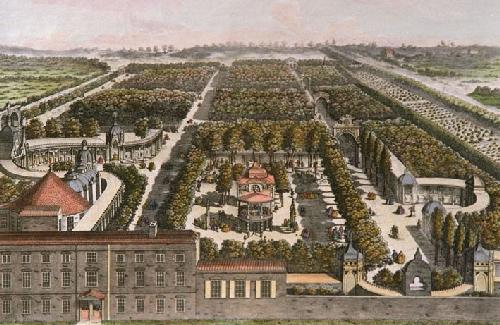
Vauxhall Gardens, Samuel Wale, c. 1751

By way of whiling away the eveing Sherry escorted his bride to Vauxhall Gardens. Here they danced, supped in one of the booths on wafter-thin slices of ham, and rack-punch, and watched a display of fireworks. – Friday’s Child


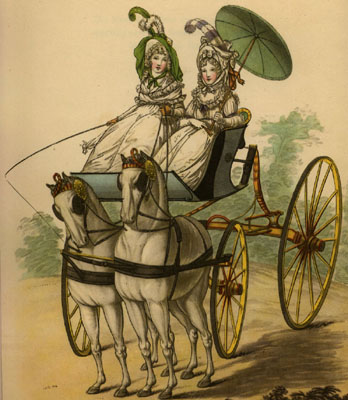
He complied with this request, backing the phaeton into place on the right of the landaulet, so that although the high perch of the phaeton made it impossible for his sister to shake hands with Frederica she was able to exchange greetings with her, and might have maintained a conversation had she not decided that to be obliged to talk to anyone sitting so far above her would soon give Frederica a stiff neck. – Frederica

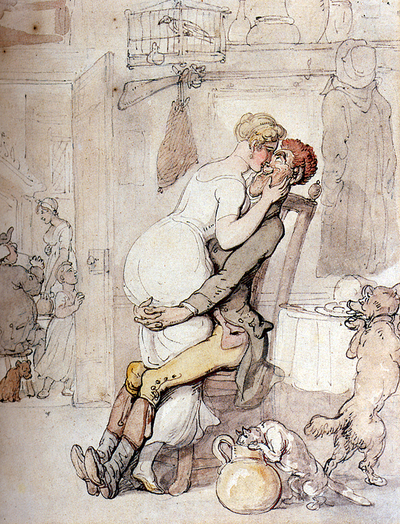
A Kiss in the Kitchen, Thomas Rowlandson

‘But if she knew that you do not mind George’s having kissed me -‘

‘But I do mind!’ said Sherry, incensed.

‘Do you, Sherry?’ she asked wistfully.

‘Well, of course I do! A pretty sort of a fellow I should be if I did not!’

‘I won’t do it again,’ she promised.

‘You had better not, by Jupiter!’ – Friday’s Child

Time and again the zany plots and witty conversations in Georgette’s novels echo the Regency prints that I love to study. Yes, she is no Jane Austen, but as an interpreter of the Regency era, she is priceless.

As a birthday gift, please click on this link to read her short story, A Proposal to Cecily.

Read Full Post »

Today almost everywhere we turn we are inundated with ads over television and radio, in film theatres, on billboards and our computers, and magazines and store fronts. We simply cannot escape the messages put out by individuals and businesses trying to get us to buy their products and services.

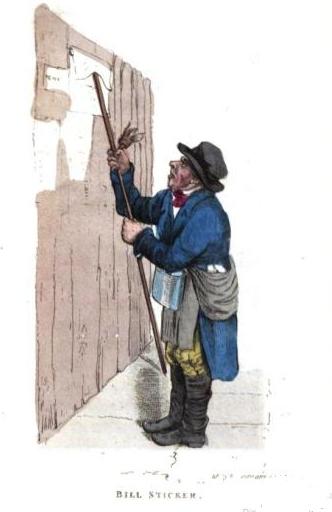
W. H. Pyne, Bill sticker

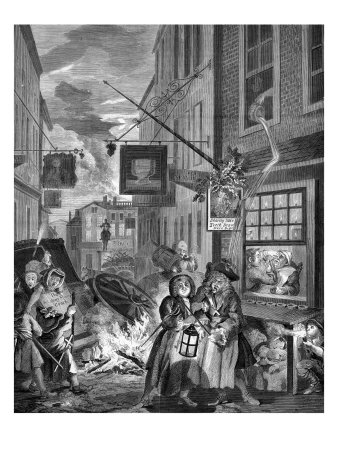
The situation was the same in Jane Austen’s day. When shoppers walked to a shopping area in a city the streets would be indundated with shop signs, hired walkers wearing advertising boards, and hawkers. Advertising merchants dealt in trades that are both familiar and unfamiliar to us today: silversmiths, coal dealers, shoemakers, scum boilers, boarding houses, brewers, tavern keepers, silk merchants, coffee houses, cabinet makers, bakers, mattress makers, curriers and dealers in grindery, warper, hair dressers, woollen drapers and dealers in trimmings, victuallers, livery stable keepers, grocers, music sellers, linen drapers, beer sellers, dealer in rags, tripeman, tobacconist – well, the list goes on.

This is a raucous street scene in London at night in which the shop signs hanging over the pedestrians seem almost ominous. (Notice the slop being poured out of the window!)

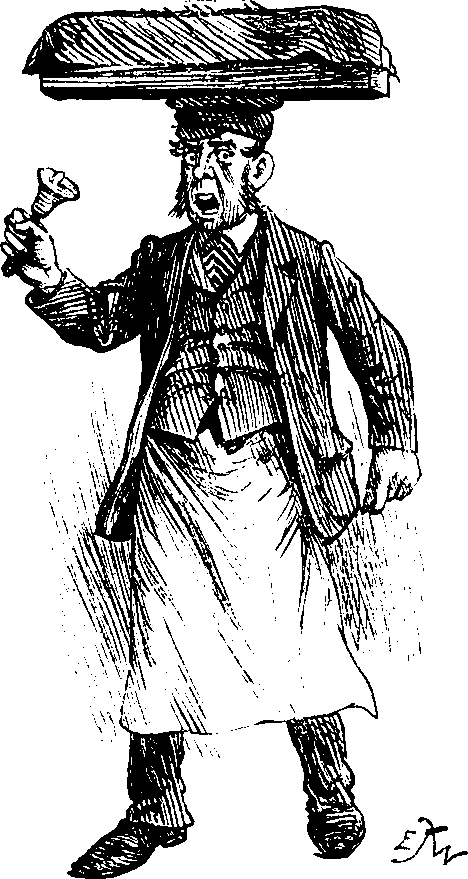
There were leaflets, handbills, posters on bricks walls and glass windows seemingly almost everywhere, and advertisements in newspapers … and of course the inevitable street criers.

The bell and cry of the muffin man

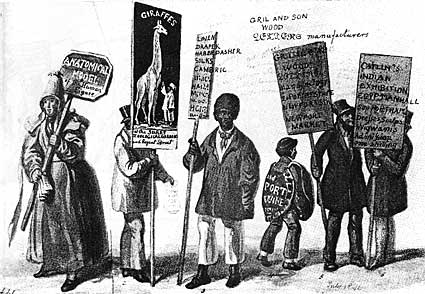
Bill stickers, or external paper hangers plastered blank walls, empty shops and wooden hoards and fences with advertisement bills. But these activities were taxed. And thus enterprising merchants turned to mobile advertising and paid people to wear sandwich boards and hand carry placards. – London Street Advertising

Walking billboards in the 18th century. The young boy is wearing a sandwich board!

Extensive improvements on the printing press meant that newspapers and printed products could be churned out swiftly and more efficiently than before. Bills and posters were printed speedily and cheaply. There were frequent misspelling of words, and if more than one color was used, a frequent misplaced overlay of one color over the other. Printed ads and posters were designed to promote an event or sale, and were meant to be discarded. Bills plastered on walls and fences would soon be covered over by newer announcements.

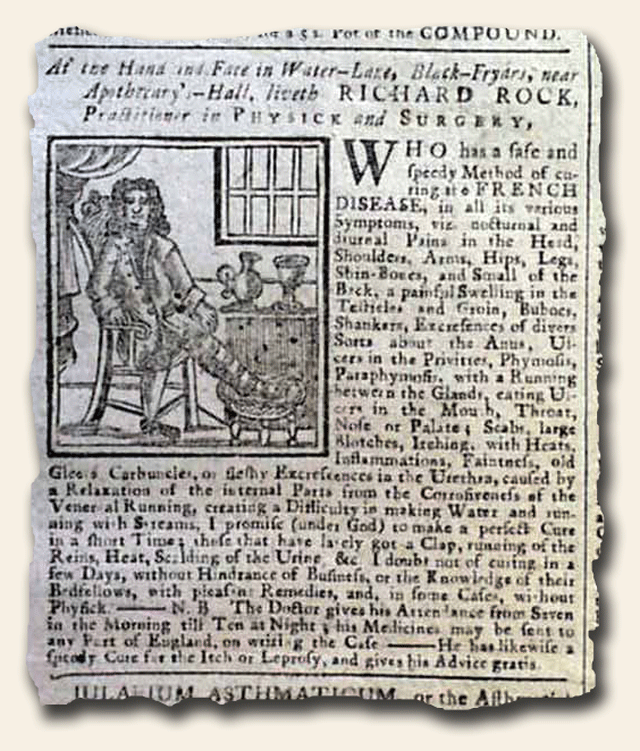
The apothecary's newspaper advertisement mentioned all the diseases he can cure

Newspapers and advertisers focused on products that appealed to a mass market. They generally targeted themselves to the middle and upper-middle classes. By the mid-eighteenth century, the variety of ads began to increase. Ladies’ fashions as well as silver, brass, and copper items became subjects of advertisements.” – Place an Advertisement

Shop bill from the frock shop. Image @The Works of William Hogarth, 1821

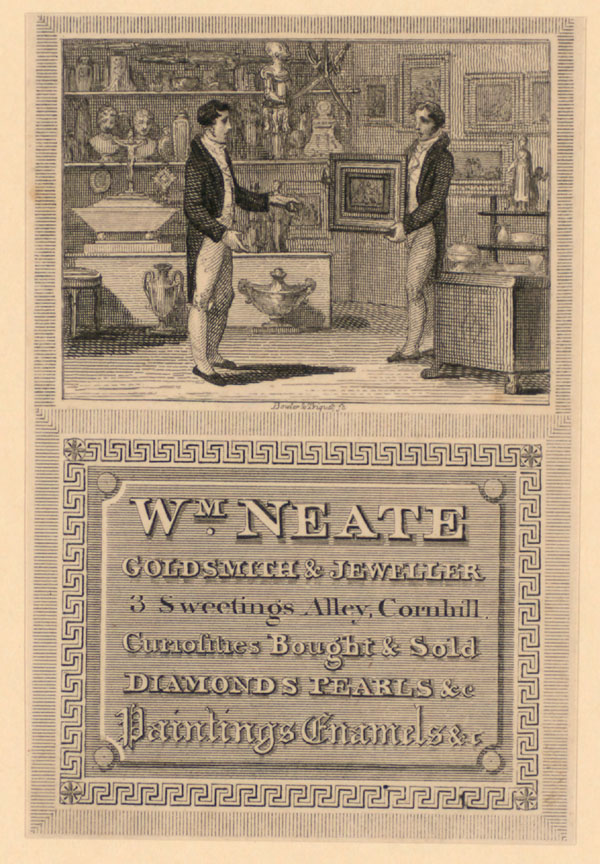
Trade cards were another way that merchants informed the public about their wares. These cards came with a combination of image and text, which provided information about the location, goods and services of an establishment or business. – Eighteenth Century Centre

Wm. Neate goldsmith & jeweller trading card. Image @Bodleian Library

More on the topic:

Read Full Post »

Gentle readers,

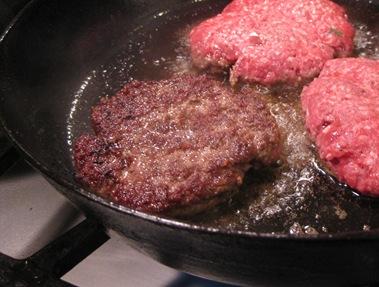
Summer means long, lazy afternoons lounging in the yard or by the pool side, grilling meats like hamburgers, sausages, and hot dogs. The hamburger has had a long tradition.

In 1802, the Oxford English Dictionary defined Hamburg steak as salt beef. It had little resemblance to the hamburger we know today. It was a hard slab of salted minced beef, often slightly smoked, mixed with onions and breadcrumbs. The emphasis was more on durability than taste. “ – Hamburger History 

Sailors from Hamburg, Germany, crossed the Baltic Sea regularly and returned with a taste for the minced raw beef dishes served up in Russian ports. The German haus-frau’s interpretation of these Baltic dishes was to fry or broil the patties. And voila! The Hamburg steak was born. By the late 1700’s the British knew them as Hamburg sausages.

Enter Hannah Glasse and her famous Art of Cookery book, which featured a recipe for Hamburgh sausage.

Hannah Glasse's recipe for Common Sausages

“By the mid-18th century, German immigrants also begin arriving in England. One recipe, titled “Hamburgh Sausage,” appeared in Hannah Glasse’s 1758 English cookbook called The Art of Cookery Made Plain and Easy. It consisted of chopped beef, suet, and spices. The author recommended that this sausage be served with toasted bread. Hannah Glasse’s cookbook was also very popular in Colonial America, although it was not published in the United States until 1805. This American edition also contained the “Hamburgh Sausage” recipe with slight revisions.” – History and Legends of Hamburger 

By 1834, the menu of Delmonico’s in New York City advertised a Hamburger steak. And the rest, as they say, is history. Today the humble hamburger is popular the world over due to the marketing genius (or avarice?) of McDonald’s and other fast food chains.

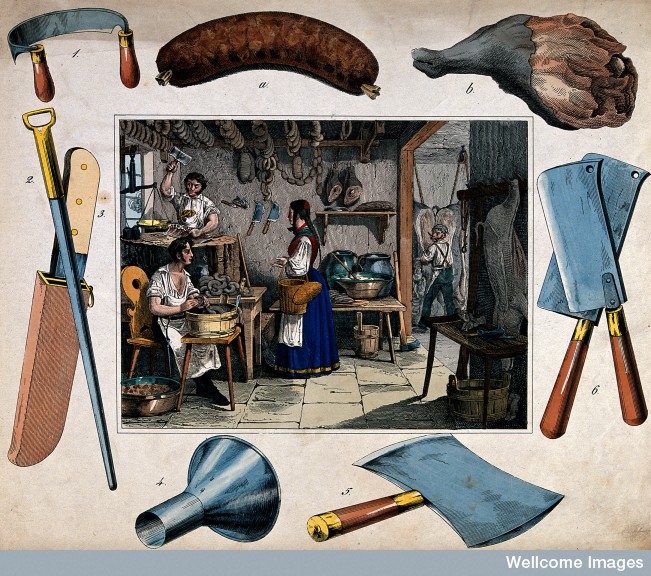
18th c. Sausage shop. Image © Wellcome Trust

Image description: Two men are working with knives and cleavers as another makes sausages, a woman has come to buy and is holding some money in her hand. Coloured etching. A pork-butcher’s shop: two butchers are working with knives and cleavers as another makes sausages, a woman has come to buy and is holding some money in her hand. Coloured etching, 18-. 19th c.” – Wellcome Trust

More on the topic:

Read Full Post »

Vendors set up their carts and booths hours before execution time, doing a roaring trade selling food, drink, souvenirs, even pornographic material, to a frenzied crowd. Minstrels and jugglers entertained the crowd. With the advent of cheap printing in the 16th and 17th centuries, touts created lurid “broadsheets” detailing the supposed history and scandalous crimes of the victim, the precursors to modern day tabloids. These “broadsheets” sold like hotcakes to an excited audience. – The History of Executions in Olde London Towne– Roy Stevenson

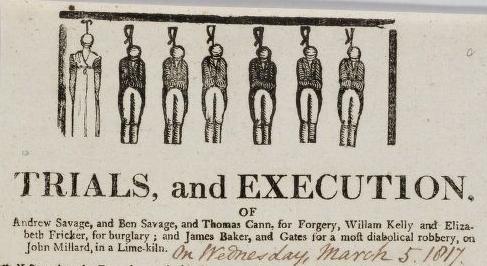
Detail of an execution broadside purchased March 5, 1817. Image @Harvard Law School Library


Life was cheap in Georgian England as this 1817 broadside attests. Five criminals were executed in March 1817 for forgery, burglary, and robbery. Poor Elizabeth Fricker protested her innocence, but to no avail.  Executions were public events, even during Jane Austen’s day, and one wonders if she ever saw a body left to rot on a gibbet, or if she cautiously avoided such sights and averted her eyes.  In any event, crowds would gather early at the execution spot to witness the hanging. They came in droves especially if the execution was of a notorious person.

Vendors set up stalls, selling drinks and refreshments to the large crowd, which, as the Hogarth illustration shows, were stacked on top of each other. The atmosphere must have been festive and somber at the same time, for even though there were jugglers and entertainers to amuse the crowd, a certain “execution” protocol was followed. Criminals were expected to speak to the crowd and to die well.

Broadsides, which were purchased for a pittance (in this instance a penny) described the crimes in detail, and were purchased much like programs to sporting events are purchased today.  Read the entire broadside here. This particular broadside was printed by J. Pitts of Seven Dials. Like other broadsides, it featured an illustration of the execution. Someone (the purchaser?) carefully penned in the date below the image.

Hogarth, 1747. Image @Wikimedia

Persistent Link to the Broadside:
http://nrs.harvard.edu/urn-3:HLS.Libr:1087957
Description:
Executions of criminals: more generally known by the uninviting name of “Dying speeches.”. Execution broadside (Andrew Savage, Ben Savage, Thomas Cann, William Kelly, Elizabeth Fricker, James Baker, James Gates)
Page:
(seq. 11)
Repository:
Harvard Law School Library
Institution:
Harvard University
Accessed:
09 June 2011

Other related links:

Read Full Post »

« Newer Posts - Older Posts »