Feeds:
Posts
Comments

Archive for the ‘Regency World’ Category

Beauty and Cosmetics 1550-1950 by Sarah Jane Downing was published this month by Shire Library.  Small and compact, as Shire publications tend to be, this wonderfully illustrated book describes the standards of beauty popular in each era, from 1550 when alabaster brows were highly prized, to the black eyebrows that were favored by 18th century women.  As with her best-selling Fashion in the Time of Jane Austen, Ms. Downing provides the reader with a comprehensive overview of the topic. She begins with the Tudor Court and ends with the delightful cosmetic advertisements of the first half of the 20th century.

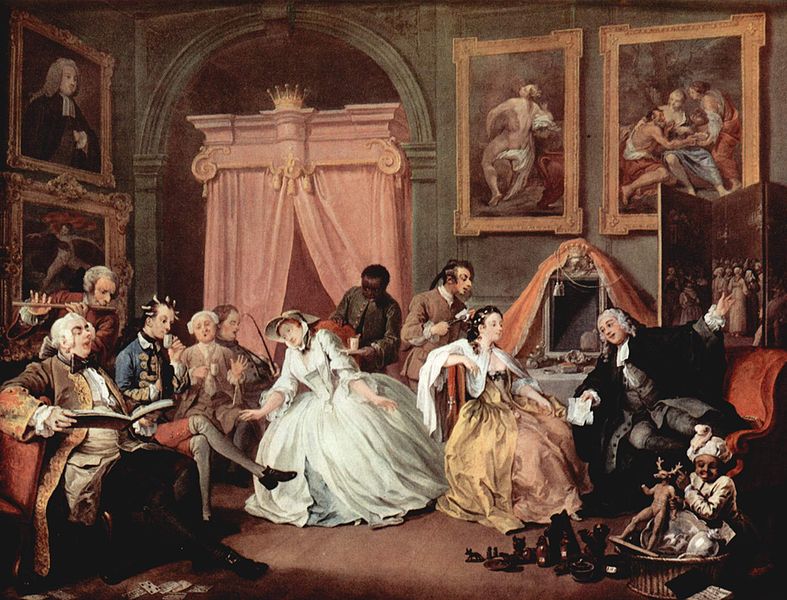
Marriage à-la-mode: The Countess's Morning Levee, William Hogarth, c. 1745

Because my blog’s theme centers on the Georgian and Regency eras, I will confine much of my recap to those years.

A woman applying beauty patches, Boucher

Mirrors, once only possessed by the rich, became so popular in London in the mid-16th century that British manufacturers petitioned Parliament to ban foreign imports. The ritual of the dressing table became quite elaborate and ladies began to entertain guests as they prepared themselves for the day.

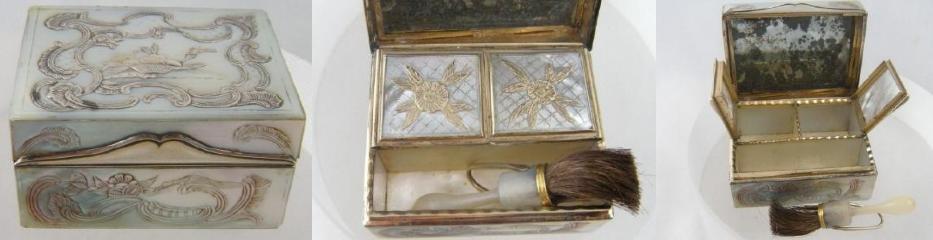
French mop gold boite a mouche patch box with brush, 1730. Images @ Etsy

Decorative patches covered skin blemishes and blotches, sometimes to such an extent that a face could be covered with a variety of dots, half-moon crescents, stars and even a coach and horses! The popularity of using patches began in the mid-17th century and did not wane until the end of the 18th century.

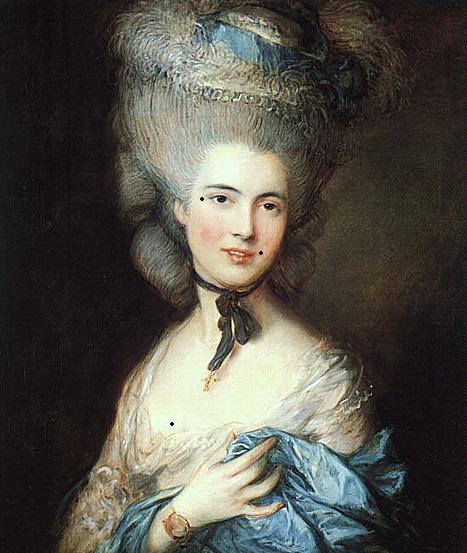
Woman with patches, pale skin and rouged cheeks. Thomas Gainsborough

Porcelain skin was highly prized and created with white lead-based skin cream. Blush was then applied to create a doll-like look. Cosmetics were created in a variety of ways. Here are the ingredients for one recipe for lead face powder that did not come from this book: several thin plates of lead, a big pot of vinegar, a bed of horse manure, water, perfume & tinting agent. Once can only guess how this concoction was put together and at its smell.

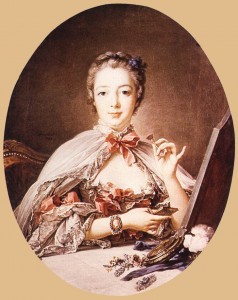
Marquise the Pompadour applying face powder with a brush. Boucher, 1758.

Ms. Downing describes in her book:

lead sheets were unrolled and beaten with battledores until all the flakes of white lead came off. These were gathered and ground into a very fine powder… p. 24

Gainsboroughs portrait of Grace Dalrymple Elliot in 1782 shows the craze for dark eyebrows.

For a while during the third quarter of the 18th century, dark eyebrows became all the rage. Lead-based cosmetics, used over time, caused hair-loss at the forehead and over the brows, resulting in a receding hair-line and a bare brow. For those who lost their eyebrows, it became the custom as early as 1703  to trap mice and use their fur for artificial eyebrows. Sadly, the glue did not always adhere well, and a lady could be caught with her brows out of kilter. This hilarious poem was written by Matthew Prior in 1718:

On little things, as sages write,

Depends our human joy or sorrow;

If we don’t catch a mouse to-night,

Alas! no eyebrows for to-morrow. – p.28

Aging beauties staved off the ravages of time with sponge fillers and rouge (sound familiar?), while many women risked poisonous side effects from using their deadly cosmetics. Maria, one of the Gunning sisters who went on to become Lady Coventry, was so addicted to her lead-based paints that she died in 1760 at the age of 27 knowing full well that she was at risk.

Maria, Countess of Coventry

The French Revolution swept away the widespread use of makeup, which was associated with the aristocracy. Defiantly, some aristocratic ladies went to their doom wearing a  full complement of make-up: pale skin, patches, rouged cheeks and rosy lips.

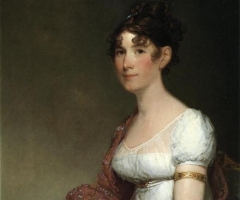
The more natural look of the regency woman. Note that the cheeks are still rouged.

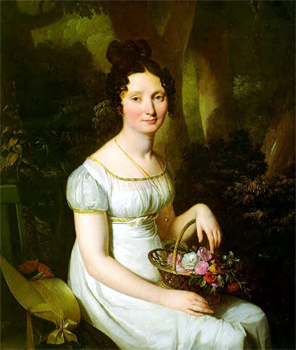
Rousseau influenced the concept of nature and a more natural Romantic look took hold, aided by the blockade of cosmetics during the Napoleonic Wars. The death of many soldiers resulted in widespread melancholia and the affectation of a consumptive look. Ladies, nevertheless, were never far from their rouge pot.

Another Regency portrait with subtle makeup. The flower basket adds to the natural look.

As with all Shire books, Sarah Jane Downing’s trip through time provides us with brilliant insights, in this instance it is via cosmetics and how society viewed beauty in each era. By the 1950s, the success of a marriage was defined by how well a woman took care of herself. This included makeup. Beauty, as Ms. Downing wrote, “was switched from a pleasure to an obligation.”  Oh, my. I give the delightful Beauty and Cosmetics 1550-1950 four out of five Regency tea cups.


Product Details

Paperback: 64 pages
Publisher: Shire (February 21, 2012)
Language: English
ISBN-10: 0747808392
ISBN-13: 978-0747808398
Product Dimensions: 5.8 x 0.2 x 8.2 inches

More on the topic:

Read Full Post »

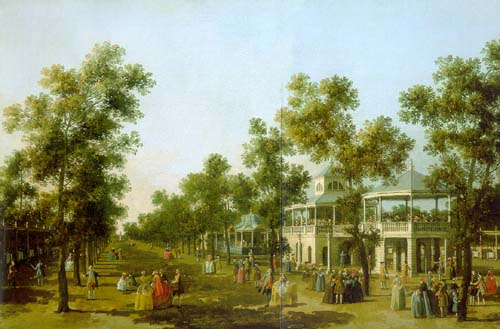
Canaletto's view of Vauxhall Gardens and the Grand Walk

Vauxhall Gardens opened in 1661. The most famous of London’s diarist’s, Samuel Pepys, recorded in his diary that he visited Vauxhall Gardens no less than twenty four times. The first time he recorded a visit to the gardens was on 29th March 1662, when Vauxhall it really was just a country inn set within a pleasant garden setting with walks and flower beds. It was approached from a path from the Thames and the Vauxhall stairs. Visitors would cross the Thames in a boat from the north bank. They generally would bring their own picnics.
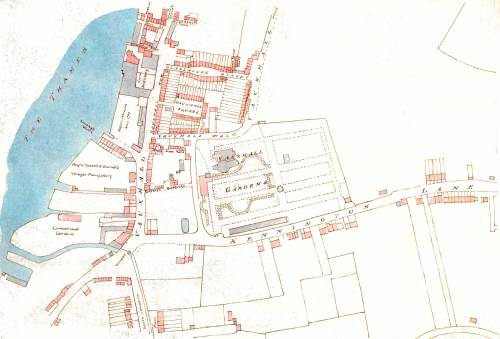
Map of Vauxhall Gardens in 1800. Click on image to enlarge. Image @Ideal Homes: History of South East Suburbs (see link below).

Amateur musicians would perform in the gardens and sometimes the visitors themselves would provide their own entertainment.  This was the first time that ordinary people could enjoy gardens like this, which was a unique social aspect at the time of Pepys. It was a freeing of social codes. Such gardens were usually found in the country estates of the nobility.
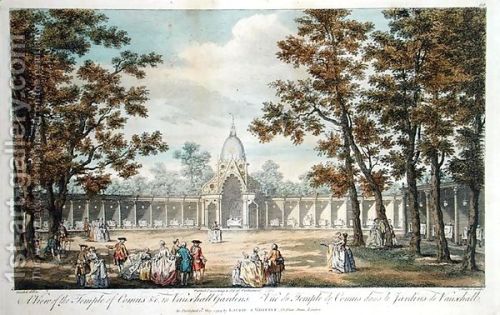
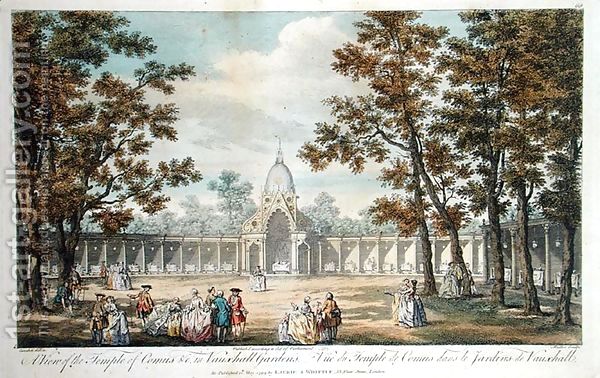
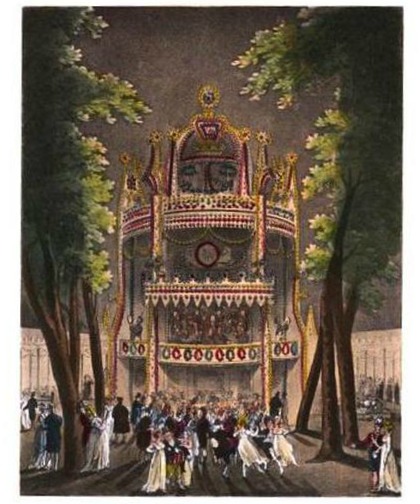
A view of the Temple of Comus at Vauxhall Gardens. Image @1st Gallery.com

People from different levels of society could meet freely and strangers could meet within the gardens. In the usual course of their lives there were strong social codes about friendships and who could talk to whom. The gardens were a place to be free of many social constraints, where males and females could meet. It was also an ideal place for the business of prostitutes.
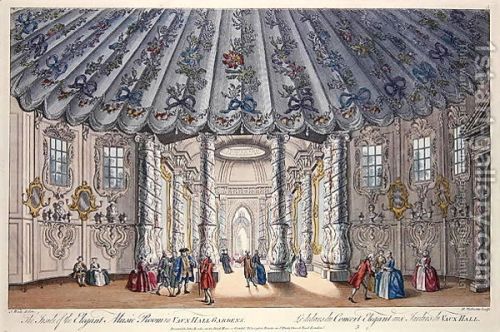
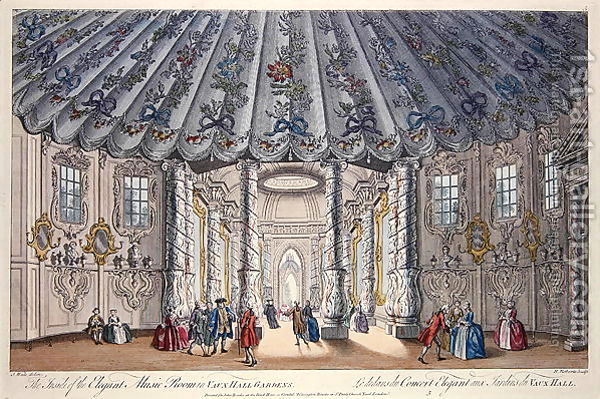
Interior view of the elegant music room at Vauxhall Gardens. Engraving by H. Roberts, 1752. Image @1st Gallery.com

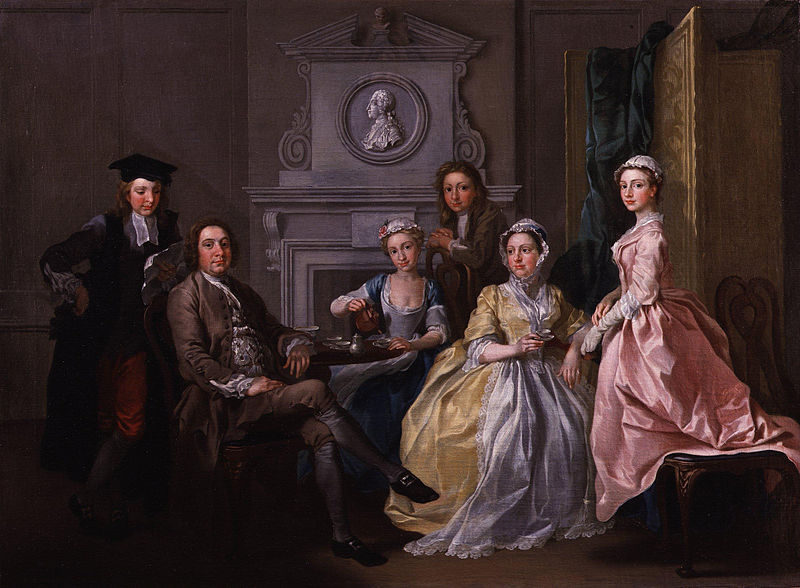
Over the centuries various owners and managers oversaw Vauxhall gardens . The greatest of these was Jonathan Tyers. He came from a family of fellmongers from Bermondsey in the east End. Fellmongers were dealers in leather hides.

Jonathan Tyers and his family by Hayman. Image @Wikimedia Commons

Tyers was a shrewd businessman and understood how to advertise and popularise the gardens. He was also good at reinventing himself as a gentleman, landowner, wit, urbane host, and patron of the arts. He owned the gardens from 1729 to his death in 1767 and saw Vauxhall gardens at the height of its fame and popularity. His most important guest was The Prince of Wales, who had his own booth within the gardens.
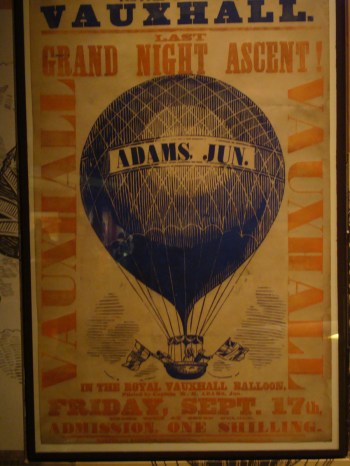
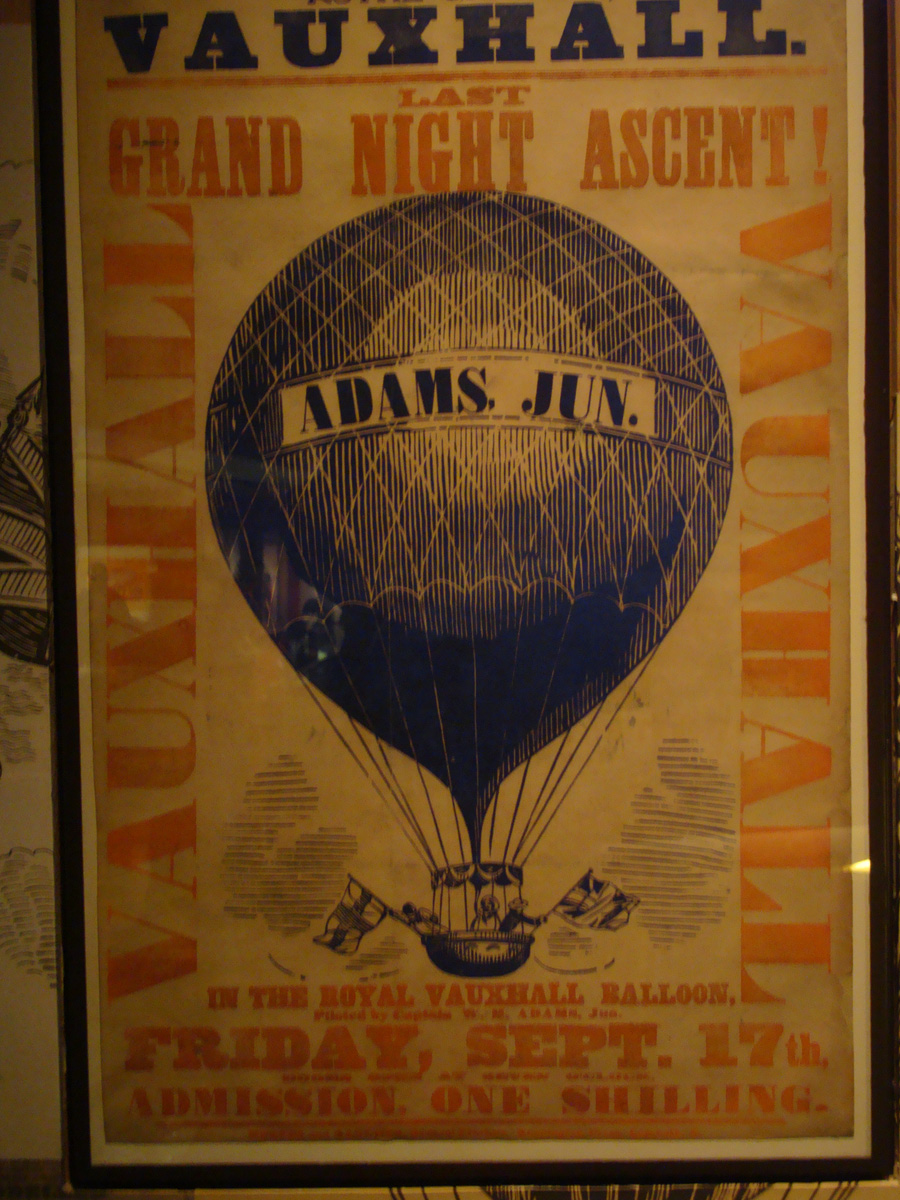
Pleasure gardens poster at The Museum of London. Image @Tony Grant

All of society, from the aristocracy, to landowners, to the ordinary working people came to Vauxhall. For special events Tyeres would raise the price to attract only certain people but generally the price was one shilling and this price remained the same for sixty years. He offered season tickets for a guinea.

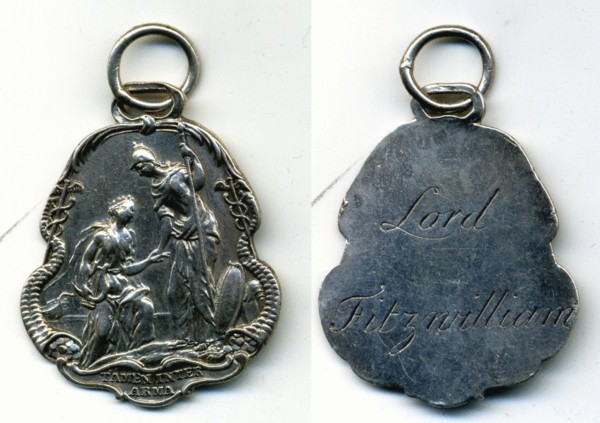
Vauxhall Garden silver pass, c. 1760

The season ticket comprised a metal tag embossed on one side with a scene of classical mythology and the other side was printed with the ticket holders name. There is quite a selection of these season tickets in various collections.
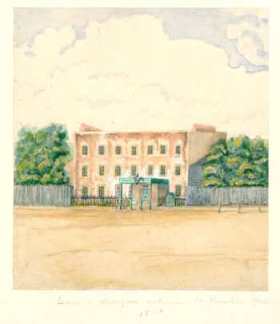
Water gate entrance to Vauxhall Pleasure Gardens

In 1740 a Vauxhall evening would begin at 7pm.The visitors would get into a boat from Westminster and alight at the Vauxhall Stairs on the south bank, very close to where Lambeth Palace, the home of the Archbishop of Canterbury, was located. Visitors would walk through the main entrance which fronted the River Thames and proceed along The Grove with the supper boxes lining the walkway on either side.
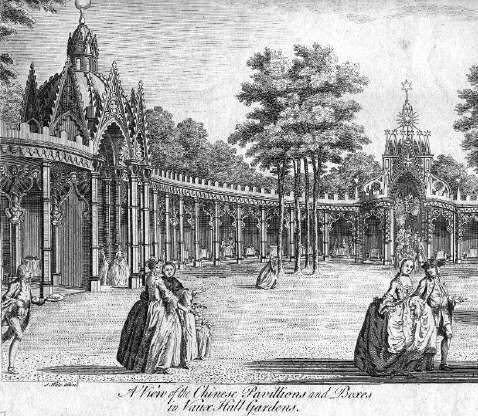
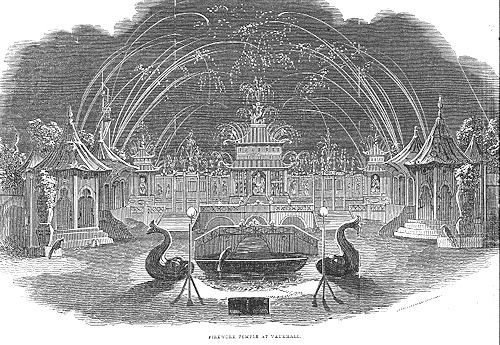
Chinese Pavillions at Vauxhall

In front of the boxes stood the orchestra building.
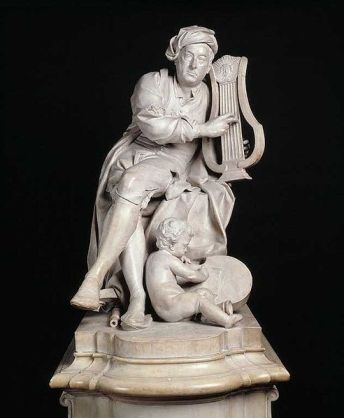
Statue of Handel by Louis-François Roubiliac, 1738. Image @V&A Museum

A statue of the composer Handel could be seen in front of this. The gardens were famous at this time for giving performances of new pieces composed by Handel or other composers well known at the time, such as Arne and Boyce.
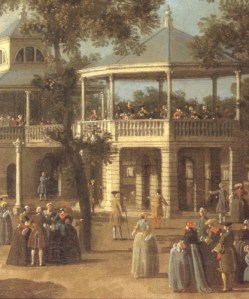
The orchestra at Vauxhall, Canaletto.

Visitors would have the chance to see wealthy people promenading through the gardens wearing the latest expensive fashions.
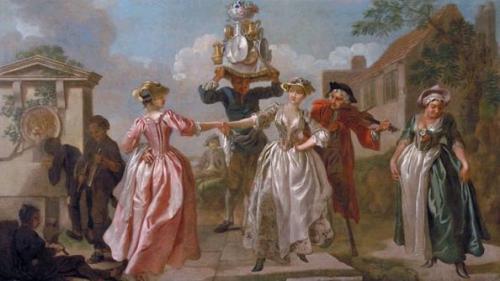
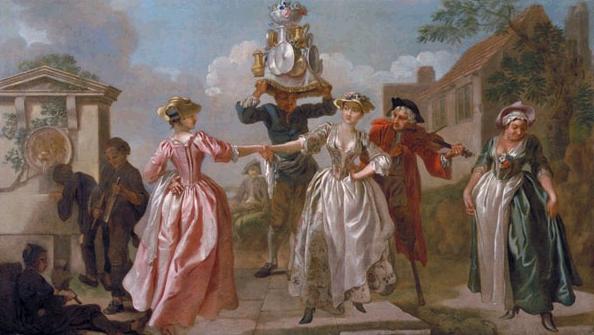
One of the surviving Vauxhall genre paintings. Image @ V&A

The fifty large supper boxes were able to entertain up to ten people to supper. Each box was decorated with an original painting. Surprisingly fourteen of these paintings still survive.
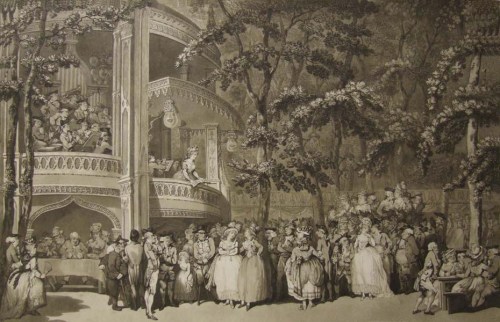
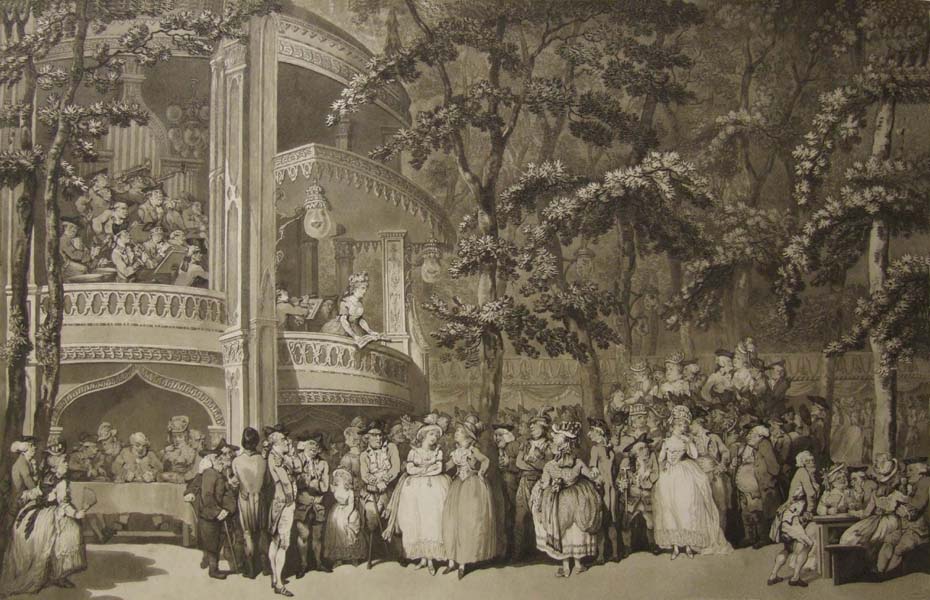
Vauxhall Gardens, Rowlandson

The Grand Walk led to the golden statue of Aurora or the Rural Downs where there was a life size statue of Milton. This reminds me of the 18th century gardens at Painshill in Surrey which have been restored very much to their former glories. At Painshill there are grand vistas, a Turkish tent, mysterious grottos near the lake, a ruined Abbey, a hermits lodging and a Roman temple as well as many large statues from Greek mythology set within groves.
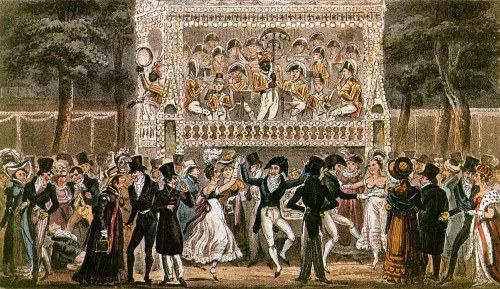
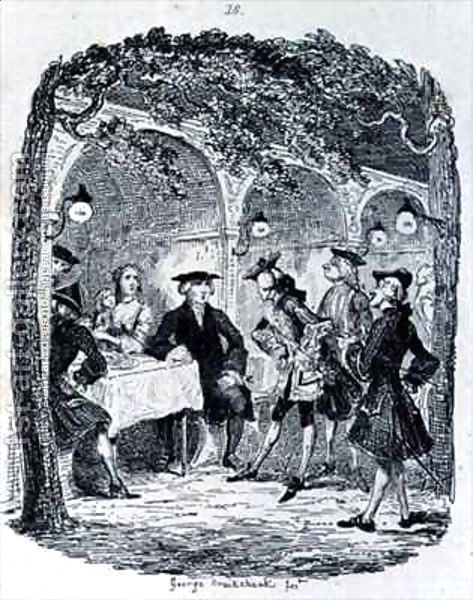
Tom and Jerry at Vauxhall

The Vauxhall experience therefore is still possible to experience. If Vauxhall was intended, as the gardens at Painshill were, then each setting was meant to create a different mood or spiritual experience. There is no record of Jane Austen visiting Vauxhall but she obviously knew about it. She stayed with her brother Henry at Hans Place which is almost directly across the Thames from Vauxhall.
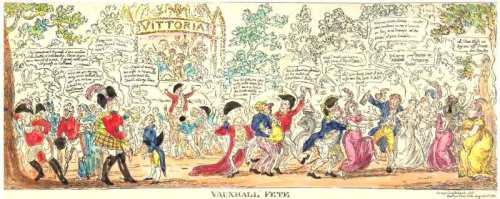
Vauxhall pleasure gardens by Cruikshank, 1813

It is about half a mile from the river bank but the lights, the sounds of the music and fire works exploding would easily have been noticed from miles around. In Mansfield Park the walk in the park at Sotherton owned by Mr Rushworth have echoes of Painshill and Vauxhall.

Night scene in a supper box at Vauxhall

The Vauxhall Supper began about 9pm as dusk fell. It comprised of Vauxhall ham, cold meats, salad, cheeses custards, tarts, cheesecakes and other puddings. As night fell during the supper a whistle was blown. Servants lit thousands of lamps positioned strategically about the gardens and illuminated the scene. The effect was sensational.
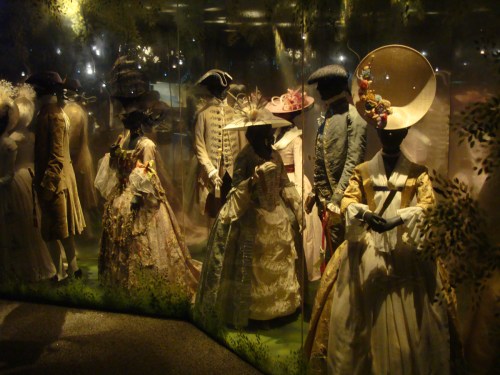
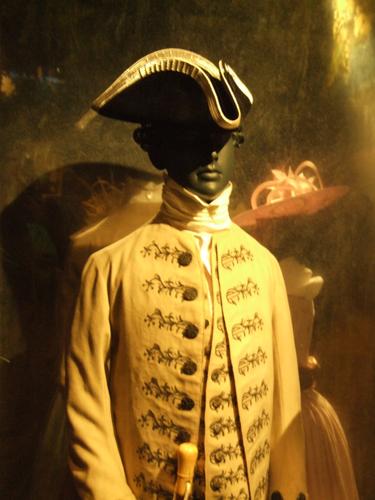
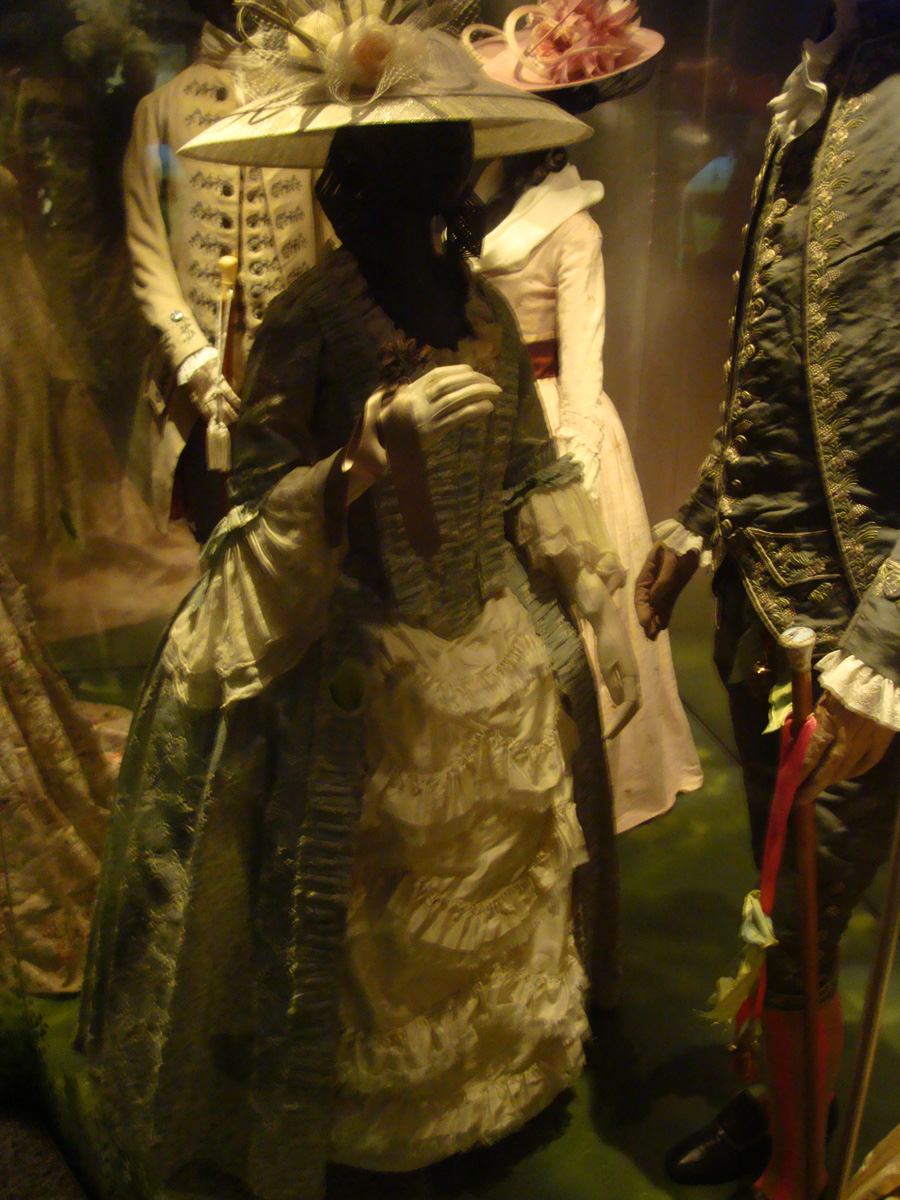
The installation at The Museum of London recreated how the costumes in Vauxhall would look at night. Hats in this exhibit by contemporary milliner Philip Treacy.

By the mid 18th century semi circular piazzas had been opened in the north and south ranges of boxes. Behind the north range of boxes Tyeres had the Rotunda built. This was a covered concert room for wet weather.
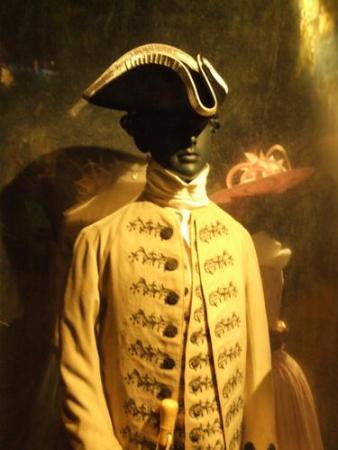
Costumes of the Vauxhall pleasure gardens, installation at The Museum of London

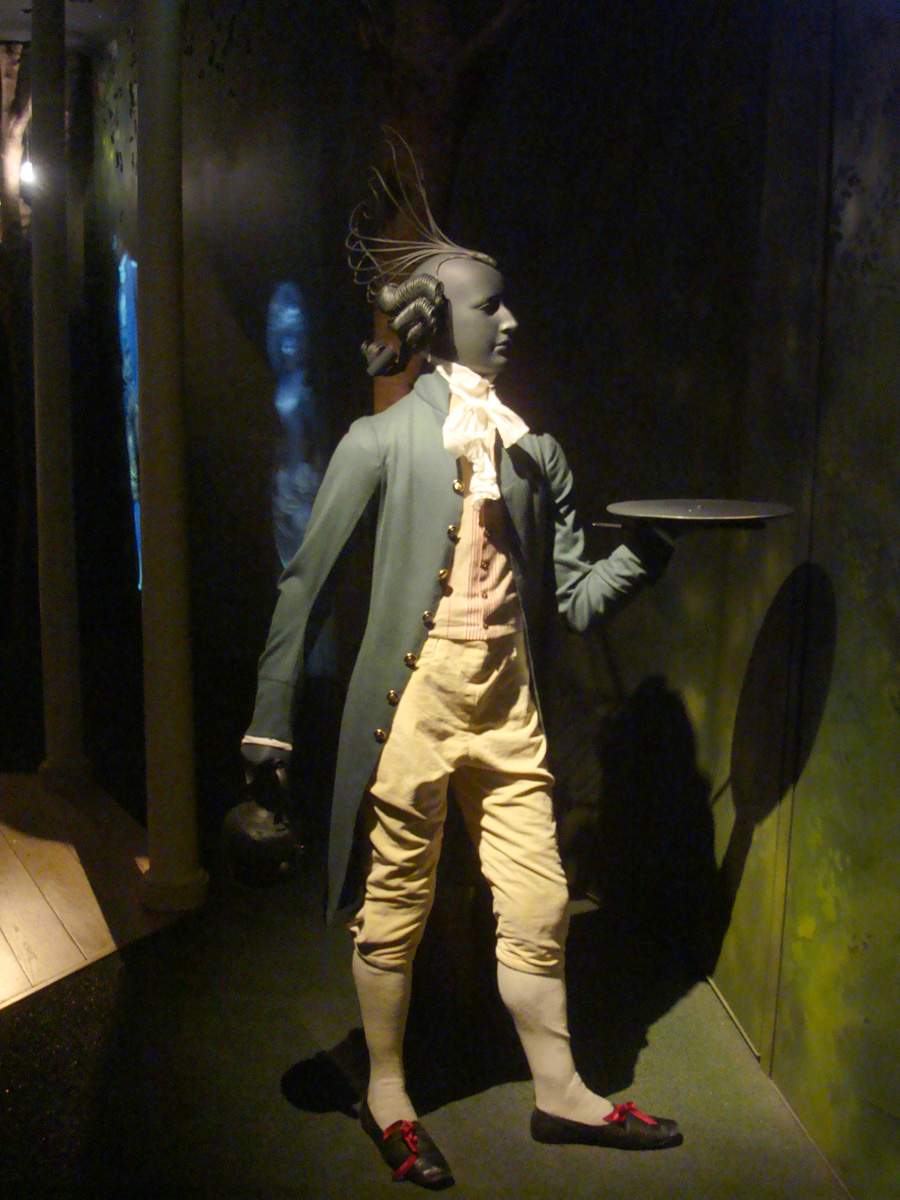
More costumes from the pleasure garden. This man is obviously a waiter.

Female costume. Note how the yellow light (from oil globes or candles) affected the colors of the costumes. Some colors would not show up well. People kept this effect in mind when choosing evening wear. Image @Tony Grant
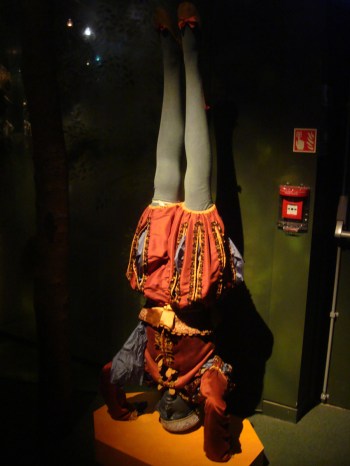
Costume of one of the entertainers. Image @Tony Grant
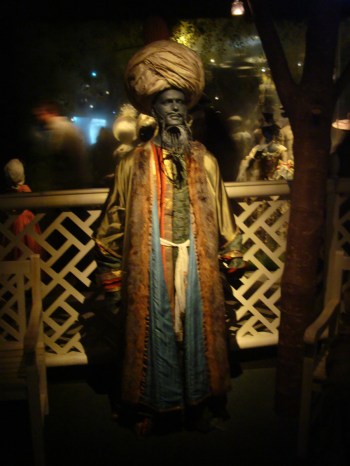
Exotic costume from the exhibit. Image @Tony Grant

Later a Pillared Saloon was added to the eastern side of the Rotunda. Within the Rotunda, Tyers got Francis Hayman to paint four huge canvases showing Britain’s victories in the Seven Years War. Each canvas was 12 feet by 15 feet. Only two oil sketches remain of the originals and an engraving is still in existence. The paintings have disappeared. Jonathan Tyers and Francis Hayman gave British art in the 1760’s its direction.
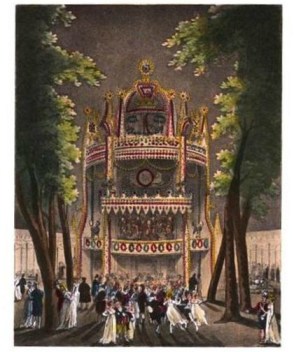
Vauxhall was also famous for its music. Many famous songs, some still known and sung today, were commissioned for the gardens. The most famous of which is, Lass of Richmond Hill. The singers became the superstars of their day, Thomas Lowe, Cecilia Arne, Joseph Vernon and Charles Dignum.
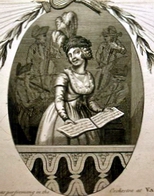
Miss Leary singing at Vauxhall, 1793-4

In 1758 the orchestra building was replaced by a neo gothic structure. The famous architect, Robert Adam, wrote to his brother:

“ I am now scheming another thing, which is a temple of Venus for Vauxhall which Mr Tyers proposes to lay £5000 upon……”

David Coke, author of a recent book on Vauxhall Gardens, wrote that this building was probably never built. Jonathen Tyers died in1767 and his children took over who themselves were followed by their children until 1822.
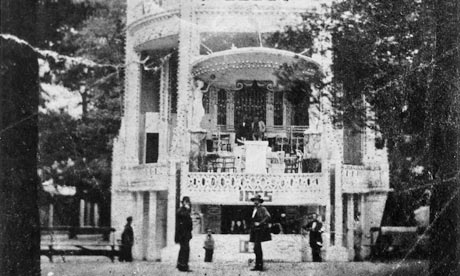
Photograph of Vauxhall in 1859. Image @The Guardian

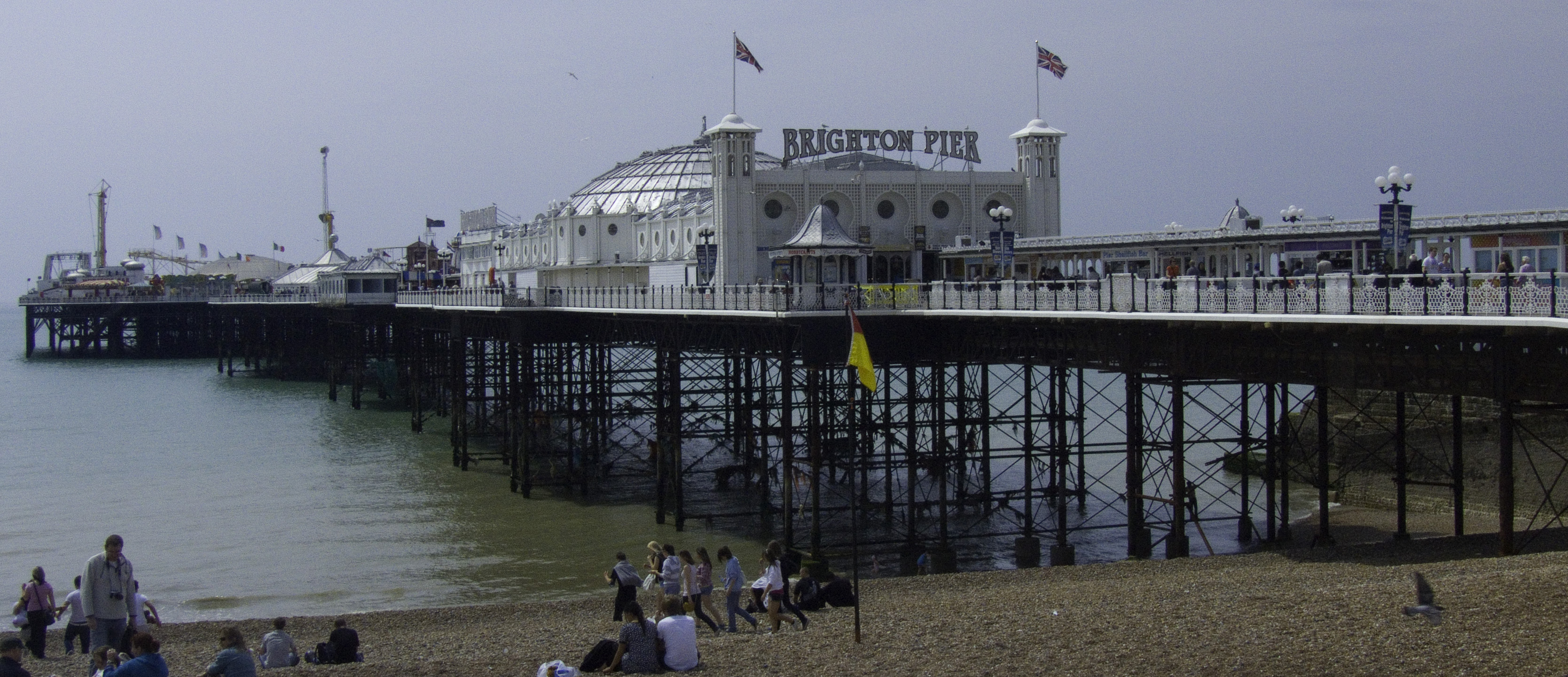
The gardens closed finally closed on 25th July 1859. By this time Vauxhall had become run down and dilapidated. Its popularity had waned. Vauxhall railway station is situated opposite to where the entrance to Vauxhall gardens was. It epitomises the changes that were occurring in the world and society. People were able to travel about the country easily. The ordinary people preferred to go to the seaside and the new entertainments that were provided at these holiday resorts. If you go to Brighton on the south coast in Sussex you can experience the delights of Brighton Pier.

Brighton Pier. Image @Tony Grant

It is a Victorian construction and many of the buildings on it date back to Victorian times. The pier has more than an echo of the Vauxhall Pleasure Gardens. These Victorian piers built at popular resorts have been described as Vauxhall piers.

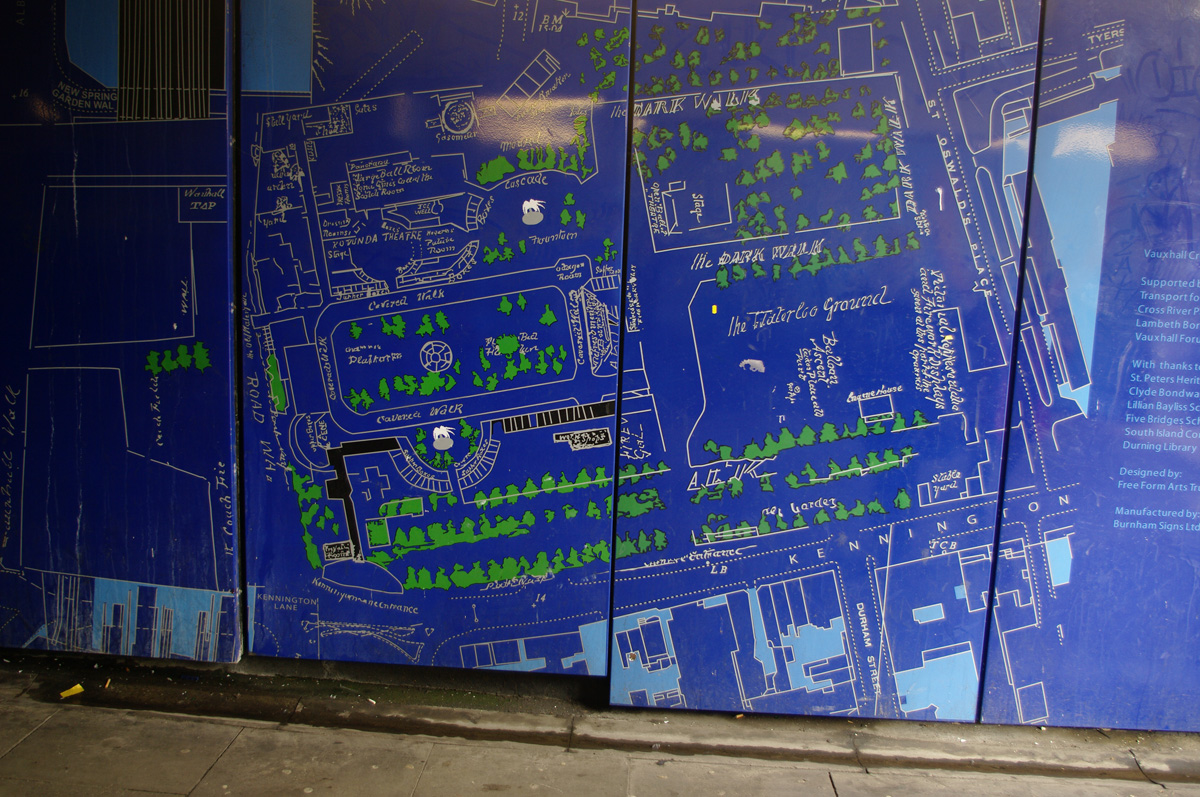
Map in Vauxhall Station showing the pleasure gardens. Image @Tony Grant

Recently I was looking at an old map showing the layout and design of Vauxhall Pleasure Gardens. I could see Kennington Road marked clearly on the map bordering the southern border of where the pleasure gardens had been. It showed the road curving slightly. It struck me that I know that part of Kennington Road well. Vauxhall is part of the London Borough of Lambeth. My wife Marilyn worked for over ten years in schools in Lambeth and often got off the train at Vauxhall and walked to her inner city school in Walnut Tree Walk next to the Lambeth Walk that is of Charley Chaplin and that song, fame. We decided that we would go for a walk around Vauxhall and see if we could find any signs or remains of the pleasure gardens.

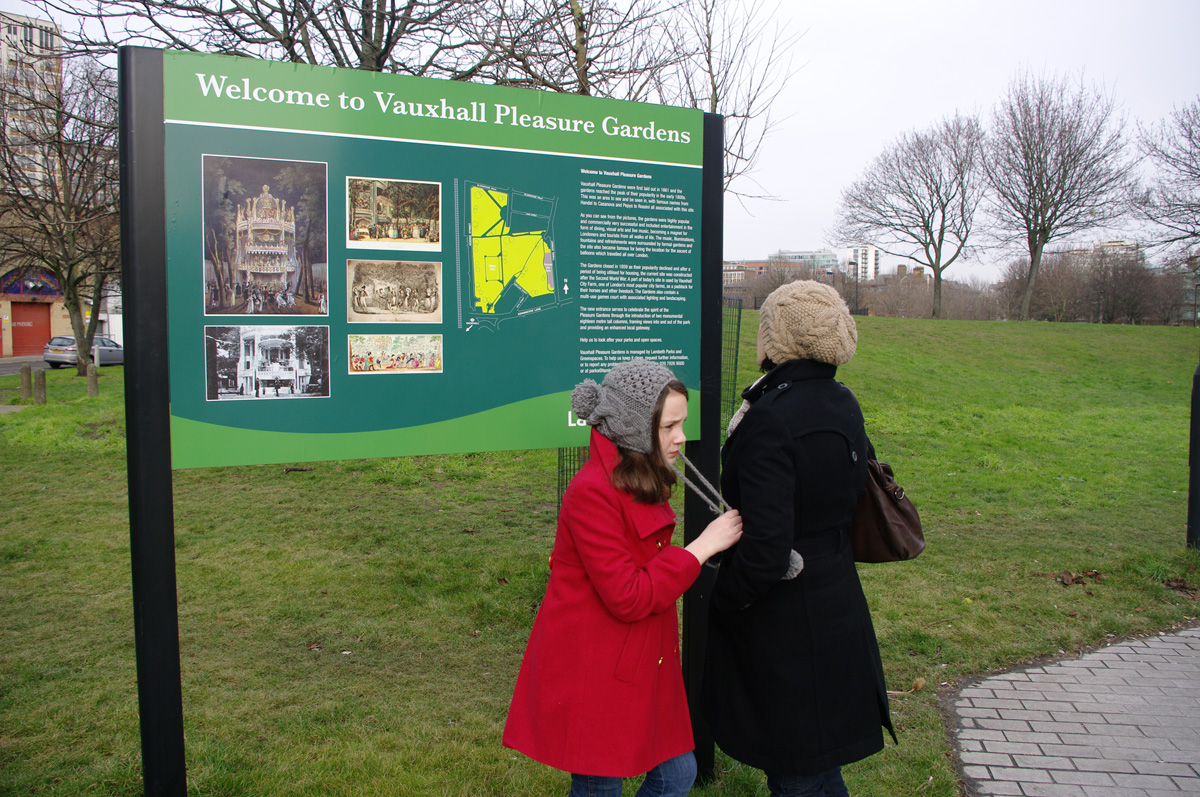
Marilyn and Abi reading the information board in the gardens

Marilyn, myself and Abigail, our youngest daughter, got off the train at Vauxhall and walked across the road to a pub which has its windows blacked out. This pub is now famous for the performance of strippers. This must be reminiscent of the courtesans who sold their bodies in the pleasure gardens of the 18th century perhaps.
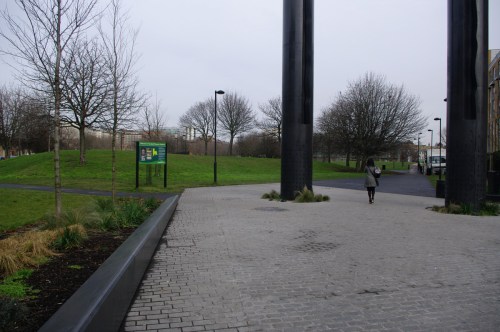
Looking across where the gardens were situated. Image @Tony Grant

Behind the pub is a small park called Spring Park. This area was covered in Victorian terraced housing up to the second World War and then during the Blitz on London many were destroyed. After the war, to commemorate the old pleasure gardens, Lambeth Council decided to make the area into a park again. This was the site of the original pleasure gardens. We had found it. To one side you can see the green glass and concrete structure that is MI6.The entrance to the park announces that this is Vauxhall Pleasure Gardens, although it is officially called Spring Gardens. When I researched the old gardens I discovered that indeed it used to called Vauxhall Spring Gardens when it first began. There is a large sign board as you walk into Spring Gardens which provides a display of old pictures of the gardens and a history of the site.
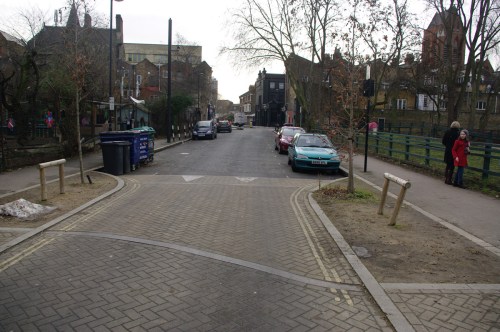
Tyers Road along the top of the present Spring Gardens

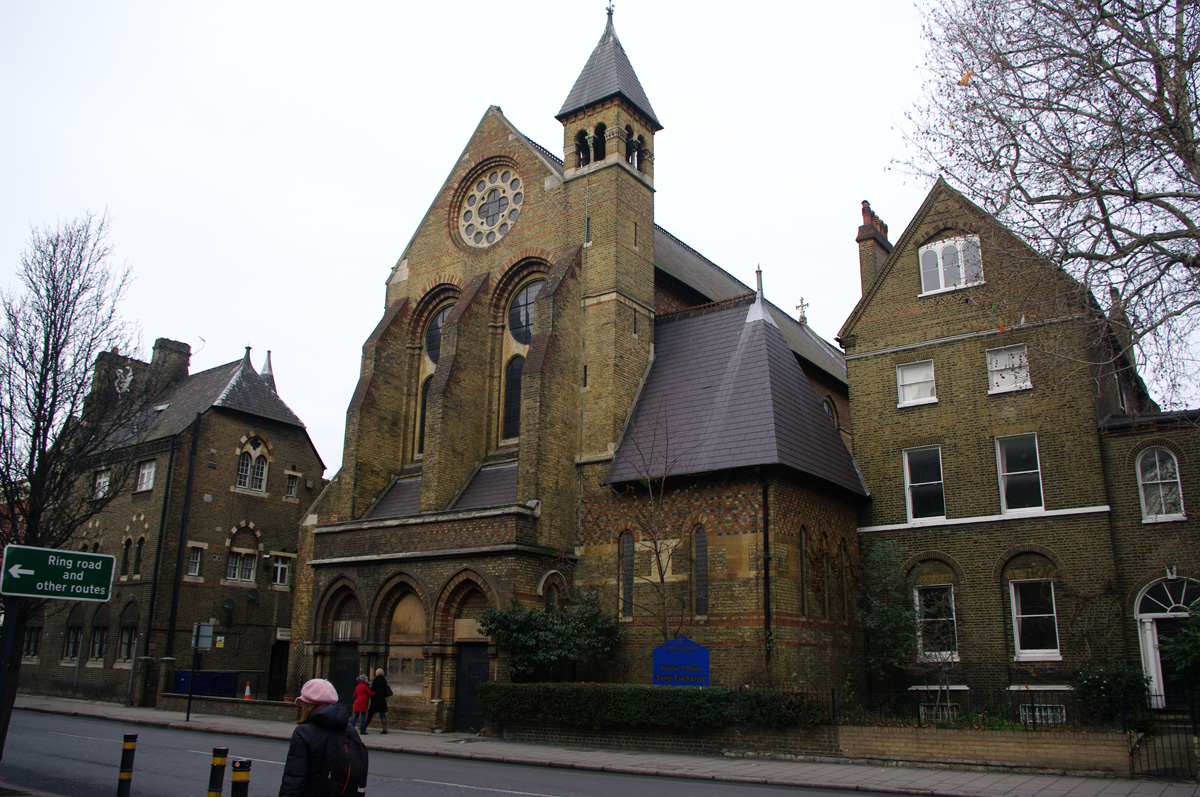
To the north of the park is Tyers Road commemorating Jonathen Tyers. There is a city farm called Vauxhall City farm on the site where the battle of Waterloo was re-enacted. In the far right eastern corner there is situated St Peter’s Church, which is reputedly on the very site of the Neptune Fountain that was placed at the end of The Grand Walk.

St. Peter's Church, Kennington Lane, on the site of the Neptune Fountain at the end of the Grand Walk. Image@Tony Grant

There are no remains of the actual pleasure gardens to be seen in the new park. Because it is an open area with walkways and grassy mounds within the park you can get a sense of the size and feel of the original pleasure gardens.
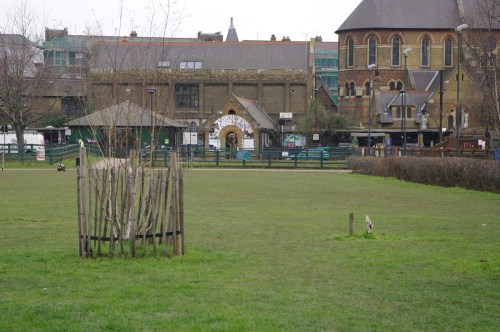
Vauxhall city farm; the site of the Waterloo grounds

Here are some quotations from people who visited the gardens at different times during its existence.

An article in The Spectator 1712:

We were now arrived at Spring-Garden, which is exquisitely pleasant at this time of the Year. When I considered the Fragrancy of the Walks and Bowers, with the Choirs of Birds that sung upon the Trees, and the loose Tribe of People that walked under their Shades, I could not but look upon the Place as a kind of Mahometan Paradise. Sir Roger told me it put him in mind of a little Coppice by his House in the Country, which his Chaplain used to call an Aviary of Nightingales.

Fireworks Vauxhall Gardens, 1800

A letter to a Lord describing the Spring gardens in 1751:

These Gardens, containing about twenty Acres and a Half, make part of a Mannor, belonging to His Royal Highness the PRINCE OF WALES, as Earl of Kennington; the famous black Prince, son to our immortal Edward III, having anciently had a Palace there. —But leaving Antiquity, I shall proceed to the present State of the Spot, which is the Subject of your Lordship’s obliging Command; after observing, that the Hint of this rational and elegant Entertainment, was given by a Gentleman, whose Paintings exhibit the most useful Lessons of Morality, blended with the happiest Strokes of Humour.
Being advanc’d up the Avenue, by which we enter into the Spring-Gardens; the first Scene that catches the Eye, is a grand Visto or Alley about 900 Feet long, formed by exceedingly lofty Sycamore, Elm, and other Trees. At the Extremity of this Visto, stands a gilded Statue of Aurora, with a Ha ha; over which is a View into the adjacent Meads; where Haycocks, and Haymakers sporting, during the mowing Season, add a Beauty to the Landskip. This Alley (a noble Gravel Walk throughout) is intersected, at right Angles, by two others. One of these Alleys (at the Extremity whereof, to the Left, a [p.3] fine Picture of Ruins is seen) extends about 600 Feet; being the whole Breadth of the Garden, or Spring-Gardens, as they are commonly called, which Terms I shall use indiscriminately.
These are the thoughts of a German Prince in 1827:

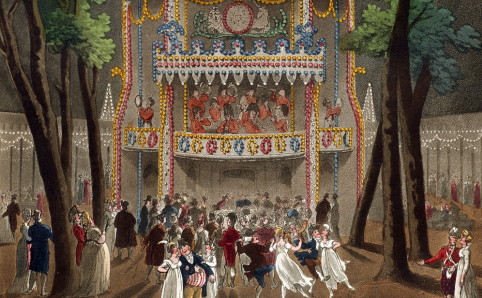
Yesterday evening I went for the first time to Vauxhall, a public garden in the style of Tivoli at Paris, but on a far grander and more brilliant scale. The illumination with thousands of lamps of the most dazzling[157] colours is uncommonly splendid. Especially beautiful were large bouquets of flowers hung in the trees, formed of red, blue, yellow, and violet lamps, and the leaves and stalks of green; there were also chandeliers of a gay Turkish sort of pattern of various hues, and a temple for the music, surmounted with the royal arms and crest. Several triumphal arches were not of wood, but of cast-iron, of light transparent patterns, infinitely more elegant, and quite as rich as the former. Beyond this the gardens extended with all their variety and their exhibitions, the most remarkable of which was the battle of Waterloo.
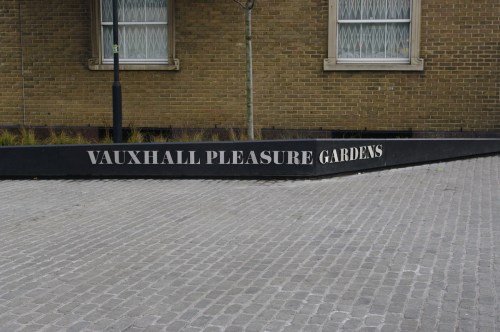
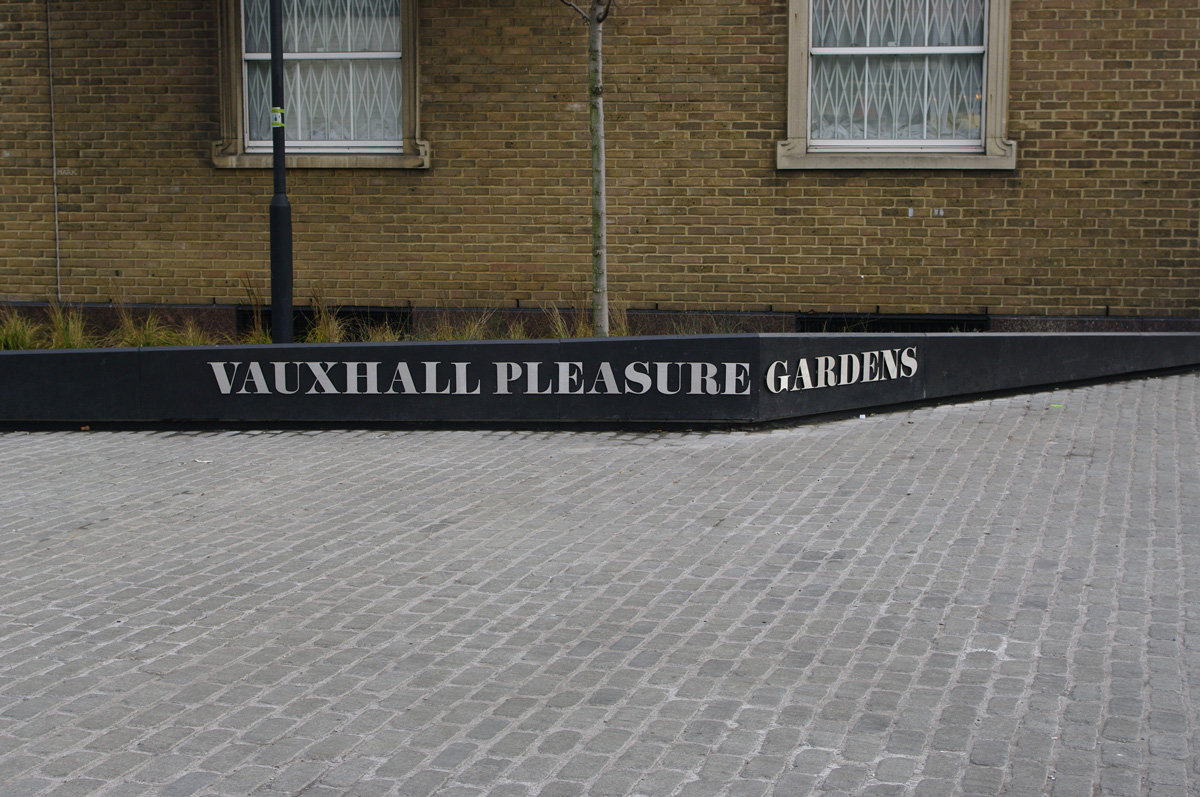
Vauxhall Pleasure Gardens entrance today. Image @Tony Grant

Here is part of a satirical poem written for the PUNCH magazine in 1859 and depicts the decline of the gardens before they were finally closed:

Comrades, you may leave me sitting in the mouldy arbour here,
With the chicken-bones before me and the empty punch-bowl near.
‘Rack’ they called the punch that in it fiercely fumed, and freely flowed:
By the pains that rack my temples, sure the name was well bestowed.
Leave me comrades, to my musings, ‘mid the mildewed timber-damps,
While from sooty branches round me splutter out the stinking lamps.
While through rent and rotten canvas sighs the bone-mill laden breeze;
And the drip-damp statues glimmer through the gaunt and ghastly trees.

And the ode goes on and on. It has become a depressing place.

Vauxhall Park looking towards the Thames. Image @Tony Grant

Written by Tony Grant, London Calling

More on the topic:

Read Full Post »

One can imagine that during her final illness, Jane Austen was no stranger to leeches. This method of bloodletting was so common in Great Britain (Wales especially) and France that by the 1830’s Hirudo medicinal leeches (common in Europe) were hard to find and had to be imported or home grown .

Leech finders, 1814. George Havell, Costumes of Yorkshire.

Gathering leeches was a traditional female occupation, although there are always exceptions to the rule. Take this passage about leech-fishers in France from the Gazette des Hopitaux:

Man leech fishing in a marsh in Bretagne. 1857. Image @Shutter Stock

If ever you pass through La Brenne, you will see a man, pale and straight-haired with a woollen cap on his head, and his legs and arms naked; he walks along the borders of a marsh, among the spots left dry by the surrounding waters. This man is a leech- fisher. To see him from a distance,—his wo-begone aspect, his hollow eyes, his livid lips, his singular gestures,—you would take him for a maniac. If you observe him every now and then raising his legs and examining them one after another, you might suppose him a fool ; but he is an intelligent leech-fisher. The leeches attach themselves to his legs and feet as he moves among their haunts; he feels their bite, and gathers them as they cluster about the roots of the bulrushes and aquatic weeds, or beneath the stones covered with a green and slimy moss. He may thus collect, ten or twelve dozen in three or four hours. In summer, when the leeches retire into deep water, the fishers move about upon rafts made of twigs and rushes.”  – Excerpt taken from Curiosities of Medical Experience (1838) by John Gideon Millingen, via The Condenser: Hunting Down Good Bits

Despite the many strides that were made in medicine regarding human anatomy and diseases, the knowledge about treatments lagged behind. Lack of anesthetics made surgery an excruciating experience, and there were no antibiotics. Useful plants, such as digitalis, were discovered more by luck than by science. Bloodletting or ‘breathing a vein’ was one way in which a patient could be treated by a physician who had few options. Applying leeches often resulted  in a severe loss of blood, which was more detrimental to the patient’s condition than not. A human with a poor immune response could suffer from wound infections, diarrhea and septicemia, all influenced by the bacterium, Aeromonas veronii, carried in the leeche’s gut.

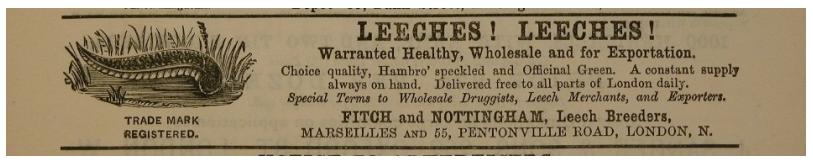
19th century leech advertisement

Regardless of adverse consequences, bloodletting has been practiced for at least 2,500 years. The earliest instruments, or lancets, were sharpened pieces of wood or stone, but it is leeches that I want to write about. (I am more repulsed by their sight than a snake’s, and had a hard time searching for an image that did not make me gag.)  The ancient Greeks believed in the humoral theory, which proposed that when the four humors, blood, phlegm, black and yellow bile in the human body were in balance, good health was guaranteed. An unbalance in these four humors led to ill health. Fast forward to the middle ages, when superstition and religion gave weight to the art of bleeding. If you recall, the earliest surgeons were barbers as well. Their leeches cured anything from headaches to gout!

Bloodletting with leeches is an ancient tradition

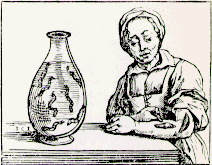
Leeches are commonly affixed by inverting a wine-glass containing as many as may be required, upon the part affected. The great disadvantage of this practice is, that some of them frequently retire to the upper part of the glass and remain at rest, defying all attempts to dislodge them, without incurring the risk of removing those that may have fastened.” – James Rawlins Johnson, A Treatise on the Medicinal Leech

Francois Broussais proposed in  his Histoire des phlegmasies ou inflammations chroniques (1808) that all disease resulted from excess build up of blood. The alleviation of this condition required heavy leeching and starvation. Leeches subsequently became the most prevalent way of treating a patient, especially in France, where tens of million of leeches were used per year, resulting in a drastic leech shortage. The British were equally enamored with this form of therapy. It is conjectured that Princess Charlotte’s death in childbirth in 1817 was exacerbated by her physician, who prescribed a rigorous course of blood letting and starvation diet during her pregnancy, weakening her before her agonizing 50+ hours of labor. (Read my article on this topic.)

In 1833, bloodletting became so popular in Europe, that the commercial trade in leeches became a major industry. France, suffering a deficiency, had to import 41.5 million leeches. The medicinal leech almost became extinct in Europe due to the extremely high demand for them. Leeches were collected in a particularly creepy way. Leech collectors would wade in leech infested waters allowing the leeches to attach themselves to the collector’s legs. In this way as many as 2,500 leeches could be gathered per day. When the numbers became insufficient, the French and Germans started the practice of leech farming. Elderly horses were used as leech feed where they would be sent into the water and would later die of blood loss. – Maggots and Leeches Make a Comeback

Oh, how I pity those elderly horses!


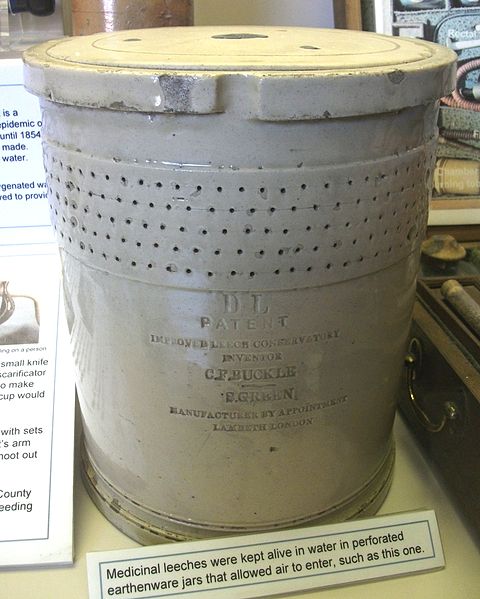
Large leech collector jar.

Intestinal tract of the hirudo leech

Leeches are quite extraordinary in that they have 31 brains and can gorge themselves up to five times their body weight before falling off their host. Afterward they require no feeding for another 6 months. There are over 650 known species of leeches, not all of which are bloodsuckers (some eat earthworms, for example). Placing leeches onto a patient (making sure the frontal sucker with teeth was directed to the skin) is relatively pain free, for their bite releases an anaesthetic. During feeding they secrete compounds, such as a vasodilator that dilates blood vessels and anticoagulant that prevents the blood from clotting. The worms are hermaphrodites, functioning as both the male and female sex. Even after being frozen, leeches can be coaxed back to life!  Needless to say, these creatures must provide an endless source of interest to scientists.

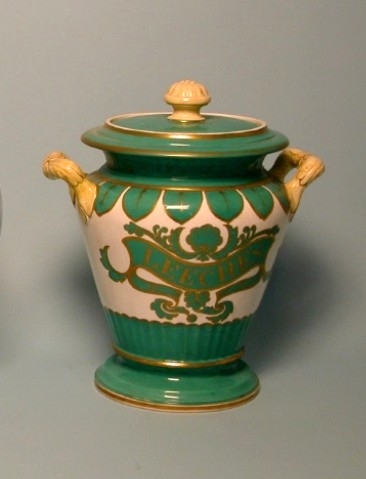
Early 19th century rare cobalt blue transportable leech jar. These were mostly made of clear glass. Cloth covered the everted lip to prevent escapees.

People (meaning mostly women) stood in fresh water marshes, lakes, pools, and the edges of river banks, and allowed the leeches to attach to their legs. (I shudder as I type this.) Once the leeches were gathered, they were placed in a basket, ceramic pot with breathing holes, or a reservoir.

One of these traders was known to collect, with the aid of his children, seventeen thousand five hundred leeches in the course of a few months; these he had deposited in a reservoir, where, in one night, they were all frozen en masse.” But congelation does not kill them, and they can easily be thawed into life, by melting the ice that surrounds them. Leeches, it appears, can bear much rougher usage than one might imagine: they are packed up closely in wet bags, carried on pack-saddles, and it is well known that they will attach themselves with more avidity when rubbed in a dry napkin previous to their application. Leech-gatherers are in general short-lived, and become early victims to agues, and other diseases brought on by the damp and noxious air that constantly surrounds them ; the effects of which they seek to counteract by the use of strong liquors.”  Excerpt taken from Curiosities of Medical Experience (1838) by John Gideon Millingen, via The Condenser: Hunting Down Good Bits

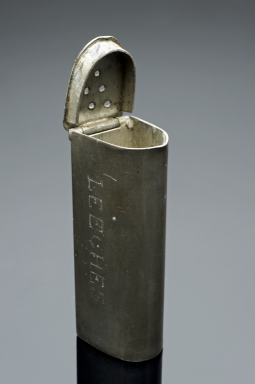
Pewter box for transporting leeches. Image @Science Museum of london

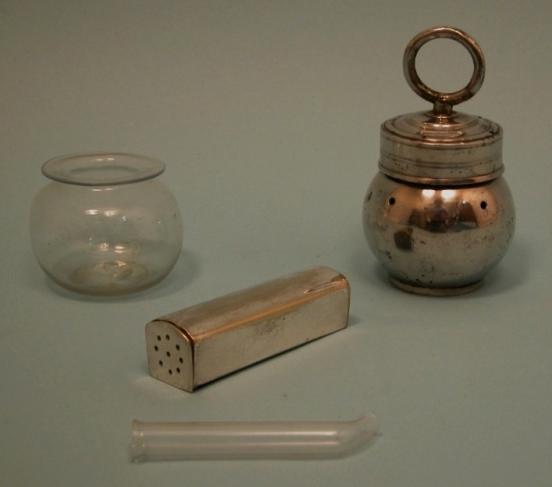
Leeches were carried in a variety of containers made of glass, silver, or pewter. Small bowls were portable, and the larger ones were probably kept in an apothecary’s shop or pharmacy. The everted lips were used to attach a cloth, which prevented the hapless creatures from escaping.

Portable leech carriers made of glass, silver and pewter. Small leech tubes directed the worm to difficult to reach places in the mouth, larynx, ear, conjunctiva, rectum and vagina, begging this question: How did one retrieve the engorged leech?

After the 1830s, the practice of leeching began to decline as medical diagnostic skills improved. Physicians realized that patients who were leeched did not often recover more fully than those who were not, and other, more beneficial treatments,  including pharmaceutical and homeopathic remedies, began to replace leeching

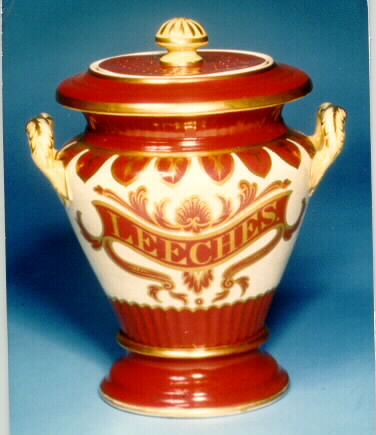
Red and cream Staffordshire leech jar

More on the Topic

Leech bowl

Read Full Post »

We’ve heard the term, “Behind the green baize doors”, but what exactly does it mean? You hear this reference most often in regard to servants and in old books.

Baize was a sturdy green cloth attached to a swing door.  The insulating fabric prevented noises from disturbing the individuals on either side:

The ‘Green Baize Door’ was the dividing line between the two domains, and trespassing beyond meant going into foreign territory. The ‘Green Baize Door’ was a feature of almost every substantial house. It was generally an ordinary framed door onto which was tacked a green baize cloth, usually with brass tacks. It was the universal signal of the dividing line between the two halves of the house.The Bull children would not be tolerated by the servants in the domestic part of the house unless they were working under supervision. This was like walking into somebody else’s house. The servants would normally use a different route to get to the various parts of the house, and would aim to be seen as little as possible. This was not because they were considered beneath notice: on the contrary, it was so that they could do their work uninterrupted by the requirement to exchange civilities. Houses evolved so that domestic staff could go about their task without interruption, not to ensure the privacy of the residents. They had none. –Borley Rectory and the Green-Baize DoorDomestic life at Borley Rectory, by Andrew Clarke copyright 2002

Image @Chest of Books

The brass-headed tacks holding the cloth down could sometimes be arranged in a decorative design. The cloth not only deadened sound but also absorbed kitchen odors. Green baize doors became popular during the mid-Eighteenth century, so Jane Austen must have been aware of the practice, which was more and more used as the 19th century progressed. During Victorian times the practice of sound proofing doors with baize was quite common. The cloth could also be used to insulate nursery room doors, bedroom doors, and doors leading to studies or any place where sound needed to be muffled.

It was a time when housemaids were taught to turn their face to the wall if they should pass their employer on the stairs. For whose protection? one wonders. The era of Squire Allworthy and Sir Roger de Coverley had long passed, when relations between master and man were more informal. – The green baize door: social identity in Wodehouse; Part two – Allan Ramsay 

Early 19th century mahogany desk with baize lining**

Baize (or bayes), also known as a bocking flannel,  was a coarse wool or cotton material, which had a felt-like texture:

“In Europe, baize was used mainly for case, cabinet and closet linings, as well as furniture coverings. Clothing baize was used for monk and nun habits as well as soldier’s uniforms. In the North American Native market, the term baize frequently alludes to inexpensive coarse broadcloth. – Wool Trade Cloth 

Baize dates back to the 16th century, 1525 to be precise. A mid-17th century English ditty about the history of ale and beer brewing, mentions “bays”:

Hops, heresies, bays, and beer;
Came into England all in one year.

“Heresies refers to the Protestant Reformation, while bays is the Elizabethan spelling for baize. – Good English Ale 

Baize scrap from the Titanic. Image @Online Titanic Museum*

Baize was used in a number of ways, including as a protective cover for gaming tables, for the nap of the cloth increased friction, preventing cards from sliding and slowing billiard or snooker balls.  The cloth is available in a variety of naps. Roman Catholic churches used red or green baize for altar cloth protectors, and the cloth was used in museum cases and desks as well.

St. Jerome in his study

As previously mentioned, baize was also used for clothing.

“I would recommend to you the Green Baize Gown, and if that will not answer, You recollect the Bear Skin.” Letter from Abigail Adams to John Adams, 3 December 1788

The site for Knox Family Clothing mentioned mid-18th century receipts for baize and bayes,  as well as rattinet, armozeen, dowles, buff battinet, flannel, linen, silk, and velvet.

In Practical Cooking and Dinner Giving, published in 1876, Mary Foote Henderson recommends:

“Put a thick baize under the table-cloth. This is quite indispensable. It prevents noise, and the finest and handsomest table – linen looks comparatively thin and sleazy on a bare table.”  

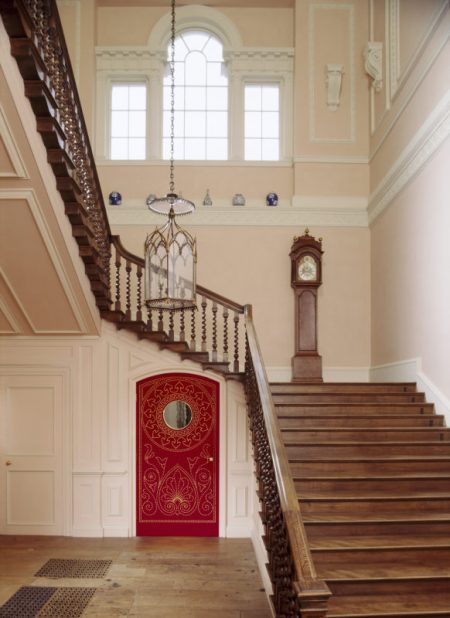
The Staircase Hall at Uppark. The red baize door leads to the servants' quarters. ©NTPL/Geoffrey Frosh
Red baize was also used as insulating material, as the decorative door at Uppark (image above) indicated. (National Treasure Hunt, National Trust Collections) In this advertisement for an 1808 Georgian house for sale, a red baize door to the inner lobby is featured. The red baize servant door providing access to the inner lobby and the kitchen, rear reception and breakfast room. 1808 house
More on the topic:

Read Full Post »

Gentle Readers, ‘The Many Lovers of Jane Austen’, a television special hosted by Amanda Vickery, was aired in Great Britain just before Christmas. Frequent contributer Tony Grant, who lives in Wimbledon and is the blog author of London Calling, graciously sent in his review. Those who cannot watch the show might enjoy this BBC radio interview. During the last eight minutes, Amanda Vickery discusses ‘The Many Lovers of Jane Austen’ with Libbie Purvves. You will need to download aBBC iPlayer.

On Friday 23rd December at 9.30pm BBC 2 showed Amanda Vickery’s exploration of the world of Jane Austen.

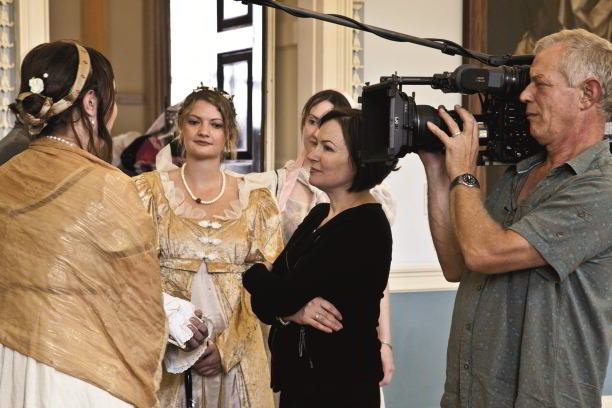
Vickery filming The Many Lovers of Jane Austen

Amanda Vickery wanted to explore how and why generations of readers have been won over to Jane Austen by just six classic novels. She takes us from the JASNA annual conference at Fort Worth, Texas; to Althorpe House, the ancestral home of Princess Diana’s family; Chawton Cottage, where she lived the last years of her life; her tomb in Winchester Cathedral; Bath, where Jane Austen is revered and celebrated; the trenches of The First World War; Sotheby’s auction house in London, where a global bidding war ensues over a fragment of Jane Austen’s writing; to Hollywood and the silver screen, and tries to discover how Jane Austen became a national treasure.

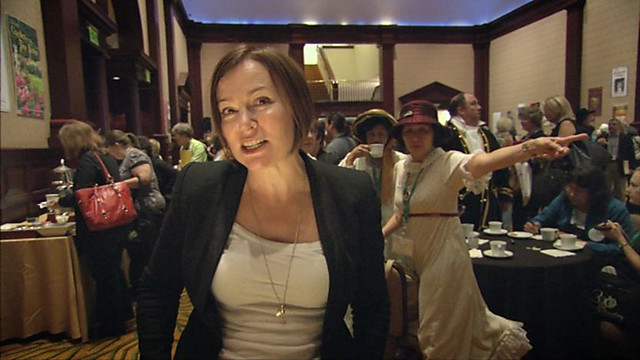
Vickery among the stalls at JASNA Fort Worth

The programme starts with Amanda Vickery strolling around the multitudinous market stalls laid out within a vast arena in the conference centre at Fort Worth. There are country and western singers and hundreds of people dressed in Regency fashions supplied by a costume company doing a very brisk trade. This is what the conference appears to be about, trade and commerce, almost “rampant commercialisation,” as Amanda Vickery describes the scene. The spin-off culture and the merchandising of Jane Austen is very evident at the Fort Worth conference. Amanda Vickery is almost surprised to find that there are actually many committed readers of the novels present. There is a mixture of popular devotion and academic prestige.

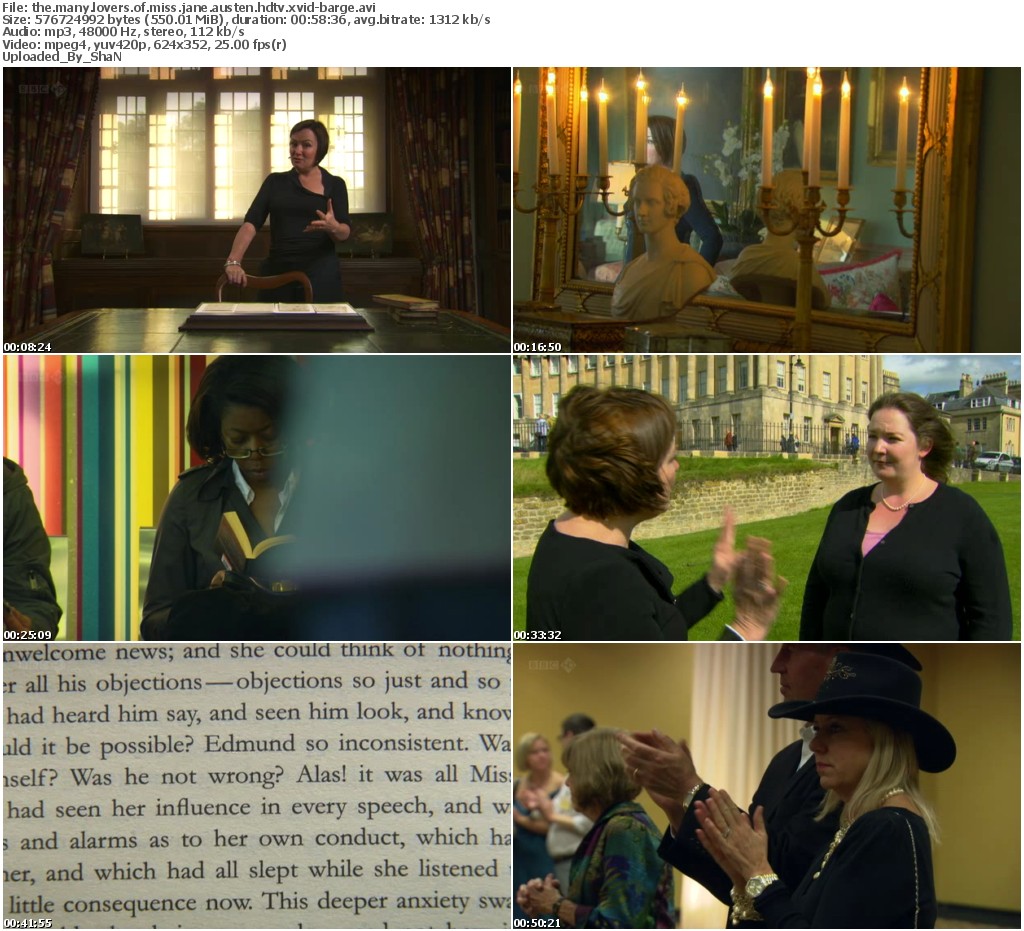
Images of The Many Lovers of Jane Austen @Shanitsinha

Trade and commerce, this is what lies at the heart of America and what has made America. The great driving force that drives a nation appears to drive the American people response to all they encounter, including Jane Austen. This intense commercial activity could actually be their way; their only way, of saying they love Jane Austen. It’s their default reaction. I think commercialisation and art have a very close relationship. Art and literature are made and written but they also have to be sold and for writers to develop they need to make money. But the balance has to be kept. The piece of art or novel has to be paramount. All this spin-off culture of nick knacks, crafts and spin-off novels can be in danger of burying the original creation.

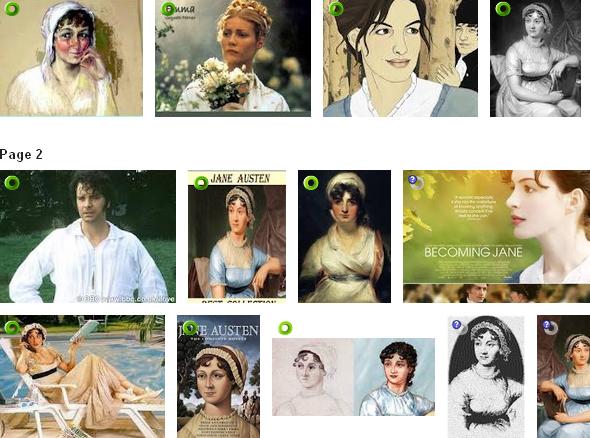
Google screen shot of "Jane Austen"

Amanda Vickery next moves to London and visits Sotheby’s, the auction house, where she attends the auction of a fragment of Jane Austen’s handwriting. It is an edited piece of The Watsons, one of her two uncompleted novels. Vickery handles the piece reverentially and reads it to us straight from Jane Austen’s very own handwriting. A great privilege for her and for us. She discusses the meaning of the fragment with the curator at Sothebys. It is the only piece of first draft written in Jane’s own hand still in existence. The words on the page are the first words that formed in her mind, which she then wrote on the paper – a very special document.

The Watson's manuscript with Jane's handwriting and edits

The Sotheby’s expert estimates a price of £ 300, 000 for the document. Amanda Vickery watches the auction taking place and we are there with her. The price soon goes past the £300,000 mark and continues on and upwards. It is eventually sold to the Bodleian Library in Oxford for a colossal, £850, 000. Nearly a million pounds. Everybody in the auction room is shocked and amazed. I could feel my heart thumping away just looking at the TV screen. Amanda looked flushed too. The document is a financial investment but in going to the Bodleian it will be displayed and used for academic and literary purposes. The importance to the Bodleain is obvious but it also means that it is kept here in the United Kingdom and remains a national treasure.

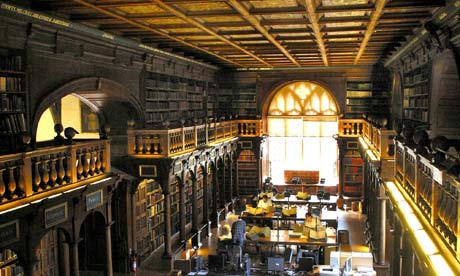
The Bodleian Library reading room. Image @The GuardianUK

So how did Jane Austen become a national treasure herself?

To start with her first readers were members of her own family. Jane would read to Cassandra, her sister, in their shared bedroom before the fireplace at Chawton. They would read, reread, act out scenes and discuss ideas together. Her brother, Henry, the banker, negotiated with publishers on her behalf. Professor John Mulllen suggests that Jane Austen wasn’t as private and shy as some make out. The statement of “By a lady,” on the title page of Sense and Sensibility, was not so much an attempt to be anonymous but to portray to the buyer of her book certain expectations. A novel,” by a lady,” suggested a certain plot arc; unmarried woman meets eligible bachelor, then courtship with certain misunderstandings occur, but all works out in the end and they marry. She was advertising a social and psychological drama of courtship. It was a commonplace deceit. Jane was aiming her novels at a certain readership. However there is little evidence and few clues about who first bought her novels. Lady Bessborough, a distant ancestor of Lady Diana Spencer, who lived at Althorpe, bought Sense and Sensibility, because she discusses the novel in letters to her friends. Austen’s novels would have been read out loud in the drawing rooms of the aristocracy as a sort of group event.”

Earl Spencer reading Jane Austen at Althorp. Image @BBC

Soon after Jane died in 1817 at the age of 41, her novels went out of print and for a few years and they were no longer sold. The Romanticism of the 1840’s epitomised by the Brontes with stories set on wild moors and characters with wild passions, became all the vogue. Emily Bronte thought that Jane Austen was in  “denial about human psychology.” But if you really read Jane’s novels all the emotions and human frailty, the passions and the lusts, are quietly there beneath the surface not being broadcast loudly from some windswept moor. The Brontes for all their brilliance probably misread Austen because they were so caught up with their own wild passions. The emergence of circulating librarie,s however, saw her novels being reprinted. These libraries needed a vast source of material to fill their shelves, and writers who had gone out of fashion were brought back into fashion for new readers who had a great appetite for novels. As these became accessible to a broad swathe of society an increasing number of lower middle class people started to read her novels.

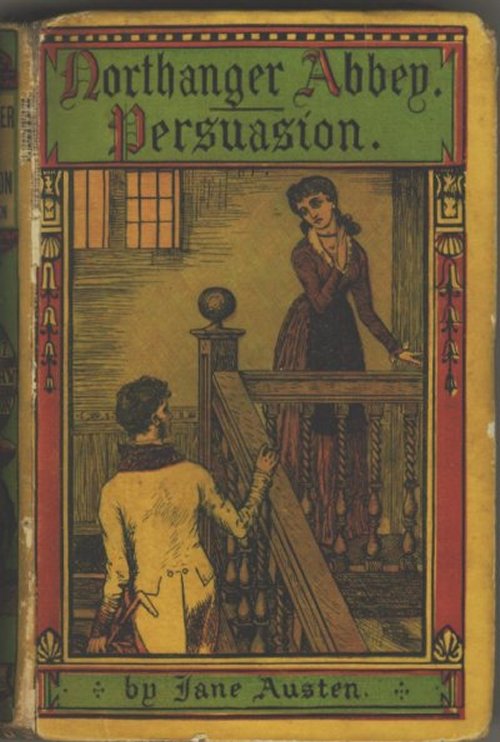
Yellow back version of Northanger Abbey

By the end of the 19th century Jane Austen got a boost through the development of the railway system throughout the British Isles. People on long journeys needed something to do so W.H.Smiths opened book shops and newspaper booths on the railway platforms. They published books that had been out of print and out of copyright because they could do this cheaply. Published  in standard yellow covers, they became known as yellow backs. Jane Austen’s novels were one such series of  yellow backs that were sold to travellers on long train journeys. They became popular again. In the late 1800’s, Persuasion became what we might term low price pulp fiction.

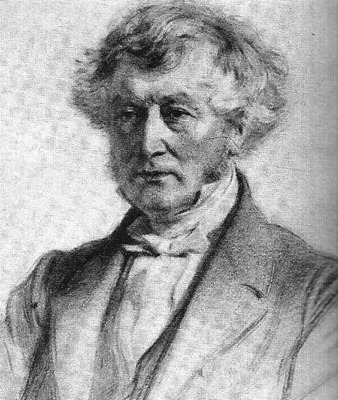
James Edward Austen Leigh

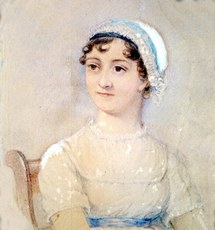
The real turning point in the success of Jane Austen was in 1870 when James Edward Austen Leigh wrote a biography of his relative’s life and so created the Jane Austen myth. Professor Kathryn Sutherland, talking to Amanda Vickery at Chawton Cottage, describes how the family took the only portrait they had of Jane, the rough sketch drawn by Cassandra and commissioned an artist to create a new, beautified copy of it so that they could publish it with James Austen Lee’s biography.

"Saint Jane"

There was very much a sense of the Austen family beginning to shape a view of Jane that they wanted the world to know. Amanda Vickery describes this mythical Jane as “Saint Jane.”

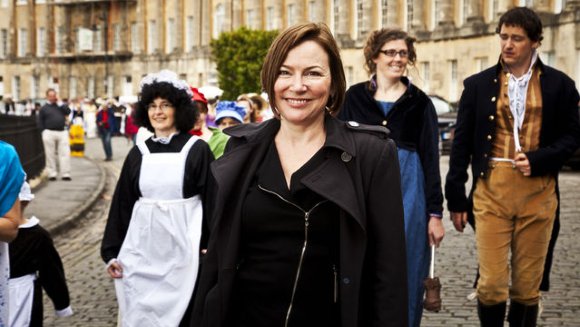
Amanda in Bath

These days, Bath, in Somerset, likes to think of itself as the spiritual heart of the Jane Austen culture. The fact that Hampshire, where she loved most of her life, has far more to do with Jane Austen appears to pass them by; perhaps more accurately, the Bathites would like us not to notice. Jane Austen used the setting of Bath in two of her novels, Persuasion and Northangar Abbey. In Persuasion especially Jane portrays the underclass side of Bath alongside the rich upper-class side. She herself was never reverential of Bath.

2008 Jane Austen Festival, Bath. Image @The Jane Austen Centre Online

Today Bath holds its festival once a year with balls and hundreds of people parading the streets in 18th century costumes. It is the home of the Jane Austen Centre positioned half way up the hill in Gay Street. But it appears to me that these are more attempts to create a tourist trade. They want the custom. Jane Austen herself did live in Bath for four years in various houses around the city, the family seemed to be forever on the move, but she was not particularly happy there. She felt that she had been torn from her dear Steventon in Hampshire by her parent’s sudden wish to retire and move to Bath to have a good time. Similar to the Fort Worth experience, Bath appears to be out to make money from Jane. Bath does create a world focus for Jane Austen and brings her to the attention of many. So it’s not all bad.

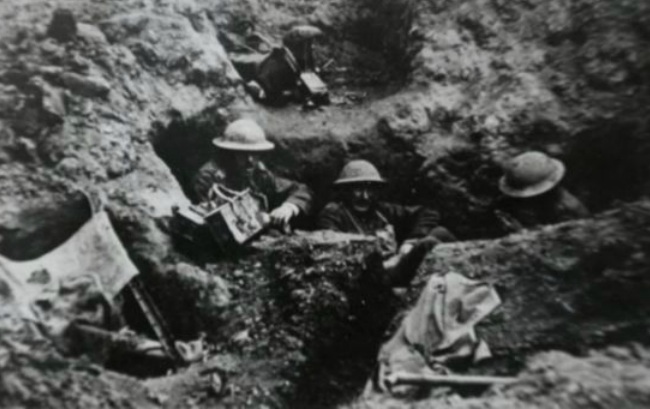
Jane Austen in the trenches of WWI. Image @BBC

In 1894 Sir George Saintsbury coined the term, Janeite. Rudyard Kipling was a renowned Janeite and so were other writers and academics.Rudyard Kipling wrote an article about a group of World War I soldiers in the trenches who read Jane Austen novels. Life in the trenches was horrific from more than one point of view. It wasn’t just the horrors of  “going over the top,” but it also included boredom, filth, lack of clean water and the deafening sounds of artillery, shell shock,and just grinding fear. Soldiers required a reading material that could take them away from this hell on earth. Jane Austen became very popular amongst soldiers in the trenches because she took them back to a pleasant land, a good, a peaceful England of quiet gentle manners and drawing rooms. William Boyd Henderson writing a letter home describes how much he enjoyed reading Jane Austen’s Emma. Winston Churchill is renowned to have said, when he was ill with a fever, “antibiotics and Pride and Prejudice have cured me.” Rudyard Kipling is said to have read Jane Austen constantly after hearing of his son, Jack’s, death in the trenches of the First World War.

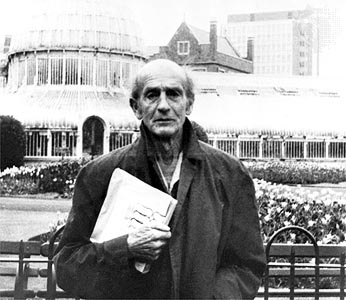
F. R. Leavis

After the First World War there was a great need for the civilising power of culture , the humanities and English Literature, to be part of the salving cure for damaged and bereft lives. F.R. Leavis, the great English Literature don at Downing College Cambridge was the driving force behind all analysis of English literature. The Professor of English literature at Downing College between the 1930’s and 1960, his was the dominant and dominating view that all others looked to. He talked about the great tradition and said there were only five great writers of the novel: D.H.Lawrence, Henry James, Joseph Conrad, George Elliot and the mother of them all, Jane Austen. Leavis’s view held dominant for decades and few could survive criticism of this view. Careers could be and were destroyed or limited if anybody went against him. Professor Janet Todd tells Amanda Vickery that Leavis thought English literature could save the world.

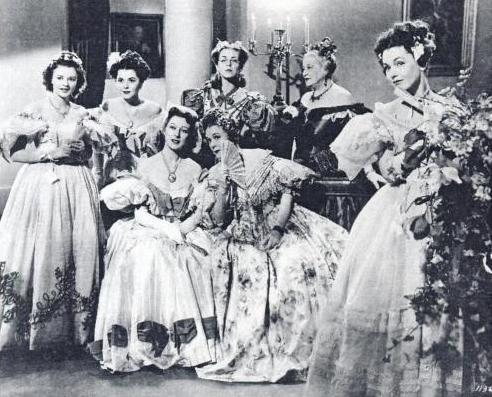
Female cast in Pride and Prejudice, 1940

In 1940 Hollywood took on Jane Austen when Pride and Prejudice with Lawrence Olivier and Greer Garson was produced. In the 1960’s the BBC produced a whole series of costume dramas portraying Jane Austen’s novels. In 1980, Pride and Prejudice was filmed again. Amanda Vickery says, ” It was as though Jane Austen was trapped in the Quallity Street tin.” It was a Laura Ashley version of Austen. This suggests that perhaps each generation gets the Austen they deserve. Each decade produces productions of Austen that reflect the age they are made in.

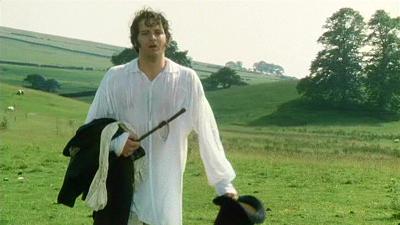
Colin Firth as Mr. Darcy

In 1995 came Andrew Davis’s wet t-shirt version with Colin Firth emerging from the lake at Pemberley, wet to the skin, pumping testosterone. A film for the young with hormones. There is lovely scene with Amanda Vickery taking the part of Elizabeth Bennett as Darcy/Firth emerges from the lake and Amanda gives Elizabeth Bennett’s lines in response to Darcy and the two films are cut together as though they are one. The 1995 film still appears to be the most popular version, even now in 2011, anyway it appeared to be so with the hordes of fans at The Forth Worth assemblage. Andrew Davies was the main guest speaker and he was very very popular. Do Janeites create a hysterical response like a form of Beatle mania? Well, perhaps not. They don’t throw their knickers at Andrew Davies; they just receive, rather cheekily, tiny black lace thongs in little black net bags provided with Willoughby’s phone number. Apparently Willoughby is sounding rather exhausted, if polite, on the phone these days!!

Andrew Davies. Image @The Telegraph

Dr Cheryl Kinney, a gynaecologist and the organiser of this year’s JASNA conference at Fort Worth, denies that the Willoughby knickers are a way of increasing the likelihood of sexually transmitted diseases so that she can make money curing people. The contemplation of this possibility makes Amanda Vickery laugh like a drain. Yes, we DO get the Austen we want.

We are left with a thought for the future: Austen has peaked in the west. Could  China and Japan be the next stops perhaps?

Other reviews: These will give you more insights and images!

Please note: The ads are placed here by WordPress. I do not make money from this blog.

Read Full Post »

« Newer Posts - Older Posts »