Feeds:
Posts
Comments

Archive for the ‘Regency World’ Category

This image of a bourdaloue might be somewhat confusing to the uninitiated. Could this small and elegant vessel be a gravy boat? Or a blood-letting container?
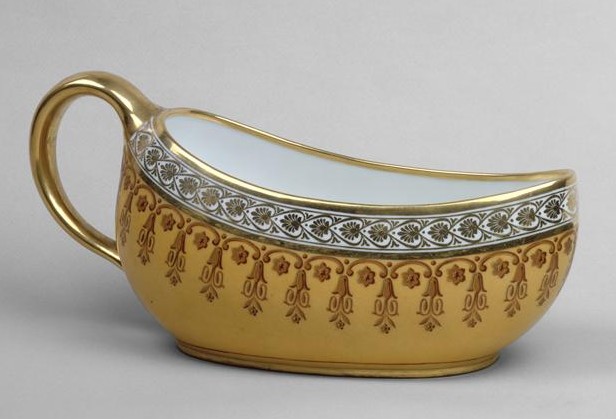
Sevres bourdaloue, 1831.

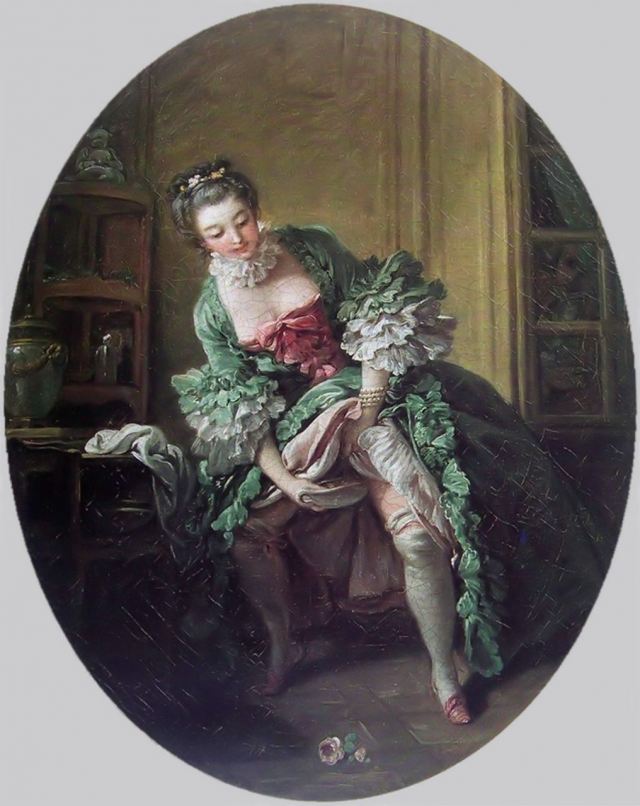
This image by Francois Boucher says it all. A fully dressed lady is relieving herself into an object called the bourdaloue or bourdalou, careful not to soil her skirts. Her maid, no doubt, stands nearby, waiting to receive the small chamber pot in order to empty it. The lady (or woman of ill repute) is in a public place – a theatre or tavern, perhaps – but certainly not a church. Wherever she is, the place has no public toilet. And so she must relieve herself standing up, taking care not to soil her skirt and petticoats.
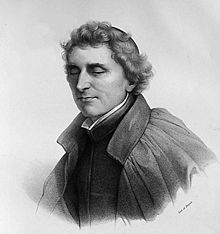
Louis Bourdaloue. Image @Wikimedia Commons

According to legend, the name of this porta potty comes from  Louis Bourdaloue (1632-1704), one of Louis XIVs Jesuit priests. His oratorical skills were reputedly so accomplished that people felt they could not miss a single word of his sermons. It is said that women sat through his masses with a bourdaloue placed under their dresses, whose skirts were held out by panniers. Since the priest’s  sermons were somewhat longwinded, the chances that ladies would need to relieve themselves were almost certain.  As a rule, churches and theatres had no toilets, and there were no breaks given during sermons. Ergo these portable urinals, which were ergonomically designed to accommodate the female body.

The vessel was oblong, rectangular, or oval in shape. A slightly raised lip at one end and a handle at the other allowed the woman to relieve herself from a squatting or standing position. The edges curved inward to avoid hurting her tenderest parts.

Sevres bourdaloue, with medallion depicting a scene from Watteau, blue lapis and framed in gold leaf. 1892.

It is a little hard to distinguish truth from fiction, so I am a bit skeptical about this apocryphal tale. Were the priest’s sermons in the early 18th century so truly awe-inspiring that a lady would squat in her pew, however discreetly, to relieve herself in front of her family and other parishioners so as not to miss a word?

In truth it was her maid who brought the vessel in, for bourdaloues were compact and came with a cover. When a lady had to relieve herself she would, I imagine, retreat discreetly to a private corner of a tall pew or to a back or side room in the church. Her maid would then hand the vessel over to her mistress, who took care not to spill any liquid on her skirts. When the lady was finished, she would hand the bourdaloue to her maid to empty its contents.  When attending a play or opera at the theatre, I imagine she would again retreat to a darker more private corner of the box to urinate.

A PAIR OF SEVRES BOURDALOUES (POTS DE CHAMBRE OVALE) CIRCA 1776,

Designed only for women, these bourdalous are quite beautiful. Made of faience or porcelain, they are decorated with flowers or painted scenes. Many are gilded. The portable pots, or coach pots as they were known in England, could be decorated inside as well.  They were quite small and compact, designed for travel, which made it easy to carry them and pack them for coach trips. They were also taken to long banquets, where ladies would scurry behind curtains when they needed to go.
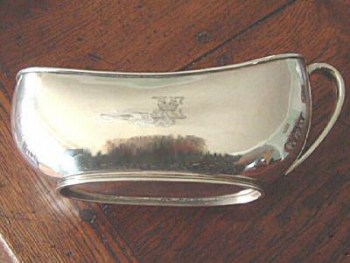
Bourdalou made in France c. 1840. It has an engraved crest and a leather case to contain it. The silver bourdalou is a small urinary receptacle for female use, of compressed eliptical shape and generally made of porcelaine or earthenware, but also made occasionally of silver. Its front end has an incurved rim and, usually, stands on a simple foot ring with a simple loop handle. Also known as a coach pot in England.

Bourdaloues were used throughout the 18th and for most of the 19th century. As water closets began to be built inside homes and buildings, the use of these chamber pots began to be reduced dramatically.

Plain bourdaloue made of creamware. The shape is quite elegant.

Gentlemen had it a little easier, although this satiric French cartoon, which I have shown before, depicts the disgust that Frenchmen felt towards Englishmen who freely pissed in a pot in the dining room. In this instance, the man misses the chamber pot and hits the floor. There seems to be a lack of modesty among these men, which largely holds true today.
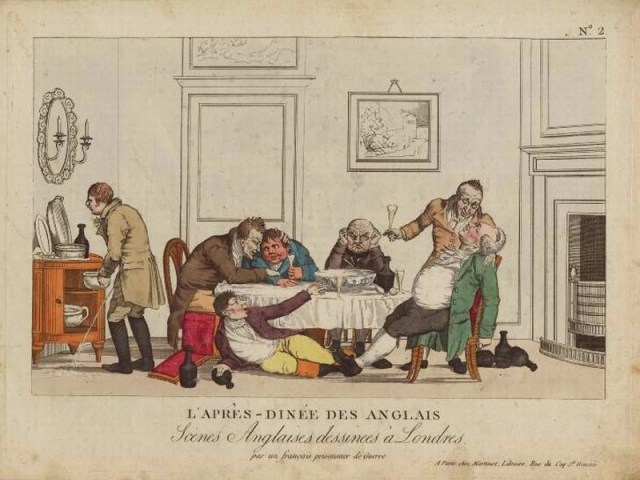
c1816, from Fitzwilliam Museum.

Modesty is also lacking in this cartoon of ladies relieving themselves inside a public restroom at Vauxhall Gardens. Four are arrayed on a long latrine against the wall. One lady is refreshing her make up and another is tightening her garter. If such scenes were common for upper class women in public spaces, perhaps many felt no modesty relieving themselves in church as well.
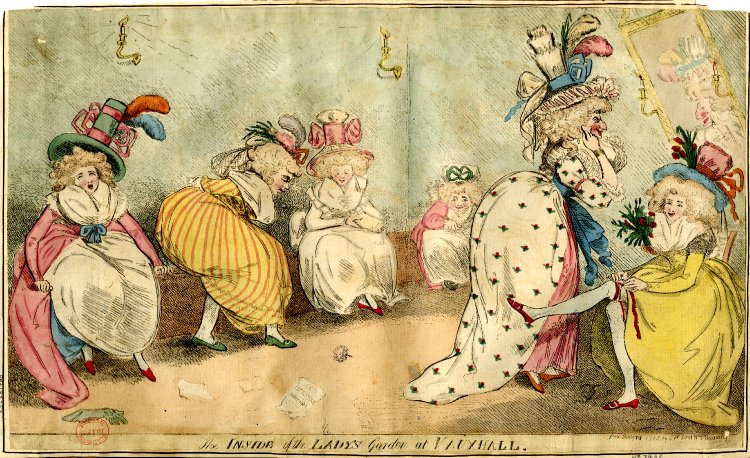
The Inside of the Lady’s Garden at Vauxhall, 1788 by SW Fores. Image @British Library. The interior of a ladies’ cloak-room. Against the wall on two sides of the room is a bench forming a latrine on which four fashionably dressed ladies are seated. On the right a woman in profile to the right, resembling Lady Archer, applies paint to her cheeks before a mirror lit by two candles. A young woman seated beside her on the extreme right ties up her garter.
Read Full Post »

“there seem to be very few, in the style of a Novel, that you can read with safety, and yet fewer that you can read with advantage.”- Sermons to Young Women, James Fordyce, 1766

It’s no secret that Jane Austen’s family were novel readers during an age when such books were considered frivolous and not worthy of reading. (Writing a novel was considered an even worse offense!) Enter Jane Austen and Pride and Prejudice. In her delightful book, Jane created a satiric scene in which Mr. Collins confirmed Mr. Bennet’s opinion of his young cousin’s foolishness. After he enjoyed the younger man’s inanity for a while, Mr. Bennet proposed that Mr. Collins read to the group. The girls chose a novel, of which Mr. Collins disapproved:

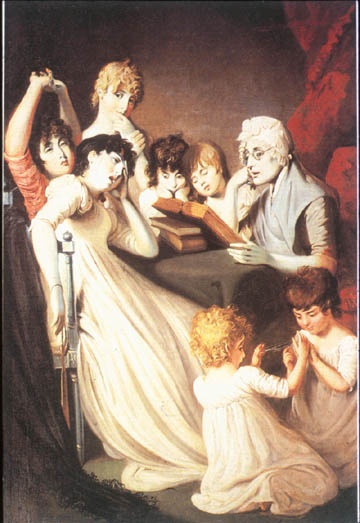
John Opie, "A Moral Homily"

John Opie, “A Moral Homily”

Mr. Bennet’s expectations [regarding Mr. Collins] were fully answered. His cousin was as absurd as he had hoped, and he listened to him with the keenest enjoyment, maintaining at the same time the most resolute composure of countenance, and, except in an occasional glance at Elizabeth, requiring no partner in his pleasure.

By tea-time, however, the dose had been enough, and Mr. Bennet was glad to take his guest into the drawingroom again, and, when tea was over, glad to invite him to read aloud to the ladies. Mr. Collins readily assented, and a book was produced; but on beholding it (for everything announced it to be from a circulating library), he started back, and begging pardon, protested that he never read novels. Kitty stared at him, and Lydia exclaimed.—Other books were produced, and after some deliberation he chose Fordyce’s Sermons. Lydia gaped as he opened the volume, and before he had, with very monotonous solemnity, read three pages, she interrupted him with—

“Do you know, mamma, that my uncle Philips talks of turning away Richard; and if he does, Colonel Forster will hire him. My aunt told me so herself on Saturday. I shall walk to Meryton to-morrow to hear more about it, and to ask when Mr. Denny comes back from town.”

Lydia was bid by her two eldest sisters to hold her tongue; but Mr. Collins, much offended, laid aside his book, and said—

“I have often observed how little young ladies are interested by books of a serious stamp, though written solely for their benefit. It amazes me, I confess;—for, certainly, there can be nothing so advantageous to them as instruction. But I will no longer importune my young cousin.”

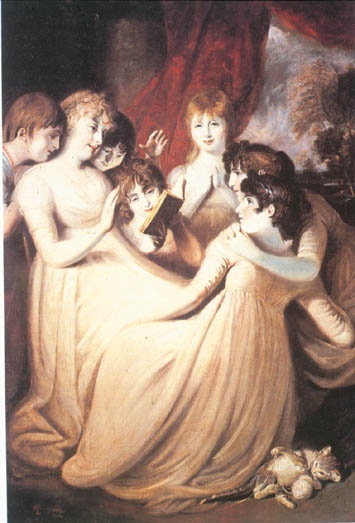
John Opie, “A Tale of Romance”

One cannot but help enjoy the irony of the situation. During his lifetime, Dr Fordyce was considered an excellent orator and his sermons were much appreciated, but by the time Jane Austen began to write her novels his luster had dimmed and novel reading was becoming more acceptable. These wonderful paintings by John Opie represent both sides of the sermon/novel story. In the first painting the governess is reading boring homilies to her charges in the hope of educating them. She is completely unaware of their expressions. One girl yawns, another can barely keep her eyes open, and a third looks pensively at the viewer as if to say, “Can you believe this?” Two of the youngest children entertain each other by playing cat’s cradle, and the girl sitting nearest the reader is about to fall asleep. What a wonderful tableau! One can imagine that the Bennets must have looked much like this ensemble before Lydia blurted out her question.

The second painting depicts the delight that the ensemble takes in listening to a tale of romance. They are all engaged and smiling and hanging onto every word from the reader. A kitten is left to play with a wool ball by itself.

Jane Austen employed words to create an ironic tone; John Opie used images. Both used their respective mediums to make a memorable point. Today, Dr. Fordyce’s sermons are largely forgotten. The following excerpt from Sermon VIII, Volume 2 demonstrates why he was considered dull and stodgy even 200 years ago:

Sermons to Young Women, Volume 2, James Fordyce, 1767. You can download the volume as an ebook at this link.

Read Full Post »

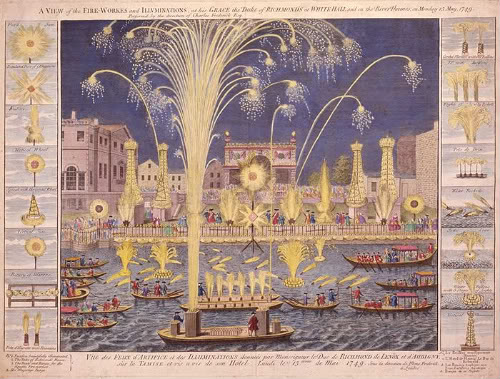
Today U.S. citizens are celebrating July 4th and the independence of our nation from Great Britain. Grand firework displays will play a pivotal role in our national revelry tonight, culminating a day long celebration. Fireworks were not unknown during the Georgian Era, and were used for grand effect in public celebrations. I will point out only a few instances in London.

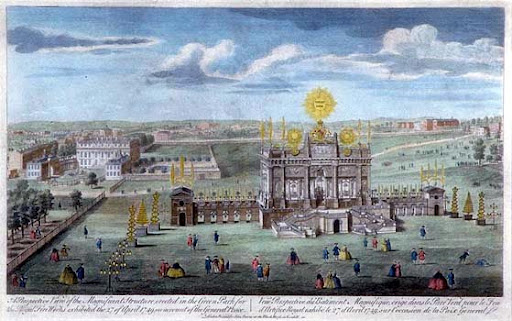
The picture above is of the firework display held by the Duke of Richmond at Richmond House near the Thames in Whitehall, London [May 1749] and shows both the whole effect of all the fireworks and also, very interestingly, gives individual details [on the side] of the individual fireworks which made up the whole display. – Austenonly

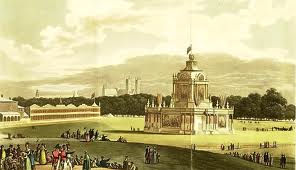
Temple of Peace in Green Park.

Early view of Green Park and the Temple of Peace.

Green Park was readied for a grand fireworks display in 1763 to celebrate the Treaty of Paris, which ended the French and Indian War in North America. The park had attracted firework displays before:

The Green Park was used for a national party in 1746 to celebrate the end of the War of Hanoverian Succession. The royal family arranged a great firework display and commissioned the composer, Handel, to write his Music for the Royal Fireworks. A vast Temple of Peace was built in the park to store the fireworks. But early on a stray rocket hit the temple. Three people died and 10,000 fireworks were destroyed in the fire that followed. – The Green Park

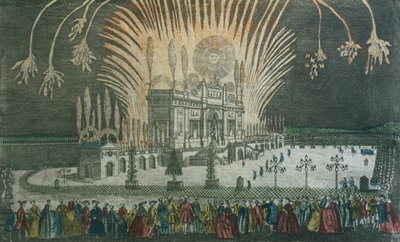
Temple of Peace in Green Park lit up by fire works.

The Treaty of Paris  granted Great Britain control of all land to the east of the Mississippi River, a cause for a grand celebration and a good reason for building a ceremonial temple. (View a print of the scene here.)

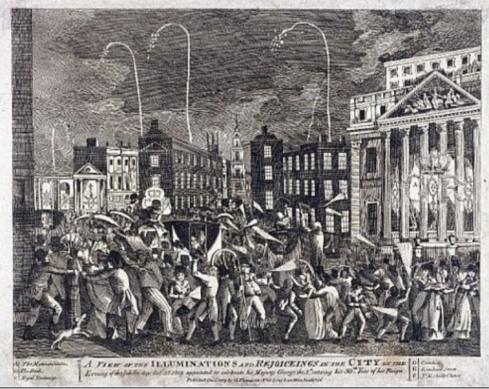
Another cause for creating massive firework displays was the long reign of George III. The details of  the Golden Jubilee celebrations are beautifully described at Austenonly.

Fireworks in London in celebration of King George III Golden Jubilee in 1809

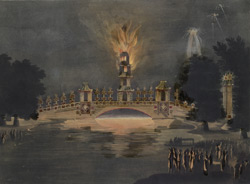
Fireworks were quite dangerous, and so were  gas lit fires. In 1814, another grand celebration was planned in St. James Park (which lies close to Green Park) to commemorate 100 years of the Hanoverian royal family. A seven-story pagoda was erected on a Chinese-style bridge spanning the canal in St. James’s Park.

A view of the Chinese pagoda burning. Image @British Library

The splendid gala was organized for the joint August first celebration of the Hanoverian Centenary and the anniversary of the Battle of the Nile. The brilliant and daring tactics of Lord Nelson at the Battle of the Nile were represented by rowboats upon the canal. A disaster occurred when the gas lit pagoda caught fire and burned. Two men were killed and a number injured trying to put out the fire. A number of the Royal swans succumbed to smoke and fire. The crowd unaware that this was an accident took the occurrence to be part of the spectacle and applauded wildly. – The Georgian Index

When the Napoleonic Wars came to an end, famed rope walker, Madame Squi, could finally cross the English Channel in  1816 to perform at Vauxhall Gardens for the first time.

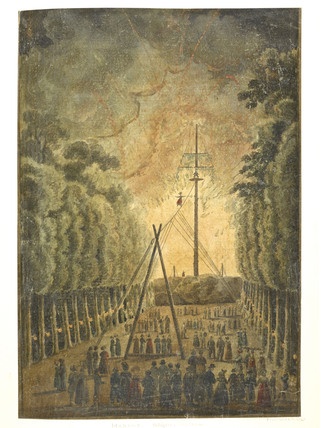
Madame Saqui illuminated by the bursts of fireworks, Vauxhall, 1816. Copyright Museum of London*

‘In the midst of a great burst of fireworks, Bengal lights glimmering faintly in the clouds of smoke, she (Saqui) stands on a rope, sixty feet up, and follows a narrow and difficult path to the end of her journey. Sometimes she is completely hidden from our eyes by the billowing waves, but from the way she walks, so self-assured, one would think an Immortal was walking peacefully towards her celestial home.’ [Lerouge on Madam Saqui at Vauxhall] – Rope Walkers and Equillibrists

Firework displays were no novelty at Vauxhall Gardens, or any of the major gardens where people congregated to walk along grand promenades, dance publicly to music, eat, drink, and enjoy an evening out in the open.

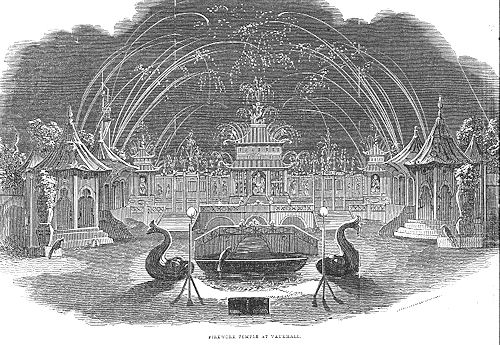
Fireworks display at Vauxhall, 1800s.

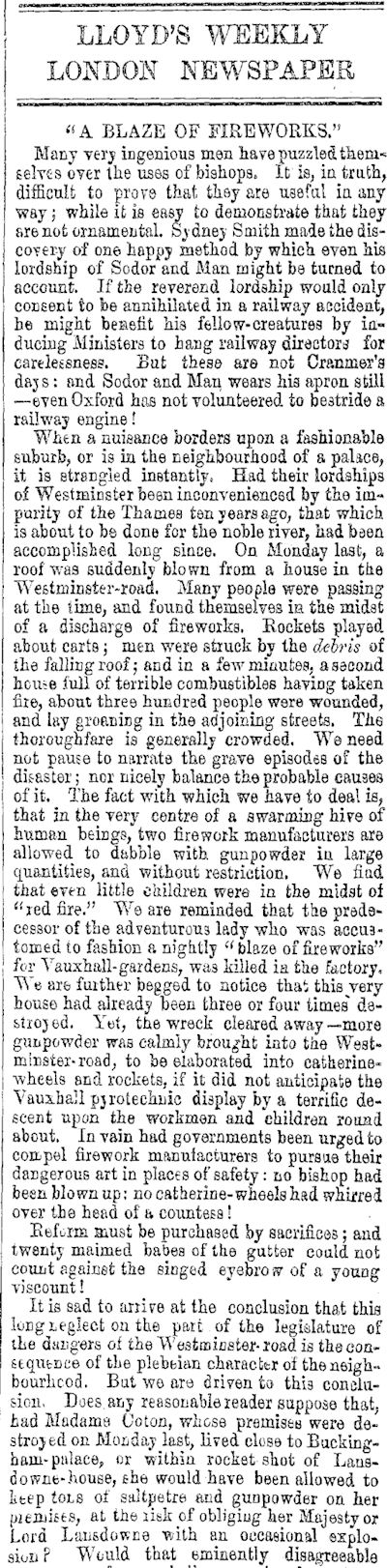
There were terrible accidents then as now with fireworks. Here is an account from  an 1858 newspaper** about an accident in central London:

All over the U.S. we will be enjoying various kinds of firework displays. Those in Washington D.C. and the major cities will be the grandest, I am sure. I recall an intimate firework display along a small lake in Vermont one year, in which only a few fireworks were set off. Interestingly, of all the firework displays I have seen, that is the one I tend to recall. Happy Birthday, America! Stay safe.

*Museum of London Prints

**Newspaper Account of Vauxhall accident.

More about Green Park at this link.

Read Full Post »

Some books are so useful they are hard to pass up. Several months ago, I received the Kindle edition of Behind Jane Austen’s Door by Jennifer Forest, author of the delightful Jane Austen’s Sewing Box. Behind Jane Austen’s Door takes you on a tour of a Regency house, room by room – the entrance hall, drawing room, dining room, breakfast room, dressing room, bedroom, and kitchen – to
explore the challenges and lives of Jane Austen’s women. Included is an appendix that provides a quick overview of the Regency era.

More accessible in tone and organization than the excellent Behind Closed Doors by Amanda Vickery and If Walls Could Talk by Lucy Worsley, which cover similar but more comprehensive territory, this book can be used as a quick reference by people who want immediate access to the purposes and functions of the rooms in a Georgian household. What distinguishes this book is its close association to Jane Austen and her novels (much like Jennifer Kloestler’s book, Georgette Heyer’s Regency World, is associated with that author).

In these large houses [such as Pemberley], the women didn’t need to use the drawing room during the day. There were other rooms for use; they had their own office and other smaller parlors. The drawing rooms, and yes there could be more than one drawing room, in these big houses were just for receiving the morning visitors and for evening entertainment.

One gains close glimpses of a rich family as well as one of more modest means, such as the household that Jane Austen’s mother oversaw.

She works with the cook in preparing menus, sourcing food and caring for the vegetables, dairy and chickens. On washing day, she and her daughters work alongside the servants to get all the laundry completed: it was just so time consuming in the days before washing machines! A gentlewoman had to monitor the budget, find supplies and pay the bills for all those expenses, including the tea and wine. 

While much of the territory that Jennifer covered seemed familiar, it is arranged in such a pleasant and easy to use format that new authors to the Jane Austen genre or Regency romance will find it very useful, especially Jane Austen fans.

Jane Austen’s own mother used her dressing room at Steventon as a second sitting space, more casual and private than the drawing room. After five weeks of illness, Mrs Austen’s return to health allows a resumption of tea in the dressing room. “My mother made her entree into the dressing-room through crowds of admiring spectators yesterday afternoon, and we all drank tea together for the first time in five weeks … We live entirely in the dressing-room now, which I like very much; I always feel so much more elegant in it than in the parlour.” Letter from Jane Austen to Cassandra Austen, Sunday 2 December 1798.

Oh, there will be people who say that they already know this information and that the book provides nothing really new, but readers who are just discovering Jane Austen and the Regency world will think otherwise. I, for one, am happy to have another source to turn to when checking my facts about meal times and the precise function of certain rooms and furniture. The book, which is a quick read, is available in e-book format. I found this quite convenient, for I can access it on all my mobile devices and computers. Also, at $2.99 for the Kindle version, it is quite a bargain. I give it four out of five Regency teacups!

About the Author
Jennifer Forest has a Bachelor of Arts and a Graduate Diploma in Cultural Heritage Management. Jennifer is a museum curator with a love of beautiful old historic buildings. She lives in Australia, a country built by Regency England.

Blog: Behind Jane Austen’s Door

Print Length: 51 pages
Sold by: Amazon Digital Services
Language: English
ASIN: B006YITPAS
Text-to-Speech: Enabled
X-Ray: Not Enabled
Lending: Enabled

Read Full Post »

Vintage book cover. The book had been purchased in the shop at Dove Cottage. Image @Grey Pony

Inquiring readers, frequent contributor, Tony Grant,  has done it again and brought the 19th century alive through his discussion of poetry. One can walk the paths along Grasmere in the Lake District with him and William Wordsworth, inhaling the clean crisp air and regarding the sad cautionary tale of Martha Ray, the woman in the scarlet cloak. Visit Tony’s blog at London Calling.

Saturday August 23rd 1798.

“ A very fine morning. Wm was composing all the morning. I shelled peas, gathered beans and worked in the garden till half past twelve. Then walked with William in the wood. The gleams of the sunshine, and the stirring trees, and gleaming boughs, cheerful lake, most delightful. After dinner we walked to Ambleside…”

Thus Dorothy Wordsworth describes the division of labour in the Wordsworth house hold at Dove Cottage, Grasmere in Cumbria. She did the labour and William her brother did the,” Romanticising.” But it shows the division of experience wasn’t as clear cut as might appear at first. Dorothy shows her emotional response to the world she inhabits too, as much as her esteemed brother does in his poetry.

Dorothy

Romanticism was a way of seeing and experiencing the world and which Wordsworth promoted in his poetry. It wasn’t necessarily about being romantic however. It was about an emotional response to the world that balanced a logical factual approach. It promoted the importance of feelings, myth, symbolism and intuition as well as taking into account the facts of a situation.

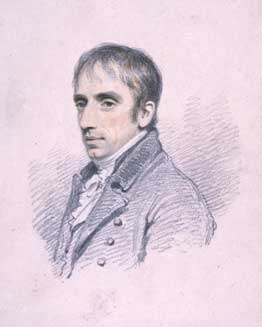
William Wordsworth by Henry Eldridge, 1807

”The Thorn,” written by William Wordsworth in 1789 is very melodramatic and tells the story of a solitary, rejected woman, Martha Ray, who’s baby has died and the mythology that builds around her.

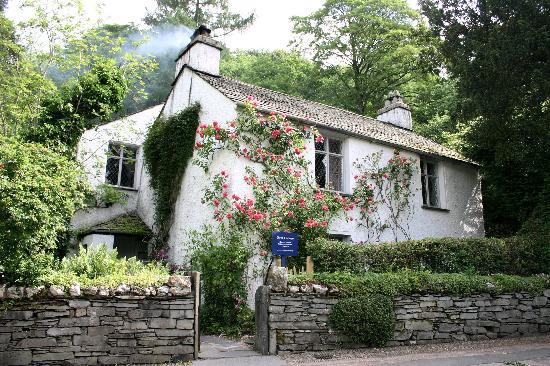
Dove Cottage.

Wordsworth, in the opening stanzas introduces us immediately to the thorn describing it as , “so old and grey,” “stands erect,” “A wretched thing forlorn.” And takes the personification to a higher degree saying it is,” Not higher than a two year’s child.”

He is setting us up to respond to natural things in an emotional way.

Footpath around the lake. Image @A Year In the Lakes

He then balances this emotional approach with factual evidence as he gives us the thorns location ,”high on a mountains highest ridge,” and the minutest detail, telling us that three yards from the thorn is, “a muddy pond,” and close beside the thorn is,

“A beauteous heap, a hill of moss.
Just half a foot in height.”

A mixture of fact and emotion balanced.
Three things are described in close proximity and we wonder how they relate to each other.

Colour is very important. The mound of earth near the thorn has, “vermilion dye,” “lovely tints,” “olive green, “scarlet bright,” “green red and pearly white.” Vivid in our minds eye.

Then, “A woman in a scarlet cloak,” Martha Ray, is introduced into this setting and we are asked,

“Now wherefore, thus, by day and night,
In rain, in tempest, and in snow,
Thus to the dreary mountain top
Does this poor woman go?”

The question all the local villagers ponder too. Observation, and imagination create a myth. Many believe she has killed her baby and buried it next to the thorn but they don’t actually know that. Wordsworth keeps pulling us back to reality, tempering our emotional response, “I cannot tell; I wish I could; for the true reason no one knows.”

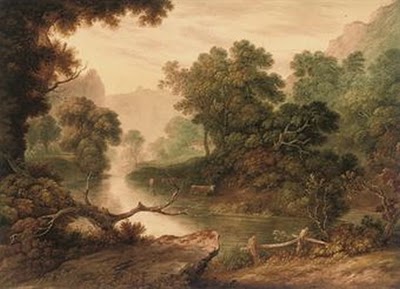
Cattle watering at Grasmere, near Ambleside, Cumbria, by John Glover.

Wordsworth also begins to use the personal pronoun. It is an egotistical device but we are with him. It is us as well as Wordsworth asking the same questions. He has got involved in this apparent tragedy and so have we.

Wordsworth relates to us the story of Martha Ray and what makes her mad.

“Full twenty years are past and gone
Since she (her name is Martha Ray)
Gave with a maidens true good will
Her company to Stephen Hill”

Stephen Hill, we are told, gets Martha pregnant but leaves her and marries somebody else. As result she has the baby but it is never seen by other people.

Then imagination intervenes again,

“For many a time and often were heard
Cries coming from the mountains head
Some plainly living voices were:
And other, I’ve heard many swear,
Were voices of the dead:
I cannot think, whate’er they say,
They had to do with Martha Ray.”

Wordsworth then draws us back to a cool scientific approach,

“But what’s the Thorn? And what the pond?
And what the hill of moss to her?”
And what the creeping breeze that comes
The little pond to stir?”

You can almost imagine Wordsworth and us being explorers into this mystery using investigative questions.
However, finally, myth is triumphant

“…but some will say
She hanged her baby on the tree
Some say she drowned it in the pond
Which is a little step beyond
But all and each one agree
The little babe was buried there
Beneath the hill of moss so fair.”

Fact, imagination, emotion, have combined to create a myth.

What use would this mythologizing be to those people in the hills and mountains of the Lake District? Would it help them make moral decisions? They wanted to bring Martha Ray to public justice based on what they thought and felt. Would it help them to create their own response to Martha’s predicament without having to experience it themselves? Is that the purpose of mythologizing? The purpose of fairy tales and myths have always been important to childhood and early emotional development and moral growth. Wordsworth has created an adult myth. So does the need for myths go beyond childhood and remain important to all?

……………………………………………………………………………………….

In a few weeks, a good friend of mine, Clive, is coming over from Canada for a reunion of old school friends. Some of us are reaching 60 this year and we are getting together for a celebration in Liverpool. Clive and I are going on further north into the Lake District for a couple of days. We will be staying in Ambleside, not far from Grasmere and Wordswoth’s Dove Cottage. We will visit Dove Cottage and I promise we will listen out for the cry of Martha Ray caught in the winds blowing about the peaks surrounding Grasmere and we will too be able to say,

“That I have heard her cry,
“Oh misery! Oh misery!
Oh woe is me! Oh misery!”

More on the topic:

Read Full Post »

« Newer Posts - Older Posts »