This Jane Austen blog brings Jane Austen, her novels, and the Regency Period alive through food, dress, social customs, and other 19th C. historical details related to this topic.
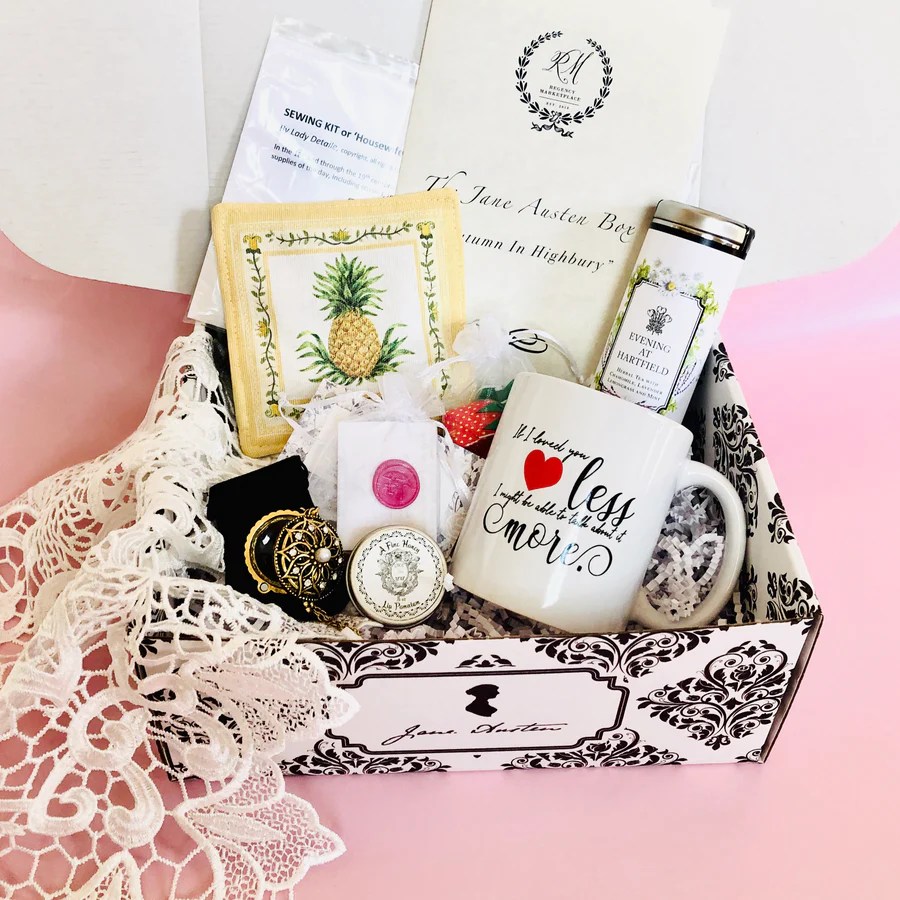
I just received my first Jane Austen Box from Regency Marketplace, and the minute I opened it, I knew I had to share it with all of my friends here at Jane Austen’s World. This is a beautiful Jane Austen-themed experience not to be missed–and it comes right to your own front door!
Special thanks to @regency_marketplace for sending me the “Autumn At Chawton Cottage” box this month so I could fully experience it for myself! This delightful box is filled to the brim with cozy Autumn and Jane Austen-themed items! I can’t wait to put on my cute new socks and have a cup of tea!
Box Full of Surprises
Each Jane Austen Box features a range of products from items of historical interest to lovely items you can incorporate in your everyday life, edibles and fine teas to Jane Austen inspired products. All boxes also include some form of book — expand your library!!
Categories include, but are not limited to:
Fine Teas
Books
Candles
Edibles
Wearables
Items of Historical Interest
Jane Austen Inspired Products
Bath and Body
Home Decor
Writing Accessories
Booklovers Paraphernalia
And More!
Subscription boxes are delightful because there are so many surprises held within each box. Regency Marketplace does a lovely job of keeping the mystery alive. They give hints and a theme for each box, but they never show what specific items are coming in each new box. That makes it even more exciting to open when it comes in the mail!
Unboxing
One of the most exciting parts about getting any kind of subscription box is the actual unboxing. When it arrived, I was so impressed with the packaging and the beautiful box. When I opened it and saw the pretty tissue and the sticker, I almost couldn’t bring myself to open it. I snapped a picture because it felt like my birthday and Christmas had arrived all at once.
If you’d like to watch an unboxing video of me opening the box, you can view it HERE. I had a blast (and it was my first time making a video reel like it). Here’s a peek inside:
Stay Tuned
The Winter Jane Austen Box will be available for Pre-Order October 15th – November 15th, and boxes will ship in early December. Regency Marketplace offers free shipping in the US. (International flat rate shipping is also available.) These luxurious boxes sell out quickly, so mark your calendars to reserve one for yourself or for a friend.
Enjoy this box for yourself, or gift one to a friend or family member for the holidays this year! Once the Winter Theme is announced, I will post a reminder to place your orders and a coupon code.
Sample of a previous Jane Austen Box
About Regency Marketplace
Regency Marketplace is run by the lovely Christina Denton. It was envisioned many years ago as a beautiful oasis for all things Regency and Jane Austen: a place where one could escape from the breakneck pace of today’s world, and enter into an era of elegance, charm, and wit.
A lifelong love of Jane Austen and the Regency Era is the guiding influence behind Regency Marketplace. As a family-run company, they work hard to source the best products for their discerning customers and fellow Janeites! They focus on celebrating the grace and beauty of an Era so distinct that it still captivates us two hundred years later.
Is this something you would like to receive as a gift? Would you buy it for yourself or for someone else as a lovely surprise?
“I was all in a fright for fear your sister should ask us for the huswifes she had gave us a day or two before”—Anne Steele, Sense and Sensibility, chapter 38
Christmas Ideas
I just finished a fall design, perfect for November. It adorns a “housewife” (or “huswife”) sewing organizer I’ll give as a Christmas gift. If, like me, you enjoy sewing gifts for people, Jane Austen Embroidery will give you great ideas and patterns. Or, if you want something for a Jane Austen fan, or for someone who enjoys sewing and embroidery, the book itself would be a great gift for them!
Jane Austen Embroidery
Jane Austen Embroidery: Regency Patterns Reimagined for Modern Stitchers, by Jennie Batchelor and Alison Larkin, is a gorgeous book. With glossy pages full of beautiful photos, it’s a delight to read. I have done cross-stitch for many years, and dabbled in other kinds of embroidery, so I enjoyed learning more about stitching in Austen’s England.
Jane Austen Embroidery by Jennie Batchelor and Alison Larkin gives fascinating views of embroidery in Austen’s life and times, and projects for modern stitchers based on patterns of Austen’s time.
The book begins with an introduction exploring “Embroidery in Jane Austen’s Britain.” We learn about Austen’s enjoyment of needlework (which was often just called “work,” in her novels and elsewhere). Some of her contemporaries, including Mary Wollstonecraft, complained that it was drudgery and meaningless work. However, Austen’s letters show that she enjoyed style and had fun fashioning trimmings and garments.
The Lady’s Magazine
The Lady’s Magazine (1770-1832) is the source for the designs in the book. The authors explore the magazine’s history. It covered politics, science, cosmetics, essays, travel writing, poetry, serialized novels, music, and much more. According to Jane Austen Embroidery, The Lady’s Magazine balanced “traditionally feminine and intellectual accomplishments,” encouraging women to take up “the pen, as well as the needle.” Austen did both!
Embroidery patterns in the magazine were usually removed for use. It took the authors five years to track down sixty issues which still had intact patterns.
Readers of the magazine used the patterns with their own choices of colors, sizes, materials, and applications. Jenny Batchelor and Alison Larkin have adapted the patterns to modern materials and uses. They give detailed instructions.
The Lady’s Magazine covered many topics, ranging from politics to cosmetics. It encouraged women to take up the pen as well as the needle. Embroidery patterns were supplied regularly. Lady’s Magazine, August, 1770, public domain via Wikipedia
Overview of Jane Austen Embroidery
Seventeen pages explain in clear detail your options for tools, fabrics, thread, transferring the patterns to fabric, framing, working the stitches, and finishing your projects. I read this all the way through; even experienced stitchers will find helpful ideas here.
Three main sections make up the book: “Embroidered Clothes: Dressed to Impress,” “Embroidered Accessories: How Do You Like My Trimming?”, and “Embroidery for the Home: A ‘Nest of Comforts.” Each begins with an extensive discussion of uses of embroidery in Austen’s England aas well as references in her novels and letters. For example, the authors say that in Northanger Abbey, when Henry Tilney was telling Catherine what she might write in her journal, he was complimenting her in an indirect way. He said that she “appeared to much advantage” in her “sprigged muslin robe with blue trimmings.” Sprigs were flowers or sprays of flowers, hand embroidered or printed onto the fabric.
Sewing Projects
Each section offers five projects with detailed instructions. Projects are marked “Beginner,” “Intermediate,” and “Advanced.” I didn’t notice this until I had already bought the material for an “Advanced” project, but I decided to go with it anyway!
For Beginners, in the first section the book offers a “simple sprig pattern” of two flowers on a stem, and a beaded pencil case with a swirling design from a gown pattern. Intermediate stitchers might sew a sequined evening clutch purse, embroidered from a waistcoat pattern, or an apron with an intricate “fireflower” pattern. Advanced stitchers can try a “housewife” sewing organizer decorated with an autumn pattern.
Later sections offer a napkin set, cell phone pouch, tablet sleeve, reticule or jewelry pouch, muslin shawl, tea box top, work bag, cushion, sewing set, and tablecloth. All are lovely.
The Regency-Style Reticule or Jewelry Pouch, embroidered and beaded in bronze and gold, would add a lovely accessory to any Regency gown. Jane Austen Embroidery
The book tended to go a little freely between Austen’s time and modern times, so I wasn’t always sure whether techniques, materials, and designs were modern or traditional. But I was usually able to figure it out. Also I would have liked a few more pictures of embroidered items of Austen’s time; these were discussed but few were shown. Though I suppose more pictures would have added to the expense of the book, and it’s not too difficult to find pictures online.
The projects that interest me most were items actually used in Austen’s time: the housewife, reticule, shawl, tea box top, work bag, and sewing set. But modern stitchers might enjoy making things they can use daily, like a cell phone pouch or a tablet sleeve. There are plenty of options!
“Workbags were essential items for every needlewoman in the eighteenth and nineteenth centuries” (p. 126). This Beginner-level project is a “glittering gold and green work bag.” Jane Austen Embroidery
The Housewife (Huswife or Hussif)
To really try this book out, I decided to make the Harvest Housewife. A “housewife”—pronounced “hussif”—was “a folded, rolled purse-like object with internal compartments for carrying needles and needlework accessories” (66). It could also be used for carrying coins, letters, and other items. Miss Bates finds a letter under her housewife or huswif in Emma.
The housewife, huswife, or hussif was a sewing kit. Jane Austen made one for her sister-in-law and wrote a poem to go with it. This is the project in the book. Jane Austen Embroidery
We also know that Jane Austen made a housewife for her friend Mary Lloyd, which Jane’s nephew James-Edward Austen-Leigh described in his Memoir of Jane Austen.
He wrote:
“Her needlework both plain and ornamental was excellent, and might almost have put a sewing machine to shame. She was considered especially great in satin stitch. She spent much time in these occupations, and some of her merriest talk was over clothes which she and her companions were making, sometimes for themselves, and sometimes for the poor.
There still remains a curious specimen of her needlework made for a sister-in-law, my mother. In a very small bag is deposited a little rolled up housewife, furnished with minikin needles and fine thread. In the housewife is a tiny pocket, and in the pocket is enclosed a slip of paper, on which, written as with a crow quill, are these lines:
‘This little bag, I hope, will prove
To be not vainly made;
For should you thread and needles want,
It will afford you aid.
‘And, as we are about to part,
‘T will serve another end:
For, when you look upon this bag,
You’ll recollect your friend.’
“It is the kind of article that some benevolent fairy might be supposed to give as a reward to a diligent little girl. The whole is of flowered silk, and having been never used and carefully preserved, it is as fresh and bright as when it was first made seventy years ago; and shows that the same hand which painted so exquisitely with the pen could work as delicately with the needle.”
As far as I can find out, that housewife is no longer around; at least, I could not find pictures of it. The Jane Austen House Museum does have a little needle case, made of cardstock and felt, which Jane Austen made for her niece; that would be fun to try to recreate.
The Georgian Sewing Set includes a needle case, scissors case, and pincushion. The embroidery designs are from patterns for decorating shoes. Jane Austen Embroidery
My Project
The housewife was definitely an advanced project. Putting together all the pockets and attachments inside was complicated. I asked Alison for a photo of the finished product to help me out, which she cheerfully supplied (see my blog). In the end, however, I made my own modifications to it, so it would hold cross-stich supplies. That was fun and worked well.
The samples in the book are beautifully hand-sewn with silk fabric and threads. However, my money and time are limited, so I decided to use cheaper fabric, DMC thread, and a sewing machine. I spent less than $20. The book lists substitute colors for those who want to use DMC or Anchor thread instead of silks.
I was very pleased with the results. For details, see my post on my blog. My experience shows that you do not need to be an expert stitcher, or spend a lot of money, to make beautiful projects with this book.
My “housewife,” made with inexpensive materials, opened out. See my blog for more detail.
Next I may make an easier project, for myself.
Check this book out if you love sewing and love Jane Austen. Or, give it to your friends who do.
Happy sewing!
Jane Austen Embroidery by Jennie Batchelor and Alison Larkin is published by Dover Publications in the US and Canada, and by Pavilion Books in the UK.
Photographs from the book are by Penny Wincer; used by permission.
You can find Jennie’s fascinating talk on “Crafting with Jane Austen” at Jane Austen & Co. (Go down to the Staying Home with Jane Austen series, then click through the videos listed horizontally below that until you get to “Crafting with Jane Austen.”)
Jennie Batchelor’s website also links to other talks she has given.
As we investigate the private lives of Regency Women, it’s important to consider money and a woman’s private expenses. If a genteel woman was expected to dress a certain way, do her hair in the latest styles, wear the right shoes and accessories to accentuate her beauty, and care for her own private needs and beauty regimes, how did she pay for everything she needed?
If one of Jane Austen’s heroines (or Jane herself) wanted to purchase something like a bonnet or a ribbon or a new gown, where did she get the money? Who supplied her with money, what was the amount she might have to spend, and how often was it replenished? Let’s find out!
You are very right in supposing how my money would be spent—some of it, at least—my loose cash would certainly be employed in improving my collection of music and books.
Marianne Dashwood, Sense and Sensibility
Magazine of Female Fashions of London and Paris, No.21. London Dresses, 1799, Wikipedia Commons.
Pin Money
Pin money, also sometimes referred to as an allowance, was the money that genteel Regency women used for personal expenses, such as dresses, hats, shoes, and other things of that sort. She kept an accounting of it herself and must balance her own budget.
The history of the term “pin money” dates back to the 1500s: “At that time, pin money was a substantial sum that was used for important purchases. The expression is linked to the price of straight pins, once items that were very rare and expensive, and part of the necessary purchases to run a household” (Grammarist). Over time, the term became synonymous with a woman’s personal money.
For the most part, genteel Regency women were entirely reliant on their male relatives for any “loose cash” for their own personal expenses. As an unmarried woman, she would only have what money her father or a close male relative gave to her (or left to her). Once married, she only had what her husband gave to her or what she was entitled to as part of her marriage settlement.
We know that Jane Austen herself had a small allowance from her father. In Oliver MacDonough’s Jane Austen: Real and Imagined Worlds, we read this: “Jane had nothing of her own beyond the pin-money allowed her by her father, which was probably only £20 a year.” Cassandra’s annual allowance, as noted in a letter from 28 December 1798 was twenty pounds: “If you will send my father an account of your Washing & Letter expenses, & c, he will send you a draft for the amount of it, as well as for your next quarter [£5, to be paid on 1 January].”
Mrs. Darcy’s Pin Money
Finally, Pride and Prejudice shows us how a generous allowance allowed married women to live in comfort, having enough for their own needs and for the needs of others, either for charitable giving or to help support family members.
We can now read Mrs. Bennet’s famous reaction to Elizabeth’s engagement to Mr. Darcywith even more interest:
Oh! my sweetest Lizzy! how rich and how great you will be! What pin-money, what jewels, what carriages you will have! Jane’s is nothing to it – nothing at all.
Mrs. Bennet, Pride and Prejudice
Jennifer Ehle and Colin Firth, Pride and Prejudice, 1995
And it seems that Mrs. Bennet was correct indeed. We see this play out when Lydia writes to Elizabeth at the end of Pride and Prejudice, hoping to get a regular allowance from Elizabeth and Darcy: “As it happened that Elizabeth had much rather not, she endeavoured in her answer to put an end to every intreaty and expectation of the kind.”
However, while the Darcys do not provide the Wickhams with a regular allowance, Elizabeth still kindly send gifts of money on a frequent basis to help Lydia. She gives this money out of her own private funds, which as the text implies, was substantial:
Such relief, however, as it was in her power to afford, by the practice ofwhat might be calledeconomy in her own private expenses, she frequently sent them. . . and whenever [the Wickhams] changed their quarters, either Jane or herself were sure of being applied to for some little assistance towards discharging their bills.
Pride and Prejudice, Jane Austen
The Love of Money
Money mattered greatly in the lives of Jane Austen’s Regency women. Having “loose cash” didn’t just provide for bonnets and gowns; it also provided for the safety and protection of several of Austen’s female characters. Money could be used as a means of control or generosity. It could limit a woman or give her greater freedom.
Join me again next month as we delve further into Regency Women: Money Matters and look closely at several instances where Austen uses a lady’s personal money (or lack thereof) as a clever plot device.
Taking a vacation—whether it’s a staycation or a trip—is all about taking a break from your everyday activities to rest, relax, and get refreshed. As things continue to reopen, it’s fun to think about ways to make the summer season special. And of course, Jane always provides me with special inspiration!
Here are a few activities you might like to try this summer, whether you prefer to keep closer to home or you are ready to set out and have an adventure. These “Jane-cation” ideas are designed to fill your cup and put a pep in your step! Most of these activities can be done virtually, with your family, or in small groups.
#1 – Take a Book Lovers Day Off
Clear your calendar—just like a regular vacation day
Plan your meals ahead of time
Select your books
Read books you want to read (not something you have to read)
Set up a cozy spot indoors (or create an outdoor reading nook)
Read Like Jane: Read the books Jane Austen read in her lifetime. You can select some of your titles from this list from Jane Austen in Vermont: Jane Austen’s Reading List.
Jane Austen on Reading:
The person, be it gentleman or lady, who has not pleasure in a good novel, must be intolerably stupid.
―Mr. Tilney, Northanger Abbey
I declare after all there is no enjoyment like reading! How much sooner one tires of anything than of a book! When I have a house of my own, I shall be miserable if I have not an excellent library.
―Miss Bingley, Pride and Prejudice
If a book is well written, I always find it too short.
―Kitty Percival, “Catharine, or the Bower”
Anne Hathaway, Becoming Jane
#2 – Host a Small Garden Party
Plan summer fare that’s light and fresh
Invite guests to bring a favorite tea cup
Provide a selection of teas, lemonades, and sparkling waters
Decorate with fresh flowers, tea cups, and stacks of books tied with ribbon
Party like Jane: Ask your guests to bring fresh flowers and create your own bouquets or nosegays. You can read this JAW article about Regency bridal bouquets for inspiration. Learn how to make Georgian ices here!
Jane Austen on Parties:
Our party went off extremely well. There were many solicitudes, alarms, and vexations beforehand, of course, but at last everything was quite right. The rooms were dressed up with flowers, etc., and looked very pretty.
―Jane Austen’s Letter to Cassandra, 25 April, 1811.
You know how interesting the purchase of a sponge-cake is to me.
―Jane Austen’s Letter to Cassandra, 15 June, 1808.
The Orange Wine will want our Care soon. –But in the meantime for Elegance & Ease & Luxury . . . I shall eat Ice & drink French wine, & be above Vulgar Economy.
Bring a pretty basket, delicious food, drinks, and a blanket
Play games or provide riddles for guests
Try a new recipe
Picnic like Jane: Take cushions, flowers, and other items to make it comfortable and picturesque. You can read this JAW article on Box Hill and Regency picnics. Or plan a Regency picnic menu courtesy of the Jane Austen Centre.
Jane Austen on Excursions:
We are to walk about your gardens, and gather the strawberries ourselves, and sit under trees;—and whatever else you may like to provide, it is to be all out of doors—a table spread in the shade, you know. Every thing as natural and simple as possible.
―Mrs. Elton, Emma
To sit in the shade on a fine day, and look upon verdure, is the most perfect refreshment.
―Fanny Price, Mansfield Park
The pleasures of friendship, of unreserved conversation, of similarity of taste and opinions will make good amends for orange wine.
―Jane Austen’s Letter to Cassandra, 20 June, 1808.
Emma, 2009
#4 – Take a Home & Garden Tour:
Explore a local public garden
Tour a historic home
Volunteer in a community garden
Revamp a corner of your own garden or patio
Take a gardening class
Garden like Jane: Try planting flowers like Jane might have had in her garden. Read this JAW article on Jane Austen’s garden when she was living at Chawton Cottage. Or enjoy this Pictorial Visit to Chawton by Tony Grant.
Jane Austen on Homes & Gardens:
Pemberley House . . . was a large, handsome stone building, standing well on rising ground, and backed by a ridge of high woody hills; and in front, a stream of some natural importance was swelled into greater, but without any artificial appearance. Its banks were neither formal nor falsely adorned. Elizabeth was delighted.
―Jane Austen, Pride and Prejudice
Some of the flower seeds are coming up very well, but your mignonette makes a wretched appearance. …Our young piony [sic] at the foot of the fir-tree has just blown and looks very handsome, and the whole of the shrubbery border will soon be very gay with pinks and sweet-williams, in addition to the columbines already in bloom. The syringas, too, are coming out. We are likely to have a great crop of Orleans plums, but not many greengages—on the standard scarcely any, three or four dozen, perhaps, against the wall.
―Jane Austen’s Letter to Cassandra, 29 May, 1811.
Two . . . hedgerows radiated, as it were, from the parsonage garden. One, a continuation of the turf terrace, proceeded westward, forming the southern boundary of the home meadows; and was formed into a rustic shrubbery, with occasional seats, entitled “The Wood Walk.” The other ran straight up the hill, under the name of “The Church Walk,” because it led to the parish church.
―James Edward Austen-Leigh, A Memoir of Jane Austen (Description of Steventon)
Jane described the syringa in the garden. Image@Tony Grant
#5 – Take a trip to the seaside or mountains:
Go to the seaside
Drive to the mountains
Take a day trip
Rent a house or cabin
Camp out
Travel like Jane: Looking for something literary? Explore one of these Literary-themed Day Trips. Or check out some of the Best Literary Places to Read and Eat around the world. Want to stay closer to home? Visit your local independent bookstore, buy a book, and show your support.
Jane Austen on Travels:
A little sea-bathing would set me up forever.
―Mrs. Bennet, Pride and Prejudice
What delight! what felicity! You give me fresh life and vigour. Adieu to disappointment and spleen. What are young men to rocks and mountains? Oh! what hours of transport we shall spend!
―Elizabeth Bennet, Pride and Prejudice
The Cobb itself, its old wonders and new improvements, with the very beautiful line of cliffs stretching out to the east of the town, are what the stranger’s eye will seek; and a very strange stranger it must be, who does not see charms in the immediate environs of Lyme, to make him wish to know it better.
―Jane Austen, Persuasion
We had a little water-party yesterday; I and my two nephews went from the Itchen Ferry up to Northam, where we landed, looked into the 74, and walked home, and it was so much enjoyed that I had intended to take them to Netley to-day; the tide is just right for our going immediately after moonshine, but I am afraid there will be rain; if we cannot get so far, however, we may perhaps go round from the ferry to the quay.
―Jane Austen’s Letter to Cassandra, 24 October, 1808.
Lyme Regis and The Cobb (Rachel Dodge, 2007)
Wishing you all a summer filled with bookish plans, dear Jane Austen’s World readers! If you could choose any “Jane-cation” (if travel/health restrictions did not exist), where would you go?
When Emma encountered Mrs. Elton visiting Jane Fairfax, “she saw [Mrs. Elton] with a sort of anxious parade of mystery fold up a letter which she had apparently been reading aloud to Miss Fairfax, and return it into the purple and gold ridicule by her side,”—Emma, Volume 3, chapter 16, Cambridge edition
If you’ve ever made yourself a Jane Austen-era costume, you know that a reticule is an essential accessory. These lovely small purses hung by a drawstring from the lady’s wrist.
In previous generations, wide skirts had allowed for two huge pockets, one on each hip, to hold essential items. But with the slim new Regency style, there was no longer room for pockets. So the pockets were externalized and made small and beautiful.
If you have a reticule, you realize that it doesn’t hold nearly as much as a modern purse. Nowadays we might put our phone and a credit card, driver’s license, and little cash in the reticule. But what did Jane Austen’s ladies carry in theirs?
Candice Hern recently gave three lovely presentations for the JASNA AGM*. She showed her collection of items an Austen-era lady might have carried in her reticule. First, she pointed out that Jane Austen would probably not have used the word reticule! This little purse was more often called a ridicule. This was the word used in ladies’ magazines of the time. That’s why, in the quote above from the original 1816 edition of Emma, Mrs. Elton has a purple and gold ridicule, not a reticule.
The Oxford English Dictionary lists sources calling it a ridicule from 1799 to 1999, and sources calling it a reticule from 1801 to 2004. So the terms were used interchangeably for a long time. Both words apparently came from the French word réticule for a small handbag. That word came from the Latin rēticulum for a small meshwork bag. Ridicule may have been a pun on the French word, though no one seems to know for sure.
The only time Jane Austen mentions a reticule, or ridicule, is in the above passage from Emma. Mrs. Elton slips a letter into her ridicule, which is, of course, a showy purple and gold one. Austen may have purposely chosen the form ridicule because Mrs. Elton is so often ridiculous! But modern versions usually change it to reticule.
So, we know that reticules could be used to carry letters. The Cambridge edition of Emma tells me that reticules might also hold handkerchiefs, snuff boxes, or sweets. However, snuff boxes seem to have been a gentleman’s item, so I doubt ladies would have often carried them. (Though some ladies did take snuff, though not as widely as men did.)
Candice Hern tells us that Regency reticules might range from only two inches long up to about ten inches long. So everything that ladies carried began to be made smaller. This created some lovely, tiny treasures.
Here are some of the items Candice showed us, with photos she kindly provided from her collection:
Reticule Essentials: the Fan, the Coin Purse, and the Vinaigrette
Fans
For hot evenings in the “crush” of a crowded ball or party, women carried fans. In Austen’s novels, she says Catherine Morland carried a fan at a dance. At Fanny Price’s ball, it seems her brother fanned her with his partner’s fan. Austen talks about her own “white fan” in a letter of Jan. 8, 1799.
Before and after this period, fans were about 10-12 inches long. (This is the length of the fan sticks; the open fan would be almost twice that in width.) But, to fit in the reticule, fans were made smaller, only about 7 inches long. They were most often made from ivory. Some were pierced with a tiny jeweler’s saw, to give a lacy effect. This was called brisé (pronounced bree-ZAY). Here are two of Candice’s (and my) favorites:
This gorgeous brisé fan is made of mother-of-pearl. It would shine and sparkle in a candlelit ballroom. The guard sticks, at each end of the fan, are made of faceted and polished steel. It also sparkles like jewels. Each stick is pierced identically, but the sticks are placed in alternating directions to form a pattern. c. 1810-1815.
The top section of this fan is painted rather than pierced. The birds and butterflies are made of real feathers. The flowers were created with tiny pieces of velvet.
On the lower part, sticks of three different pierced patterns are arranged to form a more complex pattern. The sticks are 6 ½” long. c. 1810-1820, or earlier.
For more lovely fans, see Candice’s website. Above photos courtesy of Candice Hern.
Coin Purses
Regency women didn’t have wallets like we carry today. In small reticules, they may have carried loose coins. But in larger reticules they kept coins in a coin purse so they could find them easily. Ladies usually made these purses, which might be beaded, knitted, or netted. In Pride and Prejudice, Mr. Bingley marvels at the accomplishments of young ladies, who can all “net purses.”
Some coin purses closed with drawstrings, while others had a metal closure at the top. The closure might be made of pinchbeck—a cheap metal alloy that looks golden—or other metals. Ladies also made coin purses for men. Austen’s favorite poet, William Cowper, wrote a poem thanking his cousin for making him a network purse. Gentlemen’s purses were sometimes called miser’s purses.
A lady probably bought the sterling silver frame (dated 1816) for this coin purse, then netted it with pink and silver metallic thread. It is 3 ¾” long, plus the tassel. Courtesy of Candice Hern.
Vinaigrettes
If a woman began to swoon, in an airless room or when she learned something unpleasant, a vinaigrette was pulled out of a reticule and waved under her nose. These tiny metal boxes held a sponge soaked in vinegar and perfumed oils, with a grille over the sponge to let out the fumes. The grille might be dotted with holes, or might be pierced in a lovely design. Vinaigrettes were made of various materials and in many shapes and designs; those in Candice’s collection are silver.
The sponge might alternatively be soaked in something sweet-smelling, like rose water or lavender water. Many places in the Regency era stank, and a sweet smell could help the lady tolerate them.
Austen doesn’t mention vinaigrettes, but she does mention smelling salts, which were used similarly. Candice thinks these salts would actually have been a solution in vinegar, kept in a vinaigrette.
Regency vinaigrettes were tiny and delicate; Candice’s range from ½” across to 1 ¾” across.
This vinaigrette is made of silver but gilded inside, so the vinegar did not discolor the silver. It still contained a ratty sponge when Candice bought it. It could be carried in a reticule, or, with the metal ring, attached to a chatelaine: chains used for hanging things to a woman’s belt. Marked 1802, made in Birmingham. Courtesy of Candice Hern.
Other Items That Might be Carried in a Reticule: Perfumes and Cosmetics
Perfume étuis
Perfume also counteracted bad smells. In Austen’s age, when bathing was not very common, perfumes were essential. However, perfume bottles were breakable, easily spilled, and too large to carry in a reticule.
So a lady would carry a perfume étui (pronounced ay-twee), a tiny container that could hold a glass vial of perfume and be fastened tightly shut. (Other types of étuis were used to carry sewing materials, writing materials, eating utensils, and other items; the word is French for any portable case.)
Perfume étuis were made of enamel, metal, tortoiseshell, shagreen, or other materials. Shagreen was a cheap option. It was shark’s skin, usually dyed green, with a knobbly texture. Shagreen étuis were probably used by middle-class women, while upper-class women used more expensive materials.
This painted enamel étui with brass fittings is about 2 ½” high. It held a tiny glass bottle of perfume with a screw-on metal top. 1760s to 1780s.
This shagreen étui is only 1 ¾” tall. It holds two tiny bottles of scent, so the lady can choose which she wants to use. Photos courtesy of Candice Hern.
Cosmetic Cases
Some ladies also carried small cosmetic cases in their reticules. These were similar to today’s compacts. When open, the top was a polished mirror, and the bottom might contain rouge and/or lip color, and an applicator.
This 2 ½” wide cosmetic case still had traces of rouge in it when Candice bought it. The applicator brush is made of ivory. The outside of this case is shagreen (dyed shark skin), with silver decoration. 1770s or 1780s. Photos courtesy of Candice Hern.
Next time, in Part 2, we’ll look at some other fun items a woman might have carried in her reticule. What else do you guess a lady might have carried?
*JASNA AGM—the Jane Austen Society of North America Annual General Meeting, which this year was held online in October.
Candice Hern writes Regency-era novels.
To find out more about her and her work, look for her on:
Fashionable Goodness: Christianity in Jane Austen's England is now available! By JAW contributor Brenda S. Cox. See Review. Available from Amazon and Jane Austen Books.
Available through December 31st, 2025. Click on image for details, and share this poster with other teachers and students!
The Obituary of Charlotte Collins by Andrew Capes
Click on image to read the story.
Comments
“My idea of good company…is the company of clever, well-informed people, who have a great deal of conversation.” – Jane Austen, Persuasion
Gentle readers: Please feel free to post your comments and continue the conversation! Due to SPAM, we will no longer accept comments on posts after 30 days of publication. In some instances, links will be removed from comments as well.
Administrators and Contributors
Vic Sanborn, founder of this blog, is supported by a team of talented and knowledgeable writers about Jane Austen and the Regency era. They are:
Tony Grant, who now contributes his photos from London and England
Click on their names to enter their own blogs.
In addition, we thank the many experts and authors who frequently contribute their posts and opinions, and who continue to do so freely or at our request.
Click here to enter the page. Topics include Regency fashion, historic foods, Jane Austen societies, British sites, related topics. Click on image.
May we suggest?
Hello, my name is Vic and I live in Maryland, USA. I have adored Jane Austen almost all of my life. I am a proud lifetime member of the Jane Austen Society of North America. This blog is a personal blog written and edited by me and my team. We do not accept any form of cash advertising, sponsorship, or paid topic insertions. However, we do accept and keep books and CDs to review.
If you would like to share a new site, or point out an error, please email us. (Yes, we are fallible. We'll own up to our mistakes and will make the corrections with a polite smile on our faces.) Write us at
Thank you for visiting this blog. Your comments and suggestions are most welcome.
Project Gutenberg: eBook of Stage-coach and Mail in Days of Yore, Volume 2 (of 2), by Charles G. Harper
STAGE-COACH AND MAIL IN DAYS OF YORE: A PICTURESQUE HISTORY
OF THE COACHING AGE, VOL. II, By CHARLES G. HARPER. 1903. Click on this link.