
Copright (c) Jane Austen’s World. Katie Couric interviewed Colin Firth in this half hour interview about The King’s Speech and King George VI’s stammer. Click on this link to view the video.

Copright (c) Jane Austen’s World. Katie Couric interviewed Colin Firth in this half hour interview about The King’s Speech and King George VI’s stammer. Click on this link to view the video.
Posted in Movie review | Tagged Colin Firth, Katie Couric, The King's Speech | 13 Comments »
Copyright (c) Jane Austen’s World. In A Triple Tragedy: How Princess Charlotte’s Death in 1817 Changed Obstetrics, I discussed the two approaches to obstetrics in the early 19th century – the conservative approach, which meant no intervention, and the more radical intervention approach. I included no image of a physician examining a woman.
Morbid Anatomy, one of my new favorite sites, features three images of a physician examining a woman (circa 1800). These images came without attribution, but are interesting nevertheless. Click here to see them all.
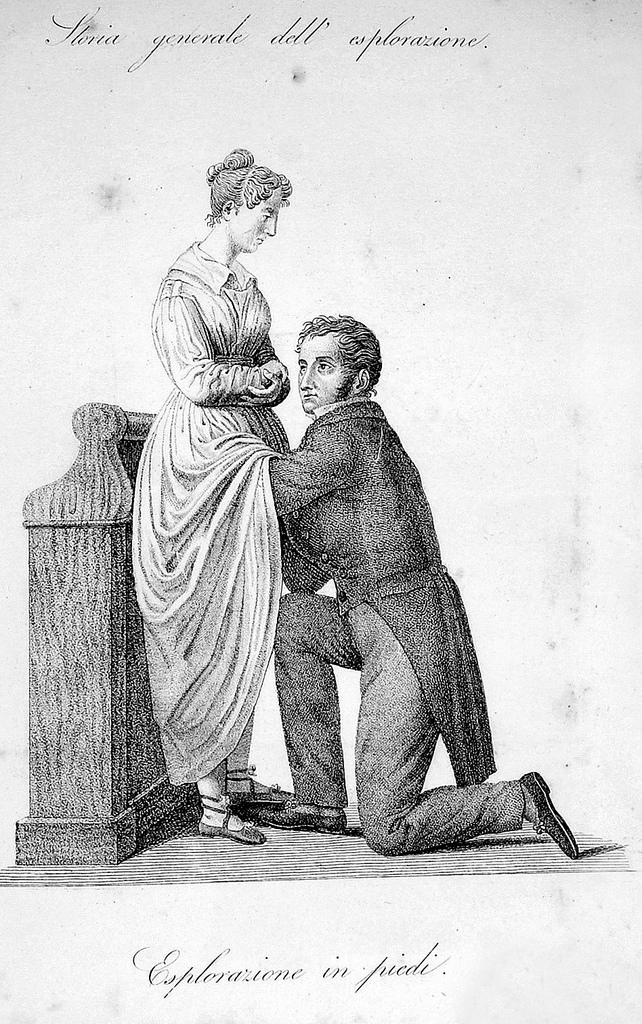
Internal examination of a woman, circa 1800
In the early 1800’s there was also a growing number of formally trained doctors who took great pains to distinguish themselves from the host of lay practitioners. The most important real distinction was that the formally trained, or “regular” doctors as they called themselves, were male, usually middle class, and almost always more expensive than the lay competition. The “regulars'” practices were largely confined to middle and upper class people who could afford the prestige of being treated by a “gentleman” of their own class. By 1800, fashion even dictated that upper and middle class women employ male “regular” doctors for obstetrical care—a custom which plainer people regarded as grossly indecent.” – Witches, Midwives, and Nurses A History of Women Healers by Barbara Ehrenreich and Deirdre English
More on the topic:
Posted in Georgian Life, jane austen, Jane Austen's World, personal hygiene, Regency Customs, Regency Life, Regency World | Tagged 19th century obstetrics, 19th century physician, Regency doctors, Regency Medical treatment, Regency medicine | 10 Comments »
Copyright (c) Jane Austen’s World. Post written by Tony Grant, London Calling.
In 1754 David Garrick became the lessee first and finally bought the house, which was to become his villa beside The Thames.
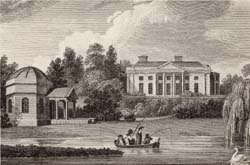
Garrick's villa, 1783
It became his country retreat and the place where he and his wife entertained friends. He began to alter the original building, which had parts that dated back to the middle ages, and employed his friend Robert Adam to redesign the façade in a classical style.Capability Brown advised on the layout of the gardens. The Kingston to Staines Road runs outside the front of the house today and it did also in the 18th century.
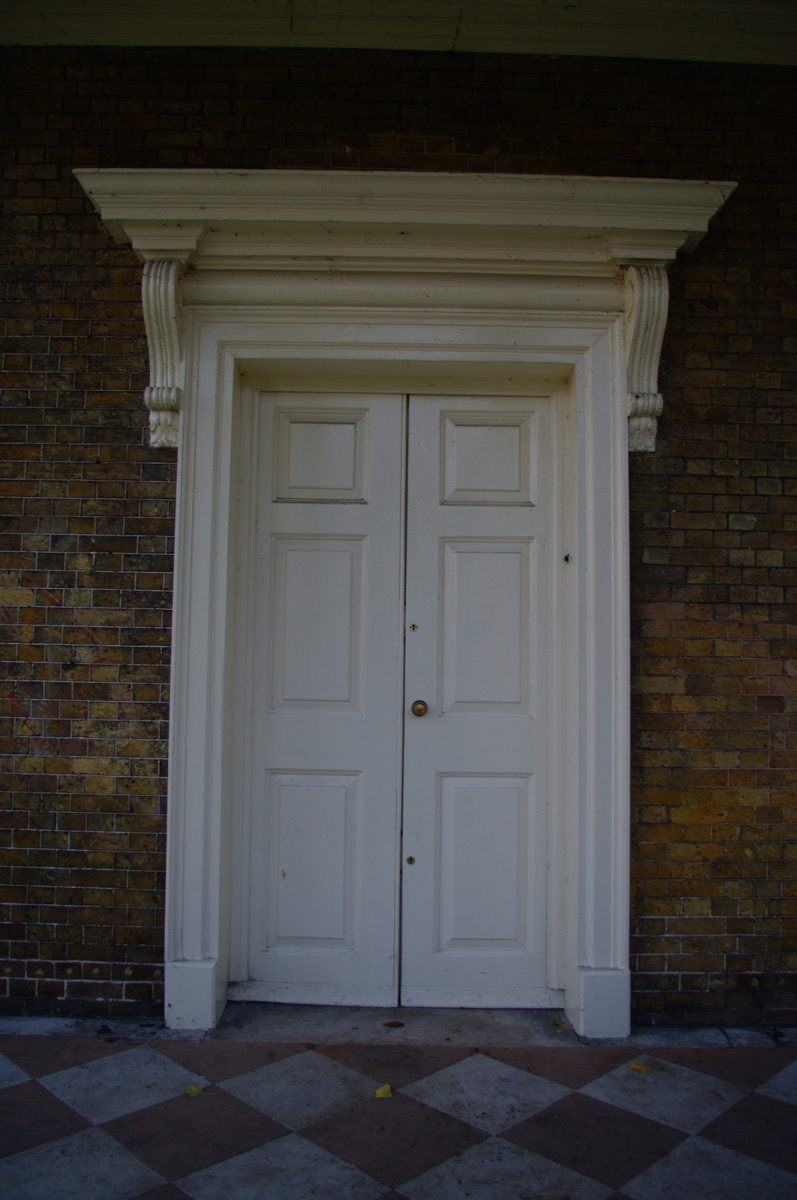
Temple doorway. Image @Tony Grant
Garrick had a tunnel dug from the front of his villa under the road to his gardens beside The Thames which today is called, Garrick’s Lawn. On this lawn, beside The Thames, Garrick had a temple to Shakespeare built. Inside was placed a very fine statue of Shakespeare designed by Roubiliac, another friend. When Garrick died, his wife Eva, gave it to the British Museum. A copy of the statue now has been placed inside the temple.
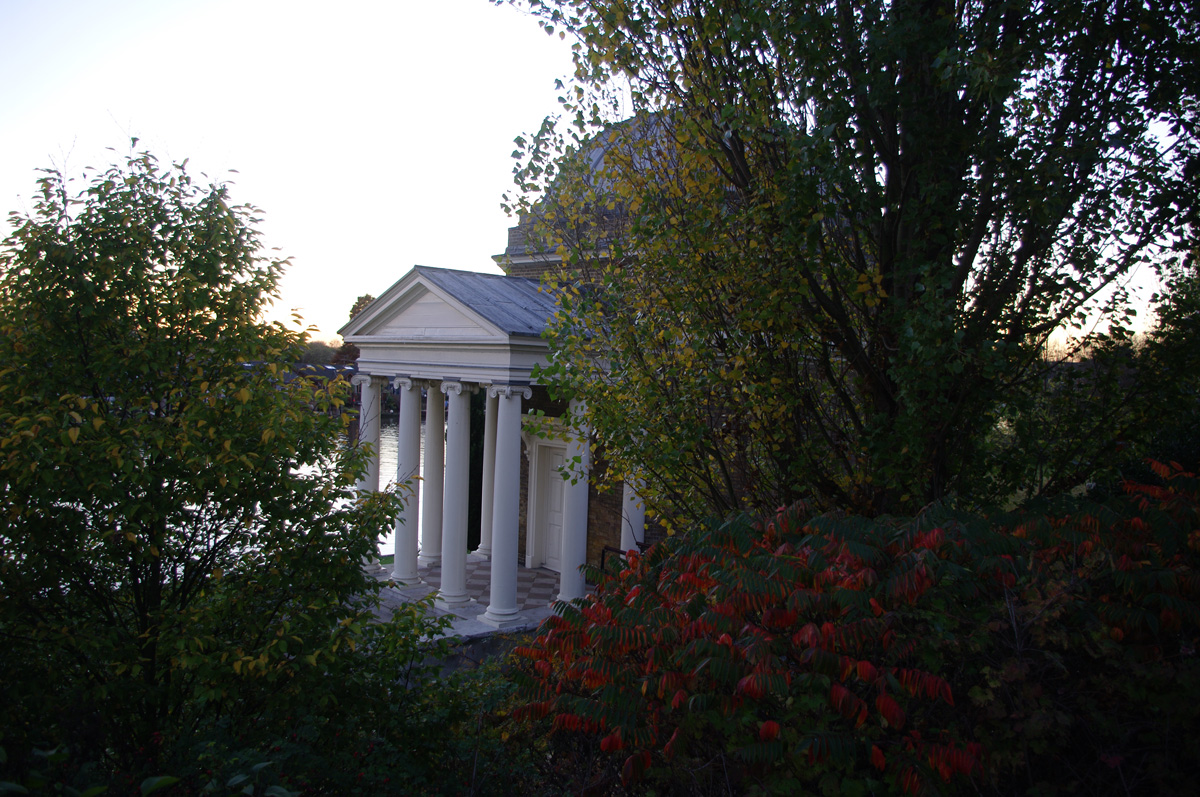
Garrick's dorric Temple. Image @Tony Grant
Garrick added an orangery at the far end of the main garden which backs onto Bushy Park. Adam also designed the orangery in the main garden with a corinthian façade and classical entablature. Garrick owned much of the farmland, which is now Bushy Park. He also bought other houses in Hampton, including Orme House in Church Street, The Six Bells pub, later named The White Heart, Garrick’s Ait, the island opposite the temple and the villa and three other aits on The Thames. Just before his death, Garrick bought The Cedars, now called Garrick House, which you drive past on the Kingston Road.
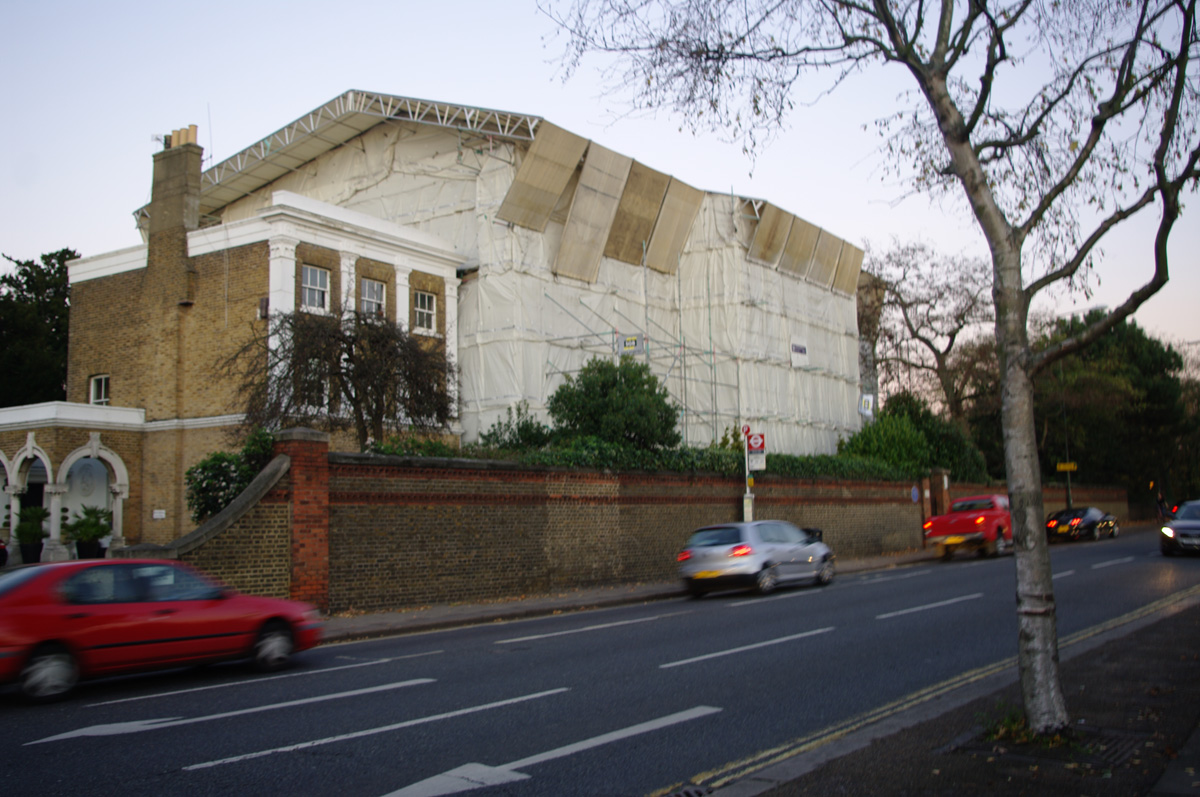
The villa under wraps after the fire. Image @Tony Grant
In 2008 some work was being done on the villa when a fire broke out. The entire roof of the grade 1 listed building collapsed. The second floor also caught fire. It took ten fire engines to bring the blaze under control and save the shell of the house. It is now undergoing extensive rebuilding. The house is a symbol of the English Theatre and must not be lost to the nation and the world.
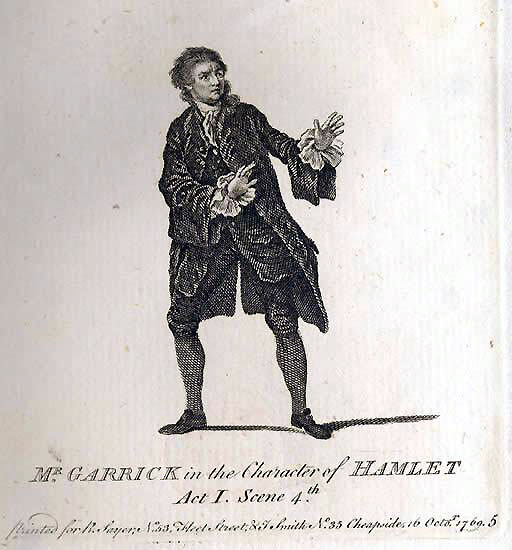
David Garrick in Hamlet. Image @Wikimedia Commons
David Garrick came from humble origins in Leicestershire. His family were Huguenot immigrants who had to struggle and fight for their survival and success. Garrick continued this need for success. He had an incredible talent as writer, actor and innovator. His greatness can only be measured by his influence on theatre and acting today.
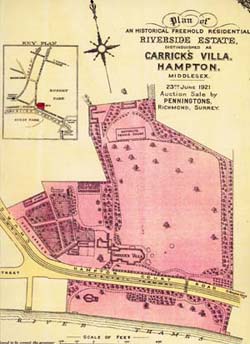
Garrick Estate Auction, 1921
What is interesting is his need to acquire property and land, to have the best in architecture and to keep acquiring, throughout his life. Was this the sign of an inner drive to stay successful, to gain security, to not allow himself to revert to lowly circumstances? Was he a driven personality? This reminds me of another driven personality, Charles Dickens, who literally worked himself to death. He too saw property and one house in particular, as a sign to himself and others that he was at the top, that he had made it.
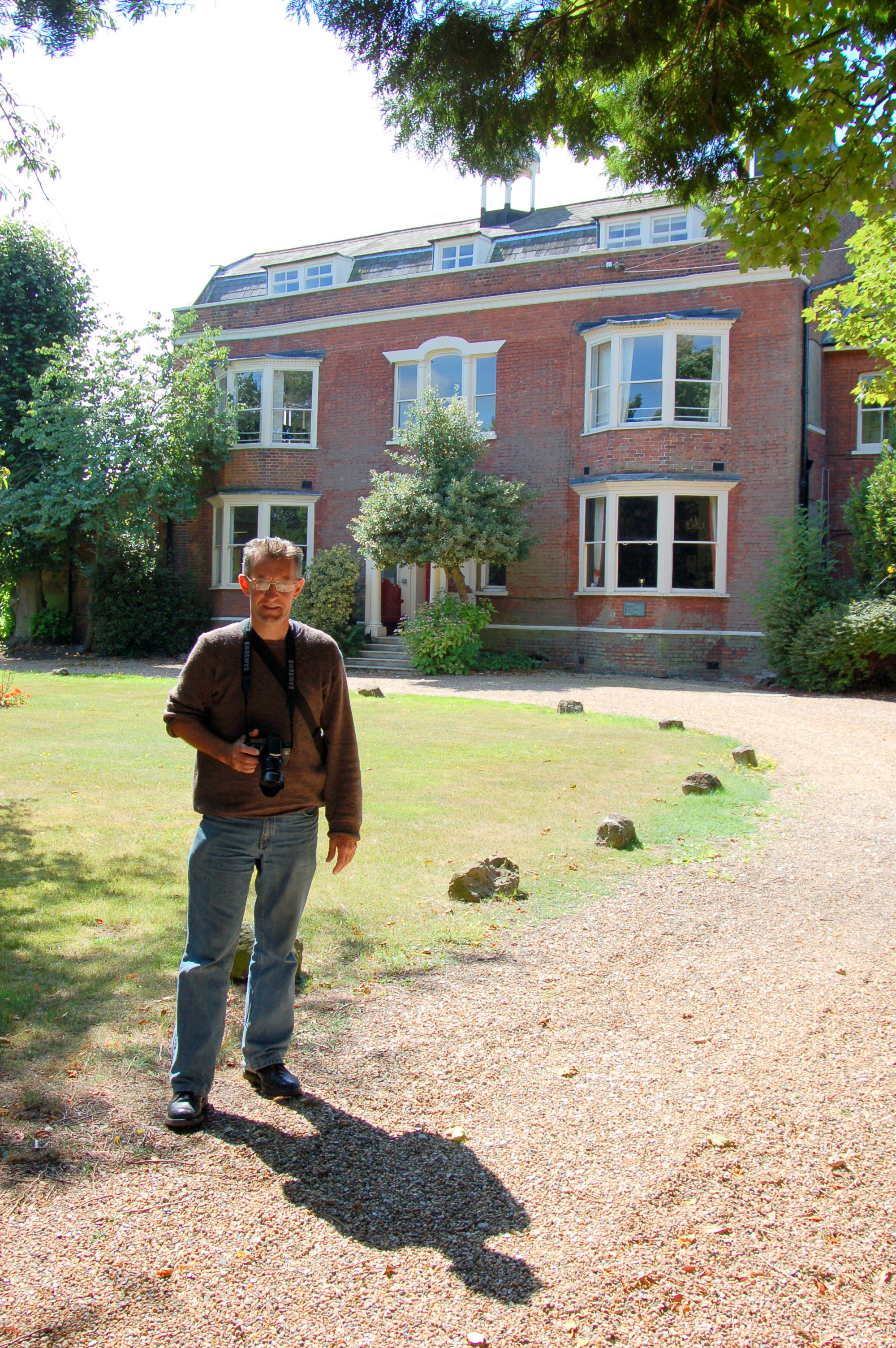
Tony Grant at Gads Hill. Image @Tony Grant
The house was Gads Hill in Kent just outside of Rochester and Chatham. After Dickens death, John Foster, a great publishing friend of Dickens wrote, “ upon first seeing it (Gads Hill) as he came from Chatham with his father and looking upon it with much admiration he had been promised that he might himself live in it or in some such house when he came to be a man, if he would only work hard enough.”
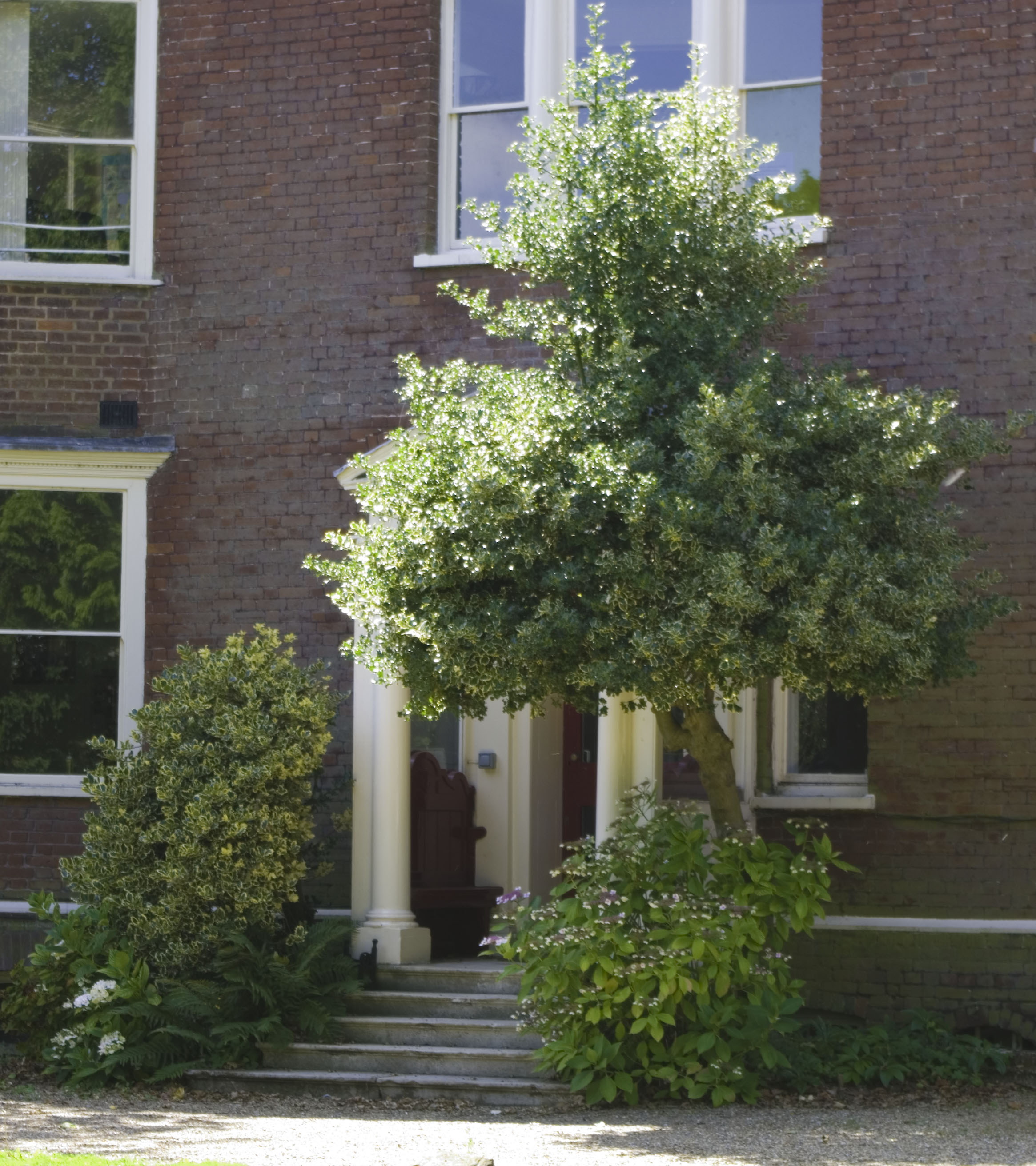
Gads Hill front door. Image @Tony Grant
Of course Dickens did work. He probably had more need to stay at the top than even Garrick. His father was notorious for getting into debt and had ended up in debtors prison. Cahrles Dickens had had to work in a blacking factory in almost slave like conditions. This affected Dickens for the rest of his life.

Ducks on the Thames. Image @Tony Grant
Both Dickens and Garrick were influenced greatly by Shakespeare. Garrick as actor and theatre owner. Garrick’s greatest performance was playing Richard III. Dicken’s house at Gads Hill was the very spot, in Henry IV part I, where Prince Hal waylays and robs Falstaff as a prank or joke. Of course Dickens absolutely loved this connection. There is another rather obscure link with Garrick. David Garrick had a tunnel dug under the road in front of his villa to get to his garden beside The Thames. Dickens purchased the land on the opposite side of the road to his house at Gads Hill and had a tunnel dug in front of his house under the road to get to it.
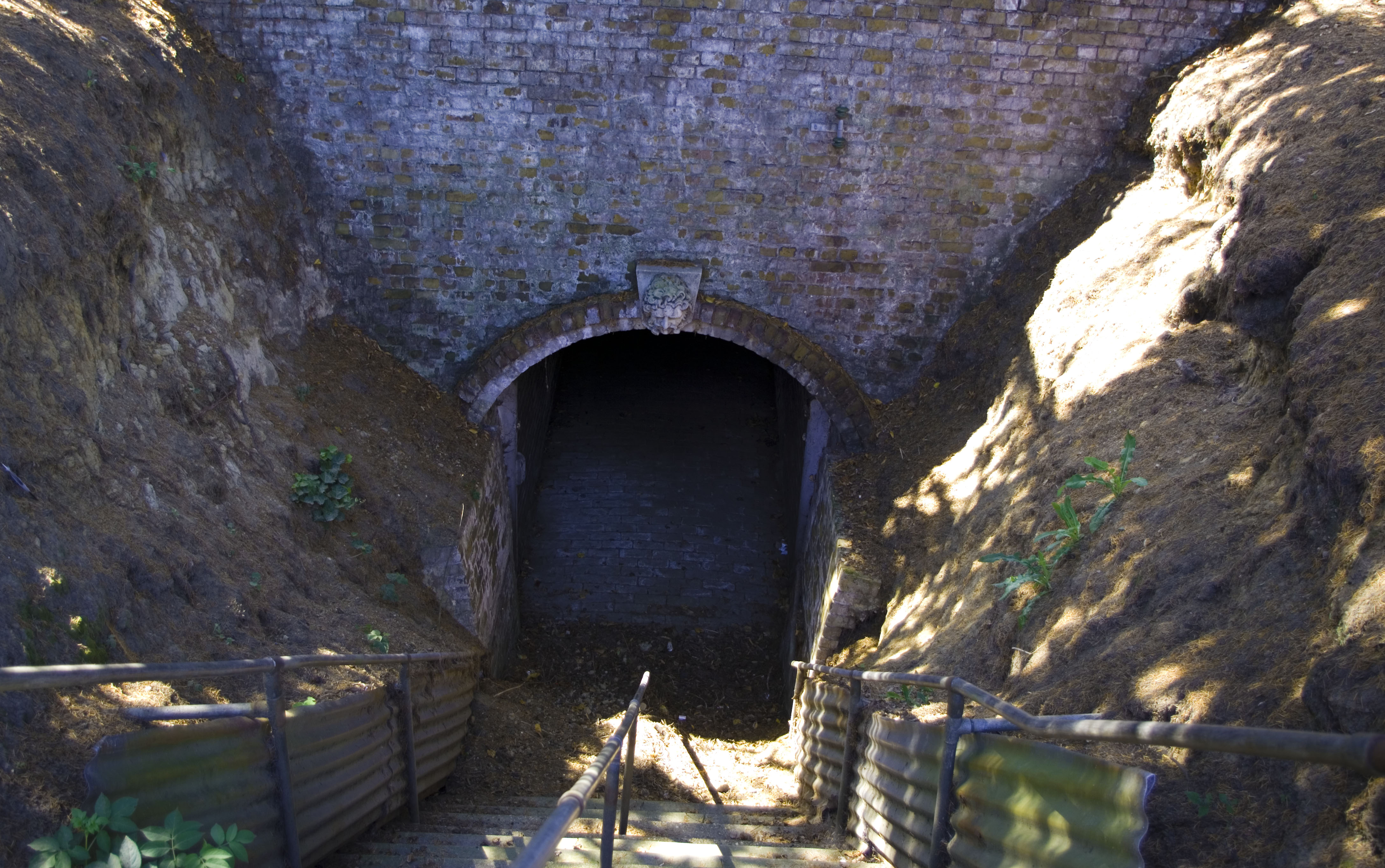
Gads Hill tunnel. Image @Tony Grant
Dickens had a small wooden Swiss Chalet built on the other side of the road where, towards the end of his life, he wrote. Passing through a tunnel to the beautiful scenery of The Thames or to a place to work could be read as having deep psychological meaning I am sure.
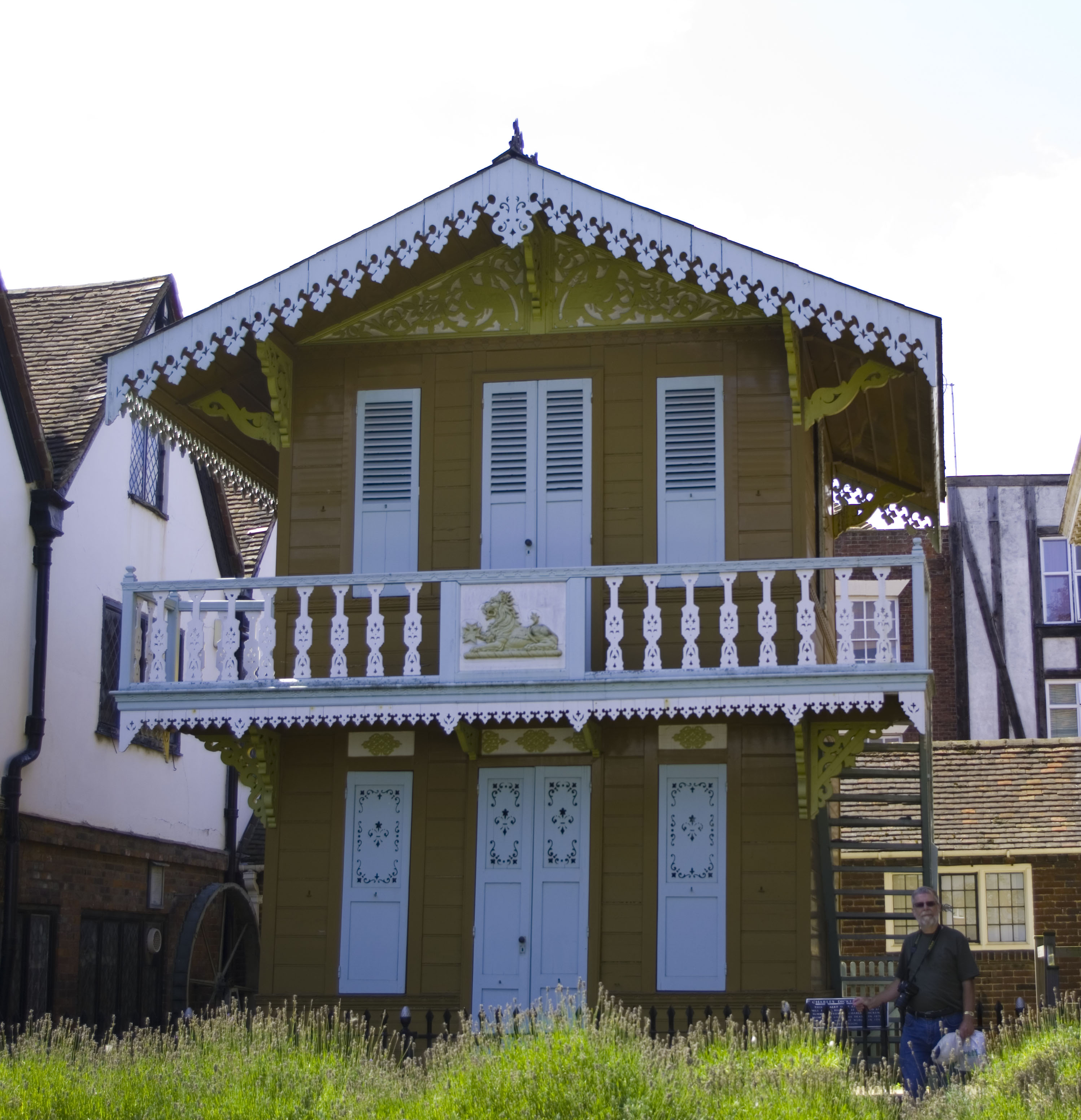
Dickens's Swiss Chalet. Image @Tony Grant
David Garrick’s villa can be seen as his badge of success. A symbol of all his striving and hard work.
Where do our middle class ambitions get us? Are we driven? Where have we come from and where do we want to go? Are we working like Garrick and Dickens to prove something? How desperate are we and are we happy with it? I wonder if Dickens was ever happy? Maybe in the heightened hyper reality that he achieved in his live readings, but that was fleeting. He was driven, so was Garrick and are we?
Garrick's villa, 1824
I know this an odd request on this site but you never know who might read this stuff. To any Hollywood Super Star out there. You owe everything, your whole profession, to David Garrick. If you have some spare cash, go on, pay for the refurbishment of Garrick’s Villa. It could be your real contribution to the world.
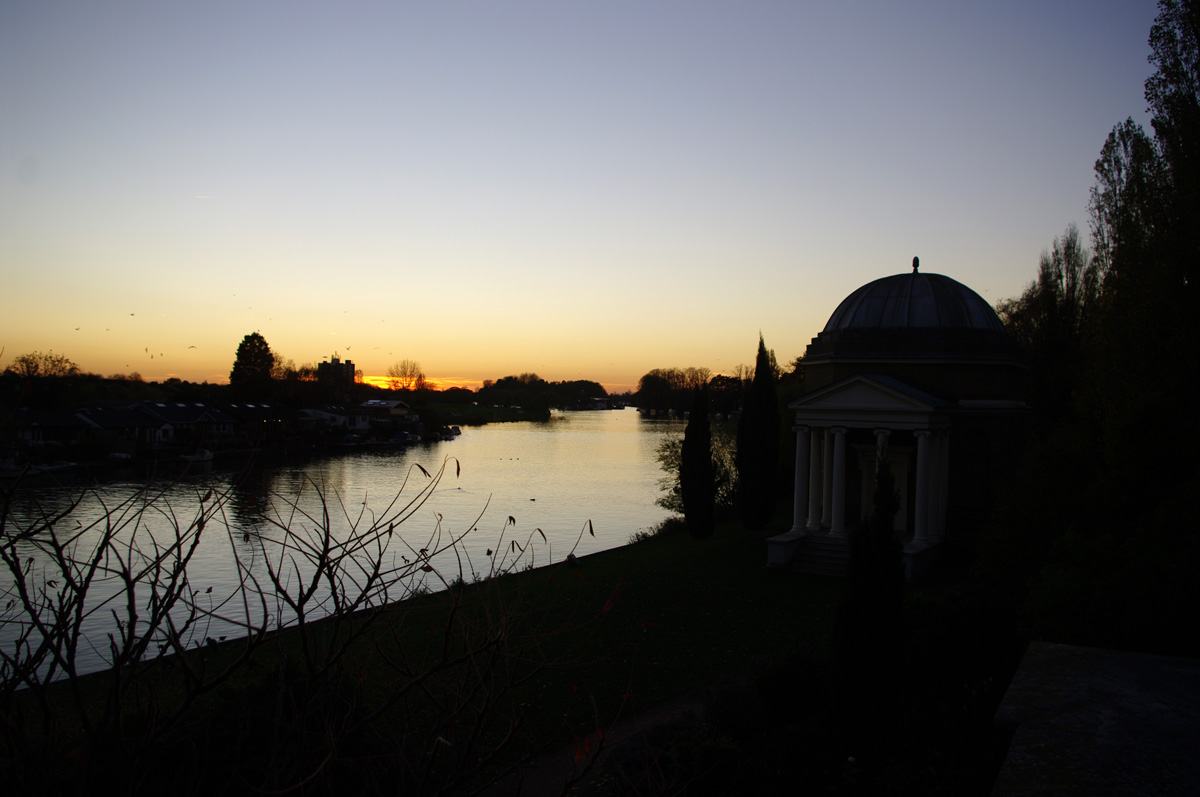
Garrick's temple, sunset. Image @Tony Grant
More on the topic:
Posted in 18th Century England, Architecture, Biography, Georgian Life, jane austen | Tagged Charles Dickens, Dave Garrick, Dickens's Swiss Chalet, Gads Hill, Garrick's villa, Shakespearean actor, Thames river | 5 Comments »
Copryright (c) Jane Austen’s World. This post is in honor of Thanksgiving and all the cooks, feminine or masculine, who toil hard in the kitchen to feed their families on this special holiday.
I am sure that the ladies there had nothing to do with the mysteries of the stew-pot or the preserving-pan” – James Edward Austen-Leigh, writing about his aunts, Jane and Cassandra Austen, and grandmother, Mrs Austen, when they lived at Steventon Rectory.
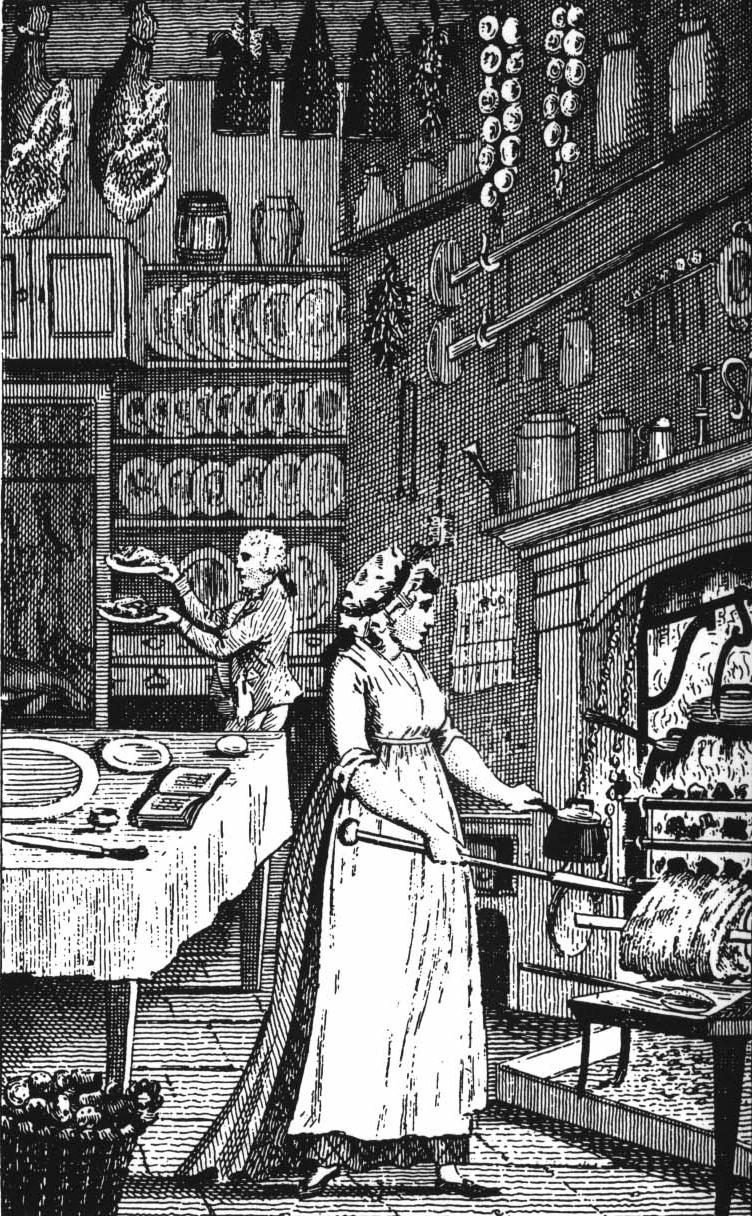
18th century kitchen servants prepare a meal. Image @Jane Austen Cookbook
In 1747, Mrs.Hannah Glasse wrote her historic The Art of Cookery Made Plain and Easy, an easy-to-understand cookbook for the lower class chefs who cooked for the rich. Her recipes were simple and came with detailed instructions, a revolutionary thought at the time.
The Art of Cookery’s first distinction was simplicity – simple instructions, accessible ingredients, an accent on thrift, easy recipes and practical help with weights and timing. Out went the bewildering text of former cookery books (“pass it off brown” became “fry it brown in some good butter”; “draw him with parsley” became “throw some parsley over him”). Out went French nonsense: no complicated patisserie that an ordinary cook could not hope to cook successfully. Glasse took into account the limitations of the average middle-class kitchen: the small number of staff, the basic cooking equipment, limited funds. – Hannah Glasse, The Original Domestic Goddess forum
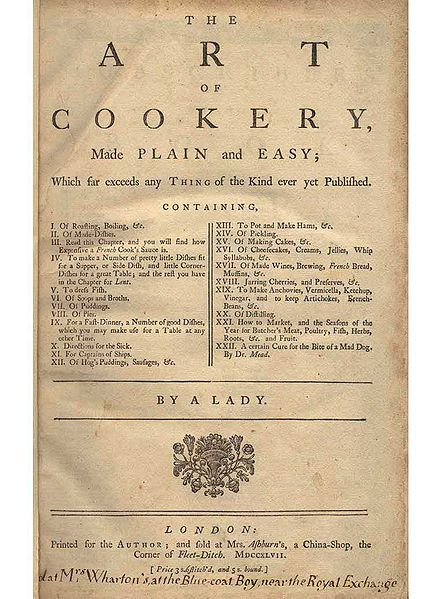
Hannah Glasse's The Art of Cookery Made Plain and Easy
Until Mrs. Glasse wrote her popular cookery book (17 editions appeared in the 18th century), these instructional books had been largely written by male chefs who offered complicated French recipes without detailed or practical directions. (To see what I mean, check Antonin Careme’s recipe for Les Petits Vol-Au-Vents a la Nesle at this link.) Like Jane Austen, Hannah signed her books “By a Lady”.
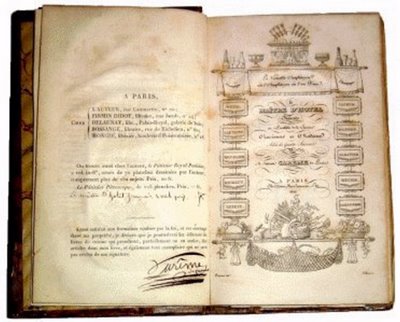
Antonin Careme's cookbook
Mrs. Glasse had always intended to sell her cookery book to mistresses of gentry families or the rising middle class, who would then instruct their cooks to prepare foods from her simplified recipes, which she collected. “My Intention is to instruct the lower Sort [so that] every servant who can read will be capable of making a tolerable good Cook,” she wrote in her preface.
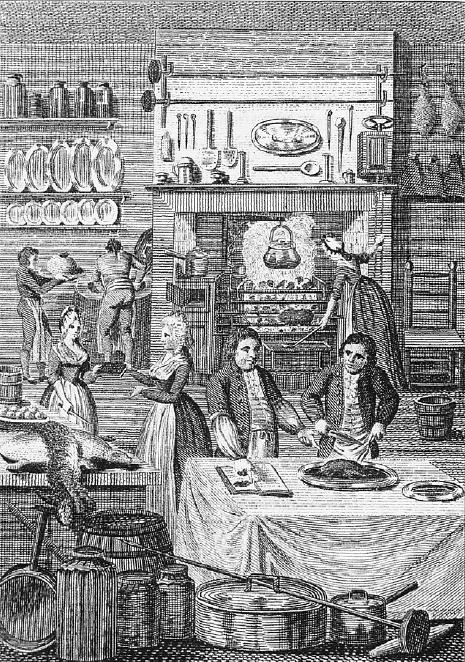
Frontispiece from William Augustus Henderson, The Housekeeper’s Instructor, 6th edition, c.1800. This same picture appeared in the very first edition of c.1791and it shows the mistress presenting the cookery book to her servant, while a young man is instructed in the art of carving with the aid of another book.*
Hanna’s revolutionary approach, which included the first known printed recipe for curry and instructions for making a hamburger, made sense. In the morning, it was the custom of the mistress of the household to speak to the cook or housekeeper about the day’s meals and give directions for the day. The servants in turn would interpret her instructions. (Often their mistress had to read the recipes to them, for many lower class people still could not read.)
In theory, the recipes from Hannah’s cookbook would help the lady of the house stay out of the kitchen and enjoy a few moments of free time. But the servant turnover rate was high and often the mistress had to roll up her sleeves and actively participate in the kitchen. Many households with just two or three servants could not afford a mistress of leisure, and they, like Mrs. Austen in the kitchens of Steventon Rectory and Chawton Cottage, would toil alongside their cook staff.
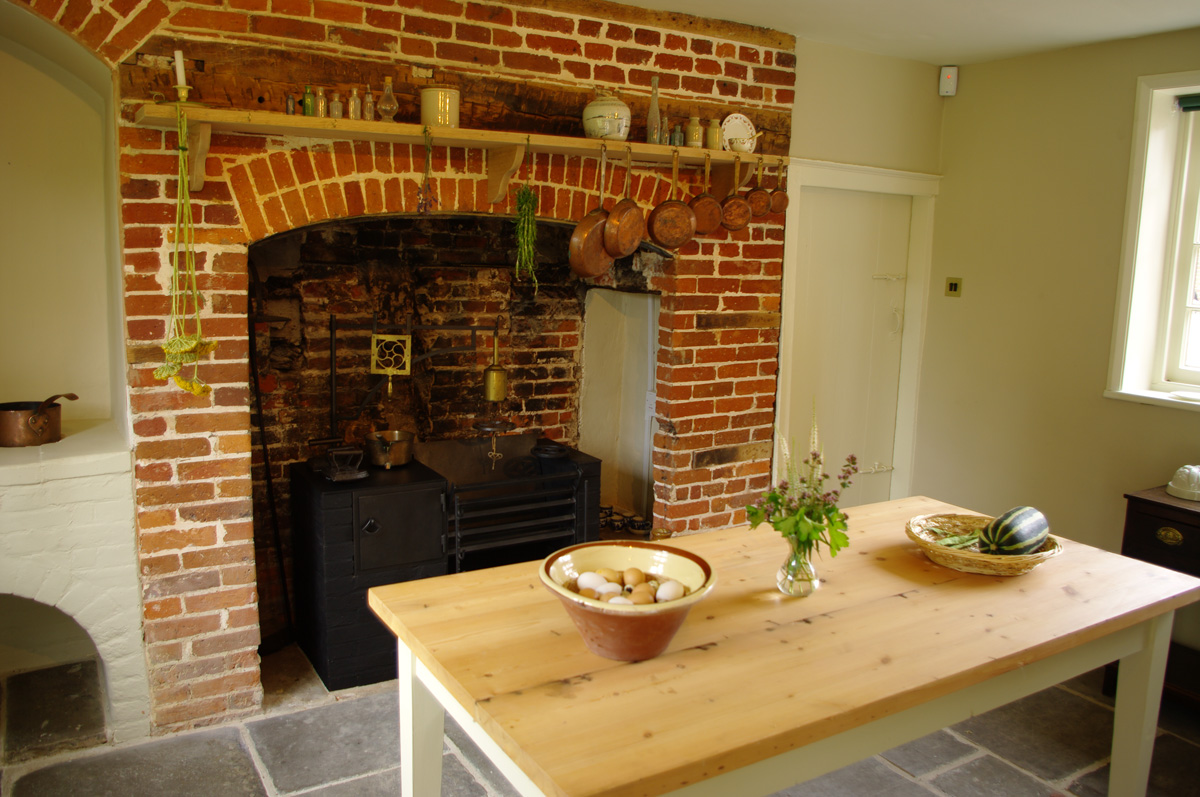
The simple kitchen at Chawton cottage. Image @Tony Grant
At the start of the 18th century the French courtly way of cooking still prevailed in genteel households. As the century progressed, more and more women like Hannah Glasse began to write cookery books that offered not only simpler versions of French recipes, but instructions for making traditional English pies, tarts, and cakes as well. Compared to the expensive cookbooks written by male chefs, cookery books written by women were quite affordable, for they were priced between 2 s. and 6 d.
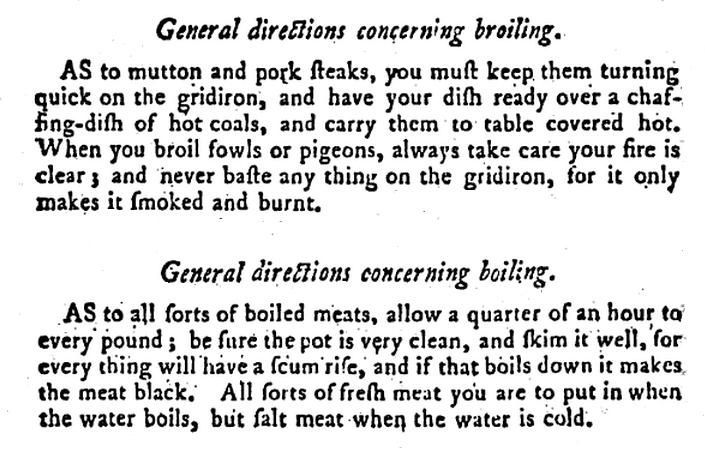
Hannah Glasse's practical directions for boiling and broiling
Publishers took advantage of the brisk trade, for with the changes in agricultural practices, food was becoming more abundant for the rising middle classes. Large editions of cheap English cookery books by a variety of female cooks were distributed to a wide new audience of less wealthy and largely female readers who had money to spend on food. Before Hannah Glasse and her cohort, cooks and housewives had been accustomed to sharing recipes in private journals (such as Marthat Lloyd’s) or handing them down by word-of-mouth.
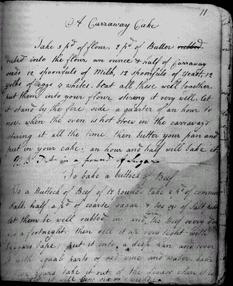
Martha Lloyd's recipe for caraway cake written in her journal.
Female authors tended to share their native English recipes in their cookery books. As the century progressed, the content of these cookery books began to change. Aside from printing recipes, these books began to include medical instructions for poultices and the like; bills of fare for certain seasons or special gatherings; household and marketing tips; etc.
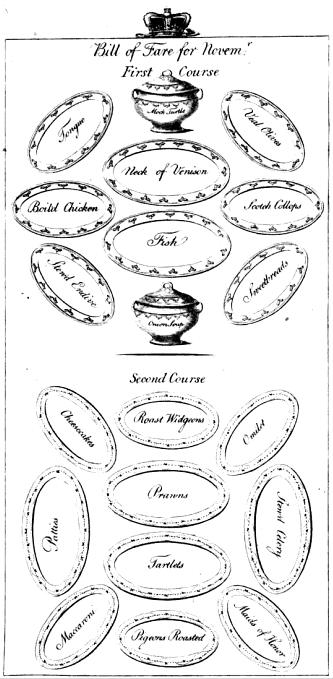
Bill of fare for November, The Universal Cook, 1792
By the end of the 18th century, cookery books also included heavy doses of servant etiquette and moral advice. At this time plain English fare had replaced French cuisine, although wealthy households continued to employ French chefs as expensive status symbols. In the mid-19th century cookery books that targeted the working classes, such as Mrs. Beeton’s famous book on Household Management, began to be serialized in magazines, as well as published in book form.
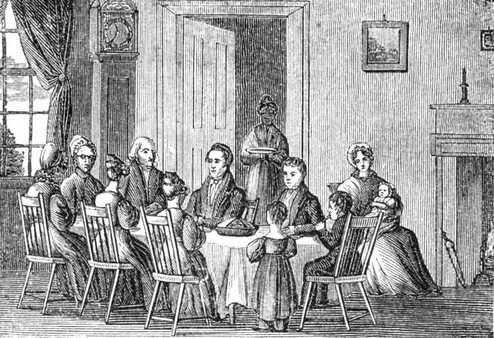
Family at meal time
Before ending this post, I would like to refer you back to James Edward Austen-Leigh’s quote at top. In contrast to what he wrote (for he did not know his aunts or grandmother well), Jane Austen scholar Maggie Lane reminds us that housewives who consulted with their cook and housekeeper about the day’s meals still felt comfortable working in the kitchen. She writes in Jane Austen and Food:
“though they may not have stirred the pot or the pan themselves, Mrs. Austen and her daughters perfectly understood what was going on within them…The fact that their friend and one-time house-mate Martha Lloyd made a collection of recipes to which Mrs. Austen contributed is proof that the processes of cookery were understood by women of their class.”
More on the topic:
Posted in 18th Century England, Georgian Life, jane austen, Old English Customs, Regency Customs, Regency food, Regency Life, Regency Period, Servants | Tagged Antonin Careme, Cassandra Austen, Hannah Glasse, Maggie Lane, Martha Lloyd, Mrs Cassandra Austen, Mrs. Beeton, The Art of Cookery Made Plain and Easy | 18 Comments »
Copryright (c) Jane Austen’s World. Post written by Tony Grant, London Calling.
For four days last week, I was working in a school in Staines near Heathrow Airport. To get there from Wimbledon I had to drive past David Garrick’s Villa and his temple to Shakespeare, at Hampton on The Thames.
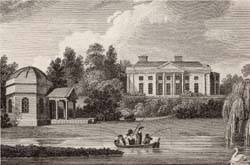
Garrick's Villa, 1783
David Garrick was an 18th century actor, playwright and owner of Drury Lane Theatre. He was innovative, and the forerunner of a new acting style. He was regarded as the greatest actor of his time and arguably is one of the great actors of all time. He had a profound interest in Shakespeare. It is easy to see connections between David Garrick and his career and the career and driven personality of Dickens. Perhaps they are both a mirror in which we can see something of ourselves.

Garrick
David Garrick was the second son of Peter and Arabella Garrick. He was born at The Angel Inn in Hereford on the 19th February 1717. For a while he was the pupil of Samuel Johnson at the little school at Edial near Lichfield. In 1773 Garrick and Johnson went to London together both with little money to support them. Garrick at first worked as a salesman in his family’s wine firm. However he turned to playwriting and acting. He write a version of, “Lethe,” that was used by Henry Giffard’s company at Drury Lane. He then joined Giffard’s company and worked at the theatre in Tankard street in Ipswich. At first Garrick took the stage name of Lyddall. On the 19th October 1741 he played Richard III at Goodman’s Fields Theatre in East London. He was an overnight sensation.
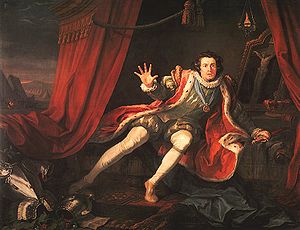
David Garrick as Richard III, 1745. William Hogarth
His acting style was new and innovative. He began a more naturalistic style. Rather than use the exaggerated bombastic style that was popular. On 28th November that year he got rid of his stage name and began to use his real name. His real name appeared on the posters advertising, “The Orphan,” in which he played the character, Chamont.. As a sign of his meteoric rise to fame within two months William Pitt decalerd that the 22 year old Garrick was the best actor the British stage had ever produced. Garrick became the dominant force in British theatre from then on.
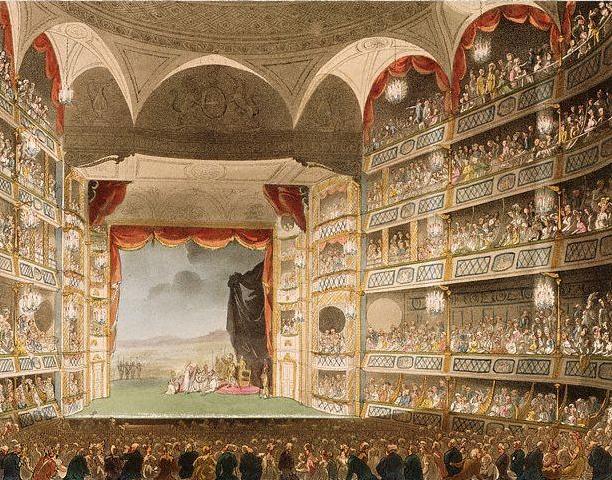
Drury Lane 1808
In 1747 with a new partner, James Lacey he took over the management of Drury Lane Theatre. For 29 years he directed repertory company in Europe. He developed new rehearsal techniques and discipline. His ideas included analysing characters, restoring the original texts of Shakespeare. Much of Shakespeare’s plays in the 18th century had been written in a bombastic and alliterative style. He didn’t always keep to Shakespeare’s original texts himself. He did tend to leave out bits and add bits to emphasise the character he was playing. Garrick was one of the leading playwrights of his day and wrote The Clandestine Marriage, Cymon, The Lying Valet and The Guardian. Garricks influence became the yardstick by which all other acting and drama was measured throughout Europe.
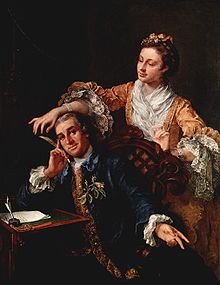
William Garrick and his wife, Eva Maria Vegel, by William Hogarth
In 1749 Garrick married the Viennese dancer, Eva Maria Vegel. They had no children and she outlived him by 43 years.They were so famous the crowned heads of Europe, the nobility and the leading figures of the London literary, art and social circles came to visit him.He owned residences at No 27 Southampton Street in Covent garden, in the Sdelphi, and his villa at Hampton on The Thames.You can imagine the elite of Europe coming to Hampton to visit garrick at his Thameside retreat, walking by The Thames, visiting his temple to Shakespeare and rowing out to the aits (river islands) Garrick owned along his stretch of the river to have sylvan parties in a beautiful natural surround.
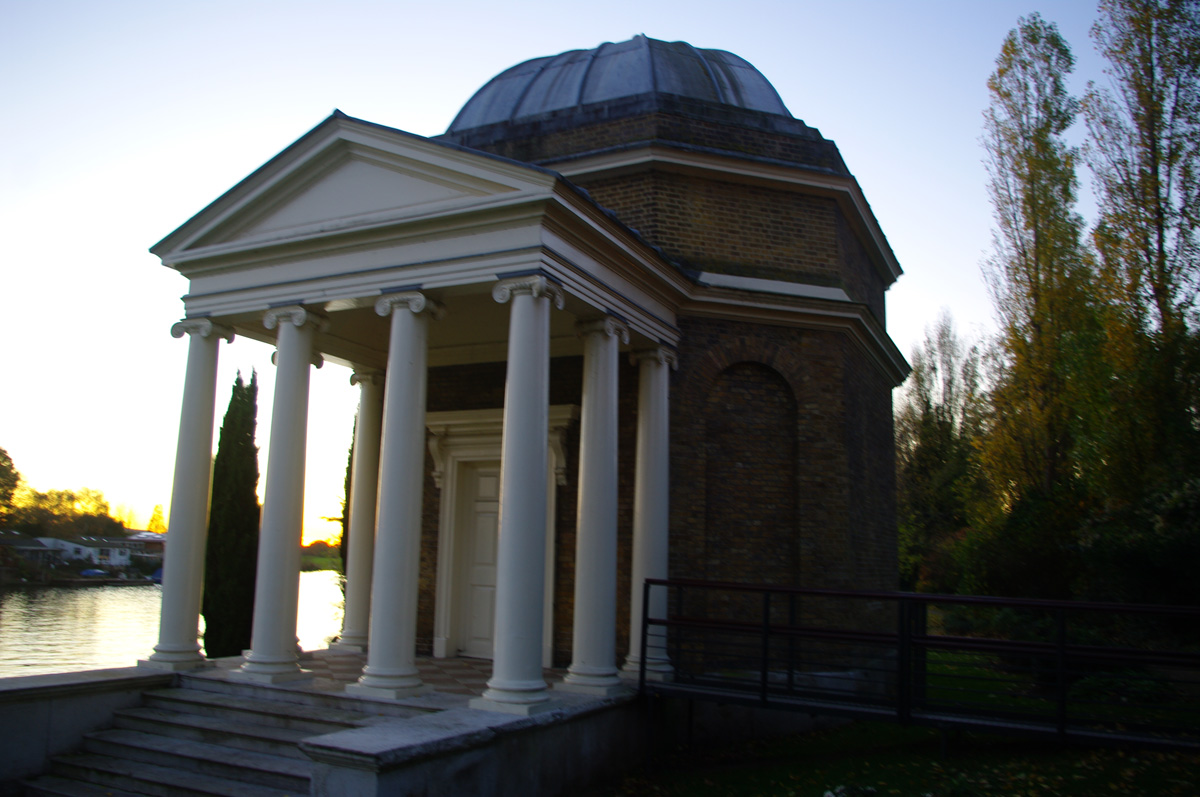
Garrick's temple close up. Image @Tony Grant
Garrick gave up Drury Lane and made his last performance at Drury Lane during a series of final performances in June 1776. He died in his house in the Adelphi on 20 th January 1779. He was buried at Poets Corner, Westminster Abbey.
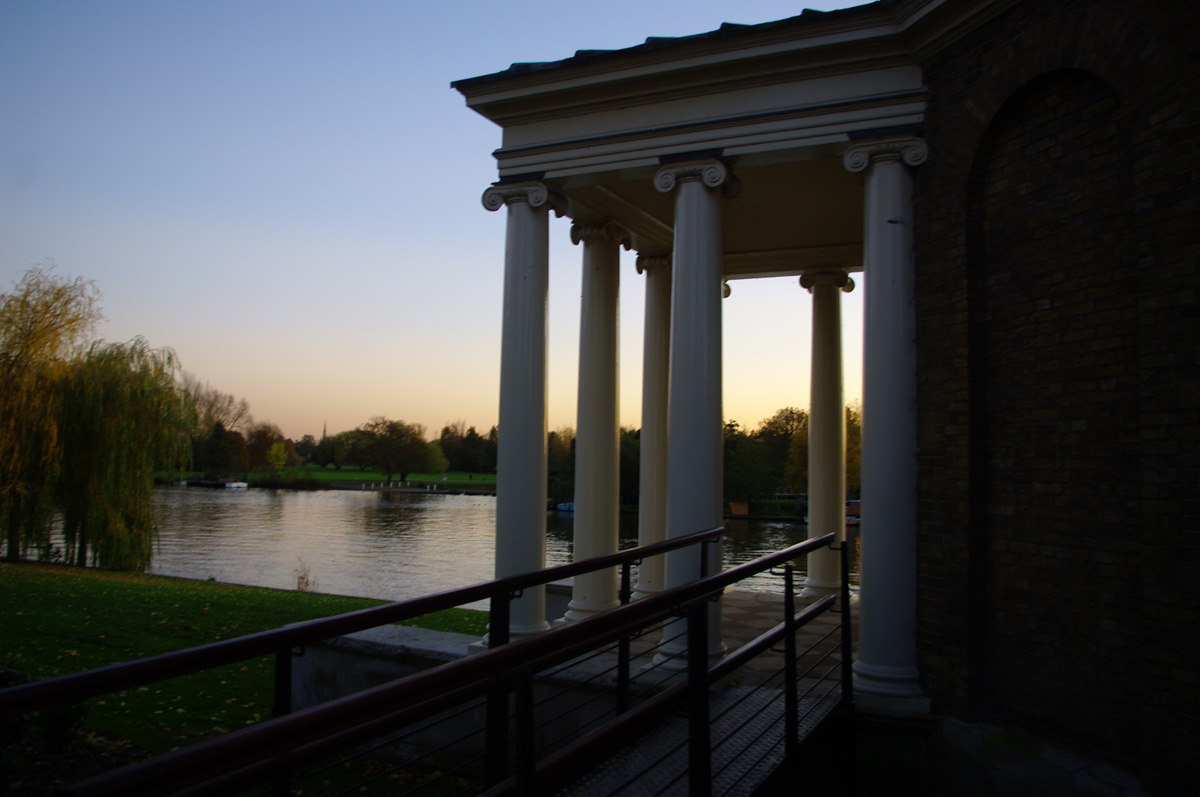
View of the Thames from the Temple. Image @Tony Grant
Gentle reader: This is the first of two articles about David Garrick by Tony Grant. The second will concentrate on the actor’s beautiful house and temple on the Thames.
Read more about the topic
Posted in 18th Century England, Architecture, Biography, Georgian Life, Georgian London, jane austen | Tagged Dave Garrick, Drury Lane Theatre, Garrick's villa, Thames river | 5 Comments »
2025 AGM in Baltimore

RECOMMENDED BOOKS AND RESOURCES



Available through December 31st, 2025. Click on image for details, and share this poster with other teachers and students!


Click on image to read the story.

Gentle readers: Please feel free to post your comments and continue the conversation! Due to SPAM, we will no longer accept comments on posts after 30 days of publication. In some instances, links will be removed from comments as well.


If you would like to share a new site, or point out an error, please email us. (Yes, we are fallible. We'll own up to our mistakes and will make the corrections with a polite smile on our faces.) Write us at

Thank you for visiting this blog. Your comments and suggestions are most welcome.
STAGE-COACH AND MAIL IN DAYS OF YORE: A PICTURESQUE HISTORY
OF THE COACHING AGE, VOL. II, By CHARLES G. HARPER. 1903. Click on this link.

Disclaimer: Our team makes no profit from this blog. We may receive books (physical or digitized) for review purposes.
Copyright Statement: © Jane Austen's World blog, 2009-2024. Unauthorized use and/or duplication of this material without express and written permission from this blog’s author and/or owners is strictly prohibited. Excerpts and links may be used, provided that full and clear credit is given to Jane Austen's World with appropriate and specific direction to the original content.
 Jane Austen's World