Feeds:
Posts
Comments

English Pleasure Gardens

It would be very pleasant to be near Sydney Gardens; we might go into the labyrinth every day. – Jane Austen to Cassandra Wednesday, January 21, 180

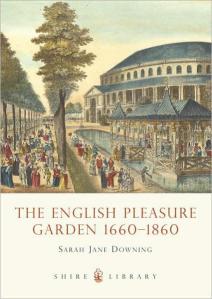
The English Pleasure Garden 1660-1860 is a small, slim volume that easily slips into my purse. I was rather skeptical that a mere 63 pages could contain very much information but I was wrong.  Sarah Jane Downing, the author, has assembled a large variety of pleasure garden images that I have not seen before, and written about the topic in a clear and readable style that was loaded with information. This book is a must for history buffs and historical romance authors who wish to write a scene set in Vauxhall or Ranelagh gardens, or perhaps in venue that is less well known, for Ms Downing writes about gardens I had not known existed.

While London’s west end boasted clean and spacious streets, the rabbit warren streets in The City were filthy, overcrowded, and dangerous. The possibility of a few hours of escape to a pleasure garden with its broad walks, decorative shrubbery, hidden bowers, music and entertainments, and fireworks drew a large number of crowds. In the 18th century, London and its environs boasted sixty-four pleasure gardens of various sizes. Aside from their obvious attraction, pleasure gardens attracted a variety of visitors from all walks of life. Aristocrats rubbed elbows with the hoi polloi, who could gain entry to even the most luxurious gardens if they could come up with one shilling for a ticket (no mean feat, for an ordinary day laborer made no more than one shilling per week.)
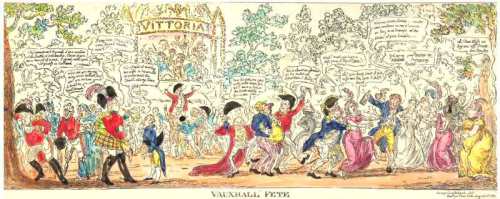
Vauxhall Pleasure Gardens

Vauxhall Pleasure Gardens

There were three kinds of public gardens people could choose from: 1) Bowling greens at pubs or tea gardens with a small but pleasant green space and limited social opportunity, 2) fashionable spa resorts that offered bowling, taking the waters, and pleasant graveled walks, and provided some entertainments, and 3) the great pleasure gardens, which were filled with glamorous and wondrous sights, and acres of lighted paths, music pavilions and private supper boxes, and arranged for a variety of fantastic entertainments, music, and dancing. The best known pleasure gardens were Vauxhall, once known as Spring Gardens, and Ranelagh Gardens, which gave Vauxhall a run for its money. Its spacious Rotunda allowed for large crowds to gather inside. Ranelagh could open in February, whereas other gardens waited until Easter.

View of a lunch party inside Ranelagh garden's famous rotunda

View of a lunch party inside Ranelagh garden's famous rotunda

Vauxhall tickets, British Museum

Vauxhall tickets, British Museum

All good things must come to an end and the gardens’ success at attracting large crowds spelled their doom. Eventually it was hard to tell the aristocrats from the poseurs, or a courtesan from a lady. As the gardens attracted an increasingly larger group of dubious people and fewer of the upper classes, their reputations suffered. Rowdy behavior, vandalism, crime, and prostitution all served to keep the “right” people away, but this development didn’t necessarily spell their death knell. They would eventually close due to competition from a distant source. The advent of cheap and rapid transportation allowed people to seek their pleasures along the grand promenades at sea side resorts, and once again the classes separated during leisure hours, each into their own niche.

This lovely little book also describes pleasure gardens outside of London – Sydney Gardens in Bath, Vauxhall Gardens in Birmingham, Tinker’s Garden in Manchester, etc. At $12.95, The English Pleasure Garden 1660-1860, loaded with color images, is a bargain. Read my post about 18th & 19th Century Pleasure and Tea Gardens in London at this link.

These links lead to more information about pleasure gardens, but they do not match the variety of information to be found in this slim volume.

Highbury, the large and populous village, almost amounting to a town, to which Hartfield, in spite of its separate lawn, and shrubberies, and name, did really belong, afforded her no equals. The Woodhouses were first in consequence there. All looked up to them. – Emma, Jane Austen, Ch 1

Read my review at this link

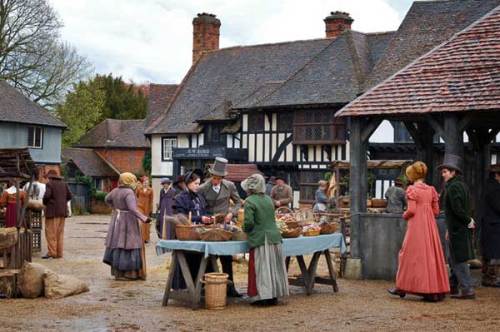
Market Day in Chilham

Market Day in Chilham

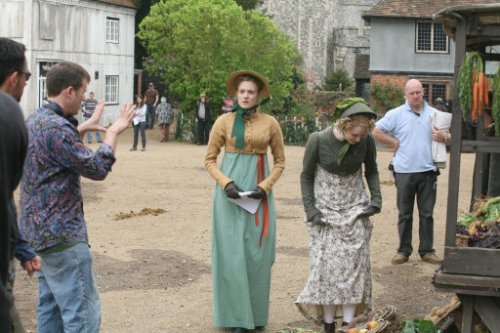
Village of Chilham: The new adaptation of Emma 2009 starring Romola Garai, uses the village of Chilham as the setting of Highbury. Click on this link to Kent Online to see a short film clip of this picturesque village.

Filming in Chilham Square

Filming in Chilham Square

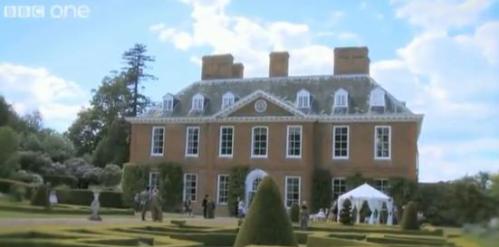
Squerryes Court was chosen to represent the Woodhouse’s home, Hartfield. The manor house was built in 1681 and has gone through extensive changes.  I visited the house during my trip to England in the mid-90’s. The guidebook states: “In the early 18th century, three pavilions to the house were built between the house and the lake. They contained the kitchens, larders, pantries, staff quarters and brew house. The distance from the kitchen to the dining-room was about ninety yards.” The pavilions were then pulled down, and wings were built at each end of the house for domestic quarters. After World War II, these wings were demolished, and the house was restored to its original form.”

Jonny and Romola in the drawing room of Squerryes Court

Jonny and Romola in the drawing room of Squerryes Court

BBC’s Press Office: “The esteemed and impressive cast also includes Michael Gambon (Cranford, Gosford Park) as Emma’s affectionate, neurotic father who unusually allows her to be mistress of their household; Jonny Lee Miller (Byron, Eli Stone, Trainspotting) as Mr Knightley, Emma’s shrewd and attractive neighbour, whose strength of character is in sharp contrast to her father; Jodhi May (Einstein And Eddington, Friends And Crocodiles) as Miss Taylor, Emma’s former governess who marries the good-humoured Mr Weston played by Robert Bathurst (Cold Feet, White Teeth, My Dad’s The Prime Minister); and Tamsin Greig (The Diary Of Anne Frank, Green Wing) as the incessantly chatty, well-meaning Miss Bates whose poverty draws the pity and goodwill of all of Highbury.

Squerryes Court as Hartfield

Squerryes Court as Hartfield

Jane AustenSir Walter Elliot, of Kellynch-hall, in Somersetshire, was a man who, for his own amusement, never took up any book but the Barontage; there he found occupation for an idle hour, and consolation in a distressed one – Persuasion
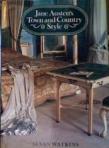
Gentle reader, it is hard to name my favorite books about Jane Austen and her era. Thankfully, Laurel Ann at Austenprose has already compiled her list to wrap up Jane Austen Sibling Week, so I only need to add in my two cents worth. Where Laurel Ann concentrated on pure biographies, I shall mention the picture books that resemble the intent of this blog in both content and form:

Lane Jane Austens WorldJane Austen’s World, Maggie Lane. When I named this blog I had no idea this book existed. Maggie, who knows the period so well, writes about Jane’s life and what daily life looked like for her and her family. The illustrations are lush, and the content is presented on two pages, so that one moves from Courtship to Travel to The Royal Navy and The Picturesque seamlessly. The information is just enough for a casual reader to learn more about the era and to steer a more determined Janeite on a world of Regency era discovery.

Watkins Town and Country StyleJane Austen’s Town and Country Style, Susan Watkins. I purchased this now well-thumbed book in England when it was first published. The cover is a lush photo of a bedroom in Stoneleigh Abbey, the ancestral seat of Cassandra Austen nee Leigh’s family. Themes covered include etiquette, the country house, architectural themes, fashion, and entertainment. The theme of this novel is the architectural settings and interior environments of the Regency era, and its pages linger over images and information about embroidery, gardens, furniture, wallpaper, architectural styles, fashion, etc.

Hughes Hallet My Dear CassandraMy Dear Cassandra, The Illustrated Letters of Jane Austen, Selected and introduced by Penelope Hughes-Hallet. Not only do Jane’s own observations come alive, but the letters are arranged in context of her life and images of the era. The format is excellent and very well done. Not all of Jane’s letters are included in this selection, but I would say that for those who have never read Jane’s letters before, this is a great introduction.

le faye jane austen the world of her novels (2)Jane Austen, The World of Her Novels by Deirdre Le Faye. I find it remarkable that each of these authors have a different perspective of Jane and her life. Yes, there is an overlap of information, but each author brings her own take on Jane to their book. Deirdre spends little time with Jane and her family, and devotes more pages to the novels, their settings, and images that evoke the era and region in which the books were set. Deirdre’s book contains more text and fewer images than the other books, but it is well organized and the illustrations help the reader to understand the unique places in which the novels are set and how they contribute to the story and characters.

Jane Austen An Illustrated Treasury DicksonJane Austen: An Illustrated Treasury by Rebecca Dickson. At first glance this seems like a coffee table book that is filled with illustrations. The book also features removable memorabilia, including handwritten letter, drafts, paintings, and more.  It looks like a fluff piece, because it is so beautifully designed, but the author discusses all of Jane’s novels in context of the age and with images that take your breath away. I found the font in the body of the main text annoying to read, but that is a minor quibble. This is a great gift for a budding Janeite fan in your family.

Obviously, there are many other excellent biographies about Jane Austen that Laurel Ann and I have not mentioned. These are just a few in my collection that the new Jane Austen fan will love. Jane Austen scholars have access to more scholarly works, and there are many new biographies that have been published in recent years. This post ends our Jane Austen Sibling week. Thank you for coming to our blogs to participate in this event. Vic

Our posts in honor of Jane Austen Sibling Week:

“We have this comfort, he cannot be a bad or a wicked child,” George Austen writing about his second son, George

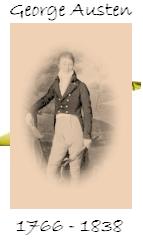
George Austen 2George Austen, Jane’s second oldest brother is an enigma, rarely glimpsed and hardly known to the world. No image exists of him, which is why the image I used for this post has no face to speak of. George Austen was thought to be mentally or physically impaired, or suffering from an infirmity. Nearly ten years older than Jane, Claire Tomalin wrote that he still lived in Steventon village in 1776 (See Boris’s comment in the comment section) and that the very young Jane knew him.
“He could walk, and he was not a Down’s Syndrome child, or he would not have lived so long, lacking modern medication. Because Jane knew deaf and dumb sign language as an adult— she mentioned talking “with my fingers” in a letter of 1808— it is thought he may have lacked language; it would not have stopped him joining in the village children’s games.” – Claire Tomalin, Jane Austen, A Biography

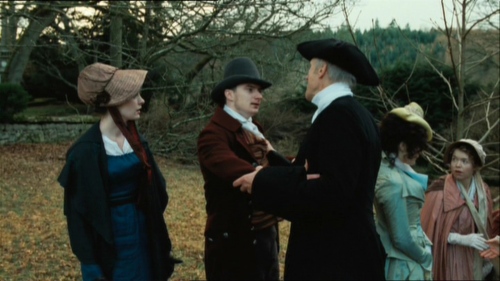
The Austens produced remarkably hardy children, for all survived their childhood. At forty-one, Jane was the youngest to die. George, who survived to a ripe old age, was cared for along with his Uncle Thomas (a mentally defective person), by Francis Cullum, who lived in Monk Sherborne, a nearby Hampshire village. Although George was not mentioned in Austen family letters, he was not totally forgotten, for the family contributed to his upkeep. The wildly sentimental film, Becoming Jane, shows George as an active member of the family, walking with Jane in the woods and attending church with them, but an article in JASNA rightly states, “It is not likely that he attended church with the Austens, as depicted in the movie.”

Jane, George, Rev. Austen, Eliza de Feuillide and Cassandra after church service in Becoming Jane.

Jane, George, Rev. Austen, Eliza de Feuillide and Cassandra after church service in Becoming Jane.

After Jane’s death, mention of George disappeared from several family sources. John and Edith Hubback in Jane Austen’s Sailor Brothers wrote: “In a family of seven all turned out well, two rose to the top of their profession, and one was—Jane Austen.”  Their math is obviously wrong. In the Memoir of Jane Austen, her nephew James Edward Austen-Leigh mentions that James was the first brother and Edward the second. This historical oversight has outraged some authors, David Nokes in particular, whose reaction is described in a Washington Post review of his book, Jane Austen: A Life:

A second “family secret” hitherto little mentioned is the existence of Jane Austen’s brother George, 10 years older than Jane, who “never learned to speak” and was boarded out for the rest of his life in another Hampshire village along with Thomas Leigh, Mrs. Austen’s mentally defective brother. This George Austen (perhaps the origin of “poor Richard” Musgrave in Persuasion) long survived his sister Jane and lived on into his seventies. David Nokes devotes an indignant last chapter to “poor George” and contrasts the Austen family’s ruthless jettisoning of him — apart from payment of a small, regular fee for his upkeep — with their family’s rather sickening adulation, after Jane’s death, of their “dear angel” Aunt Jane — whose propensity for satire and malice was almost entirely played down, while her simple religious beliefs were elevated into near-canonization.

The Loiterer cautions us about first-hand accounts, saying they can be wildly inaccurate:

“There were eight children in the family and the second brother was George and not Edward who, in fact, was the third brother. George, apparently, was epileptic and may have been deaf and dumb as well. He simply was not allowed to join the family in their home. None of Jane’s existing letters mentions him—not one single time. (In spite of his infirmities, he outlived Jane by at least ten years!) Now, there is something to give one perspective on “first-hand accounts”. – The Loiterer

Another source of outrage for David Nokes was Mrs. Austen, who died in 1823. In her will she had divided the money from her South Sea Annuities equally among the surviving Austen children, with the exception of  George.

“He, as usual, was excluded and forgotten. It was Edward Knight who, as an act of kindness, made over his share of the money ‘for the use of my brother George, being his full share of the £3,350 old South Sea Annuities. – David Nokes, p. 525

Francis Cullum, George caretaker, died in the spring of 1834. After his death, his son George took over the responsibilities of caring for George Austen, who died of dropsy in 1838. Once again, David Nokes writes with melodramatic flourish about the loving way in which Jane’s memory was perpetuated by her family, even as they neglected poor George:

“Less than twenty miles away [from Jane’s grave], Jane’s brother George was laid to rest in an unnamed grave in the churchyard of All Saints church, Monk Sherborne. In death, as in life, he was to be forgotten, his remains unmarked by any stone. Only George Cullum was in attendance at George Austen’s death. It was he who noted for the death certificate that George Austen was ‘a gentleman’. – Nokes, p. 526

I cannot express how much I disagree with David Nokes in this instance. The Austens arranged to have George and Cassandra’s brother, Thomas Leigh, looked after by a caring family, and supported these two family members financially. One imagines that with eight children, a boarding school, a small plot of land to tend to with chickens and a cow, and two livings as a clergyman, that the two elder Austens had their hands full overseeing their burgeoning household. The addition of a special needs child who required constant care would have added a great strain to their living situation.

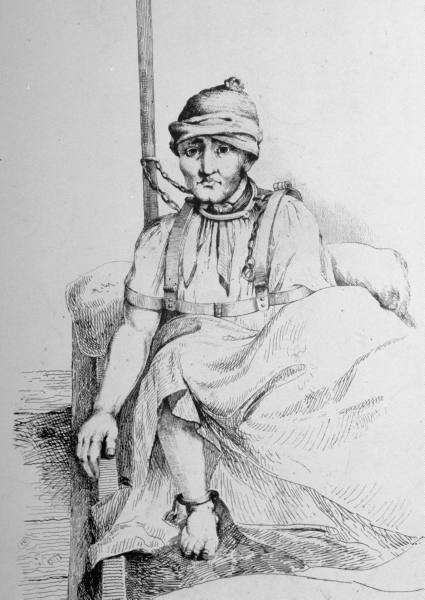
Bedlam inmate shackled in irons, Bethelehem Royal Hospital, London

Bedlam inmate shackled in irons, Bethelehem Royal Hospital, London

This was an age where few asylums for the mentally disabled or the physically disabled existed. People with infirmities were looked upon as defectives and many became sideshows at fairs or carnivals, or as beggars on the streets. It was a custom at this time to visit Bedlam and stare at the people in the lunatic asylum. In fact, there were very few institutions available during this era for people of special needs and very few places that could take them in. Bedlam was the only hospital of its kind in London during Jane’s lifetime. Workhouses and almshouses were the only other places where the physically and mentally handicapped could be deposited, and these were places that people strove to avoid at all cost. In addition, there has been a history since the beginning of time in almost all cultures that looked the other way when parents left their defective babies in the wild to die. (This situation still exists today.) Unlike David Nokes, my conclusion is that, given the era the Austens lived in, the family behaved in a remarkably responsible manner towards George, who lived a quiet life of peace and relative comfort for 72 long years. As for the inaccuracies in later biographies written by Austen family members, one wonders how effectively George had been hidden from view. Out of sight is out of mind, and these mistakes of omittance may well have been the natural result of – as David Nokes accused the Austens of doing – the extended family forgetting that George had ever existed.
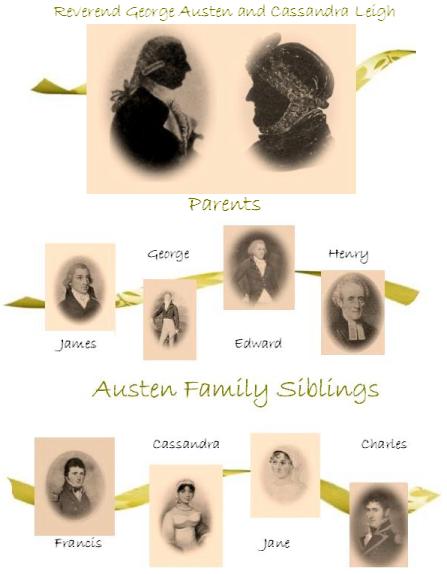
Austen family

Gentle reader: In honor of JASNA’s annual meeting in Philadelphia this week, this blog, Austenprose, and Jane Austen Today have devoted posts to Jane Austen and her siblings. This is the last of seven articles devoted to her brothers and sisters. Tomorrow, Laurel Ann and I will recommend several biographies on Jane Austen.

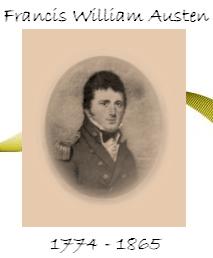
francis william austen

My dearest Frank, You will be glad to hear that every copy of  S. and S. is sold, and that it has brought me £140 besides the copyright, if that should ever be of any value.

In 1788,  14 ½ year-old Frank Austen prepared to put out to sea and leave his family. After excelling in his courses at the Portsmouth Naval Academy, the Commissioner of the Dockyards recommended that Frank join the Perserverance under the direction of Cornwallis, who was recently appointed Commander-in-Chief of India. The letter that young Francis received from his father, Rev.  George Austen, upon his departure was one that he would treasure for the rest of his life. In part, the Reverend wrote:

As you have hitherto, my dear Francis, been extremely fortunate in making friends, I trust your future conduct will confirm their good opinion of you; and I have the more confidence of this expectation because the high character you acquired at the Academy for propriety of behaviour and diligence in your studies, when you were so much younger and had so much less experience, seems to promise that riper years and more knowledge of the world will strengthen your naturally good disposition. That this may be the case I sincerely pray, as you will readily believe when you are assured that your good mother, brothers, sisters and myself will all exult in your reputation and rejoice in your happiness …

Ten years later, Jane would write with exultation:

My dear Cassandra, Frank is made. He was yesterday raised to the rank of Commander and appointed to the Petterel sloop, now at Gilbraltar. – Dec 28, 1798

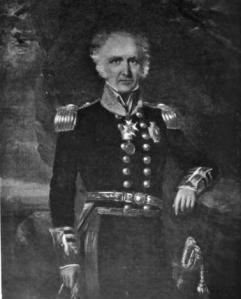
Vice Admiral Sir Francis Austen

Vice Admiral Sir Francis Austen

By 1800, Frank, was still single, although his captain’s salary would enable him to marry and support a family in reasonable comfort. The letter Jane would write him on January 21, 1805 was heartbreaking:

My dearest Frank

I have melancholy news to relate, & sincerely feel for your feelings under the shock of it.—I wish I could better prepare you for it. But having said so much, your mind will already forestall the sort of event which I have to communicate.—Our dear Father has closed his virtuous & happy life, in a death almost as free from suffering as his Children could have wished. He was taken ill on Saturday morning, exactly in the same way as heretofore, an oppression in the head, with fever, violent tremulousness, & the greatest degree of Feebleness….towards the Evening however he got better, had a tolerable night, & yesterday morning was so greatly amended as to get up & join us at breakfast as usual, & walk about with only the help of a stick, & every symptom was then so favourable that when Bowen saw him at one, he felt sure of his doing perfectly well. But as the day advanced, all these comfortable appearances gradually changed; the fever grew stronger than ever, & when Bowen saw him at ten at night, he pronounc’d his situation to be most alarming. At nine this morning he came again—& by his desire a Physician was called in;—Dr. Gibbs—But it was then absolutely a lost case—. Dr. Gibbs said that nothing but a Miracle could save him, and about twenty minutes after Ten he drew his last gasp…My Mother bears the Shock as well as possible; she was quite prepared for it, & feels all the blessing of his being spared a long Illness. My Uncle & Aunt have been with us, & shew us every imaginable kindness. And tomorrow we shall I dare say have the comfort of James’s presence, as an express has been sent to him. Adieu my dearest Frank. The loss of such a Parent must be felt, or we should be Brutes—. I wish I could have given you better preparation—but it has been impossible. Yours Ever affectly – J A.

The news must have been a great blow to Frank, who sailed the world over and only saw his family sporadically. Perhaps his grief was somewhat ameliorated by Jane’s next letter a little over a week later:

My mother has found among our dear father’s little personal property a small astronomical instrument, which she hopes you will accept for his sake. It is, I believe, a compass and sundial, and is in a black shagreen case…Yours very affecly, JA.

When Frank asked Miss Mary Gibson to marry him, Jane and Cassandra discovered that they liked her extremely well. Their cordial relationship had an opportunity to flourish after Rev. George Austen’s death. Frank invited his mother and sisters to live with him and his bride in Southampton from 1806 to 1808.  It was to be a mutually beneficial arrangement, for Frank did not want his young wife to be alone while he was away on his next voyage. He rented a house in Castle Square  with a fine garden and a view across Southampton Water to the Isle of Wight, which Jane found very much to her liking. The invitation included the Austen women’s close friend, Martha Lloyd, sister to James Austen’s wife Mary.

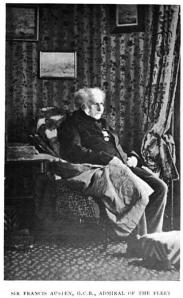
Sir Francis Austen lived until 1865, well into the age of photography

Sir Francis Austen lived until 1865, well into the age of photography

Unfortunately, like Edward’s wife Elizabeth, Mary did not survive into old age and died after the birth of her 11th child in 1823.  In an ironic turn of events, Frank asked Martha Lloyd to be his second wife in 1828 and she accepted. By any stretch of the imagination, Frank’s career was illustrious. He eventually achieved Knighthood as Sir Francis Austen and rose to the position of Admiral of the Fleet. Jane last saw her brother in the New Year of 1817, when a lull in her fatal illness allowed her to visit Frank and his large rambunctious family in Alton.

Thirty-five years after her death there came also a voice of praise from across the Atlantic. In 1852 the following letter was received by her brother Sir Francis Austen:

Boston, Massachusetts, U.S.A., 6th Jan. 1852

Since high critical authority has pronounced the delineations of character in the works of Jane Austen second only to those of Shakspeare, trans-atlantic admiration appears superfluous; yet it may not be uninteresting to her family to receive an assurance that the influence of her genius is extensively recognised in the American Republic, even by the highest judicial authorities. The late Mr Chief Justice Marshall, of the supreme Court of the United States, and his associate Mr Justice Story, highly estimated and admired Miss Austen, and to them we owe our introduction to her society. For many years her talents have brightened our daily path, and her name and those of her characters are familiar to us as ‘household words’. We have long wished to express to some of her family the sentiments of gratitude and affection she has inspired, and request more information relative to her life than is given in the brief memoir prefixed to her works.

Having accidentally heard that a brother of Jane Austen held a high rank in the British navy, we have obtained his address from our friend Admiral Wormley, now resident in Boston, and we trust this expression of our feeling will be received by her relations with the kindness and urbanity characteristic of Admirals of her creation. Sir Francis Austen, or one of his family, would confer a great favour by complying with our request. The autograph of his sister, or a few lines in her handwriting, would be placed among our chief treasures.

The family who delight in the companionship of Jane Austen, and who present this petition, are of English origin. Their ancestor held a high rank among the first emigrants to New England, and his name and character have been ably represented by his descendants in various public stations of trust and responsibility to the present time in the colony and state of Massachusetts. A letter addressed to Miss Quincey, care of the Honble Josiah Quincey, Boston, Massachusetts, would reach its destination.

Sir Francis Austen returned a suitable reply to this application; and sent a long letter of his sister’s, which, no doubt, still occupies the place of honour promised by the Quincey family. – A Memoir of Jane Austen by her nephew, Chapter IX

More links:

Gentle reader: In honor of JASNA’s annual meeting in Philadelphia this week, this blog, Austenprose, and Jane Austen Today will be devoting posts to Jane Austen and her siblings. Look for new links each day.