This Jane Austen blog brings Jane Austen, her novels, and the Regency Period alive through food, dress, social customs, and other 19th C. historical details related to this topic.
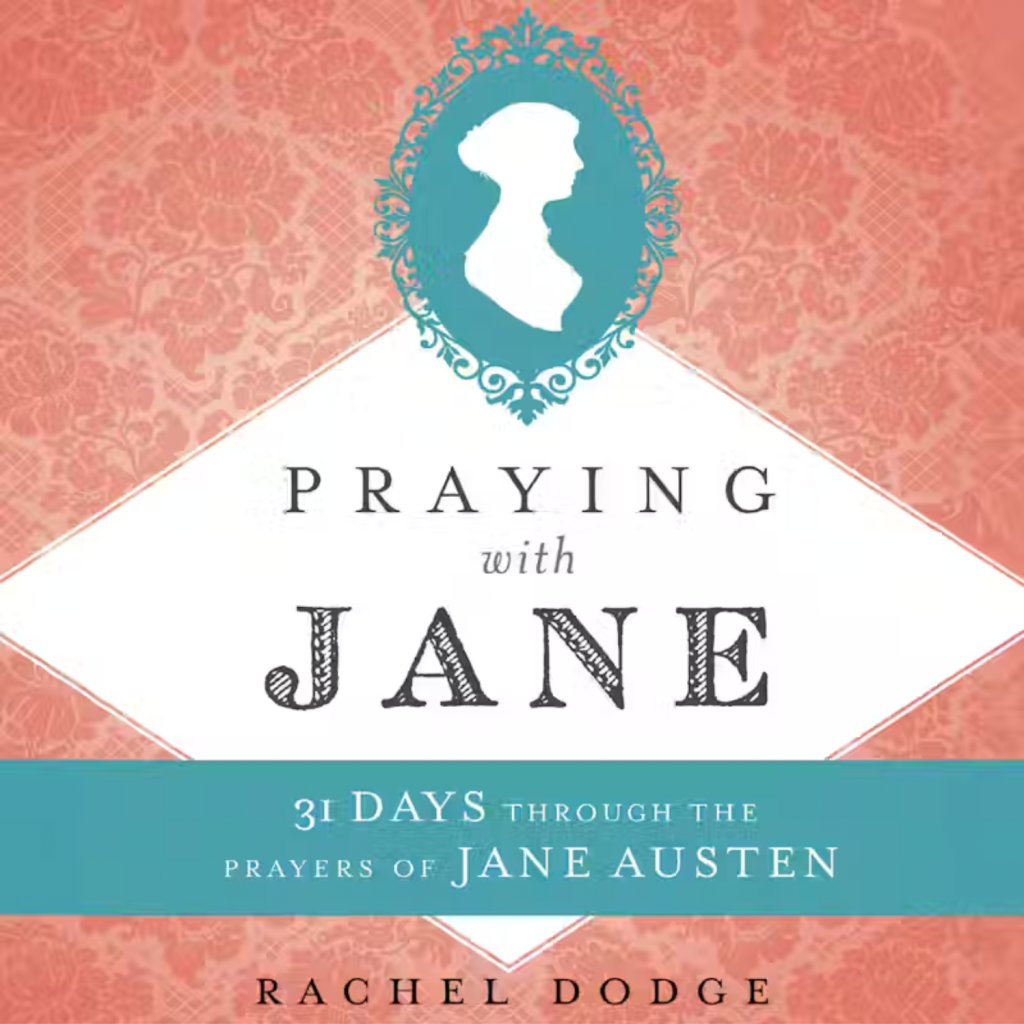
In honor of Jane Austen’s 250th anniversary year, I’m happy to announce a new audiobook project: The Praying with Jane Audiobookfeaturing narration by actress Amanda Root and author Rachel Dodge (yours truly). Published by ONE Audiobooks, this title is available on all major audiobook platforms.
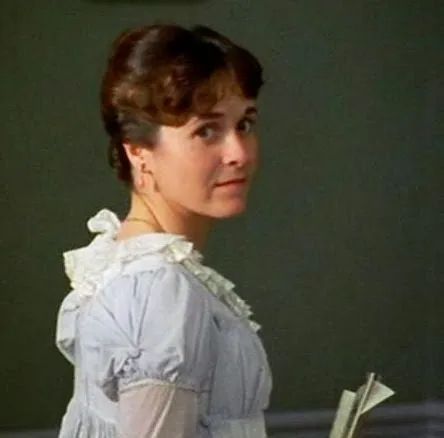
Amanda Root is best known by Austen fans around the world for her starring role as Anne Elliot in the acclaimed 1995 BBC adaptation of Jane Austen’s Persuasion. Root claimed audience hearts opposite Ciarán Hinds, as Captain Wentworth, and has held them ever since.
Proceeds from this anniversary project will be donated directly to the Jane Austen House Museum to further Jane Austen’s lasting legacy.
Persuasion film adaptation with Amanda Root (1995).
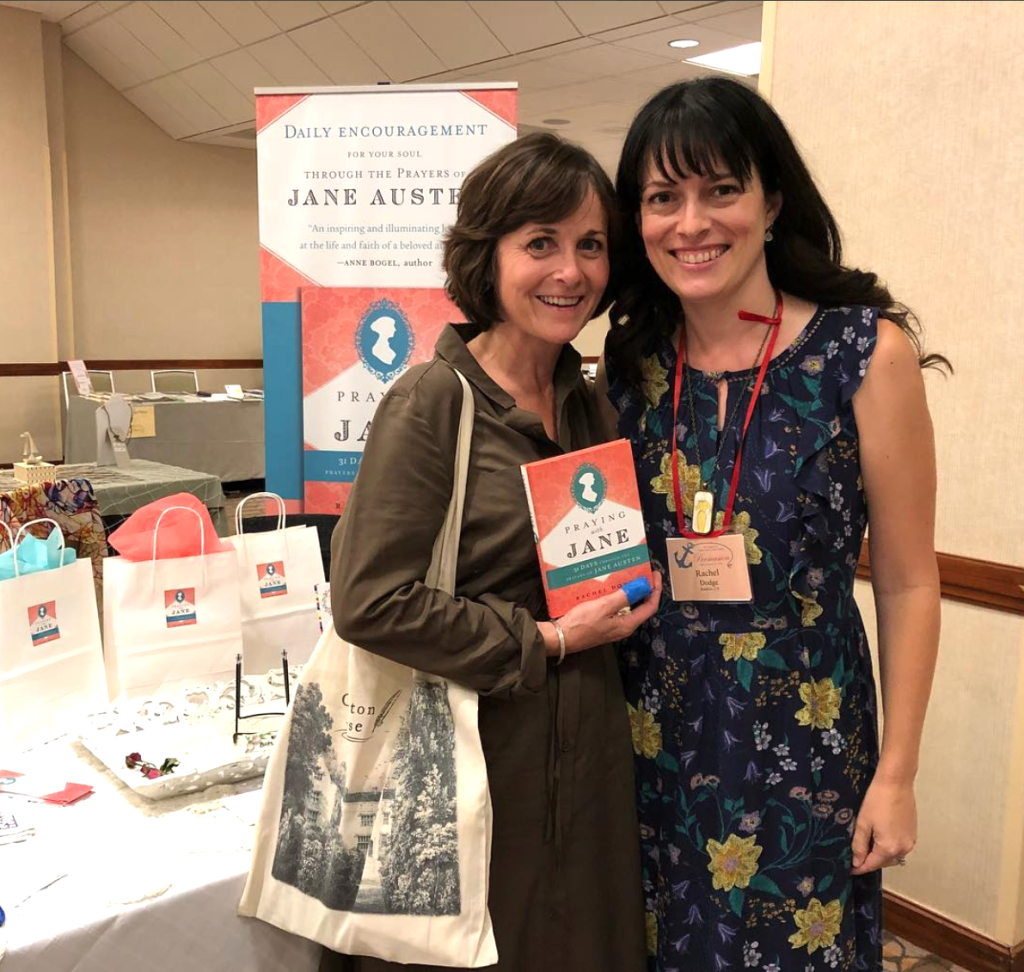
Amanda Root and Rachel Dodge, Kansas City AGM.
Audiobook Description
In this 31-day devotional, you will get an in-depth look at Jane Austen’s prayers. Her faith comes to life through her exquisite prayers, touching biographical anecdotes, intimate excerpts from family letters and memoirs, illuminating scenes from her novels, and spiritual insights. Austen’s prayers read by British film and voice actress Amanda Root; text read by author Rachel Dodge.
You can listen to a sample of Jane Austen’s Prayer 1 here, read by actress Amanda Root:
Proceeds will be donated to the Jane Austen House Museum.
Amanda Root Bio
Amanda Root is an English stage and screen actress and a former voice actress for children’s programs. Root is known for her starring role in the 1995 BBC film adaptation of Jane Austen’s Persuasion, her role in the British TV comedy All About Me (2002), as Miranda, alongside Richard Lumsden in 2004, and for voicing Sophie in The BFG (1989). She trained for the stage at Webber Douglas Academy of Dramatic Art. (IMBD Mini Bio)
Many Austen fans enjoy viewing various early editions of Pride and Prejudice – and many of us are familiar with the famous “Peacock” edition. I recently had the opportunity to hold and examine a very early “Peacock” edition in my very own hands. (It was beautiful!!! I may have squealed in my head.)
During this 250th celebration year of Austen’s delightful works, I thought a little trip down “Peacock Lane” might be in order! This beautiful edition has a rich history and has contributed to Austen’s lasting legacy.
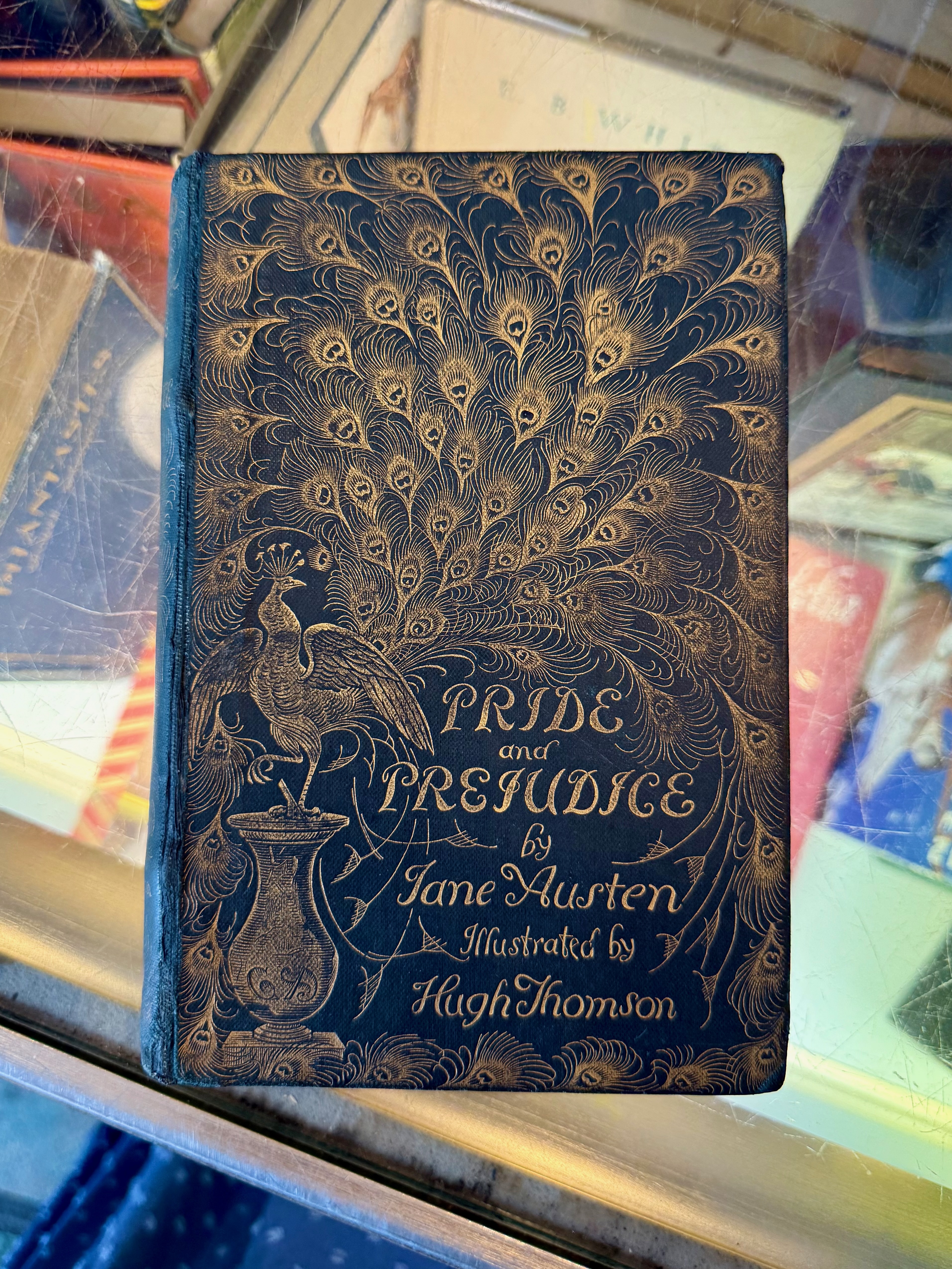
A rare “Peacock” edition in a bookstore I recently visited ($3,500).
The Original “Peacock” P&P
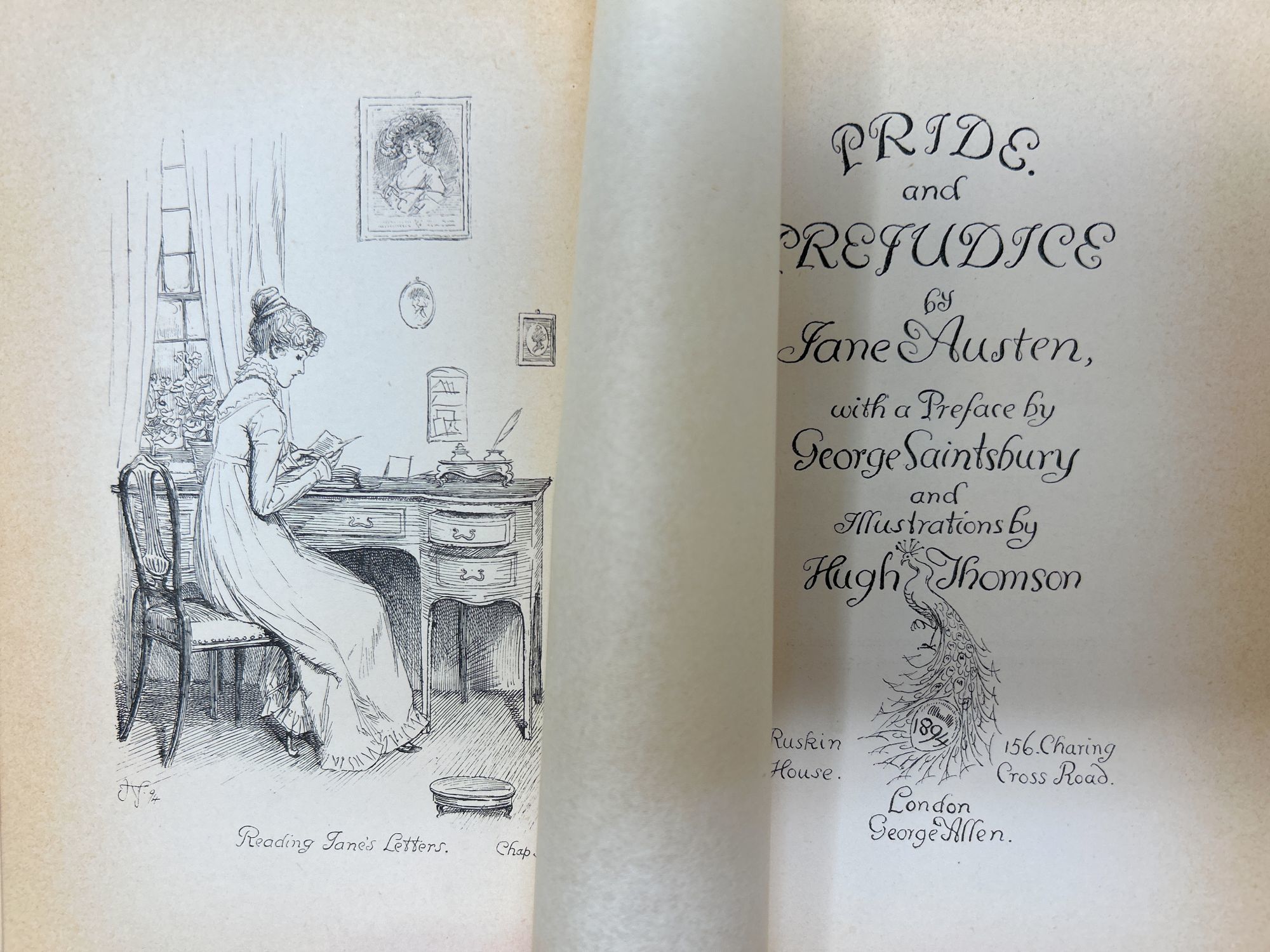
George Allen is responsible for the original 1894 “Peacock” edition of Pride and Prejudice, which includes the now-famous illustrations by Hugh Thomson. It includes 65 illustrations and 160 drawings and designs in total.
According to a University of Michigan Library Online Exhibit, Allen’s “Peacock” edition was not only extremely popular at the time, but it also helped revitalize the popularity of Austen’s works in the late 1800s:
“In reaction to the wave of British nationalism in the late nineteenth century, a renowned publisher of the time, George Allen, sought to preserve traditional English values by publishing a series of illustrated classic works of literature.”
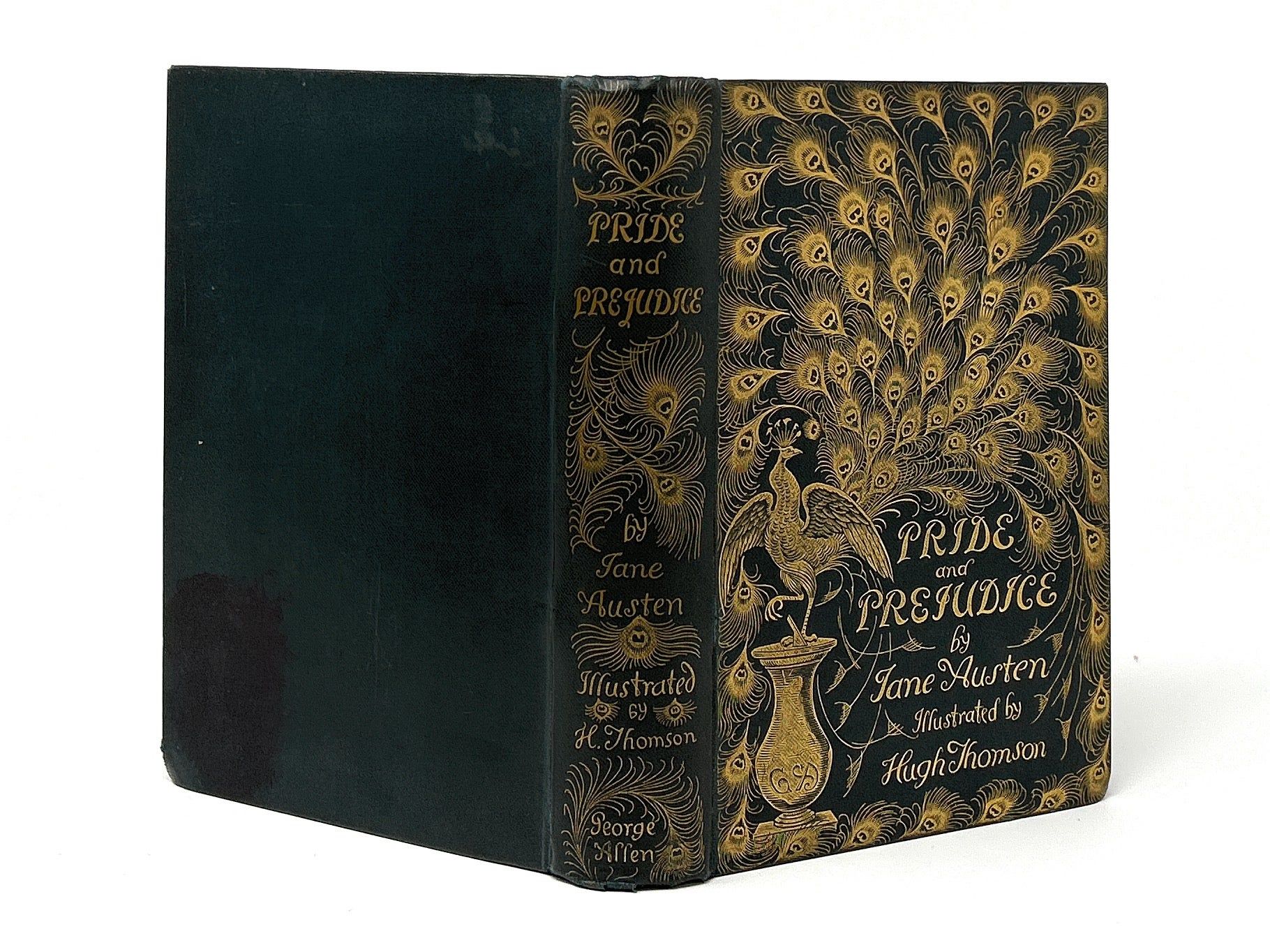
Peacock Edition, Cover and Spine (1894).
There’s a reason people love the “Peacock” edition. The cover is striking with its deep navy blue background, gilded title, and resplendent gold peacock feathers. Every detail is exquisite:
“The edition’s iconic features include its gilded peacock cover (symbolic of pride) and 65 full page illustrations, all created by Hugh Thomson. As an acclaimed illustrator of the time, Thomson’s work symbolized grace and refinement, which made him the perfect choice for capturing Allen’s vision.”
Allen’s goal to revitalize interest in Austen’s work proved successful, but the edition itself did better than he ever imagined and went on to become an iconic edition that book collectors salivate over today:
“The edition surpassed expectations, selling over 11,605 copies in England and 3,500 copies in the United States, within the first year. Its popularity was partly due to its large appeal across class divisions, gender spheres, and political factions, functioning most basically as a gift book and mark of good taste. George Allen’s revival has proven to be timeless. Thomson’s peacock design has become the iconic representation of Austen’s Pride and Prejudice in contemporary marketing and merchandising, continuing to capture audiences today.”
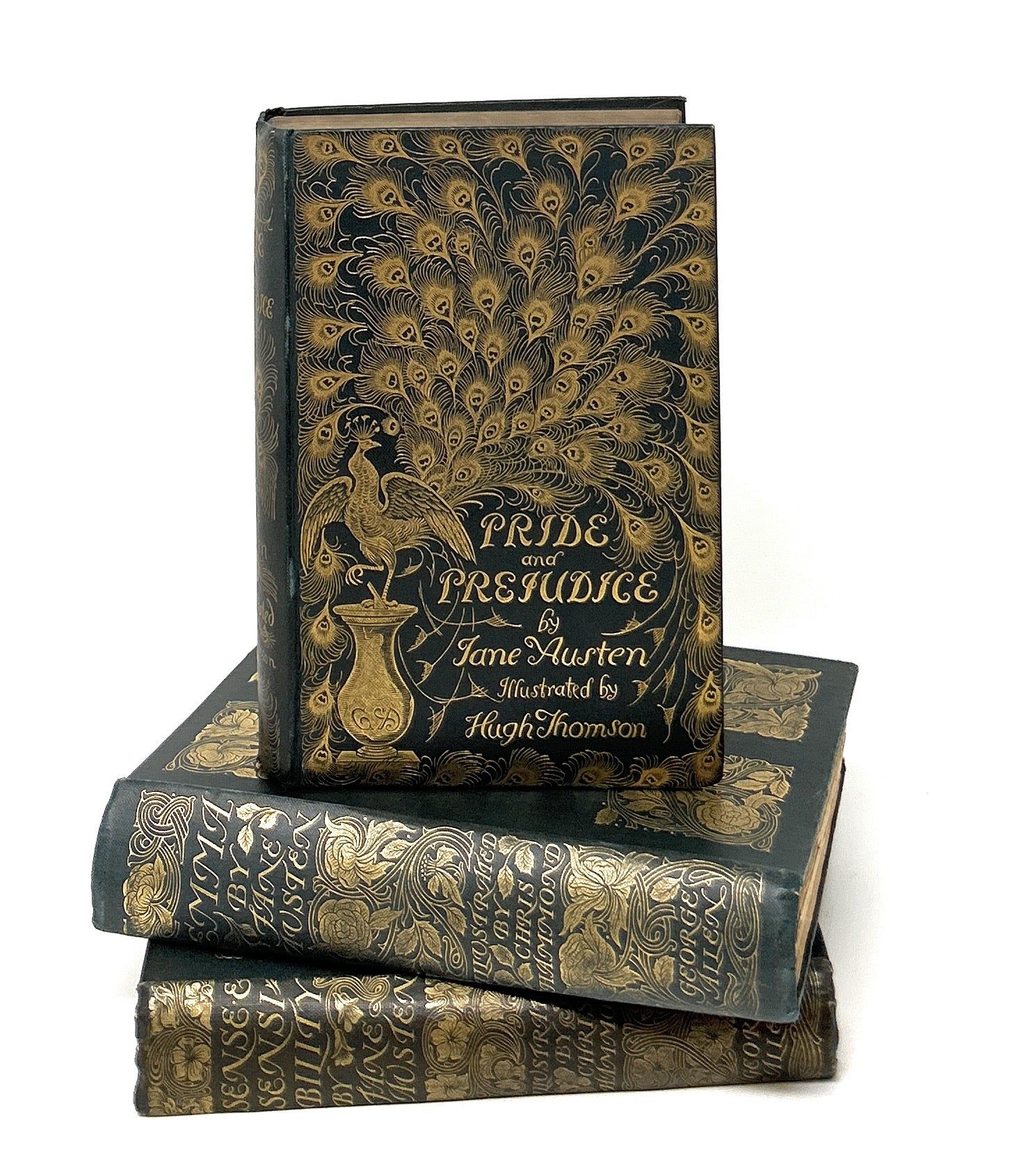
George Allen editions of Pride and Prejudice, Emma, and Sense and Sensibility
“Peacock” Illustrations
If Hugh Thomson’s name sounds familiar, you’re right. Jane Austen’s House Museum shares these intriguing details:
“The Irish illustrator, Hugh Thomson (1860-1920), was best known for his pen and ink illustrations and in addition to Jane Austen’s work, illustrated the novels of Charles Dickens, Elizabeth Gaskell and J.M Barrie. Thomson used to visit the British Museum and V&A to research costume styles, room decorations and furniture design for his illustrations. Despite that his drawings for Pride and Prejudice have a distinct Victorian rather than Georgian feel to them.”
If you’ve ever wondered why Thomson chose a peacock for the cover, you’ll find a clue in the old saying, “proud as a peacock.” Male peacocks have long been associated with pride and vanity because of their vibrant plumage and the way they strut about with their feather fanned out around them. Some believe that the peacock’s elaborate display of its tail feathers, especially by the male during courtship, is a fitting image for Pride and Prejudice’s themes of courtship as well. Either way, the peacock as a symbol of pride seems fitting for the cover of Pride and Prejudice.
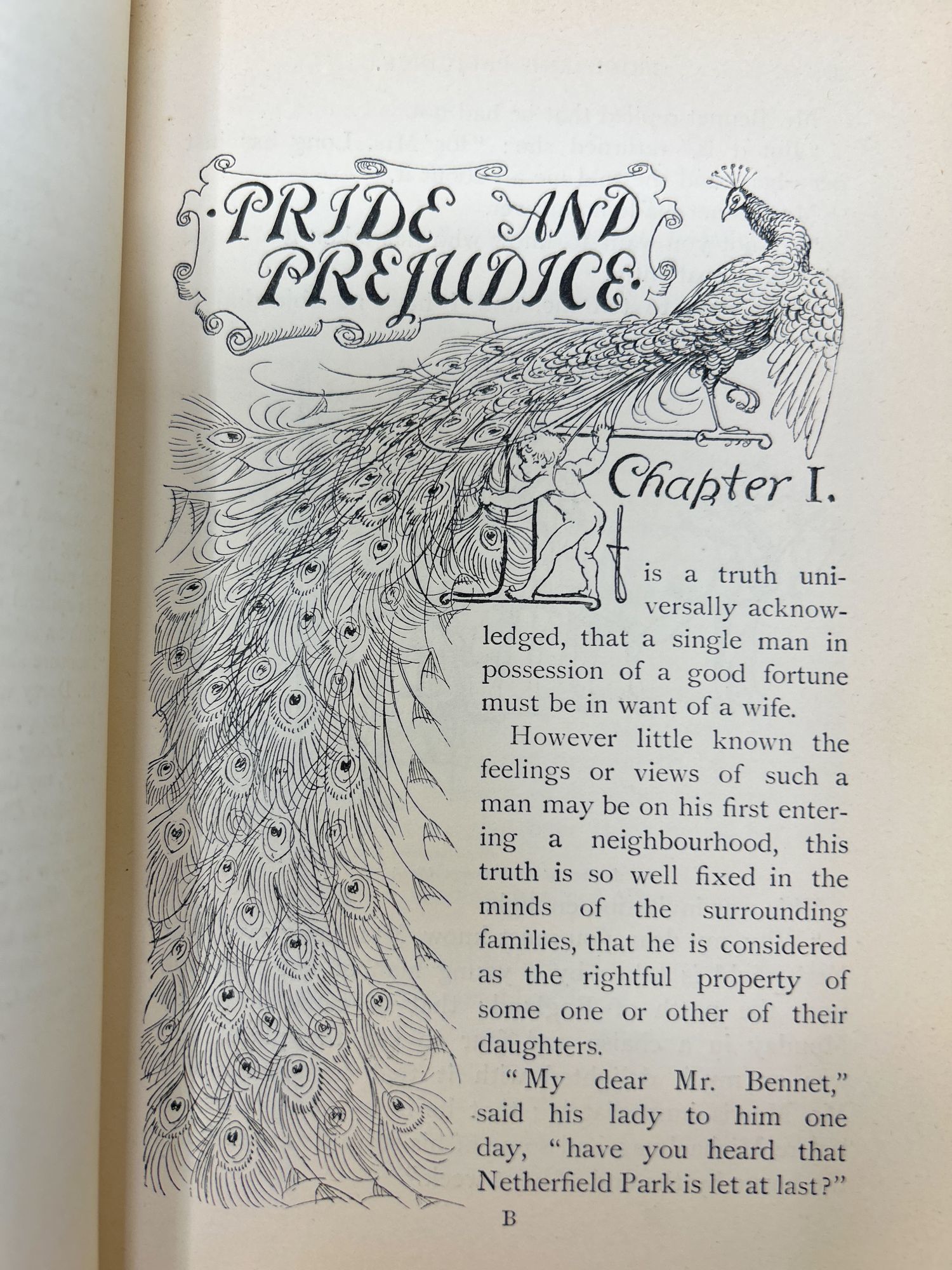
The interior is filled with beautiful full-page illustrations. The first page of the first chapter is particularly lovely with the peacock plumage on full display:
“Peacock”-Themed Editions Through the Years
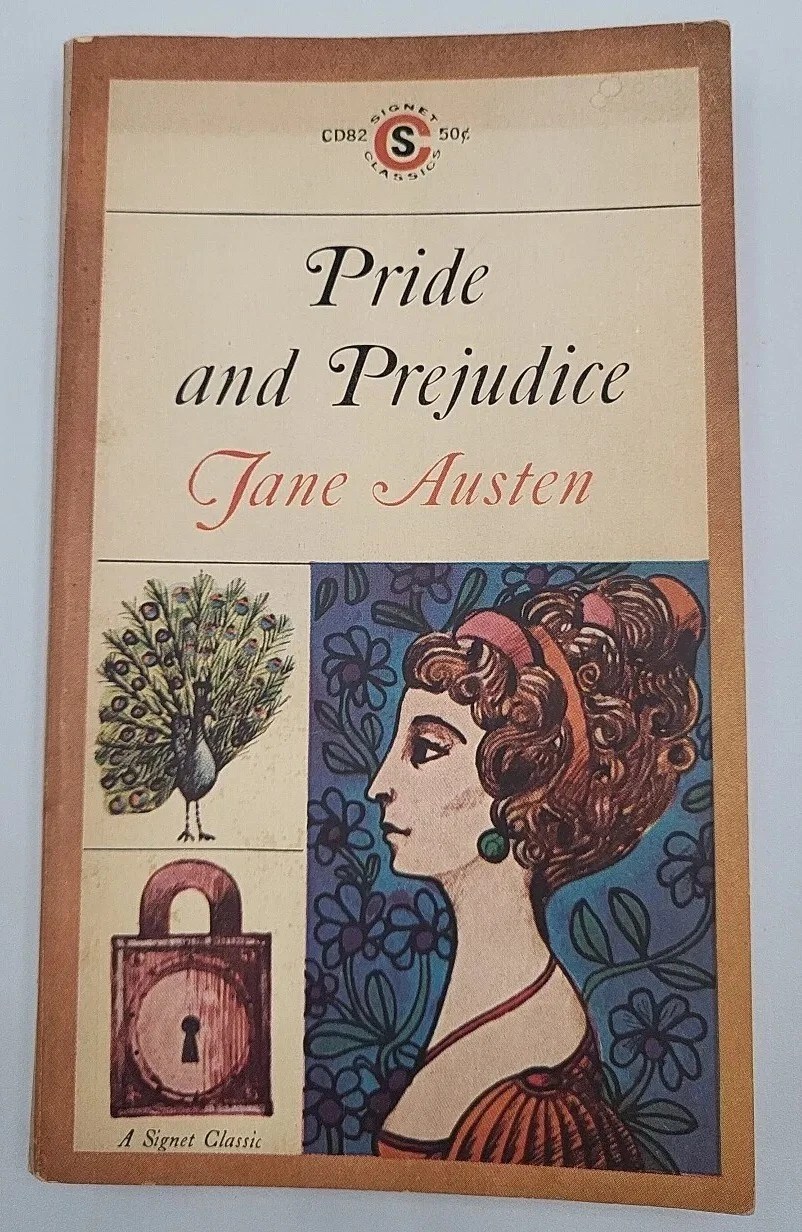
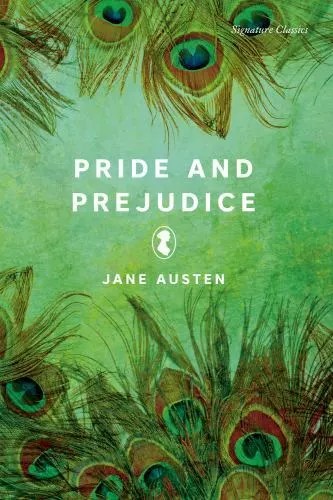
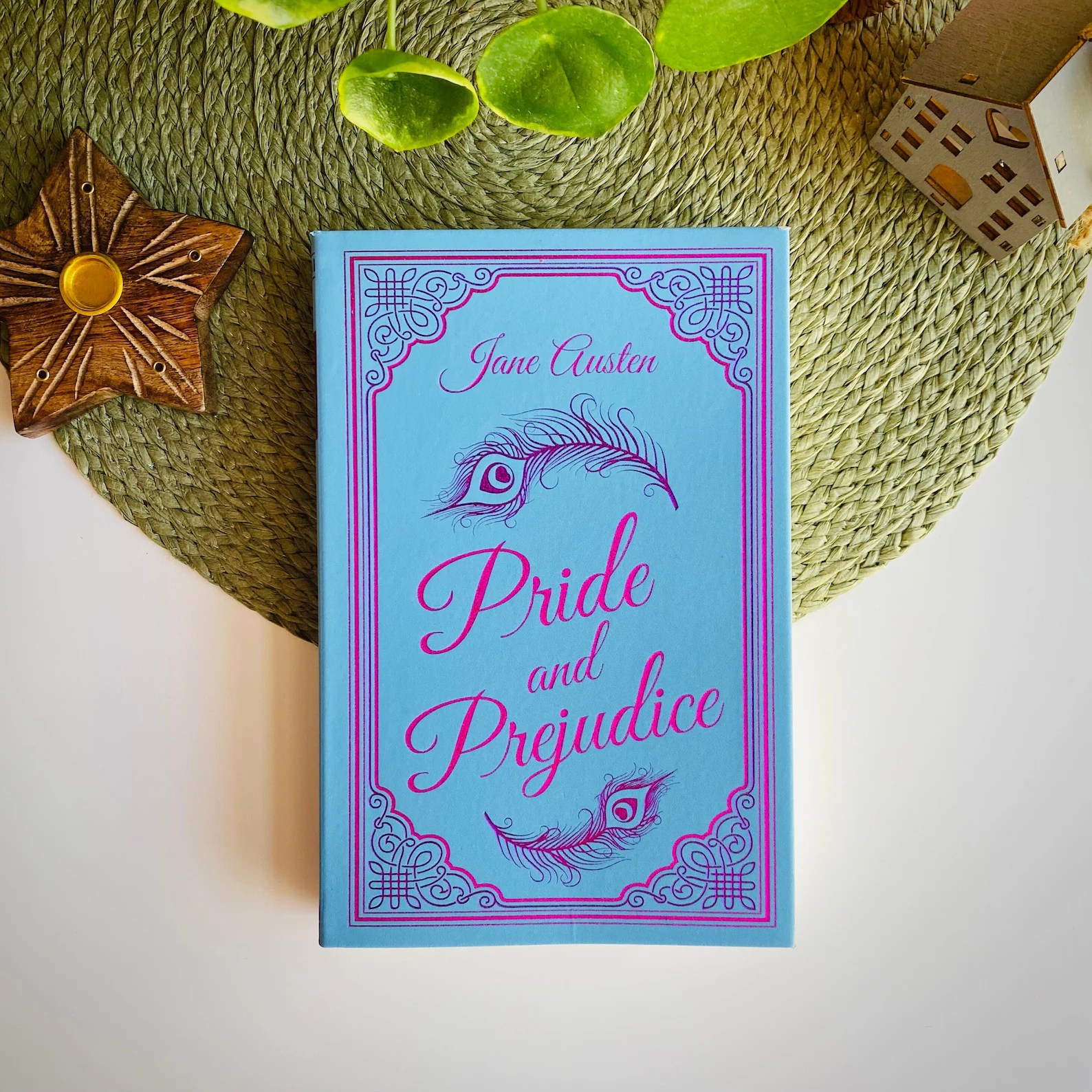
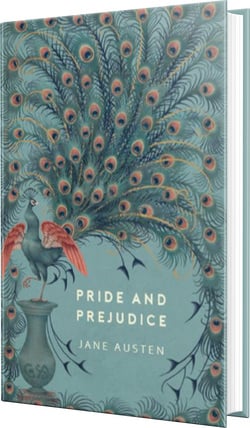
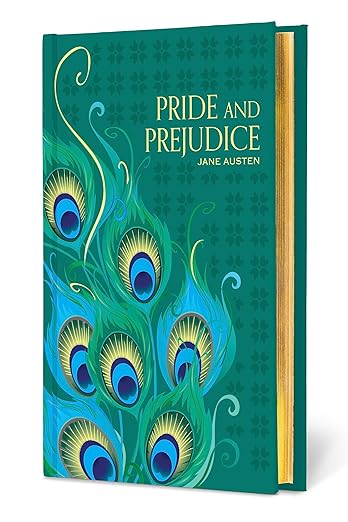
Ever since the original “Peacock” edition was released, many other editions of Pride and Prejudice have featured a peacock or peacock feathers. Each one is a nod to the original and to the overarching theme in the novel. Here are a few select highlights:
Signet Classic, 1961 (I read this one from my dad’s bookshelves growing up)
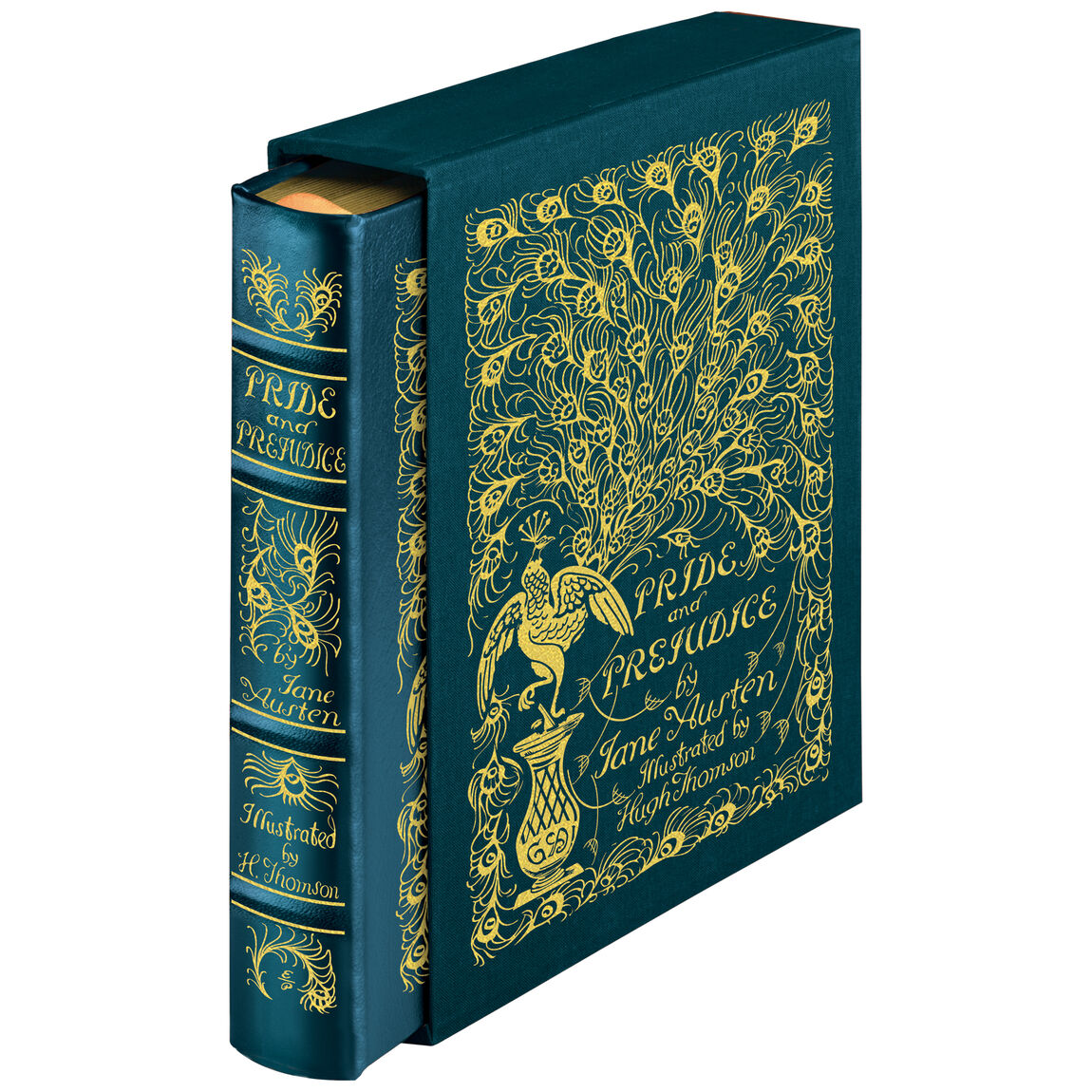
Easton Press collector’s reproduction edition with illustrations by Thomson.
Though the Easton Press leather-bound edition is pricey at $252, it might be worth it to those who want to have a beautiful and exquisitely-reproduced copy of Allen’s original “Peacock” edition with Thomson’s illustrations throughout. It’s truly a work of art in its own right with its “hubbed” spine, sewn pages, acid-free paper, and custom-crafted, clothbound slipcase.
250th Editions Featuring Peacocks
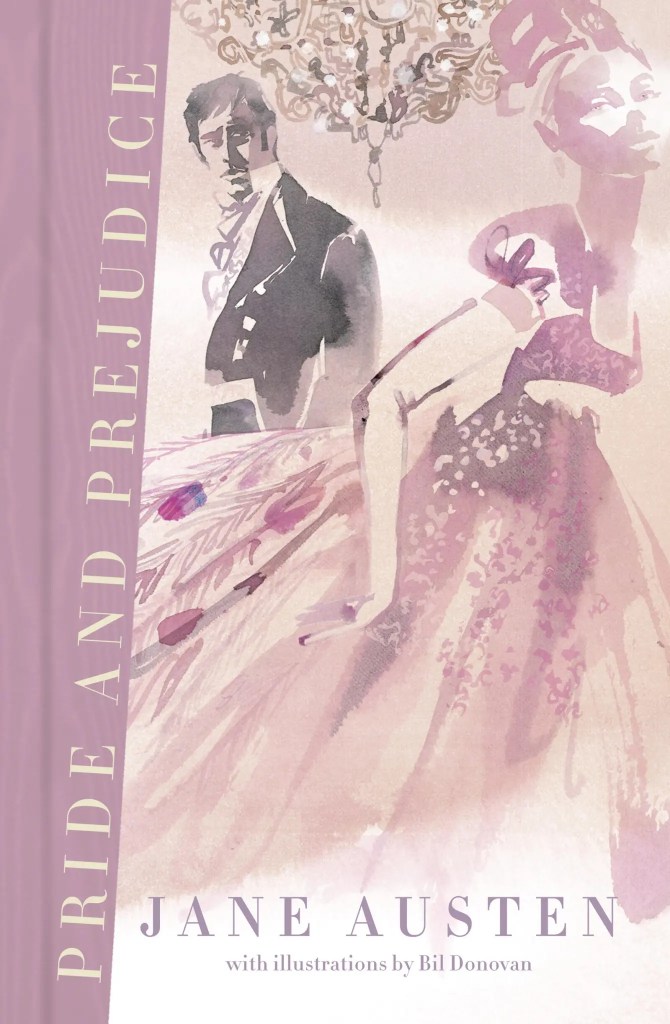
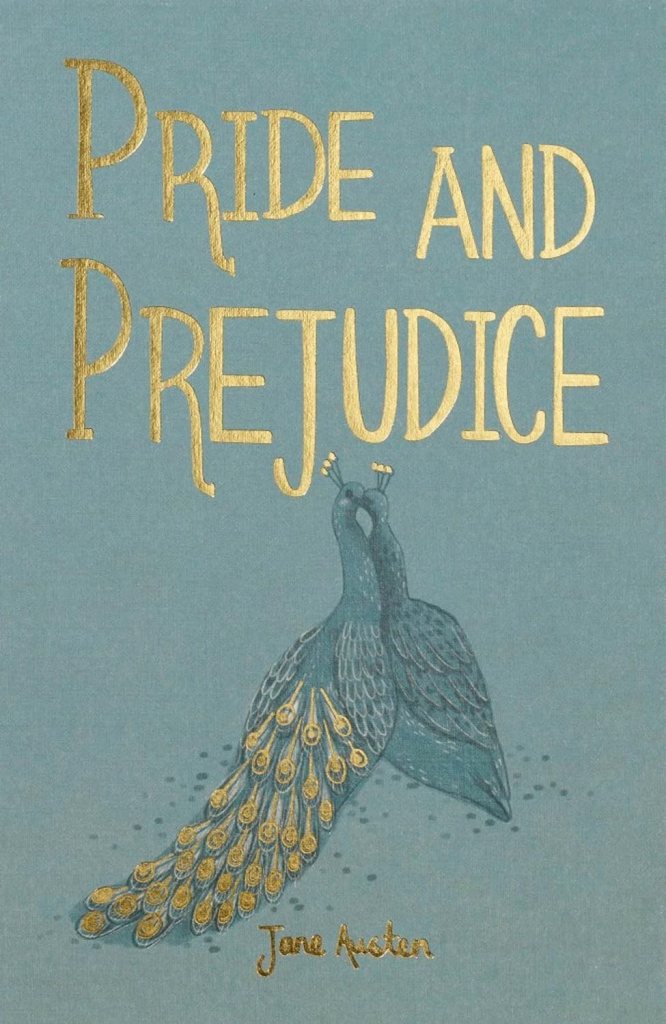
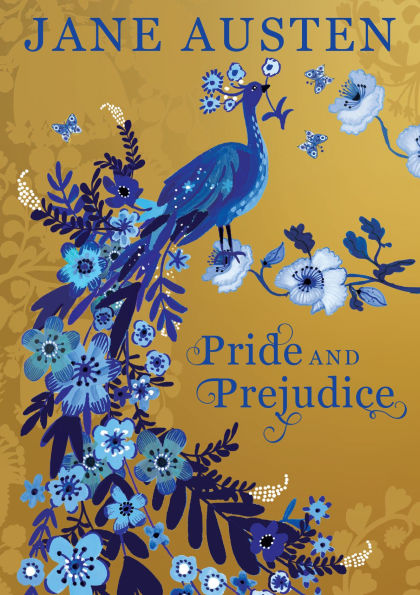
Finally, for the 250th anniversary of Jane Austen’s birth, Austen fans can enjoy several new “Peacock”-inspired editions. These editions pay homage to the original Allen edition with an updated flair. Thus far, I’ve seen these new and upcoming editions advertised:
Whichever edition you enjoy reading, it’s clear that the peacock remains an enduring symbol of pride in the novel. As Elizabeth Bennet says about Mr. Darcy after he snubs her: “I could easily forgive his pride if he had not mortified mine.”
A copy of the original “Peacock” edition is worth a lot of money these days, but its impact is truly priceless. Allen and Thomson helped revive and sustain popular interest in Jane Austen’s work far beyond what they ever imagined.
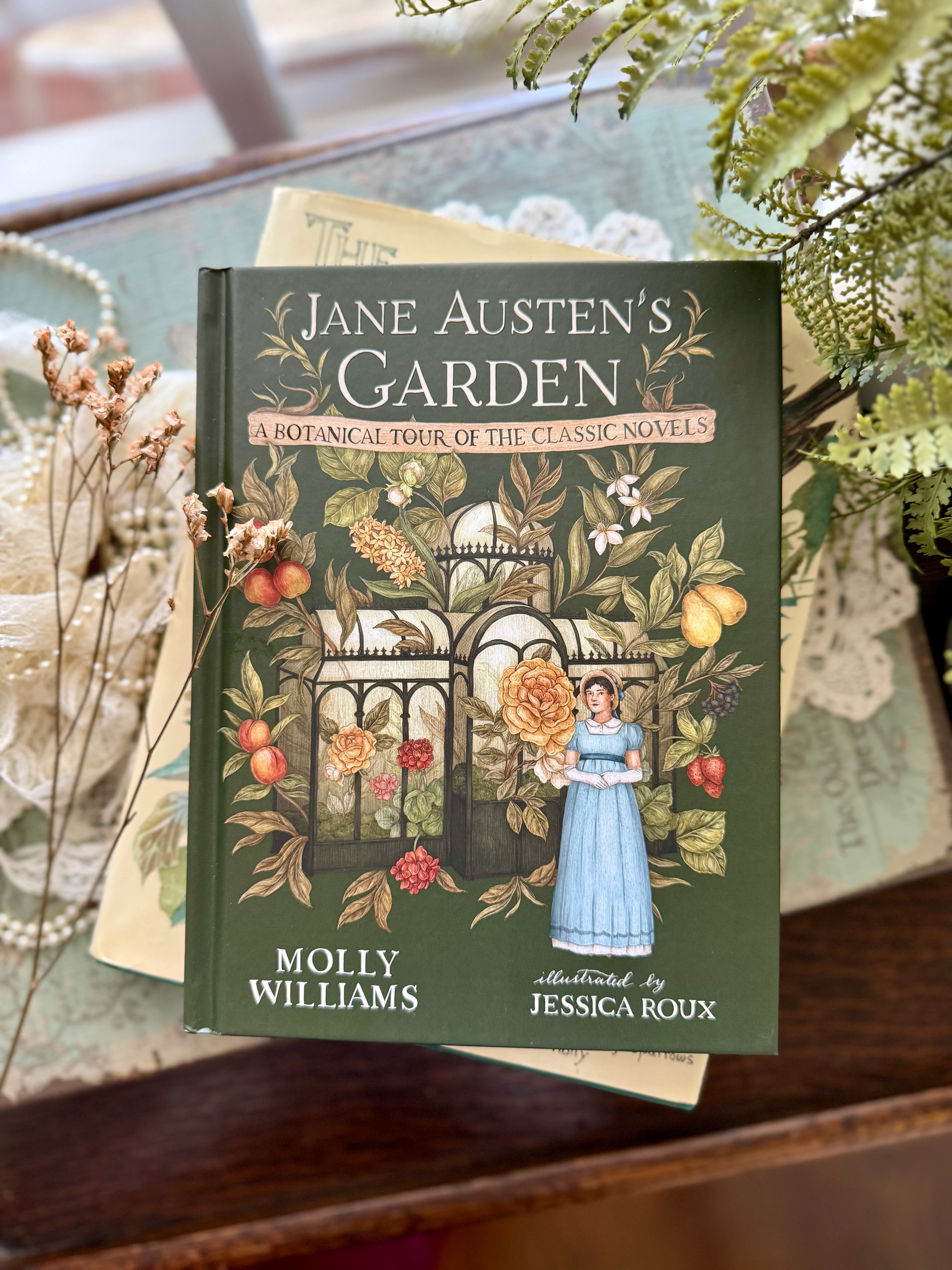
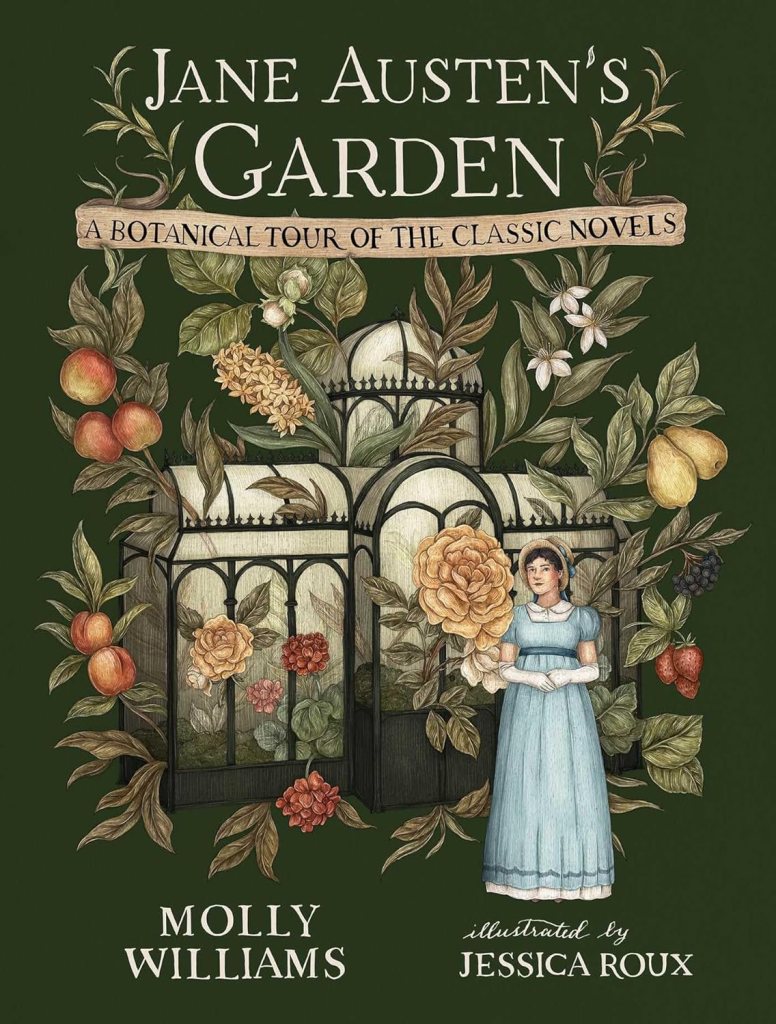
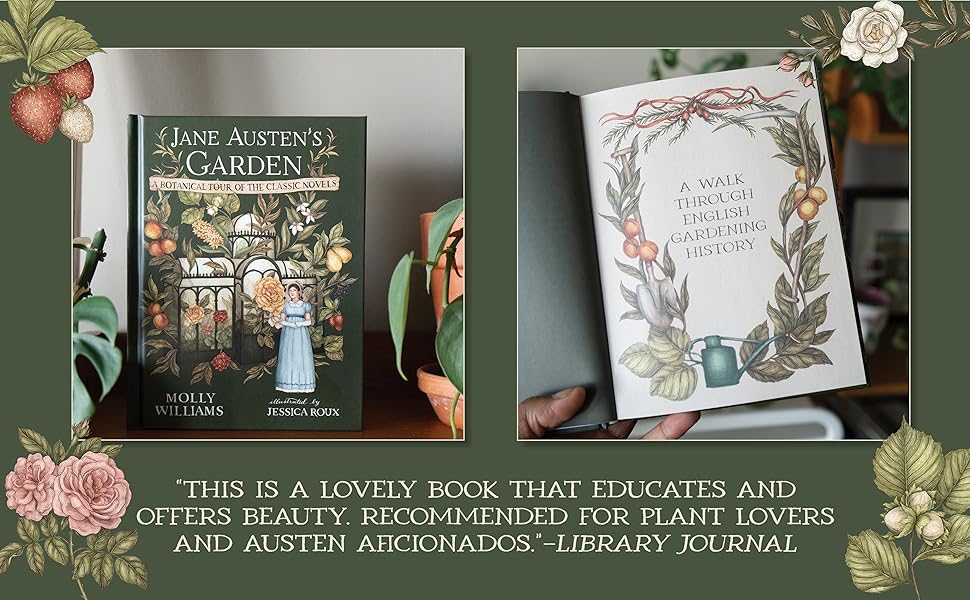
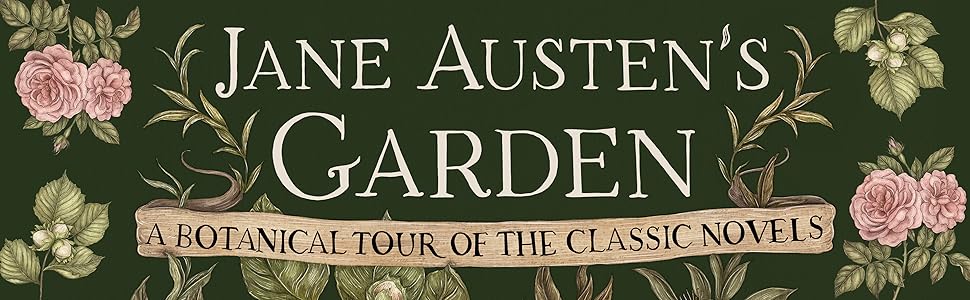
Fellow Janeites, I have a new book review for you in honor of Jane’s 250th year: Jane Austen’s Garden: A Botanical Tour of the Classic Novels written by Molly Williams and illustrated by Jessica Roux. This new book pairs two of my favorite things: Jane Austen and gardening! I looked forward to its release for months and it now sits prominently on my shelves!
I knew this book would be beautiful, and I confess that I preordered it based on how pretty it looked. I have another gorgeous book by Jessica Roux called Floriography: An Illustrated Guide to the Victorian Language of Flowers. I’ve always been drawn to the language of flowers and their meanings.
When I ordered it, I assumed Jane Austen’s Garden would mostly include drawings and tidbits of information. However, when it arrived, I discovered that it is filled with detailed information about the flowers, plants, trees, fruits, and vegetables mentioned in Austen’s novels and in her own garden and kitchen garden! There are even instructions about how to grow your own fruits and vegetables at home.
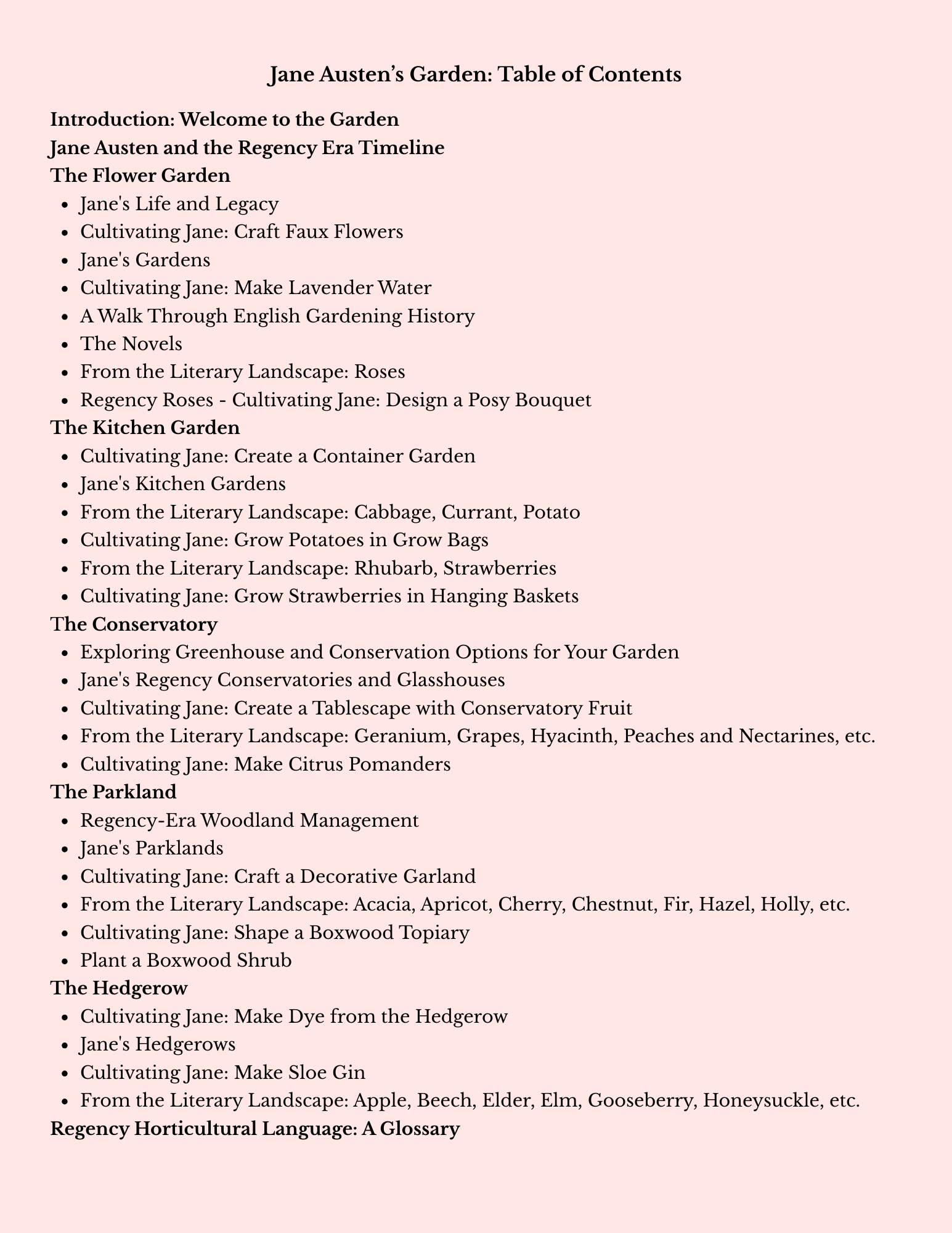
And don’t let the Table of Contents fool you. This book has a LOT to offer. The editor(s) merely listed the craft projects in the book in the Table of Contents, which does a great disservice to Williams’ painstaking research and intriguing information. Williams provides ample material for Jane Austen fans and has done a wonderful job of researching every detail of this book.
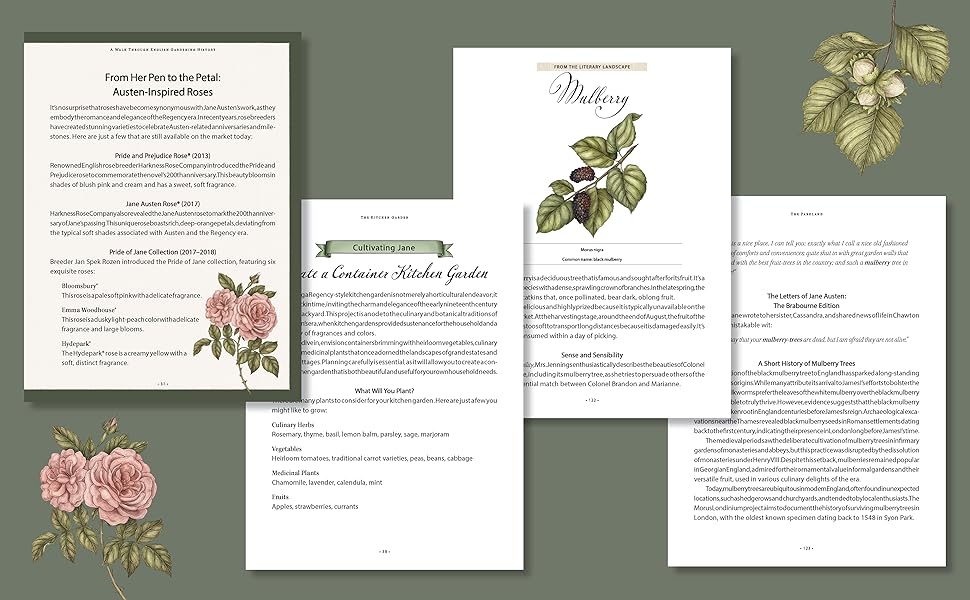
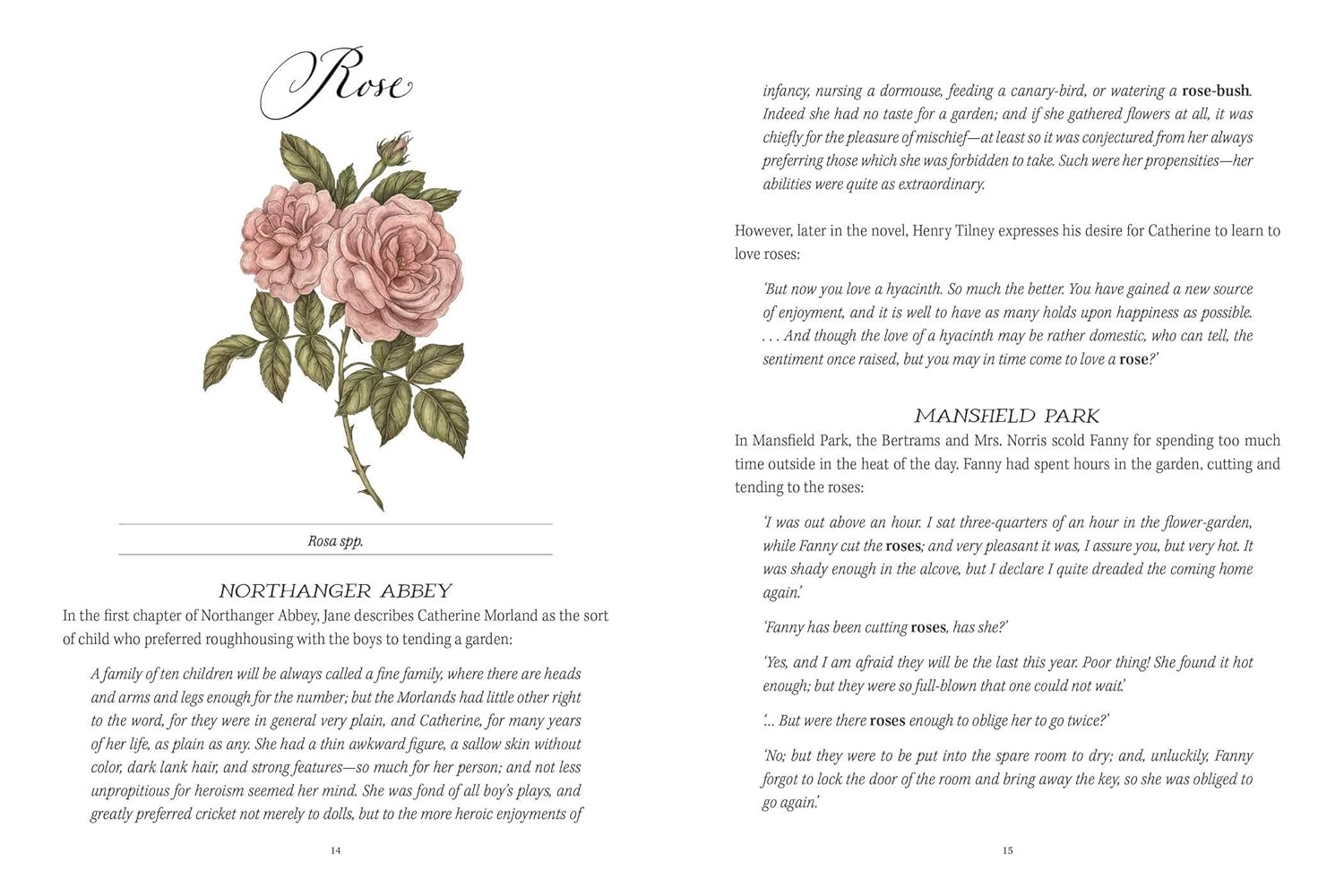
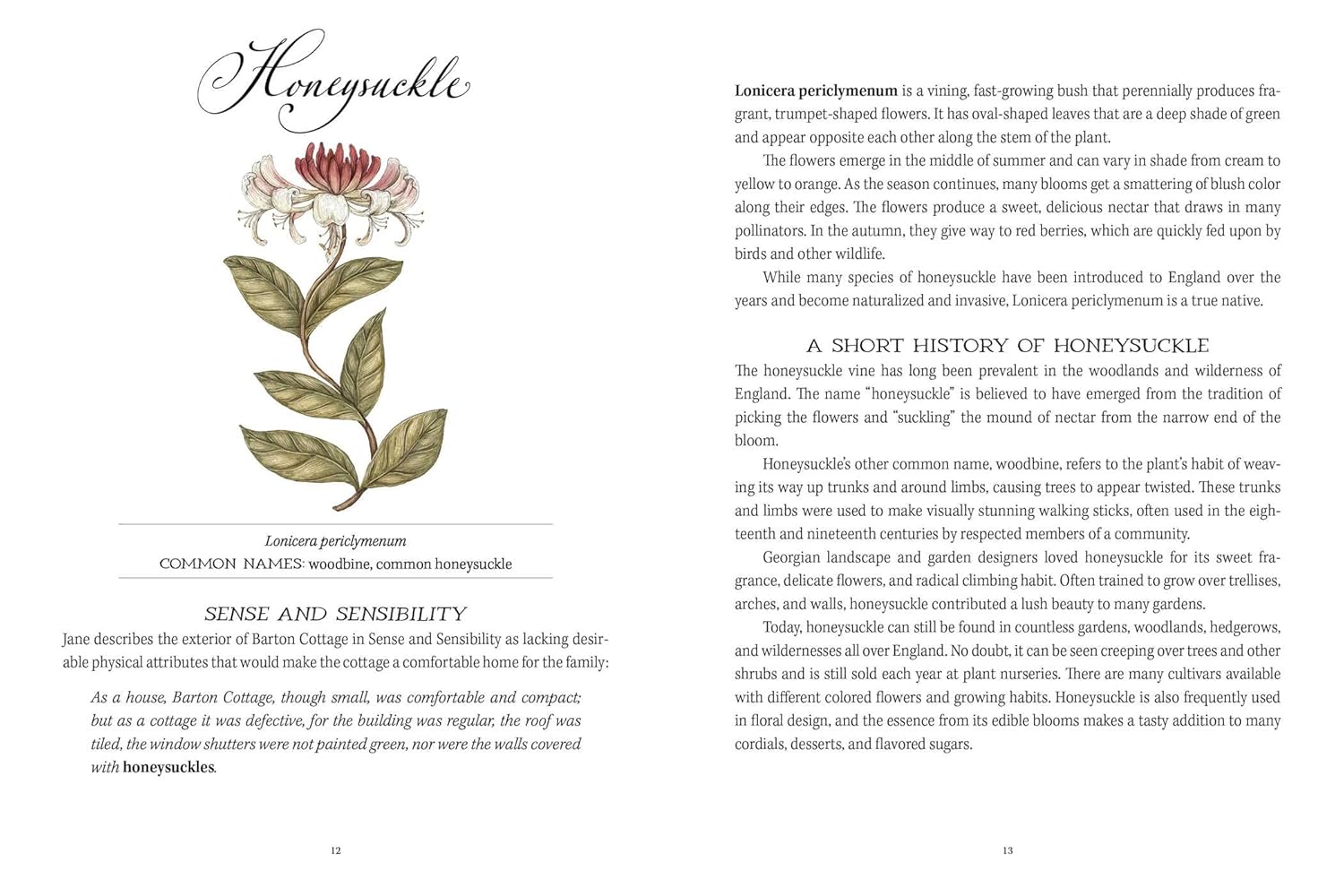
In each chapter, there is a section entitled “From the Literary Landscape.” This is the best part!! This is where Jane Austen fans can really dig into Williams’ research. She outlines the instances when various trees, fruits, or flowers are mentioned in the novels (or how the Austens used them in their everyday lives). Then, Williams goes into detail about what they signified and/or their history. As many of you know from my articles over the years, I love to look for specific items in the novels and research them.
Finally, the illustrations in this book are to die for. Truly, Roux is a most extraordinary artist. You can see more of her art HERE. I truly could look at it all day long!!!! I have a dream of writing a book with botanical illustrations one day, and I can’t imagine having someone like Roux do the artwork. She brings Williams’ research to life and captures the Regency imagination beautifully.
Book Description
An elegantly illustrated celebration of Jane Austen’s life and literature as told through the flowers, plants, and landscapes that inspired her.
Through explorations of the botanical inspirations and symbolism in Austen’s work and personal life, as well as historical information about the gardens and landscapes of the Regency Era, Jane Austen’s Garden will transport readers back in time to the lush English landscape of the early 1800s. Woven throughout are DIY projects to help you create a home garden worthy of a surprise visit from Lady Catherine de Bourgh or maybe just give your dining table a bit of historical flair. Accessible, entertaining, and enhanced by the enchanted illustrations of celebrated artist Jessica Roux, Jane Austen’s Garden is a fun twist on a familiar subject that will delight plant lovers and Janeites alike.
Book Contents
The Table of Contents is misleading as it only outlines the various DIY projects you can try at home. The book itself has a LOT more meat to it, so don’t let the overview dissuade you from purchasing it. In an effort to provide a fuller picture of all that Williams included, I created a full outline of the book:
Below are two examples of how Williams includes information about different flowers and plants in the novels, along with more illustrations from Roux:
About the Author and Illustrator
Molly Williams is the author of Killer Plants: Growing and Caring for Flytraps, Pitcher Plants and Other Deadly Flora, and Taming the Potted Beast: The Strange and Sensational History of the Not-So-Humble Houseplant, and she writes regularly for Apartment Therapy‘s gardening and horticulture section. She grew up on a flower farm and is now a professor of writing in New England. You can visit her online HERE.
Jessica Roux is a Nashville-based freelance illustrator and plant and animal enthusiast. She loves exploring in her own backyard and being surrounded by an abundance of nature. Using subdued colors and rhythmic shapes, she renders flora and fauna with intricate detail reminiscent of old-world beauty. She is the author and illustrator behind Floriography: An Illustrated Guide to the Victorian Language of Flowers, Ornithography: An Illustrated Guide to Bird Lore & Symbolism, and the Woodland Wardens Oracle Deck & Guidebook. You can visit her online HERE.
250 Years of Bookish Bounty
Books like these truly make the 250th celebration of Jane Austen’s life, writing, and legacy a true gift and a joy. I’m so thankful to the authors, illustrators, editors, and publishers who make books like this possible. The bounty of books releasing this year is a wonder to behold. I hope you’ll check this one out and add it to your bookshelves!
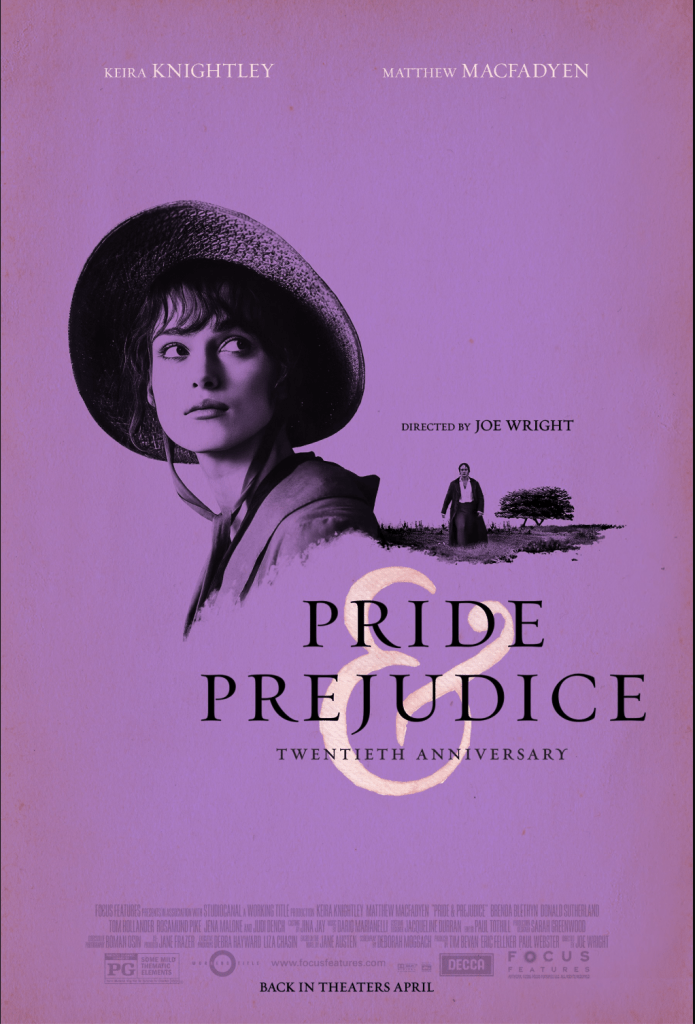
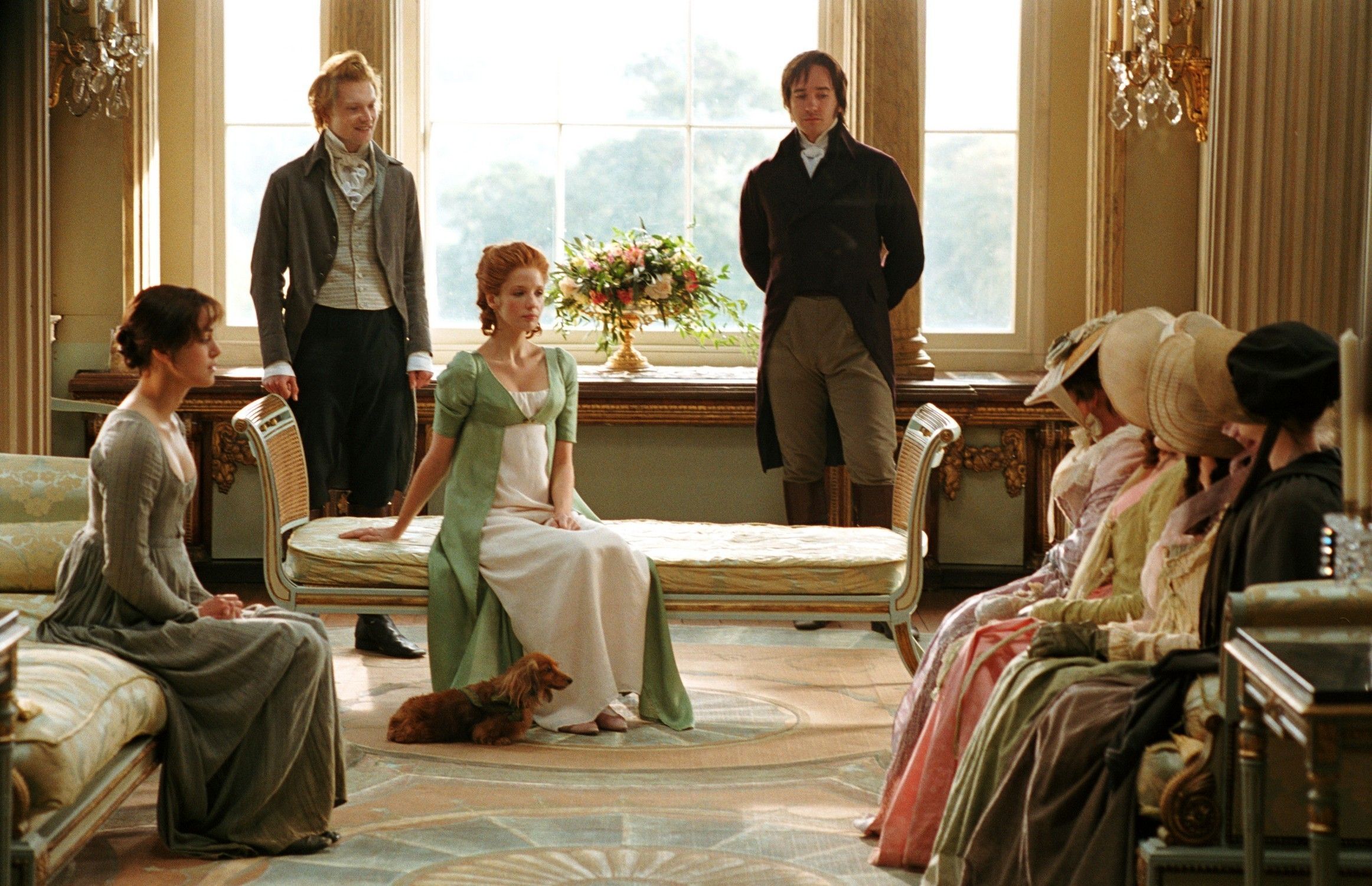
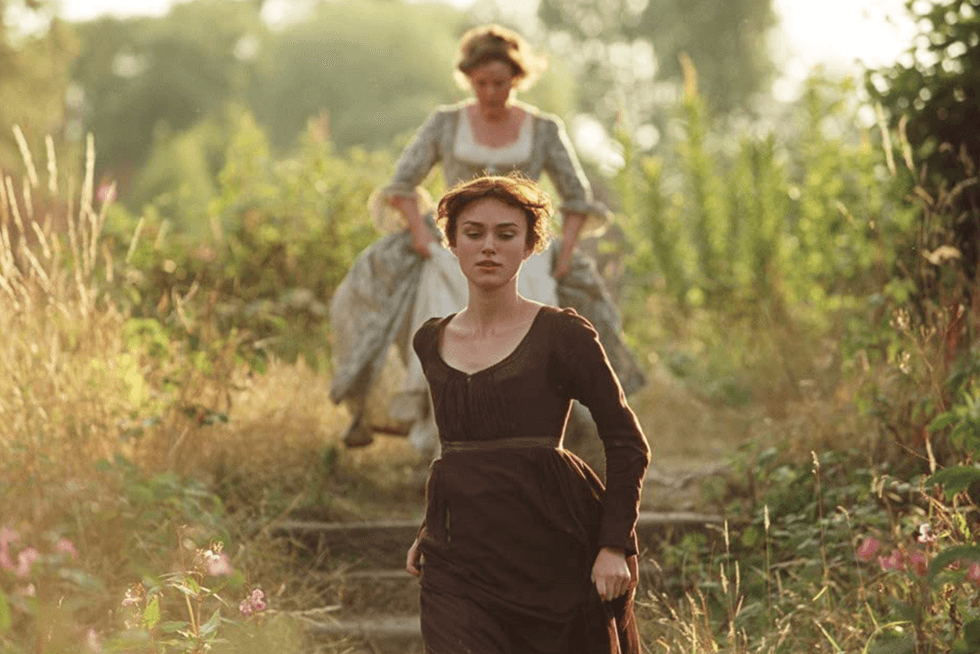
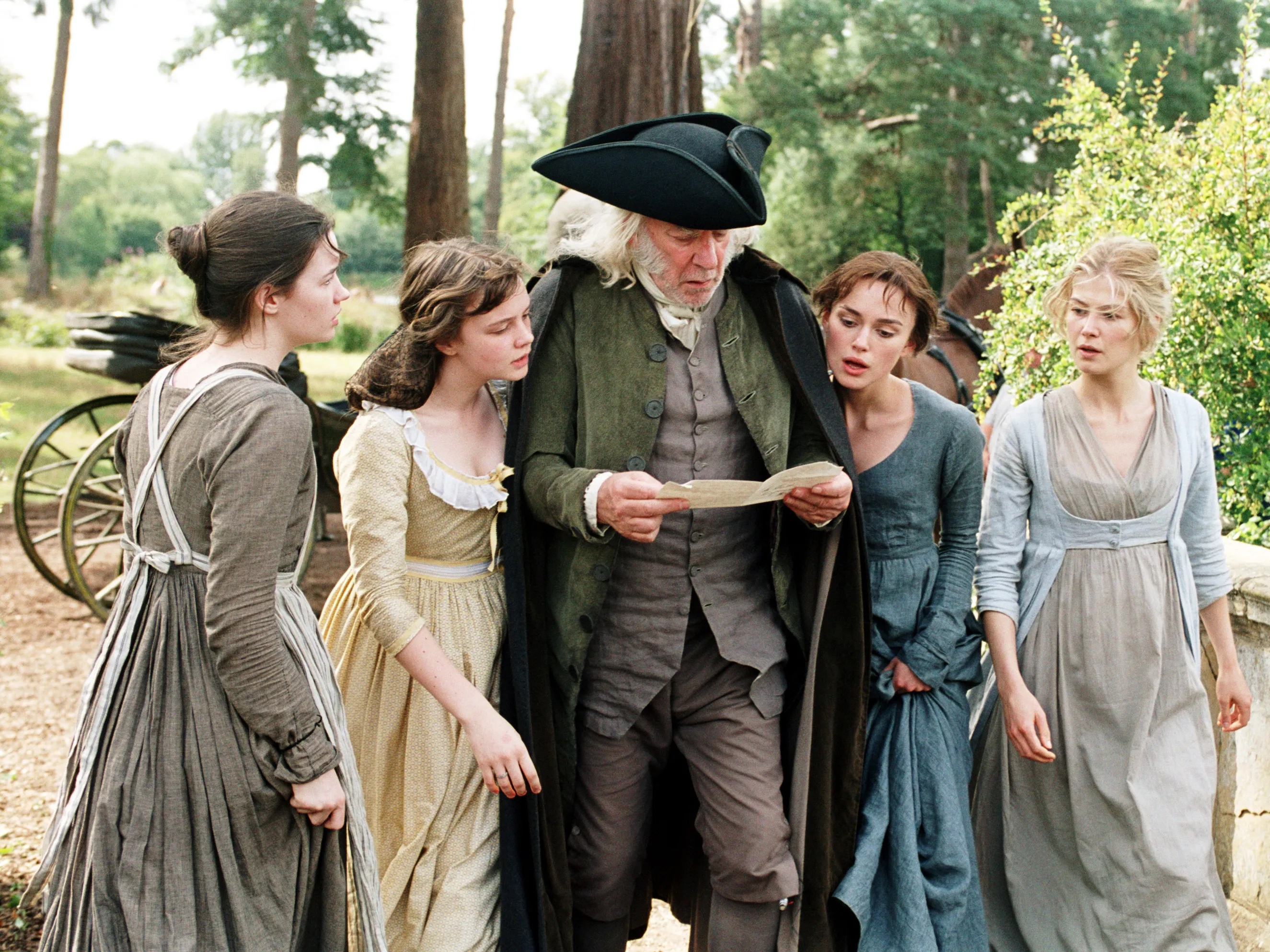
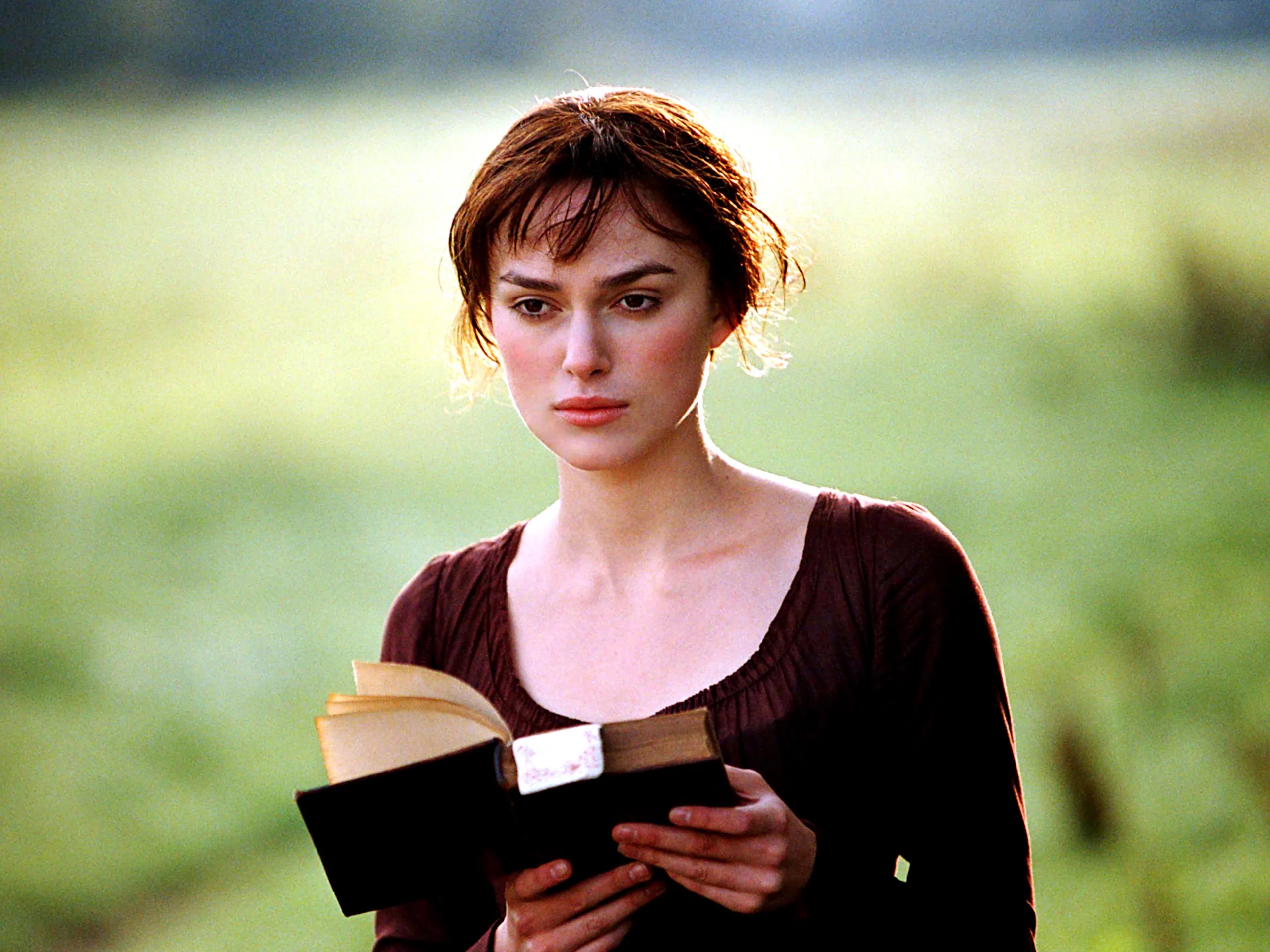
Jane Austen fans are flocking to theaters to watch the 2005 Pride and Prejudicefilm in theaters to celebrate its 20th anniversary. And what perfect timing with Jane’s own 250th celebration!
The film’s re-release in theaters was originally set for April 18-24, 2025, but it was extended to April 25-30, 2025 due to its success. It’s a limited engagement, primarily in the U.S., so Jane Austen friend groups, book clubs, and JASNA regional groups are taking advantage of this special event and gathering at movie theaters nationwide to watch it together.
Some, in Regency garb!
Pop Culture Craze
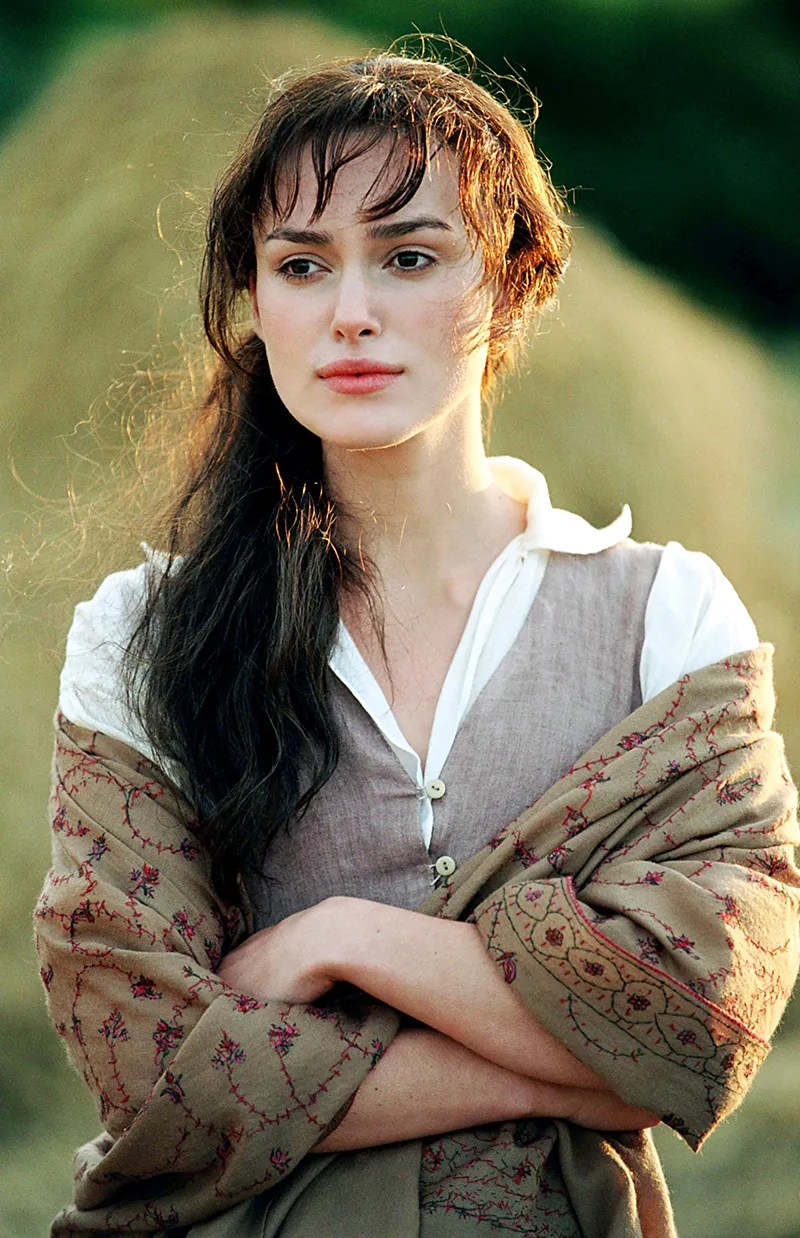
While the 2005 film version of Pride and Prejudice isn’t a favorite with some Jane Austen fans, who argue that it’s a very loose interpretation of the novel (and rife with historical inaccuracies), it’s been a huge sensation with a whole new wave of Austen fans since it first released 20 years ago. P&P 2005 fans discuss it non-stop online and have created fan groups and an endless library of memes, edits, reels dedicated to it. An entire fandom has formed itself around the film and its actors.
Hand Flex
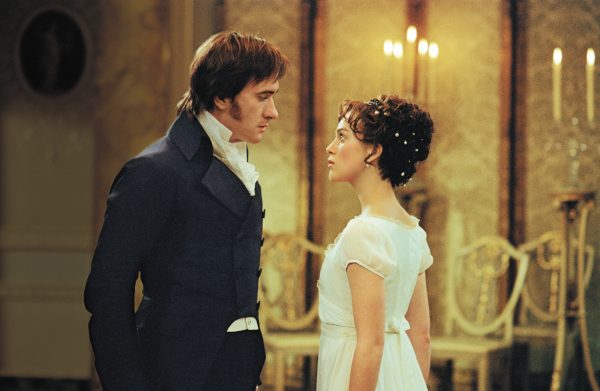
And its popularity shows no sign of stopping. From Macfadyen’s emotionally complex portrayal of Mr. Darcy, the electricity between Knightley and Macfadyen, and the famous “hand-flex” scene, this highly romanticized adaptation of Austen’s novel is a cultural phenomenon in its own right.
Musical Score
The musical score alone is beloved by fans everywhere. Composed by Dario Marianelli and performed by Jean-Yves Thibaudet (piano) and the English Chamber Orchestra), the music is one of the reasons people love the film so much. The title track “Dawn” is just about as dreamy as it can get:
Awards and Nominations
After its release, the film won or was nominated for endless awards from the film industry, including Oscar nominations for Best Performance by an Actress in a Leading Role (Keira Knightley), Best Achievement in Art Direction (Sarah Greenwood, art director and Katie Spencer, set decorator), Best Achievement in Costume Design (Jacqueline Durran), and Best Achievement in Music Written for Motion Pictures (Original Score, Dario Marianelli).
Joe Wright, the film’s director and the 2006 Winner Carl Foreman Award for the Most Promising Newcomer, joined a Q&A several days ago at a special screening of the re-release. Of his directorial debut, he said, “I’m actually prouder of the film tonight than I think I’ve ever been.” (@focusfeatures)
The 2005 Pride and Prejudice is often compared to the 1995 sweeping BCC version with Colin Firth and Jennifer Ehle, but it’s a bit like comparing apples and oranges. They are both so vastly different in every way. Nonetheless, fans have been debating this topic for 20 years now and will probably continue for another 20 years at least.
People outside the Jane Austen fandom probably won’t ever understand why we all feel so passionate about the different film versions of Austen’s novels, but in the words of Mr. Bennet, “For what do we live, but to make sport for our neighbours, and laugh at them in our turn?”
Re-Watching
Jane Austen fans LOVE to re-watch the films over and over. Have you been to the theater to watch the 2005 P&P re-release? Are you planning to go? (Did you / Will you dress up?) Which version do you prefer? Please comment below!
If you’d like to check showtimes in your local village theater, you can search AMC’s listings HERE. I’m hoping to see it before it’s gone. I can’t pass up the chance to watch a movie with other die-hard Janeites at the theater!
“There must have been many precious hours of silence during which the pen was busy at the little mahogany writing-desk, (This mahogany desk, which has done good service to the public, is now in the possession of my sister, Miss Austen) while Fanny Price, or Emma Woodhouse, or Anne Elliott was growing into beauty and interest.”–A Memoir of Jane Austen by James Edward Austen-Leigh, her nephew
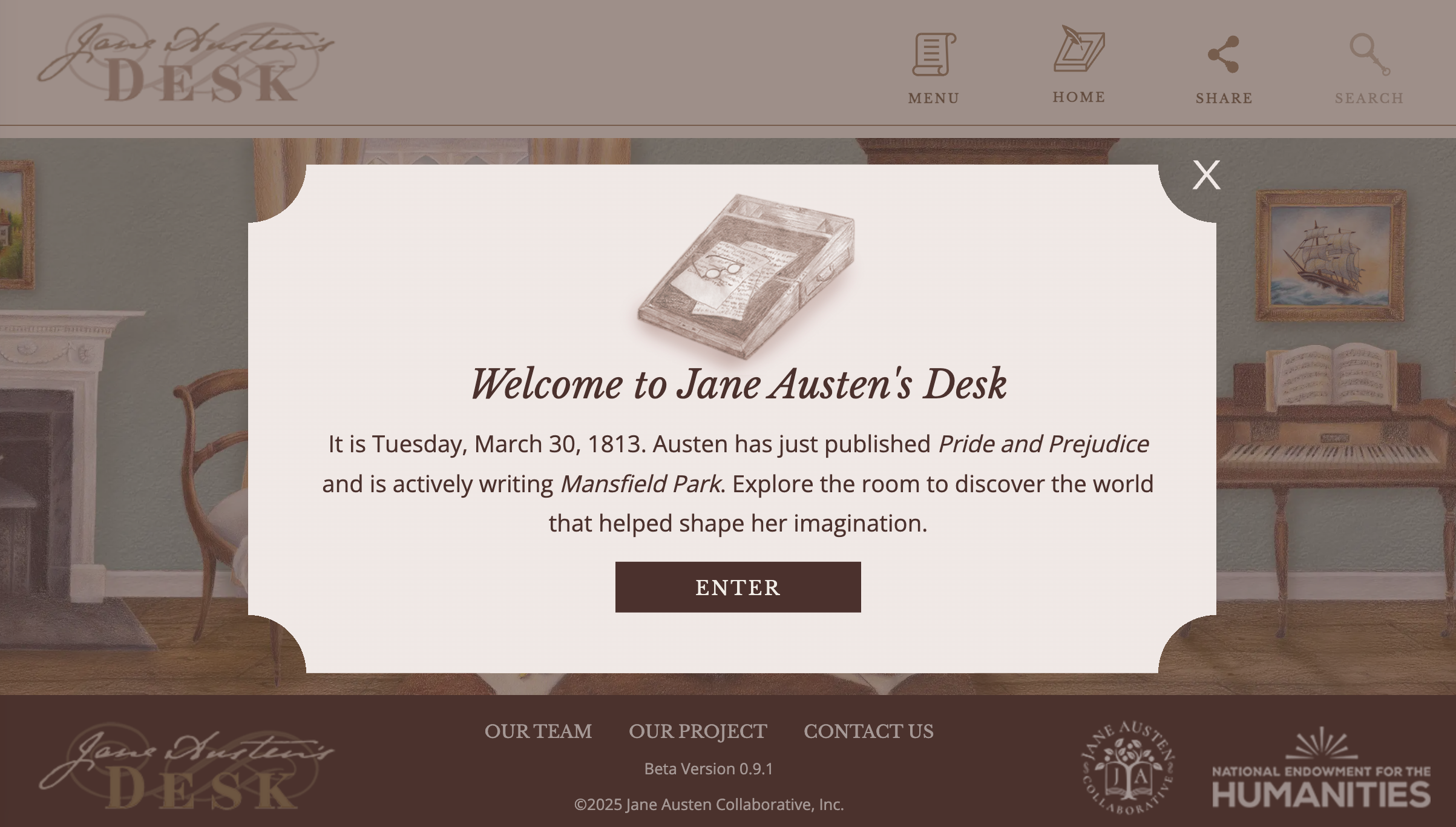
Welcome page to the website “Jane Austen’s Desk”
Wouldn’t you love to explore Jane Austen’s desk and room? Inger Brodey, Sarah Walton, and their amazing team at the Jane Austen Collaborative are recreating Jane’s desk and room for us to visit virtually.
While the website is still a beta version, I found lots of great information there. The plan is for it to become a “portal” linking to many Austen resources.
The site opens with a view of a room loosely based on the drawing room of Jane Austen’s House in Chawton
Jane Austen’s Desk
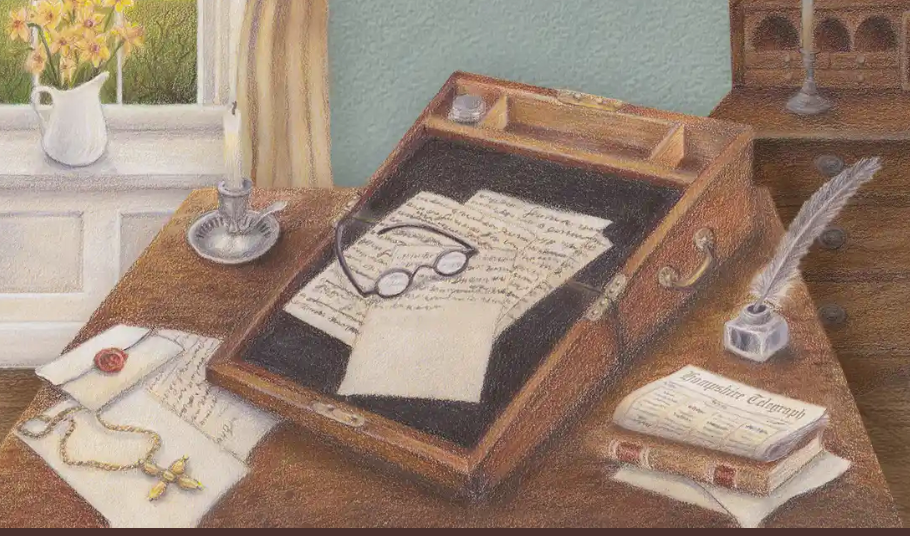
When you visit the room, you might want to start at the desk itself—Jane’s travel desk sits on a table. You’ll see manuscripts of several of the novels, which you can open and enjoy in early editions. Commentary tells more about the novel and the edition, with direct links to interesting sections like “Darcy’s list of desirable female accomplishments” and “Fanny asking about the slave trade.”
Nearby are newspapers, one of the most fun links. Several contemporary papers are included. You can hone in on a number of interesting articles, ranging from her brother Edward’s selling part of Stoneleigh Abbey, to reports of her brother Frank’s naval exploits, to the story of a swindler who pretended to be a rich person’s housekeeper!
Jane Austen’s travel desk (the real one is owned by the British Library). The manuscripts on the desk, the newspapers next to it, and the cross, take you to various resources.
The Bookshelf
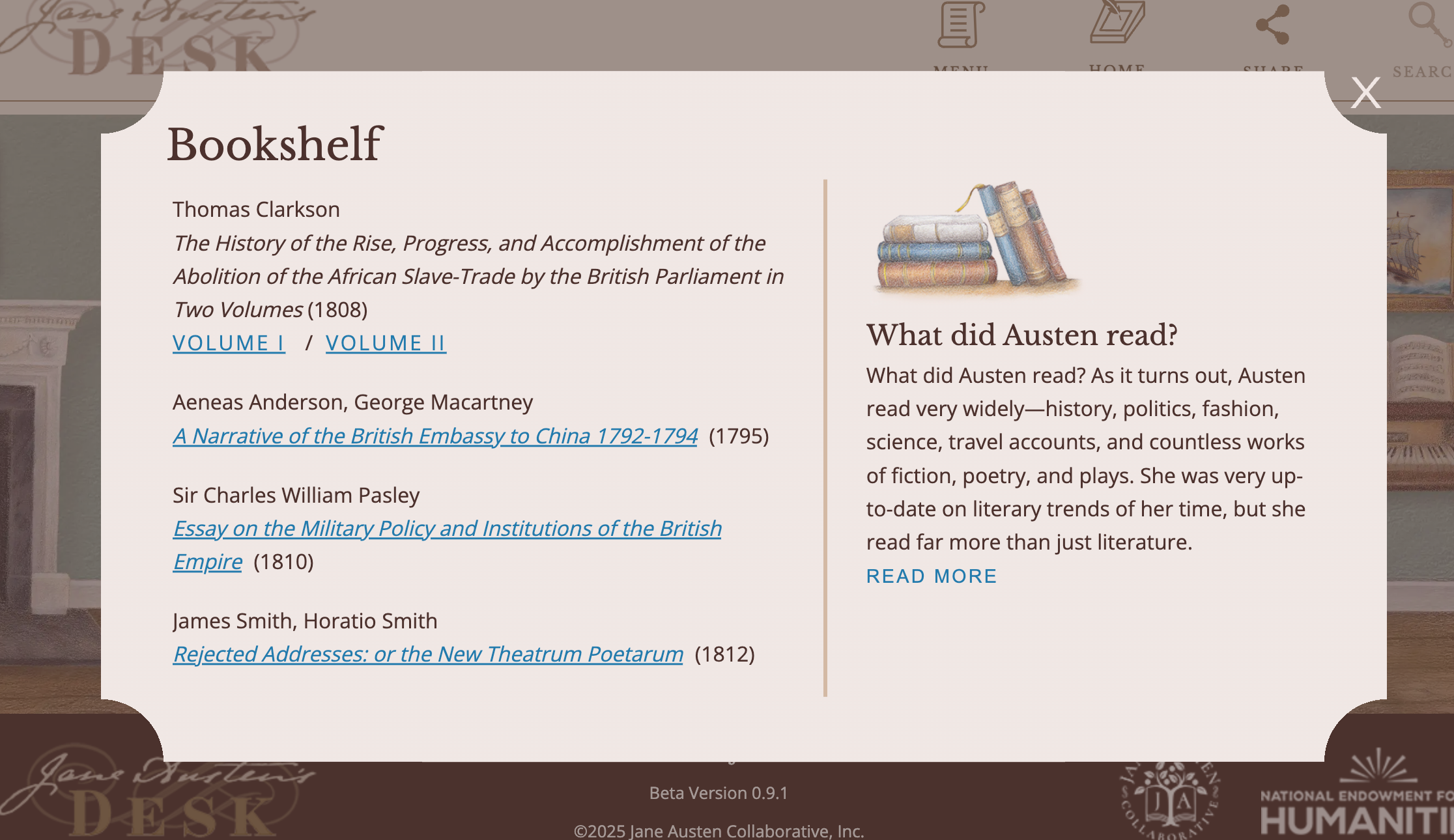
Click on the bookshelves in Rev. Austen’s bureau-bookcase , and you’ll see some books mentioned in Austen’s writings. I expect this will be expanded later. But for now, you can read from several authors Austen said she was “in love with”—Thomas Clarkson (on abolition), Sir Charles Pasley (on the military), and James and Horatio Smith (verse parodies). We also have a book that Fanny Price was reading, George Macartney on the British Embassy to China.
For each, you will find an easy-to-read early version of the book; clear commentary; pictures; and links to relevant passages in the novels and letters. Two also link to related articles. A great start if you want to explore these books connected to Austen!
Catalogs on the ledge of the bookcase open up to records of the Alton Book Society that Austen enjoyed. You’ll find lists of members, rules, and lists of the books that the members, including Austen, traded around. This gives us another peek into Austen’s life and reading.
The Bookshelf takes you to some books Austen read.
Travels
A pianoforte stands next to the bookcase. It will eventually be connected to Austen’s music.
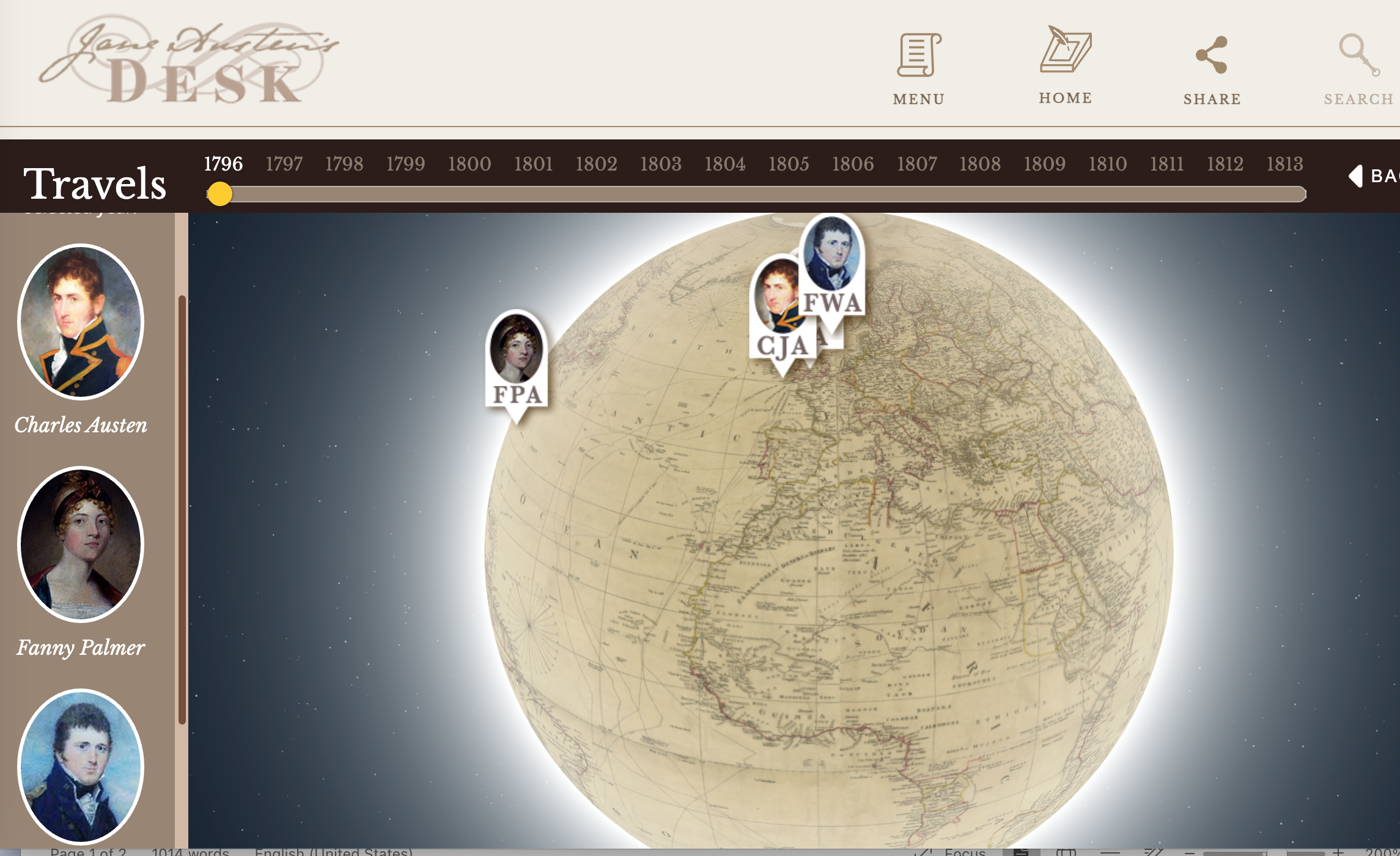
Above the pianoforte, click on the portrait of a ship on the sea. You go to a globe, where you can follow the travels of Austen’s family.
Jane Austen’s Desk, travel section. You can trace the positions of Frank and Charles Austen, Charles’s wife Fanny Palmer, and Jane Austen herself, year by year. You can also read stories about Frank and Charles’s experiences at sea.
Silhouettes on the wall connect you to Jane Austen’s family tree. If you click on the orange “i”, you get more information about each person. The plus buttons reveal more generations.
Many of these features include audio commentary as well as written commentary. For example, Lizzie Dunford of Jane Austen’s House tells us about the topaz crosses Charles brought back for his sisters.
There are great possibilities for future additions.
JAW: Inger, what gave you the idea for doing this website?
Inger: I was interested in Austen’s own creative process, and also in countering the myth that she was not well informed in the science and politics of her day. I found a kindred spirit in Sarah Walton, who was a grad student when we started. In the 1990s, both Sarah and I had been enchanted by JK Rowling’s website with clickable, magical elements on her desk to interact with.
JAW: How is the website being funded?
Inger: We have received two rounds of funding from the National Endowment for the Humanities, and have applied for more. We intend to create a GoFundMe or Kickstarter campaign to seek private funding to support specific new developments, such as the learning games we have in mind.
JAW: What are some parts you are excited about adding in the future?
Inger: The current setting is Spring 1813, while [Jane Austen] is writing Mansfield Park. Eventually we hope to add additional settings: for example, Summer or Winter 1814, when she was composing Emma; or Autumn, 1815, when Persuasion was in process.
JAW: What are some parts that you and your team are finding challenging?
Inger: Well, it all takes much more time to create than one would imagine. We have a great team of programmers and designers, including the wonderful Harriet Wu who has drawn the site by hand. We constantly try to find the sweet spot where we can appeal to both scholars and the general public, and to all ages. Just as with our Jane Austen Summer Program, we also focus on providing tools for educators who wish to bring Jane Austen into the classroom.
JAW: What other ideas do you have for expansion in the future?
Inger: As you can see on the site, there are many objects with potential to “animate” in the future. We are collaborating with Laura Klein to add music to the piano, Jennie Batchelor for sewing, and have plans for links to weather and agricultural information (via the scene out the window), tea culture (via the kettle), letter writing (via a folded letter), and many more.
We applied for a grant to develop a state-of-the-art platform for navigating, reading, notating, and analyzing Austen’s novels, including the potential for crowd-sourced editions.
As long as we can continue to find funding, I think this will be a lifelong project—there is so much potential to grow!
JAW: Thanks, Inger, we look forward to that!
The Desk, the Summer Program, and Online Talks
Gentle readers, I recommend you explore Jane Austen’s Desk. The website has not yet been configured for mobile phones, so you’ll need to access it on your computer or tablet.
When you’ve finished exploring, go back to the main page and take a survey, to possibly win a prize. The survey takes some thought and time, but you will get to give input for what you’d like to see in the future at this very helpful site.
The same Jane Austen Collaborative who created Jane Austen’s Desk also runs the Jane Austen Summer Program. This year it will be held June 19-22, 2025, in North Carolina. The theme is “Sensibility and Domesticity,” exploring “topics including medicine, birth, and domestic arts in Regency England and colonial North Carolina.” They will “focus on Austen’s first published novel, Sense and Sensibility—considering the birth of her career as a published writer as well as taking a transatlantic look at the world into which she was born.” I’m signed up, and would love to see some of you there!
Of course, even if you can’t get to North Carolina, you can always enjoy Jane Austen & Co.’s great offerings online. They are currently exploring Music in the Regency; I enjoyed a recent talk on Women & Musical Education in the Regency Era, by Kathryn Libin. Get on their mailing list for announcements of upcoming events.
They generously provide free access to recordings of their previous talks, on topics including “Austen and the Brontes,” “The Many Flavors of Jane Austen,” “Everyday Science in the Regency,” “Reading with Jane Austen,” “Asia and the Regency,” “Race and the Regency,” and “Staying Home with Jane Austen.” Something for everyone, it seems to me.
Fashionable Goodness: Christianity in Jane Austen's England is now available! By JAW contributor Brenda S. Cox. See Review. Available from Amazon and Jane Austen Books.
Available through December 31st, 2025. Click on image for details, and share this poster with other teachers and students!
The Obituary of Charlotte Collins by Andrew Capes
Click on image to read the story.
Comments
“My idea of good company…is the company of clever, well-informed people, who have a great deal of conversation.” – Jane Austen, Persuasion
Gentle readers: Please feel free to post your comments and continue the conversation! Due to SPAM, we will no longer accept comments on posts after 30 days of publication. In some instances, links will be removed from comments as well.
Administrators and Contributors
Vic Sanborn, founder of this blog, is supported by a team of talented and knowledgeable writers about Jane Austen and the Regency era. They are:
Tony Grant, who now contributes his photos from London and England
Click on their names to enter their own blogs.
In addition, we thank the many experts and authors who frequently contribute their posts and opinions, and who continue to do so freely or at our request.
Click here to enter the page. Topics include Regency fashion, historic foods, Jane Austen societies, British sites, related topics. Click on image.
May we suggest?
Hello, my name is Vic and I live in Maryland, USA. I have adored Jane Austen almost all of my life. I am a proud lifetime member of the Jane Austen Society of North America. This blog is a personal blog written and edited by me and my team. We do not accept any form of cash advertising, sponsorship, or paid topic insertions. However, we do accept and keep books and CDs to review.
If you would like to share a new site, or point out an error, please email us. (Yes, we are fallible. We'll own up to our mistakes and will make the corrections with a polite smile on our faces.) Write us at
Thank you for visiting this blog. Your comments and suggestions are most welcome.
Project Gutenberg: eBook of Stage-coach and Mail in Days of Yore, Volume 2 (of 2), by Charles G. Harper
STAGE-COACH AND MAIL IN DAYS OF YORE: A PICTURESQUE HISTORY
OF THE COACHING AGE, VOL. II, By CHARLES G. HARPER. 1903. Click on this link.










 Jane Austen's World