Feeds:
Posts
Comments

Archive for the ‘19th Century England’ Category

Fire!

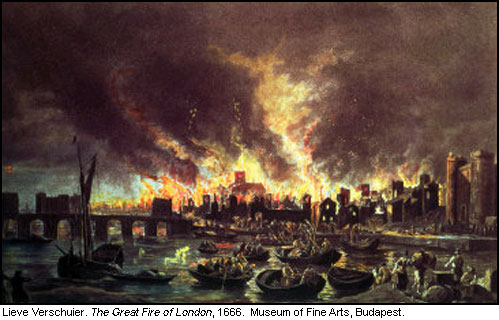
Can there be a more frightening word in Georgian London?  The great fire in 1666 changed the landscape of that city forever. Once a densely packed city riddled with overcrowded, wood-timbered houses and dark, narrow lanes, the fire led the way to a change in building regulations that ushered in brick and stone edifices, wider streets, and public squares. Even with improvements, a fire still presented a horrifically dangerous situation.
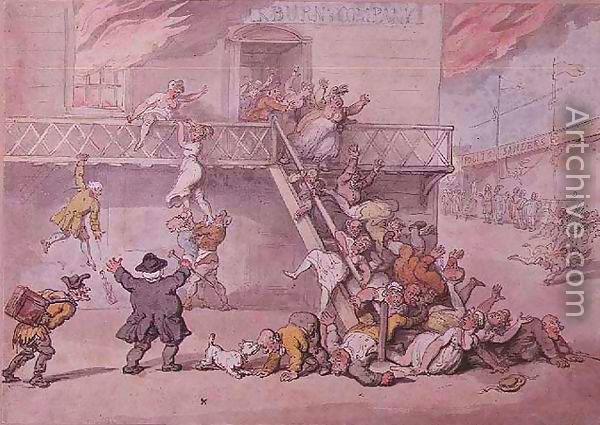
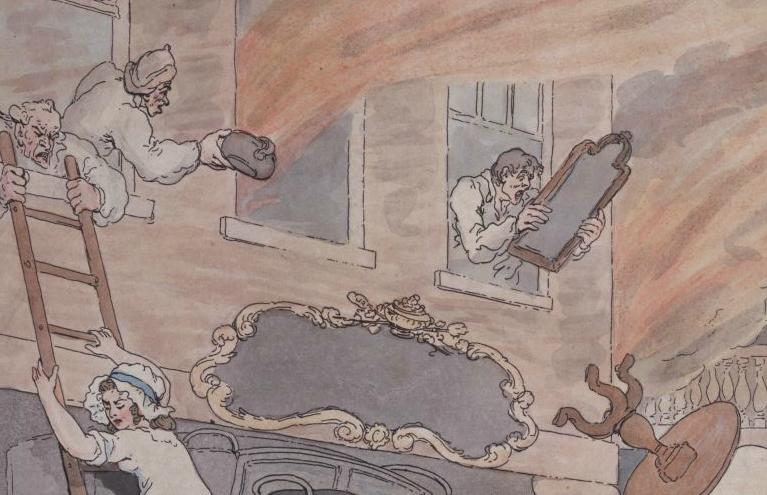
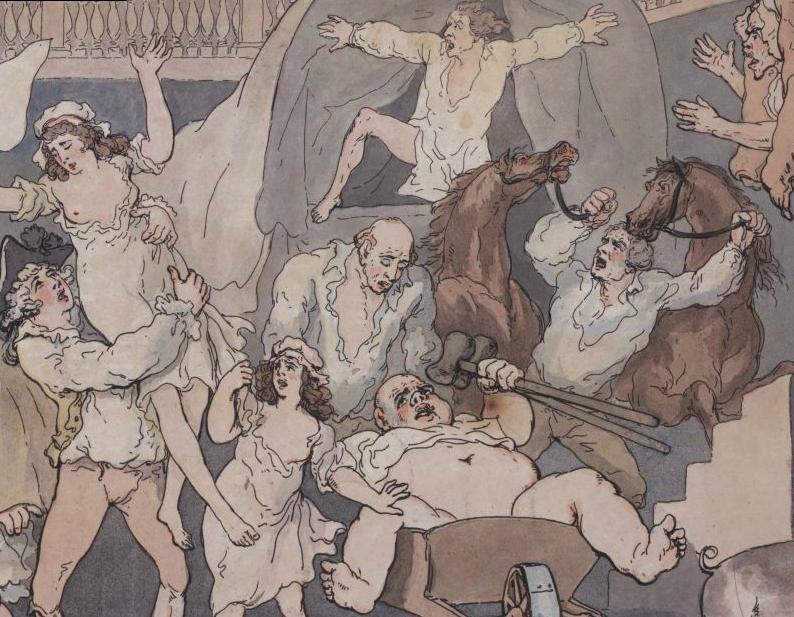
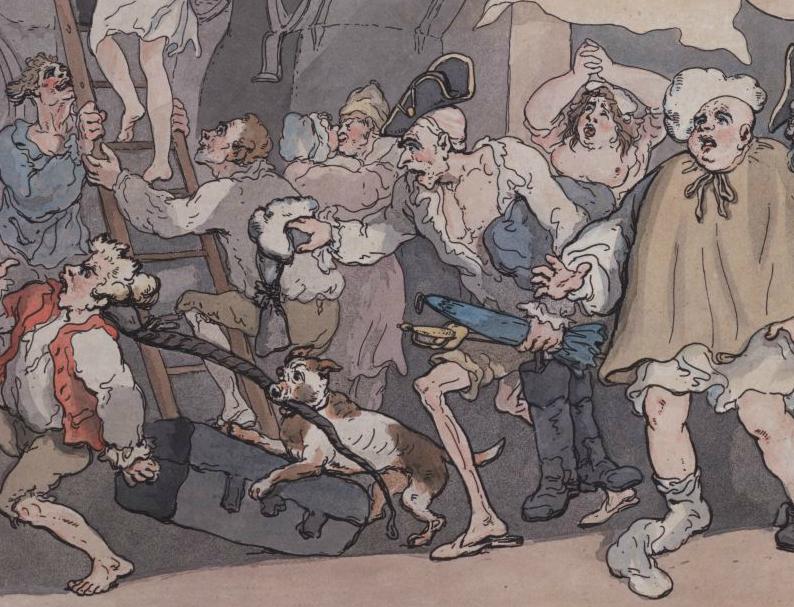
Thomas Rowlandson captures the scene with such realism in “Inn Yard on Fire” that one can smell the smoke and fear, and hear the horses neighing, people screaming, furniture breaking, and wagon wheels squealing as guests and staff run around trying to save themselves, their possessions, and each other.
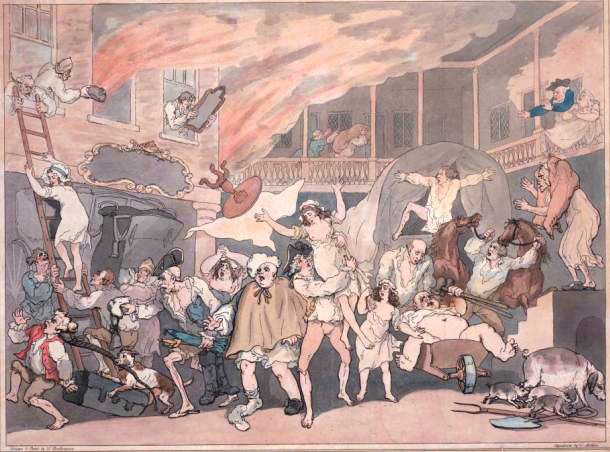
Fire at the Inn, by Thomas Rowlandson

Panic and pandemonium ensue. A man contemplates tossing a mirror from the second story, another pours his ineffectual chamber pot over the flames. A side table has been tossed through the window, while an anxious woman descends a ladder.
People are in various states of dress and undress. Some help others, some are  overcome with panic. A disabled man is carried from danger in a wheel barrow, while a groom tries to calm two terrified horses.
Elements in Rowlandson’s cartoon show a direct association with classical language and Tobias Smollet. The young man saving the girl in distress is reminiscent of Giambologna’s statue of the Rape of the Sabine Women, as well as Peregrine Pickle’s heroic actions towards Emilia.
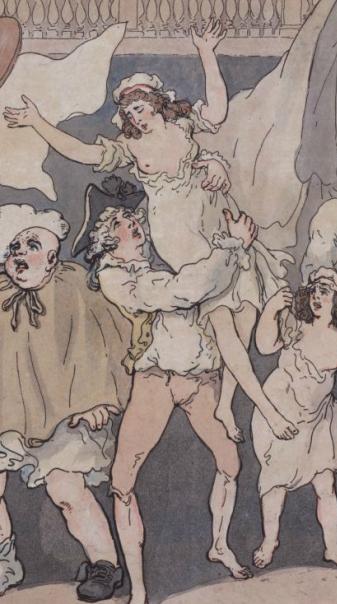
Rowlandson
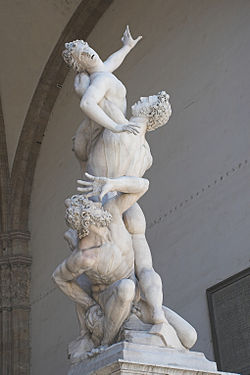
Rape of the Sabine Women
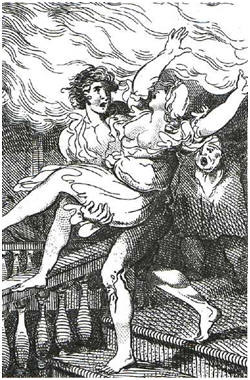
Peregrine Pickle saves Emilia. Image @A World History of Art

Once a fire had gained as much ground as depicted in this illustration, there was little chance of saving the building. Rowlandson shows some people carrying out their belongings, while others were barely able to get dressed. By now an alarm had probably been sounded in the community. Bucket brigades, in which people were arrayed in long lines to the nearest well and passed buckets in a continuous motion, could probably put out a minor fire, but not one of this magnitude. In the 1800s, almost 150 years after the great fire, there was still no centralized fire brigade.
In 1680, a property developer named Nicholas Barbon introduced the first fire insurance, which initially insured buildings but not furniture, fittings, or goods.  Insurance companies began to proliferate and formed private fire brigades to protect their customers’ property.
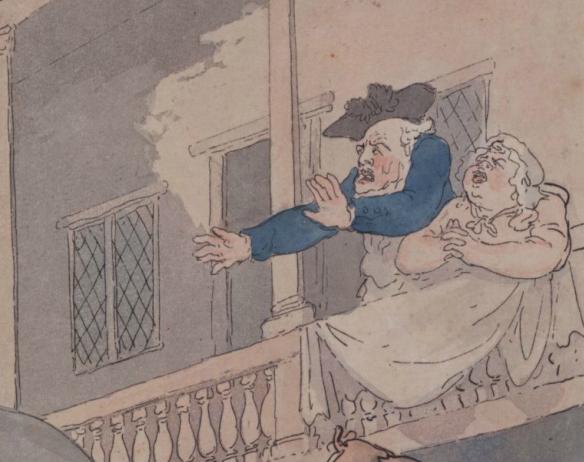
Is this praying elderly couple trapped on the balcony?

In Rowlandson’s cartoon the most the inn keeper can hope for is that the brigade arrives in time to save his structure – if he is insured.  This was easier said than done, for many of London’s streets were not named, since many people could not read, and insured properties were difficult to find.
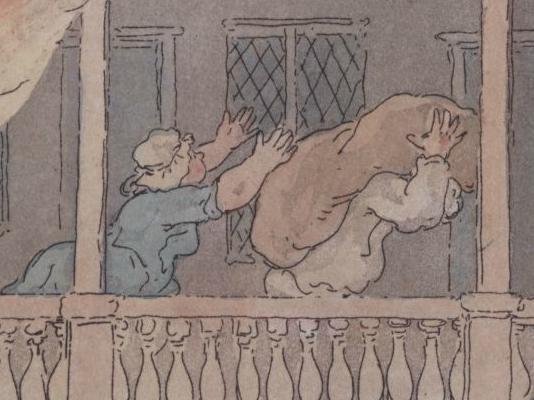
A couple on the second floor frantically attempt to save their belongings.

In the early 1800s the fire mark was developed. These plaques, sometimes brightly painted, would signal which properties were protected by insurance firms. Each fire brigade had its own unique plaque.
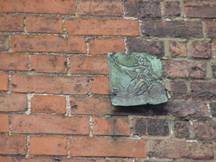
Fire mark on a building

If a fire started, the Fire Brigade was called. They looked for the fire mark and, provided it was the right one, the fire would be dealt with. Often the buildings were left to burn until the right company attended! Many of these insurance companies were to merge, including those of London, which merged in 1833 to form The London Fire Engine Establishment, whose first Fire Chief was James Braidwood. Braidwood had come to London after holding the position of the Chief Officer of Edinburgh Fire brigade. Edinburgh’s authorities had formed the first properly organised brigade in 1824. – History of the UK Fire and Rescue Service
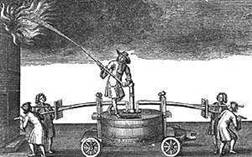
There were quite a few fire brigades operating in London in the early 19th century and competition was keen. The companies hired sailors and watermen as part-time employees. An advantage of serving in this position was that these men were protected from being pressed into service, a not inconsiderable benefit during the Napoleonic wars.
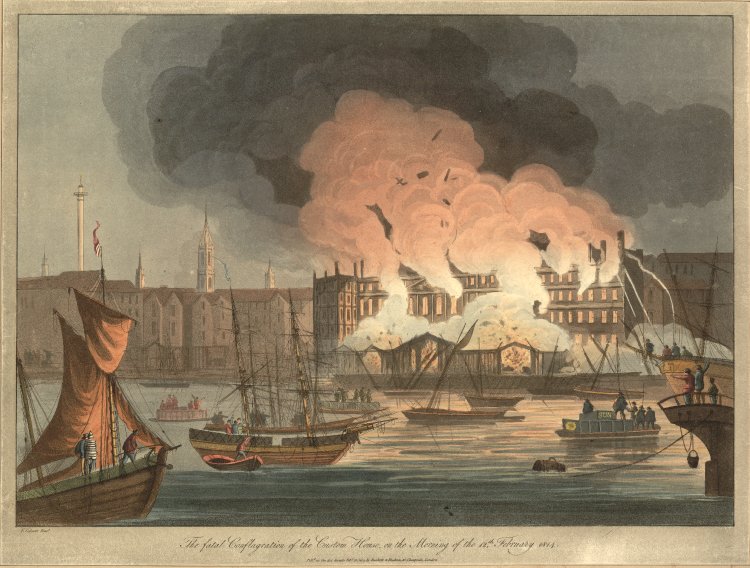
Fighting the fire at the Customs House in February 1814.Image@British Museum

Buildings that had no insurance protection were left to burn, although attempts were made to save the surrounding buildings. Firemarks were essential to identify insured buildings:
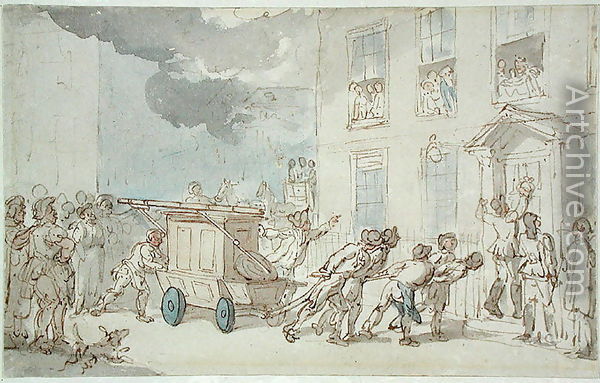
Arrival of the fire engine, Thomas Rowlandson

Designs included, for Sun Fire Office: a large sun with a face; the Royal Exchange Assurance: their building; and Phoenix: obviously Phoenix rising from the ashes. Later fire marks were made of tin, copper, or similar material. These are more often called fire plates. They were more an advertising medium as most do not have a policy number stamped upon them. – Fire Marks: The First Logos of Insurance Companies
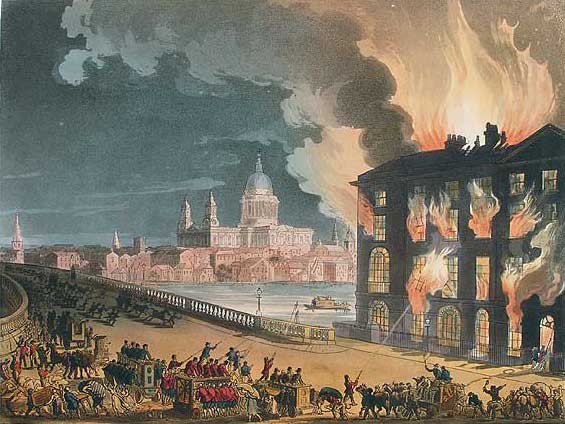
Illustration from Ackermann’s ”Microcosm of London” (1808) drawn by Thomas Rowlandson and Augustus Pugin. Firefighters are tackling a fire which has broken out in houses at the Blackfriars Bridge. Teams of men operate hand pumped equipment. Image @Wikipedia

In 1833 companies in London merged to form The London Fire Engine Establishment, the first step to the various fire brigades being taken over by local government.
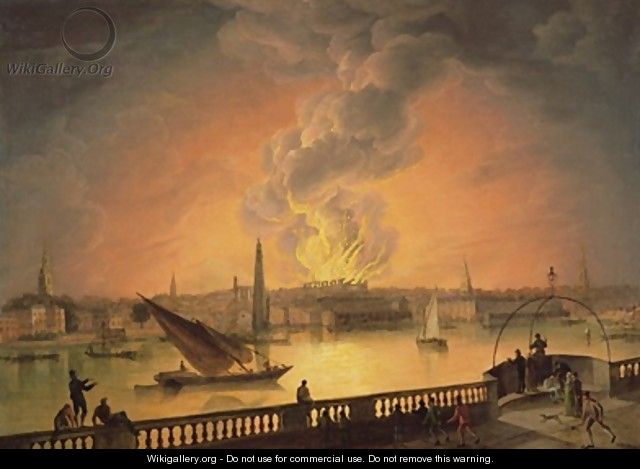
The Burning of Drury Lane Theatre from Westminster Bridge 1809. Artist unknown.  Image property of the Museum of London.

Equipment was still very basic but in 1721, Richard Newsham patented a ‘new water engine for the quenching and extinguishing of fires’. The pump provided a continuous jet of water with more force than before. This new fire engine became a standard until the early 19th century.
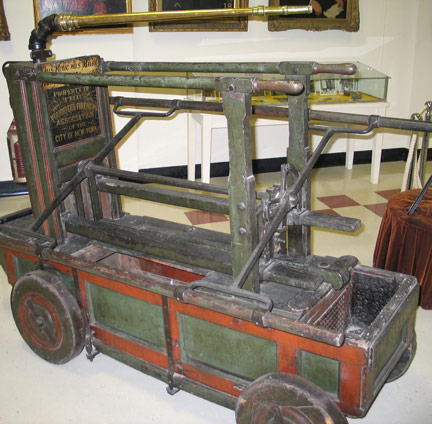
Newsham’s wood pumper, ca. 1731.

The men used the handles to pump the water from a lead-lined trough in the main body of the equipment. The apparatus was quite heavy and difficult to maneuver, but it represented a huge step forward in fire fighting technology. People continually ran back and forth to a water source to fill the trough with water. You could also attach a hose to aim the water to a specific location. During this time, however, hose-making was still in its infancy and many leaked. Water buckets and axes to hack out trapped people and create fire free perimeters were still regarded as standard fire fighting equipment.
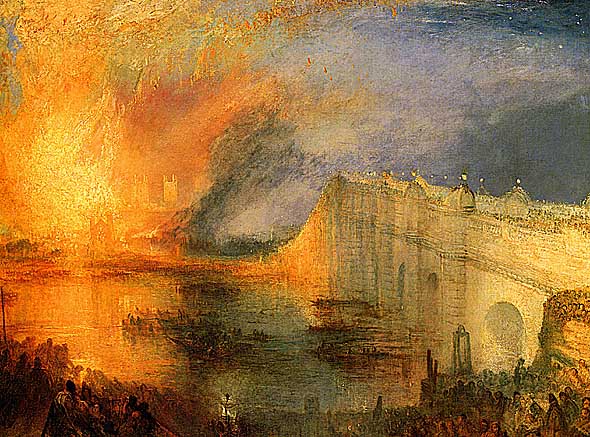
The Burning of the Houses of Parliament, 1834 by William Mallord Turner. Such an event must have provided a spectacular yet horrifying scene for onlookers.

Steam powered appliances were first introduced in the 1850s, allowing a greater quantity of water to be guided onto a fire. With the invention of the internal combustion engine, these appliances were replaced in the early 1900s.
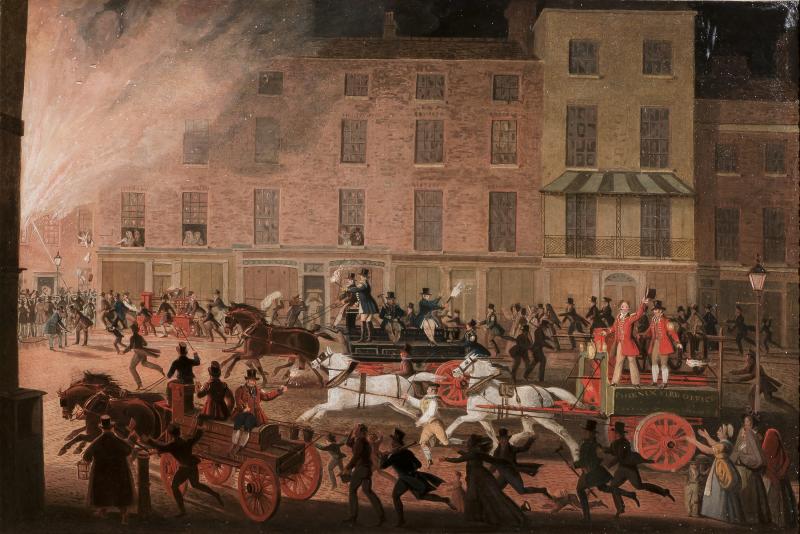
James Pollard (British, 1797-1867) London fire engines: The noble protectors of lives and property, 1823. Image @Olympia Art Antiques

This image by James Pollard, and engraved by R. Reeve, shows several insurance brigades hurrying to a fire.

The firemen, of the time, had little training and wore brightly coloured uniforms to distinguish themselves between the different brigades. During large fires they would become very tired through continual pumping of the appliances, and would offer bystanders ‘beer tokens’ in return for their help. – Insurance Firemen and their Equipment
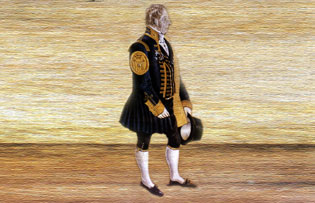
Each company provided different liveries for their men, so that the fire fighters could easily be identified with a particular firm.All insurance firemen wore a large badge on their shoulder to show which insurance company they worked for.
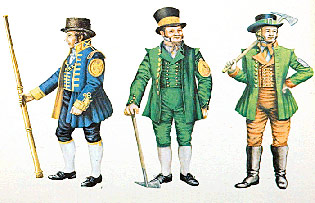
Three uniforms of insurance firemen. All wear a badge

More on the topic:

Cockburn’s theatre on fire, another dramatic caricature by Rowlandson.
Read Full Post »

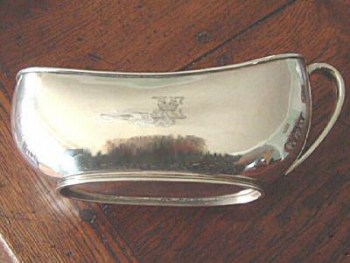
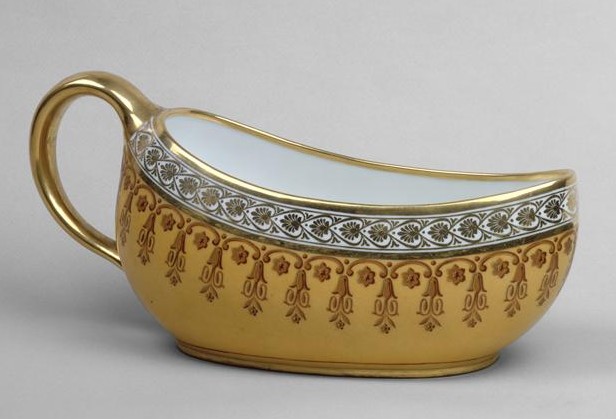
This image of a bourdaloue might be somewhat confusing to the uninitiated. Could this small and elegant vessel be a gravy boat? Or a blood-letting container?

Sevres bourdaloue, 1831.

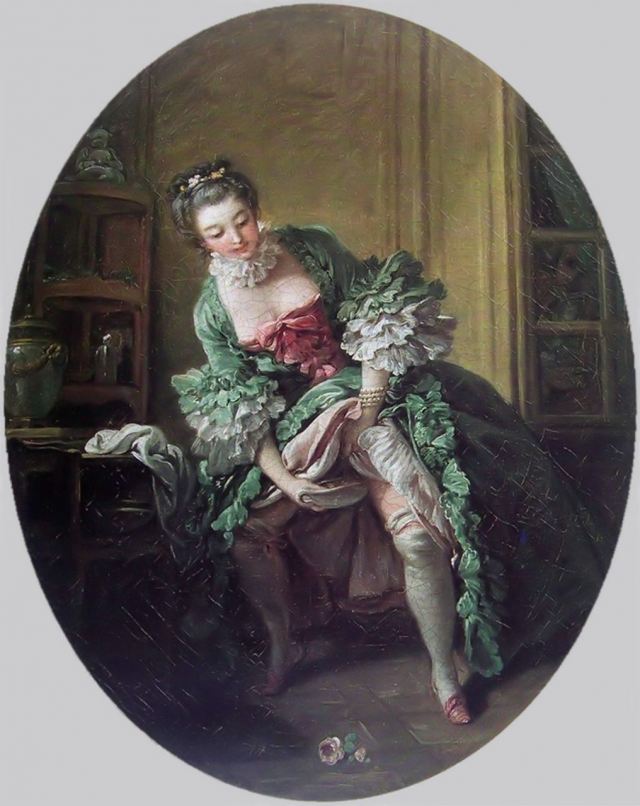
This image by Francois Boucher says it all. A fully dressed lady is relieving herself into an object called the bourdaloue or bourdalou, careful not to soil her skirts. Her maid, no doubt, stands nearby, waiting to receive the small chamber pot in order to empty it. The lady (or woman of ill repute) is in a public place – a theatre or tavern, perhaps – but certainly not a church. Wherever she is, the place has no public toilet. And so she must relieve herself standing up, taking care not to soil her skirt and petticoats.

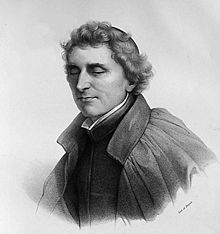
Louis Bourdaloue. Image @Wikimedia Commons

According to legend, the name of this porta potty comes from  Louis Bourdaloue (1632-1704), one of Louis XIVs Jesuit priests. His oratorical skills were reputedly so accomplished that people felt they could not miss a single word of his sermons. It is said that women sat through his masses with a bourdaloue placed under their dresses, whose skirts were held out by panniers. Since the priest’s  sermons were somewhat longwinded, the chances that ladies would need to relieve themselves were almost certain.  As a rule, churches and theatres had no toilets, and there were no breaks given during sermons. Ergo these portable urinals, which were ergonomically designed to accommodate the female body.

The vessel was oblong, rectangular, or oval in shape. A slightly raised lip at one end and a handle at the other allowed the woman to relieve herself from a squatting or standing position. The edges curved inward to avoid hurting her tenderest parts.

Sevres bourdaloue, with medallion depicting a scene from Watteau, blue lapis and framed in gold leaf. 1892.

It is a little hard to distinguish truth from fiction, so I am a bit skeptical about this apocryphal tale. Were the priest’s sermons in the early 18th century so truly awe-inspiring that a lady would squat in her pew, however discreetly, to relieve herself in front of her family and other parishioners so as not to miss a word?

In truth it was her maid who brought the vessel in, for bourdaloues were compact and came with a cover. When a lady had to relieve herself she would, I imagine, retreat discreetly to a private corner of a tall pew or to a back or side room in the church. Her maid would then hand the vessel over to her mistress, who took care not to spill any liquid on her skirts. When the lady was finished, she would hand the bourdaloue to her maid to empty its contents.  When attending a play or opera at the theatre, I imagine she would again retreat to a darker more private corner of the box to urinate.

A PAIR OF SEVRES BOURDALOUES (POTS DE CHAMBRE OVALE) CIRCA 1776,

Designed only for women, these bourdalous are quite beautiful. Made of faience or porcelain, they are decorated with flowers or painted scenes. Many are gilded. The portable pots, or coach pots as they were known in England, could be decorated inside as well.  They were quite small and compact, designed for travel, which made it easy to carry them and pack them for coach trips. They were also taken to long banquets, where ladies would scurry behind curtains when they needed to go.

Bourdalou made in France c. 1840. It has an engraved crest and a leather case to contain it. The silver bourdalou is a small urinary receptacle for female use, of compressed eliptical shape and generally made of porcelaine or earthenware, but also made occasionally of silver. Its front end has an incurved rim and, usually, stands on a simple foot ring with a simple loop handle. Also known as a coach pot in England.

Bourdaloues were used throughout the 18th and for most of the 19th century. As water closets began to be built inside homes and buildings, the use of these chamber pots began to be reduced dramatically.

Plain bourdaloue made of creamware. The shape is quite elegant.

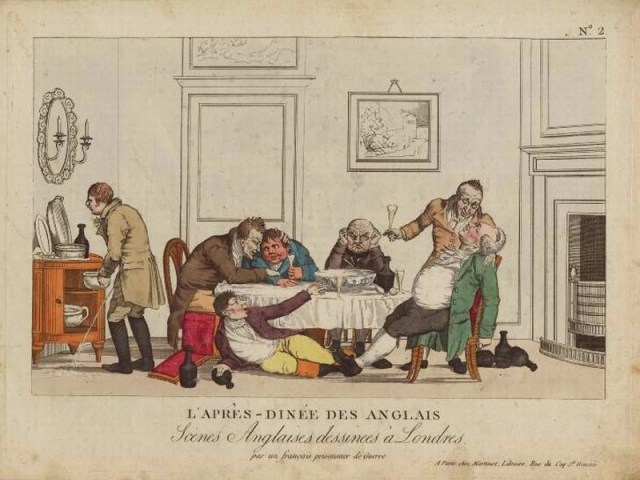
Gentlemen had it a little easier, although this satiric French cartoon, which I have shown before, depicts the disgust that Frenchmen felt towards Englishmen who freely pissed in a pot in the dining room. In this instance, the man misses the chamber pot and hits the floor. There seems to be a lack of modesty among these men, which largely holds true today.

c1816, from Fitzwilliam Museum.

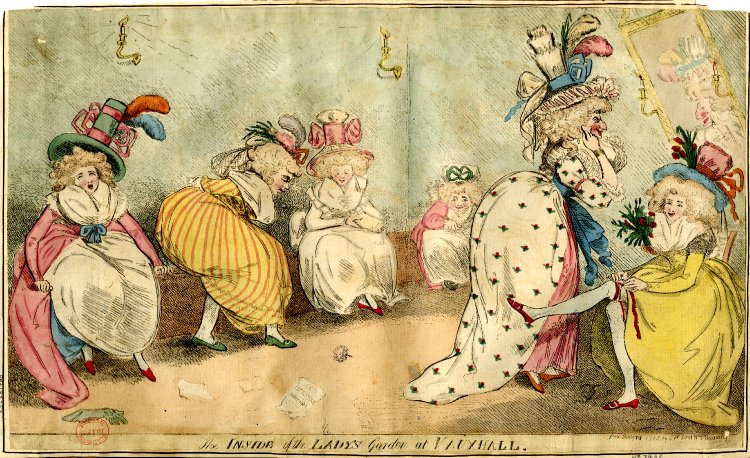
Modesty is also lacking in this cartoon of ladies relieving themselves inside a public restroom at Vauxhall Gardens. Four are arrayed on a long latrine against the wall. One lady is refreshing her make up and another is tightening her garter. If such scenes were common for upper class women in public spaces, perhaps many felt no modesty relieving themselves in church as well.

The Inside of the Lady’s Garden at Vauxhall, 1788 by SW Fores. Image @British Library. The interior of a ladies’ cloak-room. Against the wall on two sides of the room is a bench forming a latrine on which four fashionably dressed ladies are seated. On the right a woman in profile to the right, resembling Lady Archer, applies paint to her cheeks before a mirror lit by two candles. A young woman seated beside her on the extreme right ties up her garter.

Read Full Post »

“there seem to be very few, in the style of a Novel, that you can read with safety, and yet fewer that you can read with advantage.”- Sermons to Young Women, James Fordyce, 1766

It’s no secret that Jane Austen’s family were novel readers during an age when such books were considered frivolous and not worthy of reading. (Writing a novel was considered an even worse offense!) Enter Jane Austen and Pride and Prejudice. In her delightful book, Jane created a satiric scene in which Mr. Collins confirmed Mr. Bennet’s opinion of his young cousin’s foolishness. After he enjoyed the younger man’s inanity for a while, Mr. Bennet proposed that Mr. Collins read to the group. The girls chose a novel, of which Mr. Collins disapproved:

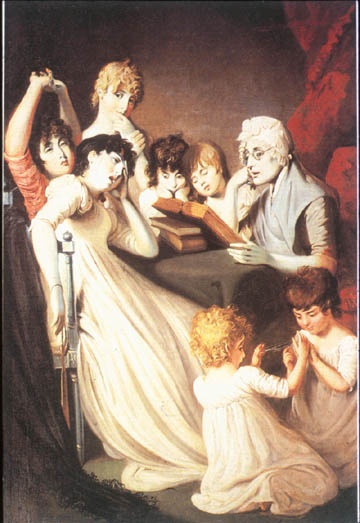
John Opie, "A Moral Homily"

John Opie, “A Moral Homily”

Mr. Bennet’s expectations [regarding Mr. Collins] were fully answered. His cousin was as absurd as he had hoped, and he listened to him with the keenest enjoyment, maintaining at the same time the most resolute composure of countenance, and, except in an occasional glance at Elizabeth, requiring no partner in his pleasure.

By tea-time, however, the dose had been enough, and Mr. Bennet was glad to take his guest into the drawingroom again, and, when tea was over, glad to invite him to read aloud to the ladies. Mr. Collins readily assented, and a book was produced; but on beholding it (for everything announced it to be from a circulating library), he started back, and begging pardon, protested that he never read novels. Kitty stared at him, and Lydia exclaimed.—Other books were produced, and after some deliberation he chose Fordyce’s Sermons. Lydia gaped as he opened the volume, and before he had, with very monotonous solemnity, read three pages, she interrupted him with—

“Do you know, mamma, that my uncle Philips talks of turning away Richard; and if he does, Colonel Forster will hire him. My aunt told me so herself on Saturday. I shall walk to Meryton to-morrow to hear more about it, and to ask when Mr. Denny comes back from town.”

Lydia was bid by her two eldest sisters to hold her tongue; but Mr. Collins, much offended, laid aside his book, and said—

“I have often observed how little young ladies are interested by books of a serious stamp, though written solely for their benefit. It amazes me, I confess;—for, certainly, there can be nothing so advantageous to them as instruction. But I will no longer importune my young cousin.”

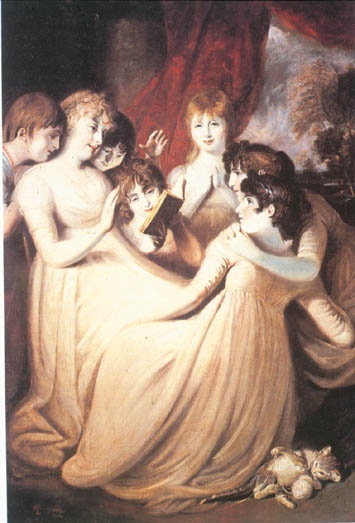
John Opie, “A Tale of Romance”

One cannot but help enjoy the irony of the situation. During his lifetime, Dr Fordyce was considered an excellent orator and his sermons were much appreciated, but by the time Jane Austen began to write her novels his luster had dimmed and novel reading was becoming more acceptable. These wonderful paintings by John Opie represent both sides of the sermon/novel story. In the first painting the governess is reading boring homilies to her charges in the hope of educating them. She is completely unaware of their expressions. One girl yawns, another can barely keep her eyes open, and a third looks pensively at the viewer as if to say, “Can you believe this?” Two of the youngest children entertain each other by playing cat’s cradle, and the girl sitting nearest the reader is about to fall asleep. What a wonderful tableau! One can imagine that the Bennets must have looked much like this ensemble before Lydia blurted out her question.

The second painting depicts the delight that the ensemble takes in listening to a tale of romance. They are all engaged and smiling and hanging onto every word from the reader. A kitten is left to play with a wool ball by itself.

Jane Austen employed words to create an ironic tone; John Opie used images. Both used their respective mediums to make a memorable point. Today, Dr. Fordyce’s sermons are largely forgotten. The following excerpt from Sermon VIII, Volume 2 demonstrates why he was considered dull and stodgy even 200 years ago:

Sermons to Young Women, Volume 2, James Fordyce, 1767. You can download the volume as an ebook at this link.

Read Full Post »

Gentle readers, I have been staying inside during this week’s heatwave, which shows no signs of letting up. As I showered, I wondered how people in days of yore dealt with their sweat and overheated bodies. Karl Philipp Moritz’s excellent and delightful travel journal from 1782, ‘Travels in England’, gave me a clue. Here are some excerpts from his account of wandering through the British countryside.

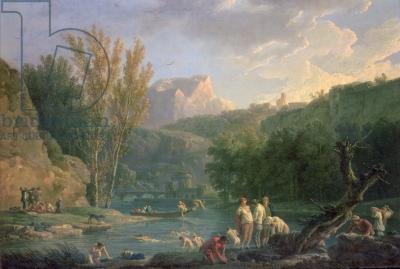
River Scene with Bathers, 18th century (oil on canvas), Vernet, Claude Joseph (1714-89) Image @Bridgeman

Now it is a pleasing exchange to find that in two hours I can walk eight miles.  And now I fancy I was about seventeen miles from London, when I came to an inn, where, for a little wine and water, I was obliged to pay sixpence.  An Englishman who happened to be sitting by the side of the innkeeper found out that I was a German, and, of course, from the country of his queen, in praise of whom he was quite lavish, observing more than once that England never had such a queen, and would not easily get such another.

It now began to grow hot.  On the left hand, almost close to the high road, I met with a singularly clear rivulet.  In this I bathed, and was much refreshed, and afterwards, with fresh alacrity, continued my journey.

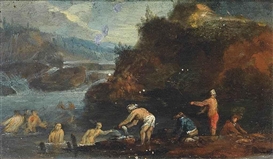
A river landscape with bathers, Dutch 18th c. painting. Such scenes were common throughout Europe.

Karl, a romanticist, read Milton as he rested in between long walks. His account bears witness to his love of the British countryside, despite the poor manners of inn keepers, who were wary of a man on foot. (Those who traveled on horseback or in a carriage received preferential treatment. )The following description shows how people during the Georgian era were not as deprived of baths as we thought, or as adverse to bathing!

I went down into the coffee-room, which is immediately at the entrance of the house, and told the landlord that I thought I wished to have yet one more walk.  On this he obligingly directed me to stroll down a pleasant field behind his house, at the foot of which, he said, I should find the Thames, and a good bathing place.

I followed his advice; and this evening was, if possible, finer than the preceding.  Here again, as I had been told I should, I found the Thames with all its gentle windings.  Windsor shone nearly as bright over the green vale as those charming houses on Richmond Hill, and the verdure was not less soft and delicate.  The field I was in seemed to slope a little towards the Thames.  I seated myself near a bush, and there waited the going down of the sun.  At a distance I saw a number of people bathing in the Thames.  When, after sunset, they were a little dispersed, I drew near the spot I had been directed to; and here, for the first time, I sported in the cool tide of the Thames.  The bank was steep, but my landlord had dug some steps that went down into the water, which is extremely convenient for those who cannot swim.  Whilst I was there, a couple of smart lively apprentice boys came also from the town, who, with the greatest expedition, threw off their clothes and leathern aprons, and plunged themselves, head foremost, into the water, where they opposed the tide with their sinewy arms till they were tired.  They advised me, with much natural civility, to untie my hair, and that then, like them, I might plunge into the stream head foremost. Refreshed and strengthened by this cool bath, I took a long walk by moonlight on the banks of the Thames.  To my left were the towers of Windsor, before me a little village with a steeple, the top of which peeped out among the green trees, at a distance two inviting hills which I was to climb in the morning, and around me the green cornfields.  Oh! how indescribably beautiful was this evening and this walk!

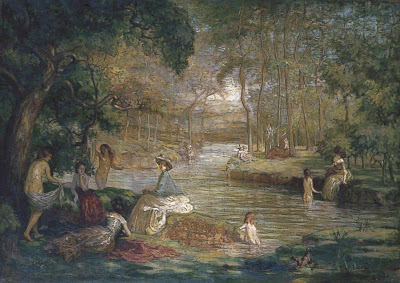
Women Bathers by a River, Tharp, 1900. This painting was made over 100 years after Karl’s journey. Notice the segregation of the women from the men, which held true over a century before this painting was made.

About Karl Philipp Moritz (from Wikipedia): Karl was a German author, editor and essayist of the Sturm und Drang, late enlightenment, and classicist periods, influencing early German Romanticism as well. He led a life as a hatter’s apprentice, teacher, journalist, literary critic, professor of art and linguistics, and member of both of Berlin’s academies. Karl traveled through England in his 20s; he died young, when he was 37.

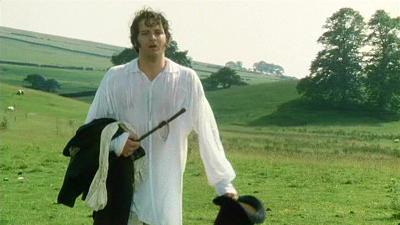
This scene in Pride and Prejudice 1995 might not have been in Jane’s book, but Darcy’s desire to cool off in his stream-fed pond made sense and was historically accurate.

You can download Karl Philipp Moritz’s book for free into your Kindle or Kindle app. [Moritz, Karl Philipp, 1757-1793. Travels in England in 1782 by Karl Philipp Moritz (Kindle Locations 987-992). Mobipocket (an Amazon.com company).]

Colin Firth in a wet shirt.

Read Full Post »

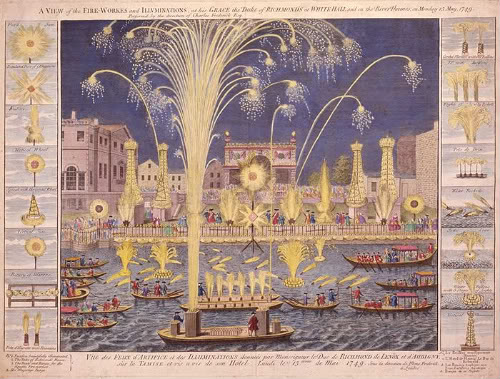
Today U.S. citizens are celebrating July 4th and the independence of our nation from Great Britain. Grand firework displays will play a pivotal role in our national revelry tonight, culminating a day long celebration. Fireworks were not unknown during the Georgian Era, and were used for grand effect in public celebrations. I will point out only a few instances in London.

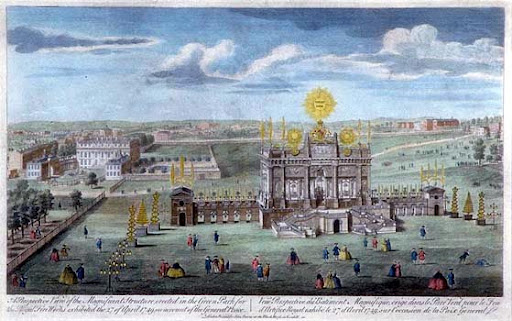
The picture above is of the firework display held by the Duke of Richmond at Richmond House near the Thames in Whitehall, London [May 1749] and shows both the whole effect of all the fireworks and also, very interestingly, gives individual details [on the side] of the individual fireworks which made up the whole display. – Austenonly

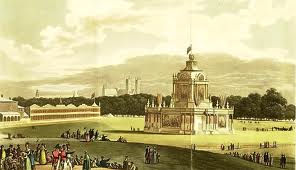
Temple of Peace in Green Park.

Early view of Green Park and the Temple of Peace.

Green Park was readied for a grand fireworks display in 1763 to celebrate the Treaty of Paris, which ended the French and Indian War in North America. The park had attracted firework displays before:

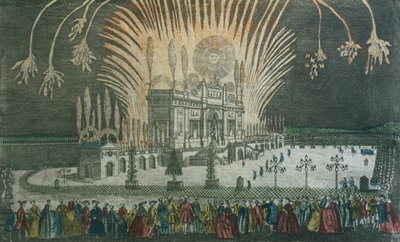
The Green Park was used for a national party in 1746 to celebrate the end of the War of Hanoverian Succession. The royal family arranged a great firework display and commissioned the composer, Handel, to write his Music for the Royal Fireworks. A vast Temple of Peace was built in the park to store the fireworks. But early on a stray rocket hit the temple. Three people died and 10,000 fireworks were destroyed in the fire that followed. – The Green Park

Temple of Peace in Green Park lit up by fire works.

The Treaty of Paris  granted Great Britain control of all land to the east of the Mississippi River, a cause for a grand celebration and a good reason for building a ceremonial temple. (View a print of the scene here.)

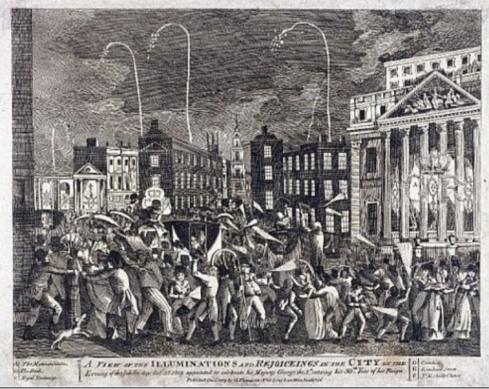
Another cause for creating massive firework displays was the long reign of George III. The details of  the Golden Jubilee celebrations are beautifully described at Austenonly.

Fireworks in London in celebration of King George III Golden Jubilee in 1809

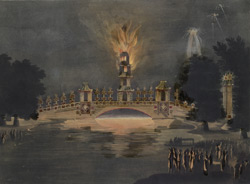
Fireworks were quite dangerous, and so were  gas lit fires. In 1814, another grand celebration was planned in St. James Park (which lies close to Green Park) to commemorate 100 years of the Hanoverian royal family. A seven-story pagoda was erected on a Chinese-style bridge spanning the canal in St. James’s Park.

A view of the Chinese pagoda burning. Image @British Library

The splendid gala was organized for the joint August first celebration of the Hanoverian Centenary and the anniversary of the Battle of the Nile. The brilliant and daring tactics of Lord Nelson at the Battle of the Nile were represented by rowboats upon the canal. A disaster occurred when the gas lit pagoda caught fire and burned. Two men were killed and a number injured trying to put out the fire. A number of the Royal swans succumbed to smoke and fire. The crowd unaware that this was an accident took the occurrence to be part of the spectacle and applauded wildly. – The Georgian Index

When the Napoleonic Wars came to an end, famed rope walker, Madame Squi, could finally cross the English Channel in  1816 to perform at Vauxhall Gardens for the first time.

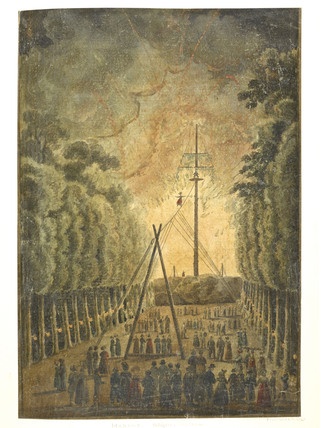
Madame Saqui illuminated by the bursts of fireworks, Vauxhall, 1816. Copyright Museum of London*

‘In the midst of a great burst of fireworks, Bengal lights glimmering faintly in the clouds of smoke, she (Saqui) stands on a rope, sixty feet up, and follows a narrow and difficult path to the end of her journey. Sometimes she is completely hidden from our eyes by the billowing waves, but from the way she walks, so self-assured, one would think an Immortal was walking peacefully towards her celestial home.’ [Lerouge on Madam Saqui at Vauxhall] – Rope Walkers and Equillibrists

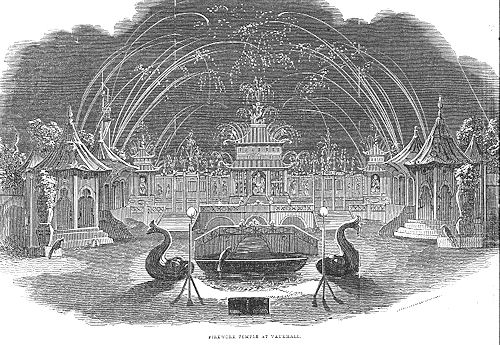
Firework displays were no novelty at Vauxhall Gardens, or any of the major gardens where people congregated to walk along grand promenades, dance publicly to music, eat, drink, and enjoy an evening out in the open.

Fireworks display at Vauxhall, 1800s.

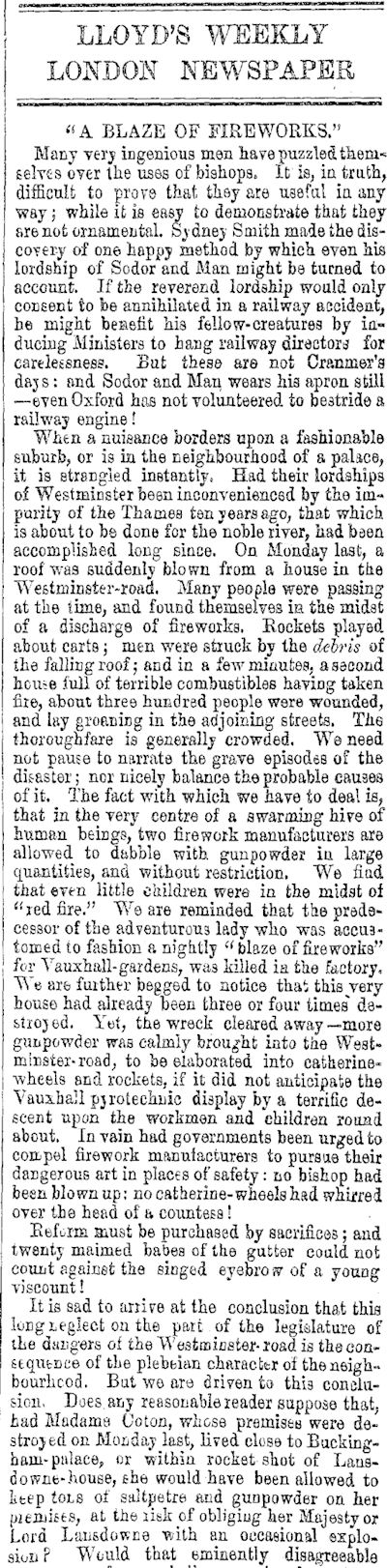
There were terrible accidents then as now with fireworks. Here is an account from  an 1858 newspaper** about an accident in central London:

All over the U.S. we will be enjoying various kinds of firework displays. Those in Washington D.C. and the major cities will be the grandest, I am sure. I recall an intimate firework display along a small lake in Vermont one year, in which only a few fireworks were set off. Interestingly, of all the firework displays I have seen, that is the one I tend to recall. Happy Birthday, America! Stay safe.

*Museum of London Prints

**Newspaper Account of Vauxhall accident.

More about Green Park at this link.

Read Full Post »

« Newer Posts - Older Posts »