Feeds:
Posts
Comments

Archive for the ‘Georgian Life’ Category

Inquiring readers: Paul Emanuelli, author of Avon Street, has contributed a post for this blog before about the City of Bath as a Character. He has graciously sent in an article about crime and an incident involving Jane Austen’s aunt, Mrs James Leigh-Perrot. Paul writes about Bath in his own blog, unpublishedwriterblog. It is well worth a visit!
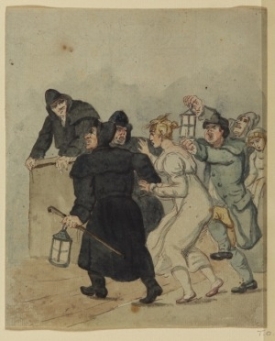
Arrest of a woman at night, 1800. Thomas Rowlandson. Image @The Proceedings of the Old Bailey

Apart from the Bow Street Runners in London there was no organised police force in 18th Century England. The capture and prosecution of criminals was largely left to their victims to deal with. Every parish was obliged to have one or two constables, but they were unpaid volunteers working only in their spare time. A victim of crime who wanted a constable to track down and arrest the perpetrator was expected to pay the expenses of their doing so.

Sometimes victims of crime hired a thief-taker to pursue the wrong-doer. Again, they were private individuals working much like latter day bounty hunters. Sometimes, thief-takers would act as go-betweens, negotiating the return of stolen goods for a fee. Many though were corrupt, actually initiating and organising the original theft in order to claim the reward for the return of goods, or extorting protection money from the criminals they were supposed to catch.
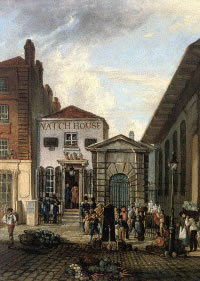
Covent Garden watchhouse. Image @The Proceedings of the Old Bailey

For the most part, unless a criminal was “caught in the act” (probably) by their intended victim it was unlikely they would be brought to justice. In the absence of a police force, the maintenance of “Law and Order” therefore came to depend more on deterrence rather than apprehension and the harshest penalty of all came to cover more and more crimes. In 1799 there were 200 offences that carried the death penalty, including the theft of items with a monetary value that exceeded five shillings.
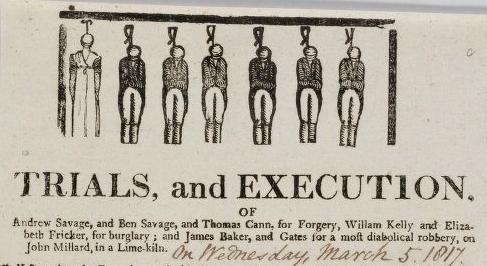
In practice, judges and juries often recognised the barbarity of the punishment in relation to the crime. Juries might determine that goods were over-priced and bring their value down below the five shilling threshold. Defendants might claim “benefit of clergy” which by virtue of stating religious belief and reading out an oath allowed the judge to exercise leniency. In other cases the Government could review the sentence. Between 1770 and 1830, 35,000 death sentences were handed down in England and Wales, but only 7000 executions were actually carried out.
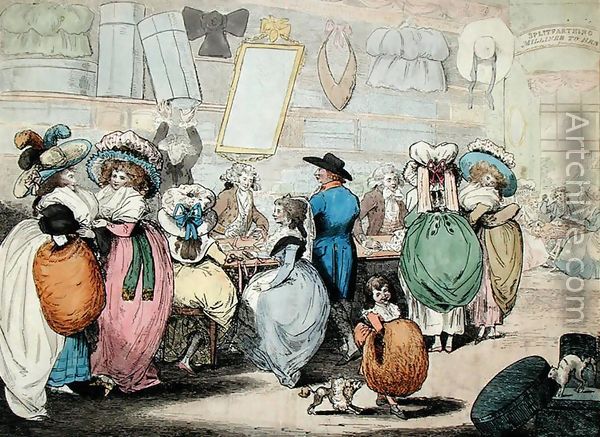
Milliners shop, after Henry Kingsbury

On the 8th August 1799, Jane Leigh-Perrot was accused of stealing a card of white lace from a millinery shop in Bath. The Leigh-Perrots, a wealthy couple, were Jane Austen’s mother’s brother and sister-in-law (Jane’s Uncle and Aunt). The white lace valued at £1 was found in Mrs Leigh-Perrot’s possession together with a card of black lace that she had bought and paid for from the same shop. Mrs Leigh-Perrot denied stealing the lace, saying that the sales clerk must have given it her by mistake when he handed over her purchase. She was nevertheless arrested on a charge of “grand theft” and the lace she was said to have stolen was worth four times the five shillings that carried the death sentence.
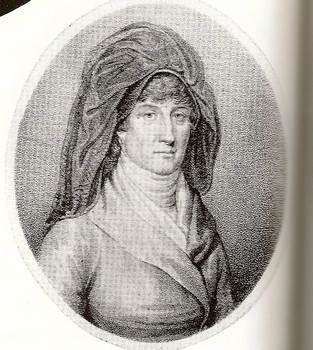
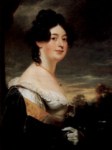
Jane Cholmeley Perrot, aka Jane Austen’s Aunt Perrot

In practice it was unlikely (given her standing) that if she had been found guilty she would have been sentenced to death. The alternatives, however, included branding or transportation to the Australian Colonies with the prospect of forced labour for 14 years. Jane Leigh-Perrot was refused bail and committed to prison on the sworn depositions of the shopkeeper. Due to her wealth, social standing and age she was allowed to stay in the house of the prison keeper, Mr Scadding, at the Somerset County Gaol in Ilchester, rather than being kept in a cell. Mrs Leigh-Perrot still wrote though that she suffered ‘Vulgarity, Dirt, Noise from morning till night’. James Leigh-Perrot insisted on remaining with her in prison.
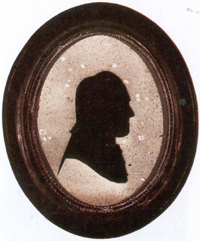
Mr James Leigh-Perrot. Image @JASA

During her trial Jane Leigh-Perrot spoke eloquently for herself. Several testimonials as to her character were also read out to the court. At the conclusion of the trial the jury took only 10 minutes to find her “Not Guilty.” It does, however, make you wonder how someone less well refined, less well-connected, less eloquent, less educated, less wealthy might have fared. The evidence of her guilt, might have been quite sufficient to send someone else to the gallows, or transported, or branded with a hot iron. She was after all caught in possession of the item and identified by the shop-keeper. In “Persuasion” Captain Harville asks Anne Elliot, ‘But how shall we prove anything?’ Anne replies, ‘We never shall.’
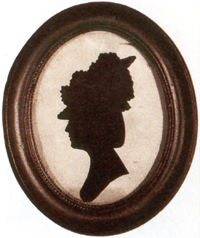
Mrs. Leigh-Perrot. Image @JASA
Read Full Post »

“there seem to be very few, in the style of a Novel, that you can read with safety, and yet fewer that you can read with advantage.”- Sermons to Young Women, James Fordyce, 1766

It’s no secret that Jane Austen’s family were novel readers during an age when such books were considered frivolous and not worthy of reading. (Writing a novel was considered an even worse offense!) Enter Jane Austen and Pride and Prejudice. In her delightful book, Jane created a satiric scene in which Mr. Collins confirmed Mr. Bennet’s opinion of his young cousin’s foolishness. After he enjoyed the younger man’s inanity for a while, Mr. Bennet proposed that Mr. Collins read to the group. The girls chose a novel, of which Mr. Collins disapproved:

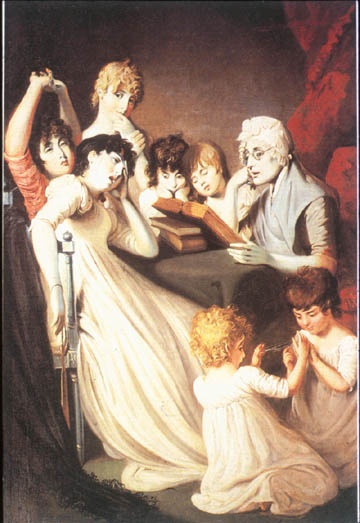
John Opie, "A Moral Homily"

John Opie, “A Moral Homily”

Mr. Bennet’s expectations [regarding Mr. Collins] were fully answered. His cousin was as absurd as he had hoped, and he listened to him with the keenest enjoyment, maintaining at the same time the most resolute composure of countenance, and, except in an occasional glance at Elizabeth, requiring no partner in his pleasure.

By tea-time, however, the dose had been enough, and Mr. Bennet was glad to take his guest into the drawingroom again, and, when tea was over, glad to invite him to read aloud to the ladies. Mr. Collins readily assented, and a book was produced; but on beholding it (for everything announced it to be from a circulating library), he started back, and begging pardon, protested that he never read novels. Kitty stared at him, and Lydia exclaimed.—Other books were produced, and after some deliberation he chose Fordyce’s Sermons. Lydia gaped as he opened the volume, and before he had, with very monotonous solemnity, read three pages, she interrupted him with—

“Do you know, mamma, that my uncle Philips talks of turning away Richard; and if he does, Colonel Forster will hire him. My aunt told me so herself on Saturday. I shall walk to Meryton to-morrow to hear more about it, and to ask when Mr. Denny comes back from town.”

Lydia was bid by her two eldest sisters to hold her tongue; but Mr. Collins, much offended, laid aside his book, and said—

“I have often observed how little young ladies are interested by books of a serious stamp, though written solely for their benefit. It amazes me, I confess;—for, certainly, there can be nothing so advantageous to them as instruction. But I will no longer importune my young cousin.”

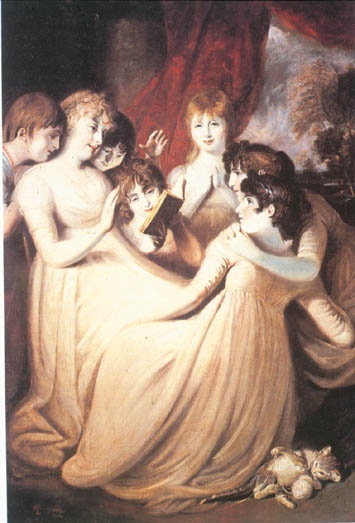
John Opie, “A Tale of Romance”

One cannot but help enjoy the irony of the situation. During his lifetime, Dr Fordyce was considered an excellent orator and his sermons were much appreciated, but by the time Jane Austen began to write her novels his luster had dimmed and novel reading was becoming more acceptable. These wonderful paintings by John Opie represent both sides of the sermon/novel story. In the first painting the governess is reading boring homilies to her charges in the hope of educating them. She is completely unaware of their expressions. One girl yawns, another can barely keep her eyes open, and a third looks pensively at the viewer as if to say, “Can you believe this?” Two of the youngest children entertain each other by playing cat’s cradle, and the girl sitting nearest the reader is about to fall asleep. What a wonderful tableau! One can imagine that the Bennets must have looked much like this ensemble before Lydia blurted out her question.

The second painting depicts the delight that the ensemble takes in listening to a tale of romance. They are all engaged and smiling and hanging onto every word from the reader. A kitten is left to play with a wool ball by itself.

Jane Austen employed words to create an ironic tone; John Opie used images. Both used their respective mediums to make a memorable point. Today, Dr. Fordyce’s sermons are largely forgotten. The following excerpt from Sermon VIII, Volume 2 demonstrates why he was considered dull and stodgy even 200 years ago:

Sermons to Young Women, Volume 2, James Fordyce, 1767. You can download the volume as an ebook at this link.

Read Full Post »

This beautiful marquetry table transforms into a desk with a turn of a key. This short animated film shows you how it operates and how an elegant French lady in the 18th century would have used it. Enjoy.

Exquisite marquetry of this French mechanical table.

Read about metamorphic furniture (which is different from mechanical furniture) at this link.

Read Full Post »

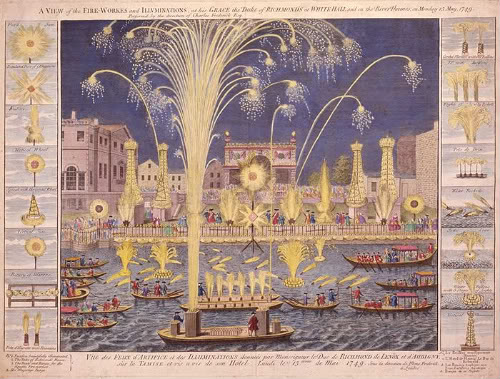
Today U.S. citizens are celebrating July 4th and the independence of our nation from Great Britain. Grand firework displays will play a pivotal role in our national revelry tonight, culminating a day long celebration. Fireworks were not unknown during the Georgian Era, and were used for grand effect in public celebrations. I will point out only a few instances in London.

The picture above is of the firework display held by the Duke of Richmond at Richmond House near the Thames in Whitehall, London [May 1749] and shows both the whole effect of all the fireworks and also, very interestingly, gives individual details [on the side] of the individual fireworks which made up the whole display. – Austenonly

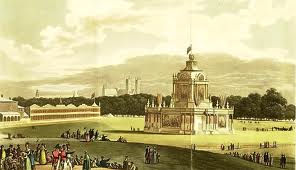
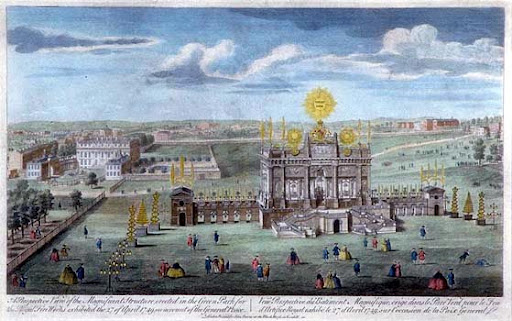
Temple of Peace in Green Park.

Early view of Green Park and the Temple of Peace.

Green Park was readied for a grand fireworks display in 1763 to celebrate the Treaty of Paris, which ended the French and Indian War in North America. The park had attracted firework displays before:

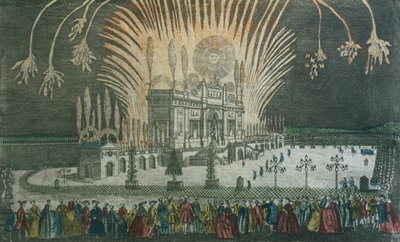
The Green Park was used for a national party in 1746 to celebrate the end of the War of Hanoverian Succession. The royal family arranged a great firework display and commissioned the composer, Handel, to write his Music for the Royal Fireworks. A vast Temple of Peace was built in the park to store the fireworks. But early on a stray rocket hit the temple. Three people died and 10,000 fireworks were destroyed in the fire that followed. – The Green Park

Temple of Peace in Green Park lit up by fire works.

The Treaty of Paris  granted Great Britain control of all land to the east of the Mississippi River, a cause for a grand celebration and a good reason for building a ceremonial temple. (View a print of the scene here.)

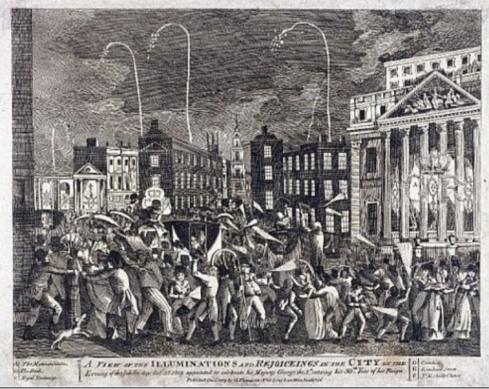
Another cause for creating massive firework displays was the long reign of George III. The details of  the Golden Jubilee celebrations are beautifully described at Austenonly.

Fireworks in London in celebration of King George III Golden Jubilee in 1809

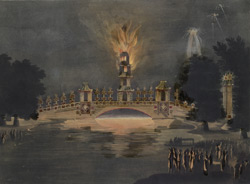
Fireworks were quite dangerous, and so were  gas lit fires. In 1814, another grand celebration was planned in St. James Park (which lies close to Green Park) to commemorate 100 years of the Hanoverian royal family. A seven-story pagoda was erected on a Chinese-style bridge spanning the canal in St. James’s Park.

A view of the Chinese pagoda burning. Image @British Library

The splendid gala was organized for the joint August first celebration of the Hanoverian Centenary and the anniversary of the Battle of the Nile. The brilliant and daring tactics of Lord Nelson at the Battle of the Nile were represented by rowboats upon the canal. A disaster occurred when the gas lit pagoda caught fire and burned. Two men were killed and a number injured trying to put out the fire. A number of the Royal swans succumbed to smoke and fire. The crowd unaware that this was an accident took the occurrence to be part of the spectacle and applauded wildly. – The Georgian Index

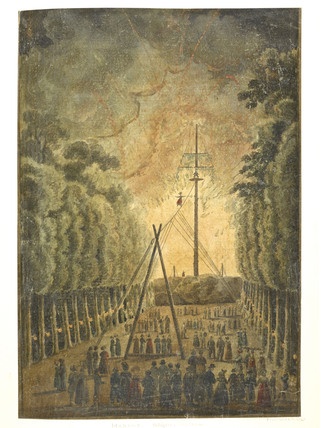
When the Napoleonic Wars came to an end, famed rope walker, Madame Squi, could finally cross the English Channel in  1816 to perform at Vauxhall Gardens for the first time.

Madame Saqui illuminated by the bursts of fireworks, Vauxhall, 1816. Copyright Museum of London*

‘In the midst of a great burst of fireworks, Bengal lights glimmering faintly in the clouds of smoke, she (Saqui) stands on a rope, sixty feet up, and follows a narrow and difficult path to the end of her journey. Sometimes she is completely hidden from our eyes by the billowing waves, but from the way she walks, so self-assured, one would think an Immortal was walking peacefully towards her celestial home.’ [Lerouge on Madam Saqui at Vauxhall] – Rope Walkers and Equillibrists

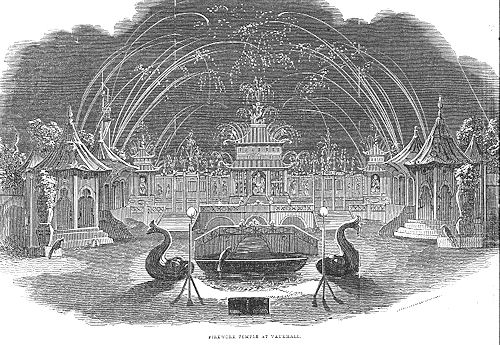
Firework displays were no novelty at Vauxhall Gardens, or any of the major gardens where people congregated to walk along grand promenades, dance publicly to music, eat, drink, and enjoy an evening out in the open.

Fireworks display at Vauxhall, 1800s.

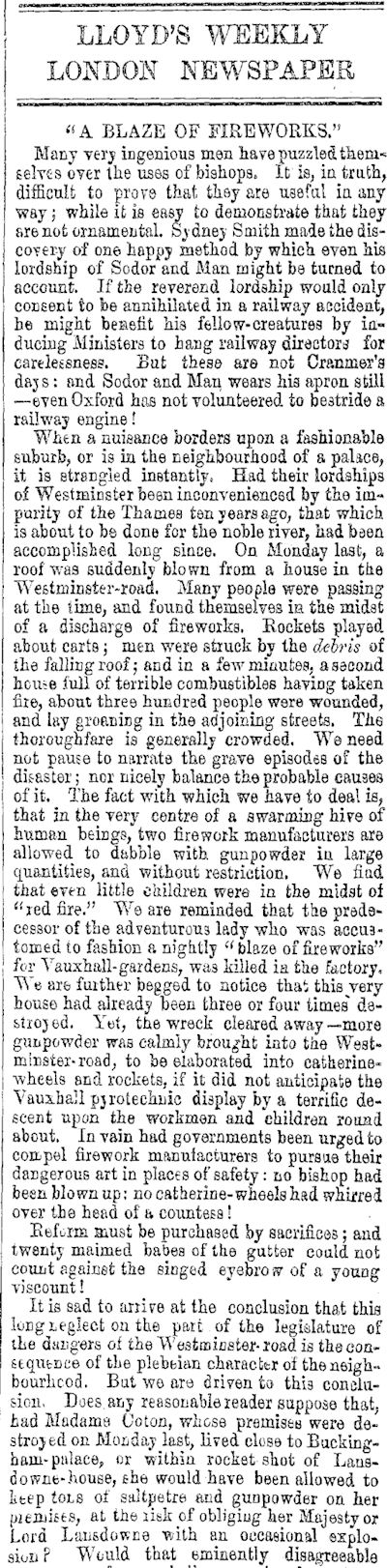
There were terrible accidents then as now with fireworks. Here is an account from  an 1858 newspaper** about an accident in central London:

All over the U.S. we will be enjoying various kinds of firework displays. Those in Washington D.C. and the major cities will be the grandest, I am sure. I recall an intimate firework display along a small lake in Vermont one year, in which only a few fireworks were set off. Interestingly, of all the firework displays I have seen, that is the one I tend to recall. Happy Birthday, America! Stay safe.

*Museum of London Prints

**Newspaper Account of Vauxhall accident.

More about Green Park at this link.

Read Full Post »

Among the principle gifts in 1908 may be mentioned: – suit of clothes, &c., formerly belonging to Mr Thomas Coutts, the founder of Coutts Bank, died 1822, given by Francis Coutts, Esq., Announcement for The Victoria & Albert Museum

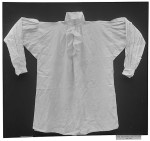
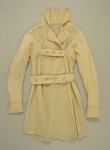
Shirt. Image @Metropolitan Museum of Art

This cryptic announcement does not tell the whole story of how a number of important museums around the world came into the possession of several portions of Mr. Coutt’s wardrobe. In her excellent book, Four Hundred Years of Fashion, Natalie Rothstein (curator of silks at the Victoria & Albert Museum) recounted how the clothes that had once been worn by Thomas Coutts, successful banker, came to be passed down for several generations in the family and divided among a number of major museums in 1908 and 1912.  The collection was unusual, for it consisted of the entire wardrobe of a gentleman who lived in the early 19th century, that included:

the considerable number of cloth costumes, articles of hosiery and underclothing left by Mr Thomas Coutts at the time of his death, 24th February 1822 . . . The cloth suits are all of a plain black and of precisely the same cut, so that only one is necessary for exhibition.”

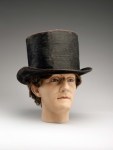
One of the ten wigs in the “brutus” style. One wonders if Mr. Coutts is wearing one in the illustration below! Image @The Metropolitan Museum of Art

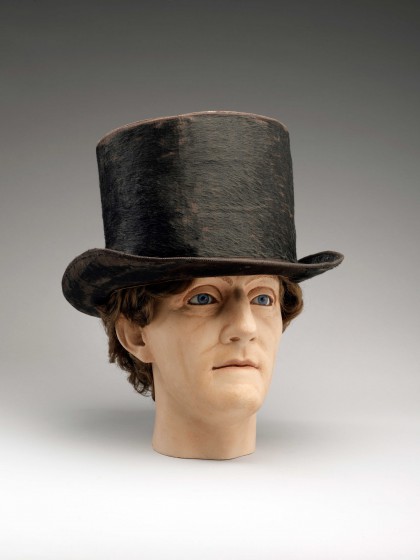
Top hat

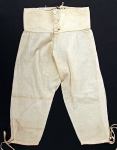
Additional clothes in the collection include: 57 items of underwear made of linen or wool,  46 shirts made of a fine cambric and with and without frills, four spotted nightgowns, several plain nightgowns, 13 pair of leather and wool gloves, ten wigs and three beaver hats. Such a large, intact group of clothes from one source was rare and unique. Ironically for the museums, according to Strandlines, “Thomas Coutts seems to have been an eccentric man, who preferred to dress scruffily and to hide his wealth, rather than display it.”

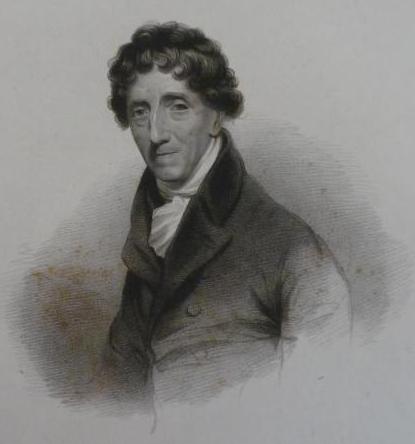
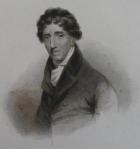
Thomas Coutts. {From an engraving by R. W. Sievier of an oil painting by Sir W. Beechey, R.A.)

Coutts was not a wit himself or the cause of wit in others. There are, indeed, two or three anecdotes, ” duplications,” in the argot of the Higher Criticism of the same legend, which turn upon the piquant incongruity of his garb with his gear. He is dressed in a threadbare coat, “the costume of a decayed gentleman,” and a benevolent stranger of limited means presses a guinea into his hand, and then to his dismay learns that he has ” pouched ” the wealthiest man in England. It may have been so. A dean once complained to the present writer that he was often mistaken for the verger, and offered a shilling for his services as guide to the Cathedral. It is possible that before the days of Harriot Mellon, Coutts was sometimes ” attired in very faded, worn-out clothes,” but his wardrobe, which his widow preserved in camphor, was, like Alice Fell’s new cloak, as stout and ” warm as man can sell.” A select portion is preserved at the Victoria and Albert Museum, and may be inspected by the curious. He had, too, some five or six ” Brutus ” wigs, which were of the finest make and the costliest description. Even if these legends are founded on fact, they are hardly worth the re-telling.” – The life of Thomas Coutts, bankerErnest Hartley Coleridge (1920).

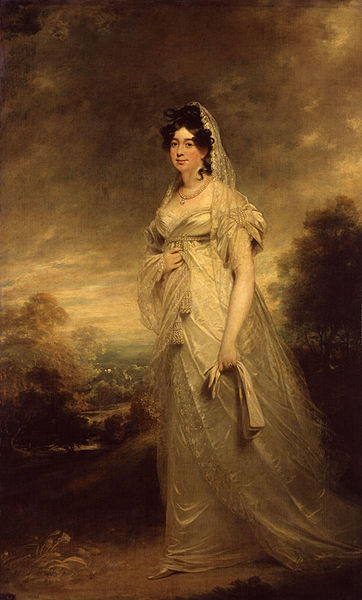
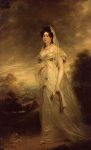
Harriot Mellon Coutts and the future Duchess of St. Albans, painted by Sir William Beechey in 1817-1818. She preserved her husband’s wardrobe.

It was fortuitous that Coutt’s second wife, Harriot Coutts, nee Mellon, was the daughter of a wardrobe-keeper in a company of strolling players. One can only imagine that when she was made a widow the preservation of her husband’s wardrobe would come naturally to her. The Victoria & Albert Museum eventually acquired three suits, several sets of the underwear, two of the spotted nightgown, and some accessories. The rest of Coutts’s wardrobe was (sadly) divided among a number of museums, including The Metropolitan Museum of Art in New York, The Royal Ontario Museum, The Royal Scottish Museum, Bristol Museum and Art Gallery, and more. All but one of the museums would receive a black suit. With vast understatement, Ms. Rothstein (who laments the break up of such an intact collection) writes:

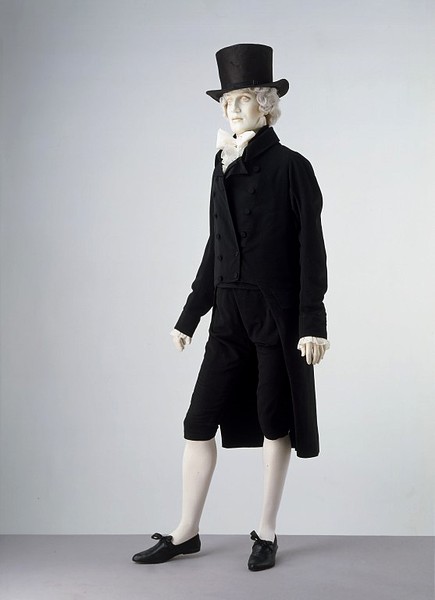
The clothes worn by Mr Coutts were probably not the height of fashion but rather conservative. There is no mention of any trousers for instance, in the full list of his clothes. All his suits had breeches. The cut of his coats is consistent with the current fashions: his tailor was probably as conservative as his customer. None of his coats had a waist seam. – Four Hundred Years of Fashion, Natalie Rothstein, p. 62

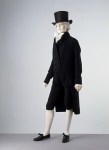
Black wool day suit. Image @ Victoria & Albert Museum

Since the late 16th century, middle-class professionals like doctors, lawyers, clergymen, academics, merchants, and businessmen have worn these stark black suits. This tradition continued through the 19th century and well into the 20th. “The sombre colour of this suit befits the sober profession of its wearer, Thomas Coutts (1735-1822), the founder of Coutts Bank., including the old-fashioned breeches, which suited his age. Top hat made in Great Britain, ca. 1800-1817. Cotton shirt, (1800-1820) made in England. (Text from the V&A.)

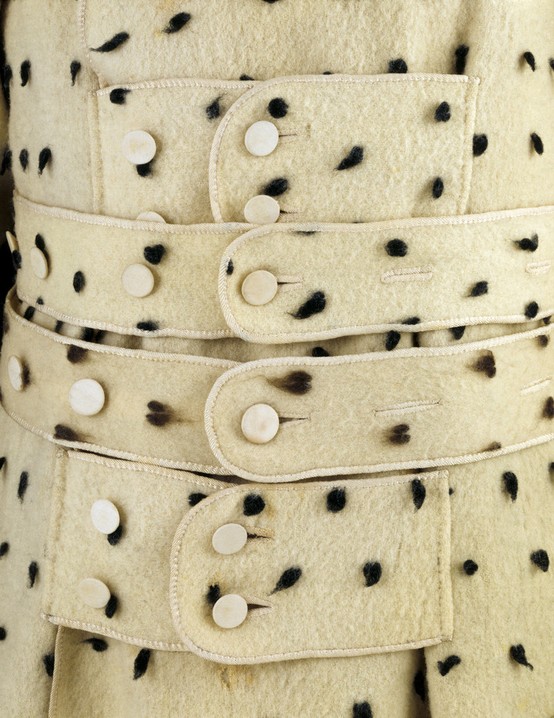
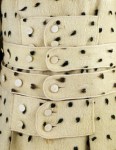
Detail of one of Coutts’s nightgowns. Image @Victoria & Albert Museum

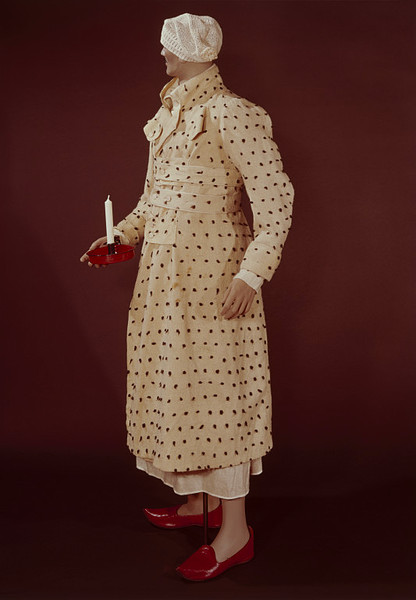
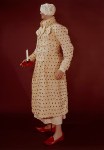
Nightgown. Image @V&A

Nightgown. Image @V&A

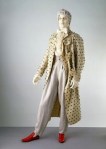
Nightgowns were worn over shirt and breeches, in the privacy of home before noon or late at night.  The tufts of black wool on the cream wool fabric are meant to imitate ermine. These nightgowns come from the wardrobe of Thomas Coutts (1735-1822), the founder of Coutts Bank. (Text from the V&A.)

More on the topic:

Read Full Post »

« Newer Posts - Older Posts »