Feeds:
Posts
Comments

Archive for the ‘Georgian Life’ Category

Image @The Culture Concept Circle

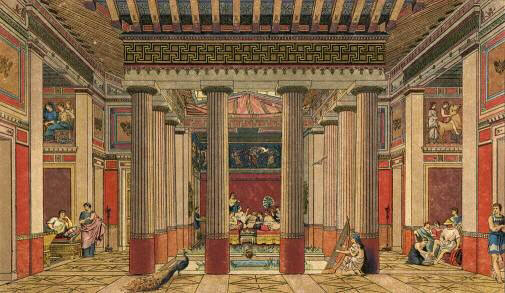
The era in which Jane Austen lived was a complex time in which scientific advances, the Industrial Revolution, warfare in Europe, and visits to ancient lands influenced the culture of Great Britain. These articles from The Culture Concept Circle will answer your questions about a few of the influences on the neoclassical style so prevalent during this time. Videos are included in some links.

Image @The Culture Concept Circle

Posts on this blog:

Read Full Post »

Jane Austen’s novels did not ignore the rising middle class and successful merchants and tradesmen, the nouveau riche of her era. Mr. Bingley and his sisters were the fortunate offspring of a tradesman. Mrs. Bennet’s,  Mrs. Jennings’, and Mrs. Elton’s vulgarities cannot be denied and add spice to her tales.  A real life representative of the rich bourgeois class was Mrs. Smith, once married to a trader named Kinnear. I would imagine that if a stranger met her, there would be no mistake from her demeanor and accent where her origins lay. She dressed well, according to an eye witness, and managed to live out her years in comfort.
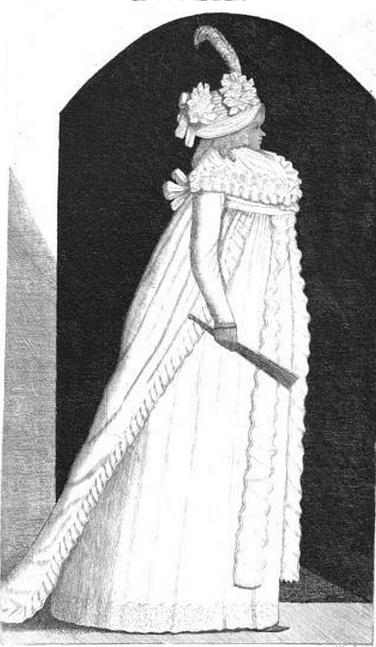
Mrs. Smith, 1795

MRS SMITH IN THE COSTUME OF 1795. That this Portraiture was sketched without a sitting may be conjectured from a memorandum by the artist, which states that when the lady heard of his intention to publish her likeness, she sent for him to come and get a proper look at her, but he did not choose to accept the invitation. Those who remember Mrs Smith will have little difficulty in recognising a strong likeness to her in the Etching. Mrs, or rather Luckie Smith, for so in her later years she was uniformly styled, is dressed in the somewhat ridiculous fashion prevailing towards the close of [the] last century. The Print bears the date 1795, and at that period she resided in South Bridge Street. Some years afterwards, she removed to a house purchased for her in Blackfriar’s Wynd. Mrs Smith was a native of Aberdeen, and had in early life been married to a trader of the name of Kinnear, by whom she had a son and two daughters. After the death of her husband, she resumed her maiden name of Smith. Her favourite walk was the Meadows. She was a stout, comely looking woman, and usually dressed well. She lived to old age in the enjoyment of two annuities, one of which she derived from a gentleman of fortune, the husband of one of her daughters. The other daughter was also well married, and we believe is now in America. Mrs Smith died in January, 1836. – A series of original portraits and caricature etchings, Volume 2, Part 2 (Google eBook), John Kay, 1838, p425.

The description might remind Georgette Heyer fans of Mrs. Floore from Bath Tangle. That “redoubtable old lady had inherited, besides two fortunes, considerable interest in her father’s soap factory, and her husband’s shipyard.” Hah!

Here is another telling description of Mrs. Floore, and how an aristocrat, comfortable in her own skin, would find such a creature fascinating:

Upon several occasions, both [Serena} and Fanny had been diverted by the startling appearance presented by an elderly female of little height but astonishing girth, who, while she adhered, perhaps wisely, to the fashions of her youth, was not wise enough to resist the lure of bright colours. She had a jolly, masterful countenance, with three chins beneath it, and a profusion of improbable black ringlets above it, imperfectly confined by caps of various designs, worn under hats of amazing opulence. Serena drew giggling protests from Fanny by asserting that she had counted five ostrich plumes, one bunch of grapes, two of cherries, three large roses, and two rosettes on one of these creations. An inquiry elicited from Mr King the information that the lady was the widow of a rich merchant of Bristol—or he might have been a shipowner: Mr King could not take it upon himself to say. No doubt a very good sort of a woman in her way, but (her la’ship would agree) sadly out of place in such a select place as Bath.” – Chapter 6

Can you imagine the Miss Bingleys hobnobbing with Mrs. Floore, or Sir Walter Elliot entertaining her in his house in Bath?
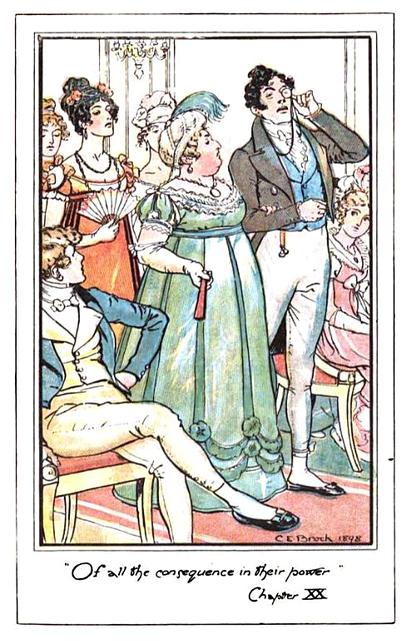
Can you imagine Sir Walter Elliot or Lady Dalrymple conversing with Mrs. Smith or Mrs. Poole? (Hugh Thompson, Persuasion)

In Bath Tangle, an adventurous Serena is quite taken by Mrs. Floore, whereas her timid stepmother, Fanny, is aghast:

‘Serena!’ breathed Fanny. ‘What an extraordinary creature!

‘Yes, but quite delightful, I promise you!’

‘But, Serena, she is dreadfully vulgar! You cannot really mean to visit her!’

Serena did visit Mrs. Floore, which few ladies of refinement would do, but she was secure in her position in Society and bored out of her gourd, and Mrs. Poole, besides being a nice and sensible person, provided her with entertainment. A reluctant Fanny accompanies her:

The call was paid, though without the suggested prelude; and the welcome accorded to the ladies was so good-natured and unaffected that Fanny was brought to acknowledge that however vulgar Mrs Floore might be she had a great deal of drollery, and was certainly no toad-eater. She declined a civil invitation to return the visit, saying, with paralysing candour, that it was one thing for their ladyships to visit in Beaufort Square whenever they felt so inclined, and quite another for them to be entertaining her in Laura Place, and very likely making all their acquaintance wonder what kind of company they had got into. – Chapter 7
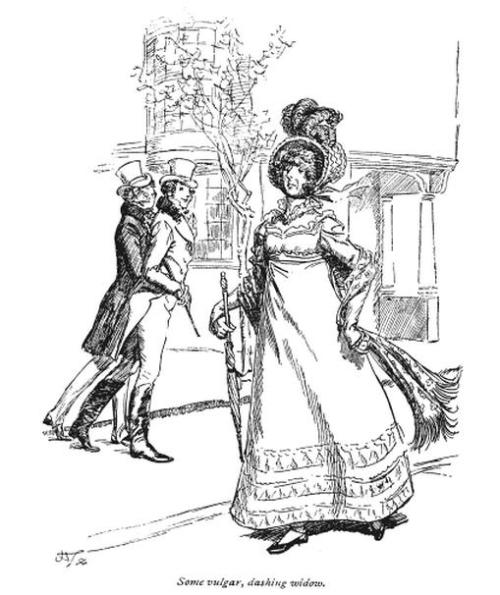
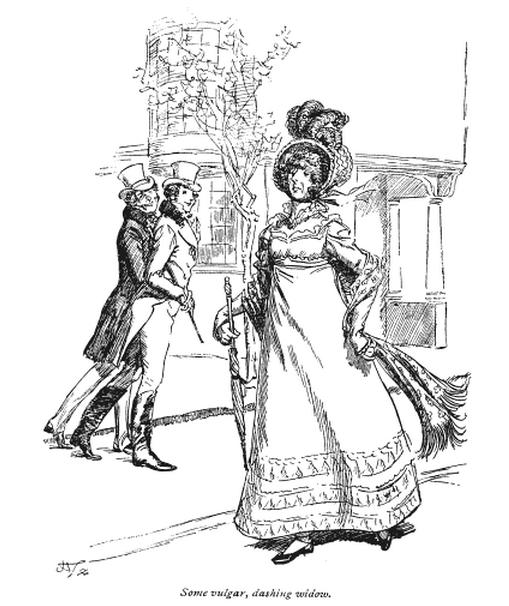
Hugh Thompsons illustration of a vulgar, dashing widow. (Emma)

Times were a-changing. The rising middle classes were able and willing to lay out ready cash to move up in the world. What they lacked (aside from refinement) were land and a nice title. The aristocrats had these aplenty. Since many a landed family had squandered their fortunes, it was inevitable that the lines of distinction would begin to blur as the nouveau riche began to snap up estates in foreclosure or shove their very rich daughters in front of impoverished heirs.

Read Full Post »
I spent a lazy Sunday catching up on the many posts I am unable to read during the week. Imagine my delight when I landed on Madame Guillotine’s blog and read her impressions about her visit to the Fashion Museum in Bath.  With increasing excitement, I viewed her close up images of several of the most beautiful 18th and early 19th century gowns imaginable. Melanie graciously allowed me to showcase her posts. (I concentrated on the early 19th century examples.) Do rush over and view all her photos. They are simply amazing.

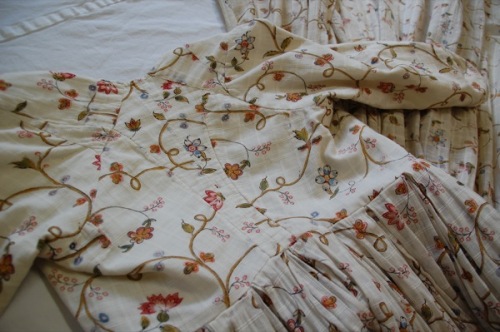
I have just got home after an amazing couple of hours spent studying some of the eighteenth century dresses in the vast collections (I think they said they have 80,000 pieces in their archives) of the Fashion Museum in Bath.

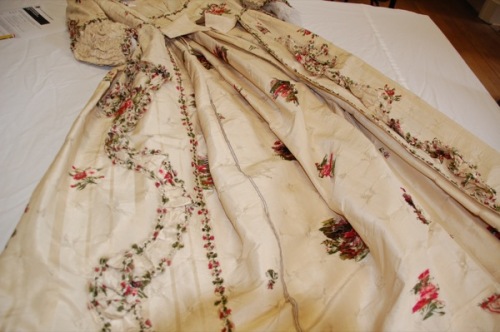
English, silk, 1770-73.

It was amazing seeing the hook and eye arrangements that they used to do up the bodices, the neat seam work and even the staining beneath the armpits which serves as a reminder that these are the real deal and not just mere costumes!

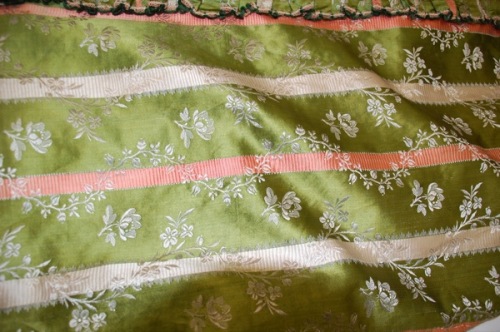
French, sacque gown, 1760-63. Image @Madame Guillotine

They were really keen on combinations of pink and green during the eighteenth century – a colour combination that seems to have vanished from fashion, alas.

A floral printed muslin from 1793-97. Image @Madame Guillotine

[This dress] is really is lovely – very floaty and romantic with a pretty floral print. You can really imagine Marianne Dashwood in this one!

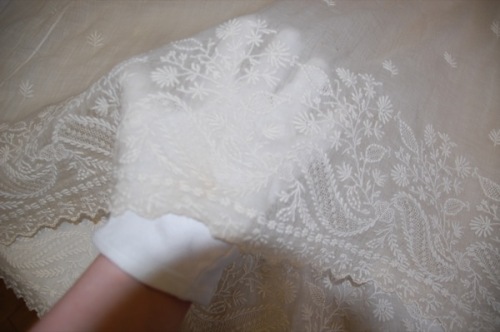
Muslin dress, 1813-20. Image @Madame Guillotine

This dress was so beautiful but really worryingly see through! You forget this about muslin when you see them in period dramas…

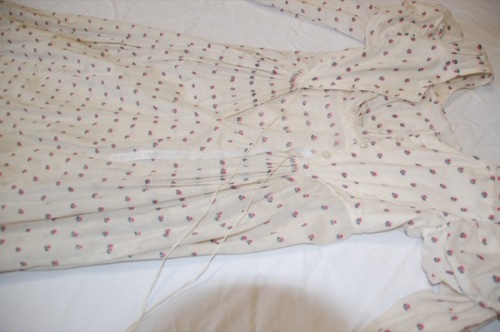
Patterned muslin dress, 1815-20. Image @Madame Guillotine

This is the sort of thing that a Heyer heroine would have worn.

These images are just a foretaste of the many photos that Melanie took at the Fashion Museum. To read both her posts, click on the two links below:

Read Full Post »

Image @Colonial Williamsburg Official Site

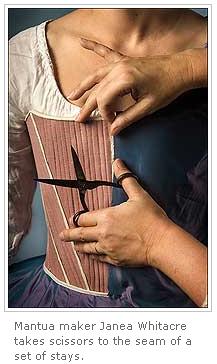
The blog, Two Nerdy History Girls, featured Janea Whitacre, mistress of the millinery & mantua-making trades in Williamsburg in their last post about Accessories: Head to Toe, a symposium that was recently held in that historic city.   Accessories Head to Toe: Beautiful Fashion From 1760 to 1830 showcases some images from the people of the Margaret Hunter Shop, where milliners and mantua makers still plie their craft.

An interview with Ms. Whitacre illuminates how fashion was made in those days, and how fashion and economics are tied together.

Janea: Mantua-making – that’s gown-making, so we’re the 18th-century dressmaker, and what we do is cut the gown to the person, so the lady is her own mannequin or her own dress form. So I don’t need to take measurements, I don’t do patterns. We cut to the person.

Lloyd: Okay, so at the risk of getting this wrong, what you are is what in a male version a tailor would be.

Janea: There’s a lot of overlap between the trades. The tailor is going to claim that stay-making and making ladies riding habits is his trade. I’m going to claim that it’s my trade. But the difference between the trades is really how we cut the fabric out. He takes measurements and does patterns. We usually don’t, because our customers are perfection in their stays. So as long as they have the stays, we’re ready to cut.  Click here to read the rest of the interview on history.org

Handiwork: The Colonial Williamsburg Official Site

Read Full Post »

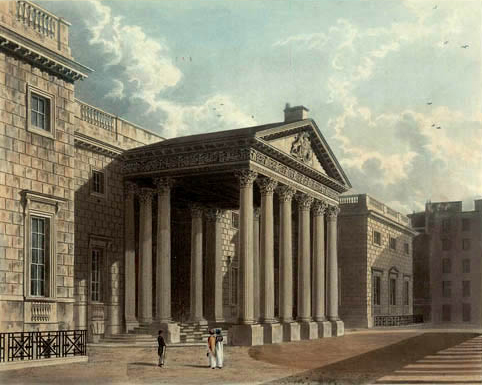
Carlton House was the town house of the Prince Regent for several decades from 1783 until it was demolished forty years later. It faced the south side of Pall Mall, and its gardens abutted St. James’s Park in the St James’s district of London. The location of the house, now replaced by Carlton House Terrace, was a main reason for the creation of John Nash’s ceremonial route from St James’s to Regent’s Park via Regent Street, All Souls, Langham Place and Park Square. Lower Regent Street and Waterloo Place were originally laid out to form the approach to its front entrance

An existing early eighteenth century house had been sold in 1732 to Frederick, Prince of Wales, and son of George I. William Kent had been employed to lay out the garden of which no trace remains. Frederick’s widow, Augusta, enlarged the house, had the entrance gates and porter’s lodge redesigned and a colonnaded porch built. She died in 1772 and for some years the house was unoccupied.

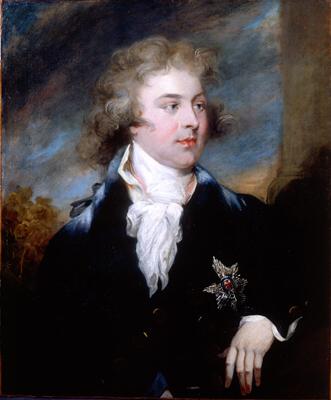
Portrait of The Prince of Wales, later King George IV (1762 – 1830) 1790. John Russell RA

In 1783 George III handed the house over, with £60,000 to refurbish it, to George, Prince of Wales on his coming of age. During the following years the interiors were remodelled and refurnished on a palatial scale.

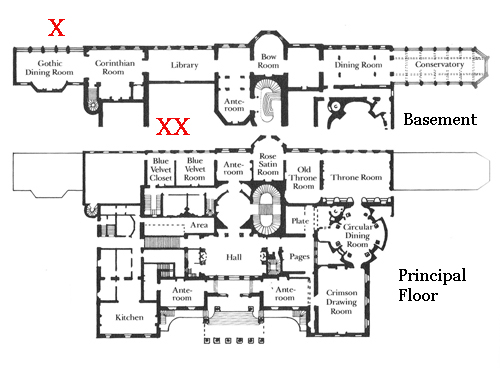
Carlton House ca.1825. As published in Britton and Pugin, Public Buildings of London. 1825. Patrick has worked on elements from the areas marked with a cross

Initially Sir William Chambers was appointed as architect, but he was quickly replaced by Henry Holland. Both Chambers and Holland were proponents of the French neoclassical style of architecture, and Carlton House would be extremely influential in introducing the Louis XVI style to England.

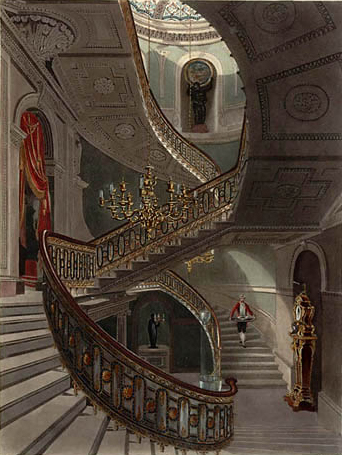
The Grand Staircase

Holland began working first on the State Apartments along the south (garden) front, the principal reception rooms of the house. Construction commenced in 1784. By the time of his marriage to Mrs Fitzherbert in December 1785, however, construction at Carlton House came to a halt because of the Prince of Wales’ mounting debts. Costs continued to soar and more money had to be found by the Prince…  Continue to read this post on Patrick Baty’s blog.

Inquiring Readers, Patrick Baty is one of the foremost authorities on architectural paint and colour on historic architecture and interiors. These days, the majority of Patrick’s time is spent as a historic paint consultant, sampling paint layers on buildings, bridges and architectural details to produce a forensic history of the decoration from creation to the present day. He has graciously allowed me to link to his post about Carlton House.

Other posts by Patrick Baty on this blog:

Read Full Post »

« Newer Posts - Older Posts »