Feeds:
Posts
Comments

Archive for the ‘Georgian Life’ Category

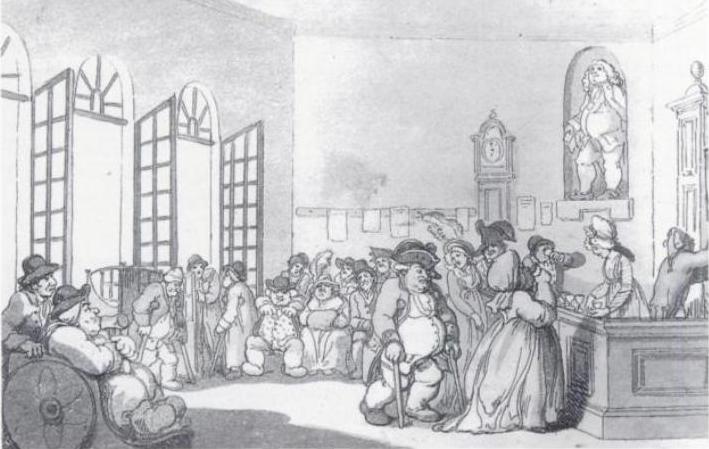
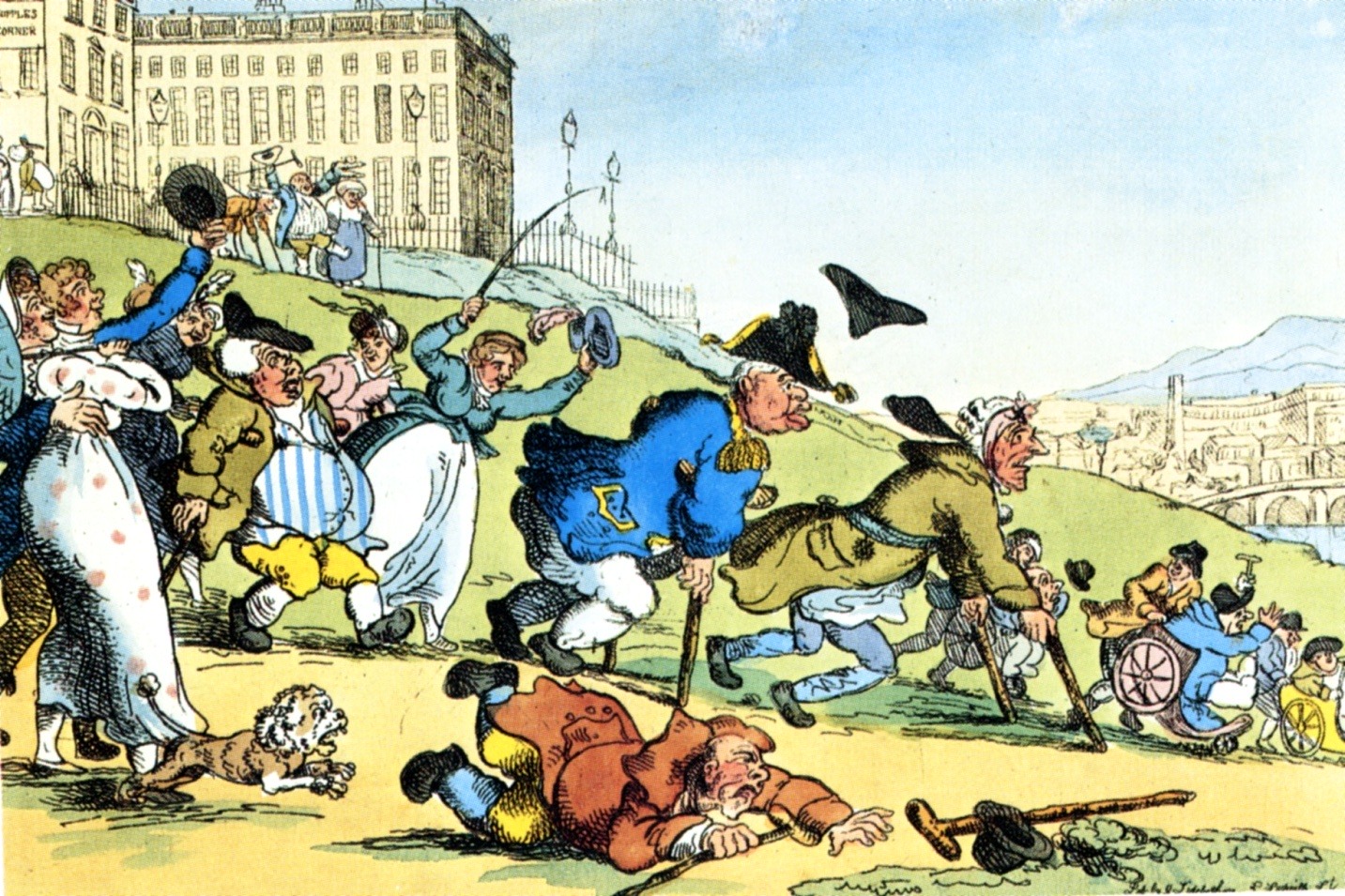
The Comforts of Bath, Thomas Rowlandson.

Almost everyone who visits my blog, Twitter account, and Facebook page knows I’ve broken my foot in two inconvenient places. Even with modern medical advances the most pleasant way to describe my experience is that it’s been a … pain. Literally and figuratively. This lover of walking 3-4 times a day with her dog has been sidelined. I’ve been sitting or lying down for a month, watching my bum grow two sizes. I’m a bit more mobile now and can hobble wearing an unwieldy boot.

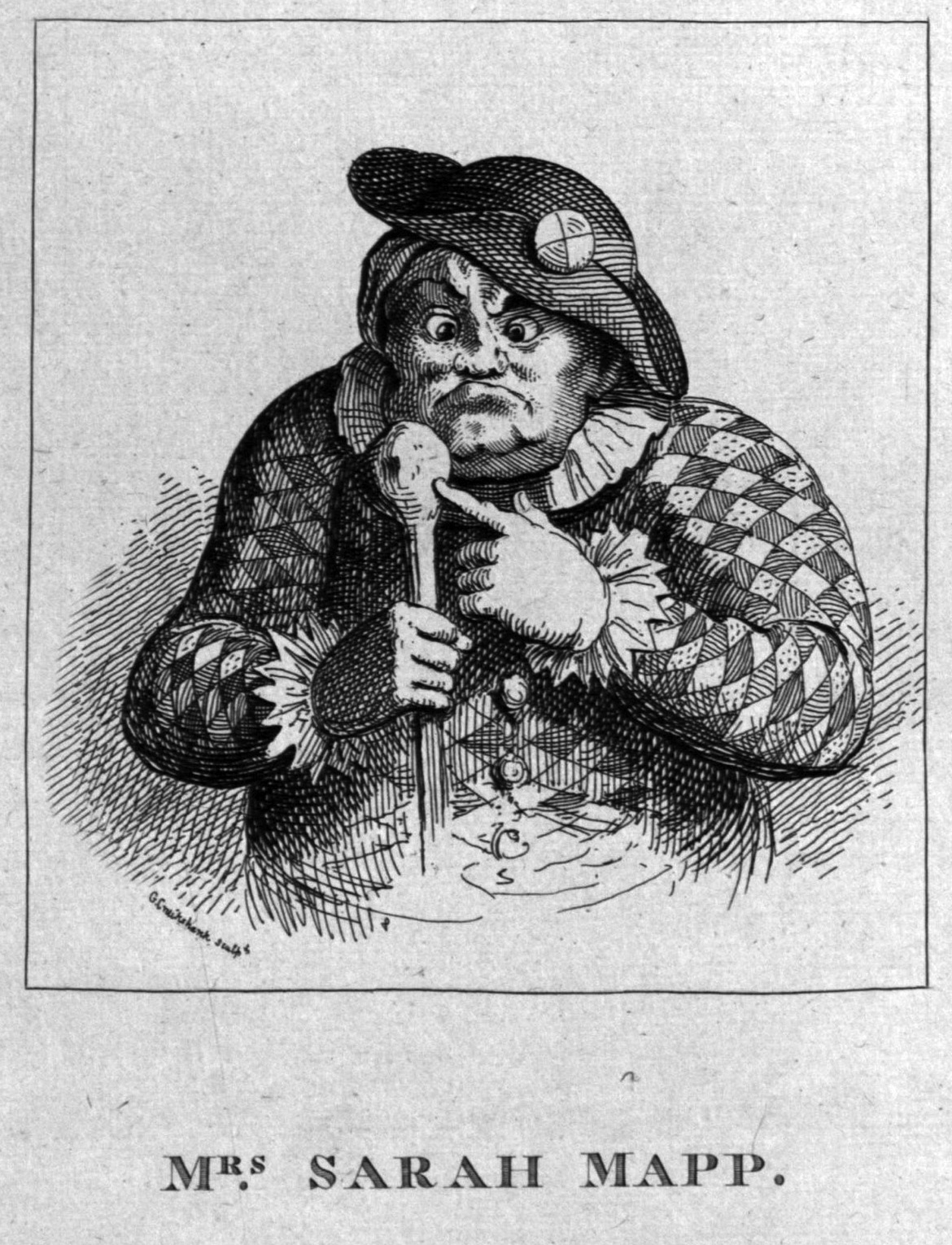
How did people deal with this situation two-hundred years ago? I wondered as I stared at the ceiling with my foot propped up higher than my head. It certainly could not have been easy. Mrs. Mapp, or Crazy Sally, as she was known, was a famous London bone setter in the early 18th century. While she was unlucky in love, she made her fortune with her strength, boldness, and wonder-working cures.

Besides driving a profitable trade at home, she used to drive to town once a week in a coach and four and return again bearing away the crutches of her patients as trophies of honour. – Mrs. Mapp: The Bone-Setter, Book of Days, Robert Chamber, 1864

I doubt Mrs. Mapp would have bothered setting my foot. There was really nothing to manipulate. All it needed was rest and a good calcium-rich diet. How did people get round and about when they were hobbled in days of yore?

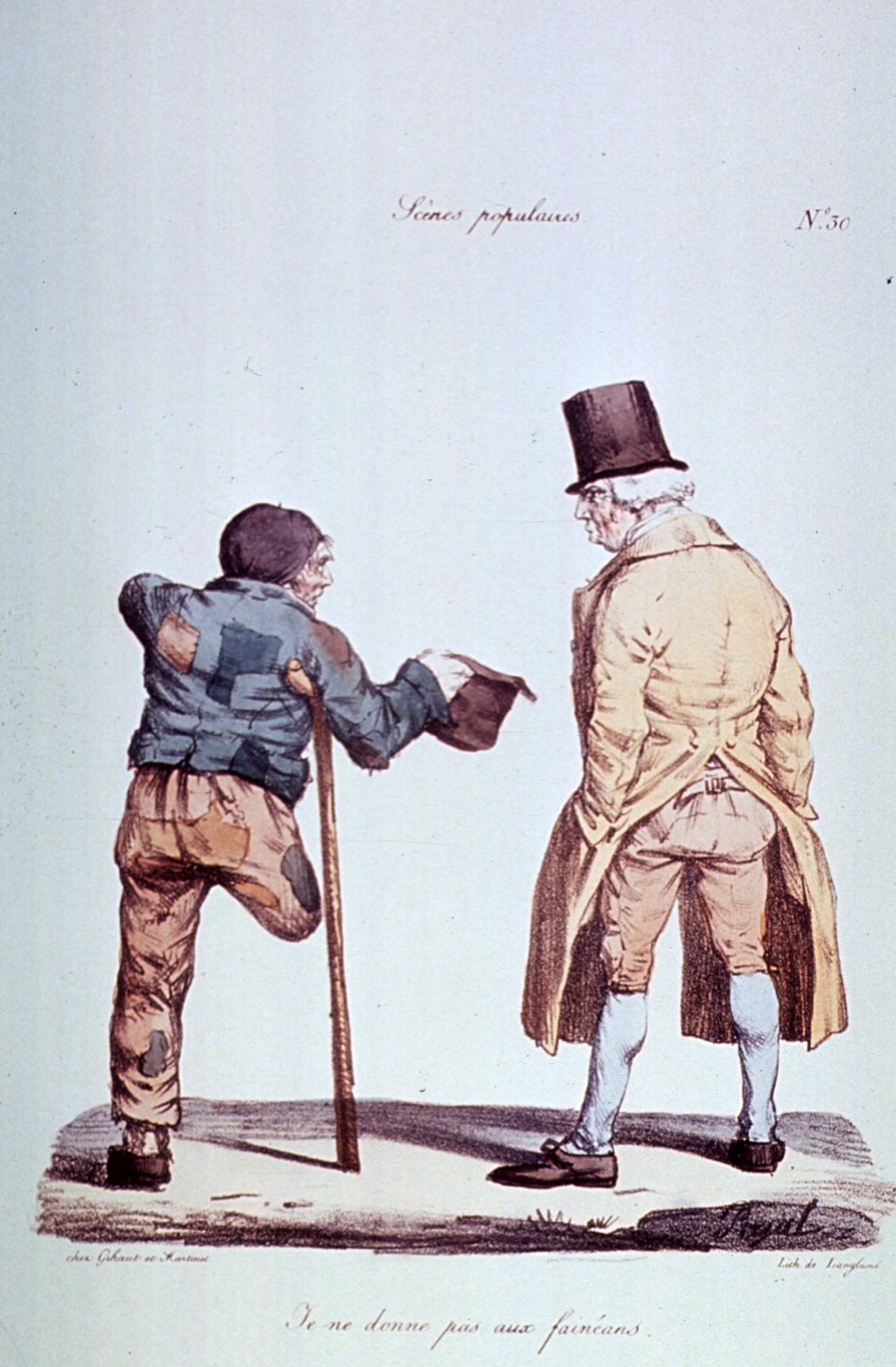
In my estimation, crutches resembled torture instruments more than helpmeets.

Beggar with one leg and a crutch. Image @Risky Regencies

This 1850 crutch is similar to the one depicted in the image above. It was not adjustable, and rags were wound around the top to make the crutch less painful. Even with ample padding on the modern crutch, my underarms became sore. I can only imagine how much discomfort the old models offered.

Wheelchair, Barry Lyndon

Wheelchairs were invented early in the history of mankind. In 530 B.C. a wheeled child’s bed made an appearance on a Greek vase, and in 525 A.D. a wheelchair was depicted on a Chinese print. By the 17th century, the patient’s comfort began to be taken into account.

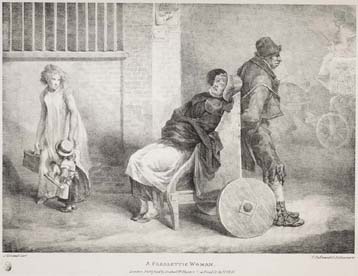
Paralytic woman in wheelchair, 1821. Image @Museum of London

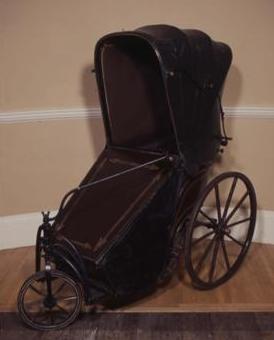
During the 18th century the Bath chair was born. Invented by John Dawson, the three-wheeled chairs remained popular all through the 19th century.

3-wheeled Bath chair. Image @BBC

This Rowlandson caricature depicts the ill visiting the Pump Room to take the waters. Note the sedan chair at left being carried inside the room, the man in the wheelchair, and the man walking with two canes.

Read Full Post »

Last week I featured the book, The History of Little Goody Two-Shoes, a moralizing children’s book that Jane Austen kept all through her lifetime. As she was growing up, she was probably familiar with the Cinderella fairytale. Hundreds of versions of the folk tale from a variety of European sources exist, but the myth goes as far back as ancient Greece and China.  The story of the cinder maid and the glass slipper was popularized in 1697 by Charles Perrault in Histoires, ou Contes du Temps Passè.  

Written for the aristocratic Salons of C17th French society, Perrault’s ‘Cendrillon’ is stripped of all violent, bawdy or socially moralizing material and is instead focused primarily on entertaining. – The Origins of the Cinderella Story

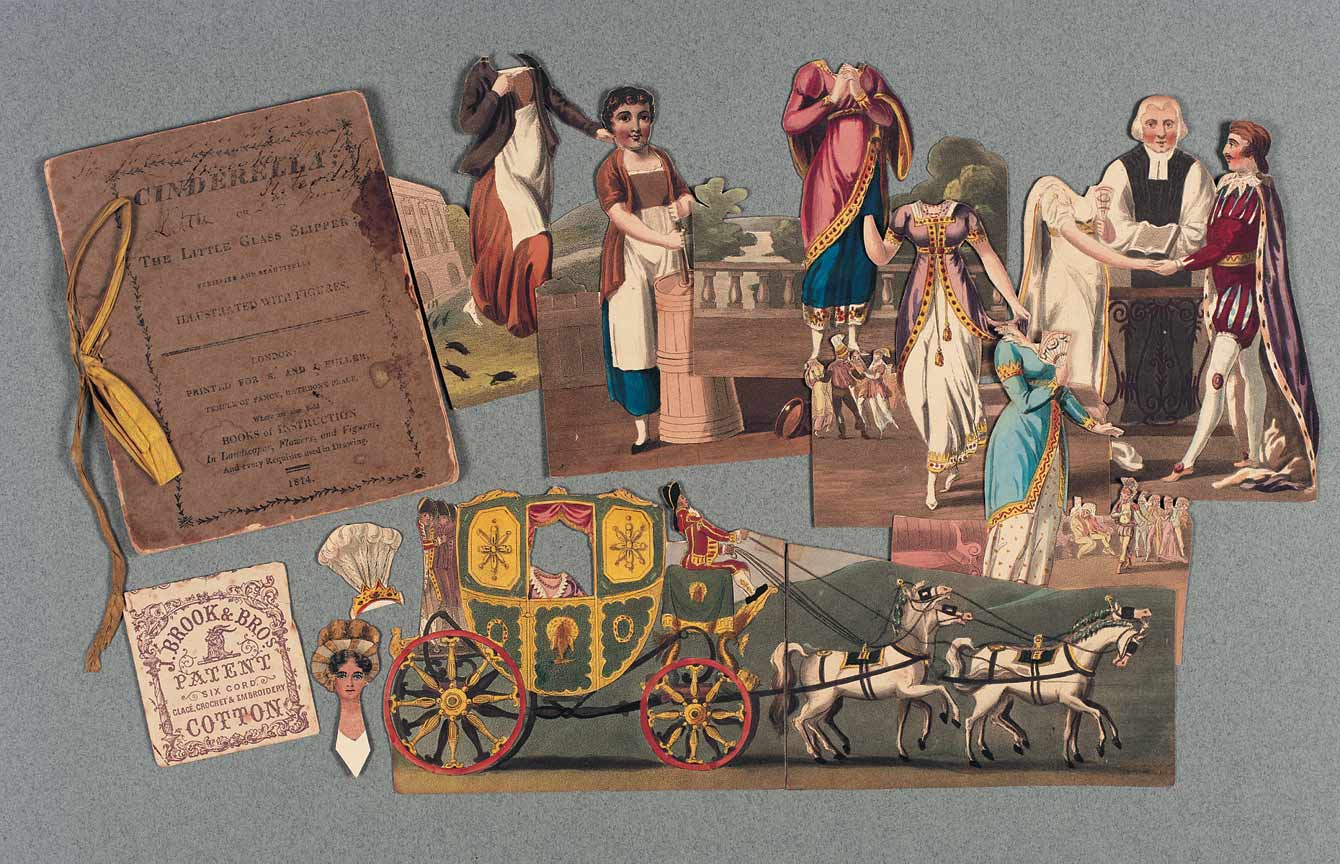
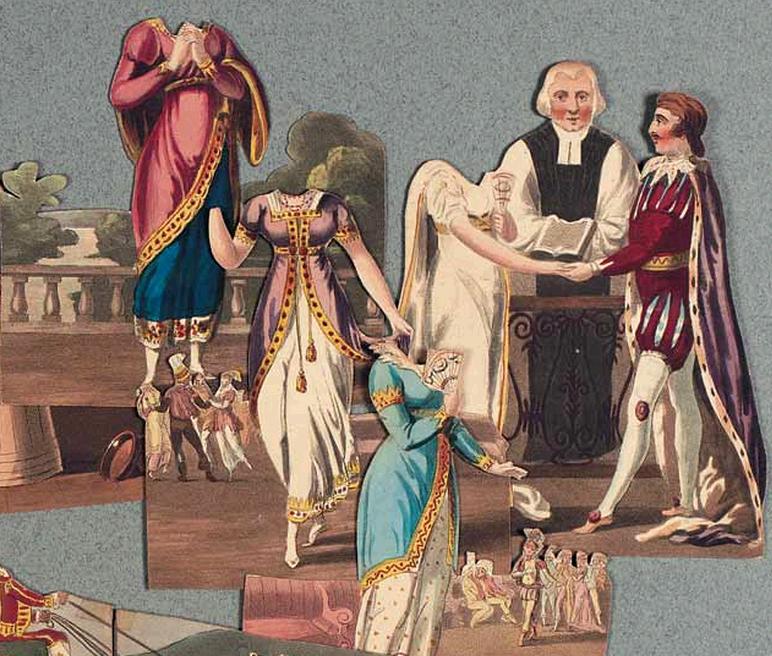
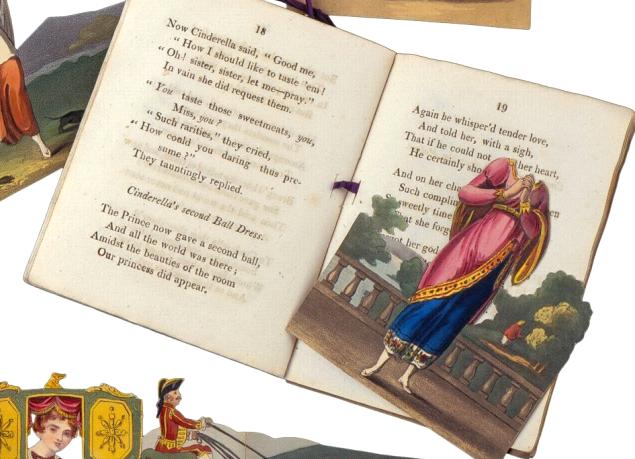
The images in this post show the paper dolls based on Perrault’s tale that were popular during Jane Austen’s time.

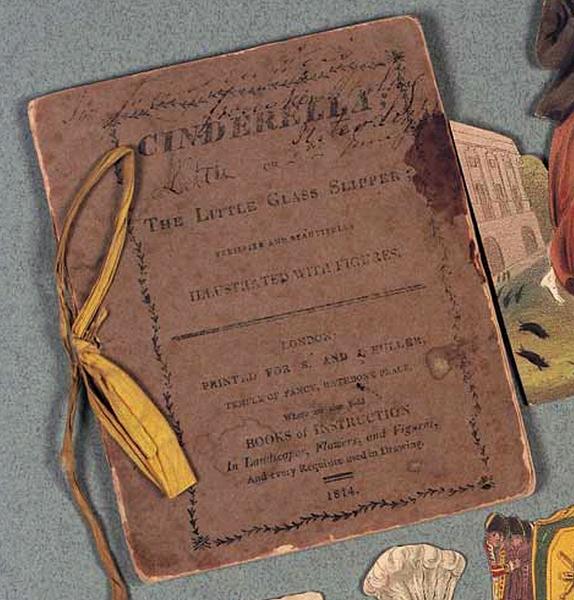
1814, Cinderella or the Glass Slipper. Image @Theriault's.

The images shown above and below are for sale at Theriault’s: The Doll Masters

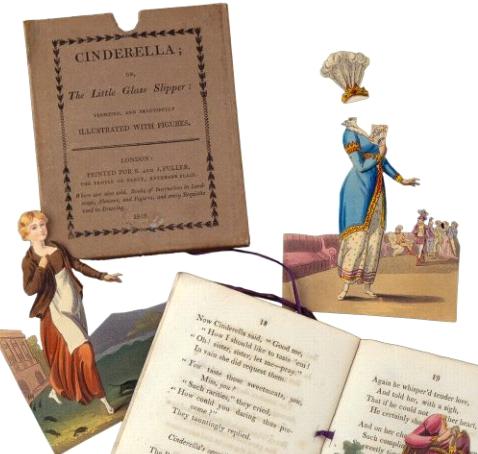
Lot: 17. An 1814 English Paper Doll and Book “Cinderella” by S&J Fuller
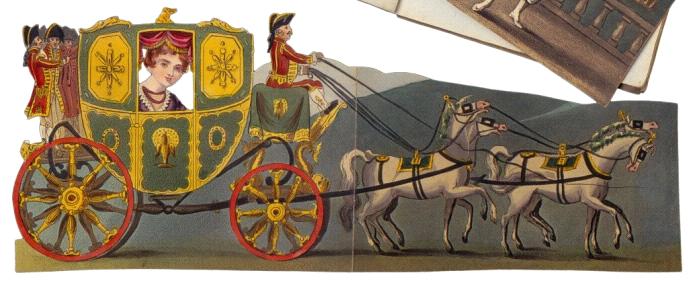
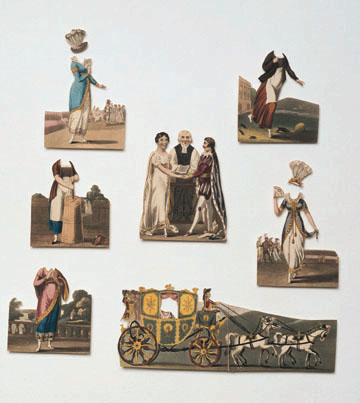
A paper bound miniature book,5″ x 4″,recounts in “beautifully versified” form the favored fairy tale,and was designed to be read while playing with the paper dolls,vignettes and accessories that illustrate the tale,comprising six costume scenes including the wedding,and Cinderella’s coach and horses (in two sections). An inscription inside the front cover reads “To my dear little niece Constance Foley”. S&J Fuller,Temple of Fancy,Rathbone Place,London,1814. Structure and lovely delicate colors of paper dolls and scenes well preserved,coachman’s head missing,one hand missing,stain on book cover. England,1814.

Image @Theriault's.

Around 1810, the London firm of  S. & J. Fuller published books with paper dolls. The 1814 book (or Book of Instruction, as printed on the cover) relates the Cinderella story in verse and is illustrated with cut out figures.

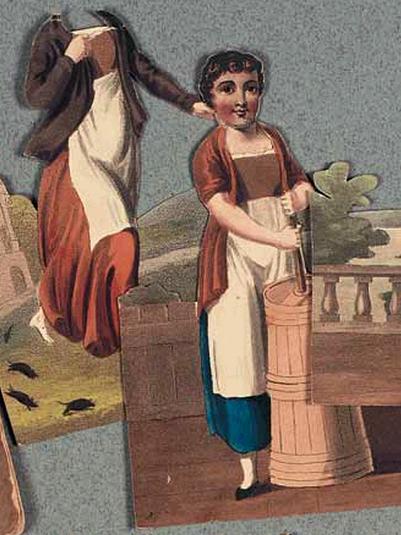
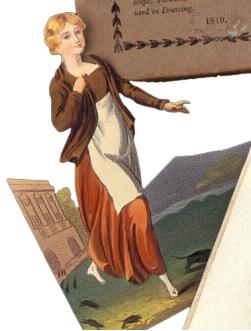
It is interesting to note that Cinderella’s head is removable and can be placed on various paper cut bodies. You see her in the image below walking through a town scape and churning butter. Children could arrange the characters in the paper sets, or drama sheets, and reenact the story.

While these scenic play books became increasingly popular, I imagine that they must have been very expensive and affordable only by the well-to-do.

Image @Theriault's.

The image below contains fancy gowns and the marriage ceremony in which Cinderella marries her prince. Cinderella’s high-waisted costumes have a decided Renaissance influence, and the prince could have doubled for Romeo.

Image @Theriault's.

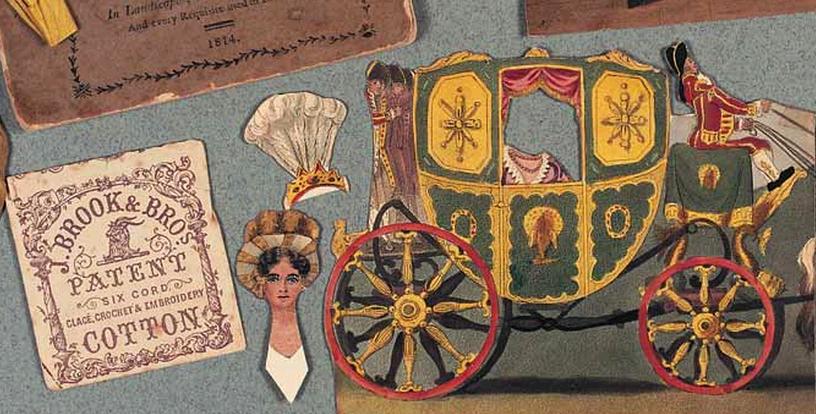
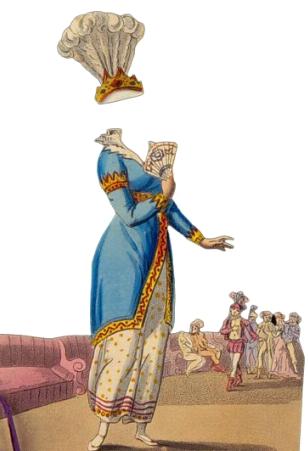
Cinderella’s head becomes much more refined once she hooks up with the prince, as you can see below. She is given a fashionable hat and a jeweled tiara with feathers. The head can also be placed on the figure in the carriage, when the Cinderella story has come full circle.

Image @Theriault's.

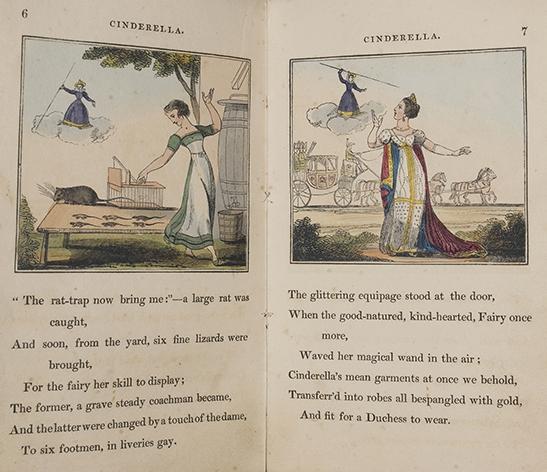
The beautiful versified edition of Cinderella below was donated in 1991 by Ms. Julia P. Wightman to the  The Morgan Library in New York.  Printed in 1819, the paper cut dolls seem more refined than in the 1817 version, especially Cinderella’s head, which has blond hair. Click on the open book images to read portions of the verse.

Image @Morgan Library.

Image @Morgan Library.

Image @Morgan Library.

Image @Morgan Library.

Image @Morgan Library.

The image below is from Picturing Childhood: The evolution of the illustrated children’s book.  Therieaults the Doll Master, Cinderella Paper Dolls, 1814, Published by S. and J. Fuller, London, 5 3/4 in. (14.6 cm) (approx.) Note that Cinderella’s elegant head is placed in the wedding scene. In this instance her hair is dark again..

Image @Picturing Childhood

Below is a more traditional children’s book version of Cinderella. It was published in 1827 and illustrated with hand–colored woodcuts. By the mid-19th century, lithography and printing were being used routinely in book illustrations, but such drawings were still rare when this book came out.

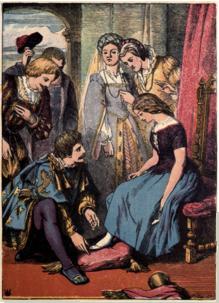
Cinderella, John Harris, London. 1827

In 1812, the Brothers Grimm wrote the Cinderella story that seems more familiar to readers today. By the end of the 19th century, over 300 versions of the Cinderella story existed in Europe. In those years:

The Fairy–Godmother seems more frightening than her later benevolent renderings, such as in Disney’s film version of the story. – Past Times: Cinderella :18th and 19th century Cinderella books.

More on the Topic:

Read Full Post »

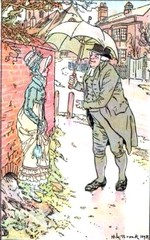
Mansfield Park, Brock. Image @Austenprose

During the 17th century, ladies used parasols for protection from the sun. A century later they were using oiled umbrellas as protection from the rain as well. By the early 19th century, the design of the umbrella had improved and its use had become widespread. After Maria’s marriage, Fanny Price was overtaken by a heavy shower close to the Parsonage and sought shelter under an oak. When the Grants spotted her, they sent out a servant, but Fanny was reluctant to come in:

A civil servant she had withstood but when Dr Grant himself went out with an umbrella there was nothing to be done but to be very much ashamed and to get into the house as fast as possible; and to poor Miss Crawford, who had just been contemplating the dismal rain in a very desponding state of mind, sighing over the ruin of all her plans of exercise for that morning, and of every chance of seeing a single creature beyond themselves for the next twenty four hours, the sound of a little bustle at the front door and the sight of Miss Price dripping with wet in the vestibule was delightful. – Jane Austen, Mansfield Park

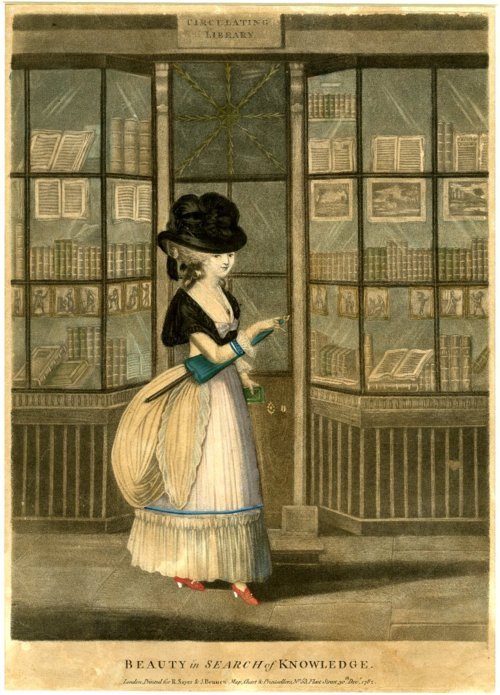
Beauty in search of knowledge, 1782. This 18th century woman carries an early version of an umbrella. These models were heavy and cumbersome. Image @Harry Elkins Widener Collection, Harvard College

A century before Mansfield Park was published (1814) men did not use umbrellas, which were regarded as women’s accessories:

A young man who borrowed one from a coffee house in a downpour in 1709 was excoriated as effeminate in a newspaper. It would have been a cumbersome model, ill-suited to being carried around. Similar heavy umbrellas were kept in churches to protect the parson during burial services. – A Brief History of the Umbrella 

Yet the following passage from Notes and queries, Volume 54, William White (Oxford University Press, 1876,  p. 202), suggests that men began to use umbrellas earlier than Jonas Hanway, who braved ridicule from street urchins and hackney coachmen, who regarded the use of the umbrella as a threat to their livelihood:

1745 – Paid for umbrella, box and carriage.
It is not stated for whose use this was intended; most probably for the minister when officiating at funerals. This is a remarkable entry, as the introduction of umbrellas into England is attributed to a much later period. The employment of the umbrella in the streets London is said to have been by Jonas Hanway, who died in 1786; but the following passage from the Trivia of Gay, who died in 1732, shows it was in use at a much earlier period

Good housewives Defended by th’ umbrella’s oily shed,
Safe through the wet on clinking pattens tread.”

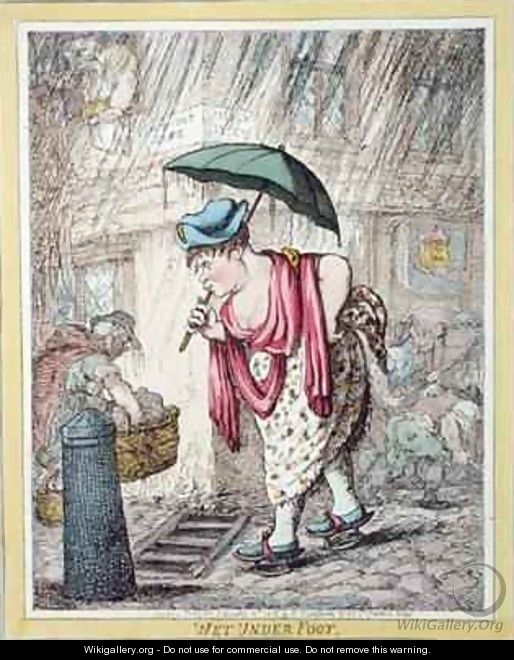
Wet under foot, James Gillray. Image @Wikigallery. The woman is wearing "clinking" pattens as well as carrying an umbrella.

In 1893, Georgiana Hill wrote this descriptive history of the umbrella in England:

Umbrellas were a recent fashion in the earlier part of the century. During the first ten years of George the Third’s reign, the only umbrellas in use were large carriage umbrellas, which required an attendant to hold them. In the country they were hardly known at all. The philanthropist, Jonas Hanway, in 1756, boldly unfurled an umbrella in the streets of London, being the first man who ventured upon such an innovation. Surely Hanway deserves to be held in grateful remembrance by the male sex for this spirited effort towards the emancipation of his brethren from the thraldom of custom. He was jeered and ridiculed by the populace, but was not to be laughed into giving up the sheltering oilskin. About twenty years later, a valiant footman named John Macdonald began to use a silk umbrella, which he had brought from Spain. The boys shouted after him: “Frenchman, why don’t you get a coach?” but he grasped his umbrella more firmly and went on his way, and in some three months time he was able to use it without exciting remark. Miss J. Gay Trivia Hutton, writing in 1779 from Derbyshire, says: “Mrs Greaves lent us their umbrella, and servant to carry it.” Miss Hutton’s brother was the person to use an umbrella in Birmingham, a Frenchman being the first.
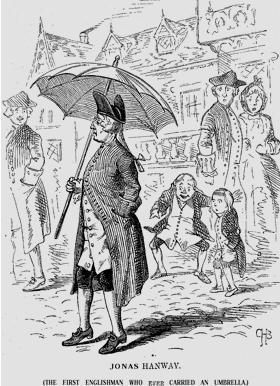
Jonas Hanway. Image @Wikipedia. This caricature depicts how long early umbrella handles were.

The town beau, when he first carried an umbrella, was caricatured in the prints as the rain-beau holding a tiny parasol over his head. A gentleman once borrowed an umbrella from the mistress of a coffee- house in Cornhill, and after the following satirical advertisement in The Female Tatler: “The young gentleman belonging to the Custom house, that for fear of rain borrowed the umbrella from Will’s Coffee house in Cornhill, of the mistress, is hereby advertised to be dry from head to foot on the like occasion he shall be welcome to the maid’s pattens.”

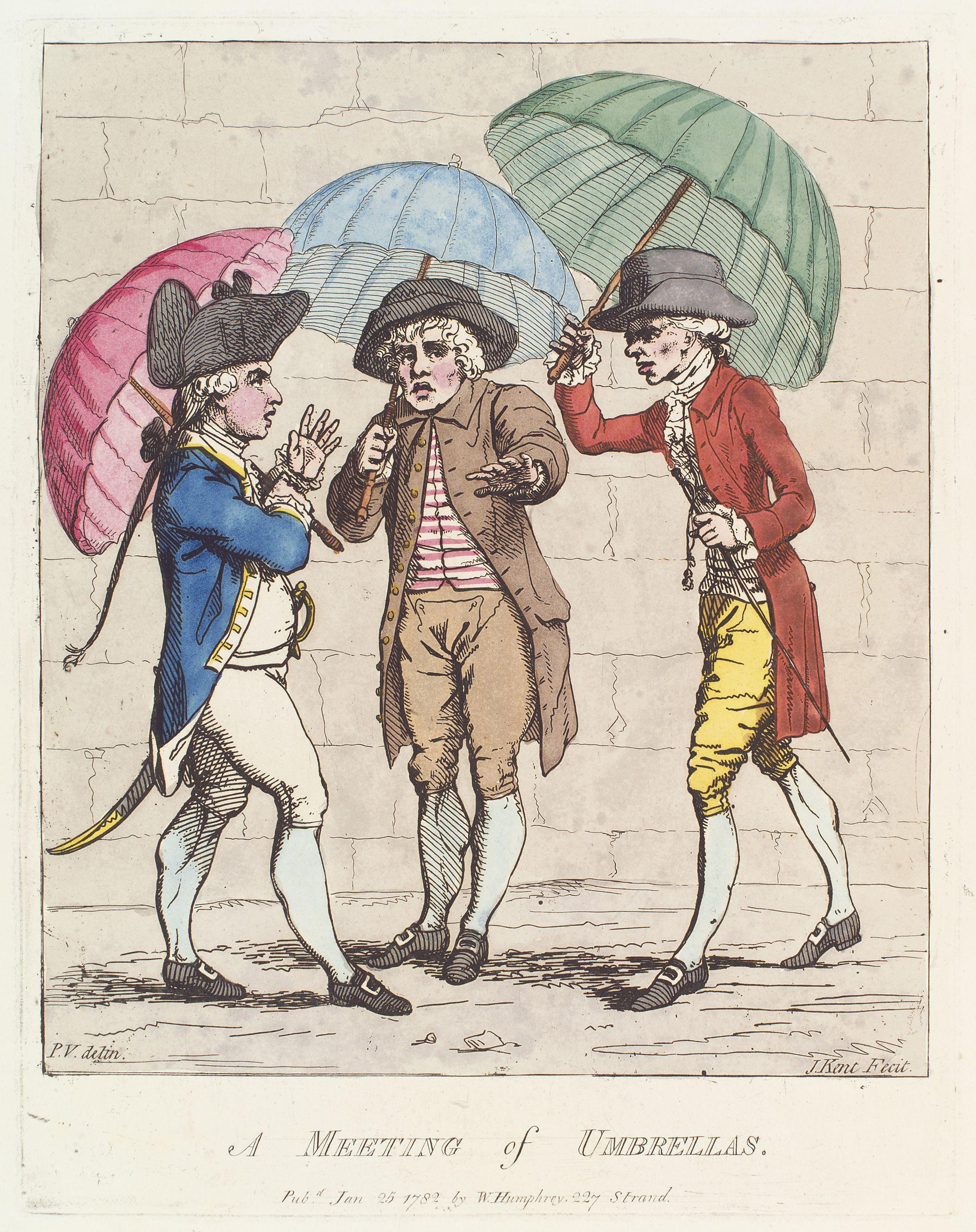
A meeting of umbrellas, James Gillray, 1782. By now, men used umbrellas as a matter of course.

An illustration of the want of umbrellas afforded in one of the caricatures of the period, showing a respectable citizen’s family from Vauxhall in a downpour of rain – the old gentleman with a handkerchief tied over his head to save his wig, and his wife’s cardinal on his to protect his best coat, while the wife herself and her daughters are tripping along in gowns turned up round their waists, and their heads enveloped in coloured handkerchiefs. In 1797 there was one umbrella in all Cambridge, and that was kept at a shop, and let out like a sedan chair ,by the hour. In London women carried umbrellas before men had taken to them, but the first umbrellas were heavy awkward machines made of oilskin or taffeta. Still, in spite of their cumbrous character, women who had to trudge along the streets on rainy days rejoiced in their shelter. With cloak and umbrella, they were able to face the dripping roofs and waterspouts, which were as much to be avoided as the rain. To the fashionable lady. who only walked in fine weather, the one important consideration was the parasol, but it was otherwise with the thrifty citizeness. Great must have been the relief and saving of clothes when the new invention came into use:

Good housewives all the winter’s rage despise,
Defended by the riding hood’s disguise;
Or underneath the umbrella’s oily shade,
Safe through the wet on clinking pattens tread.
Let Persian dames the umbrella’s ribs display,
To guard their beauties from the sunny ray;
Or sweating slaves support the shady load,
When Eastern monarchs show their state abroad;
Britain in winter only knows its aid,
To guard from chilling showers the walking maid.”
– J Gay Trivia

– A history of English dress from the Saxon period to the present day, Volume 1, By Georgiana Hill , 1893, p. 173-74.

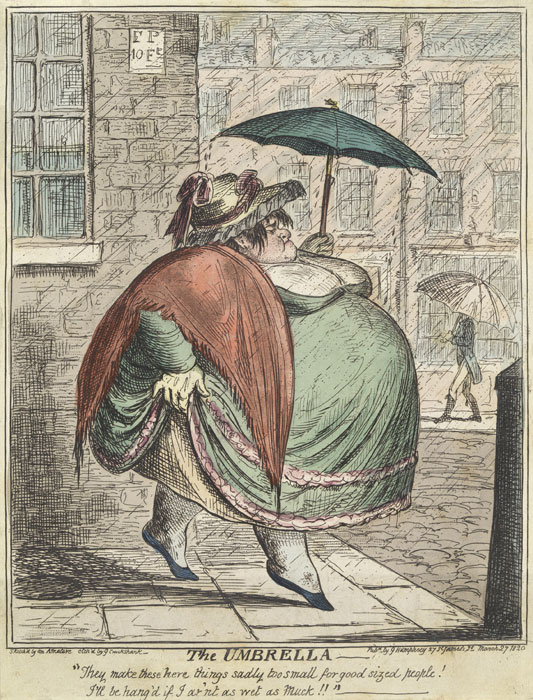
The Umbrella, 1820. This cartoon depicts how little protection these early umbrellas afforded. Cruikshank exaggerates the woman's size to demonstrate the point. Image @Art Tattler

Early umbrellas were heavy and cumbersome to use:

Early umbrellas were made of oiled silk with heavy wooden frames which made them difficult to open or close when wet. Whalebone (baleen) was also used but this still made the article heavy. It wasn’t until 1852 that Samuel Fox invented the steel ribbed umbrella claiming that he was using up stocks bought for making corsets. This made umbrellas much lighter and more portable. – Come rain or shine: historic umbrellas and parasols 

More on the topic:

Read Full Post »
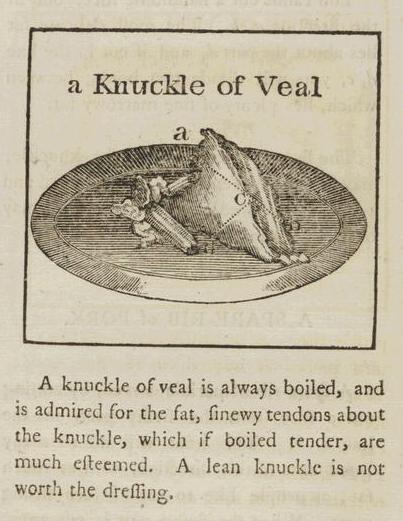
This image comes from The Library of Congress’s digital collection, and sits in John Trusler’s The honours of the table, or, Rules for behaviour during meals : with the whole art of carving, illustrated by a variety of cuts. Together with directions for going to market, and the method of distinguishing good provisions from bad; to which is added a number of hints or concise lessons for the improvement of youth, on all occasions in life. By the author of Principles of politeness, &c. … For the use of young people, London, 1791

My tenderest emotions go toward that veal, for it did not have much time on this earth to use its knuckle. And yet, Mr. Trusler writes of this delicacy with such feeling.

Read Full Post »

Fans of Jane Austen’s fiction are familiar with the rising middle class, successful and enterprising tradesmen, upward mobility through marriage, the fragility of life (especially for fishermen, sailors and child-bearing women), and the difficulties of road travel. All these topics are touched upon in a short biography of Mr. Edward Innes, a successful baker and property man.

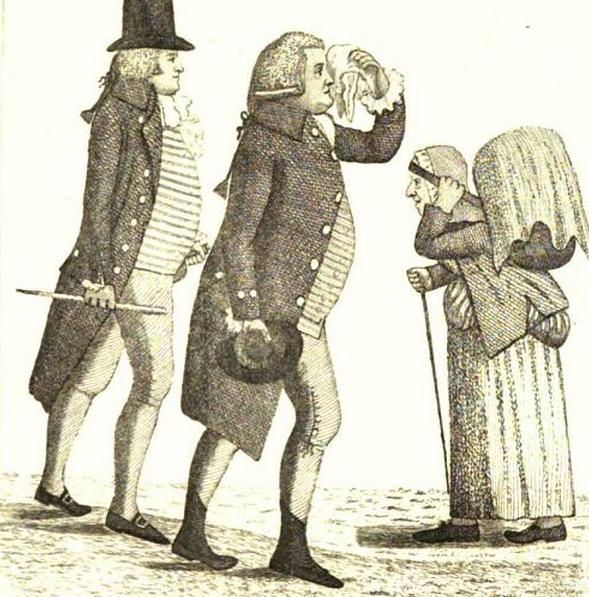
In this image, Mr. Innes is dressed as a gentleman, and is followed by a companion, Mr. James Cooper. As his position rose in life, his sensibilities must have become quite delicate, for as he passes a woman carrying a basket, Mr. Innes shields his face and nose from the offending stench that must have emanated from her basket.

Mr. Edward Innes and his second, James Cooper

Mr. Innes, if this account is to be believed, was a nonpareil, covering the distance to London in his carriage at the unheard of speed of 50 miles per day.

The progenitors of Mr Innes were farmers in the neighbourhood of Glencorse, but his father was a baker, and had his shop at one time at the head of the Fleshmarket Close. Latterly, the shop having been let without his knowledge to a higher bidder, he removed to his son’s property situated betwixt Marling and Niddfy’s Wynds. In his younger years, the old man was usually styled the handsome baker from his exquisite symmetry, and he was not less fortunate in his choice of a pretty woman for his wife. Isabella, or Bell Gordon, had been married to the captain of a vessel, who was drowned at sea only a few weeks after. The young widow then only in her eighteenth year, happening to be on a visit at the house of her brother in law, Mr Syme ,ship builder, Leith; the handsome baker was introduced to her acquaintance, and the result was a speedy union. Besides a daughter by her first husband, Mrs Innes had eight children, of whom the subject of our notice was the second eldest.

Mr Edward Innes, after serving his apprenticeship with his father, commenced as a baker on his own account in the High Street. In addition to his good fortune in business, he acquired considerable property by his wife, a Miss Wright of Edinburgh, by whom he had several children. Mr Innes kept a horse and gig, an equipage rather unusual for a tradesman in his day; and what was considered remarkable at that time, he drove to London on one occasion, accompanied by his wife, in eight days, a distance averaging fifty miles a day. The circumstance was much talked o,f and taking into account the then state of the roads, the performance was really one of no ordinary magnitude. – A series of original portraits and caricature etchings, Volume 2, Part 2 (Google eBook), John Kay, 1838, p 284.

Note: Considering the poor road conditions of the day, carriage horses averaged from 2-4 miles per hour; at breakneck speed, they could achieve a remarkable 6 miles per hour, but horses that pulled a carriage could keep up this pace for only a short distance. Thus Mr. Innes and his wife spent long hours on the road (10-12 per day) and had their horses frequently changed at stops along the way.

Other posts on this topic:

Read Full Post »
« Newer Posts - Older Posts »