This Jane Austen blog brings Jane Austen, her novels, and the Regency Period alive through food, dress, social customs, and other 19th C. historical details related to this topic.
Inquiring readers, I once enjoyed afternoon tea in Fortnum and Mason’s in London. It was an exquisite, elaborate, and unforgettable experience. It was so elegant that I thought of it as high tea, but its presentation and intent had nothing in common with high tea in Jane Austen’s day, or in our present time. This post is meant to complement Rachel Dodge’s excellent post entitled “Jane Austen’s Regency Women: A Day in the Life , Part 1.”
Afternoon tea:
The tradition of tea in the afternoon as we understand it began in 1840 with the Duchess of Bedford (1783-1857). She requested light food with tea and a few refreshments in mid-afternoon to stave off hunger pangs before dinner, which was served at 8 p.m. The Duchess soon began to invite friends to her rooms to join her in taking tea, and so a tradition began. This custom, which we celebrate to this day, began years after Jane Austen’s death in 1817.
Afternoon tea, Thomas Rowlandson. Image in the public domain.
High tea:
High tea was generally known as dinner or supper by the working classes.
“For workers in the newly industrialized Britain, tea time had to wait until after work. By that hour, tea was generally served with heartier dishes which were substantially more than just tea and cakes. Workers needed sustenance after a day of hard labor, so the after-work meal was more often hot and filling and accompanied by a pot of good, strong tea to revive flagging spirits.”- Lemm
It seems that the term ‘high tea’ had more in common with furniture than a lofty service.
“Today, the evening meal in working-class households is still often called “tea” but as working patterns have changed yet again, many households now refer to the evening meal as supper. The addition of the word “high” to the phrase “high tea” is believed to differentiate between the afternoon tea that is traditionally served on low, comfortable parlor chairs or relaxing in the garden and the worker’s after-work high tea that is served at the table and seated on high back dining chairs.” – Lemm
Afternoon tea was therefor served on comfortable chairs in a drawing room or lady’s sitting room, or as a refreshment in the garden.
“Afternoon tea, also known as “low tea,” is the most often taken a a low table, like a coffee table in the sitting room before a warm fire. (Of course, it can also be served at a dining table.) High tea gets its name from its tendency to be served at a high table, like a dining table or high counter at the end of the workday.” – Brown
Breakfast:
Jane Austen was in charge of her family’s tea and sugar stores. She made her family’s breakfast at 9 a.m. The simple repast consisted of toast, rolls, or muffins and butter. Jane toasted the bread over a fire using a long handled fork or a metal rack that held the bread in place.
“The typical ‘tea and toast’ breakfast that Jane Austen enjoyed was a relatively new invention. Traditionally, British breakfasts had consisted of hearty fare that often included beef and ale.” – Wilson, p. 21
Evening tea:
Tea was also served one or two hours after dinner. The time was variable, because people during the Regency era ate dinner at different times. Some ate early in the afternoon, as Jane Austen’s parents did when they were younger; some at 3 p.m., like the Bennets in Pride and Prejudice; the Bingleys dined at the more fashionable hour of 6 p.m.; and the Duchess of Bedford, a trendsetter, dined at 8 p.m. Kim Wilson quotes Captain Harry Smith in 1814 as saying, “I breakfast at eight, dine at three, have tea in the evening…” People who did not follow the latest fashion in dining kept the earlier dinner hours they and their families had always adhered to.
“Confusing the issue further is that people of the time referred to all hours before dinner as ‘morning’, and the period between dinner and teas as ‘afternoon’, even if it fell in what we now call the evening. To them, ‘evening’ started after tea.” – Wilson, p. 91
In the evening after dinner, the assembled guests returned to the drawing-room. Tea was made by the ladies of the house to prevent servants from taking portions of this expensive commodity for their own use. After tea, “…when the tea-things were removed, and the card-tables placed” (Pride and Prejudice) the diners would play games, such as riddles or charades, or read to each other and partake of other pleasures. In Hartfield, “Mr. and Mrs. Weston and Mr. Elton sat down with Mr. Woodhouse to cards.”- (Emma)
Tea was also provided at balls, when suppers were served at midnight, in private alcoves in pleasure gardens, on visits when “Mr. Woodhouse was soon ready for his tea; and when he had drank his tea he was quite ready to go home” (Emma), and at musicales —”The first act was over. Now she hoped for some beneficial change; and, after a period of nothing-saying amongst the party, some of them did decide on going in quest of tea” (Persuasion).
A lady at a public assembly ball was dependent on a gentleman to escort her to the tea-room.
“At a grand ball in Bath, Catherine Moreland of Northanger Abbey, and her friend Mrs. Allen, feel awkward and out of place until “they received an offer of tea from one of their neighbors; it was thankfully accepted, and this introduced a light conversation with the gentleman who offered it…”-Martyris
So many unanswered questions remain about tea taking in the Regency era, especially among the working classes and this post does not begin to address them or pretend to. Tea was so universal during this age, that anyone who could afford it (or smuggle it in) drank it, including Emma’s Mrs. Bates, who was “almost past every thing but tea and quadrille.“
I find Jane Austen’s daily routines inspiring, don’t you? She was well-rounded and enjoyed a variety of activities to keep her body, mind, and spirit healthy and balanced. She wrote newsy letters, played the pianoforte, prayed with her family, sewed beautifully, and loved brisk walks. Austen’s evenings at home were spent reading, sewing, and talking with her family. Evenings in company meant dinners, game tables, and dancing. And Sundays were set aside for rest and church.
But what else did Austen understand about the everyday lives of Regency women that might help further our enjoyment of her novels? What went on behind (and between) the scenes we love so well? In this series, I’ll cover a variety of topics on Regency women. Let’s start by looking at what women did each morning on a normal day.
Mornings
The Regency day was broken into two parts: Morning and Evening. Morning usually refers to the part of the day before dinner. Women changed their dresses for dinner, marking the evening portion of the day. Thus, when we read Austen’s novels, we must understand that “morning” encompasses what we refer to as morning and afternoon.
Pre-Breakfast: This was the time between rising and breakfast, which was given to various private pursuits and personal hygiene. A married woman or mistress of the house (as in Emma’s case) might use this time to look over menus and address household necessities with a housekeeper or servant. We know Austen used that time to practice the piano, walk in the garden or run short errands, and write letters to friends and family members. It’s easy to see that a lady’s personal time before breakfast was quite pleasant.
Breakfast: Breakfast was eaten around 10 a.m. in most households, as the Middletons and their guests do in Sense and Sensibilitybefore their morning outing, though people in the country tended to eat earlier than those in town. Jane Austen herself was known for eating an earlier breakfast at 9 a.m. Breakfast was a leisurely meal, with food on the side board where people might serve themselves. In London at Mrs. Jennings’ table, we read that breakfast “lasted a considerable time” as it was her “favourite meal.”
Breakfasts in the Regency period were “dainty meals of varieties of bread, cake and hot drinks, served in the breakfast-parlour…and eaten…off…fine china” (Maggie Lane, Jane Austen and Food). However, an early and more substantial breakfast might be taken before traveling a long distance. In Mansfield Park, Henry and Fanny’s brother eat a hearty breakfast before setting out early in the morning: “the remaining cold pork bones and mustard in William’s plate might but divide her feelings with the broken egg-shells in Mr. Crawford’s.”
Coffee, tea, and chocolate were the favorite hot drinks of the time, but tea was a breakfast staple for the Austen family: “Toast was made in front of the fire by the consumers themselves, rather than by their servants” (Lane 31). Jane Austen’s duties at breakfast included “[t]oasting the bread and boiling the water for tea in a kettle.” In Sanditon, we find this detail: “[Arthur] took his own cocoa from the tray . . . and turning completely to the fire, sat coddling and cooking it to his own satisfaction and toasting some slices of bread . . .” (ch. 10).
Morning Calls: Visiting took up a great portion of the day, usually anywhere from 10 a.m. until 6 p.m., depending on each household’s meal times. Normally, it was safest to call between 12:00 p.m. and 3:00 p.m. for most households. Between visits or on quiet mornings at home, women tended to sew together as we know Austen herself enjoyed doing. In Sense and Sensibility, we’re told that the ladies settled themselves after breakfast “round the common working table.” Their work, of course, was needlework.
Social visits were typically 15 minutes in duration. A shorter visit was considered a snub, as is seen in Emma when she allows Harriet Smith to make a 14-minute visit to the Martins: “The style of the visit, and the shortness of it, were then felt to be decisive. Fourteen minutes to be given to those with whom she had thankfully passed six weeks not six months ago!” (emphasis mine). However, in Pride and Prejudice, emphasis is given to the length of Georgiana Darcy’s visit to Elizabeth at the inn: “Their visitors stayed with them above half-an-hour” (emphasis mine).
Visits were made for a variety of reasons, but special visits to friends and neighbors were made before and after trips away from home; new neighbors were often visited, as we see in Pride and Prejudice when Mrs. Bennet pressured Mr. Bennet to visit Mr. Bingley; and new brides were visited by everyone in the neighborhood. When Mr. Elton brings Mrs. Elton home, Mr. Woodhouse says, “Not to wait upon a bride is very remiss. […] I ought to have paid my respects to her if possible. It was being very deficient.”
As a Regency woman, morning visits must have ranged from enjoyable and entertaining to downright bothersome and boring. But one thing we modern readers must keep in mind: Virtually every visit required a reciprocal visit. Once you began visiting someone, it must have been difficult to ever stop!
Luncheon: Lunch did not exist as we know it today. Instead, light refreshments were brought in during the day, often during visit. These light meals were comprised of cold foods and served in whatever room the family was in at the time. When callers came, the woman receiving a visit rang for refreshments and was expected to offer and serve tea and refreshments, all while carrying on polite conversation.
In Austen’s novels, these midday refreshments are referred to as a “tray,” “cold meat,” “a set-out” or a “cold repast” (Lane 35). In Pride and Prejudice when Elizabeth visits Miss Darcy at Pemberley, we read of “cold meat, cake, and a variety of all the finest fruits in season.”
Interestingly, the only time a “lunch” of sorts is mentioned in Austen’s novels is at an inn. In Pride and Prejudice, the Bennet sisters eat “‘the nicest cold luncheon in the world,’ which consists of ‘a sallad and cucumber’ and ‘such cold meat as an inn larder normally affords’” (Ch. 39). In Sense and Sensibility, Willoughby stops for a quick “nuncheon” when traveling from London to Cleveland, consisting of “a pint of porter” and “cold beef.”
Dressing for dinner: At the conclusion of a full day of visiting with friends, neighbors, and family members, Regency women then returned to their rooms to change for dinner. The timing of this change of dress again depended on the hours kept in each home. This provided women time to refresh themselves, arrange their hair, and put on their evening dresses. (I imagine they also took the opportunity to loosen their stays for a bit!)
Evening activities ranged from simple dinners at home to full nights of dinner, dancing, and entertaining—sometimes until the early morning hours—so a Regency woman’s day did not necessarily end when the sun went down. Often, it was just getting started!
Please join me next month in Part 2 of this series as we explore the evening portion of a Regency woman’s day.
Food for thought: If you lived in Jane Austen’s time, what would you spend your time doing before breakfast?
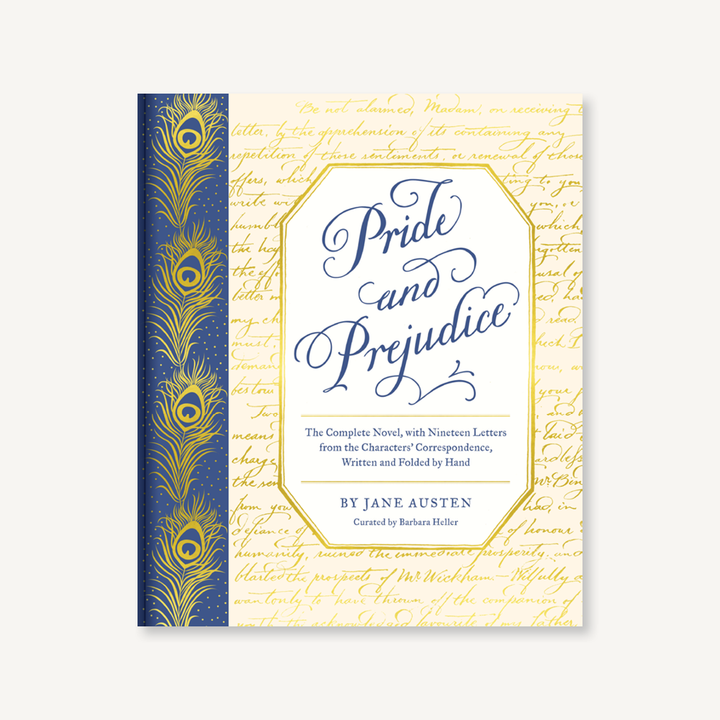
Inquiring Readers, On September 15th Chronicle Books will release an edition of Pride and Prejudice: The Complete Novel, with Nineteen Letters from the Characters’ Correspondence, Written and Folded by Hand, By Jane Austen, Curated by Barbara Heller. I received my lovely copy along with this text:

“This deluxe edition brings to life the letters exchanged among Jane Austen’s characters in Pride and Prejudice.
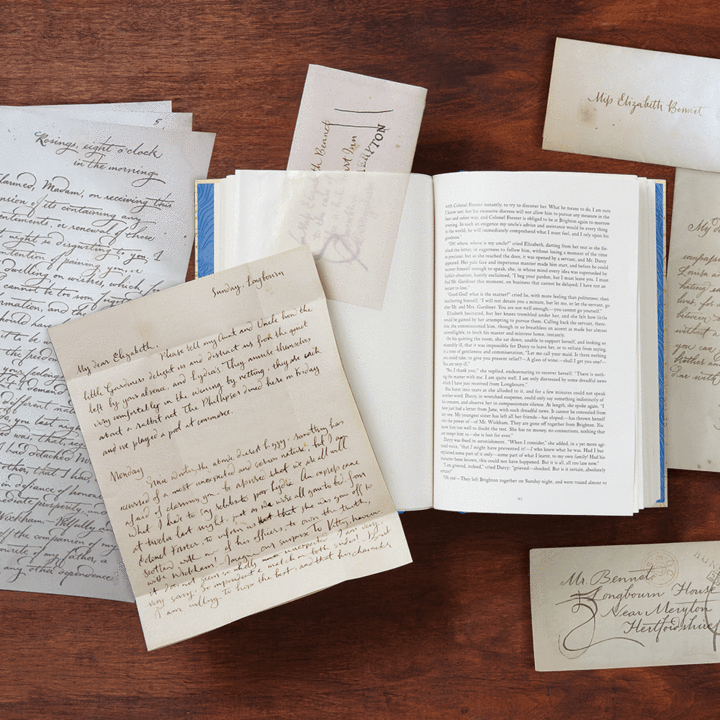
Glassine pockets placed throughout the book contain removable replicas of 19 letters from the story.
Pride and Prejudice letters with glassine inserts. Image Chronicle Books.
These powerful epistles include Lydia’s announcement of her elopement, Mr. Collins’s obsequious missives, and of course Darcy’s painfully honest letter to Elizabeth.
Nothing captures Jane Austen’s vivid emotion and keen wit better than her characters’ correspondence.
Each letter is re-created with gorgeous calligraphy.
Letters are hand-folded with painstaking attention to historical detail.
Perusing the letters will transport readers straight to the drawing-room at Netherfield or the breakfast table at Longbourn.”
Find Barbara Heller at BarbaraHeller.org, with information about her process and the scribes and graphic artist who designed the letters.
ChattyFeet Winners of Jane Austoe Socks!
In mid-August we held a contest regarding ChattyFeet’s Jane Austoe socks and received a variety of creative answers to our prompts.
We announced three winners on August 22nd–Denise, Mea, and Mary. Mea proudly sent images of her wearing the socks and holding them.
Mea holds her new socks
Jane Austoe & Mea
Denise, another contest winner, also sent in her images.
Denise with her new chattyfeet socks
Denise and her socks view her Darcy and Lizzie figurines.
Vic received a surprise gift from Gil Kahana, the CEO of this funky, wonderful site. It was a literature box set of four outstanding authors: Jane Austoe, Virginia Wool, Ernestoe Hemingway, and Marcel Proustoe. I was thrilled and immediately donned two socks. Guess which author dominated!
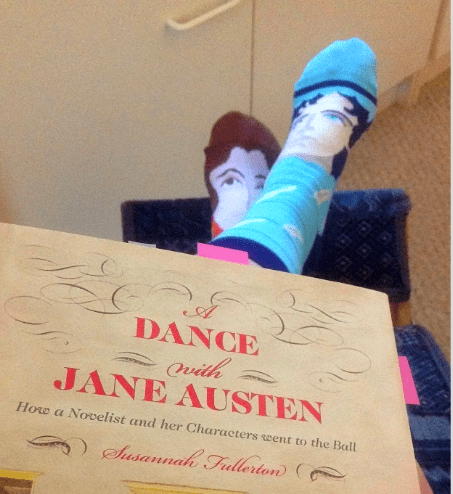
Vic wears rival authors on her feet whilst reading Fullerton’s A Dance With Jane Austen.
The box is as unique as the socks.
The socks inside the box. Let the socks do the talkin’
The top of the Literature Sock Collection
ChattyFeet does not stop at literature. Famous artists, scientists, and royals also receive the funky and humorous treatment. Jane Austoe is the latest design to receive foot accolades.
Inquiring Readers, I discovered that Susanna Fullerton, President of the Jane Austen Society of Australia and Austen author, is as much of a fan of Georgette Heyer as I am, perhaps more. This delightful article compares and contrasts the writings of Jane Austen and Georgette Heyer. Susannah also offers a giveaway at the end of her article. Enjoy!
In Georgette Heyer’s novel Regency Buck there’s a delightful scene that takes place in Hookham’s Library in London’s Bond Street. The heroine, Judith Taverner, picks up a novel called Sense and Sensibility, one of the “new publications on offer” and written “By a Lady”. She proceeds to read aloud to her cousin Bernard from the scene when mercenary John Dashwood congratulates his sister Elinor on capturing the romantic interest of Colonel Brandon. John Dashwood is of course mistaken – it is Marianne that interests the Colonel – and it’s a lovely comic moment of misunderstanding. Judith closes the book and says to her cousin, “Surely the writer of that must possess a most lively mind?” This is one of the tributes that Heyer pays to Jane Austen, in her fiction. She knew only too well how very lively was the mind of her favourite novelist.
She’d have loved to have learned more about Jane Austen, but Heyer did not have the wealth of material available to today’s reader. James Edward Austen-Leigh’sMemoir had been published, and she could also turn to Constance Hill’s Jane Austen: Her Homes and Her Friends, but otherwise she had to pretty much rely on the novels to gain details she could use in her own fiction. There was no superbly researched edition of the letters by Deirdre le Faye, no Tomalin biography, no John Mullan analysis, for Heyer to turn to. But she made the most of what she had and reread the novels frequently. One reviewer of Friday’s Child picked up on this, noting with approval, “The author has read Jane Austen to advantage”.
I think Heyer must have felt, even with the limited biographical material available to her, that she had much in common with Jane Austen. Both women lost adored fathers and had rather troubled relationships with their mothers, both cherished their privacy, both were meticulous when it came to accuracy, and neither suffered fools easily. Both novelists “dearly loved to laugh” and their humour shines through in their fiction.
Sense and Sensibility is a novel about sisters and one can see the influence of this in Heyer’s oeuvre. Frederica is the sensible sister in the novel of that name, while Charis is the emotional and romantic equivalent of Marianne Dashwood. Mary and Sophia Challoner of Devil’s Cub, Horatia and Elizabeth Winwood of The Convenient Marriage are more examples of Austen-influenced sister-pairings, and Heyer shows, just as Austen did in Sense and Sensibility, that second attachments can succeed and that sometimes handsome young men turn out to be rotters.
Heyer learned from Northanger Abbey too, playing with Gothic conventions such as abductions, strange and overbearing ‘villains’, dark and stormy nights, and people being locked in cellars – but, like Austen, she mines Gothic tropes for humour, not for scariness. We find Gothic devices being mocked in The Reluctant Widow, Devil’s Cub, Friday’s Child, Cousin Kate and Faro’s Daughter.
Image of the cover of 24 novels of Georgette Heyer published by Sourcebooks Cassablanca in 2008
Novelist PD James once described Pride and Prejudice as “Mills & Boon, written by a genius”. Certainly, Austen’s novels give us the standard romance plot of ‘boy meets girl – consequent misunderstanding – romantic happiness’. Of course, Austen adds to this standard plot her own unique depth, psychological acuteness, and complexity of character which lifts her books into the realm of genius. Heyer uses this standard plot too – just as Elizabeth Bennet has to listen to Darcy’s “not handsome enough to tempt me”, so does Arabella have to listen to slighting comments from Mr Beaumaris. Like Austen, Heyer shows her couples learning about themselves and their world, often through making mistakes or initial prejudice. Sylvester, like Darcy, will learn to be “properly humbled” by the woman he comes to love, Sherry has to learn from Hero to think of others and not just himself, Freddy Standen in Cotillion must discover that love comes into one’s life in unexpected ways. Heyer shows couples sparring with each other in seeming dislike, just as Elizabeth and Darcy bandy words in the ball room. In Bath Tangle, Lady of Quality, Black Sheep and The Grand Sophy we see young men and women falling in love as they argue, and so often their language has echoes of the language used by Austen’s characters.
Eyes are said to be the windows of the soul, and eyes that speak to each other are important in Jane Austen’s books. Darcy finds himself admiring Elizabeth’s very fine eyes and when Emma’s eyes “invited him irresistibly to come to her”, Mr Knightley doesn’t even try to resist. The eyes of Heyer’s heroines (usually cool grey ones) are often mentioned and are a great part of their attraction to their lovers. Eyes in her novels also sparkle with laughter, for Heyer’s heroines all love to laugh, as do Austen’s (even Fanny Price laughs – once!). Gurgles of laughter, lips twitching in smiles, and sudden bursts of laughter, all remind one of Elizabeth Bennet’s laughter, or of Emma’s smiles.
Stack of the annotated editions of Jane Austen’s six novels: Northanger Abbey, Pride and Prejudice, Sense and sensibility, Emma, Mansfield Park, and Persuasion.
“There are just so many similarities in language, character and plot, as one sees again and again how Heyer pays tribute to Jane Austen. To many modern readers, the idea of cousins marrying each other is not appealing (we know of the possible genetic consequences for their children), but we find cousin marriages, which must have been common in the Regency, happening in Mansfield Park and in The Grand Sophy. That Heyer novel has a rather sleepy Spanish woman, a Marquesa, who is surely a Lady Bertram copy-cat, Dr Grant’s obsession with food and wine is mirrored in the wonderfully named Sir Bonamy Ripple of False Colours, and sudden illness, elopements to Scotland, and marital unhappiness (all to be found in Mansfield Park)are found frequently in Heyer. Sir Thomas Bertram and Miles Calverleigh have money from Indian plantations, Tom Bertram and Horatia Winwood are addicted to gaming, Fanny Price and Kitty Charing are taken in by relatives when young, and even Lady Bertram’s lazy pug is comically reincarnated in Friday’s Child. Emma is a rather managing young lady – so is Sophy Stanton-Lacy of The Grand Sophy though Emma has more to learn than Sophy; Miss Bates rarely stops talking long enough to draw breath and we gain such a vivid sense of how exhausting it must be for poor Jane Fairfax to live with her – Maria Farlow in Lady of Quality also has an inexhaustible flow of “nothing-sayings” which exhausts Annis; and Mr Woodhouse’s hypochondria has influenced the vapourish and imagined illness of many Heyer characters. Mrs Elton’s social climbing teaches Mrs Challoner a thing or two, dim-witted Harriet Smith and Belinda of The Foundling have much in common, while Bath Tangle concerns itself with lost love and second chances, just as does Persuasion.
Both Jane Austen and Georgette Heyer wrote about young women who enter the marriage market, and their novels are centred on romantic relationships. However, both novelists then proceed to de-centre this romance by using comedy, irony and by showing us the realities of marriage. Sometimes love or lust are just not enough, as is obvious from the Bennet marriage. Both writers investigate what W.H. Auden called “the amorous effects of brass” and show how money influences and distorts. And both show us the instability and social concerns of the Regency era (urban poverty, enclosure of land, women lacking dowries, a growing middle class, and soldiers with not enough to do). They give us heroines who must learn to cope on their own while losing homes, income, family and love, both show an unerring sense of place, and they give us so much to laugh over.
I love both of these authors, sometimes for the same reasons and sometimes for very different reasons. Jane Austen was writing contemporary novels, Heyer historical ones, so she spends more time explaining social detail than does Austen. I love Heyer’s sense of fun and relax into her fiction without feeling challenged or disturbed (which in these Covid times is exactly what I need). But Heyer never provides the acute psychological brilliance that we find in Austen, or the sheer innovation, or the depth of characterisation, or the knowledge that every single time we go back to her books we will learn something new about ourselves or other people. Austen challenges our intellects and makes us think; Heyer soothes and restores. Georgette Heyer would have been the first to admit that her own talents were far inferior to those of her literary mentor – she knew her novels were not in the same class. And yet her novels have huge charm and I am happy to keep going back to them, always with delight. I think that as readers we can rejoice in the differences and enjoy both writers in different ways, and have the fun of finding the echoes of Austen in the pages of Heyer.
Jennie Chawleigh of A Civil Contract reads Mansfield Park after her marriage to Adam. She is consoled by reading in its pages that a man can form a deep and lasting second attachment, and seeing Edmund Bertram begin to forget Mary and think about Fanny brings her comfort. I love such references made by one of my favourite novelists to the writer whose books I adore more than any other. In my view, one can find that both writers are, in the words of Heyer, “complete to a shade”, each in their own inimitable way.
About Susannah Fullerton:
Susannah Fullerton, OAM, FRSN, has been President of the Jane Austen Society of Australia for the past 25 years. She is the author of several books about Jane Austen – Jane Austen and Crime, A Dance with Jane Austen, Happily Ever After: Celebrating Jane Austen’s Pride and Prejudice and Jane & I: A Tale of Austen Addiction. She has also organised 3 Georgette Heyer conferences in Sydney and edited Georgette Heyer: Complete to a Shade. Please visit her website at https://susannahfullerton.com.au/ She is a ‘Lady Patroness’ of the newly formed International Heyer Society, which publishes a newsletter ‘Nonpareil’ and sends out fascinating posts about all things Heyer. For further information, see https://heyersociety.com/
Bibliography:
A fuller version of this article can be found in Heyer Society: Essays on the Literary Genius of Georgette Heyer, Edited by Rachel Hyland, Overlord Publishing, 2018
Georgette Heyer: Biography of a Bestseller, Jennifer Kloester,,Penguin, 2011
SPECIAL OFFER!:
Susannah writes a very popular blog, ‘Notes from a Book Addict’, which comes out for free on the first day of each month. This blog provides reading recommendations, keeps you up-to-date concerning film versions of classic novels, discusses a fabulous poem each month, and much more.
If you subscribe to this blog before 31 September, your name will be entered into a draw to win one of these prizes:
A signed copy of Georgette Heyer: Complete to a Shade
Cover of Georgette Heyer: Complete to a Shade
A signed copy of Jane Austen and Crime
A 25-page Reader’s Guide to Jane Austen’s Emma
Complimentary membership for the rest of 2019 and all of 2020 of the International Heyer Society
Two of Susannah’s fabulously illustrated video talks: ‘Jane Austen: Her Life and Works’ and ‘The Inimitable Georgette Heyer’ (each talk is about 60 mins)
To enter the draw, simply email Susannah on susannah@susannahfullerton.com.au, reference HEYER, and she will subscribe you to the blog and enter your name in the draw. Winners will be announced at the end of September.
“You deserve a longer letter than this, but it is my unhappy fate seldom to treat people so well as they deserve…” – Jane Austen
Introduction:
In August, 1798, Rev George and Mrs. Austen and their daughters Cassandra and Jane visited Godmersham, Edward Austen-Knight’s estate near Godmersham, Kent, where he had moved with his family in November, 1797. While Jane and her parents returned to Steventon in October, Cassandra remained behind until March, 1799. Jane wrote the following letter on Christmas eve in the middle of Cassandra’s prolonged visit.
Godmersham Park, 1799, Wikipedia public domain image
Jane Austen’s letter:
Steventon: Monday Night, Dec 24 [1798]
My dear Cassandra
Our ball was very thin, but by no means unpleasant. There were thirty-one people, and only eleven ladies out of the number, and but five single women in the room. Of the gentlemen present you may have some idea from the list of my partners—Mr. Wood, G. Lefroy, Rice, a Mr. Butcher (belonging to the Temples, a sailor and not of the 11thLight Dragoons). Mr. Temple (not the horrid one of all). Mr. Wm Orde (cousin to the Kingsclere man). Mr. John Harwood, and Mr. Calland, who appeared as usual with his hat in his hand, and stood every now and then behind Catherine and me to be talked to and abused for not dancing. We teased him, however, into it at last. I was very glad to see him again after so long a separation…
There were twenty dances, and I danced them all, and without any fatigue…My black cap was openly admired by Mrs. Lefroy, and secretly I imagine by everybody else in the room…Of my charities to the poor since I came home you shall have a faithful account. I have given a pair of worsted stockings to Mary Hutchins, Dame Kew, Mary Steevens, and Dame Staples: a shift to Hannah Staples, and a shawl to Betty Dawkins: amounting in all to about half a guinea…
I was to have dined at Deane today, but the weather is so cold that I am not sorry to be kept at home by the appearance of snow. We are to have company to dinner on Friday: the three Digweeds and James. We shall be a nice silent party. I suppose.
You deserve a longer letter than this, but it is my unhappy fate seldom to treat people so well as they deserve…God bless you!
Yours affectionately, Jane Austen
Steventon Parsonage, Wikimedia Commons
This short letter might reveal very little information to the contemporary reader, but Cassandra knew the context of every sentence Jane wrote. She knew the people, time, place, and setting, since she lived it. No detailed descriptions were needed for Cassandra to comprehend the letter’s full meaning
Thankfully for us, records and books exist that will help us make more sense of Jane’s cryptic words.
The Years Leading to Austen’s Letter
Jane and Cassandra had just experienced a number of eventful years. In 1796, Jane met and danced with Tom LeFroy at Deane. We know the details of this meeting in the first existing letter Jane wrote to Cassandra. In August, 1797, Cassandra learned that Thomas Fowle, her fiance, died tragically of fever in the West Indies months earlier and was buried at sea. A little over a year after the shocking news, she must still have been in deep mourning.
By 1798, Jane had already written the first drafts of Pride and Prejudice, initially entitled First Impressions, and Sense and Sensibility, originally drafted as an epistolary novel entitled Elinor and Marianne. Just five months previously, her dear cousin Lady Williams (Jane Cooper) had died in a carriage accident, another cause for mourning.
Timeline of events:
1795
(?)
Cassandra engaged to Thomas Fowle.
May
Mrs. James Austen died.
1795
-6
Mr. Tom Lefroy at Ashe.
1796
First Impressions (Pride and Prejudice) begun.
1797,
Jan.
James Austen married Mary Lloyd.
Feb.
Thomas Fowle died of fever in the W. Indies.
Nov.
Jane, with mother and sister, went to Bath.
First Impressions refused by Cadell.
Sense and Sensibility (already sketched in Elinor and Marianne) begun.
1798,
Aug.
Lady Williams (Jane Cooper) killed in a carriage accident.
Mrs. Knight gave up Godmersham to the Edward Austens. Jane’s first visit there.
Deidre Le Faye in Jane Austen’s Letters, 4th Edition, listed Austen’s known letters in chronological order. At a glance one can see when and where the sisters were apart. Many casual readers think of Jane as a spinster and a homebody, but the list demonstrates how often and how extensively she and Casssandra traveled, largely in the south of England. This link leads to an interactive map of her travels in Smithsonian Magazine.
Le Faye chronicles the ten letters Jane sent to Cassandra during her visit to Godmersham. They were written from October 24, 1798 to January 23, 1799. This letter, which described past and future events, was dated December 24th, Christmas eve. The ball had already occurred. Christmas festivities in 1798 were rather simple compared to festivities introduced during Queen Victoria’s time, (Click on this link to a Georgian Christmas). Jane must have missed her sister even more on this occasion.
Deirdre Le Faye, in her descriptive article for Persuasion #14, 1992, entitled Jane Austen’s Letters, described the letters as “often hasty and elliptical–the equivalent of chatty telephone conversations between the sisters, keeping each other informed of the events at home…interspersed with news of the day, both local and national.” (p. 82, Jane Austen’s Letters)
Example of a cross written letter to save paper and postage, much as the Austens sent to each other. The recipient of the letter paid for the postage. Paper was saved by cross writing. Image in the public domain.
When Jane and Cassandra were apart, they wrote each other every three days, or five letters in a fortnight. As soon as one was sent, they began to write the next one. The letters followed a pattern, telling the other of the journey, then about daily events and how life was at home, then talking about the visit at the destination, and finally of the journey home. This pattern helped Le Faye determine which letters (or set of letters) were missing or destroyed by Cassandra.
When Jane was ready to mail her letter, Mr. Austen dropped it off at the post box in Deane as he made his rounds throughout his parish. Cassandra bequeathed this letter to Fanny Knatchbull, née Austen-Knight, which eventually made its way into her son’s, Lord Brabourne’s, publication of Jane’s letters.
Events in the Letter: The Ball, the People, and the Setting
The setting
In her December 24th letter, Jane indicated her physical fitness – she danced all twenty dances without any fatigue. As a country girl who helped her family in the kitchen garden or with breakfast, and who walked into town, to church, or to visit neighbors at Deane or Ashe, she was in prime physical condition. View this map of Steventon, Deane, and Ashe.
She described the ball as being thin.
“There were thirty-one people, and only eleven ladies out of the number, and but five single women in the room.“
It is hard to tell if the ball was public or private. The word “thin,” however, indicated that it must have been public to anyone who had a subscription. If the ball had been private, then the hosts would have ensured that the correct number of persons of both sexes would have been invited. Once they accepted the invitation, good manners would have obliged them to show up. If the December ball had been private, Jane would surely have known who and how many were coming. There would have been few surprises.
Basingstoke Town Hall in the late 18th early 19th centuries.
Public assembly balls were held in Basingstoke’s town hall, which was a little over 7 miles from Steventon (an hour’s carriage ride in good weather, since horses pulling carriages traveled 6 miles per hour on average). Dancing was performed in a ballroom on the first floor that also held a card room for gentlemen like Mr. Austen, who might not have felt like dancing.
Rev George and Mrs Anne Lefroy (née Brydges). The reverend obtained his living in Ashe in 1783, and Madam Lefroy, as she was locally known, was Jane’s good friend and mentor. In her letters, Jane talked of visiting friends and neighbors, such as the Lefroys of Ashe Park, which was within easy walking distance. In 1800, Jane wrote:
“We had a very pleasant day on Monday at Ashe (Park). We sat down fourteen to dinner in the study, the dining-room being not habitable from the storms having blown…down its chimney. There was a whist and a casino table…” – Constance Hill
Ashe Rectory. Illustration by Ellen Hill
Mr. Wood: All we know about John Wood is that he was Jane’s dance partner.
Rice is most likely Henry Rice, who married Jemima-Lucy Lefroy. He was known to be a fun-loving spendthrift who was often bailed out by his mother.
Mr. Temple, mostly likely Frank, who served in the navy. His friend was Samuel Butcher.
Mr. Butcher (belonging to the Temples, a sailor and not of the 11th Light Dragoons.) Samuel Butcher was five years older than Jane. He was appointed to HMS Sans Pareil in 1795.
Mr. Wm Orde (cousin to the Kingscler man) of Nunnykirk “perhaps.” He remained unmarried.
Mr. Calland, who Penelope Hughes-Hallett identified as the Rector of Bentworth. The joke in the Austen family was that he always appeared at any function with a hat in his hand, which Mrs. Austen made fun of with a poem. On this day, Jane and her friend Catherine teased him into dancing.
Catherine is Catherine Bigg, daughter of Mr. Bigg Wither of Manydown Park, and Jane’s good friend.
“Manydown is within easy reach of Basingstoke, and Jane often stayed there when the Assembly balls took place. She had done so on the present occasion.”- Constance Hill
18th century engraving of Manydown Park
Of my charities to the poor…
In this section of the letter, Jane listed the Steventon villagers who received her largesse:
“ I have given a pair of worsted stockings to Mary Hutchins, Dame Kew, Mary Steevens, and Dame Staples: a shift to Hannah Staples, and a shawl to Betty Dawkins:”
Hannah was Dame Staples’ daughter. Jane Austen, as a rector’s daughter of the most influential man (not the richest) in the parishes he served, was obligated to support the many poor ladies in Steventon. Her gifts, simple as they seemed, were multiplied by the gifts of food and clothing from the community at large and kept the villager women from dire extremes. Mrs. and Miss Bates in Emma depend on the kindness of neighbors to survive, as Jane wrote in scene after scene.
The Austens, while influential in Steventon, were not rich. They belonged, as Lucy Worsley writes in Jane Austen at Home, to the pseudo-gentry.
“Jane belonged to the pseudo-gentry; there was land in her family, but her parents and siblings didn’t own land, so they had to make do and mend and gloss things over.”
Pseudo-gentry kept up appearances even though their means fell short of their richer neighbors, friends, and relatives. Still, Jane managed from her meager yearly-pin money of around £20 to spend a sum “amounting in all to about half a guinea….”
Half a guinea was a gold coin minted from the Guinea Coast in Africa, which ceased to be minted around the time of this letter. The idea that Jane possessed a gold coin is far fetched. In Austen’s day, a guinea had a value of 21 shillings–this value could change depending on the quality of the coinage in use. Interestingly, the gold coin’s purchasing power (comparing Austen’s time to now), remains a little over 1 pound today. (CPI Inflation calendar).
The ball and dances
“Balls in the days of Miss Austen consisted mainly of country dances, for the stately minuet was going out of vogue, while the rapid waltz had not yet come in. We must picture to ourselves the ladies and gentlemen ranged in two long rows facing one another, whilst the couples at the extreme ends danced down the set; the most important lady present having been privileged to “call” or lead off the dance.”… Constance Hill
Which dances did Jane Austen dance?
Country dances as late as 1798 had very little variation, with long lines of couples progressing up and down a set that could last from twenty minutes to as much as an hour. This and other dances mentioned by Austen included cotillions performed as a square by four couples. The boulanger was known as a “finishing” dance performed at the last. It was physically an easy dance to do and one that after a night of physical exertion was probably most welcome. – (“What did Jane Austen Dance,” Capering & Kickery, 2009)
Dances Austen might have danced in 1798, since they were popular during that time, were the Scotch reel, the minuet (rapidly going out of fashion), and Sir Roger de Coverley, another finishing dance (although no record exists of Jane mentioning this dance). One dance she and her contemporaries decidedly did not dance during this period was the waltz, although Jane might have heard its music. (Capering & Kickery.)
The Music
Jane adored music and she made eight volumes of her own collections, two of which she wrote by hand (copying sheets of music). The music included songs by Handel and English composers, and instrumental pieces by Correlli, Gluck and J.C. Bach. (Jane Austen and classical music: how Bath brought them together, Discover Music.)
‘The London March’, manuscript music copied by Jane Austen, image in the public domain
Susan of Capering and Kickery reminds readers that dancers during the end of the 18th century and in the Regency era paid attention to fashionable “music in the moment.” Dancers would not have chosen to dance to music popular in the 17th or early 18th centuries. “Austen was no more likely to dance a 75- or 100-year old dance than she was to wear fashions from a hundred years earlier.”
Many contemporary comments regarding the music in the recent mini-series of “Sanditon” and the film, “Emma.” 2020, were scathing regarding the raw country tunes that were played in the dance scenes, many of which were Scottish airs and folk music, like “The Water is Wide,” which is popular to this day. Yet these movies have it wrong.
“… dances like “Hole in the Wall,” “Mr. Beveridge’s Maggot,” “Childgrove,” and “Grimstock” (all dating from 1650 to 1710) are nothing Jane Austen or her characters would have been caught dead dancing.”- Capering and Kickery
Yet, due to films, such as 1995’s “Pride and Prejudice” (an adaptation I admire), modern audiences accept these dance choices as authentic. Neither Cassandra nor Jane would have.
The Musicians
Well-paid musicians in London would have played more sophisticated pieces from the Continent interspersed with popular English music. Country balls, however, employed traveling musicians (from 5-6) who sought work from town to town. Villagers and townsmen might have sought out local talent, who consisted of anyone who could play an instrument, no matter the quality of their play. Think of Mary Bennet, whose talent at the piano forte was bad, versus an impresario like Jane Fairfax. Elizabeth Bennet could play tolerably well and Anne Elliot was called upon to play at the piano forte as the family rolled up the carpet for an impromptu dance in the evening.
Henry Raeburn, violinist and composer, 1727-1807
Ball dress:
The only reference Austen makes to her dress is:
“My black cap was openly admired by Mrs. Lefroy, and secretly I imagine by everybody else in the room…”
At twenty-three years of age, Jane was almost on the shelf and in danger of becoming a spinster. She had begun to wear caps earlier than most other unmarried ladies, and in this respect her quote was not surprising. It is hard, however, to find a black cap in the fashion magazines of her day and before. Black hats were shown in the magazines, but not caps in that color. They were generally made of white muslin and sewn by the women who wore them. Tom Fowle’s death hit Cassandra hard (she was not to learn of his passing until months after the event when the ship made it back to port.)
Cassandra knew exactly what Jane was writing about regarding the cap; but we can only conjecture. Regency mourning customs were not as strict as in Victorian times, but wearing a black cap was perhaps Jane’s way of honoring his memory and perhaps Jane Cooper. The following quote from The British Library states:
“The Gallery of Fashion shows a lot of mourning dresses. A woman might spend a considerable part of her life wearing mourning of some sort, for distant relatives as well as close ones, so it is not surprising that there was a pressure to remain fashionable while doing so.” – Gallery of Fashion, The British Library.
In any case, little is known of the black cap. The closeup of this image is the only 1798 full dress example I found online after hours of searching.
Detail, Fashion Plate, ‘Full Dress for Dec. 1798’ for ‘Lady’s Monthly Museum’
In 1798, ladies’ dresses made the transition from round gowns (so prettily drawn in Nicholas Heideloff’s Gallery of Fashion (1794-1802) to sleeker, more figure hugging gowns popular in the early 19th century.
Fashion Plate, ‘Full Dress for Decr. 1798’ for ‘Lady’s Monthly Museum’, LACMA (Los Angeles County Museum of Art)
Women’s dresses during this decade sported trains. Austen’s gown in the ball she attended in 1798 was probably a full dress gown, since the senior Austens were too often strapped for income to afford a full array of morning gowns, walking gowns, dinner gowns, full dress gowns, and ball gowns for their two girls.
Jane began to write Northanger Abbey in 1798, when gowns with trains were fashionable. This extra fabric must have gotten quite dirty during country walks and work around the house, and might have tripped the dancer and her partners if left to its own devices. This passage from her novel provided the solution:
“The progress of the friendship between Catherine and Isabella was quick as its beginning had been warm, and they passed so rapidly through every gradation of increasing tenderness that there was shortly no fresh proof of it to be given to their friends or themselves. They called each other by their Christian name, were always arm in arm when they walked, pinned up each other’s train for the dance, and were not to be divided in the set;” – Chapter 5, Northanger Abbey
“Pinned up each others trains”, Northanger Abbey illustration in the public domain, Hugh Thompson. British Library.
Shoes and the accoutrements of a lady’s dance wardrobe
Interestingly, many shoes made for dancing lasted for only one evening or two. The slippers, constructed of cloth or delicate kid, barely lasted the full hours of physical exertion. The slippers were festooned with rosettes made with a fabric that matched or complimented the ladies’ gowns. Mrs. Austen made dance slippers of fabric for her grandchildren, much in this tradition.
Gloves not only came above the elbow, but were often made of kid leather, which were a buttery color. The gloves also were made with white or an assortment of pale, soft colored cloths. Gentlemen wore gloves as well, for it was unseemly for a gentleman and lady to touch each other with bare hands. Another necessity, especially on warm nights, or when candlelight and exertion overheated the ballroom, was a fan.
Dance cards were not yet as popular as in the 19th century, but a lady knew not to commit to too many dances ahead of the ball in case a likely prospect entered the room later in the evening. A couple could dance only two sets together, for dancing more than two was considered ill-mannered.
As mentioned in this letter, only five single women danced in a room with twenty men, which meant that each female was quite busy and exhausted at the end of the night. After supper, served around midnight, the ladies and their partner sat with the lady’s family or chaperones. The etiquette of the ballroom was quite strict. Once a lady refused to dance with a gentleman, she had to sit out the rest of the dances for the evening.
In her novels, Jane used this convention to differentiate the villains from the obedient or the heroes and heroines, or to demonstrate personality quirks. Mr. Elton’s rudeness in refusing a dance with poor Harriet Smith in Emma humiliated the young woman and spoke ill of his character. Mr. Knightley, in inviting Harriet to dance, showed his heroic instincts. These actions demonstrated a gentleman’s quality better than any exposition Jane could have written. Her contemporary readers knew this, but we in the 21st century must learn these quirks of etiquette through research and reading.
Post Ball mentions
“I was to have dined at Deane today, but the weather is so cold that I am not sorry to be kept at home by the appearance of snow. We are to have company to dinner on Friday: the three Digweeds and James. We shall be a nice silent party. I suppose.”
Image of Deane House, Ellen Hill.
Dining at Deane meant dining in the old manor house of Deane with Squire Harwood and his family. In this house Jane had danced with Tom Lefroy in 1796. The Harwoods were very well off according to late 18th century standards, but this was not to last. Upon his death in 1813, it was discovered that John Harwood had mortgaged his estate to the hilt, leaving his heir in ruin and his widow and daughter with nothing.
As for not dining with the Harwoods in December, 1798, the narrow country lanes between Steventon, Deane and Ashe were filled with deep ruts. Wet snow would have deterred the company from visiting their good friends.
Austen’s letter ends with a planned dinner with the Digweeds on Friday, December 28th. The Digweeds were tenants of Steventon Manor in Steventon Parish, who rented the land from Mr. Knight in Godmersham Park. (p. 18, Jane Austen’s Country Life.) The Digweeds and the Austens grazed hundreds of sheep around the village. (p. 21, Country Life.) Harry and William-Francis Digweed (who, with their brothers, were playmates with the Austen siblings) were joint tenants until 1798. James Digweed, ordained in 1797, became curate of Steventon in 1798. Jane, it seems, anticipated a quiet (boring?) evening.
Gentle reader: This analysis ends my research into this letter, which was sent shorthand to Cassandra. She would have mentally filled in the gaps easily and fluently, gaps that we today struggle to understand.
Deirdre Le Fay, who passed away just a few weeks ago, painstakingly researched Austen’s letters and their corresponding information for her massive undertaking, Jane Austen’s Letters, 4th edition. With its lists of letters, the letters, abbreviations and citations, notes and general notes on the letters, select bibliography, biographical index, topographical index, subject index, and general index is 667 pages long. This world has lost a scholar of the first rank.
References:
Jane Austen’s Letters, Deirdre Le Faye, Oxford University Press, 4th Edition (December 1, 2011), ISBN-10 : 0199576076, ISBN-13 : 978-0199576074
Jane Austen’s Country Life: Uncovering the rural backdrop to her life, her letters and her novels, Deidre Le Faye, Frances Lincoln (June 1, 2014) ISBN-10 : 0711231583, ISBN-13 : 978-0711231580
Jane Austen at Home: A Biography, Lucy Worsley, St. Martin’s Press, New York, 2017. Hardcover, 400 pages. ISBN-13 : 978-1250131607, ISBN-10 : 125013160X
A Dance With Jane Austen: How a Novelist and her Characters went to the Ball, Susannah Fullerton, Frances Lincoln, 2012. ISBN-10 : 0711232458, ISBN-13 : 978-0711232457
Fashionable Goodness: Christianity in Jane Austen's England is now available! By JAW contributor Brenda S. Cox. See Review. Available from Amazon and Jane Austen Books.
Available through December 31st, 2025. Click on image for details, and share this poster with other teachers and students!
The Obituary of Charlotte Collins by Andrew Capes
Click on image to read the story.
Comments
“My idea of good company…is the company of clever, well-informed people, who have a great deal of conversation.” – Jane Austen, Persuasion
Gentle readers: Please feel free to post your comments and continue the conversation! Due to SPAM, we will no longer accept comments on posts after 30 days of publication. In some instances, links will be removed from comments as well.
Administrators and Contributors
Vic Sanborn, founder of this blog, is supported by a team of talented and knowledgeable writers about Jane Austen and the Regency era. They are:
Tony Grant, who now contributes his photos from London and England
Click on their names to enter their own blogs.
In addition, we thank the many experts and authors who frequently contribute their posts and opinions, and who continue to do so freely or at our request.
Click here to enter the page. Topics include Regency fashion, historic foods, Jane Austen societies, British sites, related topics. Click on image.
May we suggest?
Hello, my name is Vic and I live in Maryland, USA. I have adored Jane Austen almost all of my life. I am a proud lifetime member of the Jane Austen Society of North America. This blog is a personal blog written and edited by me and my team. We do not accept any form of cash advertising, sponsorship, or paid topic insertions. However, we do accept and keep books and CDs to review.
If you would like to share a new site, or point out an error, please email us. (Yes, we are fallible. We'll own up to our mistakes and will make the corrections with a polite smile on our faces.) Write us at
Thank you for visiting this blog. Your comments and suggestions are most welcome.
Project Gutenberg: eBook of Stage-coach and Mail in Days of Yore, Volume 2 (of 2), by Charles G. Harper
STAGE-COACH AND MAIL IN DAYS OF YORE: A PICTURESQUE HISTORY
OF THE COACHING AGE, VOL. II, By CHARLES G. HARPER. 1903. Click on this link.