Feeds:
Posts
Comments

Archive for the ‘Regency Customs’ Category

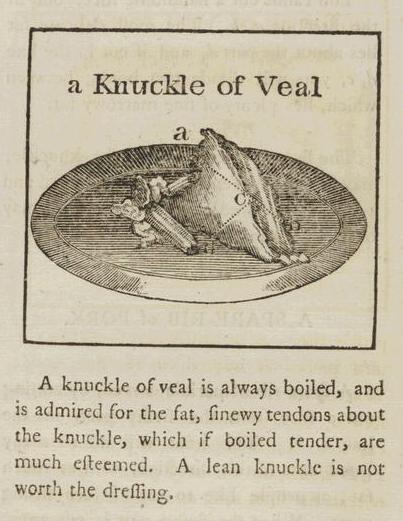
This image comes from The Library of Congress’s digital collection, and sits in John Trusler’s The honours of the table, or, Rules for behaviour during meals : with the whole art of carving, illustrated by a variety of cuts. Together with directions for going to market, and the method of distinguishing good provisions from bad; to which is added a number of hints or concise lessons for the improvement of youth, on all occasions in life. By the author of Principles of politeness, &c. … For the use of young people, London, 1791

My tenderest emotions go toward that veal, for it did not have much time on this earth to use its knuckle. And yet, Mr. Trusler writes of this delicacy with such feeling.

Read Full Post »

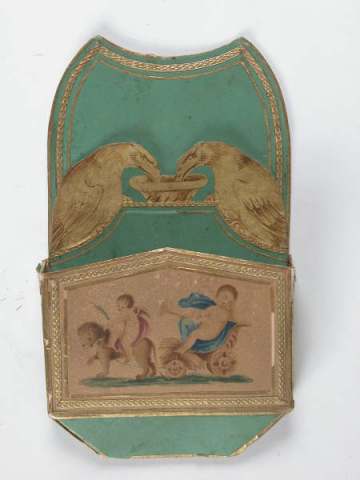
One of a pair of card racks made of decorated cardboard, French, c. 1820, at Attingham. ©National Trust/Claire Reeves

About two weeks ago, The National Trust asked a question about card racks: How were they used? The organization had acquired a number of beautiful examples of 1820’s card racks from Attingham, an estate in Shropshire.  Laurel Ann from Austenprose referred me to the site and to Emile de Bruijn, who had asked the question. I jumped right in, only to discover how little I (or anyone, really) knew about the topic. There was much lively speculation about these beautiful items.

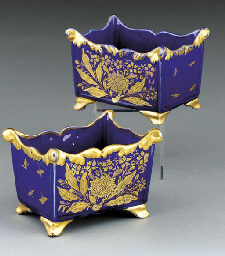
Card racks are small, only large enough to hold visiting cards or small notes. They were designed to be hung somewhere, perhaps on a wall, or over a fireplace mantle. Many were made from cardboard, yet sturdier porcelain examples exist. Their true purpose is now obscure and has faded from memory.

These facts came out as I researched the topic:

It seems that young ladies decorated these card racks from the turn of the 19th c. until at least 1830. Mary Russel Mitford wrote in Our village: sketches of rural character and scenery, Volume 4, 1830:

With regard to accomplishments she knew what was commonly taught in a country school above twenty years ago, and nothing more: played a little, sang a little, talked a little, indifferent French, painted shells; and roses, not particularly like nature, on card-racks and hand screens; danced admirably; and was the best player at battledore, and shuttlecock, hunt the slipper, and blind man’s buff in the county.” p. 131

French emigres made card racks to earn a living:

During the period when the French emigres were so numerous in this country, he (Rudolph Ackermann) was one of the first to relieve their distress by liberal employment. He had seldom less than fifty nobles priests and ladies engaged in manufacturing screens, card racks, flower stands, and other ornaments.” – English coloured books, 1906, Martin Hardie

Rudolph Ackermann kept on hand in his Repository the supplies ladies needed for making hand made items:

No. 3 is a new embossed gold seed-paper. It is used, in a variety of ways, for ladies’ fancy work — in card-racks, hand and fire-screens, chimney ornaments, boxes, watch–stands and cases, &c. It is manufactured by Mr. S. Solomon, and sold, wholesale and retail, at R. Ackermann’s Repository, No., 101, Strand.” – From The Repository of arts, literature, commerce, manufactures, fashions and politics (1809)

And of course I found a Jane Austen connection. In Persuasion, Mrs. Smith makes pin money by creating hand made items:

One might argue that perhaps Nurse Rooke’s patients themselves are practicing charity by buying the thread-cases, pin-cushions, and card-racks. One finds, however, that they do not do so willingly. Nurse Rooke is skilled not only in invalid care, but also in sales. In the case of Mrs. Wallis, Nurse Rooke’s current invalid, Mrs. Smith says, “‘I mean to make my profit of Mrs. Wallis . . . . She has plenty of money, and I intend she shall buy all the high-priced things I have in hand now’” Thread-cases, Pin-cushions, and Card-racks: Women’s Work in the City in Jane Austen’s Persuasion, Susan E. Jones, Persuasions Online

Ironstone ware card rack. Image @Christie's

More speculation and information about card racks can be found in the comment section of the National Trust post. (I have included only my own findings.) It is fascinating to learn how quickly a once popular pasttime has lost its meaning. If anyone can help the staff at The National Trust, do go over and leave a comment.

Read Full Post »

Inquiring readers: Recently I ran across the Contracts Prof Blog, a member of the Blog Professor Blogs network. Professor Franklin G. Snyder kindly granted me permission to reprint in full a second post written by Professor Jeremy Telman of Valparaiso University on February 1, 2010. (See the first post at this link.)  This post discusses the similarities and dissimilarities between a dance partnership and a marriage partnership in Northanger Abbey:

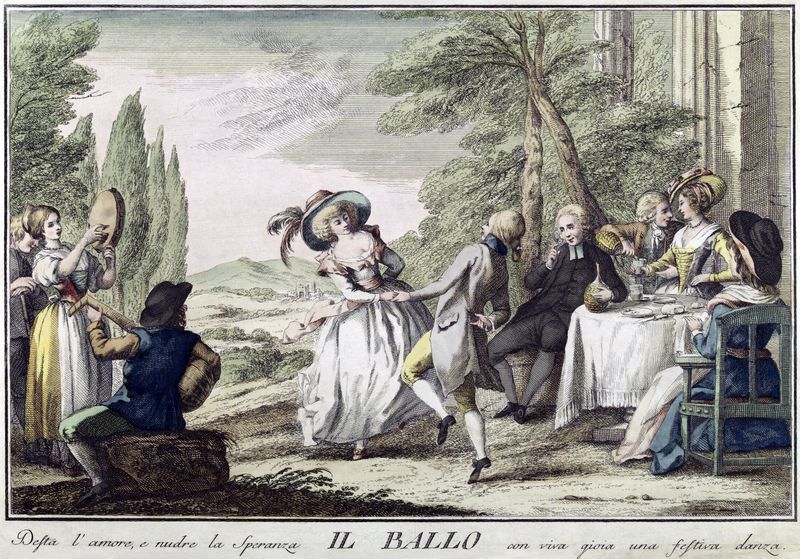
Image @Contracts Prof Blog

Thus the dashing Mr. Tilney addresses Catherine Morland, heroine of Northanger Abbey, upon discovering her in conversation with the odious Mr. Thorpe at the commencement of a dance:

That gentleman would have put me out of patience, had he staid with you half a minute longer. He has no business to withdraw the attention of my partner from me. We have entered into a contract of mutual agreeableness for the space of an evening, and all our agreeableness belongs solely to each other for that time. Nobody can fasten themselves on the notice of one, without injuring the rights of the other. I consider a country-dance as an emblem of marriage. Fidelity and complaisance are the principal duties of both; and those men who do not chuse to dance or marry themselves, have no business with the partners or wives of their neighbours.”

The conversation proceeds on the similarities and dissimilarities between a dance partnership and a marriage partnership. But if Catherine really wanted to impress Mr. Tilney, she would have pointed out that his real complaint sounded in tortious interference rather than in breach of contract.
[Jeremy Telman]

Legal Definition of Tortious/Wrongful Intereference (in Business Relationship)

The theory of the tort or wrong of interference is that the law draws a line beyond which no one may go in intentionally intermeddling with the business affairs of others. So, a systematic effort to induce employees to leave their present employment and take work with another is unlawful when the purpose of such enticement is to cripple or destroy their employer rather than to obtain their skills and services in the legitimate furtherance of one’s own business enterprise.

It also becomes unlawful when the inducement is made through the use of untruthful means, or for the purpose of having the employees commit wrongs such as disclosing the former employer’s trade secrets. – ‘Lectric Law Library Lexicon


Read Full Post »

Inquiring readers,

For those of you who have not yet visited Nancy Mayer’s beautiful website, you are in for a treat. Click here to enter Nancy Mayer, Regency Researcher: A most proper authority on all things Regency. Nancy has been a member of JASNA (Jane Austen Society of North America) for some time. She was a member of a local chapter in 1990-1994, then started up a new chapter in 1996, and has been the regional coordinator for northern Georgia since then. Nancy has been researching Regency England for more than twenty years, and finds Google books a big help. While she is responsible for the text on her website, Susan Newman designed the web pages and added the illustrations. Nancy graciously agreed to answer a few of my questions:

1. How and when did you become interested in Jane Austen’s novels?

This is probably heresy, but I came to Austen and her novels because I wanted to learn more about Regency life. I had heard of Pride and Prejudice and seen the old Lawrence Olivier movie, but hadn’t gone any further with it or the other novels until I became interested in the Regency period. After reading Jane Austen’s letters, and some biographical data on her, I started in on her novels. I joined a discussion group in Atlanta around 1990 and haven’t looked back since. Even after twenty years of discussing the novels there is always something new to be found. I am not one who has memorized the books and don’t read them all over every year, but I usually find some new insight each time I do.

2. Which is your favorite Jane Austen book and/or character, and why?

Persuasion. Anne Elliot is my favorite character. She is more mature than the other heroines and so doesn’t make the mistakes they do. One seldom has to blush for her. I also think Wentworth is more romantic than Darcy, but I wouldn’t want to be a sailor’s wife.

3. You are considered an authority on the topic of Jane Austen and the Regency period, and your breadth of knowledge about the era astounds me. What are some of your favorite topics to research and why?

You flatter me. The more I research the more I discover what I don’t know. I like to research marriage, titles, peerage, the law, and mourning rules. I find property law most confusing, and barely know a VanDyke fringe from a scalloped one.

One can find all sorts of period books on Google books.

I am also interested in Lord Byron who was Jane Austen’s contemporary, His life gives the masculine and aristocratic elements missing in Jane Austen’s life. Though they both were alive from 1809 to 1817, one could sometimes think they lived at different times.

4. For the casual (but avid) Jane Austen reader, what are some sources you would recommend for further reading?

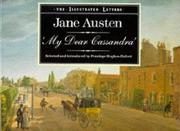
  • My Dear Cassandra:The letters of Jane Austen, Selected and introduced by Penelope Hughes Hallet. Clarkston Potter Publishers or Collins & Brown 1990, ISBN 0-51758312-7
  • Some might want the complete letters edited by Deirdre Le Faye, or the ones edited by John Chapman.
  • The novels published by Oxford have great appendices. Some of the Critical editions of the novels have appendices. One should have a copy of Lover’s Vows in one’s Copy of Mansfield Park. There are annotated versions of the stories with explanations of obscure and not so obscure points, and there are even comic book editions of Pride and Prejudice and Sense and Sensibility. No matter one’s taste or interests, one should be able to find a connection with Jane Austen.
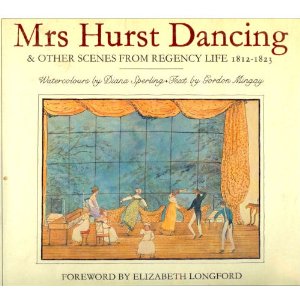
  • Mrs. Hurst Dancing by Diana Sperling. This isn’t about Jane Austen but the illustrations of the Sperling family could be those of the Younger Dashwoods or the Bennets. # ISBN-10: 0575030356 # ISBN-13: 978-0575030350. Some are exceedingly expensive, but there are remaindered copies and second-hand copies at reasonable prices.
  • Jane Austen and Her times by G.E. Mitton, originally published 1905, 2007 Barnes and Noble.
  • Also there are probably fifty books out there covering everything from Jane Austen and Art to Jane Austen and Zombies. I know of book on Jane Austen and Food, Jane Austen and Crime, Jane Austen and fashion, ( and Fashion in the Time of Jane Austen).
  • Those who like quizzes and challenges might like: Jane Austen Challenge by Helen Barton: BartonBooks (June 2009) # ISBN-10: 0952725754 # ISBN-13: 978-0952725756
  • Also, So you Think You Know Jane Austen? By John Sutherland and Deidre le Faye Oxford University press, ISBN 0-19-280440-5

5. Would you like to share a common misconception about the Regency period with our readers, one that is wrongly perpetuated by book sources, websites, and blogs?

A general error I have found is thinking that the marriage laws, the church, and laws of inheritance were the same then as they are now. Many think the regency period was just like today, but in costume and with horses.

Nancy, thank you for sharing your wonderful insights. I hope readers will bookmark your website and visit it often. It’s best feature, as far as I am concerned, is your answers to their specific questions, like a personal researcher.

Read Full Post »

Lady Sarah Jersey

Gentle Readers: In my sidebar I call myself an amateur historian, an apt term as this post will attest. I try to quote from older sources, but this can sometimes backfire. Captain Gronow, for example, whose words I quoted for this post via John Ashton (1890) and Lewis Saul Benjamin (1909), wrote down his memories about the Regency era in 1863, a half century after the events occurred.  Gronow’s memory, unfortunately, was faulty in a few particulars, especially in recalling the names of the patronesses of Almack’s in 1814, and why they turned the Duke of Wellington away. I have placed a number of updates in the original post.

Any individual who has read a novel set in Regency England knows about the assembly rooms at Almack’s and the club’s exclusivity. While Almack’s was notorious for its stale refreshments and thin lemonade in the supper room, the Beau Monde never minded, for the idea was to hob nob with the right people, trot out one’s eligible daughters, and make the best marriages possible given their dowries and family connections. Looks and a personality had very little to do with a young lady’s success in her first season OUT, but a pleasing countenance matched with a fortune would swiftly speed up the unification of great estates or the purchase of a worthy title.

Almack's, Pall Mall, opened in 1765

The Patronesses of Almack’s guarded entry to the club like Valkeries prepared to do battle. No one, not even the Duke of Wellington, would dare to step a foot inside the establishment without a proper voucher, and, indeed, he was turned away once for wearing *gasp* trousers instead of knee breeches. But is this true? Please keep on reading.

This passage from Social England Under the Regency by John Ashton (p 383) is quite telling:
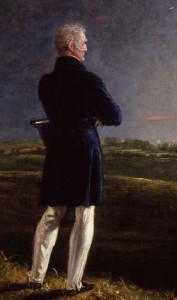
*The Duke of Wellington

Of course the Creme de la creme went to Almack’s, but numberless were the Peris who sighed to enter that Paradise, and could not. Capt. Gronow, writing of 1814, says: “At the present time one can hardly conceive the importance which was attached to getting admission to Almack’s, the seventh heaven of the fashionable world. Of the three hundred officers of the Foot Guards, not more than half a dozen were honoured with vouchers of admission to this exclusive temple of the beau monde, the gates of which were guarded by lady patronesses whose smiles or frowns consigned men and women to happiness or despair. These lady patronesses were the Ladies Castlereagh, Jersey, Cowper, and Sefton; … and the Countess Lieven.” (Note: At that time, two other patronesses included Lady Downshire and Lady Bathurst.)
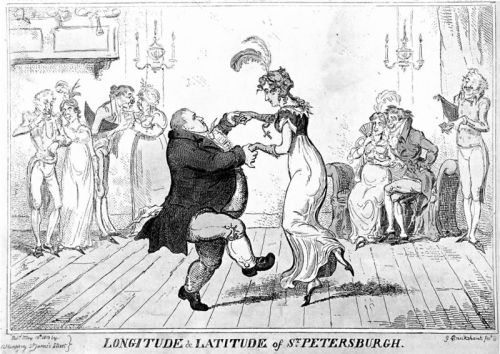
Cruikshank, Longitude (Countess Lieven) and Latitude (in capri-length pantaloons) at Almack's.

In a Newspaper of May 12, 1817, we read – “The rigorous rule of entry established at Almack’s Rooms produced a curious incident at the last Ball – The Marquis and Marchioness of W__r, the Marchioness of T__, Lady Charlotte C__ and her daughter, had all been so imprudent as to come to the rooms without tickets, and though so intimately known to the Lady Managers, and so perfectly unexceptionable, they were politely requested to withdraw, and accordingly they all submitted to the injunction. Again at the beginning of the season of 1819, we find these female tyrants issuing the following ukase: “An order has been issued, we understand, by the Lady Patronesses of Almack’s, to prevent the admission of Gentlemen in Trowsers and Cossacks to the balls on Wednesdays, at the same time allowing an exception to those Gentlemen who may be knock kneed or otherwise deformed.” But the male sex were equal to the occasion as we find in the following lines: –

TO THE LADY PATRONESSES OF ALMACK’S

Tired of our trousers are ye grown?

But since to them your anger reaches,

Is it because tis so well known

You always love to wear the breeches.
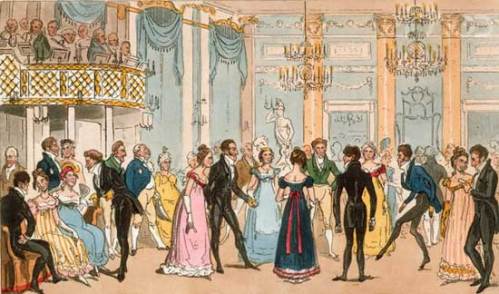
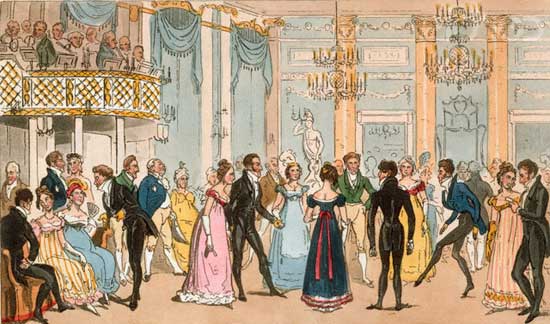
*Image from Highest Life in London: Tom and Jerry Sporting a Toe among the Corinthians at Almack's in the West, by I. Robert and George Cruikshank, 1821

Update:  Regency Researcher, Nancy Mayer, was kind enough to contact me and set a few facts straight. I have placed her explanations in the update/update below. In the above image, the young bucks are wearing dark suits with dark, close-fitted trousers (Beau Brummel’s influence), while the older men are still in buff-colored knee breeches.

If anyone knows the true story about the Duke and his trousers, please contact me. One conjecture is that Wellington was turned away for arriving after midnight. (Read more about the Patronesses’ edict on trousers in this link to The Beaux of the Regency, Vol. 1.)

Update/Update: Pantaloons, which fitted snug to the leg, came in two lengths: capri and long. A strap under the foot kept long pantaloons in place. (The image below shows the strap.) Thus, the men in the image above were wearing tight pantaloons, for trousers at the time were slightly looser and would have sported gussets that extended the fabric low over the shoe.
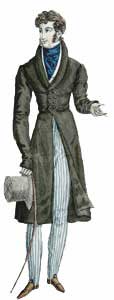
Pantaloons with straps, 1821. Image @Republic of Pemberley

In 1814, the date Gronow recollected, trousers (below) were acceptable for day wear only. Pantaloons were worn as evening wear.

Nancy Mayer, a Regency researcher who provided much of the updated information, wrote in a second note: “Luttrell’s poem on Almack’s was published around 1819. According to the verse about the “trowsers”, I think trousers didn’t become an issue until after 1817, at least. Sometimes it is hard to tell if the men are wearing trousers or the longer pantaloons with the strap under the foot. Most of the Lords in the picture of the Trial of Queen Caroline 1820 are wearing trousers or the long pantaloons.”
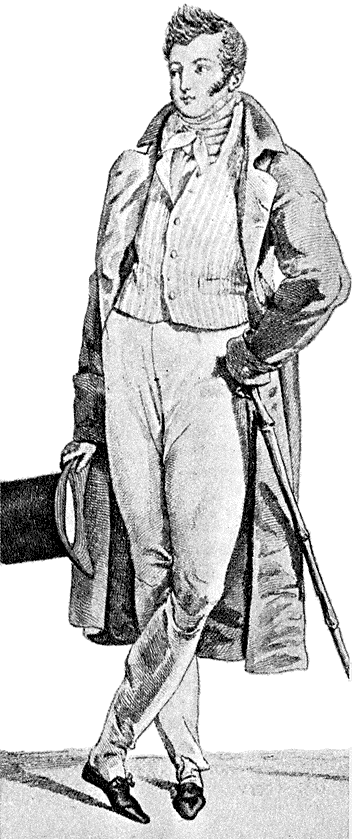
 

Trouser with gussets, day wear, 1813

More on the topic:

*Images: Carolyn McDowell

Read Full Post »
« Newer Posts - Older Posts »