Feeds:
Posts
Comments

Archive for the ‘Regency style’ Category

The riding habit, was first introduced in the 17th century. They were tailored by men in the manner of men’s dress: a fitted jacket worn over a long skirt, often worn with a masculine hat. Samuel Pepys, ever helpful with observations of his time, wrote in 1666 of seeing the Queen’s ladies of honor “dressed in their riding garbs, with coats and doublets and deep skirts, just for all the world like men, and buttoned their doublets up to the breast, with periwigs and with hats; so that, only for a long petticoat dragging under the men’s coats, nobody could take them for women in any point whatever — which was an odd sight, and a sight which did not please me.” – Candice Hern

In the 18th and through most of the 19th centuries, women’s riding habits were generally made by tailors and constructed like men’s wear. They were usually buttoned left over right, like a man’s coat. Other women’s fashions were made by dress makers and mantua makers. Masculine touches onwomen’s riding habits included mariner’s cuffs and fabrics and trims as seen on naval uniforms.  These riding habits were functional, but in the late 1700s they became fashionable dress as well, and were worn for informal day wear for traveling, visiting, or walking.

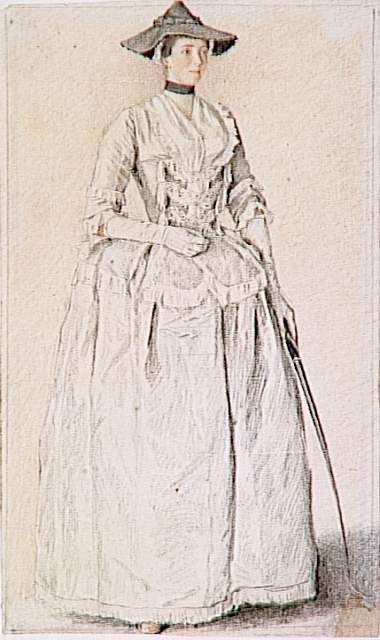
Madame Gaspard de Péleran by Jean-Etienne Liotard, 1738

The materials worn for riding from the mid-seventeenth to the early twentieth centuries were easily distinguished from the silks, muslins, and velvets of fashionable evening dress. Equestrian activities required sturdy and often weatherproof fabrics such as woolen broadcloth, camlet (a silk and wool or hair mixture), melton wool, and gabardine for colder weather and linen or cotton twill for summer or the tropics. In the eighteenth and early nineteenth centuries, habits were frequently adorned with gold, silver, or later woolen braiding, often imitating the frog-ging on Hussar or other military uniforms. – Equestrian costume

Equestrian portrait of Marie-Louise-Elisabeth d'Orléans (The Duchess of Berry in hunting-costume in 1710)

The appearance of a lady on horseback in a fashionable London riding-habit, and tricked out in the newest guise with patches, is amusingly described by Steele. The lady is supposed to be riding through the town of Kettering in Northamptonshire, in the month of July, 1724. ” Yesterday astrange and surprising creature was seen to pass through our town on horseback. It had the face of a young woman, stuck full of patches ; a perriwig which hung down to its waist; a hat cock’d with the smartness of a young officer; a huge bunch of ribbons fastened behind its left shoulder; a shirt laid in large pleights on the breasts and tied close at the neck and wrists, which, with a vest of white satteen, trimmed with black, had much the resemblance of a shroud.

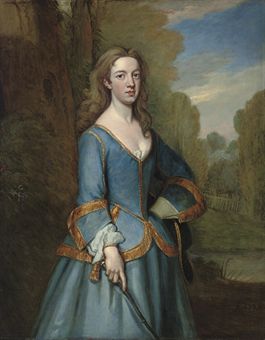
Portrait of Lucy Pelham-Holles, Countess of Lincoln (d. 1736), three-quarter-length, in riding habit, in a landscape

Our whole town was soon alarmed with this strange appearance, and various are still the opinions what it really was. The old people, who were the most couragious generally, went pretty near to it with their spectacles on to view it more distinctly; the younger sort kept it at an awful distance. Some were of opinion that it was a highwayman in disguise, and accordingly were for seizing it; others took it for a nun; but by a certain arch leer it had with its eyes I dare engage it had not a bit of nun’s flesh about it. However, by its pale complexion and shroud-like dress, most of my neighbours at last concluded it to be a ghost, and so took to their heels, and left me (who am no great believer in these things) almost alone with it in the road. I had now an opportunity, during the time it was drinking a glass of Rhenish wine and sugar at the Saracen’s Head Inn, to survey it well, and thereupon concluding it to be an Hermaphrodite, I enquired of the man who seemed to have the keeping of it, if he intended to show it in our town, and at what inn? For you must know, Sir, that I have a mighty curiosity to see one of those creatures all over. But the man with an angry countenance told me: That what I took for an Hermaphrodite was only a young lady, and that the sort of dress she was in was commonly worn for a riding-habit by the ladies of fashion at London. But as neither I nor my neighbours can believe it possible for folks upon no ill design to disguise themselves in such a manner… – A history of English dress from the Saxon period to the present day, Volume 2 (Google eBook)R. Bentley, 1893

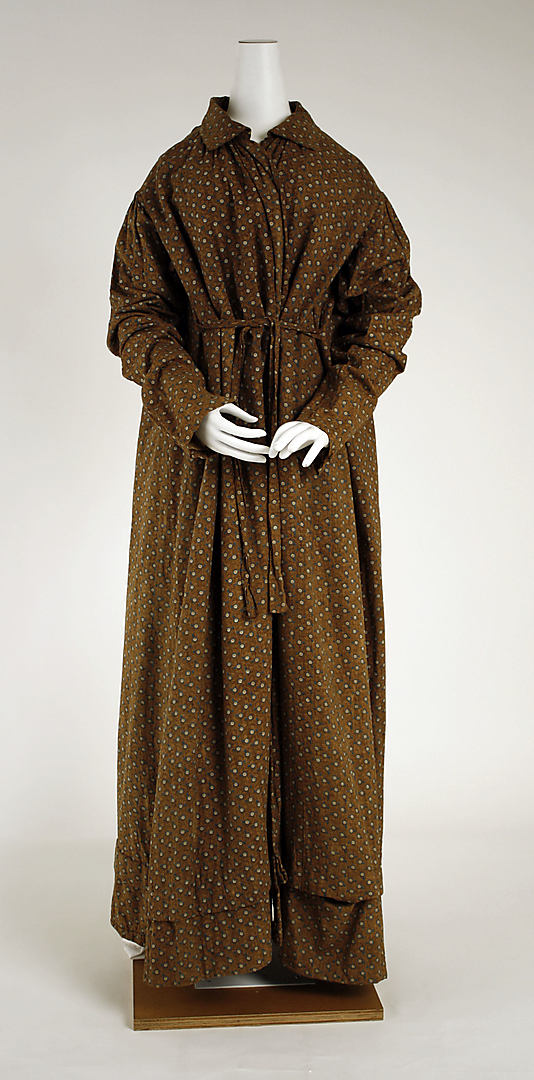
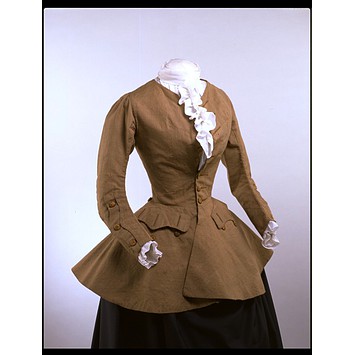
Women's riding Coat, 1750-59. Image V&A museum

Women’s riding outfits, known as ‘riding habits’, of the 18th century adapted elements of men’s dress. This jacket of the 1750s is styled after a man’s coat, although it has been modified with a waist seam to fit over stays and a wide petticoat. A narrow straight collar attached at the back neck and buttoning in front added protection on chilly rides. The fine tailoring and plain aspect of this jacket is typical of 18th century women’s riding habits. – Victoria & Albert Museum.

More Links

Read Full Post »

During the second half of the 18th century and early 19th century Axminster carpets were the favorite carpets of the rich. They are frequently mentioned in descriptions of interiors in Regency novels, especially Georgette Heyer’s. Famous architects/designers like Robert Adam would supply the patterns based on Roman floor mosaics or coffered ceilings. Both George III and George IV patronized the factory, commissioning carpets for various Royal residences.

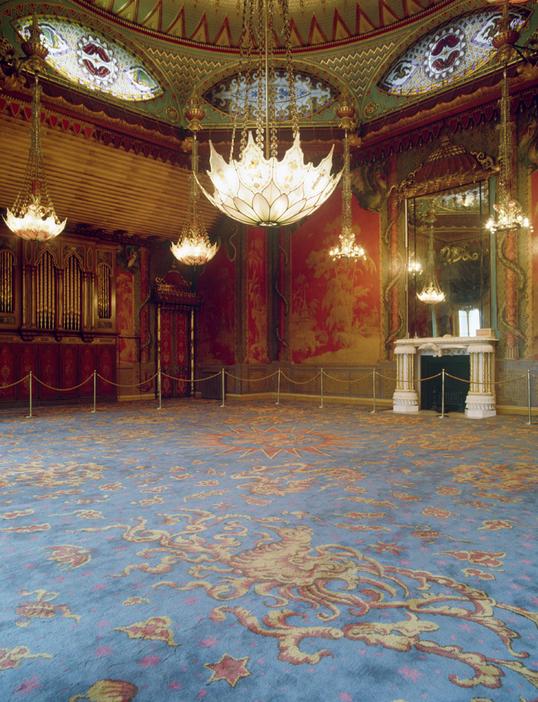
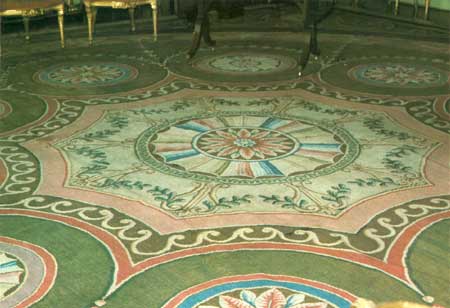
Reproduction of the Axminster carpet in the music room, Brighton Pavilion. Image @Craigie Stockwell

The history of the Axminster carpet started in 1755, when Thomas Whitty opened a carpet manufacturing company in the town of Axminster, in the county of Devon. The development of carpet manufacture in England during this period was enabled by laws which were designed to promote locally produced textiles, out of concern that foreign textiles were dominating the market, particularly by the French Savonnerie carpets. These early Axminster rugs were hand knotted, and they quickly became the undisputed choice for wealthy aristocracy. Antique Axminster carpets and rugs grace the floors of Chatsworth and Brighton Pavillion to name a few and were bought by George III and Queen Charlotte who visited the factory in the 18th Century. – Doris Lelsie Brau, English Axminster and Wilton

The Brighton Pavilion music room carpet (first image) has quite a remarkable story. The original carpet was made by Thomas Whitty and his daughters circa 1820 for the Prince Regent. Her Majesty, Queen Victoria, apparently disliked the brash blue color of this  ‘decadent’ carpet and had it removed, bleached into a light beige colour,  and cut up to be used in a guest bedroom at Buckingham Palace. The reproduction of this carpet is outlined in  Craigie Stockwell’s Historic Reproduction. (Scroll down the page to find the details of how a copy of the original carpet was made!)

The story of how Thomas Whitty (1713-1792), cloth manufacturer of Axminster in Devonshire, came to make his first carpet is well known. As an old man, he wrote an account for his son describing how, in 1755, in an attempt to provide a better income to support his growing family, he spied on the carpet factory of French émigrés in Fulham and returned to Axminster where “I immediately began to prepare a loom and materials for making a Carpet, and on MIDSUMMER’S DAY 1755, a memorable day for my family, I began the first carpet I ever made, taking my children and their Aunt Betty Harvey to overlook and assist them, for my first workers”. – Early Axminster Carpets

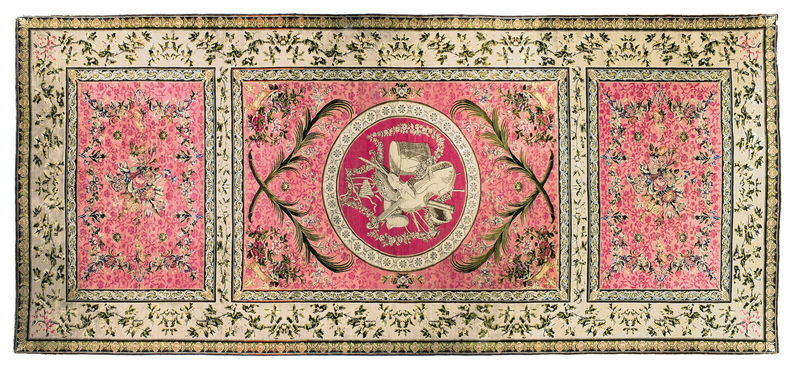
George III Axminster Carpet, England, by Thomas Whitty, late 18th century approximately 1323 by 572cm; 43ft. 5in. by 18ft. 9in. Photo: Sotheby's

This enormous late 18th century Axminster carpet was made by Whitty for the Music Room at Powderham Castle, 1798. Image @Eloge de l'Art par Alain Truong

Axminster carpets are distinctive because of their bright colors and intricate designs. They are traditionally made from wool.

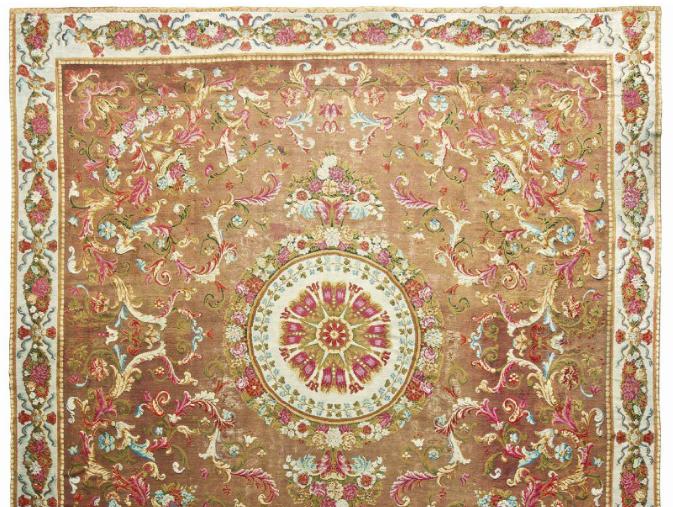
Large Axminster carpet, late 18th century. From Cowdray Park and Dunecht House, At Cowdray Park, West Sussex. Image @Christie's.

 Samuel Whitty, in an advertising broadsheet, described the advantages of Axminster carpets thus: “They are made in one piece, to any size or pattern and of any shape however irregular. They are capable of the most beautiful designs in Flowers, Fruit, Armorial Bearings, Grotesques or any other….and their texture is extremely durable”. – – Early Axminster Carpets

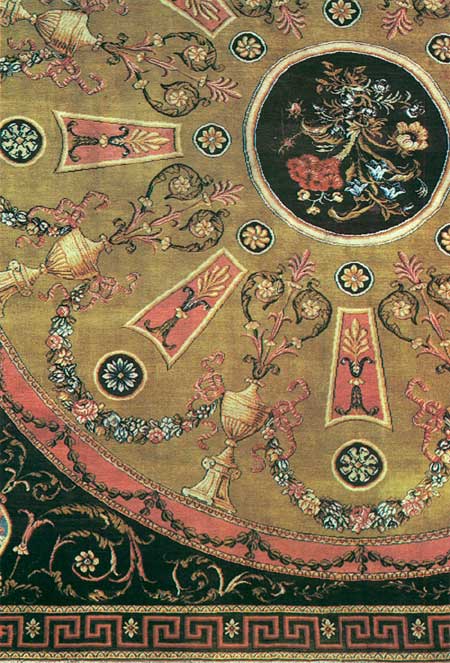
Detail of the Axminster carpet in the music room of Harewood House, c. 1791.

At Harewood House, for example, where Thomas Whitty made carpets for rooms remodeled by Robert Adam in the 1790’s, the neoclassical ideal of the whole becomes magnificently apparent. In the Music Room a flat plaster ceiling decorated with low-relief arabesques and geometric motifs incorporates small round classical paintings by Angelica Kauffmann; these medallions are exactly reflected in the Axminster carpet below, and the lines of the carpet mirror the lines of the light, airy plasterwork. – The Most Splendid Carpet, Chapter 3

The early 19th century English Axminster carpet in the video above has a sand field with a golden leaf roundel containing four fish around a naturalistic lion head within a border of finely-drawn mythological animals, palmettes and vinery. It goes for $425,000

Axminster carpet in the Blue Drawing Room, Dumfries House

This carpet [above] is one of the earliest datable examples to have survived from the formative years at Axminster and was commissioned for the Drawing Room at Dumfries House. In a marvellously early example of thrift, it was shipped up separately from another, identical carpet, which the surviving invoice tells us was part of a Buy One – Get One Half Price deal! At £69 for the first one, this represents a saving of a large sum of money for the day. This is, of course, explained by the fact that they were both worked to the same design as a pair, so that the cartoon only need to be paid for once.

The carpet signifies the growing 18th century interest in exotic botany, as it includes a flowering cactus. The carpet dates from before Whitty’s collaboration with Robert Adam on the design of carpets. However, it is a wonderful example of a colourful, animated and sumptuous looking rococo piece of design. – The Story of the Blue Drawing Room: Dumfries House

The colors, designs,  and shapes of Axminster carpets were quite versatile.  Examples included floral carpets of the 1750s and 1760, and architect-designed carpets by Robert Adam for Harewood and Saltram, by Lewis Wyatt for the Library at Tatton Park, and by Robert Jones and Frederick Crace for the Brighton Pavilion. Axminster carpets were shaped and could be circular,  semi-circular, or woven with shaped ends to fit semi-circular and square alcoves and apses.  (Early Axminster carpets)

Detail of an Axminster carpet, c 1791. Image @Metropolitan Museum of Art

Axminster dominated the English carpet market until 1835, when Samuel Rampson Whitty, grandson of the founder, declared bankruptcy following a disastrous fire which destroyed the weaving looms. With competition from Europe and the rise of high-quality but cheaper, machine-made carpets, it was too expensive to try to revive the works.- Risky Regencies

The fire was disastrous on many levels, destroying records and carpet designs:

The fire destroyed not only buildings, looms and stock but also most of the written records, including the working drawings for carpets. Whereas the Woodward Grosvenor Company of Kidderminster still have an extensive archive of early cartoons, such cartoons are virtually non-existent for early Axminster carpets.  – Early Axminster Carpets

The Axminister carpet industry was revived in the 20th century. According to the Axminster website, “a carpet manufacturer called Harry Dutfield was on a train where he met a vicar from the West Country who told him that carpets had not been made in Axminster for a while due to a disastrous fire that had destroyed the factory. The germ of an idea was born and in 1937 the decision was taken to relaunch carpet manufacturing in the town of Axminster. This was the renaissance of ‘Axminsters from Axminster’.” Today the name serves as a generic term for all machine-made carpets with pile similar to velvet or chenille, with almost all pile yarn appearing on the surface of the carpet.

Modern Axminster carpet in the Casino de Deauville, France.

When one sees patterned carpet in a public place [today], such as a casino, hotel or restaurant, it is usually an Axminster.  Axminsters are more economical, for they use less yarn in their construction.  The pile is created by a V-shaped tuft of wool that is trapped in place between the warp and weft. This weaving method also allows for the use of many more colors, as it is not limited like the Wilton/Brussels construction.   For this reason, there were many carpets with huge sprays of flowers and Arabesques that could now be produced cheaply, and were available to the middle class, including outlets such as Sears and Roebuck. – Old House Web

More on the topic:

Read Full Post »

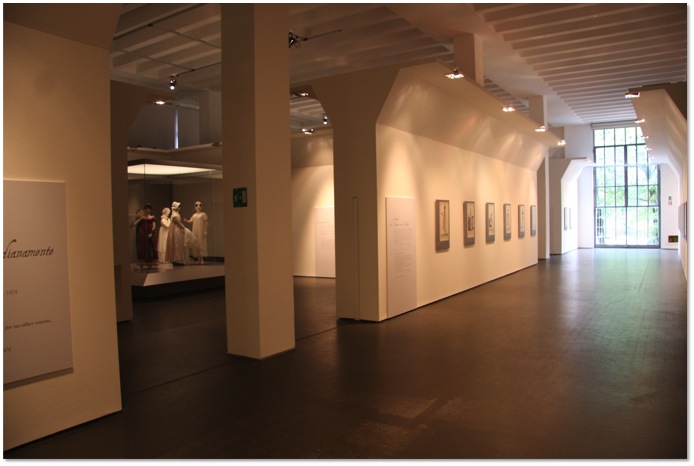
The lush fashion exhibition, Napoleon and the Empire of Fashion, closed in Milan in September. On the website, readers are still allowed to choose where they would like it to travel next!

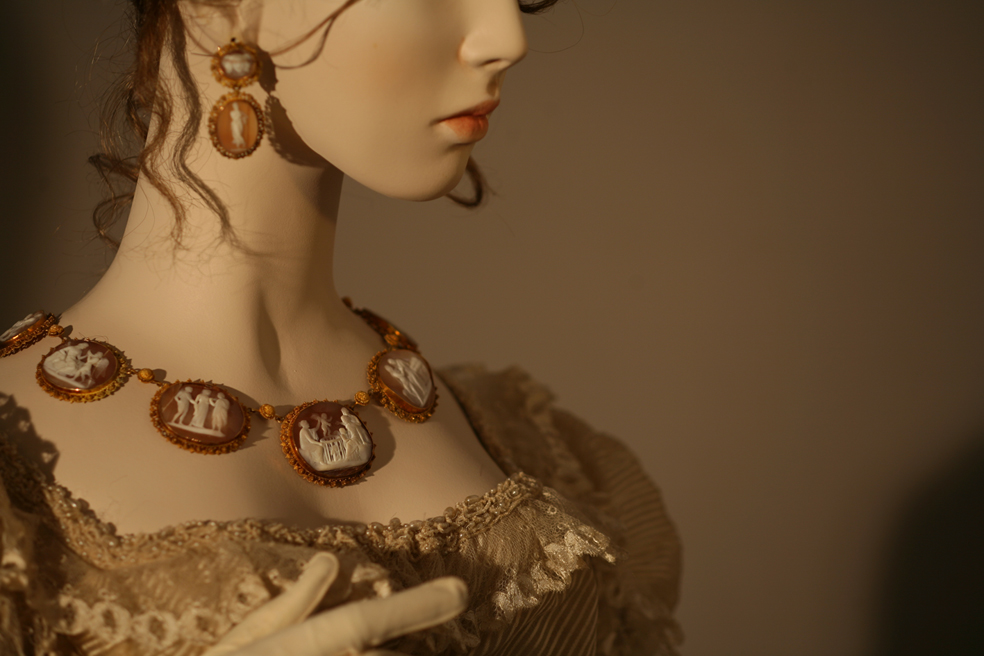
The beautiful cameo necklace and earrings complete this evening ensemble.

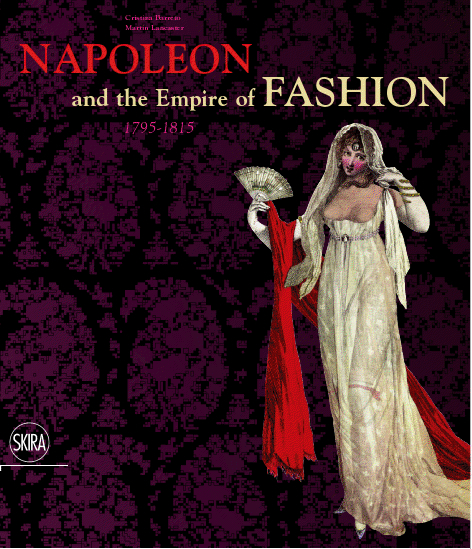
The catalogue, written by Cristina Barreto and Martin Lancaster, is sumptuous and filled with color photographs. The clothes are compared to fashion illustrations of the day. One cannot get a better education of French fashion during this period than this book. This video and the link to the slide show below it show what we have missed by not traveling to Milan last spring and summer.

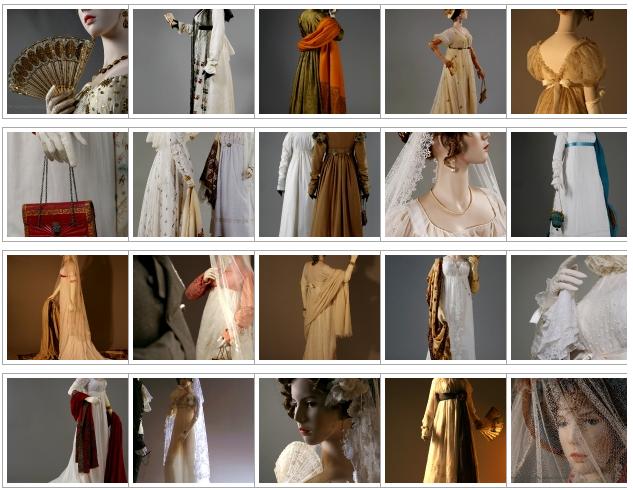
Napoleon’s desire to protect the garment industry in France after the French Revolution resulted in an explosion of designs that propelled the French fashion industry to the forefront, making it hugely influential. By encouraging women to purchase many gowns (so that they would not be seen in the same dress too often), France became synonymous with fashion. See the slide show of images from the exhibition by clicking on this link.

The many French fashions shown from the 1795-1810 years

Vote where you would like the exhibit to travel next. If the exhibit comes to New York, I hope to see the same mannequins. Aren’t they simply superb?

Napoleon and the Empire of Fashion in Milan

Order the catalog at Amazon: It ships within 1-3 months.

Read Full Post »

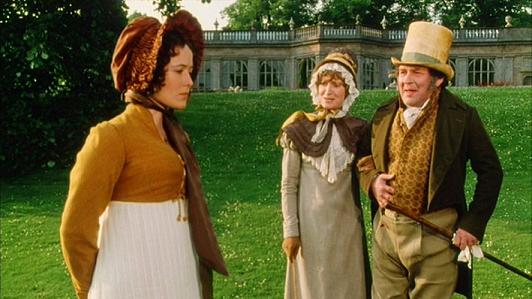
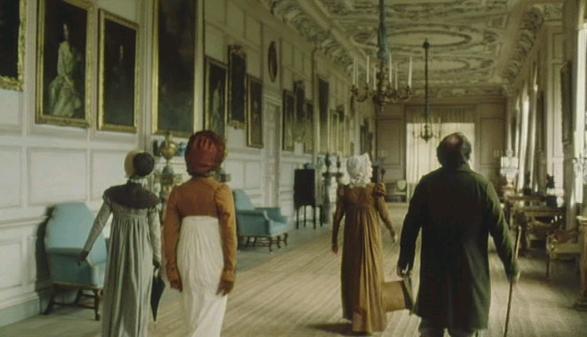
One of the most pivotal decisions in Pride and Prejudice was when Elizabeth Bennet agreed to visit Pemberley’s gardens and grounds with the Gardiners, only to suddenly encounter Mr. Darcy, who was not slated to return until the next day.

Such a visit to grand estates by the well-heeled and more common folk like Elizabeth and her aunt and uncle were quite common in the 18th century. They would have purchased an inexpensive guide book at a local inn or town, and read information about the paintings and objects inside the great houses, and a description of the gardens and their rustic buildings and ornaments.

Prospect of Stowe House by Benton Seeley

Stowe in particular was a destination point for visitors. Its magnificent gardens and grounds were a model and inspiration for other gardens of the Romantic era, which echoed the movement’s reverence for nature and aesthetic ideals. The blog of the current Duke of Buckingham and Chandos contains this passage:

“The house and gardens at Stowe, my family seat, were tourist attractions from around 1724, when my ancestor Lord Cobham set out the gardens. People came to visit the gardens and house, sometimes invited, often not. Topographical notes and poems were written. And in 1744 the first full guidebook to the house and grounds was published by Benton Seeley, a writing master in Buckingham. The guidebooks continued for a further 70 years and Seeley went on to become a printer and publisher, founding a business that wound up only in 1978.” – Duke of Buckingham and Chandos 

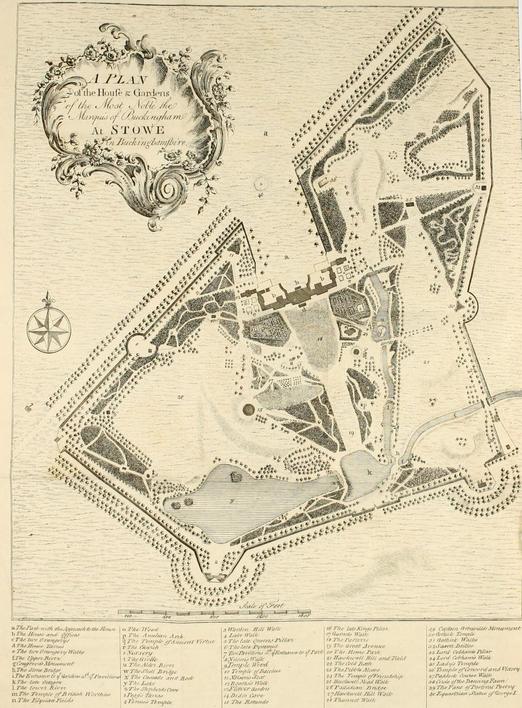
Seeley's plan of the house and gardens at Stowe.

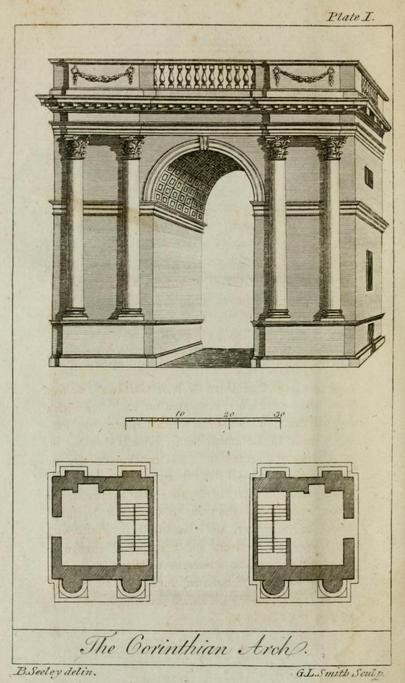
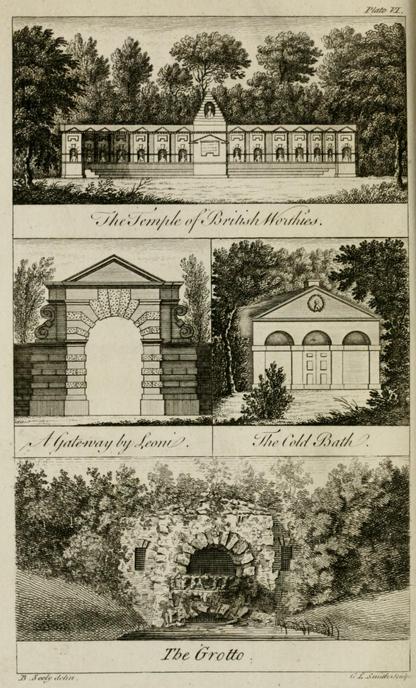
Benton Seeley’s guidebook, Stowe: A Description of the Magnificent House and Gardens of The Right Honourable Richard Grenville Temple, Earl Temple… Embellished with a General Plan of the Gardens, and also a separate Plan of each Building, with Perspective Views of the same, was published in the same year that Elizabeth Montague described Stowe’s gardens as “beyond description, it gives the best idea of Paradise that can be.” Visitors came away from viewing Stowe’s natural gardens inspired to implement changes to their own grounds. Seeley’s guidebook helped to spread Stowe’s influence throughout the 18th century as the model for the ideal English garden. (Today the original guidebook sells for close to $2,000.)

Thomas Jefferson owned at least two of Seeley’s guidebooks. In fact, Stowe’s reputation as a gardening attraction had spread beyond the British Isles:

“When well-heeled Americans traveled to England in the late eighteenth century, they often sought out famous gardens to inspire their own designs at home. As Benton Seeley’s Stowe: A Description of the Magnificent House and Gardens shows, the gardens at Stowe were particularly large and ornate, featuring temples, pavilions, and statues strewn about the grounds. Thomas Jefferson and John Adams visited Stowe together in 1786 in what Abigail Adams called their “journey into the country.”- Better Homes and Gardens, Stanford University

Corinthian Arch

Seeley’s Guide Book became historically significant. It went through seventeen editions between 1744 and 1797, continually undergoing improvements and revisions. The book’s influence was such that it helped to make the Stowe gardens among the most publicized and copied of the English landscape model. However, Seeley’s was not the only guidebook written for the famed Stowe gardens. In 1732 Lord Cobham’s nephew Gilbert West wrote a lengthy poem The Gardens of the Right Honourable Richard Viscount Cobham that is actually a guide to the gardens in verse form. Charles Bridgeman commissioned 15 engravings of the gardens from Jacques Rigaud, and these were published in 1739 (Wikipedia), five years before Seeley’s guide.

The Stowe gardens and grounds were extensive, offering planned vistas along a winding path, parterres, canals, large swaths of meadows, places for isolation and retreat, rustic buildings, and an emphasis on natural grandeur over formal symmetry. The 4th Baronet, Viscount Cobham, who married a rich brewery heiress, implemented the garden changes at Stowe in 1711. By 1724, the gardens rested on 24 acres and required the labor of 30 men. Garden maintenance cost the family 827 pounds in 1749-1750. Multiply that amount by 50, and you gain a quick idea of the cost in today’s terms. This sum represented almost all the spare money Lord Cobham could afford on the house and grounds.

The grotto was originally designed by William Kent in the late 1730s as a symmetrical, freestanding structure decorated with flints, colored glass, and shells. Soon covered over with earth, it was then described as a “romantic retirement.” By the 1780s, it was more deeply buried, resurfaced with tufa, and planted with vines and conifers for a cavernous effect.- Romantic Gardens: Nature, Art, and Landscape Design, 2010, The Morgan Library Museum

In “A fine house richly furnished: pemberley and the visiting of country houses,” Stephen Clarke, a London lawyer and architectural historian discusses the kind of information a guidebook owner could expect. A New Description of Blenheim by Mayor, 1811, offered the following General Information in its preface:

“BLENHEIM may be seen every afternoon, from three till five o’Clock, except on Sundays and public Days. On Fair days at Woodstock, likewise, it can be seen only by particular permission.

COMPANY who arrive in the morning may take the ride of the Park, or the walk of the Gardens, before dinner, and after that visit the Palace.

The CHINA GALLERY, PARK, and GARDENS, will, on proper application, be shewn at any hour of the day, except during the time of Divine Service on Sundays.”

In 1776, the Wilton visitors book showed 2, 324 visitors in the last year.

The housekeeper guides Elizabeth and the Gardiners through Pemberley's interior

As discussed on this blog in another post, The Housekeeper as a Guide to a Great Country Estate, housekeepers and other servants stood to make a great deal of extra money from tourists.

“The rapacity of housekeepers-and, in the larger houses, of the other staff–was a common complaint. At Blenheim during his tour of 1810-1811, Louis Simond was required to pay the porter at the gate, the woman showing the china collection, the woman showing the theatre, the woman showing the pleasure grounds, the gardener showing the park, and the upper servant showing the house–at a total cost of 19s. (qtd. in Ousby 81). There are similar complaints of Woburn, Chatsworth, and other great houses. Horace Walpole wryly remarked that he should have married his own housekeeper, who had grown rich on showing Strawberry Hill, as the only way of recouping some of his expense on the house (Walpole Correspondence 33, 411) –

At most houses, the traveller would send in his name to the porter or housekeeper to request access–at Hagley in 1800 Mrs. Lybbe Powys, (5) a perceptive visitor of country houses, noted that “we sent in our names for leave to walk round Lord Curzon’s [actually Lord Lyttelton’s] grounds, and he desired we would go into any part of it we chose, without being attended by his gardener” (Lybbe Powys 339). Elizabeth and the Gardiners were of course accompanied by the gardener in the park at Pemberley, as was normal. – A fine house richly furnished: pemberley and the visiting of country houses, Stephen Clarke

In the YouTube video below, one can get a sense of Stowe’s grounds and gardens in the first 3 ½ minutes. Enjoy the tour!

More on the topic:

Read Full Post »

Child's hand-embroidered dress, c 1810. Image @Vintage Textile

I love visiting Vintage Textile, one of the best, most descriptive vintage fashion sites on the Internet. The Regency era fashions are superb. Take this embroidered child’s dress, which was once white. It was made for a child around one or two years of age. The dress, which came from a New England estate, is long, like a christening dress, which suggests that the child would have been carried in it. The fabric is made of a lightweight cotton broadcloth, and the Persian-style Tree of Life embroidery design is made with wool floss. For more images and information about the dress or to purchase it, click here. 

Detail of sleeve with Van Dyke points and embroidery. Images@Vintage Textile

More on the topic:

Read Full Post »

« Newer Posts - Older Posts »