Feeds:
Posts
Comments

Archive for the ‘Regency World’ Category

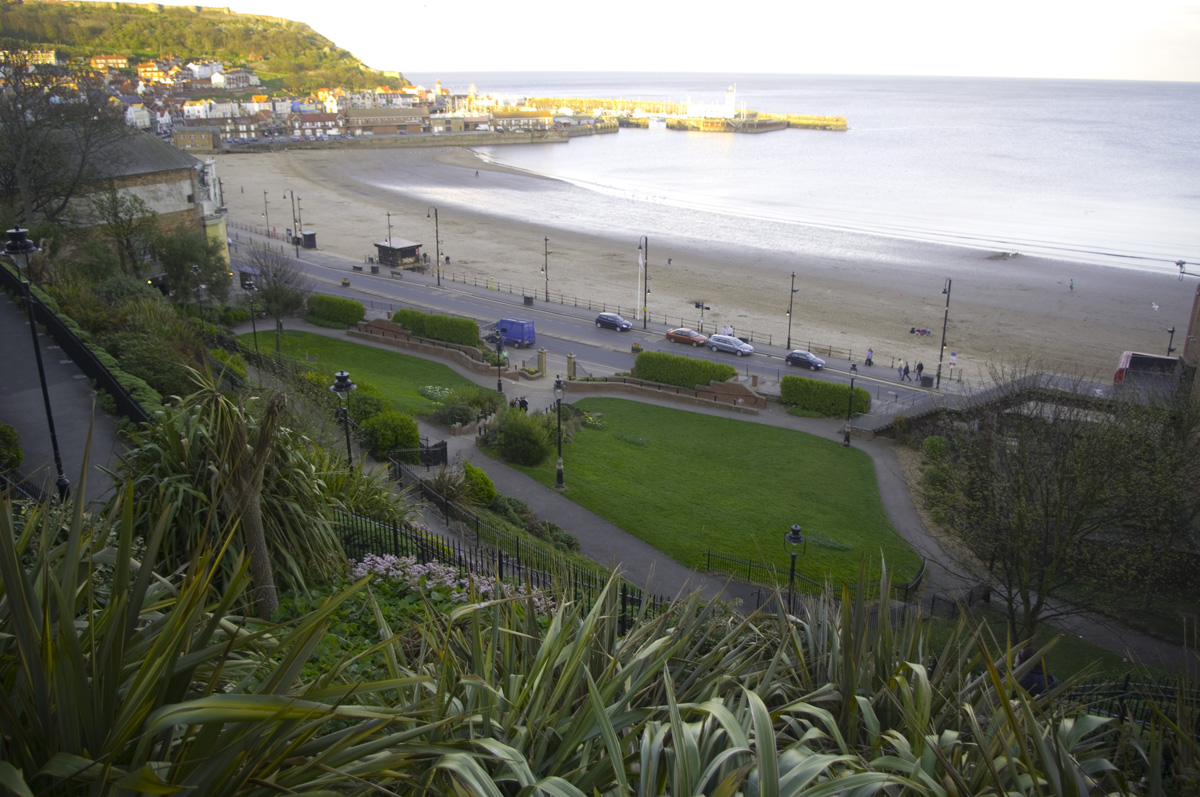
Scarborough Beach today. Image @Tony Grant

Post contributed by Tony Grant. All rights reserved, Tony Grant.

At the start of our Easter Holidays, on the 11th April, Marilyn, Abigail and myself drove up to Scarborough to spend a few days. Scarborough is on the beautiful rugged Yorkshire coast in the North East of England. We wanted to visit somewhere different and take a refreshing break from South London. We spent three days up there and drove on the North Yorkshire Moors, had a day in York, visited the fishing port of Whitby and went to Castle Howard, a few miles east of York, for one whole afternoon. Many of you will know Castle Howard as the wonderful, rich pile, used in the film and TV adaptations of Brideshead Revisited.
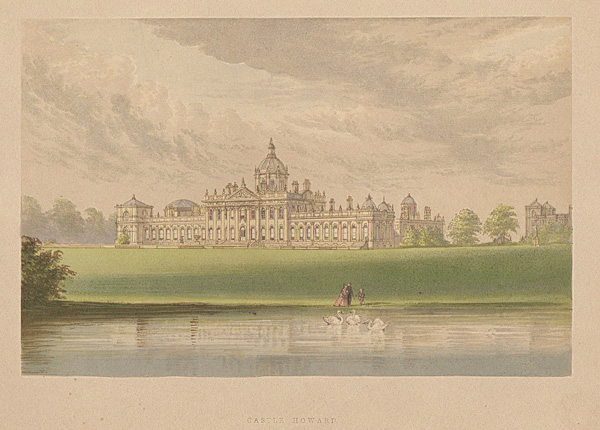
Castle Howard

Castle Howard has been home to the Howard family for over three hundred years. It is an 18th century residence set within over a thousand acres of landscaped gardens and vistas.

Castle Howard. Image @Tony Grant

Marilyn, Abigail and myself took a tour of this wonderful place. One of the things that has always interested me and I have often wondered about, is what books and authors an 18th century gentlemen has on his shelves. Reading Claire Tomlin’s biography of Jane Austen, it is her father’s library, consisting of hundreds of books that was part of Jane’s partly self lead education at Steventon. A short while ago we visited Sir John Soane’s house in Holburn. He had an extensive library. I asked one of the assistants in his house if I could take pictures. I was told politely that I could not.
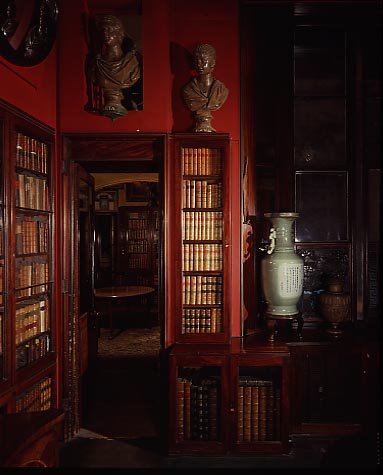
Library at the Sir John Soane's house. Image @Sir John Soane's House Museum

I had a discussion about the books on John Soanes shelves with the assistant but he did not know much about them. I looked at them, stared at them closely, extremely closely and tried very hard to remember titles, authors and general themes that ran throughout the library. My memory is not that good. I remember large leather bound atlases, the works of Shakespeare, books containing prints and sketches of ruins from classical Greece and Rome, philosophies, histories and there were many religious tracts. There seemed to be a variety of dictionaries. It is interesting to remember that Dr Johnson had many rivals before his Oxford English Dictionary became the definitive one.
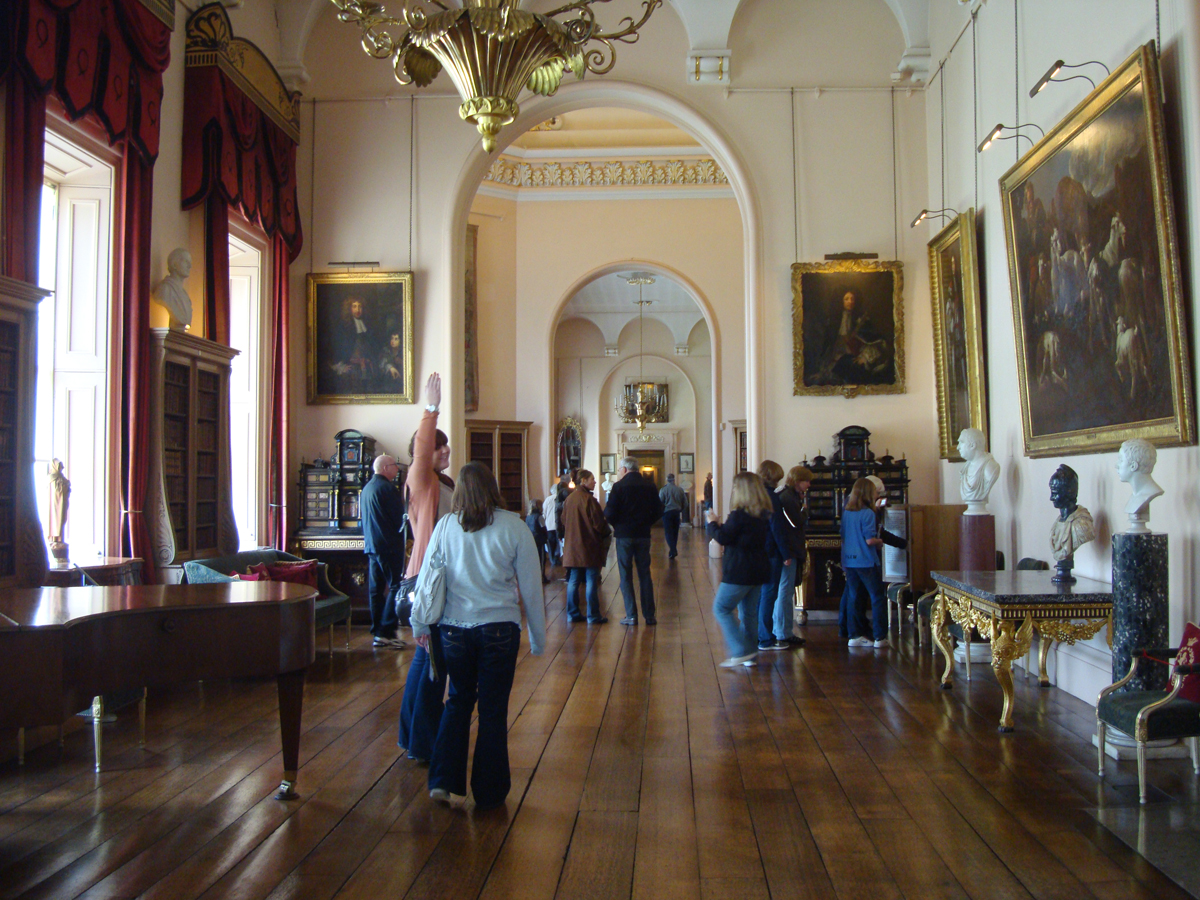
The Library at Castle Howard sits along a grand hallway. Image @Tony Grant

Anyway, getting back to Brideshead, sorry, Castle Howard. There is a magnificent library there. Shelves and shelves of beautiful volumes with gold-tooled titles and gold leaf flower and leaf patterns adorning, the light tan, dark brown and black leather bound volumes.
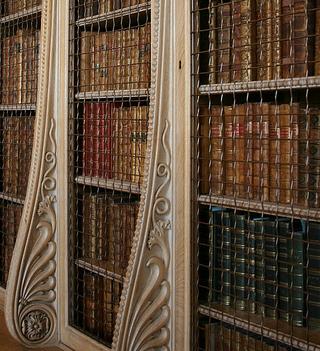
Detail of the book shelves in the library at Castle Howard

I asked, timorously, of a smiling gentle looking lady standing to one side of the library, the gallery assistant, if I could take photographs of the books expecting a negative reply. “Yes,” she said enthusiastically, “go ahead, and are there any particular books you would like to see?” I couldn’t believe my luck. She continued,“We have many first editions by great authors here.” I did ask about Jane Austen first editions. She thought there might be some somewhere amongst the novels section. We looked, but could only find Swift, Dryden, Byron, Congreve and others. We couldn’t find Jane. These first editions were there, on shelves, within touching distance. AAAAAGH!!!!
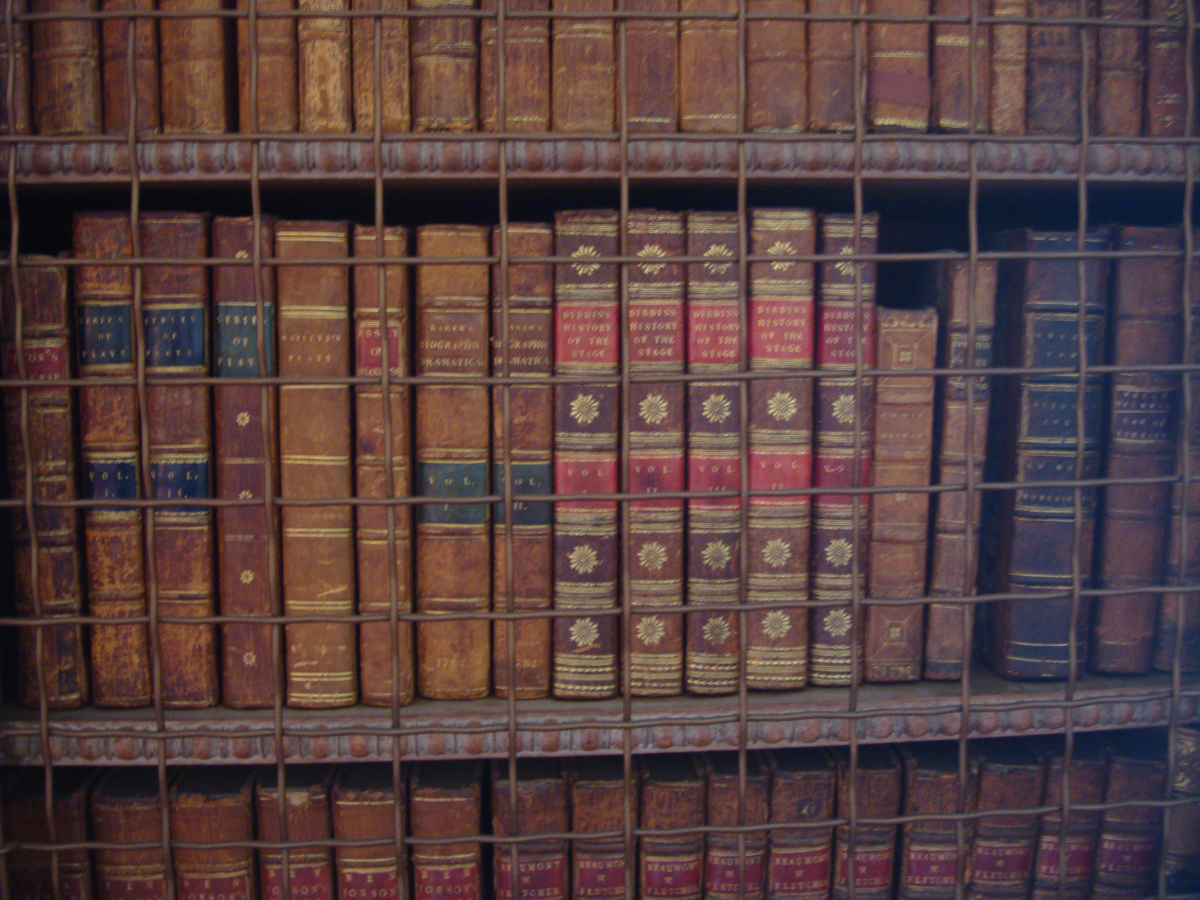
Brown Leather and gold-tooled lettering

One thing I discovered as we went around Castle Howard was that the gallery assistants were not your run of the mill gallery assistants, these people know a lot about the contents of the rooms. They had really studied what they watched over. An example was when we walked into a bedroom and on the wall was a portrait of Henry VIII and it was a Hans Holbein but the same room had Gainsboroughs and Lawrences, on the walls too. No, not copies, the real thing. Rooms throughout the Castle were full of original masterpieces. I couldn’t believe it. A lady there when I asked her, gave me a great art historians analysis of one particular Gainsborough. She, never mind the painting, was the real deal.
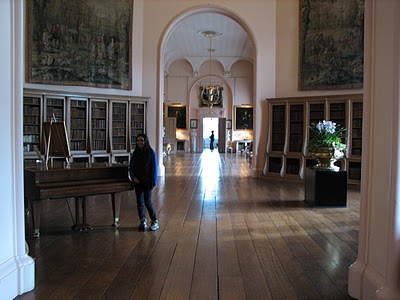
Library at Castle Howard. Image @A Life Less ORdinaRY

So back to the books, where I started. I was allowed to take photographs of the books. I must have looked odd. Other visitors looked through the windows at the magnificent views around the grounds, or studied beautiful gleaming vases and glanced at magnificent paintings and there was I, getting close and personal with brown dusty looking things crammed on shelves. I am a constant embarrassment to my family. Ha! Ha!
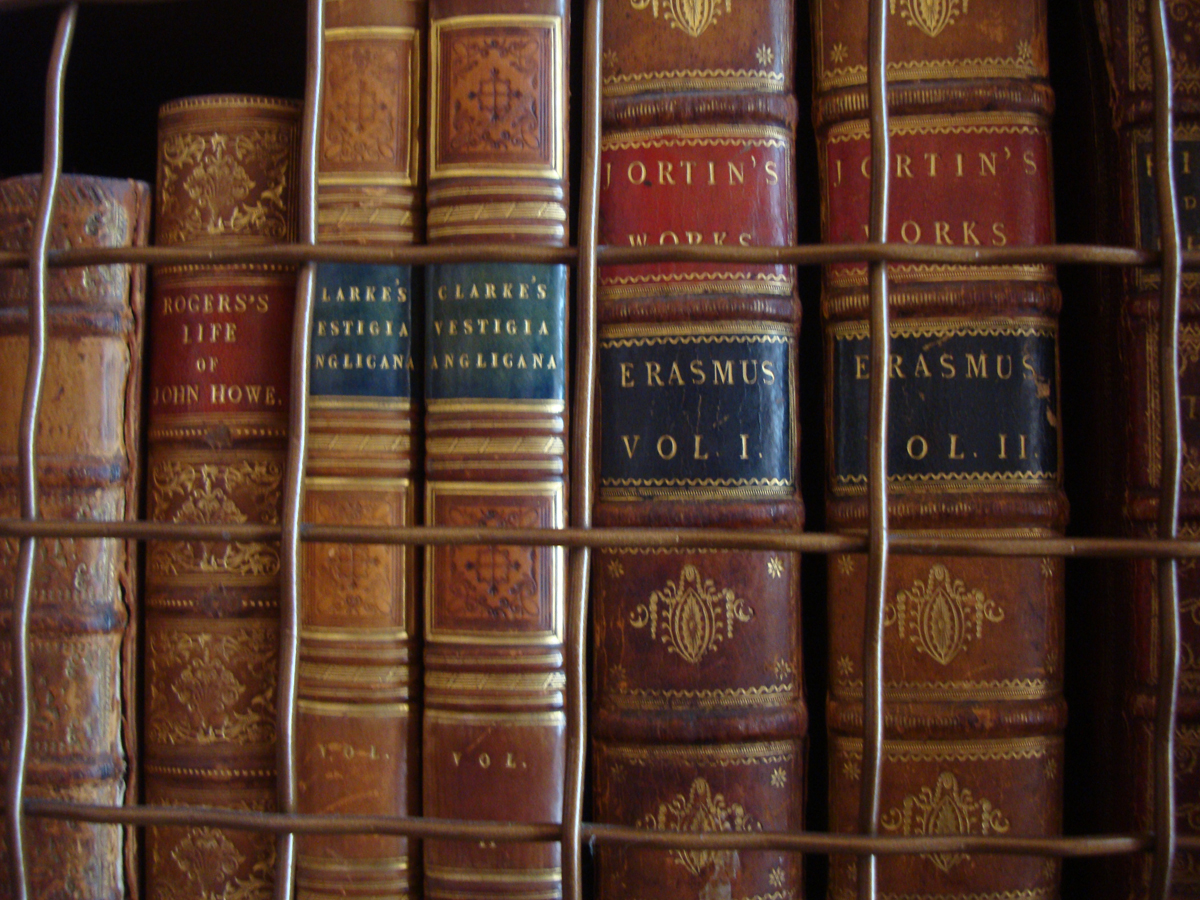
Books on the shelves at the library. Image @Tony Grant

Some of the books I came across were by authors I had never heard of, for instance, “Col. Napiers Peninsula Wars.” I discovered later that,Sir Charles James Napier was born in August 1782 and died in August 1853. He was a general in the British Army and became the British Army’s Commander in Chief in India. Napier commanded the 50th (Queen’s Own) Regiment of Foot during the Peninsular War in Iberia against Napoleon Bonaparte.
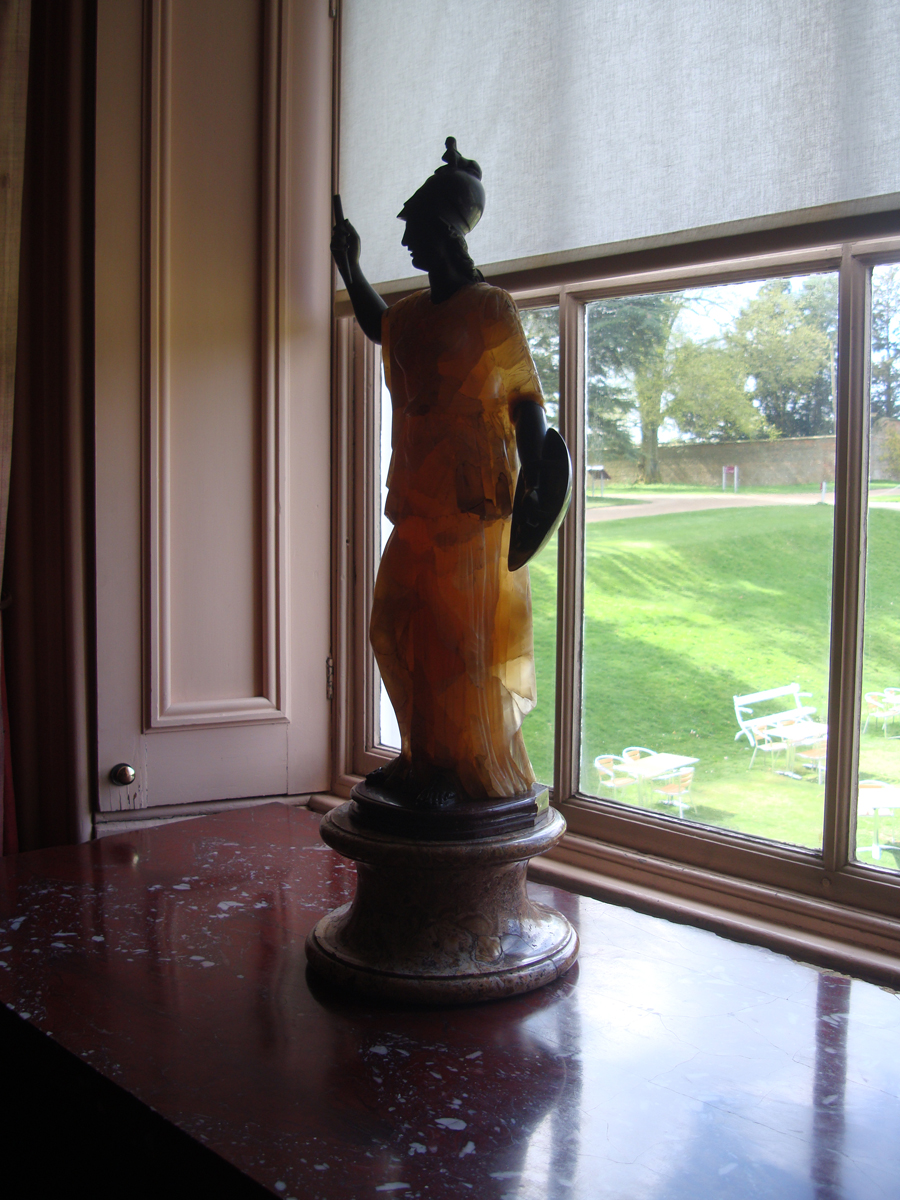
A luminous Greek statuette in the library. Image @Tony Grant

General Napier put down several insurgencies in India during his reign as Commander-in-Chief in India. Some of his rather perceptive insights into dealing with insurgencies included:

The best way to quiet a country is a good thrashing, followed by great kindness afterwards. Even the wildest chaps are thus tamed.
which may help explain why he felt rebellions should be suppressed with such brutality.”

He also once said that:

the human mind is never better disposed to gratitude and attachment than when softened by fear.”
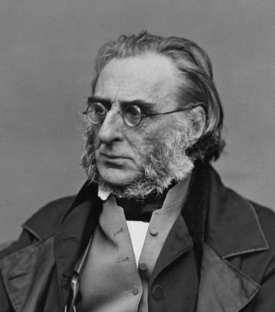
Charles James Napier

An example of this idea in practice was after the Battle of Miani, where most of the Mirs surrendered. One leader held back and was told by Napier:

Come here instantly. Come here at once and make your submission, or I will in a week tear you from the midst of your village and hang you.”

He also mused that:

“so perverse is mankind that every nationality prefers to be misgoverned by its own people than to be well ruled by another”

I would have loved to have met him. Wouldn’t you? Imagine him at your dinner party.
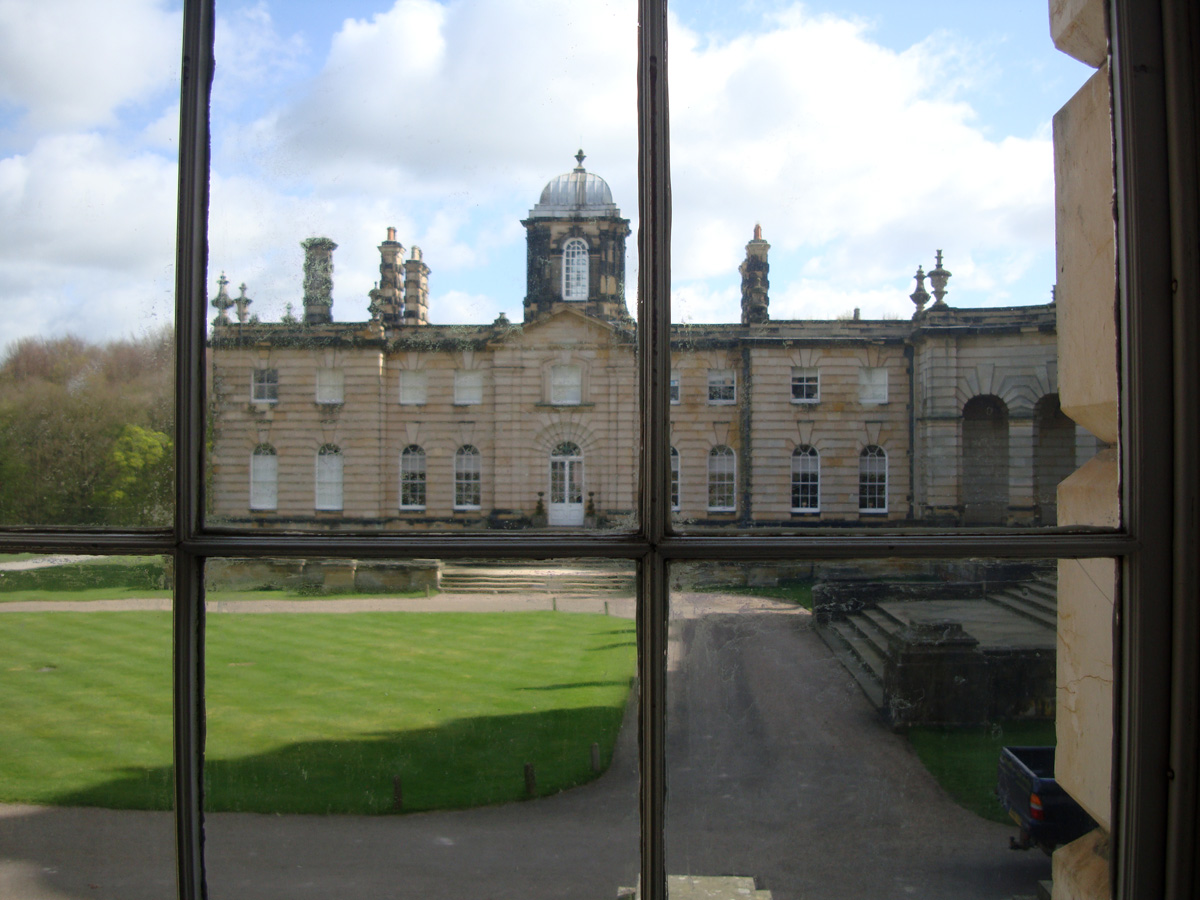
Castle Howard. Image @Tony Grant

Other books on the shelves included: Davies’s Micelanie, J. Orton’s Works ERASMUS, Murphy’s Works, alongside some more tried and tested volumes that have lasted the travails of time: Ben Johnson’s Work, Defoes’ History of The Stage, Drydens Plays, and Smollett’s England, to give you a flavour and taste of the contents of this library. I tried to search for information on some of the more obscure authors and as you can tell I found a bit about Colonel Napier. Many of the authors I could find nothing about, but an interesting discovery I made was about Murphy and his works. He was an Irish playwright. Here are some play titles to slake your thirst and satiate your appetite.

The Upholsterer (1758)
The Way to Keep Him (1760),
The Old Maid (1761)
Three Weeks After Marriage (1764)
Know Your Own Mind (1777)

Arthur Murphy wrote about eighteen plays in this vein. I wonder about The Upholsterer though. I’m sure it was a very “comfortable” play. You would probably fall asleep on your deeply “upholstered” seat during it, mind.

HOW can you write a play about upholstery???

He also wrote biographies of David Garrick, Samuel Johnson and Henry Fielding.
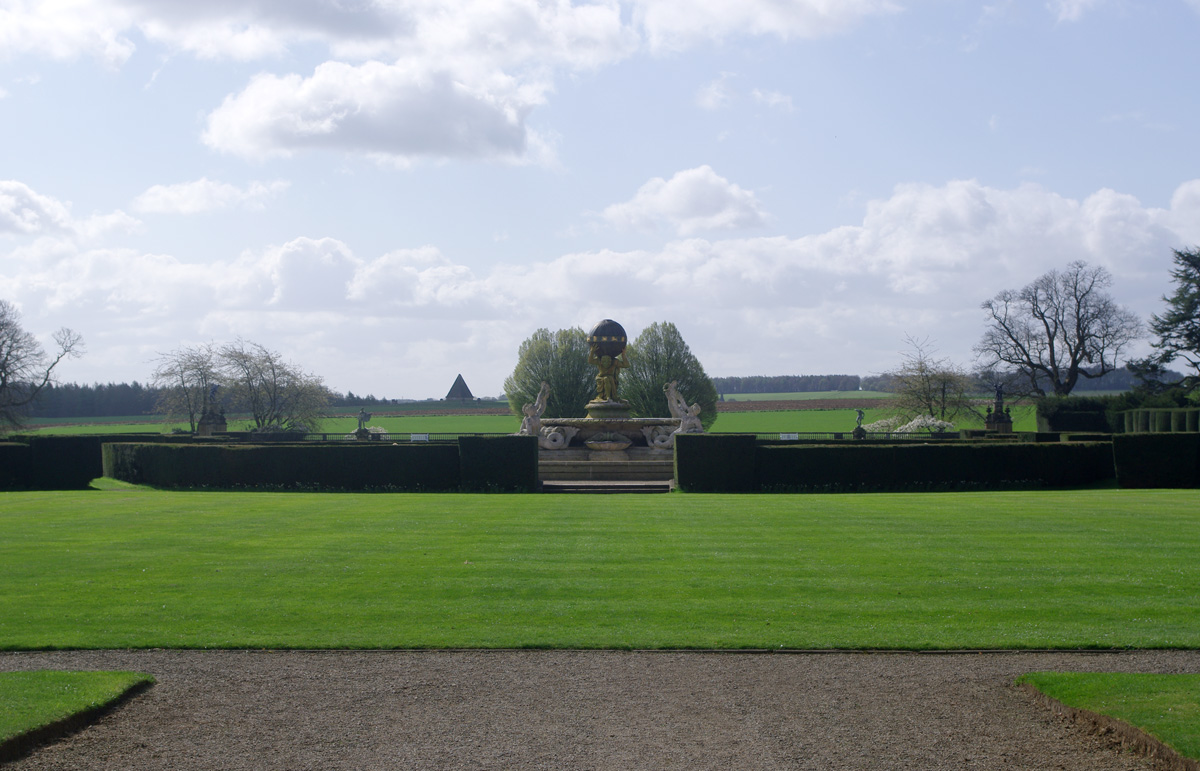
Globe Fountain on Castle Howard Grounds. Image @Tony Grant

With my experiences in two 18th century gentlemen’s libraries, Sir John Soanes house in Holburn, and the vast and airy gallery of the Howard family at Castle Howard, amongst their fine varied brown leather covers and illuminated gold leaf lettering, what sort of conclusion can I come to? After a swift and furtive voyeuristic delving into their interests and source of deep thought and emotions? What can I say?

The book titles have a familiar ring to them. If you spend an afternoon in a Waterstones [bookstore] it too has many of the same book divisions and sections as those two 18th century libraries. Nowadays the novel provides the larger section in Waterstones but at Holburn and Castle Howard they provide a rather smaller section. History, biography, philosophy, poetry, plays and dramas, atlases and travel accounts are there in varied abundance. Dictionaries are very prevalent in the 18th century library and dictionarys produced by different people using different criteria. In the 18th century there was a great interest in words, their meaning and origins. There was a hunt going on for words in the 18th century and need for conformity. There was the need for one language and one set of words accepted by all. You can only speculate the economic consequences. Local dialects were all very well within a locality. There was a sort of race to be the best amongst word gatherers, dictionary makers. Of course, we know now that Dr Johnson won. Hurray!!
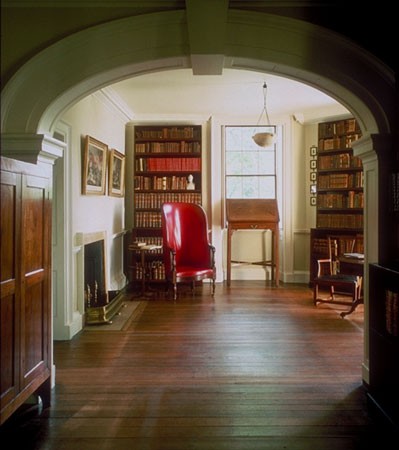
In 1815, Thomas Jefferson sold 6,487 volumes of his vast collection of books from his library at Monticello to the U.S. Library of Congress.

Many of these interests shown in the books displayed can be connected to interests in the classical world, which is not so much of a concern these days for the majority, unless you do a degree or are doing the Romans at school, or are watching a BBC documentary about Delphi or the Olympics.

I imagine plays by Dryden or Arthur Murphy were in great demand, because people didn’t have television and radio then to entertain them. We can see people’s interest in owning written drama scripts, reflected in Jane Austen’s own family’s exuberant enacting of plays and the writing of them at their home in Steventon. Jane uses the play, Lover’s Vows, as home entertainment in Mansfield Park, with many meanings and personal interactions connected to it.

So there are differences in the use and purpose of books between now and the 18th century, but the subjects covered and the systems of organisation were recognisable. Melvil Dewey (1851-1931) didn’t create his system until later, but the general system used for organisation was grouped in familiar ways. How we think about the world was being formed. Dewey and some others made it far more sophisticated. The organisation of books has had a big impact on the way we think and learn.

So there you are. We are not the only generation with a thirst for reading. The next time you visit a country house or stately home, get in amongst the musty smelling, brown leathery things. They will speak volumes to you.

Read Full Post »

Ladies shoes, 1810

In a previous post, I discussed how ladies slippers and boots were so delicately made that they could not withstand much wear and tear. In fact, a lady would not venture to walk outside the house in rainy weather and would be confined inside, whether she was in the city or country. Jane Austen described a rainy day in Mansfield Park:

… to poor Miss Crawford, who had just been contemplating the dismal rain in a very desponding state of mind, sighing over the ruin of all her plan of exercise for that morning, and of every chance of seeing a single creature beyond themselves for the next twenty-four hours; the sound of a little bustle at the front door, and the sight of Miss Price dripping with wet in the vestibule, was delightful. The value of an event on a wet day in the country, was most forcibly brought before her.”

1801, Two ladies in morning dresses, Nicholas Heideloff, Gallery of Fashion

In the country a lady would not soil her delicate kid slippers on grass or muddy lanes, but would walk along gravel paths in the shrubbery, as shown in the Heideloff image above. Elizabeth Bennet, who walked the three miles to Netherfield Park, muddying her petticoats in the process, would have worn sturdier shoes, such as those worn by the women in the watercolor below.

Studies of female figures with children, James Ward

Female fashionable attire in the eighteenth century was very ill fitted for country life, which is so largely spent out of doors. Indeed, it was not fitted for out door wear at all. No fashionable woman was properly shod in the first place, for the coloured shoes, which, as has been stated, all ladies wore, were not adapted for vigorous exercise, or damp weather, with their high heels and very open tops. Those were the kind of shoes worn for walking in London. Country life in shoes of that sort would mean endless expense. The wonder is that town bred women did not insist upon the shoemakers providing something more fitted for the dirty, uneven pathways. But, then, walking was not a daily exercise as it is now. Foot gear has undergone much reformation in the present century, in spite of the persistence of high heels…”

Knife Sharpener, W.H. Pyne. This traveling craftsman would have worn sturdy old boots like William Conway.

“… A notable itinerant trader of the middle of the eighteenth century, known to all Londoners, was William Conway of Bethnal Green, who made a living by selling and exchanging metal spoons. As he walked twenty five miles a day, Sundays excepted, his shoes were the most important articles of his attire, and these he made out of the uppers of old boots. A pair of shoes lasted him six weeks. He was an odd figure, with his long spindle legs encased in tight knee breeches, short coat, high hat, and bag slung over his shoulder.” – A history of English dress from the Saxon period to the present day, Volume 1, By Georgiana Hill , 1893, p 181

"Cash", Rowlandson, 1800. Note the dark leather slippers worn by the maid, and the sturdy buckled shoes by her elderly swain.

Read Full Post »

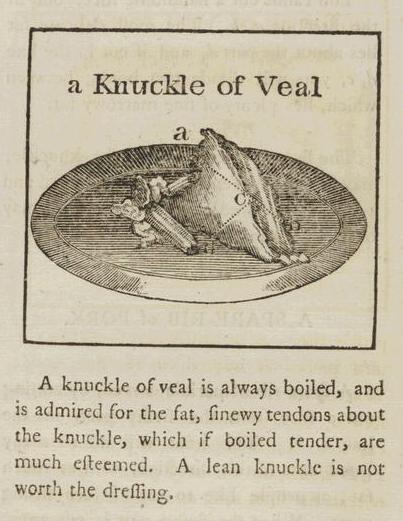
This image comes from The Library of Congress’s digital collection, and sits in John Trusler’s The honours of the table, or, Rules for behaviour during meals : with the whole art of carving, illustrated by a variety of cuts. Together with directions for going to market, and the method of distinguishing good provisions from bad; to which is added a number of hints or concise lessons for the improvement of youth, on all occasions in life. By the author of Principles of politeness, &c. … For the use of young people, London, 1791

My tenderest emotions go toward that veal, for it did not have much time on this earth to use its knuckle. And yet, Mr. Trusler writes of this delicacy with such feeling.

Read Full Post »

Inquiring Readers, Carolyn McDowall of The Culture Concept Circle has graciously allowed me to recreate Part One of her Two Part series. Find Part Two of Vanity Fair, but where is Mr Darcy? at this link.

Vanity and pride are different things, though the words are often used synonymously…pride relates more to our opinion of ourselves, vanity to what we would have others think of us” … Jane Austen, Pride and Prejudice, 1811

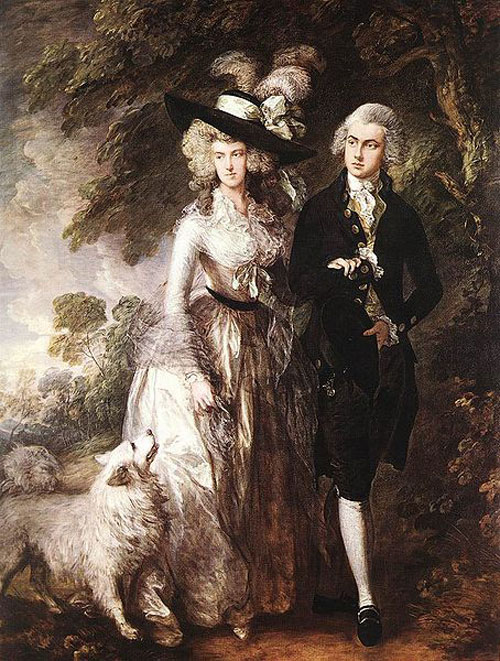
William Hallett and Elizabeth Stephen by Thomas Gainsborough, courtesy National Gallery at London

By the close of the eighteenth century archaeological investigations in Europe and Egypt were revealing more and more about the ‘antique’ past. The expansion of knowledge about antiquity revealed that ancient artists and writers had been accustomed to free expression in their work, with religion and honour paramount to any society’s daily existence. This revelation began changing the social and moral values and concerns of the many English, American and European societies who were all now ardently in search of truth.

Author Jane Austen lived in one of the most eventful, colourful and turbulent epochs in the history of England and Europe. The scenes of this extraordinary era were well recorded by many talented painters and sculptors of the day. In England this included the renowned painter Thomas Gainsborough.

In 1785, when Jane Austen was just 10 years old, he captured William Hallett and Elizabeth Stephen stepping out in style together for a morning walk. They were an elegant young couple, both 21 years of age and bound by their social status and the rules it imposed. They were due to be married in the summer of 1785.

They epitomize the stylish quality of the people who starred in Jane’s novels. He is discreetly dashing in a well fitting black velvet riding coat, an aspect of a gentleman’s costume that reflected his desire to be seen as ‘informal’, approachable, someone in touch with the political scene and social set of his day. He has the quiet confidence of a compleat gentleman.

She looks lovely in her softly floating silk dress, a smart black band accentuating her small waist and balancing perfectly with the simple black straw hat tied with a ribbon and feathers and placed at a jaunty modern angle on her very bouffant hair.

Strolling happily through a woodland landscape with an adoring dog at the lady’s heel they both appear full of hope in love and eagerly looking forward to a July wedding and a happy life together into the new millennium.

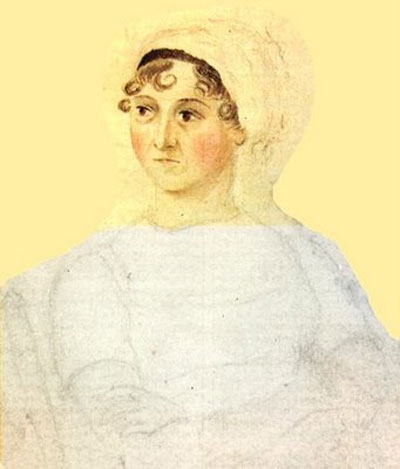
Cassandra's portrait of her sister, Jane Austen. National Portrait Gallery

One of Jane Austen’s peers, renowned Scottish author of romantic novels Sir Walter Scott (1771 – 1832) said of Jane (1775-1817) that he believed the secret of her success was that she had chosen to write about ‘ordinary people doing things that happen in every day life’.Born at Steventon, Hampshire on 16th December 1775. The seventh child and second daughter of a scholar-clergyman and rector of the small country parishes of Steventon and Deane, Jane Austen’s family were members of the wealthy merchant class on her father’s side and aristocrats on her mother’s side. She was brought up in a country rectory and was, from contemporary descriptions, without pretension, her demeanour more ‘in a homely rather than grand manner’. Another way of saying that she was plain.

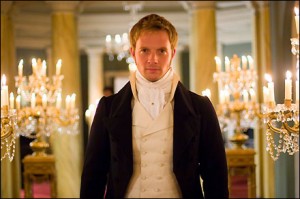
Captain Wentworth (Rupert Penry-Jones)

She and her family enjoyed amateur dramatics in the barn, playing charades, literary readings and musical evenings. While her older brothers hunted and shot game her mother industriously managed a small herd of cows, a dairy and, as a woman of sensibility and of some station in life, looked to the wellbeing of the local poor. Her father, as a rector, was regarded as a ‘gentleman’. He was an affable, courteous man welcomed by all the local landed gentry, and their well off tenants, as was her brother Edward, who just happened to be the heir to his cousin Mr. Thomas Knight’s estates. This meant Jane was able to move comfortably out and about in society and become a respectable observer in the luxurious world of the leisured classes.

A Georgian Rectory

It seems that her family more than likely fell into a category of middling people, a term coined by literary wit and social commentator Horace Walpole on his return from the continent in 1741 “I have before discovered that there was nowhere but in England the distinction of being middling people. I perceive now that there is peculiar to us middling houses; how snug they are” The country gentry actively supported the ruling and upper classes by cultivating an ambience of politeness, a keen, though delicate sensibility, which was always balanced by displaying a great deal of practical common sense.

Their gentrification was reflected in how they dressed, dined, performed and were entertained, in a selection of social settings. They rotated from the socially competitive atmosphere of London’s elegant drawing rooms to the cheerful gaiety of Bath’s assembly’s room and they also enjoyed the more robust attractions of popular coastal resorts like Brighton, which were after 1792 was also frequented by the Prince Regent and his entourage.

They strove for aesthetic perfection urged on by their awareness of the ‘antique’, while striving to emulate the ideal – classical perfection, The classical ideal had flowed over into the landscape during the eighteenth century and small temples originally designed as refuges from the hot Mediterranean sun, became focal points of beauty.

View of the Hall at Horace Walpole's Strawberry Hill 1788 Watercolour by John Carte

At the time of Jane’s birth Horace Walpole, for whom literacy mattered, was using decorative ornament inspired by a literary and pictorial interest in Gothic architecture at his house Strawberry Hill.

He and his peers benchmarked standards for excellence in taste and style well recognised by Jane and the burgeoning middle classes, who wished to emulate them.

Horry took what he liked and used it the way he wanted and his character seemingly enjoyed total satisfaction by ‘imprinting the gloomth of abbeys and cathedrals on one’s house.’

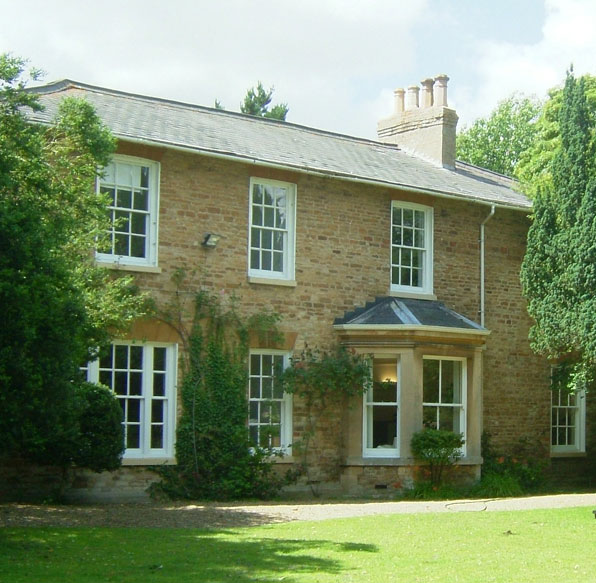
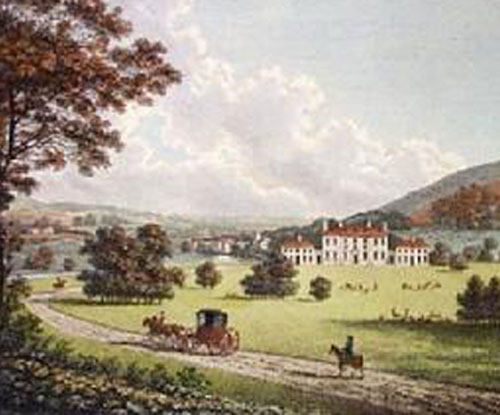
Godmersham Park.

Jane’s brother Edward Austen Knight eventually inherited the very gentrified Godmersham Park in Kent and two of her other brother’s Francis and Charles had distinguished careers in the British navy. Francis received a knighthood and the much coveted order of Bath and Jane’s brother Charles bought topaz crosses for his two sisters, going without to purchase them.

In the Christian understanding perfect love makes no demands and seeks nothing for itself, and this was the quality of the people that abounded in so many of the characters in Jane Austen’s life and in her novels. Jane enjoyed what she herself called ‘life a la Godmersham”.

Emma (Gwynneth Paltrow) and Mr Knightley (Jeremy Northam) dance

Her brothers hunted in Edward’s park, played billiards and entertained in a style that amused Jane. Writing from Godmersham in 1813 she commented “at this present time I have five tables, eight and twenty chairs and two fires all to myself”.

The Royal navy were winning great victories on the continent at the time. For the leisured classes in Jane’s novels the war was something that happened in the newspapers or far out at sea. Although her brothers were involved, many of these events seemed very remote and Jane and her peers continued to pursue their daily activities such as music, painting, playing games and writing with great enthusiasm comforted in the knowledge that England had the best navy in the world.

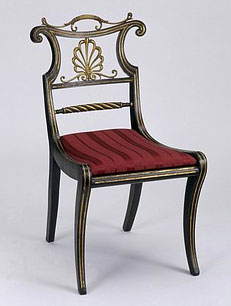
Trafalgar Chair, 1810, courtesy V & A Museum, London

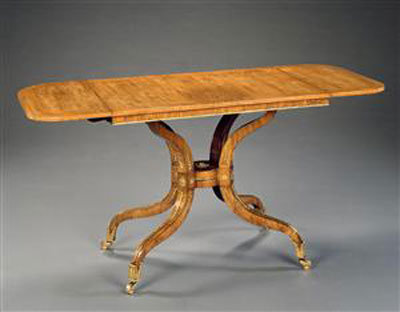
The Duke of Wellington’s victories and Admiral Nelson’s death at the Battle of Trafalgar caused a nation to mourn as well as celebrate wildly for twenty years afterward. And all manner of goods were named for him including “Trafalgar chairs”, which along with the sofa table were two very popular pieces of furniture during the Regency period.

Rosewood Regency period Sofa Table c1810, courtesy Mallett Antiques, London

Country houses and their beautiful parks were not simply the expressions of a wealthy ruling class for Jane and her contemporaries. They represented an ideal civilization with a mixture of self-esteem, national pride and uncompromising good taste. For the rest of the population they reflected the unequal structure of a society where a third of the nation’s population faced a daily struggle to survive. From the monarch to the poorest of the land there was a pyramid of patronage and property. At the base of which in 1803 a third were the labouring poor, the cottagers, the seamen, the soldiers, the paupers and the vagrants who lived at subsistence level.

Jane’s letter to her sister Cassandra in 1799 highlights the point, when a horse her brother purchased cost sixty guineas and the boy hired to look after him four pounds a year. Those employed in service counted they lucky, but even in well off household’s service conditions were still fairly primitive. Jane said “Let other pens dwell on guilt and misery. I quit such odious subjects as soon as I can”. The contrast of the battlefield and the ballroom are apt as a reminder of the powerfully opposed elements that made up the England into which Jane was born and in which she grew to maturity.

Beau Brummell - The Fashionable dress of a Gentleman

George, Prince of Wales, the future George IV was the very active, central focus of the style we now know as the Regency period. His personality was complex and he often indulged in fantastic flights of fantasy.

George, Prince of Wales in 1792

As a young man he had fair hair, blue eyes and pink and white complexion, and a tendency to corpulence. As he grew to maturity he gained considerably in popularity due to his good looks, high spirits and agreeable manners.

He was the darling of the fashionable world. George Bryan Brummell (England, 1778-1840) became the most famous of all the dashing young men of the Regency. He was not of aristocratic birth, but the son of the secretary to Lord North.(George III’s Prime Minister who played a major role in the American Revolution). Educated at Eton, the Beau became known as Buck and was extremely well liked by the other boys. He spent a short period at Oriel College, which has the distinction of being the oldest royal foundation in Oxford, dating from 1324.

Sartorial splendour - shades of Mr Darcy? (Colin Firth)

The Prince Regent was told that Brummell was a witty fellow, so he obtained an appointment for him in his regiment (1794). Brummell became a Captain of the Tenth Hussars and was constantly in the Prince’s company.

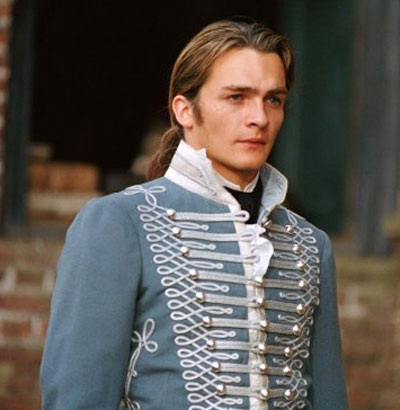
Military sartorial splendour...must be Mr Wickham! (Rupert Friend)

In the circles around the Prince he was known as a virtual oracle on matters related to dress and etiquette. As the new dictator of taste he established a code of costume.

A typical Regency outfit for day wear was a jacket cut away in front and with tails at the back. There was no waist seam, a feature present in Victorian coats. The open area around the hip had a distinctive curve pulling slightly around the waist.

Even more notably, the sleeves were particularly long and seated high on the shoulder. There are virtually no shoulder pads. Normally jackets had fabric-covered buttons. An exception was blue jackets with brass metal buttons–an association with military styles.

At night it was all sartorial splendour, rich textiles velvet, brocades, silks, all combined with a great deal of elegance, the costume for a gentlemen including a black coat.

Today we would say the Beau was very well connected, an important part of an influential network and a man to know.

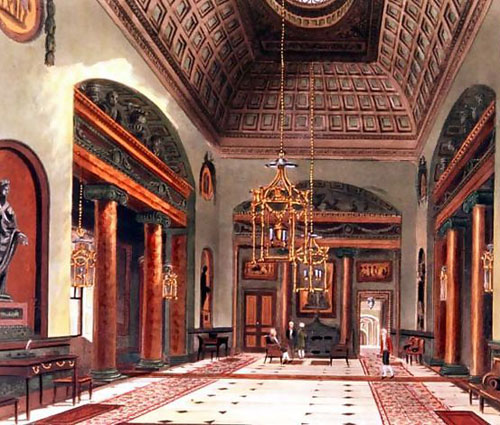
Entrance Hall, Carlton House, 1819 by W.H.Pyn

It was in 1784 when the Prince of Wales took one look at Maria Fitzherbert standing on the steps of the Opera and fell instantly in love with her. He was totally besotted and would only attend parties and events if the hostess assured him Maria would be both there – and sat next to him!

Maria Fitzherbert

Following a dedicated and unsuccessful pursuit of Mrs. Fitzherbert, Maria was surprised one evening by a visit from some of the Prince’s men. They had found him weak and bleeding in his home Carlton House, whose interiors were among the wonders of the age.

They told her the Prince had tried to commit suicide and Mrs. Fitzherbert, accompanied by the Duchess of Devonshire, rushed to his side whereupon he persuaded Maria to marry him. In 1785 George, Prince of Wales Prince married Mrs. Fitzherbert (1756 –1837) a Roman Catholic who had been married twice before. The couple was happy and while society seemingly accepted the unconventional pair the marriage rocked court circles, which could not cope with the thought that a Prince might marry a divorced woman.

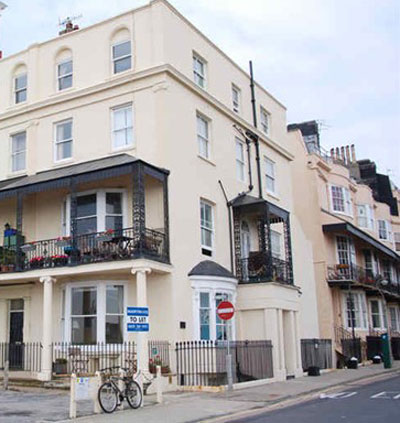
Bedford Square Brighton built 1801

Eventually the Prince would be forced to put her aside and it did not help his cause that his friend Beau Brummell, to whom Maria took a pronounced dislike, disapproved of the liaison.

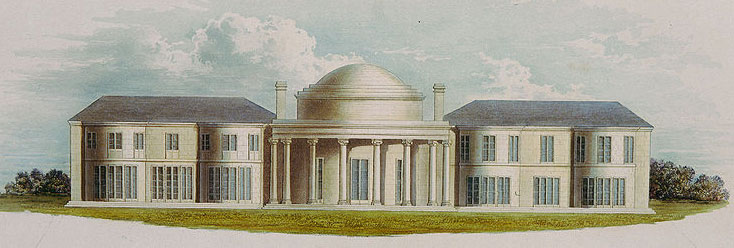
Brighton-Marine-Pavilion

Initially the Prince spent a great deal of time and effort building Maria his bride a house nearby his home Carlton House in Pall Mall and decorating his own home. He ran up such huge debts the only way his father, the King would agree to help him out and pay them was if he put aside Maria and marry Caroline of Brunswick, for political reasons, which he did.

In 1793 George, Prince of Wales visited the seaside town of Brighton, and ordered the subsequent renovation of a small house he purchased from one of his footman. Architect, Henry Holland, well known for his refined Francophile tastes, fashioned it into a splendid marine villa with gentle curving bays, wrought iron balconies and long sash windows, and it was much admired and set a standard for marine villas for many years to come. Mrs. Fitzherbert and the Prince parted company upon the marriage to Princess Caroline, however following the birth of his daughter; the Prince recommenced his pursuit of Maria.

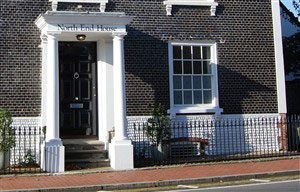
Mathematical Tiles on Regency House, Brighton

Maria was wary, however and upon asking the Pope for guidance she was informed that she was the only true wife of the Prince so she returned to him. Again the couple spent a lot of time entertaining at Brighton and London.

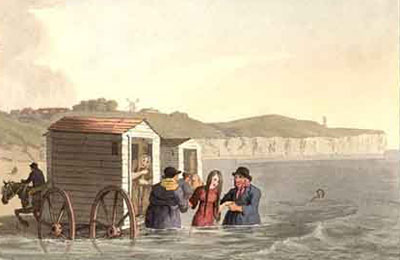
Sea Bathing England C19

Bathing in the sea had become very popular, with the Prince’s own physician recommending he bathe daily and bathing machines were set up especially for that purpose. All over Brighton, rows of small villas were built, echoing the Pavilion’s shape.

Some of the newly popular ‘seaside’ villas in Brighton were glazed with a smart material called ‘mathematical tiles’ which enabled villa houses to be built of less expensive brick and then ‘faced’. Introduced into the English architectural system after 1700 in England they were hung on buildings originally built of timber to give the appearance of higher quality brick walls. Today they are still not easy to recognise and are often mistaken for conventional brickwork. Black, glazed mathematical tiles are easy to discern, however, and may be seen at many locations in Brighton.

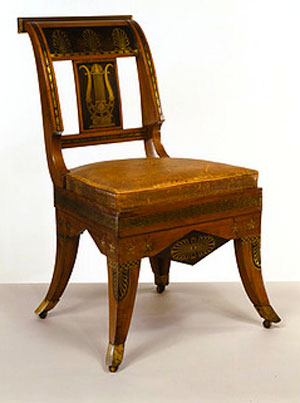
Chair designed by Thomas Hope, London in 1807 and made in 1892

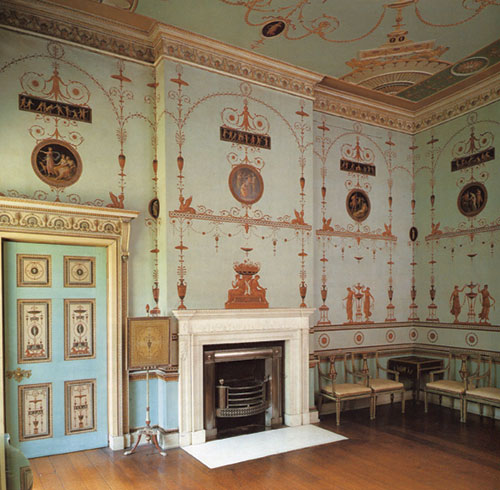
Painted furniture and at wall decoration ‘Etruscan style’ at Osterley House. The interiors were designed by Scottish Architect Robert Adam
Interior arrangements whose design focus was based on classical order reached the height of its popularity through the neoclassical style of Scottish architect Robert Adam between 1760 and 1793. The expansion of the neo-classical style was fuelled in the last half of the eighteenth century because of the interests of English Grand Tourists in the new discoveries being made at Pompeii and Herculaneum in Italy.

Etruscan room, Osterly House, Robert Adam.

Not only the shapes of the furniture were greatly influenced – for instance in the use of animal forms as supports for tables and chairs – but also the colour and decoration used for painted furniture, which was to be found in grand houses as well as much simpler gentry houses. Much of the charm of collecting such pieces lies in the rather primitive way the decoration was thought out and executed and many examples of very sophisticated simulated bamboo pieces were destined for important rooms.

Adam’s interiors could have easily been the inspiration for those of the formidable Lady Catherine de Burgh. Her country house Rosings in Pride and Prejudice was described by Jane as an interior of ‘fine proportion and finished ornaments’

Vanity fair, but where is Mr Darcy? – Part 2

Carolyn McDowall, April 2011 ©The Culture Concept Circle

Read Full Post »

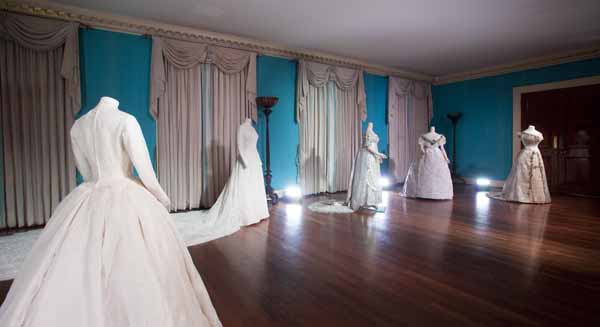
Wedding dresses in the royal collection. Princess Charlotte's gown is in the middle. Image @Daily News

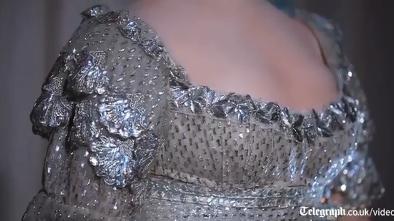
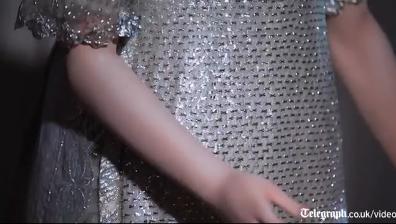
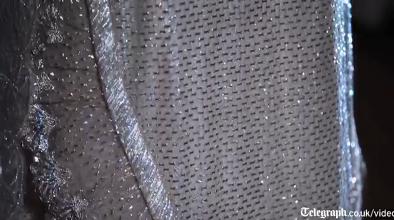
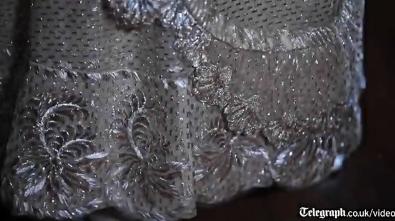
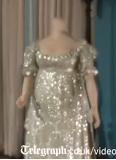
The Telegraph.co.uk features a video of five beautiful wedding dresses of the past, Queen Victoria’s and Princess Margaret’s among them, and asks the question, “How will Kate Middleton’s gown measure up to history?” Featured is Princess Charlotte’s beautiful silver wedding gown, which has not been on view for several decades and which, as the oldest wedding dress in the collection, requires quite a bit more conservation. In these images pulled from the film you can see the beautiful sheen of the silver fabric, which was meant to represent British wealth, status, and power.

It was made by Mrs Triaud of Bolton Street, from ‘cloth-of-silver’, silk bobbinet embroidered with heavy silver lamé, embellished with Brussels lace, and with embroidered flowers and shells festooning the hem.” –Telegraph.co.uk

Contemporary images simply do not do the dress justice.

One can see in this small (blurred) image how the dress sparkles under lights. The dress required “500 hours of detailed hand-stitching in ultra-fine, mono-filament silk threads, almost invisible to the naked eye.” Those poor seamstresses must have gone blind. The Regency Fashion page carries a description of the dress and ceremony in La Belle Assemblee.

The manteau was of silver tissue lined with white satin, with a border of embroidery to answer that on the dress, and fastened in front with a splendid diamond ornament. Such was the bridal dress” … La Belle Assemblee

Princes Charlotte and Prince Leopold on their wedding day in 1816, Chapel Royal, St. James's Palace

The historic wedding dresses are among the 10,000 items in the Royal Ceremonial Dress Collection. Queen Victoria’s wedding dress will be publicly displayed in March 2012, in the new permanent exhibition at the refurbished Kensington Palace, ‘Victoria Revealed” hrp.org.uk . –  Telegraph.co.uk

In this older image you can see the gown's train. Image @Museum of London

The jewellery of the royal bride is most superb; beside the wreath, are a diamond cestus, ear- rings, and an armlet of great value, with a superb set of pearls.” – La Belle Assemblee

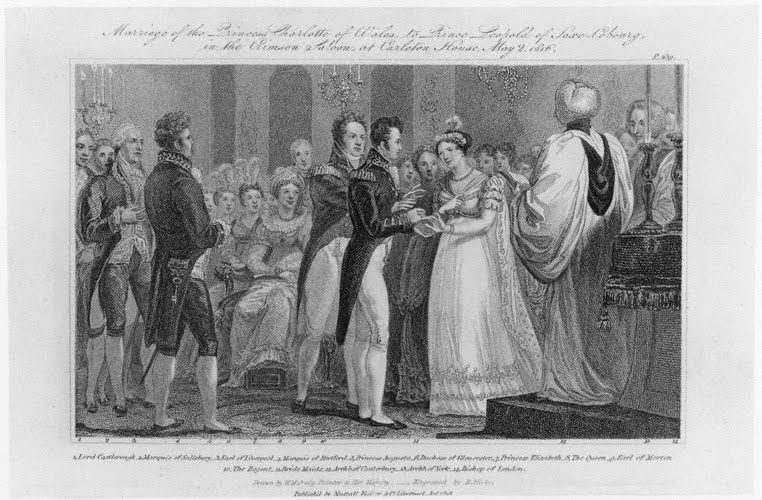
Contemporary depiction of Princess Charlotte's wedding

Sadly, the marriage did not last for even two years, due to Princess Charlotte’s death in childbirth (see article below.) Thank you, Brandy Parfums for alerting me to this video and article!

More posts about Princess Charlotte and Royal Weddings:

Read Full Post »

« Newer Posts - Older Posts »