Feeds:
Posts
Comments

Archive for the ‘Regency World’ Category

A Receipt for a Pudding

Contributed by Mrs. Cassandra Austen (Jane’s mother) to Martha Lloyd’s collection of recipes, 1808. As this recipe attests, Jane Austen came by her talent honestly. For amusement, her family wrote riddles, charades, poems, and plays for each other. Mrs. Austen excelled at poetry to the extent that one can easily follow her recipe in rhyme.
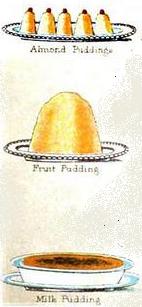
Puddings, Mrs. Beeton

If the vicar you treat,
You must give him to eat,
A pudding to hit his affection;
And to make his repast,
By the canon of taste,
Be the present receipt your direction.

First take two pounds of Bread,
Be the crumb only weigh’d,
For the crust the good house-wife refuses;
The proportion you’ll guess,
May be made more or less,
To the size that each family chuses.

Then its sweetness to make
Some currants you take
And Sugar of each half a pound
Be not butter forgot
And the quantity sought
Must the same with your currants be found

Cloves & mace you will want,
With rose water I grant,
And more savory things if well chosen;
Then to bind each ingredient,
You’ll find it expedient,
Of Eggs to put in half a dozen.

Some milk dont refuse it,
But boiled ere you use it,
A proper hint this for its maker;
And the whole when compleat,
In a pan clean and neat,
With care recommend to the baker.

In praise of this pudding,
I vouch it a good one,
Or should you suspect a fond word;
To every Guest,
Perhaps it is best,
Two puddings should smoke on the board.

Two puddings! – yet – no,
For if one will do,
The other comes in out of season;
And these lines but obey,
Nor can anyone say,
That this pudding’s with-out rhyme or reason

Jean at Delightful Repast has created a modern interpretation of this bread pudding. It looks so delicious, I think I shall try it at my next Janeites meeting! Click on the link for the recipe. Thank you for sharing, Jean!
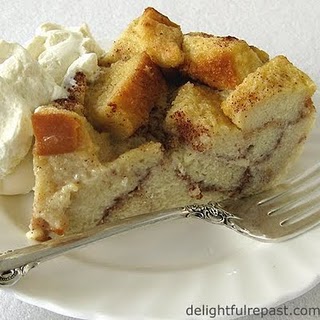
Jean's bread pudding

Bread and Butter Pudding, also called simply “bread pudding,” is a dessert that has been a first for many of my dinner guests. Since I grew up with it, I’m always amazed when people tell me they’ve never had it before. They always like it and think it was something very difficult and time-consuming to make, when actually it is quite the opposite (Isn’t that what every hostess aims for!).

If you are a Jane Austen aficionado, you may have read her mother’s recipe, written in rhyme. My recipe makes about a fourth the quantity of Mrs. Austen’s and uses proportionately less sugar and butter and more eggs. Also, I skip the cloves and rosewater–the cloves because so many people don’t like them and the rosewater because I seldom have it on hand.

Sometimes I serve it with custard sauce, sometimes with my Banana-Pecan Rum Sauce (see below), but this time I served it with softly whipped cream sweetened with a drop of real maple syrup.

Read Full Post »

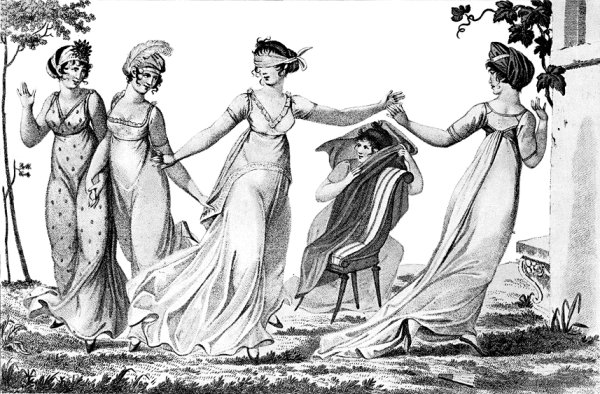
Gentle readers, I will be on semi-hiatus for the next few weeks, as my personal and work schedules do not permit me to concentrate as much on my blogs as I would like. For the time being I will feature past posts or link to others. When I looked at these images, I was reminded of the old-fashioned games of my childhood. Do children, I wonder, still play blind man’s bluff? Curious minds want to know.

Blind Man's Bluff

The above plate came from Healthful Sports for Young Ladies by Mlle St. Sernin, a French governess, and delightfully illustrated by Jean Demosthene Dugourc (1749-1825). In blind man’s bluff, the blindfolded person must first find someone and then guess her identity. Here is a charming description from Mlle St. Sernin:

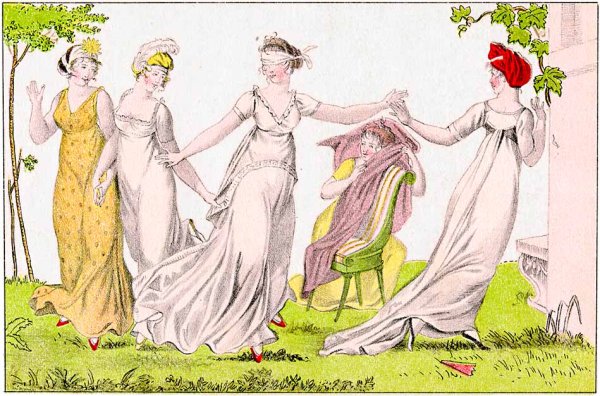
Le Bon Genre documented the social trends and leisure activities of Parisians. Below are two images from that magazine.

Black and white plate of Blind Mans Bluff, Le Bon Genre, 1803

Magazines with color plates cost more. Blind Mans Bluff, Le Bon Genre, 1803

Read Full Post »

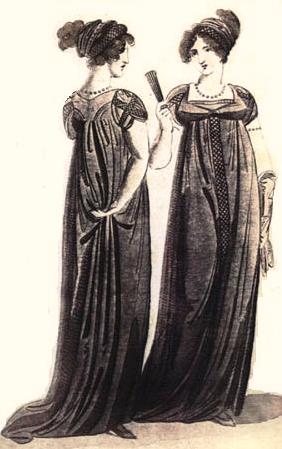
Fashionable mourning dresses, Ladies Museum, 1805

According to Jane Austen chronicler and scholar, David Nokes, when Martha Lloyd’s mother died on April 16, 1805, Jane Austen showed few signs of grief or emotion over that woman’s earthly departure. Instead, Jane wrote a jaunty verse to an uncivil (and imaginary) dressmaker. I surmise that these verses were meant more to cheer Martha up than to bring Martha’s mood down by reminding her of her loss. Mrs Austen, who was known for her droll verses, wrote a mythical reply by the dressmaker. At this time the Austen women were still reeling from Rev. Austen’s death in January and their own change in financial circumstances, having moved to more modest lodgings and becoming accustomed to a drastically reduced style of life. They would soon invite Martha to live with them in Bath. (Martha would remain with the Austen women through their move to Southampton in 1809.) After Jane’s death in 1817, Martha joined Cassandra in Chawton to help look after Mrs. Austen.

The poem that Jane wrote gives us a glimpse into how mourning clothes were made to order quickly. In this for-instance, the dressmaker, Miss Green, was slow to respond.

Lines sent to an uncivil Dress maker

Miss Lloyd has now sent to Miss Green,
As, on opening the box, may be seen,
Some yards of a Black Ploughman’s Gauze,
To be made up directly, because
Miss Lloyd must in mourning appear –
For the death of a Relative dear –
Miss Lloyd must expect to receive
This license to mourn & to grieve,
Complete, er’e the end of the week –
It is better to write than to speak – Jane Austen

Mrs. Austen’s reply as Miss Green

I’ve often made clothes
For those who write prose,
But ’tis the first time
I’ve had orders in rhyme – .
Depend on’t, fair Maid,
You shall be obeyed;
Your garment of black
Shall sit close to your back,
And in every part
I’ll exert all my art;
It shall be the neatest,
And eke the completest
That ever was seen –
Or my name is not Green! – Mrs. Cassandra Austen

Read Full Post »

Fans of Jane Austen’s fiction are familiar with the rising middle class, successful and enterprising tradesmen, upward mobility through marriage, the fragility of life (especially for fishermen, sailors and child-bearing women), and the difficulties of road travel. All these topics are touched upon in a short biography of Mr. Edward Innes, a successful baker and property man.

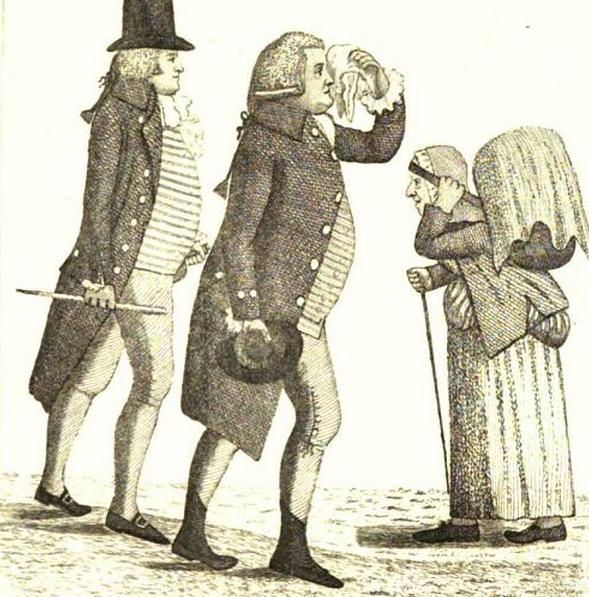
In this image, Mr. Innes is dressed as a gentleman, and is followed by a companion, Mr. James Cooper. As his position rose in life, his sensibilities must have become quite delicate, for as he passes a woman carrying a basket, Mr. Innes shields his face and nose from the offending stench that must have emanated from her basket.

Mr. Edward Innes and his second, James Cooper

Mr. Innes, if this account is to be believed, was a nonpareil, covering the distance to London in his carriage at the unheard of speed of 50 miles per day.

The progenitors of Mr Innes were farmers in the neighbourhood of Glencorse, but his father was a baker, and had his shop at one time at the head of the Fleshmarket Close. Latterly, the shop having been let without his knowledge to a higher bidder, he removed to his son’s property situated betwixt Marling and Niddfy’s Wynds. In his younger years, the old man was usually styled the handsome baker from his exquisite symmetry, and he was not less fortunate in his choice of a pretty woman for his wife. Isabella, or Bell Gordon, had been married to the captain of a vessel, who was drowned at sea only a few weeks after. The young widow then only in her eighteenth year, happening to be on a visit at the house of her brother in law, Mr Syme ,ship builder, Leith; the handsome baker was introduced to her acquaintance, and the result was a speedy union. Besides a daughter by her first husband, Mrs Innes had eight children, of whom the subject of our notice was the second eldest.

Mr Edward Innes, after serving his apprenticeship with his father, commenced as a baker on his own account in the High Street. In addition to his good fortune in business, he acquired considerable property by his wife, a Miss Wright of Edinburgh, by whom he had several children. Mr Innes kept a horse and gig, an equipage rather unusual for a tradesman in his day; and what was considered remarkable at that time, he drove to London on one occasion, accompanied by his wife, in eight days, a distance averaging fifty miles a day. The circumstance was much talked o,f and taking into account the then state of the roads, the performance was really one of no ordinary magnitude. – A series of original portraits and caricature etchings, Volume 2, Part 2 (Google eBook), John Kay, 1838, p 284.

Note: Considering the poor road conditions of the day, carriage horses averaged from 2-4 miles per hour; at breakneck speed, they could achieve a remarkable 6 miles per hour, but horses that pulled a carriage could keep up this pace for only a short distance. Thus Mr. Innes and his wife spent long hours on the road (10-12 per day) and had their horses frequently changed at stops along the way.

Other posts on this topic:

Read Full Post »

Inquiring readers: Jane Odiwe’s blog features a portrait of a Regency family that had sold in 1983. She wrote to several bloggers recently: “I’m writing to you on Mrs. Henry Rice’s behalf to ask if you would be interested in showing the painting with the information I’ve learned about on your blogs. The family would really like some help in publicising the picture, and wish to make an appeal to see if we can find its whereabouts, as Christie’s do not seem to have any record. They are hoping the painting is by Ozias Humphry, which will help to strengthen his association as a painter of the Austen family.”

Jane Austen's family?

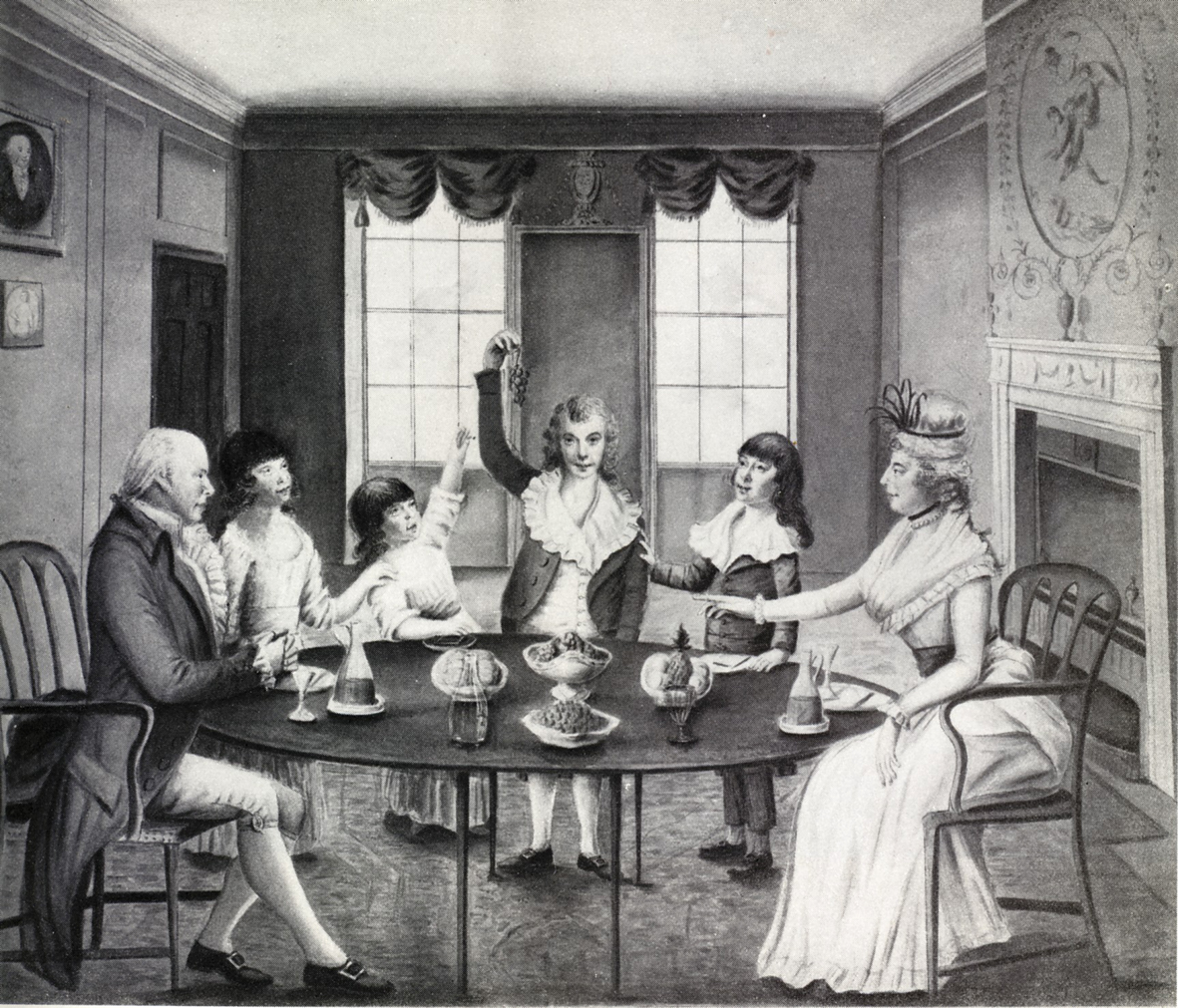
Is this a portrait of Jane Austen’s family that has gone unnoticed until now?  The image was made in 1781, when young Jane would have been six years old. What say you?

To learn more about this art work and possible image of the Austen family, click on this link to Jane’s blog. Thank you for joining in!!

Read Full Post »

« Newer Posts - Older Posts »