Feeds:
Posts
Comments

Archive for the ‘Upper Class’ Category

Today marks the start of a new month-by-month series, “A Year in Jane Austen’s World,” in which I highlight several important events and details that happened in Jane Austen’s novels, letters, and lifetime during each month of the year.

We’ll kick off Jane Austen January (aka “Jane-uary”) by examining passages and situations in each of her novels that occur in January. While some of the novels have no mention of January, others do—with interesting results! Next, we’ll note where Austen was and what she was doing in January by checking her letters for January dates and details. Finally, we’ll highlight events and anniversaries that occurred in January that directed affected Jane Austen or her family.

All of this can help us better understand Austen’s life and times as we look at specific dates, events, and details in the context of months and seasons.

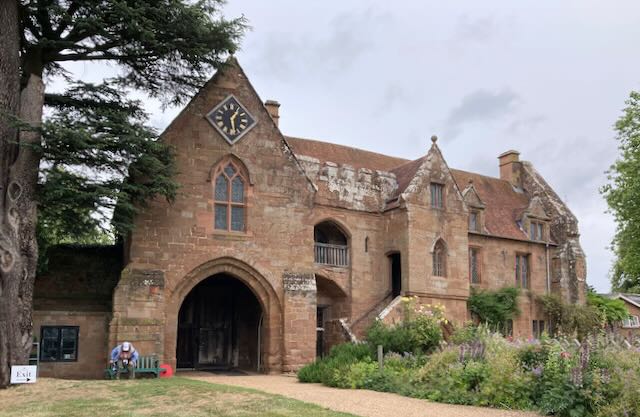
Snowdrops at Chawton House in January, courtesy of Chawton House.

January in Regency Times

One of the highlights of January for Jane Austen’s family was surely Twelfth Night (also known as Epiphany), which falls on January 5th.

Maria Grace, in her article “Celebrating Twelfth Night–Jane in January and You,” explains its religious importance: “Epiphany or Twelfth Night … was the exciting climax of the Christmastide season… It was a feast day to mark the coming of the Magi bearing gifts to the Christ child, and as such was the traditional day to exchange gifts.”

She also explains the social side of Twelfth Night: “In Jane Austen’s day, the party of the year would generally be held on Twelfth Night.” (Austen Variations)

During the Regency Era, people hosted parties and balls to celebrate Christmas and especially the last day of the Christmas season. The entertainment often involved guests playing assigned parts for the evening, dressing up in costumes, eating “Twelfth Cake,” and eating and drinking.

Rowlandson, “Twelfth Night Characters,” Creative Commons, 1811.

In a letter to Cassandra on December 27, 1808, Austen writes about an upcoming ball between Christmas and “Twelfth-day” at Manydown:

I was happy to hear, chiefly for Anna’s sake, that a ball at Manydown was once more in agitation; it is called a child’s ball, and given by Mrs. Heathcote to Wm. Such was its beginning at least, but it will probably swell into something more. Edward was invited during his stay at Manydown, and it is to take place between this and Twelfth-day. Mrs. Hulbert has taken Anna a pair of white shoes on the occasion.

Austen’s Letters (December 27, 1808)

Later, on January 10, 1809, she writes, “The Manydown ball was a smaller thing than I expected, but it seems to have made Anna very happy. At her age it would not have done for me.”

Manydown Great House, Wikipedia Commons, 1833.

January Travel in Jane Austen’s Novels

In Austen’s novels, January is primarily mentioned in the context of parties and travel. Anne Elliot goes to Bath for January and February, Miss Crawford is invited for “a long visit” to see her friend in London in January, Mrs. Jennings goes to her own house in London in January, and Mr. Bingley, Mr. Darcy, and Bingley’s sisters all go to London (when Bingley leaves Netherfield) and stay for the winter.

In Sense and Sensibility, Lucy Steele and her sister, Anne, go to “town” (London) in January to stay with relatives (and subsequently move from house to house throughout the season as socially advantageous opportunities become available):

I had quite depended upon meeting you there. Anne and me are to go the latter end of January to some relations who have been wanting us to visit them these several years! But I only go for the sake of seeing Edward. He will be there in February, otherwise London would have no charms for me; I have not spirits for it.

Sense and Sensibility

Mrs. Jennings, who “resided every winter in a house in one of the streets near Portman Square,” invites Elinor and Marianne to come with her to London in January when her thoughts begin to turn toward home after Christmas.
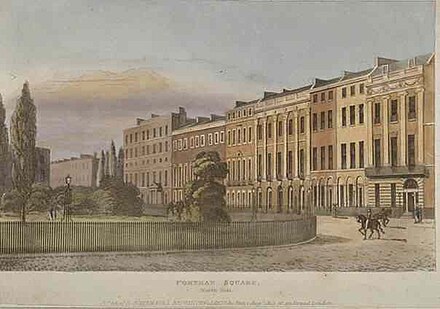
Portman Square, London, Wikipedia Commons, 1813.

The London Season

So why do so many of Austen’s characters travel to London in January? Wouldn’t the weather make travel difficult? Wouldn’t they prefer to stay home (and inside) where it’s cozy?

These are fair questions, but after Christmas, a large portion of the genteel class moved “to town” during the winter months for the London Season, which coincided with England’s political schedule, for entertainment and socializing. The Season had previously started in the fall, meaning most people went to London before the bad weather set in, but with the improvement of roads and travel during Austen’s day, the season slowly shifted later.

Here’s an explanation of the London Season from Jane Austen’s House Museum:

The London season coincided with the sitting of Parliament, beginning at some point after Christmas when fashionable families would move into their London houses. The men would attend Parliament, whilst the women shopped, visited, and found husbands for themselves or their daughters. It lasted until early summer, when the ‘beau monde’ would return to their country estates, escaping the city’s stifling heat and pungent smells.

The season was a whirlwind of court balls and concerts, private balls and dances, parties and sporting events. On a typical day, ladies would rise early to go riding in Hyde Park, before returning home to breakfast and spending the day shopping, dealing with correspondence and paying calls.

The Season, Jane Austen’s House Museum

Most villages had assemblies and balls during the winter, but all of the most important social occasions happened “in town.” In Pride and Prejudice, we’re told that the Bennet sisters have little to do “beyond the walks to Meryton” in January and February, when conditions are “sometimes dirty and sometimes cold” (Ch. 27). It makes sense that many young women longed to go to town in the winter, at the height of the London Season and “marriage market,” when the majority of the parties, balls, and social events were held.

Rowlandson, Drawing Room at St. James’s Palace in London, Wikimedia Commons, 1810.

January in Jane Austen’s Letters

January often brings rain, cold weather, and even snow to the various locations where Austen lived and traveled. Austen kept her spirits up, but January in England, especially in homes without central heating or today’s insulation, could not have been entirely comfortable. Balls and assemblies, visits and travel, kept Austen busy and content during the winter months.

Austen’s entries follow below and give us a glimpse into the miserable weather conditions during one particularly snowy and wet January:

17 January 1809 (Castle Square):
“Yes, we have got another fall of snow, and are very dreadful; everything seems to turn to snow this winter.”

24 January 1809 (Castle Square):
“This day three weeks you are to be in London, and I wish you better weather; not but that you may have worse, for we have now nothing but ceaseless snow or rain and insufferable dirt to complain of; no tempestuous winds nor severity of cold. Since I wrote last we have had something of each, but it is not genteel to rip up old grievances.”

In the same letter, Austen describes her writing:
“I am gratified by her having pleasure in what I write, but I wish the knowledge of my being exposed to her discerning criticism may not hurt my style, by inducing too great a solicitude. I begin already to weigh my words and sentences more than I did, and am looking about for a sentiment, an illustration, or a metaphor in every corner of the room. Could my ideas flow as fast as the rain in the store-closet, it would be charming.”

On the topic of the store-closet, she writes this:
“We have been in two or three dreadful states within the last week, from the melting of the snow, etc., and the contest between us and the closet has now ended in our defeat. I have been obliged to move almost everything out of it, and leave it to splash itself as it likes.”

30 January 1809 (Castle Square):
“Here is such a wet day as never was seen. I wish the poor little girls had better weather for their journey; they must amuse themselves with watching the raindrops down the windows. Sackree, I suppose, feels quite broken-hearted. I cannot have done with the weather without observing how delightfully mild it is; I am sure Fanny must enjoy it with us. Yesterday was a very blowing day; we got to church, however, which we had not been able to do for two Sundays before.”

And a final update on the flooded closet:
“The store-closet, I hope, will never do so again, for much of the evil is proved to have proceeded from the gutter being choked up, and we have had it cleared. We had reason to rejoice in the child’s absence at the time of the thaw, for the nursery was not habitable. We hear of similar disasters from almost everybody.”

If you’ve ever dealt with water damage or burst pipes due to cold weather, you know how awful and destructive it can be. Austen makes light, but one can imagine it caused quite a bit of damage.

Snow at Jane Austen’s House Museum, January 2021.

January in Jane Austen’s Lifetime

And finally, let us turn our attention to some of the most important dates and events that happened (or were celebrated) during the first month of the year in Jane Austen’s lifetime. In December 1800, Reverend Austen decided to retire and remove his family to Bath. Austen’s letters in January 1801 prove an interesting read as she and the Austen family prepare to move later in the year:

3 January 1801 (Steventon):
Austen writes that her mother wants to keep two maids and quips about their plans to have “a steady cook and a young giddy housemaid, with a sedate, middle-aged man, who is to undertake the double office of husband to the former and sweetheart to the latter.”

Austen discusses three parts of Bath where they might live:
“Westgate Buildings, Charles Street, and some of the short streets leading from Laura Place or Pulteney Street.” She writes extensively about each neighborhood and several others, giving her opinion and hopes about each. She details which pictures, furniture, and beds they are choosing to keep or leave behind and asks Cassandra’s advice. And she shares plans for the family to travel to Bath a few weeks from then.

Austen shares own thoughts on their move to Bath:
“I get more and more reconciled to the idea of our removal. We have lived long enough in this neighborhood: the Basingstoke balls are certainly on the decline, there is something interesting in the bustle of going away, and the prospect of spending future summers by the sea or in Wales is very delightful. For a time we shall now possess many of the advantages which I have often thought of with envy in the wives of sailors or soldiers. It must not be generally known, however, that I am not sacrificing a great deal in quitting the country, or I can expect to inspire no tenderness, no interest, in those we leave behind…”

The letter is full of useful information and well-worth a read. You can access it HERE.

14 January 1801 (Steventon):
Austen speaks of the many visitors they’ve received in response to the news that Rev. Austen is retiring and the family is moving to Bath. She says, “Hardly a day passes in which we do not have some visitor or other: yesterday came Mrs. Bramstone, who is very sorry that she is to lose us, and afterwards Mr. Holder, who was shut up for an hour with my father and James in a most awful manner.”

4 Sydney Place, Bath.
Plaque outside 4 Sydney Place, Bath.

January Dates of Importance

This brings us now to several dates that would have been quite important to Austen personally:

Celebrations/Birthdays:

9 January 1773: Jane Austen’s sister, Cassandra Elizabeth Austen, born.

23 January 1793: Edward Austen’s first child, Fanny, born.

Goodbyes/Sorrows:

January 1796: Tom Lefroy leaves Ashe for London (and never returns) and Tom Fowle (Cassandra’s fiancé) sets sail for the Indies, where he later dies.

21 January 1805: Rev. George Austen (Jane’s father) dies suddenly in Bath.

Writing:

28 January 1813: Pride and Prejudice was published, by Thomas Egerton (Whitehall, London).

21 January 1814: Austen begins writing Emma.

The Joys of Sleuthing

I hope you’ve enjoyed this first installment of our month-by-month exploration of Jane Austen’s world. I was pleasantly surprised to find that there was so much more to research and explore about the month of January than I anticipated. I enjoyed sleuthing around, following my nose, and discovering what I could uncover–just with the word “January.” If you have ideas about what I might pursue for February in Jane Austen’s World, please share your ideas in the comments.


RACHEL DODGE teaches college English classes, gives talks at libraries, teas, and book clubs, and writes for Jane Austen’s World blog. She is the bestselling author of The Little Women DevotionalThe Anne of Green Gables Devotional and Praying with Jane: 31 Days Through the Prayers of Jane Austen. Now Available: The Secret Garden Devotional! You can visit Rachel online at www.RachelDodge.com.

Read Full Post »

“I had expected to find everything about the place very fine and all that, but I had no idea of its being so beautiful.” –Mrs. Cassandra Leigh Austen, Aug. 13, 1806, on a visit to Stoneleigh Abbey with her daughters Jane and Cassandra

Merry Christmas and Happy Holidays! As my gift to you, let’s take a trip to Stoneleigh Abbey together.

Jane Austen visited Stoneleigh Abbey in 1806. She and her mother and sister were visiting their cousin, Rev. Thomas Leigh, in Adlestrop when his distant cousin, the Honorable Mary Leigh, died. Rev. Thomas inherited the wealthy estate. He took his poorer relations, the Austens, with him to take possession, as a treat for them. They enjoyed it very much, as Mrs. Austen wrote in a letter.  She said the house was so large that they needed signposts to find their way, and that it was not only very “fine,” but more beautiful than she had imagined. Catherine Morland, similarly, when she saw Northanger Abbey, “was struck . . . beyond her expectation, by the grandeur of the abbey.”

Based on income, Stoneleigh Abbey was an even grander place than Pemberley or Sotherton (the Rushworth estate in Mansfield Park) would have been. Austen tells us that Darcy’s income was £10,000 a year and Mr. Rushworth’s was £12,000 a year. But the income of the Leighs of Stoneleigh Abbey, in Jane Austen’s time, was even higher, at £17,000 a year, which Victoria Huxley says was “perhaps the annual equivalent of a million pounds in today’s values” (p. 9). (We were told when touring Chatsworth that the income there in Austen’s time was about £30,000, three times Darcy’s income; I haven’t found confirmation of that number anywhere, though.)

Today, ideally you need a car or a tour bus to get you to Stoneleigh Abbey. It is about an hour’s drive north of Oxford or about 40 minutes southeast from Birmingham. If you want to take public transport, it looks like you’ll have a half-hour’s walk at the end of your journey.

I went with the JASNA Summer Tour. We saw the Adlestrop church the same day; it’s only about an hour’s drive away.

Stoneleigh Abbey, like Austen’s fictional Northanger Abbey, is a mix of older monastic buildings and newer buildings. (Newer in Austen’s time, at least.) Let’s take a trip through it, with some quotes from Austen’s novels.

The red sandstone gatehouse, where you buy entry tickets, is from the 14th century, a remnant of the original Cistercian monastery. At this gatehouse, built in 1346 by Abbot Robert de Hoeckle, the poor received alms and travelers found hospitality.

So low did the building stand, that she found herself passing through the great gates of the lodge into the very grounds of Northanger, without having discerned even an antique chimney. . . . To pass between lodges of a modern appearance, to find herself with such ease in the very precincts of the abbey, and driven so rapidly along a smooth, level road of fine gravel, without obstacle, alarm, or solemnity of any kind, struck her as odd and inconsistent.–Catherine Morland, Northanger Abbey

Now we are coming to the lodge-gates; but we have nearly a mile through the park still.–Maria Bertram, Mansfield Park

The tour did not take us into this north wing. But you can still see arches on the walls, from the original monastery church. They are now bricked over. A cloister and medieval stained glass windows remain in the older buildings.
Another building from the old monastery. Stoneleigh Abbey was a small Cistercian monastery from 1155 until Henry VIII dissolved the monasteries in 1536. The Leigh family bought it in 1561. Catherine Morland was disappointed not to stay in such a building at Northanger Abbey.

[Catherine] was hardly more assured than before, of Northanger Abbey having been a richly endowed convent at the time of the Reformation, of its having fallen into the hands of an ancestor of the Tilneys on its dissolution–Northanger Abbey

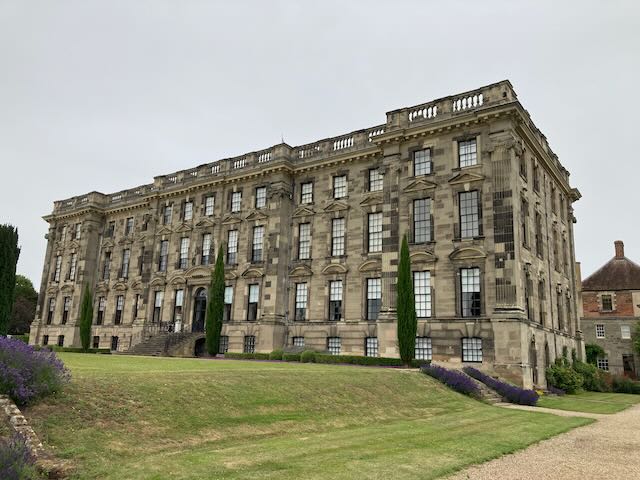
The baroque West Wing is the most impressive building, built in the 1720s by Edward, the third baron Leigh. He married a rich heiress. After his Grand Tour on the continent, he was inspired to create his own Italian-style palace. Mrs. Austen wrote that there are 45 windows in the front.

She was struck, however, beyond her expectation, by the grandeur of the abbey, as she saw it for the first time from the lawn.–Catherine Morland, Northanger Abbey

Even Fanny had something to say in admiration. . . . Her eye was eagerly taking in everything within her reach; . . . being at some pains to get a view of the house, and observing that “it was a sort of building which she could not look at but with respect”–Mansfield Park

Architect Francis Smith designed the Stoneleigh Abbey West Wing, which cost £3,300. The older abbey buildings became servants’ quarters.
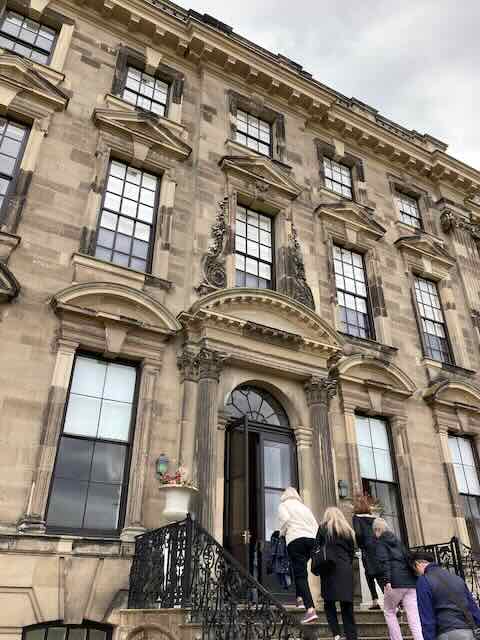
A flight of stairs leads up to the main entry to Stoneleigh Abbey, West wing

Miss Bertram could now speak with decided information of what she had known nothing about when Mr. Rushworth had asked her opinion; and her spirits were in as happy a flutter as vanity and pride could furnish, when they drove up to the spacious stone steps before the principal entrance.–Mansfield Park

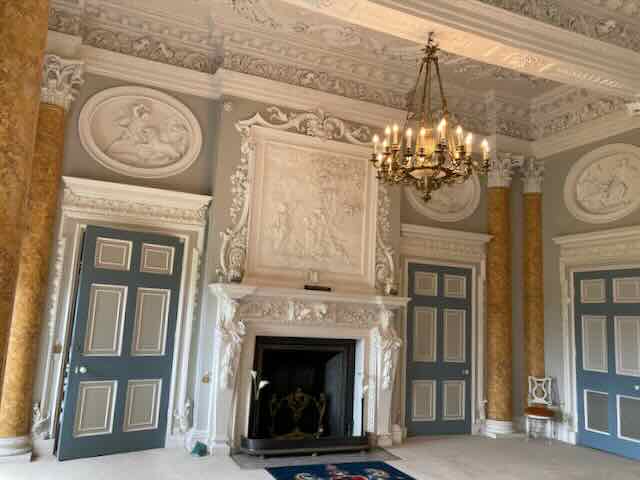
One end of the impressive “saloon” (salon, entry room) of Stoneleigh Abbey. Plaster decorations show myths of the Greek hero Hercules. Edward, the fifth Lord Leigh, decorated this room in the 1760s while doing vast “improvements” to his manor.
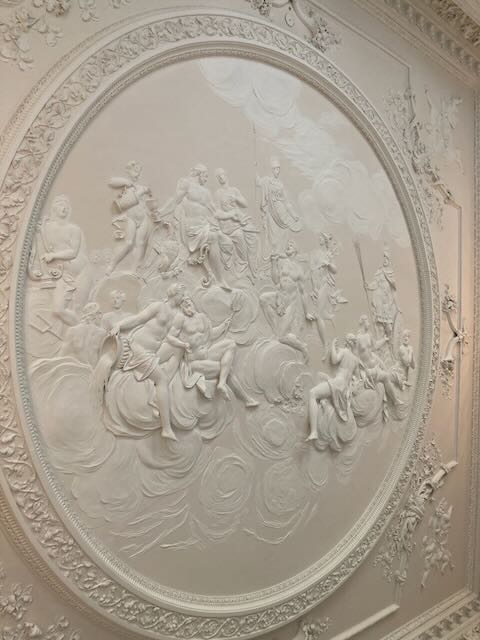
Ceiling plasterwork in the Stoneleigh Abbey saloon showing Hercules joining the gods. Ironically, Hercules suffered from bouts of madness, as did Edward Leigh himself.

An abbey! Yes, it was delightful to be really in an abbey! But she doubted, as she looked round the room, whether anything within her observation would have given her the consciousness. The furniture was in all the profusion and elegance of modern taste.–Catherine Morland, Northanger Abbey

The whole party rose accordingly, and under Mrs. Rushworth’s guidance were shewn through a number of rooms, all lofty, and many large, and amply furnished in the taste of fifty years back, with shining floors, solid mahogany, rich damask, marble, gilding, and carving, each handsome in its way.–Mansfield Park

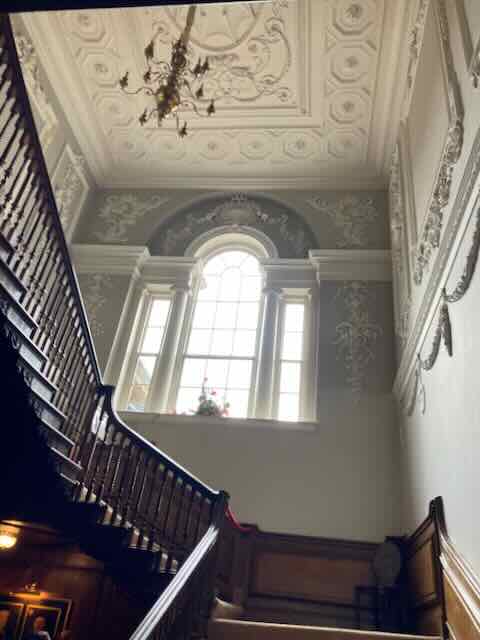
The main staircase of Stoneleigh Abbey, one of three staircases Jane Austen’s mother mentions.

They returned to the hall, that the chief staircase might be ascended, and the beauty of its wood, and ornaments of rich carving might be pointed out.–Northanger Abbey

The lower part of the house had been now entirely shewn, and Mrs. Rushworth, never weary in the cause, would have proceeded towards the principal staircase, and taken them through all the rooms above, if her son had not interposed with a doubt of there being time enough.–Mansfield Park

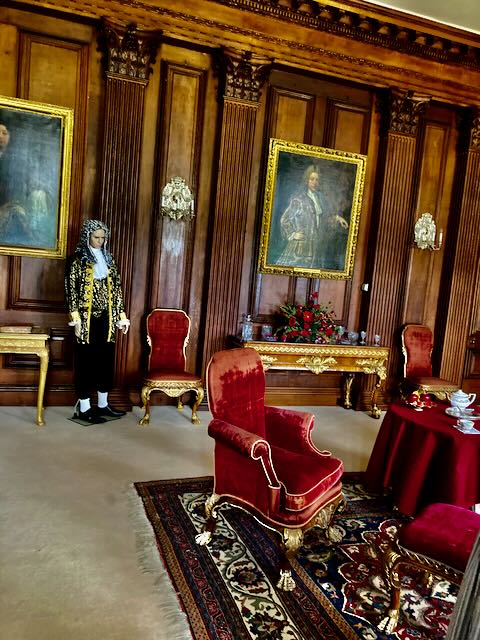
The drawing room of Stoneleigh Abbey. After dinner, the ladies would “withdraw” to the “withdrawing room,” later called the drawing room. The gentlemen would join them after a time.

The general leads Catherine “into a room magnificent both in size and furniture—the real drawing-room, used only with company of consequence. It was very noble—very grand—very charming!—was all that Catherine had to say, for her indiscriminating eye scarcely discerned the colour of the satin; and all minuteness of praise, all praise that had much meaning, was supplied by the general: the costliness or elegance of any room’s fitting-up could be nothing to her; she cared for no furniture of a more modern date than the fifteenth century.”–Northanger Abbey

The drawing room clock, from 1786, plays carillon music on the hour. Stoneleigh Abbey

“Till midnight, she supposed it would be in vain to watch; but then, when the clock had struck twelve, and all was quiet, she would, if not quite appalled by darkness, steal out and look once more. The clock struck twelve—and Catherine had been half an hour asleep.”–Northanger Abbey

Stoneleigh Abbey card room fireplace, with plates of “the prettiest English china,” hand painted by ladies of the family.

The fireplace, where she had expected the ample width and ponderous carving of former times, was contracted to a Rumford, with slabs of plain though handsome marble, and ornaments over it of the prettiest English china.–Northanger Abbey

A Rumford was an invention that made fireplaces more efficient. They are still used today.

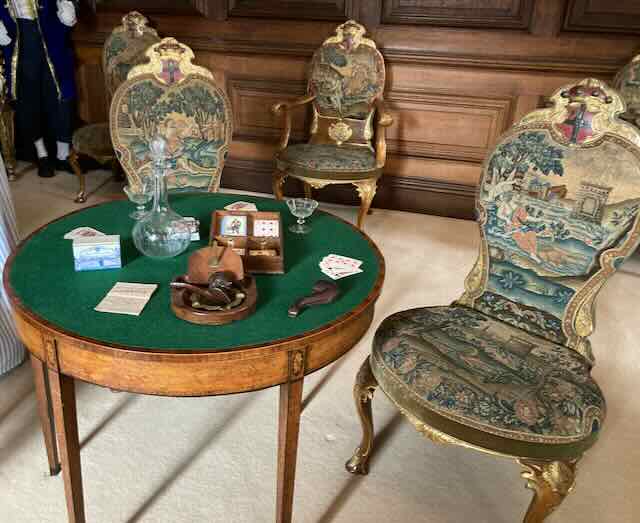
Stoneleigh Abbey card room, set up for a game of cards.

Mr. Elton had retreated into the card-room, looking (Emma trusted) very foolish.–Emma

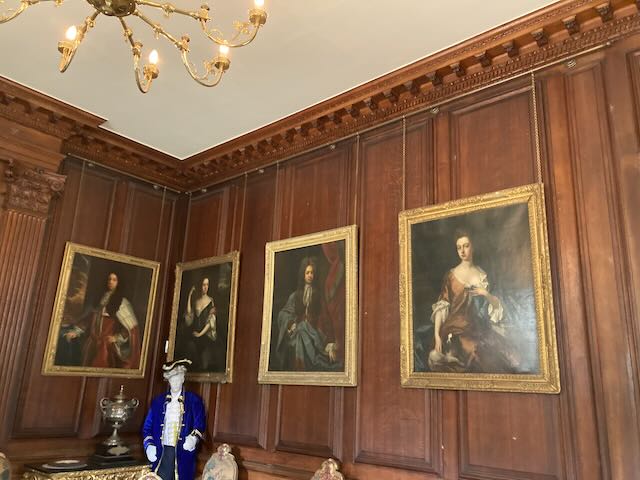
Portraits in the Card Room. All the rooms we saw were lined with family portraits.

Of pictures there were abundance, and some few good, but the larger part were family portraits, no longer anything to anybody but Mrs. Rushworth–Mansfield Park

Edward, fifth Lord Leigh, bequeathed most of his extensive library to his alma mater, Oriel College at Oxford. These included “outstanding works on architecture and music, his scientific instruments, maps and prints.” (Jane Austen & Adlestrop, 22).
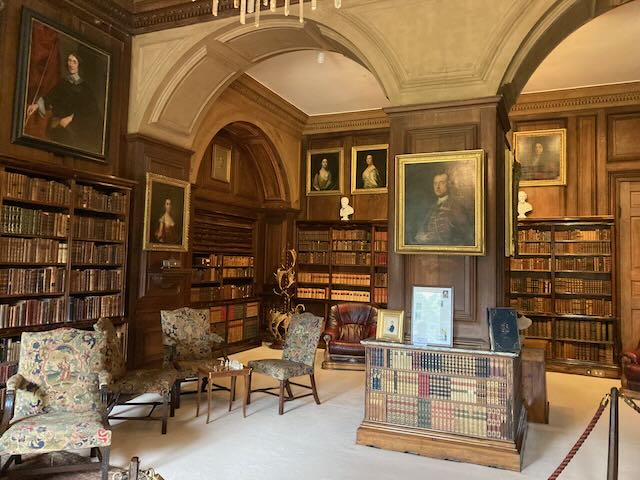
The library of Stoneleigh Abbey was replenished by later heirs.

Marianne, who had the knack of finding her way in every house to the library, however it might be avoided by the family in general, soon procured herself a book.–Sense and Sensibility

Ready to play chess in the library, Stoneleigh Abbey

“What a delightful library you have at Pemberley, Mr. Darcy!”

“It ought to be good,” he replied, “it has been the work of many generations.”

“And then you have added so much to it yourself, you are always buying books.”

“I cannot comprehend the neglect of a family library in such days as these.”–Miss Bingley and Mr. Darcy, Pride and Prejudice

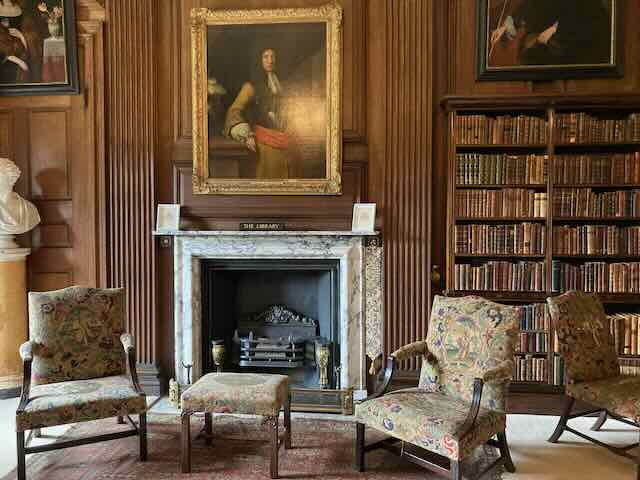
Stoneleigh Abbey library

After tea, Mr. Bennet retired to the library, as was his custom–Pride and Prejudice

Ladies’ dressing table, Stoneleigh Abbey

“My mother is tolerably well, I trust; though her spirits are greatly shaken. She is up stairs and will have great satisfaction in seeing you all. She does not yet leave her dressing-room.”–Jane Bennet, Pride and Prejudice

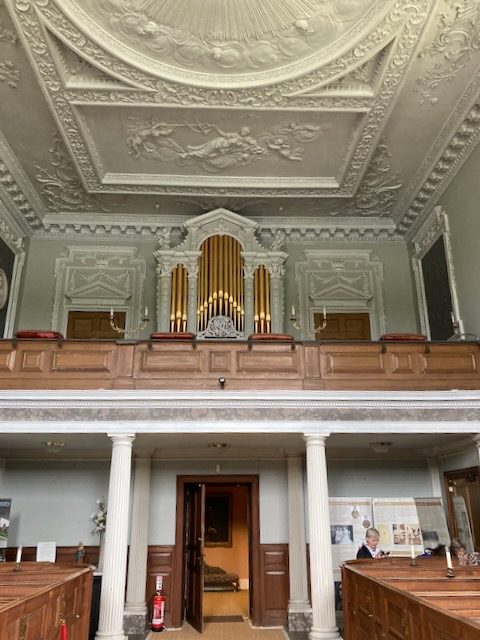
The chapel at Stoneleigh Abbey is considered to be the model for the chapel at Sotherton in Mansfield Park. Crimson cushions appear over the balcony ledge, as in Mansfield Park. Rev. Thomas Leigh read prayers (led a worship service) in the chapel twice a day, with morning prayers at 9 A.M.

Fanny’s imagination had prepared her for something grander than a mere spacious, oblong room, fitted up for the purpose of devotion: with nothing more striking or more solemn than the profusion of mahogany, and the crimson velvet cushions appearing over the ledge of the family gallery above. “I am disappointed,” said she, in a low voice, to Edmund. “This is not my idea of a chapel. There is nothing awful here, nothing melancholy, nothing grand.” . . .

Mrs. Rushworth began her relation. “This chapel was fitted up as you see it, in James the Second’s time. Before that period, as I understand, the pews were only wainscot; and there is some reason to think that the linings and cushions of the pulpit and family seat were only purple cloth; but this is not quite certain. It is a handsome chapel, and was formerly in constant use both morning and evening. Prayers were always read in it by the domestic chaplain, within the memory of many; but the late Mr. Rushworth left it off.” . . .

“It is a pity,” cried Fanny, “that the custom should have been discontinued. It was a valuable part of former times. There is something in a chapel and chaplain so much in character with a great house, with one’s ideas of what such a household should be! A whole family assembling regularly for the purpose of prayer is fine!”–Mansfield Park

See my post on The Stoneleigh Abbey Chapel and Mansfield Park for a visit to the chapel with further quotes from Mansfield Park.

Queen Victoria’s bedroom at Stoneleigh Abbey. In 1858, Queen Victoria stayed for two nights at the Abbey, in a suite of five rooms. The furniture was painted white and gold, according to the Queen’s preference.

In a house so furnished, and so guarded, she could have nothing to explore or to suffer, and might go to her bedroom as securely as if it had been her own chamber at Fullerton.–Catherine Morland, Northanger Abbey

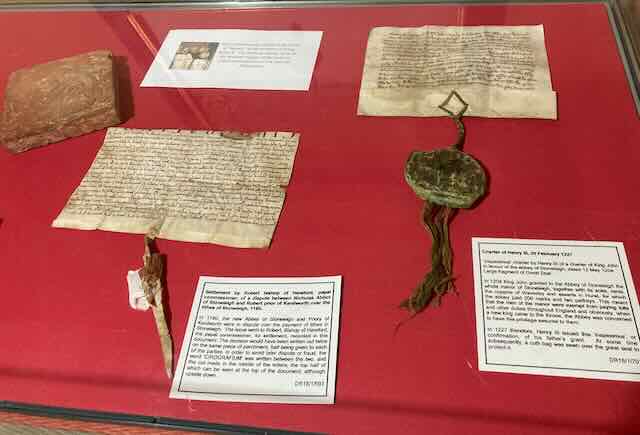
Further rooms at Stoneleigh Abbey display historical relics, such as the monks’ charters and seals.

Northanger turned up an abbey, and she was to be its inhabitant. Its long, damp passages, its narrow cells and ruined chapel, were to be within her daily reach, and she could not entirely subdue the hope of some traditional legends, some awful memorials of an injured and ill-fated nun.–Catherine Morland, Northanger Abbey

Humphry Repton was hired to improve Stoneleigh Abbey and its surroundings. His Red Book, showing before and after pictures, still exists.
Repton moved the river toward Stoneleigh Abbey so you could see the house reflected in the water.

“Smith’s place is the admiration of all the country; and it was a mere nothing before Repton took it in hand. I think I shall have Repton.”–Mr. Rushworth, Mansfield Park

A ha-ha (see below) at Stoneleigh Abbey gives an uninterrupted view across the fields.
From the other side of Stoneleigh Abbey’s hedge of lavender shown above, you can see the wall that kept animals from trespassing to the area around the house. A ha-ha is a walled ditch dug to act as a fence without disrupting the view.

A few steps farther brought them out at the bottom of the very walk they had been talking of; and standing back, well shaded and sheltered, and looking over a ha-ha into the park, was a comfortable-sized bench, on which they all sat down. . . .

“You will hurt yourself, Miss Bertram,” [Fanny Price] cried; “you will certainly hurt yourself against those spikes; you will tear your gown; you will be in danger of slipping into the ha-ha.”–Mansfield Park

In 1946, Stoneleigh Abbey became “one of the first stately homes to open its doors to the public” (Stoneleigh Abbey, 18). A fire destroyed much of it in 1960, though most of the furniture and paintings were rescued. In 1996, a trust was set up to restore it, at a cost of £12 million. They did an amazing job. Restoration was also done on the grounds and the lake. The restoration work sought to improve the habitats of bats, otters, kingfishers, and other species

Restorers also worked on conserving water management structures such as these locks.
We exit back through the Stoneleigh Abbey gatehouse, having enjoyed a beautiful day.

During their visit, the Austens enjoyed extensive walks through the grounds. Rachel Dodge has posted some of those lovely views. The Austens must have also attended the Stoneleigh Church, St. Mary the Virgin, though we didn’t get to visit it this trip. 

I hope you have enjoyed our visit to Stoneleigh Abbey with Jane Austen’s characters, and that you can see it in person some day! This year, the Abbey celebrated Christmas with a Christmas fair and a series of concerts, including carols in the chapel. If you have been to Stoneleigh Abbey, please tell us about your impressions!

Brenda S. Cox is the author of Fashionable Goodness: Christianity in Jane Austen’s England. She also blogs at Faith, Science, Joy, and Jane Austen.

All photos in this post, © Brenda S. Cox, 2023.

Sources and Further Reading

Jane Austen & Adlestrop: Her Other Family, by Victoria Huxley. US Amazon link

Stoneleigh Abbey by Paula Cornwell (obtained from Stoneleigh Abbey)

Jane Austen: A Family Record, 2nd ed., by Deirdre Le Faye

The Stoneleigh Abbey Chapel and Mansfield Park

Jane Austen’s Rich(er) Leigh Family Connections at Adlestrop and Stoneleigh Abbey 

Visiting Stoneleigh Abbey

Cassandra Leigh Austen’s Stay at Stoneleigh Abbey (letter)

Jane Austen’s Leigh Family: Stories Behind the Stories

Jane Austen’s Clergymen and Her Leigh Family

Jane Austen’s Mansfield Park and Stoneleigh Abbey

More pictures of Stoneleigh village, church, and abbey 

Stoneleigh Abbey website

Read Full Post »

By Brenda S. Cox

“What are young men to rocks and mountains?”—Pride and Prejudice

Rocks and mountains recur in the story of Lady Hester Stanhope, though the mountains she climbed were much farther away than Derbyshire. We all know that women of Jane Austen’s England faced many restrictions. Austen herself published her books as “a lady” rather than under her own name, to avoid any stigma for stepping outside of the box that society prescribed for her.

Yet some women did step out of that box, some of them very far outside the box! Those in the upper classes with enough money could afford to be “eccentric” and go their own ways. (Some in the middle and lower classes did the same, especially if they were widows, but that’s another story.)

Lady Hester Stanhope

One of the most famous, or infamous, of these trailblazing women was Lady Hester Stanhope, Middle Eastern traveler and pioneer archaeologist. Chawton House hosted a talk entitled “Lady Hester Stanhope: Trowelblazer or Iconoclast?” on Feb. 16. 

Lady Hester was born only a few months after Jane Austen, in March of 1776. She was the oldest child of an earl. In 1803 she moved into the home of her uncle, William Pitt the Younger, prime minister of England. She acted as his hostess and private secretary. When he died in 1806, the British government granted Hester a pension of £1200 a year, at Pitt’s request. After several romantic disappointments, she became disillusioned with England. She went overseas in 1810 and never returned to England. She was almost 34.

Shipwrecked on Rhodes

Starting out on a Grand Tour of Europe, she was shipwrecked on the island of Rhodes, losing all her possessions and money. She wrote,


Unable to make the land, I got ashore, not on an island, but a bare rock which stuck up in the sea, and remained thirty hours without food or water. It becoming calmer the second night, I once more put to sea, and fortunately landed upon the island of Rhodes, but above three days’ journey from the town, travelling at the rate of eight hours a day over mountains and dreadful rocks. Could the fashionables I once associated with believe that I could have sufficient composure of mind to have given my orders as distinctly and as positively as if I had been sitting in the midst of them, and that I slept for many hours very sound on the bare rock, covered with a pelisse, and was in a sweet sleep the second night, when I was awoke by the men, who seemed to dread that, as it was becoming calmer, and the wind changing (which would bring the sea in another direction), that we might be washed off the rock before morning. So away I went, putting my faith in that God who has never quite forsaken me in all my various misfortunes. The next place I slept in was a mill, upon sacks of corn; after that, in a hut, where I turned out a poor ass to make more room, and congratulated myself on having a bed of straw. When I arrived (after a day of tremendous fatigue) at a tolerable village, I found myself too ill to proceed the next day, and was fortunate enough to make the acquaintance of a kind-hearted, hospitable Greek gentleman, whom misfortune had sent into obscurity, and he insisted upon keeping me in his house till I was recovered. 

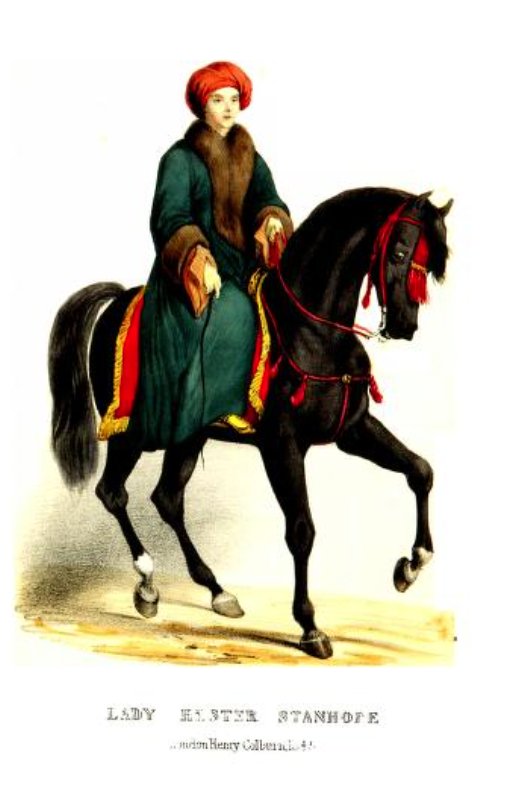
At this point she adopted the Turkish dress of the Ottoman Empire. She explains why she chose men’s clothing:

. . . Everything I possessed I have lost; had I attempted to have saved anything, others would have done the same, and the boat would have been sunk. To collect clothes in this part of the world to dress as an Englishwoman would be next to impossible; at least, it would cost me two years’ income. To dress as a Turkish woman would not do, because I must not be seen to speak to a man; therefore I have nothing left for it but to dress as a Turk — not like the Turks you are in the habit of seeing in England, but as an Asiatic Turk in a travelling dress — just a sort of silk and cotton shirt; next a striped silk and cotton waistcoat; over that another with sleeves, and over that a cloth short jacket without sleeves or half-sleeves, beautifully worked in coloured twist, a large pair of breeches, and Turkish boots, a sash into which goes a brace of pistols, a knife, and a sort of short sword, a belt for powder and shot made of variegated leather, which goes over the shoulder, the pouches the same, and a turban of several colours, put on in a particular way with a large bunch of natural flowers on one side. This is the dress of the common Asiatic; the great men are covered with gold and embroidery, and nothing can be more splendid and becoming than their dress. (Life and Letters of Lady Hester Stanhope, 116-117)

The clothes sound quite sumptuous, and she seems to have enjoyed them! As a foreign woman, and a woman in men’s clothing, Lady Hester occupied an unusual place in Ottoman society. She could be treated as more or less an “honorary man,” relating to local men in ways that local women could not.

Lady Hester Stanhope wearing Turkish men’s clothing. Frontispiece, Memoirs of the Lady Hester Stanhope, Vol. 1 (London: Henry Colburn, 1846).

Egypt to Palmyra

Lady Hester traveled deeper into the Middle East. She wasn’t much impressed with the wonders of Egypt. She refused to enter the Great Pyramid and complained of “an inconceivable number of fleas.” Many English tourists visited Egypt, and she wanted to do something more impressive.

Because of her background with Pitt in politics, and her connections, she was able to get permission from the Ottoman Pasha to go to Palmyra, an ancient city in the Syrian desert. When she reached it with her Beduin caravan after six days of travel, they “crowned” her “Queen of the Desert,” after the ancient Queen Zenobia.

During her travels, Lady Hester constantly racked up debts, and wrote back to the English government asking for money. They sometimes ended up paying because of her high connections.

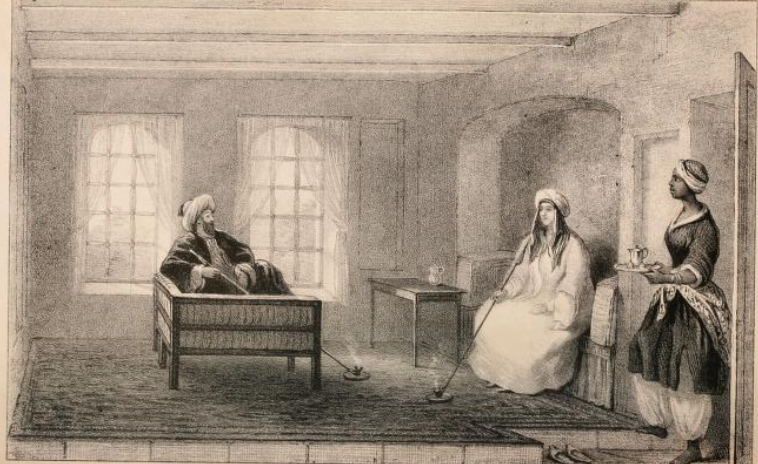
Lady Hester Stanhope smoking a Turkish pipe. Frontispiece, Memoirs of the Lady Hester Stanhope, Vol. 2 (London: Henry Colburn, 1845).

Archaeologist; Searching for Treasure

Emma Yandle, curator of the Chawton House exhibition on “Trailblazers: Women Travel Writers,” went on to discuss Lady Hester Stanhope’s somewhat questionable contributions to archaeology. Lady Hester was arguably the first Westerner given official permission to excavate an ancient site; certainly she was the first woman to do so.

Lady Hester somehow obtained a manuscript, purportedly written by a monk, describing the location of immense hoards of buried treasure (three million gold coins!) in the ancient cities of Ashkelon, Awgy (near Jaffa), and Sidon. She got permission and safe conduct letters from the Ottoman government to excavate at Ashkelon. She promised the Ottoman government all the treasure she would find. She asked the British government to pay for the excavations, simply for the honor it would bring to England and to herself.

Excavations began in April of 1815. Lady Hester was the visionary, nominally in charge. Actually, though, her personal physician, Dr. Charles Meryon, directed the excavations and kept the records. They found no gold coins.

They did, however, find one archaeological treasure. It appeared to be a Roman statue, somewhat mutilated. According to a later biography, this made Lady Hester Stanhope “the first person who ever intentionally excavated an ancient artifact in the ‘Holy Land.’”

However, Lady Hester feared that if the Ottoman ruler heard about this, he would believe that she was excavating treasures to send back to her native England. She had promised she would not do that. (Many others of the time were plundering the various countries they colonized.) So—she destroyed the statue! She had it smashed and thrown into the sea. A very strange decision.

We still have drawings and a description of the statue, but that’s all. A much later archaeological expedition, in 1921, found what were apparently the missing pieces of that statue.

The records of the expedition, however, gave a lot of historical information. The layers of history that were uncovered were recorded: a Roman temple at the lowest layer, above it a church, and over that a mosque. (This was confirmed by the later expedition.) They also recorded the locations of any artifacts found. This was a new procedure. Other diggings at the time simply took whatever they could find and shipped it off to museums or private collections, with no details of location or depth. So Lady Hester’s excavation did blaze new trails for archaeology.

End of Life

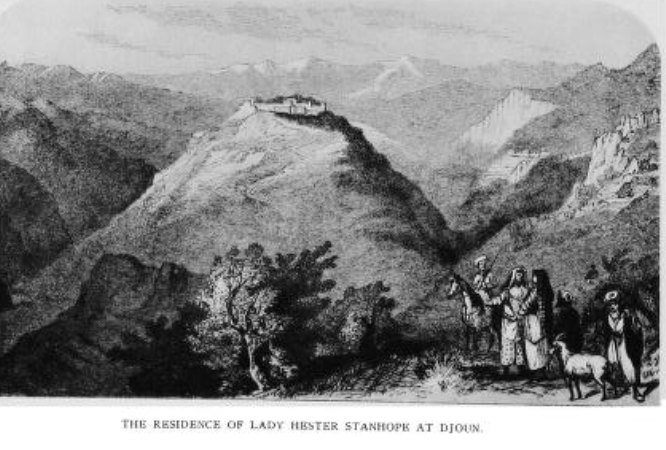
Lady Hester Stanhope later settled on a mountaintop among the Druze people of Lebanon, near Sidon. She became disastrously involved in Middle Eastern conflicts, and went deeper and deeper into debt. She died, penniless and alone, in 1839.

The Residence of Lady Hester Stanhope at Djoun. Frontispiece, The Life and Letters of Lady Hester Stanhope, by her niece the Duchess of Cleveland (London: John Murray, 1914).

Dr. Meryon, who had accompanied her on many of her travels, wrote her memoirs in 1845-6, romanticizing her story.

Paul Pattison, at English Heritage, summarizes Lady Hester Stanhope’s life: 

She was always a wilful aristocrat, who wanted to govern her life and the lives of others – indeed believed it was her position in life to do so – and on occasions she was overbearing and unkind. But she was also vivacious, daring, sharp-witted, charismatic, benevolent, and brave to the point of recklessness. 

Above all, she rejected society conventions and the restrictions of life for a woman in Europe, embracing the unexpected opportunity to be her own mistress within an Eastern culture that excluded women from public life. That alone sets her apart as a pioneer and an extraordinary human being.

As far as I’ve been able to discover, Jane Austen never mentioned Hester Stanhope in her letters. She may have known of some of her exploits, however. Both were trailblazers: Jane, quietly, from her home; and Hester, flamboyantly, in exotic places.


Resources about Lady Hester Stanhope

Memoirs of the Lady Hester Stanhope; the sequel, Travels of Lady Hester Stanhope; and Life and Letters of Lady Hester Stanhope, are available on archive.org

Lady Hester, Queen of the East, by Lorna Gibb

Star of the Morning: The Extraordinary Life of Lady Hester Stanhope, by Kirsten Ellis


Brenda S. Cox is the author of Fashionable Goodness: Christianity in Jane Austen’s England. She also writes for Faith, Science, Joy, and Jane Austen.


Read Full Post »

As we investigate the private lives of Regency Women, it’s important to consider money and a woman’s private expenses. If a genteel woman was expected to dress a certain way, do her hair in the latest styles, wear the right shoes and accessories to accentuate her beauty, and care for her own private needs and beauty regimes, how did she pay for everything she needed?

If one of Jane Austen’s heroines (or Jane herself) wanted to purchase something like a bonnet or a ribbon or a new gown, where did she get the money? Who supplied her with money, what was the amount she might have to spend, and how often was it replenished? Let’s find out!

You are very right in supposing how my money would be spent—some of it, at least—my loose cash would certainly be employed in improving my collection of music and books.

Marianne Dashwood, Sense and Sensibility
Magazine of Female Fashions of London and Paris, No.21. London Dresses, 1799, Wikipedia Commons.

Pin Money

Pin money, also sometimes referred to as an allowance, was the money that genteel Regency women used for personal expenses, such as dresses, hats, shoes, and other things of that sort. She kept an accounting of it herself and must balance her own budget.

The history of the term “pin money” dates back to the 1500s: “At that time, pin money was a substantial sum that was used for important purchases. The expression is linked to the price of straight pins, once items that were very rare and expensive, and part of the necessary purchases to run a household” (Grammarist). Over time, the term became synonymous with a woman’s personal money.

For the most part, genteel Regency women were entirely reliant on their male relatives for any “loose cash” for their own personal expenses. As an unmarried woman, she would only have what money her father or a close male relative gave to her (or left to her). Once married, she only had what her husband gave to her or what she was entitled to as part of her marriage settlement.

British Sixpence, 1816, Wikipedia Commons.

Jane Austen’s Allowance

We know that Jane Austen herself had a small allowance from her father. In Oliver MacDonough’s Jane Austen: Real and Imagined Worlds, we read this: “Jane had nothing of her own beyond the pin-money allowed her by her father, which was probably only £20 a year.” Cassandra’s annual allowance, as noted in a letter from 28 December 1798 was twenty pounds: “If you will send my father an account of your Washing & Letter expenses, & c, he will send you a draft for the amount of it, as well as for your next quarter [£5, to be paid on 1 January].”

Mrs. Darcy’s Pin Money

Finally, Pride and Prejudice shows us how a generous allowance allowed married women to live in comfort, having enough for their own needs and for the needs of others, either for charitable giving or to help support family members.

We can now read Mrs. Bennet’s famous reaction to Elizabeth’s engagement to Mr. Darcy with even more interest:

Oh! my sweetest Lizzy! how rich and how great you will be! What pin-money, what jewels, what carriages you will have! Jane’s is nothing to it – nothing at all.

Mrs. Bennet, Pride and Prejudice
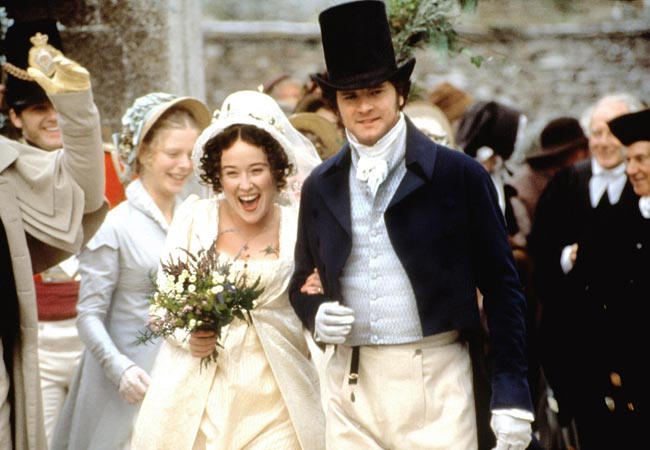
Jennifer Ehle and Colin Firth, Pride and Prejudice, 1995

And it seems that Mrs. Bennet was correct indeed. We see this play out when Lydia writes to Elizabeth at the end of Pride and Prejudice, hoping to get a regular allowance from Elizabeth and Darcy: “As it happened that Elizabeth had much rather not, she endeavoured in her answer to put an end to every intreaty and expectation of the kind.”

However, while the Darcys do not provide the Wickhams with a regular allowance, Elizabeth still kindly send gifts of money on a frequent basis to help Lydia. She gives this money out of her own private funds, which as the text implies, was substantial:

Such relief, however, as it was in her power to afford, by the practice of what might be called economy in her own private expenses, she frequently sent them. . . and whenever [the Wickhams] changed their quarters, either Jane or herself were sure of being applied to for some little assistance towards discharging their bills.

Pride and Prejudice, Jane Austen

The Love of Money

Money mattered greatly in the lives of Jane Austen’s Regency women. Having “loose cash” didn’t just provide for bonnets and gowns; it also provided for the safety and protection of several of Austen’s female characters. Money could be used as a means of control or generosity. It could limit a woman or give her greater freedom.

Join me again next month as we delve further into Regency Women: Money Matters and look closely at several instances where Austen uses a lady’s personal money (or lack thereof) as a clever plot device.


RACHEL DODGE teaches college English classes, gives talks at libraries, teas, and book clubs, and writes for Jane Austen’s World blog and Jane Austen’s Regency World magazine. She is the bestselling author of The Anne of Green Gables Devotional: A Chapter-By-Chapter Companion for Kindred Spirits and Praying with Jane: 31 Days Through the Prayers of Jane Austen. Her newest book The Little Women Devotional is now available for pre-order and releases December 2021. You can visit Rachel online at www.RachelDodge.com.


Read Full Post »

Regency women went to great lengths to achieve an effortless, romantic look with long, flowing lines to their dresses and hairstyles. Even their dresses, which appeared to have little underneath, had several layers hidden below the surface. As with everything, nothing in the Regency era is quite as simple as it seems.

And behind the scenes of every genteel woman’s daily beauty regime were servants who made it all possible. Without today’s modern household appliances, a whole team of people were required to make a household run smoothly. There were servants who laundered, mended, ironed, and polished. Maids who buckled, tied, boosted, and smoothed; carried clean, hot water for bathing; and emptied bathtubs and chamber pots. Men and women cleaned, cooked, served, polished, and dusted. All so that life could go on smoothly and seamlessly.

Women in Jane Austen’s world were expected to be many things, especially when it came to their personal appearance, but what went on behind the scenes to make these women appear so effortless and graceful?

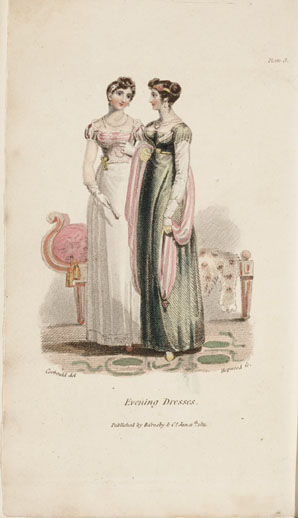
Evening dresses, fronticepiece, The Mirror of Graces,, 1811
Evening dresses

[Mr. Bingley] came, and in such very good time that the ladies were none of them dressed. In ran Mrs. Bennet to her daughter’s room, in her dressing gown, and with her hair half finished, crying out:

“My dear Jane, make haste and hurry down. He is come—Mr. Bingley is come. He is, indeed. Make haste, make haste. Here, Sarah, come to Miss Bennet this moment, and help her on with her gown. Never mind Miss Lizzy’s hair.”

“We will be down as soon as we can,” said Jane; “but I dare say Kitty is forwarder than either of us, for she went up stairs half an hour ago.”

Oh! hang Kitty! what has she to do with it? Come be quick, be quick! Where is your sash, my dear?”

Pride and Prejudice, Jane Austen

It took time to achieve the polished look of a Jane Austen heroine; thus, I’ve also included additional links for each of the topics below for those who want to delve deeper. Let’s look behind the scenes:

Bathing

Cleanliness then wasn’t quite what it is today. Bathing only became common during the 18th century in wealthy households. In Jane Austen’s time, baths were taken once a week (more or less depending on the season) with sponge baths in between. This was usually done by sponging off with a pitcher of water and a little basin on the bedroom dresser. To bathe, people sat in a larger tub or stood in a smallish tub on the floor and washed with a pitcher of water. (The Family, Sex & Marriage in England 1500-1800 by Laurence Stone)

A portable bath shower from the mid 19th c.

Affordable soaps of the time were soft and more caustic than the soaps, lathers, and body washes we enjoy today. Firm, refined bar soaps were scented and more costly (and therefore less frequently used). As for a woman’s hair, the same soap used for the body was also used for the hair, and the hair was washed far less often than today.

Oral Health

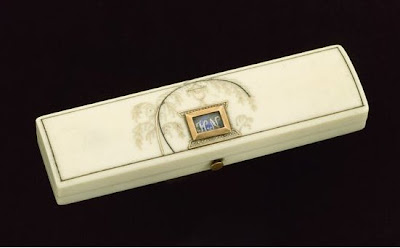
As for dental health, tooth brushes and tooth powder were used. In Sense and Sensibility, we read this: “He was giving orders for a toothpick-case for himself, and till its size, shape, and ornaments were determined, all of which, after examining and debating for a quarter of an hour over every toothpick-case in the shop, were finally arranged by his own inventive fancy…”

Toothpick Case, National Maritime Museum, 1806

From Austen’s own letters, we know that dentistry in her time was a grisly business:

The poor girls and their teeth! I have not mentioned them yet, but we were a whole hour at Spence’s, and Lizzy’s were filed and lamented over again, and poor Marianne had two taken out after all, the two just beyond the eye teeth, to make room for those in front. When her doom was fixed, Fanny, Lizzy, and I walked into the next room, where we heard each of the two sharp and hasty screams.

The little girls’ teeth I can suppose in a critical state, but I think he must be a lover of teeth and money and mischief, to parade about Fanny’s. I would not have had him look at mine for a shilling a tooth and double it. It was a disagreeable hour.

Jane Austen’s Letters, Henrietta St., 15 Sept. 1813

The advent of modern dentistry, and the use of anesthetics, wouldn’t come until long after Austen’s lifetime. I, for one, feel much more enthusiastic about my next dental cleaning after this. For more on the topic of Regency dentistry, you can read this JAW article on Dental Hygiene in the Regency Period.

Dressing and Undergarments

For the latest fashions, women often shared patterns and new fashions. Those who had lately traveled to London or even Bath brought back descriptions, clippings, and patterns to share with their friends and family member. In Pride and Prejudice, we read this about Mrs. Gardiner’s visit: “The first part of Mrs. Gardiner’s business on her arrival, was to distribute her presents and describe the newest fashions.”

Underdrawers belonging to the Duchess of Kent, 1810-1820

As fashions evolved, so did women’s undergarments. Under their slim, empire-waisted Regency dresses made of thinner material than previous years, women wore a shift, stays, a waist petticoat, stockings, and more. With so much to lace up and buckle, women needed help getting dressed. On the topic of stays, we know that Jane wrote this to Cassandra:

I learnt from Mrs Tickar’s young Lady, to my high amusement, that the stays now are not made to force the Bosom up at all; that was a very unbecoming, unnatural fashion.

Jane Austen’s Letters, September 1813

However, women did not yet wear “underwear,” drawers, or pantaloons. Drawers were considered immodest and improper, something only men wore, until the early to mid 1800s. Slowly they caught on, and by the mid-1800s they were a matter of course when hoop skirts became popular. You can find more here: Ladies Underdrawers in Regency Times: Regency Underwear.

Cosmetics

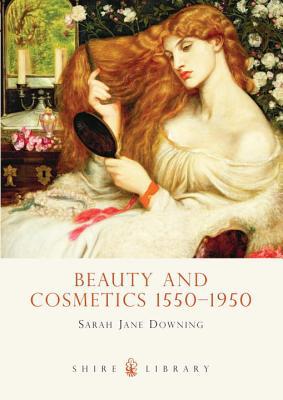
In terms of cosmetics, a more natural Romantic look took hold during Austen’s life, in large part aided by the blockade during the Napoleonic Wars. Ladies were still, nevertheless, never too far from their rouge pot (Beauty and Cosmetics, 1550-1950 by Sarah Jane Downing). Regardless of one’s complexion or skin tone, a rosy glow was part of achieving that healthy romantic look.

As for covering up body odor, deodorant was not yet used, while the perfumes of the time tended toward sweet, musky scents. To find out more about cosmetics and how they were made (many times out of materials we now know are dangerous), you can read this article: A Deadly Fashion: Beauty and Cosmetics 1550-1950 – A Review.

Hair

During Jane Austen’s lifetime, hairstyles for women became more natural and graceful. This meant instead of powder, wigs, and elaborate updos, the natural hair color became popular again. Women wore their hair swept up into simple twists, buns, and chignons with locks of hair curled around their faces. Curling tongs and curling papers and cloths were used to create this effect.

The fashions and hairstyles all came from the Greco Roman styling that became popular during Austen’s day. You can read more here: Greco Roman Influences on Women’s Hairstyles During the Georgian Era.

Combs used as hair accessories

With the bonnets and caps used at the time, curls were used to frame the face. For evening and dinner parties, accessories such as combs and ribbons were used. Often a maid helped fix a lady’s hair each morning and before an evening dinner or party. What might look like a very natural hairstyle could take quite a bit of time to perfect beforehand. For more, you can read about Regency Hairstyles and their Accessories. Additionally, you can view Vic’s stunning Pictorial History of Regency Hairstyles.

A Look Behind the Scenes

The world of a genteel Regency woman was complex and nuanced. Next month, I’ll discuss “Privy” Matters: Regency Feminine Hygiene, Bodily Functions, and Childbirth. We’ll take an even closer, behind-the-scenes look at a genteel woman’s private life in Jane Austen’s time. All to help us understand the real-life world of carriage rides, balls, dinners, and courtship that we so enjoy in Austen’s novels.

As much as I love dressing up for a Jane Austen event, all of this information reminds me, as ever, that as romantic as everything looks in a Jane Austen film, life for women of her time was anything but simple—even for those who were part of the landed gentry.

When I’ve dressed for the ball given at past JASNA AGMs, my outer layer tends to be the most historically accurate. I’ve yet to invest in undergarments, and I usually “make do” with my own homemade hair accessories, jewelry, and ballet flats. One day, I’d like to invest in a bonnet. As one wise woman once told me at an AGM, “It takes years to build your Regency wardrobe – just take it one piece at a time.” Do you own any Regency clothing? If so, what do you enjoy wearing most? -Rachel


RACHEL DODGE teaches college English classes, gives talks at libraries, teas, and book clubs, and writes for Jane Austen’s World blog and Jane Austen’s Regency World magazine. She is the bestselling author of The Anne of Green Gables Devotional: A Chapter-By-Chapter Companion for Kindred Spirits and Praying with Jane: 31 Days Through the Prayers of Jane Austen. Her newest book The Little Women Devotional is now available for pre-order and releases December 2021. You can visit Rachel online at www.RachelDodge.com.

Read Full Post »

Older Posts »