This Jane Austen blog brings Jane Austen, her novels, and the Regency Period alive through food, dress, social customs, and other 19th C. historical details related to this topic.
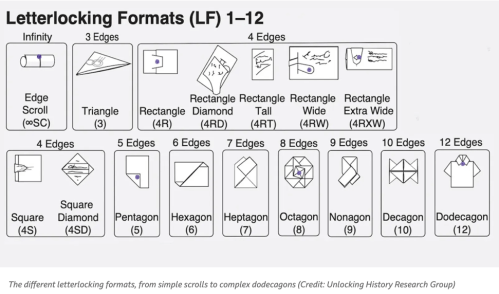
Letterlocking was a method used by European societies between the 15th – 18th centuries to keep messages private. Ancient human societies found other techniques to protect their messages through the use of seals, or, as in the case of Ancient Mesopotamia, cylinder seals that were unique to each owner. These were eventually replaced with stamp seals, some of which are still used today in the form of signet rings.
Cylinder seal, Walters Art Museum, public domain image
Stamp seal, Met Museum, public domain image.
Today I seek other ways to keep my public affairs private. Passwords for my online correspondence and purchases are changed frequently, and I make sure to have a secure two-step process for accessing the information along with a back up plan.
During Jane Austen’s lifetime, envelopes were not yet used. The extra weight made the expense of sending or receiving letters more expensive. Therefore, the paper was carefully folded. Often the lines were crossed, as shown in an article from this blog. Images of Austen’s surviving letters demonstrate the method by which she folded them, as described by Jane Austen’s House .
The letter was written across the first three pages and the top and bottom thirds of the fourth page, leaving its middle third blank. With the first page uppermost, the bottom third of the letter was then folded upwards and the top third folded down so that the edges met in the middle. Then, holding the letter lengthways, the left-hand and right-hand sides were tucked inside each other. The packet was sealed with wax and the address written on the blank reverse. – Room 5: How to Write and Fold a Letter, Jane Austen’s House
One method of letterlocking is shown in the YouTube video below.
Letterlocking is the art of using specific folds and cuts in flexible paper to seal it shut for document security. Because paper was not always as common as it is today, it was much more expensive, which led to minimizing the use of paper as much as possible. At this point in history, envelopes would have been seen as excess cost, an issue that was quickly solved with letterlocking.” — Securing Ancient Secrets: The Fascinating History of Letterlocking, Ancient Origins
In a BBC article (see link below), Richard Fisher described the historic research that uncovered the secrets to letterlocking in the early 2000’s. Conservator Jana Dambrogio was the first woman allowed to work in the Vatican Secret Archives when she found a cache of documents and noticed cuts, creases and folds in the paper. Thinking they were evidence of letterlocking, she scientifically described what she observed.
She and a colleague, Starza Smith, searched for more letterlocking samples, which they often found in old archives and museum collections. Recently they discovered a trunk containing 2,600 letters from 17th-Century Europe, of which 577 were unopened. This trove provided details of European life during the 1600s.
As a final act before her execution, Mary Queen of Scots sealed a letter she wrote to her brother-in-law with a spiral lock. He would have known her message had been intercepted if that seal arrived broken. The irony would not have been lost on a juvenile Austen, whose “History of England” included a memorable passage about the doomed queen.
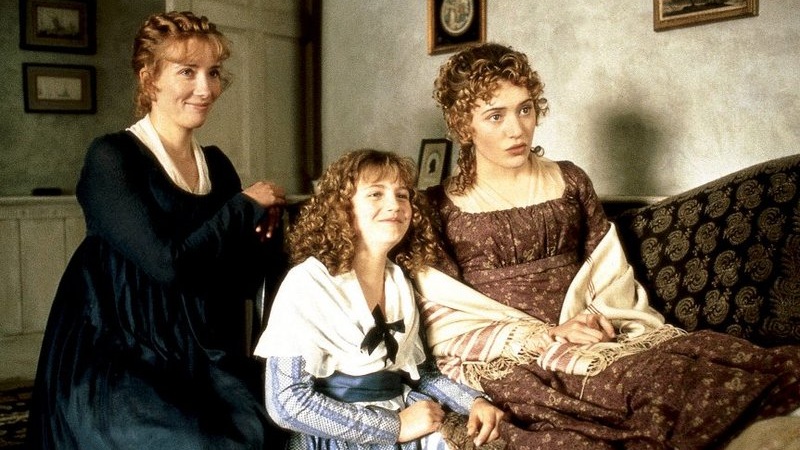
Last but certainly not least, this brings us to Sense and Sensibility and one of Austen’s most mature and intricate plots. Sense and Sensibility is unique in that it contains two main love stories with its sister-heroines, Elinor and Marianne Dashwood. Though Elinor is the main protagonist of the novel, Marianne’s romantic life is often front-and-center with its high drama and plot impact.
Love Triangles
In the world of storytelling, love triangles provide a potent plot device. There’s the age-old King Arthur-Guinevere-Lancelot story that’s been told again and again; the love triangle/identity mix-up in Shakespeare’s Twelfth Night; and the explosive Heathcliff-Cathy-Edgar triangle in Wuthering Heights. And this is only the tip of the iceberg. We could add dozens of other famous triangular love stories to this list.
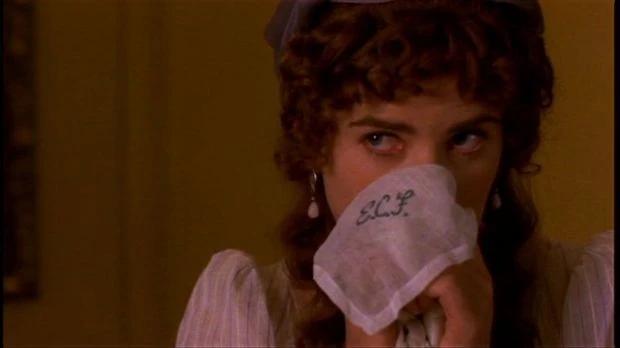
In Sense and Sensibility, Austen provides her readers with not one, but two separate love triangles to untangle between Elinor-Edward-Lucy Steele and Marianne-Willoughby-Colonel Brandon.
In each of these triangles, there is one “wrong” person standing in the way of true love with Mr./Ms. Right. For Colonel Brandon, Willoughby takes the spotlight and all of Marianne’s attention. For Elinor, Lucy stands in the way of her happiness with Edward, due to an unfortunate youthful promise made by Edward.
In both of these love triangles, a character falls for Mr./Ms. Wrong first and later finds Mr./Ms. Right. Elinor and Colonel Brandon both wait in the wings and watch to see if Edward and Marianne will break free from their previous attachments. They both must wait and wonder; they both feel the pain and angst of separation; and they both know that they may never find their personal happy ending.
The only difference is, Edward and Elinor have a mutual attachment to one another, while Marianne does not develop romantic feelings toward Colonel Brandon until far later in the novel. She thinks he’s far too old for romance and “thirty-five has nothing to do with matrimony”:
Colonel Brandon is certainly younger than Mrs. Jennings, but he is old enough to be my father; and if he were ever animated enough to be in love, must have long outlived every sensation of the kind. It is too ridiculous! When is a man to be safe from such wit, if age and infirmity will not protect him?
Sense and Sensibility
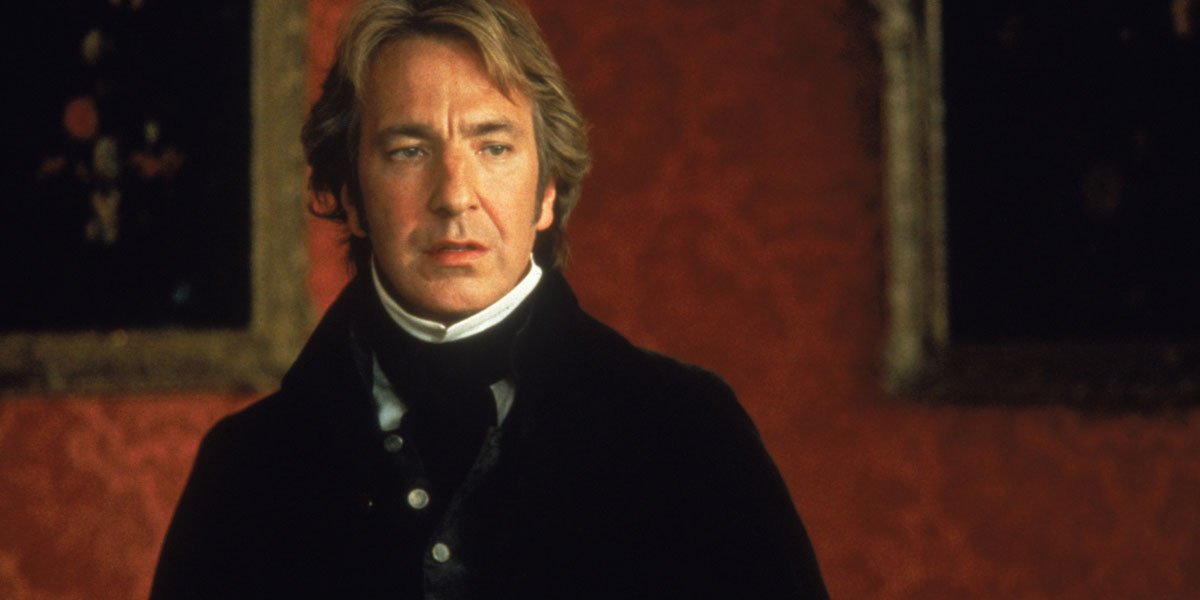
Thus, Colonel Brandon must wait in the wings, ever true and ever patient, caring deeply for Marianne and wanting the best for her, even if it means watching her break her heart and health over Willoughby.
Mr. Wrong: The Problem with Willoughby
As in life, Jane Austen’s characters often have to fall for Mr./Ms. Wrong before they can appreciate Mr./Ms. Right. In some of her novels, she even uses a “red herring” to keep her readers distracted (Frank Churchill is one such example). In Sense and Sensibility, Marianne Dashwood falls for a young, dashing, handsome, attractive man who appears to be everything she’s ever hoped for in a man.
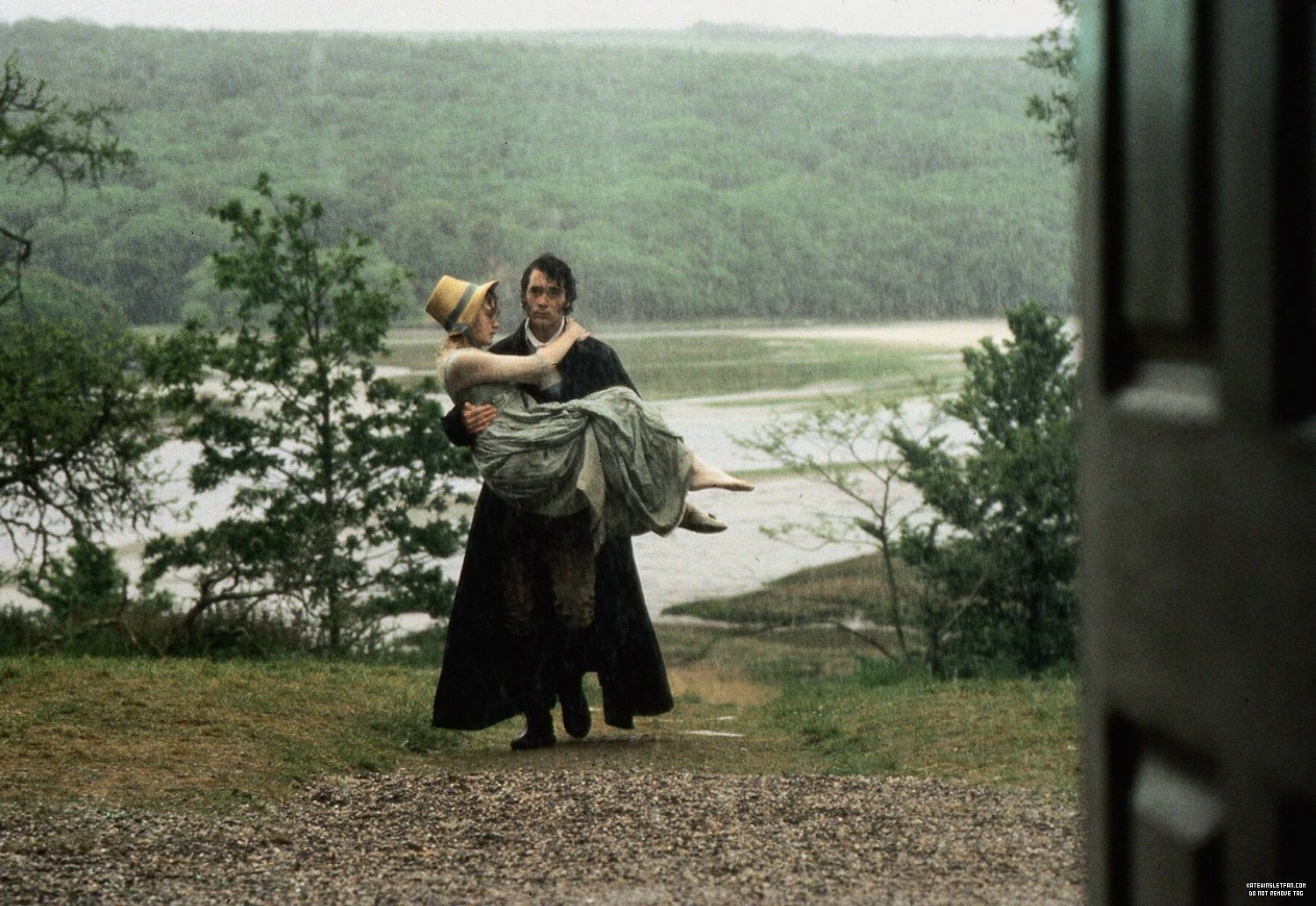
To make matters even more exciting, their “meet-cute” involves an intoxicating rescue scene where Willoughby lifts Marianne and carries her home after she falls down and is hurt. How could a young lady, especially a young romantic woman like Marianne, not fall for a strong, handsome man who literally sweeps her off her feet and carries her through the rain to safety.
The problem is, no matter how dashing, friendly, attractive, romantic, or exciting Willoughby might appear, he is not who he seems. As we later find out from Colonel Brandon, Willoughby has a checkered past and has impregnated (at least) one young woman out of wedlock, without taking any responsibility for her care, sufficiently ruining her reputation and her chances (in that time/culture) of a happy future.
But, you might ask, how could anyone have known, since the fate of Colonel Brandon’s ward was unknown to any of the Dashwoods until much later? Though no one could believe just how bad he is, Austen does provide clues about Willoughby’s character through her descriptions of his conduct. He frequently crosses lines of propriety (usually a red flag in Austen’s novels) and makes himself far too cozy and familiar with Marianne without making any firm promises.
Today, dozens of movies and books follow a similar script. We often see characters like Mr. Willoughby, Mr. Wickham, and Mr. Crawford who are just a little bit too handsome, too dashing, and too perfect to actually be Mr. Right.
Ms. Wrong: The Problem with Lucy Steele
The problem with Lucy Steele is more a matter of youthful ignorance and inexperience. Edward Ferrars is captivated by Lucy’s beauty and, due in part to forced proximity, experiences young love and makes a commitment to someone who does not match his personality, intelligence, values, or interests in life. Austen describes her as “illiterate, artful, and selfish” – certainly no match for a thoughtful, principled man like Edward.
Not surprisingly, he soon regrets committing himself to a woman like Lucy:
The youthful infatuation of nineteen would naturally blind him to every thing but her beauty and good nature; but the four succeeding years—years, which if rationally spent, give such improvement to the understanding, must have opened his eyes to her defects of education, while the same period of time, spent on her side in inferior society and more frivolous pursuits, had perhaps robbed her of that simplicity which might once have given an interesting character to her beauty.
Sense and Sensibility
And while Lucy at first only appears to be an ignorant, vapid girl without much sense, we quickly realize she is far less sweet and far more dangerous than meets the eye. She’s not in love with Edward; she merely sees him as a “way up.” We later find out that she’s a conniving “gold digger” (to use today’s terms) who is looking for any way to climb the social ladder and make the best match she can, regardless of who she hurts or what anyone thinks.
This type of female red herring shows up in many popular romantic movies and books today as well. However, in many of today’s plot lines, this type of female character tends to be some kind of shark in the business world who cares more about appearances and getting ahead than building a loving relationship and happy life with the handsome main character.
Finding Mr. (Colonel) Right
Marianne must go through heartache before she can appreciate or fall in love with Colonel Brandon. He watches and waits, hoping against hope, until she begins to blossom and heal from her broken heart. His steadiness, thoughtfulness, and gentlemanlike manner is a welcome change from the high drama and passion of her first attachment, and soon an attachment forms:
Instead of falling a sacrifice to an irresistible passion, as once she had fondly flattered herself with expecting,—instead of remaining even for ever with her mother, and finding her only pleasures in retirement and study, as afterwards in her more calm and sober judgment she had determined on,—she found herself at nineteen, submitting to new attachments, entering on new duties, placed in a new home, a wife, the mistress of a family, and the patroness of a village.
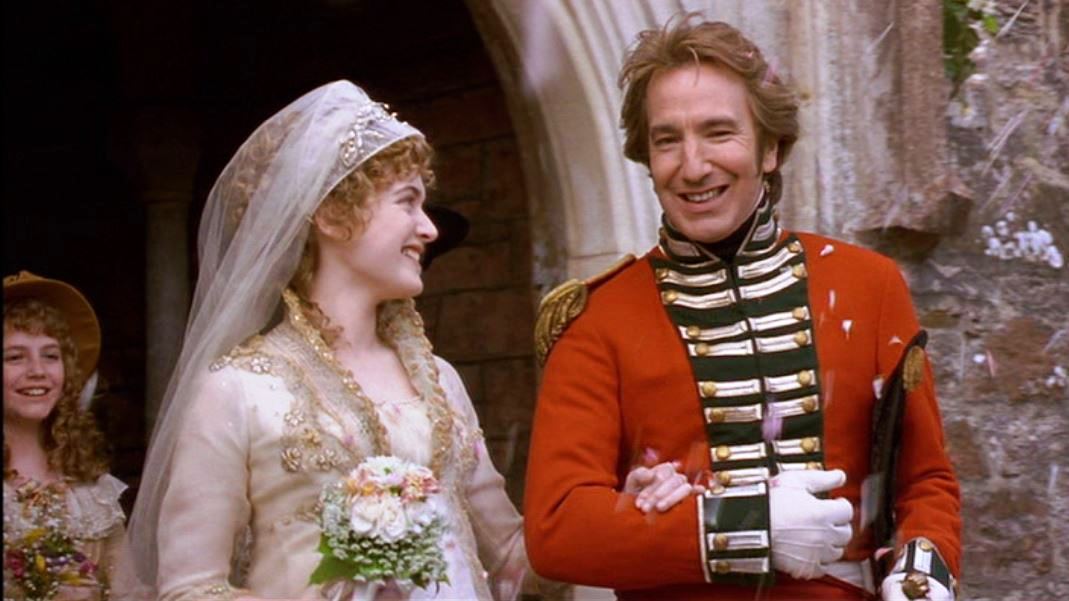
Colonel Brandon was now as happy, as all those who best loved him, believed he deserved to be;—in Marianne he was consoled for every past affliction;—her regard and her society restored his mind to animation, and his spirits to cheerfulness; and that Marianne found her own happiness in forming his, was equally the persuasion and delight of each observing friend. Marianne could never love by halves; and her whole heart became, in time, as much devoted to her husband, as it had once been to Willoughby.
Sense and Sensibility
In today’s popular movies and books, a character like Colonel Brandon is sometimes the childhood best friend or the nerdy next door neighbor that suddenly turns handsome. It’s usually a matter of the main character being blinded at first by a passionate but unhealthy relationship and then “coming to their senses” and noticing the quality person that’s been there all along.
As far as the age-gap between Brandon and Marianne (which was quite common during Austen’s day and culture), many of today’s romantic storylines, such as As Good as It Gets, Crazy Heart, and Autumn in New York, feature a May-December romance.
Finding Ms. Right
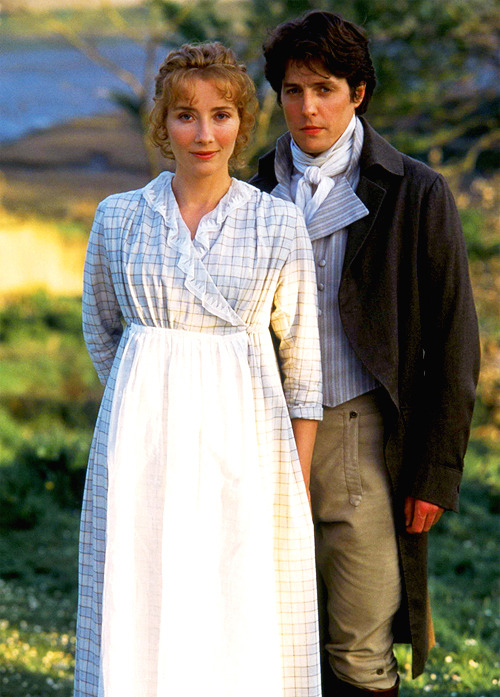
From the moment they meet, it’s clear that Elinor and Edward are perfect for one another in every way. For Edward, once he meets a woman of Elinor’s caliber, there is no question that she is far superior to Lucy Steele.
However, Edward is a man of his word and refuses to do wrong by Lucy Steele. This honorable choice only serves to make Edward more attractive, even though Elinor is pained deeply by the knowledge that he must marry an ignorant woman he does not love. Like Brandon, Elinor waits patiently, enduring much pain, until Edward is finally set free.
Dozens of movies and televisions shows use this type of plot line where the main character must come to the realization that their current relationship is all wrong and someone else is a much better fit. Sweet Home Alabama is one mainstream movie example of this type of love affair.
Love Triangles in Popular Media
More romantic comedies feature a love triangle of some kind in today’s world of romantic writing.
The following are some popular movies (and/or books) with this theme: Pretty in Pink, While You Were Sleeping, The Notebook, Beauty and the Beast, Spider-Man, The Hunger Games, Titanic, Twilight (Team Edward v. Team Jacob), My Best Friend’s Wedding, Bridget Jones’s Diary, Sabrina, Reality Bites, Gone with the Wind, Something Borrowed, Pearl Harbor, Pirates of the Caribbean, and The Princess Bride.
Some well-known television love triangles include: Dawson’s Creek, Friends, Gilmore Girls, The Office, Beverly Hills 90210, Sex & The City, How I Met Your Mother, Felicity, Outlander, The Summer I Turned Pretty, Never Have I Ever, Friday Night Lights, Lost, and Grey’s Anatomy.
Though none of these shows or movies holds a candle to Austen’s writing, it’s clear that love triangles and plot twists about finding and/or waiting for Mr./Ms. Right continue to keep audiences coming back for more.
Happily Ever After
In the end, everyone lives happily ever after. (Except, of course, those characters whom Austen deems foolish or undeserving of true happiness.) As always, Austen provides her reader’s with a satisfying ending: “Let other pens dwell on guilt and misery. I quit such odious subjects as soon as I can, impatient to restore everybody not greatly in fault themselves to tolerable comfort, and to have done with all the rest.”
As we close this pop culture series on Jane Austen and Rom Coms, I’d love to know which couples and romantic themes are your favorite(s) in her novels!
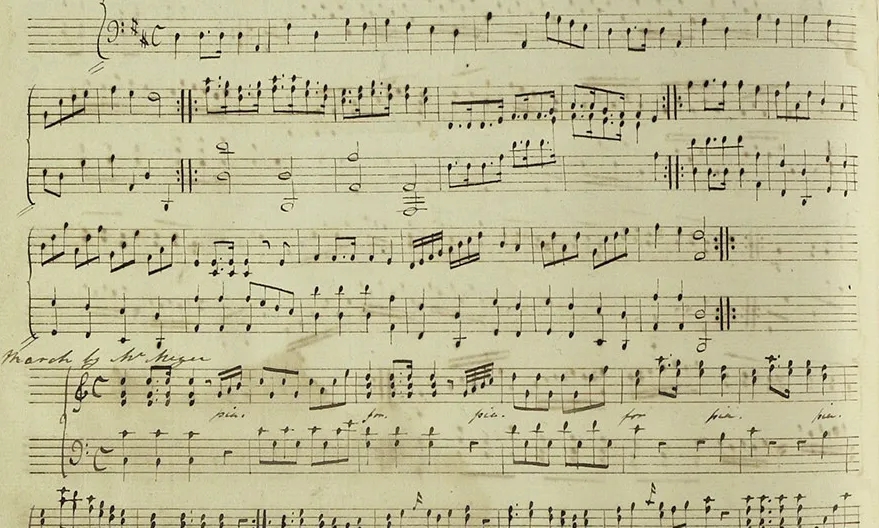
Jane Austen’s relationship with music, especially her private morning sessions on the piano forte before her family arose, was as creatively important to her as her writing. Digitized versions of the Jane Austen Music Books are stored on the Southampton UK website, where scholars, musicians, and Austen fans can peruse the music that the family liked and deemed important.
“The Austen Family Music Books is a collection of 18 albums of music containing around 600 pieces that belonged to the 19th century writer and her relations.”
Yet even with these troves of treasures, modern audiences are left to wonder:
This musical score, in Jane Austen’s handwriting, is one of nearly 600 Austen family musical treasures available in an online archive. Jane Austen Museum/Public Domain
“So what kind of music did Jane Austen like to play?
“The line between classical and popular music was very soft in that period,” [Austen scholar Professor Joan] Ray noted. “She lived 1775 to 1817. So she has a lot of popular music but, for example, she had a popular song called ‘William.’ But when music scholars really looked at the 20th and 21st centuries, they discovered it was actually based on Haydn’s Piano Concerto No. 1.”
The Colorado Public Radio site provides sample music from movie soundtracks based on Austen’s novels. Interestingly, today’s film composers have only a vague idea of the music Austen specifically liked because of the very few references she made in writing: they had to imagine which music best represented the stories in the time they were written. The 1995 film of Pride and Prejudice used music from Mozart, Haydn, and Schubert: it is still celebrated as one of the best musical scores in an Austen film.
Three Emma film musical scores
The music scorers of following three Emma film adaptations use different approaches to music to tell Austen’s tales of the young, self-important heroine. If you have access to the streaming videos or own the DVDs, you may want to listen to the music and compare how their composers move these plots forward. The scores of each film are suited to the settings and vision of the film director.
Emma 1996 with Gwynneth Paltrow: Rachel Portman, the female composer for the musical score, won an academy award.
“One of Rachel’s [Portman’s} most well-known film scores was for Emma (1996). Starring Gwyneth Paltrow, this film is an adaptation of the Jane Austen novel of the same name. A light and playful romantic comedy, the film needed the right music to go with it. As FF2 Contributor Sophia Jin says of Rachel’s score for Emma, “Portman’s music feels joyful and lighthearted. It is warming and brings a sense of calm and peace to the picture.” Rachel won an Academy Award for Best Musical or Comedy Score for Emma, making her the first female composer to win an Academy Award in that category.” – Composer Rachel Portman is a Mastermind of Movie Music, International Swans
YouTube video of 3 musical themes from Emma 1996
Emma 2009, with Romola Garai took an earthier musical approach. In this film adaptation, Highbury was depicted as a relatively unsophisticated country town outside of London. Emma danced to rustic music that could easily be played by local musicians. The costumes also had a more earthy, homemade feel.
Emma 2009: 4 musical themes from the film – YouTube video
Emma 2020 mixes folksongs that were popular during Austen’s era, with classical, and modern compositions.
The score fits the beautiful, elegant vision of director Autumn de Wilde, who had only directed music videos before tackling a full length feature film.
As with today’s musical tastes, in Austen’s day the line between classical and popular music was ever shifting. She copied the music of “La Marseillaise”, the French National Anthem, and contemporary tunes and folk music that were popular in her day. The Family Music Books show the family’s preferences, but few references were made in Austen’s letters to the music she practiced daily. In her writings, she mentioned only one classical composer – Johann Baptise Cramer. The following YouTube video features his Piano Concerto No 5 in C Minor, Opus 48.
Cramer was credited with renaming Beethoven’s final piano concerto the “Emperor”. Beethoven began composing this Concerto in 1809, while Vienna was under invasion from Napoleon’s forces for the second time.
No documentation exists that Austen heard this concerto in person. After moving to Chawton, Austen visited her brother Henry frequently in London to work on the publication of her novels. Before this period she lived in Bath after her father retired from his living in Steventon. In both cities she regularly attended recitals and concerts, and likely had a more sophisticated exposure to contemporary music, especially to the works that arrived in major cities from the European composers.
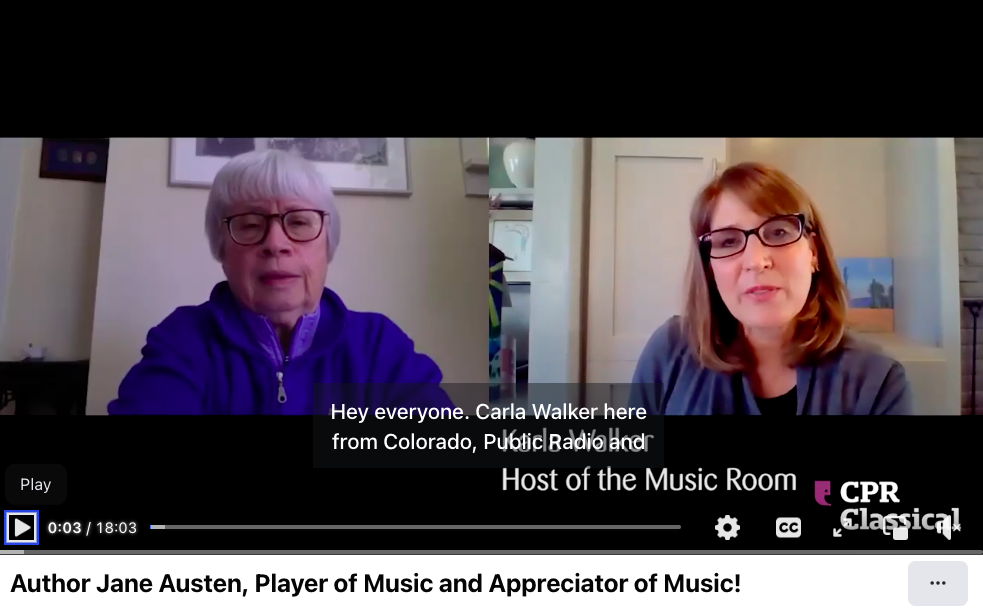
Screen shot of Joan Ray’s talk with Carla Walker, host of the Music Room, CPR Classical, Public Radio
The clue to Austen’s love for music was in her daily practice at the piano forte. Her novels also provided clues. Any young lady in her novels who lived in the upper strata of society learned to play the piano forte and/or harp and could give concerts at home events. As for Austen, her morning practices were private. She did not provide entertainment for others in a public situation as some films have suggested. Instead, Austen took quiet comfort and inspiration from her morning musicals. They added as much to her creativity as her writings.
More background information and suggested readings:
Music and Class in Jane Austen » JASNA: This is an excellent article with far ranging analysis of Austen and her characters in her novels re: their class status. Highly recommended.
“My father’s old Ministers are already deserting him to pay their court to his Son; the brown Mare, which, as well as the black was to devolve on James at our removal, has not had patience to wait for that, & has settled herself even now at Deane.”—Jane Austen to Cassandra, Jan. 8, 1801, when her brother James was about to take over their father’s place as clergyman at Steventon church (as his father’s curate), and James was taking over much of their property as Jane, Cassandra, and their parents moved to Bath.
Church was an important part of Jane Austen’s life and her family’s lives. Last time we explored the church at Chawton, which Austen attended during the later years of her life. Today we’ll visit Steventon, the church in which she grew up. Both churches are named after St. Nicholas, both are small country churches of the national Church of England, and both are named after St. Nicholas, patron saint of sailors, children, and others. (He is also called, in a more modern incarnation, Santa Claus.)
Jane grew up in the rectory at Steventon, which no longer exists. Her father was the rector, the clergyman of St. Nicholas’. The rectory, or parsonage, was the house provided for the rector to live in. George Austen made repairs and additions to the rectory as his family grew, and as he began to teach boarding students to supplement his church income.
When Jane’s father died in 1805, her brother James became rector of Steventon. After he died, her brother Henry served temporarily for three years (as Charles Hayter gets a temporary living at the end of Persuasion). Both lived in the rectory while serving the church.
However, that rectory was damp and tended to flood. The Knight family were the patrons of the parish, choosing the rectors for the church (as Colonel Brandon was the patron of his parish, giving a church living to Edward Ferrars). In 1823, Edward Knight’s son William Knight (Jane’s nephew) became rector of Steventon. Edward built a new rectory for his son, opposite the church on higher ground. That building still stands, now a private home called Steventon House (put up for sale in 2023).
Jane Austen’s family home, the old rectory, was demolished in the 1820s. In 2011, excavators found bits and pieces at the site: fragments of pottery and crockery, nails, etc. An old pump sat on the site for a long time; now you can see part of it inside the church.
The church itself is still standing and, in form at least, is mostly as Jane Austen knew it. She and her family worshiped there most Sundays for the first twenty-five years of her life. They likely attended church on Sunday afternoons or evenings as well as mornings. Services were several hours long, so Jane spent quite a bit of time at that church.
History of St. Nicholas’ Church, Steventon
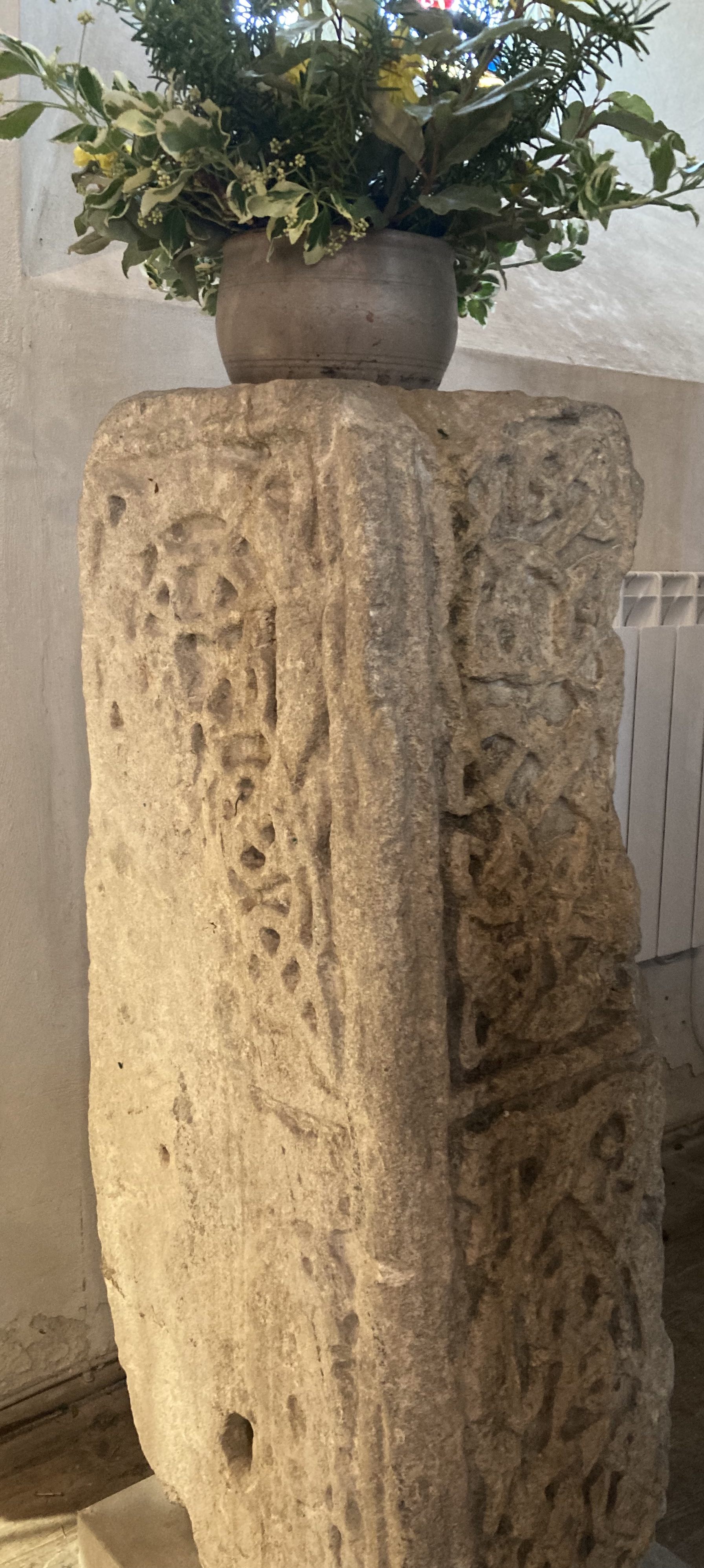
Steventon was apparently a place of Christian worship from a very early date. Part of the shaft of a Saxon Cross, from about the ninth century, was discovered built into the wall of a nearby Tudor manor (now demolished). The cross shaft is displayed in the church. The cross was likely set up outdoors. Visiting priests would hold services there, before the church was built. Villagers may also have buried their dead near the cross. Steventon was possibly a stop on the Salisbury to Canterbury pilgrimage route.
The church building is medieval, built around 1200 A.D. The most obvious change since Jane Austen’s time is the addition of a Victorian steeple (around 1850-1860), a blue and brown structure that looks quite different from the rest.
Jane would have seen the four ancient “scratch dials” or “Mass clocks” on the outside walls of the church. These were sundials with a scratch marking the time when people were to come to worship. She would have also seen the medieval carvings of faces, a man and a woman, on either side of the main door.
Next to the church is a gigantic yew tree, an estimated 900 years old. It measures at least 25 feet around. Yews were considered sacred in ancient times and also by Christians. They represented regeneration and new life. The church key, 15 inches long and weighing 5 lb., was kept in a hole in this tree during Austen’s time. After the key disappeared, a replacement was made which is kept elsewhere. The church is now always left unlocked for visitors.
The tower holds three church bells. The oldest was cast in 1470. These bells were restored, through the support of JASNA, in 1995. I got to hear them ringing when the JASNA Summer Tour group visited in July. The bells are rung for church services, weddings, and funerals.
The Church Interior
The layout of the church is still much the same as it was in Jane Austen’s time. Three arches separate the nave of the church (where the congregation sits) from the chancel (where the altar is).
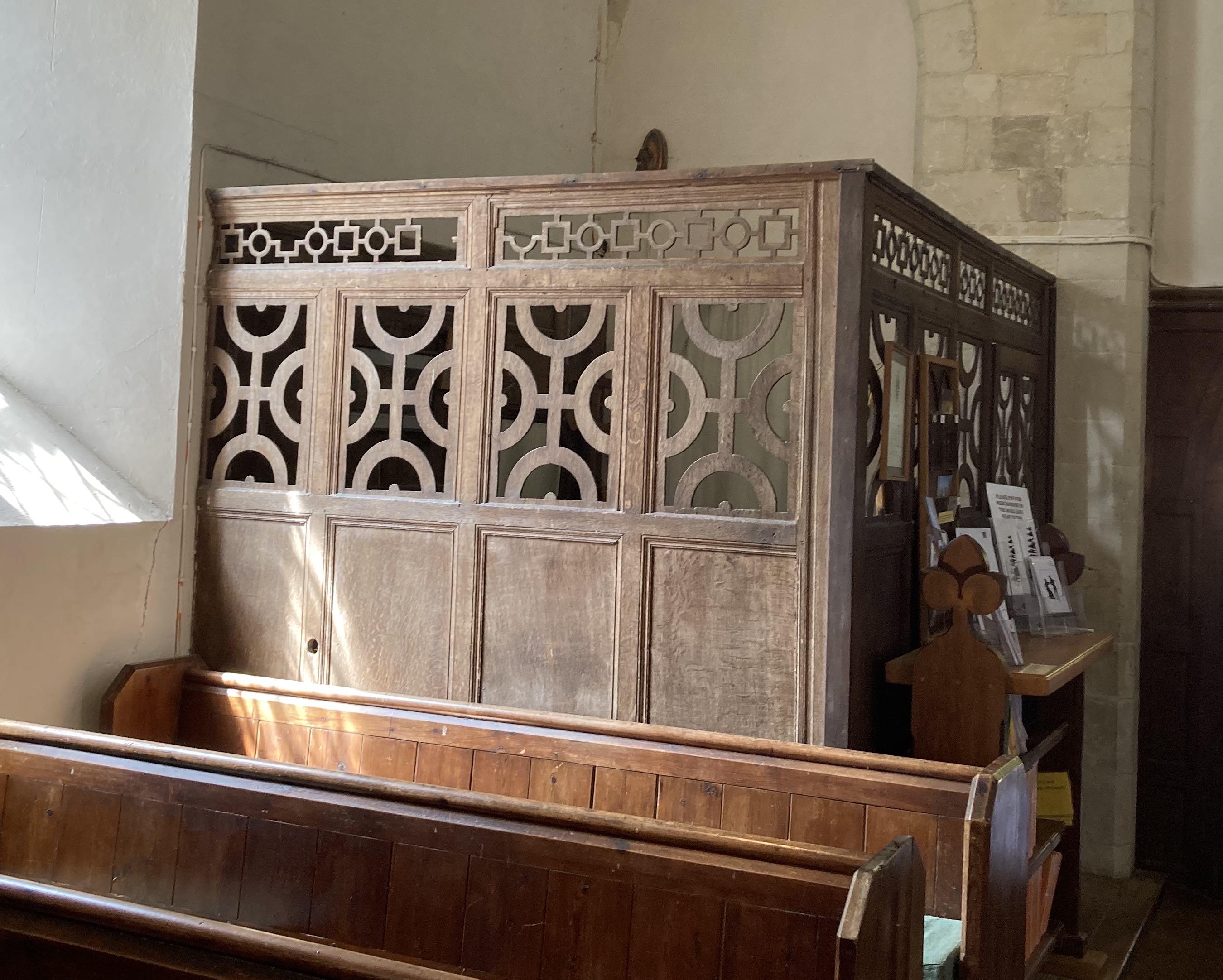
A large box pew, made of oak, was built in the seventeenth century for the lords of the manor. The Digweed family, who rented the manor house from the Knights, used this pew during Austen’s time. It was at the front of the nave, near the pulpit. The box pew is still in the church but has been moved to the back. It is now used as the vestry, the clergyman’s office.
So the Digweed family sat in state, protected from drafts and from curious eyes, at the front. Others, including the Austen family, likely sat on benches. If there weren’t enough benches, servants and the poor would have stood in the aisles and at the back. There was no gallery (balcony) in this church.
Some ancient wall paintings were found during one restoration of the church. These have been left uncovered. They were most likely covered by whitewash during Jane Austen’s time, however.
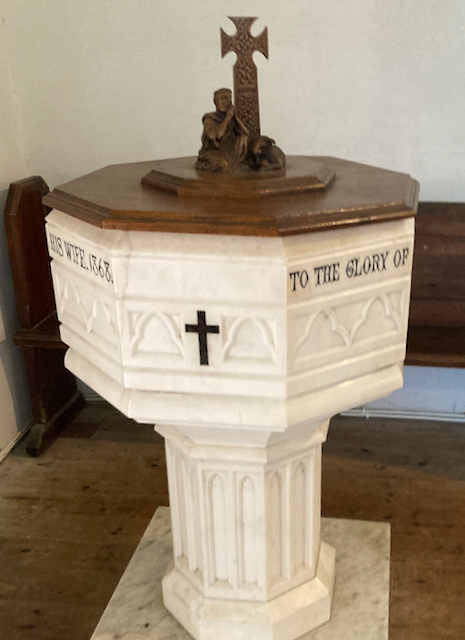
Other lovely decorations in the church are from Victorian times. The stained glass windows, pews, pulpit, baptismal font, choir stalls, and altar are all from the late 1800s, with the organ from the early 1900s.
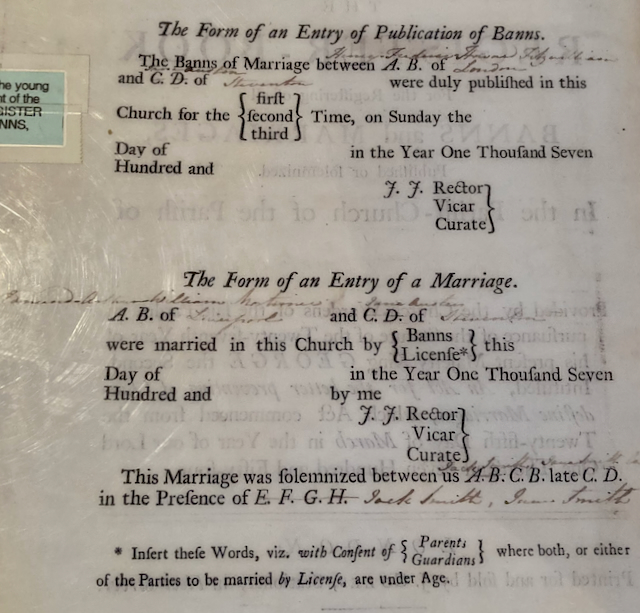
The church has reproductions of several church documents relating to Jane. (The originals are held at the Hampshire County Archives, which unfortunately I did not get a chance to visit.) The parish priest—in this case, Jane’s father, George Austen—kept the parish register for officially recording births, marriages, and deaths. The register included a sample page for marriages, and Jane playfully filled this out with imaginary names for her own future marriage.
Another page of the parish register records Jane’s baptism at home on Dec. 17, 1775, shortly after her birth. She was born in the middle of a very cold winter, so her father christened her at home. She was officially received into the church on April 5, 1776, probably her first excursion.
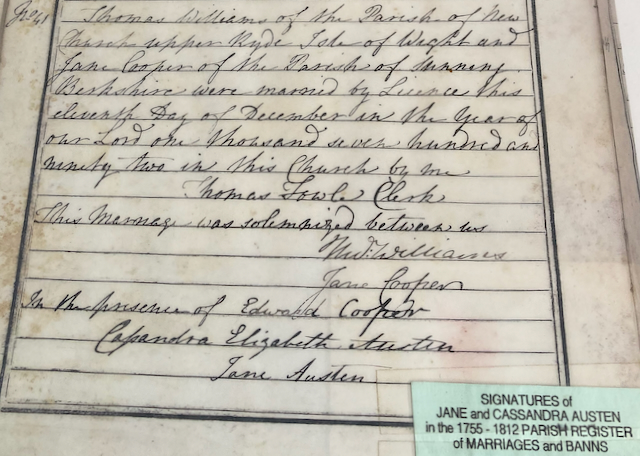
We can also see Jane and Cassandra’s signatures as witnesses to a wedding. Their first cousin Jane Cooper married Thomas Williams. Jane, Cassandra, and Edward Cooper (Jane Cooper’s brother and Jane Austen’s cousin), were the official witnesses.
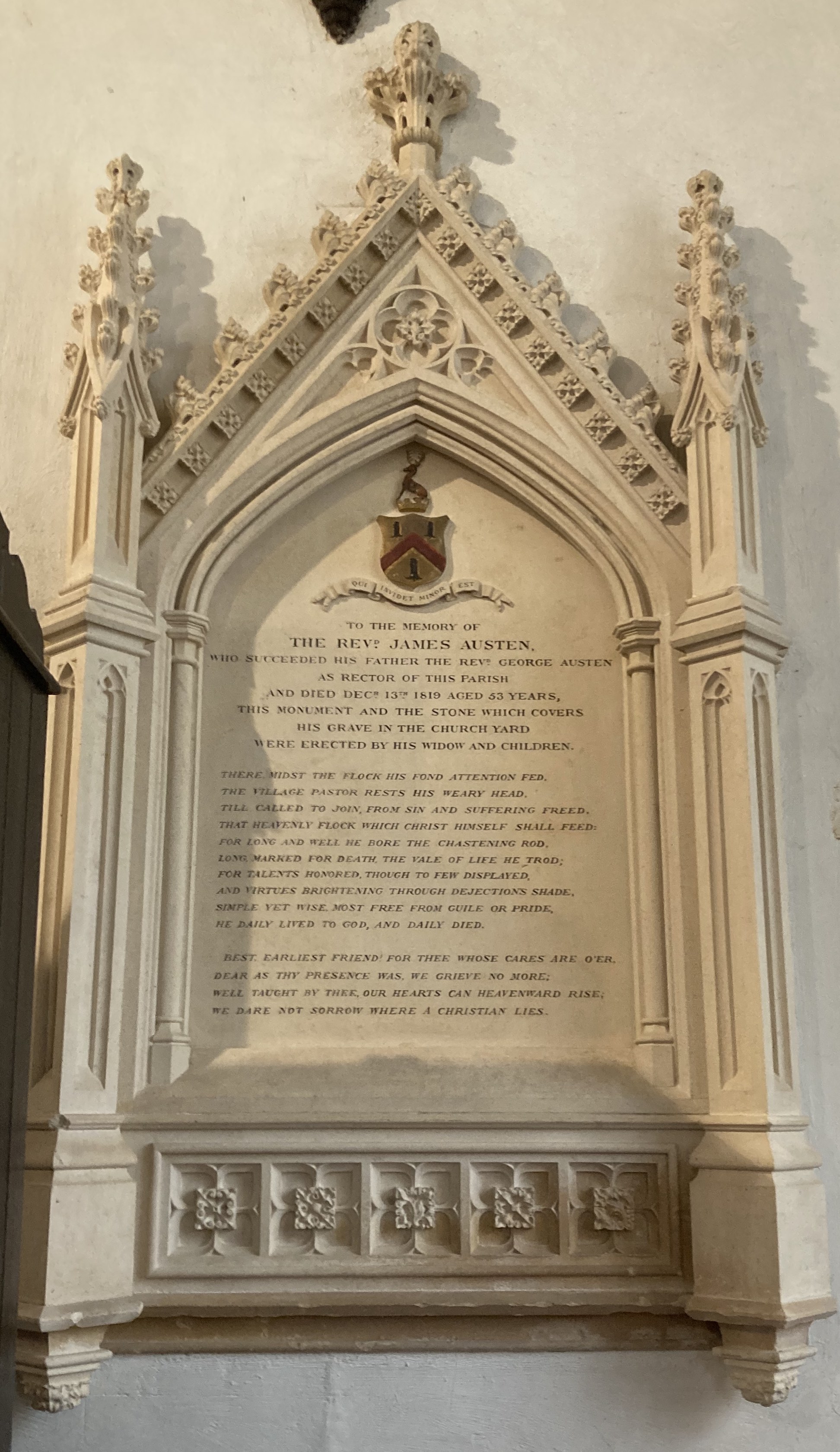
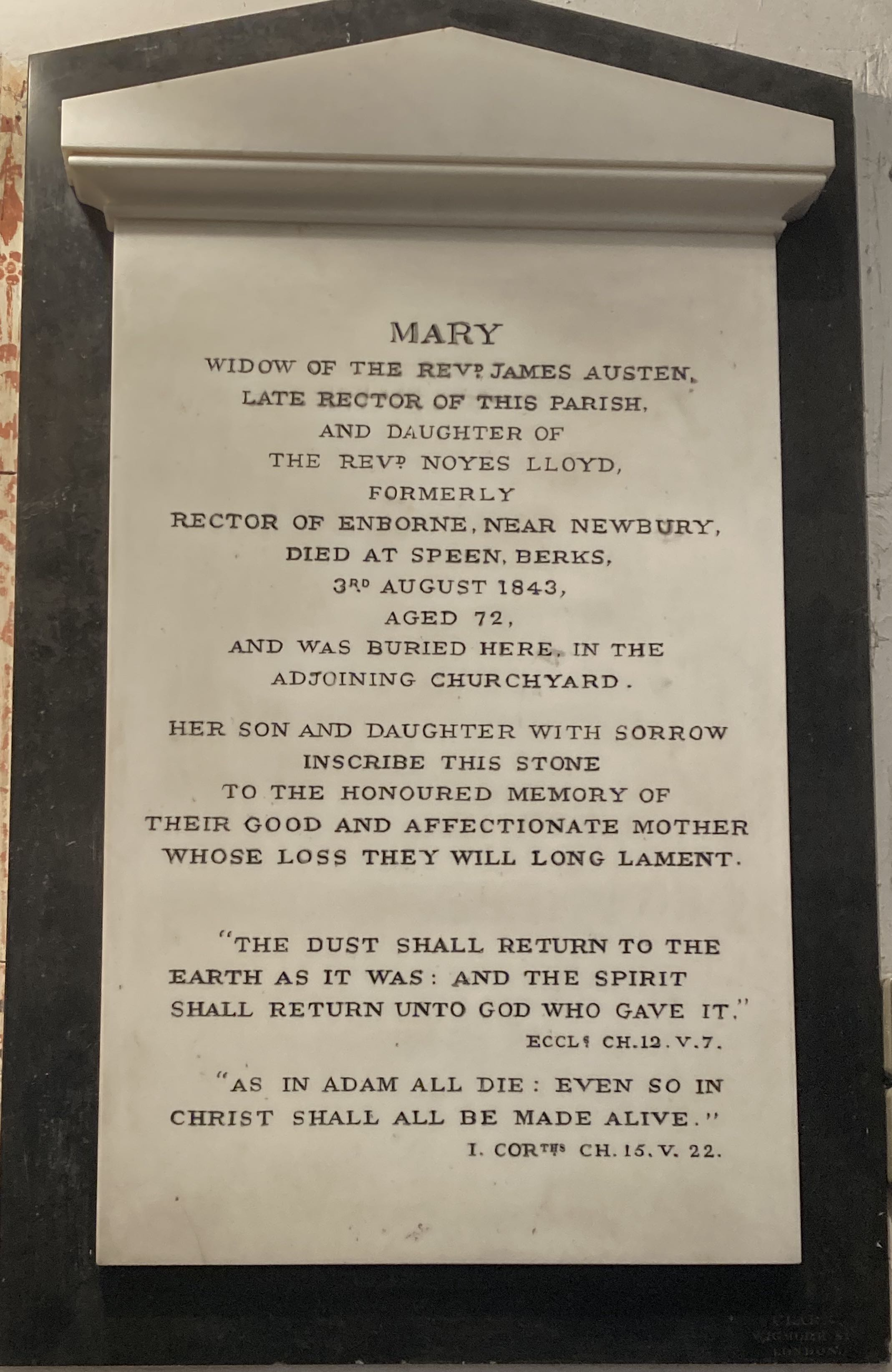
Inside the Steventon church, you can find memorial plaques to Jane’s brother James, James’s first wife Anne, and his second wife Mary. When Anne died in 1795, James was not yet rector of Steventon, so he is listed as vicar of Sherborne St. John.
When James died in 1819, the memorial says he “succeeded his father George Austen as rector of this parish.” George, of course, died in Bath and is buried at St. Swithin’s.
Mary’s memorial says that she died in 1843 at Speens, Berkshire, but was buried in Steventon (about 16 miles away) with her husband. Mary, of course, had left the rectory when her husband died and his brother Henry took over as rector.
The Knight family owned the manor at Steventon from the early 1700s. They rented it to the Digweed family in 1758, and Digweeds lived there until 1877, though the Knights sold the property in 1855. (This was similar to Charles Bingley renting Netherfield and becoming the de facto squire of the parish.) Austen mentions some of the Digweeds in her letters.
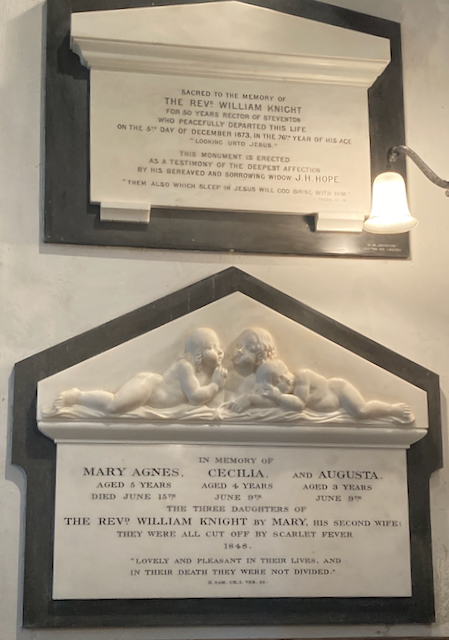
Memorials in the church commemorate Rev. William Knight, “50 years rector of Steventon.” He was Jane’s nephew who became rector after Henry. A sad memorial below his own records the deaths of William’s three daughters, ages 3, 4, and 5 years, who were all “cut off by scarlet fever” in one June week of 1848.
A ledgerstone on the church floor covers the grave of Hugh and Ruth Digweed, who died while Jane was at living at Steventon, and their daughter who died at age 2 in 1770. Other memorials enshrine later members of the Digweed family.
Some Digweeds, like these, are buried in the church, the most honored place to be buried, presumably since they were the squires of the manor house. Others are buried outside in the churchyard.
Like most small country churches in England, Steventon is now part of a benefice including several churches, served jointly by a few clergy. Steventon belongs to the Overton Benefice, seven parishes all served by one rector, one vicar, and one curate.
The Steventon parish is still small, rural, and agricultural, as it was in Austen’s time. About 250 people live in the parish. Sunday services are still held at the church twice a month, usually with a dozen or so people in the congregation. One is a Communion service and the other may be matins, evensong, a holiday service, or a Saturday breakfast and talk for the wider community. Much larger crowds, up to 100 or even 200 people, come to events like holiday services, weddings, baptisms, and funerals. The church seats about 75-80 comfortably, so it can be quite crowded!
In Austen’s time, the church would get bitterly cold in the winter. A modern improvement is the addition of heaters under the pews. People in each pew can turn on their own heater, making the church much more comfortable without wasting energy by heating the whole church.
Marilyn Wright, the churchwarden, told me that she loves the peace of the church, and goes in there when she wants to pray and think. She said if her father, who has dementia, ever got lost, they would find him at the church. As I heard over and over in the Austen country churches, the church is still central to community life.
The Revd. Canon Michael Kenning, former rector of Steventon, gave our JASNA tour group a lovely introduction to the church. At the end, he pointed out that there are about 10,000 Church of England churches in the UK, and most do not get any funding from the National Trust, the British government, or the Church of England. Therefore they need outside funding. The Steventon church is currently in need of some major work. Damp has gotten into the walls, causing cracks and other damage. New drainage and other work is needed. After that, interior features of the church will be renovated.
If you wish to donate to the Steventon church, you can use this link.
JASNA provides support for such special projects at Austen family churches, including this one. If you are a JASNA member, donations to the churches fund for such projects are appreciated. (You can donate when renewing your membership, or sign in to your account and go under the drop-down menu to “Donate to JASNA or English Institutions.”)
For Further Exploration
During Austen’s time, Steventon had a Norman baptismal font. For an idea of what that might have looked like, as well as stories of St. Nicholas, see, The Winchester Type Fonts.
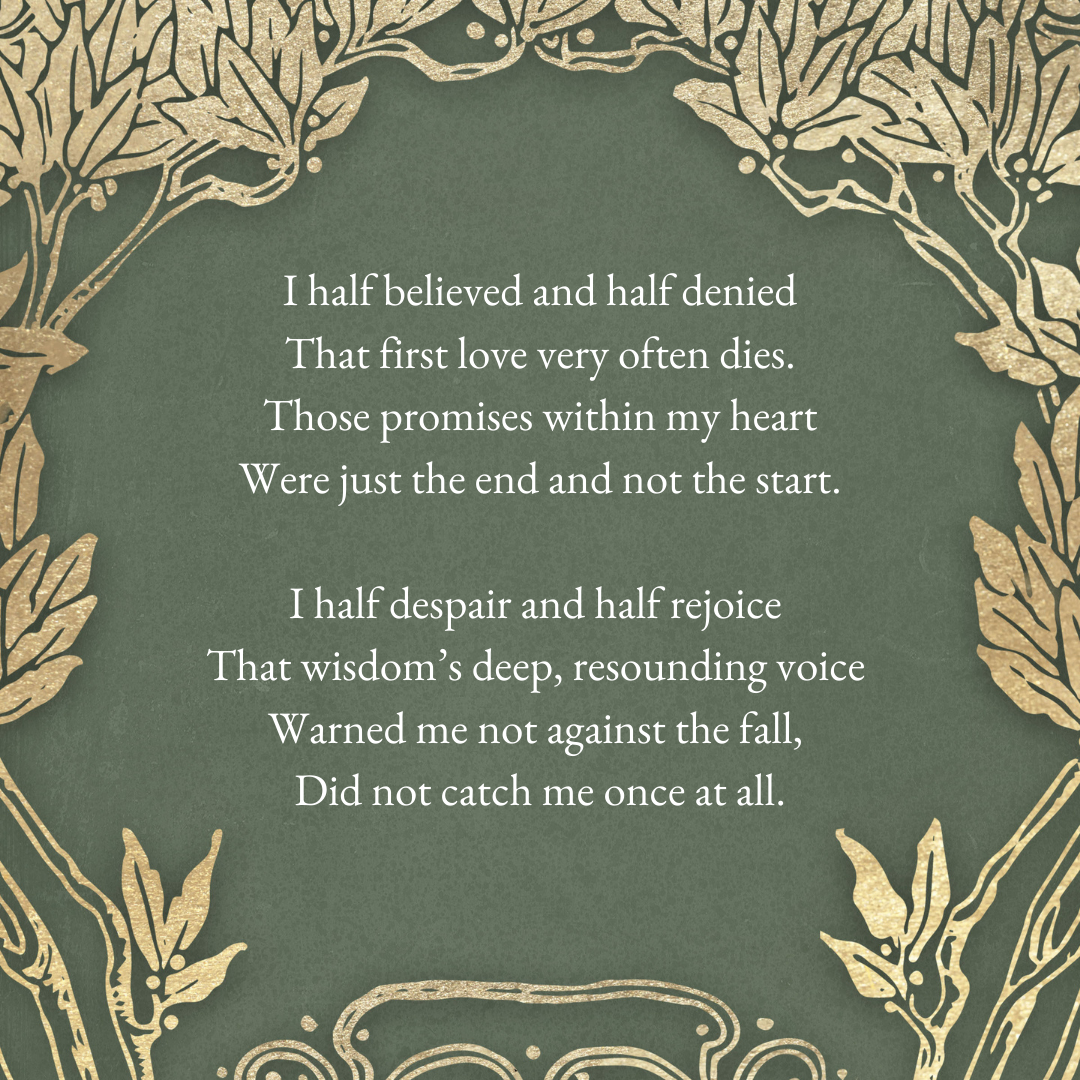
I’m delighted to share with you a beautiful new book I think you’ll want by your side this fall as you settle down for a cozy read by the fire! It’s called Bygone: Musings and Poems from a Regency Hearthside by Hannah Linder.
Not only is it beautiful to behold, but it is also beautiful to read. Read on for a fun interview with Hannah and some of my own thoughts on her book!
Book Description:
Modern, Regency-Esque Love Poems from a Regency Novelist. Enjoy this hardback collection of whimsical thoughts and poems, perfect for fans of Jane Austen. Grab a cup of tea and immerse yourself in this gift book release, just in time for fall.
I had the great honor of writing an endorsement for this book:
“In Bygone: Musings and Poems from a Regency Hearthside, Hannah Linder offers elegant, heartfelt verses for the discerning Regency soul. As words dance delicately across the page, you’ll soon hear the gentle rustle of silk and the subtle murmur of voices as you step back through time to the beauty and romance of a bygone era.”
As you can see, I found myself in a very poetic mood after reading Hannah’s poems! Her words not only sweep you away to another time and place, but they are also food for the soul.
Interview with Hannah Linder
Hannah agreed to do an interview with me, and I enjoyed getting to know more about her and her writing and artistic background. She is an accomplished, creative, and talented person (I’m sure Austen would approve) with the same deep love for Austen and the Regency Era that all of us here at Jane Austen’s World share. I hope you enjoy our Q&A!
1. What is your background with poetry and what inspired you to write this book?
For years, I’ve enjoyed slipping off alone somewhere with an old poetry book, reading the stanzas out loud, or committing them to memory. I love the way poems play with words. The soothing sound. The cut of realization, throbbing at your chest, when you read something you always knew about life but never really pondered.
For years, I said I could not write poetry. I liked freedom best and writing in rhythms seemed too binding. Funny, isn’t it? Oftentimes the things we say we’ll never do are those we find ourselves doing. Now, writing poetry is an outlet. When emotions swell, I let them topple over and bleed into paper, each line a journal entry or a piece of what cries within me. Bygone is the collection of all my thoughts, dreams, and longings.
2. What are 2 of your favorite poems and what is the story behind each one?
Love You? is one that will always be special to me, because it reflects the heart of a wife who tries to explain to her husband all the ways she loves him. Love is not always flowers and moonlit dances and serenating music. Love, more often, is the simple things we do for each other. The life we live together.
Another favorite is Worth the While. This poem is a sweet reminder to slow down, be happy, and enjoy life as it comes.
3. When did you first discover Jane Austen and the Regency Era?
My best friend, in my early teens, invited me over and introduced me to the 2005 Pride and Prejudice. From the moment Mr. Darcy walked through the foggy field with his coat billowing in the wind, I was hopelessly twitterpated. I have been in love with everything Jane Austen ever since.
4. Do you read Regency or Historical Fiction? If so, who are your favorite authors?
Absolutely! My all-time favorite Regency author is Michelle Griep. Her stories always keep me captivated.
5. What are your favorite 3 books you read in the last year?
This is such a hard question! I think Memory Lane by Becky Wade and Forgotten Secrets by Christy Barritt were among my favorite reads of the year.
6. Who do you picture reading the poems in this collection?
Anyone who loves the Regency Era, the sweetness of romance, the sing-song voice of poetry, or the sentimental things in life. Bygone would be a fun book to curl up with in a chair, near a hearth, with a steaming cup of tea.
7. What was your writing process for this collection? Where did you write these poems?
Anywhere, everywhere! Sometimes a thought or idea would strike me, and I would rush to write it down before I could forget. Other times, I’d just go wandering in a field, take a seat by the creek, and ponder on life until a poem came to me.
Bonus: Who is your favorite Jane Austen hero? Who is your favorite villain?
Absolutely, hands down, the wonderful Mr. Darcy. Though Mr. Knightly would be a close second. And villain, hmm…perhaps Mr. Wickham. He’s so charmingly deceitful and such a layered character. Jane Austen was so masterful.
About the Author
Hannah Linder resides in the beautiful mountains of central West Virginia. Represented by Books & Such, she writes Regency romantic suspense novels filled with passion, secrets, and danger. She is a four-time Selah Award winner, a 2023 Carol Award semi-finalist, and a member of American Christian Fiction Writers (ACFW). Also, Hannah is an international and multi-award-winning graphic designer who specializes in professional book cover design. She designs for both traditional publishing houses and individual authors, including New York Times, USA Today, and international bestsellers. She is also a self-portrait photographer of historical fashion. When Hannah is not writing, she enjoys playing her instruments—piano, guitar, ukulele, and banjolele—songwriting, painting still life, walking in the rain, and sitting on the front porch of her 1800s farmhouse.
I hope you enjoyed learning more about Hannah and her beautiful new book! Which Jane Austen character do you think would be most likely to read poetry? Which would be most likely to write poetry?
Fashionable Goodness: Christianity in Jane Austen's England is now available! By JAW contributor Brenda S. Cox. See Review. Available from Amazon and Jane Austen Books.
Available through December 31st, 2025. Click on image for details, and share this poster with other teachers and students!
The Obituary of Charlotte Collins by Andrew Capes
Click on image to read the story.
Comments
“My idea of good company…is the company of clever, well-informed people, who have a great deal of conversation.” – Jane Austen, Persuasion
Gentle readers: Please feel free to post your comments and continue the conversation! Due to SPAM, we will no longer accept comments on posts after 30 days of publication. In some instances, links will be removed from comments as well.
Administrators and Contributors
Vic Sanborn, founder of this blog, is supported by a team of talented and knowledgeable writers about Jane Austen and the Regency era. They are:
Tony Grant, who now contributes his photos from London and England
Click on their names to enter their own blogs.
In addition, we thank the many experts and authors who frequently contribute their posts and opinions, and who continue to do so freely or at our request.
Click here to enter the page. Topics include Regency fashion, historic foods, Jane Austen societies, British sites, related topics. Click on image.
May we suggest?
Hello, my name is Vic and I live in Maryland, USA. I have adored Jane Austen almost all of my life. I am a proud lifetime member of the Jane Austen Society of North America. This blog is a personal blog written and edited by me and my team. We do not accept any form of cash advertising, sponsorship, or paid topic insertions. However, we do accept and keep books and CDs to review.
If you would like to share a new site, or point out an error, please email us. (Yes, we are fallible. We'll own up to our mistakes and will make the corrections with a polite smile on our faces.) Write us at
Thank you for visiting this blog. Your comments and suggestions are most welcome.
Project Gutenberg: eBook of Stage-coach and Mail in Days of Yore, Volume 2 (of 2), by Charles G. Harper
STAGE-COACH AND MAIL IN DAYS OF YORE: A PICTURESQUE HISTORY
OF THE COACHING AGE, VOL. II, By CHARLES G. HARPER. 1903. Click on this link.























 Jane Austen's World