Feeds:
Posts
Comments

By Brenda S. Cox

“Your letter to Adlestrop may perhaps bring you information from the spot . . .”–Jane Austen writing to her sister Cassandra about a relative in Adlestrop they loved, Elizabeth Leigh, who was very ill. Jan. 10, 1809

I’ve just finished a fascinating little book, Jane Austen & Adlestrop: Her Other Family, by Victoria Huxley. Huxley tells the stories of Austen’s Leigh relatives alongside frequent quotes from Austen’s works as well as other contemporary sources. I highly recommend this book, but I’ll share some highlights.

Members of the JASNA Summer Tour were entertained by church members at Adlestrop. Author Victoria Huxley sells her book to me, Brenda Cox. Photo © Brenda S. Cox, 2023

We know Jane Austen didn’t take her characters or situations directly from life. And yet, for every author, the experiences we have and hear about, and the people we know and know of, are all grist for the mill. They come together in new shapes and forms as we write. Jane Austen was close to her Leigh relatives, so it’s not surprising their lives fed into her novels in various ways.

The Leigh Family

Jane’s mother Cassandra Leigh Austen was from an old family descended from a Lord Mayor of London, Sir Thomas Leigh (1498-1571). During Sir Thomas’s lifetime, King Henry VIII dissolved the monasteries, making much land available for purchase. Sir Thomas invested widely. When he died, he owned extensive lands in four counties plus London.

His eldest son, Rowland, inherited Adlestrop and the lands around it in Gloucestershire (north of Oxford). His second son, Thomas, inherited Stoneleigh, Hamstall Ridware, and other estates in Staffordshire (north of Gloucestershire). The Adlestrop line remained country squires, while the Stoneleigh line gained a peerage by supporting Charles I in the English Civil War. They became far wealthier than the Adlestrop Leighs. By Jane Austen’s time, the Stoneleigh estate was worth around £17,000 a year, more than the income of wealthy Mr. Rushworth (£13,000) or Mr. Darcy (£10,000)!

Jane Austen must have attended the lovely old church at Adlestrop on her three visits to her mother’s cousin, Rev. Thomas Leigh, who was rector there. Photo © Brenda S. Cox, 2023

I won’t inflict the whole family tree on you, as they repeated the same names over and over. Some of their favorite names were Thomas, Theophilus, James, Cassandra, and Mary. Cassandra Leigh Austen’s father was Rev. Thomas Leigh (1696-1764), and her mother’s maiden name was Jane Walker. Cassandra Leigh also had a sister named Jane, a sister-in-law named Jane, and, our favorite, a daughter named Jane (plus a daughter named Cassandra, and two first cousins named Cassandra). Jane Walker brought the Perrot family’s wealth into the family. [In the following, whenever I say “Cassandra Leigh” or “Cassandra Leigh Austen,” I mean our Jane Austen’s mother, not her sister.]
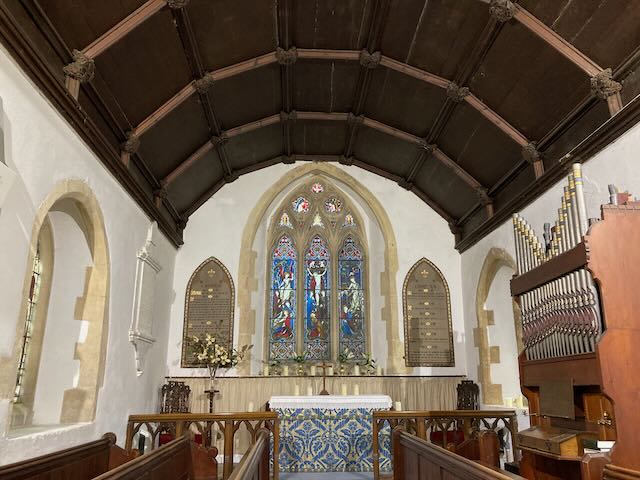
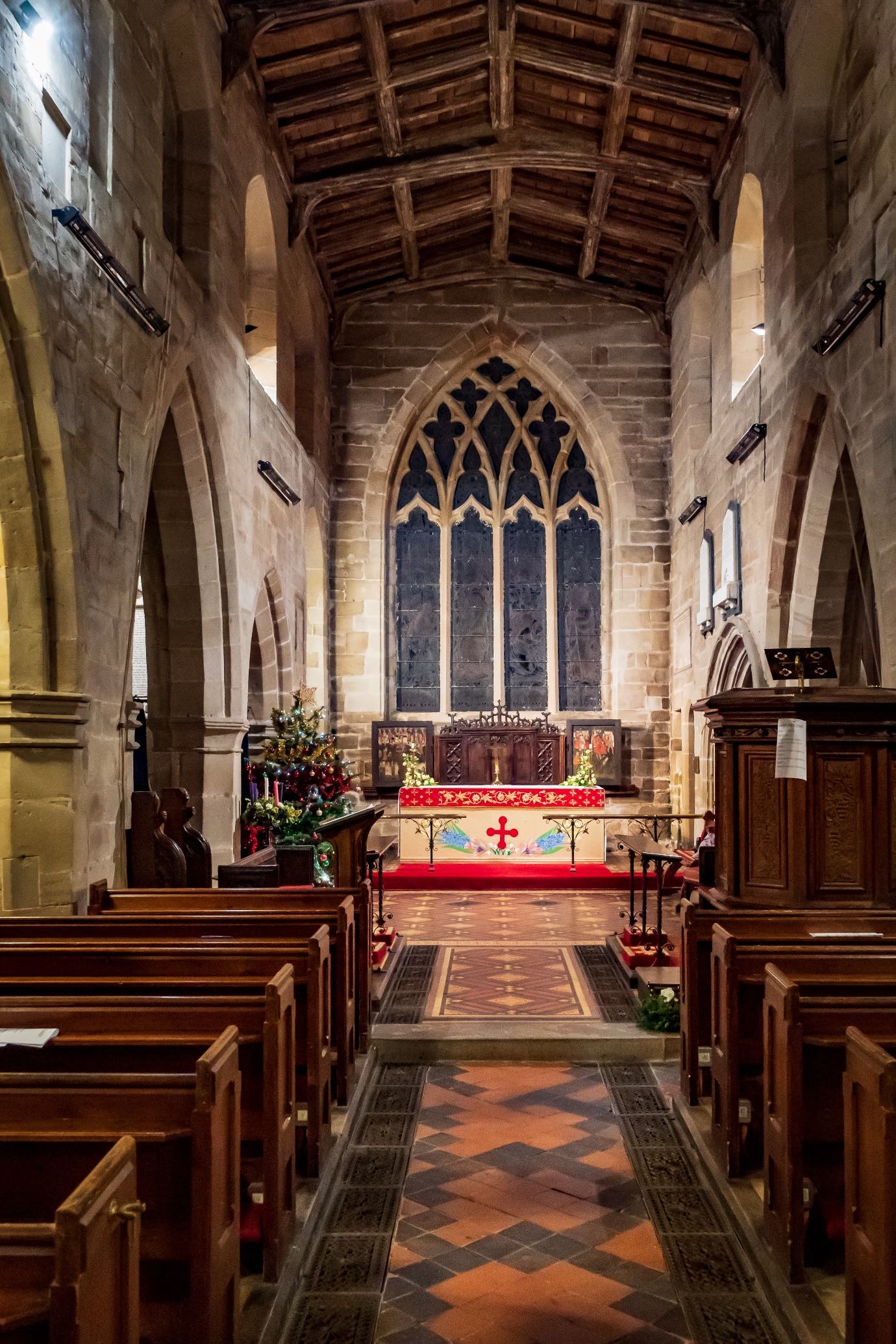
The chancel of the Adlestrop church (area around the altar). Photo © Brenda S. Cox, 2023

Adlestrop, Jane Austen, and the Clergy

Adlestrop is now best known for a poem written in 1914 by Edward Thomas, who died three years later in World War I. His train stopped there briefly, and the poem describes the natural beauties of the area, the “willows, willow-herb, and grass” and a blackbird singing. Adlestrop is still a small, rural town, as it was in Austen’s time.

The squire of the manor, Adlestrop Park, during Jane’s lifetime was James Henry Leigh, who inherited in 1774, when he was only nine years old. His uncle, Rev. Thomas Leigh, was his guardian and the rector of Adlestrop at that time. He was Cassandra Leigh’s first cousin. Rev. Thomas lived with his wife Mary and his unmarried sister Elizabeth, who was the godmother of Jane’s sister Cassandra.

Memorial to James Henry Leigh, squire of Adlestrop when Austen visited there. Photo © Brenda S. Cox, 2023

Apparently Cassandra Leigh was closer to Rev. Thomas than to James Henry. On their visits, the Austens always stayed in the rectory, not in the great house. They would certainly have attended the Adlestrop church, where Rev. Thomas preached. Jane Austen first visited Adlestrop in 1794, when she was 19. She visited again five years later, in 1799, and then in 1806, when she was 31. Throughout the years, the Austen and Leigh families kept in touch through letters.

The nave of the Adlestrop church, where the congregation sits. Perhaps Jane Austen sat on one of these pews, or an earlier version of them. Photo © Brenda S. Cox, 2023

Many of Cassandra Leigh’s relatives were clergymen*, including her father, an uncle, two cousins, a brother-in-law, and a nephew. Leigh family members were patrons of various church livings connected with their extensive properties, and bestowed those livings on relatives, as was customary. In Austen’s novels, for example, both Henry Tilney and Edmund Bertram receive livings from their fathers. Livings might also be given by more distant relations. The Honorable Mary Leigh, for example, gave Edward Cooper (Jane Austen’s cousin) his living at Hamstall Ridware in Staffordshire. 

A living green cross welcomes visitors to the Adlestrop church. Photo © Brenda S. Cox, 2023

Stoneleigh Abbey and Inheritance

In 1806, the last member of the Stoneleigh branch of the Leigh family, the Honorable Mary Leigh, died, and Rev. Thomas Leigh, inherited. Mrs. Austen [Cassandra Leigh, who was Rev. Thomas’s first cousin], with her daughters Jane and Cassandra, were visiting Rev. Thomas at the time, and they traveled with him to take possession of Stoneleigh. The Abbey made a strong impression on Jane and her family. Mrs. Austen wrote letters describing its wonders.

When Rev. Leigh inherited Stoneleigh Abbey, he gave a settlement to another claimant*, Jane’s uncle, James Leigh-Perrot (Cassandra Leigh’s brother). The understanding was that rich Mr. Leigh-Perrot would share this settlement with the needy Austens and Coopers. However, he did not. Jane attributed this lack of generosity to Mrs. Leigh-Perrot; perhaps she was caricatured as selfish Fanny Dashwood of Sense and Sensibility. You can find more details in “Jane Austen’s Leigh Family: Stories behind the Stories.”

When James Leigh-Perrot died, he left almost everything to his wife. Eventually, when Mrs. Leigh-Perrot died in 1836, some of her estate went to Jane’s nephew, James’s son James Edward. He had to take the name Leigh, becoming James Edward Austen-Leigh. 

Next month I’ll post more pictures of Stoneleigh Abbey and talk about its possible parallels with Sotherton and Northanger Abbey in Austen’s novels.

The Leighs who inherited Stoneleigh Abbey and the surrounding lands eventually became much wealthier than the Leighs who inherited Adlestrop. But when that branch died out, some of the Adlestrop Leighs inherited the Abbey. Photo © Brenda S. Cox, 2023

Improvements—Mansfield Park

“Improvements” of land and property often meant providing more “picturesque,” more “natural” views, according to the ideas promoted by Gilpin at the time. In Mansfield Park, Mr. Rushworth wants to get the well-known expert, Humphry Repton, to improve his estate. Henry Crawford has already improved his own estate, and he advises Edmund Bertram on improving his parsonage. In Sense and Sensibility, Mrs. Dashwood talks often of making improvements to Barton Cottage, but she never has the funds for it. John and Fanny Dashwood do spend their money making improvements to Norland, which Elinor and Marianne don’t think much of. Mr. Collins makes improvements to his parsonage. Elizabeth is impressed that the Darcys have shown good taste in improving Pemberley, inside and out.

Austen more strongly commends personal “improvement,” though, improvement in mind, in manners, in education.

Austen would have known first-hand about Repton and his improvements from her cousins in Adlestrop and Stoneleigh. Rev. Thomas Leigh and his nephew employed Repton to make improvements to the manor, rectory, and surrounding lands of Adlestrop. Records show payments to Repton between 1798 and 1812.

Adlestrop House, the former rectory, where Jane Austen and her family stayed. The bow on the left side was added later, and the entrance returned to its original position. Photo © Brenda S. Cox, 2023

Rev. Leigh “improved” his parsonage at Adlestrop by moving his front door to another side of the house, so the principal rooms would face the pretty valley. He also destroyed “a dirty farmyard and house which came within a few yards of the Windows.” Similarly, in Mansfield Park, Henry Crawford tells Edmund Bertram that he must improve his parsonage: “The farmyard must be cleared away entirely, and planted up to shut out the blacksmith’s shop. The house must be turned to front the east instead of the north—the entrance and principal rooms, I mean, must be on that side, where the view is really very pretty.” He also recommends combining gardens, changing a stream, and moving a road.

Rev. Thomas Leigh enclosed neighbouring land (with permission), adding it to his church living, and created a small lake from some flooded ground. As Huxley says, “Now he had a ‘Pleasure Ground’ to rival his brother’s” (at the Adlestrop estate). He moved roads and paths, as Mr. Knightley is planning to do in Emma. Jane Austen would have seen these improvements first hand during her visits. Sometimes she might have felt, like Mary Crawford, that all was “dirt and confusion, without a gravel walk to step on, or a bench fit for use” because of all the changes in process. However, as Mr. Collins did for his visitors, no doubt Rev. Leigh proudly took the Austen family on a thorough tour of his parsonage and its gardens, pointing out with pride all the improvements he was making.

In 1799, some land was exchanged between the church and the manor. In return, James Henry paid to build and fence a better church road and enclose the churchyard with a stone wall. In 1800, Repton was hired to unite the gardens of the rectory and Adlestrop Park, to improve the views. Dr. Grant in Mansfield Park also extends a wall and makes a plantation “to shut out the churchyard,” improving the view from the parsonage.

Rev. Thomas Leigh expanded the park area between the rectory and Adlestrop Park, adding an unused part of the church graveyard to the Park. Photo © Brenda S. Cox, 2023

Austen would have heard about Repton’s later “improvements” in Stoneleigh Abbey’s grounds, which Thomas Leigh set about once he moved in. Repton’s “Red Book,” showing the suggested improvements, is still in existence. You can see a video of it here. Not all of Repton’s recommendations were followed, but some were.

The Leighs and Persuasion

Two other stories from the Leigh family are echoed in Persuasion. At one point, the Adlestrop family was deep in debt and needed to “retrench” in order not to lose the estate. They rented out the manor and moved to Holland for some years, until their finances were in order. Sir Walter and his family, of course, only moved to Bath; we wonder if they will ever make it back to Kellynch!

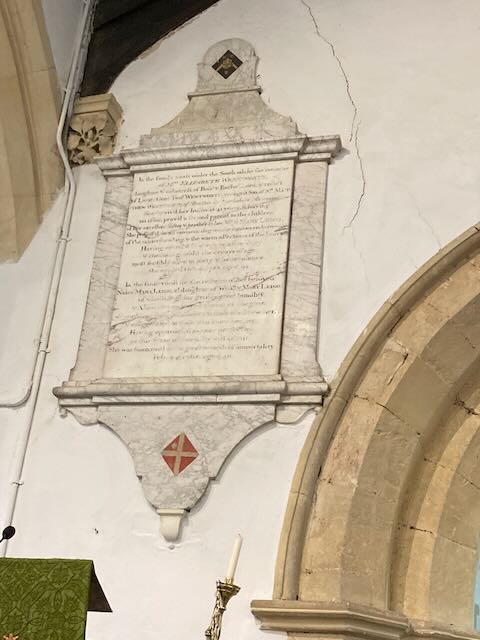
The Leighs also had an aunt who fell in love with an army officer. The family disapproved because of his lack of money. She married him secretly before he went off to war. When he returned as–guess who? Captain Wentworth!– she finally got her family’s approval. Elizabeth Wentworth and her Captain became wealthy and were benefactors to their Leigh relatives. The largest marble tablet in the Adlestrop church, just behind the pulpit, memorializes Elizabeth Wentworth.

For more of these stories, see my post on the Stories Behind the Stories

Memorial in the Adlestrop church to Elizabeth Wentworth, whose story is similar to Anne Elliot’s in Persuasion. Photo © Brenda S. Cox, 2023

Adlestrop Today

The church, St. Mary Magdalene, at Adlestrop is well worth a visit. The church dates from the thirteenth century, though much of it was rebuilt in the 1750s. In the Victorian period, the window traceries were replaced, and stained glass windows and a clock added. The church is one of seven in the Evenlode Vale Benefice. Services are usually held at St. Mary Magdalene twice a month. Like other country churches, a handful of the faithful attend regular services, while larger crowds come to special services at Harvest and Christmas. We don’t know about attendance numbers in Austen’s time. Supposedly, by 1851, “‘all parishioners without exception‘ attended church at least once a week” (Huxley, 201). 
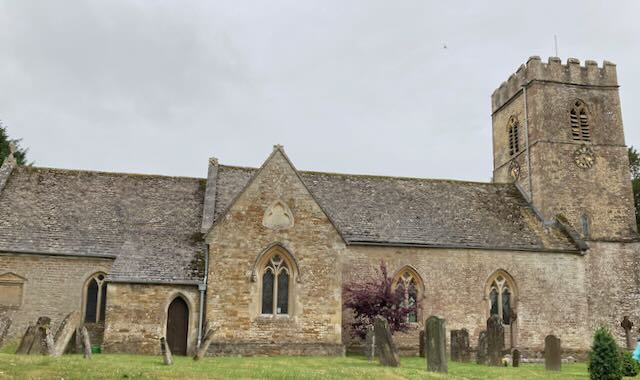
St. Mary Magdalene’s Church, Adlestrop. The interior includes many memorials to the Leigh family, and many of the family are buried in the churchyard.Photo © Brenda S. Cox, 2023

The rectory where Jane and her family stayed is now called Adlestrop House, and, along with Adlestrop Park, still belongs to the Leigh family. Both are very close to the church, but are not open to the public. The lands were originally monastic lands owned by Evesham Abbey.

The Old Schoolhouse opposite the church was built after Austen’s time. However, Austen probably saw the earlier charity school, supported by donations from the Leigh family and other local gentry. In 1803, sixteen children learned reading, knitting, and other marketable skills at that “school of industry.” By 1818 there was a day school for boys and another for girls. A Sunday school attended by 52 children was supported by a bequest from Rev. Thomas Leigh (Huxley, 203). (Sunday schools taught reading and other basic skills to working-class children, who were only free on Sundays.)

The last chapter of Jane Austen & Adlestrop takes readers on a tour of Adlestrop today, still a sleepy country village, but with history around every corner.

Adlestrop Park, the manor, etching in 1818, from Historic England.
Across from the church in Adlestrop is the “Coachman’s Cottage,” in a building dated 1722. The “Old Schoolhouse” next door was probably built in the mid-1800s. Photo © Brenda S. Cox, 2023

Notes

* Claimants for the Stoneleigh Abbey estate (this is complicated, sorry! You can find a chart of these relationships in Jane Austen & Adlestrop, by Victoria Huxley, or in Jane Austen and the Clergy, by Irene Collins):

Theophilus Leigh (died 1724), of the Adlestrop Leighs (great-great grandson of the Lord Mayor), had 14 children.

Theophilus’s oldest son, William, had a son named James (who died in 1774). James had one son (Theophilus’s grandson), James Henry (1765-1823). William’s second son was Rev. Thomas Leigh (1734-1813), rector of Adlestrop, who had no children.

Theophilus’s next surviving son, Dr. Theophilus Leigh (died 1785), was a clergyman and Master of Balliol at Oxford. He had no sons who survived childhood. One of his daughters married Rev. Thomas Leigh of Adlestrop, and another married Rev. Samuel Cooke, Jane Austen’s godfather.

Theophilus’s next son, also Rev. Thomas Leigh (died 1764), was Cassandra Leigh Austen’s father. He had a son, James Leigh-Perrot (1735-1817), just a year younger than Rev. Thomas Leigh of Adlestrop. James had added “Perrot” to his last name to get an inheritance from his wife’s family.

So in 1806, the closest living male heirs were Rev. Thomas Leigh of Adlestrop, who inherited the estate, then he passed it to his nephew James Henry Leigh. They gave money to James Leigh-Perrot, the third claimant, to pay off his claim.

For more stories of the Leigh family and their connections with Jane Austen’s novels, see “Jane Austen’s Leigh Family: Stories behind the Stories.”

Brenda S. Cox is the author of Fashionable Goodness: Christianity in Jane Austen’s England. She also blogs at Faith, Science, Joy, and Jane Austen.

Further Reading

“Jane Austen’s Leigh Family: Stories Behind the Stories”

“Jane Austen’s Clergymen and Her Leigh Family”

“Edward Cooper: Jane Austen’s Evangelical Cousin”

“Jane Austen’s Family Churches: St. Michael and All Angels, Hamstall Ridware”

Sources

Jane Austen & Adlestrop: Her Other Family, by Victoria Huxley. Highly recommended. US Amazon link

The Story of Elizabeth Wentworth or “Aunt Betty”—Jane Austen’s Anne Elliot? By Sheila Woolf (obtained from Stoneleigh Abbey)

Stoneleigh Abbey by Paula Cornwell (obtained from Stoneleigh Abbey)

Jane Austen: A Family Record, 2nd ed., by Deirdre Le Faye 

Adlestrop Park and House

St. Mary Magdalene, Adlestrop 

Jane Austen’s Mansfield Park and Stoneleigh Abbey

Posts on other Jane Austen Family Churches

Steventon

Chawton

Hamstall Ridware

Stoneleigh Abbey Chapel

Great Bookham and Austen’s godfather, Rev. Samuel Cooke
Ashe and Jane’s Friend Mrs. Lefroy 

Deane

This week the United States celebrates Thanksgiving, a holiday in honor of families and friendship. For the most part, we lay aside our differences and grievances, and give thanks for what we have. The poor, aged, and lonely are not forgotten. Community soup kitchens are filled with volunteers, and many are turned away because of the sheer volume who want to serve their less fortunate brethren. 

This annual North American feast is reminiscent of the British Christmas dinners celebrated in Jane Austen’s day. In Emma, Mr Elton states:

This is quite the season indeed for friendly meetings. At Christmas, everybody invites their friends about them, and people think little of even the worst weather.” 

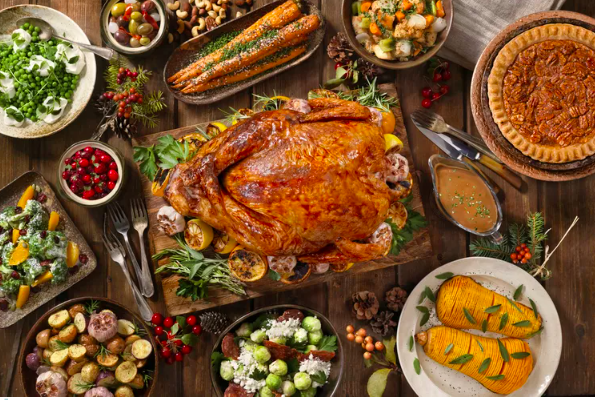
If we substitute Christmas for Thanksgiving, Austen’s phrase applies just as well. Foods offered on the Georgian Christmas table and Colonial thanksgiving tables in the U.S. and Canada have been remarkably similar from the 17th century on: Soup, cheese, nuts, turkey, goose, duck, mashed potato, yams, fresh cranberries, dried fruits, pumpkin and mince pies.

Screen Shot 2023-11-20 at 2.43.27 PM

Image of traditional Thanksgiving foods. iStock image, LauriPatterson.

We North Americans have our British ancestors to thank for this tradition, so closely tied to these countries’ respective fall harvests. Earlier ripening explains why Canada’s Thanksgiving falls on the second Monday of October, almost two months before its southern neighbor, the US, celebrates this event. 

Canadian Thanksgiving:

One can only envision the reaction of explorer Martin Frobisher and his men when, in three voyages to Canada to find a northwest passage to Asia, they encountered the immensity, richness, and diversity of flora and fauna, and countless miles of almost untouched forests, lakes, and fields populated by an abundance of wildlife. These natural riches must have overwhelmed their senses, prompting them to give thanks in a tradition still celebrated today. The reality was less than elaborate:

In 1578, … privateer and mariner Sir Martin Frobisher was the first European to celebrate “Thanksgiving” with his crew. The meal was decidedly less glamorous than today’s feasts: mostly salt beef, biscuits and mushy peas. The locale, too, was less inviting. Frobisher and his men celebrated in current-day Nunavut, likely aboard one of the 15 ships that had set sail to discover a northwest passage to Asia’s trading areas. – A Short History of Thanksgiving in Canada, Ottawa Citizen 

Screen Shot 2023-11-20 at 7.31.45 PM

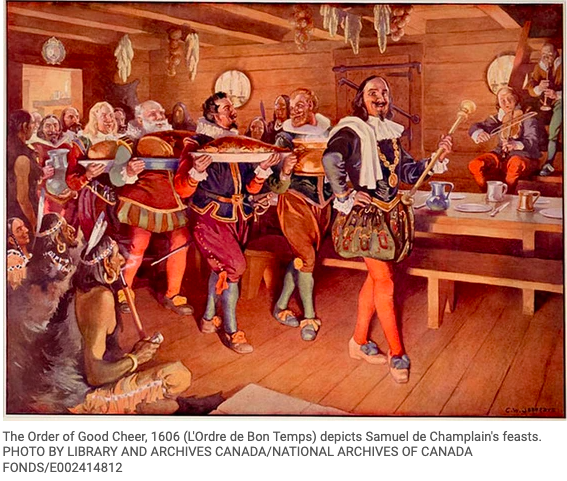
Explorer Samuel de Champlain organized a thanksgiving celebration in the early 17th century which is more reminiscent of today’s ceremonies than Frobisher’s. To prevent scurvy, Champlain introduced a variety of foods that included fresh vegetables and fruits high in vitamin C, such as cranberries. Since the 18th century, Nova Scotia’s Thanksgiving meals have resembled today’s variety of foods. But this is not the full story. Without indigenous Indians, neither the Canadian explorers nor the pilgrims would have survived long enough to present a meal of any great variety. 

U.S. Thanksgiving:

Screen Shot 2023-11-20 at 2.40.04 PM

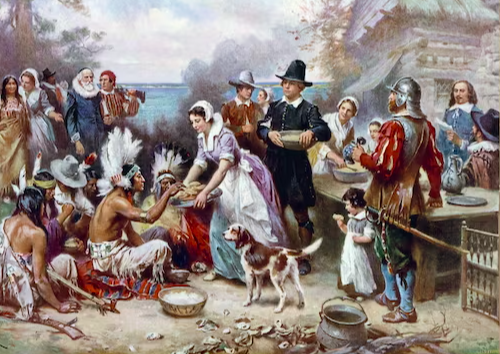
Romantic version of the first Thanksgiving in the U.S. Plymouth Rock Foundation.

In contrast to the happy scene depicted in the storybook image above, settlers and indigenous warriors experienced devastating losses from natural causes – the settlers from starvation and the tribes from the loss of as much as 50 to 90 percent of their population to the epidemics the Europeans brought with them. The pilgrims and Wampanoags joined forces to strengthen their numbers and to fight off possible attacks from other Indian tribes. And so the Wampanoags taught settlers to plant corn and other vegetables and to use herring for fertilizer. Under their tutelage, the pilgrims learned to fish for cod and bass, build housing with the materials at hand, and trade and barter for products they could not produce. 

N.C._Wyeth_-_Thanksgiving_with_Indians_(detail)

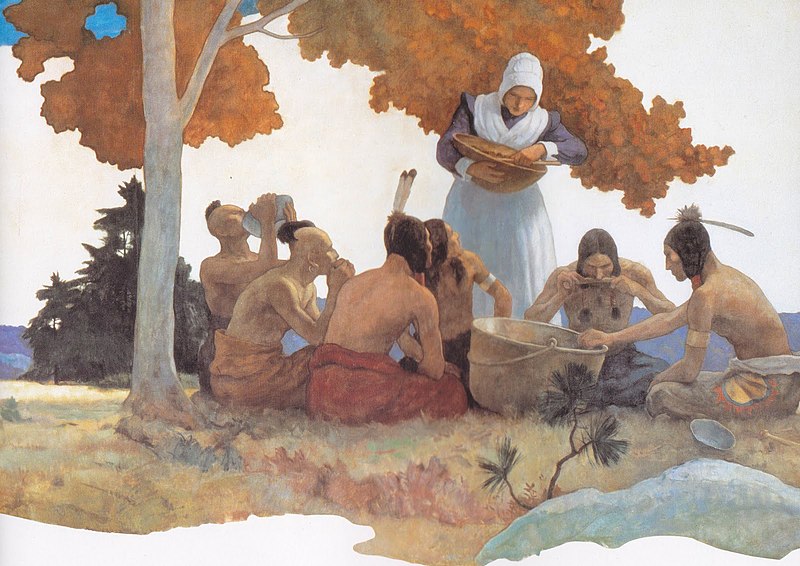
Detail of an NC Wyeth painting, Wikimedia Commons

After the bountiful result of their hard labor, the pilgrims commemorated their success with a series of feasts that featured the riches of their fall harvest. The chief of the Wampanoags, Massasoit, attended the event for three days with 90 men. They brought five deer, which were roasted, and played games in celebration.  According to an article in the National Endowment for the Humanities entitled Who Were the Pilgrims Who Celebrated the First Thanksgiving? | The National Endowment for the Humanities this was the true first American Thanksgiving.

Interestingly, in 1862 President Lincoln declared the turkey to be the official meat for the Thanksgiving dinner table. Before this time, there was no consensus. U.S. dinner tables had featured venison, ham, pheasant, duck, oysters, and other choices preferred regionally, such as bison. Personally, I like turkey once a year. At Christmas, I prefer ham.

Sketch-of-a-Christmas-Celebration-Republic-of-Pemberley

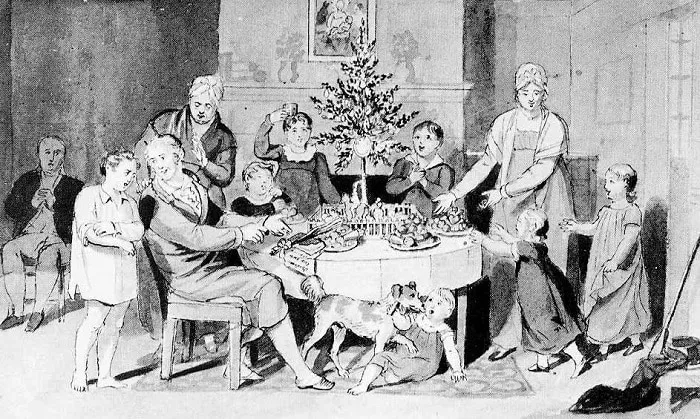
Festive 19th century Christmas goodies for a family. Image: British Food and Travel 

British Christmas Dinner:

When one examines the traditional Traditional Christmas dinner menu featured in this BBC Good Food website, one recognizes how close the three nations still are in their traditional celebratory food offerings. Oh, variations have crept in. Local foods are offered in abundance (in Maryland crab cakes and seafood recipes are heavily featured, and Tex Mex recipes are also making an appearance, especially at the appetizer and dessert tables.) But overall, we U.S. Americans are staying with the traditional holiday feast on the 4th Thursday in November.

Author Syrie James’s Jane Austen quote is apropos for both holiday feasts:

After Jane Austen’s Christmas guests had departed in January 1807, Jane wrote to her sister, Cassandra, “I shall be left to the comfortable disposal of my time, to ease of mind from the torments of rice puddings and apple dumplings, and probably to regret that I did not take more pains to please them all.”  

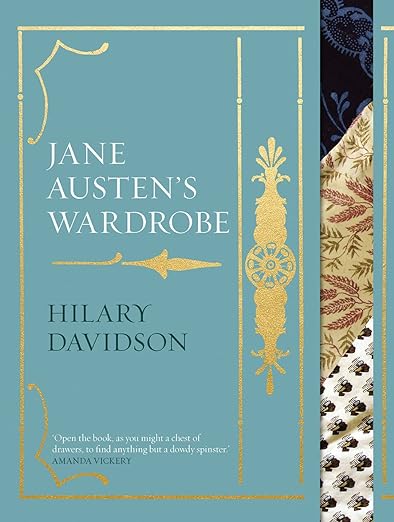
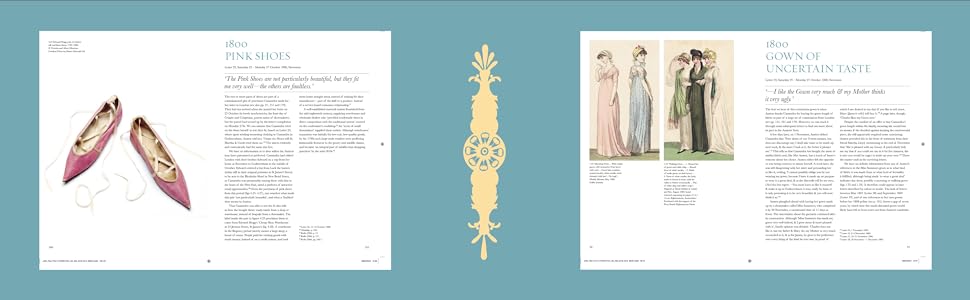
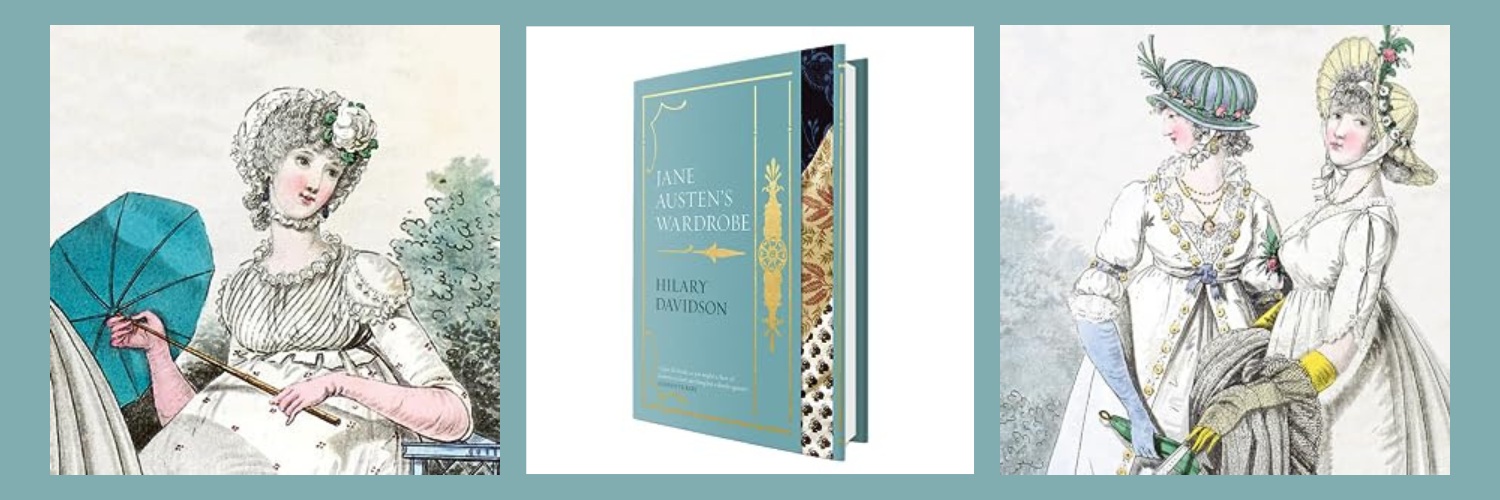
Dear readers, I have an exquisite new book to share with you today: Jane Austen’s Wardrobe by Hilary Davidson!

Filled with incredible photos and written information, it’s one of the most detailed books I’ve seen in a long time on this topic. Not only is it beautiful, it is filled with fascinating information on one of my most favorite topics.

This is my new favorite book on Jane Austen’s Regency Fashion. I know I’ll continue to pour over it for years to come!

Austen’s Wardrobe by Category

Within the pages of this lovely book, Davidson works her way through Austen’s personal wardrobe chronologically, from head to toe. Davidson’s system for cataloging Austen’s wardrobe is fascinating! For those of us who delight in a linear and/or chronological order to a wide and varied topic, Davidson definitely checks all the boxes.

First, she breaks all of Austen’s clothing down into the following categories:

  • Clothes Press: Gowns
  • Closet: Spencers, Pelisses and Outer Garments
  • Band Box: Hats, Caps and Bonnets
  • Shelves: Shawls, Tippets, Cloaks and Shoes
  • Dressing Table: Gloves, Fans, Flowers, Trims and Handkerchiefs
  • Jewelery Box: Necklaces, Rings and Bracelets
  • Drawers: Undergarments and Nightwear

Davidson even includes several pages of sketches, descriptions, and explanations for Jane’s “Portrait Gown” – which I found completely engrossing.

Austen’s Letters Quoted

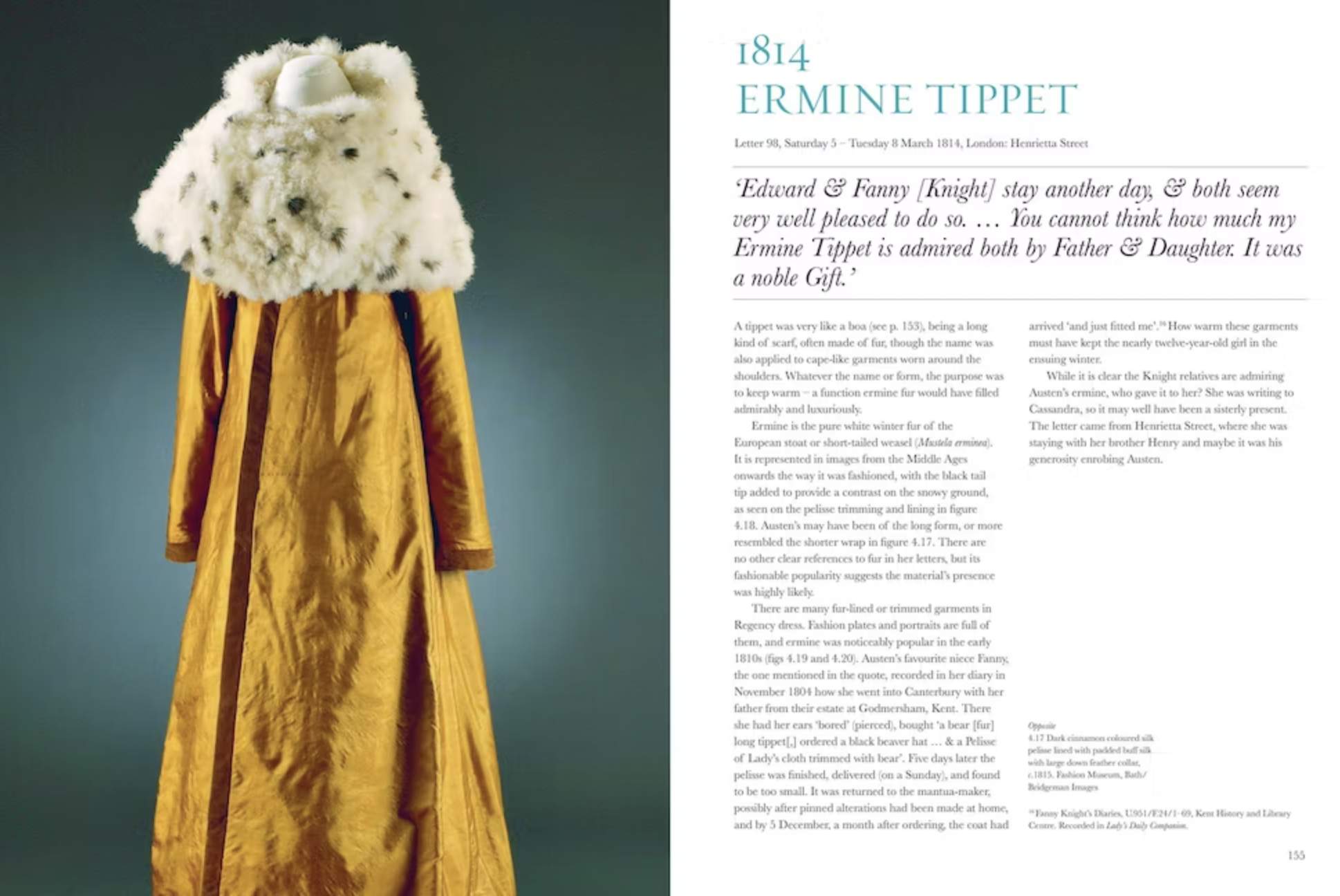
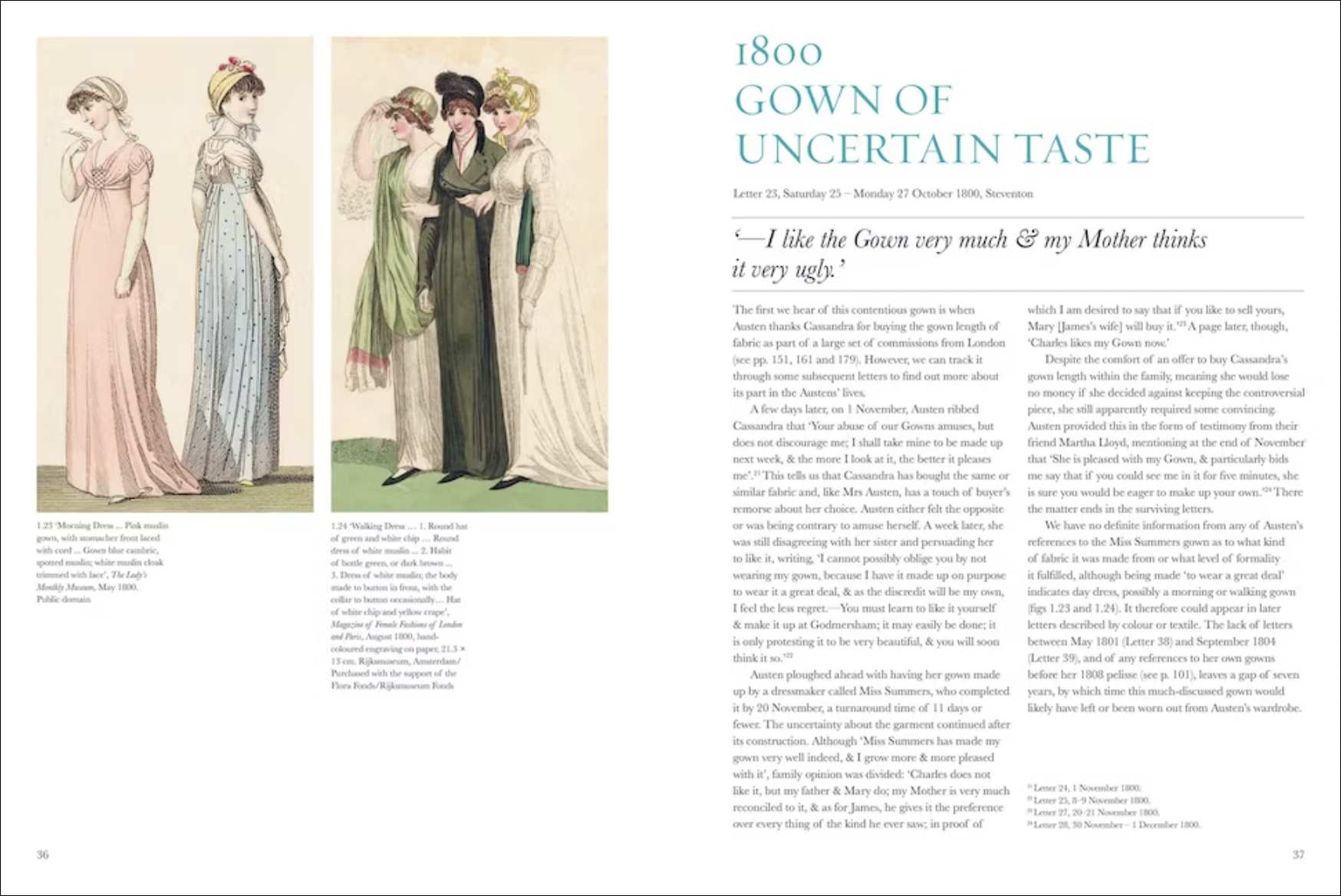
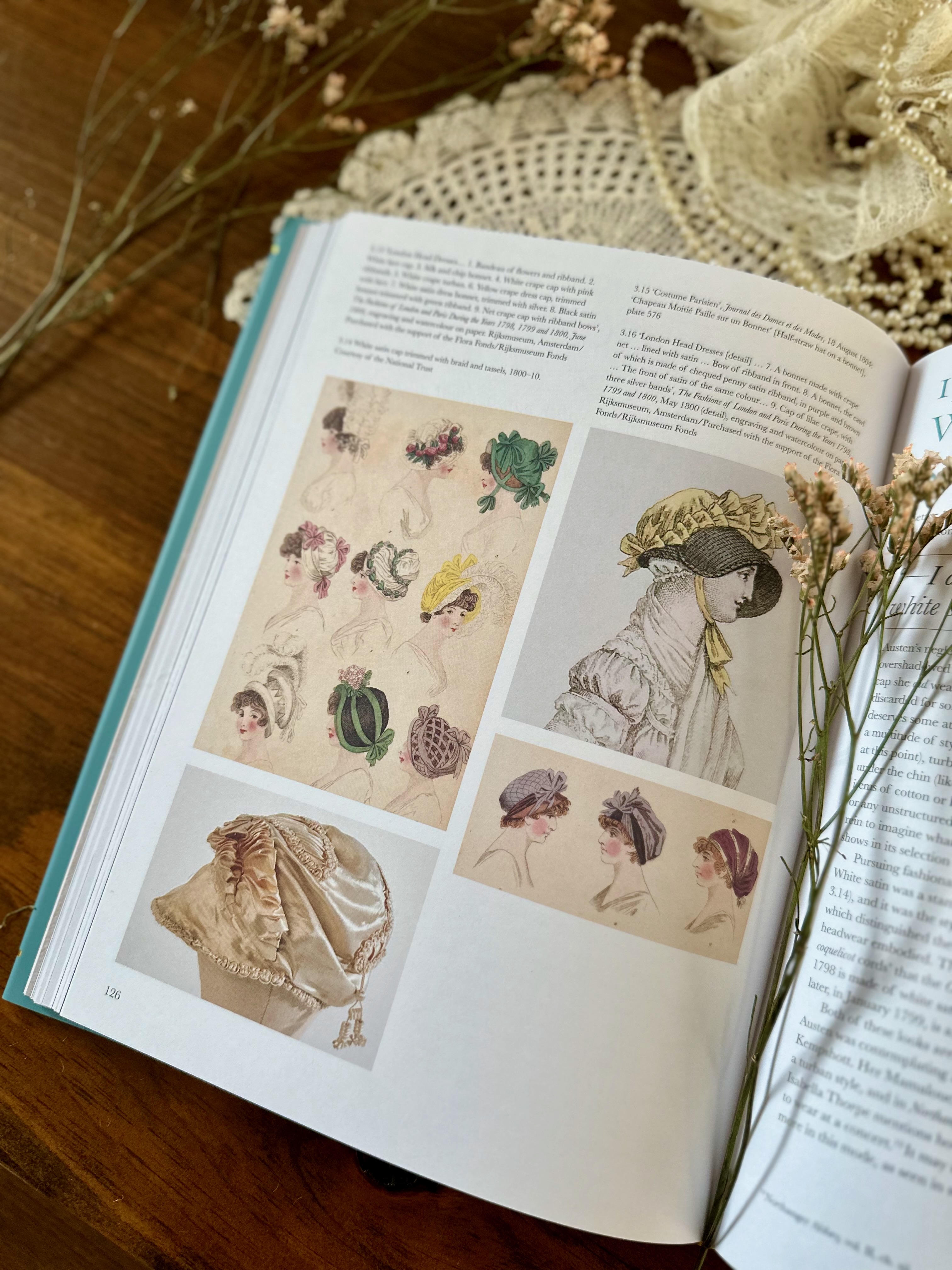
Next, Davidson utilizes Austen’s personal letters to explore every inch of Austen’s wardrobe, working her way through each category in chronological order. To do this, she shares one quote at time, citing portions of letters that mention Austen’s clothing. Then, for each article of clothing, every hat, and every piece of jewelry, she explains that quote in great detail and provides photos to aid our understanding.

For instance, Austen writes this in Letter 65:

“I can easily suppose that your six weeks here will be fully occupied, were it only in lengthening the waists of your gowns. I have pretty well arranged my spring & summer plans of that kind, & mean to wear out my spotted Muslin before I go. –You will exclaim at this–but mine has signs of feebleness, which with a little care may come to something.”

Tuesday 17 – Wednesday 18 January, 1809, Castle Square

Davidson provides photos of spotted muslin fabric swatches and a photo of a dress made of spotted muslin, dated 1805-10. Then she explains the muslin fabric, provides quotes from Austen’s novels about muslin dresses, and explains Austen’s quote. She goes over the dress styles, what was involved in “lengthening the waist” of a gown, the meaning of “worked” fabric, and the ins and outs of fragile fabrics of that time period, including how women used belts to cover holes in the fabric when a waist was lengthened.

I found this incredibly interesting because I’ve always been curious about Austen’s extensive quotes about her dresses and hats in her letters. The result is a delightful (and sometimes hilarious) tour through Jane Austen’s closet in her own words, with pictures and explanations to match!

Here are several more examples, provided by Yale University Press:

Informative and Beautiful

Like many of Austen’s heroines, this book is both intelligent and beautiful. Inside and out, this book is absolutely stunning. The photos provide a detailed look into Jane Austen’s clothing that is hard to find, especially all in one place. This book feels like a worldwide museum tour of all the most exquisite clothing artifacts from Austen’s time.

This is the perfect addition to any Jane Austen library – and it will look gorgeous on your coffee table!

Book Description

Hilary Davidson delves into the clothing of one of the world’s great authors, providing unique and intimate insight into her everyday life and material world.
 
Acclaimed dress historian and Austen expert Hilary Davidson reveals, for the first time, the wardrobe of one of the world’s most celebrated authors. Despite her acknowledged brilliance on the page, Jane Austen has all too often been accused of dowdiness in her appearance. Drawing on Austen’s 161 known letters, as well as her own surviving garments and accessories, this book assembles examples of the variety of clothes she would have possessed—from gowns and coats to shoes and undergarments—to tell a very different story.

The Jane Austen Hilary Davidson discovers is alert to fashion trends but thrifty and eager to reuse and repurpose clothing. Her renowned irony and wit peppers her letters, describing clothes, shopping, and taste. Jane Austen’s Wardrobe offers the rare pleasure of a glimpse inside the closet of a stylish dresser and perpetually fascinating writer.

About the Author

Hilary Davidson is a dress, textile and fashion historian and curator. Her work encompasses making and knowing, things and theory, with an extraordinary understanding of how historic clothing objects come to be and how they function in culture.

Hilary is equally skilled in analysing historical and archaeological material culture artefacts; presenting engaging, fascinating talks to diverse audiences; and producing influential academic research.

Her extensive experience includes:

  • Scholarly research
  • Lecturing, teaching and public talks
  • Broadcasting and journalism
  • Historic dressmaking

Hilary trained as a bespoke shoemaker in her native Australia before completing a Masters in the History of Textiles and Dress at Winchester School of Art (University of Southampton) in 2004. Since graduating, Hilary’s practice has concerned the relationship between theoretical and highly material approaches to dress history, especially in the early modern and medieval periods.

As a skilled and meticulous handsewer, she has created replica clothing projects for a number of museums, including a ground-breaking replication of Jane Austen’s pelisse. At the same time she lectured extensively on fashion history, theory and culture, on semiotics, and cultural mythologies, especially red shoes.

In 2007 Hilary became curator of fashion and decorative arts at the Museum of London. She contributed to the £20 million permanent gallery redevelopment opening in 2010, and curated an exhibition on pirates, while continuing to publish, teach and lecture in the UK and internationally. In collaboration with Museum of London Archaeology, Hilary began analysing archaeological textiles and continues to cross disciplines by consulting in this area in England and Australia. She also worked on the AHRC 5-star rated Early Modern Dress and Textiles Network (2007-2009) and from 2011 has appeared as an expert on a number of BBC historical television programmes, and as a frequent radio guest speaker in London and Sydney.

From 2012 Hilary worked between Sydney and London as a freelance curator, historian, broadcaster, teacher, lecturer, consultant and designer, while working on a PhD in Archaeology at La Trobe University, Melbourne. In addition to historical studies she has been a jewellery designer, graphic designer, photographer, gallerist, and worked in retail fashion and vintage clothing. In 2022 she moved to New York City to take up the role of Associate Professor and Chair of the MA Fashion and Textile Studies: History, Theory, Museum Practice at the Fashion Institute of Technology.

Hilary has taught and lectured extensively, including at the University of Southampton, Central St Martins, the University of Cambridge, the University of Glasgow, New York University London, The American University Paris, Fashion Design Studio TAFE Sydney and the National Institute of Dramatic Art (NIDA), Sydney. She speaks regularly at academic conferences and to the public. Her first monograph book was Dress in the Age of Jane Austen (2019) followed by Jane Austen’s Wardrobe in 2023. Her extensive publications can be found on Academia and ResearchGate.

To Order the Book:

You can order the book by clicking HERE
or by clicking the image below:

Recommended Book Gift

I hope you’ve enjoyed this short tour of this stunning new book by Hilary Davidson. If you’re looking for a gift for a fellow Jane Austen fan, or if your friends or family members need an idea for a gift for you this holiday season, I highly recommend this one!


RACHEL DODGE teaches college English classes, gives talks at libraries, teas, and book clubs, and writes for Jane Austen’s World blog. She is the bestselling author of The Little Women DevotionalThe Anne of Green Gables Devotional and Praying with Jane: 31 Days Through the Prayers of Jane Austen. Now Available: The Secret Garden Devotional! You can visit Rachel online at www.RachelDodge.com.

Moving in Jane Austen’s Day

Inquiring readers,

I recently moved and, like Jane, left a home I loved. When I purchased my current slice of paradise, I found my perfect place. In addition, my new neighborhood suits my personality. Echoes of Jane Austen in Chawton Cottage!

Rachel Dodge, who writes splendid articles for this blog, wrote a wonderful post last year about moving entitled Jane Austen’s Tips on Moving House. I cannot improve on her article. I can,  however, discuss the various 18th C. methods by which the English moved their possessions – large or small. 

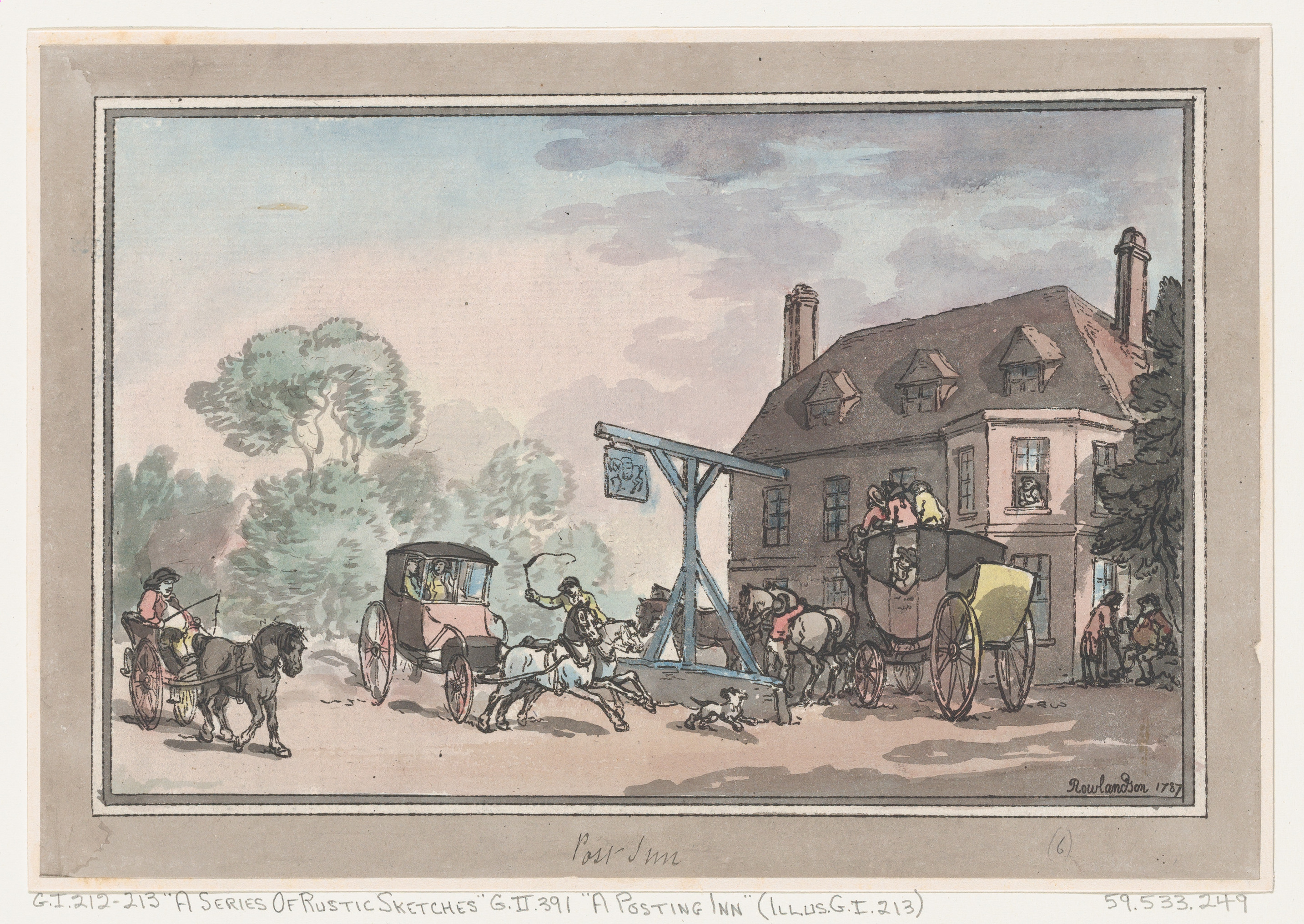
A Posting Inn Rowlandson

Thomas Rowlandson: A Posting Inn, 1787, Met Museum, public domain image

This  print shows three vehicles beside an inn – two moving, one parked:

  1. The parked vehicle is a public coach laden with passengers and drawn by four horses. The animals are being switched out for a fresh team, which, depending on the size, weight, and speed of the coach occurs every 6 – 12 hours. Switches slowed the journey’s progress and provided passengers with an opportunity to disembark and look to their personal needs. Some might choose to spend the night or enjoy a meal at the inn, much like Lydia, Kitty, Jane and Elizabeth.

“…in Hertfordshire; and, as they drew near the appointed inn where Mr. Bennet’s carriage was to meet them, they quickly perceived, in token of the coachman’s punctuality, both Kitty and Lydia looking out of a dining-room up stairs. These two girls had been above an hour in the place, happily employed in visiting an opposite milliner, watching the sentinel on guard, and dressing a salad and cucumber.” – Pride and Prejudice, Chapter 13

After welcoming their sisters, the girls triumphantly displayed a table set out with such cold meat as an inn larder usually offers, exclaiming, “Is not this nice? Is not this an agreeable surprise?” Elizabeth and Jane remained calm and collected, and murmured approval in the appropriate way. Silently Lizzie (and we readers) thought Lydia and Kitty the silliest of chits.

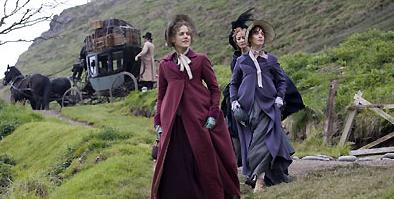
The Dashwood women took a public coach out of necessity after vacating Norland Park with just enough funds to live as gentlewomen in a cottage provided generously by Mrs Jenkins, a relative stranger to them.

seeing-barton-cottage

The above image depicts the Dashwood women leaving the carriage and seeing Barton Cottage for the first time. Notice the luggage strapped on top of the conveyance. Their furniture, cutlery, tableware, linens and the like would most likely be delivered in a humble wagon by a male servant before or after the move. Servants were often sent ahead of time to ready the new dwelling or they might travel at the same time in a different carriage or wagon. 

Passengers sitting inside a crowded carriage carried their possessions on their laps or between their feet, especially those unfortunate enough to sit in the middle. Those sitting on top were subject to the elements, come rain or snow.

2. In the center of the print is a post chaise that is often a private carriage. It could seat from two to three passengers and was guided by a postillion astride one of two or four horses. A trunk placed in the front of the carriage and behind the horses was just big enough to carry personal effects. This private carriage was more expensive to hire than a public coach, for the vehicle’s speed was highly prized, especially by couples who eloped to Gretna Green.

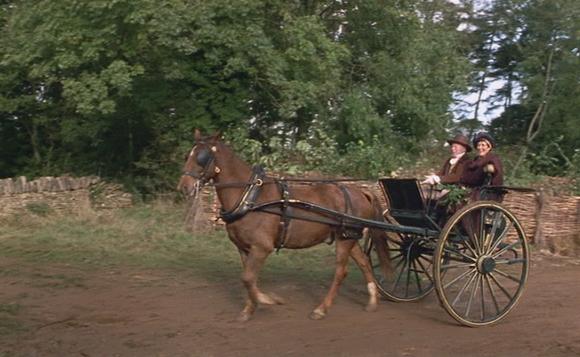
3. The vehicle to the left is a humble cart pulled by a pony or donkey. Austen’s donkey carriage, also known as a donkey cart, looks elegant in comparison. (See image in link.) After a cold spell in January of 1817, Jane wrote:

‘our Donkeys are necessarily having so long a run of luxurious idleness that I suppose we shall find that they have forgotten much of their Education when we use them again.’

Austen used the vehicle for local shopping runs to Alton. The vehicle depicted by Rowlandson provided little space for purchased goods. These carts were serviceable for moving a few possessions to a location not far away and for individuals who could make frequent back and forth trips. Austen drove her cart at the breakneck speed of 4 mph in her travels to Alton, a trip that took 20 minutes one way.  

Along the road:

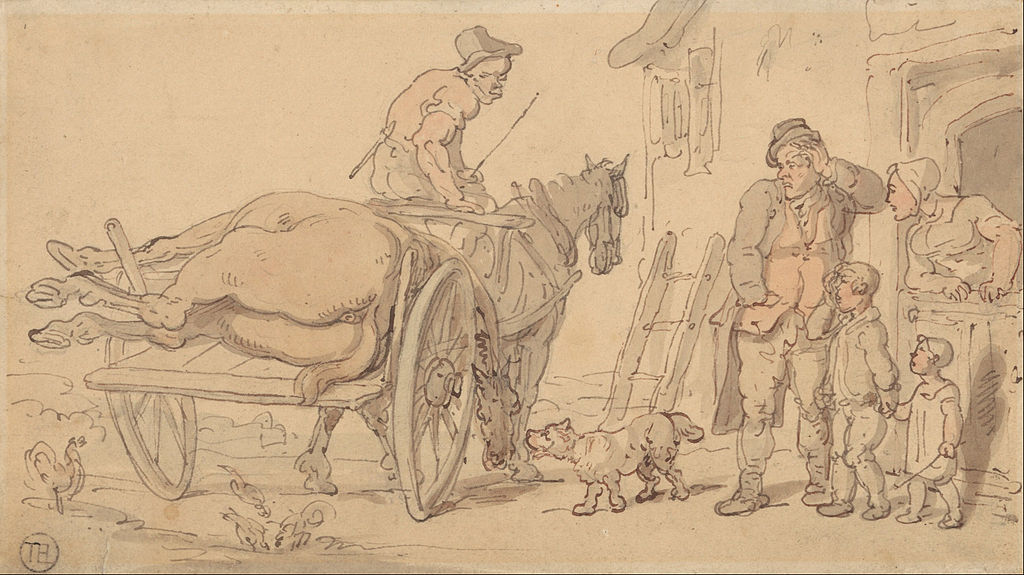
Before the railroads were built, beasts of burden were the “engines” used for transport on land and along man-made canals. They included horses, oxen, mules, and donkeys. Small carts were often pulled by goats or large dogs. As mentioned before, all needed food, water, shelter, and rest, an expense that poor owners could barely afford. Animals who did not receive these basic necessities, lived shortened lives. Often a beast of burden’s reward after years of service was either a trip to the knacker after it died or to a farmer to labor until they dropped from exhaustion. 

Thomas_Rowlandson_-_A_Dead_Horse_on_a_Knacker's_Cart_-_Google_Art_Project

A Dead Horse on a Knacker’s Cart. Thomas Rowlandson, Wikipedia

Even with the help of beasts of burden, moving heavy furniture and a large quantity of personal possessions was no small feat. The pace of travel was slow and often laborious. Before roads were macadamized in the early 19th century, they were in poor condition. After heavy rains, deep ruts and mud slowed vehicles down. Winter snow and ice presented additional hazards. Animals as well as passengers and drivers suffered the most in these harsh elements. 

Working animals’ lives were even more drastically reduced from their exertions of pulling heavy wagons and over loaded carriages. Mail coaches during Austen’s day were the fastest means of land transportation. A faster speed was achieved by driving the horses at top speed and changing the teams every 12 to 15 miles or about every 2 hours. These horses, urged to attain maximum speed at whatever cost, had drastically shortened working lives and lifespans.

The images below show the challenges of moving heavy wagons in snow and mud. Click on the images to enlarge.

The liverpool mail near St Albans – Robert Havell (click the link to see image, which is copyrighted. Horses are stopped with its leader fallen.)

Types of vehicles and those who used them:

Travel for the upper classes:

Income determined the conveyance in which an individual or family moved and how many household goods could be transported over a certain distance. Aristocrats and rich landowners, like Mr Darcy, experienced few impediments. The rising middle classes could also choose more comfortable and efficient means of travel. One can imagine that Mr Bingley arrived at a fully furnished Netherfield Park, having sent trusted representatives and servants ahead of time to see to the details of moving personal belongings, and hiring competent locals to perform additional labor. Keep in mind that the upper crust travelled in style, while servants, aside from valets and ladies maids, accompanied their masters’ possessions in less desirable transportation.

  • For more visual references regarding carriages for the upper classes, Deborah Barnum of Jane Austen in Vermont offers valuable posts on the topic. Click on this link: IV of a series.  

Landless gentry and aspiring social climbers make do with less elegant equipages: 

Mrs Elton, a ridiculous character in Austen’s splendid novel, Emma, assumes that her social position in Highbury is equal to Emma’s. Austen has fun with the character, who utters one absurd opinion after another. She piggy backs onto her sister’s wealth by bragging about that woman’s elegant carriage, while expressing a desire to Mr Knightley to have a donkey. He wryly suggests that she could borrow Mrs Cole’s animal, implying she could save herself the money. In reality, the Eltons must make do with what they have.

crofts curricle

Crofts arrive in a gig, Persuasion 1995. Gigs were not associated with the rich, and the Crofts drove theirs for local excursions only.

“She and her husband are provided with an unexceptionable carriage and horses that suffice for their needs, though of course they cannot be compared with her wealthy sister’s equipage, a barouche-landau….” – Diana Birchall quote in writer Sarah Elmsley‘s splendid blog.

Mr Elton, a mere vicar, served parishioners at a lower social scale than Rev Austen. While Elton received a salary and a rent-free a house, he received no tithes, which limited his income and necessitated his finding a wife with resources. He overstepped his ambition by wooing Emma Woodhouse, but settled for Augusta Elton, whose connections are murky. His marriage to Augusta increased the readers’ enjoyment of the couple’s absurdities.

Austen’s father, Rev George Austen, enjoyed an income from a variety of sources, including a 10% tithe from parishioners from two parishes who could afford to pay the amount. He also oversaw a glebe land, which he farmed. This combined income should have served him well, but his large family necessitated that he and Mrs Austen run a boy’s boarding school for profit inside Steventon Rectory. When George retired, his son James inherited his living and the house the family once occupied, but Rev Austen retained the income from the tithes of the parishes he once served. When he died, this income ceased, plunging the Austen women into financial difficulties, which resulted in their continual quest to find more affordable lodgings — until Edward Austen Knight offered Chawton Cottage to them. This last move resulted in Jane Austen’s glorious creative period in which she published five novels during her lifetime.

Rev Austen and his family moved to Bath in 1801, with only the possessions that would fit into their new home. He no longer had his extensive library or the use of a horse and carriage. The family’s many servants were reduced to a cook, manservant, and one or two maids, depending on the family’s needs. Like other families in their economic situation, they used hired carriages, such as hackney coaches, or public coaches to reach destinations beyond walking distance. During the family’s move to Bath, the goods and possessions they could not physically take with them were most likely transported by a manservant in a wagon.

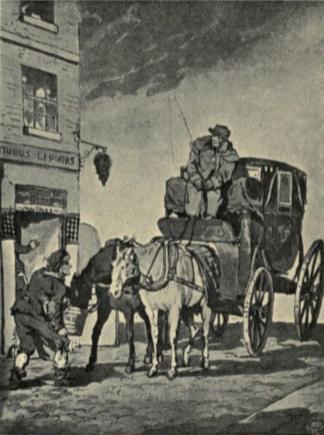
Hackney Coach 1800

Hackney Coach 1800

The 60-mile journey from Steventon to Bath took one day. A rest for the horses at an inn or hotel like the Petty France was a necessity. The following quote from Dean Cantrell describes Catherine Morland’s journey from Bath to Northanger Abbey. The Austen family must have also shared the same feelings: 

“Both carriages stop at Petty France, exactly half the thirty-mile distance from Bath to the General’s Abbey.  Catherine laments “the tediousness of a two hours’ bait” that permits “nothing to be done but to eat without being hungry, and loiter about without any thing to see” (NA, 156).  She clearly understands that it is the chaise with its “heavy and troublesome business” that requires a two-hour halt for the horses to be fed and refreshed…Fifteen miles from Bath, Petty France would have been a likely coach stop in 1801 and 1806 for Jane Austen.” – Yes, There is a Petty France, Dean Cantrell, Persuasions, 1987

Screen Shot 2023-10-28 at 8.45.13 AM

Petty France Hotel

A sixty mile journey must have been exhausting in a public conveyance. View more images of public transportation in this Jane Austen in Vermont, post number III

People from humbler walks of life and their forms of transport:

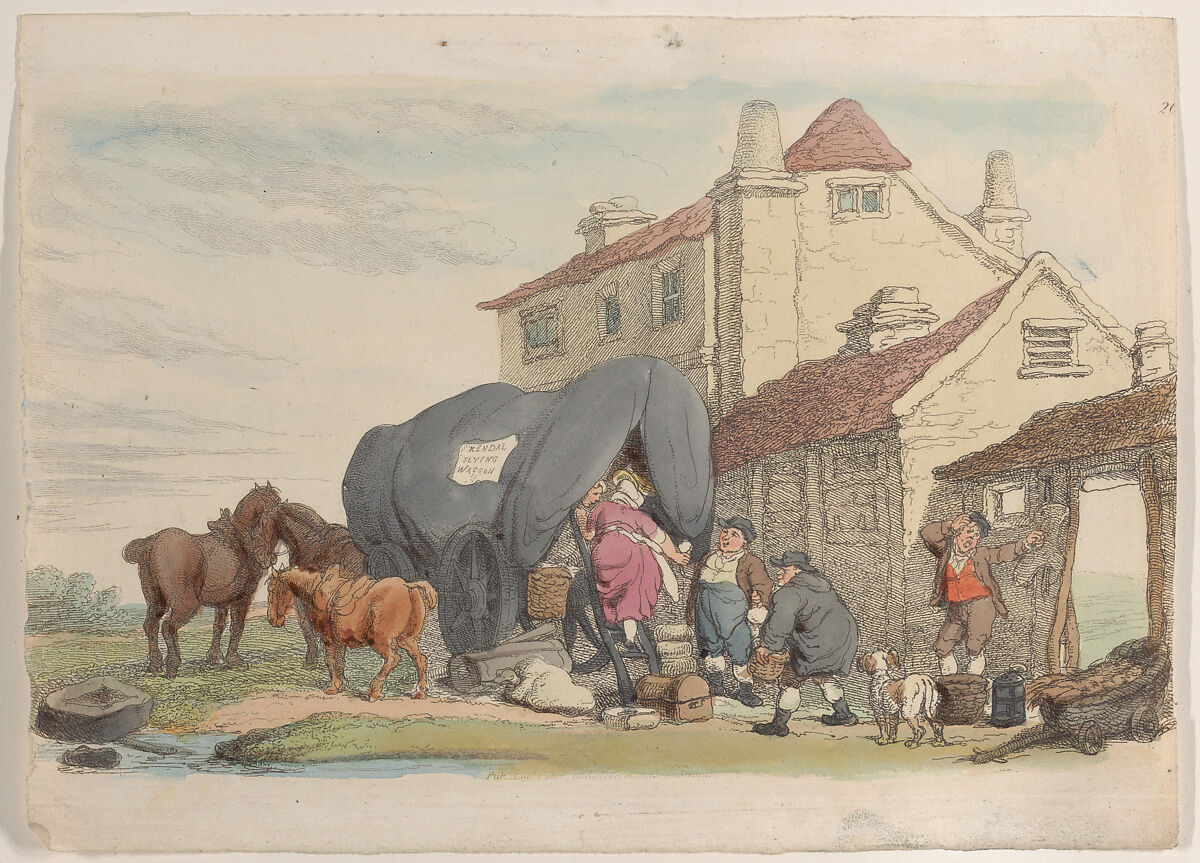
Three Rowlandson images of a flying wagon speak volumes on how people with modest means traveled and transported their goods in wagons that look remarkably like the Conestoga wagons colonists drove across America. 

A flying wagon Rowlandson

Rowlandson, Flying Wagon, MET Museum, public domain, 1816

This Kendal Flying Machine, a wagon, is parked outside of an inn. A woman climbs up a ladder into the wagon. Three men stand at right. In Mr. Rowlandson’s England, Robert Southey described the laboriously slow progress of a flying wagon:

The English mode of travelling is excellently adapted for every thing, except for seeing the country…We met a stage-waggon, the vehicle in which baggage is transported, I could not imagine what this could be; a huge carriage upon four wheels of prodigious breadth, very wide and very long, and arched over with a cloth like a bower, at a considerable height: this monstrous machine was drawn by six large horses, whose neck-bells were heard far off as they approached; the carrier walked beside them, with a long whip upon his shoulder…these waggons are day and night upon their way, and are oddly enough called flying waggons, though of all machines they travel the slowest, slower than even a travelling funeral.” – P 23   


From Southey’s description and depiction of the flying wagon in the first Rowlandson image, one can see the differences in size and the numbers of people and the size of the loads each of these wagons could carry. Rowlandson’s first image of a flying waggon depicted a much smaller vehicle than the one shown in the rendering on P 23, which was drawn by six horses.

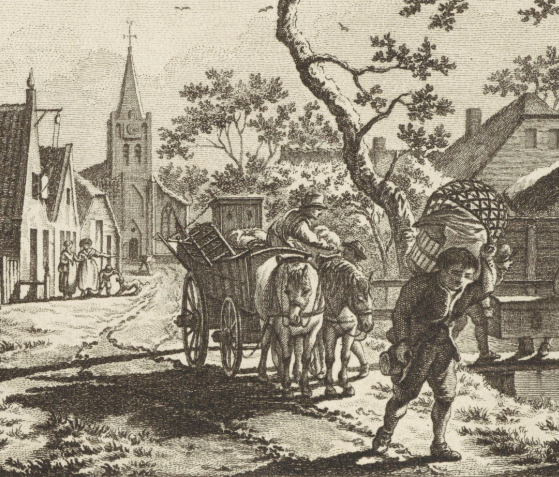
The detail below of an 1806 Dutch etching from The Rijksmuseum shows a cart laden with furniture moving through a small village. A man walking in front seems to be carrying baskets with items inside.

Screen Shot 2023-10-28 at 9.23.25 PM

As in the illustration above, affordable modes of transportation of two- or four-wheel uncovered wagons, were used by humbler people who could afford them. Examples are included in the slide show below. Notice that some images are current, since the mode of moving goods among the poor has changed little over the centuries. 

This slideshow requires JavaScript.

pack_horses

Detail of pack horses.

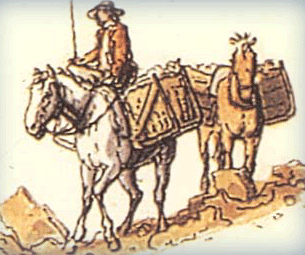
Very poor or itinerants who moved from place to place often walked, carried their personal goods in sacks, pushed them in wheelbarrows or hand carts, rode pack horses, or caught a ride by a kind stranger.

Rivers and inland waterways:

Overland transportation was not the only route people took to move to a new location. England’s streams and rivers had long been a fast, efficient means of travel.

Steam locomotives arrived 3 years before Jane Austen’s death. Before this time, transport via inland waterways and rivers provided a more comfortable and, in many instances, a faster way to move items. Ferries took people and wagons across river crossings.

A surge in canals building occurred in England in the second half of the 18th century, and by the mid-19th century these canals helped the expansion of the English Industrial Revolution. In Jane Austen’s day, most developers still struggled to make a profit building canals. Once they were introduced to connect city to city and routes within cities, these canals became an important source of transporting goods within England and were more profitable.

Horse_Drawing_Barge_on_the_Kennet_and_Avon_Canal

Horse drawing from a towpath on the Kennet and Avon Canal, England, Wikipedia

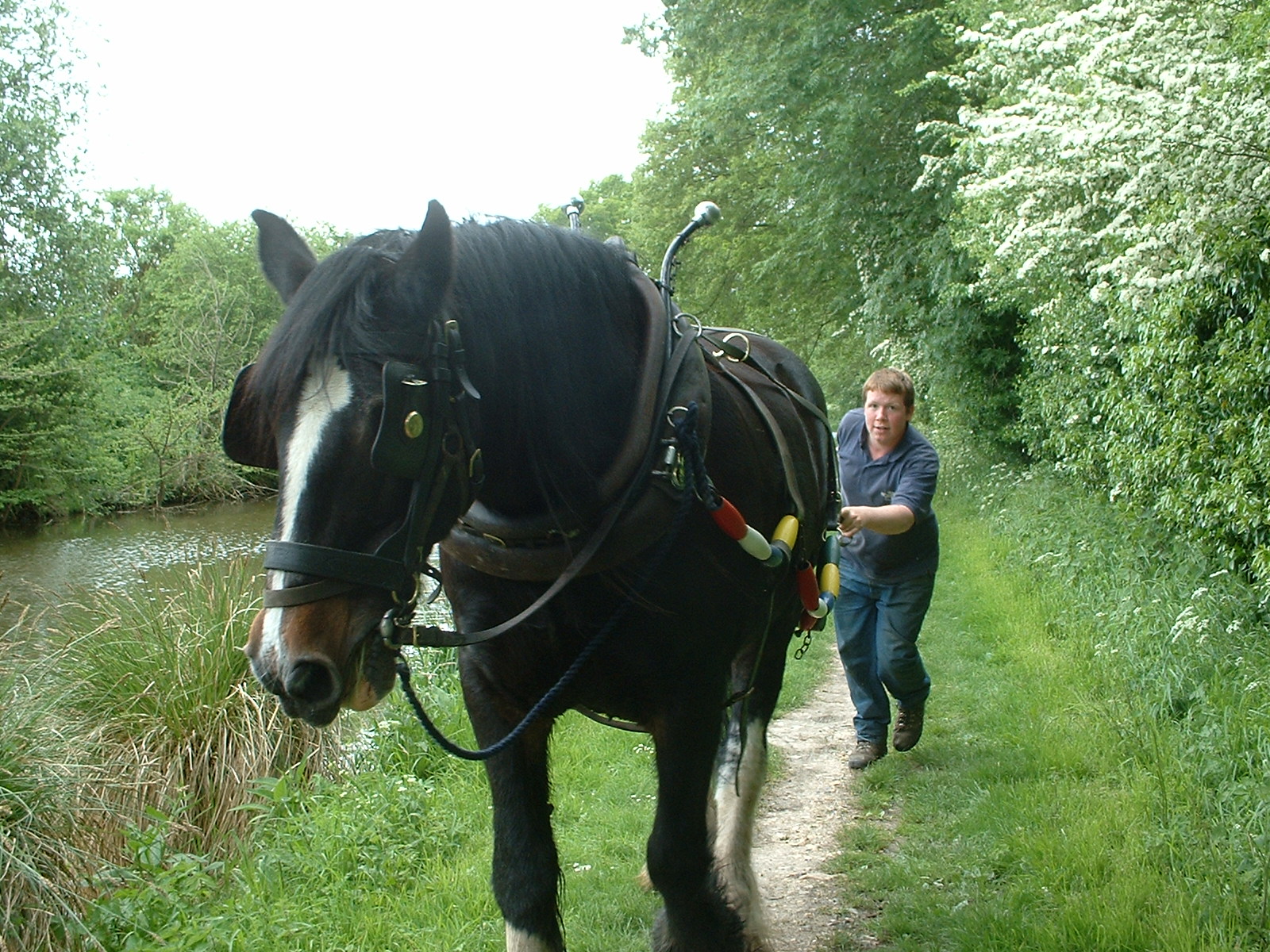
“A horse, towing a boat with a rope from the towpath, could pull fifty times as much cargo as it could pull in a cart or wagon on roads. In the early days of the Canal Age, from about 1740, all boats and barges were towed by horse, mule, hinny, pony or sometimes a pair of donkeys.” Wikipedia, Horse-drawn boat

Importantly, ferries, canal boats, and barges carried heavier loads: they also provided accessibility and affordability to a variety of people from different classes. 

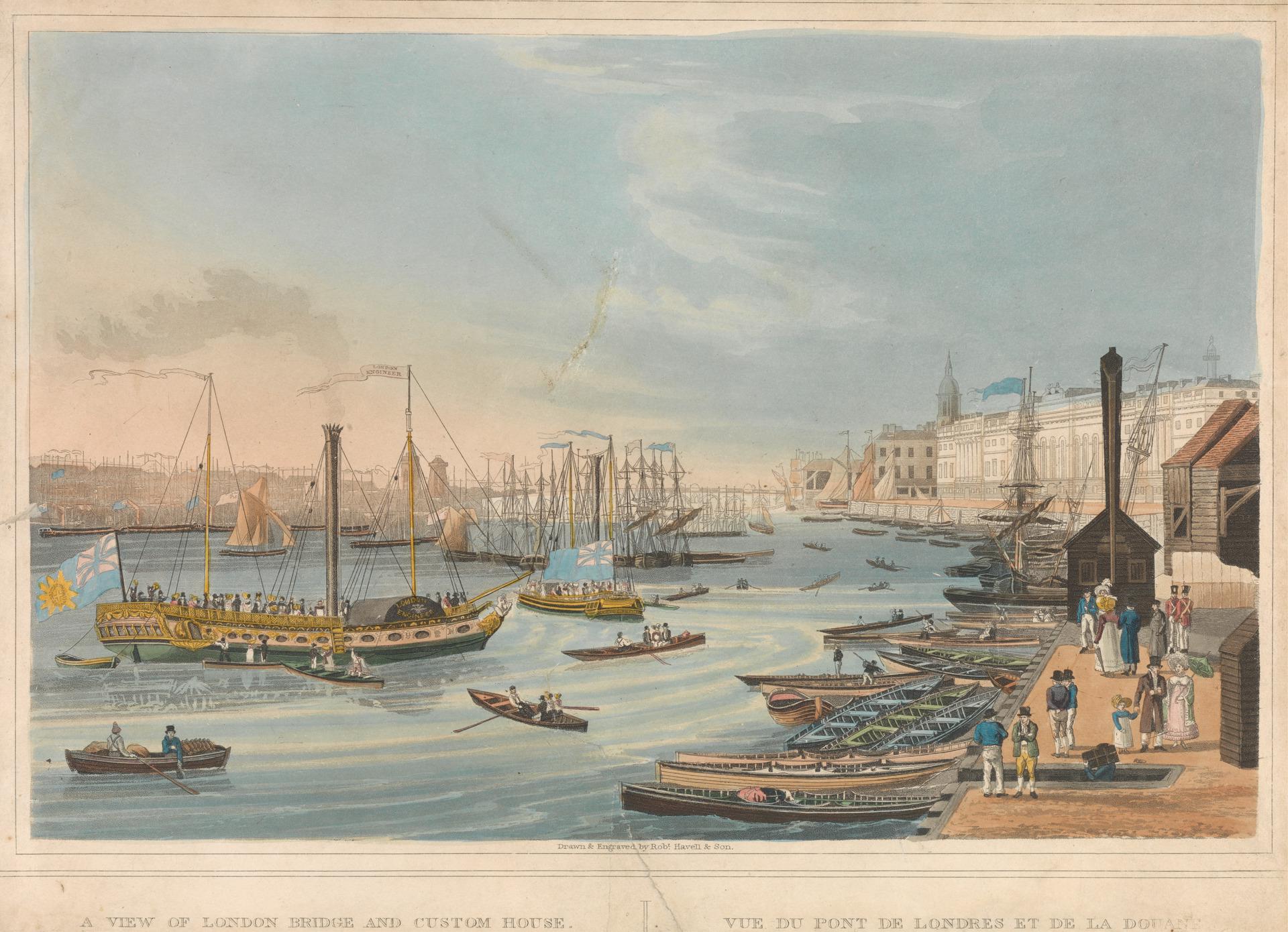
Seaside ports:

Another popular means of transportation in England, an island nation, was via ships that sailed along and around its coastlines to various coastal ports and into major cities. 

Havell, A View of London Bridge and Custom House_-_B1977.14.18472_-_Yale_Center_for_British_Art

A View of London Bridge and Custom House, Robert Havell, Sr., Yale Center for British Art

Additional information on the topic:

By Brenda S. Cox

“Yesterday came a letter to my mother from Edward Cooper to announce, not the birth of a child, but of a living; for Mrs. Leigh has begged his acceptance of the Rectory of Hamstall-Ridware in Staffordshire, vacant by Mr. Johnson’s death. We collect from his letter that he means to reside there, in which he shows his wisdom. Staffordshire is a good way off . . .”—Jane Austen to Cassandra, Jan. 21, 1799

In 1806, Jane Austen and her family made a trip to visit their relatives in the north. They spent five weeks with her first cousin Edward Cooper, rector of Hamstall Ridware (whom I wrote about earlier). They stayed in his rectory, and must have attended the adjacent Church of St. Michael and All Angels and heard Edward Cooper preach there. The church is still much as Austen knew it, inside and out.

The Church of St. Michael and All Angels, Hamstall Ridware, where Jane Austen visited for several weeks in 1806. Photo © Brenda S. Cox, 2023

Hamstall Ridware History

Hamstall Ridware means “homestead,” or “place of the house,” by the “river ford.” It is on the River Blithe. The first word is Anglo-Saxon, the second is Celtic, indicating that the two people groups may have both been living in the area at the time it was named. Three other towns with the name Ridware (Pipe Ridware, Hill Ridware, and Mavesyn Ridware) are nearby.

The de Ridware family were the medieval “lords of the manor” for the area. The church was built, in the Norman style, around 1120 A.D, and expanded in the 14th and 15th centuries.

In the 1370s, the de Ridwares had no male heir, so the land passed to the Cotton family. A Cotton family tomb, from the time of King Henry VIII, still stands in the church. Each shield on the sides commemorates one of the children of John and Joanna Cotton. Half of each shield is their family crest, an eagle on a blue background. For the sons, the other half represents their profession. For the daughters, the other half shows the shield of their husband’s family.

This tomb from the time of King Henry VIII represents all the children of the Cotton family, the lords of the manor at the time. Photo © Brenda S. Cox, 2023

In the 1500s, the Cottons had no male heir, so the manor, Hamstall Hall, and the lands, passed to Sir Anthony Fitzherbert, the husband of the eldest daughter. 

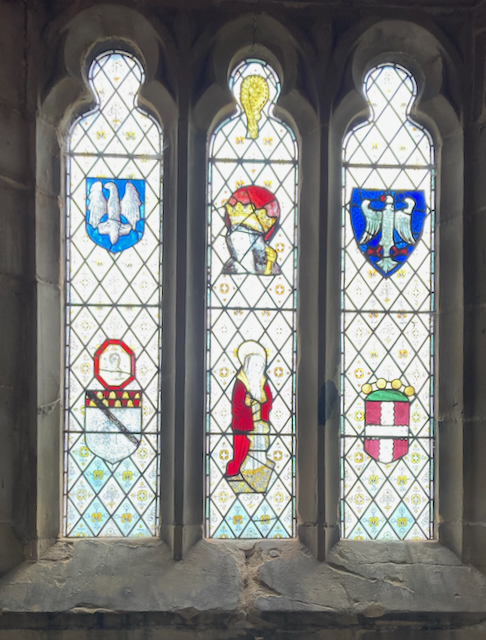
In 1601 the estate went to Sir Thomas Leigh of Stoneleigh, one of Jane Austen’s forebears. This early stained glass window, incorporating 14th century glass, commemorates all these patrons of the Hamstall Ridware church. Each family would have owned the advowson for the Hamstall Ridware church, the right to choose the rector of the church when the previous one died.

Stained glass window in Hamstall Ridware church. This window shows coats of arms of the families who have owned the manor and land of Hamstall Ridware: the de Ridwares of Hamstall on the upper right, the Cotton de Ridwares on the upper left, the Fitzherberts on the lower left, and the Leighs on the lower right. Alice Cotton, wife of Richard Cotton, appears near the top of the middle panel. Photo © Brenda S. Cox, 2023

The Leighs’ main home was at Stoneleigh Abbey (which we’ll “visit” later). The Hon. Mary Leigh of Stoneleigh Abbey was patroness of Hamstall Ridware in 1799.  When the previous rector, Mr. Johnson, died, she gave the living to her relative Edward Cooper. Before that he had been a curate, an assistant or substitute clergyman, probably with a low salary, at Harpsden. Jane and her family had visited the Coopers at Harpsden in August and September of 1799, before the Coopers moved to Hamstall Ridware in October. Edward invited them to visit Hamstall Ridware in 1801, but Jane said in a letter that they preferred to go to the seaside that summer. However, five years later, the Austens did make a long trip to visit their Leigh relations at Adlestrop, then accompanied their cousin, Rev. Thomas Leigh, who had just inherited Stoneleigh Abbey, to the abbey. From Stoneleigh they went to Hamstall Ridware, 38 miles away.

During this time, it’s possible that Jane may have seen the play Lover’s Vows, an important part of Mansfield Park. It was advertised in a village called Cheadle about an hour’s carriage ride away (Gaye King, “Visiting”).

Unfortunately, during Jane’s visit, Edward’s eight children came down with whooping cough, and Jane got it a few weeks later, after she got home (Letters, Jan. 7, 1807).

Displays in the church commemorate Jane Austen, her visit to Hamstall Ridware, the history of the church, and the Leigh family’s connections to the area. Photo © Brenda S. Cox, 2023
The church history board gives fascinating tidbits. For example, the parish register for 1715 lists the death of rector Thomas Allestree, M.A., and the induction of a new rector, Gorstelowe Monck, A.M. (same as M.A., Master of Arts); 7 baptisms (presumably of babies); 5 marriages including two to widows, and two others by license, both with one spouse from another parish; 7 burials, including Rev. Allestree (age 77) in July, his widow in December, and two babies buried shortly after their baptisms. An adjacent news article about Rev. Allestree says he wrote and memorized 500 sermons, and preached them a total of 5,000 times! Photo © Brenda S. Cox, 2023

The Rectory

The rectory (or parsonage, the house provided for the rector of the parish) where the Austens stayed is now a private home. It is now difficult to see even from the outside, but this photo shows the building before a gate was built.

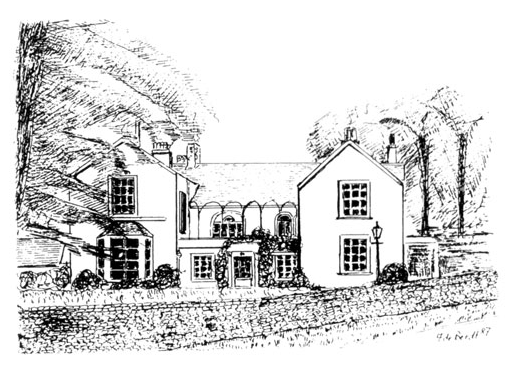
The Hamstall Ridware rectory, before gates were installed. Jane Austen and her family stayed here for five weeks in 1806 with Jane’s cousin Edward Cooper. Photo © Jack Barber, 2017, used by permission.

It has been speculated that this rectory was the pattern for the Delaford rectory, where Edward and Elinor Ferrars settle in Sense and Sensibility. The layout of the Delaford estate, with “stew-ponds” (fish ponds), “a very pretty canal” (perhaps suggested by the nearby river), and “great garden walls,” also corresponds to some features of the Leighs’ estate at Hamstall Ridware.

Gaye King wrote,

“Edward had found the rectory quite large enough to accommodate his growing family. Like the fictional parsonage at Delaford it had ‘five sitting-rooms on the ground floor, and … could make up fifteen beds’ (292). So the young rector could look forward to maintaining the tradition of liberal hospitality such as that he had enjoyed at the Steventon parsonage. When Jane Austen, together with her mother and sister, did eventually spend those five weeks at Hamstall Ridware in 1806 Edward and Caroline had eight children. There were also, living in at the rectory, two maids and a governess, yet there was still ample accommodation for the guests.”

(I have since noticed that the five sitting rooms and fifteen beds were characteristics of the manor house where Col. Brandon lived, not of the parsonage! And I doubt a country parsonage would have so many sitting rooms.)

However, relatives who visited wrote that it was “a beautifully situated parsonage house on a considerable eminence, back’d with fine woods, seen at a distance from the road to this happy village,” and that the church “was a very neat old Spire Building of stone, having two side Ailes [sic] Chancel &c. and makes a magnificent appearance as a Village Church” (quoted in Deirdre Le Faye, Jane Austen: A Family Record, 157).

The Church of St. Michael and All Angels, Hamstall Ridware

The Church of St. Michael and All Angels, Hamstall Ridware, where Jane Austen’s cousin Edward Cooper was rector from 1799-1833. Photo © Brenda S. Cox, 2023

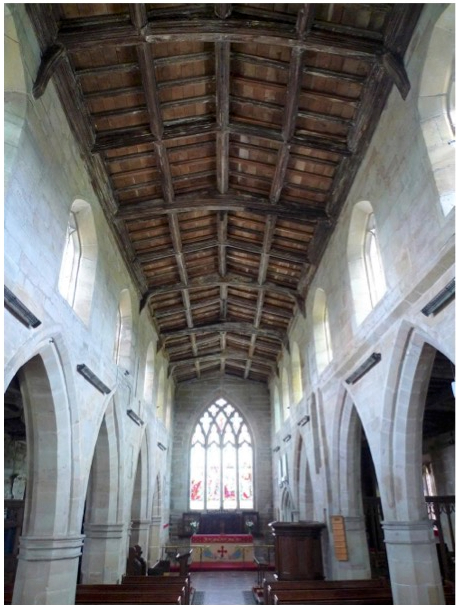
The church is large, seating 200 people, almost three times the size of Jane’s church at Steventon (which seats about 75). It has a long central aisle leading to the chancel, where the altar sits, and two side aisles. Lining both sides is a clerestory, high walls with a series of windows which let in natural light.

Central aisle of the Hamstall Ridware church. Photo courtesy of Hamstall Ridware PCC, used by permission.
Unusually, the upper section of the church has clerestory windows down the whole length of the church, lighting up the whole interior. The aisle roofs are “moulded ridge pieces and tie beams.” Photo courtesy of Hamstall Ridware PCC, used by permission.
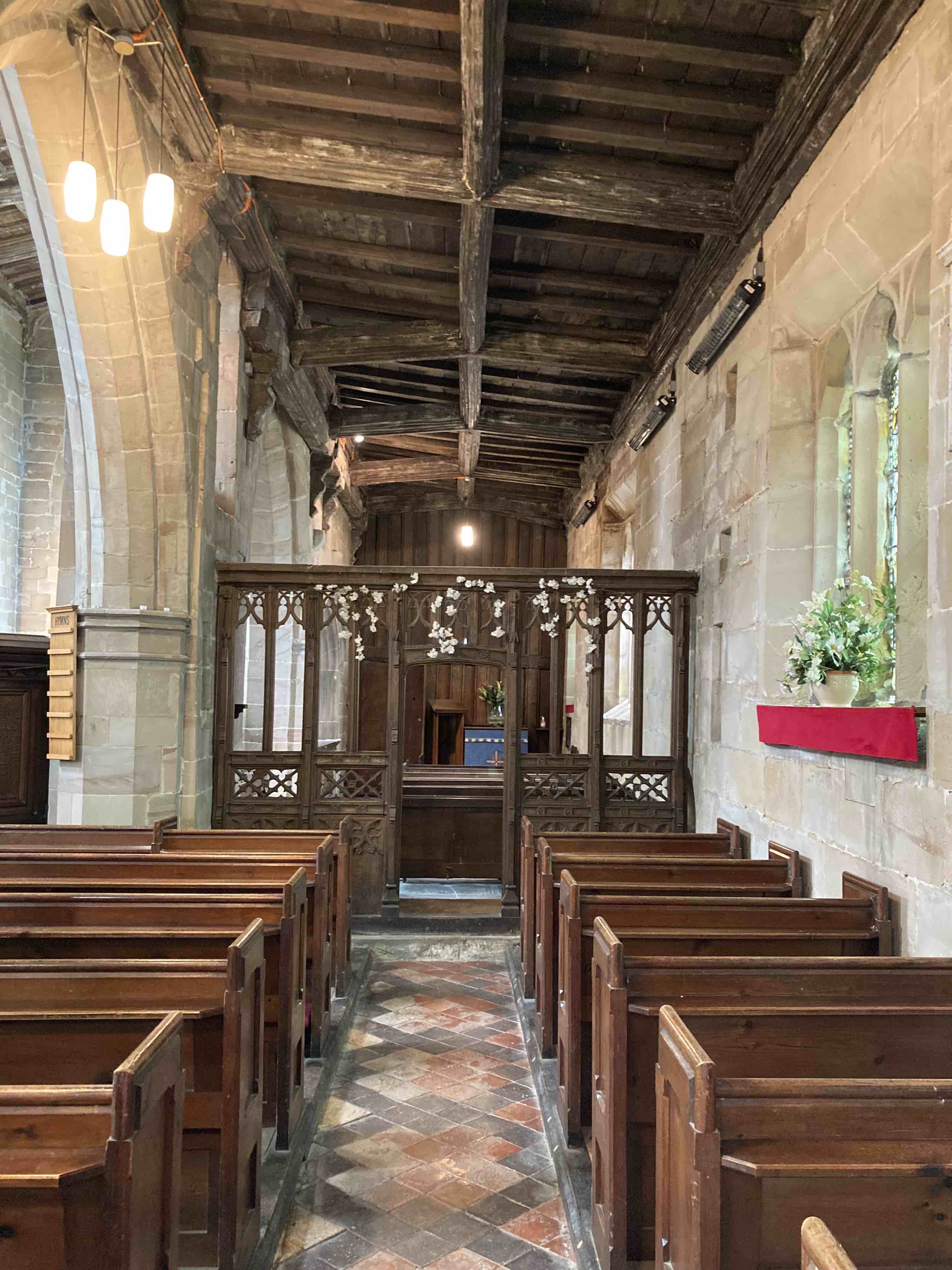
Late 15th century chapel screen on a side aisle. Photo © Brenda S. Cox, 2023

Like many churches in England before the Reformation, this church once had a rood screen separating the chancel from the nave. This was a barrier between the chancel, where the clergy celebrated mass at the altar, and the lay people worshiping in the nave. It was usually topped by a cross; the Anglo-Saxon word for cross is rood. Some churches also had a rood loft, above the screen, from which a choir would sing parts of the service. Many rood screens and lofts were destroyed during or after the Reformation, to symbolize people’s more direct access to God.

A few steps, which once led to the rood loft, still remain in one wall. Two paintings from the rood screen are now behind the main altar in a reredos (reer-ih-dahss is one pronunciation). This means a decorative panel behind the altar. These paintings are from the late 15th century, by an unknown accomplished artist, probably local.

The reredos behind the altar includes two 15th century paintings from the rood screen of the church, which was destroyed during the Reformation. The one on the left is apparently unique in England. It shows times when Christ’s blood was shed: “the circumcision, the agony in the garden, the scourging, the crown of thorns and the crucifixion,” according to the church booklet. “The right-hand panel shows the procession of the cross with St. Mary Magdalene kneeling in front of it. Both panels have been heavily scratched and scored. This was probably done at the time of the Civil War [1642-1651], when everything that had Roman Catholic associations was defaced.” Photo © Brenda S. Cox, 2023

Memorials to the Cooper Family

Edward Cooper and his family left their mark on the church. The memorial to Edward Cooper says:

In a vault near this spot, are deposited the remains of the Rev. EDWARD COOPER, who, for upwards of 30 years was rector of this parish, and for many years of the adjoining parish of Yoxall also: in both which places, (as a faithful minister of Christ, and endeared to all his parishioners,) he discharged, with unremitting zeal, the duties of his sacred office.

He was the only son of the Rev. Edward Cooper, L.L.D. vicar of Sonning Berks, &c. and prebendary of Bath and Wells; and of Jane his wife, grandaughter of Theophilus Leigh, Esq., of Addlestrop, in the county of Gloucester,

He was formerly fellow of All-Souls’ College, Oxford, as was his father also.

He departed this life, the 26th day of February, 1833, in the 63rd year of his age.

“He being dead yet speaketh”

Within the same vault also repose the remains of CAROLINE ISABELLA, his widow, only daughter of Philip Lybbe Powys, Esq. of Hardwick House in the county of Oxford,

She died on the 28th day of August, 1838, in the 63rd year of her age.

This tablet is erected by their eight surviving children, as a tribute of grateful affection, and respect, to the memory of their deeply lamented, and much beloved parents.

Memorial in Hamstall Ridware church to Edward Cooper, rector. Photo © Brenda S. Cox, 2023

As the memorial notes, Edward was also rector of a neighboring parish, Yoxall (from 1809). Like George Austen, he needed the income from two small parishes and was able to serve them both since they were close. Rev. Thomas Gisborne, another Evangelical minister, was from Yoxall. He wrote a book that Cassandra and Jane both liked, An Enquiry into the Duties of the Female Sex (letter of Aug. 30, 1805). Perhaps Edward had recommended it to them. Though we have no record of it, it’s possible Jane could have met Gisborne during her visit. He was a friend of Edward’s, and he and Henry Austen were the godfathers of one of Edward’s sons. Gisborne was also involved with Wilberforce in fighting the slave trade. (Gaye King, “Cousin” article)

On another wall is a memorial to Edward’s son and grandson. His youngest son Warren died in 1844, age 39, and Warren’s son, Edward-Warren, died as an infant in 1840.

Hamstall Ridware memorial to Edward Cooper’s son and grandson. Photo © Brenda S. Cox, 2023

Outside, under a large cross, are the graves of Edward’s third son, Rev. H. C. Cooper, vicar of Barton-under-Needwood (5.6 miles away), who died in 1876, “in the 76th year of his age.” Also Edward’s second daughter, Cassandra Louisa, who died in 1880, “in the 84th year of her age.” The final inscription reads, “Looking for the mercy of our Lord Jesus Christ unto eternal life. Jude, v. 21”

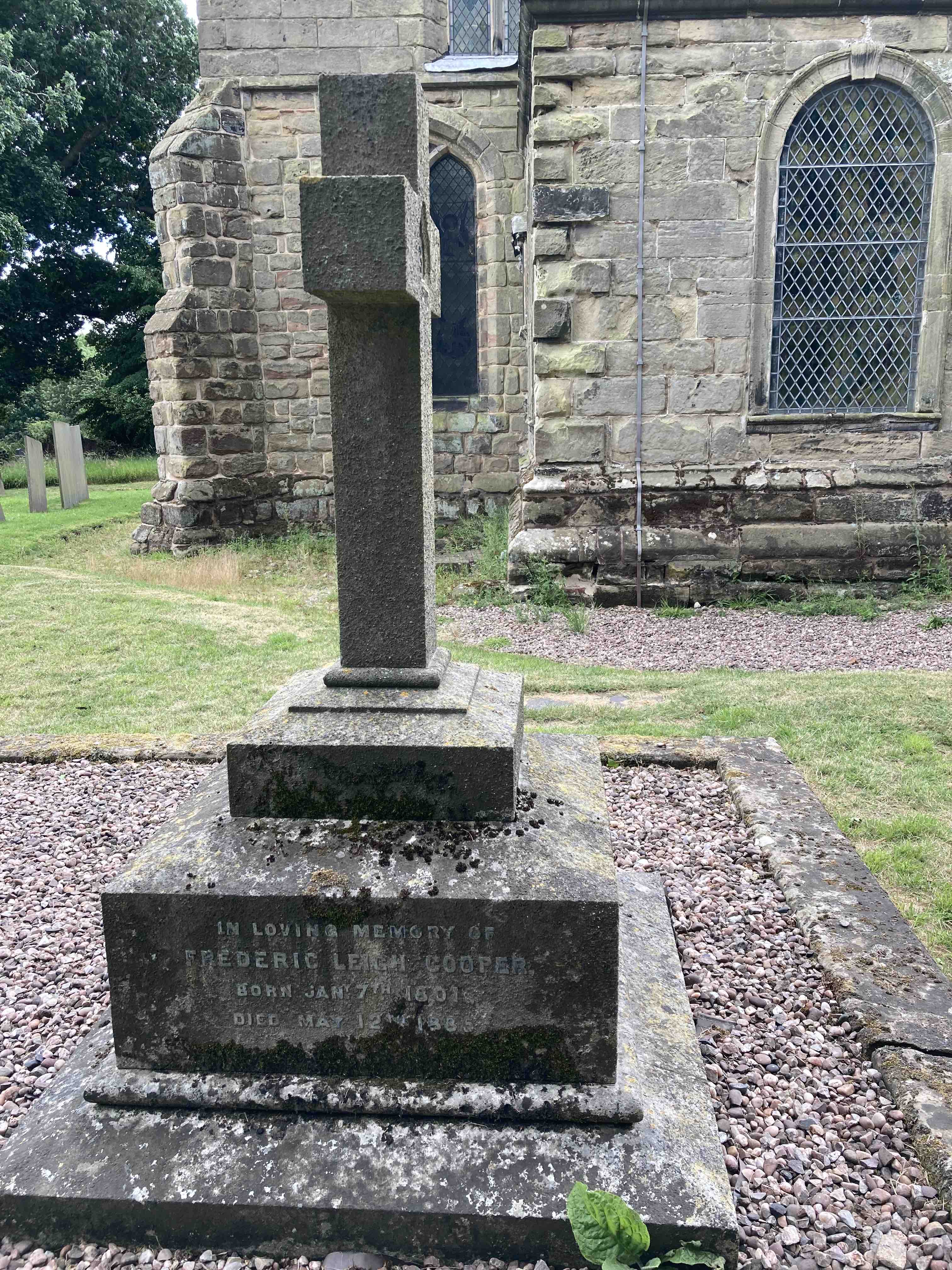
Another side memorializes Frederic Leigh Cooper, born 1801, died 1885. This was Edward’s fifth child

This cross identifies the burial site of several of Edward Cooper’s children in the Hamstall Ridware church burial ground. Photo © Brenda S. Cox, 2023
Side view of cross with inscription to another son. Photo © Brenda S. Cox, 2023

Glebe

Green fields surround the church. Most churches in England had glebe land, farmland that provided income for the clergyman. In 1978, all glebe land was transferred to the dioceses, who administer it now. (A diocese is a group of church parishes overseen by a bishop.) Some modern locations in England still retain the name glebe. Hamstall Ridware is part of the Diocese of Lichfield, and I was told the diocese still receives income from grazing on glebe lands nearby. Glebe income today is used to pay clergy salaries and other expenses.

The Hamstall Ridware church is in the midst of green fields, some of which still provide income to the Church of England today. Photo © Brenda S. Cox, 2023

The Church Today

The Hamstall Ridware church is now part of a benefice including four parishes with one rector. In 1831, the population of the parish was 443. In 2011 it was 313.

Hamstall Hall, previous home of the Leigh family, is now mostly in ruins. But, according to the church booklet, the current Lord Leigh is still “a patron of the United Benefice of King’s Bromley, the Ridwares, and Yoxall jointly with the Bishop of Lichfield and the Dean and Chapter of Lichfield Cathedral.” (In other words, they jointly choose/approve the clergymen for the churches of the benefice.) 

Like Chawton and Steventon, Sunday services are held at the Hamstall Ridware church weekly, usually with only ten or so faithful parishioners attending. The church is large, seating 200 people, but it has little heating, and only a chemical toilet outside. However, they do get big crowds for Harvest, Christmas, and other special services, as well as lectures and concerts. And many visitors come to the church, which is open in the daytime, though apparently the door can be tricky to open.

The Church of St. Michael and All Angels is well worth a visit for Jane Austen enthusiasts. It is just over an hour’s drive, by car, from Stoneleigh Abbey. The Samuel Johnson Birthplace Museum in Lichfield is on the way.

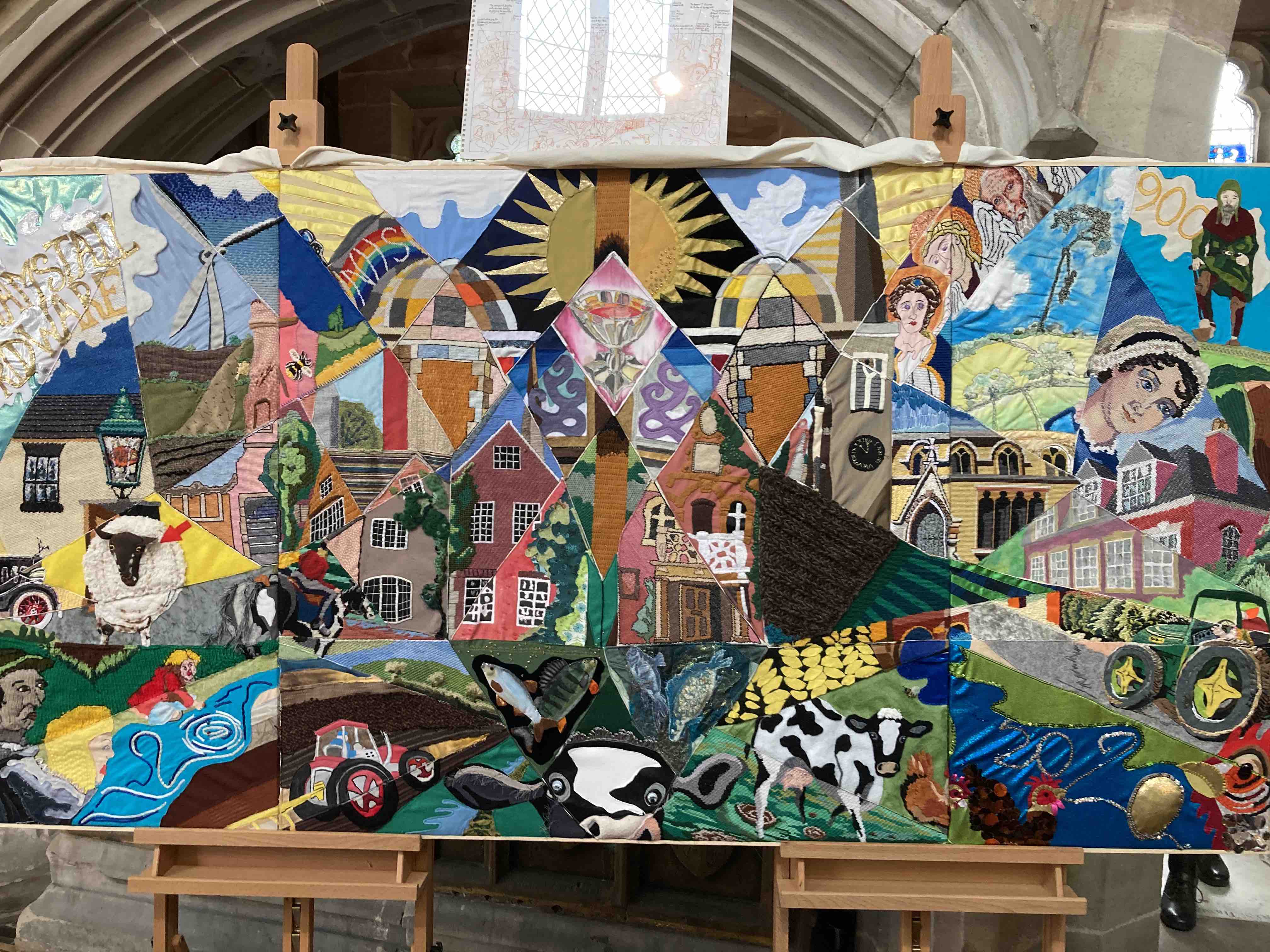
The people of the church created a tapestry depicting Hamstall Ridware through 900 years of history. Jane Austen’s face is prominent on the right side. Photo © Brenda S. Cox, 2023

Note: In 1805, Edward Cooper wrote a hymn that is still sung today, “Father of Heaven, Whose Love Profound.”

For Further Exploration

This post from the Ridware Historic Society includes diary entries from Edward’s mother-in-law, during her visits to the family at Hamstall Ridware, as well as more information about the town and its people.

The church website gives some history and a schedule of services.

The historic listing tells more details of the church’s architecture.

A video showing many aspects of the church

Booklet on the church (a slightly older version than the one I used for this article)  

Photos on Flickr of Hamstall Hall, Hamstall Ridware church and Yoxall church  

Gaye King “Jane Austen’s Staffordshire Cousin: Edward Cooper and His Circle,” Persuasions 1993

Gaye King, “Visiting Edward Cooper,” Persuasions 1987

Donald Greene article, “Hamstall Ridware: A Neglected Austen Setting,” Persuasions 1985 

Posts on other Jane Austen Family Churches

Steventon

Chawton

Adlestrop and the Leigh Family

Stoneleigh Abbey Chapel

Great Bookham and Austen’s godfather, Rev. Samuel Cooke
Ashe and Jane’s Friend Mrs. Lefroy 
Deane

Brenda S. Cox is the author of Fashionable Goodness: Christianity in Jane Austen’s England. She also blogs at Faith, Science, Joy, and Jane Austen.