This Jane Austen blog brings Jane Austen, her novels, and the Regency Period alive through food, dress, social customs, and other 19th C. historical details related to this topic.
Gentle readers, this incredible panorama was found in an attic in Rhinebeck, New York. Forgotten and neglected in a barrel, filthy, and badly torn, this painting c. 1810 revealed itself to be over eight feet long when it was unrolled. Click here to see a magnified version of the painting. The details are staggering. I even see a fire! Can you spot other details? Like cannon fire? Or is this my imagination?
London panorama, unknown artist, c. 1810
The ‘Rhinebeck’ Panorama of London, c.1810. Facsimile publication (no.125) of the London Topographical Society, 1981. Stk ++ DA 683 RF396.
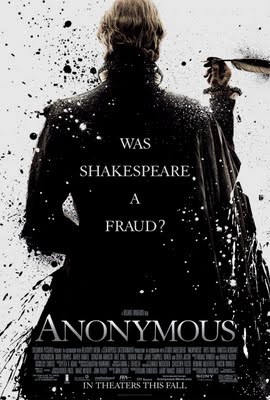
Gentle Readers, Patty of Brandy Parfums frequently contributes articles of interest to this blog. Her latest post is about Anonymous, the film about the authorship of Shakespeare’s plays, which recently opened in theatres.
Film Poster
Introduction – Instead of writing a traditional plot-spoiler review of Anonymous, which can be found in many newspapers and magazines, I’ve written what I think will be more useful – a short guide to Shakespeare authorship. Enjoy! – Patricia Saffran
Jamie Campbell Bower as the young earl of Oxford
A Guide to Shakespeare Authorship
Jane Austen knew Shakespeare’s plays well and based a number of her novels on Shakespeare’s characters and plot devices. Stephen Derry writes about these many references in his paper for the Jane Austen Society of North America, ‘Jane Austen’s Use of Measure for Measure in Sense and Sensibility.’ Derry begins his paper by saying -In Mansfield Park, Edmund Bertram declares that one is familiar with Shakespeare in a degree from one’s earliest years. His celebrated passages are quoted by everybody we all talk Shakespeare, use his similes, and describe with his descriptions.
Tudor England
Knowing of Jane Austen’s profound knowledge of Shakespeare should give those who love her works a keen interest in all things Shakespeare – and in this new movie, which brings the Elizabethan period to life. This is the first time a major movie studio has taken a leap, with an elaborate period production, costumes, and star-studded cast, to delve into the question plaguing scholars for centuries, as to who the author of Shakespeare’s plays really was.
Joely Richardson as a young Elizabeth I and Jamie Campbell Bower as a young Earl of Oxford
The gamble has payed off, as this is a truly sensational
movie. It takes place during the succession of Queen Elizabeth I, and the Essex Rebellion against her – a period of turmoil and political instability. During this period, being the author of a play with politically loaded or satirical material was dangerous. Some authors chose anonymity………
Shakespeare authorship as an area of inquiry is not new. While making a list of the greatest Elizabethan poets, Henry Peacham in The Compleat Gentleman published in 1622, when the First Folio was being created, lists Edward de Vere, the Earl of Oxford, first on his list and does not include Shakespeare at all. Many believe that this was Peacham’s way of hinting that Edward de Vere, not William Shakespeare, wrote the plays and poetry.
Rafe Spall as William Shakespeare
More recently, in the past 150 years, there have been many notable actors, writers, and Supreme Court judges who have questioned William Shakespeare as the author of the plays. Among them are Mark Twain, Leslie Howard, Charlie Chaplin, Orson Welles, Sigmund Freud, Charles Dickens, Walt Whitman, Henry James, J. Thomas Looney, Michael York, Sandra Day O’Connor, Harry A. Blackmun, and John Paul Stevens. Besides de Vere and William Shakespeare, the other main candidates to have written the plays are Bacon, Marlowe, and Neville.
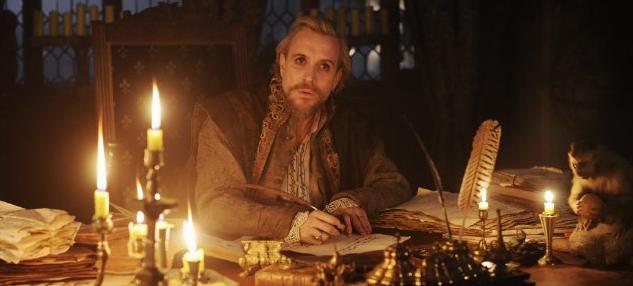
Rhys Ifans as the mature Earl of Oxford
A fantastic short video by the director of Anonymous, Roland Emmerich, summarizes ten reasons why it is implausible that the Stratford William Shakespeare wrote the plays. For some, the main reason is that unlike all other great authors of the period, no letters exist either to or from Shakespeare.
A new book coming out November 8th continues to examine the question of Shakespeare authorship – The Shakespeare Guide to Italy by Richard Paul Roe, paints the Stratford man who never left England as an improbable author of the many distinctively Italian plays.
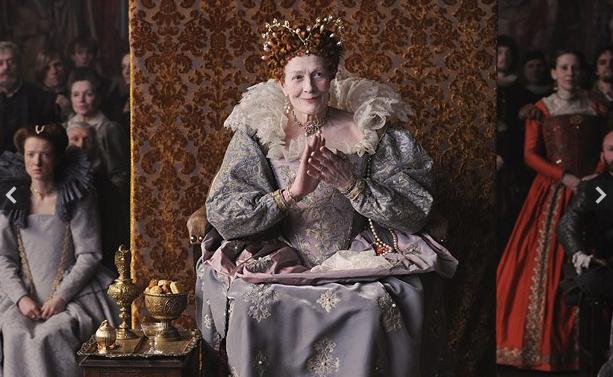
Vanessa Redgrave as the mature Elizabeth I
Current scholars, and by extension many of their now journalist proteges, who defend William Shakespeare as the author of the plays, are extremely defensive and say there is no room for doubt. Time will likely make the world more receptive to exploring Shakespeare authorship, but for now Anonymous will inspire interest in this fascinating field. I highly recommend this film.
For more on Shakespeare and Shakespeare Authorship:
Anonymous, the new movie about Edward de Vere, the Earl of Oxford, as the true author of Shakespeare’s plays. With Rhys Ifans, Vanessa Redgrave, David Thewlis, and along with those who actively support authorship studies, Derek Jacobi and Mark Rylance. Directed and produced by Roland Emmerich, released by Columbia.
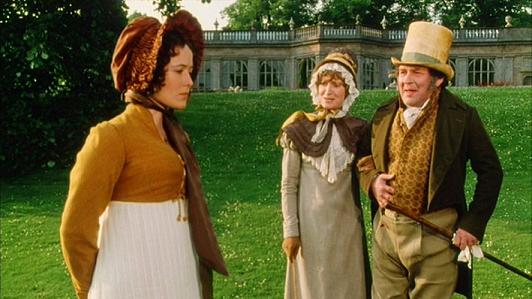
One of the most pivotal decisions in Pride and Prejudice was when Elizabeth Bennet agreed to visit Pemberley’s gardens and grounds with the Gardiners, only to suddenly encounter Mr. Darcy, who was not slated to return until the next day.
Such a visit to grand estates by the well-heeled and more common folk like Elizabeth and her aunt and uncle were quite common in the 18th century. They would have purchased an inexpensive guide book at a local inn or town, and read information about the paintings and objects inside the great houses, and a description of the gardens and their rustic buildings and ornaments.
Prospect of Stowe House by Benton Seeley
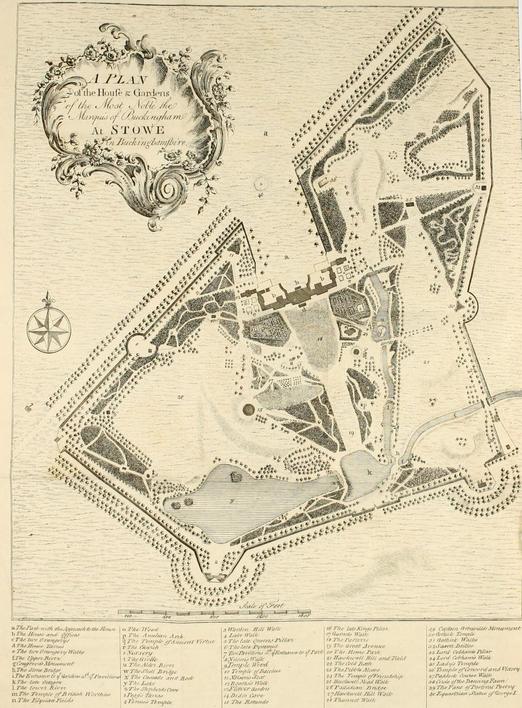
Stowe in particular was a destination point for visitors. Its magnificent gardens and grounds were a model and inspiration for other gardens of the Romantic era, which echoed the movement’s reverence for nature and aesthetic ideals. The blog of the current Duke of Buckingham and Chandos contains this passage:
“The house and gardens at Stowe, my family seat, were tourist attractions from around 1724, when my ancestor Lord Cobham set out the gardens. People came to visit the gardens and house, sometimes invited, often not. Topographical notes and poems were written. And in 1744 the first full guidebook to the house and grounds was published by Benton Seeley, a writing master in Buckingham. The guidebooks continued for a further 70 years and Seeley went on to become a printer and publisher, founding a business that wound up only in 1978.” – Duke of Buckingham and Chandos
Thomas Jefferson owned at least two of Seeley’s guidebooks. In fact, Stowe’s reputation as a gardening attraction had spread beyond the British Isles:
“When well-heeled Americans traveled to England in the late eighteenth century, they often sought out famous gardens to inspire their own designs at home. As Benton Seeley’s Stowe: A Description of the Magnificent House and Gardens shows, the gardens at Stowe were particularly large and ornate, featuring temples, pavilions, and statues strewn about the grounds. Thomas Jefferson and John Adams visited Stowe together in 1786 in what Abigail Adams called their “journey into the country.”- Better Homes and Gardens, Stanford University
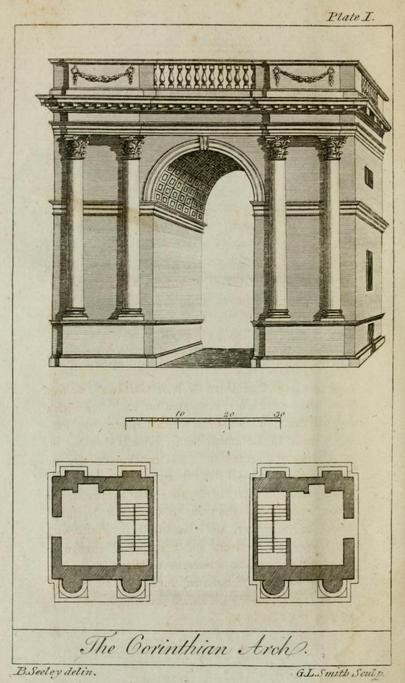
Corinthian Arch
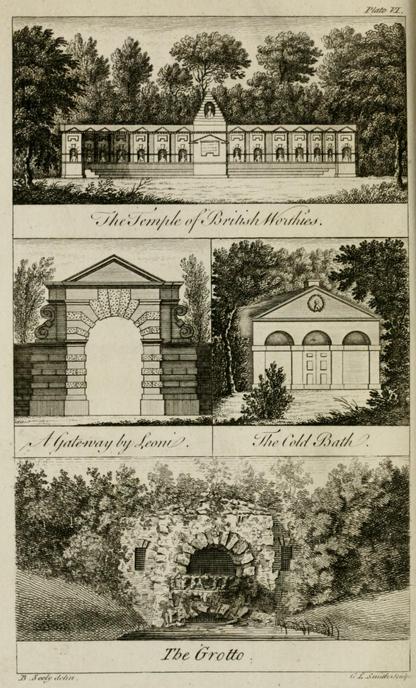
Seeley’s Guide Book became historically significant. It went through seventeen editions between 1744 and 1797, continually undergoing improvements and revisions. The book’s influence was such that it helped to make the Stowe gardens among the most publicized and copied of the English landscape model. However, Seeley’s was not the only guidebook written for the famed Stowe gardens. In 1732 Lord Cobham’s nephew Gilbert West wrote a lengthy poem The Gardens of the Right Honourable Richard Viscount Cobham that is actually a guide to the gardens in verse form. Charles Bridgeman commissioned 15 engravings of the gardens from Jacques Rigaud, and these were published in 1739 (Wikipedia), five years before Seeley’s guide.
The Stowe gardens and grounds were extensive, offering planned vistas along a winding path, parterres, canals, large swaths of meadows, places for isolation and retreat, rustic buildings, and an emphasis on natural grandeur over formal symmetry. The 4th Baronet, Viscount Cobham, who married a rich brewery heiress, implemented the garden changes at Stowe in 1711. By 1724, the gardens rested on 24 acres and required the labor of 30 men. Garden maintenance cost the family 827 pounds in 1749-1750. Multiply that amount by 50, and you gain a quick idea of the cost in today’s terms. This sum represented almost all the spare money Lord Cobham could afford on the house and grounds.
The grotto was originally designed by William Kent in the late 1730s as a symmetrical, freestanding structure decorated with flints, colored glass, and shells. Soon covered over with earth, it was then described as a “romantic retirement.” By the 1780s, it was more deeply buried, resurfaced with tufa, and planted with vines and conifers for a cavernous effect.- Romantic Gardens: Nature, Art, and Landscape Design, 2010, The Morgan Library Museum
In “A fine house richly furnished: pemberley and the visiting of country houses,” Stephen Clarke, a London lawyer and architectural historian discusses the kind of information a guidebook owner could expect. A New Description of Blenheim by Mayor, 1811, offered the following General Information in its preface:
“BLENHEIM may be seen every afternoon, from three till five o’Clock, except on Sundays and public Days. On Fair days at Woodstock, likewise, it can be seen only by particular permission.
COMPANY who arrive in the morning may take the ride of the Park, or the walk of the Gardens, before dinner, and after that visit the Palace.
The CHINA GALLERY, PARK, and GARDENS, will, on proper application, be shewn at any hour of the day, except during the time of Divine Service on Sundays.”
In 1776, the Wilton visitors book showed 2, 324 visitors in the last year.
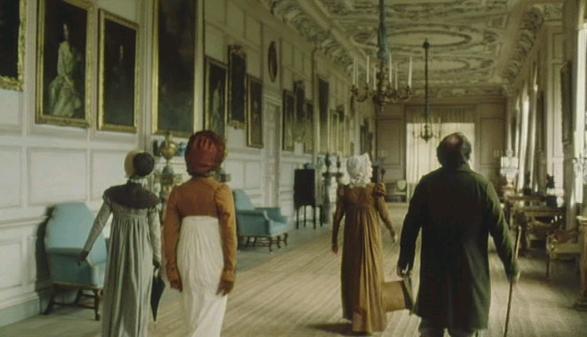
The housekeeper guides Elizabeth and the Gardiners through Pemberley's interior
“The rapacity of housekeepers-and, in the larger houses, of the other staff–was a common complaint. At Blenheim during his tour of 1810-1811, Louis Simond was required to pay the porter at the gate, the woman showing the china collection, the woman showing the theatre, the woman showing the pleasure grounds, the gardener showing the park, and the upper servant showing the house–at a total cost of 19s. (qtd. in Ousby 81). There are similar complaints of Woburn, Chatsworth, and other great houses. Horace Walpole wryly remarked that he should have married his own housekeeper, who had grown rich on showing Strawberry Hill, as the only way of recouping some of his expense on the house (Walpole Correspondence 33, 411) –
At most houses, the traveller would send in his name to the porter or housekeeper to request access–at Hagley in 1800 Mrs. Lybbe Powys, (5) a perceptive visitor of country houses, noted that “we sent in our names for leave to walk round Lord Curzon’s [actually Lord Lyttelton’s] grounds, and he desired we would go into any part of it we chose, without being attended by his gardener” (Lybbe Powys 339). Elizabeth and the Gardiners were of course accompanied by the gardener in the park at Pemberley, as was normal. – A fine house richly furnished: pemberley and the visiting of country houses, Stephen Clarke
In the YouTube video below, one can get a sense of Stowe’s grounds and gardens in the first 3 ½ minutes. Enjoy the tour!
Peter Hayden, Reviewed work(s):Temples of Delight: Stowe Landscape Gardens by John Martin Robinson, Descriptions of Lord Cobham’s Gardens at Stowe 1700-1750 by G. B. Clarke; Lord Cobham, Garden History, Vol. 19, No. 1 (Spring, 1991), pp. 100-102, (review consists of 3 pages)Published by: The Garden History Society. Stable URL: http://www.jstor.org/stable/1586995
The rise and fall of the Grenvilles: dukes of Buckingham and Chandos, 1710 to 1921, p22 J.V. Beckett, Manchester University Press ND, 1994 – Architecture – 308 pages, ISBN 0719037573, 9780719037573
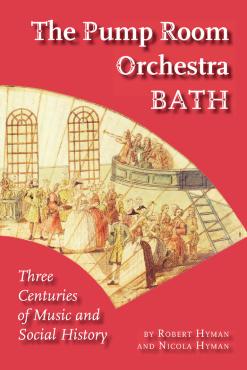
Gentle Readers, Nicola Hyman, one of the authors of The Pump Room Orchestra, Three Centuries of Music and Social History, a book that she co-wrote with her musician husband, Robert, sent me this information about music in the Pump Room. The book is available at Hobnob Press in the UK.
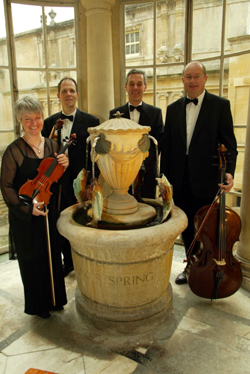
The Pump Room Orchestra is believed to be the first resident band in the country to play in an assembly room in the early 1700s. The book chronicles the three hundred year old history of this Band, from its inception to today. Beau Nash founded the Band and, during his sojourn, his supremacy over its management was unequalled. However, over the decades municipal philistinism, wars, economic slumps and the appeal of (usually Italian), virtuosi in Bath threatened its almost unbroken continuity. Handel visited Bath in 1749 and collaborated with Thomas Chilcot whose support of the Pump Room Band leader, during one of its most intense conflicts, is explored in the book. Thomas Linley and William Herschel both played in the Band in the 1760s. Haydn enthused over the progress of the new Grand Pump Room built in 1795 where the present Trio play. The glamorous backdrop of eighteenth century Bath was underpinned by a climate of fierce rivalry and partisan affiliations among many musicians, many who struggled to survive.
Several fine German musicians were directors or members of the Pump Room Orchestra during the nineteenth century, including up to the Great War, the great grandfather of Bristol based composer Richard Barnard. Bath was now a more sober city, its appeal as a resort diminishing and the Corporation’s control of the Pump Room Orchestra a constant challenge. During bleak pre Great War years, Holst conducted the Orchestra for the first performance of his Somerset Rhapsody.
During the Spa hey day of the 1920s ‘cellist Gilhermina Suggia, contralto Edna Thornton , violinist Daniel Melsa, Arthur Rubenstein and Solomon are just a few of the well known guest soloists who played with the Orchestra. Sir Thomas Beecham conducted the Orchestra several times during this period. Elgar was another guest conductor. As Spa Director, John Hatton’s progressive style of marketing revived Bath as a tourist attraction. A thriving Pump Room Orchestra reflected the unique collaboration Hatton had with Jan Hurst, the Orchestra’s director.
In the late 1930s the Orchestra was directed by the distinguished Maurice Miles and concerts were regularly aired on the BBC. His predecessor, the brilliant and popular ‘showman’ Edward Dunn, had emigrated to South Africa. Dunn’s role as Durban’s Director of Music led him after the War to build up an International Arts League of Youth Festivals across South Africa. While, after the Second World War, the direction of the Yorkshire Symphony Orchestra and the BBC Northern Ireland Orchestra were among Maurice Miles’s later roles.
However, it is the forgotten army of predominantly rank and file players in the Orchestra which is a central theme in the book. Many of these players were given solo roles and played in chamber ensembles in the Pump Room. Our research has divulged fascinating cameos, many tragic but many invested with astonishing devotion to music in the Pump Room and to Bath. One example was Lawrence Lackland who switched, at Lionel Tertis’ suggestion, to viola, and whose father was a violinist in St Helens under Thomas Beecham’s early orchestra.
Please find attached the website http://www.hobnobpress.co.uk for an order form for those readers who would like to purchase The Pump Room Orchestra, Bath: Three Centuries of Music and Social History. Robert Hyman, (who studied at the Juilliard School, New York) is a violinist in the Pump Room Trio in Bath. Together he and his wife Nicola have researched and written this history. The book has a Foreward by Tom Conti. Colour plates include a photo ‘Leaving the Pump Room’ of ladies dressed in costume for the annual Jane Austen Festival. Two chapters in the book explore music in the Pump Room when Austen first visited Bath. They are ‘When Jane Austen Came to Bath’ and ‘After Rauzzini’. There is also a chapter called Screen and Stage which chronicles movies filmed in and around the Pump Room; actors who visit or have visited the Pump Room, some because they are performing at the Theatre Royal in Bath, and also TV productions of Jane Austen’s novels, where many of the scenes were filmed in the Pump Room. UK customers can order the book directly from the publisher.
November 2011, 214 pages + 8 pages of colour, £14.95. ISBN 978-0-946418-74-9.
Fashionable Goodness: Christianity in Jane Austen's England is now available! By JAW contributor Brenda S. Cox. See Review. Available from Amazon and Jane Austen Books.
Available through December 31st, 2025. Click on image for details, and share this poster with other teachers and students!
The Obituary of Charlotte Collins by Andrew Capes
Click on image to read the story.
Comments
“My idea of good company…is the company of clever, well-informed people, who have a great deal of conversation.” – Jane Austen, Persuasion
Gentle readers: Please feel free to post your comments and continue the conversation! Due to SPAM, we will no longer accept comments on posts after 30 days of publication. In some instances, links will be removed from comments as well.
Administrators and Contributors
Vic Sanborn, founder of this blog, is supported by a team of talented and knowledgeable writers about Jane Austen and the Regency era. They are:
Tony Grant, who now contributes his photos from London and England
Click on their names to enter their own blogs.
In addition, we thank the many experts and authors who frequently contribute their posts and opinions, and who continue to do so freely or at our request.
Click here to enter the page. Topics include Regency fashion, historic foods, Jane Austen societies, British sites, related topics. Click on image.
May we suggest?
Hello, my name is Vic and I live in Maryland, USA. I have adored Jane Austen almost all of my life. I am a proud lifetime member of the Jane Austen Society of North America. This blog is a personal blog written and edited by me and my team. We do not accept any form of cash advertising, sponsorship, or paid topic insertions. However, we do accept and keep books and CDs to review.
If you would like to share a new site, or point out an error, please email us. (Yes, we are fallible. We'll own up to our mistakes and will make the corrections with a polite smile on our faces.) Write us at
Thank you for visiting this blog. Your comments and suggestions are most welcome.
Project Gutenberg: eBook of Stage-coach and Mail in Days of Yore, Volume 2 (of 2), by Charles G. Harper
STAGE-COACH AND MAIL IN DAYS OF YORE: A PICTURESQUE HISTORY
OF THE COACHING AGE, VOL. II, By CHARLES G. HARPER. 1903. Click on this link.











 Jane Austen's World