Feeds:
Posts
Comments

Archive for the ‘18th Century England’ Category

Great landed estates were symbols of the owner’s wealth and status in British society. Everything was put on grand display – from the exquisite architecture of the house itself to the furniture, jewels, silver plate, servants, books, carriages, horses, deer, game, forests, fields, and splendid grounds and gardens.
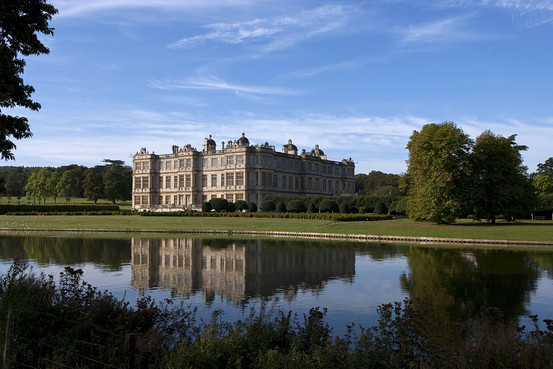
Longleat House in Wiltshire Image @www.longleat.co.uk

A fine estate certainly elevated a man in a lady’s estimation. Take this passage in Mansfield Park, written from Mary Crawford’s point of view:

Tom Bertram must have been thought pleasant, indeed, at any rate; he was the sort of young man to be generally liked, his agreeableness was of the kind to be oftener found agreeable than some endowments of a higher stamp, for he had easy manners, excellent spirits, a large acquaintance, and a great deal to say; and the reversion of Mansfield Park, and a baronetcy, did no harm to all this. Miss Crawford soon felt that he and his situation might do. She looked about her with due consideration,and found almost everything in his favour, a park, a real park, five miles round, a spacious modern-built house, so well placed and well screened as to deserve to be in any collection of engravings of gentlemen’s seats in the kingdom, and wanting only to be completely new furnished—pleasant sisters, a quiet mother, and an agreeable man himself—with the advantage of being tied up from much gaming at present, by a promise to his father, and of being Sir Thomas hereafter. ” – Mansfield Park, Jane Austen

(It is to Mary’s credit that, after this consideration, she prefered Edmund, the younger son, until she discovered that he intended to become a man of the cloth, and even then she did not give him up so easily.)

Visitors arriving at a landed estate took a circuitous route to the house along winding paths that were designed to show the grounds to their best advantage. They would pass through wooded areas and open fields, past lakes and rivers and herds of deer or cattle, and through a controlled wilderness area.

“The idea with Brownian landscapes is that you effectively go round them,” explains Mowl. “When [Capability] Brown did his landscape designs they would always have drives in them. They were an essential part of what he would do.” – The English Landscape Garden
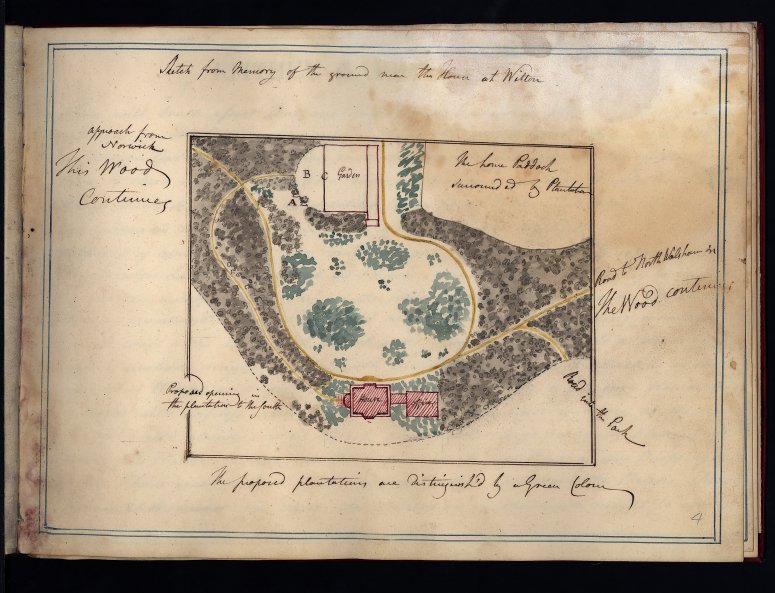
Witton approach from Norwich, 1801, Humphrey Repton Red Book. Image @University of Florida Rare Book Collection

Groundskeepers of extensive parks that featured winding drives and a variety of formal and ornamental gardens employed several means of keeping grass under control. Grazing sheep and cattle represented the first lines of defense. These herds were allowed to roam over vast expanses of land. Eighteenth-century romantic sensibility required that nothing as obviously artificial as a visible fence be allowed to contain them.
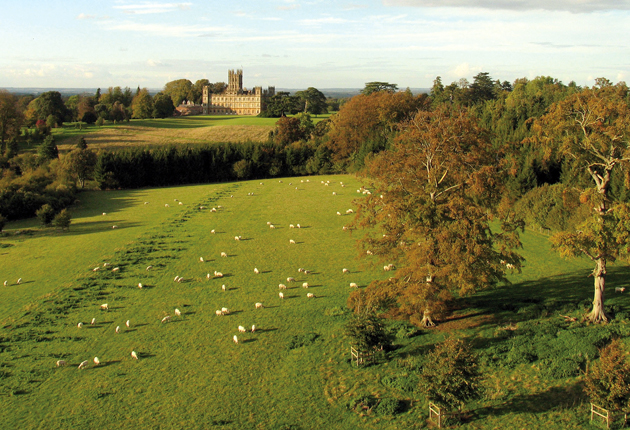
Highclere Castle is surrounded by park land designed by Capability Brown. Grazing sheep in the foreground.

A landscape feature called a Ha-Ha prevented grazing herds from coming too close to the house. The Ha-Ha, which consisted of a deep trench abutting a wall and which was hidden from casual view even at a short distance, allowed for the naturalistic features of romantic landscape gardening to take hold.
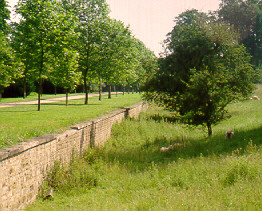
The Ha-Ha prevented grazing animals from crossing from one area of the estate to another. Image © John D. Tatter, Birmingham-Southern College

A Ha-Ha was so named because, as the myth goes, this landscape feature was so well hidden that an unsuspecting visitor would blurt out “ha-ha!” before falling into the trench.  This cross section shows how the system worked.

The trenches of a Ha-Ha could sometimes be 8 feet deep.The primary view is from the right and the barrier created by the ha-ha becomes invisible from that direction and sometimes from both directions, unless close to the trench. Image @Wikipedia

Not all Ha-Ha’s prevented deer, sheep, or cattle from grazing up to the front of the house (though considering their droppings, one would thinks that this would be highly preferred.) At Petworth, the Ha-Ha was placed at the side of the house.
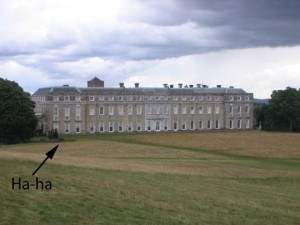
Petworth with Ha-Ha on the side of the house. Image @The English Landscape Garden

Built at the edge of a pleasure grounds surrounding a house, the ha-aha made a virtually invisible barrier that kept the cows and sheep in their pastures yet allowed uninterrupted views from house into park of from park into distant countryside. It meant that pleasure grounds, park and landscape could seamlessly become one. It is probably French in origin. Charles Bridgeman is generally credited with it’s introduction, but the first remnants of a ha-ha had already been installed at Levens Hall in Cumbria in 1689. – Architessica: Gardens and Landscapes

The transitional area between the formal gardens and the large park surrounding the house was known as the wilderness. This area was as meticulously planned as the other areas of the estate, but here the plantings were more irregular and included native plants and trees; gravel walkways; a pond, lake or river or all three; waterfalls; lawns that resembled meadows; and areas where the vistas were framed to deliberately look natural. If cottages and villages were required to be moved to achieve this picturesque effect, then so be it. The master’s will was done.
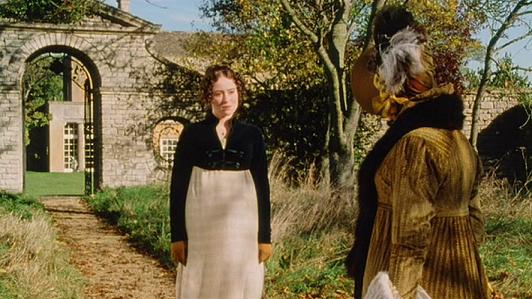
In Pride and Prejudice 1995, Elizabeth Bennet and Lady Catherine de Bourgh conduct their heated discussion in Longbourn’s “wilderness”. No grazing required here.

These wilderness areas were unique to topography and region, for each estate was uniquely different.

Nature in Herefordshire is not like nature in Lancashire and the garden style that tries to emulate the same form everywhere (particularly
one imported from another country entirely) is destroying what Pope had called the genius loci.” – (Wildness in the English Garden Tradition: A Reassessment of the Picturesque from Environmental Philosophy Author(s): Isis Brook Reviewed work(s): Source: Ethics and the Environment, Vol. 13, No. 1 (Spring, 2008), pp. 105-119)

This plan of Paca Garden in Annapolis, MD, shows the formal gardens separated from the park by a wilderness area with pond, bridge, and follies. Image (a) Creating a Period Garden

Walking along a wilderness provided one with an endless variety of aesthetic experiences. Paths wended their way through woods that opened up to vistas. Large trees provided shelter for a bench or revealed moss growing on gnarly roots. Rivers, ponds, follies, and bridges provided natural sources of visual patterns. They were pleasant places to visit:

 A ‘pleasant place’ is supposed to be naturally crafted. It’s a balance between two opposites: wanting to cultivate the land and letting it grow freely.  However landscapers and architects finally accomplish this goal, the product always ends up being a beautiful oxymoron. – Landscape as Amenity
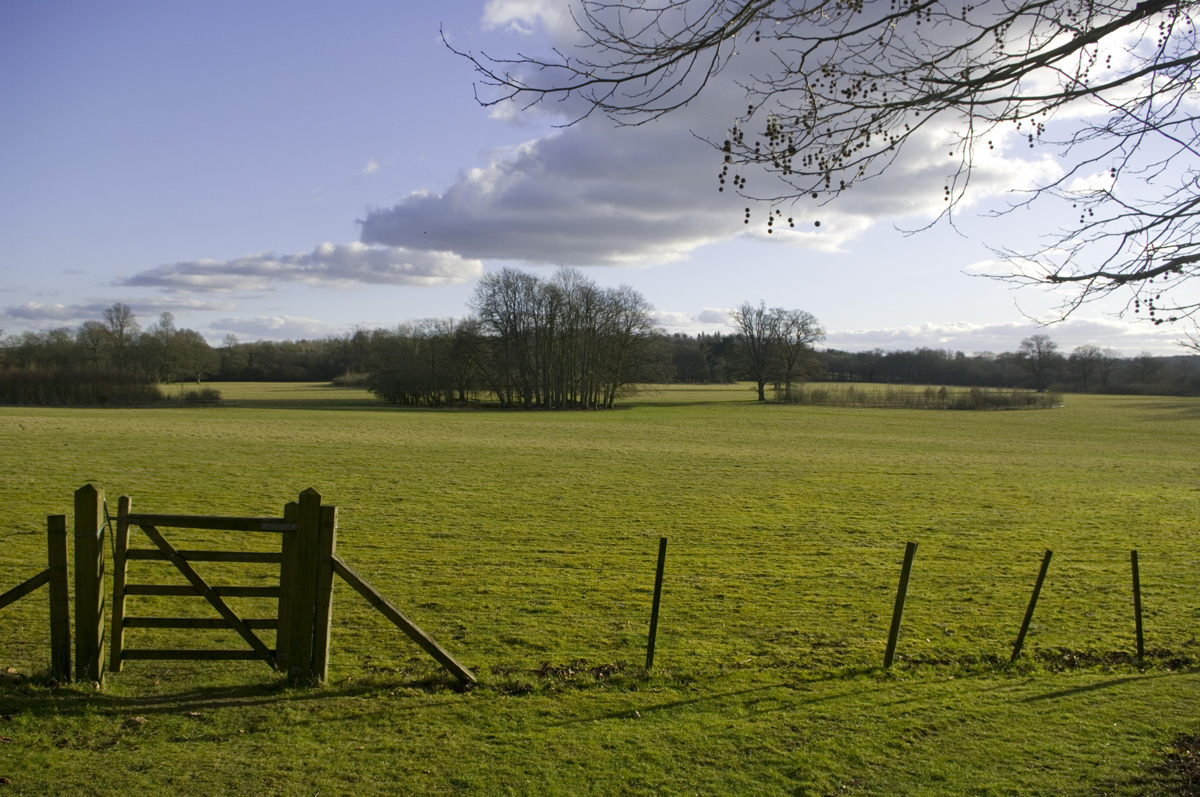
Chawton House grounds. One of the vistas from a gravel path. Image @Tony Grant

The exercise of walking along a wilderness ground was both visually and physically stimulating. These wilderness areas took years to design and arrange, with large trees moved from one area to another, buildings demolished or transported, and hillsides lowered or raised to “improve” the view.
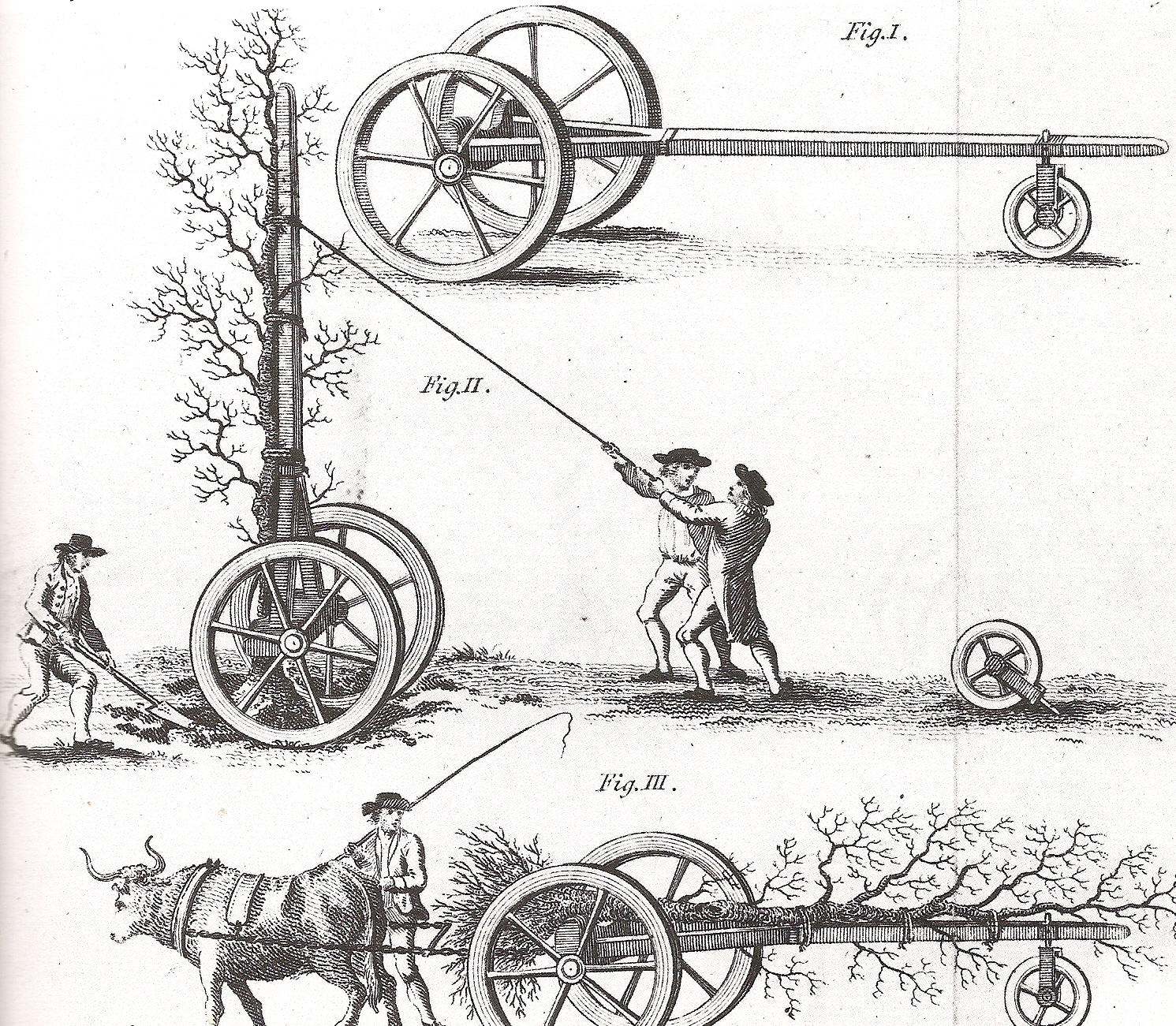
Moving a full grown tree into place, Hayes, 1794

Such improvements, as they were generally known, required meticulous planning and strenuous effort. Master landscape gardeners like Lancelot “Capability” Brown and  Humphry Repton became household names. Jane Austen knew about such efforts and their resulting changes:

Mr. Rushworth, however, though not usually a great talker, had still more to say on the subject next his heart. “Smith has not much above a hundred acres altogether, in his grounds, which is little enough, and makes it more surprising that the place can have been so improved. Now, at Sotherton, we have a good seven hundred, without reckoning the water meadows; so that I think, if so much could be done at Compton, we need not despair. There have been two or three fine old trees cut down that grew too near the house, and it opens the prospect amazingly, which makes me think that Repton, or anybody of that sort, would certainly have the avenue at Sotherton down; the avenue that leads from the west front to the top of the hill, you know,” turning to Miss Bertram particularly as he spoke. But Miss Bertram thought it most becoming to reply—

“The avenue! Oh! I do not recollect it. I really know very little of Sotherton.”

Fanny, who was sitting on the other side of Edmund, exactly opposite Miss Crawford, and who had been attentively listening, now looked at him, and said, in a low voice—

“Cut down an avenue! What a pity! Does it not make you think of Cowper ?’ Ye fallen avenues, once more I mourn your fate unmerited.'”

He smiled as he answered, ” I am afraid the avenue stands a bad chance, Fanny.”

“I should like to see Sotherton before it is cut down, to see the place as it is now, in its old state , but I do not suppose I shall.” – Mansfield Park, Jane Austen
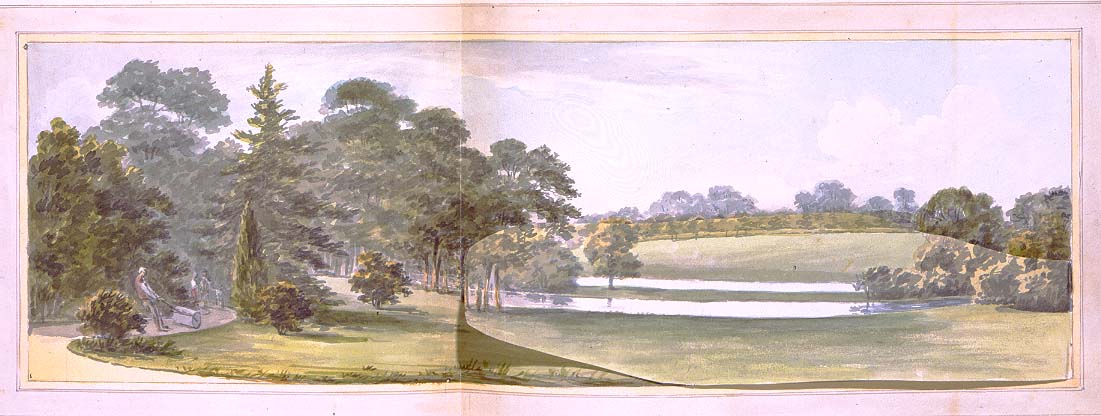
Sir Humphrey Repton, Whiton (Before) Image @British Architecture

Sir Humphry Repton left a valuable legacy with his Red Books. It was his habit to sketch before and after landscapes for his customers and present the drawings to them bound in red covers. His improvements for Whiton are subtle but important. Two parallel streams have been turned into a serpentine lake with a waterfall at one end. The distant fields provide a focal point with artfully arranged trees. If you look closely at the gravel path on the left, you can spy a gardener.
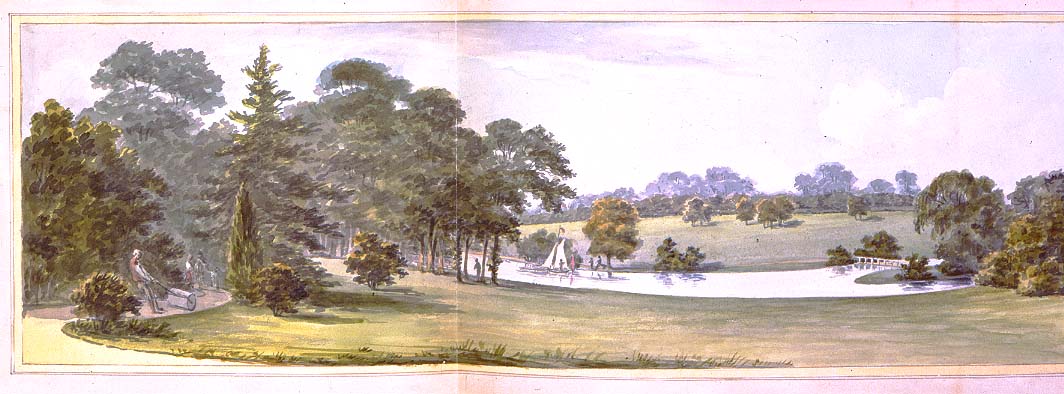
Sir Humphrey Repton, Whiton (After). Image @British Architecture

The samples below of Ferney Hall from The Morgan Library and Museum show the before and after drawing of an improved vista in which, using Jane Austen’s words, ” a prospect was opened”.
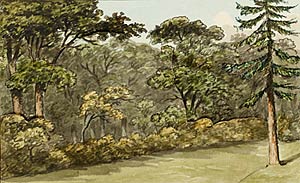
Ferney Hall by Repton. Image @The Morgan Library

The after image provides a glimpse of a folly. Instead of acting as a barrier, the woods give way to the scene, which provides a pleasant stopping point for the wanderer to sit and view. While such scenes looked natural, they were not.
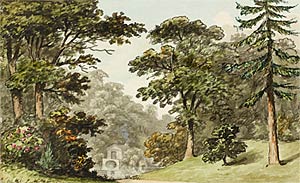
Ferney Hall, After, by Repton. Image @The Morgan Library

Though visually the wild and the domestic were one is the same, “these were carefully managed scenes, designed to look natural, but actually contrived on a vast scale” – Landscape as Amenity

The wilderness was designed some distance from the house. Approaching closer, the visitor would see a more formal arrangement of fountains and shrubbery and mazes and flower gardens.
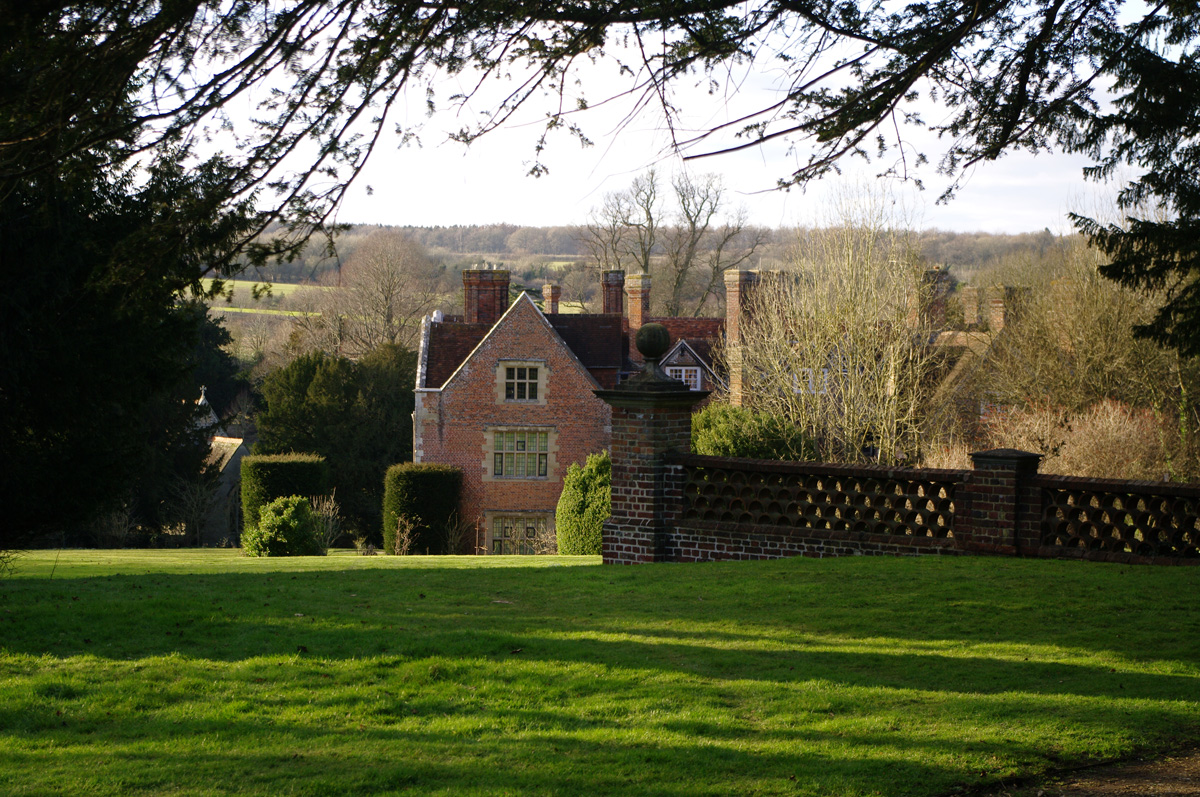
Chawton House: View from the wilderness towards the house and more formal plantings. Image @Tony Grant

The gentlemen who had these gardens designed for them had all been on the Grand Tour and learned the classics,” says Timothy Mowl of the University of Bristol. “It was part of their make-up and they wanted to display their taste and learning within gardens.” – The English Landscape Garden
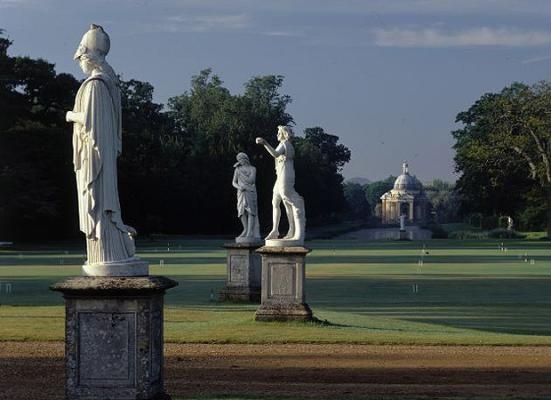
Wrest Park, Bedfordshire. Image @The Telegraph UK

Landscape designs informed the process of maintaining the grounds. Large estates employed many gardeners to keep cricket and croquet fields in pristine condition, cultivate the ornamental and kitchen gardens, and oversee the orchards and hot houses. The question is: How did they do it?
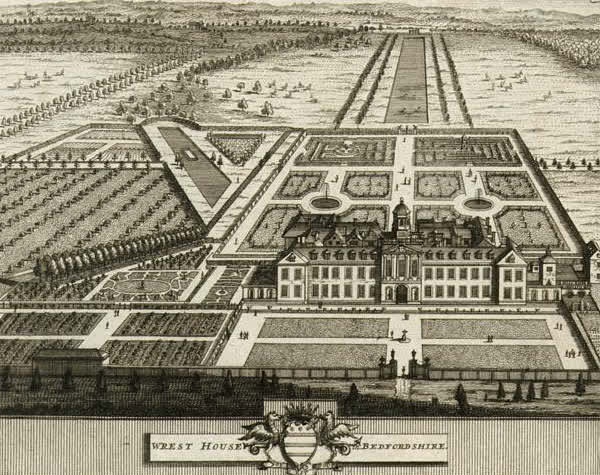
Extensive gardens surrounding Wrest House in Bedfordshire. Wrest Park Gardens are spread over 150 acres (607,000 m²) near Silsoe, Bedfordshire, and were originally laid out in the early 18th century, probably by George London and Henry Wise for Henry Grey, 1st Duke of Kent, then modified by Capability Brown in a more informal landscape style, without sacrificing the parterres. Image from The Leisure Guide

As mentioned before, the first line of defense was allowing herds of sheep and cattle to graze. However, their by-products left something to be desired. (If anyone has ever walked through a cow pasture, they will know what I mean.)
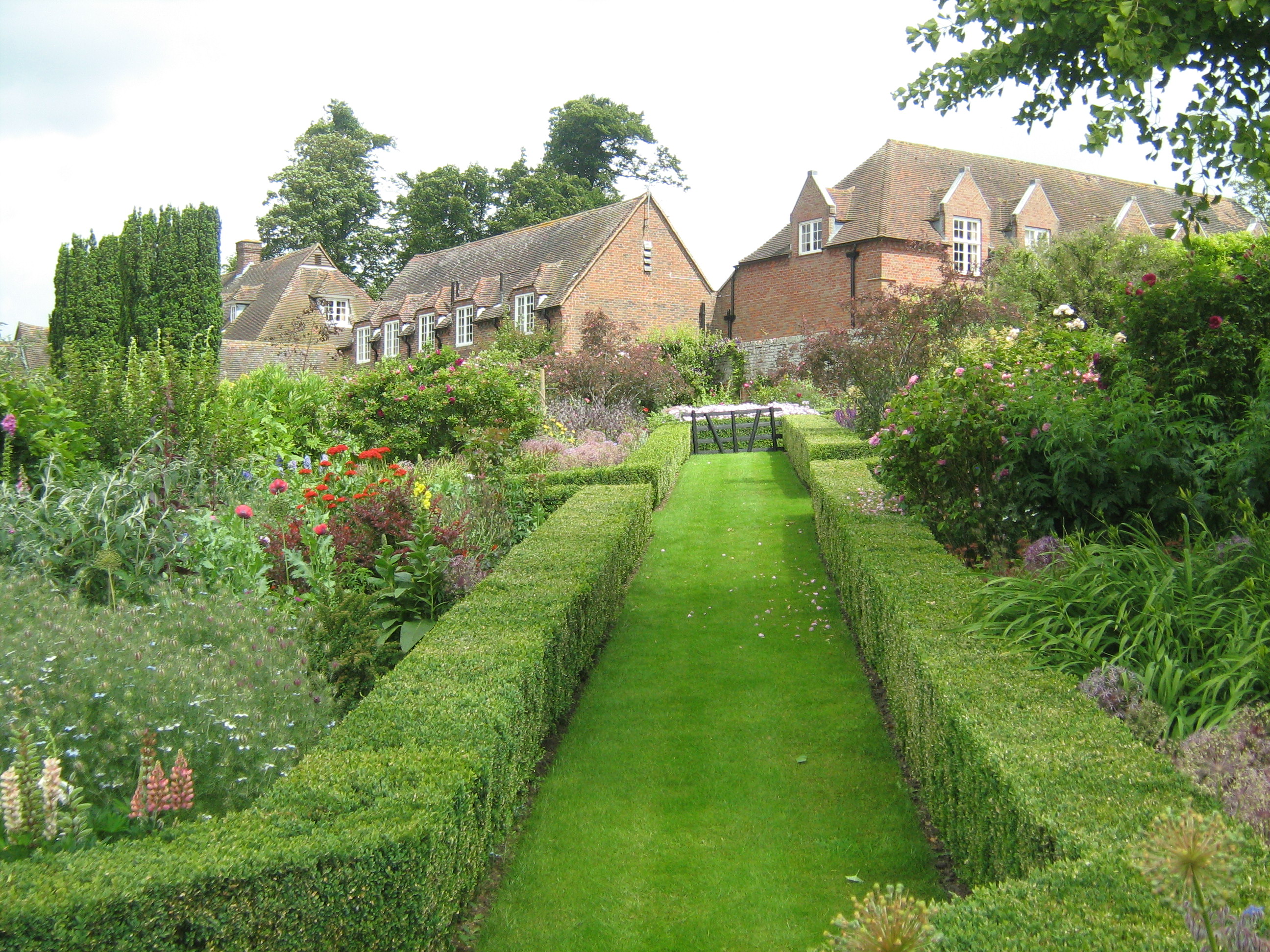
English Garden at Leeds: Artfully contrived to look both contained and natural. Image @Landscape Into Land

Lawn mowing and ornamental landscaping held no particular interest to 99% of the people who lived during the Georgian era. Cottagers and town dwellers maintained small plots of vegetable gardens and laborers worked in the fields, using scythes to cut wheat and grain for their employers.
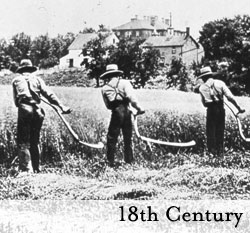
18th century method for harvesting grain with scythes. Image @Our Ohio

The laborers wielding scythes in the above image provide a clue to how grass was clipped – using a smooth, well-rehearsed motion, they worked in teams to cover large areas of ground. Their labor was cheap and they followed a system that included working in the morning when the ground was still damp.

Mowing Clover, late 19th c., by Arthur Verey

To prepare the lawn for scything, a gardener would:

“pole” the lawn first (swishing a long whippy stick across the grass to remove wormcasts) and … roll the ground to firm it and set the blades of grass in a uniform direction.” – Notes and Queries, The Guardian UK
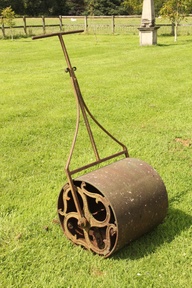
19th Century Coalbrookdale Roller. Rolling the lawn tamped down the grass and seed, and promoted growth and strong roots. Image @jardinique.co.uk

The secret to maintaining a close-cropped lawn was to trim it frequently, about once a week. Lawn edges were best trimmed with sheep shearing clippers.
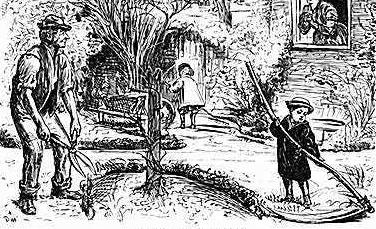
This gardening family is using shears, a rake, and a scythe in their cottage garden.

The grass was kept free of daisies with an instrument named a daisy grubber, which is the long-handled instrument with angled pick in the image below. Daisy grubbers are still sold today, as they apparently do the job well.
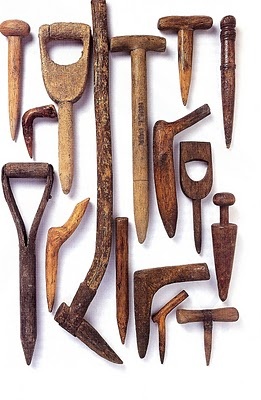
Dibbles and daisy grubber. Image @Garden History -Tools the Dibble

Dibbles were used to dig holes in the ground to plant seeds or bulbs, pry up roots, or jab weeds out between bricks and stone.
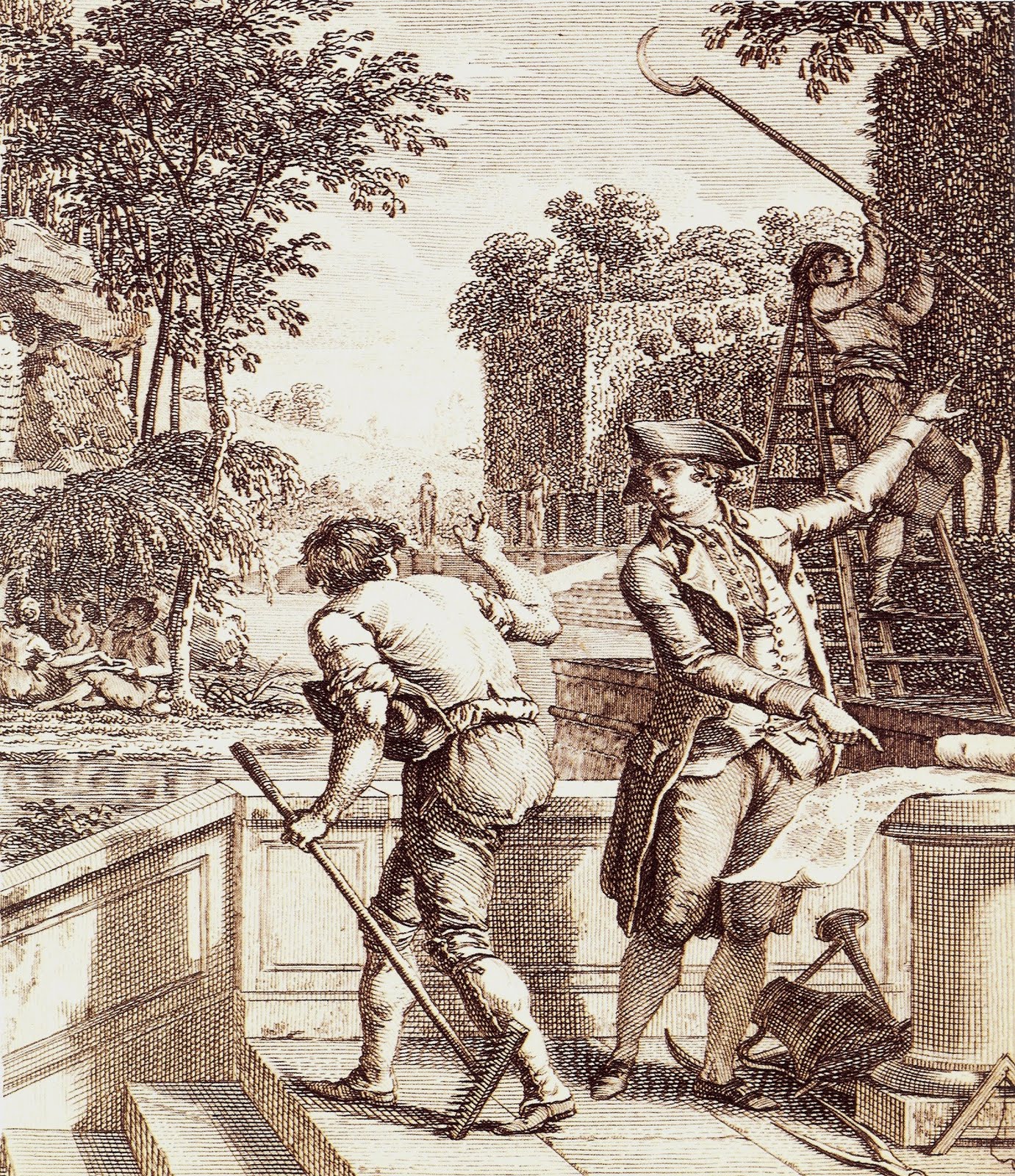
18th century gardener taking direction from a landscape designer. Note the man pruning the tree.

Even with these instruments, maintaining these large gardens took intensive labor. One can just imagine how much work was involved in protecting tender plants from insects and marauders, early frosts, and dry spells; and forcing exotic fruits and vegetables to grow out of season in hot houses.
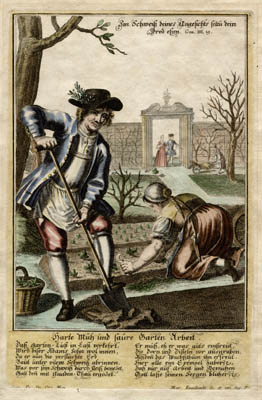
Engelbrecht. 18th century German print of gardening – planting.

While improvements were made over the course of the 19th century, some customs remained the same:

“rich people used to show their wealth by the size of their bedding-plant list: 10,000 plants for a squire; 20,000 for a baronet; 30,000 for an earl and 50,000 for a duke. ” – Ernest Fields, Life in the Victorian Country House by Pamela Horn, p. 75.
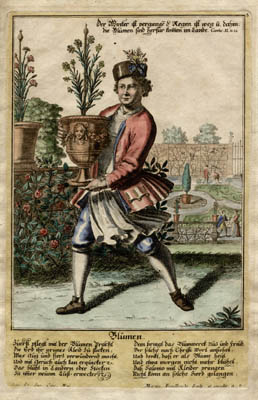
Engelbrecht’s plate of an 18th century gardener working with flowers

Landed owners showed off their wealth through a variety of means, including the number of servants they employed.
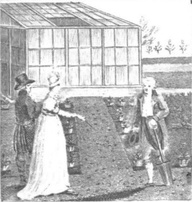
Master and mistress in discussion with the head gardener

It was not unusual for a great estate to employ 60 – 100 gardeners. There was the full-time staff, consisting of a master gardener, who had begun his apprenticeship as a boy, and his assistants.
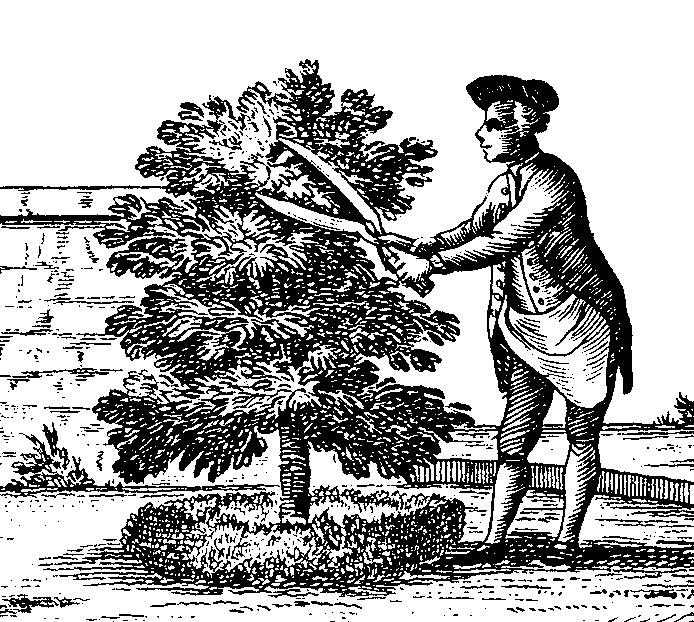
Pruning

Scottish gardeners were preferred, as it was thought that they had received the best training. Unmarried apprentice gardeners moved from estate to estate in order to gain experience and be promoted.
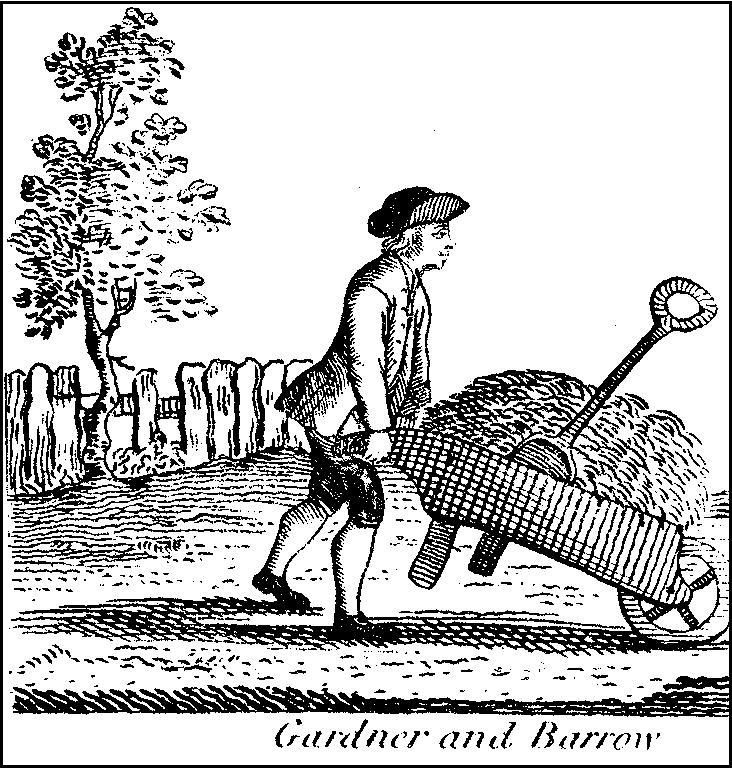
Dungbarrow

Junior staff worked long hours, around 60 hours a week, for, in addition to their gardening duties, they had to maintain the temperatures in glassed-in conservatories and meticulously care for archery, cricket, bowling and croquet lawns.
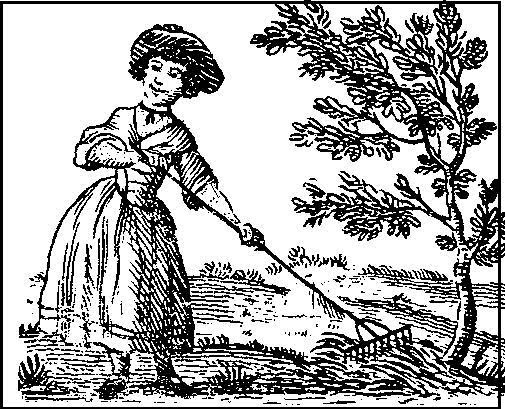
Woman using a rake

The master gardener hired local labor seasonally to help during peak times, so the number of laborers fluctuated.
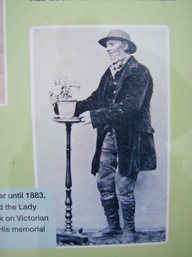
The head gardener at the Thornham estate in Sussex at the end of the 19th century. Image by kitchen915
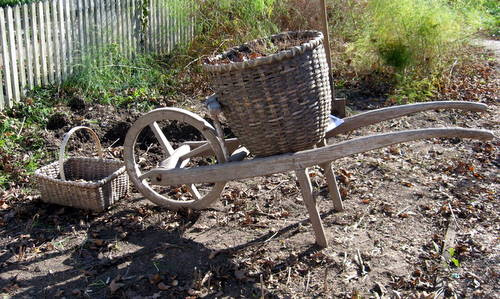
18th century garden cart and basket

With improvements in gardening equipment, including the invention of the lawn mower in 1830 by Edwin Beard Budding, machines began to take over the hard work of the scythe men.
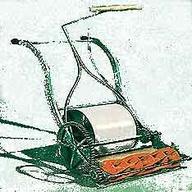
First lawnmower invented by Edwin Beard Budding. Image @The Chronicle of Andrew Jackson, Wikispaces

I imagined a Regency gentleman pushing one in his regalia, and found this wonderful advertisement. After Budding’s initial invention, a variety of lawn mowers were invented, each improving on the other.

Mowing a lawn in 1832. Credit: Ann Ronan Picture Library / Heritage Images

Needless to say, large areas of lawn needed a more efficient method of keeping the grasses trimmed. As the 19th century progressed, horses were employed to pull large lawn mowing machines.
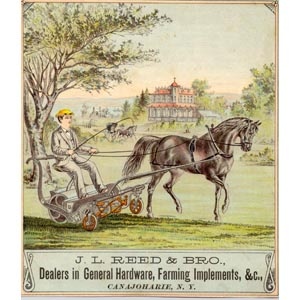
Horse pulling a lawn mower. Image @The Cultural Landscape Foundation

They wore special leather over shoes to protect fragile lawns, such as those shown in the image below.
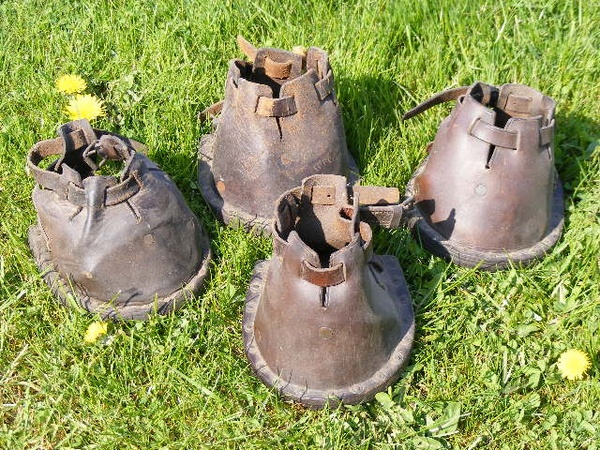
This short video on YouTube demonstrates how 18th century gardeners dealt with sudden cold snaps.

More on the topic:
Read Full Post »

Gentle readers, some months back Lucy Warriner expressed an interest in writing about Mary Darby Robinson. This past week she submitted this wonderful post about a fascinating and successful woman who embodied the Georgian Era – wife, mother, actress, mistress, and writer. Enjoy. Mary Darby Robinson (1758–1800) was a woman of considerable talent. She was one of the leading English actresses of her day, and she also published several volumes of poetry and prose. Yet Robinson’s tumultuous love life often rivaled her professional accomplishments. She was unhappily married, and the press maligned her for her affairs with the Prince of Wales and Revolutionary War veteran Banastre Tarleton. Mary Robinson’s autobiography, first published in 1801 as Memoirs of the Late Mrs. Robinson, Written by Herself,sheds light on her fascination with the stage, which started at an early age and continued even after she became a full-time writer.

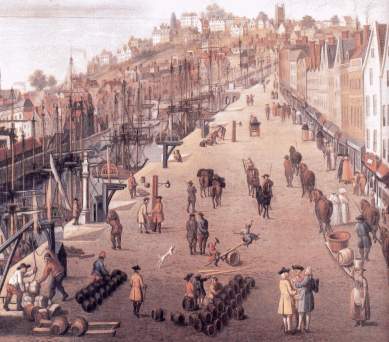
Bristol in the 18th century

Mary Darby, daughter of John Darby and Mary Seys Darby, was born in Bristol, England, on November 27, 1758. Her father pursued whaling in Labrador and America while she, her mother, and her four siblings remained in England. John Darby acquired a mistress, and after young Mary’s parents separated, the family finances were strained. However, John Darby intermittently funded his daughter’s education at schools in Chelsea, Battersea, and London. At Chelsea, teacher Meribah Lorrington fostered Mary’s love of reading and encouraged her when she began to write poetry.

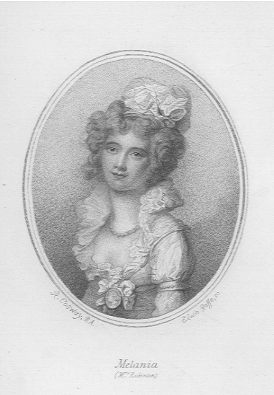
Mrs. Robinson as Melania

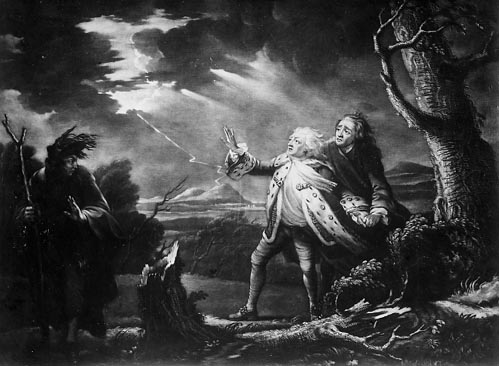
As a fifteen-year-old student at Oxford House in Marylebone, Mary was still drafting poems, even planning a great tragedy. This was a fitting development, for she had long shown a flair for the sentimental and dramatic. As a child, she had delighted in sad poetry and music, and she loved “the awful though sublime impression which the church service never failed to make upon [her] feelings” (Robinson, Memoirs 8–9). The recollection of seeing King Lear, the first play she ever attended, remained vivid throughout her life. In time, one of Mary’s teachers at Oxford House noticed her “extraordinary genius for dramatic exhibitions” (Robinson 31). The school dancing instructor, who was also employed at Covent Garden Theatre in London, put Mary and her mother in touch with Thomas Hull, the theatre manager. Hull, too, discerned Mary’s talent, and it was soon decided that her first performance would be opposite acclaimed thespian David Garrick in Lear.

David Garrick as King Lear, London, 1761. Image @UC, Berkeley

Garrick soon began coaching Mary for her debut, and she seems to have been his prize pupil:

Garrick was delighted with everything I did. He would sometimes dance a minuet with me, sometimes request me to sing the favourite ballads of the day; but the circumstance which most pleased him was my tone of voice, which he frequently told me closely resembled that of his favourite Cibber [singer and actress Susannah Cibber, who was a member of Garrick’s Drury Lane troupe from 1753 to 1766]. (Robinson 37)

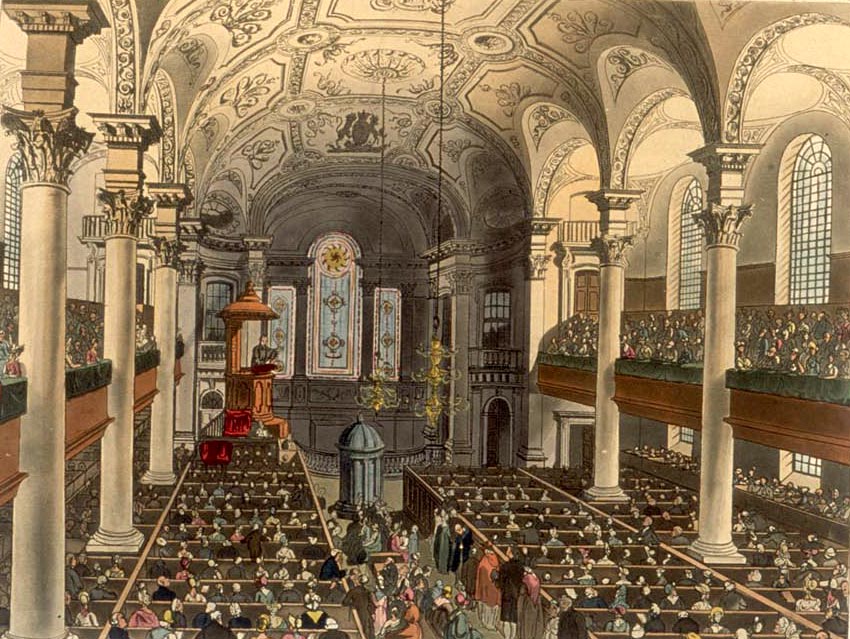
But while Mary relished the charismatic actor’s tutelage, she was unable to take full advantage of it. In the midst of her training, Mary met Thomas Robinson, an aspiring legal assistant who endeared himself to Mrs. Darby by bringing her books and comforting her when her son contracted smallpox. He turned his attentions to Mary when she, too, developed smallpox. When she was almost sixteen, Mary accepted Robinson’s marriage proposal and gave up the chance to appear in Lear with Garrick. The couple married on April 12, 1774, and remained in London. When Thomas wanted the union to remain secret, the new Mary Robinson discovered that he was an illegitimate child with no prospect of inheritance and a great amount of arrears.

St. Martin in the Fields. Mary’s wedding was not so well attended.

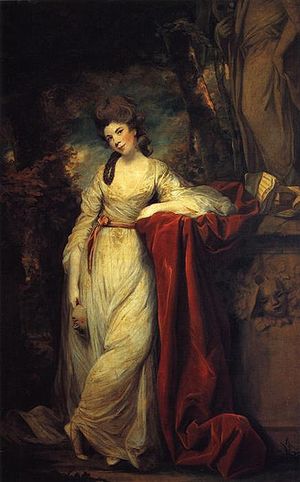
Despite his penury, Thomas Robinson lived extravagantly. He took a mistress, Harriet Wilmot, and associated with debauched spendthrifts Lord Lyttleton and George Robert Fitzgerald, both of whom propositioned Mary. Deeply unhappy, Mary Robinson’s thoughts again turned to the theatre. Encountering accomplished thespian Mrs. Abington at a party, she “thought the heroine of the scenic art was of all human creatures the most to be envied” (Robinson 80). When creditors laid claim to the Robinsons’ possessions, the couple moved to evade them, at one point staying with Thomas’s father in Wales. Mary gave birth to Maria Elizabeth, her first child, in Wales on November 18, 1774.

Frances (Fanny) Abington by Sir Joshua Reynolds, 1764-1773

Upon his return to London in 1775, police apprehended Thomas Robinson and confined him in King’s Bench Prison. Mary and Maria joined him there, and their imprisonment lasted little more than a year. While Thomas began an affair with the wife of a fellow inmate, Mary rebuffed further offers to become a kept woman. She devoted herself to raising Maria, transcribing legal documents for Thomas, and writing poetry. Prior to her incarceration, Mary had published Poems by Mrs. Robinson to help offset her husband’s debts. Though it had not sold well, she forwarded a copy to Georgiana, Duchess of Devonshire, a devotee of literature who sponsored writers. Mary Robinson soon became the duchess’s protégé.

William Breteton, by Henry Walton, 1780

Once her husband was freed from prison, Robinson resumed acting to provide for the family. Thomas, who had never finished his legal training, was no breadwinner. A chance encounter with Drury Lane actor William Brereton, who introduced her to theatre manager and famed playwright Richard Sheridan, returned Robinson to the theatrical milieu. While pregnant with her second child, Sophia, she read Shakespeare for Sheridan and won his approval. Garrick, Robinson’s old mentor, came out of retirement to coach her for the lead in Romeo and Juliet.

Drury Lane Theatre

In a flurry of nerves, she debuted at Drury Lane Theatre opposite Brereton’s Romeo in December 1776:

When I approached the side-wing my heart throbbed convulsively; I then began to fear that my resolution would fail, and I leaned upon the Nurse’s [the character of Juliet’s nurse] arm, almost fainting. Mr. Sheridan and several other friends encouraged me to proceed; and at length, with trembling limbs and fearful apprehension, I approached the audience. The thundering applause that greeted me nearly overpowered all my faculties. I stood mute and bending with alarm, which did not subside till I had feebly articulated the few sentences of the first short scene, during the whole of which I never once ventured to look at the audience. . . . The second scene being the masquerade, I had time to collect myself. I shall never forget the sensation which rushed upon my bosom when I first looked towards the pit. . . . All eyes were fixed upon me, and the sensation they conveyed was awfully impressive; but the keen, the penetrating eyes of Mr. Garrick, darting their lustre from the centre of the orchestra, were, beyond all others, the objects most conspicuous. As I acquired courage, I found the applause augment; and the night was concluded with peals of clamorous approbation. (Robinson 129–131)

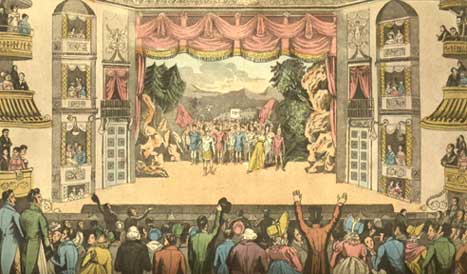
18th century actors on stage

Robinson’s appearance as Juliet led to a four-year acting career in which she starred in forty dramas, at times portraying several characters per week or per play. In February 1777, she followed her turn as Juliet with appearances in Alexander the Great and in Sheridan’s A Trip to Scarborough. The latter play was adapted from another work, and it elicited “a considerable degree of disapprobation” from audience members who had expected an original play (Robinson 132). Nevertheless, Robinson carried the day:

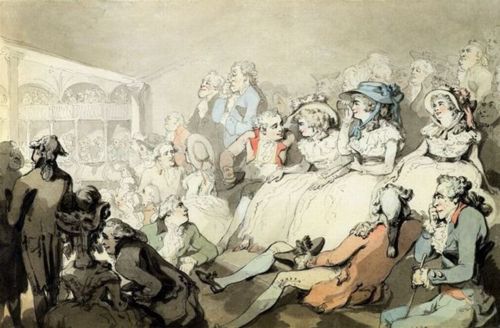
An audience watching a play at Drury Lane Theatre, by Thomas Rowlandson, ca. 1785

I was terrified beyond imagination when Mrs. Yates, no longer able to bear the hissing of the audience, quitted the scene, and left me alone to encounter the critic tempest. I stood for some moments as though I had been petrified. Mr. Sheridan, from the side wing, desired me not to quit the boards; the late Duke of Cumberland, from the stage box, bade me take courage: “It is not you, but the play, they hiss,” said his Royal Highness. I curtsied; and that curtsey seemed to electrify the whole house, for a thundering appeal of encouraging applause followed. The comedy was suffered to go on, and is to this hour a stock play at Drury Lane Theatre. (Robinson 132).

It is no wonder that Robinson claimed she “was always received with the most flattering approbation” (Robinson 133).

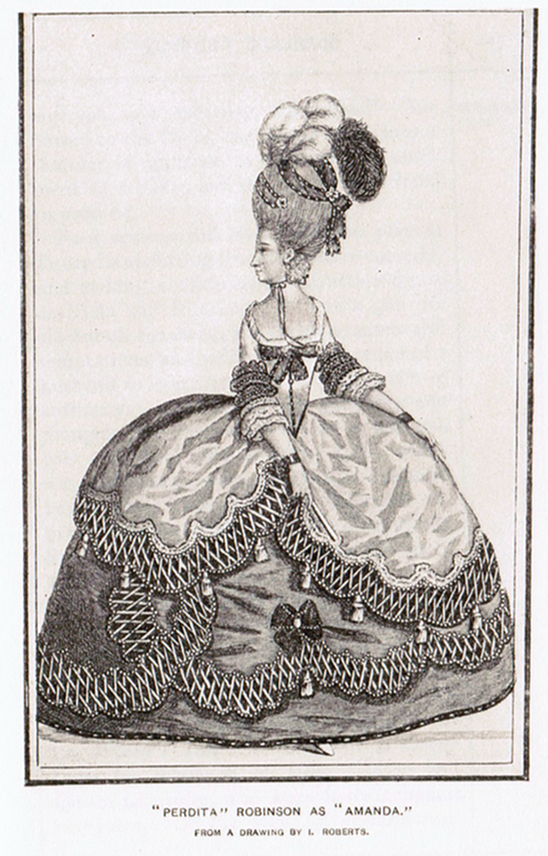
Mary Robinson in stage costume as Amanda, by Roberts Robins

Indeed, Mary Robinson was a prominent figure in a great age of theater. She observed that her time on the stage marked a period when dramatists and thespians were exceptionally gifted, when public enthusiasm about the theater was high, and when she and three other young actresses—Miss Farren, Miss Walpole, and Miss P. Hopkins—dominated their field. Robinson’s most acclaimed heroines were Juliet, Ophelia in Hamlet, Rosalind in As You Like It, and Palmira in Mahomet. Yet for all her renown, Robinson’s family never completely approved of her career. Her mother “never beheld [her] on the stage but with a painful regret” (Robinson 151). Her brother attended one of her performances but walked out when she took the stage. Robinson was somewhat relieved that her father was always abroad and never saw her perform.

Richard Sheridan, by Sir Joshua Reynolds

In 1778, Robinson took time off from acting to give birth to Sophia and mourn the infant’s passing less than two months later . Sheridan, who had planned for her to star in The School for Scandal, was unfailingly supportive during her bereavement. Robinson considered him her “most esteemed of friends,” and she found his grief over Sophia’s death deeper than her husband’s (Robinson 153). When she was ready to work again, Sheridan helped find Robinson summer employment at Haymarket Theatre. However, a casting dispute with the director resulted in her receiving payment but never taking the stage.

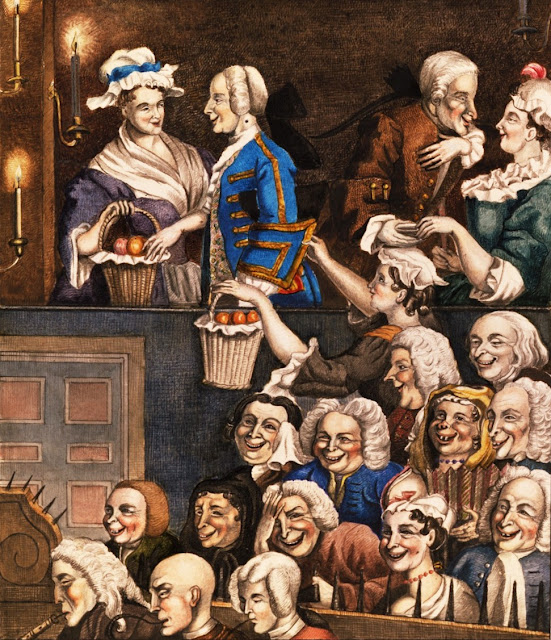
Theatre goers: The laughing audience, Edward Matthew Ward, from an etching by William Hogarth made in 1733

Mary Robinson had returned to acting in 1779 when her life changed drastically. A twenty-one-year-old with many celebrated performances to her name, she was hopeful about her future. Though Thomas remained negligent, the Robinsons’ financial situation was improving. Ever concerned for Mary, Sheridan worried that she would exceed her income and/or have an affair with one of her many wealthy admirers, thereby jeopardizing her acting career. His fears were well founded. King George III and Queen Charlotte requested a performance of The Winter’s Tale, in which Robinson played Perdita. When the royal family attended the play on December 3, 1779, the seventeen-year-old Prince of Wales unashamedly admired her:

Mary Robinson as Perdita

I hurried through the first scene, not without embarrassment, owing to the fixed attention with which the Prince of Wales honoured me. Indeed, some flattering remarks which were made by his Royal Highness met my ear as I stood near his box, and I was overwhelmed with confusion. The Prince’s particular attention was observed by everyone. . . . On the last curtsy, the royal family condescendingly returned a bow to the performers; but just as the curtain was falling, my eyes met those of the Prince of Wales, and with a look that I never shall forget, he gently inclined his head a second time; I felt the compliment, and blushed my gratitude. . . . I met the royal family crossing the stage. I was again honoured with a very marked and low bow from the Prince of Wales. (Robinson 157-158) A few days later, Lord Malden (George Capel Coningsby) delivered Robinson a love letter from the Prince of Wales, who was an associate of his. The prince referred to her as “Perdita” and himself as “Florizel,” in the latter case referring to the prince in A Winter’s Tale who falls in love with Perdita. The press, which chronicled the relationship from its start, appropriated these names for their own use as well. Robinson at first refused to meet her new admirer, entering instead into an impassioned correspondence with him. Malden, who eventually fell in love with Mary himself, remained their reluctant go-between.

Caricature of the Prince of Wales as Florizel and Mary Robinson as Perdita, 1783

Eventually, the couple began meeting in person with third parties present, hoping to conceal the relationship until the prince was a legal adult. The prince guaranteed Robinson 20,000 pounds upon reaching his majority, and she left her husband and retired from acting.

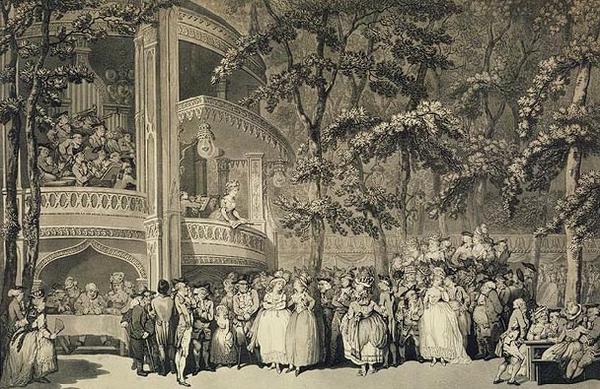
At Vauxhall by Thomas Rowlandson. Mary Robinson stands at the right side on the front row, her husband (with cane) on one side and the Prince of Wales on the other.

Her last performance showcased her roles in The Miniature Picture and The Irish Widow. Robinson wept during the show, aware “that [she] was flying from a happy certainty, perhaps to pursue the phantom disappointment” (Robinson 177).

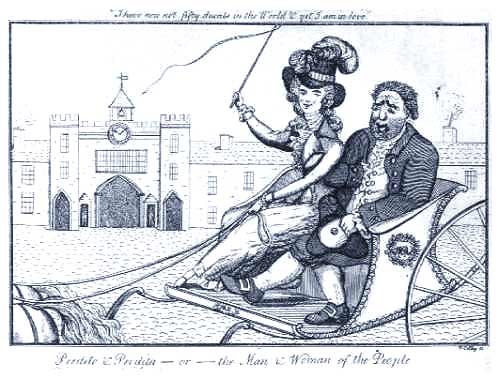
Caricature of Perdita and Charles James Fox (The Man & Woman of the People). He obtained an annuity for her from George III at the end of her affair with the prince.

Disappointment was, indeed, fast in coming. Before he formally and publicly acknowledged their love, Robinson received word from the prince that they could no longer see one another. He had given no prior indication of a change in his feelings, and all her attempts to contact him were unsuccessful. The press began lampooning Robinson mercilessly. Deeply in debt, she considered acting again but decided against it due to the general enmity against her. An invitation to meet the prince raised Robinson’s hopes, as did his renewed professions of love. But he quickly shunned her again, and their relationship was over by 1781. With the help of politician Charles James Fox, Robinson attempted to claim her promised 20,000 pounds, but in 1783 she instead accepted 500 pounds a year to make up for having abandoned her career.

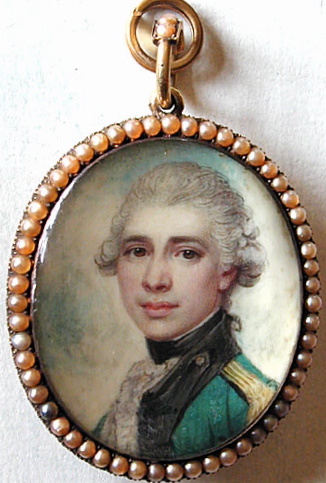
Banastre Tarleton, miniature by Richard Cosway, 1782

After her disappointment with the prince, Robinson was linked romantically to Fox and Malden. Banastre Tarleton, a hard-living veteran of the American Revolution who moved in the same echelons as Malden, stole Mary away from him on a bet. Though sporadic, this relationship lasted for sixteen years, ending in 1798. As far as the press was concerned, it was the final blow against Robinson’s character. In 1784, at age twenty-four, she contracted rheumatism and developed paralysis that left her unable to walk. It is possible that botched treatment after she miscarried Tarleton’s child caused her condition. Robinson sought treatment in Germany and Flanders and returned to England in 1787.

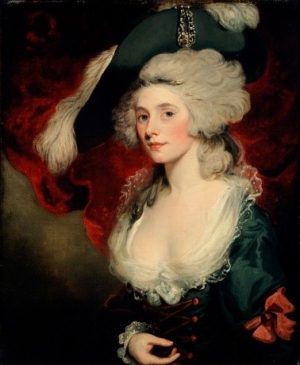
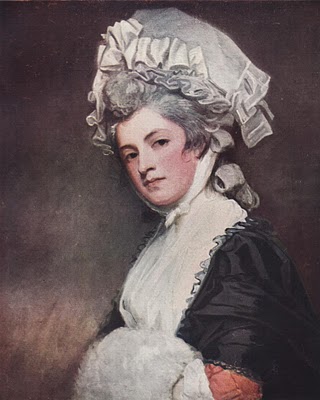
Mrs Mary Robinson by George Romney

From the time she returned to England, Mary Robinson focused on writing and publishing. She wrote in a variety of genres, and her works were highly sought after due to the notoriety her love life had achieved. Poetry was a continuing interest for Robinson. She participated in the Della Cruscan movement that championed elaborate romantic verse; composed poems for the Morning Post, which also published Samuel Taylor Coleridge’s work; and published seven collections of her own verse between 1791 and 1800. Robinson also wrote eight novels, two of which alluded to her relationship with Tarleton.

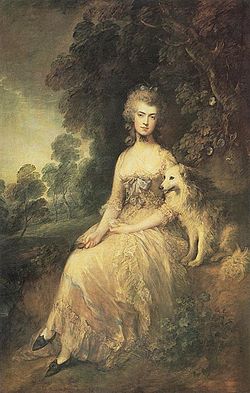
Mary Darby Robinson by Thomas Gainsboroughm, 1781

Though they were less popular than her other projects, Robinson penned at least two works for performance. In the late 1780s, she was reputed to be composing an opera. If the rumors were true, no trace of the work survived. But the idea recalls Robinson’s youthful desire to write a tragedy. In 1793, she authored The Nobody, a play focusing on women gamblers. It was not her first foray into playwriting, for she had penned and acted in The Lucky Escape in 1778. Unfortunately, The Nobodymet with derision and only played for three nights before Robinson stopped production.

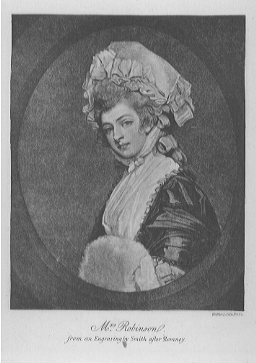
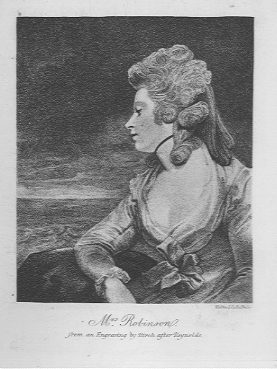
Mrs. Robinson from an engraving by Smith after Romney

Robinson’s last completed literary effort was A Letter to the Women of England, on the Injustice of Mental Insubordination, published in 1799. In it, she asserted women’s right to escape unhappy marriages, defending her own lifestyle in the process. Robinson was at work on her memoirs when she died on December 26, 1800. Maria Robinson edited the existing manuscript and continued the narrative from the point at which her mother began corresponding with the Prince of Wales. Memoirs of the Late Mrs. Robinson, Written by Herselfappeared in 1801, and a volume of verse, The Poetical Works of the Late Mrs. Mary Robinson, appeared in 1806. In 1895, Robinson’s memoirs were republished as Memoirs of Mary Robinson, this time with an introduction and footnotes by J. Fitzgerald Molloy.

Fronticepiece of Mary Robinson’s Memoirs

Mary Robinson’s autobiography provides an intriguing glimpse into eighteenth-century London’s theatrical circles. Though her acclaimed acting career was cut short, Robinson channeled her innate sense of the dramatic into writing. Her poetry and prose have garnered sporadic interest, only attracting scholarly attention over the last several decades. But Robinson’s autobiography has had enduring appeal. Perhaps this is because Mary Robinson was far more than a royal mistress, even though much of her notoriety was based upon this role. Instead of confining herself to the domestic sphere, she was at once a wife, mother, and career woman. By leaving her unfaithful husband and taking lovers, she flouted sexual double standards and affirmed women’s autonomy within marriage. Thus the study of this intelligent, rebellious, and troubled woman—at once an inspiration and a tragic figure—will likely endure for many years to come. About the author of this post: Lucy Warriner is a North Carolina animal lover and dance enthusiast. She is also an ardent admirer of Jane Austen. Bibliography

Image sources:

Read Full Post »

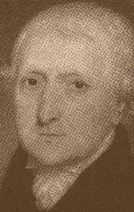
Reverend George Austen

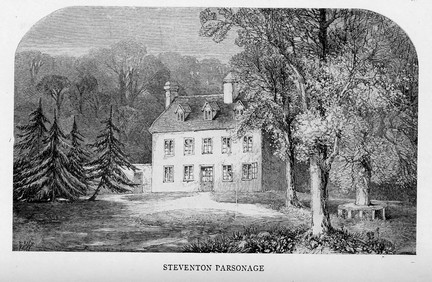
As many Jane Austen fans know, Rev. George Austen ran a boarding school out of his parsonage house in Steventon to augment his £230 pr year income. In1793 he began to teach the sons of local gentlemen in his home to prepare them for university. His library was extensive for a man of modest means, from 300- 500 volumes, depending on the source, an amazing collection, for books were frightfully expensive. Rev. Austen encouraged Cassandra and Jane to read from his library and supported budding author Jane in her writing. At some point, the Austens sent the girls to boarding school in Reading, for which he paid £35 per term, per girl, a not inconsiderable sum. He received around the same amount of money per boarder, and it is conjectured that the Austens hoped to replace their two daughters with many more pupils, which made economic sense. (See Linda Robinson Walker’s link below.) Mrs. Austen was not an indifferent bystander. She cooked, cleaned, sewed, and clucked over the boys like a mother hen, and was involved in their maintenance in a hands-on and caring way, acting as a surrogate mother.

In his Travels Through England in 1782, German traveler Karl Phillip Moritz describes learning academies, head masters, and boarding schools. From his observations, one gains a sense of what life must have been like for the Austens and their pupils:

A few words more respecting pedantry.  I have seen the regulation of one seminary of learning, here called an academy.  Of these places of education, there is a prodigious number in London, though, notwithstanding their pompous names, they are in reality nothing more than small schools set up by private persons, for children and young people.

One of the Englishmen who were my travelling companions, made me acquainted with a Dr. G– who lives near P–, and keeps an academy for the education of twelve young people, which number is here, as well as at our Mr. Kumpe’s, never exceeded, and the same plan has been adopted and followed by many others, both here and elsewhere.

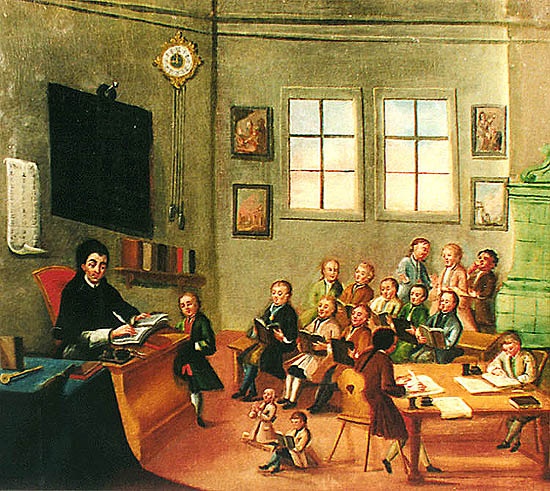
18th Century school room. One imagines a less formal setting for Rev. Austen’s school.

At the entrance I perceived over the door of the house a large board, and written on it, Dr. G–’s Academy.  Dr. G– received me with great courtesy as a foreigner, and shewed me his school-room, which was furnished just in the same manner as the classes in our public schools are, with benches and a professor’s chair or pulpit.

The usher at Dr. G–’s is a young clergyman, who, seated also in a chair or desk, instructs the boys in the Greek and Latin grammars.

Such an under-teacher is called an usher, and by what I can learn, is commonly a tormented being, exactly answering the exquisite description given of him in the “Vicar of Wakefield.”  We went in during the hours of attendance, and he was just hearing the boys decline their Latin, which he did in the old jog-trot way; and I own it had an odd sound to my ears, when instead of pronouncing, for example viri veeree I heard them say viri, of the man,exactly according to the English pronunciation, and viro, to the man.  The case was just the same afterwards with the Greek.

Mr. G– invited us to dinner, when I became acquainted with his wife, a very genteel young woman, whose behaviour to the children was such that she might be said to contribute more to their education than any one else.  The children drank nothing but water.  For every boarder Dr. G– receives yearly no more than thirty pounds sterling, which however, he complained of as being too little.  From forty to fifty pounds is the most that is generally paid in these academies.

I told him of our improvements in the manner of education, and also spoke to him of the apparent great worth of character of his usher.  He listened very attentively, but seemed to have thought little himself on this subject.  Before and after dinner the Lord’s Prayer was repeated in French, which is done in several places, as if they were eager not to waste without some improvement, even this opportunity also, to practise the French, and thus at once accomplish two points.  I afterwards told him my opinion of this species of prayer, which however, he did not take amiss.

After dinner the boys had leave to play in a very small yard, which in most schools or academies, in the city of London, is the ne plus ultra of their playground in their hours of recreation.  But Mr. G– has another garden at the end of the town, where he sometimes takes them to walk.

After dinner Mr. G– himself instructed the children in writing, arithmetic, and French, all which seemed to be well taught here, especially writing, in which the young people in England far surpass, I believe, all others.  This may perhaps be owing to their having occasion to learn only one sort of letters.  As the midsummer holidays were now approaching (at which time the children in all the academies go home for four weeks), everyone was obliged with the utmost care to copy a written model, in order to show it to their parents, because this article is most particularly examined, as everybody can tell what is or is not good writing.  The boys knew all the rules of syntax by heart.

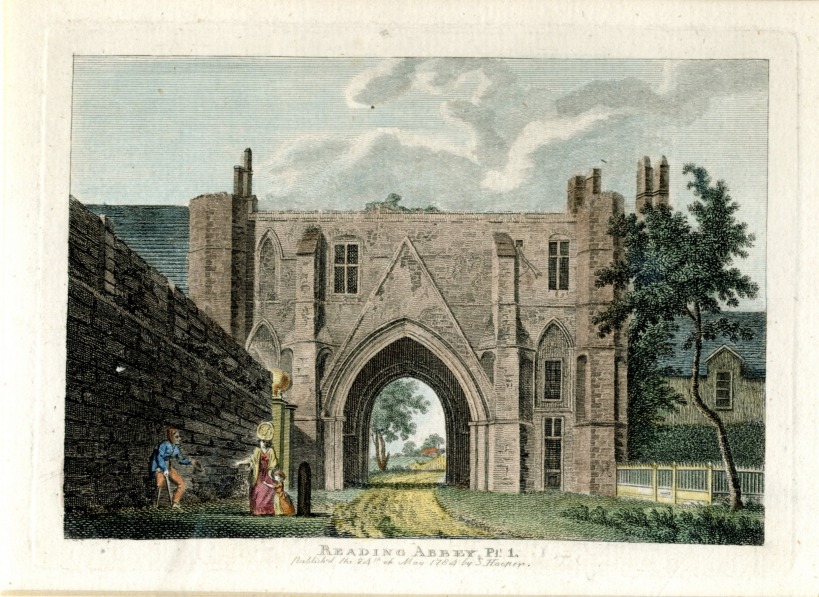
Reading Abbey, where Jane and Cassandra Austen were sent to boarding school

All these academies are in general called boarding-schools.  Some few retain the old name of schools only, though it is possible that in real merit they may excel the so much-boasted of academies.

It is in general the clergy, who have small incomes, who set up these schools both in town and country, and grown up people who are foreigners, are also admitted here to learn the English language.  Mr. G– charged for board, lodging, and instruction in the English, two guineas a-week.  He however, who is desirous of perfecting himself in the English, will do better to go some distance into the country, and board himself with any clergyman who takes scholars, where he will hear nothing but English spoken, and may at every opportunity be taught both by young and old.

Source: Moritz, Karl Philipp, 1757-1793. Travels in England in 1782 by Karl Philipp Moritz (Kindle Locations 645-656). Mobipocket (an Amazon.com company).

Read Full Post »

Fire!

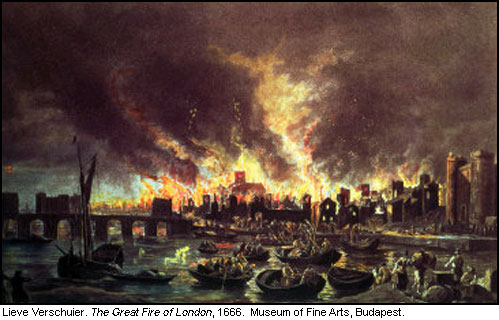
Can there be a more frightening word in Georgian London?  The great fire in 1666 changed the landscape of that city forever. Once a densely packed city riddled with overcrowded, wood-timbered houses and dark, narrow lanes, the fire led the way to a change in building regulations that ushered in brick and stone edifices, wider streets, and public squares. Even with improvements, a fire still presented a horrifically dangerous situation.

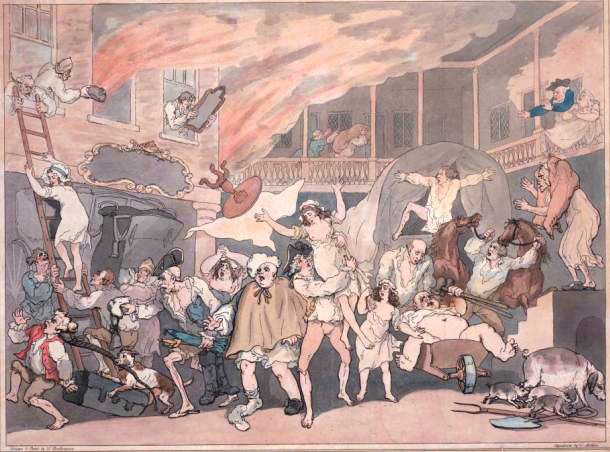
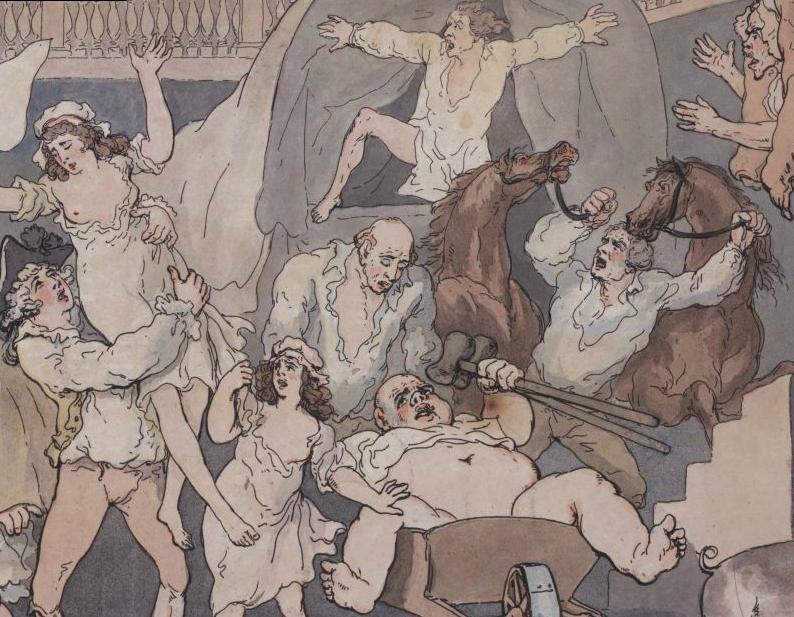
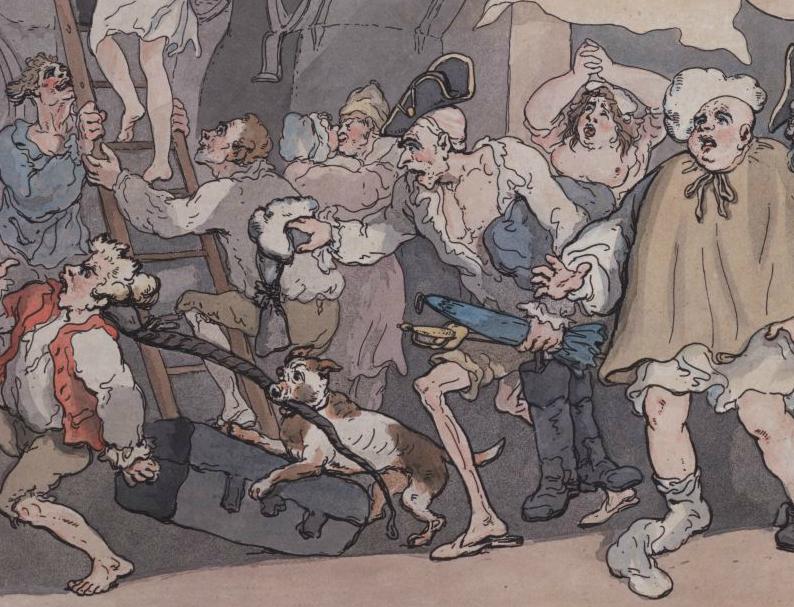
Thomas Rowlandson captures the scene with such realism in “Inn Yard on Fire” that one can smell the smoke and fear, and hear the horses neighing, people screaming, furniture breaking, and wagon wheels squealing as guests and staff run around trying to save themselves, their possessions, and each other.

Fire at the Inn, by Thomas Rowlandson

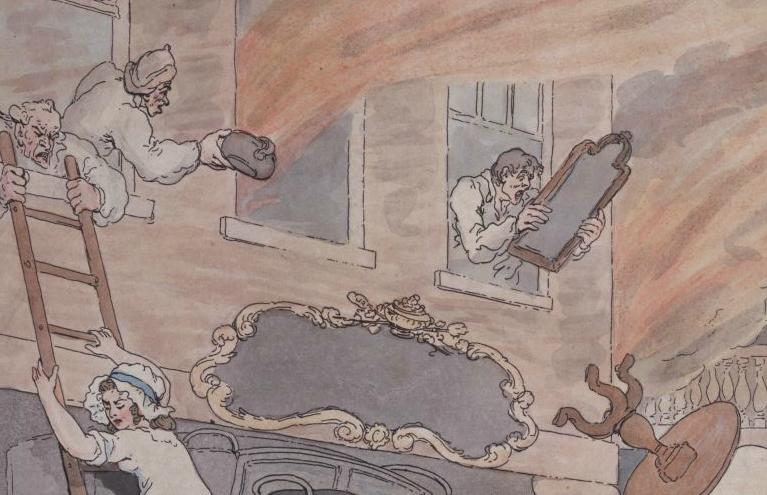
Panic and pandemonium ensue. A man contemplates tossing a mirror from the second story, another pours his ineffectual chamber pot over the flames. A side table has been tossed through the window, while an anxious woman descends a ladder.

People are in various states of dress and undress. Some help others, some are  overcome with panic. A disabled man is carried from danger in a wheel barrow, while a groom tries to calm two terrified horses.

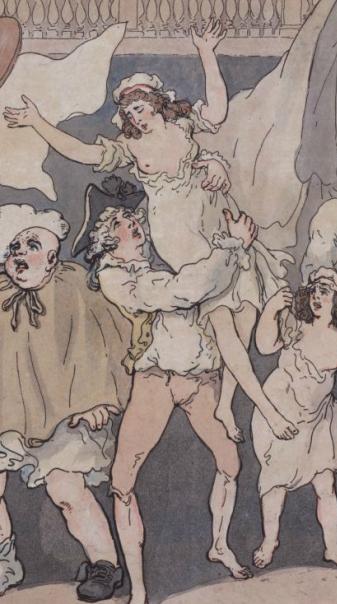
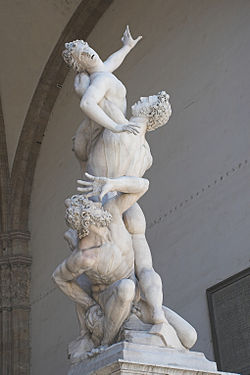
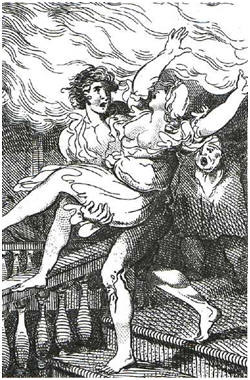
Elements in Rowlandson’s cartoon show a direct association with classical language and Tobias Smollet. The young man saving the girl in distress is reminiscent of Giambologna’s statue of the Rape of the Sabine Women, as well as Peregrine Pickle’s heroic actions towards Emilia.

Rowlandson

Rape of the Sabine Women

Peregrine Pickle saves Emilia. Image @A World History of Art

Once a fire had gained as much ground as depicted in this illustration, there was little chance of saving the building. Rowlandson shows some people carrying out their belongings, while others were barely able to get dressed. By now an alarm had probably been sounded in the community. Bucket brigades, in which people were arrayed in long lines to the nearest well and passed buckets in a continuous motion, could probably put out a minor fire, but not one of this magnitude. In the 1800s, almost 150 years after the great fire, there was still no centralized fire brigade.

In 1680, a property developer named Nicholas Barbon introduced the first fire insurance, which initially insured buildings but not furniture, fittings, or goods.  Insurance companies began to proliferate and formed private fire brigades to protect their customers’ property.

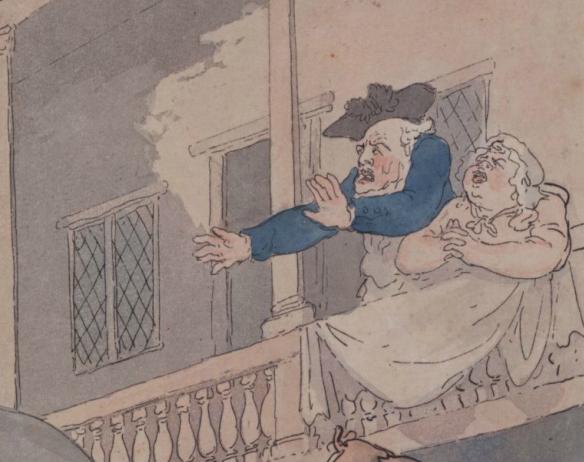
Is this praying elderly couple trapped on the balcony?

In Rowlandson’s cartoon the most the inn keeper can hope for is that the brigade arrives in time to save his structure – if he is insured.  This was easier said than done, for many of London’s streets were not named, since many people could not read, and insured properties were difficult to find.

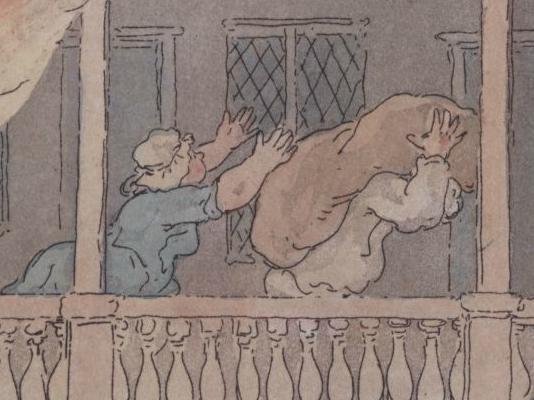
A couple on the second floor frantically attempt to save their belongings.

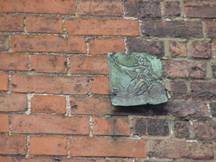
In the early 1800s the fire mark was developed. These plaques, sometimes brightly painted, would signal which properties were protected by insurance firms. Each fire brigade had its own unique plaque.

Fire mark on a building

If a fire started, the Fire Brigade was called. They looked for the fire mark and, provided it was the right one, the fire would be dealt with. Often the buildings were left to burn until the right company attended! Many of these insurance companies were to merge, including those of London, which merged in 1833 to form The London Fire Engine Establishment, whose first Fire Chief was James Braidwood. Braidwood had come to London after holding the position of the Chief Officer of Edinburgh Fire brigade. Edinburgh’s authorities had formed the first properly organised brigade in 1824. – History of the UK Fire and Rescue Service

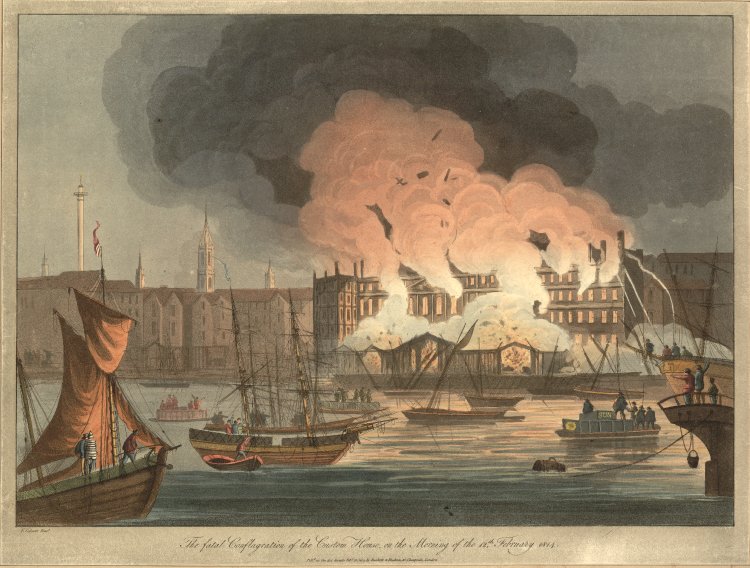
There were quite a few fire brigades operating in London in the early 19th century and competition was keen. The companies hired sailors and watermen as part-time employees. An advantage of serving in this position was that these men were protected from being pressed into service, a not inconsiderable benefit during the Napoleonic wars.

Fighting the fire at the Customs House in February 1814.Image@British Museum

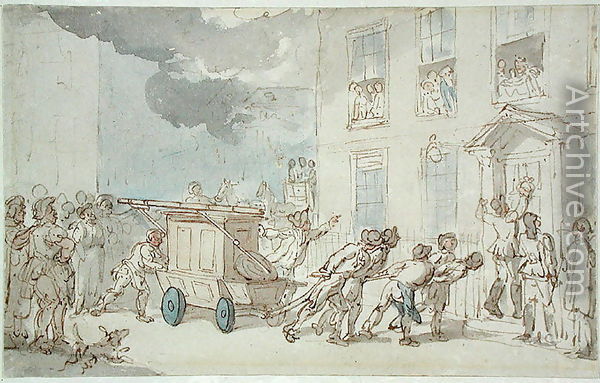
Buildings that had no insurance protection were left to burn, although attempts were made to save the surrounding buildings. Firemarks were essential to identify insured buildings:

Arrival of the fire engine, Thomas Rowlandson

Designs included, for Sun Fire Office: a large sun with a face; the Royal Exchange Assurance: their building; and Phoenix: obviously Phoenix rising from the ashes. Later fire marks were made of tin, copper, or similar material. These are more often called fire plates. They were more an advertising medium as most do not have a policy number stamped upon them. – Fire Marks: The First Logos of Insurance Companies

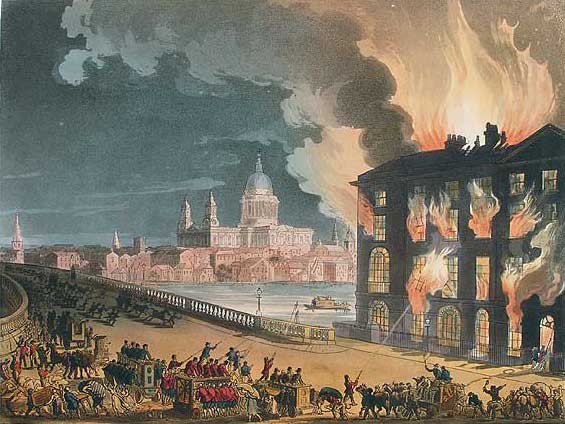
Illustration from Ackermann’s ”Microcosm of London” (1808) drawn by Thomas Rowlandson and Augustus Pugin. Firefighters are tackling a fire which has broken out in houses at the Blackfriars Bridge. Teams of men operate hand pumped equipment. Image @Wikipedia

In 1833 companies in London merged to form The London Fire Engine Establishment, the first step to the various fire brigades being taken over by local government.

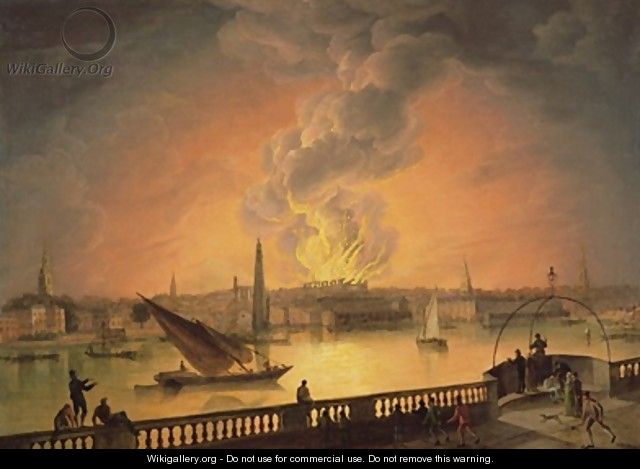
The Burning of Drury Lane Theatre from Westminster Bridge 1809. Artist unknown.  Image property of the Museum of London.

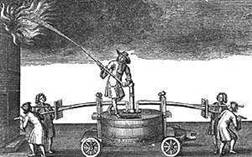
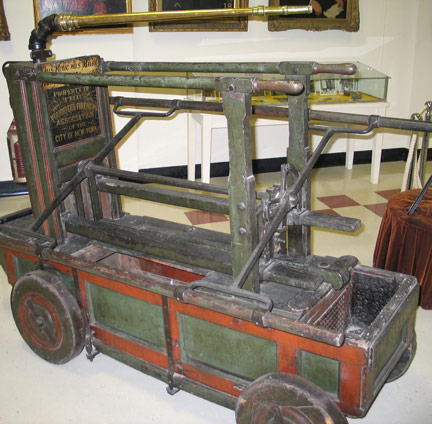
Equipment was still very basic but in 1721, Richard Newsham patented a ‘new water engine for the quenching and extinguishing of fires’. The pump provided a continuous jet of water with more force than before. This new fire engine became a standard until the early 19th century.

Newsham’s wood pumper, ca. 1731.

The men used the handles to pump the water from a lead-lined trough in the main body of the equipment. The apparatus was quite heavy and difficult to maneuver, but it represented a huge step forward in fire fighting technology. People continually ran back and forth to a water source to fill the trough with water. You could also attach a hose to aim the water to a specific location. During this time, however, hose-making was still in its infancy and many leaked. Water buckets and axes to hack out trapped people and create fire free perimeters were still regarded as standard fire fighting equipment.

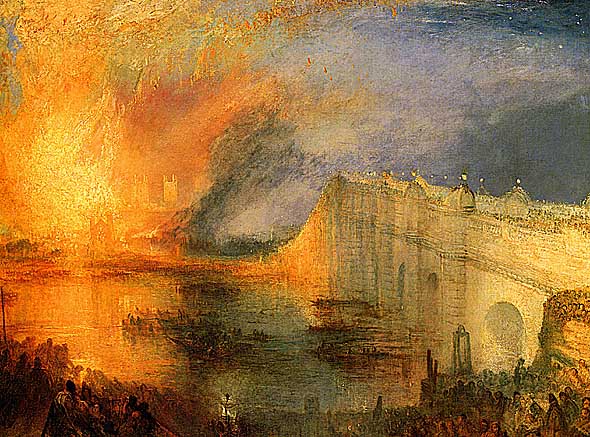
The Burning of the Houses of Parliament, 1834 by William Mallord Turner. Such an event must have provided a spectacular yet horrifying scene for onlookers.

Steam powered appliances were first introduced in the 1850s, allowing a greater quantity of water to be guided onto a fire. With the invention of the internal combustion engine, these appliances were replaced in the early 1900s.

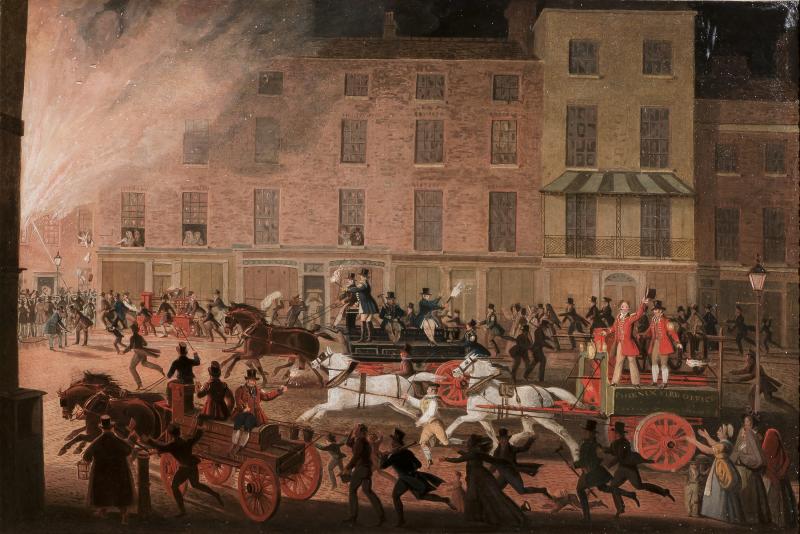
James Pollard (British, 1797-1867) London fire engines: The noble protectors of lives and property, 1823. Image @Olympia Art Antiques

This image by James Pollard, and engraved by R. Reeve, shows several insurance brigades hurrying to a fire.

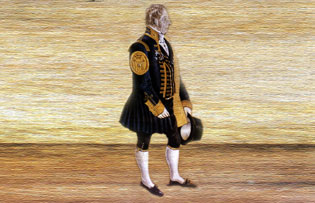
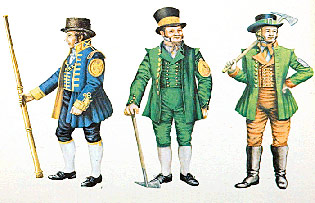
The firemen, of the time, had little training and wore brightly coloured uniforms to distinguish themselves between the different brigades. During large fires they would become very tired through continual pumping of the appliances, and would offer bystanders ‘beer tokens’ in return for their help. – Insurance Firemen and their Equipment

Each company provided different liveries for their men, so that the fire fighters could easily be identified with a particular firm.All insurance firemen wore a large badge on their shoulder to show which insurance company they worked for.

Three uniforms of insurance firemen. All wear a badge

More on the topic:
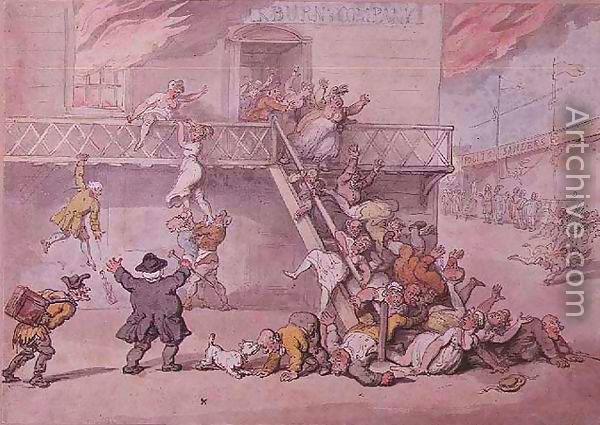
Cockburn’s theatre on fire, another dramatic caricature by Rowlandson.

Read Full Post »

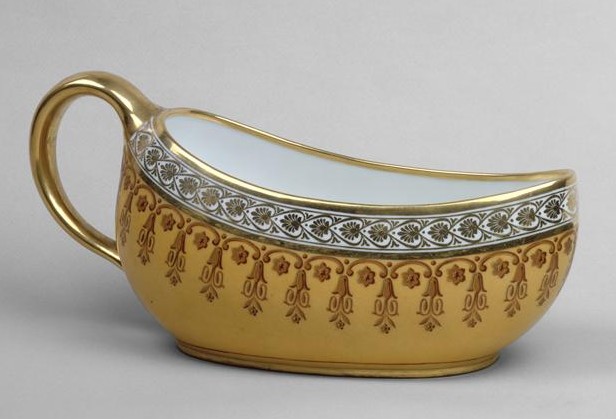
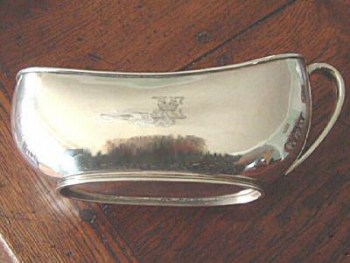
This image of a bourdaloue might be somewhat confusing to the uninitiated. Could this small and elegant vessel be a gravy boat? Or a blood-letting container?

Sevres bourdaloue, 1831.

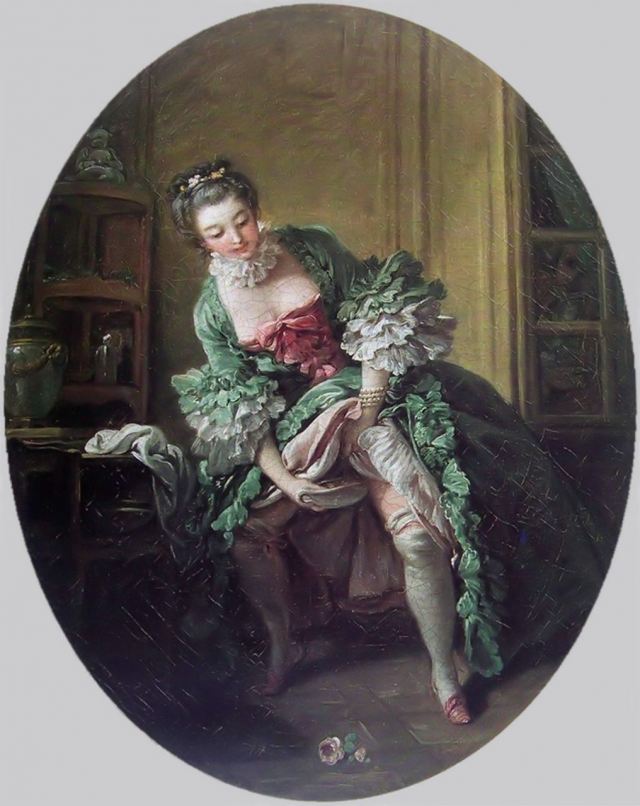
This image by Francois Boucher says it all. A fully dressed lady is relieving herself into an object called the bourdaloue or bourdalou, careful not to soil her skirts. Her maid, no doubt, stands nearby, waiting to receive the small chamber pot in order to empty it. The lady (or woman of ill repute) is in a public place – a theatre or tavern, perhaps – but certainly not a church. Wherever she is, the place has no public toilet. And so she must relieve herself standing up, taking care not to soil her skirt and petticoats.

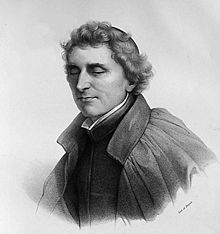
Louis Bourdaloue. Image @Wikimedia Commons

According to legend, the name of this porta potty comes from  Louis Bourdaloue (1632-1704), one of Louis XIVs Jesuit priests. His oratorical skills were reputedly so accomplished that people felt they could not miss a single word of his sermons. It is said that women sat through his masses with a bourdaloue placed under their dresses, whose skirts were held out by panniers. Since the priest’s  sermons were somewhat longwinded, the chances that ladies would need to relieve themselves were almost certain.  As a rule, churches and theatres had no toilets, and there were no breaks given during sermons. Ergo these portable urinals, which were ergonomically designed to accommodate the female body.

The vessel was oblong, rectangular, or oval in shape. A slightly raised lip at one end and a handle at the other allowed the woman to relieve herself from a squatting or standing position. The edges curved inward to avoid hurting her tenderest parts.

Sevres bourdaloue, with medallion depicting a scene from Watteau, blue lapis and framed in gold leaf. 1892.

It is a little hard to distinguish truth from fiction, so I am a bit skeptical about this apocryphal tale. Were the priest’s sermons in the early 18th century so truly awe-inspiring that a lady would squat in her pew, however discreetly, to relieve herself in front of her family and other parishioners so as not to miss a word?

In truth it was her maid who brought the vessel in, for bourdaloues were compact and came with a cover. When a lady had to relieve herself she would, I imagine, retreat discreetly to a private corner of a tall pew or to a back or side room in the church. Her maid would then hand the vessel over to her mistress, who took care not to spill any liquid on her skirts. When the lady was finished, she would hand the bourdaloue to her maid to empty its contents.  When attending a play or opera at the theatre, I imagine she would again retreat to a darker more private corner of the box to urinate.

A PAIR OF SEVRES BOURDALOUES (POTS DE CHAMBRE OVALE) CIRCA 1776,

Designed only for women, these bourdalous are quite beautiful. Made of faience or porcelain, they are decorated with flowers or painted scenes. Many are gilded. The portable pots, or coach pots as they were known in England, could be decorated inside as well.  They were quite small and compact, designed for travel, which made it easy to carry them and pack them for coach trips. They were also taken to long banquets, where ladies would scurry behind curtains when they needed to go.

Bourdalou made in France c. 1840. It has an engraved crest and a leather case to contain it. The silver bourdalou is a small urinary receptacle for female use, of compressed eliptical shape and generally made of porcelaine or earthenware, but also made occasionally of silver. Its front end has an incurved rim and, usually, stands on a simple foot ring with a simple loop handle. Also known as a coach pot in England.

Bourdaloues were used throughout the 18th and for most of the 19th century. As water closets began to be built inside homes and buildings, the use of these chamber pots began to be reduced dramatically.

Plain bourdaloue made of creamware. The shape is quite elegant.

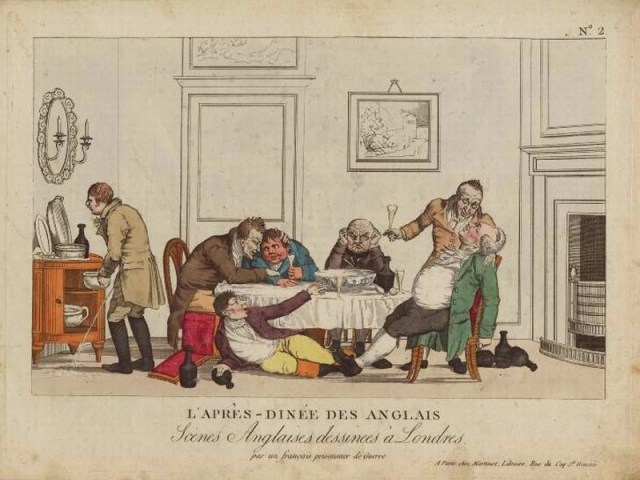
Gentlemen had it a little easier, although this satiric French cartoon, which I have shown before, depicts the disgust that Frenchmen felt towards Englishmen who freely pissed in a pot in the dining room. In this instance, the man misses the chamber pot and hits the floor. There seems to be a lack of modesty among these men, which largely holds true today.

c1816, from Fitzwilliam Museum.

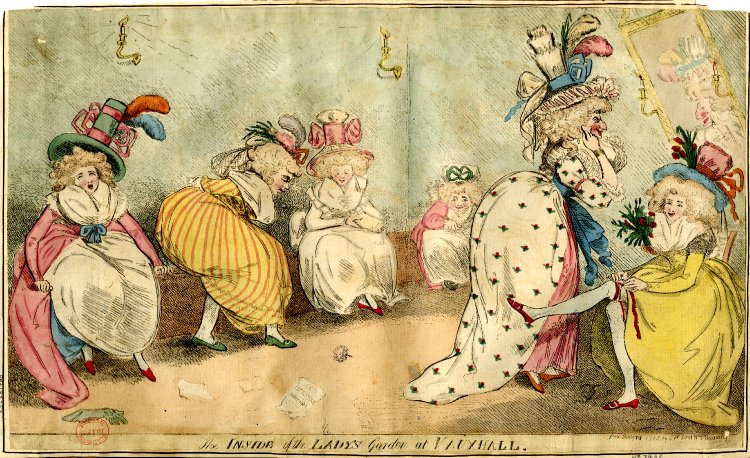
Modesty is also lacking in this cartoon of ladies relieving themselves inside a public restroom at Vauxhall Gardens. Four are arrayed on a long latrine against the wall. One lady is refreshing her make up and another is tightening her garter. If such scenes were common for upper class women in public spaces, perhaps many felt no modesty relieving themselves in church as well.

The Inside of the Lady’s Garden at Vauxhall, 1788 by SW Fores. Image @British Library. The interior of a ladies’ cloak-room. Against the wall on two sides of the room is a bench forming a latrine on which four fashionably dressed ladies are seated. On the right a woman in profile to the right, resembling Lady Archer, applies paint to her cheeks before a mirror lit by two candles. A young woman seated beside her on the extreme right ties up her garter.

Read Full Post »

« Newer Posts - Older Posts »