This Jane Austen blog brings Jane Austen, her novels, and the Regency Period alive through food, dress, social customs, and other 19th C. historical details related to this topic.
Downton Abbey, presented on PBS Masterpiece classic this month, is one of the most expensively produced mini-series for television next to Brideshead Revisited. The sets and costumes are lavish, and the viewer can readily see that everything possible has been done to recreate the Edwardian world.
But even huge budgets have their limits, for creating new costumes for every character in the production would have been prohibitive. The website, Recycled Movie Costumes, and an article in the Daily Mail point to a few outfits that were worn in other productions. This custom is common, and has been pointed out on this blog before in Recycled Fashions in Emma 2009. Around 2/3 of the costumes used in Downton Abbey were used before, but only a few have been expressly identified so far.
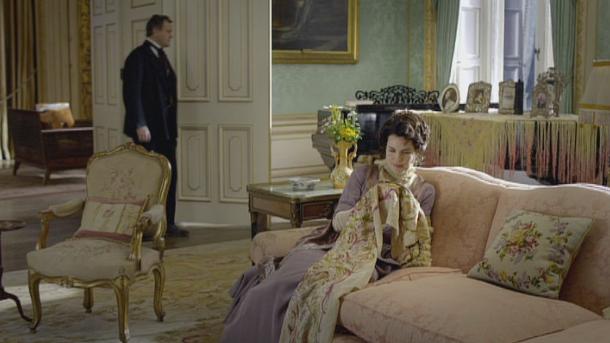
The dress worn by Laura Michael (Lady Edith) was also used in A Room With a View, 2007. At left is Elizabeth McGovern as the Countess
Elaine Cassidy in A Room With a View, 2007
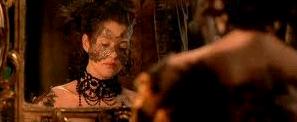
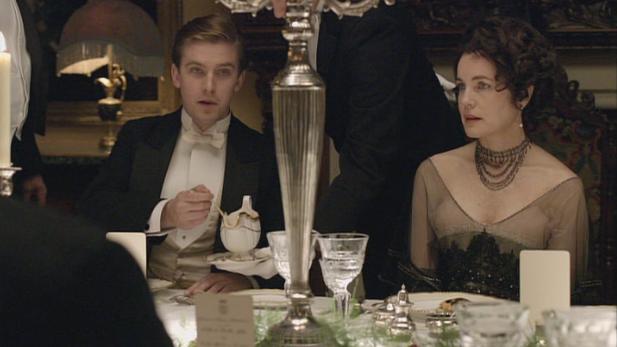
Compare the necklace worn by Michelle Dockery as Lady Mary to ...
...Monica Belluci's in Brotherhood of Wolves
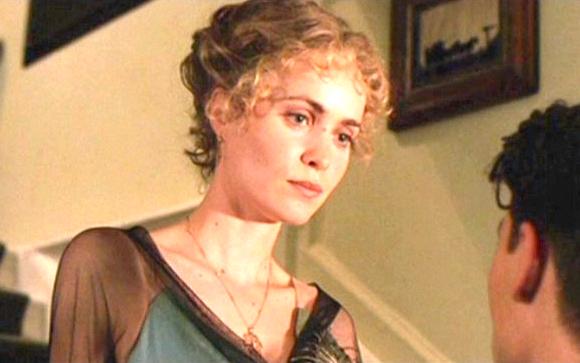
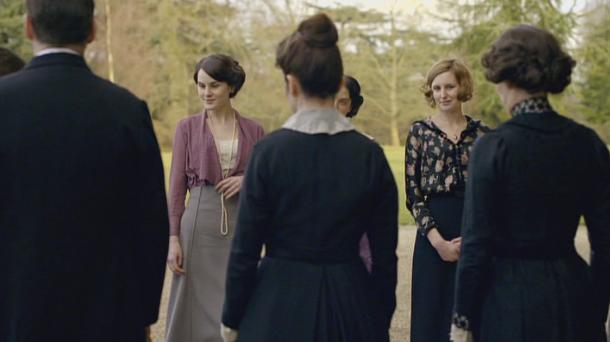
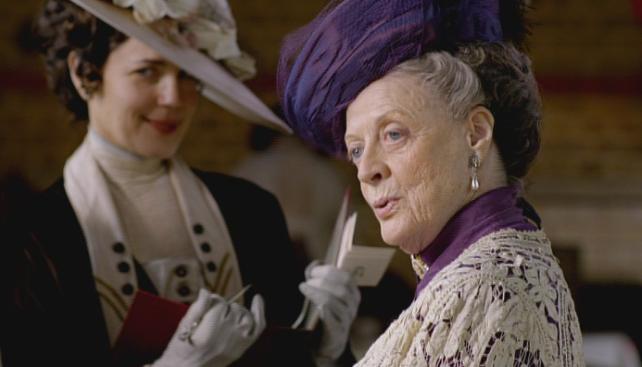
Lady Mary (Michelle Dockerey, between Maggie Smith and Laura Michaels) wears the same dress as ...
... Radha Mitchell in Finding Neverland
You can look for Regency costumes that have been recycled in this link. The Daily Mail mentioned that one certain brown dress has been used in seven productions in the past 15 years, including Pride and Prejudice and Little Dorrit. I wonder which one it is?
As you watch Downton Abbey tonight, perhaps you can spot a few recycled outfits on your own and inform Recycled Films of your find. Learn more about the series on PBS Masterpiece Classic.
Downton Abbey, a PBS Masterpiece Classic mini-series, is as much a tale about the servants below stairs as about the noble Earl of Grantham and his family who employed them. With the recent airing of the updated version of Upstairs Downstairs in Great Britain, I am sure a debate will long rage about which series portrayed their eras and class differences better. In both cases, the viewer is the winner.
No matter how expertly this mini-series of Downton Abbey tries to portray this bygone era, it is nearly impossible to capure life in an Edwardian country house exactly as it once was. The viewer should be aware that we can glimpse only a faint, musty, museum shadow of the complex and thriving community that a great English estate once supported.
It is a well-known fact that grand country houses could only be run with a great deal of help. As early as the 18th century, Patrick Colquhoun estimated that there were around 910,000 domestic servants (in a population of 9 million). By 1911, the number of domestic servants had risen to 1.3 million. Eighty percent of the land during the Edwardian era was owned by only 3% of the population, yet these vast estates were considered major employers.
In the grander and larger houses, the ratio of servants (both indoor and outdoor) to the family could approach 1:7 or 1:10, but as the industrial revolution introduced improvements in laundering, lawn maintenance, and cooking, the number of servants required to run a great estate was greatly reduced.
After World War One and the rise in taxes for each servant employed, many great families no longer kept two sets of house staff. They began to bring servants from their country house to their house in Town, leaving only a skeleton crew behind to maintain the family seat in their absence.
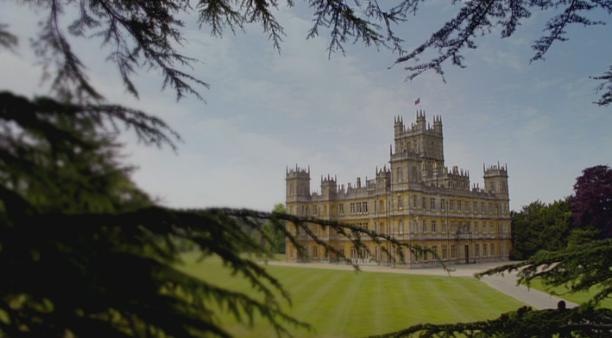
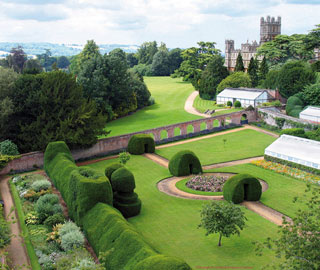
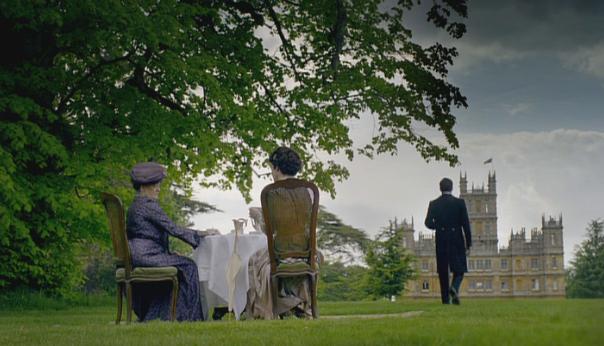
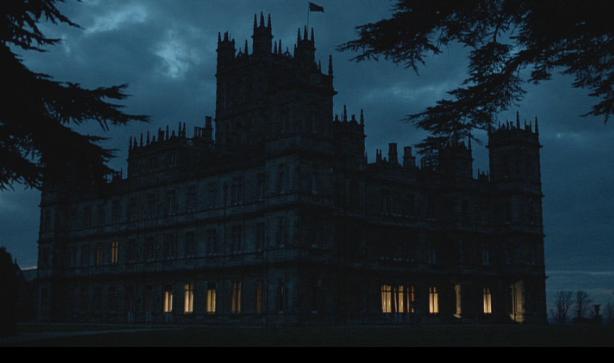
Grounds of Downton Abbey (Highclere Castle)
Country estates were designed to showcase the owner’s wealth via collections of art, furniture and other luxurious possessions, such as carriages, lawn tennis courts, and the like. The main house sat at the end of a long and winding drive through acres of beautifully landscaped park lands.
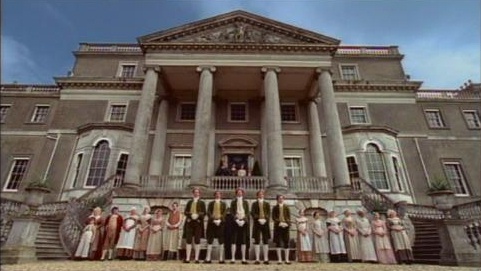
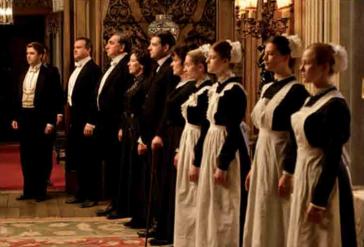
The spectacle did not end there, for approaching the house, guests would see a grand facade or an equally imposing flight of stairs that led to the first floor (or both). In Downtown Abbey, the family awaited the arrival of the Duke of Crowborough (Charlie Cox) along with their servants, who were arrayed in line according to their station.
The servants await their new masters at Norland. Sense and Sensibility, 2008.
Such a display of staff was also evident in the 2008 adaptation of Sense and Sensibility, when Fanny and Robert Dashwood arrived to claim Norland Park.
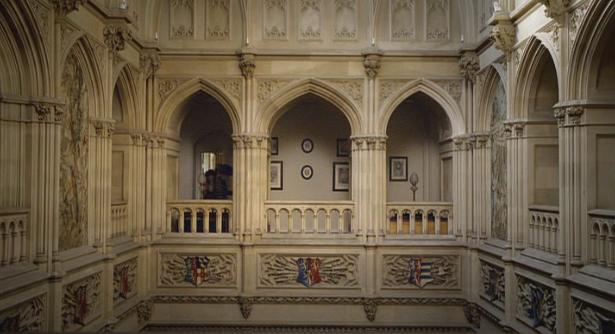
Once introductions had been made, the guests would ascend the imposing stairway and enter an equally impressive high-ceilinged hall that contained yet another grand staircase, which led to the private rooms upstairs. The ladies customarily brought their own maids, who would also require lodging. (In Gosford Park, a poor female relation had to make do with one of the hostesses’ house maids to help her with her dress and hair.)
The guests’ servants were expected to enter the house through a separate, back servant’s entrance, and shared quarters with the regular staff. The host supplied his own butler or footmen to help serve as valet to his male guests.
A host’s willingness to lavishly entertain his guests did not necessarily reflect the family’s daily schedule:
In 1826 a German visitor to England remarked that: it requires a considerable fortune here to keep up a country house; for custom demands… a handsomely fitted-up house with elegant furniture, plate, servants in new and handsome liveries, a profusion of dishes and foreign wines, rare and expensive desserts… As long as there are visitors in the house, this way of life goes on; but many a family atones for it by meagre fare when alone; for which reasons, nobody here ventures to pay a visit in the country without being invited, and these invitations usually fix the day and hour… True hospitality this can hardly be called; it is rather the display of one’s own possessions, for the purpose of dazzling as many as possible.(3)” – The Country House: JASA
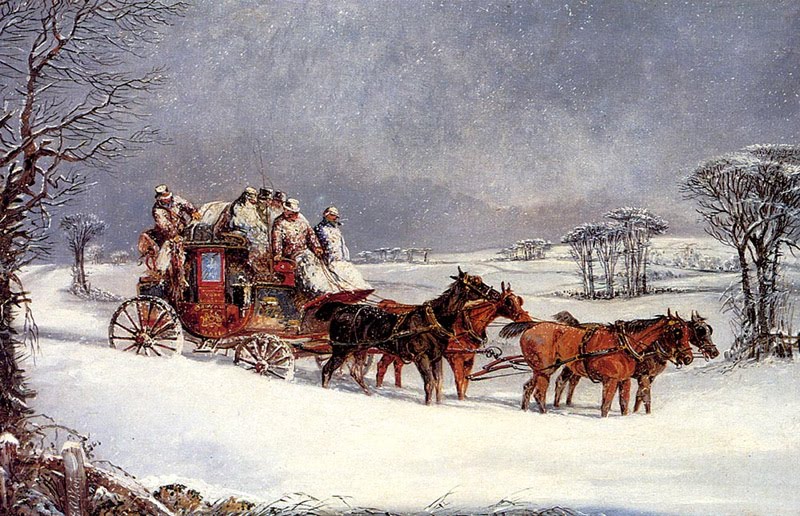
Travel in winter, Henry Alken, 1785
Guests stayed for a long time for a variety of reasons. In the 17th and 18th centuries, travel over a long distance was laboriously slow and difficult, for roads were notoriously poor and dangerous. Long visits, such as Cassandra Austen’s visits to her brother Edward in Godmersham Park, became a custom. Even during the Edwardian age, when travel was much improved, guests tended to stay for the weekend (Saturday through Monday). In Downton Abbey, the Duke of Crowborough arrived amidst much hope and anticipation, until he discovered that the estate had been entailed to a third cousin not the earl’s daughter, whom he had come to woo, and he cut his visit to one short day and evening, making an excuse that did not hold water.
Even during the 18th century, when long-term guests were expected, some overstayed their welcome, like Jane Austen’s anti-heroine, Lady Susan Vernon, whose hostess (sister-in-law) despised her but was forced to tolerate her because she was ‘family.’ Desirable guests, like Catherine Morland of Northanger Abbey, were invited to extend their visit. In Catherine’s instance, Eleanor Tilney, a motherless young lady who lived without a female companion, found the young girl’s company delightful. By the time General Tilney discovered that Catherine was no heiress, she had been with the Allens in Bath and the Tilneys in Northanger Abbey for a total of 11 weeks. As previously noted, Edwardian hosts, while generous, expected house guest to stay for only three days. During this time every luxury was lavished upon them, but it was considered bad form if they stayed longer than arranged or without invitation.
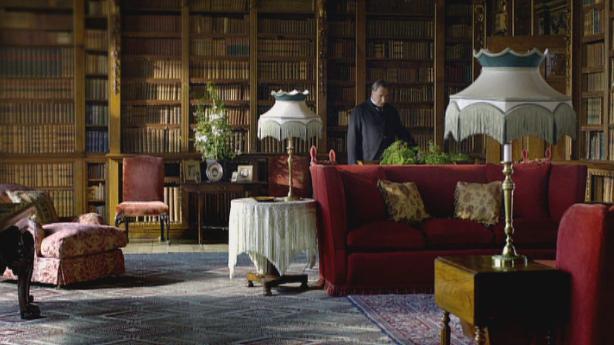
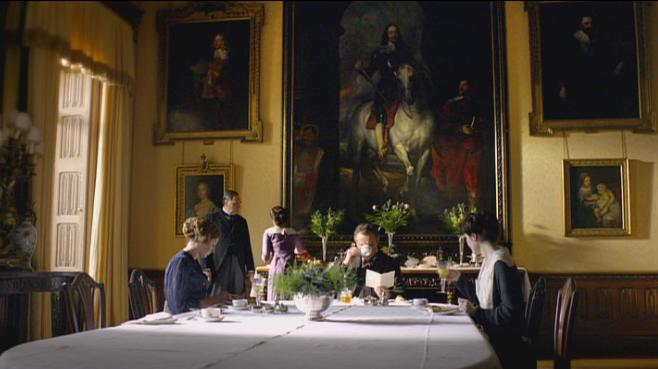
At set times, Edwardian guests would congregate in the common rooms, which included the drawing room, music room, dining room and breakfast room, the library or study, the gallery (where ancient family portraits were hung), the billiard room, and the conservatory. Vast lawns and gardens were laid out for promenading; guests could ride or walk through the parklands to view picturesque follys or dine alfresco (outdoors), take tea under an awning, or paint a vista or two.
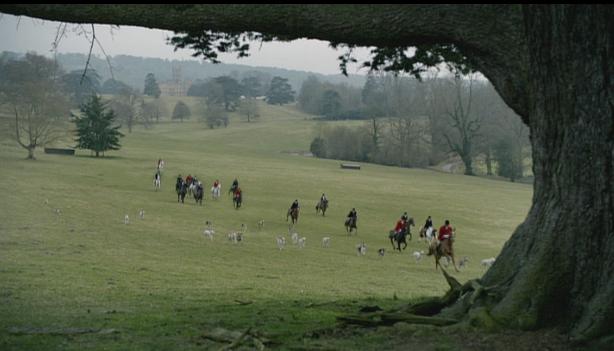
The reputation of a host rested on the entertainments, which helped to pass the time – walking, riding, shooting (in winter), and hunting (in fall) for outdoor activities; and card parties, musicales, and dances for indoor festivities. A fox hunt, such as the one depicted in Downton Abbey, required riding skill and stamina, for the chase would take riders over hills and dales, and hedges, and over long distances for much of the day.
Billiards made an appearance during the 17th century, and by the 19th century billiard rooms had become a staple. Private libraries offered a variety of books and periodicals. In the summer, Edwardians enjoyed lawn tennis, croquet, cricket, and golf (by the men).
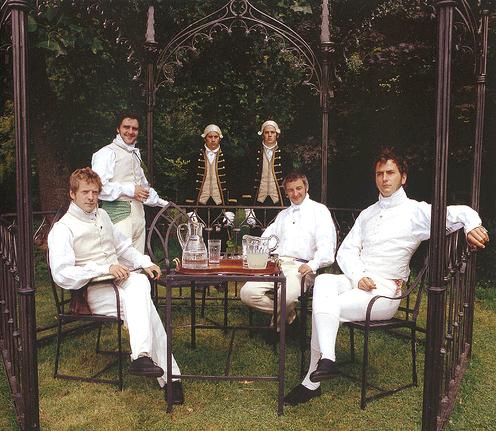
The male guests in Regency House Party (2004) could pretty well behave and move around as they pleased.
Ladies and gentlemen tended to spend the day apart. Male guests were more active and could engage in almost any activity during the day, except at the time reserved for dinner, when they were expected to show up. In an Edwardian house, men did not escort their female dining partners into the dining room. Rather, after the host served cocktails in the drawing room a half hour before the meal, the group moved to the dining room where they were seated according to a set pattern, with guests sitting between members of the family and their neighbors.
After dinner, the ladies would remove to the drawing room, which became increasingly larger and more feminine over time, while the gentleman relaxed at the dining room table, drinking port, smoking their cheroots, and discussing manly topics.
While an 18th century gentlemen would have talked about horse flesh and carriages, Edwardian guests would have included automobiles and their rapidly changing technology, road improvements, and the availability of petrol as well.
Unlike the gentlemen, a lady’s day was more restricted and confined. She spent her day following a set routine, starting with breakfast, and wearing appropriate outfits and getting into them and out of them. Mothers spent some time overseeing the nannies and the care of their children (if they were brought along). Ladies, married or not, would also receive visitors, sew, gossip, read, walk, participate in charity work, observe the men at sport (if invited) or take a ride in the carriage. They did join in on more active, outdoor games at set times during the appropriate season, such as cricket, croquet, lawn tennis, lawn bowling, and the like, but they would have been properly dressed for the occasion.
Imagine poor Eleanor Tilney in the late 18th century, alone in a grand house without female companionship, having no-one to talk to and forced to live a constricted life. No amount of walking, charity work, practicing the piano, or overseeing the household would have made up for her boredom, and thus Catherine Morland’s companionship was so welcome.
Manor House (2002), dressing Lady Olliff-Cooper. Image @PBS
In Regency House Party (the 2004 mini-series), the modern women who portrayed Regency ladies chafed under the strict rules of protocol, forced chaperonage, and daily tedium. A lady’s routine did not much improve during the Edwardian era, although towards the end of this period changing one’s gown for afternoon tea became obsolete.
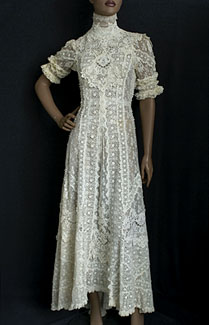
Tea gown, circa 1908. Image @Vintage Textiles
In Manor House, the 2002 mini-series set in the Edwardian era, Lady Olliff-Cooper’s spinster sister, the lowest-ranking member of the family, had so little to do and so little say in how she could spend her time, that Avril Anson (who in real life is a professor) left the series for a few episodes to maintain her sanity.
Lady Olliff-Cooper … [needed] to change her clothes five or six times a day. And very few of these dresses would be what today we’d call practical. Not only did each meal carry its own dress code, but if she needed to receive a visitor, pay a call or go riding, she’d have to change both her clothes and often her hairstyle as well.” Manor House, clothes
Anna Olliff-Cooper, who portrayed the lady of the house in Manor House, spent an enormous amount of her day changing into new gowns and having her hair dressed. She would stand passively as her maid did all the work. Anna noted how constricting the dresses were, and cried as she described how the tight sleeves of her gowns prevented her from raising her arms above her shoulders or from closely hugging her eleven-year old son. Even the fashions conspired to keep a women passive!
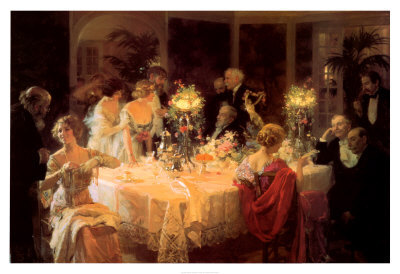
The Dinner Party, 1911, Jules Alexandre Grun
After they had finished their cigars and port, the gentlemen were obligated to rejoin the ladies for cards or music, or both, to while away the evening. The Duke’s behavior in Downton Abbey was egregious, for instead of joining the group for the rest of the evening, he went to bed early. The house party would stay up until 10:30 or so (unless a grand ball had been arranged, and then the guests would stay up until the wee hours of the morning).
In either case, the last people in the house to retire for the night would be the servants, but their lives and schedule will be described in another post.
Look for Downton Abbey, Part One to air on PBS Masterpiece Classic on Sunday, January 9th! Once again PBS will host a twitter party! Stay tuned for details.
Created by Oscar-winning writer Julian Fellowes (Gosford Park), “Downton Abbey” depicts the lives of the noble Crawley family and the staff who serve them at their Edwardian country house. It is April and the Titanic has just sunk.The world will never be the same for the Crawleys, for both the heirs to Downton Abbey went down with the ship.
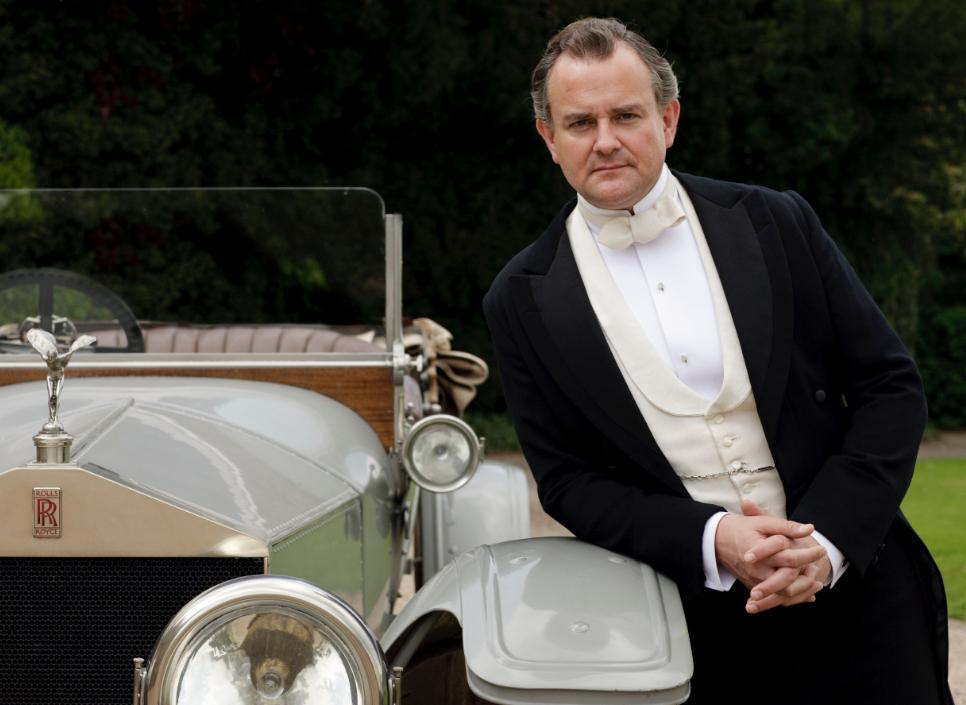
Hugh Bonneville as the Earl of Grantham. This image speaks of power and privilege.
The earl and countess of Grantham’s three daughters cannot inherit the estate, which is entailed to the male next in succession. He is Matthew Crawley, a third cousin, son of a doctor and a nurse, and a lawyer by trade. Matthew knows nothing about running such a vast estate, and cares little about the niceties of protocol.
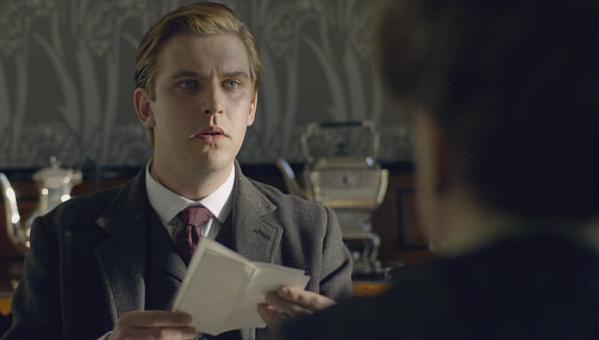
Dan Stevens plays Matthew Crawley. He also played Edward Ferrars in Sense and Sensibility.
The answer to the earl’s predicament is simple really – Lady Mary, his eldest daughter, should marry Matthew. But nothing is simple in Downton Abbey, for Lady Mary is stubborn and has a mind of her own.
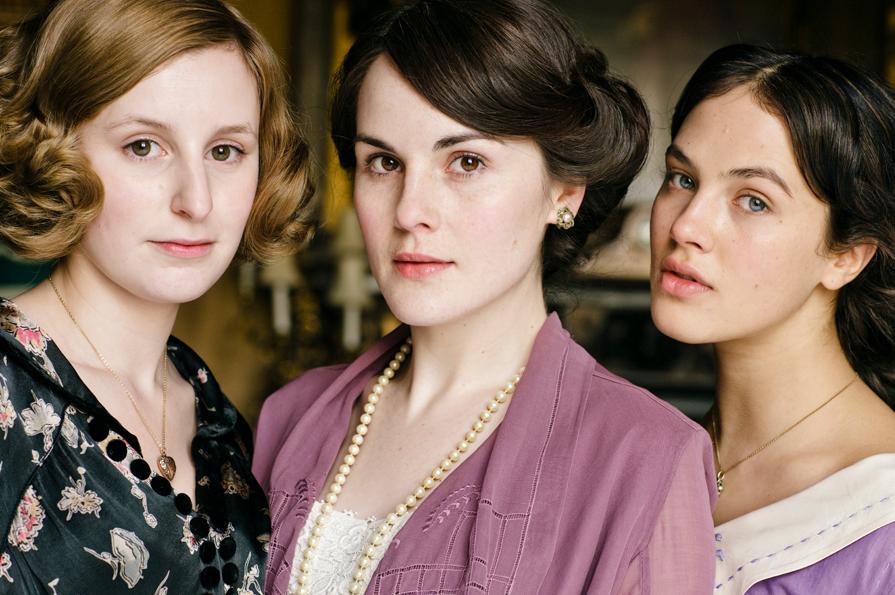
The Crawley sisters: Lady Edith, Lady Mary, and Lady Sybil
The series is lushly produced and the story lines are riveting. In its depiction of the intertwined lives of servants and aristocrats, Downton Abbey recalls one of television’s most beloved programs, Upstairs Downstairs, which aired on MASTERPIECE (then MASTERPIECE THEATRE ) in the 1970s. One of the thrills of MASTER PIECE’s 40th season is a new three-part Upstairs Downstairs with a new cast of characters set in the same house at 165 Eaton Place, taking the story from 1936 to the outbreak of World War II .
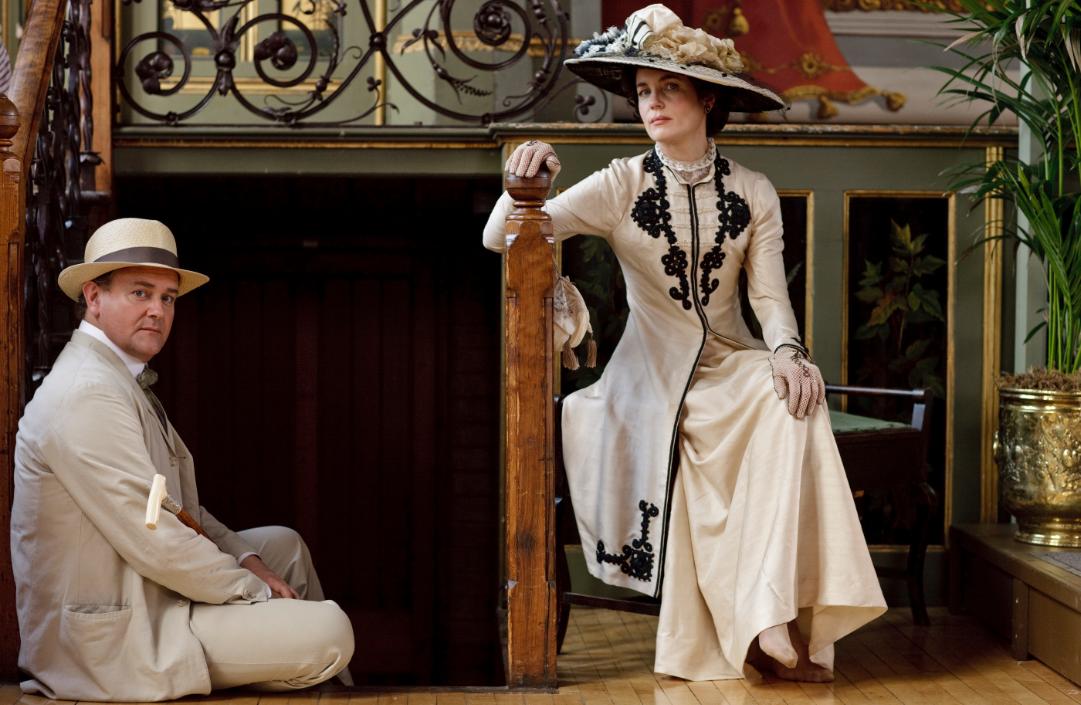
The Earl and Countess of Grantham (Hugh Bonneville and Elizabeth McGovern)
Episode 1
Sunday, January 9, 2011, 9 to 10:30pm
When the Titanic goes down, Lord Grantham loses his immediate heirs, and his daughter Mary loses her fiancé, throwing Downton Abbey and its servants into turmoil. The new heir turns out to be Matthew, a handsome lawyer with novel ideas about country life.
Matthew and his mother are formally received by the servants and family during their first visit to the Abbey
Episode 2
Sunday, January 16, 2011, 9 to 10:30pm
Mary entertains three suitors, including a Turkish diplomat whose boldness leads to a surprising event. Downstairs, the shocking former life of Carson, the butler, is unmasked, and Bates risks his health to remain valet.
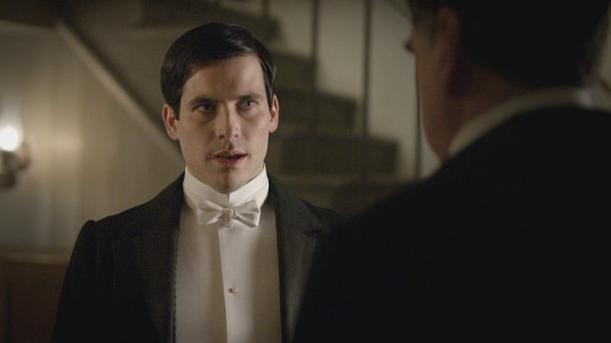
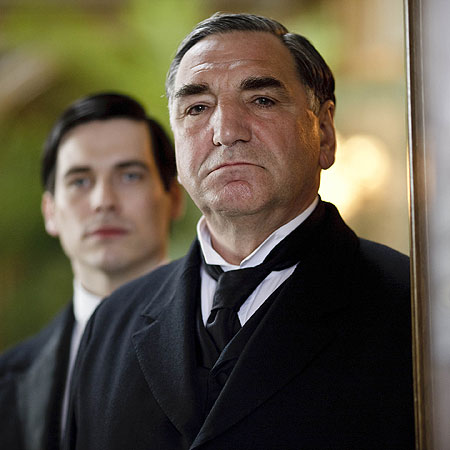
Jim Carter (Cranford) as Mr. Carson, the butler
Episode 3
Sunday, January 23, 2011, 9 to 10:30pm
Growing into his role as heir, Matthew brings out the bitter rivalry between sisters Mary and Edith. Servants Thomas and O’Brien scheme against Bates, while head housemaid Anna is increasingly attracted to him. Lady Violet’s winning streak in the flower show is threatened.
The Countess (Elzabeth McGovern) and the Dowager Countess (Maggie Smith) at the flower show.
Episode 4
Sunday, January 30, 2011, 9 to 10:30pm
The heir crisis at Downton Abbey takes an unexpected turn. Meanwhile, rumors fly about Mary’s virtue. Her sister Sybil takes a risk in her secret political life. Anna unearths Bates’ mysterious past. And O’Brien and Thomas plot their exit strategy.
The Countess of Grantham with her daughter Lady Edith
Hugh Bonneville (Daniel Deronda, Filth)…Robert, Earl of Grantham Jessica Brown-Findlay…Lady Sybil Crawley Laura Carmichael…Lady Edith Crawley Jim Carter (Cranford)…Mr. Carson Brendan Coyle (Prime Suspect 7: The Final Act)…John Bates Michelle Dockery (Return to Cranford)…Lady Mary Crawley Siobhan Finneran (The Amazing Mrs. Pritchard)… O’Brien Joanne Froggatt (Robin Hood)…Anna Thomas Howes…William Rob James-Collier…Thomas Rose Leslie…Gwen Phyllis Logan (Wallander)…Mrs. Hughes Elizabeth McGovern (A Room with a View)…Cora, Countess of Grantham Sophie McShera…Daisy Lesley Nicol (Miss Marple)…Mrs. Patmore Maggie Smith (Harry Potter)…Violet, Dowager Countess of Grantham Dan Stevens (Sense & Sensibility)…Matthew Crawley Penelope Wilton (Wives and Daughters)…Isobel Crawley Charlie Cox (Stardust)…Duke of Crowborough Kevin Doyle (The Tudors)…Molesley Robert Bathurst (Emma)…Sir Anthony Strallan Bernard Gallagher…Bill Molesley Samantha Bond (Miss Marple)…Lady Rosamund Painswick Allen Leech (The Tudors)…Tom Branson Brendan Patrick…Evelyn Napier David Robb…Dr. Clarkson Helen Sheals…Postmaster’s Wife
Inquiring Readers: I will be contributing four posts to Pride and Prejudice Without Zombies, Austenprose’s main event for June/July – or an in-depth reading of Pride and Prejudice. This post discusses the clothes that the characters would have worn in relation to the film adaptations and actual fashion plates of the time. Warning: this is a long post.
Netherfield Ball, Pride & Prejudice 2005
The Netherfield Ball. Ah! How much of Jane Austen’s plot for Pride and Prejudice wasput on show in this chapter! Elizabeth Bennet – its star – enters the ball room hoping for a glimpse of a strangely absent Mr. Wickham, but is forced to dance two dances with bumblefooted Mr. Collins, whose presence she somehow can’t seem to shake. (From his actions the astute reader comes to understand that this irritating man will be proposing soon.)
Lizzie and Mr. Collins out of step, Pride & Prejudice 1980
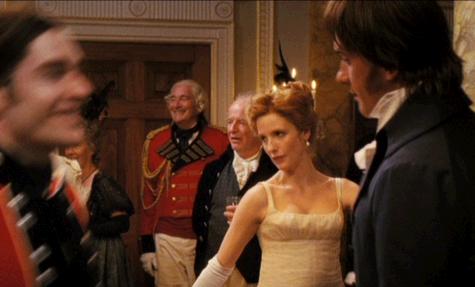
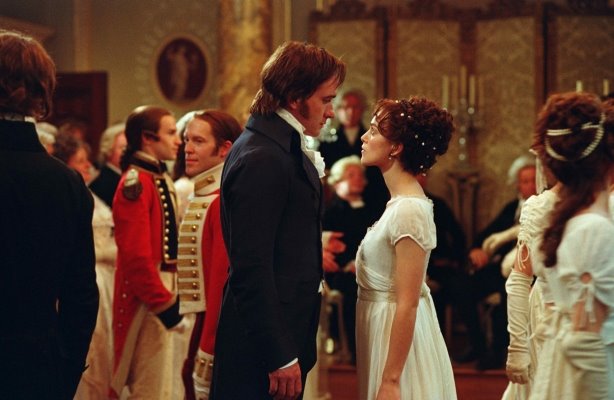
Mr. Darcy then solicits Lizzie for a dance, and his aloofness and awkward silences during their set confirms in Lizzie’s mind that he suffers from a superiority complex.
Dancing a set with Mr. Darcy at the Netherfield Ball, Pride & Prejudice 1995
As the evening progresses her family’s behavior is so appalling (Mary hogs the pianoforte with her awful playing; Kitty and Lydia are boisterously flirtatious with the militia men; and Mrs. Bennet brazenly proclaims to all within earshot that Mr. Bingley and Jane are as good as engaged) that the only enjoyment Lizzie takes away from the event is in the knowledge that Mr. Bingley is as besotted with Jane as she is with him.
Jane and Bingley have eyes only for each other, while Lizzie cannot wait for her set with Mr. Collins to end, Pride & Prejudice 2005
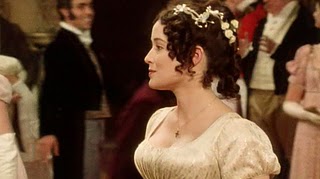
In anticipation of furthering her acquaintance with Mr. Wickham, Lizzie dressed with extreme care, making sure both her dress and hair looked perfect. In the image below, Jennifer Ehle’s “wig” is adorned with silk flower accessories, and a string of pearls, which was the fashion of the time. She wears a simple garnet cross at her throat (Jane Austen owned one made of topaz) and her dress shows off her figure to perfection.
Elizabeth (Jennifer Ehle) in full dress, Pride and Prejudice 1995
Jane Austen wrote Pride and Prejudice between 1797 and 1813, when the novel was accepted for publication. For continuity’s sake, I will discuss the style of dresses worn from 1811-1813.
Pride and Prejudice 1995
Pride and Prejudice 1980 and 1995 stayed fairly consistent in using costumes that were based on fashions from the early 19th century. Pride and Prejudice 2005 took great liberties in several ways, and I shall point out the most egregious deviations or obvious errors as they arise.
Assembly Hall dance, Meryton, Pride & Prejudice 2005
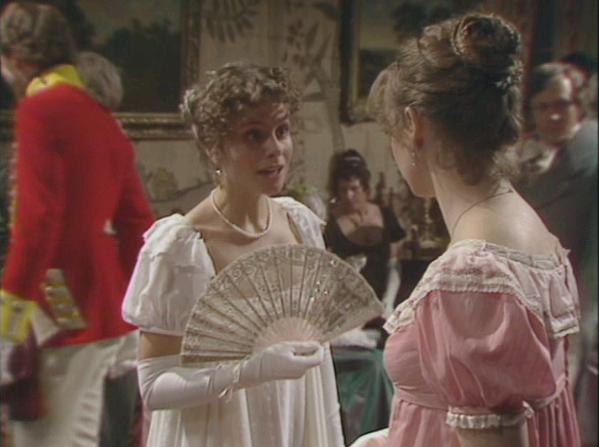
For a private ball, Lizzie and Jane would don their best ball gowns, also known as full dress gowns. They would have worn simpler dresses for a public assembly hall dance, such as the one in Meryton when Mr. Bingley and Mr. Darcy made their first appearance, and where anyone in town who could afford the price of a season ticket could attend. (This is one of the reasons that the Bingley sisters and Mr. Darcy did not comingle with the hoi poloi! Imagine Mr. Darcy dancing with an apothecary’s daughter!) The image above shows Lizzie in a dark green cotton gown and Charlotte in a brown dress. None of the ladies are wearing hair ornaments or gloves, nor holding fans.
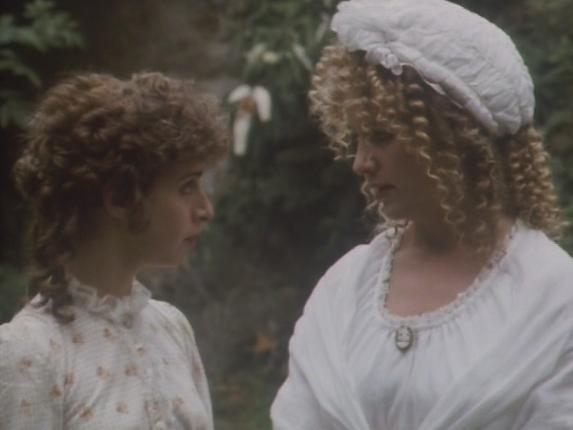
Jane and Lizzie, 1980 Pride & Prejudice
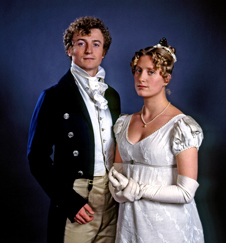
For a private ball, in which the guest list could be controlled by the host, the guests went all out to show off their finery. Their best gowns were retrieved from storage and were accessorized with long gloves, fancy hair ornaments, a fan, dance card, delicate necklaces and earrings, and a beautiful Norwich or India shawl. The dresses were made of finer muslin or silk (an extremely expensive fabric worn largely by the rich). They had these qualities in common: bare necks and/or low necklines, short puffy sleeves, and long, columnar skirts embellished with lace, embroidery or ribbon. Under the dresses, the ladies wore bodiced petticoats and silk stockings and slippers. By 1813, trains on full dress gowns were beginning to go out of fashion or were reduced considerably in length, except for court gowns, which followed a different set of rules.
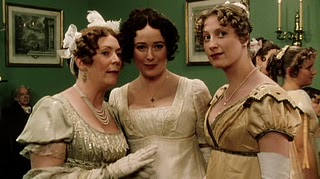
Mrs. Bennet, Elizabeth and Jane, Pride & Prejudice 1995
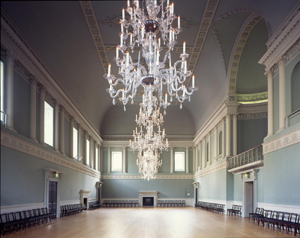
Balls were generally scheduled during a full moon so that carriages traveling over dark roads were guided by lunar light. As the revelers approached the house, brightly lit lanterns dangling from trees or torches planted alongside the road would light the way; and the rooms themselves would be emblazoned from the light of hundreds of beeswax candles, which tended not to drip and would give off a steady flame (but were horrifically expensive). Candlelight made large rooms look smaller, since so many dark corners remained unlit. The resulting low light was kind to aging skin and the badly complected.
Chandelier, Upper assembly room, Bath
The hundreds of blazing candles emitted no more light than that of a few 25 watt bulbs. The light was enhanced by the crystal pendants that acted as reflectors and by mirrors, that were often placed in back of wall sconces. Candlelit rooms became hot over time and ceilings were covered in soot from the smoke. With the number of people assembled in one space and the great number of burning candles, ball rooms required good ventilation. Most women carried fans. One can imagine how hot the men must have felt wearing long sleeved shirts and waistcoats under coats and cravats that covered the neck up to the chin. As an aside, if an overabundance of guest spilled over from room to room, the event was deemed to be a “crush,” (or a rousing success).
Cruikshank, Inconveniences of a Crowded Drawing Room shows what a "crush" looks like
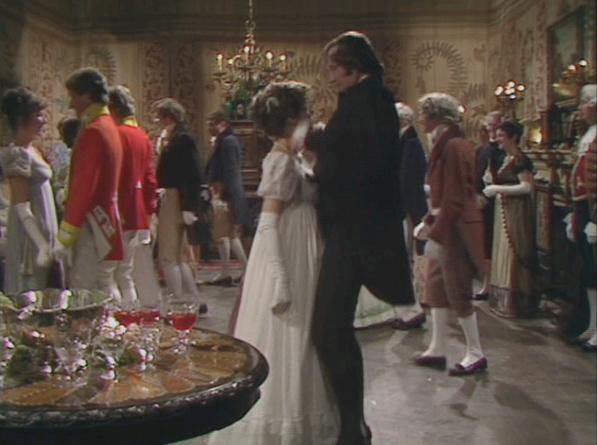
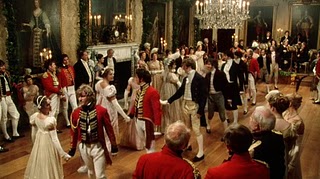
One can suppose that the gathering at Netherfield was a more sedate affair than the one depicted above by Cruikshank, with only the cream of Meryton crop invited to partake in the festivities. Given the size of Netherfield Park, a crush would have looked more like this:
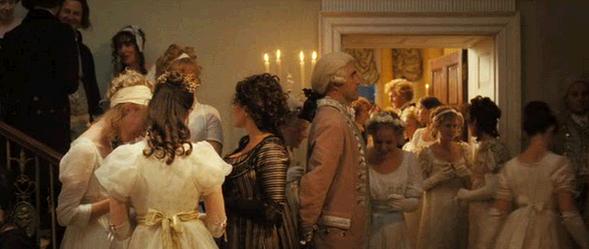
Crush at Netherfield, 1995 Pride & Prejudice
The golden glow emanating from chandeliers and wall sconces would alter the color of the gowns that the ladies wore. Colors that looked good in the yellow light would be chosen for greatest effect, colors that clashed would be avoided. I imagine that a blue gown could look green under yellow light, and that a strong puce could look black or that lavender would turn a sickly gray.
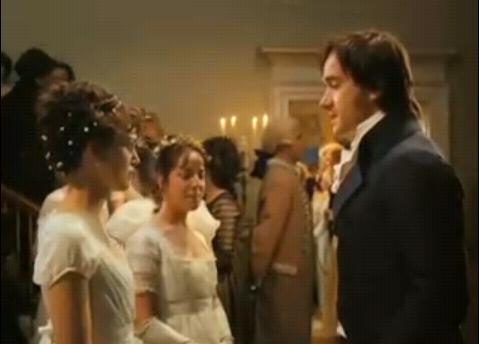
Mr. Darcy approaches Lizzie and Charlotte. The white dresses look beautiful in candlelight.
Young ladies of fashion preferred to wear white during the Regency era, but they would also wear soft pastel colors, as shown in the image below from P & P 1995. Notice the slight differences in the necklines and details of sashes and embellishments, but the gowns look as if they were designed for the same era.
A Lady of Distinction, author of The Mirror of Graces (1811), advised young maidens how to dress:
In the spring of youth, when all is lovely and gay, then, as the soft green, sparkling in freshness, bedecks the earth; so, light and transparent robes, of tender colours, should adorn the limbs of the young beauty…Her summer evening dress may be of a gossamer texture; but it must still preserve the same simplicity, though its gracefully-diverging folds may fall like the mantle of Juno…In this dress, her arms, and part of her neck and bosom may be unveiled: but only part. The eye of maternal decorum should draw the virgin zone to the limit where modesty would bid it rest.”
A Lady of Distinction advised married ladies like Mrs. Bennet to make more modest choices:
As the lovely of my sex advance towards the vale of years, I counsel them to assume a graver habit and a less vivacious air…At this period she lays aside the flowers of youth, and arrays herself in the majesty of sobriety, or in the grandeur of simple magnificence…Long is the reign of this commanding epoch of a woman’s age; for from thirty to fifty she may most respectably maintain her station on this throne of matron excellence.”
Mrs. Bennet and Lady Lucas in subdued colors, Pride & Prejudice 1980
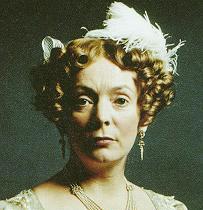
Mrs. Bennet and other matrons are shown covering their hair with feathers or caps. At their age, they were allowed to wear deeper but more somber colors. If they chose to wear white, they were advised to add a striking color through accessories, such as a richly colored shawl. The costumes in Pride and Prejudice 2005 combine the fashionable dress of 1812-1813 (women at left below) with old-fashioned 18th century gowns that had natural waists (Brenda Blethyn and woman at right). Since Regency gowns kept their “value” longer, it makes sense that matrons would wear them beyond their fashionable hey day. It would not make sense for a young lady on the marriage mart to wear anything but the most up to date gown she could afford.
In Pride and Prejudice 2005, Mrs. Bennet wears an old-fashioned gown with a natural waistline.
All five Bennet girls were “out,” much to Lady Catherine de Bourgh’s surprise, and allowed to attend balls and parties en masse. This meant that all the girls would need their own party and ball dresses in addition to their regular gowns, a quite expensive proposition for Mr. Bennet, who, one suspects, would have preferred to spend his money on books . Handmade fabrics were still very costly before the age of mass production and ladies recycled their gowns as a matter of course. It was the tradition to remake their gowns, or to hand them down to younger or smaller members of the family to be recut in the latest fashion or refurbished with new trim and accessories, which were more affordable.
The Bennet family dressed for the Netherfield Ball, Pride & Prejudice 2005
Silks were quite expensive. Mr. Bennet could probably afford to dress Jane in silks since she was the eldest daughter and her dresses could be handed down to the younger girls, but the cost would be too prohibitive for him to outfit all his daughters in such a costly fabric.
Jane and Elizabeth, Pride & Prejudice 2005. Lizzie
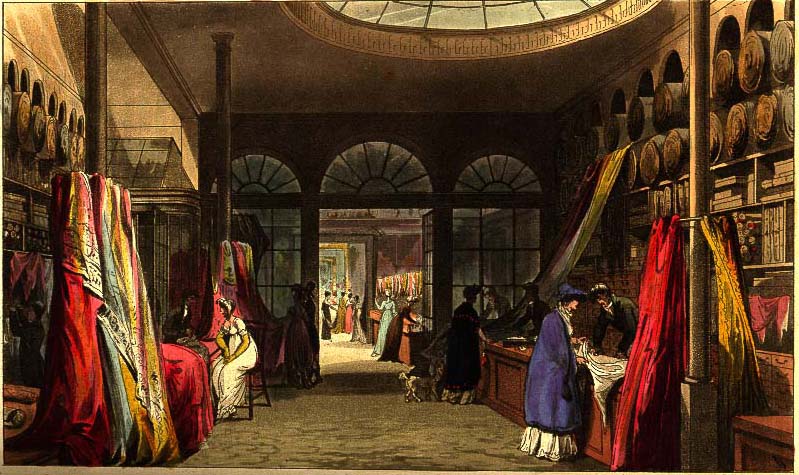
The Bennet girls lived less than a day’s drive from Town and received the most recent fashion magazines within days of their city counterparts, but they did not have access to the latest textiles at the fabric warehouses in London. Whenever friends or relatives visited London, they came armed with orders to purchase fabrics and clothing items at the Draper’s.
Harding & Howell Drapers, Rudolph Ackermann. Print from Georgian Index
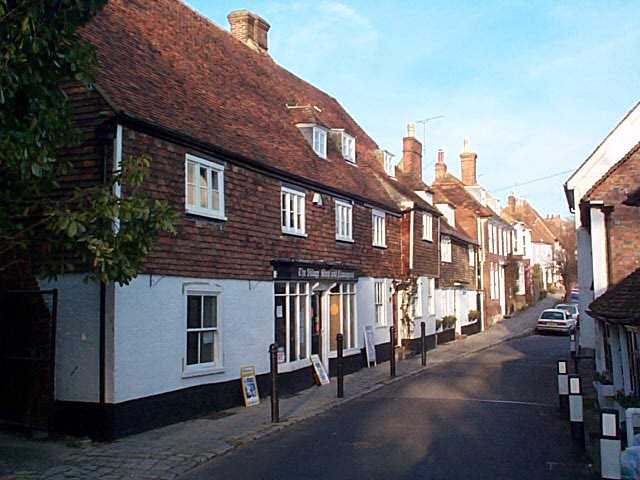
Traveling salesmen and local shops could offer only a limited supply of fabrics to choose from, and one imagines that quite a few ladies in a small community would be forced to make dresses (or have them made up by a dressmaker) from the same bolt of cloth. Local drapers, dressmaker shops, and millinary shops would have looked much like the shop below:
In 1828 the proprietor of this milinary shop in Sutton Valence, Miss Elizabeth Hayes, "went to London to purchase Bonnetts at Ludgate Hill".
Because fashion took longer to take hold in the “provinces”, most of the women in Meryton would have worn dresses that were popular several years back (1811 or 1812). They could update their gown with lace and ribbon, or embroidery, and make minor adjustments, which is what Jane Austen often wrote about in her letter to Cassandra. In that way they updated their gowns and introduced variety.
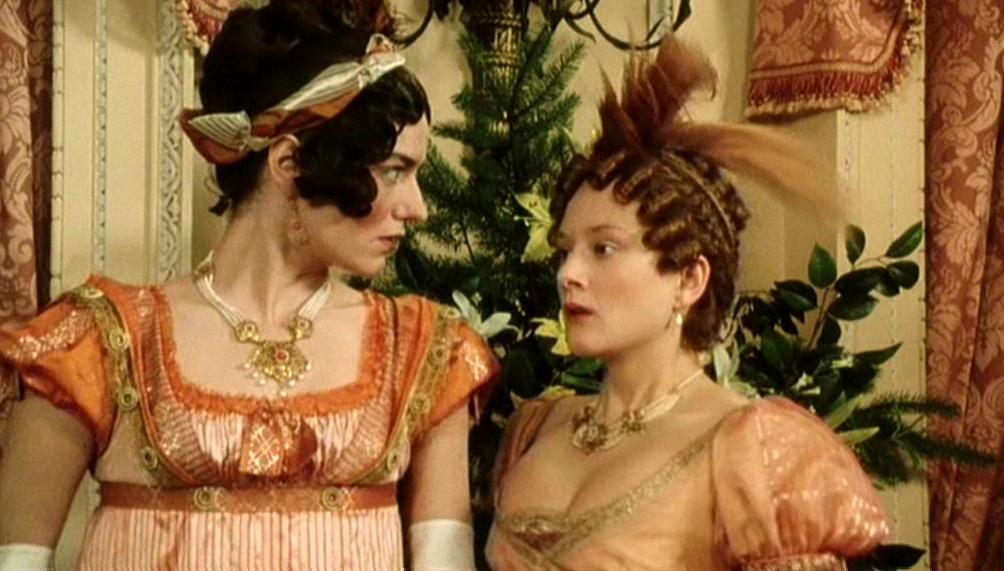
Miss Bingley and Mrs Hurst in their London finery. Pride & Prejudice 1995.
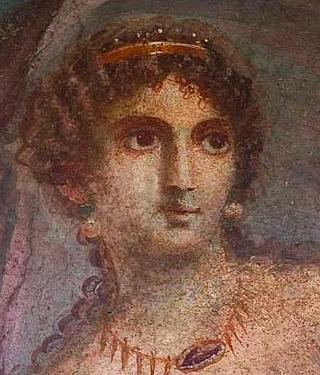
Miss Bingley and Mrs. Hurst, on the other hand, would be decked out in the latest and most elaborate finery that London fashion had to offer. The fabrics and trims on Miss Bingley’s gown are rich and costly and is made up of a color that was quite in vogue. Mrs. Hurst’s hairdo, which evokes a Roman matron, must have taken a while to fashion. Her decolete is more obvious; not only is she better endowed than her sister, but her neckline is lower and the sleeves are puffier. She, too, wears a more elaborate necklace than the Bennet girls, but is is matched with a simple pair of pearl drop earrings. Compare Mrs. Hurst’s hairstyle to that of the ancient Roman portrait below.
Roman fresco, Pompeii, Aphrodite, after a Greek painting
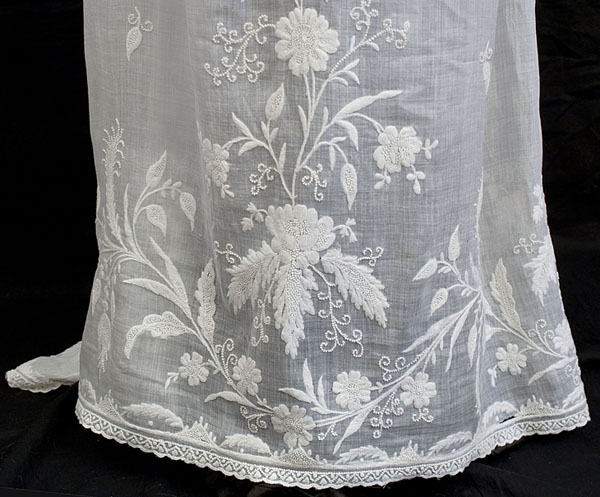
Pride and Prejudice 2005 shows most of the young women wearing pretty but simple muslin ball gowns, many of which would be embroidered in whitework. The young ladies of that era were adept seamstresses, and they learned to embroider at a young age. Whitework embroidery patterns were readily available in fashion magazines.
Whitework embroidered hem
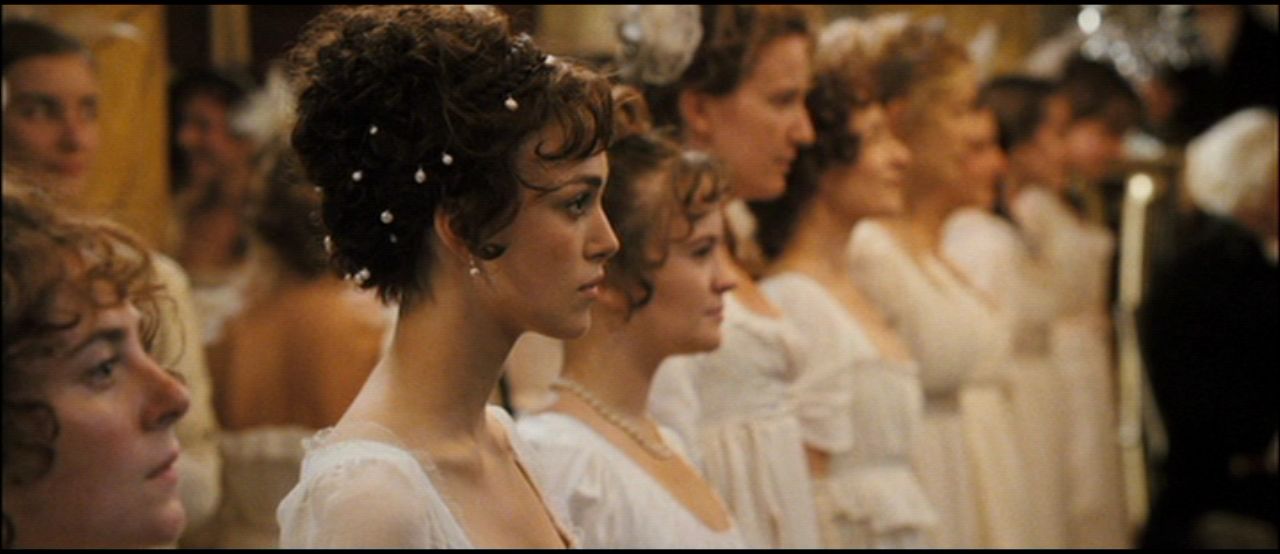
Lizzie’s hair (below) is styled becomingly with pearls, but it has a more modern, contemporary flavor than Miss Bingley’s and Mrs. Hursts hairdos in the (3rd) image above.
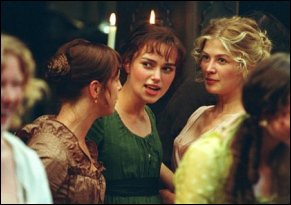
Caroline Bingley (below) looks like she’s dressed for a 2005 wedding. There is nothing Regency about her outfit or her hair. While actress Kelly Riley looks beautiful, I wince every time I see her in this supposed Regency costume.
Miss Bingley, Pride and Prejudice 2005
Director Joe Wright wanted to play up Lizzie’s tomboyish side, but regardless of her affinity for plein air walks she would still have followed propriety and worn gloves. Her dress, too, has a modern feel. We know that Keira Knightely has a small bosom, but a corseted petticoat would have given this gown more structure. In addition, her waist is a tad too low. Compare this image with the one above, and you get virtually no sense of place or time in Pride and Prejudice 2005 via the gowns.
Elizabeth dancing with bare arms. Her hair is elaborately fashioned, but the gown's waist should be a little higher.
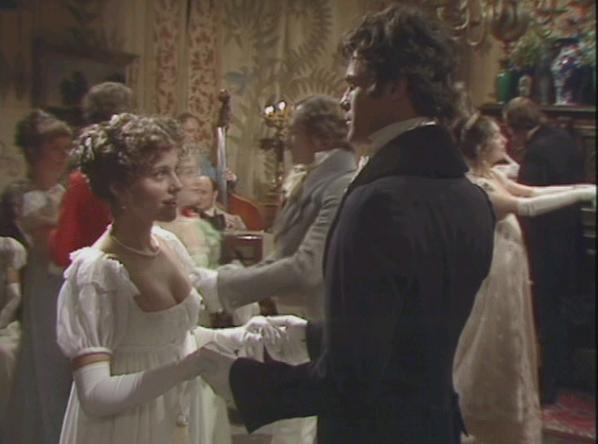
In the 1980 movie adaptation, Lizzie is shown wearing a more elaborate ballgown. She is also holding a fan, a handy instrument in a crowded and hot ballroom! My biggest complaint with her gown is that her bosom is showing entirely too much, and would have earned disapprobation from A Lady of Distinction.
Ornaments were woven through upswept hairdos. Small tight curls framed the face and tumbled in front of ears. The only ornamentation in Charlotte’s hair (image above) are thin braids that are twisted in such a way as to decorate the upswept “do.”
One note about the opera gloves used in these film adaptations. They should be worn over the elbow and they should be quite loose! In the image at right, below, the loose long gloves fall naturally below the elbow.
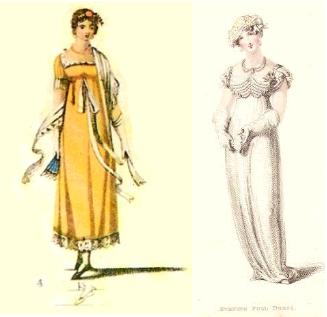
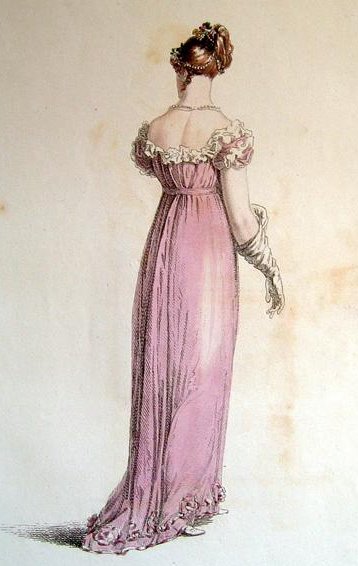
Up to now I’ve shown the fashions from movie adaptations. But the fashion plates from the Regency era are even more revealing. Let’s look at some sample plates from 1811 to 1813. Note that throughout these three years, the waists remained high, just under the bosom. Gown lengths seemed to vary, but the hems would creep up as the decade progressed to reveal neat ankles and lovely slippered feet. In 1811, such brazenness was frowned upon by A Lady of Distinction.
The bosom, which nature has formed with exquisite symmetry in itself … has been transformed into a shape, and transplanted to a place, which deprives it of its original beauty and harmony with the rest of the person. This hideous metamorphose has been effected by mean of invented stays or corsets…”
1812 evening gown, Ackermann
Jane Austen noted in one of her letters to Cassandra how long sleeves were becoming fashionable for evening. I imagine this dress was meant to be worn on a cold night, for such sleeves would have been stifling in summer. The sleeves are known as Mamaluke or Marie Sleeves.
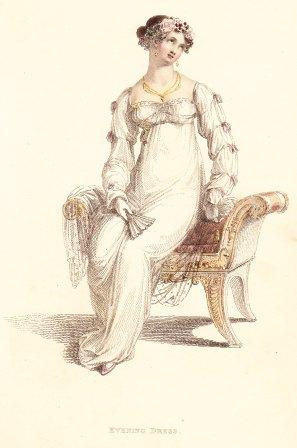
1813, evening dress, Ackermann
In the illustration above, you can best see how the loose gloves bunched below the elbows. This dress comes with a short train, ribbon embellishments at the hem, and white lace ruffles around the neckline and on the sleeves. Pearls and flowers are woven throughout the hair.
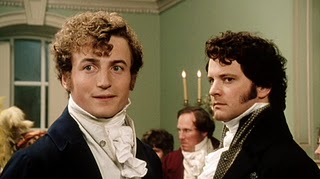
Let’s not forget the gentlemen. Their attire included beautifully formed jackets and waistcoats, white pantaloons, silk stockings, leather slippers, and short gloves. Their cravats, it goes without saying, were tied with precision and made with the whitest starched linen. A cravat pin, a quizzing glass, snuff box, and fob watch completed their sartorial splendor.
Both Darcy and Lizzie are wearing gloves. Pride and Prejudice 1980
More on the topic:
Pride and Prejudice 1995, Lizzie and Darcy dance to Mr. Beveridge’s Maggot
This post is copyrighted. You may link to it, and use excerpts with attribution, but you may not place it wholesale on your blog. Always, always attribute this post or material derived from it to Vic at Jane Austen’s World.
Once again PBS will host a Twitter Party during the second installment of Emma 2009. Come join me and Laurel Ann from Austenprose for a chat from 9-11 PM EST. PBS has also arranged for a Twitter Fest for those who live on the west coast. That Twitter Chat will begin at 9 PM PT and last until 11 PM. Click here for the details. Don’t forget to use the hash tag #emma_pbs! See you there.
Fashionable Goodness: Christianity in Jane Austen's England is now available! By JAW contributor Brenda S. Cox. See Review. Available from Amazon and Jane Austen Books.
Available through December 31st, 2025. Click on image for details, and share this poster with other teachers and students!
The Obituary of Charlotte Collins by Andrew Capes
Click on image to read the story.
Comments
“My idea of good company…is the company of clever, well-informed people, who have a great deal of conversation.” – Jane Austen, Persuasion
Gentle readers: Please feel free to post your comments and continue the conversation! Due to SPAM, we will no longer accept comments on posts after 30 days of publication. In some instances, links will be removed from comments as well.
Administrators and Contributors
Vic Sanborn, founder of this blog, is supported by a team of talented and knowledgeable writers about Jane Austen and the Regency era. They are:
Tony Grant, who now contributes his photos from London and England
Click on their names to enter their own blogs.
In addition, we thank the many experts and authors who frequently contribute their posts and opinions, and who continue to do so freely or at our request.
Click here to enter the page. Topics include Regency fashion, historic foods, Jane Austen societies, British sites, related topics. Click on image.
May we suggest?
Hello, my name is Vic and I live in Maryland, USA. I have adored Jane Austen almost all of my life. I am a proud lifetime member of the Jane Austen Society of North America. This blog is a personal blog written and edited by me and my team. We do not accept any form of cash advertising, sponsorship, or paid topic insertions. However, we do accept and keep books and CDs to review.
If you would like to share a new site, or point out an error, please email us. (Yes, we are fallible. We'll own up to our mistakes and will make the corrections with a polite smile on our faces.) Write us at
Thank you for visiting this blog. Your comments and suggestions are most welcome.
Project Gutenberg: eBook of Stage-coach and Mail in Days of Yore, Volume 2 (of 2), by Charles G. Harper
STAGE-COACH AND MAIL IN DAYS OF YORE: A PICTURESQUE HISTORY
OF THE COACHING AGE, VOL. II, By CHARLES G. HARPER. 1903. Click on this link.


























 Jane Austen's World