This Jane Austen blog brings Jane Austen, her novels, and the Regency Period alive through food, dress, social customs, and other 19th C. historical details related to this topic.
As we investigate the private lives of Regency Women, it’s important to consider money and a woman’s private expenses. If a genteel woman was expected to dress a certain way, do her hair in the latest styles, wear the right shoes and accessories to accentuate her beauty, and care for her own private needs and beauty regimes, how did she pay for everything she needed?
If one of Jane Austen’s heroines (or Jane herself) wanted to purchase something like a bonnet or a ribbon or a new gown, where did she get the money? Who supplied her with money, what was the amount she might have to spend, and how often was it replenished? Let’s find out!
You are very right in supposing how my money would be spent—some of it, at least—my loose cash would certainly be employed in improving my collection of music and books.
Marianne Dashwood, Sense and Sensibility
Magazine of Female Fashions of London and Paris, No.21. London Dresses, 1799, Wikipedia Commons.
Pin Money
Pin money, also sometimes referred to as an allowance, was the money that genteel Regency women used for personal expenses, such as dresses, hats, shoes, and other things of that sort. She kept an accounting of it herself and must balance her own budget.
The history of the term “pin money” dates back to the 1500s: “At that time, pin money was a substantial sum that was used for important purchases. The expression is linked to the price of straight pins, once items that were very rare and expensive, and part of the necessary purchases to run a household” (Grammarist). Over time, the term became synonymous with a woman’s personal money.
For the most part, genteel Regency women were entirely reliant on their male relatives for any “loose cash” for their own personal expenses. As an unmarried woman, she would only have what money her father or a close male relative gave to her (or left to her). Once married, she only had what her husband gave to her or what she was entitled to as part of her marriage settlement.
We know that Jane Austen herself had a small allowance from her father. In Oliver MacDonough’s Jane Austen: Real and Imagined Worlds, we read this: “Jane had nothing of her own beyond the pin-money allowed her by her father, which was probably only £20 a year.” Cassandra’s annual allowance, as noted in a letter from 28 December 1798 was twenty pounds: “If you will send my father an account of your Washing & Letter expenses, & c, he will send you a draft for the amount of it, as well as for your next quarter [£5, to be paid on 1 January].”
Mrs. Darcy’s Pin Money
Finally, Pride and Prejudice shows us how a generous allowance allowed married women to live in comfort, having enough for their own needs and for the needs of others, either for charitable giving or to help support family members.
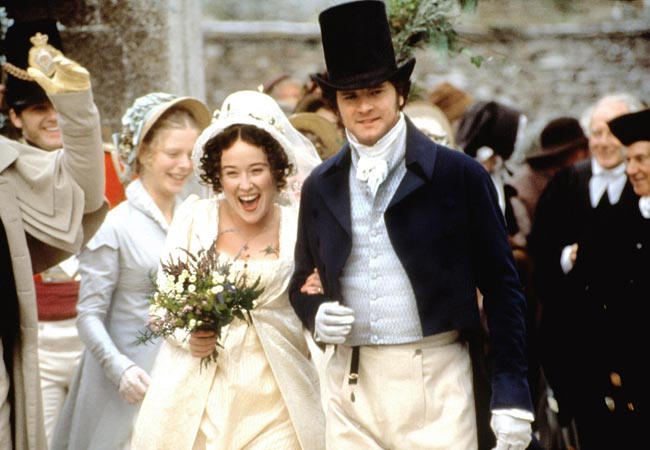
We can now read Mrs. Bennet’s famous reaction to Elizabeth’s engagement to Mr. Darcywith even more interest:
Oh! my sweetest Lizzy! how rich and how great you will be! What pin-money, what jewels, what carriages you will have! Jane’s is nothing to it – nothing at all.
Mrs. Bennet, Pride and Prejudice
Jennifer Ehle and Colin Firth, Pride and Prejudice, 1995
And it seems that Mrs. Bennet was correct indeed. We see this play out when Lydia writes to Elizabeth at the end of Pride and Prejudice, hoping to get a regular allowance from Elizabeth and Darcy: “As it happened that Elizabeth had much rather not, she endeavoured in her answer to put an end to every intreaty and expectation of the kind.”
However, while the Darcys do not provide the Wickhams with a regular allowance, Elizabeth still kindly send gifts of money on a frequent basis to help Lydia. She gives this money out of her own private funds, which as the text implies, was substantial:
Such relief, however, as it was in her power to afford, by the practice ofwhat might be calledeconomy in her own private expenses, she frequently sent them. . . and whenever [the Wickhams] changed their quarters, either Jane or herself were sure of being applied to for some little assistance towards discharging their bills.
Pride and Prejudice, Jane Austen
The Love of Money
Money mattered greatly in the lives of Jane Austen’s Regency women. Having “loose cash” didn’t just provide for bonnets and gowns; it also provided for the safety and protection of several of Austen’s female characters. Money could be used as a means of control or generosity. It could limit a woman or give her greater freedom.
Join me again next month as we delve further into Regency Women: Money Matters and look closely at several instances where Austen uses a lady’s personal money (or lack thereof) as a clever plot device.
Inquiring Readers: Who knew? Jane Austen not only viewed works of art when visiting London, in one letter she spoke particularly well of a painting by Benjamin West, a successful American transplant in that city, whose major patron was King George III..
Austen’s Opinion About “Christ Rejected”
During a first visit to her Brother Henry’s new house in Hans Place, Austen wrote a letter to her dear friend Martha Lloyd. Whenever Jane visited London, she attended parties and balls, plays, and concerts. She also went shopping in a major way, and brought a list of items that friends and relatives wanted her to purchase for them. In this letter (109, as listed by Deirdre Le Faye in her Fourth Edition of Jane Austen’s Letters, and dated September 2, 1814) Jane mentions (among many other things) a painting she’d recently viewed.
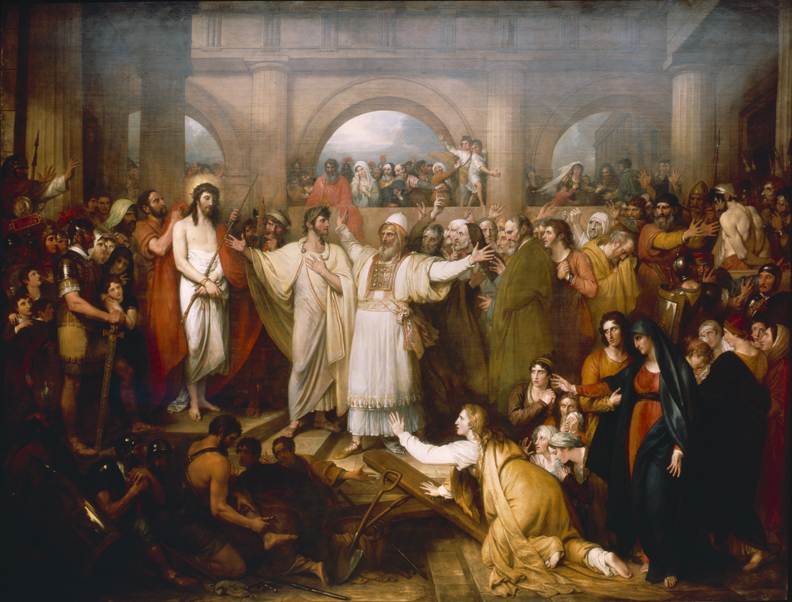
Jane Austen was taken by the image of Christ in this painting. Image from Wikimedia Commons, public domain.
“I have seen West’s famous Painting, & prefer it to anything of the kind I ever saw before. I do not know that it is reckoned superior to his “Healing in the Temple”, but it has gratified me much more, & indeed is the first representation of our Savior which ever at all contented me. His “Rejection by the Elders”, is the subject.–I want to have You & Cassandra see it.”
Jane was writing about “Christ Rejected by the Jews”, now hanging at the Pennsylvania Academy of the Fine Arts. In 1814, when this enormous and complicated painting was exhibited from June to late fall, and when Austen was visiting Henry, it hung in the “former” Royal Academy at 125 Pall Mall. Visitors were given a 3-page description of the work, which was filled with information about each of the characters in the painting. In the past, panoramas, dioramas, and tableaus, like those created by Emma Hamilton, were popular Georgian entertainment.
Austen mentions that not only did this painting gratify her, but that this was the “first representation of our Savior which ever at all contented me.” She wanted her best friend, Martha, and her beloved sister, Cassandra, to view the painting in person. Ellen Moody in Reveries Under the Sign of Austen, Two mentions that this was:
“A highly unusual passage for Jane Austen: she has been talking about what tastes she likes and by association (how the letters proceed) she moves to discourse about solemn religious painting done in the grand historical style. I suggest Martha liked these or mentioned them in her letter. For Jane’s part, in this sort of picture what she likes best is Christ Rejected. Martha seems to have wanted to know if Christ Healing the Sick is considered superior — hinting perhaps that she, Martha, preferred it.”
In fact, Moody states that this is the first time the reader reads explicitly religious language from Austen, when she mentions “Our savior.” Food for thought from a clergyman’s devoted & religious daughter.
Who Was Benjamin West?
Benjamin West hardly raised a blip in my Art History courses, although he was a prominent painter during his life and in Great Britain. His paintings have not stood the test of time, but during his heyday, he was King George III’s favorite historical painter. And, so, when he moved to London in 1763, he established his atelier and metier within 5 years of his move to that great city. King George’s patronage ensured West’s success. He became the second President of the Royal Academy of Arts in London from 1792 until his death in 1820 at 81. His enormous neoclassical paintings do not make my heart soar, although I find his portraits, especially his self-portraits, interesting and masterful. (Hover cursor over the portraits for details.)
Wikimedia commons image of a copy of a self portrait of Benjamin West in his early years in London
Self portrait of Benjamin West the year before his death. Public Domain image.
Austen’s mention of “Christ Healing the Sick in the Temple”
This painting was not Austen’s favorite of the two, however, its immense popularity drew crowds. It has an interesting and convoluted history. From Jane’s excerpt in her letter, she found the latter painting of ‘Christ Rejected” more meaningful. West, however, was so attached to this painting that he created a second version that he donated to a Pennsylvania Hospital. Interestingly
“On its [first] completion in 1811 it was exhibited in London to immense crowds, and was subsequently purchased by the British Institution for 3,000 guineas — the largest sum ever paid for a modern work.”
And so West painted another version, with an “improved composition”, which he sent to the Pennsylvania Hospital (where it still resides, with this partial note:
“Mr. West bequeaths the said picture to the Hospital in the joint names of himself and his wife, the late Elizabeth West, as their gratuitous offering and as a humble record of their patriotic affection for the State of Pennsylvania, in which they first inhaled the vital air — thus to perpetuate in her native city of Philadelphia the sacred memory of that amiable lady who was his companion in life for fifty years and three months.”
Austen’s letters add so much flavor to our knowledge about her life, thoughts, and novels. I highly recommend that all Austen devotees read every letter that has been printed, starting with Deirdre Le Faye’s masterwork, the compilation of Jane Austen’s Letters.
More about this topic
Self Portrait, copy, Wikimedia CommonsBenjamin West – Wikipedia.Acquired from this site with the following information: After Benjamin West, Self-Portrait of Benjamin West, 1776. Currently at the Baltimore Museum of Fine Art.
I am enjoying reading a brand-new book, Jane Austen: A Companion, by Laura Dabundo. I’m finding it easy to read and full of fascinating information and insights.
Jane Austen: A Companion, by Laura Dabundo, is an encyclopedic resource on Austen, her novels, and her world, full of fascinating insights.
The book is essentially an encyclopedia of Austen. Sample topic entries cover agriculture; animals and hunting; the Church of England and Anglicanism; and sensibility and sentimentality. She explores each topic in the context of Austen’s England and shows how it connects to Austen’s writing.
You’ll find people from Austen’s life, both family members and friends. I met a few new ones, including Brook Edward Bridges, who apparently proposed to Jane at one time, though he was “too young and thoughtless” to be an appropriate husband for her. While many books include Austen’s friends and family in her story, it’s helpful to have each one’s story told separately.
Dabundo also explores locations, ranging from Chawton House and Manor to Brighton to Tonbridge. Each is given its place in Austen’s life, novels, and world.
Longer, deeper entries describe Austen’s life and each of her novels and shorter works. Dabundo argues in her Introduction that Austen is quintessentially a Romantic era writer. The novels fit chronologically into the Romantic period of English literature, and explore the feelings and internal lives of individuals.
I’ve interviewed Dr. Dabundo, who is a retired college professor, asking her to tell us more about herself and her book.
Laura, thank you for putting together this great reference on Jane Austen.
How did you first get interested in Jane Austen, and how did your interest grow from there?
From childhood I loved reading Jane Austen. I did not study the works in my academic career, but afterwards I returned to reading for pleasure. I slowly began critically appraising, researching, writing, presenting, teaching, and publishing about Austen. Eventually, besides my personal interest in her, she became one of my principal scholarly interests.
What do you most love about Jane Austen and her novels?
I can’t pin it down to any one thing, because she was a genius. Her vision of the world was anchored in morality and religion, but represented the great variety of humanity. I don’t mean the diversity of backgrounds our societies seek today, but she included the full range of human behavior, motivations, and actions. And, of course, she was a splendid crafter. She wove eloquence, themes, ideas, complicated characters, and more into her beautifully written works.
What led you to write Jane Austen: A Companion?
Such a book was not on my radar at all. I was not familiar with the publisher (McFarland) or the series (McFarland Companions to 19th Century Literature). However, I had written book chapters and book reviews for the series editor, Larry Mazzeno, who works for different journals and publishers. He wrote me out of the blue to ask if I would be interested in writing this book. Of course, I was thrilled! I had to prepare a long, formal proposal according to the publisher’s specifications, and the editor and publisher asked me to write the book.
There are other “companions” to Jane Austen available; what is special about yours?
Thank you for this question! Maybe a dozen books about Austen include the word “companion” in the title. Mine is the only single-authored one, which means it is unified and consistent. I could include extensive cross-references because I knew all the material and how it was related.
Also, most other “companion” books are collections of scholarly and academic essays designed for scholars and graduate students. Mine is specifically aimed at an educated general audience. That may include scholars, students, Janeites, and anyone seeking to know more about Austen and the people, places, events, times, and tropes of her life and work. I also explore what I call the strange “literary-industrial complex” of her afterlife in later adaptations. Of course, I read tons of literary criticism in writing this book. But I wanted my version to be accessible and useful as an introduction, a review, and a resource covering the remarkable cultural phenomenon of Jane.
I know that your publisher chose your title and cover image to match the rest of the series they are producing. What title and image would you have chosen for your book, and why?
I had hoped to use a beautiful, full-color watercolor of the Cobb at Lyme Regis on the cover. As you know, this artificial breakwater features at a climax of Persuasion. However, the publishers naturally wanted the book to look similar to others in the series. So they used Cassandra’s portrait of Jane, which is probably not very accurate and is certainly overused. The picture of the Cobb I had suggested appears as a black and white version opposite the Table of Contents. (See the original here, The Cobb, Lyme Regis.)
Similarly, I wanted to call the book “Here, There, and Everywhere with Jane Austen.” This quote from Sanditon would have set the book apart from other companions on the market and emphasized Austen’s wide appeal. But the title needed to fit the rest of the series. (In chapter 4 of Sanditon, Sydney Parker’s brother says Sydney is “here, there, and everywhere.”)
What were some interesting things you learned when researching your book?
One thing I hadn’t realized was that Jane Austen’s cousin, Jane Cooper, spent much of her childhood with the Austen family, especially after her mother’s death. So really there were three girls in the house full of boys. Young Jane Austen had, in effect, the experience of two older sisters, not just one.
Also, I knew that her rich Aunt Jane Leigh-Perrot was arrested, jailed, and tried for shoplifting in Bath and then cleared of the charge. I learned that her attorney believed her guilty and that she was later accused again of shoplifting. That time it was settled and hushed up quickly. I felt more sympathy for her when I learned of her background. When she was just six years old, she was dispatched from her home in Barbados to boarding school in England. Imagine what trauma that experience of separation from home and family and the long, lonely trans-Atlantic crossing must have done to her psyche!
I’ll leave you to read the book to find more insights about Austen’s novels and times and those who followed her and tried to keep her alive in their works!
What parts of your book do you think a serious “Janeite” will find most interesting and illuminating?
It depends on their interests. I tried to be comprehensive as well as open-ended. Someone wanting to know about the times—for example, the Regency, the Napoleonic Wars, the Industrial Revolution, slavery and abolition, or the Church of England—will find useful information. Those looking for coherent interpretations of the works of Austen and her contemporaries will find those. I included biographies of all her family members and a few friends, pulling together into single entries information which is scattered through Austen biographies as those people appear in and disappear from her life.
What part of the book did you most enjoy writing, and why?
Whatever I was writing at the time! Even the historical stuff! I waited until the end to write about most of the novels, so I would know what I had already said, and because that would be the most fun to do. I believe in delayed gratification!
Tell us about what you have written about Jane Austen in the past, and any projects you have planned for the future.
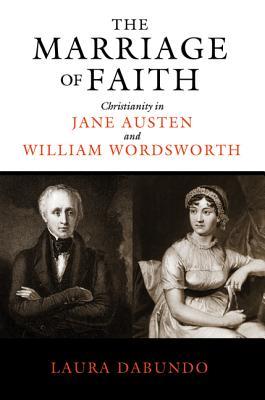
My previous book is The Marriage of Faith: Christianity in Jane Austen and William Wordsworth. I argue that Austen and Wordsworth, the preeminent novelist and poet of English Romanticism, were at heart Christian writers. (That belief seeps into my latest book also, of course.) I examine their works separately and comparatively to make the point. My favorite parts are two essays that began as presentations. In one I compare Lady Catherine de Bourgh to the Tempter/Devil who confronts Jesus in the Wilderness. She comes to scold Elizabeth Bennet out of marriage to Darcy in the “wilderness” of Longbourn. The other was written for a JASNA AGM in Philadelphia, the “City of Brotherly Love,” where I was born. So I wrote about the City of Sisterly Love in Austen, developing the motifs of “city” and of sisters in Austen.
Professor Dabundo’s earlier book on Christianity in Jane Austen and William Wordsworth
When I sent the Companion manuscript off to the publisher, we were all stuck at home in the first round of Covid. I cast about for something else to write and hit upon three autobiographical prose pieces I had written over the years. I pulled them together into a memoir of my own personal spiritual journey. Wipf and Stock published it, to my delight, as When the Parallel Converge, with a better cover than I imagined. It is very short and not at all like my work on Austen, though I do mention her a couple times.
Future projects will be more religiously and spiritually based, I think. I did just get an idea for something about Austen, but now I don’t know where I put that piece of paper!
I know you’ll be speaking at the JASNA AGM next month in Chicago, and that the talk will be based on material in this book. What will you be talking about, and why did you choose that topic?
At first I could not think of anything useful on my part to say about the Arts and Austen. But I realized I could write about popular/contemporary arts. That includes what I think is a unique section of my book, though it has been relegated to an Appendix. I have called it “the military-industrial complex” of Austen, though it is really a “literary-industrial complex.” In it I discuss, with examples and criticism, Austen’s “afterlife” of sequels, prequels, works in which Austen or her characters appear, movies, plays, and TV shows. The paper I will be presenting contains some new thoughts on those areas, though the book includes more than the presentation can cover.
I was privileged to hear a trial run of your talk, and I know AGM participants will enjoy it! Thank you for sharing with us, Laura.
Readers of JAW, you can read Jane Austen: A Companion straight through or dip into the parts that interest you. I am appreciating every section. I’ll be glad to have it as a handy reference on my shelf, and I recommend it to you.
Books by Laura Dabundo
Jane Austen: A Companion, by Laura Dabundo. McFarland Companions to 19th Century Literature, 2021.
Cover of Bath: An Adumbration in Rhyme by John Matthews
Inquiring readers: Many of you who have visited here before are aware of Dr. Wiebracht’s online senior high school students’ research on John Matthews’s 18th century poem “Bath: An Adumbration in Rhyme.” This link leads to their published work, as well as Dr. Wiebracht’s description about the project and his advice for teachers on starting a similar semester-long online endeavor. Their remarkable results were published on this blog in January and spring of this year. The third step in Dr. Wiebracht’sexamination of the poem – a publication – is presented in this review.
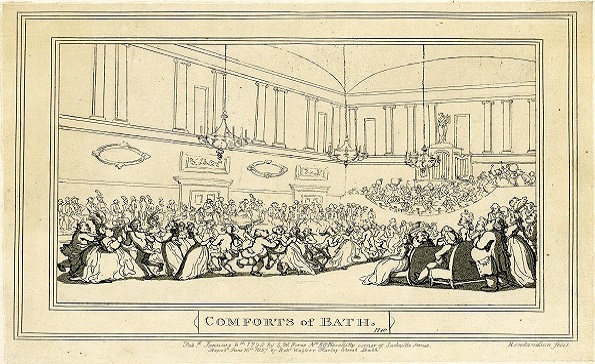
So the beaux in their boots, the belles in their slippers,
Come to walk up and down, and peep at the dippers,
For though strange it appears, I’d have you to know,
Whilst you’re drinking above, some are bathing below,
And each glass of water brought up by the pumps
Contains the quintessence of half-a-score rumps.”
– Bath: An Adumbration in Rhyme, John Matthews
A Peep at the Dippers, Cruikshank. Public Domain Image
The forgotten contemporaries of Jane Austen and an introduction to the first book in a series that will examine them
In his introduction of this unique annotated publication, Wiebracht writes that it:
speaks as directly as possible to the typical reader – the same reader Austen herself addressed. And teachers and students, particularly high-school students, will be inspired to know that the volume they are reading was researched, designed, and edited in large part by other high-school students. Indeed, as a teacher and scholar, one of my hopes for this series is that it challenges the narrow assumption that only university faculty and graduate students are capable of making original contributions to literary scholarship. This isn’t so.”
After the students completed their project in December 2020, Dr. Wiebracht and his academic colleagues continued to study the Adumbration. The result was this completed book, published in August of this year.
The major goals for Dr. Wiebracht, his students, and academic researchers were to find original sources to chronicle the genesis of this poem and the resources that influenced it. These sources can be found in the Table of Contents under bibliography and further reading, as well as a biographical essay on John Matthews, and an essay on Bath satire. Also included is a thoroughly accessible, but academic analysis of *Northanger Abbey (with references to Persuasion) regarding Austen’s descriptions of Bath, Anstley’s The New Bath Guide (1762), and G. Davis’s and P. Bonhall’s book, entitled A History of Bath: Image and Reality(2006). The highlight of this volume, though, is the poem, located near the very end. My close friend, H. Major, (and editor) particularly liked how the annotations were placed on the right page, next to the archaic phrases in the poem on the left page for helpful understanding.
Side by side- poem on the left, annotation on the right
This 54-page book is the first in a planned series entitled Forgotten Contemporaries of Jane Austen. The selected works will have a varied audience in mind, with characteristics that include:
The work is not available in any other modern edition.
It must discuss subjects that directly concern Jane Austen and are featured prominently in her novels.
It must be relatively short to enable teachers and professors to use it as a supplement in a class or unit devoted to Jane Austen.
It must have merit in its own right.
I won’t reveal too many details about the information contained in this first Critical Edition, for it would spoil your fun in learning what it has to offer when you purchase the book, which I recommend highly, but I would like to mention one sequence of connections that clearly tie several topics together: Bath in the late 18th century + Jane Austen’s Northanger Abbey and Persuasion + 18th century satire + writing in rhyme + macaronis and fops + Matthew’s one-dimensional view of fops compared to Austen’s more masterful take on that fashionable group of gentlemen.
Historical and literary connections:
In 1762, Christopher Anstey wrote The New Bath Guide: Or Memoirs of the B-R-D Family, which consisted of 15 letters in poetic verse. The popularity of this guide began a tradition of writing letters, journals, and guides in rhyme. Decades later, John Matthews followed in his footsteps by using bawdy and satiric references, while also including Greek myths and the daily habits of visitors to Bath, and the region’s topography.
Anstey’s rhyme regarding a reflection on arrival in Bath
In his poem, published in 1795, Matthews describes a day in Bath from morning to night using the sharp humor characteristic of Georgian era satire (notice the quote about taking the waters in the pump room at the start of this review). Matthews was not the only one to follow this wide practice. Men and women of fashion often wrote in rhyme, as did Jane Austen’s mother, Cassandra, who wrote delightful recipes in that tradition. Jane, too, wrote poetry, but her poems are merely adequate when compared to her novels.
In one passage in the Adumbration, Matthews mentions macaronis in Milsom Street:
“Where, booted and spurred, the gay macaronies,
Bestride Mandell’s counter instead of their ponies,
Preferring the pleasure of ‘tending the fair,
To breathing the freshness of Lansdown’s pure air” – Matthews
From the mid-18th century, cartoonists and writers made merry sport of the affectations of effete fops and macaronis, who were objects of visual and verbal fun. In his Adumbration, Matthews follows his era’s sardonic judgment. The annotations offer definitions and historical context that are placed conveniently near the Georgian terms and phrases that modern readers no longer understand.
Jane Austen’s take on fops, in the form of Sir Walter Elliot (Persuasion), a man who cared more about his personal appearance than most men and women of his acquaintance, is more nuanced than Matthews’ fops, for behind Sir Walter’s sartorial pride and conceit, is a man disdainful of the middling sort, a man whose high opinion is reserved only for those he deems his equals, and a man who squanders his inheritance in the service of his immense ego. Unlike Austen, Mathews simply makes surface sport of a macaroni’s preference for fashion, much like the caricatures of his era.
Both Austen and Matthews portrayed Bath past its prime, however. It was once a highly desired resort town that, by the 1790’s, saw the mingling of the rising middle classes with an aging gentry and those on the downward slide, like Sir Walter, or with fortune hunters. Today, we read Matthews’ guide for fun and understanding; but we tend to reread Jane’s “fun” novels for their richness and insights!
Portraits of John Matthews and Jane Austen. Vic’s image is from the book
Stanford online high school student testimonials:
The Jane Austen’s World team would like to thank the students for their hard work on this project and the excellent results. We would also like to thank Dr. Wiebracht and his colleagues for illuminating this document for a wider audience. In addition to their research, students were required to read Austen’s *Northanger Abbey. They also attended two 1 hour zoom workshops, one given by Tony Grant, and the other given by me, Vic. A number of them sent notes of thanks!
“Thank you so much for being willing to get involved in our Bath project, for your enthusiasm on our work, and for helping us learn something new and unique about Jane Austen’s era! – Josie Chan
“Thank you so much for giving us a space on your platform, and for visiting our class last year! Your insight on both Jane Austen and the publication process was invaluable.” – Varsha Venkatram
“Thank you so much not only for giving us the opportunity to publish on your blog but for sharing your expertise. Your advice was an invaluable guide in this process.” – Sophia Romagnoli
“Thank you for visiting our class and publishing our article on your blog! It’s an honor to have been part of a team contribution to Jane Austen’s World. – Carolyn Engargiola
Note from Jane Austen’s World: Dear students, the honor is ours. We are so proud of your research and contributions, and cannot recommend this book highly enough – Vic Sanborn and Tony Grant
Order the book on Amazon:
Bath: An Adumbration in Rhyme: A Critical Edition for Readers of Jane Austen (Forgotten Contemporaries of Jane Austen) Paperback – 8 August 2021
by John Matthews (Author), Ben Wiebracht (Editor), Josephine Chan (Editor), & 6 more
Fashionable Goodness: Christianity in Jane Austen's England is now available! By JAW contributor Brenda S. Cox. See Review. Available from Amazon and Jane Austen Books.
Available through December 31st, 2025. Click on image for details, and share this poster with other teachers and students!
The Obituary of Charlotte Collins by Andrew Capes
Click on image to read the story.
Comments
“My idea of good company…is the company of clever, well-informed people, who have a great deal of conversation.” – Jane Austen, Persuasion
Gentle readers: Please feel free to post your comments and continue the conversation! Due to SPAM, we will no longer accept comments on posts after 30 days of publication. In some instances, links will be removed from comments as well.
Administrators and Contributors
Vic Sanborn, founder of this blog, is supported by a team of talented and knowledgeable writers about Jane Austen and the Regency era. They are:
Tony Grant, who now contributes his photos from London and England
Click on their names to enter their own blogs.
In addition, we thank the many experts and authors who frequently contribute their posts and opinions, and who continue to do so freely or at our request.
Click here to enter the page. Topics include Regency fashion, historic foods, Jane Austen societies, British sites, related topics. Click on image.
May we suggest?
Hello, my name is Vic and I live in Maryland, USA. I have adored Jane Austen almost all of my life. I am a proud lifetime member of the Jane Austen Society of North America. This blog is a personal blog written and edited by me and my team. We do not accept any form of cash advertising, sponsorship, or paid topic insertions. However, we do accept and keep books and CDs to review.
If you would like to share a new site, or point out an error, please email us. (Yes, we are fallible. We'll own up to our mistakes and will make the corrections with a polite smile on our faces.) Write us at
Thank you for visiting this blog. Your comments and suggestions are most welcome.
Project Gutenberg: eBook of Stage-coach and Mail in Days of Yore, Volume 2 (of 2), by Charles G. Harper
STAGE-COACH AND MAIL IN DAYS OF YORE: A PICTURESQUE HISTORY
OF THE COACHING AGE, VOL. II, By CHARLES G. HARPER. 1903. Click on this link.













 Jane Austen's World

