This Jane Austen blog brings Jane Austen, her novels, and the Regency Period alive through food, dress, social customs, and other 19th C. historical details related to this topic.
Natalie Jenner’s latest book, Austen at Sea, will become available through booksellers on May 6th! She will hold a discussion at The Poison Pen Bookstore at 2 PM, MST on May 5th. (In my Eastern state, the conversation will start at 5 PM.) Click on the link provided below to the YouTube video, subscribe, and hit the Notification Button! This discussion will include a live chat online.
I’ve been listening to the audio version of the book, and my review will go online soon. This book is a quite ambitious project, and suits the 250 year anniversary of Jane Austen’s birth beautifully! – Vic
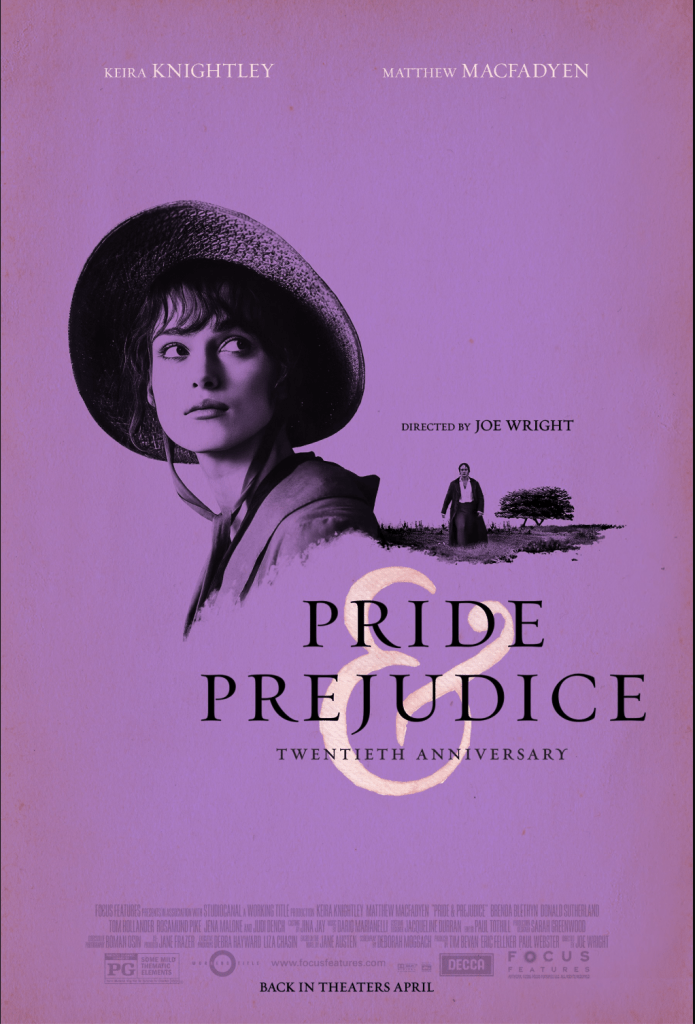
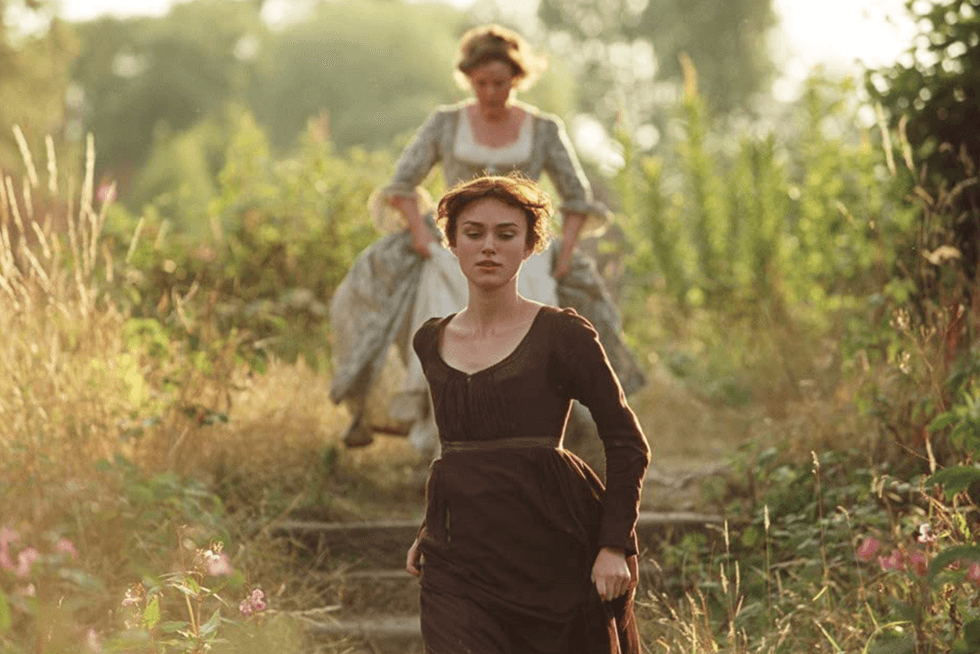
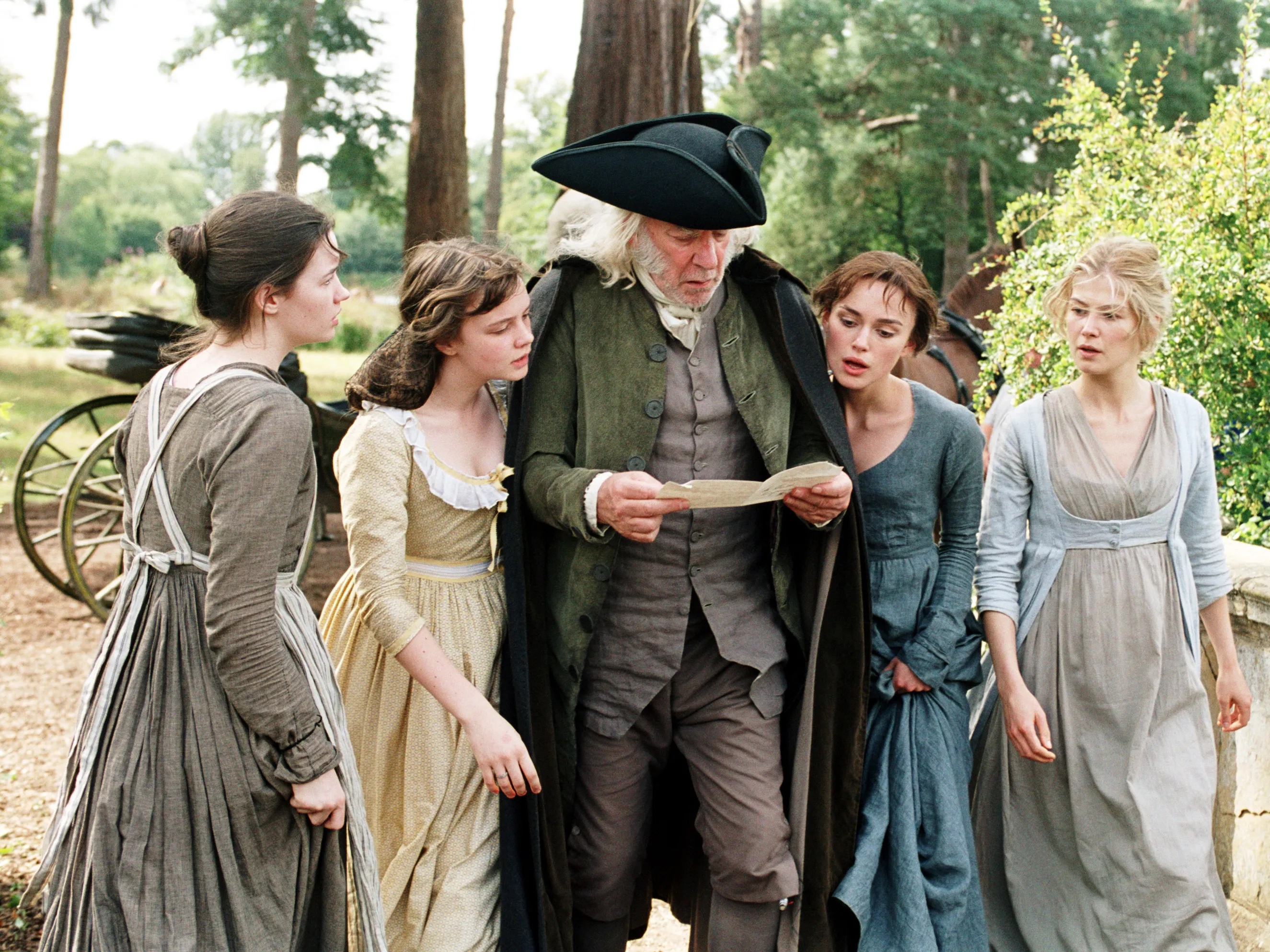
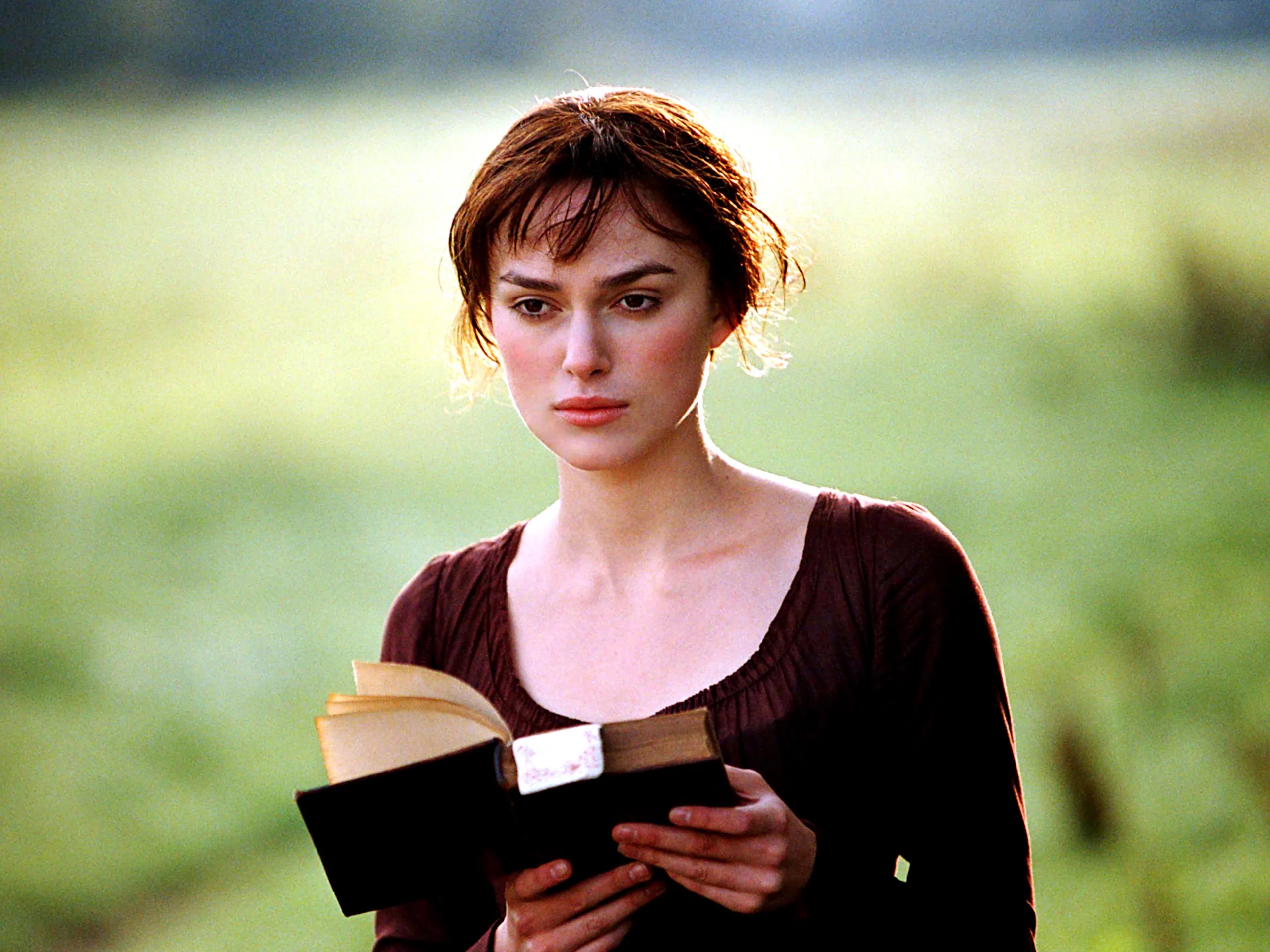
Jane Austen fans are flocking to theaters to watch the 2005 Pride and Prejudicefilm in theaters to celebrate its 20th anniversary. And what perfect timing with Jane’s own 250th celebration!
The film’s re-release in theaters was originally set for April 18-24, 2025, but it was extended to April 25-30, 2025 due to its success. It’s a limited engagement, primarily in the U.S., so Jane Austen friend groups, book clubs, and JASNA regional groups are taking advantage of this special event and gathering at movie theaters nationwide to watch it together.
Some, in Regency garb!
Pop Culture Craze
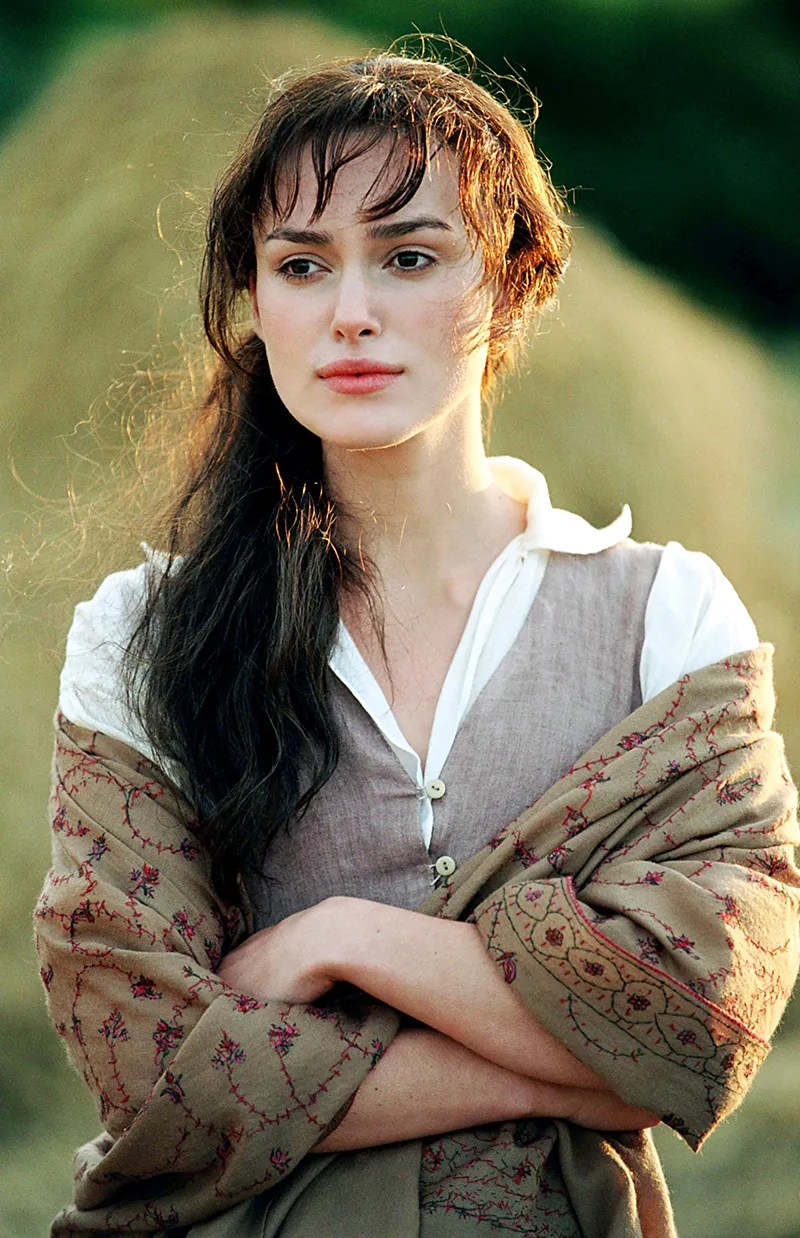
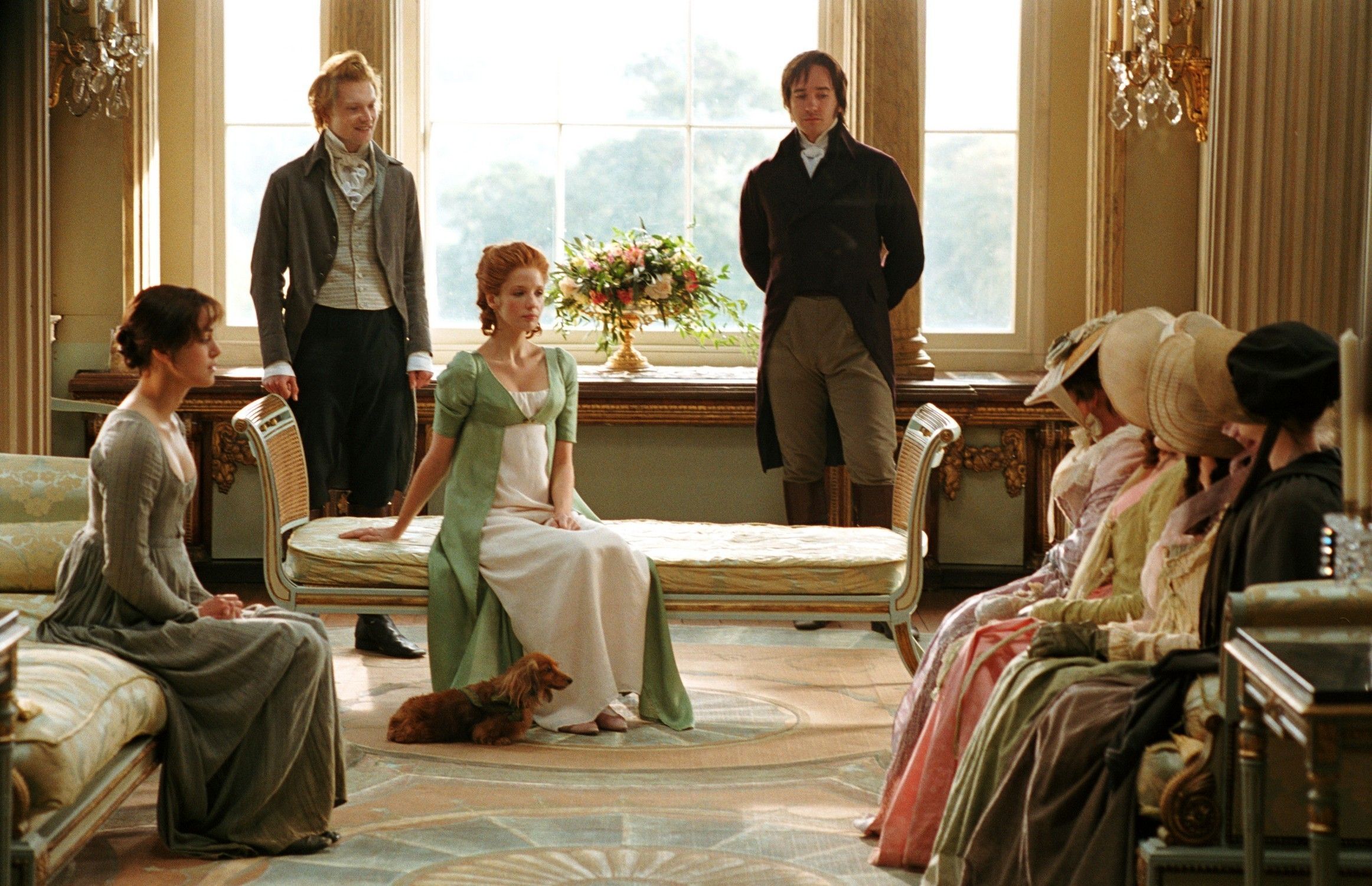
While the 2005 film version of Pride and Prejudice isn’t a favorite with some Jane Austen fans, who argue that it’s a very loose interpretation of the novel (and rife with historical inaccuracies), it’s been a huge sensation with a whole new wave of Austen fans since it first released 20 years ago. P&P 2005 fans discuss it non-stop online and have created fan groups and an endless library of memes, edits, reels dedicated to it. An entire fandom has formed itself around the film and its actors.
Hand Flex
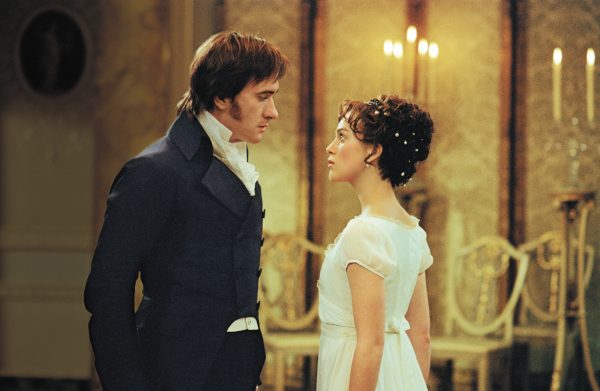
And its popularity shows no sign of stopping. From Macfadyen’s emotionally complex portrayal of Mr. Darcy, the electricity between Knightley and Macfadyen, and the famous “hand-flex” scene, this highly romanticized adaptation of Austen’s novel is a cultural phenomenon in its own right.
Musical Score
The musical score alone is beloved by fans everywhere. Composed by Dario Marianelli and performed by Jean-Yves Thibaudet (piano) and the English Chamber Orchestra), the music is one of the reasons people love the film so much. The title track “Dawn” is just about as dreamy as it can get:
Awards and Nominations
After its release, the film won or was nominated for endless awards from the film industry, including Oscar nominations for Best Performance by an Actress in a Leading Role (Keira Knightley), Best Achievement in Art Direction (Sarah Greenwood, art director and Katie Spencer, set decorator), Best Achievement in Costume Design (Jacqueline Durran), and Best Achievement in Music Written for Motion Pictures (Original Score, Dario Marianelli).
Joe Wright, the film’s director and the 2006 Winner Carl Foreman Award for the Most Promising Newcomer, joined a Q&A several days ago at a special screening of the re-release. Of his directorial debut, he said, “I’m actually prouder of the film tonight than I think I’ve ever been.” (@focusfeatures)
The 2005 Pride and Prejudice is often compared to the 1995 sweeping BCC version with Colin Firth and Jennifer Ehle, but it’s a bit like comparing apples and oranges. They are both so vastly different in every way. Nonetheless, fans have been debating this topic for 20 years now and will probably continue for another 20 years at least.
People outside the Jane Austen fandom probably won’t ever understand why we all feel so passionate about the different film versions of Austen’s novels, but in the words of Mr. Bennet, “For what do we live, but to make sport for our neighbours, and laugh at them in our turn?”
Re-Watching
Jane Austen fans LOVE to re-watch the films over and over. Have you been to the theater to watch the 2005 P&P re-release? Are you planning to go? (Did you / Will you dress up?) Which version do you prefer? Please comment below!
If you’d like to check showtimes in your local village theater, you can search AMC’s listings HERE. I’m hoping to see it before it’s gone. I can’t pass up the chance to watch a movie with other die-hard Janeites at the theater!
“There must have been many precious hours of silence during which the pen was busy at the little mahogany writing-desk, (This mahogany desk, which has done good service to the public, is now in the possession of my sister, Miss Austen) while Fanny Price, or Emma Woodhouse, or Anne Elliott was growing into beauty and interest.”–A Memoir of Jane Austen by James Edward Austen-Leigh, her nephew
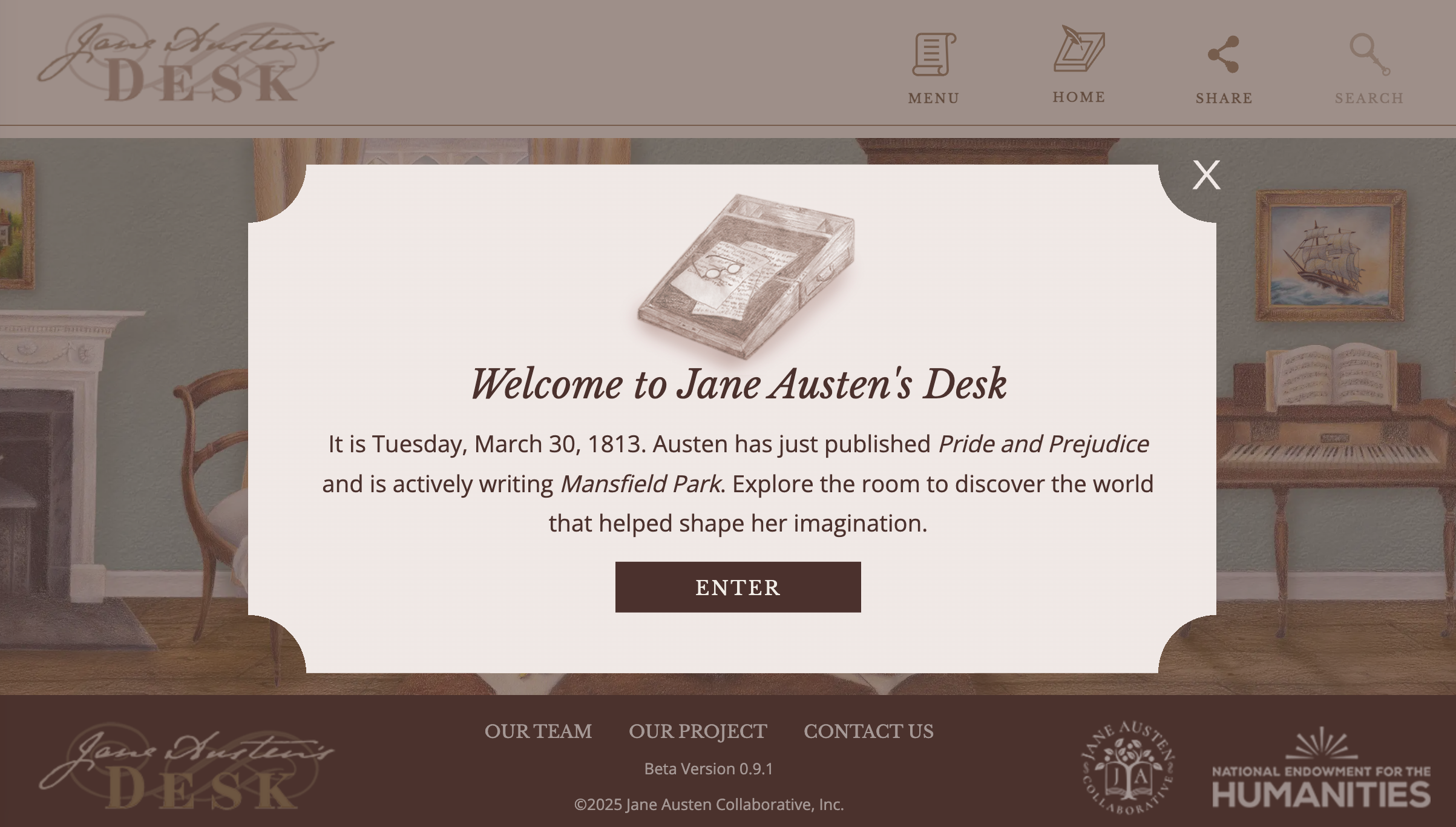
Welcome page to the website “Jane Austen’s Desk”
Wouldn’t you love to explore Jane Austen’s desk and room? Inger Brodey, Sarah Walton, and their amazing team at the Jane Austen Collaborative are recreating Jane’s desk and room for us to visit virtually.
While the website is still a beta version, I found lots of great information there. The plan is for it to become a “portal” linking to many Austen resources.
The site opens with a view of a room loosely based on the drawing room of Jane Austen’s House in Chawton
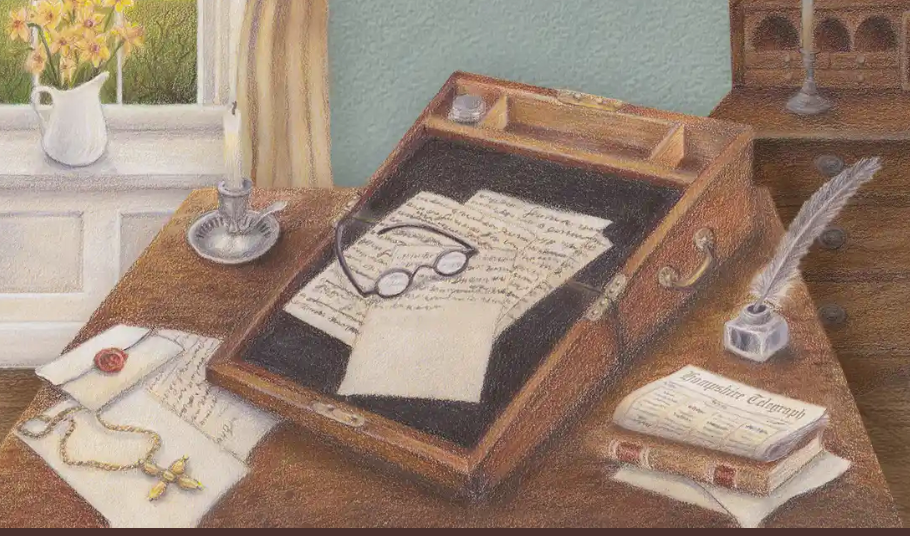
Jane Austen’s Desk
When you visit the room, you might want to start at the desk itself—Jane’s travel desk sits on a table. You’ll see manuscripts of several of the novels, which you can open and enjoy in early editions. Commentary tells more about the novel and the edition, with direct links to interesting sections like “Darcy’s list of desirable female accomplishments” and “Fanny asking about the slave trade.”
Nearby are newspapers, one of the most fun links. Several contemporary papers are included. You can hone in on a number of interesting articles, ranging from her brother Edward’s selling part of Stoneleigh Abbey, to reports of her brother Frank’s naval exploits, to the story of a swindler who pretended to be a rich person’s housekeeper!
Jane Austen’s travel desk (the real one is owned by the British Library). The manuscripts on the desk, the newspapers next to it, and the cross, take you to various resources.
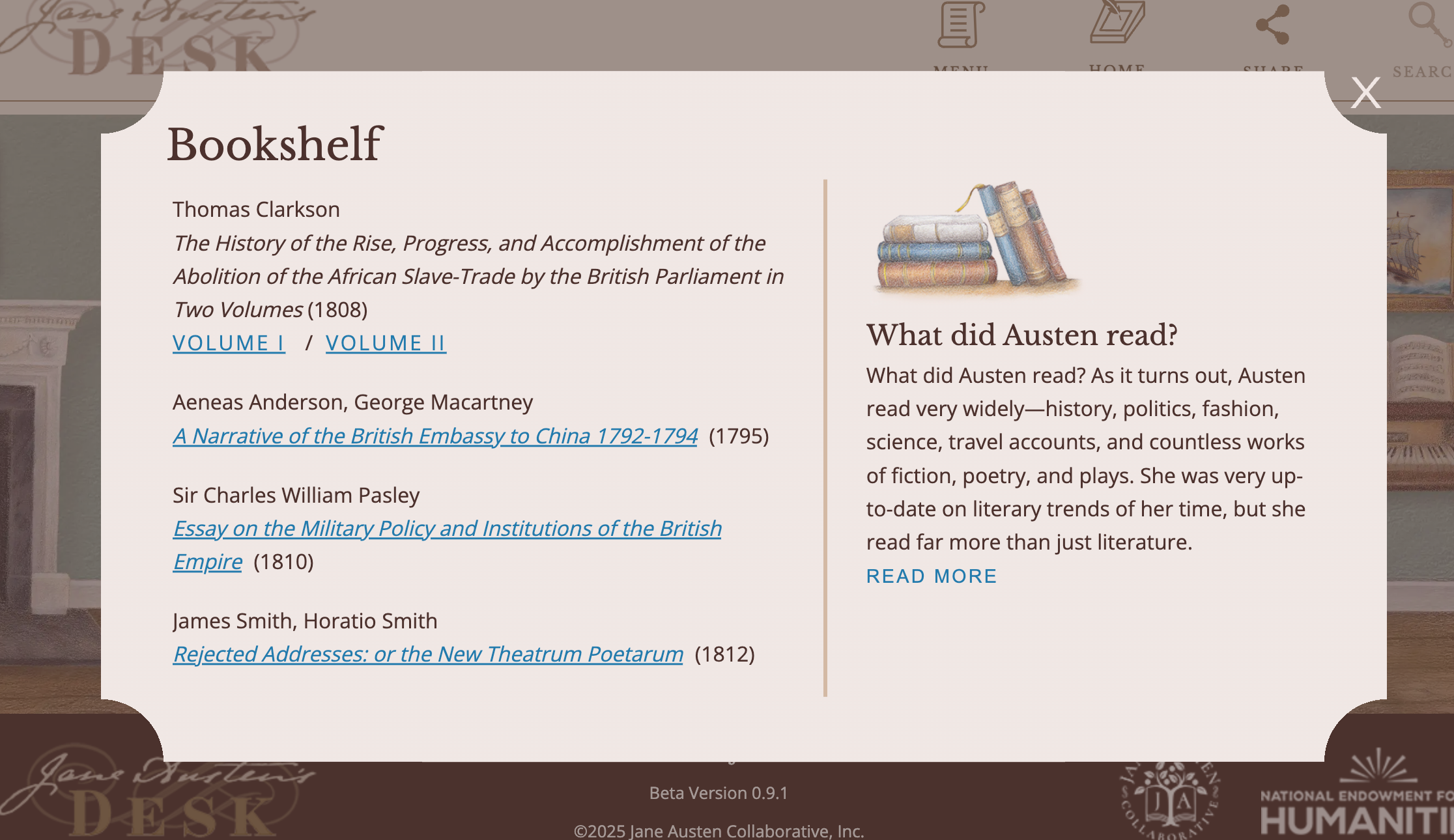
The Bookshelf
Click on the bookshelves in Rev. Austen’s bureau-bookcase , and you’ll see some books mentioned in Austen’s writings. I expect this will be expanded later. But for now, you can read from several authors Austen said she was “in love with”—Thomas Clarkson (on abolition), Sir Charles Pasley (on the military), and James and Horatio Smith (verse parodies). We also have a book that Fanny Price was reading, George Macartney on the British Embassy to China.
For each, you will find an easy-to-read early version of the book; clear commentary; pictures; and links to relevant passages in the novels and letters. Two also link to related articles. A great start if you want to explore these books connected to Austen!
Catalogs on the ledge of the bookcase open up to records of the Alton Book Society that Austen enjoyed. You’ll find lists of members, rules, and lists of the books that the members, including Austen, traded around. This gives us another peek into Austen’s life and reading.
The Bookshelf takes you to some books Austen read.
Travels
A pianoforte stands next to the bookcase. It will eventually be connected to Austen’s music.
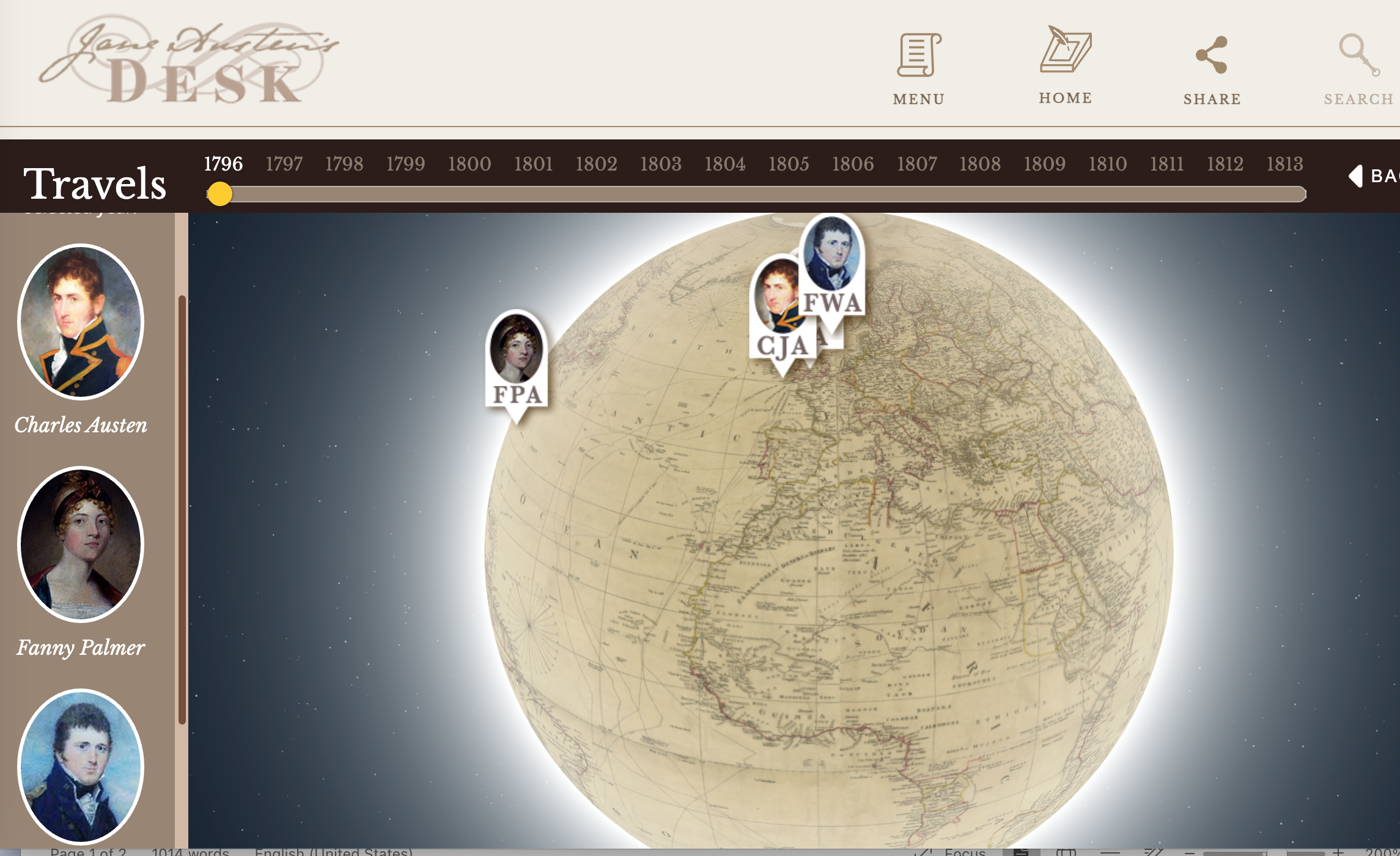
Above the pianoforte, click on the portrait of a ship on the sea. You go to a globe, where you can follow the travels of Austen’s family.
Jane Austen’s Desk, travel section. You can trace the positions of Frank and Charles Austen, Charles’s wife Fanny Palmer, and Jane Austen herself, year by year. You can also read stories about Frank and Charles’s experiences at sea.
Silhouettes on the wall connect you to Jane Austen’s family tree. If you click on the orange “i”, you get more information about each person. The plus buttons reveal more generations.
Many of these features include audio commentary as well as written commentary. For example, Lizzie Dunford of Jane Austen’s House tells us about the topaz crosses Charles brought back for his sisters.
There are great possibilities for future additions.
JAW: Inger, what gave you the idea for doing this website?
Inger: I was interested in Austen’s own creative process, and also in countering the myth that she was not well informed in the science and politics of her day. I found a kindred spirit in Sarah Walton, who was a grad student when we started. In the 1990s, both Sarah and I had been enchanted by JK Rowling’s website with clickable, magical elements on her desk to interact with.
JAW: How is the website being funded?
Inger: We have received two rounds of funding from the National Endowment for the Humanities, and have applied for more. We intend to create a GoFundMe or Kickstarter campaign to seek private funding to support specific new developments, such as the learning games we have in mind.
JAW: What are some parts you are excited about adding in the future?
Inger: The current setting is Spring 1813, while [Jane Austen] is writing Mansfield Park. Eventually we hope to add additional settings: for example, Summer or Winter 1814, when she was composing Emma; or Autumn, 1815, when Persuasion was in process.
JAW: What are some parts that you and your team are finding challenging?
Inger: Well, it all takes much more time to create than one would imagine. We have a great team of programmers and designers, including the wonderful Harriet Wu who has drawn the site by hand. We constantly try to find the sweet spot where we can appeal to both scholars and the general public, and to all ages. Just as with our Jane Austen Summer Program, we also focus on providing tools for educators who wish to bring Jane Austen into the classroom.
JAW: What other ideas do you have for expansion in the future?
Inger: As you can see on the site, there are many objects with potential to “animate” in the future. We are collaborating with Laura Klein to add music to the piano, Jennie Batchelor for sewing, and have plans for links to weather and agricultural information (via the scene out the window), tea culture (via the kettle), letter writing (via a folded letter), and many more.
We applied for a grant to develop a state-of-the-art platform for navigating, reading, notating, and analyzing Austen’s novels, including the potential for crowd-sourced editions.
As long as we can continue to find funding, I think this will be a lifelong project—there is so much potential to grow!
JAW: Thanks, Inger, we look forward to that!
The Desk, the Summer Program, and Online Talks
Gentle readers, I recommend you explore Jane Austen’s Desk. The website has not yet been configured for mobile phones, so you’ll need to access it on your computer or tablet.
When you’ve finished exploring, go back to the main page and take a survey, to possibly win a prize. The survey takes some thought and time, but you will get to give input for what you’d like to see in the future at this very helpful site.
The same Jane Austen Collaborative who created Jane Austen’s Desk also runs the Jane Austen Summer Program. This year it will be held June 19-22, 2025, in North Carolina. The theme is “Sensibility and Domesticity,” exploring “topics including medicine, birth, and domestic arts in Regency England and colonial North Carolina.” They will “focus on Austen’s first published novel, Sense and Sensibility—considering the birth of her career as a published writer as well as taking a transatlantic look at the world into which she was born.” I’m signed up, and would love to see some of you there!
Of course, even if you can’t get to North Carolina, you can always enjoy Jane Austen & Co.’s great offerings online. They are currently exploring Music in the Regency; I enjoyed a recent talk on Women & Musical Education in the Regency Era, by Kathryn Libin. Get on their mailing list for announcements of upcoming events.
They generously provide free access to recordings of their previous talks, on topics including “Austen and the Brontes,” “The Many Flavors of Jane Austen,” “Everyday Science in the Regency,” “Reading with Jane Austen,” “Asia and the Regency,” “Race and the Regency,” and “Staying Home with Jane Austen.” Something for everyone, it seems to me.
The new BBC miniseries “Miss Austen”, based on Gill Hornby’s novel of the same name, is currently the focus of much attention worldwide. The series aired in the UK in February and comes to PBS this May. Some of you have maybe already seen the show, depending on where you live, but for those who are waiting for it to air, I am here to say this:
Read the book while you wait!
You won’t regret it. In anticipation of the show, I decided to read Miss Austen by Gill Hornby, fully expecting to dislike it (I’m very picky). But I’m here to report that I loved it! I actually finished it in two days because I could not put it down (which is not easy as a writer with a busy household of teens). The story flows at a slower pace, but Hornby’s style–and the whole world she created–pulled me in and kept me engaged from start to finish.
In the book, an older Cassandra searches for a packet of Jane’s letters that she does not want anyone to ever see or read. As she finds and reads the various letters, we travel back through her memories to visit her younger self. I found myself completely immersed in the real (and imagined) details about Cassandra’s relationship with Tom Fowle (a former pupil of Reverend Austen), the Fowle family, and the Lloyd family.
Overall, the book does tell a sad story because it deals with a fictional retelling of Cassandra’s real-life story, her heartbreaks, her deep affection for her beloved family (many of whom she outlived), the Austens’ move to Bath, Reverend Austen’s death, the Austen women and their search for stability after his death, and Cassandra’s devotion and loyalty to Jane. However, there are many endearing and uplifting themes as well. The writing itself is exquisite.
While Hornby of course employs creative license as a novelist, I was also impressed by the copious amounts of research she must have done to write this book. Though fictional, it acts as a poignant biography of Jane’s sister and best friend. I felt as though I understood Cassandra, and had a deeper understanding of her protectiveness over Jane, by the end of the book. Hornby’s perspective on Jane is intriguing, and her (entirely fictional) character Henry Hobday adds depth to Cassandra’s story.
For those of you that read Miss Austen when it released in 2020, you might enjoy a reread. For those who have never read it, it’s a wonderful way to prepare yourself for the show. And even if you’ve already watched the show, you might like to read it and compare the two.
Book Description
England, 1840. Two decades after the death of her beloved sister, Jane, Cassandra Austen returns to the village of Kintbury and the home of her family friends, the Fowles. In a dusty corner of the vicarage, there is a cache of Jane’s letters that Cassandra is desperate to find. Dodging her hostess and a meddlesome housemaid, Cassandra eventually hunts down the letters and confronts the secrets they hold, secrets not only about Jane but about Cassandra herself. Will Cassandra bare the most private details of her life to the world, or commit her sister’s legacy to the flames?
Moving back and forth between the vicarage and Cassandra’s vibrant memories of her years with Jane, interwoven with Jane’s brilliantly reimagined lost letters, Miss Austen is the untold story of the most important person in Jane’s life. With extraordinary empathy, emotional complexity, and wit, Gill Hornby finally gives Cassandra her due, bringing to life a woman as captivating as any Austen heroine.
(The collection of cover art included in this article is from various editions sold worldwide.)
About the Author
Gill Hornby is the author of Miss Austen, The Hive, and All Together Now, as well as The Story of Jane Austen, a biography of Austen for young readers. Her most recent novel is Godermsham Park, also available from Pegasus Books. She lives in Kintbury, England, with her husband and their four children.
About the Show
Miss Austen takes an historic literary mystery – the notorious burning of Jane Austen’s letters by her sister Cassandra – and reimagines it as a fascinating, witty, and heart-breaking story of sisterly love, while creating in Cassandra a character as captivating as any Austen heroine.
Based on Gill Hornby’s best-selling novel, this period drama brings a fresh and intimate perspective to the Austen sisters’ lives — their joys, heartaches, and the passions that shaped Jane’s iconic novels.
Keeley Hawes (The Durrells in Corfu, Bodyguard, Line of Duty) as the loyal and loving Cassandra leads an ensemble cast that includes Rose Leslie (Game of Thrones, Downton Abbey) as family friend Isabella Fowle, Patsy Ferran (Living) as young Jane Austen, and Synnøve Karlsen (Bodies) as young Cassy.
PBS Episode Schedule
Premieres: Sunday, May 4, 2025, at 9/8c Episode 2: Sunday, May 11, 9/8c Episode 3: Sunday, May 18, 9/8c Episode 4: Sunday, May 18, 10/9c
Miss Austen, Dutiful Daughter and Sister
I cannot wait to watch the show soon, and I hope to come back to discuss it later this year, but in the meantime, I enjoyed the book immensely. I usually only review nonfiction books here, but I felt that a novel of such high caliber warranted a thorough review, especially in light of the upcoming show. Here’s to celebrating Jane Austen’s 250th year and to enjoying her world more fully!
“Edward & I settled that you went to St. Paul’s Covent Garden, on Sunday.”—Jane Austen, letter to Cassandra from Godmersham Park, Oct. 26, 1813
Covent Garden
We’ve been visiting London churches mentioned in Austen’s novels. Now let’s go to one mentioned in her letters. In the fall of 1813, Jane was staying with her brother Edward and his family at Godmersham Park. Cassandra was visiting their brother Henry at 10 Henrietta Street, Covent Garden, London. He lived in a flat above his bank. (For locations Henry lived in London, see Jane Austen’s Visits to London.) Covent Garden was known for its fruit and vegetable market, as well as, unfortunately, its prostitutes.
Jane Austen’s London offered two official theatres, at Drury Lane and Covent Garden. Both were in the church parish served by St. Paul’s Covent Garden, and Austen saw plays at both. She was planning to see a play at the Covent Garden theatre when she visited Henry a month earlier:
“Fanny and the two little girls are gone to take places for to-night at Covent Garden; “Clandestine Marriage” and “Midas.” The latter will be a fine show for L. and M.” (Lizzie and Marianne)—Sept. 15, 1813 (Fanny was the eldest daughter of Jane’s brother Edward Austen Knight; her mother had died five years earlier. Lizzie and Marianne were Fanny’s younger sisters. Edward was with them but staying at a nearby hotel.)
Jane and Edward assumed Cassandra would go to church at St. Paul’s Covent Garden, since it was Henry’s parish church. Jane probably attended that church herself when any of her visits to Henrietta Street lasted over a Sunday. She and her family regularly attended church on Sundays, wherever they were.
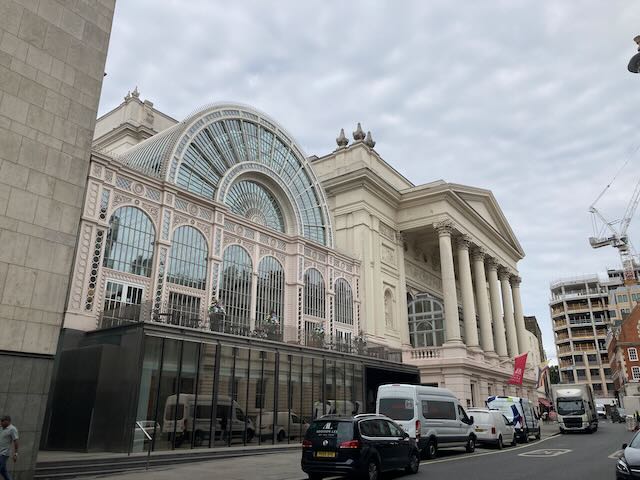
The old Covent Garden Theatre building is at the center of the modern Royal Opera House.
The Actors’ Church
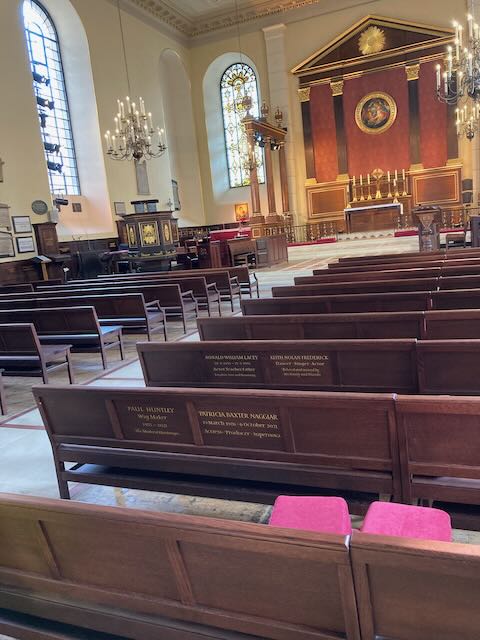
The Covent Garden area today offers more than twenty theatres. St. Paul’s, called “The Actors’ Church,” hosts concerts and plays in the church and in its walled garden. They have an in-house professional theatre company, Iris Theatre. The church’s summer schedule for this year includes Sense and Sensibility and Pride and Prejudice, along with several Shakespeare productions and children’s shows. To accommodate such events, the church replaced deteriorating Victorian pews with custom-made movable and stackable pews.
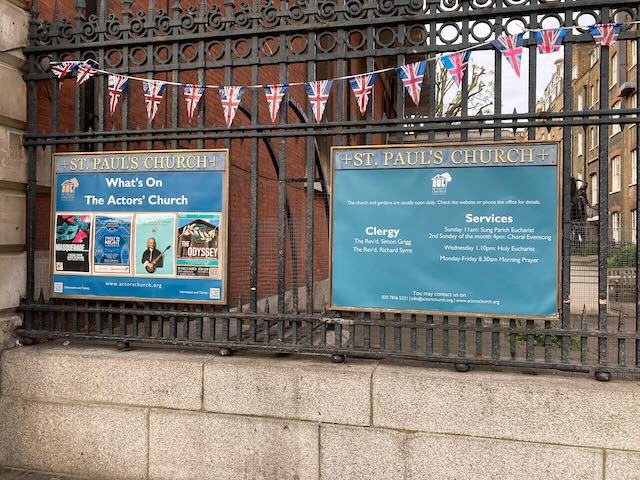
Signs announce upcoming shows and services at St. Paul’s Covent Garden, the Actors’ Church.
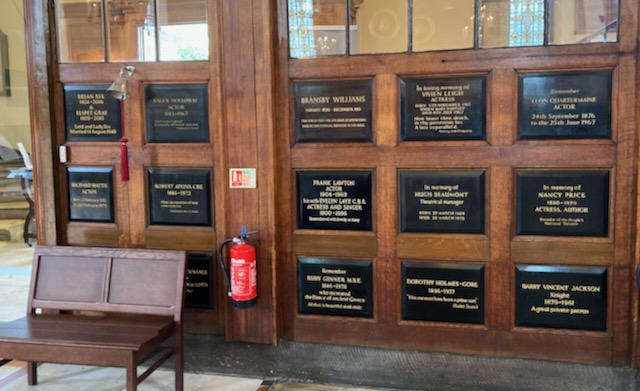
The inside of the church commemorates famous entertainers wherever you look. Hundreds of plaques adorn the walls of the church, the backs of the pews, and the garden benches and walls.
Wall plaques at St. Paul’s Covent Garden. Vivien Leigh’s is in the top right center.
Some plaques are memorials to the church’s leaders and parishioners, as you would see in other English churches. But most remind visitors of famous people such as Vivien Leigh (star of Gone with the Wind), Boris Karloff (who played Frankenstein’s monster), Thomas Arne (who wrote “Rule, Britannia” around 1740), Sir Charles Chaplin (Charlie Chaplin), and others.
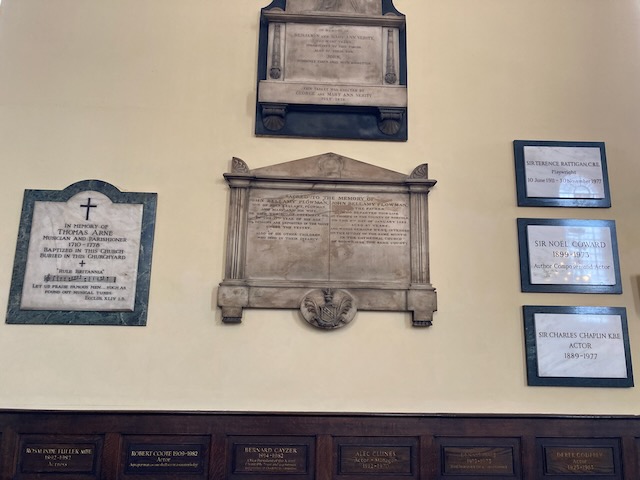
A variety of memorials line the walls of St. Paul’s Covent Garden. The central memorial is to John Bellamy Plowman, his son who died in 1811 at age 17, his son’s wife, and six children who died in infancy. The monument above it is from 1879. The grey and white plaque to the left is to Thomas Arne, “musician and parishioner,” 1710-1778, who wrote the anthem “Rule Britannia.” To the right are three twentieth century plaques, honoring playwright Sir Terence Rattigan; author, composer, and actor Sir Noel Coward; and actor Sir Charles Chaplin. A line of more modern brown plaques is below.
Besides actors and actresses, plaques commemorate dancers, singers, directors, theatre managers, patrons, choreographers, drama teachers, playwrights, and even a “critic, journalist, wit.” One woman is listed as “Actress, Producer, Supernova.” The church charges hefty fees to install these plaques (around £3000 for a plaque on the wall). These fees have kept the church solvent.
Memorials on the backs of pews at St. Paul’s Covent Garden
History
The church was designed by Inigo Jones and consecrated to St. Paul in 1638.
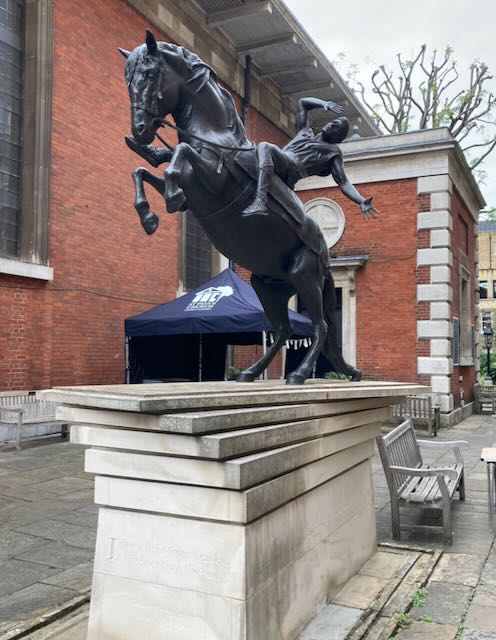
Covent Garden churchyard statue of St. Paul seeing a vision on the road to Damascus.
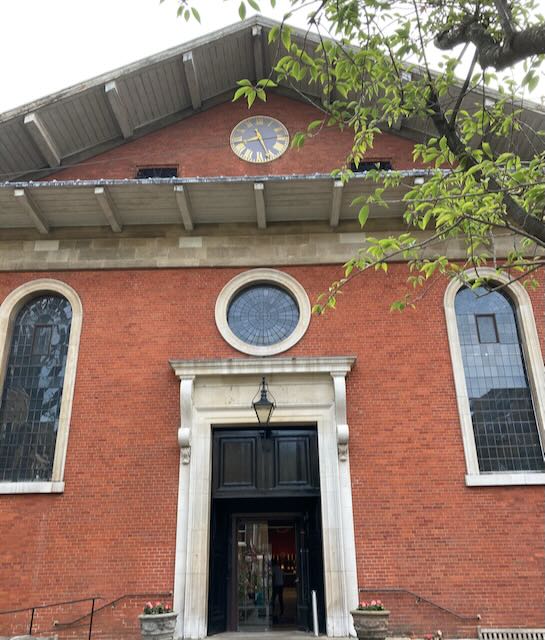
Jones designed it with a great East Door into the main piazza of Covent Garden. However, that would have put the altar at the west end of the church, which went against Christian tradition. At the last moment, the Bishop of London decreed that the altar had to be in the east end of the church, so the East Door doesn’t open. Entry is through the churchyard, from the sides of the building.
Front of St. Paul’s Covent Garden, with the false door in the center.
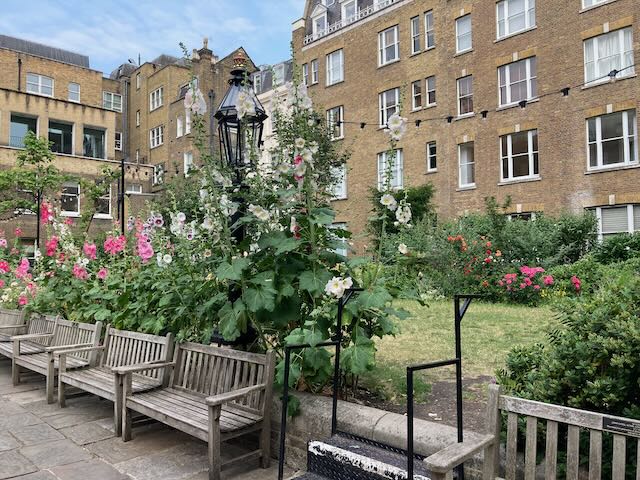
Various famous people are buried in the churchyard, including the painter JMW Turner and the first victim of the Great Plague of London, who died in 1665. In the 1850s, Parliament stopped all burials in central London churches. At that time, the headstones were removed and the gardens laid out as they are today.
Lovely garden in the churchyard of St. Paul’s Covent Garden
A fire destroyed much of the church in 1795, but it was rebuilt so that today it is much as Austen would have seen it.
Entrance from the churchyard of St. Paul’s Covent Garden.
Rectors
When Jane Austen was there, Edward Embry was the rector, from 1810-1817. She might have heard him preach, but she does not mention him in her letters. His portrait is in the National Gallery.
The rector who kindly showed us around when we visited was Rev. Simon Grigg, who has been rector since 2006. His bio says “When not in church you will usually find him in a bar, a theatre or the gym.” The assistant rector, Rev. Richard Syms, is a professional actor and theatre manager as well as a priest.
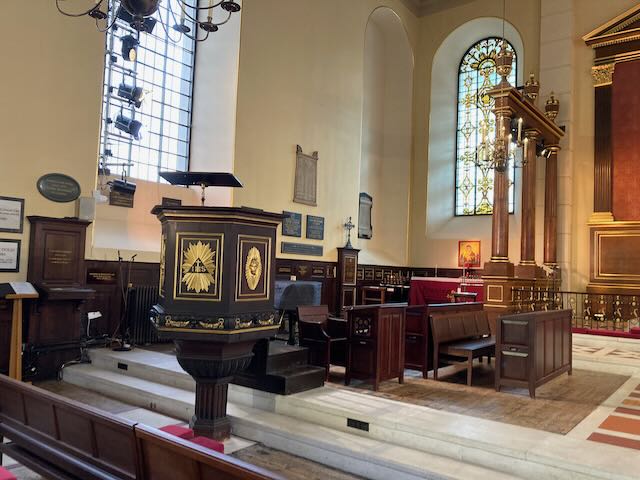
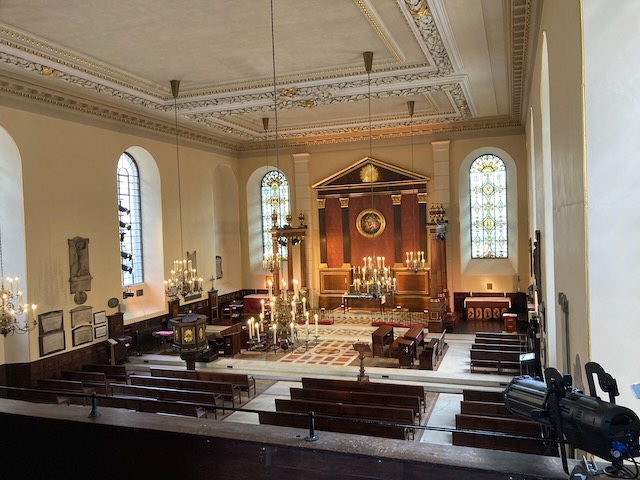
The pulpit of St. Paul’s Covent Garden was designed by Grinling Gibbons (1648-1721) or his students.
Worship
The church offers communion services on Sundays and Wednesdays, and brief Morning Prayer services Tuesday through Friday. Their choir sings Choral Evensong once a month. Rev. Grigg told us that attendance on Sundays is about 50 people, plus those who attend online. The church seats 200.
Chancel of St. Paul’s Covent Garden. Note the camera on the right.
They have larger services for Easter and for midnight mass on Christmas Eve. Of course they also host weddings, baptisms, and funerals. According to their website, “St Paul’s is well known because of its memorial services for members of the theatrical and entertainment community, but we also offer them for the local community.”
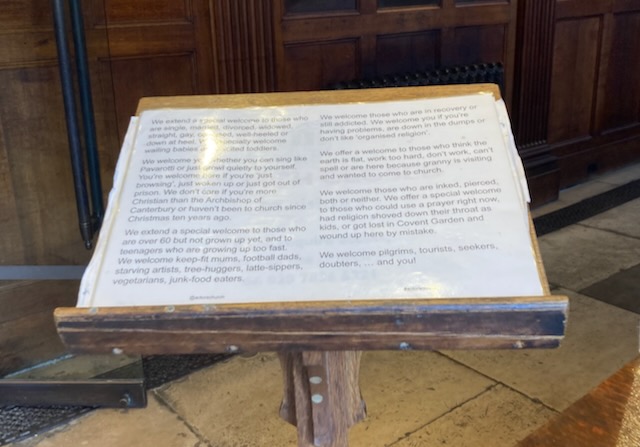
Welcome sign to St. Paul’s Covent Garden; text is below.
“We extend a special welcome to those who are single, married, divorced, widowed, straight, gay, confused, well-heeled or down at heel. We especially welcome wailing babies and excited toddlers.
We welcome you whether you can sing like Pavarotti or just growl quietly to yourself. You’re welcome here if you’re ‘just browsing’, just woken up or just got out of prison. We don’t care if you’re more Christian than the Archbishop of Canterbury or haven’t been to church since Christmas ten years ago.
We extend a special welcome to those who are over 60 but not grown up yet, and to teenagers who are growing up too fast. We welcome keep-fit mums, football dads, starving artists, tree-huggers, latte-sippers, vegetarians, junk-food eaters.
We welcome those who are in recovery or still addicted. We welcome you if you are having problems, are down in the dumps, or don’t like ‘organized religion’.
We offer a welcome to those who think the earth is flat, work too hard, don’t work, can’t spell or are here because granny is visiting and wanted to come to church.
We welcome those who are inked, pierced, both or neither. We offer a special welcome to those who could use a prayer right now, had religion shoved down their throats as kids, or got lost in Covent Garden and wound up here by mistake.
We welcome pilgrims, tourists, seekers, doubters, . . . and you!”
No doubt Jane Austen and her family would have felt welcome in the church, especially with their love of the theatre.
Fashionable Goodness: Christianity in Jane Austen's England is now available! By JAW contributor Brenda S. Cox. See Review. Available from Amazon and Jane Austen Books.
Available through December 31st, 2025. Click on image for details, and share this poster with other teachers and students!
The Obituary of Charlotte Collins by Andrew Capes
Click on image to read the story.
Comments
“My idea of good company…is the company of clever, well-informed people, who have a great deal of conversation.” – Jane Austen, Persuasion
Gentle readers: Please feel free to post your comments and continue the conversation! Due to SPAM, we will no longer accept comments on posts after 30 days of publication. In some instances, links will be removed from comments as well.
Administrators and Contributors
Vic Sanborn, founder of this blog, is supported by a team of talented and knowledgeable writers about Jane Austen and the Regency era. They are:
Tony Grant, who now contributes his photos from London and England
Click on their names to enter their own blogs.
In addition, we thank the many experts and authors who frequently contribute their posts and opinions, and who continue to do so freely or at our request.
Click here to enter the page. Topics include Regency fashion, historic foods, Jane Austen societies, British sites, related topics. Click on image.
May we suggest?
Hello, my name is Vic and I live in Maryland, USA. I have adored Jane Austen almost all of my life. I am a proud lifetime member of the Jane Austen Society of North America. This blog is a personal blog written and edited by me and my team. We do not accept any form of cash advertising, sponsorship, or paid topic insertions. However, we do accept and keep books and CDs to review.
If you would like to share a new site, or point out an error, please email us. (Yes, we are fallible. We'll own up to our mistakes and will make the corrections with a polite smile on our faces.) Write us at
Thank you for visiting this blog. Your comments and suggestions are most welcome.
Project Gutenberg: eBook of Stage-coach and Mail in Days of Yore, Volume 2 (of 2), by Charles G. Harper
STAGE-COACH AND MAIL IN DAYS OF YORE: A PICTURESQUE HISTORY
OF THE COACHING AGE, VOL. II, By CHARLES G. HARPER. 1903. Click on this link.













 Jane Austen's World