Feeds:
Posts
Comments

Archive for the ‘Regency Life’ Category

Reverend George Austen

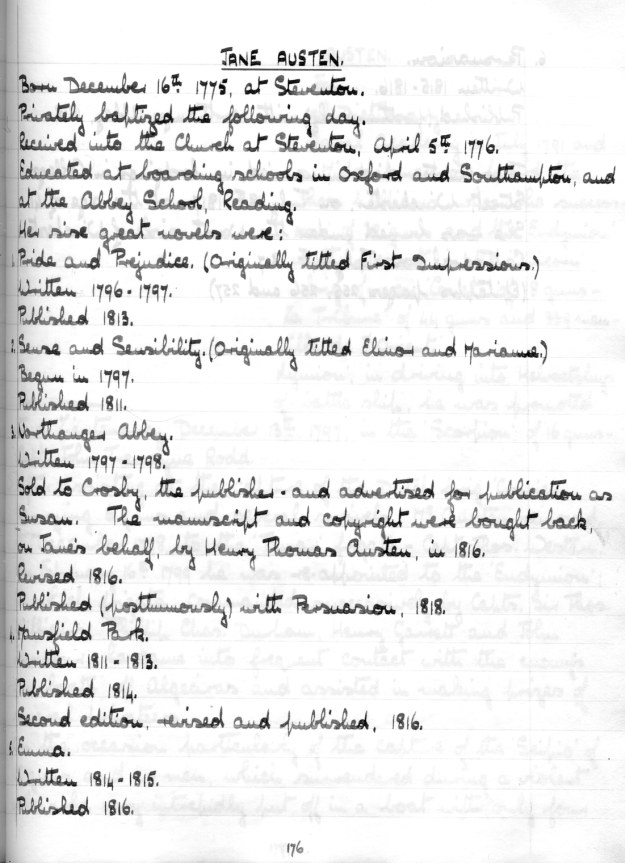
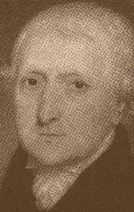
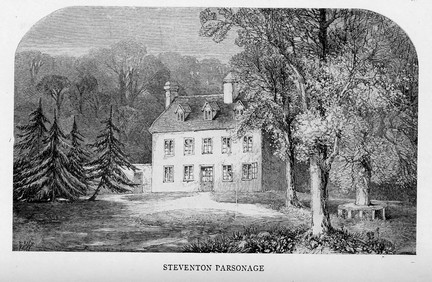
As many Jane Austen fans know, Rev. George Austen ran a boarding school out of his parsonage house in Steventon to augment his £230 pr year income. In1793 he began to teach the sons of local gentlemen in his home to prepare them for university. His library was extensive for a man of modest means, from 300- 500 volumes, depending on the source, an amazing collection, for books were frightfully expensive. Rev. Austen encouraged Cassandra and Jane to read from his library and supported budding author Jane in her writing. At some point, the Austens sent the girls to boarding school in Reading, for which he paid £35 per term, per girl, a not inconsiderable sum. He received around the same amount of money per boarder, and it is conjectured that the Austens hoped to replace their two daughters with many more pupils, which made economic sense. (See Linda Robinson Walker’s link below.) Mrs. Austen was not an indifferent bystander. She cooked, cleaned, sewed, and clucked over the boys like a mother hen, and was involved in their maintenance in a hands-on and caring way, acting as a surrogate mother.
In his Travels Through England in 1782, German traveler Karl Phillip Moritz describes learning academies, head masters, and boarding schools. From his observations, one gains a sense of what life must have been like for the Austens and their pupils:

A few words more respecting pedantry.  I have seen the regulation of one seminary of learning, here called an academy.  Of these places of education, there is a prodigious number in London, though, notwithstanding their pompous names, they are in reality nothing more than small schools set up by private persons, for children and young people.

One of the Englishmen who were my travelling companions, made me acquainted with a Dr. G– who lives near P–, and keeps an academy for the education of twelve young people, which number is here, as well as at our Mr. Kumpe’s, never exceeded, and the same plan has been adopted and followed by many others, both here and elsewhere.
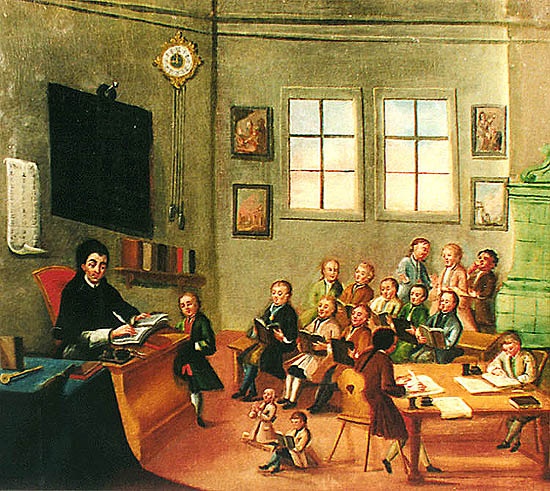
18th Century school room. One imagines a less formal setting for Rev. Austen’s school.

At the entrance I perceived over the door of the house a large board, and written on it, Dr. G–’s Academy.  Dr. G– received me with great courtesy as a foreigner, and shewed me his school-room, which was furnished just in the same manner as the classes in our public schools are, with benches and a professor’s chair or pulpit.

The usher at Dr. G–’s is a young clergyman, who, seated also in a chair or desk, instructs the boys in the Greek and Latin grammars.

Such an under-teacher is called an usher, and by what I can learn, is commonly a tormented being, exactly answering the exquisite description given of him in the “Vicar of Wakefield.”  We went in during the hours of attendance, and he was just hearing the boys decline their Latin, which he did in the old jog-trot way; and I own it had an odd sound to my ears, when instead of pronouncing, for example viri veeree I heard them say viri, of the man,exactly according to the English pronunciation, and viro, to the man.  The case was just the same afterwards with the Greek.

Mr. G– invited us to dinner, when I became acquainted with his wife, a very genteel young woman, whose behaviour to the children was such that she might be said to contribute more to their education than any one else.  The children drank nothing but water.  For every boarder Dr. G– receives yearly no more than thirty pounds sterling, which however, he complained of as being too little.  From forty to fifty pounds is the most that is generally paid in these academies.

I told him of our improvements in the manner of education, and also spoke to him of the apparent great worth of character of his usher.  He listened very attentively, but seemed to have thought little himself on this subject.  Before and after dinner the Lord’s Prayer was repeated in French, which is done in several places, as if they were eager not to waste without some improvement, even this opportunity also, to practise the French, and thus at once accomplish two points.  I afterwards told him my opinion of this species of prayer, which however, he did not take amiss.

After dinner the boys had leave to play in a very small yard, which in most schools or academies, in the city of London, is the ne plus ultra of their playground in their hours of recreation.  But Mr. G– has another garden at the end of the town, where he sometimes takes them to walk.

After dinner Mr. G– himself instructed the children in writing, arithmetic, and French, all which seemed to be well taught here, especially writing, in which the young people in England far surpass, I believe, all others.  This may perhaps be owing to their having occasion to learn only one sort of letters.  As the midsummer holidays were now approaching (at which time the children in all the academies go home for four weeks), everyone was obliged with the utmost care to copy a written model, in order to show it to their parents, because this article is most particularly examined, as everybody can tell what is or is not good writing.  The boys knew all the rules of syntax by heart.
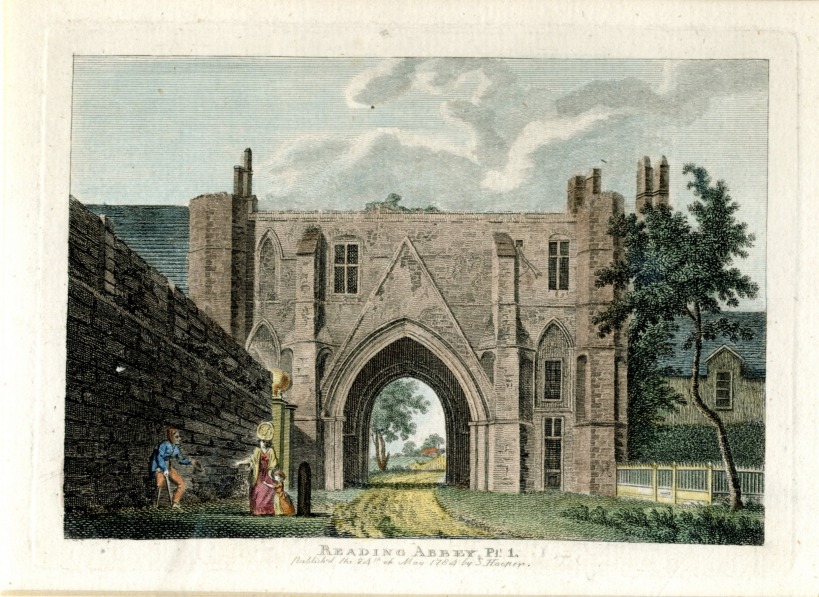
Reading Abbey, where Jane and Cassandra Austen were sent to boarding school

All these academies are in general called boarding-schools.  Some few retain the old name of schools only, though it is possible that in real merit they may excel the so much-boasted of academies.

It is in general the clergy, who have small incomes, who set up these schools both in town and country, and grown up people who are foreigners, are also admitted here to learn the English language.  Mr. G– charged for board, lodging, and instruction in the English, two guineas a-week.  He however, who is desirous of perfecting himself in the English, will do better to go some distance into the country, and board himself with any clergyman who takes scholars, where he will hear nothing but English spoken, and may at every opportunity be taught both by young and old.

Source: Moritz, Karl Philipp, 1757-1793. Travels in England in 1782 by Karl Philipp Moritz (Kindle Locations 645-656). Mobipocket (an Amazon.com company).


Read Full Post »

Inquiring readers, One of the benefits of overseeing a long-lasting blog is the number of Jane Austen aficionados one meets via email and online. Ronald Dunning, a descendant of Jane Austen’s brother, Francis, recently emailed me to discuss his new genealogy site and Jane Austen family website. After I visited the sites and read Deb Barnum’s excellent post on the topic at Jane Austen in Vermont, I invited Mr. Dunning to explain how he managed to fill in so many members on his family tree. When all was said and done, what excited me most was when I saw the resemblance between Mr. Dunning and his illustrious ancestor. The Austens do indeed live on. Enjoy!

Sir Francis William Austen, Admiral of the Fleet, and descendant Ronald Dunning

Hi Vic! I’m a 4th-great-grandson of Frank Austen, and a committed genealogist. I’ve been working for quite a few years on an extended and inclusive genealogy of the Austen family, which can be seen at RootsWeb: http://wc.rootsweb.ancestry.com/~janeausten. It’s an ongoing project, subject to addition and revision, but has reached an advanced state of maturity. Various writers on the Austen family in England and the US have used it, and I’ve even found it cited as a reference source for biographies at Wikipedia.

Joan Corder

I’ve just posted a new website dedicated to Jane Austen’s Family, which was announced to the public at last week’s JAS AGM. The address is www.janeaustensfamily.co.uk. The first content is Joan Corder’s “Akin to Jane” – a 1953 manuscript listing as many descendants of George and Cassandra Austen as the author could find. Joan recorded something like 320 descendants of George and Cassandra Austen, which is very good going for 1953. The biographical detail in the manuscript makes it invaluable. She could never find a publisher and the book exists only in a couple of manuscript copies, one of which is at the Jane Austen’s House Museum at Chawton. When I first began working on the site, I wasn’t sure whether it would interest anyone – I was simply driven on by my obsession with family history – but it’s been well received, to my delight. The Museum is pleased that they can now retire Joan Corder’s fragile original.

Joan’s page on Jane Austen in Akin to Jane Austen. The fragile original has been replaced with interactive online pages.

With the benefit of modern genealogical facilities, I’ve increased the tally from 320 to over 1200 – all of whom are to be found on my RootsWeb site. I have to admit that I have included very little anecdotal information, it is mainly genealogy; and all details except the surname are withheld for anyone born after 1915, though I have them on my computer database.

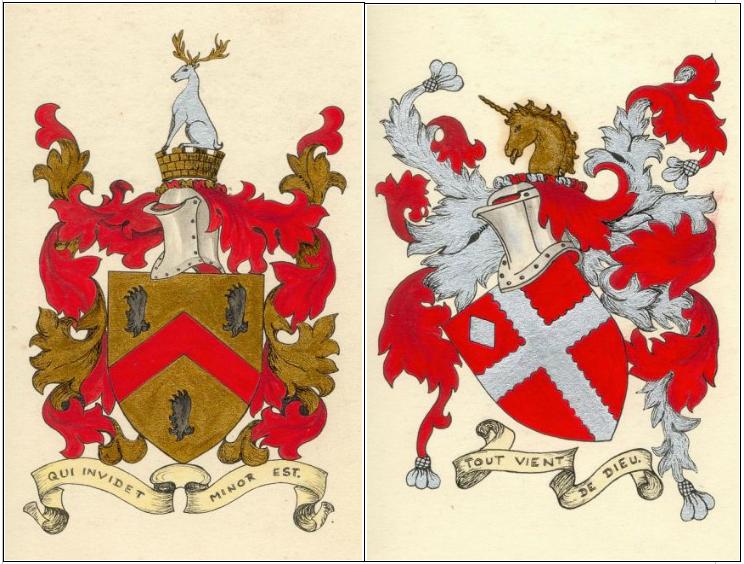
Austen (l) and Austen-Leigh (r) family coat of arms.

You asked for an anecdotal example for Jane Austen’s World readers that would flesh out the details of my research. I immediately thought of James Brydges, 8th Baron Chandos of Sudeley and Elizabeth Barnard – Cassandra Leigh’s great-grandparents. Cassandra was of course Jane Austen’s mother.

Hearing Miss Barnard was engaged to a party with a fashionable conjuror, who showed the ladies their future husbands in a glass, he by a proper application to the cunning man beforehand, and by a proper position at the time, was exhibited in the glass to Miss Barnard: clapping her hands she cried, ‘Then Mr. Bridges is my destination, and such he shall be.’”

This lovely anecdote was recorded in a footnote, in The Complete Peerage,under the entry for James Brydges, the 8th Lord Chandos of Sudeley. The lady in question, Elizabeth Barnard, did become his wife. Elizabeth’s father Sir Henry Barnard was a “Turkey merchant,” a trader whose business interest was in importing from Constantinople. Her husband James Brydges was himself the Ambassador of the “Turkey Company” (properly the Levant Company) in Constantinople from 1680 to 1686.

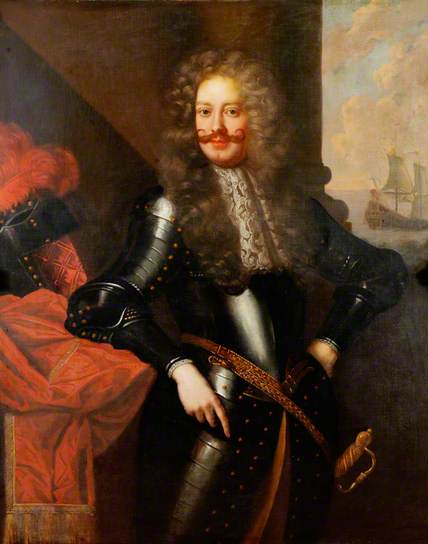
Sir James Brydges (1642–1714), 8th Baron Chandos, Turkey Company Ambassador to Constantinople

Elizabeth gave birth to twenty-two children. We are familiar with the mortal threat to women’s lives from childrearing – three of Jane Austens’ sisters-in-law suffered that fate. Elizabeth survived her twenty-two deliveries and lived to the age of 77. Not all of her children fared so well – only fifteen were baptized, and of those, three sons and five daughters survived infancy. This was far from unusual – Antonia Fraser, in her study of 17th-century woman, The Weaker Sex, stated that it was normal for only a third of children born to a large family to survive. Their eldest child, Mary Bridges, was one of the survivors. The link to Jane Austen can now be traced within a few generations. Mary married Theophilus Leigh; they were Cassandra Leigh’s paternal grandparents and the parents of Theophilus Leigh, who served as Master of Balliol College in Oxford from 1726 until his death in 1785. Theophilus Jr.’s brother Thomas Leigh married Jane Walker, and they were Cassandra Leigh’s parents. Cassandra, who married George Austen, gave birth to eight children, including Jane Austen in 1775. (And she too survived to a ripe old age, outliving her daughter Jane by 10 years.)

Click on image for details. Image @A Reading Affair

I hope you enjoyed this small sampling of the information that my sites offer about Jane Austen’s family. Deb Barnum from Jane Austen in Vermont has interviewed me, and written a very thorough review and detailed explanation of how to find information on the sites.

More on the topic:

Read Full Post »

Inquiring readers: Paul Emanuelli, author of Avon Street, has contributed a post for this blog before about the City of Bath as a Character. He has graciously sent in an article about crime and an incident involving Jane Austen’s aunt, Mrs James Leigh-Perrot. Paul writes about Bath in his own blog, unpublishedwriterblog. It is well worth a visit!

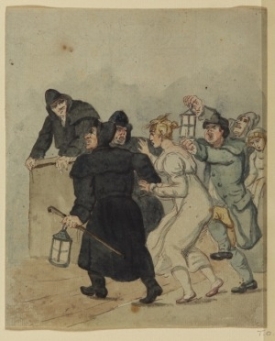
Arrest of a woman at night, 1800. Thomas Rowlandson. Image @The Proceedings of the Old Bailey

Apart from the Bow Street Runners in London there was no organised police force in 18th Century England. The capture and prosecution of criminals was largely left to their victims to deal with. Every parish was obliged to have one or two constables, but they were unpaid volunteers working only in their spare time. A victim of crime who wanted a constable to track down and arrest the perpetrator was expected to pay the expenses of their doing so.

Sometimes victims of crime hired a thief-taker to pursue the wrong-doer. Again, they were private individuals working much like latter day bounty hunters. Sometimes, thief-takers would act as go-betweens, negotiating the return of stolen goods for a fee. Many though were corrupt, actually initiating and organising the original theft in order to claim the reward for the return of goods, or extorting protection money from the criminals they were supposed to catch.

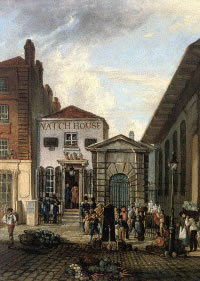
Covent Garden watchhouse. Image @The Proceedings of the Old Bailey

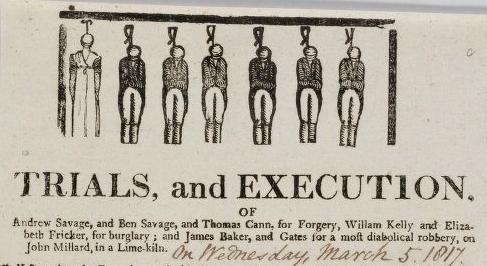
For the most part, unless a criminal was “caught in the act” (probably) by their intended victim it was unlikely they would be brought to justice. In the absence of a police force, the maintenance of “Law and Order” therefore came to depend more on deterrence rather than apprehension and the harshest penalty of all came to cover more and more crimes. In 1799 there were 200 offences that carried the death penalty, including the theft of items with a monetary value that exceeded five shillings.

In practice, judges and juries often recognised the barbarity of the punishment in relation to the crime. Juries might determine that goods were over-priced and bring their value down below the five shilling threshold. Defendants might claim “benefit of clergy” which by virtue of stating religious belief and reading out an oath allowed the judge to exercise leniency. In other cases the Government could review the sentence. Between 1770 and 1830, 35,000 death sentences were handed down in England and Wales, but only 7000 executions were actually carried out.

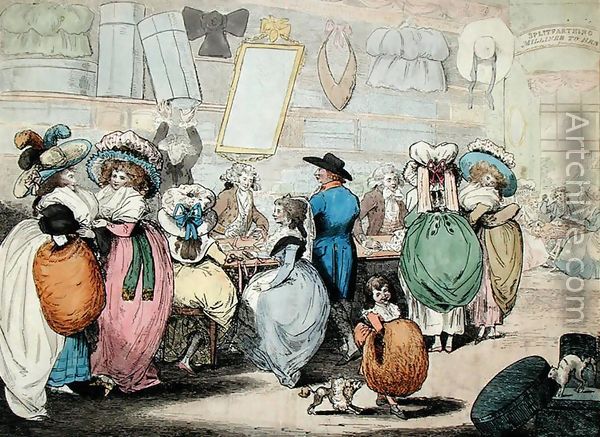
Milliners shop, after Henry Kingsbury

On the 8th August 1799, Jane Leigh-Perrot was accused of stealing a card of white lace from a millinery shop in Bath. The Leigh-Perrots, a wealthy couple, were Jane Austen’s mother’s brother and sister-in-law (Jane’s Uncle and Aunt). The white lace valued at £1 was found in Mrs Leigh-Perrot’s possession together with a card of black lace that she had bought and paid for from the same shop. Mrs Leigh-Perrot denied stealing the lace, saying that the sales clerk must have given it her by mistake when he handed over her purchase. She was nevertheless arrested on a charge of “grand theft” and the lace she was said to have stolen was worth four times the five shillings that carried the death sentence.
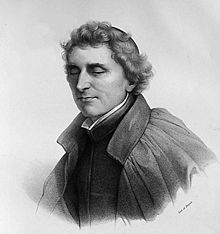
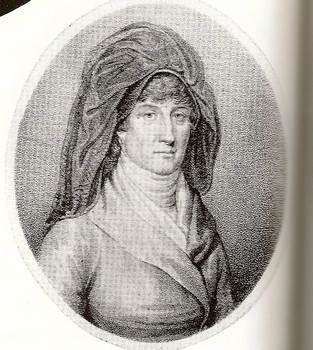
Jane Cholmeley Perrot, aka Jane Austen’s Aunt Perrot

In practice it was unlikely (given her standing) that if she had been found guilty she would have been sentenced to death. The alternatives, however, included branding or transportation to the Australian Colonies with the prospect of forced labour for 14 years. Jane Leigh-Perrot was refused bail and committed to prison on the sworn depositions of the shopkeeper. Due to her wealth, social standing and age she was allowed to stay in the house of the prison keeper, Mr Scadding, at the Somerset County Gaol in Ilchester, rather than being kept in a cell. Mrs Leigh-Perrot still wrote though that she suffered ‘Vulgarity, Dirt, Noise from morning till night’. James Leigh-Perrot insisted on remaining with her in prison.

Mr James Leigh-Perrot. Image @JASA

During her trial Jane Leigh-Perrot spoke eloquently for herself. Several testimonials as to her character were also read out to the court. At the conclusion of the trial the jury took only 10 minutes to find her “Not Guilty.” It does, however, make you wonder how someone less well refined, less well-connected, less eloquent, less educated, less wealthy might have fared. The evidence of her guilt, might have been quite sufficient to send someone else to the gallows, or transported, or branded with a hot iron. She was after all caught in possession of the item and identified by the shop-keeper. In “Persuasion” Captain Harville asks Anne Elliot, ‘But how shall we prove anything?’ Anne replies, ‘We never shall.’

Mrs. Leigh-Perrot. Image @JASA

Read Full Post »

Fire!

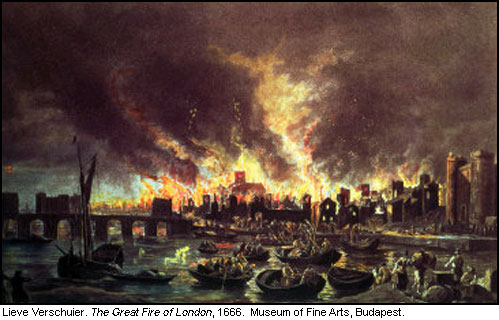
Can there be a more frightening word in Georgian London?  The great fire in 1666 changed the landscape of that city forever. Once a densely packed city riddled with overcrowded, wood-timbered houses and dark, narrow lanes, the fire led the way to a change in building regulations that ushered in brick and stone edifices, wider streets, and public squares. Even with improvements, a fire still presented a horrifically dangerous situation.

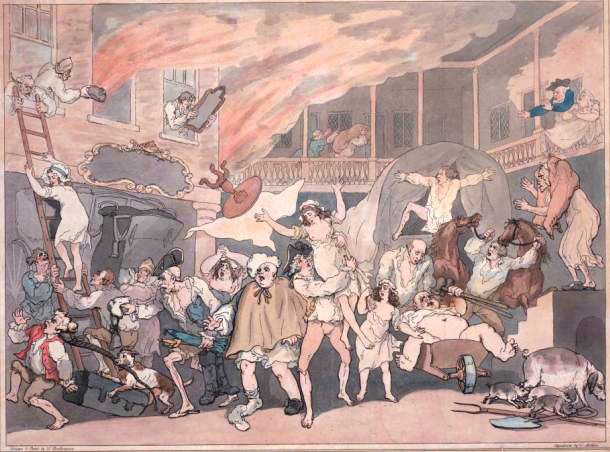
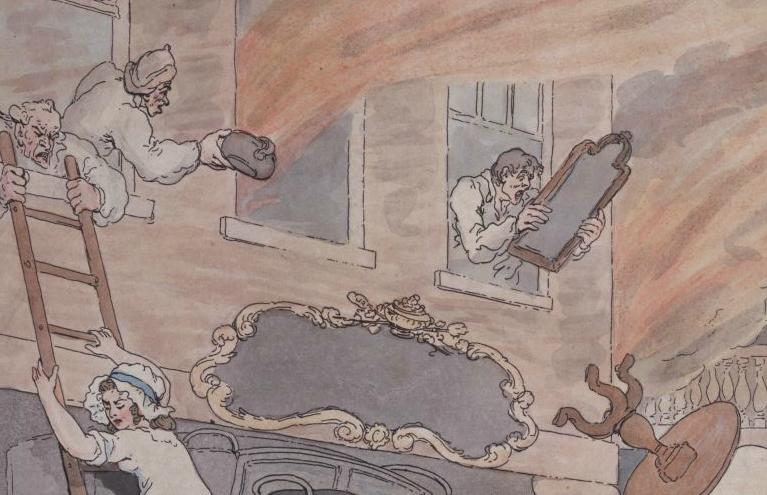
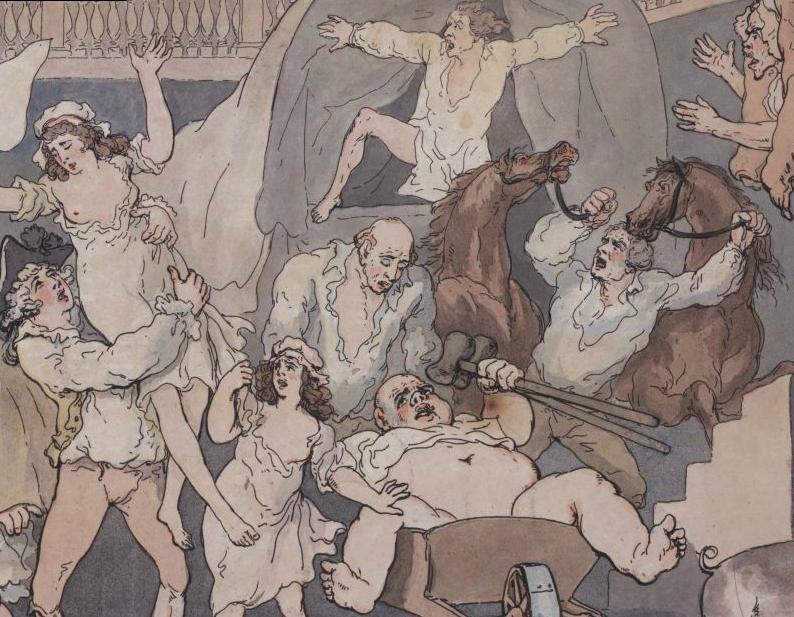
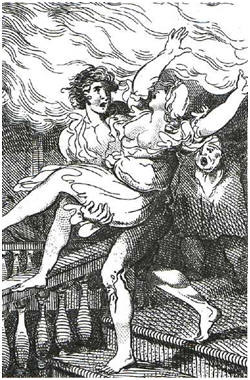
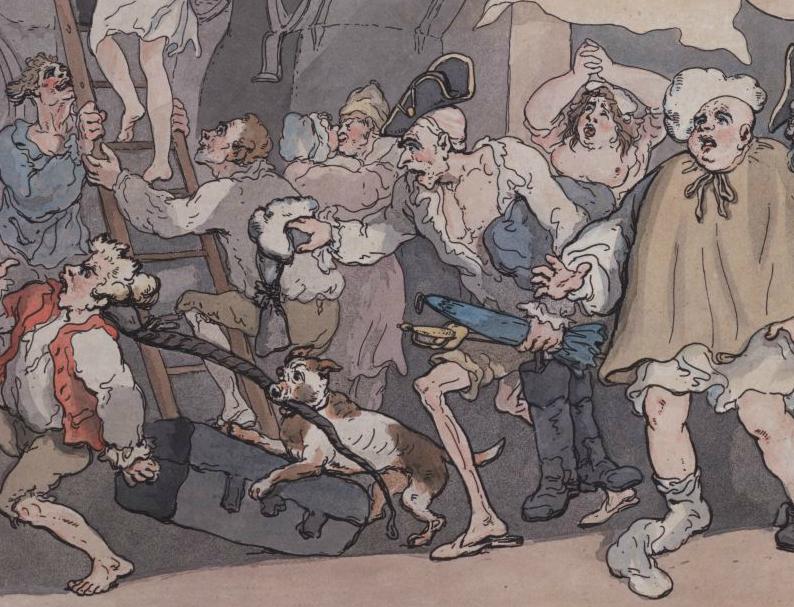
Thomas Rowlandson captures the scene with such realism in “Inn Yard on Fire” that one can smell the smoke and fear, and hear the horses neighing, people screaming, furniture breaking, and wagon wheels squealing as guests and staff run around trying to save themselves, their possessions, and each other.

Fire at the Inn, by Thomas Rowlandson

Panic and pandemonium ensue. A man contemplates tossing a mirror from the second story, another pours his ineffectual chamber pot over the flames. A side table has been tossed through the window, while an anxious woman descends a ladder.

People are in various states of dress and undress. Some help others, some are  overcome with panic. A disabled man is carried from danger in a wheel barrow, while a groom tries to calm two terrified horses.

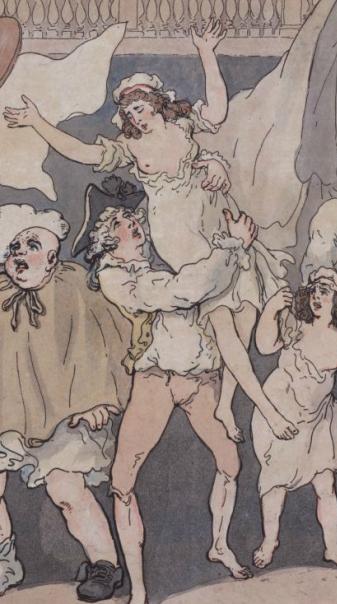
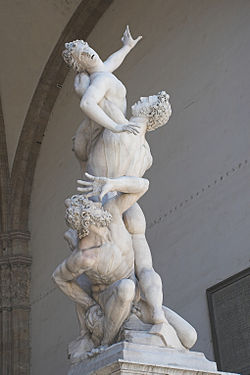
Elements in Rowlandson’s cartoon show a direct association with classical language and Tobias Smollet. The young man saving the girl in distress is reminiscent of Giambologna’s statue of the Rape of the Sabine Women, as well as Peregrine Pickle’s heroic actions towards Emilia.

Rowlandson

Rape of the Sabine Women

Peregrine Pickle saves Emilia. Image @A World History of Art

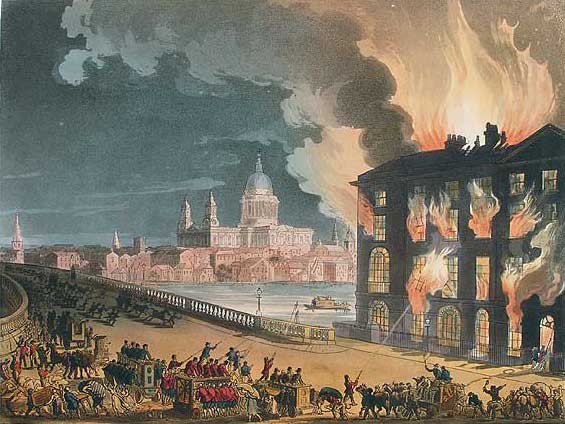
Once a fire had gained as much ground as depicted in this illustration, there was little chance of saving the building. Rowlandson shows some people carrying out their belongings, while others were barely able to get dressed. By now an alarm had probably been sounded in the community. Bucket brigades, in which people were arrayed in long lines to the nearest well and passed buckets in a continuous motion, could probably put out a minor fire, but not one of this magnitude. In the 1800s, almost 150 years after the great fire, there was still no centralized fire brigade.

In 1680, a property developer named Nicholas Barbon introduced the first fire insurance, which initially insured buildings but not furniture, fittings, or goods.  Insurance companies began to proliferate and formed private fire brigades to protect their customers’ property.

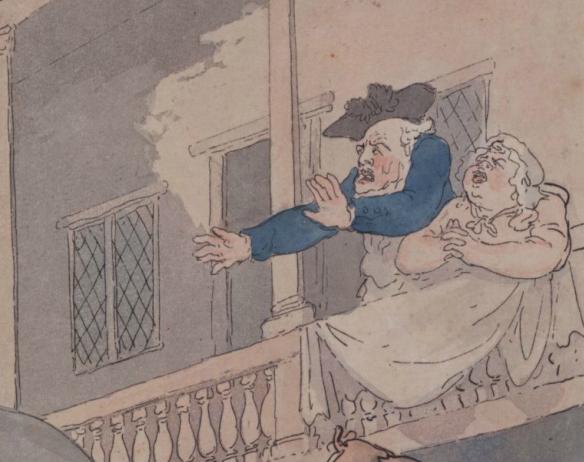
Is this praying elderly couple trapped on the balcony?

In Rowlandson’s cartoon the most the inn keeper can hope for is that the brigade arrives in time to save his structure – if he is insured.  This was easier said than done, for many of London’s streets were not named, since many people could not read, and insured properties were difficult to find.

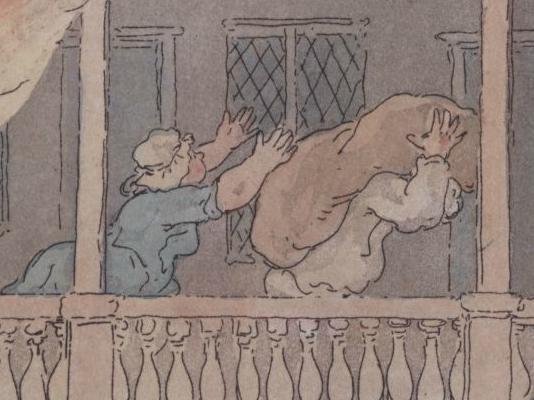
A couple on the second floor frantically attempt to save their belongings.

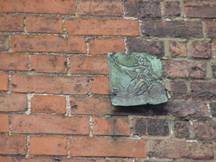
In the early 1800s the fire mark was developed. These plaques, sometimes brightly painted, would signal which properties were protected by insurance firms. Each fire brigade had its own unique plaque.

Fire mark on a building

If a fire started, the Fire Brigade was called. They looked for the fire mark and, provided it was the right one, the fire would be dealt with. Often the buildings were left to burn until the right company attended! Many of these insurance companies were to merge, including those of London, which merged in 1833 to form The London Fire Engine Establishment, whose first Fire Chief was James Braidwood. Braidwood had come to London after holding the position of the Chief Officer of Edinburgh Fire brigade. Edinburgh’s authorities had formed the first properly organised brigade in 1824. – History of the UK Fire and Rescue Service

There were quite a few fire brigades operating in London in the early 19th century and competition was keen. The companies hired sailors and watermen as part-time employees. An advantage of serving in this position was that these men were protected from being pressed into service, a not inconsiderable benefit during the Napoleonic wars.

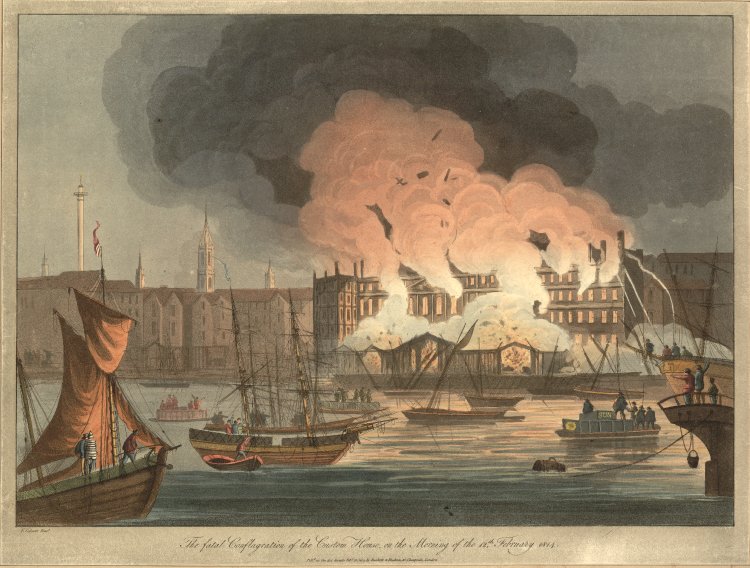
Fighting the fire at the Customs House in February 1814.Image@British Museum

Buildings that had no insurance protection were left to burn, although attempts were made to save the surrounding buildings. Firemarks were essential to identify insured buildings:

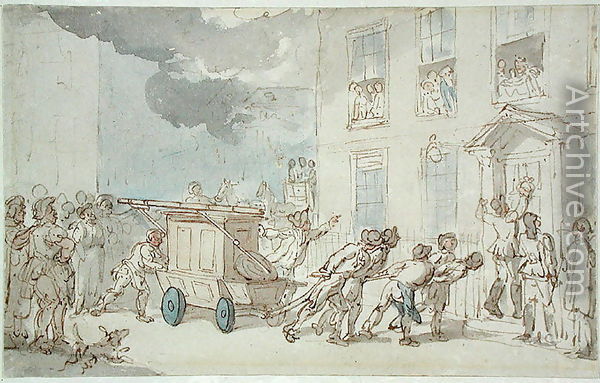
Arrival of the fire engine, Thomas Rowlandson

Designs included, for Sun Fire Office: a large sun with a face; the Royal Exchange Assurance: their building; and Phoenix: obviously Phoenix rising from the ashes. Later fire marks were made of tin, copper, or similar material. These are more often called fire plates. They were more an advertising medium as most do not have a policy number stamped upon them. – Fire Marks: The First Logos of Insurance Companies

Illustration from Ackermann’s ”Microcosm of London” (1808) drawn by Thomas Rowlandson and Augustus Pugin. Firefighters are tackling a fire which has broken out in houses at the Blackfriars Bridge. Teams of men operate hand pumped equipment. Image @Wikipedia

In 1833 companies in London merged to form The London Fire Engine Establishment, the first step to the various fire brigades being taken over by local government.

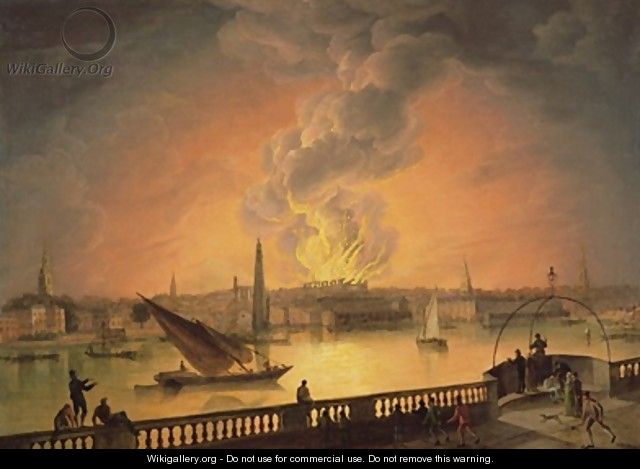
The Burning of Drury Lane Theatre from Westminster Bridge 1809. Artist unknown.  Image property of the Museum of London.

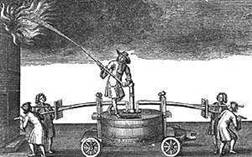
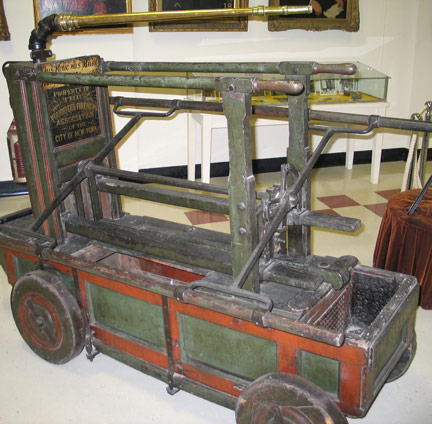
Equipment was still very basic but in 1721, Richard Newsham patented a ‘new water engine for the quenching and extinguishing of fires’. The pump provided a continuous jet of water with more force than before. This new fire engine became a standard until the early 19th century.

Newsham’s wood pumper, ca. 1731.

The men used the handles to pump the water from a lead-lined trough in the main body of the equipment. The apparatus was quite heavy and difficult to maneuver, but it represented a huge step forward in fire fighting technology. People continually ran back and forth to a water source to fill the trough with water. You could also attach a hose to aim the water to a specific location. During this time, however, hose-making was still in its infancy and many leaked. Water buckets and axes to hack out trapped people and create fire free perimeters were still regarded as standard fire fighting equipment.

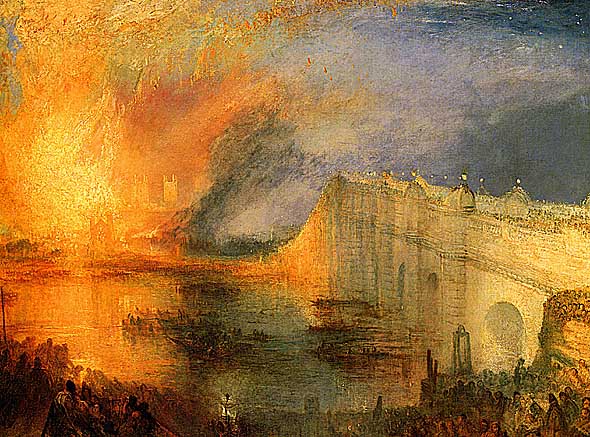
The Burning of the Houses of Parliament, 1834 by William Mallord Turner. Such an event must have provided a spectacular yet horrifying scene for onlookers.

Steam powered appliances were first introduced in the 1850s, allowing a greater quantity of water to be guided onto a fire. With the invention of the internal combustion engine, these appliances were replaced in the early 1900s.

James Pollard (British, 1797-1867) London fire engines: The noble protectors of lives and property, 1823. Image @Olympia Art Antiques

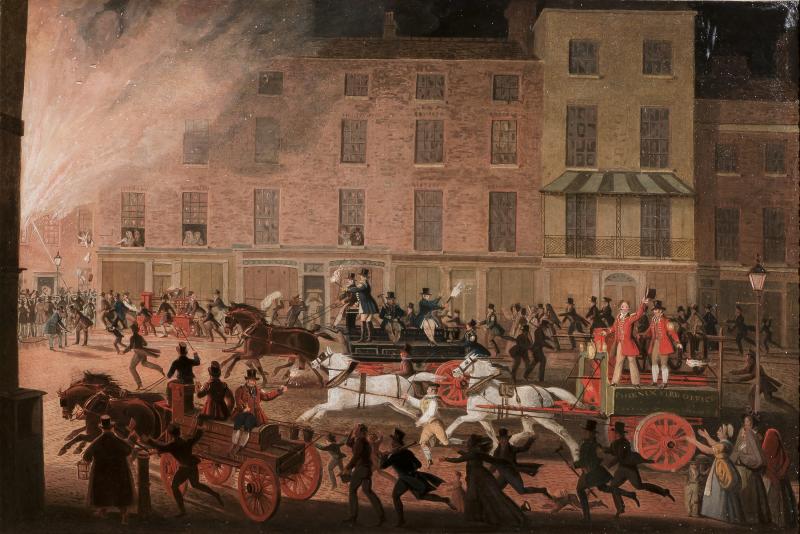
This image by James Pollard, and engraved by R. Reeve, shows several insurance brigades hurrying to a fire.

The firemen, of the time, had little training and wore brightly coloured uniforms to distinguish themselves between the different brigades. During large fires they would become very tired through continual pumping of the appliances, and would offer bystanders ‘beer tokens’ in return for their help. – Insurance Firemen and their Equipment

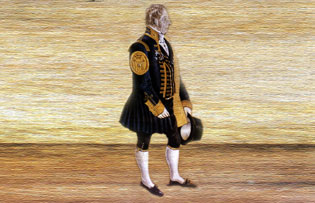
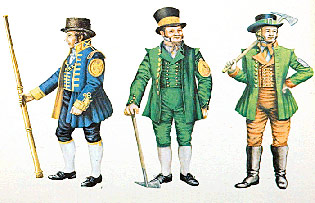
Each company provided different liveries for their men, so that the fire fighters could easily be identified with a particular firm.All insurance firemen wore a large badge on their shoulder to show which insurance company they worked for.

Three uniforms of insurance firemen. All wear a badge

More on the topic:

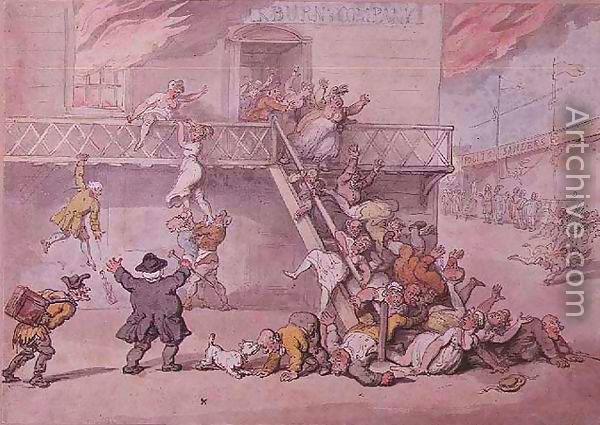
Cockburn’s theatre on fire, another dramatic caricature by Rowlandson.

Read Full Post »

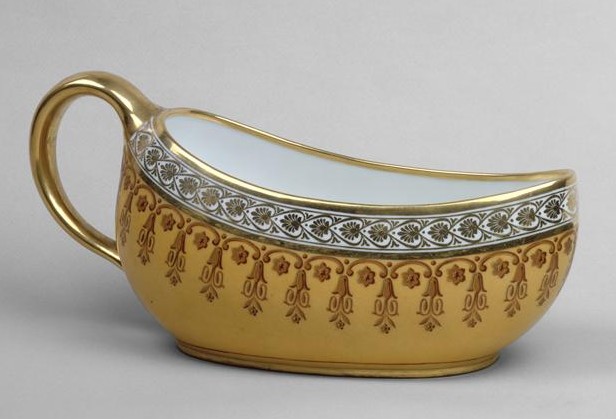
This image of a bourdaloue might be somewhat confusing to the uninitiated. Could this small and elegant vessel be a gravy boat? Or a blood-letting container?

Sevres bourdaloue, 1831.

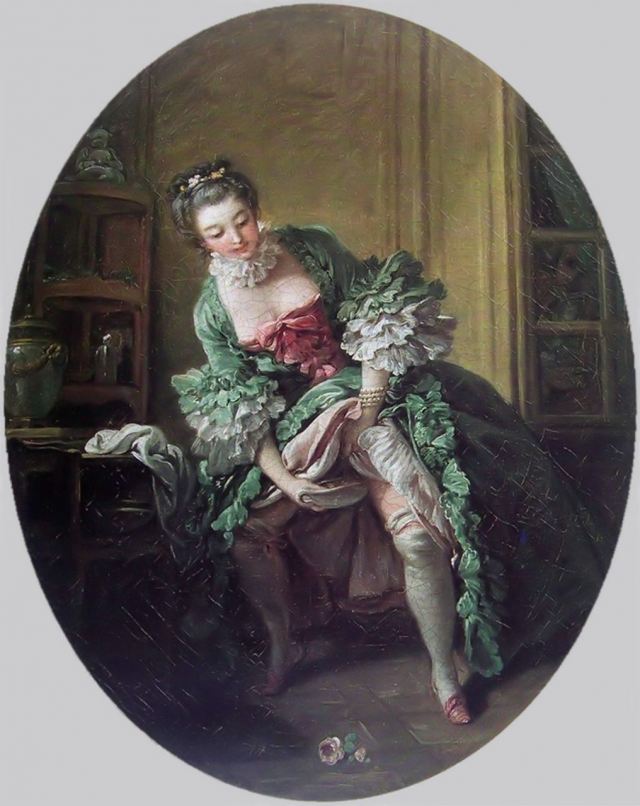
This image by Francois Boucher says it all. A fully dressed lady is relieving herself into an object called the bourdaloue or bourdalou, careful not to soil her skirts. Her maid, no doubt, stands nearby, waiting to receive the small chamber pot in order to empty it. The lady (or woman of ill repute) is in a public place – a theatre or tavern, perhaps – but certainly not a church. Wherever she is, the place has no public toilet. And so she must relieve herself standing up, taking care not to soil her skirt and petticoats.

Louis Bourdaloue. Image @Wikimedia Commons

According to legend, the name of this porta potty comes from  Louis Bourdaloue (1632-1704), one of Louis XIVs Jesuit priests. His oratorical skills were reputedly so accomplished that people felt they could not miss a single word of his sermons. It is said that women sat through his masses with a bourdaloue placed under their dresses, whose skirts were held out by panniers. Since the priest’s  sermons were somewhat longwinded, the chances that ladies would need to relieve themselves were almost certain.  As a rule, churches and theatres had no toilets, and there were no breaks given during sermons. Ergo these portable urinals, which were ergonomically designed to accommodate the female body.

The vessel was oblong, rectangular, or oval in shape. A slightly raised lip at one end and a handle at the other allowed the woman to relieve herself from a squatting or standing position. The edges curved inward to avoid hurting her tenderest parts.

Sevres bourdaloue, with medallion depicting a scene from Watteau, blue lapis and framed in gold leaf. 1892.

It is a little hard to distinguish truth from fiction, so I am a bit skeptical about this apocryphal tale. Were the priest’s sermons in the early 18th century so truly awe-inspiring that a lady would squat in her pew, however discreetly, to relieve herself in front of her family and other parishioners so as not to miss a word?

In truth it was her maid who brought the vessel in, for bourdaloues were compact and came with a cover. When a lady had to relieve herself she would, I imagine, retreat discreetly to a private corner of a tall pew or to a back or side room in the church. Her maid would then hand the vessel over to her mistress, who took care not to spill any liquid on her skirts. When the lady was finished, she would hand the bourdaloue to her maid to empty its contents.  When attending a play or opera at the theatre, I imagine she would again retreat to a darker more private corner of the box to urinate.

A PAIR OF SEVRES BOURDALOUES (POTS DE CHAMBRE OVALE) CIRCA 1776,

Designed only for women, these bourdalous are quite beautiful. Made of faience or porcelain, they are decorated with flowers or painted scenes. Many are gilded. The portable pots, or coach pots as they were known in England, could be decorated inside as well.  They were quite small and compact, designed for travel, which made it easy to carry them and pack them for coach trips. They were also taken to long banquets, where ladies would scurry behind curtains when they needed to go.

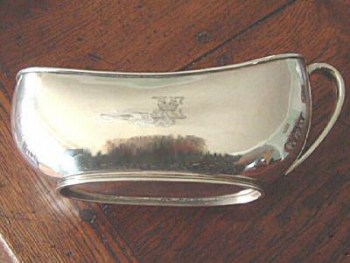
Bourdalou made in France c. 1840. It has an engraved crest and a leather case to contain it. The silver bourdalou is a small urinary receptacle for female use, of compressed eliptical shape and generally made of porcelaine or earthenware, but also made occasionally of silver. Its front end has an incurved rim and, usually, stands on a simple foot ring with a simple loop handle. Also known as a coach pot in England.

Bourdaloues were used throughout the 18th and for most of the 19th century. As water closets began to be built inside homes and buildings, the use of these chamber pots began to be reduced dramatically.

Plain bourdaloue made of creamware. The shape is quite elegant.

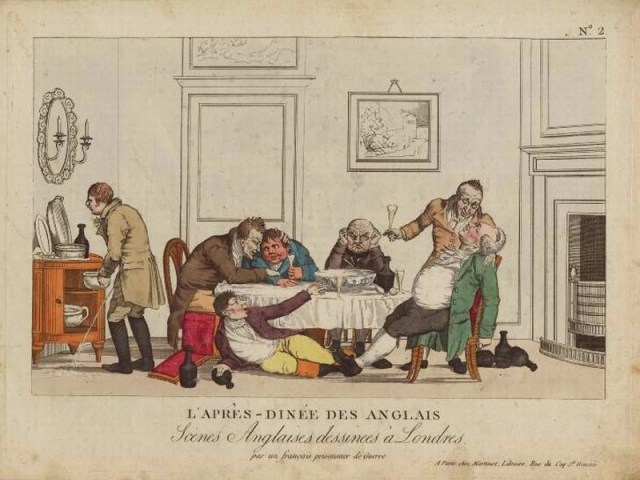
Gentlemen had it a little easier, although this satiric French cartoon, which I have shown before, depicts the disgust that Frenchmen felt towards Englishmen who freely pissed in a pot in the dining room. In this instance, the man misses the chamber pot and hits the floor. There seems to be a lack of modesty among these men, which largely holds true today.

c1816, from Fitzwilliam Museum.

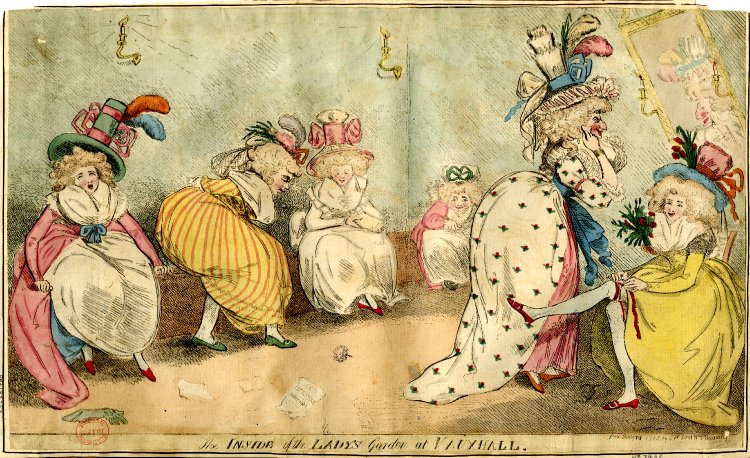
Modesty is also lacking in this cartoon of ladies relieving themselves inside a public restroom at Vauxhall Gardens. Four are arrayed on a long latrine against the wall. One lady is refreshing her make up and another is tightening her garter. If such scenes were common for upper class women in public spaces, perhaps many felt no modesty relieving themselves in church as well.

The Inside of the Lady’s Garden at Vauxhall, 1788 by SW Fores. Image @British Library. The interior of a ladies’ cloak-room. Against the wall on two sides of the room is a bench forming a latrine on which four fashionably dressed ladies are seated. On the right a woman in profile to the right, resembling Lady Archer, applies paint to her cheeks before a mirror lit by two candles. A young woman seated beside her on the extreme right ties up her garter.

Read Full Post »

« Newer Posts - Older Posts »