Feeds:
Posts
Comments

Archive for the ‘jane austen’ Category

From Tony Grant, whose contributions to this blog are numerous: “Two years ago some of my friends wanted a weekend away so we decided on Lyme. Our wives went off to New York for the shopping. We tend to go to places more for the local beer than the literary connections, I must admit. Lyme has some very nice pubs and also we wanted somewhere where we could take a brisk walk. We thought of the Undercliff.”

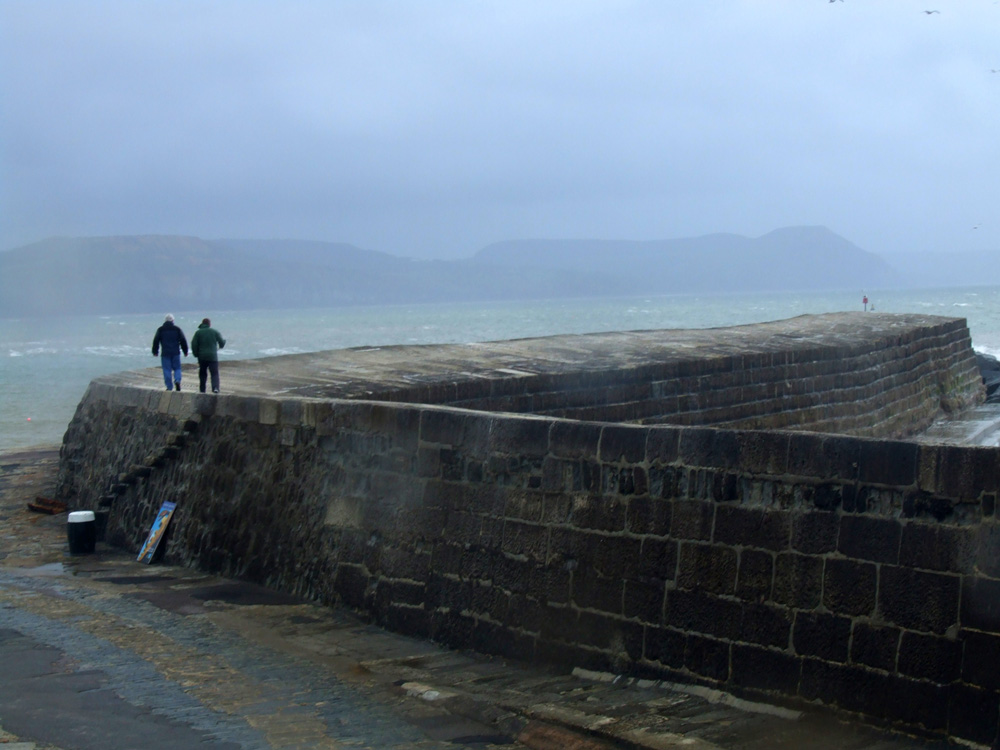
The Cobb at Lyme Regis. Image @Tony Grant

It depends on the weather conditions but the Cobb at Lyme can look and behave like an evil spirited leviathan; a Moby Dick. It’s a savage beast. At other times it can be a gentle, peaceful and calm creature.

Jane Austen used the Cobb at Lyme for the setting of an integral scene in her novel, Persuasion.

The accident on The Cobb, to Louisa Musgrove, brings Anne Elliot to the fore. She is the one looked to by Captain Wentworth and the others to take charge.

John Fowles, who lived in Lyme for most of his life, used Lyme , The Cobb and The Undercliff as the settings for his novel ,The French Lieutenants Woman.Indeed these topographical elements of Lyme are like a group of brooding characters within the novel and shape the action as much as the human characters…” Read the rest of the post at Tony Grant’s blog, London Calling.

View of the Undercliff from the Cobb. Image @Tony Grant

Read Full Post »

Inquiring readers,

For those of you who have not yet visited Nancy Mayer’s beautiful website, you are in for a treat. Click here to enter Nancy Mayer, Regency Researcher: A most proper authority on all things Regency. Nancy has been a member of JASNA (Jane Austen Society of North America) for some time. She was a member of a local chapter in 1990-1994, then started up a new chapter in 1996, and has been the regional coordinator for northern Georgia since then. Nancy has been researching Regency England for more than twenty years, and finds Google books a big help. While she is responsible for the text on her website, Susan Newman designed the web pages and added the illustrations. Nancy graciously agreed to answer a few of my questions:

1. How and when did you become interested in Jane Austen’s novels?

This is probably heresy, but I came to Austen and her novels because I wanted to learn more about Regency life. I had heard of Pride and Prejudice and seen the old Lawrence Olivier movie, but hadn’t gone any further with it or the other novels until I became interested in the Regency period. After reading Jane Austen’s letters, and some biographical data on her, I started in on her novels. I joined a discussion group in Atlanta around 1990 and haven’t looked back since. Even after twenty years of discussing the novels there is always something new to be found. I am not one who has memorized the books and don’t read them all over every year, but I usually find some new insight each time I do.

2. Which is your favorite Jane Austen book and/or character, and why?

Persuasion. Anne Elliot is my favorite character. She is more mature than the other heroines and so doesn’t make the mistakes they do. One seldom has to blush for her. I also think Wentworth is more romantic than Darcy, but I wouldn’t want to be a sailor’s wife.

3. You are considered an authority on the topic of Jane Austen and the Regency period, and your breadth of knowledge about the era astounds me. What are some of your favorite topics to research and why?

You flatter me. The more I research the more I discover what I don’t know. I like to research marriage, titles, peerage, the law, and mourning rules. I find property law most confusing, and barely know a VanDyke fringe from a scalloped one.

One can find all sorts of period books on Google books.

I am also interested in Lord Byron who was Jane Austen’s contemporary, His life gives the masculine and aristocratic elements missing in Jane Austen’s life. Though they both were alive from 1809 to 1817, one could sometimes think they lived at different times.

4. For the casual (but avid) Jane Austen reader, what are some sources you would recommend for further reading?

  • My Dear Cassandra:The letters of Jane Austen, Selected and introduced by Penelope Hughes Hallet. Clarkston Potter Publishers or Collins & Brown 1990, ISBN 0-51758312-7
  • Some might want the complete letters edited by Deirdre Le Faye, or the ones edited by John Chapman.
  • The novels published by Oxford have great appendices. Some of the Critical editions of the novels have appendices. One should have a copy of Lover’s Vows in one’s Copy of Mansfield Park. There are annotated versions of the stories with explanations of obscure and not so obscure points, and there are even comic book editions of Pride and Prejudice and Sense and Sensibility. No matter one’s taste or interests, one should be able to find a connection with Jane Austen.
  • Mrs. Hurst Dancing by Diana Sperling. This isn’t about Jane Austen but the illustrations of the Sperling family could be those of the Younger Dashwoods or the Bennets. # ISBN-10: 0575030356 # ISBN-13: 978-0575030350. Some are exceedingly expensive, but there are remaindered copies and second-hand copies at reasonable prices.
  • Jane Austen and Her times by G.E. Mitton, originally published 1905, 2007 Barnes and Noble.
  • Also there are probably fifty books out there covering everything from Jane Austen and Art to Jane Austen and Zombies. I know of book on Jane Austen and Food, Jane Austen and Crime, Jane Austen and fashion, ( and Fashion in the Time of Jane Austen).
  • Those who like quizzes and challenges might like: Jane Austen Challenge by Helen Barton: BartonBooks (June 2009) # ISBN-10: 0952725754 # ISBN-13: 978-0952725756
  • Also, So you Think You Know Jane Austen? By John Sutherland and Deidre le Faye Oxford University press, ISBN 0-19-280440-5

5. Would you like to share a common misconception about the Regency period with our readers, one that is wrongly perpetuated by book sources, websites, and blogs?

A general error I have found is thinking that the marriage laws, the church, and laws of inheritance were the same then as they are now. Many think the regency period was just like today, but in costume and with horses.

Nancy, thank you for sharing your wonderful insights. I hope readers will bookmark your website and visit it often. It’s best feature, as far as I am concerned, is your answers to their specific questions, like a personal researcher.

Read Full Post »

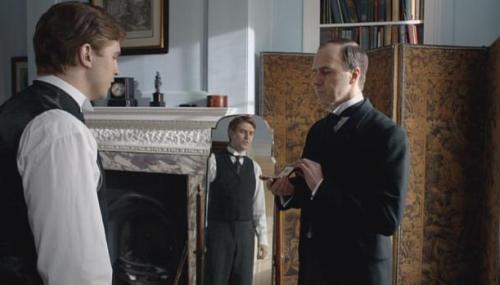
The servants in Downton Abbey. Image courtesy @ITV and PBS Masterpiece.

Downton Abbey. Gosford Hall.  Manor House. Regency House. Each film follows the servants and takes the viewer up and down back stairways, into kitchens and butler’s pantries, and stables and courtyards. But how were the servants’ quarters laid out, and where were they placed in relation to the public and private rooms that the family used? Each house had a different arrangement, to be sure, but patterns did exist.
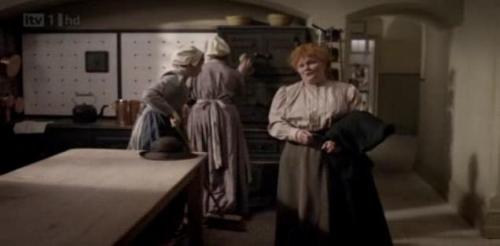
A narrow corridor leads from the kitchen. Image courtesy @PBS Masterpiece.

The interior and exterior shots of Downton Abbey were filmed in Highclere Castle,but because the servant kitchens and bedrooms below-stairs no longer existed as they once were, the servant quarters for the mini-series were reconstructed in Ealing Studios in London. The cost of reconstructing these “plain” rooms was relatively affordable. Imagine if one of the elaborate public rooms had to be reconstructed. As script writer Julian Fellowes observed: “The thing about filming in these great houses is that if you were to start from scratch, you simply couldn’t build this and if you did you would have used up all your budget in one room.”
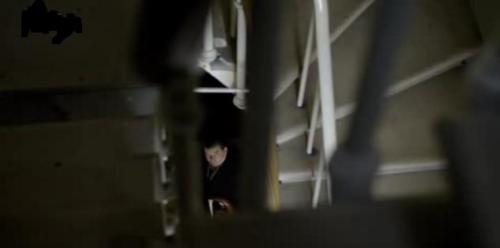
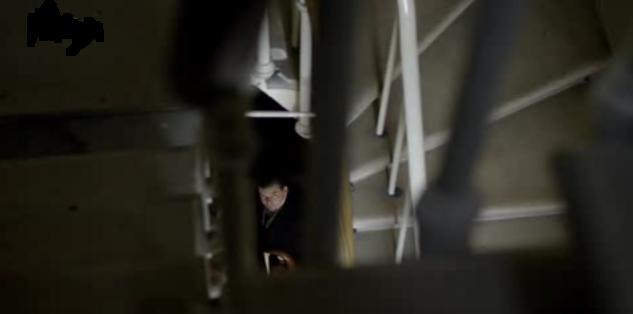
Servant stairs in Downton Abbey. Image courtesy @PBS Masterpiece

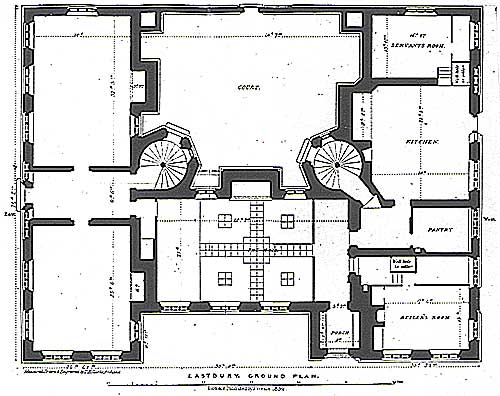
The ground plan from Eastbury Manor House is representative of a great house. It shows the servant quarters at the right near tight round servant stairs, or back stairs, that the servants used instead of the grand staircase reserved for the family and their guests. Maids were expected to work invisibly and sweep and dust when the family was asleep, or work in a room when the family was not scheduled to use it. In fact, many of the lower servants never encountered the family during their years of service.

Unless they were polishing or cleaning the grand staircase, the servants would use the backstairs for all other occasions. A small housemaid’s closet would be located near the back stair on the bedroom floor to accommodate brushes, dusters, pails, and cans. In “modern” Victorian and Edwardian houses, such a closet might  contain a sink that provided water for mopping.  Some great houses boasted a linen-room on the bedroom floor, where clean bed linen and table linen were stored. In this instance, a dry environment was essential.
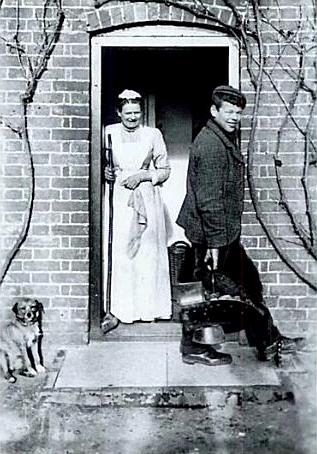
Late 19th c. maid and lad at the back entrance

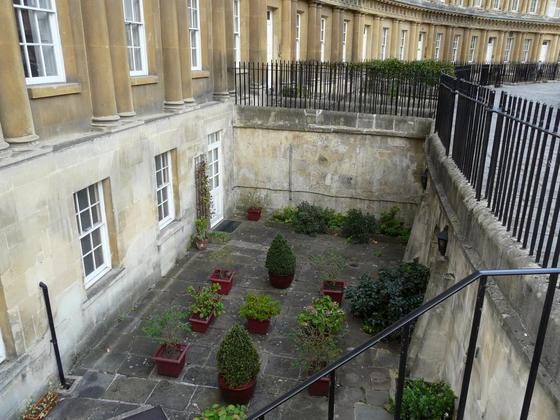
Servants were expected to enter the house in their own entrance, even in smaller houses, such as townhouses.  The Regency Townhouse Annex shows a typical entrance below street level. If you click on the links on the various rooms, you can see the other servant areas in this site.
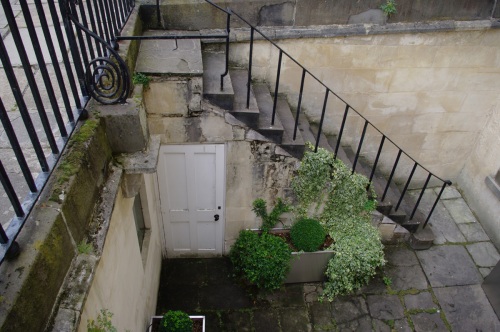
Stairs to servant’s entrance. Bath. Image @Tony Grant

In a country house, the entrance would be in the back of the building or from a courtyard, where supplies could be delivered. The philosophy of a smooth running household was that servants were out of sight and out of mind.
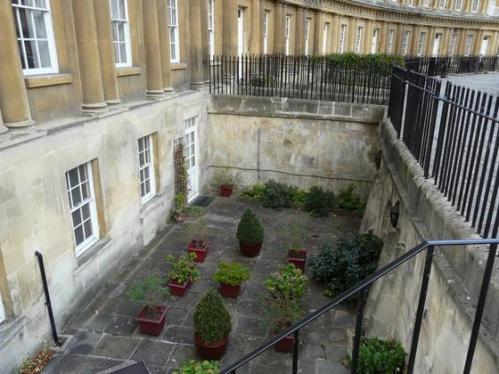
Belowstairs entrance, Bath. Image @Tony Grant

Upon entering, servants would walk along a long hallway to reach the servants’ rooms and other work areas such as the kitchen, scullery, servant’s hall, housekeeper’s room, butler’s room, storage room, etc.  Country were at least two or three stories tall. Servants climbed the stairs and came down them again all day long, cleaning, hauling water, carrying meals or coal for fires, and a myriad other duties. They rose before the family, often from top floor garrets with small windows, and worked long after their employers had gone to bed.

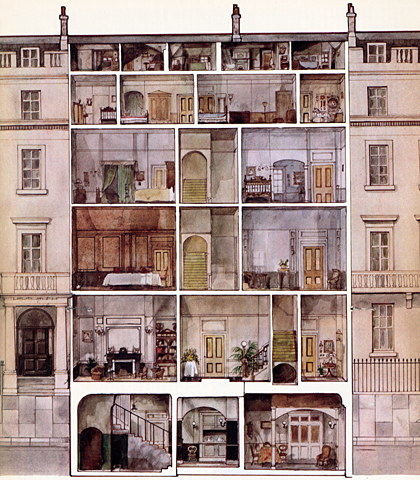
Interior, Upstairs Downstairs web page. Notice the tiny garret bedrooms.

In this image, you can see the small garret rooms reserved for servants in the attic of a townhouse. Men’s and women’s quarters were separated, as in Downton Abbey, with the women’s quarters called the virgin’s wing. The most common servant quarters are described below.
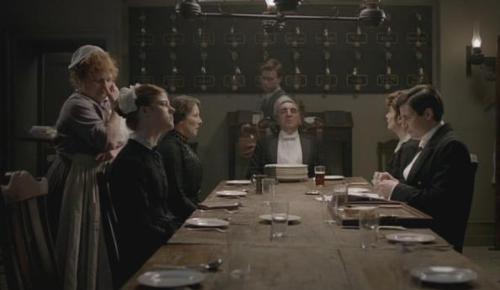
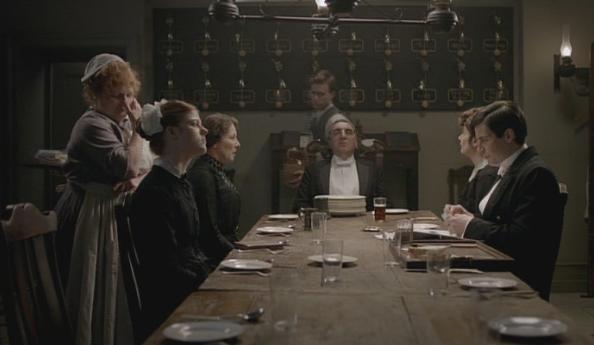
A meal belowstairs. Downton Abbey. Notice the servant bells on the back wall. Image courtesy @PBS Masterpiece

Servant’s Hall:

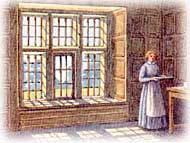
The servant’s hall was a common room where the work staff congregated, ate their meals, performed small but essential tasks, like mending, darning, polishing, ect. A long table was its main feature, as well as a window that would let in enough light for the tasks that needed to be accomplished. This window is a feature in images of several servants halls, which makes me think it was essential, for many of their tasks (darning, polishing shoes, ironing, and the like) required good light.

1907 Watercolor of the windows in a servant’s hall

The servants would regard the hall as their living room, for they ate their meals there and congregated in the hall for the evening. Often the cook did not regard making the servants’ meals as part of her duty, and this task would be left to the kitchen maids. Servants would also receive the visitors’ servants here (as in Gosford Park), persons of similar rank, or their own visitors on a very rare occasion.
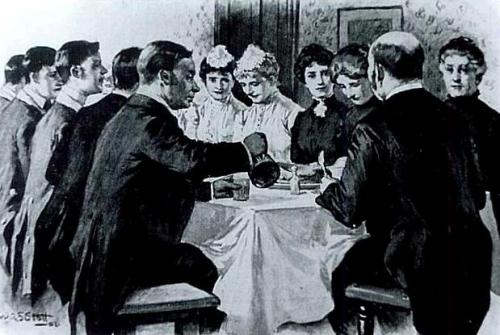
Image of Victorian servants eating dinner in the servants hall.

The servant bells were located in this area, as well as hooks for coats and uniforms.

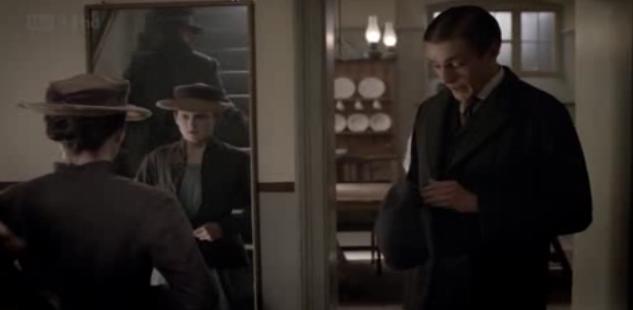
Daisy puts on her coat as William speaks to her just outside the servants hall. Downton Abbey. Image courtesy @PBS masterpiece

The servants followed a hierarchy downstairs as strict as upstairs, and the upper servants, the butler, housekeeper, cook, valet and ladies maid would be served meals and tea by the lower servants.  The highest ranking servant was the stewart, then came the butler and housekeeper.

Anna completes a task in the servants hall. Downton Abbey. Image courtesy @PBS Masterpiece

The ladies maid would defer to the housekeeper and the valet to the butler. Standing low down was the scullery maid or tweeny, who often was just a young girl of twelve or thirteen. Her hours were the longest, for she would make sure that the water was boiling for the cook before she began her day.

Kitchen:
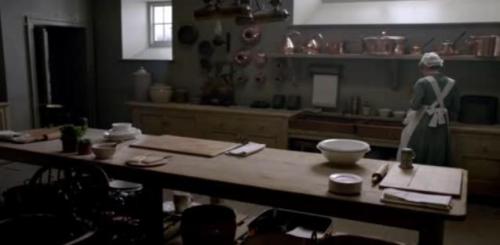
The long work table is the focal point of the kitchen. Downton Abbey. Image courtesy @PBS Masterpiece

The kitchen even in great houses were utilitarian, and positioned away from the family quarters to keep cooking smells away yet near enough for the delivery of food. Kitchens were also located near an entrance were supplies could be delivered, and near the kitchen gardens (but not always. See below.)
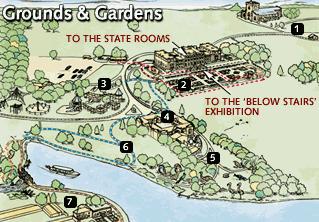
Harewood house and grounds. The kitchen was a 20-minute walk to the walled garden.

Kitchens tended to be oblong and dominated by a large kitchen table, where the majority of food preparation was done. The window would be ideally positioned to the left side of the range, and the kitchen dresser, where essential equipment was held, would stand close to the work table.

Kitchen suite, 1900 house.

The cook worked under the housekeeper, but the kitchen was her domain. She saw to its cleanliness and neatness, and made sure the larders were well-stocked. Not only were the floors, shelves, and work spaces scrubbed, but they had to be thoroughly dried to prevent mold and mildew from contaminating food stuffs and work tops. The arrangement of the scullery and kitchen was convenient, so that one did not need to cross the kitchen to reach the scullery. Natural light in both rooms needed to be ample. 
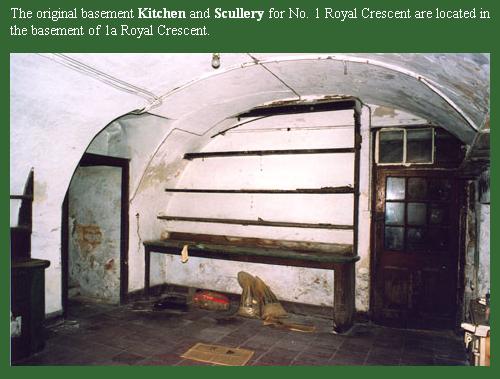
This kitchen in the Royal Crescent in Bath needs renovation and preservation.

She (for by the end of the 19th century, most of the cooks in British households were female) oversaw the meals and kitchen staff, consisting of kitchen maids and the scullery maid.

Scullery and kitchen in the Fota House, Ireland

Scullery:

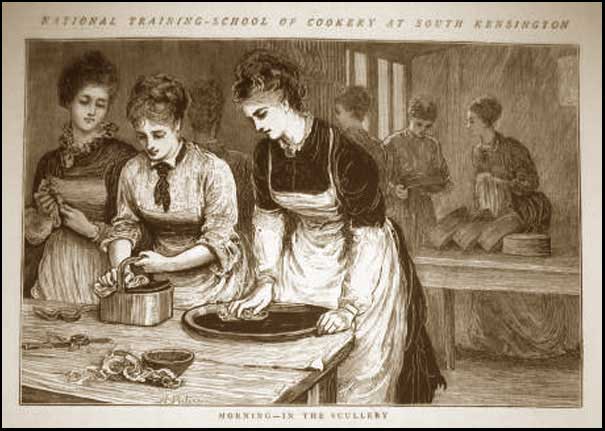
Cleaning in the scullery

The scullery was always located in a separate room from the kitchen so that food would not be contaminated by soiled water. Double stone sinks were the main feature of this room, where pots and pans and the servants’ crockery were rinsed and cleaned. The family’s fine china would be washed in a copper sink, whose softer surface prevented chipping. A cistern above the sinks was used to flush the drains, which led out of house. This was one reason that sculleries were located next to the outer walls and nearest the courtyards or an outer garden. Often, the scullery had no door into the kitchen (only a pass through), and one could enter the room only from the outside. An outside door in the scullery was also known as the “tradesmen’s entrance”.
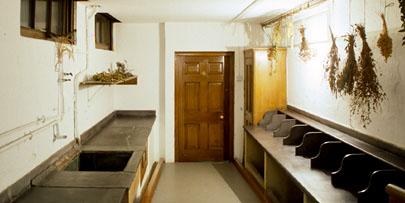
Scullery, Image @Harewood House.

Food preparation also occurred in this area, such as chopping vegetables. Hygiene was essential in order not to contaminate existing food supplies, or the people within the house with soiled cutlery or water. This meant constant hauling of fresh water, scrubbing, washing, and cleaning. The scullery floor, made of stone, was lower than the kitchen’s, which prevented water from flowing into the cooking areas. Dry goods were stashed well away from the scullery, which also had to be kept dry in order to prevent mold. To prevent standing in water all day long, raised latticed wood mats were placed by the sink for the scullery maid to stand upon.
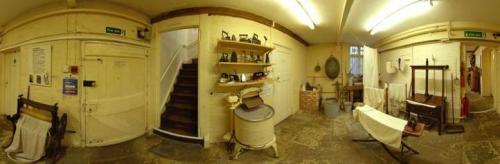
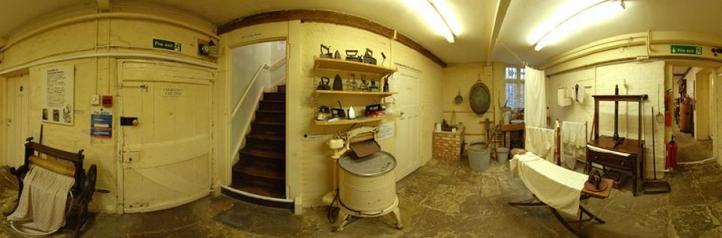
Panorama of a Victorian scullery with boiler and laundry features

Sculleries also contained a copper for boiling clothes on laundry day, washtubs, washboards, irons, and cabinets for cleaning supplies. In 1908, an eight-room house required 27 hours per week of labor, which did not include laundering clothes. One can only imagine how long a house the size of Downton Abbey took to manage.
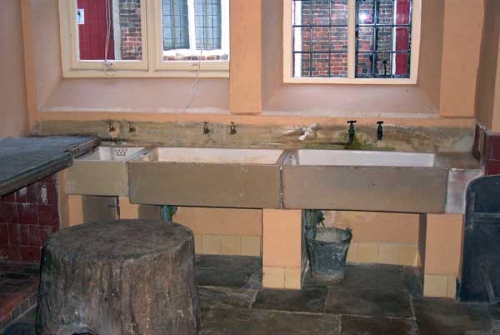
Scullery sinks, Chawton

She stood at a sink behind a wooden dresser backed with choppers and stained with blood and grease, upon which were piles of coppers and saucepans that she had to scour, piles of dirty dishes she had to wash. Her frock, her cap, her face and arms were more or less wet, soiled, perspiring and her apron was a filthy piece of sacking, wet and tied round her with a cord. The den where she wrought was low, damp, ill-smelling, windowless, lighted by a flaring gas-jet……with many ugly dirty implements around her. – The History of Country House Staff

In this 17th c. image, the scullery maid stands upon a platform to keep her feet dry.

In Downton Abbey, the scullery maid is nowhere to be seen. (Daisy is the kitchen maid,  with vastly different duties.) Two modern women who played the scullery maid in Manor House quit the series, unable to pursue that role for the duration of the series. Only the third person, Ellen Beard, who had a better understanding of the scullery maid’s duties of endless washing, managed to remain at her station until the very end. Click on this link to hear a short podcast of a Scottish scullery maid, who described her job as slave labor.
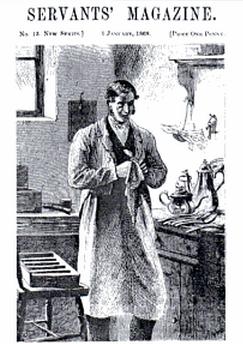
The butler polishes the silver, 1868.

Butler’s room and Butler’s Pantry

The duties of the butler confine him to the drawing-room and dining-room. The dining-room, however, is his particular domain; he sees that everything is in order, that the table is laid correctly, the lighting effect satisfactory, the flowers arranged, and in short that the room and appointments are in perfect readiness for a punctual meal. In this work a parlor maid assists him by sweeping and dusting, and a pantry-maid helps him by keeping everything immaculate and in readiness in the pantry. The butler serves at breakfast, luncheon and dinner.” – Vintage Maids and Butlers

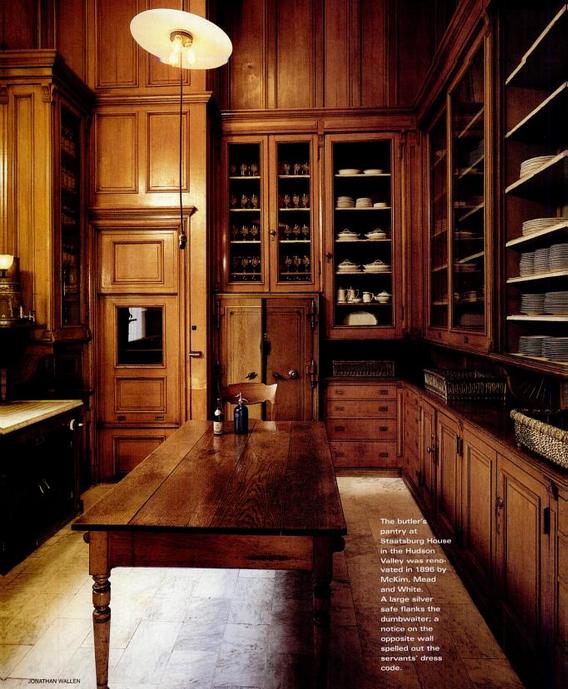
Butlert’s pantry, 1896. Staatsburg House, McKim, Mead, & White

The butler’s rooms, which included the Butler’s Pantry, were located in the basement nearest the dining room upstairs and back entry, and had no connection with the kitchen, except for service. When he was summoned, even in his rooms, the butler could appear quickly. In smaller establishments, such as Matthew Crawley’s house, the butler also acted as valet. In all instances, except for the steward, he was the highest-ranking servant, answering directly to the master.

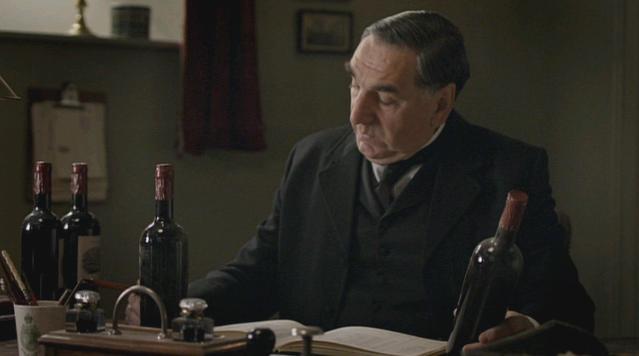
One of the duties of the butler (Mr. Carson in Downton Abbey) is to account for the wine. In this instance, he notices a discrepancy in the tally and the books. Image courtesy @PBS Masterpiece

The butler’s pantry was kept under lock and key, so that thievery was impossible at best, and at the very least deterred. A plate-closet or safe were placed there, as well as a private scullery for cleaning. The butler’s bedroom was a necessary (and lockable) adjunct in large houses for the protection of the plate.
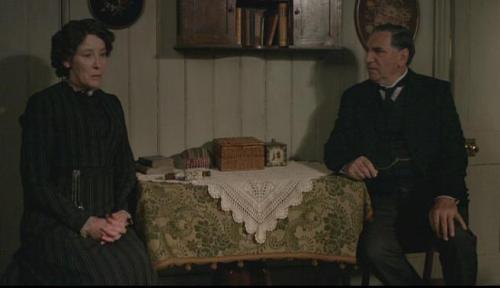
Mrs. Hughes and Mr. Carson chat in her sitting room. Downton Abbey. Image courtesy @PBS Masterpiece

The Housekeeper’s Room

The housekeepers room in large establishments served as both a sitting- and business-room where she would take the directions of the day from the lady of the house. She would also entertain visitors of similar rank in her quarters. The housekeeper oversaw the female servants, and when she walked, a thick assortment of keys, symbols of her status and which dangled from her waist, would jiggle and certainly make a sound.
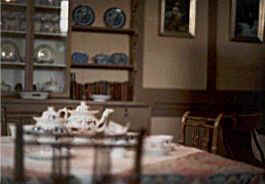
The housekeeper’s room in Uppark. At times the upper servants would congregate there for tea, and in some houses, for dinner.

Before dinner in the servants hall, the upper servants would assemble in the housekeeper’s room, also known as the Pug’s Parlour, and walk in for dinner, with the butler leading the way. This was known as the Pug’s Parade. After dinner, the upper servants would withdraw to the housekeeper’s parlor again for conversation.

Servant Bedrooms
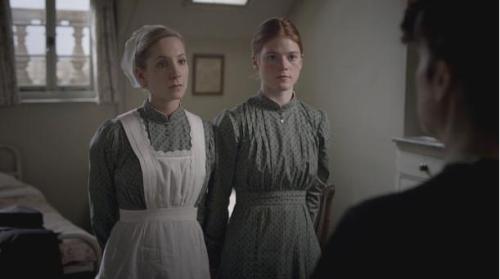
Anna and Gwen confronted by O’Brien in their unlocked room. Downton Abbey. Image courtesy @PBS Masterpiece

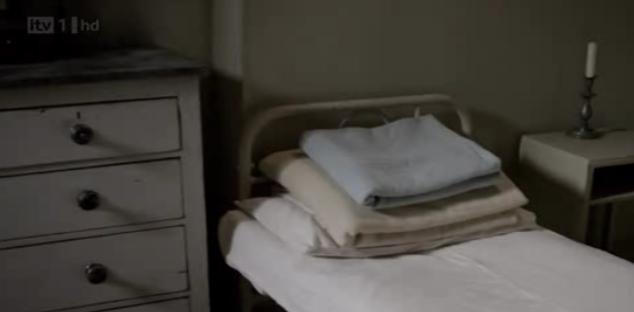
In the latter half of the 19th century, servants slept in attic bedrooms. These were often cold and damp in the winter and hot in the summer, with little light coming in from small windows. Some male servants slept downstairs to guard the family silver. The furnishings in servant quarters were basic and essential. A servant might have a locked box in which personal materials were kept, but the rooms were open and subject to inspection by their employers.
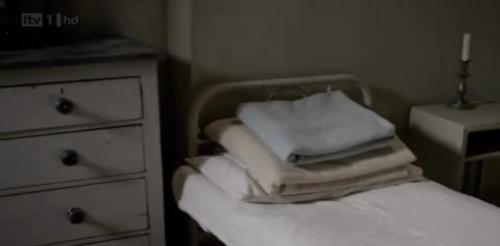
The valet’s simple bedroom. Downton Abbey. Image courtesy @PBS Masterpiece

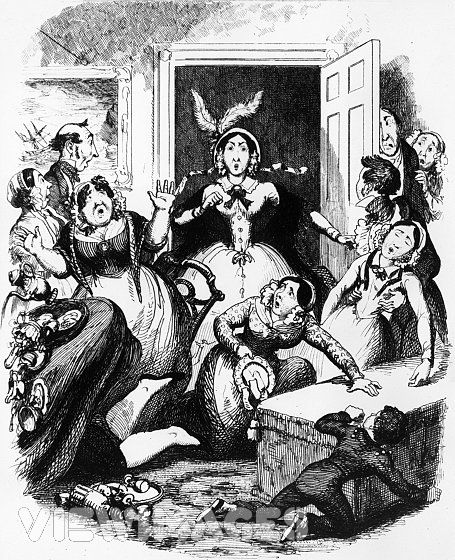
One source for servant quarters and duties of the servants cautioned that books about servant etiquette discussed ideal behavior. In reality, servant turnover was high, theft did occur, and servants did not always know their place. In this humorous Punch cartoon, the mistress arrived home unexpectedly, catching the servants eating upstairs and generally misbehaving. The truth, I suspect, is somewhere in between.

“Oh, hey, the missus! Servants eating a meal upstairs.” Cruikshank. Punch

Sources: (A long list that fleshes out the topic.)

Read Full Post »
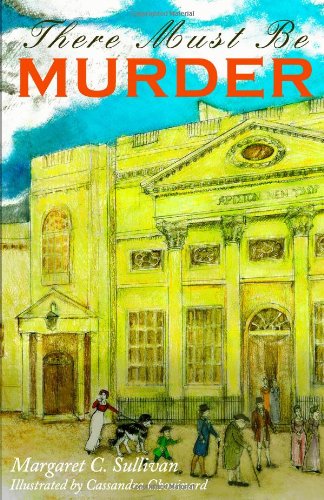
There Must Be Murder, a very nice story by Margaret C. Sullivan,

It is one year after Catherine has married her Henry. She still is sweet and naïve, but she now possesses the womanly knowledge that every bride with an adoring husband soon comes to know. Henry Tilney is as charming as ever and clearly loves his pretty Cat. The couple, only one year married, live in Woodston Parish with a cat named Ruby Begonia and an assortment of dogs, including a Newfoundland named MacGuffin. Catherine has redecorated the pretty parsonage, and the couple has a habit of cozying up together as Henry reads passages from The Mysteries of Udolpho. During one such occasion, Catherine fondly recalls her introduction to Henry in Bath by the Master of Ceremonies, Mr. King, and in no time Henry has arranged for a visit to that ancient city.

“Henry, you know perfectly well that I keep no journal. Besides, I did not know then that you were my future husband.”

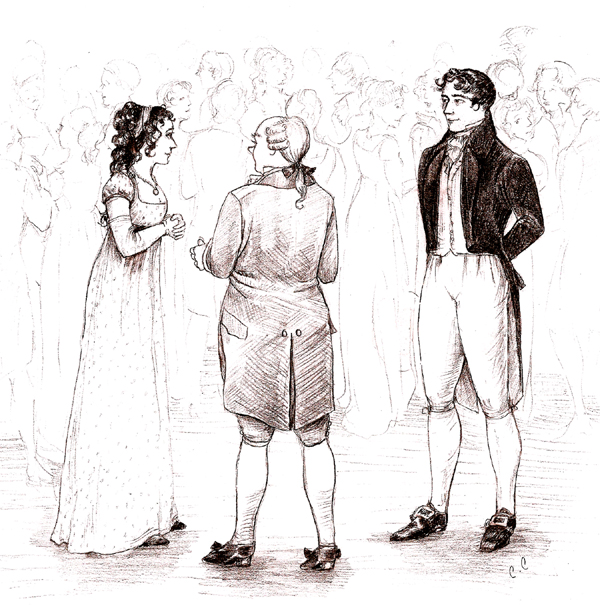
“Some husbands would be injured at such an admission, but not I; after all, I did not know that you were my future wife. I remember that I was wandering about the Rooms like a lost soul, having no acquaintance there. The master of ceremonies, Mr. King, took pity upon me and asked if I would like an introduction to a clergyman’s daughter who was in need of a partner. In Christian charity, I could not decline; though from my past experiences of ladies described as ‘clergymen’s daughters,’ I expected to be presented to an elderly spinster with a squint. You may imagine my relief when Miss Morland turned out to be rather a pretty girl, and I considered myself fortunate that no other gentleman had already claimed the honour of dancing with her.”

Catherine’s eyes were shining. “You thought me pretty?”

“Indeed.” Henry reached for her hand and kissed it.

Margaret C. Sullivan, the author of this charming tale, deftly combines old characters (General Tilney and Henry’s sister, Eleanor) with the new – an apothecary named Mr. Shaw, a pretty but calculating woman named Judith Beauclerk, her mother, Lady Beauclerk, and Sir Philip, to name a few. Ms. Sullivan takes us on a sweet journey over familiar territory, paying homage to Jane’s characters while staying true to her own writing style. The book is illustrated with pen and ink drawings by Casandra Chouinard, which certainly enhance one’s enjoyment of the novella.

Catherine, Mr. King, and Henry Tilney. Image @There Must Be Murder

Fans of Jane Austen will recognize Margaret as the editrix of Austenblog, the longest surviving Jane Austen blog on the blogosphere, and as one whose knowledge of Jane and the Regency period is that of an expert. And thus the details set down in this tale are accurate and true to the time, including the use of arsenic in beauty potions. Margaret’s humor also shines through, and I found myself turning page after page until I had finished the story in one sitting.

Here’s her bio, with an example of her humor: Margaret C. Sullivan is the author of numerous Jane Austen sequels and editrix of AustenBlog. Her first book, The Jane Austen Handbook: A Sensible yet Elegant Guide to Her World, will be in bookstores this spring. She likes to think that Henry Tilney would dance with her at the Lower Rooms, although she is an almost-middle-aged spinster with a squint.

If you are intrigued by my short review, you may purchase the book in several ways. Girlebooks, an excellent source of free Ebooks, now offers original eBooks that have never been published, such as There Must be Murder. You have a choice of several platforms in which to download the book or purchase a printed copy. It is available for $9.99 at Amazon paperback and for free at Smashwords at this link .

The novella was first commissioned by the Jane Austen Centre, and you may read the book chapter by chapter in this link.

Enjoy! I certainly did.

Book Giveaway (Closed – congratulations to winner, Cecilia): If you leave a comment, you have a chance to win my hard copy of the book with all its charming illustrations. The drawing (by random number) will be held on February 5th.

Read Full Post »

The valet (rhymes with pallet) is a personal manservant who tends to his master’s every need, from a clean room to seeing to his clothes to making sure that his entire day goes smoothly from the moment he rises to the time he goes to bed. Also known as a gentleman’s gentleman, the valet is the closest male equivalent to a lady’s maid.

Mr. Darcy (Colin Firth) dresses with the help of his valet, who stands ready to put on his coat. In this scene, Mr. Darcy changes his mind and chooses another coat before visiting Elizabeth at the inn. Image @Pride and Prejudice, 1995

Mrs. Beeton describes a valet’s duties in her excellent 1861 book on household management:

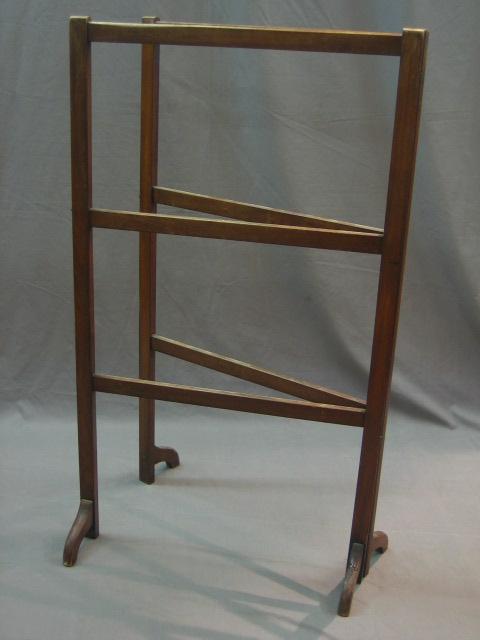
His day commences by seeing that his master’s dressing-room is in order; that the housemaid has swept and dusted it properly; that the fire is lighted and burns cheerfully; and some time before his master is expected, he will do well to throw up the sash [open the window] to admit fresh air, closing it, however, in time to recover the temperature which he knows hismaster prefers. It is now his duty to place the body-linen on the horse before the fire, to be aired properly;

Edwardian clothes horse. Image @Denhams.com

to lay the trousers intended to be worn, carefully brushed and cleaned, on the back of his master’s chair; while the coat and waistcoat, carefully brushed and folded, and the collar cleaned, are laid in their place ready to be put on when required. All the articles of the toilet should be in their places, the razors properly set and stropped, and hot water ready for use.

Barry Lyndon (Ryan O’Neal). While the master shaves, his footmen assist him, making sure his implements are at hand. His valet would have overseen the arrangements and will sharpen the razor and clean the shaving brush after Barry has finished shaving. Image @Barry Lyndon

Gentlemen generally prefer performing the operation of shaving themselves, but a valet should be prepared to do it if required; and he should be a good hairdresser. Shaving over, he has to brush the hair, beard and moustache, where that appendage is encouraged, arranging the whole simply and gracefully, according to the age and style of the countenance. Every fortnight, or three weeks at the utmost, the hair should be cut, and the points of the whiskers trimmed as often as required. A good valet will now present the various articles of the toilet as they are wanted; afterwards, the body-linen. Neck-tie, which he will put on, if required, and, afterwards, waist-coat, coat, and boots, in suitable order, and carefully brushed and polished.”

Other valet duties:

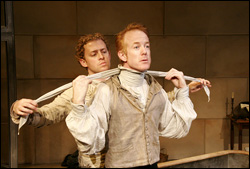
Ian Kelly (Brummel) and Ryan Early in Beau Brummel (2006 play)

  • As his master goes out, the valet hands him his gloves and hat, opens the door for him, and receives his orders for the rest of the day.
  • He puts his master’s dressing-room in order, cleaning combs and brushes, folding clothes and putting them in drawers.
  • If his master has no clothes sense, the valet will select suitable clothes, making sure they are clean, particularly the collars, and maintained in good repair.
  • He consults with the tailor, perfumer, and linen-draper.
  • He awaits his master’s return, making sure that his drawing room is picked up by the maids, and dusted and swept by them, and that the room is made ready with a lit fire and candles.
Credit: Courtesy of © Carnival Film & Television Limited 2012 for MASTERPIECE

Bates (Brendan Coyle) assists Lord Grantham (Hugh Bonneville) in Downton Abbey. A valet and his master become close over the years. Image @Downton Chaser

  • The valet stands ready to help his master dress for dinner or any other occasion.
  • He makes sure that the washing table is ready, filling the ewer and carafe with fresh water, and placing the basin towels, brushes, hot water, and shaving apparatus near at hand.
  • In case of wet weather, when his master has returned from riding, the valet lays out a change of dry linen and clothing, and is ready to assist his master out of the damp clothing.
  • He helps his master prepare for journeys, packing enough linen and other clothing for the trip. At the Inns, he takes charge of his master’s comfort as he would at home, and has everything ready to assist his master in dressing and undressing.
  • If no footmen is available during the journey, the valet will also see to these services, even at table.
Bates at the moment he is informed that he must leave Lord Grantham's service. Despite their long association, it was imperative that a valet was physically capable of performing all his duties, including standing in as footman when the occasion required. Bates' reliance on a cane prevented him from carrying a tray. (We all have learned that Lord Grantham is a softie and kept Bates on.) Credit: Courtesy of © Carnival Film & Television Limited 2012 for MASTERPIECE

Bates at the moment he is informed that he must leave Lord Grantham’s service. Despite their long association, it was imperative that a valet was physically capable of performing all his duties, including standing in as footman when the occasion required. Bates’ reliance on a cane prevented him from carrying a tray. (We all have learned that Lord Grantham is a softie and kept Bates on.) Credit: Courtesy of © Carnival Film & Television Limited 2012 for MASTERPIECE

The valet keeps his master’s clothes in good repair:

  • Hats are kept well brushed on the outside with a soft brush, and wiped inside with a clean handerchief.
  • Clothes placed in a wardrobe are covered with brown holland or linen wrappers to secure them from dust.
  • He places boots and shoes cleaned by the under footman in the dressing room.
  • Slippers are aired by the fire.
  • As soon as his master finishes shaving, the valet will clean the razor and brushes.
  • Before he hangs damp clothing by the fire, he rubs the cloth with a sponge until the smoothness of the nap is restored. If the clothes are allowed to dry before brushing, then later brushing might not remove the roughness.
Credit: Courtesy of © Carnival Film & Television Limited 2012 for MASTERPIECE

In Downton Abbey, Matthew resists Molesley’s services, causing an undue amount of stress to the butler, who also acts as his valet. Credit: Courtesy of © Nick Wall/Carnival Film & Television Limited 2012 for MASTERPIECE

Valets in humbler households:

The butler in a second or third rate establishment takes on the duties of the house steward, valet, and footman as well. He is likely to pay market bills, assist his master in dressing, serve at table and oversee the wine and silver, and superintend other male servants.

Sources:

Read Full Post »
« Newer Posts - Older Posts »